This study examines how organisational commitment, organisational culture, employee motivation and performance appraisal jointly shape employee performance in Bali's Meetings, Incentives, Conventions and Exhibitions [MICE] and wider event industry. Grounded in social exchange theory, it explores how reciprocal exchanges between employees and organisations underpin these relationships in a post-pandemic, hybrid work context.
Explanatory sequential mixed-methods design was employed, combining a cross-sectional partial least squares structural equation modelling [PLS-SEM] survey (146 useable responses from event planners, wedding organisers, venue-based staff and related actors) with inductive thematic analysis of 18 semi-structured interviews. Quantitative and qualitative strands were analysed separately and then integrated through side-by-side comparison.
The structural model confirms significant positive paths among organisational commitment, organisational culture, employee motivation, performance appraisal and employee performance, with motivation emerging as a key mediating mechanism. Qualitative themes show that perceived fairness, supportive and learning-oriented cultures, hybrid work readiness and relational leadership are central to sustaining commitment and discretionary effort among predominantly young, early-career workers.
This research contributes a novel structural account of employee performance in Bali's MICE sector by showing that organisational culture operates primarily as a motivational antecedent rather than a direct performance driver, and that organisational commitment functions chiefly as a foundation for culture rather than a direct performance lever. This pathway configuration has not previously been documented in Bali's post-pandemic, hybrid-event context. The study additionally offers one of the first mixed-methods applications of social exchange theory in this setting, integrating PLS-SEM and thematic analysis to substantiate this configuration.
Introduction and literature review
The MICE (meetings, incentives, conventions and exhibitions) industry is a cornerstone of Bali's tourism economy and a major contributor to regional development, yet the COVID-19 pandemic and the rise of hybrid event formats have severely tested it. The pandemic triggered a 9.31% contraction in Bali's economy in 2020, far exceeding the national decline, with tourism-related GDP falling by 30–50% and generating widespread unemployment, especially among less-skilled workers (Moldicz, 2025). Rather than viewing recovery simply as adjusting to tough times, current strategies focus on building broader resilience across employees, businesses and local communities (Lew and Cheer, 2018). Grounded in dynamic capabilities and effectuation theory, organisations are driving this resilience through digital tools, business model shifts and expansion into cultural and agricultural tourism.
At the same time, tourism globally has moved towards more precarious employment models, with temporary and seasonal contracts increasingly used to reduce labour costs (Robinson et al., 2019). Such arrangements undermine job security, limit training, exclude workers from decision-making and are associated with wage theft, all of which weaken motivation, organisational commitment and service quality while driving high turnover, particularly in contexts with weak labour protection (Giousmpasoglou, 2024).
Concurrently, the rapid expansion of hybrid and virtual events has transformed how organisations manage commitment and performance in Bali's MICE sector (Gilbert et al., 2021). Organisational commitment in hybrid settings now encompasses strategic investment in digital infrastructure, leadership adaptation to remote supervision and deliberate design of virtual interactions to preserve belonging, motivation and productivity (Giousmpasoglou, 2024). Despite these changes, empirical research on post-pandemic organisational commitment and hybrid work in Bali's MICE industry remains scarce, indicating a significant knowledge gap (Tirtawati and Putra, 2025).
Social exchange theory (SET) offers a powerful lens for examining these organisational dynamics in service-oriented contexts such as Bali's MICE industry (Meira and Hancer, 2021). Beyond its general formulation, SET has been applied empirically in hospitality and event contexts to demonstrate that perceived organisational support and leader–member exchange predict discretionary effort and service performance (Kilroy et al., 2023; Meyer et al., 2018), that culturally embedded reciprocity norms shape how exchanges are interpreted in Southeast Asian tourism settings (Braun and Clarke, 2019; Reisinger and Turner, 2003), and that fairness perceptions in HR processes such as appraisal directly moderate the strength of exchange-based commitment (Li et al., 2025). These findings collectively justify the selection of organisational commitment, culture, motivation and performance appraisal as the four antecedent constructs operationalised in the present framework.
SET posits that employees evaluate social relationships through perceived costs and benefits, reciprocating positive organisational treatment with higher commitment, motivation and performance, and distinguishes between social, economic and psychological exchanges that jointly shape workplace behaviour (Meira and Hancer, 2021). It should be noted that, in tourism and hospitality labour research, managerial and business-oriented approaches have often dominated over workers' lived experiences. When SET is applied to supervisor–subordinate relationships, its cost–benefit and reciprocity framing should therefore be interpreted cautiously, because unequal access to resources, voice and authority can shape which costs and benefits are recognised (Robinson et al., 2019; Cropanzano et al., 2017; Ye et al., 2021). This study adopts SET not to naturalise hierarchical exchange, but to analytically trace how perceived reciprocity shapes commitment, motivation and performance outcomes for MICE employees. In tourism and hospitality, SET has been used to show how supportive organisational relationships and culturally sensitive practices strengthen employee commitment and service performance, with Balinese cultural norms and values influencing how social exchanges are interpreted and enacted (Braun and Clarke, 2019; Reisinger and Turner, 2003; Montañés-Sánchez et al., 2025).
Organisational commitment
Within this framework, organisational commitment is conceptualised as a reciprocal response to fair treatment, support and recognition, often mediated by perceived organisational support and leader–member exchange (Kilroy et al., 2023). Commitment comprises affective, continuance and normative dimensions, each relating differently to performance: recent hospitality studies report that normative commitment directly enhances performance, whereas affective and continuance commitment rely on motivation as a mediating mechanism (Meyer et al., 2018). In Bali's event industry, where seasonal work and turnover are pervasive, continuance commitment may be reinforced by limited job alternatives, while affective commitment develops when organisations repeatedly offer work and psychological security in unstable conditions (Meyer et al., 2018).
Organisational culture
Organisational culture further shapes social exchange processes by providing the shared values and assumptions that guide behaviour, trust and perceptions of fairness (Farnese et al., 2022). Emerging work highlights the role of green governance and sustainability-oriented cultures in improving environmental and organisational performance, suggesting that MICE firms must integrate commercial objectives with cultural preservation and sustainability to cultivate engagement and commitment (Li et al., 2025).
Employee motivation
Employee motivation is central in translating organisational practices into performance, and SET helps explain how perceptions of fair, supportive exchanges enhance both intrinsic and extrinsic motivation (Gagné et al., 2022). Evidence from hospitality shows that motivation mediates the impact of affective and normative commitment on performance, while perceived organisational support and autonomy foster organisational citizenship behaviours such as helping, initiative and conscientiousness, which improve teamwork and service quality even though they are not formally rewarded (Kontoghiorghes, 2016). In event management, where work intensifies around projects and guest expectations are high, understanding these motivational drivers is essential to sustaining performance under pressure.
Performance appraisal
Performance appraisal systems constitute a concrete arena in which SET processes play out, because employees' reactions depend heavily on perceptions of justice and the developmental value of feedback. Studies indicate that while direct links between appraisal and performance can be weak, satisfaction with appraisal and the broader human resource management [HRM] system significantly mediates the relationship, with evidence from Ghana's hospitality sector showing that job satisfaction channels the effect of human resource (HR) practices, including appraisal, on performance outcomes (Iqbal et al., 2015; Li et al., 2025). This suggests that in Bali's MICE industry, appraisals must be culturally appropriate, transparent and growth-oriented to enhance satisfaction, motivation and alignment with organisational goals (Tweedie et al., 2019; Boon et al., 2019).
Employee performance
Employee performance emerges as the ultimate outcome of these interrelated organisational factors within SET's reciprocal framework (Diamantidis and Chatzoglou, 2019). Research in hospitality consistently demonstrates that organisational commitment, supportive cultures, effective motivation mechanisms and well-designed HR practices jointly improve performance, with leader–member exchange and work engagement acting as key mediators (Liu et al., 2022). In Bali, high-quality human resources are central to the success of tourism programmes, and for MICE firms, failures in service delivery are both visible and costly, making optimised performance a strategic imperative.
Overall, the complex interplay between organisational commitment, culture, motivation and performance appraisal forms a dynamic system that shapes employee performance in Bali's evolving MICE landscape (Kontoghiorghes, 2016; Zhai et al., 2023). Organisational commitment influences performance directly and through motivation; culture provides the context in which commitment and motivation are cultivated; and performance appraisal can reinforce or erode these relationships depending on its perceived fairness and developmental focus (Li et al., 2025). By applying SET to these interdependencies and situating them within Bali's post-pandemic, hybrid MICE environment, the study aims to generate practical insights for rebuilding competitiveness while safeguarding cultural integrity, employee well-being and long-term industry resilience (Tirtawati and Putra, 2025; Montañés-Sánchez et al., 2025).
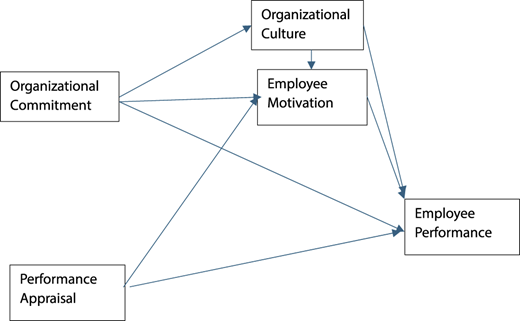
Based on that literature, five hypotheses are created as stated as below.
Organisational commitment positively influences organisational culture and employee motivation.
Performance appraisal positively influences employee motivation and employee performance.
Organisational culture positively influences employee motivation and employee performance.
Employee motivation positively influences employee performance.
Organisational commitment positively influences employee performance.
All those relationships are illustrated in Figure 1.
Research design and methodology
This study adopts a cross-sectional, explanatory research design with a quantitative and qualitative approach to examine the relationships among the five organisational variables. An explanatory sequential mixed-methods design was adopted, gathering quantitative and qualitative data concurrently with equal emphasis (Creswell and Plano Clark, 2018). This facilitated triangulation, bolstering validity via separate analyses and merged interpretations (Fetters and Tajima, 2022).
A cross-sectional design was selected as it allows for data collection at a single point in time, enabling efficient examination of relationships between multiple variables simultaneously (Spector, 2019). The explanatory approach helps establish causal relationships between the predictor and outcome variables in the proposed model (Grace and Irvine, 2020).
Research setting and sampling
The target population comprised full-time employees within Bali's event sector, specifically wedding planners, MICE organisers and hotel event departments. Purposive, criterion-based sampling was used to select organisations from industry directories. Organisational leaders (CEOs/HR heads) distributed the online survey to employees meeting predefined eligibility criteria: active involvement in event operations, full-time status, a minimum of six months of tenure and a minimum age of 18, consistent with Indonesia's legal minimum working age under Law No. 13/2003 on Manpower (Undang-Undang Nomor 13 Tahun, 2003 tentang Ketenagakerjaan, 2003).
Respondents were drawn from 42 distinct organisations (including 9 event and wedding planning/organising firms and 33 hotel/venue that have event departments), with an average of approximately 3–4 respondents per organisation, ensuring that no single employer disproportionately influenced the sample.
For the quantitative phase, 170 questionnaires were formally circulated, yielding 146 valid responses after screening. Overall, 73% is the useable response rate (24 incomplete surveys were excluded; 30 pilot responses were handled separately). This final sample size (N = 146) satisfies the requirements determined by the inverse square root and gamma-exponential methods for partial least squares structural equation modelling (PLS-SEM) to achieve a statistical power of 0.80 under moderate effect sizes (Kock and Hadaya, 2018).
The distribution of 170 questionnaires, rather than the minimum sample size alone, anticipated an approximate 14% attrition rate from incomplete or inconsistent responses typical of self-administered organisational surveys, ensuring the final useable sample would comfortably exceed the minimum N required by the inverse square root and gamma-exponential methods (Kock and Hadaya, 2018).
For the qualitative component, 18 respondents were purposively selected from the survey pool to ensure variation across the MICE value chain (planners, venue operators, caterers and production firms). Sampling and concurrent analysis proceeded iteratively until thematic saturation was achieved, defined as the point where no new codes emerged, aligning with empirical benchmarks for homogeneous samples (Hennink et al., 2017).
Research instrument and data collection
Fieldwork spanned June to December 2025 using mixed data collection modes (digital surveys and 45–60 min Zoom or in-person interviews). The self-administered questionnaire included demographic items followed by five adapted, multi-item 5-point Likert scales (ranging from 1 = strongly disagree to 5 = strongly agree): perceived organisational support, leader–member exchange, work motivation, organisational commitment and job performance. Minor wording adjustments ensured cultural and sectoral relevance to Bali's hospitality ecosystem. The description of each question in the questionnaire can be found in Appendix 1 (variables' description as the questionnaire questions).
To minimise common method bias, procedural remedies including scale order randomisation and guaranteed respondent anonymity were applied (Shahriari et al., 2022). A pilot test (n = 30, excluded from the final analysis) confirmed scale clarity and internal consistency, with all constructs exceeding the minimum reliability threshold (Cronbach's alpha >0.70).
A semi-structured interview protocol was developed based on the quantitative findings to explore participants' experiences and perceptions in greater depth. The protocol included open-ended questions organised around the five main constructs (organisational commitment, organisational culture, employee motivation, performance appraisal and employee performance), with additional probing questions to elicit rich responses. The sample of interview questions were shared in Table 1.
Data processing and analysis
In this study, 200 questionnaires were distributed, with 30 used in a pilot test and 170 formally circulated through referrals, Microsoft Forms and on-site distribution at event venues. After screening for completeness and validity, 146 responses were retained, representing an overall useable response rate of approximately 73%. The remaining 24 questionnaires (14%) were excluded due to incomplete or inconsistent responses, while 30 pilot responses (15%) were considered separately for instrument refinement rather than final analysis. This approach yielded a dataset robust enough for the planned statistical analyses while maintaining quality and relevance.
After data refinement, data analysis was conducted in several phases using SMART-PLS 4.1.1. for SEM.
An inductive thematic analysis was also conducted using NVivo 14, guided by Braun and Clarke's (2019) six-phase framework. Researchers began by familiarising themselves with the interview transcripts through repeated readings to identify preliminary patterns. Initial codes were then generated via systematic, line-by-line open coding, with two researchers independently coding subsets of transcripts and resolving discrepancies through discussion to ensure accurate interpretation (Nowell et al., 2017).
Finally, themes were defined, named and contextualised with compelling exemplar extracts to illustrate their scope and evidentiary grounding. Intercoder reliability was maintained by cross-checking coded data and resolving differences through consensus, adhering to established qualitative research standards (Braun and Clarke, 2019; Nowell et al., 2017).
Quantitative preliminary analysis
Initial data screening included checking for missing values, outliers and normality of distribution (Mat and Djajadikerta, 2021). Exploratory factor analysis was conducted to examine the underlying factor structure of the measurement scales (Laupichler et al., 2023).
Partial least squares structural equation modeling (PLS-SEM)
The research model was tested using PLS-SEM with SMART-PLS 4.1.1 software. PLS-SEM was chosen over covariance-based SEM due to its ability to handle complex models with multiple constructs, its robustness with non-normal data and its predictive capabilities (Busu and Busu, 2020; Shahriari et al., 2022). The PLS-SEM analysis followed a two-stage approach as recommended in the literature (Busu and Busu, 2020):
The first was measurement model assessment. According to Cheung et al. (2024), the measurement model was evaluated based on individual item reliability (outer loadings >0.70). Next was internal consistency reliability (Cronbach's alpha and composite reliability >0.70). Convergent validity should have an average variance extracted >0.50. Lastly, discriminant validity has 3 components, which are the Fornell and Larcker (1981) criterion, cross-loadings and heterotrait–monotrait ratio (Dirgiatmo, 2023).
The second was structural model assessment; after confirming the measurement model's adequacy, the structural model was evaluated through five items. Path coefficients (β) and their significance levels have bootstrapped with 5,000 resamples. Coefficient of determination (R2) is for endogenous constructs. According to Hair et al. (2017), R2 values of 0.75, 0.50 and 0.25 can be considered substantial, moderate and weak in many social science disciplines. Effect size (f2) for each path relationship indicates the strength of the relationship between an independent variable and a dependent variable in a structural model (Hair et al., 2017). Interpreting f2 values can be classified into 3 effects. According to Hair et al. (2017), a small effect is f2 ≥ 0.02; a medium effect is f2 ≥ 0.15; and a large effect is f2 ≥ 0.35. Furthermore, predictive relevance (Q2) was assessed using the blindfolding procedure. A Q2 value larger than 0 for a certain endogenous latent variable indicates the PLS path model has predictive relevance for this construct (Hair et al., 2017). Lastly, model fit indices have 2 items, which are standardised root mean square residual (SRMR) and normed fit index (NFI). A good fit is generally indicated by SRMR values below 0.08. The NFI compares the fit of a specific model to a null model, with values above 0.95 often considered a good fit (Ximénez et al., 2022).
Reliability and validity procedures were implemented to ensure research quality (Agegnehu et al., 2022; Trépanier et al., 2022). Internal consistency was assessed using Cronbach's alpha and composite reliability, and a pilot test with 30 participants over a two-week interval supported test–retest stability, with all instruments exceeding 0.70 in prior studies. Content validity was ensured through expert review, construct validity via confirmatory factor analysis and convergent and discriminant validity following established PLS-SEM guidelines, while common method bias was checked using Harman's single-factor test and mitigated through procedural remedies.
Integration of quantitative and qualitative findings
Following an explanatory sequential mixed-methods design, quantitative and qualitative data strands were integrated at the interpretation phase using a side-by-side comparison strategy (Fetters and Tajima, 2022). The initial quantitative analysis mapped the statistical relationships between organisational culture, motivation, commitment, appraisal practices and performance. Inductive qualitative themes were then integrated to clarify the underlying contextual mechanisms, expanding the numerical trends with the lived professional experiences of participants within the event industry (Zhou et al., 2024).
Ethical considerations
Ethical procedures in this study were grounded in the principles of respect for persons, beneficence and justice articulated in the Belmont Report and further reinforced by the Declaration of Helsinki's requirements to safeguard participants' dignity, autonomy, privacy and confidentiality (National Commission for the Protection of Human Subjects of Biomedical and Behavioural Research, 1979; World Medical Association, 2024). These principles were operationalised through method-sensitive protocols: in the quantitative strand, anonymity was protected via non-identifiable survey codes, encrypted data storage, tiered access controls and aggregated reporting that limited the collection of unnecessary sensitive information; in the qualitative strand, a relational ethics stance framed informed consent as an ongoing, dialogical process, with particular attention to contextual vulnerabilities, careful masking of potentially identifying contextual details and the use of pseudonyms in all records (Braun and Clarke, 2019; Nowell et al., 2017). Mixed-methods integration introduced additional ethical scrutiny, whereby datasets were anonymised and cross-checked before linkage to prevent re-identification, and dissemination plans incorporated explicit checks on how participants' accounts, especially those from marginalised groups, were represented, thereby promoting analytical transparency, protecting confidentiality across data strands and mitigating risks of interpretive misappropriation (World Medical Association, 2024). Lastly, age eligibility was verified during the screening stage of data collection, and all retained respondents in both the quantitative and qualitative strands were confirmed to be 18 years of age or older, in compliance with Indonesian labour law and the journal's ethical requirements (Undang-Undang Nomor 13 Tahun, 2003 tentang Ketenagakerjaan, 2003; World Medical Association, 2024). The details of the respondents' profile can be found in Appendix 2 (Respondent age verification).
Research findings and discussion
Participants' demographics
The quantitative sample is predominantly Gen Z (75%), with smaller proportions of Millennials (15%), Gen X and Baby Boomers. Women represent 63% of respondents, and most participants report at least senior high school education, with nearly half holding undergraduate degrees. Tenure is mixed, with around one-third having less than one year's experience and a similar share more than five years, reflecting a blend of early-career and more established workers across event planners, wedding organisers, venue-based staff and related roles (Table 2).
Professionally, the group displays a “U-shaped” experience curve, split almost evenly between newcomers with less than a year of tenure (34%) and seasoned veterans with over five years of experience (33%). The primary scope of work is event and wedding planning, which collectively accounts for 48% of the roles. Economically, the largest segment (42%) falls into a middle-to-upper-middle expenditure bracket, reporting monthly individual expenses between Rp 2.04 million and Rp 9.91 million, suggesting a relatively stable socioeconomic standing for most of this cohort.
Outer model test (validity and reliability research test)
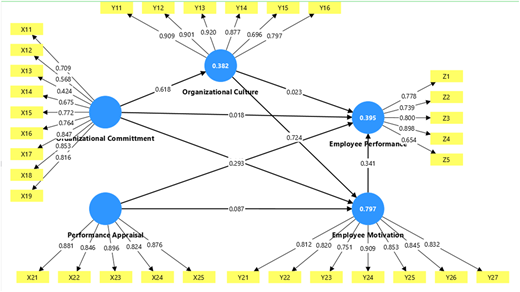
Validity and reliability test are tested to determine the outer model. The result of the calculation is illustrated in Figure 2.
The assessment of an alternative set of constructs, including employee motivation and organisational commitment, likewise demonstrates high reliability and validity. Employee motivation (alpha = 0.926, rhoc = 0.941) and performance appraisal (alpha = 0.916, rhoc = 0.937) exhibit particularly strong internal consistency. While Cronbach's alpha values above 0.90 can indicate item redundancy rather than purely stronger reliability (Streiner et al., 2024), inspection of inter-item correlations and item content confirmed that each item within the employee motivation and performance appraisal scales captured a conceptually distinct facet of the construct, supporting retention of all items rather than removal for parsimony.
All variables comfortably exceed the required 0.70 reliability benchmarks. Convergent validity is confirmed for this secondary set of variables as well, with all average variance extracted (AVE) values above 0.50. Performance appraisal and organisational culture show high indicator reliability (AVE of 0.748 and 0.728, respectively), while organisational commitment shows the lowest, yet still acceptable, level of convergent validity with an AVE of 0.528. Although organisational commitment's AVE (0.528) is comparatively lower than the other four constructs, it exceeds the minimum 0.50 threshold recommended by Fornell and Larcker (1981), and inspection of individual item loadings confirmed no item fell below 0.60, supporting retention of the full item set on convergent-validity grounds. Table 3 illustrates the results of the outer model in depth.
Discriminant validity
Discriminant validity is illustrated to elaborate 5 variables. The details are stated in Table 4.
Structural model analysis (inner model)
R-square (R2)
In this subset of the model, employee motivation shows very high predictive relevance with an R2 of 0.797 (Adjusted R2 = 0.793), suggesting that the model captures nearly 80% of the factors driving motivation. This indicates that the antecedent variables in this specific structural pathway are highly effective at explaining motivational outcomes. Employee performance and organisational culture exhibit moderate predictive power, with R2 values of 0.395 and 0.382, respectively. These results suggest that while motivation is well-accounted for, performance and culture are likely influenced by a broader array of external variables, requiring further investigation to achieve higher explanatory power. The summary of R2 and Adjusted R2 are illustrated in Table 5.
Hypothesis testing (t-statistic and p-value)
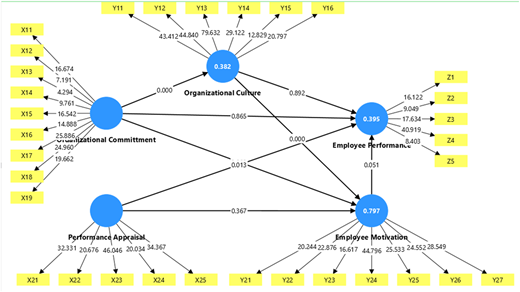
T-statistic and p-value are the most crucial items in SMART-PLS to test the hypothesis. The illustration of the result after bootstrapping can be shown in Figure 3.
The results highlight a complex interplay between organisational elements and individual outcomes within Bali's MICE industry. The dominant role of organisational culture in driving employee motivation suggests that for the youthful demographic of this sector, the intangible values, norms and working atmosphere are the primary catalysts for internal drive. In a creative and high-pressure industry like MICE, a supportive culture appears to be the engine that fuels enthusiasm. However, the fact that culture does not directly translate into employee performance implies that while a positive environment makes employees motivated, it does not inherently guarantee higher productivity without other supporting mechanisms. A critical finding is the significant link between performance appraisal and employee performance. This suggests that tangible feedback and formal evaluation processes are more effective at driving actual work output than culture or commitment alone. In the context of Bali's MICE industry, where success is measured by meticulous execution and client satisfaction, employees seem to respond better to clear performance standards and appraisals. Furthermore, the strong path from organisational commitment to organisational culture (beta = 0.618, p < 0.001) indicates that committed employees are the primary architects of a healthy company culture, even if their commitment does not directly boost their individual performance metrics. Finally, the marginal significance of the path from employee motivation to performance (p = 0.051) suggests that motivation is a necessary but perhaps insufficient condition for peak performance in this sector. This might be due to the highly technical and logistical nature of MICE work, where skill sets and clear directives (as reflected in appraisals) may outweigh purely motivational factors.
Qualitative findings: thematic overview
For the qualitative phase, all informant profiles were summarised in Table 6.
The qualitative data revealed four distinct relational themes that illuminate how organisational factors interplay to shape employee outcomes in the event industry. The first theme centres on organisational commitment as a foundational driver, influencing workplace culture, employee motivation and overall performance. The second theme highlights performance appraisal as a motivational mechanism, showing how evaluation practices directly affect staff engagement and work quality. The third theme examines organisational culture as a contextual force that shapes both motivation and performance outcomes. Finally, the fourth theme demonstrates the direct pathway from employee motivation to performance, particularly evident in the high-pressure, client-facing nature of event work.
Organisational commitment as a foundation (H1, H5)
Participants consistently described how their commitment to the organisation created ripple effects across workplace dynamics and personal work attitudes. P1 explained how institutional investment in staff well-being fostered both cultural cohesion and individual effort:
In peak season, our workload can be crazy, back-to-back conferences and incentive groups, but most of us stay because we feel this hotel really invests in us. The GM is visible, checks on the team during big events and remembers our families. That makes us proud to wear the uniform, and it shapes how we treat each other.
This sense of reciprocal commitment translated into tangible behavioural outcomes. The same manager noted that “when people feel the company stands behind them, the atmosphere on the floor is more positive and we are willing to go the extra mile for guests and for our colleagues.”
P2 articulated how personal commitment influenced team leadership and operational resilience: “My loyalty to the company makes me more patient with last-minute client changes. I don't see it as a burden, but as part of protecting our reputation.” This supervisor explicitly connected personal commitment to motivational influence, stating, “Because I'm committed, I try to motivate my team, if I show I'm fully in, they follow and our event execution runs smoother.”
Performance appraisal as motivational catalyst (H2)
The quality and transparency of performance appraisal systems emerged as critical in shaping employee motivation and subsequent performance. P3 from an event company described a significant shift in staff engagement following appraisal reform:
We used to do appraisals just once a year, and staff saw it as a formality. Since we tied evaluations to clear KPIs, like client feedback scores, on-time setup and teamwork, and linked them to training opportunities and bonuses, staff started to care more.
The outcome was notable: “When employees feel the appraisal is fair and transparent, they become more motivated, prepare better for events and even ask for feedback right after a conference closes.” This proactive feedback-seeking behaviour illustrated how appraisal systems could trigger sustained motivational changes.
P9 reinforced this connection whilst highlighting the inverse relationship: “If my supervisor explains why I got a certain rating and shows a plan to help me grow, I feel more energised. But if the appraisal feels arbitrary, my motivation drops and I just do what's required, nothing more.” The contrast between developmental versus perfunctory appraisals directly determined effort levels and discretionary performance.
Organisational culture as contextual shaper (H3)
Organisational culture functioned as an ambient force that structured how employees experienced motivation and delivered performance. P5 described how cultural values permeated daily operations and crisis moments:
Here we have a strong 'service from the heart' culture. Even when an event goes overtime, the team rarely complains openly because we have this shared belief that guest satisfaction comes first. New staff quickly learn that we support each other, if banquet is short-staffed, sales will help with simple tasks.
This cultural fabric sustained motivation through collective identity: “That kind of culture keeps people motivated, because they don't feel alone during stressful events, and it directly shows in how smoothly the programme runs.”
Cultural dysfunction produced opposite effects. P2 contrasted previous toxic environments with current supportive ones: “In some venues I've worked with, the culture is very hierarchical and blame oriented. People are afraid to speak up when something goes wrong, so performance suffers. In my current company, mistakes are discussed openly after an event, so the team stays engaged and learns together.” Psychological safety within the culture enabled both sustained motivation and performance improvement through collective learning.
Employee motivation driving performance (H4)
The direct link between motivation and performance manifested most clearly in discretionary effort and service quality outcomes. P4 articulated how perceived influence shaped work intensity:
Honestly, when I see my ideas for improving guest flow implemented, I feel more enthusiastic. I arrive earlier, double-check setups and coordinate better with banquet and AV. When I feel ignored, I just follow the rundown and don't take extra initiative.
This distinction between energised engagement and minimal compliance directly affected event execution quality. P10 observed motivation's visible impact on client-facing outcomes: “Our most motivated staff members are the ones who consistently get the best client feedback. They anticipate needs, communicate calmly during crises and still smile even at midnight.” The manager concluded, “You can see a clear difference in event quality when the team is energised versus when they feel burnt out,” highlighting motivation as a performance determinant observable to both management and clients. All the transcribed interviews naturally create themes as stated in Table 7.
Discussion
This discussion section addresses the study's research objectives by examining how organisational commitment, organisational culture, performance appraisal and employee motivation jointly shape employee performance in Bali's event industry. The discussion is organised around the five hypotheses, beginning with the role of organisational commitment and its links to culture and motivation (H1), then moving to the influence of performance appraisal on motivation and performance (H2). It then considers the contribution of organisational culture to motivation and performance (H3), before turning to employee motivation as a direct driver of performance (H4) and the residual direct effect of organisational commitment on performance (H5). Across these sub-sections, the discussion develops a coherent line of argument that integrates these relationships to highlight how HR practices and cultural conditions interact to sustain performance in project-intensive service settings.
Commitment as a foundation for culture and motivation
The positive link between organisational commitment and organisational culture in the model indicates that committed employees actively reinforce shared values and norms in daily behaviour. Recent studies show that employees with strong commitment tend to support cultural initiatives, engage in collaborative practices and become key carriers of organisational values.
A significant positive path from organisational commitment to employee motivation implies that employees who feel emotionally attached to the organisation are more energised and willing to invest effort. Recent empirical work shows that commitment enhances both intrinsic and extrinsic motivation by strengthening trust and psychological attachment between employees and their organisation (Nuel-Okoli et al., 2023). Such findings indicate that committed employees perceive their work as meaningful, are more resilient when facing obstacles and are more inclined to go beyond formal role requirements (Malik and Garg, 2020).
This pathway (H1) implies that MICE organisations seeking to build a cohesive culture and a motivated workforce should treat investment in employee commitment, through job security signals, recognition and consistent leadership engagement, as an upstream lever, since commitment shapes both culture and motivation rather than operating as a downstream outcome of them.
Performance appraisal as a lever for motivation and performance
The model's indication that performance appraisal positively influences employee motivation aligns with contemporary findings that transparent and developmental appraisal systems enhance motivational states. Recent studies report that well-designed appraisal processes, featuring clear criteria, constructive feedback and participation, are associated with higher motivation and work enthusiasm (Akanmu et al., 2025; Musa et al., 2025).
Evidence from previous studies shows that when employees perceive appraisals as fair and linked to development opportunities, their motivation increases significantly, as reflected in regression results showing meaningful effect sizes of appraisal on motivation (Musa et al., 2025). This suggests that improving appraisal quality can be an effective lever for enhancing motivational climates.
The positive association between performance appraisal and employee performance in the model is supported by recent empirical work that emphasises the strategic role of appraisal in driving behavioural change. Studies in Asia and the Middle East demonstrate that structured appraisal systems improve performance by clarifying expectations, guiding development and aligning individual goals with organisational objectives (Akanmu et al., 2025).
Results from these studies indicate that employees who receive regular, feedback-rich appraisals display higher productivity, better task completion and improved overall job performance.
This pathway (H2) implies that MICE managers seeking to improve both motivation and measurable output should prioritise redesigning appraisal systems around transparent criteria, regular feedback cycles and visible links to development opportunities, since appraisal quality functions as a direct lever on performance rather than merely an administrative formality.
Culture as a driver of motivation and performance
The model's finding that organisational culture significantly affects employee performance is in line with recent evidence that culture remains a central determinant of how employees perform their roles. Quantitative studies report that supportive and achievement-oriented cultures significantly increase performance outcomes such as service quality, innovation and goal attainment (Rahman and Bhuiyan, 2024).
Cultures emphasising collaboration, responsibility and openness reduce uncertainty and provide behavioural guidance, which allows employees to focus their energy on task accomplishment (Kadyan and Sharma, 2025). Recent analyses in government and private organisations indicate that culture explains a substantial proportion of performance variance, underscoring its strategic importance.
A positive and significant path from organisational culture to employee motivation suggests that cultural attributes shape how motivated employees feel in their work. Recent studies show that cultures characterised by openness, mutual respect and shared purpose foster higher levels of work motivation because they satisfy employees' needs for autonomy, competence and relatedness (Rahman and Bhuiyan, 2024).
Evidence from previous studies further demonstrates that a positive culture, marked by collaboration and responsibility, enhances both intrinsic and extrinsic motivation, which in turn improves focus and persistence in task performance (Turner, 2017). Thus, cultural interventions such as improving communication, involving staff in decision-making and recognising contributions can be expected to elevate motivation.
This pathway (H3) implies that MICE managers seeking to strengthen employee motivation should prioritise investment in cultural cohesion initiatives, such as mentoring programmes and recognition rituals, over generic culture-branding campaigns, since culture's effect on performance operates indirectly through motivation rather than directly.
Motivation as a direct pathway to performance
The strong link between employee motivation and employee performance in the SMART-PLS model reflects one of the most consistent findings in recent organisational research. Recent structural-equation and regression studies confirm that motivated employees deliver higher task performance, better quality of work and more proactive behaviour than their less-motivated counterparts.
Contemporary evidence shows that both intrinsic and extrinsic motivation contribute to performance, but intrinsic motivation tends to be particularly important for creativity and sustained effort.
This pathway (H4), while only marginally significant in the present model (p = 0.051), implies that MICE managers should not treat motivation-building activities as sufficient on their own; rather, motivational initiatives such as autonomy-supportive supervision and recognition of discretionary effort should be paired with clear technical direction and appraisal-based feedback to reliably translate motivation into measurable performance gains.
Commitment and performance in project-intensive service work
The positive effect of organisational commitment on employee performance in the SMART-PLS model is consistent with recent research indicating that commitment is a strong predictor of job performance indicators. Recent evidence from business and public organisations suggests that commitment directly improves performance while also working indirectly through mediators such as job satisfaction and work engagement (Nuel-Okoli et al., 2023).
This pathway (H5) implies that MICE managers should view commitment-building efforts, such as long-term career pathways and consistent organisational support during peak-season workloads, as a direct contributor to performance outcomes, and not solely as a mechanism operating through culture or motivation, given commitment's residual direct effect on performance in the structural model.
Structural constraints beyond organisational exchange
While the structural model demonstrates that organisational commitment, culture, motivation and appraisal jointly shape performance, these relational mechanisms operate within a labour market in tourism and events that remain characterised by precarious contracts, seasonal employment and limited wage security (Robinson et al., 2019; Giousmpasoglou, 2024). The positive pathways identified in this study should therefore not be read as evidence that a supportive culture or strong commitment can substitute for fair compensation and stable employment; rather, they indicate the relational conditions under which employees remain engaged despite structural precarity. Future research and policy attention should treat decent wages and job security as necessary complements to, rather than replacements for the organisational-exchange mechanisms examined here.
Conclusion
This research concludes that organisational culture and performance appraisal are the two primary pillars of organisational success in Bali's MICE industry, albeit serving different functions. While organisational culture is the critical driver for employee motivation, performance appraisal is the more effective tool for enhancing employee performance. The study reveals that organisational commitment plays a foundational role in building culture but lacks a direct impact on productivity.
For MICE organisations in Bali, these findings suggest a dual strategy: managers should cultivate a supportive and learning-oriented culture to enhance motivation, and this cultural investment should be paired with equitable compensation and secure contractual terms, without which improvements in culture or motivation are unlikely to translate into sustained employee well-being (Robinson et al., 2019). Among their predominantly Gen Z workforce, managers should simultaneously implement rigorous and transparent performance appraisal systems to ensure operational excellence. Future research should investigate the potential mediating role of motivation between culture and performance to further refine these organisational strategies.
Theoretical contributions
This research advances organisational theory by clarifying the distinct pathways between soft organisational elements and tangible work outcomes. It contributes to the existing literature by demonstrating that organisational culture serves as a primary driver of employee motivation (R2 = 0.797), rather than directly influencing performance. This challenges traditional direct-effect models and suggests that in the high-pressure MICE sector, culture operates as an emotional catalyst. Furthermore, the study establishes that organisational commitment is foundational to the development of a robust organisational culture (beta = 0.618), providing a more nuanced understanding of how employee attitudes shape the broader work environment before impacting individual drive.
Unlike prior Bali-based hospitality studies that treat organisational culture and appraisal as parallel, direct predictors of performance (e.g. Ginting et al., 2024), the present model demonstrates that culture's effect on performance is fully channelled through motivation, while performance appraisal retains a significant direct effect. This is a distinction that clarifies which HR levers most directly influence output in project-intensive MICE work.
Practical contributions
For practitioners in Bali's MICE industry, this study offers a strategic framework for talent management, particularly for a workforce dominated by Gen Z (75%). To maximise individual output, managers must move beyond general “culture-building” and prioritise formal performance appraisal systems, which were proven to be the most direct driver of employee performance. Conversely, to enhance workforce morale and internal drive, leaders should cultivate a supportive organisational culture, as this is the most significant predictor of employee motivation. By separating “motivation strategies” from “performance strategies,” MICE firms can achieve a more efficient allocation of organisational resources.
Limitations and future research suggestions
A primary limitation of this study is the marginally insignificant relationship between employee motivation and employee performance (p = 0.051), which suggests that motivation alone may not be sufficient to overcome technical or logistical barriers to productivity in the MICE sector. Additionally, the findings are specific to the unique socioeconomic context of Bali, where 48% of the workforce is concentrated in event and wedding planning, which may limit the generalisability of the results to other global MICE hubs. Finally, the cross-sectional nature of the SMART-PLS data provides a “snapshot” of the industry, potentially overlooking long-term shifts in organisational commitment or culture.
This study's SET framing prioritises relational and motivational mechanisms within the employment relationship and does not directly measure wage adequacy, contract type or job security. Given that precarious employment conditions are well documented in tourism and event settings (Robinson et al., 2019; Giousmpasoglou, 2024), findings on organisational commitment and culture should not be interpreted as sufficient conditions for employee well-being in the absence of fair wages and stable contracts. Future studies should incorporate direct measures of compensation adequacy and contractual security alongside relational constructs.
Furthermore, next studies should incorporate employee motivation as a mediating variable between organisational culture and employee performance to further explore why the direct path was insignificant. It is also recommended that researchers conduct a comparative analysis between the MICE industry and more traditional hospitality sectors in Bali to determine if these patterns are industry specific. Given the marginal significance of the motivation–performance link, future research should also investigate moderating factors such as technical competency or resource availability, which may act as necessary precursors for motivation to be successfully translated into work performance.
The supplementary material for this article can be found online.