Skip to article sections
Purpose

Humanitarian supply chain management (HSCM), operating in a complex environment, needs to be agile and robust. The advent of digital technologies has revolutionized HSCM operations, and thus, this study identifies and evaluates key drivers of artificial intelligence (AI) incorporation in HSCM.

Design/methodology/approach

In total, 20 key drivers were identified through a review of the relevant extant literature and finalized with experts’ inputs using a Likert scale survey. With a Kappa analysis, these drivers were classified into four groups: technical (T), organization (O), human (H) and institution (I). An integrated multi-criteria decision-making (MCDM) method of the Fermatean fuzzy set (FFS) analytic hierarchy process (AHP) and Decision-Making Trial and Evaluation Laboratory (DEMATEL) was used to rank the key drivers and explore their causal interrelationships.

Findings

Improved performance output, organizational preparedness, user acceptance and continued support, guarantee of job security for technologically semi-skilled workers and government support are the five key drivers of AI incorporation in HSCM.

Originality/value

This study evaluates the key drivers of AI integration in HSCM with FFS-AHP-DEMATEL.

The primary role of humanitarian supply chain management (HSCM) is to ensure the provision of the correct relief materials at the correct time. Generally, the functioning of both commercial supply chain management (CSCM) and HSCM may appear to be identical; however, the critical difference lies in the working circumstances (Dubey et al., 2022). HSCM is typically carried out in uncertain and challenging conditions with limited resources. As multiple stakeholders are involved in HSCM, its efficiency depends heavily on the degree of consensus among the stakeholders (Patil et al., 2023). Because of the complexity involved in HSCM, the stakeholders want a resilient and robust information management system during relief operations. Hence, the HSCM organizations are in a position to redesign the humanitarian supply chain network that provides agility, robustness, speed, flexibility, and resilience (Sathiya et al., 2023). Also, the demand for transparency and visibility in HSCM has increased in recent years (Beduschi, 2022). Digital technologies have been used in HSCM in the past; however, in recent times, advancements in computational power combined with vast amounts of data have eased the digitalization of HSCM (Marić et al., 2022). Moreover, the recent COVID-19 pandemic, which restricts human movements, emphasized the significance of HSCM digitalization. As physical movement is restricted during the COVID-19 pandemic, telehealth and remote monitoring techniques were used for treating patients (Zhang et al., 2024).

Digital technologies such as Artificial intelligence (AI), blockchain, and big data analytics (BDA), are expected to bring revolution to HSCM (Sharma et al., 2022). AI provides computers with the capability to recognize patterns from a large amount of data based on experience and knowledge. Incorporating AI in HSCM has enhanced optimization and forecasting capabilities while providing competitiveness and effective risk management capabilities (Ramaswamy et al., 2022). Through the application of blockchain and AI technologies, Gao et al. (2023) found that the coordination and efficiency of COVID-19 vaccine supply chains improved. Similarly, supply chain integration and the environmental performance of hospitals have been enhanced with the incorporation of BDA and AI technologies (Benzidia et al., 2021). Shrivastav and Bag (2023) identified that the incorporation of AI improved global partnerships in HSCM, and enabled preparedness, improved resilience, and humanitarian logistics movement. Despite expressing concern about data privacy and security, the incorporation of AI in healthcare systems has been well-received by society (Ho et al., 2023; Wu et al., 2023). However, in a study by Altay et al. (2023), it has been claimed that the incorporation of digital technologies in HSCM is taking place at a slow pace and that many organizations are reluctant to adopt digital technologies. Likewise, even countries like Poland, South Korea, and the USA, which have renowned electronic health record systems, are encountering difficulties in the digitalization of HSCM (Arji et al., 2023; Naveen Kumar et al., 2024).

Several barriers may hamper the incorporation of digital technologies in HSCM; these barriers may be related to organization, technology, humans, strategy, and financial factors (Kabra et al., 2023). The lack of internal capacity of healthcare organizations and the absence of laws that enforce the incorporation of AI also slow the digitalization of HSCM (Choukolaei et al., 2023). Drivers such as organizations' involvement and culture will help in establishing a conducive environment for HSCM digitalization. While there are some difficulties in digitalizing HSCM, it has a good impact on the HSCM by enhancing information visibility and collaboration among stakeholders (Dubey, 2023). Accordingly, digital technologies like AI, blockchain, BDA, and simulation techniques are being employed in HSCM to improve resilience (Arji et al., 2023).

From the above information, it was understood that the digitalization of HSCM improves the robustness and agility; while there are many barriers to HSCM digitalization (Singh et al., 2023). Without overlooking the barriers, HSCM organizations must show interest in digitalizing SC activities. The major concern debated around the incorporation of digital technologies in HSCM is data privacy and security. Yet, with technological advancements, digital technologies have ensured the privacy and security of individual data (Altay et al., 2023). Earlier studies have discussed either the benefits of digitalization in HSCM (Patil et al., 2023; Sathiya et al., 2023) or the difficulties involved in digitizing such supply chains (Kabra et al., 2023; Sahebi et al., 2020). However, no previous study has investigated and established the key drivers for incorporating AI in HSCM. Despite the proven impact on commercial supply chain activities, there are many challenges involved in digitizing HSCM. Furthermore, there is limited evidence in the literature deliberating the drivers for AI incorporation in HSCM. Also, literature focusing on embracing AI in HSCM in developing countries is very scarce. The digital divide existing between developed and developing countries restrains the complete AI incorporation in HSCM. As a result, there is a disparity in receiving emergency help between developed and developing countries. In particular, the Indian healthcare industry which accounts for nearly $372 bn with a compound annual growth rate of 39% is still in an embryonic stage in AI incorporation in HSCM (Ramaswamy et al., 2022). Thus, there is a great scope for AI to leverage the Indian healthcare sector. To fill this research gap, this study proposes a theoretical framework for examining the key drivers of AI incorporation in Indian HSCM. The objectives of this study are to identify the key drivers in the application of AI in HSCM, the significance of each key driver, and the causal interrelationship among these. To guide these objectives, the following research questions are formulated:

RQ1.

What are the key drivers of AI incorporation in HSCM?

RQ2.

What is the weight significance and causal interrelationship of key drivers of AI incorporation in HSCM?

This study contributes to the existing literature by identifying the key drivers of AI incorporation in HSCM. Also, the key drivers were categorized under the Technology, Organization, Human, and Institution (TOIH) framework and validated with the Kappa analysis. Further, it evaluates the weight significance and reveals the causal interrelationship of the key drivers. The outcome of this study will assist policymakers and supply chain practitioners in leveraging the digitalization of HSCM.

The reminder of the manuscript is structured as follow: Section 2 discusses earlier works on AI incorporation in HSCM and highlights research gaps. Research methodology used is explained in Section 3. The application of research methodology is illustrated in Section 4. Outcomes of the study are discussed in Section 5. Implications of the study are provided in Section 6. The study is concluded in Section 7 by highlighting the main contributions, limitations and future scope of the study.

The digital revolution has brought many changes in business activities and has also changed the business paradigm. It has become mandatory for industrial communities to embrace digital technologies owing to the benefits offered. Patil et al. (2023) argue that digitalization processes can leverage the supply chain operational efficiency by improving information sharing and minimizing the bullwhip effect. A bullwhip effect is a condition in which a small fluctuation in demand can cause ripple effect in whole supply chain network. A study by Sharma et al. (2022) concluded that adopting AI in HSCM can enhance relationships, integration, and coordination among supply chain stakeholders. In a study, Gao et al. (2023) examined the potential of blockchain and AI in the coordination of supply chains during COVID-19 and found that the usage of such technologies enhanced coordination. Through a review, Pournader et al. (2021) found that the incorporation of AI in supply chain activities is slowly gaining momentum, and have also cautioned about the impediments to its adoption. In examining the impact of AI on the Indian healthcare system, Ramaswamy et al. (2022) identified that restrictive healthcare policies and laws are decelerating the digitization process. Meanwhile, Dubey et al. (2021) advocated that HSCM with AI-driven BDA helps in improving supply chain agility. Another study by Dubey et al. (2022) also claimed that AI-driven BDA will significantly enhance the agility, resilience, and performance of HSCM. A similar study by Benzidia et al. (2021) on AI-driven BDA insisted that the digitalization of HSCM improves environmental performance. Considering the development and evolution of information technology, Helo and Hao (2021) predicted that in the future, all supply chain activities such as planning, scheduling, and optimization will be assisted by AI technology. This prediction has been endorsed by Marić et al. (2022) in a review study on the role of emerging technologies in HSCM.

Digital transition needs intense alteration in the whole supply chain management activities (Rohith and Madhusundar, 2023). The digital transformation of various processes and operations in HSCM is influenced by numerous drivers. Ease of documentation and improved agility in the supply chain activities were recognized as the key drivers in the incorporation of AI technology in HSCM by Gnaneshwar Reddy and Arumugam (2024) and Patil et al. (2023). A study by Petersson et al. (2022) regarding AI incorporation in HSCM, from the context of Sweden, identified improved collaboration and better information flow among the various stakeholders as the main drivers. Improved collaboration and information will improve the agility of supply chain activities. Cadden et al. (2022) argues that bringing change in the organizational culture will largely enhance AI incorporation in HSCM. It has also been highlighted that a change in organizational culture may increase the investment in the technological capability of the organization, which in turn eases the AI incorporation in supply chain activities. A similar study by Samad et al. (2022) that prioritized the enablers of AI in supply chain management identified improved connectivity, seamless information flow, and traceability as the major drivers for AI incorporation. In another study, Modgil et al. (2022) pointed out transparency, ensuring last-mile delivery, and improved agility as the major drivers necessitating AI incorporation in HSCM. In a study regarding the influence of digitalization in supply chain management, (Di Vaio et al., 2023) found that with AI it is possible to clearly define and examine the accountability of each stakeholder involved in supply chain activities. The key drivers were categorized under four areas, namely technology, organization, human, and institution, and are given in Table 1.

Like CSCM, the digitalization of HSCM is also of critical importance as it needs to be agile and robust. Studies by De Boeck et al. (2023) and Zhang et al. (2024) stressed the need for digitalizing HSCM while mentioning the potential impact of digital technologies in HSCM. Accordingly, several studies (Arji et al., 2023; Wu et al., 2023) highlighted the potential of digital technologies in improving the agility and robustness of HSCM. Apell and Eriksson (2023) insisted that the incorporation of AI in the healthcare system improves agility while cautioning about the preparedness of the healthcare sector. Earlier studies on the incorporation of AI technology in HSCM and their contributions along with the novelty of this study are provided in Table 2. Though several research works have been carried out on AI in HSCM, it mainly focuses on the advantages and potential impact of AI in HSCM. Few studies have discussed the challenges involved in incorporating AI in HSCM. However, no studies have focused on the key drivers that necessities AI incorporation in HSCM. To fill this gap, this study intends to identify the key drivers which motivate the incorporation of AI in HSCM. Further, to evaluate the key drivers for AI incorporation in HSCM, this study uses an integrated Fermatean fuzzy set (FFS) – analytic hierarchy process (AHP) – Decision-Making Trial and Evaluation Laboratory (DEMATEL) framework. Usage of combined AHP and DEMATEL in FFS context in HSCM is very scarce. In this work, AHP is used to evaluate the weight significance of the key drivers while DEMATEL is used to examine the causal interrelationship among the key drivers. Moreover, FFS is used in this work over fuzzy, grey and Pythagorean sets, as it offers flexible and robust results (Deng and Wang, 2022).

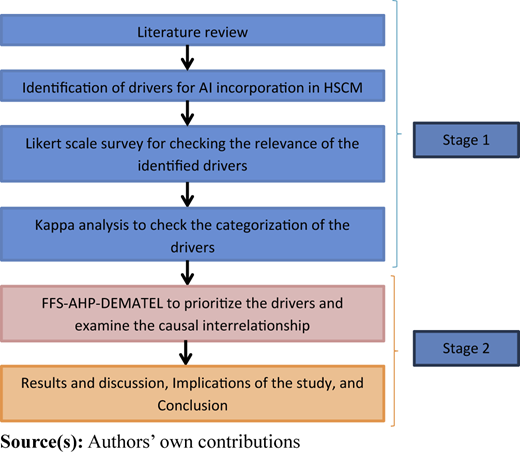
As seen in Figure 1, the study begins with the identification and validation of drivers in stage 1. Initially, literature relevant to AI incorporation in HSCM was collected. From this literature, a list of drivers was identified. Then, the identified drivers were checked for their relevance and validated based on the experts' input. The categorization of the drivers was confirmed by performing a kappa analysis.

Multi-criteria decision-making (MCDM) approaches are generally preferred when a problem in the study is influenced by several factors. Earlier, in the MCDM approach real or crisp numbers are used for evaluating the factors. However, these real or crisp numbers were criticized for not considering the vagueness and uncertainties in the data (Jiang et al., 2022). To address this criticism, (Zadeh, 1965) presented the fuzzy set concept. Since then, a number of fuzzy set extensions such as intuitionistic fuzzy set, Pythagorean fuzzy set, and rough fuzzy set have been developed and used (Alamoodi et al., 2022). The recent extension of the fuzzy set is FFS, proposed by Senapati and Yager (2020). In recent times, FFS has gained popularity among the research community as an effective tool for describing vagueness and uncertainty in complex problems (Deng and Wang, 2022). The main advantage of FFS over other fuzzy extensions is its criterion, i.e.; the cube root of membership and non-membership must be less than 1. It provides greater capability for FFS to identify ambiguous information. Furthermore, FFS offers more flexibility, and efficiency, and is less complex in analyzing the factors under consideration. The basic functions of FFS are as follow:

Suppose a universal set X and the general form of FFS, f in X is given as shown below:

(1)

where αf(x):X[0,1] and βf(x):X[0,1]. Here, αf(x) and βf(x) indicates the degree of membership and non-membership of the element x in the set f.

The degree of indeterminacy (πf) is estimated using Eq. (2).

(2)

With Eq. (3), the Fermatean fuzzy weighted average (FFWA) is calculated.

(3)

where wi is the corresponding weight vector.

FFS score is estimated using Eq. (4).

(4)

where SF:FX

In the second stage, the AHP technique is combined with FFS and is used to calculate the weight significance of the drivers. The AHP technique, introduced by Saaty (1980), is a decision-making method used to solve difficult problems influenced by several criteria. It is commonly used to calculate criteria weights by making a pairwise comparison of alternatives and criteria, calculating the significance values, and selecting the best alternative. The unique feature of AHP is that it allows decision-makers to include both objective and subjective concerns of the criteria under evaluation. Furthermore, in AHP, the problem is deconstructed into several groups and a hierarchical structure is built (Deretarla et al., 2023). For this study, the AHP technique was selected over other weight calculating methods like Stepwise Weight Assessment Ratio Analysis (SWARA) and Best Worst Method (BWM) due to it is effectiveness in avoiding bias and predetermined categorization (Karuppiah and Sankaranarayanan, 2023). To improve the robustness, in this study, FFS and AHP were combined. The steps followed by the AHP technique are explained below:

  • Step 1: Construct a pairwise comparison matrix (A)

(5)

where xij represents the impact of criteria (i) over criteria (j)

  • Step 2: Check the consistency of the matrix

To check the consistency, first, W has to be calculated. For this, initially, the weight of the criteria (W) has to be calculated.

(6)
(7)
(8)
(9)

where λmax- largest Eigen value and n – dimension of the matrix.

(10)
  • Step 3: Estimate the weights of the challenges

(11)

where W refers to the weight of the challenges

DEMATEL technique was used in the second stage and with this technique, the causal relationship among the drivers is examined. DEMATEL, proposed by Gabus and Fontela (1972), is a popular MCDM method for analyzing the interrelationship among different factors. It depicts the interrelationship in a graph where the factors are grouped into cause-and-effect groups. Also, the prominence of each factor is calculated in the DEMATEL technique (Zhang et al., 2023). Following are the steps involved in the DEMATEL technique:

  • Step 1: Construct a direct-relation matrix.

  • Step 2: Direct-relation matrix is normalized into a normalized matrix (K) using Eq. (12) and Eq. (13).

(12)
(13)
  • Step 3: Construct total relation matrix (T)

(14)

where “I” is the identity matrix.

  • Step 4: Group the factors into cause-and-effect groups using Eq. (15) and Eq. (16)

(15)
(16)

where mi – sum of rows, ni – sum of columns, tij− elements of total relation matrix

Using (mi+ni) value, the prominence of the key drivers is estimated. Likewise, using (mini) value, the key drivers are grouped into cause-and-effect groups.

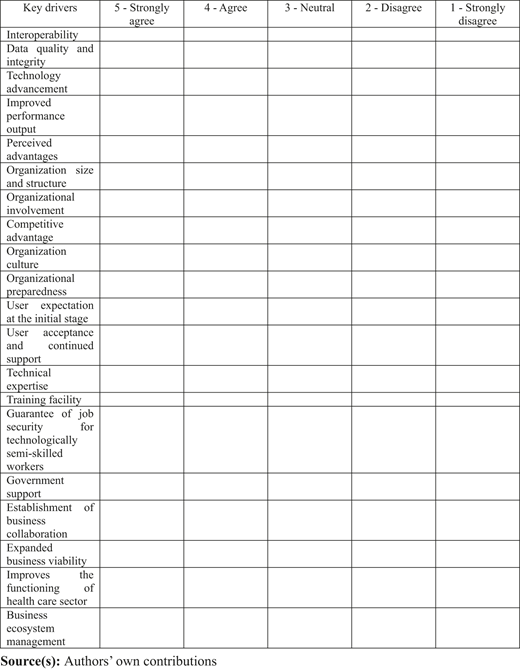
First, the key drivers of AI incorporation in HSCM were identified by following an extensive literature review. The literature review was conducted with the aim of identifying the key drivers that were considered earlier. Then, a team of ten experts with a minimum of ten years of work experience in HSCM was formed. The experts’ information is provided in Table 3. When compared to earlier studies, the number of experts considered in this study was deemed to be acceptable. For instance, (Lin et al., 2023; Shahrabi-Farahani et al., 2024) utilized five and six experts, respectively, for the studies to validate the factors. For the purpose of this study, the experts were approached to determine whether the key drivers collected were still relevant now. To determine their relevance, a questionnaire (Table A1 of  Appendix) consisting of twenty key drivers identified through an extensive literature review along with a five-point Likert scale (1 – strongly disagree and 5 – strongly agree) was developed and given to the experts. An initial discussion was made with the experts to explain the purpose of this study. The reliability of the questionnaire was validated by calculating the Cronbach's alpha value, which was found to be 0.75 and hence acceptable (Taber, 2018). The identified key drivers were considered for further evaluation, only when they were agreed by at least five experts. All the twenty key drivers satisfied the threshold condition and hence were considered for further study. Based on their experience, the experts grouped the listed key drivers under four categories (Technology, Organization, Human, and Institution) based on the TOIH framework. The key drivers were grouped under each category based on their relevance. For instance, the key drivers coming under the technology category aimed at enhancing operational and productivity efficiency. Similarly, other key drivers were grouped under the TOIH framework. As earlier studies (Kumar et al., 2023; Patil et al., 2023) mentioned that the TOIH would help in better understanding the key area which needs focus for embracing new technologies, the TOIH framework was used in this work. Then, a Kappa analysis was conducted to validate the categorization of the experts, using a five-point Likert scale survey. Generally, a Kappa analysis is used to ensure consensus among the experts (Patil et al., 2023). For the present study, this analysis was used to measure the consensus on the grouping of the identified key drivers. The Kappa value calculated was 0.645, which indicates sufficient consensus among the experts (Patil et al., 2023). The key drivers for AI incorporation in HSCM are included in Table 1.

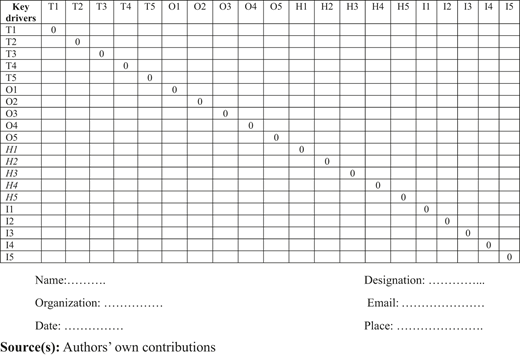
The proposed integrated MCDM technique of FFS-AHP-DEMATEL was utilized to estimate the weights and explore the causal relationship of the key drivers for AI incorporation in HSCM. For this, experts' ratings on each of the drivers were collected through a pairwise comparison questionnaire (Table A2 of  Appendix). The questionnaire (Table A2 of  Appendix) was prepared with the finalized key drivers. As a first step in FFS-AHP, the experts were requested to carry out pairwise comparisons between the drivers using the scale provided in Table 4. Then, the influence value given by the experts was converted into FFS numbers. With Eqs. (1) – (4), the FFS numbers were changed into crisp numbers. Moreover, the consistency of the pairwise comparison matrix was evaluated using Eqs. (6) – (10), and the consistency obtained ratio of 0.074 was considered satisfactory (Karuppiah and Sankaranarayanan, 2023). Finally, the weights of the key drivers were calculated using Eq. (11). The calculated weights of the key drivers are included in Table 4.

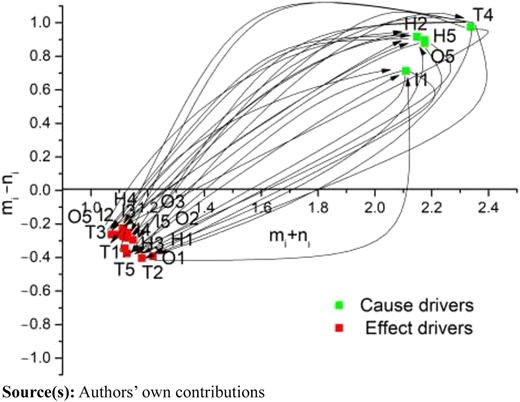
In FFS-DEMATEL, the pairwise comparison matrix formed in FFS-AHP was used. The pairwise comparison matrix was normalized using Eq. (12) and (13), and the normalized matrix (K) was established. Then, a total relation matrix (T) was constructed using Eq. (14). Using Eq. (15) and Eq. (16), (mi) and (ni) were calculated. The prominence of each driver was calculated using (mi+ni) values while concerning the difference in (mini) values, the causal interrelationship among the drivers was calculated. These are shown in Table 5 and Figure 2.

According to the weights given in Table 5, the study identifies improved performance output (T4) as the most important key driver in the incorporation of AI in HSCM with the highest weight. The remaining key drivers are ranked accordingly based on the obtained weight as given in Table 5. The advent of digital technologies has changed the business paradigm. Furthermore, the continuous evolution of associated technologies has brought improved performance in all areas where it is applied (Tsang and Lee, 2022). Hence, it turned out to be necessary to adopt AI technology in supply chain management and its need is no different for HSCM. Moreover, there is an expectation that HSCM needs to be responsive and efficient. For this, HSCM must be agile and resilient. In enhancing agility and resilience, AI is anticipated to play a critical role. Dubey et al. (2022) advocated that by incorporating AI in HSCM it is possible to lower the information complexity, thereby increasing the agility, resilience, and performance of HSCM. Similarly, De Boeck et al. (2023) highlighted the necessity of AI inclusion in HSCM by stating the complexity involved in rescue operations, and the difficulty involved in maintaining relationships with various stakeholders. In measuring the effectiveness of AI technology in vaccine supply chains during COVID-19, Gao et al. (2023) found AI technology useful and meaningful in HSCM.

The next important key driver is organizational preparedness (O5). To improve performance and customer service, the organization always needs to keep improving its capability. For the same, organizations need to equip themselves with advanced technologies. As AI technology has a proven impact on organizational performance, incorporating AI technology has become indispensable for organizations (Kumar et al., 2023). For incorporating AI technology, the technological maturity of the organization is critical. Technological maturity determines the effective utilization of digital technologies. The third important key driver is data literacy and interpretation (H2). The workers involved in HSCM need to have sufficient knowledge and skills to interpret insights from the available data. Further, understanding the operation of AI algorithms is also important. Hence, HSCM workers are expected to have sufficient data literacy and interpretation skills (Ho et al., 2023). Then, the guarantee of job security for technologically semi-skilled workers (H5) is another important key driver in the incorporation of AI technology in HSCM. Since AI technology is in an infant stage, most of the existing healthcare workers are not accustomed to AI technology. Furthermore, there are possibilities that the incorporation of AI technology in HSCM may put the job security of existing healthcare workers at stake (Cefaliello and Kullmann, 2022). The fifth important key driver is government support (I1). The government has a crucial role in promoting AI technology not only in HSCM but also in other industrial applications. However, being a critical area, the incorporation of AI technology is more compelling for HSCM as it may help in establishing coordination among the various stakeholders involved and maintaining the information database (Dubey et al., 2021).

According to the mini values, the twenty key drivers analyzed in this study were grouped into cause-and-effect categories. The key drivers coming under the cause category need more focus as they tend to impact other key drivers. In this case, five key drivers fell under the cause category and improved performance output (T4) occupied the top position. The main function of HSCM is to assist the people affected. Furthermore, HSCM is mostly executed under uncertain situations (Karuppiah et al., 2021). In such a situation, HSCM needs to be resilient and agile. By incorporating AI technology, it is possible to mobilize the affected people quickly and also useful in finding the people under debris, e.g. after an earthquake. Moreover, AI technology summarizes spatial data from various data sources (Dubey et al., 2021). Next, data literacy and interpretation (H2) are the second important key drivers. While embracing new technologies, the workers initially face several challenges and the same is applicable for the HSCM workers with AI technologies. A study by Wu et al. (2023) insists that most HSCM workers lack adequate skills in data management and interpretation in relevance to AI technologies. Further, it has been underlined that most HSCM workers are semi-skilled in AI technologies. The guarantee of job security for technologically semi-skilled workers (H5) is the third most important key driver in AI adoption in HSCM. As AI technology keeps continuously advancing, the industrial workforce is facing difficulty in acquiring and being proficient with AI skill sets. A study by Petersson et al. (2022) advocates that healthcare workers are facing initial difficulties in working with AI technology.

Organizational preparedness (O5) is the fourth most important key driver in AI incorporation. To be agile, organizations involved in HSCM need to stay up-to-date and need to embrace the latest technologies. Furthermore, having a technical workforce is also critical. Hence, it is the responsibility of the organizations to train the existing workforce on AI technology (Dicuonzo et al., 2023). The fifth causal driver is government support (I1). The government sector is an important stakeholder in HSCM and it needs to establish an effective relationship with other involved stakeholders. A study by Apell and Eriksson (2023) has called for policy intervention by the government to increase AI technology resources and reframe vision and mission statements to enhance HSCM with AI technology.

Then, the prominence of each driver was analyzed and ranked as follows based on mi+ni values: T4>O5>H5> H2>I1>O1>T2>H3>I3>H4>T5>O2>T1>I5>I4>O4>H1>O3>T3>I2. The top five key drivers based on prominence have already been discussed in detail previously. The sixth important key driver in AI incorporation is organization capacity (O1). It refers to the financial capability of an organization in investing in AI technology. Although AI technology has delivered many promising benefits, its success is deeply rooted in the financial capability of the organization. To lower the financial burden related to AI incorporation, it has been suggested and called for the involvement of government support (I1) to ensure the incorporation of AI technology in HSCM (Dubey et al., 2021). Next, the most important key driver is data quality and integrity (T2). In HSCM, having reliable data is important as it helps in estimating the level of preparedness for rescue operations or emergencies. In such a situation, AI technology will be efficacious by providing integrated reliable data. Technical expertise (H3) is also one of the important key drivers in the incorporation of AI technology with HSCM. A direct relationship can be drawn between the driver's technical expertise (H3) and the guarantee of job security for technologically semi-skilled workers (H5). A certain level of competence is expected from HSCM workers to work alongside AI technology. Presently, the global HSCM industry is in the nascent stage of AI incorporation and has not yet prepared fully to work with AI technology (Ho et al., 2023). Therefore, HSCM workers need to be properly trained to effectively work with AI technology.

This study renders’ valuable theoretical contributions to the existing HSCM literature. First, it sheds light on the key drivers that necessitate the incorporation of AI technology in HSCM. Although several earlier studies are exploring the role of AI technology in HSCM, many of these studies discuss the benefits and positive impacts (Dubey et al., 2022; Helo and Hao, 2021). Yet, there is a scarcity of studies focusing on the key drivers of AI technology incorporation in HSCM. Second, the key drivers of AI incorporation in HSCM are identified through a literature review and are grouped using inputs from industry experts based on the TOIH framework. By grouping the key drivers using the TOIH framework, it is possible to recognize the area in which organizations need to concentrate. Third, the key drivers are evaluated using an integrated FFS-AHP-DEMATEL framework. FFS has been sporadically used along with the MCDM technique. Additionally, with this integrated framework, the weight importance and causal interrelationship among the key drivers are analyzed. For sustaining in the competitive marketplace, understanding the significance and causal interrelationship among the key drivers of AI incorporation in HSCM is crucial and it can help organizations in gaining a competitive edge. The outcome of this study suggests improved performance output, organizational preparedness, user acceptance and continued support, guarantee of job security for technologically semi-skilled workers, and government support as the critical key drivers in facilitating the incorporation of AI technology in HSCM. The outcome of this study shows the focal points that need to be concentrated on by HSCM organizations.

Based on the outcome, this study offers some managerial implications that can enable the incorporation of AI technology in HSCM. Improved performance output has been identified as the key driver in AI incorporation. AI-assisted HSCM can enhance and facilitate the management of healthcare supply chains. It helps, for example, in checking and tracing healthcare equipment, keeps data regarding various stakeholders involved, and ensures the privacy and security of individuals, which is a great social concern (Sharma et al., 2022). Moreover, incorporating AI technology in HSCM will align with the National Digital Health Mission (NDHM) 2020 of the Indian government (Kumar et al., 2023). Next, an important step that needs to be taken by HSCM organizations is to provide adequate training on AI technology for their existing workers. In this current digital market era, owning a knowledge-driven workforce has been mandatory for an organization to thrive. For this, HSCM organizations have to be prepared. Only foresight can help organizations sustain themselves in a volatile business environment. Hence, organizations have to be equipped with advanced technologies, change their organizational structure, and be ready to invest in digital technologies. From the government side, some initiative programs (e.g. FutureSkills PRIME, Youth for Unnati, and Vikas with AI) have been put in place to enhance technical skills (Joshi and Pramod, 2023). However, a public-private partnership can quicken the pace of generating a knowledgeable workforce. Furthermore, awareness regarding the impact of digital technologies on the well-being of humans and their usefulness in preparedness for emergencies has to be created in society. More than embracing the technologies, society is majorly concerned over privacy and security.

Digitalization of CSCM has improved the operational performance and agility of organizations and hence, it has become a primary goal for HSCM to digitalize their supply chain activities. The recent COVID-19 pandemic has given a greater push for the digitalization of HSCM. However, although there has been a large call for the digitalization of HSCM, many organizations are not fully aware of its importance. In recent times, AI has gained wide attention from HSCM practitioners as it helps in demand forecasting and imparts knowledge on the significance of digitalization. This study identifies and evaluates the key drivers of AI incorporation in HSCM using the TOIH framework from the Indian HSCM context. By reviewing the existing literature, this study identified twenty key drivers for AI incorporation in HSCM. These key drivers were then grouped under the technology (T), organization (O), institution (I), and human (H) categories of the TOIH framework. Then, using a combination of FFS-AHP and FFS-DEMATEL, the key drivers were ranked and their causal interrelationships were explored. The outcome of this study indicates improved performance output, organizational preparedness, user acceptance and continued support, guarantee of job security for technologically semi-skilled workers, and government support as the five most important key drivers for HSCM organizations to adopt and deploy AI in their operations. Of these five key drivers, two fell within the human, one within technology, one under institution, and one under the organization categories. Thus, from the outcome, it is clear that the human, i.e. society, role is very critical in the digitalization of HSCM. Based on the outcome, implications were postulated for the HSCM stakeholders and other facilitators.

This study offers significant contributions. First, this study discusses the key drivers that compel AI incorporation in HSCM. Earlier studies have discussed the advantages and potential impact of digitalization on HSCM. However, studies assessing the key drivers of AI incorporation in HSCM are scant. Thus, this study is the first to discuss and explore the key drivers of AI incorporation in HSCM. Second, the key drivers were analyzed based on the TOIH framework. When technology is planned to be incorporated, factors under these categories need to be considered. Also, a Kappa analysis is conducted to confirm the categorization of key drivers. Next, this study used the FFS-AHP-DEMATEL technique, for calculating the weight significance and the causal interrelationship of the key drivers.

Like other studies, this study is not devoid of limitations. In this study, the key drivers were analyzed by following the TOIH framework, and hence, some other important drives such as societal and financial may have not been considered. Hence, in future studies, a more holistic perspective to consider other drivers that may not fall under the TOIH framework can be considered. Next, the outcome of this study is based on expert opinion from the logistics, supply chain, and IT domains. However, a representative from the government has not been involved. Therefore, in future studies, an expert from the government sector may be included in the expert panel. Moreover, only the weight significance and causal interrelationship among the key drivers have been investigated. Future studies can analyze the structural relationship of the key drivers using structural equation modeling (SEM) and interpretive structure modeling (ISM) techniques. This will provide better insights into the structural and hierarchical relationship among the drivers.

Data availability: The data are included in the paper.
Alamoodi
,
A.H.
,
Albahri
,
O.S.
,
Zaidan
,
A.A.
,
AlSattar
,
H.A.
,
Ahmed
,
M.A.
,
Pamucar
,
D.
,
Zaidan
,
B.B.
and
Mahmoud
,
M.S.
(
2022
), “
New extension of fuzzy-weighted zero-inconsistency and fuzzy decision by opinion score method based on cubic pythagorean fuzzy environment: a benchmarking case study of sign language recognition systems
”,
International Journal of Fuzzy Systems
, Vol. 
24
No. 
4
, pp. 
1909
-
1926
, doi: .
Altay
,
N.
,
Heaslip
,
G.
,
Kovács
,
G.
,
Spens
,
K.
,
Tatham
,
P.
and
Vaillancourt
,
A.
(
2023
), “
Innovation in humanitarian logistics and supply chain management: a systematic review
”,
Annals of Operations Research
, Vol. 
335
No. 
3
, pp. 
965
-
987
, doi: .
Apell
,
P.
and
Eriksson
,
H.
(
2023
), “
Artificial intelligence (AI) healthcare technology innovations: the current state and challenges from a life science industry perspective
”,
Technology Analysis and Strategic Management
, Vol. 
35
No. 
2
, pp. 
179
-
193
, doi: .
Arji
,
G.
,
Ahmadi
,
H.
,
Avazpoor
,
P.
and
Hemmat
,
M.
(
2023
), “
Identifying resilience strategies for disruption management in the healthcare supply chain during COVID-19 by digital innovations: a systematic literature review
”,
Informatics in Medicine Unlocked
, Vol. 
38
, 101199, doi: .
Beduschi
,
A.
(
2022
), “
Harnessing the potential of artificial intelligence for humanitarian action: opportunities and risks
”,
International Review of the Red Cross
, Vol. 
104
No. 
919
, pp. 
1149
-
1169
, doi: .
Benzidia
,
S.
,
Makaoui
,
N.
and
Bentahar
,
O.
(
2021
), “
The impact of big data analytics and artificial intelligence on green supply chain process integration and hospital environmental performance
”,
Technological Forecasting and Social Change
, Vol. 
165
, 120557, doi: .
Rohith
,
B.
and
Madhusundar
,
N.
(
2023
), “
Artificial intelligence based credit card fraud detection for online transactions optimized with sparrow search algorithm
”,
International Journal of Performability Engineering
, Vol. 
19
No. 
9
, p.
624
, doi: .
Cadden
,
T.
,
Dennehy
,
D.
,
Mantymaki
,
M.
and
Treacy
,
R.
(
2022
), “
Understanding the influential and mediating role of cultural enablers of AI integration to supply chain
”,
International Journal of Production Research
, Vol. 
60
No. 
14
, pp. 
4592
-
4620
, doi: .
Cefaliello
,
A.
and
Kullmann
,
M.
(
2022
), “
Offering false security: how the draft artificial intelligence act undermines fundamental workers rights
”,
European Labour Law Journal
, Vol. 
13
No. 
4
, pp. 
542
-
562
, doi: .
Choukolaei
,
H.A.
,
Ghasemi
,
P.
and
Goodarzian
,
F.
(
2023
), “
Evaluating the efficiency of relief centers in disaster and epidemic conditions using multi-criteria decision-making methods and GIS: a case study
”,
International Journal of Disaster Risk Reduction
, Vol. 
85
, 103512, doi: .
De Boeck
,
K.
,
Besiou
,
M.
,
Decouttere
,
C.
,
Rafter
,
S.
,
Vandaele
,
N.
,
Van Wassenhove
,
L.N.
and
Yadav
,
P.
(
2023
), “
Data, analytical techniques and collaboration between researchers and practitioners in humanitarian health supply chains: a challenging but necessary way forward
”,
Journal of Humanitarian Logistics and Supply Chain Management
, Vol. 
13
No. 
3
, pp. 
237
-
248
, doi: .
Deng
,
Z.
and
Wang
,
J.
(
2022
), “
New distance measure for Fermatean fuzzy sets and its application
”,
International Journal of Intelligent Systems
, Vol. 
37
No. 
3
, pp. 
1903
-
1930
, doi: .
Deretarla
,
Ö.
,
Erdebilli
,
B.
and
Gündoğan
,
M.
(
2023
), “
An integrated Analytic Hierarchy Process and Complex Proportional Assessment for vendor selection in supply chain management
”,
Decision Analytics Journal
, Vol. 
6
, 100155, doi: .
Di Vaio
,
A.
,
Latif
,
B.
,
Gunarathne
,
N.
,
Gupta
,
M.
and
D'Adamo
,
I.
(
2023
), “
Digitalization and artificial knowledge for accountability in SCM: a systematic literature review
”,
Journal of Enterprise Information Management
, Vol. 
37
No. 
2
, pp. 
606
-
672
, doi: .
Dicuonzo
,
G.
,
Donofrio
,
F.
,
Fusco
,
A.
and
Shini
,
M.
(
2023
), “
Healthcare system: moving forward with artificial intelligence
”,
Technovation
, Vol. 
120
, 102510, doi: .
Dohale
,
V.
,
Ambilkar
,
P.
,
Gunasekaran
,
A.
and
Bilolikar
,
V.
(
2022
), “
Examining the barriers to operationalization of humanitarian supply chains: lessons learned from COVID-19 crisis
”,
Annals of Operations Research
, Vol. 
335
No. 
3
, pp. 
1137
-
1176
, doi: .
Dubey
,
R.
(
2023
), “
Unleashing the potential of digital technologies in emergency supply chain: the moderating effect of crisis leadership
”,
Industrial Management and Data Systems
, Vol. 
123
No. 
1
, pp. 
112
-
132
, doi: .
Dubey
,
R.
,
Bryde
,
D.J.
,
Foropon
,
C.
,
Tiwari
,
M.
,
Dwivedi
,
Y.
and
Schiffling
,
S.
(
2021
), “
An investigation of information alignment and collaboration as complements to supply chain agility in humanitarian supply chain
”,
International Journal of Production Research
, Vol. 
59
No. 
5
, pp. 
1586
-
1605
, doi: .
Dubey
,
R.
,
Bryde
,
D.J.
,
Dwivedi
,
Y.K.
,
Graham
,
G.
and
Foropon
,
C.
(
2022
), “
Impact of artificial intelligence-driven big data analytics culture on agility and resilience in humanitarian supply chain: a practice-based view
”,
International Journal of Production Economics
, Vol. 
250
, 108618, doi: .
Gabus
,
A.
and
Fontela
,
E.
(
1972
),
World Problems, an Invitation to Further Thought within the Framework of DEMATEL
,
Battelle Geneva Research Center
,
Geneva
, pp. 
1
-
8
.
Gao
,
Y.
,
Gao
,
H.
,
Xiao
,
H.
and
Yao
,
F.
(
2023
), “
Vaccine supply chain coordination using blockchain and artificial intelligence technologies
”,
Computers and Industrial Engineering
, Vol. 
175
, 108885, doi: .
Gnaneshwar Reddy
,
A.P.
and
Arumugam
,
S.S.
(
2024
), “
Design of web application for community answering using Long short-term memory compared over Hybrid Emotion Interface Model with improved accuracy
”,
2024 15th International Conference on Computing Communication and Networking Technologies (ICCCNT)
,
IEEE
, pp. 
1
-
5
, doi: .
Helo
,
P.
and
Hao
,
Y.
(
2021
), “
Artificial intelligence in operations management and supply chain management: an exploratory case study
”,
Production Planning and Control
, Vol. 
33
No. 
16
, pp. 
1
-
18
, doi: .
Ho
,
M.-T.
,
Le
,
N.-T.B.
,
Mantello
,
P.
,
Ho
,
M.-T.
and
Ghotbi
,
N.
(
2023
), “
Understanding the acceptance of emotional artificial intelligence in Japanese healthcare system: a cross-sectional survey of clinic visitors' attitude
”,
Technology in Society
, Vol. 
72
, 102166, doi: .
Hosseini
,
S.M.A.
,
Mohammadi
,
L.
,
Amirbagheri
,
K.
and
de la Fuente
,
A.
(
2023
), “
Assessing humanitarian supply chain operations in the aftermath of the Kermanshah earthquake
”,
Journal of Humanitarian Logistics and Supply Chain Management
, Vol. 
13
No. 
4
, pp. 
378
-
398
, doi: .
Jiang
,
S.
,
Dou
,
Y.
,
He
,
S.
,
Tan
,
B.
,
Peng
,
X.
and
Jing
,
L.
(
2022
), “
Fuzzy concept evaluation based on prospect theory and heterogeneous evaluation information
”,
Journal of Computing and Information Science in Engineering
, Vol. 
22
No. 
4
, doi: .
Joshi
,
S.
and
Pramod
,
P.J.
(
2023
), “
A collaborative metaverse based A-La-carte framework for tertiary education (CO-mate)
”,
Heliyon
, Vol. 
9
No. 
2
, e13424, doi: .
Kabra
,
G.
,
Ramesh
,
A.
,
Jain
,
V.
and
Akhtar
,
P.
(
2023
), “
Barriers to information and digital technology adoption in humanitarian supply chain management: a fuzzy AHP approach
”,
Journal of Enterprise Information Management
. doi: .
Kamran
,
M.A.
,
Kia
,
R.
,
Goodarzian
,
F.
and
Ghasemi
,
P.
(
2023
), “
A new vaccine supply chain network under COVID-19 conditions considering system dynamic: artificial intelligence algorithms
”,
Socio-Economic Planning Sciences
, Vol. 
85
, 101378, doi: .
Karuppiah
,
K.
and
Sankaranarayanan
,
B.
(
2023
), “
An integrated multi-criteria decision-making approach for evaluating e-waste mitigation strategies
”,
Applied Soft Computing
, Vol. 
144
, 110420, doi: .
Karuppiah
,
K.
,
Sankaranarayanan
,
B.
,
Ali
,
S.M.
and
Paul
,
S.K.
(
2021
), “
Key challenges to sustainable humanitarian supply chains: lessons from the COVID-19 pandemic
”,
Sustainability
, Vol. 
13
No. 
11
, p.
5850
, doi: .
Kord
,
H.
and
Samouei
,
P.
(
2023
), “
Coordination of humanitarian logistic based on the quantity flexibility contract and buying in the spot market under demand uncertainty using NSGA-II and NRGA algorithms
”,
Expert Systems with Applications
, Vol. 
214
, 119187, doi: .
Kumar
,
A.
,
Mani
,
V.
,
Jain
,
V.
,
Gupta
,
H.
and
Venkatesh
,
V.G.
(
2023
), “
Managing healthcare supply chain through artificial intelligence (AI): a study of critical success factors
”,
Computers and Industrial Engineering
, Vol. 
175
, 108815, doi: .
Lin
,
S.-S.
,
Zhou
,
A.
and
Shen
,
S.-L.
(
2023
), “
Safety assessment of excavation system via TOPSIS-based MCDM modelling in fuzzy environment
”,
Applied Soft Computing
, Vol. 
138
, 110206, doi: .
Marić
,
J.
,
Galera-Zarco
,
C.
and
Opazo-Basáez
,
M.
(
2022
), “
The emergent role of digital technologies in the context of humanitarian supply chains: a systematic literature review
”,
Annals of Operations Research
, Vol. 
319
No. 
1
, pp. 
1003
-
1044
, doi: .
Modgil
,
S.
,
Singh
,
R.K.
and
Hannibal
,
C.
(
2022
), “
Artificial intelligence for supply chain resilience: learning from Covid-19
”,
International Journal of Logistics Management
, Vol. 
33
No. 
4
, pp. 
1246
-
1268
, doi: .
Naveen Kumar
,
R.
,
Surendran
,
R.
and
Madhusundar
,
N.
(
2024
), “
An intelligent human pose detection comparing with random forest and recurrent neural network
”,
2024 8th International Conference on Electronics, Communication and Aerospace Technology (ICECA)
,
IEEE
, pp. 
915
-
921
, doi: .
Patil
,
A.
,
Shardeo
,
V.
,
Dwivedi
,
A.
and
Paul
,
S.K.
(
2023
), “
An integrated framework for digitalization of humanitarian supply chains in post COVID-19 era
”,
International Journal of Disaster Risk Reduction
, Vol. 
87
, 103574, doi: .
Petersson
,
L.
,
Larsson
,
I.
,
Nygren
,
J.M.
,
Nilsen
,
P.
,
Neher
,
M.
,
Reed
,
J.E.
,
Tyskbo
,
D.
and
Svedberg
,
P.
(
2022
), “
Challenges to implementing artificial intelligence in healthcare: a qualitative interview study with healthcare leaders in Sweden
”,
BMC Health Services Research
, Vol. 
22
No. 
1
, p.
850
, doi: .
Pournader
,
M.
,
Ghaderi
,
H.
,
Hassanzadegan
,
A.
and
Fahimnia
,
B.
(
2021
), “
Artificial intelligence applications in supply chain management
”,
International Journal of Production Economics
, Vol. 
241
, 108250, doi: .
Rahman
,
M.M.
,
Tasnim
,
F.
,
Mukta
,
M.Z.
,
Abedin
,
A.
and
Aryal
,
K.R.
(
2022
), “
Assessing barriers in humanitarian supply chains for cyclone in coastal areas of Bangladesh: an interpretive structural modeling (ISM) approach
”,
Sustainability
, Vol. 
14
No. 
15
, p.
9724
, doi: .
Ramaswamy
,
A.R.
,
Gowda
,
N.
,
Vikas
,
H.
,
Prabhu
,
M.
,
Sharma
,
D.K.
,
Gowda
,
P.R.
,
Mohan
,
D.
and
Kumar
,
A.
(
2022
), “
It's the data, stupid: inflection point for Artificial Intelligence in Indian healthcare
”,
Artificial Intelligence in Medicine
, Vol. 
128
, 102300, doi: .
Rojas Trejos
,
C.A.
,
Meisel
,
J.D.
and
Adarme Jaimes
,
W.
(
2023
), “
Humanitarian aid distribution logistics with accessibility constraints: a systematic literature review
”,
Journal of Humanitarian Logistics and Supply Chain Management
, Vol. 
13
No. 
1
, pp. 
26
-
41
, doi: .
Saaty
,
T.L.
(
1980
), “
The analytic hierarchy process
”,
Agricultural Economics Review
, p.
70
.
Sahebi
,
I.G.
,
Masoomi
,
B.
and
Ghorbani
,
S.
(
2020
), “
Expert oriented approach for analyzing the blockchain adoption barriers in humanitarian supply chain
”,
Technology in Society
, Vol. 
63
, 101427, doi: .
Samad
,
T.A.
,
Sharma
,
R.
,
Ganguly
,
K.K.
,
Wamba
,
S.F.
and
Jain
,
G.
(
2022
), “
Enablers to the adoption of blockchain technology in logistics supply chains: evidence from an emerging economy
”,
Annals of Operations Research
, Vol. 
327
No. 
1
, pp. 
251
-
291
, doi: .
Sathiya
,
V.
,
Nagalakshmi
,
K.
,
Jeevamalar
,
J.
,
Anand Babu
,
R.
,
Karthi
,
R.
,
Acevedo-Duque
,
Á.
,
Lavanya
,
R.
and
Ramabalan
,
S.
(
2023
), “
Reshaping healthcare supply chain using chain-of-things technology and key lessons experienced from COVID-19 pandemic
”,
Socio-Economic Planning Sciences
, Vol. 
85
, 101510, doi: .
Senapati
,
T.
and
Yager
,
R.R.
(
2020
), “
Fermatean fuzzy sets
”,
Journal of Ambient Intelligence and Humanized Computing
, Vol. 
11
No. 
2
, pp. 
663
-
674
, doi: .
Shahrabi-Farahani
,
S.
,
Hafezalkotob
,
A.
,
Mohammaditabar
,
D.
and
Khalili-Damghani
,
K.
(
2024
), “
Selection of sustainable industrial livestock site using the R-Number GIS-MCDM method: a case study of Iran
”,
Environmental and Sustainability Indicators
, Vol. 
22
, 100362, doi: .
Sharma
,
R.
,
Shishodia
,
A.
,
Gunasekaran
,
A.
,
Min
,
H.
and
Munim
,
Z.H.
(
2022
), “
The role of artificial intelligence in supply chain management: mapping the territory
”,
International Journal of Production Research
, Vol. 
60
No. 
24
, pp. 
7527
-
7550
, doi: .
Shrivastav
,
S.K.
and
Bag
,
S.
(
2023
), “
Humanitarian supply chain management in the digital age: a hybrid review using published literature and social media data
”,
Benchmarking: An International Journal
, Vol. 
31
No. 
7
, pp. 
2267
-
2301
, doi: .
Singh
,
A.
,
Dwivedi
,
A.
,
Agrawal
,
D.
and
Singh
,
D.
(
2023
), “
Identifying issues in adoption of AI practices in construction supply chains: towards managing sustainability
”,
Operations Management Research
, Vol. 
16
No. 
4
, pp. 
1667
-
1683
, doi: .
Taber
,
K.S.
(
2018
), “
The use of Cronbach's alpha when developing and reporting research instruments in science education
”,
Research in Science Education
, Vol. 
48
No. 
6
, pp. 
1273
-
1296
, doi: .
Tsang
,
Y.P.
and
Lee
,
C.K.M.
(
2022
), “
Artificial intelligence in industrial design: a semi-automated literature survey
”,
Engineering Applications of Artificial Intelligence
, Vol. 
112
, 104884, doi: .
Wu
,
C.
,
Xu
,
H.
,
Bai
,
D.
,
Chen
,
X.
,
Gao
,
J.
and
Jiang
,
X.
(
2023
), “
Public perceptions on the application of artificial intelligence in healthcare: a qualitative meta-synthesis
”,
BMJ Open
, Vol. 
13
No. 
1
, p. 
e066322
, doi: .
Zadeh
,
L.A.
(
1965
), “
Information and control
”,
Fuzzy Sets
, Vol. 
8
No. 
3
, pp. 
338
-
353
, doi: .
Zhang
,
Z.-X.
,
Wang
,
L.
,
Wang
,
Y.-M.
and
Martínez
,
L.
(
2023
), “
A novel alpha-level sets based fuzzy DEMATEL method considering experts' hesitant information
”,
Expert Systems with Applications
, Vol. 
213
, 118925, doi: .
Zhang
,
F.
,
Huang
,
H.
,
Cao
,
C.
and
Yang
,
Q.
(
2024
), “
Coordination mechanism of integrative humanitarian-business partnership for relief supplies with the consideration of public engagement amidst the Coronavirus Disease 2019 pandemic
”,
Annals of Operations Research
. doi: .
Published in International Journal of Industrial Engineering and Operations Management. Published by Emerald Publishing Limited. This article is published under the Creative Commons Attribution (CC BY 4.0) licence. Anyone may reproduce, distribute, translate and create derivative works of this article (for both commercial and non-commercial purposes), subject to full attribution to the original publication and authors. The full terms of this licence may be seen at http://creativecommons.org/licences/by/4.0/legalcode

Data & Figures

Figure 1
Flowchart of research framework with two stages.The flowchart begins with a literature review, followed by identification of drivers for A I incorporation in H S C M. A Likert scale survey checks the relevance of the identified drivers, and Kappa analysis categorizes them. Stage 1 concludes here. Stage 2 starts with F F S-A H P-D E M A T E L to prioritize the drivers and examine causal interrelationships. The final step involves results and discussion, implications of the study, and conclusion.

Research framework

Figure 1
Flowchart of research framework with two stages.The flowchart begins with a literature review, followed by identification of drivers for A I incorporation in H S C M. A Likert scale survey checks the relevance of the identified drivers, and Kappa analysis categorizes them. Stage 1 concludes here. Stage 2 starts with F F S-A H P-D E M A T E L to prioritize the drivers and examine causal interrelationships. The final step involves results and discussion, implications of the study, and conclusion.

Research framework

Close modal
Figure 2
A scatter plot showing causal relationships among key drivers.A scatter plot showing causal relationships among key drivers. The plot features several data points, with the x-axis representing the sum of influence (m_i + n_i) and the y-axis representing the difference in influence (m_i - n_i). The data points are labeled with identifiers such as T1, T2, T3, T4, T5, H1, H2, H5, O1, O2, O3, O5, and I1. Green squares indicate cause drivers, while red squares indicate effect drivers. Arrows connect the points, illustrating the causal relationships. The plot shows clusters and patterns of influence among the drivers, with some points positioned higher on the y-axis indicating stronger causal effects. All values are approximated.

Causal relationship of the key drivers of AI incorporation in HSCM

Figure 2
A scatter plot showing causal relationships among key drivers.A scatter plot showing causal relationships among key drivers. The plot features several data points, with the x-axis representing the sum of influence (m_i + n_i) and the y-axis representing the difference in influence (m_i - n_i). The data points are labeled with identifiers such as T1, T2, T3, T4, T5, H1, H2, H5, O1, O2, O3, O5, and I1. Green squares indicate cause drivers, while red squares indicate effect drivers. Arrows connect the points, illustrating the causal relationships. The plot shows clusters and patterns of influence among the drivers, with some points positioned higher on the y-axis indicating stronger causal effects. All values are approximated.

Causal relationship of the key drivers of AI incorporation in HSCM

Close modal
Table 3

Information about the experts

ExpertPositionExperience (in years)Organization typeLocation
Expert 1Technology support manager12Medical device companyChennai
Expert 2Senior-level supply chain manager14HSCMDelhi
Expert 3General manager12Technology solution providersGurugram
Expert 4Junior supply chain manager11Healthcare equipment supply companyChennai
Expert 5General manager strategy15HSCMBangalore
Expert 6Professor13AcademicsChennai
Expert 7Deputy manager IT infrastructure12Technology solution providersNoida
Expert 8Junior logistics manager11Pharmaceuticals companyChennai
Expert 9Professor12AcademicsBangalore
Expert 10Senior logistics manager14HSCMDelhi

Source(s): Authors’ own contributions

Table A1

List of key drivers for AI incorporation in HSCM identified through literature survey

A table listing key drivers for AI incorporation in HSCM.
Table 4

Linguistic scale and their corresponding FFS number

Linguistic termInfluence valueFFS numbers
No influence (NO)0(0,1)
Very low Influence (VL)1(0.1, 0.75)
Low influence (L)2(0.4, 0.5)
High influence (H)3(0.7, 0.2)
Very high influence (VH)4(0.9, 0.1)

Source(s): Table courtesy of Karuppiah and Sankaranarayanan (2023) 

Table A2

Pairwise comparison matrix

A matrix showing pairwise comparisons of key drivers for AI incorporation in HSCM.
Table 5

Causal relationship and weight of key drivers for AI incorporation in HSCM

Key driversminimi+niRankminiCategoryRankWeightRank
T10.3860.7331.11913−0.347Effect170.0114118
T20.3880.7911.1797−0.403Effect200.0114019
T30.4130.6751.08819−0.262Effect110.0120714
T41.6560.6822.33810.975Cause10.050001
T50.3750.7511.12711−0.376Effect180.0110820
O10.4130.8061.2186−0.393Effect190.0119316
O20.4210.7041.12412−0.283Effect150.0125110
O30.4370.6751.11218−0.239Effect80.012807
O40.4430.6701.11316−0.226Effect60.012886
O51.5270.6492.1762−0.878Effect40.046952
H10.4230.6901.11317−0.266Effect130.0123213
H21.5320.6162.14840.916Cause20.046523
H30.4270.7221.1498−0.296Effect160.012609
H40.4340.6941.12810−0.260Effect100.0124112
H51.5350.6402.17530.895Cause30.046304
I11.4110.6982.10950.712Cause50.042845
I20.4050.6681.07320−0.263Effect120.0114917
I30.4390.6901.1299−0.252Effect90.0124811
I40.4210.6941.11515−0.273Effect140.0119415
I50.4390.6761.11514−0.238Effect70.012638

Source(s): Authors’ own contributions

Table 1

List of key drivers for AI incorporation in HSCM

AreaKey driversExplanationReferences
Technology (T)Interoperability (T1)Indicates the handling and evaluation of the collected data to ensure better communication among stakeholdersRojas Trejos et al. (2023), Samad et al. (2022) 
Data quality and integrity (T2)Refers to usability and credibility of data in terms of reliability and validityBeduschi (2022), Patil et al. (2023) 
Technology advancement (T3)Issues such as latency and security have been addressed with technological maturityKord and Samouei (2023), Samad et al. (2022) 
Improved performance output (T4)Well-defined testing models and tools enhance the performance in the applied areaKumar et al. (2023), Patil et al. (2023) 
Perceived advantages (T5)It necessitates the adoption of technological advancements owing to anticipated benefitsHosseini et al. (2023), Patil et al. (2023) 
Organization (O)Organization capacity (O1)The capability of the organization to invest and handle risks while adopting AICadden et al. (2022) 
Organizational involvement (O2)Indicates the support extended by the organization in embracing AICadden et al. (2022), Rahman et al. (2022) 
Competitive advantage (O3)Provides a competitive advantage edge among the competitors in the dynamic business environmentKumar et al. (2023), Modgil et al. (2022) 
Organizational culture (O4)Refers to consensus among the stakeholders in accepting the adoption of new technologyCadden et al. (2022) 
Organizational preparedness (O5)Related to the foresightedness of the organization in adopting new technologies for the development of the organizationDicuonzo et al. (2023), Samad et al. (2022) 
Human (H)Ethical Considerations (H1)Ensuring transparency and accountability in decision-making with AIKamran et al. (2023), Petersson et al. (2022) 
Data literacy and interpretation (H2)Humanitarian workers need analytical skills and domain knowledge to interpret data-driven insights from AI outputsPetersson et al. (2022) 
Technical expertise (H3)Availability of workers with technical competenceCadden et al. (2022), Pournader et al. (2021) 
Training facility (H4)Organizations must be able to train workers in AIBeduschi (2022), Dohale et al. (2022) 
Guarantee of job security for technologically semi-skilled workers (H5)AI adoption poses a threat to the job security of technically semi-skilled workersBeduschi (2022), Kabra et al. (2023) 
Institution (I)Government support (I1)Financial and infrastructure assistance by the government helps in AI adoptionKumar et al. (2023), Pournader et al. (2021) 
Establishment of business collaboration (I2)Helps in knowledge transfer and mutual benefit for the stakeholders involvedDubey et al. (2022), Kumar et al. (2023) 
Expanded business viability (I3)Helps in business expansionDubey et al. (2022), Kumar et al. (2023) 
Improves the functioning of health care sector (I4)Addresses the problems involved in the healthcare sectorCadden et al. (2022), Kumar et al. (2023) 
Business ecosystem management (I5)Intricate relationship among the stakeholders and participants needs to be managedModgil et al. (2022), Di Vaio et al. (2023) 

Source(s): Authors’ own contributions

Table 2

Earlier literature on AI in HSCM

AuthorsContributionMethod(s) usedResearch gap(s)Contribution of this work
Kumar et al. (2023) Provided a list of critical success factors for AI incorporation in HSCMRough SWARACausal interrelationship among critical success factors has not been examinedThe need for incorporating digital technologies in HSCM has been on the surge. Interestingly, many research works have supported and demanded the incorporation of AI technologies in HSCM. However, the key drivers for AI incorporation in HSCM have not been explored. This research provides a list of key drivers an organization needs to consider in integrating AI in HSCM. Further, this work provides the weight significance of the key drivers and reveals the causal interrelationship of the key drivers
Apell and Eriksson (2023) Emphasized on the benefits of incorporating AI in HSCM activitiesInterviewsA real-time case study has not been carried out
Petersson et al. (2022) Identified the challenges involved in incorporating AI in HSCMSemi-structured interviewsThe role of organizational management in AI incorporation in HSCM has not been examined
Wu et al. (2023) Estimated the public perception of AI incorporation in the healthcare sectorLiterature reviewRole of government in incorporating AI in the healthcare sector has not been examined

Source(s): Authors’ own contributions

Supplements

References

Alamoodi
,
A.H.
,
Albahri
,
O.S.
,
Zaidan
,
A.A.
,
AlSattar
,
H.A.
,
Ahmed
,
M.A.
,
Pamucar
,
D.
,
Zaidan
,
B.B.
and
Mahmoud
,
M.S.
(
2022
), “
New extension of fuzzy-weighted zero-inconsistency and fuzzy decision by opinion score method based on cubic pythagorean fuzzy environment: a benchmarking case study of sign language recognition systems
”,
International Journal of Fuzzy Systems
, Vol. 
24
No. 
4
, pp. 
1909
-
1926
, doi: .
Altay
,
N.
,
Heaslip
,
G.
,
Kovács
,
G.
,
Spens
,
K.
,
Tatham
,
P.
and
Vaillancourt
,
A.
(
2023
), “
Innovation in humanitarian logistics and supply chain management: a systematic review
”,
Annals of Operations Research
, Vol. 
335
No. 
3
, pp. 
965
-
987
, doi: .
Apell
,
P.
and
Eriksson
,
H.
(
2023
), “
Artificial intelligence (AI) healthcare technology innovations: the current state and challenges from a life science industry perspective
”,
Technology Analysis and Strategic Management
, Vol. 
35
No. 
2
, pp. 
179
-
193
, doi: .
Arji
,
G.
,
Ahmadi
,
H.
,
Avazpoor
,
P.
and
Hemmat
,
M.
(
2023
), “
Identifying resilience strategies for disruption management in the healthcare supply chain during COVID-19 by digital innovations: a systematic literature review
”,
Informatics in Medicine Unlocked
, Vol. 
38
, 101199, doi: .
Beduschi
,
A.
(
2022
), “
Harnessing the potential of artificial intelligence for humanitarian action: opportunities and risks
”,
International Review of the Red Cross
, Vol. 
104
No. 
919
, pp. 
1149
-
1169
, doi: .
Benzidia
,
S.
,
Makaoui
,
N.
and
Bentahar
,
O.
(
2021
), “
The impact of big data analytics and artificial intelligence on green supply chain process integration and hospital environmental performance
”,
Technological Forecasting and Social Change
, Vol. 
165
, 120557, doi: .
Rohith
,
B.
and
Madhusundar
,
N.
(
2023
), “
Artificial intelligence based credit card fraud detection for online transactions optimized with sparrow search algorithm
”,
International Journal of Performability Engineering
, Vol. 
19
No. 
9
, p.
624
, doi: .
Cadden
,
T.
,
Dennehy
,
D.
,
Mantymaki
,
M.
and
Treacy
,
R.
(
2022
), “
Understanding the influential and mediating role of cultural enablers of AI integration to supply chain
”,
International Journal of Production Research
, Vol. 
60
No. 
14
, pp. 
4592
-
4620
, doi: .
Cefaliello
,
A.
and
Kullmann
,
M.
(
2022
), “
Offering false security: how the draft artificial intelligence act undermines fundamental workers rights
”,
European Labour Law Journal
, Vol. 
13
No. 
4
, pp. 
542
-
562
, doi: .
Choukolaei
,
H.A.
,
Ghasemi
,
P.
and
Goodarzian
,
F.
(
2023
), “
Evaluating the efficiency of relief centers in disaster and epidemic conditions using multi-criteria decision-making methods and GIS: a case study
”,
International Journal of Disaster Risk Reduction
, Vol. 
85
, 103512, doi: .
De Boeck
,
K.
,
Besiou
,
M.
,
Decouttere
,
C.
,
Rafter
,
S.
,
Vandaele
,
N.
,
Van Wassenhove
,
L.N.
and
Yadav
,
P.
(
2023
), “
Data, analytical techniques and collaboration between researchers and practitioners in humanitarian health supply chains: a challenging but necessary way forward
”,
Journal of Humanitarian Logistics and Supply Chain Management
, Vol. 
13
No. 
3
, pp. 
237
-
248
, doi: .
Deng
,
Z.
and
Wang
,
J.
(
2022
), “
New distance measure for Fermatean fuzzy sets and its application
”,
International Journal of Intelligent Systems
, Vol. 
37
No. 
3
, pp. 
1903
-
1930
, doi: .
Deretarla
,
Ö.
,
Erdebilli
,
B.
and
Gündoğan
,
M.
(
2023
), “
An integrated Analytic Hierarchy Process and Complex Proportional Assessment for vendor selection in supply chain management
”,
Decision Analytics Journal
, Vol. 
6
, 100155, doi: .
Di Vaio
,
A.
,
Latif
,
B.
,
Gunarathne
,
N.
,
Gupta
,
M.
and
D'Adamo
,
I.
(
2023
), “
Digitalization and artificial knowledge for accountability in SCM: a systematic literature review
”,
Journal of Enterprise Information Management
, Vol. 
37
No. 
2
, pp. 
606
-
672
, doi: .
Dicuonzo
,
G.
,
Donofrio
,
F.
,
Fusco
,
A.
and
Shini
,
M.
(
2023
), “
Healthcare system: moving forward with artificial intelligence
”,
Technovation
, Vol. 
120
, 102510, doi: .
Dohale
,
V.
,
Ambilkar
,
P.
,
Gunasekaran
,
A.
and
Bilolikar
,
V.
(
2022
), “
Examining the barriers to operationalization of humanitarian supply chains: lessons learned from COVID-19 crisis
”,
Annals of Operations Research
, Vol. 
335
No. 
3
, pp. 
1137
-
1176
, doi: .
Dubey
,
R.
(
2023
), “
Unleashing the potential of digital technologies in emergency supply chain: the moderating effect of crisis leadership
”,
Industrial Management and Data Systems
, Vol. 
123
No. 
1
, pp. 
112
-
132
, doi: .
Dubey
,
R.
,
Bryde
,
D.J.
,
Foropon
,
C.
,
Tiwari
,
M.
,
Dwivedi
,
Y.
and
Schiffling
,
S.
(
2021
), “
An investigation of information alignment and collaboration as complements to supply chain agility in humanitarian supply chain
”,
International Journal of Production Research
, Vol. 
59
No. 
5
, pp. 
1586
-
1605
, doi: .
Dubey
,
R.
,
Bryde
,
D.J.
,
Dwivedi
,
Y.K.
,
Graham
,
G.
and
Foropon
,
C.
(
2022
), “
Impact of artificial intelligence-driven big data analytics culture on agility and resilience in humanitarian supply chain: a practice-based view
”,
International Journal of Production Economics
, Vol. 
250
, 108618, doi: .
Gabus
,
A.
and
Fontela
,
E.
(
1972
),
World Problems, an Invitation to Further Thought within the Framework of DEMATEL
,
Battelle Geneva Research Center
,
Geneva
, pp. 
1
-
8
.
Gao
,
Y.
,
Gao
,
H.
,
Xiao
,
H.
and
Yao
,
F.
(
2023
), “
Vaccine supply chain coordination using blockchain and artificial intelligence technologies
”,
Computers and Industrial Engineering
, Vol. 
175
, 108885, doi: .
Gnaneshwar Reddy
,
A.P.
and
Arumugam
,
S.S.
(
2024
), “
Design of web application for community answering using Long short-term memory compared over Hybrid Emotion Interface Model with improved accuracy
”,
2024 15th International Conference on Computing Communication and Networking Technologies (ICCCNT)
,
IEEE
, pp. 
1
-
5
, doi: .
Helo
,
P.
and
Hao
,
Y.
(
2021
), “
Artificial intelligence in operations management and supply chain management: an exploratory case study
”,
Production Planning and Control
, Vol. 
33
No. 
16
, pp. 
1
-
18
, doi: .
Ho
,
M.-T.
,
Le
,
N.-T.B.
,
Mantello
,
P.
,
Ho
,
M.-T.
and
Ghotbi
,
N.
(
2023
), “
Understanding the acceptance of emotional artificial intelligence in Japanese healthcare system: a cross-sectional survey of clinic visitors' attitude
”,
Technology in Society
, Vol. 
72
, 102166, doi: .
Hosseini
,
S.M.A.
,
Mohammadi
,
L.
,
Amirbagheri
,
K.
and
de la Fuente
,
A.
(
2023
), “
Assessing humanitarian supply chain operations in the aftermath of the Kermanshah earthquake
”,
Journal of Humanitarian Logistics and Supply Chain Management
, Vol. 
13
No. 
4
, pp. 
378
-
398
, doi: .
Jiang
,
S.
,
Dou
,
Y.
,
He
,
S.
,
Tan
,
B.
,
Peng
,
X.
and
Jing
,
L.
(
2022
), “
Fuzzy concept evaluation based on prospect theory and heterogeneous evaluation information
”,
Journal of Computing and Information Science in Engineering
, Vol. 
22
No. 
4
, doi: .
Joshi
,
S.
and
Pramod
,
P.J.
(
2023
), “
A collaborative metaverse based A-La-carte framework for tertiary education (CO-mate)
”,
Heliyon
, Vol. 
9
No. 
2
, e13424, doi: .
Kabra
,
G.
,
Ramesh
,
A.
,
Jain
,
V.
and
Akhtar
,
P.
(
2023
), “
Barriers to information and digital technology adoption in humanitarian supply chain management: a fuzzy AHP approach
”,
Journal of Enterprise Information Management
. doi: .
Kamran
,
M.A.
,
Kia
,
R.
,
Goodarzian
,
F.
and
Ghasemi
,
P.
(
2023
), “
A new vaccine supply chain network under COVID-19 conditions considering system dynamic: artificial intelligence algorithms
”,
Socio-Economic Planning Sciences
, Vol. 
85
, 101378, doi: .
Karuppiah
,
K.
and
Sankaranarayanan
,
B.
(
2023
), “
An integrated multi-criteria decision-making approach for evaluating e-waste mitigation strategies
”,
Applied Soft Computing
, Vol. 
144
, 110420, doi: .
Karuppiah
,
K.
,
Sankaranarayanan
,
B.
,
Ali
,
S.M.
and
Paul
,
S.K.
(
2021
), “
Key challenges to sustainable humanitarian supply chains: lessons from the COVID-19 pandemic
”,
Sustainability
, Vol. 
13
No. 
11
, p.
5850
, doi: .
Kord
,
H.
and
Samouei
,
P.
(
2023
), “
Coordination of humanitarian logistic based on the quantity flexibility contract and buying in the spot market under demand uncertainty using NSGA-II and NRGA algorithms
”,
Expert Systems with Applications
, Vol. 
214
, 119187, doi: .
Kumar
,
A.
,
Mani
,
V.
,
Jain
,
V.
,
Gupta
,
H.
and
Venkatesh
,
V.G.
(
2023
), “
Managing healthcare supply chain through artificial intelligence (AI): a study of critical success factors
”,
Computers and Industrial Engineering
, Vol. 
175
, 108815, doi: .
Lin
,
S.-S.
,
Zhou
,
A.
and
Shen
,
S.-L.
(
2023
), “
Safety assessment of excavation system via TOPSIS-based MCDM modelling in fuzzy environment
”,
Applied Soft Computing
, Vol. 
138
, 110206, doi: .
Marić
,
J.
,
Galera-Zarco
,
C.
and
Opazo-Basáez
,
M.
(
2022
), “
The emergent role of digital technologies in the context of humanitarian supply chains: a systematic literature review
”,
Annals of Operations Research
, Vol. 
319
No. 
1
, pp. 
1003
-
1044
, doi: .
Modgil
,
S.
,
Singh
,
R.K.
and
Hannibal
,
C.
(
2022
), “
Artificial intelligence for supply chain resilience: learning from Covid-19
”,
International Journal of Logistics Management
, Vol. 
33
No. 
4
, pp. 
1246
-
1268
, doi: .
Naveen Kumar
,
R.
,
Surendran
,
R.
and
Madhusundar
,
N.
(
2024
), “
An intelligent human pose detection comparing with random forest and recurrent neural network
”,
2024 8th International Conference on Electronics, Communication and Aerospace Technology (ICECA)
,
IEEE
, pp. 
915
-
921
, doi: .
Patil
,
A.
,
Shardeo
,
V.
,
Dwivedi
,
A.
and
Paul
,
S.K.
(
2023
), “
An integrated framework for digitalization of humanitarian supply chains in post COVID-19 era
”,
International Journal of Disaster Risk Reduction
, Vol. 
87
, 103574, doi: .
Petersson
,
L.
,
Larsson
,
I.
,
Nygren
,
J.M.
,
Nilsen
,
P.
,
Neher
,
M.
,
Reed
,
J.E.
,
Tyskbo
,
D.
and
Svedberg
,
P.
(
2022
), “
Challenges to implementing artificial intelligence in healthcare: a qualitative interview study with healthcare leaders in Sweden
”,
BMC Health Services Research
, Vol. 
22
No. 
1
, p.
850
, doi: .
Pournader
,
M.
,
Ghaderi
,
H.
,
Hassanzadegan
,
A.
and
Fahimnia
,
B.
(
2021
), “
Artificial intelligence applications in supply chain management
”,
International Journal of Production Economics
, Vol. 
241
, 108250, doi: .
Rahman
,
M.M.
,
Tasnim
,
F.
,
Mukta
,
M.Z.
,
Abedin
,
A.
and
Aryal
,
K.R.
(
2022
), “
Assessing barriers in humanitarian supply chains for cyclone in coastal areas of Bangladesh: an interpretive structural modeling (ISM) approach
”,
Sustainability
, Vol. 
14
No. 
15
, p.
9724
, doi: .
Ramaswamy
,
A.R.
,
Gowda
,
N.
,
Vikas
,
H.
,
Prabhu
,
M.
,
Sharma
,
D.K.
,
Gowda
,
P.R.
,
Mohan
,
D.
and
Kumar
,
A.
(
2022
), “
It's the data, stupid: inflection point for Artificial Intelligence in Indian healthcare
”,
Artificial Intelligence in Medicine
, Vol. 
128
, 102300, doi: .
Rojas Trejos
,
C.A.
,
Meisel
,
J.D.
and
Adarme Jaimes
,
W.
(
2023
), “
Humanitarian aid distribution logistics with accessibility constraints: a systematic literature review
”,
Journal of Humanitarian Logistics and Supply Chain Management
, Vol. 
13
No. 
1
, pp. 
26
-
41
, doi: .
Saaty
,
T.L.
(
1980
), “
The analytic hierarchy process
”,
Agricultural Economics Review
, p.
70
.
Sahebi
,
I.G.
,
Masoomi
,
B.
and
Ghorbani
,
S.
(
2020
), “
Expert oriented approach for analyzing the blockchain adoption barriers in humanitarian supply chain
”,
Technology in Society
, Vol. 
63
, 101427, doi: .
Samad
,
T.A.
,
Sharma
,
R.
,
Ganguly
,
K.K.
,
Wamba
,
S.F.
and
Jain
,
G.
(
2022
), “
Enablers to the adoption of blockchain technology in logistics supply chains: evidence from an emerging economy
”,
Annals of Operations Research
, Vol. 
327
No. 
1
, pp. 
251
-
291
, doi: .
Sathiya
,
V.
,
Nagalakshmi
,
K.
,
Jeevamalar
,
J.
,
Anand Babu
,
R.
,
Karthi
,
R.
,
Acevedo-Duque
,
Á.
,
Lavanya
,
R.
and
Ramabalan
,
S.
(
2023
), “
Reshaping healthcare supply chain using chain-of-things technology and key lessons experienced from COVID-19 pandemic
”,
Socio-Economic Planning Sciences
, Vol. 
85
, 101510, doi: .
Senapati
,
T.
and
Yager
,
R.R.
(
2020
), “
Fermatean fuzzy sets
”,
Journal of Ambient Intelligence and Humanized Computing
, Vol. 
11
No. 
2
, pp. 
663
-
674
, doi: .
Shahrabi-Farahani
,
S.
,
Hafezalkotob
,
A.
,
Mohammaditabar
,
D.
and
Khalili-Damghani
,
K.
(
2024
), “
Selection of sustainable industrial livestock site using the R-Number GIS-MCDM method: a case study of Iran
”,
Environmental and Sustainability Indicators
, Vol. 
22
, 100362, doi: .
Sharma
,
R.
,
Shishodia
,
A.
,
Gunasekaran
,
A.
,
Min
,
H.
and
Munim
,
Z.H.
(
2022
), “
The role of artificial intelligence in supply chain management: mapping the territory
”,
International Journal of Production Research
, Vol. 
60
No. 
24
, pp. 
7527
-
7550
, doi: .
Shrivastav
,
S.K.
and
Bag
,
S.
(
2023
), “
Humanitarian supply chain management in the digital age: a hybrid review using published literature and social media data
”,
Benchmarking: An International Journal
, Vol. 
31
No. 
7
, pp. 
2267
-
2301
, doi: .
Singh
,
A.
,
Dwivedi
,
A.
,
Agrawal
,
D.
and
Singh
,
D.
(
2023
), “
Identifying issues in adoption of AI practices in construction supply chains: towards managing sustainability
”,
Operations Management Research
, Vol. 
16
No. 
4
, pp. 
1667
-
1683
, doi: .
Taber
,
K.S.
(
2018
), “
The use of Cronbach's alpha when developing and reporting research instruments in science education
”,
Research in Science Education
, Vol. 
48
No. 
6
, pp. 
1273
-
1296
, doi: .
Tsang
,
Y.P.
and
Lee
,
C.K.M.
(
2022
), “
Artificial intelligence in industrial design: a semi-automated literature survey
”,
Engineering Applications of Artificial Intelligence
, Vol. 
112
, 104884, doi: .
Wu
,
C.
,
Xu
,
H.
,
Bai
,
D.
,
Chen
,
X.
,
Gao
,
J.
and
Jiang
,
X.
(
2023
), “
Public perceptions on the application of artificial intelligence in healthcare: a qualitative meta-synthesis
”,
BMJ Open
, Vol. 
13
No. 
1
, p. 
e066322
, doi: .
Zadeh
,
L.A.
(
1965
), “
Information and control
”,
Fuzzy Sets
, Vol. 
8
No. 
3
, pp. 
338
-
353
, doi: .
Zhang
,
Z.-X.
,
Wang
,
L.
,
Wang
,
Y.-M.
and
Martínez
,
L.
(
2023
), “
A novel alpha-level sets based fuzzy DEMATEL method considering experts' hesitant information
”,
Expert Systems with Applications
, Vol. 
213
, 118925, doi: .
Zhang
,
F.
,
Huang
,
H.
,
Cao
,
C.
and
Yang
,
Q.
(
2024
), “
Coordination mechanism of integrative humanitarian-business partnership for relief supplies with the consideration of public engagement amidst the Coronavirus Disease 2019 pandemic
”,
Annals of Operations Research
. doi: .

Languages

or Create an Account

Close Modal
Close Modal