Skip to article sections
Purpose

This study aims to evaluate a set of criteria representing the core capabilities that garment firms need to sustain competitiveness, including supply chain reconfiguration (SCR), dynamic capabilities (DCs) and environmental, social and governance (ESG), along with 20 sub-criteria. Subsequently, the study assesses 20 Vietnam’s garment companies.

Design/methodology/approach

A hybrid multi-criteria decision-making (MCDM) framework is employed, combining the Spherical Fuzzy Analytic Hierarchy Process (SF-AHP) to determine criteria priorities and Technique for Order of Preference by Similarity to Ideal Solution (TOPSIS) to rank Vietnam’s garment firms accordingly.

Findings

The findings reveal that DC is the most influential factor in enhancing adaptability and competitiveness, followed by SCR and ESG practices. Among the evaluated firms, A5, A1 and A9 achieved the highest rankings, demonstrating superior integration of sustainability and operational flexibility.

Originality/value

This study develops an integrated framework that combines SCR, DC and ESG to address a research gap in sustainability and operations management. By applying the SF-AHP and TOPSIS models, the research advances methodological approaches while offering practical insights for managers and policymakers. The findings provide valuable guidance for Vietnam’s garment sector in redesigning supply chains, strengthening DCs and aligning strategies with sustainable governance.

Global manufacturing is undergoing rapid transformation, driven by shorter product life cycles, technological disruption and increasing sustainability expectations. To remain competitiveness, manufacturing companies must continually adapt their supply chain and production systems to navigate turbulent global environments. Supply chain reconfiguration (SCR), the ability to flexibly redesign networks, processes and relationships, has become a strategic necessity for enhancing both responsiveness and cost efficiency (Koren, 2010; Ulle et al., 2025). While production reconfigurability has been widely studied, the strategic dimensions of SCR, especially in relation to sustainability and adaptability, remain underexplored.

Meanwhile, the rising importance of environmental, social and governance (ESG) principles is reshaping supply chain management. By integrating ESG into Sustainable Supply Chain Management, firms can improve compliance and gain a competitive advantage (Katiyar et al., 2018).

This study employs the dynamic capability (DC) theory as its conceptual framework, explaining how firms sense, seize and reconfigure resources to sustain competitiveness and advance sustainability in evolving environments (Teece et al., 1997). This viewpoint is especially evolving in Vietnam’s garment sector, where SCR, in response to ESG pressures, requires continuous adaptation and innovation. Unlike the resource-based view (RBV), which focuses on static resource ownership (Barney, 1991), and institutional theory, which emphasizes external pressures, the DC theory highlights firms' internal adaptability, a critical factor for effectively implementing ESG- oriented supply chain strategies.

The Vietnamese garment industry, which plays a vital role in national exports and employment, provides a compelling context for this study. The sector faces rising ESG-related pressures from global buyers and regulatory requirements, alongside the urgent need to digitally transform operations while balancing cost and flexibility (Asian Productivity Organization, 2025). Simultaneously, volatile trade environments, technological disruptions and resource constraints demand agile reconfiguration and innovation. These factors position Vietnam’s garment industry as an ideal setting for exploring the interplay among DC, SCR and ESG integration.

While prior studies have explored certain pairwise relationships among DC, SCR and ESG practices, their comprehensive and integrative interaction in shaping firm competitiveness remains largely underexplored. The literature indicates that DC enables firms to sense, seize and reconfigure resources to adapt to turbulent environments (Teece, 2007; Al Dhaheri et al., 2024) and increasingly contribute to ESG-oriented innovation and sustainability transitions (Ortiz-Avram et al., 2024; Bhadra et al., 2024). Liang et al. (2022) examined how DC supports ESG strategy implementation to enhance sustainable management performance, while Hirth and Palepu (2025) analyzed ESG alignment within supply chain relationships. Concurrently, SCR has emerged as a strategic approach that operationalizes DC, enabling firms to redesign networks, supplier bases and production processes to enhance flexibility and resilience (Stadtfeld and Gruchmann, 2024; Basit et al., 2025). ESG imperatives increasingly constrain and influence such reconfigurations through global buyer compliance, ethical sourcing and carbon accountability requirements (Hoang et al., 2024a). However, no empirical study has systematically integrated DC, SCR and ESG within a unified framework, particularly in emerging manufacturing contexts such as Vietnam’s garment industry, where adaptability and sustainability are both critical and resource-constrained.

In addition, although advanced fuzzy multi-criteria decision-making (MCDM) techniques have been applied in various contexts, such as analytic hierarchy process (AHP) and Technique for Order of Preference by Similarity to Ideal Solution (TOPSIS) under spherical fuzzy sets (SFSs) for waste management, fire response and advanced manufacturing system selection (Kaur and Yadav, 2022; Tezcan and Eren, 2025; Mathew et al., 2020), and the interval-valued spherical fuzzy analytic hierarchy process (SF-AHP) with TOPSIS model for cloud service evaluation (Monika and Sangwan, 2022), no study has explicitly integrated SCR, DCs and ESG frameworks, particularly within labor-intensive industries such as Vietnam’s garment sector.

Our study addresses this gap by conceptually linking DC, SCR and ESG imperatives, viewing ESG not only as a compliance framework but as a strategic boundary condition that directs firms’ adaptive reconfiguration toward sustainable competitiveness. Methodologically, the integrated SF-AHP–TOPSIS model captures expert uncertainty and evaluates alternatives across multiple criteria, offering a rigorous MCDM tool for sustainability assessment. By utilizing SF-AHP to determine criteria weights and TOPSIS to rank enterprises, this study provides an objective, systematic and practically relevant decision-support tool for assessing firms’ adaptability and sustainability within the integrated framework of SCR, DC and ESG practices in emerging markets.

To address the identified gaps, this study aims to answer the following research questions:

RQ1.

How can the relationships among SCR, DCs and ESG practices be conceptually integrated within a unified assessment framework for Vietnam’s garment sector?

RQ2.

Which criteria and sub-criteria most critically influence firms’ adaptability and sustainability within this integrated framework?

RQ3.

How can the developed MCDM approach combining SF-AHP and TOPSIS be applied to evaluate and rank Vietnam’s garment enterprises based on these criteria?

Theoretically, this study integrates the DC perspective with ESG and SCR concepts to develop a conceptual and analytical framework for understanding organizational adaptability under sustainability pressures through an MCDM approach. This framework converts expert evaluations into quantifiable insights, providing a structured lens for assessing the relative significance of DC, SCR and ESG under uncertainty. Practically, the study demonstrates how this framework can support policymakers and managers in Vietnam’s garment sector in prioritizing strategic actions, identifying capability gaps and enhancing firms’ resilience and ESG compliance in global supply chains.

The remainder of this study is structured as follows. Section 2 reviews the relevant literature. Section 3 describes the methodology. Section 4 presents the analysis and results, followed by a discussion in Section 5. Section 6 presents the main conclusions, limitations and future research directions.

SCR is the capability of a supply chain to modify, reorganize and reallocate its resources, processes and network structures in response to environmental changes or disruptions, thereby preserving or enhancing operations and performance (Al Naimi et al., 2022). This concept encompasses flexibility, responsiveness, cost-effectiveness and resilience, enabling rapid structural changes with minimal resource consumption (Dolgui et al., 2020). SCR is thus a DC that supports businesses to acquire, shed and utilize assets to develop new operational competencies and remain competitive in challenging environments (Lee, 2021). According to Zidi et al. (2022), key characteristics of SCR include modularity (the ease of separating and recombining components), scalability (the capacity for adjustment), convertibility (the ability to shift between functions) and diagnosability (the ability to identify where modifications are needed). These features influence the speed, cost and effectiveness of reconfiguration initiatives.

SCR is grounded in several interrelated theoretical frameworks. From the perspective of the DC view, SCR represents a firm’s ability to integrate, develop and reconfigure internal and external resources in response to rapidly changing environments. This enables organizations to identify opportunities or threats (visibility), capitalize on them through strategic realignment (such as shifting production or sourcing) and adapt operational structures accordingly (Teece et al., 1997; Zai et al., 2024; Aslam et al., 2025). Additionally, the RBV emphasizes the importance of leveraging both tangible and intangible assets, including supplier networks, IT infrastructure and logistical expertise, to enhance reconfigurability (Aslam et al., 2025). Together, these perspectives provide a robust conceptual foundation for understanding and implementing SCR.

DC refers to a firm’s advanced ability to intentionally integrate, develop and transform both internal and external capabilities in response to rapidly changing environments (Teece et al., 1997; Teece, 2007). Unlike ordinary capabilities, which focus on operational efficiency, DC emphasizes adaptability, innovation and strategic renewal (Teece, 2023). Teece (2007) describes DC as microfoundations that enable organizations to sense opportunities and threats, seize opportunities and reconfigure resources. Supporting this view, Laaksonen and Peltoniemi (2018) contend that DC should be understood as tangible and measurable organizational processes rather than abstract constructs. Collectively, these viewpoints underscore that DC is not routine activities but essential strategic tools that empower organizations to renew their competencies and sustain resilience amid change (Eisenhardt and Martin, 2017; Teece, 2007).

Beyond the aforementioned literature findings, it is essential to examine how DC operates within specific business contexts, such as the garment industry, where external pressures are particularly pronounced. For example, small apparel companies in the United Kingdom leverage DC to advance the circular economy principle, enabling resource recovery, innovation and customer collaboration (Elf et al., 2022). Similarly, research on Bangladesh’s garment industry demonstrates that firms can mitigate business disruptions and sustain export performance by utilizing dynamic supply chain capabilities, including agility and reconfiguration (Uddin et al., 2023). These findings suggest that textile and apparel businesses can grow, adapt and remain competitive in volatile environments by effectively utilizing DCs.

ESG frameworks have emerged as critical standards for evaluating the sustainability and accountability of businesses. These frameworks transcend traditional financial metrics by compelling firms to demonstrate effective environmental management, social responsibility and transparent governance practices (Zhou et al., 2024; Chu et al., 2025). Recent research suggests that robust ESG disclosure helps reduce systematic risk related to climate change and stakeholder mistrust, while also enhancing corporate legitimacy (Liu, 2025; Zeng et al., 2022). Consequently, regulators and investors are increasingly mandating ESG reporting as a prerequisite for long-term value creation.

ESG significantly influences strategic decisions in supply chain management, including information management, logistics and supplier selection. Organizations now prioritize suppliers who demonstrate commitment to responsible labor practices, renewable energy and waste reduction (Rosalin and Santosa, 2023). Green logistics, such as recycling initiatives and energy-efficient transportation, enable supply chains to better align with global sustainability goals. Research shows that effective ESG strategies, including diversifying sourcing networks and reducing reliance on single suppliers, enhance organizational resilience (Liu, 2025). Furthermore, digitalization supports ESG implementation by improving supply chain transparency and facilitating green innovation (Xu et al., 2025).

To systematically assess SCR and DCs under ESG, a comprehensive set of criteria was developed based on an extensive review of prior literature. These criteria are DCs, SCR and ESG. The DC criteria include seven sub-criteria to measure organizational competencies such as supply chain risk management (Jüttner et al., 2003), innovation (Rungtrakulchai and Kanignant, 2024), sensing, seizing capability (Teece, 2007) and learning orientation (Pavlou and El Sawy, 2011). The SCR criteria include four sub-criteria to measure firms’ adaptability in reconfiguring logistics and sourcing strategies (Wei and Wang, 2010; Guo et al., 2018; Oh et al., 2013). Finally, the ESG criteria include nine sub-criteria to measure responsible and transparent business practices aligned with ESG norms, such as diversity, emission control and fair labor (Rosalin and Santosa, 2023; Chu et al., 2025; Sharma et al., 2023). Table 1 summarizes the criteria and their sources.

To validate the relevance and robustness of the identified criteria, a cross-referencing analysis was conducted using existing literature. Each criterion’s empirical and theoretical significance is reinforced by the number of peer-reviewed articles that have adopted or discussed it, as shown in Table 2. In addition, the proposed criteria were reviewed and confirmed by 12 industry experts to ensure their practical relevance and comprehensiveness for evaluating Vietnam’s garment sector.

This study integrates the SF-AHP and TOPSIS within the MCDM framework. SF-AHP is utilized to determine the relative significance of the key evaluation criteria, including SCR, DCs and ESG, under uncertainty, as it can effectively handle ambiguity and hesitation in expert judgments. The spherical fuzzy extension provides a broader decision domain than classical or intuitionistic fuzzy sets, thereby improving the accuracy of weight determination (Sharaf, 2020; Hoang et al., 2024b). Subsequently, TOPSIS is applied to evaluate and rank Vietnam’s garment enterprises based on their overall performance, using the SF-AHP weights to ensure consistency and objectivity in the ranking process.

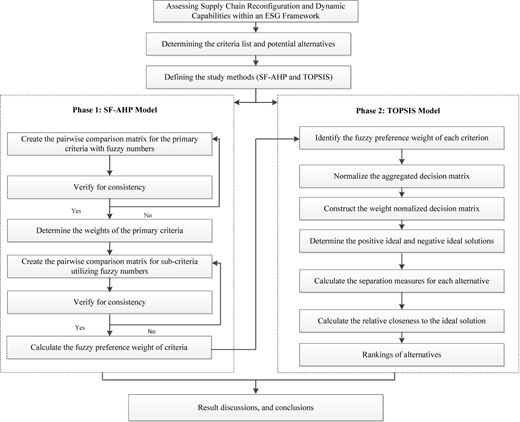
To provide a clearer understanding of the overall research process, the methodological framework of this study is illustrated in Figure 1. The flowchart outlines the sequential stages followed in the analysis, beginning with the identification of criteria and expert consultation, followed by the determination of criteria weights using the SF-AHP, and culminating in the ranking of alternatives through the TOPSIS method. This visual representation facilitates a comprehensive view of how the two methods are integrated to support MCDM within the ESG framework.

The SFS was developed as an extension of the intuitionistic fuzzy set, the PFS and neutrosophic logic by Kutlu Gündoğdu and Kahraman (2019). Its primary purpose is to address uncertainty in quantifying expert judgments. The operational rules and mathematical properties of SFSs are presented in the supplementary file (see section 3.1).

The criteria weights are determined using the SF-AHP (Kutlu Gündoğdu and Kahraman, 2020). The procedure comprises the construction of a spherical fuzzy pairwise comparison matrix, aggregation of expert judgments, consistency verification and criteria weights. The detailed computational steps are reported in the supplementary file (see section 3.2).

The TOPSIS model will be employed to rank the solutions in this study after the SF-AHP model is employed to determine the criteria weights. A similarity index to the positive-ideal solution and a remoteness index from the negative-ideal solution are defined by TOPSIS. Subsequently, the method selects an alternative that is most similar to the positive-ideal solution (Hwang and Masud, 2012). The method consists of normalization of the decision matrix, construction of the weighted normalized matrix, identification of ideal solutions and calculation of closeness coefficients. For brevity, the detailed computational procedures are provided in the supplementary file (see section 3.3).

The SF-AHP method employed to rank criteria by conducting pairwise comparisons and calculating their relative significance. A decision-making group was established to achieve this objective, consisting of 12 experts who were provided with the information in Table S1 (see supplementary material). These experts were independent from the evaluated companies and were selected for their experience and professional expertise in supply chain management, sustainability and the garment industry. Their primary obligation was to provide input for the pairwise comparison matrix. Three main criteria and 20 hierarchical sub-criteria are presented in this study to determine which criteria should be prioritized. The consistency ratios (CR) will be calculated to confirm the reliability of the experts’ judgments. The initial pairwise comparisons derived from the questionnaire responses are presented in Table S2 (see supplementary material).

The Crisp matrix, Normalized matrix and CR are presented in Tables S3 and S4 (see supplementary material), respectively. Then, the weights of the main criteria, sub-criteria and their rankings are presented in Table 3.

Based on the results, the evaluation framework comprises three main criteria: DC, SCR and ESG factors. Among these, DC has the highest main weight (0.381) and ranks first, indicating its dominant influence in the overall assessment. Within this category, sub-criteria DC7 (0.1851) and DC6 (0.1643) emerge as the most influential on local weights, ranking fourth and sixth globally, respectively.

SCR follows closely with a main weight of 0.361 and ranks second, demonstrating a level of importance nearly equivalent to DC. The top-performing sub-criteria in this group, SCR1 (0.3037) and SCR3 (0.2623), achieve the highest local importance scores among all sub-criteria, ranking first and second in global weights. This suggests that SCR capability is a pivotal strategic dimension in the evaluation.

ESG ranks third with the lowest main weight (0.258), indicating a supportive but non-negligible role in the model. Although ESG-related sub-criteria generally hold smaller weights, ESG4 (0.121) shows the largest influence within the group.

A comparative analysis reveals that the gap between DC and SCR is small, underscoring the need to prioritize both DC and SCR capability concurrently in strategic decision-making. For the global weights, the top five most important sub-criteria, including SCR1, SCR3, SCR2, DC7 and SCR4, are concentrated in DC and SCR, confirming their central role in driving performance outcomes.

The results of the TOPSIS method, including the weighted normalized decision matrix (Table 4) calculated based on the global weight (Table 3) and the final ranking (Table 5), are presented later. Note that, for confidentiality, the actual company names corresponding to A1–A12 are not disclosed; however, the full set of alternatives is listed for reference in Table S5 (see supplementary material). Twelve garment enterprises were selected as evaluation alternatives based on expert consultation and their representativeness in Vietnam’s garment industry. The selected firms comprise both domestic and foreign-invested companies, varying in ownership structure, production scale and market orientation (such as export- or retail-focused businesses). This diversity ensures that the application of the SF-AHP and TOPSIS model reflects a realistic and heterogeneous sample, highlighting its practical relevance and methodological robustness.

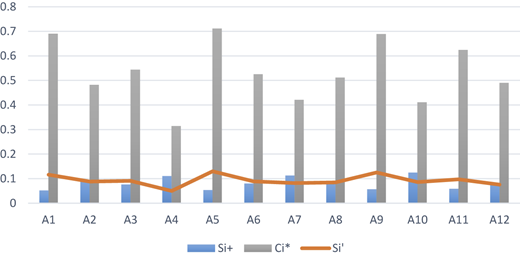
According to Table 5 and Figure 2, the overall performance varies markedly. A5 leads with the highest Ci∗ = 0.711, narrowly ahead of A1 (0.690, difference = 0.021) and A9 (0.689, difference = 0.001 to A1), indicating a tight top tier whose members are close to the positive ideal and far from the negative ideal (such as A5 with Si+ = 0.053, Si’ = 0.130). A11 (0.624) forms a strong upper-middle performer. A competitive middle cluster – A3 (0.544), A8 (0.511), A6 (0.525) – trails the leaders but remains within striking distance. A12 (0.490) and A2 (0.482) sit mid-pack, while A7 (0.421), A10 (0.411) and A4 (0.314) occupy the lower tier, characterized by larger distances to the ideal and smaller separations from the negative ideal (e.g. A4 with Si+ = 0.110, Si’ = 0.050).

Patterns in the weighted matrix (Table 4) indicate that DC3 and DC4 exert substantial influence on the composite scores. Top performers consistently register strong contributions on these criteria, for example A5 (DC3 = 0.188; DC4 = 0.129), A9 (0.184; 0.124) and A1 (0.170; 0.134), while some lower ranked options show an imbalance (strong DC4 but weak DC3), which likely depresses their overall performance (e.g. A10 with DC4 = 0.169 vs. DC3 = 0.067; A7 with 0.165 vs. 0.081). Top-ranking companies also differentiate on selected SCR/ESG dimensions, notably SCR2 and ESG3/ESG4 (e.g. A9 with SCR2 = 0.023; ESG2 = ESG4 = 0.016; A5 with ESG1 = 0.017), reinforcing their proximity to the ideal solution.

The SF-AHP model results show that DC is the most significant of the three main criteria, ranking highest, highlighting their central role in shaping adaptability and competitiveness in Vietnam’s garment sector. This suggests that firms' ability to adjust routines, processes and relationships is more critical than reliance on static resources or compliance-based sustainability practices in a highly volatile and buyer-driven industry.

These findings align with Li et al. (2025), who highlighted that DCs strengthen supply chain sustainability by fostering resilience in China’s construction sector. Likewise, De Moura and Saroli (2021) observed that SMEs in Brazil cultivated DCs to navigate regulatory and logistical disruptions, resulting in more sustainable value chains. Thus, this study not only reaffirms the robustness of the DCs framework across various industries and national contexts but also advances it by integrating ESG-related adaptability into the model – an aspect that remains insufficiently explored in emerging economies.

Although SCR ranks below DC, its sub-criteria remain strategically significant. The top-ranked sub-criterion, digital integration (SCR1), emerges as the leading sub-criterion, highlighting that digital transformation is a key driver of supply chain agility and responsiveness. This result aligns with the findings of Zhang et al. (2024) and Rana et al. (2025), who showed that digital transformation enhances supply chain reconfigurability, leading to improved integration and resilience. Overall, these findings reinforce the expanding literature that positions digitally enabled reconfiguration as an essential pathway through which DCs are converted into superior operational performance.

Although ESG criteria received the lowest relative weight among the three main dimensions, their importance remains substantial. Sub-criteria such as energy-saving practices (ESG4) and equality and diversity in recruitment (ESG7) were highly valued, indicating a shift toward viewing ESG as a strategic enabler rather than a compliance requirement. These findings are consistent with Das (2023), who showed that strong governance and ESG-oriented training enhance both firms’ environmental performance and financial outcomes, highlighting ESG’s dual operational and financial significance. The results, therefore, suggest that ESG considerations are becoming an integral component of DC development rather than an external supplement.

The global weight analysis from the SF-AHP model indicates that DC holds the highest importance at the main-criteria level, emphasizing its role as the strategic foundation for sustainable supply chain transformation. However, several DC sub-criteria, such as sensing, seizing and reconfiguring, rank lower than SCR sub-criteria. This divergence reflects the contextual reality of Vietnam’s garment sector, where DC practices are long term and abstract, while SCR actions are more tangible and yield immediate operational impact. The SF-AHP results thus reveal a clear distinction between strategic recognition (DC) and practical prioritization (SCR) in experts’ judgments.

The TOPSIS results reveal distinct performance differences among the 12 garment enterprises, with the closeness coefficient (Ci*) ranging from 0.711 (A5) to 0.314 (A4). These differences can be explained by how closely each firm’s capability profile aligns with the critical criteria identified by SF-AHP, particularly digitally enabled SCR and learning-based DCs.

The top performing firms – A5 (rank 1), A1 (rank 2) and A9 (rank 3) – demonstrate consistently strong performance across the highest weighted drivers, including SCR1 (integrating digitalization ability), SCR3 (diversification of supply sources) and DC7 (learning orientation and application). Their relatively low distance from the positive ideal solution (Si+) and high distance from the negative ideal solution (Si-) indicate a balanced and complementary capability configuration. These findings suggest that superior performance is achieved not through isolated ESG initiatives but through the effective integration of learning, digitalization and SCR. Such integration enables firms to perceive sustainability-related pressures and translate them into concrete operational actions (Eisenhardt and Martin, 2017; Teece, 2007).

Mid-ranked firms, including A11, A3 and A6, demonstrate partial alignment with the primary performance drivers. Although these firms display moderate strength in specific DCs – such as sensing or networking – their weaker performance in digitalized reconfiguration limits their ability to translate knowledge and ESG pressures into tangible operational improvements. Consequently, their Ci* values remain moderate, indicating inadequate transformation mechanisms that connect capabilities to performance outcomes (Helfat and Peteraf, 2015).

In contrast, the lowest-ranked firms, notably A4 and A10, perform poorly across several high-weight criteria, particularly SCR1 and DC7. While some ESG-related practices may exist, these firms lack the dynamic and reconfiguration capabilities necessary to embed ESG principles into their core operations. This deficiency results in a greater distance from the ideal solution and lower overall performance. This pattern is consistent with previous research on limited absorptive capacity and organizational rigidity, which translates external sustainability demands into effective operational practices (Beske, 2012).

Overall, the findings suggest that variations in performance among alternatives are primarily determined by alignment with high-impact criteria, the complementarity between DCs and SCR and the capability to transform ESG pressures into successful organizational and structural changes. This explains why companies with comparable institutional environments show noticeably different levels of sustainable competitiveness.

This study provides significant theoretical implications by integrating DCs theory, the RBV, SCR and the ESG framework within a unified SF-AHP–TOPSIS approach.

First, these findings extend the RBV by demonstrating that sustainable competitiveness in Vietnam’s garment sector is determined less by static resource ownership and more by orchestration of capabilities. While the RBV highlights the importance of valuable and inimitable resources (Barney, 1991), the main-criteria results reveal that DCs and SCR have a greater impact than ESG factors. This implies that ESG-related resources alone do not generate competitive advantage unless firms possess the capabilities to continuously recombine and redeploy them in volatile and sustainability-constrained environments.

Second, this study advances DC theory by empirically identifying learning orientation (DC7), networking capability (DC6) and sensing capability (DC5) as the most influential microfoundations underpinning sustainability-oriented competitiveness. Consistent with the sensing–seizing–transforming framework (Teece et al., 1997), these findings reaffirm the central role of organizational learning and external linkages, while extending prior research by demonstrating the amplified significance in ESG constrained, buyer-driven global supply chains. The pronounced importance of learning orientation suggested that sustainable competitiveness depends on institutionalized learning routines, rather than reactive or ad hoc responses to market or ESG pressures.

Third, this study conceptualizes SCR as a digitally enabled extension of DCs rather than a purely operational adjustment. The global priority analysis reveals that the integration of digitalization ability (SCR1) is the most influential driver, followed by supplier diversification (SCR3) and logistics network redesign (SCR2). While these findings align with the existing literature on reconfiguration and resilience, which emphasizes adaptability, they further extend the body of work by positioning digitalization as a capability multiplier that accelerates and enhances the effectiveness of reconfiguration. In contrast to metric-based perspectives of reconfigurability (e.g. Zidi et al., 2022), which focus on structural attributes, the results suggest that effective reconfiguration in the garment sector relies more heavily on firms’ ability to actively mobilize and redeploy supply chain resources in real time. Consequently, SCR serves as the transformative dimension of DCs, translating sensing and learning into structural and network-level change.

Fourth, this study theoretically positions ESG as a boundary condition rather than a direct source of competitive advantage in emerging economy manufacturing. While ESG criteria receive lower overall weights, the relative significance of energy saving (ESG4) and emission reduction practices (ESG5) indicates that ESG contributes primarily through operational efficiency and compliance legitimacy. This perspective is consistent with Chu et al. (2025), who argue that ESG metrics create value chiefly by supporting efficiency and compliance-oriented decision-making processes. Collectively, these findings indicate that competitive advantage arises not from ESG adoption in isolation but from embedding ESG requirements within DCs and SCR mechanisms.

Finally, by integrating SF-AHP and TOPSIS, this study establishes a connection between capability priorities and firm level performance differentiation. The observed heterogeneity among the 12 firms, where A5, A1 and A9 are closest to the ideal solution while A4 and A10 lag behind, demonstrates that sustainability outcomes are contingent upon distinct configurations of high impact capabilities within the same institutional context. These findings support a capability bundling perspective, suggesting that sustainable competitiveness emerges from complementarities among learning-oriented DCs, digitally enabled reconfiguration and ESG-aligned practices.

The findings provide clear guidance for managers and policymakers seeking to enhance sustainable competitiveness in Vietnam’s garment sector.

For firm managers, digitally enabled SCR should be prioritized, as SCR1 emerges as the most influential driver of sustainable competitiveness. Investment strategies should emphasize the implementation of integrated digital systems that improve visibility, coordination and the ability to rapidly reconfigure across sourcing, production and logistics. To reduce dependency risks and increase responsiveness, businesses should simultaneously strengthen resilience by diversifying supply sources (SCR3) and redesigning logistics networks (SCR2). Additionally, given the central role of learning orientation (DC7), enterprises should institutionalize learning routines through continuous improvement procedures, cross-functional knowledge sharing and training aligned with sustainable goals. Enhancing networking (DC6) and sensing (DC5) capabilities further enables firms to anticipate shifts in buyer demands, ESG standards and make proactive adjustments.

For benchmarking and identifying capability gaps, the TOPSIS rankings provide a robust framework for performance evaluation. High-performing firms (A5, A1, A9) represent reference models in effective capability configuration, whereas lower-ranked firms (A4, A10) are advised to strategically allocate resources toward high impact drivers, specifically digitalized reconfiguration and learning capabilities, rather than dispersing efforts across fragmented ESG initiatives.

For policymakers, ESG-oriented policies are most effective when prioritizing capability development over mere compliance. The policy agenda should incorporate incentives for digital transformation and traceability, measures to support supply chain resilience and diversification and capacity-building initiatives that strengthen managerial learning and reconfiguration capabilities. Aligning ESG regulations with these capability-building mechanisms is likely to enhance both regulatory compliance and long-term competitiveness within the garment sector.

At the societal level, digital (SCR1) integration and learning (DC7)-driven practices stabilize operations, enhance employee skills and secure jobs, while energy-saving (ESG4) initiatives improve workplace safety, fostering sustainable and inclusive workforce development.

This study examines how DCs, SCR and ESG considerations jointly shape sustainable competitiveness in Vietnam’s garment industry by employing an integrated SF-AHP–TOPSIS approach. By prioritizing key capability dimensions and evaluating firm-level performance, the study provides a structured assessment of how firms respond to increasing market volatility and sustainability pressures.

The SF-AHP analysis results indicate that DCs play a dominant role in driving sustainable competitiveness, followed closely by digitally enabled SCR, while ESG-related practices primarily serve as enabling conditions embedded in organizational and operational routines. The TOPSIS results indicate that firms A5, A1 and A9 perform best, reflecting stronger capability configurations and sustainability alignment.

From a theoretical perspective, this study contributes to the literature by establishing a framework that integrates DC theory with ESG-driven SCR through an MCDM-based analytical process. It extends prior research by quantitatively operationalizing the concepts of sensing, seizing and reconfiguring capabilities within the ESG context. Furthermore, the integration of SF-AHP and TOPSIS represents a methodological innovation that improves the accuracy and transparency of decision- making under uncertainty in sustainability research.

From a practical standpoint, the findings provide actionable guidance for managers and policymakers in emerging-economy manufacturing sectors. Firms are encouraged to strengthen learning-oriented capabilities, embrace digital transformation and develop flexible supply chain structures to enhance resilience and sustain long-term competitiveness under ESG constraints. For policymakers, the results indicate that sustainability-oriented policies are most effective when they facilitate capability development and organizational learning alongside regulatory enforcement.

Despite these contributions, the study has certain limitations. Although the current ranking results are consistent and derived from expert consensus, no sensitivity analysis was conducted for the TOPSIS model, nor were comparisons made with alternative MCDM techniques. Future research should incorporate sensitivity or robustness analyses to examine how variations in the criterion weights may influence the ranking outcomes and to further validate the stability of the proposed model. Additionally, the empirical application focused solely on Vietnam’s garment industry, potentially limiting generalizability. Subsequent studies could extend the framework to other industries or countries, employ alternative fuzzy-based decision models and undertake longitudinal analyses to capture the development of ESG-driven DCs over time.

The supplementary material for this article can be found online
Al Dhaheri
,
M.H.
,
Ahmad
,
S.Z.
and
Papastathopoulos
,
A.
(
2024
), “
Do environmental turbulence, dynamic capabilities, and artificial intelligence force SMEs to be innovative?
”,
Journal of Innovation and Knowledge
, Vol. 
9
No. 
3
, 100528, doi: .
Al Naimi
,
M.
,
Faisal
,
M.N.
,
Sobh
,
R.
and
Bin Sabir
,
L.
(
2022
), “
A systematic mapping review exploring 10 years of research on supply chain resilience and reconfiguration
”,
International Journal of Logistics Research and Applications
, Vol. 
25
No. 
8
, pp. 
1191
-
1218
, doi: .
Aljarboa
,
S.
(
2024
), “
Factors influencing the adoption of artificial intelligence in e-commerce by small and medium-sized enterprises
”,
International Journal of Information Management Data Insights
, Vol. 
4
No. 
2
, 100285, doi: .
Asian Productivity Organization
(
2025
), “
National strategy to boost Vietnam's textile and garment productivity through innovation and technology
”,
available at:
 https://www.apo-tokyo.org/wp-content/uploads/2025/10/Vietnam‘s-Textile-and-Garment-Sector_PUB.pdf
Aslam
,
H.
,
ur Rehman
,
A.
,
Iftikhar
,
A.
,
ul Haq
,
M.Z.
,
Akbar
,
U.
and
Kamal
,
M.M.
(
2025
), “
Digital transformation: unlocking supply chain resilience through adaptability and innovation
”,
Technological Forecasting and Social Change
, Vol. 
219
, 124234, doi: .
Barney
,
J.
(
1991
), “
Firm resources and sustained competitive advantage
”,
Journal of Management
, Vol. 
17
No. 
1
, pp. 
99
-
120
, doi: .
Basit
,
A.
,
Javed
,
A.
,
Khan
,
K.A.
,
Aslam
,
M.A.
and
Nazir
,
H.
(
2025
), “
The path to supply chain resilience and robustness: a dynamic capability view
”,
Journal of Manufacturing Technology Management
, Vol. 
36
No. 
8
, pp.
1493
-
1512
.
Beske
,
P.
(
2012
), “
Dynamic capabilities and sustainable supply chain management
”,
International Journal of Physical Distribution and Logistics Management
, Vol. 
42
No. 
4
, pp. 
372
-
387
, doi: .
Bhadra
,
K.V.
,
Kamalanabhan
,
T.J.
and
Singh
,
S.K.
(
2024
), “
Evolution of dynamic capabilities for business sustainability performance: evidence from the Indian manufacturing sector
”,
Business Strategy and the Environment
, Vol. 
33
No. 
6
, pp. 
5583
-
5605
, doi: .
Chu
,
Y.T.
,
Moktadir
,
M.A.
and
Ren
,
J.
(
2025
), “
Constructing an environmental, social, and governance (ESG) metrics framework for assessing medical waste valorization alternatives: a novel integrated MCDM model under decomposed fuzzy environment
”,
Journal of Environmental Management
, Vol. 
373
, 123457, doi: .
Das
,
A.
(
2023
), “
Predictive value of supply chain sustainability initiatives for ESG performance: a study of large multinationals
”,
Multinational Business Review
, Vol. 
32
No. 
1
, pp. 
20
-
40
, doi: .
de Moura
,
G.B.
and
Saroli
,
L.G.
(
2021
), “
Sustainable value chain management based on dynamic capabilities in small and medium-sized enterprises (SMEs)
”,
International Journal of Logistics Management
, Vol. 
32
No. 
1
, pp. 
168
-
189
, doi: .
de Souza Barbosa
,
A.
,
Crispim
,
M.C.
,
da Silva
,
L.B.
,
da Silva
,
J.M.N.
,
Barbosa
,
A.M.
,
de Morais Correia
,
L.M.A.
and
Morioka
,
S.N.
(
2025
), “
Empirical analysis of workers' perceptions of ESG impacts on corporate sustainability performance: a methodological innovation combining the PLS-SEM, PROMETHEE-ROC and FIMIX-PLS methods
”,
Technological Forecasting and Social Change
, Vol. 
215
, 124091, doi: .
Dolgui
,
A.
,
Ivanov
,
D.
and
Sokolov
,
B.
(
2020
), “
Reconfigurable supply chain: the X-network
”,
International Journal of Production Research
, Vol. 
58
No. 
13
, pp. 
4138
-
4163
, doi: .
Eisenhardt
,
K.M.
and
Martin
,
J.A.
(
2017
), “Dynamic capabilities: what are they?”, in
The SMS Blackwell Handbook of Organizational Capabilities
, pp. 
341
-
363
.
Elf
,
P.
,
Werner
,
A.
and
Black
,
S.
(
2022
), “
Advancing the circular economy through dynamic capabilities and extended customer engagement: insights from small sustainable fashion enterprises in the UK
”,
Business Strategy and the Environment
, Vol. 
31
No. 
6
, pp. 
2682
-
2699
, doi: .
Ellström
,
D.
,
Holtström
,
J.
,
Berg
,
E.
and
Josefsson
,
C.
(
2021
), “
Dynamic capabilities for digital transformation
”,
Journal of Strategy and Management
, Vol. 
15
No. 
2
, pp. 
272
-
286
, doi: .
Guo
,
W.
,
Tian
,
Q.
,
Jiang
,
Z.
and
Wang
,
H.
(
2018
), “
A graph-based cost model for supply chain reconfiguration
”,
Journal of Manufacturing Systems
, Vol. 
48
, pp. 
55
-
63
, doi: .
Helfat
,
C.E.
and
Peteraf
,
M.A.
(
2015
), “
Managerial cognitive capabilities and the microfoundations of dynamic capabilities
”,
Strategic Management Journal
, Vol. 
36
No. 
6
, pp. 
831
-
850
, doi: .
Hirth
,
S.
and
Palepu
,
S.
(
2025
), “
ESG alignment and supply chain dynamics: evidence from U.S. customer–supplier relationships
”,
SSRN preprint
, doi: .
Hoang
,
P.-D.
,
Nguyen
,
L.-T.
and
Tran
,
B.-Q.
(
2024a
), “
Assessing environmental, social and governance (ESG) performance of global electronics industry: an integrated MCDM approach-based spherical fuzzy sets
”,
Cogent Engineering
, Vol. 
11
No. 
1
, 2297509, doi: .
Hoang
,
P.-D.
,
Nguyen
,
L.-T.
,
Tran
,
B.-Q.
and
Ta
,
D.-T.
(
2024b
), “
Corporate governance for sustainable development in Vietnam: criteria for SOEs based on MCDM approach
”,
PLoS One
, Vol. 
19
No. 
5
, e0302306, doi: .
Hwang
,
C.-L.
and
Masud
,
A.S.M.
(
2012
),
Multiple Objective Decision Making—Methods and Applications: A State-of-the-Art Survey
,
Springer Science & Business Media
,
Berlin and Heidelberg
, Vol. 
164
.
Jiang
,
W.
,
Mavondo
,
F.
and
Zhao
,
W.
(
2020
), “
The impact of business networks on dynamic capabilities and product innovation: the moderating role of strategic orientation
”,
Asia Pacific Journal of Management
, Vol. 
37
No. 
4
, pp. 
1239
-
1266
, doi: .
Jüttner
,
U.
,
Peck
,
H.
and
Christopher
,
M.
(
2003
), “
Supply chain risk management: outlining an agenda for future research
”,
International Journal of Logistics Research and Applications
, Vol. 
6
No. 
4
, pp. 
197
-
210
, doi: .
Katiyar
,
R.
,
Meena
,
P.L.
,
Barua
,
M.K.
,
Tibrewala
,
R.
and
Kumar
,
G.
(
2018
), “
Impact of sustainability and manufacturing practices on supply chain performance: findings from an emerging economy
”,
International Journal of Production Economics
, Vol. 
197
, pp. 
303
-
316
, doi: .
Kaur
,
M.
and
Yadav
,
R.
(
2022
), “
Prioritizing the indicators responsible for sustainable municipal solid waste management using SF-AHP and SF-TOPSIS
”,
Research Square Preprint
, doi: .
Koren
,
Y.
(
2010
),
The Global Manufacturing Revolution: Product-Process-Business Integration and Reconfigurable Systems
,
John Wiley & Sons
,
Hoboken, New Jersey
.
Kutlu Gündoğdu
,
F.
and
Kahraman
,
C.
(
2019
), “
Spherical fuzzy sets and spherical fuzzy TOPSIS method
”,
Journal of Intelligent and Fuzzy Systems
, Vol. 
36
No. 
1
, pp. 
337
-
352
, doi: .
Kutlu Gündoğdu
,
F.
and
Kahraman
,
C.
(
2020
), “
A novel spherical fuzzy analytic hierarchy process and its renewable energy application
”,
Soft Computing
, Vol. 
24
No. 
6
, pp. 
4607
-
4621
, doi: .
Laaksonen
,
O.
and
Peltoniemi
,
M.
(
2018
), “
The essence of dynamic capabilities and their measurement
”,
International Journal of Management Reviews
, Vol. 
20
No. 
2
, pp. 
184
-
205
, doi: .
Lee
,
N. C.-A.
(
2021
), “
Reconciling integration and reconfiguration management approaches in the supply chain
”,
International Journal of Production Economics
, Vol. 
242
, 108288, doi: .
Li
,
K.
,
Bashiri
,
M.
,
Lim
,
M.K.
and
Akpobi
,
T.
(
2025
), “
How to improve supply chain sustainable performance by resilience practices through dynamic capability view: evidence from Chinese construction
”,
Resources, Conservation and Recycling
, Vol. 
212
, 107965, doi: .
Liang
,
Y.
,
Lee
,
M.J.
and
Jung
,
J.S.
(
2022
), “
Dynamic capabilities and an ESG strategy for sustainable management performance
”,
Frontiers in Psychology
, Vol. 
13
, 887776, doi: .
Liu
,
J.
(
2025
), “
ESG strategy in the supply chain considering ownership structures
”,
Discover Sustainability
, Vol. 
6
No. 
1
, p.
11
, doi: .
Mathew
,
M.
,
Chakrabortty
,
R.K.
and
Ryan
,
M.J.
(
2020
), “
A novel approach integrating AHP and TOPSIS under spherical fuzzy sets for advanced manufacturing system selection
”,
Engineering Applications of Artificial Intelligence
, Vol. 
96
, 103988, doi: .
Meier
,
O.
,
Gruchmann
,
T.
and
Ivanov
,
D.
(
2023
), “
Circular supply chain management with blockchain technology: a dynamic capabilities view
”,
Transportation Research Part E: Logistics and Transportation Review
, Vol. 
176
, 103177, doi: .
Mongkol
,
K.
(
2021
), “
The influence of dynamic capabilities on performance of small and medium firms: the case of Thai SMEs
”,
International Journal of Entrepreneurship
, Vol. 
25
No. 
7
, pp. 
1
-
11
.
Monika
and
Sangwan
,
O.P.
(
2022
), “
A framework for evaluating cloud computing services using AHP and TOPSIS approaches with interval valued spherical fuzzy sets
”,
Cluster Computing
, Vol. 
25
No. 
6
, pp. 
4383
-
4396
, doi: .
Oh
,
S.
,
Ryu
,
K.
and
Jung
,
M.
(
2013
), “
Reconfiguration framework of a supply network based on flexibility strategies
”,
Computers & Industrial Engineering
, Vol. 
65
No. 
1
, pp. 
156
-
165
, doi: .
Ortiz‐Avram
,
D.
,
Ovcharova
,
N.
and
Engelmann
,
A.
(
2024
), “
Dynamic capabilities for sustainability: toward a typology based on dimensions of sustainability‐oriented innovation and stakeholder integration
”,
Business Strategy and the Environment
, Vol. 
33
No. 
4
, pp. 
2969
-
3004
, doi: .
Pavlou
,
P.A.
and
El Sawy
,
O.A.
(
2011
), “
Understanding the elusive black box of dynamic capabilities
”,
Decision Sciences
, Vol. 
42
No. 
1
, pp. 
239
-
273
, doi: .
Rana
,
J.
,
Daultani
,
Y.
,
Goswami
,
M.
and
Kumar
,
S.
(
2025
), “
Exploring the impact of supply chain digital transformation on supply chain performance: an empirical investigation
”,
Business Strategy and the Environment
, Vol. 
34
No. 
3
, pp. 
3497
-
3521
, doi: .
Rosalin
,
G.
and
Santosa
,
W.
(
2023
), “
Evaluation of suppliers in the implementation of sustainable supply chains for the apparel industry in Indonesia
”,
Journal for Social Research
, Vol. 
2
No. 
10
, pp. 
3534
-
3543
, doi: .
Rungtrakulchai
,
R.
and
Kanignant
,
T.
(
2024
), “
Developing propositions on firm capabilities, business network, knowledge management practices and dynamic capabilities in the Thai textile industry
”,
Journal of Business Administration and Languages (JBAL)
, Vol. 
12
No. 
2
, pp. 
1
-
11
.
Sharaf
,
I.M.
(
2020
), “Global supplier selection with spherical fuzzy analytic hierarchy process”, in
Decision Making with Spherical Fuzzy Sets: Theory and Applications
,
Springer
, pp. 
323
-
348
.
Sharma
,
M.
,
Shah
,
J.K.
and
Joshi
,
S.
(
2023
), “
Modeling enablers of supply chain decarbonisation to achieve zero carbon emissions: an environment, social and governance (ESG) perspective
”,
Environmental Science and Pollution Research
, Vol. 
30
No. 
31
, pp. 
76718
-
76734
, doi: .
Stadtfeld
,
G.M.
and
Gruchmann
,
T.
(
2024
), “
Dynamic capabilities for supply chain resilience: a meta-review
”,
International Journal of Logistics Management
, Vol. 
35
No. 
2
, pp. 
623
-
648
, doi: .
Teece
,
D.J.
(
2007
), “
Explicating dynamic capabilities: the nature and microfoundations of (sustainable) enterprise performance
”,
Strategic Management Journal
, Vol. 
28
No. 
13
, pp. 
1319
-
1350
, doi: .
Teece
,
D.J.
(
2023
), “
The evolution of the dynamic capabilities framework
”,
Artificiality and Sustainability in Entrepreneurship
, Vol. 
113
, p.
238
.
Teece
,
D.J.
,
Pisano
,
G.
and
Shuen
,
A.
(
1997
), “
Dynamic capabilities and strategic management
”,
Strategic Management Journal
, Vol. 
18
No. 
7
, pp. 
509
-
533
, doi: .
Tezcan
,
B.
and
Eren
,
T.
(
2025
), “
Integer programming based on spherical fuzzy AHP and spherical fuzzy TOPSIS for wildfire equipment planning
”,
Environment Systems and Decisions
, Vol. 
45
No. 
3
, p.
38
, doi: .
Uddin
,
M.H.
,
Razzak
,
M.R.
and
Rahman
,
A.A.
(
2023
), “
Sustainable supply chain management practices, dynamic capabilities and competitive advantage: evidence from Bangladesh ready‐made garments industry
”,
Business Strategy & Development
, Vol. 
6
No. 
2
, pp. 
176
-
188
, doi: .
Ulle
,
R.S.
,
Yogananthan
,
S.
,
Gopalan
,
B.
and
Patil
,
K.
(
2025
), “Enhancing supply chain resilience in the fashion apparel industry through advanced analytics: a review”, in
Supply Chain Transformation Through Generative AI and Machine Learning
, pp. 
129
-
150
.
Vesalainen
,
J.
and
Hakala
,
H.
(
2014
), “
Strategic capability architecture: the role of network capability
”,
Industrial Marketing Management
, Vol. 
43
No. 
6
, pp. 
938
-
950
, doi: .
Wei
,
H.-L.
and
Wang
,
E.T.G.
(
2010
), “
The strategic value of supply chain visibility: increasing the ability to reconfigure
”,
European Journal of Information Systems
, Vol. 
19
No. 
2
, pp. 
238
-
249
, doi: .
Xu
,
B.
,
Guo
,
Q.
and
Chen
,
L.
(
2025
), “
The Influence of Supply Chain Digitalization on Enterprise ESG Performance: a quasi-natural experiment based on pilot policies for supply chain innovation and application
”,
Economic Analysis and Policy
, Vol. 
87
, pp.
1058
-
1072
.
Zai
,
A.I.
,
Rahim
,
B.S.A.
,
Setyawan
,
C.A.
and
Rahman
,
D.N.A.A.
(
2024
), “
The influence of multiple sourcing supplier strategy, supply chain risk management and technology adoption on supply chain resilience (SCRe); Mediating role of supply chain flexibility (SCF) in Indonesia
”,
Global Business and Management Research
, Vol. 
16
No. 
3
, pp. 
35
-
55
.
Zeng
,
H.
,
Li
,
R.Y.M.
and
Zeng
,
L.
(
2022
), “
Evaluating green supply chain performance based on ESG and financial indicators
”,
Frontiers in Environmental Science
, Vol. 
10
, 982828, doi: .
Zhang
,
L.
,
Gu
,
F.
and
He
,
M.
(
2024
), “
The influence of digital transformation on the reconfigurability and performance of supply chains: a study of the electronic, machinery, and home appliance manufacturing industries in China
”,
Sustainability
, Vol. 
16
No. 
7
,
2689
, doi: .
Zhou
,
Y.
,
Zhang
,
N.
,
Wu
,
C.-H.
,
Wang
,
Y.
,
Zhang
,
X.
and
Zhang
,
D.
(
2024
), “
The impact of supply chain ESG management on supply chain resilience with emerging IT technologies: based on supply chain network capabilities
”,
Journal of Organizational and End User Computing
, Vol. 
36
No. 
1
, pp. 
1
-
31
, doi: .
Zidi
,
S.
,
Hamani
,
N.
and
Kermad
,
L.
(
2022
), “
New metrics for measuring supply chain reconfigurability
”,
Journal of Intelligent Manufacturing
, Vol. 
33
No. 
8
, pp. 
2371
-
2392
, doi: .
Storer
,
M.
and
Hyland
,
P.
(
2011
), “
Reconfiguration or innovation in supply chains?
”,
International Journal of Technology Management
, Vol. 
56
Nos
2/3/4
, pp. 
188
-
207
, doi: .
Published in International Journal of Industrial Engineering and Operations Management. Published by Emerald Publishing Limited. This article is published under the Creative Commons Attribution (CC BY 4.0) licence. Anyone may reproduce, distribute, translate and create derivative works of this article (for both commercial and non-commercial purposes), subject to full attribution to the original publication and authors. The full terms of this licence may be seen at Link to the terms of the CC BY 4.0 licence.

Supplementary data

Data & Figures

Figure 1
A process flow diagram shows an integrated SF-AHP and TOPSIS methodology for use in this study.The process flow diagram is arranged vertically and horizontally, beginning at the top with three stacked rectangular boxes connected by downward arrows labeled “Assessing Supply Chain Reconfiguration and Dynamic Capabilities within an ESG Framework”, “Determining the criteria list and potential alternatives”, and “Defining the study methods (SF-AHP and TOPSIS)”. Below these, the diagram splits into two dashed rectangular sections placed side by side. On the left, a dashed box titled “Phase 1: SF-AHP Model” contains a vertical sequence of rectangles connected by downward arrows reading “Create the pairwise comparison matrix for the primary criteria with fuzzy numbers”, followed by “Verify for consistency”, and a decision branch labeled “Yes” and “No”. The “No” arrow connects upward to “Create the pairwise comparison matrix for the primary criteria with fuzzy numbers”, while the “Yes” arrow connects downward to “Determine the weights of the primary criteria”, then to “Create the pairwise comparison matrix for sub-criteria utilizing fuzzy numbers”, followed by “Verify for consistency” with another “Yes” and “No” branch. In this second decision point, the “No” arrow connects upward to “Create the pairwise comparison matrix for sub-criteria utilizing fuzzy numbers”, and the “Yes” arrow connects downward to “Calculate the fuzzy preference weight of criteria”. On the right, a dashed box titled “Phase 2: TOPSIS Model” contains a vertical sequence of rectangles connected by downward arrows labeled “Identify the fuzzy preference weight of each criterion”, “Normalize the aggregated decision matrix”, “Construct the weight normalized decision matrix”, “Determine the positive ideal and negative ideal solutions”, “Calculate the separation measures for each alternative”, “Calculate the relative closeness to the ideal solution”, and “Rankings of alternatives”. A bidirectional arrow connects both dashed boxes. An arrow from “Calculate the fuzzy preference weight of criteria” leads to “Identify the fuzzy preference weight of each criterion”. At the bottom center, a final rectangle labeled “Result discussions and conclusions” is connected by downward arrows from both dashed boxes.

Research framework

Figure 1
A process flow diagram shows an integrated SF-AHP and TOPSIS methodology for use in this study.The process flow diagram is arranged vertically and horizontally, beginning at the top with three stacked rectangular boxes connected by downward arrows labeled “Assessing Supply Chain Reconfiguration and Dynamic Capabilities within an ESG Framework”, “Determining the criteria list and potential alternatives”, and “Defining the study methods (SF-AHP and TOPSIS)”. Below these, the diagram splits into two dashed rectangular sections placed side by side. On the left, a dashed box titled “Phase 1: SF-AHP Model” contains a vertical sequence of rectangles connected by downward arrows reading “Create the pairwise comparison matrix for the primary criteria with fuzzy numbers”, followed by “Verify for consistency”, and a decision branch labeled “Yes” and “No”. The “No” arrow connects upward to “Create the pairwise comparison matrix for the primary criteria with fuzzy numbers”, while the “Yes” arrow connects downward to “Determine the weights of the primary criteria”, then to “Create the pairwise comparison matrix for sub-criteria utilizing fuzzy numbers”, followed by “Verify for consistency” with another “Yes” and “No” branch. In this second decision point, the “No” arrow connects upward to “Create the pairwise comparison matrix for sub-criteria utilizing fuzzy numbers”, and the “Yes” arrow connects downward to “Calculate the fuzzy preference weight of criteria”. On the right, a dashed box titled “Phase 2: TOPSIS Model” contains a vertical sequence of rectangles connected by downward arrows labeled “Identify the fuzzy preference weight of each criterion”, “Normalize the aggregated decision matrix”, “Construct the weight normalized decision matrix”, “Determine the positive ideal and negative ideal solutions”, “Calculate the separation measures for each alternative”, “Calculate the relative closeness to the ideal solution”, and “Rankings of alternatives”. A bidirectional arrow connects both dashed boxes. An arrow from “Calculate the fuzzy preference weight of criteria” leads to “Identify the fuzzy preference weight of each criterion”. At the bottom center, a final rectangle labeled “Result discussions and conclusions” is connected by downward arrows from both dashed boxes.

Research framework

Close modal
Figure 2
A combined bar and dashed line chart shows values and across categories A 1 to A 12 on a 0 to 0.8 vertical scale.The horizontal axis lists 12 categories labeled “A 1”, “A 2”, “A 3”, “A 4”, “A 5”, “A 6”, “A 7”, “A 8”, “A 9”, “A 10”, “A 11”, and “A 12”, arranged from left to right. The vertical axis shows values ranging from 0 to 0.8, in increments of 0.1 units. Horizontal grid lines are drawn at each vertical axis increment. Each category includes two vertical bars and one line point, as indicated in the legend. The bars represent “S i plus” and “C i asterisk”. The line represents “S i prime”. Bar values are as follows. A 1: S i plus: 0.05. C i asterisk: 0.69. A 2: S i plus: 0.09. C i asterisk: 0.48. A 3: S i plus: 0.08. C i asterisk: 0.54. A 4: S i plus: 0.11. C i asterisk: 0.32. A 5: S i plus: 0.05. C i asterisk: 0.71. A 6: S i plus: 0.08. C i asterisk: 0.53. A 7: S i plus: 0.11. C i asterisk: 0.42. A 8: S i plus: 0.08. C i asterisk: 0.51. A 9: S i plus: 0.05. C i asterisk: 0.69. A 10: S i plus: 0.13. C i asterisk: 0.41. A 11: S i plus: 0.06. C i asterisk: 0.62. A 12: S i plus: 0.05. C i asterisk: 0.49. The line “S i prime” connects the following points in order from left to right: (A 1, 0.12), (A 2, 0.09), (A 3, 0.09), (A 4, 0.05), (A 5, 0.13), (A 6, 0.09), (A 7, 0.08), (A 8, 0.09), (A 9, 0.13), (A 10, 0.09), (A 11, 0.10), and (A 12, 0.08). Note: All numerical values are approximated.

TOPSIS distances and closeness coefficient for alternatives

Figure 2
A combined bar and dashed line chart shows values and across categories A 1 to A 12 on a 0 to 0.8 vertical scale.The horizontal axis lists 12 categories labeled “A 1”, “A 2”, “A 3”, “A 4”, “A 5”, “A 6”, “A 7”, “A 8”, “A 9”, “A 10”, “A 11”, and “A 12”, arranged from left to right. The vertical axis shows values ranging from 0 to 0.8, in increments of 0.1 units. Horizontal grid lines are drawn at each vertical axis increment. Each category includes two vertical bars and one line point, as indicated in the legend. The bars represent “S i plus” and “C i asterisk”. The line represents “S i prime”. Bar values are as follows. A 1: S i plus: 0.05. C i asterisk: 0.69. A 2: S i plus: 0.09. C i asterisk: 0.48. A 3: S i plus: 0.08. C i asterisk: 0.54. A 4: S i plus: 0.11. C i asterisk: 0.32. A 5: S i plus: 0.05. C i asterisk: 0.71. A 6: S i plus: 0.08. C i asterisk: 0.53. A 7: S i plus: 0.11. C i asterisk: 0.42. A 8: S i plus: 0.08. C i asterisk: 0.51. A 9: S i plus: 0.05. C i asterisk: 0.69. A 10: S i plus: 0.13. C i asterisk: 0.41. A 11: S i plus: 0.06. C i asterisk: 0.62. A 12: S i plus: 0.05. C i asterisk: 0.49. The line “S i prime” connects the following points in order from left to right: (A 1, 0.12), (A 2, 0.09), (A 3, 0.09), (A 4, 0.05), (A 5, 0.13), (A 6, 0.09), (A 7, 0.08), (A 8, 0.09), (A 9, 0.13), (A 10, 0.09), (A 11, 0.10), and (A 12, 0.08). Note: All numerical values are approximated.

TOPSIS distances and closeness coefficient for alternatives

Close modal
Table 1

Criteria summary

CodeCriteriaExplanationSource
DCDynamic capability
DC1Supply chain risk management capabilityThe ability of an organization to recognize, evaluate and reduce risks in the supply chain to guarantee continuity and efficiencyJüttner et al. (2003) 
DC2Innovation capabilityThe firm’s capacity to create and implement new ideas, procedures or products to strengthen their competitive advantageRungtrakulchai and Kanignant (2024) 
DC3Dynamic seizing capabilityThe capability to capture and execute opportunities promptly through mobilizing, deploying and reconfiguring resourcesTeece (2007) 
DC4Dynamic adaptabilityThe capability to adjust resources, business processes in response to changes in the environmentMongkol (2021) 
DC5Sensing capabilityThe capability to identify, evaluate and pursue opportunities as well as to recognize early opportunities, threats or trends in the business environmentPavlou and El Sawy (2011), Teece (2007) 
DC6Networking capabilityThe capacity to create, preserve and take advantage of relationships with external partnersVesalainen and Hakala (2014) 
DC7Learning orientation and applicationThe ability to update existing operational capabilities with newly acquired knowledgePavlou and El Sawy (2011) 
SCRSupply chain reconfiguration
SCR1Integrating digitalization abilityThe ability to apply digital technologies to enable effective supply chain reconfigurationWei and Wang (2010) 
SCR2Logistics network redesigning abilityThe ability to re-structure logistics nodes and flows (e.g. warehouses, transport routes) to adapt to changes in demand, supply disruptions or strategic prioritiesWei and Wang (2010), Guo et al. (2018) 
SCR3Diversifying supply sourcesThe ability to expanding and varying the supplier base to reduce dependence on single suppliersOh et al. (2013) 
SCR4Supplier flexibilityThe ability of suppliers to adjust manufacturing volumes, change product lines, to fulfill customized orders quickly in response to changesWei and Wang (2010) 
ESGEnvironmental, social and governance
ESG1Transparency of supplier informationVisibility into suppliers’ sourcing, practices and dataZhou et al. (2024) 
ESG2ESG disclosurePublic reporting of standardized ESG metrics to stakeholdersRosalin and Santosa (2023) 
ESG3Good working conditionsFair wages, humane hours, safe, rights-respecting workplacesRosalin and Santosa (2023) 
ESG4Energy savingReducing energy use through efficiency and conservation initiativesChu et al. (2025) 
ESG5Emission reduction policy, green standardsPolicies and standards for reducing greenhouse-gas emissionsChu et al. (2025) 
ESG6Use of recycled materialsIncorporating recycled or recyclable materials into products and packagingSharma et al. (2023) 
ESG7Equality and diversity in recruitmentEqual-opportunity, diversity-focused hiring and inclusive employment practicesRosalin and Santosa (2023) 
ESG8Internal ESG Governance PolicyFormal internal policies governing ESG responsibilities and conductRosalin and Santosa (2023) 
ESG9ESG compliance audit and assessment systemStructured audits and assessment instruments to verify ESG complianceChu et al. (2025) 
Table 2

Cross-referencing summary

CodeCriteriaTeece (2007) Jiang et al. (2020) Pavlou and El Sawy (2011) Wei and Wang (2010) Meier et al. (2023) Sharma et al. (2023) Ellström et al. (2021) Aljarboa (2024) Zhou et al. (2024) Rosalin and Santosa (2023) de Souza Barbosa et al. (2025) Chu et al. (2025) 
DCDynamic capability
DC1Supply chain risk management capability        vv  
DC2Innovation capabilityvvvv        
DC3Dynamic seizing capabilityvv vv v     
DC4Dynamic adaptabilityvv v        
DC5Sensing capabilityvvvvv vv    
DC6Networking capability vvv   vv   
DC7Learning orientation and application  vv   v    
SCRSupply chain reconfiguration
SCR1Integrating digitalization ability      vvv   
SCR2Logistics network redesigning ability    v       
SCR3Diversifying supply sources vv         
SCR4Supplier flexibility v  v       
ESGSocial, environmental and governance
ESG1Transparency of supplier information        v vv
ESG2ESG disclosure        vv  
ESG3Good working conditions        vv  
ESG4Energy saving     v  vvvv
ESG5Emission reduction policy, green standards        vv v
ESG6Use of recycled materials     v  vvvv
ESG7Equality and diversity in recruitment         v  
ESG8Internal ESG Governance Policy     v  vv  
ESG9ESG compliance audit and assessment system     v  vvvv

Note(s): “v” represents the presence of the criterion in the corresponding reference, meaning that the study explicitly addresses or operationalizes this factor

Table 3

Results of the final rankings and weights

CriteriaSF-WM-wRankSub-criteriaSF-WsL-wRankG-wG-crisp-WRank
DC(0.560, 0.404, 0.327)0.3811DC1(0.392, 0.591, 0.285)0.112870.0430.047311
   DC2(0.422, 0.559, 0.298)0.12260.0460.050910
   DC3(0.446, 0.538, 0.296)0.129940.0490.05378
   DC4(0.444, 0.532, 0.309)0.128650.0490.05349
   DC5(0.533, 0.441, 0.314)0.157430.060.06387
   DC6(0.550, 0.439, 0.292)0.164320.0630.06606
   DC7(0.613, 0.371, 0.284)0.185110.0710.07344
SCR(0.531, 0.438, 0.313)0.3612SCR1(0.594, 0.373, 0.316)0.303710.110.06731
   SCR2(0.493, 0.479, 0.323)0.246430.0890.05603
   SCR3(0.520, 0.450, 0.317)0.262320.0950.05912
   SCR4(0.384, 0.583, 0.306)0.187640.0680.04405
ESG(0.396, 0.562, 0.320)0.2583ESG1(0.476, 0.508, 0.303)0.112150.0290.040716
   ESG2(0.456, 0.524, 0.310)0.106380.0270.038919
   ESG3(0.481, 0.493, 0.320)0.112540.0290.041015
   ESG4(0.512, 0.468, 0.311)0.12110.0310.043712
   ESG5(0.484, 0.490, 0.322)0.11330.0290.041214
   ESG6(0.472, 0.502, 0.321)0.110260.0280.040317
   ESG7(0.489, 0.483, 0.322)0.114420.030.041713
   ESG8(0.471, 0.499, 0.327)0.109470.0280.040118
   ESG9(0.439, 0.527, 0.325)0.101290.0260.037520
Table 4

Weighted normalized decision matrix

DC1DC2DC3DC4DC5DC6DC7SCR1SCR2SCR3SCR4IS1IS2IS3IS4IS5IS6IS7IS8IS9
A10.0120.0120.1700.1340.0120.0230.0260.0140.0220.0120.0150.0110.0120.0090.0140.0080.0100.0150.0090.011
A20.0080.0140.1520.0890.0180.0140.0260.0160.0130.0130.0110.0120.0070.0130.0110.0150.0090.0120.0110.007
A30.0180.0130.1210.1560.0150.0260.0130.0250.0140.0110.0160.0110.0080.0140.0130.0080.0140.0120.0060.011
A40.0150.0220.0980.1160.0240.0110.0150.0130.0150.0220.0100.0100.0130.0080.0070.0130.0150.0090.0160.010
A50.0130.0100.1880.1290.0100.0230.0200.0210.0130.0130.0170.0170.0070.0090.0120.0140.0080.0080.0110.015
A60.0090.0170.1480.1070.0270.0220.0230.0180.0110.0250.0070.0090.0110.0170.0090.0060.0130.0100.0140.011
A70.0060.0190.0810.1650.0160.0190.0270.0170.0100.0190.0150.0110.0130.0050.0150.0100.0120.0150.0110.009
A80.0170.0090.1430.1070.0230.0160.0200.0290.0170.0200.0140.0130.0080.0120.0110.0120.0130.0170.0090.010
A90.0150.0170.1840.1240.0150.0100.0160.0190.0230.0150.0070.0120.0160.0100.0160.0090.0070.0110.0130.014
A100.0190.0130.0670.1690.0190.0200.0220.0170.0190.0170.0100.0100.0130.0150.0140.0190.0120.0110.0130.010
A110.0120.0130.1460.1410.0170.0190.0210.0200.0160.0160.0130.0120.0100.0120.0120.0120.0120.0120.0110.009
A120.0140.0140.1290.1250.0190.0170.0220.0180.0140.0170.0110.0110.0120.0110.0130.0110.0110.0100.0110.011
Table 5

Ranking of the solutions

Si+Si'Ci*Rank
A10.0520.1160.6902
A20.0940.0880.4829
A30.0760.0910.5445
A40.1100.0500.31412
A50.0530.1300.7111
A60.0800.0890.5256
A70.1120.0820.42110
A80.0810.0850.5117
A90.0560.1250.6893
A100.1240.0860.41111
A110.0580.0970.6244
A120.0790.0760.4908

Supplements

Supplementary data

References

Al Dhaheri
,
M.H.
,
Ahmad
,
S.Z.
and
Papastathopoulos
,
A.
(
2024
), “
Do environmental turbulence, dynamic capabilities, and artificial intelligence force SMEs to be innovative?
”,
Journal of Innovation and Knowledge
, Vol. 
9
No. 
3
, 100528, doi: .
Al Naimi
,
M.
,
Faisal
,
M.N.
,
Sobh
,
R.
and
Bin Sabir
,
L.
(
2022
), “
A systematic mapping review exploring 10 years of research on supply chain resilience and reconfiguration
”,
International Journal of Logistics Research and Applications
, Vol. 
25
No. 
8
, pp. 
1191
-
1218
, doi: .
Aljarboa
,
S.
(
2024
), “
Factors influencing the adoption of artificial intelligence in e-commerce by small and medium-sized enterprises
”,
International Journal of Information Management Data Insights
, Vol. 
4
No. 
2
, 100285, doi: .
Asian Productivity Organization
(
2025
), “
National strategy to boost Vietnam's textile and garment productivity through innovation and technology
”,
available at:
 https://www.apo-tokyo.org/wp-content/uploads/2025/10/Vietnam‘s-Textile-and-Garment-Sector_PUB.pdf
Aslam
,
H.
,
ur Rehman
,
A.
,
Iftikhar
,
A.
,
ul Haq
,
M.Z.
,
Akbar
,
U.
and
Kamal
,
M.M.
(
2025
), “
Digital transformation: unlocking supply chain resilience through adaptability and innovation
”,
Technological Forecasting and Social Change
, Vol. 
219
, 124234, doi: .
Barney
,
J.
(
1991
), “
Firm resources and sustained competitive advantage
”,
Journal of Management
, Vol. 
17
No. 
1
, pp. 
99
-
120
, doi: .
Basit
,
A.
,
Javed
,
A.
,
Khan
,
K.A.
,
Aslam
,
M.A.
and
Nazir
,
H.
(
2025
), “
The path to supply chain resilience and robustness: a dynamic capability view
”,
Journal of Manufacturing Technology Management
, Vol. 
36
No. 
8
, pp.
1493
-
1512
.
Beske
,
P.
(
2012
), “
Dynamic capabilities and sustainable supply chain management
”,
International Journal of Physical Distribution and Logistics Management
, Vol. 
42
No. 
4
, pp. 
372
-
387
, doi: .
Bhadra
,
K.V.
,
Kamalanabhan
,
T.J.
and
Singh
,
S.K.
(
2024
), “
Evolution of dynamic capabilities for business sustainability performance: evidence from the Indian manufacturing sector
”,
Business Strategy and the Environment
, Vol. 
33
No. 
6
, pp. 
5583
-
5605
, doi: .
Chu
,
Y.T.
,
Moktadir
,
M.A.
and
Ren
,
J.
(
2025
), “
Constructing an environmental, social, and governance (ESG) metrics framework for assessing medical waste valorization alternatives: a novel integrated MCDM model under decomposed fuzzy environment
”,
Journal of Environmental Management
, Vol. 
373
, 123457, doi: .
Das
,
A.
(
2023
), “
Predictive value of supply chain sustainability initiatives for ESG performance: a study of large multinationals
”,
Multinational Business Review
, Vol. 
32
No. 
1
, pp. 
20
-
40
, doi: .
de Moura
,
G.B.
and
Saroli
,
L.G.
(
2021
), “
Sustainable value chain management based on dynamic capabilities in small and medium-sized enterprises (SMEs)
”,
International Journal of Logistics Management
, Vol. 
32
No. 
1
, pp. 
168
-
189
, doi: .
de Souza Barbosa
,
A.
,
Crispim
,
M.C.
,
da Silva
,
L.B.
,
da Silva
,
J.M.N.
,
Barbosa
,
A.M.
,
de Morais Correia
,
L.M.A.
and
Morioka
,
S.N.
(
2025
), “
Empirical analysis of workers' perceptions of ESG impacts on corporate sustainability performance: a methodological innovation combining the PLS-SEM, PROMETHEE-ROC and FIMIX-PLS methods
”,
Technological Forecasting and Social Change
, Vol. 
215
, 124091, doi: .
Dolgui
,
A.
,
Ivanov
,
D.
and
Sokolov
,
B.
(
2020
), “
Reconfigurable supply chain: the X-network
”,
International Journal of Production Research
, Vol. 
58
No. 
13
, pp. 
4138
-
4163
, doi: .
Eisenhardt
,
K.M.
and
Martin
,
J.A.
(
2017
), “Dynamic capabilities: what are they?”, in
The SMS Blackwell Handbook of Organizational Capabilities
, pp. 
341
-
363
.
Elf
,
P.
,
Werner
,
A.
and
Black
,
S.
(
2022
), “
Advancing the circular economy through dynamic capabilities and extended customer engagement: insights from small sustainable fashion enterprises in the UK
”,
Business Strategy and the Environment
, Vol. 
31
No. 
6
, pp. 
2682
-
2699
, doi: .
Ellström
,
D.
,
Holtström
,
J.
,
Berg
,
E.
and
Josefsson
,
C.
(
2021
), “
Dynamic capabilities for digital transformation
”,
Journal of Strategy and Management
, Vol. 
15
No. 
2
, pp. 
272
-
286
, doi: .
Guo
,
W.
,
Tian
,
Q.
,
Jiang
,
Z.
and
Wang
,
H.
(
2018
), “
A graph-based cost model for supply chain reconfiguration
”,
Journal of Manufacturing Systems
, Vol. 
48
, pp. 
55
-
63
, doi: .
Helfat
,
C.E.
and
Peteraf
,
M.A.
(
2015
), “
Managerial cognitive capabilities and the microfoundations of dynamic capabilities
”,
Strategic Management Journal
, Vol. 
36
No. 
6
, pp. 
831
-
850
, doi: .
Hirth
,
S.
and
Palepu
,
S.
(
2025
), “
ESG alignment and supply chain dynamics: evidence from U.S. customer–supplier relationships
”,
SSRN preprint
, doi: .
Hoang
,
P.-D.
,
Nguyen
,
L.-T.
and
Tran
,
B.-Q.
(
2024a
), “
Assessing environmental, social and governance (ESG) performance of global electronics industry: an integrated MCDM approach-based spherical fuzzy sets
”,
Cogent Engineering
, Vol. 
11
No. 
1
, 2297509, doi: .
Hoang
,
P.-D.
,
Nguyen
,
L.-T.
,
Tran
,
B.-Q.
and
Ta
,
D.-T.
(
2024b
), “
Corporate governance for sustainable development in Vietnam: criteria for SOEs based on MCDM approach
”,
PLoS One
, Vol. 
19
No. 
5
, e0302306, doi: .
Hwang
,
C.-L.
and
Masud
,
A.S.M.
(
2012
),
Multiple Objective Decision Making—Methods and Applications: A State-of-the-Art Survey
,
Springer Science & Business Media
,
Berlin and Heidelberg
, Vol. 
164
.
Jiang
,
W.
,
Mavondo
,
F.
and
Zhao
,
W.
(
2020
), “
The impact of business networks on dynamic capabilities and product innovation: the moderating role of strategic orientation
”,
Asia Pacific Journal of Management
, Vol. 
37
No. 
4
, pp. 
1239
-
1266
, doi: .
Jüttner
,
U.
,
Peck
,
H.
and
Christopher
,
M.
(
2003
), “
Supply chain risk management: outlining an agenda for future research
”,
International Journal of Logistics Research and Applications
, Vol. 
6
No. 
4
, pp. 
197
-
210
, doi: .
Katiyar
,
R.
,
Meena
,
P.L.
,
Barua
,
M.K.
,
Tibrewala
,
R.
and
Kumar
,
G.
(
2018
), “
Impact of sustainability and manufacturing practices on supply chain performance: findings from an emerging economy
”,
International Journal of Production Economics
, Vol. 
197
, pp. 
303
-
316
, doi: .
Kaur
,
M.
and
Yadav
,
R.
(
2022
), “
Prioritizing the indicators responsible for sustainable municipal solid waste management using SF-AHP and SF-TOPSIS
”,
Research Square Preprint
, doi: .
Koren
,
Y.
(
2010
),
The Global Manufacturing Revolution: Product-Process-Business Integration and Reconfigurable Systems
,
John Wiley & Sons
,
Hoboken, New Jersey
.
Kutlu Gündoğdu
,
F.
and
Kahraman
,
C.
(
2019
), “
Spherical fuzzy sets and spherical fuzzy TOPSIS method
”,
Journal of Intelligent and Fuzzy Systems
, Vol. 
36
No. 
1
, pp. 
337
-
352
, doi: .
Kutlu Gündoğdu
,
F.
and
Kahraman
,
C.
(
2020
), “
A novel spherical fuzzy analytic hierarchy process and its renewable energy application
”,
Soft Computing
, Vol. 
24
No. 
6
, pp. 
4607
-
4621
, doi: .
Laaksonen
,
O.
and
Peltoniemi
,
M.
(
2018
), “
The essence of dynamic capabilities and their measurement
”,
International Journal of Management Reviews
, Vol. 
20
No. 
2
, pp. 
184
-
205
, doi: .
Lee
,
N. C.-A.
(
2021
), “
Reconciling integration and reconfiguration management approaches in the supply chain
”,
International Journal of Production Economics
, Vol. 
242
, 108288, doi: .
Li
,
K.
,
Bashiri
,
M.
,
Lim
,
M.K.
and
Akpobi
,
T.
(
2025
), “
How to improve supply chain sustainable performance by resilience practices through dynamic capability view: evidence from Chinese construction
”,
Resources, Conservation and Recycling
, Vol. 
212
, 107965, doi: .
Liang
,
Y.
,
Lee
,
M.J.
and
Jung
,
J.S.
(
2022
), “
Dynamic capabilities and an ESG strategy for sustainable management performance
”,
Frontiers in Psychology
, Vol. 
13
, 887776, doi: .
Liu
,
J.
(
2025
), “
ESG strategy in the supply chain considering ownership structures
”,
Discover Sustainability
, Vol. 
6
No. 
1
, p.
11
, doi: .
Mathew
,
M.
,
Chakrabortty
,
R.K.
and
Ryan
,
M.J.
(
2020
), “
A novel approach integrating AHP and TOPSIS under spherical fuzzy sets for advanced manufacturing system selection
”,
Engineering Applications of Artificial Intelligence
, Vol. 
96
, 103988, doi: .
Meier
,
O.
,
Gruchmann
,
T.
and
Ivanov
,
D.
(
2023
), “
Circular supply chain management with blockchain technology: a dynamic capabilities view
”,
Transportation Research Part E: Logistics and Transportation Review
, Vol. 
176
, 103177, doi: .
Mongkol
,
K.
(
2021
), “
The influence of dynamic capabilities on performance of small and medium firms: the case of Thai SMEs
”,
International Journal of Entrepreneurship
, Vol. 
25
No. 
7
, pp. 
1
-
11
.
Monika
and
Sangwan
,
O.P.
(
2022
), “
A framework for evaluating cloud computing services using AHP and TOPSIS approaches with interval valued spherical fuzzy sets
”,
Cluster Computing
, Vol. 
25
No. 
6
, pp. 
4383
-
4396
, doi: .
Oh
,
S.
,
Ryu
,
K.
and
Jung
,
M.
(
2013
), “
Reconfiguration framework of a supply network based on flexibility strategies
”,
Computers & Industrial Engineering
, Vol. 
65
No. 
1
, pp. 
156
-
165
, doi: .
Ortiz‐Avram
,
D.
,
Ovcharova
,
N.
and
Engelmann
,
A.
(
2024
), “
Dynamic capabilities for sustainability: toward a typology based on dimensions of sustainability‐oriented innovation and stakeholder integration
”,
Business Strategy and the Environment
, Vol. 
33
No. 
4
, pp. 
2969
-
3004
, doi: .
Pavlou
,
P.A.
and
El Sawy
,
O.A.
(
2011
), “
Understanding the elusive black box of dynamic capabilities
”,
Decision Sciences
, Vol. 
42
No. 
1
, pp. 
239
-
273
, doi: .
Rana
,
J.
,
Daultani
,
Y.
,
Goswami
,
M.
and
Kumar
,
S.
(
2025
), “
Exploring the impact of supply chain digital transformation on supply chain performance: an empirical investigation
”,
Business Strategy and the Environment
, Vol. 
34
No. 
3
, pp. 
3497
-
3521
, doi: .
Rosalin
,
G.
and
Santosa
,
W.
(
2023
), “
Evaluation of suppliers in the implementation of sustainable supply chains for the apparel industry in Indonesia
”,
Journal for Social Research
, Vol. 
2
No. 
10
, pp. 
3534
-
3543
, doi: .
Rungtrakulchai
,
R.
and
Kanignant
,
T.
(
2024
), “
Developing propositions on firm capabilities, business network, knowledge management practices and dynamic capabilities in the Thai textile industry
”,
Journal of Business Administration and Languages (JBAL)
, Vol. 
12
No. 
2
, pp. 
1
-
11
.
Sharaf
,
I.M.
(
2020
), “Global supplier selection with spherical fuzzy analytic hierarchy process”, in
Decision Making with Spherical Fuzzy Sets: Theory and Applications
,
Springer
, pp. 
323
-
348
.
Sharma
,
M.
,
Shah
,
J.K.
and
Joshi
,
S.
(
2023
), “
Modeling enablers of supply chain decarbonisation to achieve zero carbon emissions: an environment, social and governance (ESG) perspective
”,
Environmental Science and Pollution Research
, Vol. 
30
No. 
31
, pp. 
76718
-
76734
, doi: .
Stadtfeld
,
G.M.
and
Gruchmann
,
T.
(
2024
), “
Dynamic capabilities for supply chain resilience: a meta-review
”,
International Journal of Logistics Management
, Vol. 
35
No. 
2
, pp. 
623
-
648
, doi: .
Teece
,
D.J.
(
2007
), “
Explicating dynamic capabilities: the nature and microfoundations of (sustainable) enterprise performance
”,
Strategic Management Journal
, Vol. 
28
No. 
13
, pp. 
1319
-
1350
, doi: .
Teece
,
D.J.
(
2023
), “
The evolution of the dynamic capabilities framework
”,
Artificiality and Sustainability in Entrepreneurship
, Vol. 
113
, p.
238
.
Teece
,
D.J.
,
Pisano
,
G.
and
Shuen
,
A.
(
1997
), “
Dynamic capabilities and strategic management
”,
Strategic Management Journal
, Vol. 
18
No. 
7
, pp. 
509
-
533
, doi: .
Tezcan
,
B.
and
Eren
,
T.
(
2025
), “
Integer programming based on spherical fuzzy AHP and spherical fuzzy TOPSIS for wildfire equipment planning
”,
Environment Systems and Decisions
, Vol. 
45
No. 
3
, p.
38
, doi: .
Uddin
,
M.H.
,
Razzak
,
M.R.
and
Rahman
,
A.A.
(
2023
), “
Sustainable supply chain management practices, dynamic capabilities and competitive advantage: evidence from Bangladesh ready‐made garments industry
”,
Business Strategy & Development
, Vol. 
6
No. 
2
, pp. 
176
-
188
, doi: .
Ulle
,
R.S.
,
Yogananthan
,
S.
,
Gopalan
,
B.
and
Patil
,
K.
(
2025
), “Enhancing supply chain resilience in the fashion apparel industry through advanced analytics: a review”, in
Supply Chain Transformation Through Generative AI and Machine Learning
, pp. 
129
-
150
.
Vesalainen
,
J.
and
Hakala
,
H.
(
2014
), “
Strategic capability architecture: the role of network capability
”,
Industrial Marketing Management
, Vol. 
43
No. 
6
, pp. 
938
-
950
, doi: .
Wei
,
H.-L.
and
Wang
,
E.T.G.
(
2010
), “
The strategic value of supply chain visibility: increasing the ability to reconfigure
”,
European Journal of Information Systems
, Vol. 
19
No. 
2
, pp. 
238
-
249
, doi: .
Xu
,
B.
,
Guo
,
Q.
and
Chen
,
L.
(
2025
), “
The Influence of Supply Chain Digitalization on Enterprise ESG Performance: a quasi-natural experiment based on pilot policies for supply chain innovation and application
”,
Economic Analysis and Policy
, Vol. 
87
, pp.
1058
-
1072
.
Zai
,
A.I.
,
Rahim
,
B.S.A.
,
Setyawan
,
C.A.
and
Rahman
,
D.N.A.A.
(
2024
), “
The influence of multiple sourcing supplier strategy, supply chain risk management and technology adoption on supply chain resilience (SCRe); Mediating role of supply chain flexibility (SCF) in Indonesia
”,
Global Business and Management Research
, Vol. 
16
No. 
3
, pp. 
35
-
55
.
Zeng
,
H.
,
Li
,
R.Y.M.
and
Zeng
,
L.
(
2022
), “
Evaluating green supply chain performance based on ESG and financial indicators
”,
Frontiers in Environmental Science
, Vol. 
10
, 982828, doi: .
Zhang
,
L.
,
Gu
,
F.
and
He
,
M.
(
2024
), “
The influence of digital transformation on the reconfigurability and performance of supply chains: a study of the electronic, machinery, and home appliance manufacturing industries in China
”,
Sustainability
, Vol. 
16
No. 
7
,
2689
, doi: .
Zhou
,
Y.
,
Zhang
,
N.
,
Wu
,
C.-H.
,
Wang
,
Y.
,
Zhang
,
X.
and
Zhang
,
D.
(
2024
), “
The impact of supply chain ESG management on supply chain resilience with emerging IT technologies: based on supply chain network capabilities
”,
Journal of Organizational and End User Computing
, Vol. 
36
No. 
1
, pp. 
1
-
31
, doi: .
Zidi
,
S.
,
Hamani
,
N.
and
Kermad
,
L.
(
2022
), “
New metrics for measuring supply chain reconfigurability
”,
Journal of Intelligent Manufacturing
, Vol. 
33
No. 
8
, pp. 
2371
-
2392
, doi: .
Storer
,
M.
and
Hyland
,
P.
(
2011
), “
Reconfiguration or innovation in supply chains?
”,
International Journal of Technology Management
, Vol. 
56
Nos
2/3/4
, pp. 
188
-
207
, doi: .

Languages

or Create an Account

Close Modal
Close Modal