


The purpose of this paper is to determine the factors that affect Industry 4.0 applications, the expected impacts of Industry 4.0 applications in companies and to analyze the importance of these factors and the importance of expected impacts correlatively.
This paper provides an empirical analysis of the factors affecting the adoption of Industry 4.0 transformation and its impacts on the companies. The paper is based on 103 valid answers to a questionnaire-survey distributed among companies in Turkey. The Pearson correlation analysis was conducted to determine the correlation between independent variables and dependent variables. Regression analyses were used to test the proposed hypotheses. A multiple regression analysis was used to investigate the causal relationship between independent and dependent variables. Linear regression method and stepwise regression method was employed for regression analyses. The factors that influence Industry 4.0 applications were determined as company size, technological level of products, budget allocation for R&D department, level of lean applications, level of agility/flexibility and level of automation; and the expected impacts of Industry 4.0 applications were determined as traceability of production processes, traceability of supply chain, flexibility of supply chains, communication between the partners of supply chain, productivity, real-time data analysis, integration between companies and integration in the company according to the literature review
The results of this research study revealed that, there is a stronger relationship between level of Industry 4.0 transformation and level of automation than there is between Industry 4.0 transformation and the other independent variables. From the analyses conducted, it can be stated that budget allocation for R&D and level of lean applications and level of automation had greater impacts on Industry 4.0 transformation than company size has. The independent variables included in the regression analysis had a positive effect on Industry 4.0 transformation of companies. However the effects of company size, technological level of products and level of agility/flexibility on Industry 4.0 transformation was weak. When the impacts of Industry 4.0 on companies were analyzed, it can be stated that there is a stronger relationship between Industry 4.0 transformation and real-time data analysis, traceability of production processes, integration in companies and productivity than there is between Industry 4.0 transformation and integration between companies, traceability of supply chains, flexibility of supply chains and communication between the partners of supply chain. It was determined that Industry 4.0 transformation generally impacts internal factors of company, while Industry 4.0 had limited impacts on the supply chains.
Although there are studies that separately investigated the factors affecting Industry 4.0 transformation and the impacts of Industry 4.0 transformation on companies, the present study provides important contributions to the literature in terms of considering the importance levels of the factors affecting Industry 4.0 transformation and the importance level of impacts of Industry 4.0 transformation on companies as a whole and in relation to each other.
1. Introduction
The term “Industry 4.0” was first coined at the Hannover Fair in 2011, originated from a national project initiated by the German Government, aimed at promoting the digitalization of manufacturing (Kagermann et al., 2013). Industry 4.0 is considered a new industrial stage in which vertical and horizontal manufacturing processes integration and the use of electronics and information technologies in manufacturing and services are available (Roblek et al., 2016; Dalenogare et al., 2018). Several studies argue that Industry 4.0 implementation will lead to better performance in terms of productivity, costs, quality, sustainability, responsiveness and leanness (Chauhan and Singh, 2020). Manufacturing will be more intelligent, more flexible, more adaptive, more autonomous, more unmanned and more sensor based with Industry 4.0 technologies (Öztemel and Gursev, 2020). However, Industry 4.0 transformation and the applications of Industry 4.0 technologies in companies are hindered by many challenges. Industry 4.0 applications have many practical and theoretical benefits, however it is still unclear exactly what the challenges and opportunities to the companies are (Müller et al., 2018).
There could be various factors which might influence the applications of Industry 4.0 in companies. The factors that affect the level of implementation of Industry 4.0 transformation and Industry 4.0 technologies in companies should also be analyzed. As adopting Industry 4.0 is not just a matter of new technologies (Agostini and Filippini, 2019; Piccarozzi et al., 2018), its success depends on organizational and managerial practices (Agostini and Filippini, 2019; Ozen-Ozkan et al., 2020).
Understanding the concept of Industry 4.0 is important to discuss factors that may encourage companies to move toward this approach (Horváth and Szabó, 2019). The factors responsible for the Industry 4.0 applications should be identified, empirically tested and validated for a common understanding for the implementation of Industry 4.0 and creating a wide framework or adoption model (Leyh et al., 2016; Narula et al., 2020). Papers focusing on specific drivers as well as barriers for Industry 4.0 and its actual application are still limited in the literature (Stentoft et al., 2021). Identifying the essential drivers and barriers helps companies to know where to target and/or make improvements in order to remain competitive (Stentoft and Rajkumar, 2020).
In the literature, there are papers that evaluate the drivers (Müller et al., 2018; Horvarth and Szabo, 2019; Sony and Naik, 2019; Türkeş et al., 2019; Lin et al., 2019; Kiraz et al., 2020; Nimawat and Gidwani, 2021; Narula et al., 2020; Srivastava et al., 2022; Nguyen and Luu, 2020; Krishnan et al., 2021; Khin and Kee, 2022), challenges and barriers (Schröder, 2017; Sevinç et al., 2018; Luthra and Mangla, 2018; Kamble et al., 2018; Türkeş et al., 2019; Horvarth and Szabo, 2019; Agostini and Filippini, 2019; Raj et al., 2020; Chauhan et al., 2021; Cugno et al., 2021) and benefits and impacts (Santos et al., 2018; Schroeder et al., 2019; Lin et al., 2019; Masood and Sonntag, 2020; Zheng et al., 2020; Ghadge et al., 2020; Cugno et al., 2021) of Industry 4.0 transformation. Some of the papers examine Industry 4.0 transformation according to a factor such as company size, agility and automation. However, it is also important to analyze these factors according to their level of effects on Industry 4.0 transformation.
Analyzing the level of effects of the factors on Industry 4.0 transformation will help companies determine what to focus for the success of Industry 4.0 transformation. It will be also important for the companies to develop strategies and make plans according to the factors that affect Industry 4.0 more.
In the literature, generally the impacts of Industry 4.0 has been analyzed in the context of benefits of Industry 4.0 and Industry 4.0 technologies (Dalenogare et al., 2018; Lin et al., 2019; Zheng et al., 2020; Ghadge et al., 2020; Fatorachian and Kazemi, 2021; Duman and Akdemir, 2021). Most of the papers analyze the impacts of Industry 4.0 transformation on the performance of the company with an interview or a questionnaire survey. The impacts of Industry 4.0 transformation implementation level, and level of applications of Industry 4.0 transformation on the performance of company should also be analyzed.
The primary purpose of the research was to determine the factors that affect Industry 4.0 transformation and the impacts of Industry 4.0 transformation on companies. There are studies that separately investigated the factors affecting Industry 4.0 transformation and the impacts of Industry 4.0 transformation on companies. This paper contributes to the literature by analyzing the importance levels of the factors affecting Industry 4.0 transformation and the importance level of impacts of Industry 4.0 transformation on companies as a whole and in relation to each other.
This paper aims to analyze the following research questions:
What are the factors that affect Industry 4.0 applications in companies?
What are the impacts of Industry 4.0 applications on companies?
How well the factors influence Industry 4.0 transformation?
How well Industry 4.0 transformation influence the companies according to expected impacts?
The study aims to give suggestions for the gaps in the literature about which factors are more important for Industry 4.0 transformation and what impacts on companies are expected more throughout Industry 4.0 transformation.
From a theoretical perspective, the paper contributes in three ways. First, it summarizes and organizes the existing literature on the factors influencing Industry 4.0 transformation in companies and the impacts of Industry 4.0 transformation on companies. Second, the paper provides which factors influence Industry 4.0 transformation more that allows the companies to evaluate their preparedness level of Industry 4.0 transformation. It can be said that the firms which have a high level of automation, apply more lean practices and have a high level of budget allocation for R&D department have a higher preparedness level of Industry 4.0 transformation. Third, the paper contributes to the literature by analyzing the expected impacts of Industry 4.0 transformation which helps the companies to understand the possible influences of Industry 4.0 transformation to their companies. Real-time data analysis and productivity are the mostly expected impacts of Industry 4.0 transformation on companies.
Papers discussing the relative importance of the factors influencing the Industry 4.0 transformation are quite limited. One of the aims of this study is to close this gap in the literature. The findings of the study show which factors are more important for the success of Industry 4.0 transformation. This paper also evaluates the significance of expected impacts of Industry 4.0 transformation on the company. This paper is unique as it comparatively discusses the factors that affect Industry 4.0 transformation and expected impacts of Industry 4.0 transformation together.
2. Literature review
This section is divided into three sub-sections: (1) Industry 4.0 (2) the factors that Influence Industry 4.0 transformation of companies and (3) the impacts of Industry 4.0 transformation on companies.
2.1 Industry 4.0
Industry 4.0 symbolizes the fourth industrial revolution, and the goal of Industry 4.0 is to increase the level of automation and data exchange in manufacturing technologies (Sony and Naik, 2020). Industry 4.0 defines a methodology to generate a transformation from machine dominant manufacturing to digital manufacturing (Öztemel and Gursev, 2020). It is a paradigm that includes a new approach to production and changes in traditional, centralized control structures in favor of decentralized structures (Prause and Weigand, 2016). Industry 4.0 can be seen as a matter of technology diffusion and adoption (Dalenogare et al., 2018) and the decentralization of business processes brought about by technological advances (Fatorachian and Kazemi, 2021). Industry 4.0 refers the fourth industrial revolution initiated by the integration of the Internet of Things (IoT) and the Internet of Services (IoS) in the manufacturing process (Kagermann et al., 2013). Thus Industry 4.0 maximizes the transparency of processes by exploiting the possibilities of digitization and integrates the corporate value chain and the supply chain into a new level of customer value creation (Nagy et al., 2018). Industry 4.0 allows industrial systems to develop a global cyber-physical network of machines, equipment, sensors and facilities for better data exchange and control (Luthra and Mangla, 2018). Adopting Industry 4.0 is not just a matter of new technologies and/or tools and/or production methods, but implies changes in all management aspects, and involves all actors of the ecosystem in which a company operates (Piccarozzi et al., 2018).
A literature review by Liao et al. (2017) analyzed online academic articles focusing on Industry 4.0 published before the end of June 2016, finding that the terms associated with Industry 4.0 are cyber-physical systems, smart factories, industrial revolutions and Internet of Things, in order of frequency (Liao et al., 2017). Industry 4.0 can be stated as applying the principles of cyber-physical systems, Internet and future-oriented technologies and smart systems with enhanced human–machine interaction paradigms (Sanders et al., 2016). The concept of Industry 4.0 is associated with the technical perspective of a cyber-physical system (CPS) integrated into manufacturing operations and with IoT technologies into the industrial processes, which can be represented by smart factories, smart products and extended value networks – vertical, horizontal and end-to-end integration (Machado et al., 2020). Vertical and horizontal manufacturing processes integration and product connectivity coming with Industry 4.0 will increase industrial performances of the companies (Dalenogare et al., 2018).The main goal of Industry 4.0 is to enable an autonomous, integrated, optimized and dynamic manufacturing processes provided by IoT, big data and high technologies (Frank et al., 2019; Lu, 2017; Piccarozzi et al., 2018).
According to the literature review by Hermann et al. (2015), the four key components are CPS, IoT, IoS and smart factory. machine to machine (M2M) can be defined as an enabler of the IoT and smart products, and is a subcomponent of CPS (Hermann et al., 2015). The main purpose of Industry 4.0 is to create changes in production systems and provide “adaptability, resource efficiency as well as the improved integration of supply and demand processes between the factories” (Varghese and Tandur, 2014). One of the aims of Industry 4.0 is to combine the digital and physical worlds. Industry 4.0 is predominantly shaped by two main drivers: CPS and the IoT and IoS (Pereira and Romero, 2017).
Hermann et al. (2015) provided a definition of Industry 4.0, and identified six design principles, for companies to take into account in the implementation of Industry 4.0 solutions (Hermann et al., 2015). Salkin et al. (2018) identified seven design principles in the application and implementation of Industry 4.0: agility, interoperability, virtualization, decentralization, real-time data management, service orientation and integrated business processes (Salkin et al., 2018) Agility and integrated business processes are the most important of these design principles (Salkin et al., 2018). The two main design principles are, first, interoperability, which highlights the importance of connected networks in creating a secure environment for Industry 4.0, and second, consciousness, which underlines the role of artificial intelligent functions (Qin et al., 2016). There are also papers in the literature that define Industry 4.0 based on its design principles and technology trends (Ghobakhloo, 2018).
2.2 The factors that influence Industry 4.0 transformation of companies
The size of the company can be a factor for the implementations of Industry 4.0 technologies in companies. Limited resources of SMEs such as financial and organizational structure can be a hinder for Industry 4.0 transformation in SMEs. The firm size has a significant and positive impact on the implementation of the Industry 4.0 (Lin et al., 2019; Szász et al., 2021). There is an important relationship between company size and digitalization level of the companies and implementing Industry 4.0 technologies in companies (Lichtblau et al., 2015; Schröder, 2017; Frank et al., 2019; Zimmerman, 2018). Larger firms are more likely to adopt Industry 4.0 technologies (Büchi et al., 2020; Szász et al., 2021; Cugno et al., 2021) and smaller companies are more likely to gain benefits from the implementation (Büchi et al., 2020). A high level of awareness of Industry 4.0 in large companies is the main factor for high adoption of Industry 4.0 enabling technologies in these companies (Zheng et al., 2020).
The main reason of large companies having a significantly higher Industry 4.0 readiness than SMEs is that SMEs have fewer resources and experience in managing new technologies and lack of financial resources for digitalization projects (Lin et al., 2019; Stentoft et al., 2017, 2019; Horváth and Szabó, 2019; Zheng et al., 2020). It has been stated that SMEs have hesitation to implement advanced manufacturing technologies due to the high risk (Yu and Schweisfurth, 2020). On the other hand, there are also papers pointing out that there is no relationship between company size and Industry 4.0 applications. Horváth and Szabó (2019) stated that organizational factors are less complex in SMEs, and they also have fewer technological dependencies and fewer barriers to cooperation, which makes the implementation of new Industry 4.0 technologies easier (Horváth and Szabó, 2019). Yu and Schweisfurth (2020) clearly indicated that company size, in terms of the number of employees or turnover, is not significantly related to the implementation of Industry 4.0 technologies (Yu and Schweisfurth, 2020). Industry 4.0 barriers decrease SMEs' readiness to Industry 4.0, but this has nothing to do with implementing Industry 4.0 (Stentoft et al., 2019).
Several studies have proposed that a successful lean manufacturing implementation should be considered a prerequisite for implementing digital technologies. Besides, lean manufacturing implementation is independent of Industry 4.0 adoption, while the adoption of Industry 4.0 is significantly linked to lean manufacturing implementation (Rossini et al., 2019a, b; Buer et al., 2020; Sanders et al., 2016). Buer et al. (2020) also stated that there are no papers proposing the fact that a digitalized factory is required for a successful lean transformation (Buer et al., 2020). Demirkol and Al-Futaih (2020) analyzed the relationship and differences between Industry 4.0 and lean manufacturing system and they stated that, there is a significant and positive correlation between Industry 4.0 and pull system, production equipment, statistical methods, equipment maintenance, product similarities and communication with suppliers (Demirkol and Al-Futaih, 2020). Companies that highly adopted Industry 4.0 technologies are more likely to implement lean manufacturing practices widely, and companies implementing lean manufacturing extensively are more likely to concurrently adopt Industry 4.0 technologies (Tortorella and Fettermann, 2018). Rossini et al. (2019a, b) claimed that the firms that poorly adopt Industry 4.0 technologies are more likely to barely implement lean manufacturing practices as well (Rossini et al., 2019a, b).
Organizational dimension is also critical in determining whether or not to adopt Industry 4.0 (Srivastava et al., 2022). Industry 4.0 requires the structure of companies to be agile and adaptable. The papers that analyze the relationship between agility and Industry 4.0 are limited. Besides, flat hierarchies, flexible structures and processes and decentralized settings that form organizational agility and organizational resilience are important abilities for companies in the context of Industry 4.0 (Morisse and Prigge, 2017; Veile et al., 2020). To ensure organizational function, the proper design of structures and processes will become even more important in a rapidly changing environment (Horvard and Szabó, 2019). Industry 4.0 offers several opportunities for the manufacturing industry that will provide improvements in dimensions associated with organizational agility, and organizational agility represents a key ability to manage change in contexts such as Industry 4.0 (Matthiae and Richter, 2018).
Companies with the higher variety of products and a high degree of automation are more likely to implement new technologies (Yu and Schweisfurth, 2020). However, Stentoft et al. (2017) stated that the industry technology intensity does not correlate with readiness to work with Industry 4.0 (Stentoft et al., 2017).
Göçer (2013) determined that there is as positive correlation between R&D expenditures and high-tech products (Göçer, 2013). There is a relationship between R&D-intensive manufacturing and enterprises having completed digitalization projects (Zimmerman, 2018). Besides, the hypothesis “High-tech companies obtain greater opportunities than companies in non-high-tech industries by applying Industry 4.0.” has been rejected based on the results of the study (Büchi et al., 2020). There is no guarantee that supporting industrial innovation, particularly through enhanced R&D funding, improves readiness for Industry 4.0 (UNIDO, 2018). As companies in developing countries allocate more expenditures for R&D, it is expected that their readiness for Industry 4.0 transformation will be higher (Yüksel, 2020).
2.3 The Impacts of Industry 4.0 transformation on companies
Significant improvements can be gained in the performances of companies implementing Industry 4.0 technologies. Increased production, per capita production and productivity have been among the most expected improvements of Industry 4.0 transformation (Duman and Akdemir, 2021). Pereira and Romero envisaged that Industry 4.0 will have an important influence on industrial processes, manufacturing systems and supply chains (Pereira and Romero, 2017). Industry 4.0 adoption has a significant direct impact on a company's’ supply chain competency and operational performance (OP) and companies adopting digitalization technologies are better in terms of OP (Chauhan et al., 2021). Most important benefits and impacts of Industry 4.0 transformation to companies has been summarized in Table 1.
Most important benefits and impacts of industry 4.0 transformation
| Increasing productivity | Decreasing costs | Increasing speed | Competitiveness | Improving customer service | Increasing efficiency | Increasing flexibility | Customization | Agility | Real time analysis | Visibility/Information transparency | Integration and better management of horizontal and vertical value chains | Improvement in quality | Reducing waste | Green manufacturing | |
|---|---|---|---|---|---|---|---|---|---|---|---|---|---|---|---|
| Survey conducted in Turkey, (Yuksel, 2020) | X | X | X | X | |||||||||||
| Survey conducted in Italian (Universita Degli Studi Di Padavo, 2017) | X | X | X | ||||||||||||
| Survey conducted in Germany (PwC, 2014) | X | X | |||||||||||||
| Survey conducted in Germany, Italy and Slovenia (European Commission, 2018) | X | X | X | ||||||||||||
| Survey conducted in Canada (BDC, 2017) | X | X | |||||||||||||
| Dalenogare et al. (2018) | X | X | X | X | |||||||||||
| Lin et al. (2019) | X | ||||||||||||||
| Stentoft et al. (2017) | X | X | X | X | |||||||||||
| Piccarozzi et al. (2018) | X | X | |||||||||||||
| Survey conducted in 26 countries (PwC, 2016) | X | ||||||||||||||
| Bueno et al. (2020) | X | ||||||||||||||
| Chauhan and Singh (2020) | X | X | X | ||||||||||||
| Ghadge et al. (2020) | X | X | X | X | |||||||||||
| Szász et al. (2021) | X | ||||||||||||||
| Bueno et al. (2020) | X | X | |||||||||||||
| Büchi et al. (2020) | X | X | |||||||||||||
| Krishnan et al. (2021) | X | X | X | ||||||||||||
| Yu et al. (2021) | X | ||||||||||||||
| Khin and Kee (2022) | X | X | X | X |
3. Conceptual framework and proposed hypothesis
The proposed conceptual frameworks of the study are shown in Figures 1 and 2. According to the literature review, the factors that influence Industry 4.0 applications were determined as company size, technological level of products manufactured, level of automation, level of lean applications, level of agility/flexibility and budget allocation for R&D department, and the impacts of Industry 4.0 applications were determined as traceability of production processes, traceability of supply chain, flexibility of supply chain, communication between the partners of supply chain, productivity, real-time data analysis, integration between companies and integration in the company.
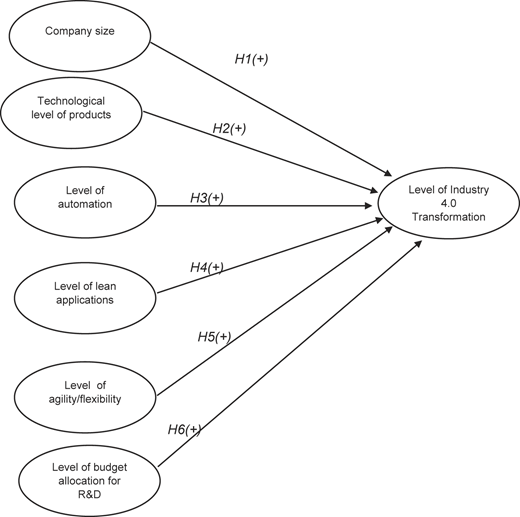
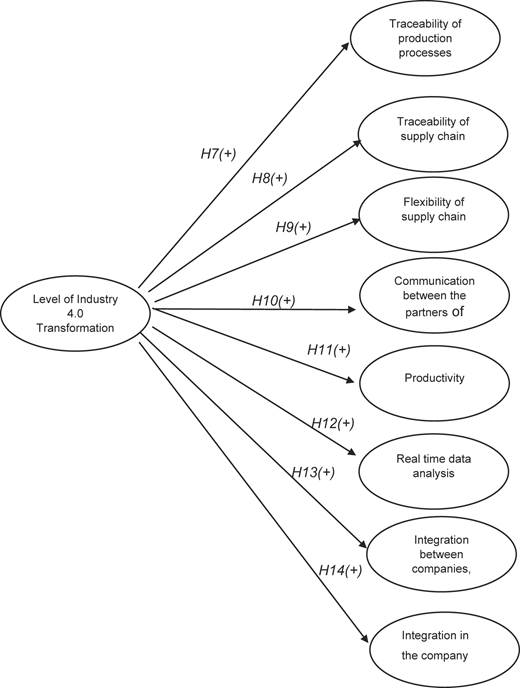
Industry 4.0 transformation includes three indicators in this study: implementation level of Industry 4.0 applications, plans for strategies of Industry 4.0 and budget allocated for Industry 4.0 applications in the past two years.
A preliminary questionnaire was given to experts and academicians, and qualitative feedback was collected. A pilot study was carried out in five manufacturing firms to confirm the questionnaire. The research instrument used in this study was a structured survey questionnaire, which was designed to evaluate the companies in terms of the described dimensions. The designed survey instrument included three major parts. The first part comprised several factors that affect the level of Industry 4.0 transformation, the second part captured several measures about the level of Industry 4.0 transformation and the last part comprised several factors related to the impacts of Industry 4.0 transformation on companies. The samples were randomly selected using a simple random sampling method. A survey questionnaire was designed, and the respondents were asked to indicate their answers using a Likert scale. The questionnaires were mailed to 500 manufacturing companies, and 108 responses were received. One hundred and three useable responses were analyzed using the SPSS software package.
Table 2 gives the factors that influence Industry 4.0 transformation in companies and Table 3 gives the impacts of Industry 4.0 transformation on companies.
Constructs and hypothesis for the factors that influence Industry 4.0 transformation
| Hypothesis | Independent factors | Reference |
|---|---|---|
| H1 | Company size | Lin et al. (2019), Szász et al. (2021), Schröder (2017), Frank et al. (2019), Büchi et al. (2020), Lichtblau et al. (2015), Zheng et al. (2020), Stentoft et al. (2017, 2019), Horváth and Szabó (2019), Yu and Schweisfurth (2020), Matt and Rauch (2020), Masood and Sonntag (2020) |
| H2 | Technological level of products | Yüksel (2020) |
| H3 | Level of automation | Yu and Schweisfurth (2020), Stentoft et al. (2017) |
| H4 | Level of lean applications | Rossini et al. (2019a, b), Buer et al. (2020), Demirkol and Al-Futaih (2020), Tortorella and Fettermann (2018) |
| H5 | Level of agility/flexibility | Morisse and Prigge (2017), Horvard and Szabó (2019), Matthiae and Richter (2018), Veile et al. (2020) |
| H6 | Level of budget allocation for R&D department | Bielawska (2010), Büchi et al. (2020), Göçer (2013), UNIDO (2018), Yüksel (2020), Zimmerman (2018) |
Constructs and hypothesis for the impacts of Industry 4.0 transformation
4. Research methodology
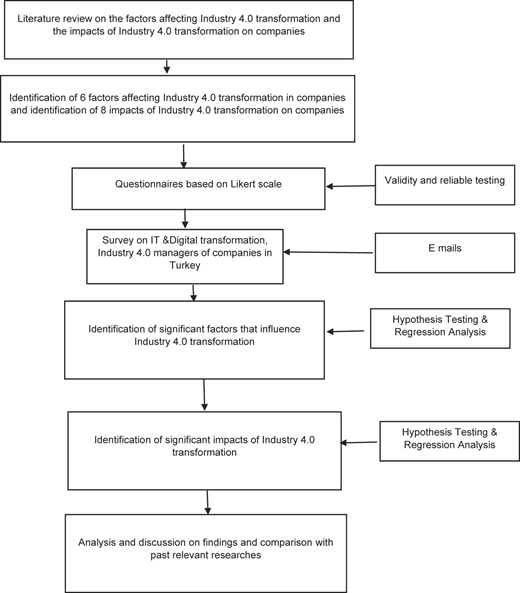
Figure 3 shows the research methodology. The primary purpose of the research was to determine the factors that affect Industry 4.0 transformation and the impacts of Industry 4.0 transformation on companies. Validity and reliability tests were used to select and assess the final items of the main constructs that were used for further statistical testing. The factors were selected from an extensive review of literature and further validated by information technology managers and digital transformation managers from the industry. Pre-testing of the questionnaire was carried out with three information technology managers and two digital transformation managers. Two managers from small-sized company, two managers from mid-sized company and one manager from big-sized company were chosen. The managers about whether there are questions that that they do not understood and whether there are any unclear questions. Some items were rephrased according to their suggestions. The reliability of the survey instrument was tested using Cronbach's alpha (α) (Nunnally and Bernstein, 1994). In most cases, the value of the reliability coefficient needs to be 0.70 or higher (Fornell and Larcker, 1981; Nunnally and Bernstein, 1994). The alpha coefficient for the survey instrument determined was as 0.911, indicating an internal consistency.
The size of the companies included in the study has been classified as small-sized companies, middle-sized companies and big-sized companies according to the number of employees. Technological level of products manufactured has been classified as low-tech products, medium-tech products and high-tech products. The implementation level of Industry 4.0 applications has been classified as (1) no plans for Industry 4.0 applications, (2) in the evaluation process for the plans of Industry 4.0 applications, (3) in the process of making plans for Industry 4.0 applications, (4) plans were made and small scale applications were carried out and (5) business-wide applications of Industry 4.0 was completed. Plans for strategies of Industry 4.0 has been classified as (1) do not have an Industry 4.0 strategy and not planning to develop one, (2) do not have any Industry 4.0 strategy, but have a plan to develop one, (3) in the development phase of Industry 4.0 strategy, (4) have an Industry 4.0 strategy but not started to implement it yet, (5) in the implementation phase of Industry 4.0 strategy and (6) completely implemented Industry 4.0 strategy. Budget allocation for R&D department has been classified as (1) no financial allocation, (2) low, (3) average and (4) high.
The respondents were asked to indicate their attitudes to the statements for level of automation, level of lean applications, level of agility/flexibility, budget allocation for R&D department, traceability of production processes, traceability of supply chain, flexibility of supply chain, communication between the partners of supply chain, productivity, real-time data analysis, integration between companies and integration in the company using a five-point Likert scale; indicating (1) very low, (2) low, (3) average, (4) high and (5) very high.
The research questions are as follows:
What are the factors that affect Industry 4.0 applications in companies?
What are the impacts of Industry 4.0 applications on companies?
How well the factors influence Industry 4.0 transformation?
How well Industry 4.0 transformation influence the companies according to expected impacts?
5. Analysis and results
5.1 Research questions 1–3
Pearson correlations quantify the strength of the relationship between two variables. A correlation that is significant at the 0.01 level implies a 99% certainty that the correlation between the two variables is not random and at the 0.05 level it implies a 95% certainty.
The Pearson correlation analysis was conducted to determine the correlation between independent variables (company size, technological level of products, budget allocation for R&D department, level of lean applications, level of agility/flexibility and level of automation) and dependent variables (implementation level of Industry 4.0 applications, plans for strategies of Industry 4.0 and budget allocated for Industry 4.0 applications in past two years).
The hypotheses 1–6 were intended to examine how well the independent/predictor variables (factors that influence Industry 4.0 transformation) impacts the dependent/outcome variables related to Industry 4.0 transformation. A multiple regression analysis was used to investigate the causal relationship between independent and dependent variables. A stepwise regression method was employed for regression analysis. Linear regression analysis and a stepwise regression analysis were also applied to test the hypotheses 1–6 after the principal components extraction used to assess the construct, Industry 4.0 transformation.
5.2 Research questions 2–4
Pearson correlation analysis was performed to determine the correlation between independent variables (implementation level of Industry 4.0 applications, plans for strategies of Industry 4.0, and budget allocated for Industry 4.0 applications in the past two years) and dependent variables (traceability of production processes, traceability of supply chain, flexibility of supply chains, communication between the partners of supply chain, productivity, real-time data, integration between companies and integration in the company).
The hypotheses 7–14 were intended to examine how well the independent/predictor variables related to Industry 4.0 transformation impacts the dependent/outcome variables (Impacts of Industry 4.0 transformation). Linear regression analyses were conducted to test the hypotheses 7–14.
6. Results/findings
6.1 Research questions 1–3
Pearson correlation coefficients are shown in Table 4. According to Table 4, there is a medium correlation between the level of automation and implementation level of Industry 4.0 applications, plans for strategies of Industry 4.0 and budget allocated for Industry 4.0 applications in the past two years. Besides, there is a medium correlation between level of lean applications and implementation level of Industry 4.0 technologies and budget allocated for Industry 4.0 applications in past two years. Table 4 also reveals that the correlation level between budget allocation for R&D and budget allocated for Industry 4.0 applications in the past two years is medium. It can be inferred from Table 4 that there is a stronger relationship between level of automation, level of lean applications and budget allocation for R&D and Industry 4.0 transformation in companies than there is between company size, technological level of products and agility/flexibility of the organization and Industry 4.0 transformation in companies.
Pearson correlation coefficients between independent variables and industry 4.0 transformation variables
| Implementation level of industry 4.0 applications | Plans for strategies of industry 4.0 | Budget allocated for industry 4.0 applications past two years. | ||
|---|---|---|---|---|
| Company size | Pearson Correlation | 0.396** | 0.330** | 0.404** |
| Sig. (2-tailed) | 0.000 | 0.001 | 0.000 | |
| N | 103 | 103 | 103 | |
| Technological level of products | Pearson Correlation | 0.255** | 0.345** | 0.299** |
| Sig. (2-tailed) | 0.009 | 0.000 | 0.002 | |
| N | 103 | 103 | 103 | |
| Level of automation | Pearson Correlation | 0.587** | 0.520** | 0.505** |
| Sig. (2-tailed) | 0.000 | 0.000 | 0.000 | |
| N | 103 | 103 | 103 | |
| Level of agility/flexibility | Pearson Correlation | 0.357** | 0.310** | 0.227* |
| Sig. (2-tailed) | 0.000 | 0.001 | 0.021 | |
| N | 103 | 103 | 103 | |
| Level of lean applications | Pearson Correlation | 0.515** | 0.472** | 0.503** |
| Sig. (2-tailed) | 0.000 | 0.000 | 0.000 | |
| N | 103 | 103 | 103 | |
| Budget allocation for R&D department | Pearson Correlation | 0.467** | 0.487** | 0.520** |
| Sig. (2-tailed) | 0.000 | 0.000 | 0.000 | |
| N | 103 | 103 | 103 | |
Table 5 summarizes the results of different models obtained from the multiple regression. According to the collinearity test the variance inflation factor values of the variables, level of automation and level of lean applications in six dimensions and company size and level of flexibility/agility in seven dimensions are greater than 10.00. In this study, collinearity between the variables has been neglected.
Stepwise regression analysis for the dependent variables and independent variables
| Models | Dependent variable | Independent variables | Included variables | Excluded variables | R2 |
|---|---|---|---|---|---|
| Model 1 | Implementation level of Industry 4.0 applications | Company size, Technological level of products, Level of automation, Level of agility/flexibility, Level of Lean applications and Budget allocation for R&D | Company size, Level of automation, Level of Lean applications and Budget allocation for R&D | Technological level of products, Level of agility/flexibility | 0.479 |
| Model 2 | Plans for strategies of Industry 4.0 | Company size, Technological level of products, Level of automation, Level of agility/flexibility, Level of Lean applications and Budget allocation for R&D | Level of automation, Level of Lean applications and Budget allocation for R&D | Company size, Technological level of products and Level of agility/flexibility | 0.39 |
| Model 3 | Budget allocated for Industry 4.0 applications past two years | Company size, Technological level of products, Level of automation, Level of agility/flexibility, Level of Lean applications and Budget allocation for R&D | Company size, Level of automation, Level of Lean applications and Budget allocation for R&D | Technological level of products, Level of agility/flexibility | 0.451 |
Technological level of products and level of agility/flexibility were excluded in all the three models. Company size variable was only excluded in the second model.
In order to investigate the relevant indicators according to their underlying factors, the principal components extraction was used to assess the construct, Industry 4.0 transformation. According to Table 6, the overall variance explained was 87%. The Cronbach's alpha value (α) was used to test the reliability, and was found to be 0.911 which is higher than 0.70 and this result, in turn, conveys that the theoretical constructs were reliable.
Factor analysis for the measures of Industry 4.0 transformation
| Correlation matrix | ||||
|---|---|---|---|---|
| Implementation level of Industry 4.0 applications | Plans for strategies of Industry 4.0 | Budget allocated for Industry 4.0 applications past two years | ||
| Correlation | Implementation level of Industry 4.0 applications | 1,000 | 0.830 | 0.810 |
| Plans for strategies of Industry 4.0 | 0.830 | 1,000 | 0.779 | |
| Budget allocated for Industry 4.0 applications past two years | 0.810 | 0.779 | 1,000 | |
| KMO and Bartlett's test | ||
|---|---|---|
| Kaiser–Meyer–Olkin Measure of Sampling Adequacy | 0.760 | |
| Bartlett's test of sphericity | Approx. Chi-Square | 235,078 |
| Df | 3 | |
| Sig | 0.000 | |
| Component matrixa | |
|---|---|
| Component | |
| 1 | |
| Implementation level of Industry 4.0 applications | 0.944 |
| Plans for strategies of Industry 4.0 | 0.932 |
| Budget allocated for Industry 4.0 applications past two years | 0.924 |
| Note(s): Extraction Method: Principal Component Analysis a. 1 component extracted | |
| Total variance explained | ||||||
|---|---|---|---|---|---|---|
| Component | Initial eigenvalues | Extraction sums of squared loadings | ||||
| Total | % of variance | Cumulative % | Total | % of variance | Cumulative % | |
| 1 | 2,613 | 87,090 | 87,090 | 2,613 | 87,090 | 87,090 |
| 2 | 0.223 | 7,447 | 94,536 | |||
| 3 | 0.164 | 5,464 | 100,000 | |||
| Note(s): Extraction Method: Principal Component Analysis | ||||||
| Reliability statistics | |
|---|---|
| Cronbach's alpha | N of items |
| 0.911 | 3 |
Factor analysis may not be suitable for all data structures. The suitability of the data for factor analysis can be examined with the Kaiser–Meyer–Olkin (KMO) coefficient and the Bartlett's sphericity test. The sample should be large enough to ensure the reliability of the correlation. To determine this, the KMO test is performed. It has been indicated that KMO value approaching 1 is acceptable and a value below 0.5 is unacceptable. The Bartlett's test is expected to be less than 0.05 (Hinton, 2004).
It can be seen from Table 7 that, as the independent variables of company size, technological level of products, level of automation, level of lean applications, level of agility/flexibility and level of budget allocation for R&D department increases and the dependent variable of level of Industry 4.0 transformation increases.
Linear regression analysis for level of industry 4.0 transformation and independent variables
| Dependent variable | Independent variable | Significant level | R | R2 |
|---|---|---|---|---|
| Level of Industry 4.0 Transformation | Company size | 0 | 0.397 | 0.158 |
| Technological level of products | 0.001 | 0.324 | 0.105 | |
| Level of automation | 0 | 0.575 | 0.331 | |
| Level of agility/flexibility | 0.001 | 0.325 | 0.106 | |
| Level of Lean applications | 0 | 0.529 | 0.28 | |
| Budget allocation for R&D | 0 | 0.523 | 0.274 |
According to Table 7, it could be inferred that there is a relationship between company size, technological level of products, level of automation, level of agility/flexibility, level of lean applications and budget allocation for R&D and level of Industry 4.0 transformation. The models for regression analysis were statistically significant at 95%. The hypothesis 1, 2, 3, 4, 5 and 6 have been supported. The independent variables had a positive impact on Industry 4.0 transformation of companies. However the impacts of company size, technological level of products and level of agility/flexibility on Industry 4.0 transformation were weak.
A stepwise regression method was used for regression analysis. According to Table 8, technological level of products and level of agility/flexibility were excluded based on stepwise regression. It can be deemed that, the variation in company size, level of automation, level of lean applications and budget allocation for R&D explains almost 50% variation in Industry 4.0 transformation level.
Stepwise regression analysis for level of industry 4.0 transformation and independent variables
| Dependent variable | Independent variables | Included variables | Excluded variables | R2 |
|---|---|---|---|---|
| Level of Industry 4.0 transformation | Company size, Technological level of products, Level of automation, Level of agility/flexibility, Level of Lean applications and Budget allocation for R&D | Company size, Level of automation, Level of Lean applications and Budget allocation for R&D | Technological level of products Level of agility/flexibility | 0.501 |
The Pearson correlation, linear regression and stepwise regression analyses indicated that there is a stronger relationship between level of Industry 4.0 transformation and level of automation than there is between Industry 4.0 transformation and the other independent variables. From the analysis, it can be stated that budget allocation for R&D and level of lean applications and level of automation have higher impacts on Industry 4.0 transformation than company size has.
6.2 Research questions 2–4
Pearson correlation coefficients are shown in Table 9. According to Table 9, there is a weak correlation between implementation level of Industry 4.0 technologies and traceability of production processes, flexibility of supply chains, productivity, real-time data analysis and integration in the company. As can be inferred from Table 9, there is a weak correlation between plans for strategies of Industry 4.0 and traceability of production processes, productivity, real-time data analysis and integration in the company. According to Table 9, there is a weak correlation between budget allocated for Industry 4.0 applications in past two years and traceability of production processes, flexibility of supply chains, productivity, real-time data analysis and integration in the company. According to Table 9 there is no correlation between all Industry 4.0 transformation variables and integration between companies, traceability of supply chains and communication between the partners.
Pearson correlation between independent variables and dependent variables
| Traceability of production processes | Traceability of supply chain | Flexibility of supply chains | Communication between the partners of supply chain | Productivity | Real time data analysis | Integration between companies | Integration in the company | ||
|---|---|---|---|---|---|---|---|---|---|
| Implementation level of Industry 4.0 technologies | Pearson Correlation | 0.281** | 0.194* | 0.236* | 0.122 | 0.346** | 0.383** | 0.162 | 0.295** |
| Sig. (2-tailed) | 0.004 | 0.056 | 0.016 | 0.221 | 0.000 | 0.000 | 0.103 | 0.002 | |
| N | 103 | 103 | 103 | 103 | 103 | 103 | 103 | 103 | |
| Plans for strategies of Industry 4.0 | Pearson Correlation | 0.273** | 0.147 | 0.192 | 0.069 | 0.360** | 0.424** | 0.159 | 0.284** |
| Sig. (2-tailed) | 0.005 | 0.139 | 0.052 | 0.487 | 0.000 | 0.000 | 0.110 | 0.004 | |
| N | 103 | 103 | 103 | 103 | 103 | 103 | 103 | 103 | |
| Budget allocated for Industry 4.0 applications past two years | Pearson Correlation | 0.352** | 0.193 | 0.226* | 0.121 | 0.319** | 0.383** | 0.140 | 0.289** |
| Sig. (2-tailed) | 0.000 | 0.051 | 0.022 | 0.222 | 0.001 | 0.000 | 0.160 | 0.003 | |
| N | 103 | 103 | 103 | 103 | 103 | 103 | 103 | 103 | |
Note(s): If significiant level is smaller than 0,05, the null hypothesis is rejected
It could be inferred from Table 10 that there is a relationship between Industry 4.0 transformation and traceability of production processes, productivity, real-time data analysis and integration in the company. The hypotheses 7, 11, 12 and 14 have been supported. As the level of Industry 4.0 applications increases, traceability of production processes, productivity, real-time data analysis, integration in companies increase. The hypotheses 8, 9, 10 and 13 have not been supported.
Linear regression analysis for dependent variables and industry 4.0 transformation
| Dependent variable | Independent variable | Sig | R | R2 | |
|---|---|---|---|---|---|
| Model 1 | Traceability of production processes | Industry 4.0 | 0.001 | 0.317 | 0.1 |
| Model 2 | Traceability of supply chain | Industry 4.0 | 0.059 | ||
| Model 3 | Flexibility of supply chains | Industry 4.0 | 0.052 | ||
| Model 4 | Communication between the partners of supply chain | Industry 4.0 | 0.28 | ||
| Model 5 | Productivity | Industry 4.0 | 0 | 0.368 | 0.136 |
| Model 6 | Real time data | Industry 4.0 | 0 | 0.428 | 0.183 |
| Model 7 | Integration between companies | Industry 4.0 | 0.095 | ||
| Model 8 | Integration in the company | Industry 4.0 | 0.001 | 0.309 | 0.096 |
According to the Pearson correlation and linear regression analyses, it was determined that there is a stronger relationship between Industry 4.0 transformation and real-time data analysis than there is between Industry 4.0 transformation and the other independent variables. The relationship between Industry 4.0 and productivity was the second strongest after the relationship between real-time data analysis and Industry 4.0 transformation. Industry 4.0 transformation generally impacted internal factors of companies, whereas Industry 4.0 had limited impacts on the supply chains.
7. Discussion
There could be various factors which might influence the applications of Industry 4.0 in companies. Determining these factors and analyzing the relationships between these factors and Industry 4.0 transformation is important in explaining how to increase the application of Industry 4.0 and how to achieve successful Industry 4.0 transformation in companies. The identified Industry 4.0 factors may help companies to check and refine their initiatives for becoming smart factories (Narula et al., 2020). In the literature, there are papers that focus on one of the factors that influence Industry 4.0 applications, especially company size. However, the papers that analyze these factors together and their level of importance in the Industry 4.0 applications are very limited. Company size can be an important factor for the application of Industry 4.0 in a company. Although, some authors (Lin et al., 2019; Szász et al., 2021; Schröder, 2017; Frank et al., 2019; Zimmerman, 2018; Zheng et al., 2020) stated that company size affects Industry 4.0 transformation positively; some authors (Horváth and Szabó, 2019; Yu and Schweisfurth, 2020; Stentoft et al., 2017; Masood and Sonntag, 2020) reported that company size is not related to Industry 4.0 applications. According to research, there is a relationship between size of the company and Industry 4.0 transformation, there is a stronger relationship between level of automation, the level of lean applications and budget allocation for R&D and Industry 4.0 transformation in companies than there is between company size, technological level of products and agility/flexibility of the organization and Industry 4.0 transformation in companies. The level of automation of the company, level of lean applications and budget allocation for R&D is more important than company size for Industry 4.0 transformation. Level of automation affects more than the other variables to the Industry 4.0 transformation. According to the Pearson correlation, linear regression and stepwise regression analyses, there is a stronger relationship between the level of Industry 4.0 transformation and level of automation than there is between Industry 4.0 transformation and the other independent variables. Yu and Schweisfurth (2020) also mentioned that the companies with a high degree of automation are more likely to implement new technologies (Yu and Schweisfurth, 2020). Several authors (Tortorella and Fettermann, 2018; Sanders et al., 2016; Buer et al., 2020) claimed that there is a significant, strong correlation between lean manufacturing and Industry 4.0 applications. The results revealed that lean manufacturing application is also an important factor for Industry 4.0 transformation in companies. In addition, it was found that there is a medium correlation between R&D intensive and Industry 4.0 transformation. Zimmerman (2018) stated the relationship between R&D-intensive manufacturing and enterprises having completed digitalization projects (Zimmerman, 2018). According to the study by Yüksel (2020), the technological level of products manufactured and the existence of R&D department have greater effect on levels of Industry 4.0 applications than the size of the company have (Yüksel, 2020). From the analysis, it can be stated that budget allocation for R&D and level of lean applications and level of automation have higher impacts on Industry 4.0 transformation than company size has. The findings of this research, regarding the limited impacts of company size on Industry 4.0 transformation, are similar to findings of Yüksel's research (2020). Some financial limits may delay the investments to be made for Industry 4.0 applications. However, small company size for SMEs with financial resources is not a real disadvantage for Industry 4.0 transformation.
Industry 4.0 will have an important influence on industrial processes, manufacturing systems and supply chains (Pereira and Romero, 2017). The implementation of Industry 4.0 technologies leads to important performance benefits for manufacturing companies, having a positive impact on cost, quality, delivery and flexibility (Szász et al., 2021). According to this research, it can be stated that there is a relationship between Industry 4.0 transformation and real-time data analysis, traceability of production processes, integration in companies and productivity and there is no relationship between Industry 4.0 transformation and integration between companies, traceability of supply chains, flexibility of supply chains and communication between the partners of supply chain. As the level of Industry 4.0 applications increases, traceability of production processes, productivity, real-time data analysis, integration in the company increase.
It has been stated that an increase in productivity and a decrease in costs are the main benefits of Industry 4.0 in companies in Turkey, as in companies in developed countries (Yüksel, 2020).
According to the literature and the study carried out by Duman and Akdemir (2021), Industry 4.0 technology components increase organizational performance criteria such as profitability, sales, production amount, production amount per capita, capacity utilization rate, production speed, product quality and can lead to significant reductions in production costs (Duman and Akdemir, 2021). Although not empirically demonstrated in the literature, flexibility is a core performance advantage promised by Industry 4.0. In contrast, cost minimization and improvement of lead times have been demonstrated but are not generalizable. Performance indicators such as quality and productivity are less addressed in the literature and still constitute potential research gaps (Bueno et al., 2020). It is also important to evaluate the level of impacts of Industry 4.0 transformation on these performance criteria. In the literature, although there are papers evaluating the effects of Industry 4.0 technologies on the performance of the organization, the level of effects of Industry 4.0 transformation on organization performance criteria should also be analyzed. According to the present study, the impacts of Industry 4.0 transformation on internal factors of companies are more than the impacts of Industry 4.0 to the factors related to the outside of the companies.
This paper evaluates which factors are more important for Industry 4.0 transformation. So it will contribute to the companies to evaluate their readiness to Industry 4.0 transformation and what factors they should focus for Industry 4.0 transformation. It also assists the companies to understand the most expected benefits of Industry 4.0 transformation. Companies face many obstacles in the industry 4.0 transformation. In overcoming these obstacles, it is important to know the factors that affect the success of Industry 4.0 transformation in companies. If the companies make the necessary arrangements for Industry 4.0 transformation, such as organizational structure, level of automation, level of lean applications and level of R&D budget, they will be able to manage Industry 4.0 transformation much more effectively. In this context, this study gains importance in terms of seeing which factors should be prioritized by companies for Industry 4.0 transformation. In addition, if the companies know what benefits they can gain through Industry 4.0 transformation, they can plan their transformation more efficiently. This paper also contributes to the Industry 4.0 transformation of the companies by evaluating the importance of the expected impacts of Industry 4.0 transformation relative to each other.
8. Conclusion
Although there has been an enormous interest in Industry 4.0 among academicians, most studies investigating Industry 4.0 implementation factors lack empirically testing (Narula et al., 2020).This paper contributes to the literature by empirically testing Industry 4.0 transformation. In the literature, there are articles focusing on one of the factors affecting Industry 4.0 applications, especially company size. However, articles examining these factors and their importance in Industry 4.0 applications are very limited. This study examined the factors that affect the adoption of Industry 4.0 transformation and the impacts of Industry 4.0 transformation on companies. Castelo-Branco et al. (2019) also clarified that it would be interesting to understand the degree of adoption of the several technologies that support the Industry 4.0 transformation (Castelo-Branco et al., 2019). According to literature review, the factors and expected impacts have been determined.
In the literature, there are papers that evaluate the drivers, challenges and barriers of Industry 4.0 transformation. Some of the papers examine Industry 4.0 transformation according to the factors such as company size, agility and automation. However, it is also important to analyze these factors according to their level of effects on Industry 4.0 transformation. This paper contributes to the literature by assessing the importance of the factors and impacts relatively. The independent factors determined in this research have positive effects on Industry 4.0 transformation of companies. However, the effects of company size, technological level of products and level of agility/flexibility on Industry 4.0 transformation are weak. The relationship between the level of automation and Industry 4.0 is the strongest among the factors. After automation level, it is seen that the relationship of Industry 4.0 with level of lean practices and level of budget allocation for R&D department is high, respectively. However the relationship between level of automation, level of lean practices, level of budget allocation for R&D department for Industry 4.0 transformation is medium. Buer et al. (2020) stated that there is a significant, strong correlation between lean manufacturing and factory digitalization, as well as between the length of the lean program and factory digitalization (Buer et al., 2020). Krishnan et al. (2021) clarified that R&D, which affects the company's innovativeness, proves to be very important in effectively implementing the Industry 4.0 (Krishnan et al., 2021). Pozzi et al. (2021) stated that lean culture emerges for the effective deployment of Industry 4.0 technologies (Pozzi et al., 2021). The findings support the papers written by Buer et al. (2020) and Krishnan et al. (2021) and Pozzi et al. (2021).
Company size is not as important as the other factors for Industry 4.0 transformation in companies. According to the study conducted by Masood and Sonntag (2020), the hypothesis “company size affects the benefits seen by an SME implementing an Industry 4.0 technology” was accepted and the hypothesis “company size affects the challenges seen by an SME implementing an Industry 4.0 technology” was rejected (Masood and Sonntag, 2020). Stentoft et al. (2017) also determined that drivers and barriers for Industry 4.0 are the same for all companies regardless of their size (Stentoft et al., 2017).
Industry 4.0 transformation has many benefits for companies and it is expected that many performance criteria will be better in companies with Industry 4.0 applications. Szász et al. (2021) also stated that most studies agree that Industry 4.0 implementation should lead to a boost in manufacturing companies' operational and financial performance (Szász et al., 2021).
This paper contributes to the literature by assessing the level of effects of Industry 4.0 transformation on the performance criteria of the companies. According to this study, there is a stronger relationship between Industry 4.0 transformation and real-time data analysis and productivity than there is between Industry 4.0 transformation and the other independent variables. Industry 4.0 transformation generally impacts the factors related to inside the company and Industry 4.0 has limited impacts on the supply chains.
This study can help companies to understand the factors that affect Industry 4.0 transformation and the most expected impacts of Industry 4.0 transformation in their companies. Understanding the factors will help the companies to evaluate their readiness level of Industry 4.0 transformation and where to focus for achieving Industry 4.0 transformation. Khin and Kee (2022) also emphasized the importance of understanding the factors for making the right decision to invest in Industry 4.0 transformation (Khin and Kee, 2022). In addition to this, knowing the expected benefits of Industry 4.0 transformation for their companies, the companies can make plans for sustaining their success.
The findings of this study have to be seen in the light of some limitations. The first one is the sample size. Although there was a great homogeneity across the groups of the population, the sample size may limit the generalization of the results. Besides the small sample size, the Cronbach's alpha value, used to assess the internal consistency of an instrument, was 0.911 in this study It may be of interest to further develop this research using samples from other countries and to compare the results across countries.

