


This research aims to investigate the factors that can influence Bumiputera contractors’ acceptance of the Contractor’s All Risks (CAR) takāful (Islamic insurance) product using the theory of reasoned action (TRA).
Using the method of quantitative surveys, 414 questionnaires were collected from targeted Bumiputera contractors in Malaysia (grade G1 to grade G7), except in Sabah and Sarawak, that are registered with the Construction Industry Development Board (CIDB) and are also members of Persatuan Kontraktor Melayu Malaysia (PKMM). The data was analysed using the partial least squares structural equation modeling (PLS-SEM) technique.
The findings from the PLS-SEM analysis show that attitude, subjective norm, religiosity and awareness have a positive relationship with Bumiputera contractors’ acceptance of the CAR takāful product. Religiosity appeared to be the most significant factor influencing Bumiputera contractors’ acceptance of the CAR takāful product.
The respondents in this study only comprised Bumiputera contractors in Peninsular Malaysia, excluding those from Sabah and Sarawak. Therefore, it is not possible to generalise the findings to a broader population.
Takāful operators and their sales and marketing departments need to act proactively in promoting the benefits of investing in CAR takāful that follows Sharīʾah (Islamic law) rules and principles. They should create mechanisms to market CAR takāful better, thus accelerating its acceptance rate among contractors.
The paper uses the proposed extended TRA model, which includes the variables of religiosity and awareness in the TRA model. These variables were successfully integrated in the model, and the findings show that they have significantly contributed to the acceptance of the CAR takāful product among Bumiputera contractors.
Introduction
The construction industry is riskier than other industries. The primary method to cover for risks in construction projects is through construction insurance (Babu and Kanchana, 2014). The Contractor’s All Risks (CAR) insurance policy, which provides complete insurance policies for construction projects, is well-known in the construction industry (Perera et al., 2008). It is a short-term insurance policy that is especially designed to insure building construction works and other civil engineering works. It protects all parties involved in the construction project against any loss or physical damage that may arise for various reasons (Musundire and Aigbavboa, 2015).
Conventional insurance, however, involves elements of ribā (usury), maysir (gambling) and gharar (uncertainty) (National Fatwa Committee Malaysia, 1972). Takāful has been identified as a permissible alternative by the Shariah Advisory Council of Bank Negara Malaysia (SAC-BNM, 2010). Thus, CAR takāful represents a Sharīʾah-compliant alternative to CAR insurance, covering against loss or damage at the construction site during the construction period, including third party liabilities such as property damage and physical injury (Zulkifli et al., 2012).
The total number of contractors who registered with the Construction Industry Development Board (CIDB) in Malaysia was 81,086 as at 31 December 2019. This figure, however, excludes contractors in Sabah and Sarawak. Of this number, 46,704 contractors (57.60%) represent Bumiputera contractors (CIDB, 2020).
Non-Muslim contractors are free to select either takāful or conventional insurance. With the availability of takāful, which provides an option over conventional insurance and allows Muslims to abide by the commands of Allah (SWT), it has become an obligation for Muslim contractors to choose the CAR takāful product.
Unfortunately, Mohd Fauzi et al. (2016) found low awareness of the takāful concept and its principles among contractors. Bank Negara Malaysia's statistics report (BNM, 2021) shows that CAR takāful's share of gross contributions in the local insurance industry were only around RM96.5 million as at end-2020 as compared to CAR insurance, whose share of gross premiums reached RM575.2 million. Moreover, CAR takāful's due contribution of RM21.0 million was much lower than the earned premium income of CAR insurance at RM304.6 million (BNM, 2021). Furthermore, Mohamed and Alhabshi (2015) observed that takāful penetration rates are still relatively low and are far behind the conventional insurance market. Md Husin (2019) further added that the takāful penetration rate is low among B40 households, although the rate increased by 0.7% from 14.5% in 2017 to 15.2% in 2018.
This study focuses on the CAR takāful product in construction projects and identifies factors that can influence Bumiputera contractors in choosing the CAR takāful product using the theory of reasoned action (TRA). Four variables are studied, including attitude, subjective norm, religiosity and awareness, by distributing questionnaires to selected Bumiputera contractors in Malaysia. The contractors located in Sabah and Sarawak were, however, excluded in the study.
This paper is accordingly structured as follows: the next section discusses previous studies and the study's hypotheses. The third section focuses on the methodology of the research. The fourth section discusses the study's results, and the final section summarises the findings of the research and suggests some recommendations.
Literature review
CAR takāful
CAR takāful is categorised under the general takāful product (Zulkifli et al., 2012). The CAR takāful certificate covers any damage or loss during the construction and maintenance period, including third party liabilities (BNM, 2005). The basic cover and exclusion of the CAR takāful certificate is shown in Table 1.
Basic cover and exclusion of the CAR takāful certificate
| Product | Basic cover | Exclusion |
|---|---|---|
| CAR takāful certificate | Loss or damage to plants, materials, temporary works and anything brought to the site by the contractor |
|
| Third party liability: Property damage and bodily injury to third parties |
Source(s): Zulkifli et al. (2012)
There are four takāful operators offering the CAR takāful product in Malaysia:
Syarikat Takaful Malaysia Am Berhad
Etiqa General Takaful Berhad
Takaful Ikhlas General Berhad
Zurich General Takaful Malaysia Berhad
The number of registered general takāful agents was 9,278 as at 31 December 2020 (Malaysian Takaful Association, 2020).
Theory of reasoned action
The TRA assumes that humans are always rational and use information systematically (Fishbein and Ajzen, 1975). A key aspect of the TRA is that human behaviour is influenced by subjective norms and attitude towards the behaviour. The TRA argues that intention to perform a behaviour directly influences the behaviour (Ajzen and Fishbein, 1980).
The TRA has been applied in takāful to explain human behaviour (Ab. Rahim and Amin, 2011; Amin, 2012). Nevertheless, there are limited studies on the application of TRA in the takāful literature. More so, there are no published studies that use TRA in the CAR takāful field. Thus, this research is the first to examine the factors that could affect contractors' behaviour. Moreover, the authors identified two additional variables, namely religiosity and awareness, as contributions to the TRA. These variables are expected to influence the acceptance of Bumiputera contractors of the CAR takāful product.
Attitude
Attitude is defined by Fishbein and Ajzen (1975) as the effect of one's feelings on a particular behaviour, whether positive or negative. Ajzen and Fishbein (1980) added that attitude affects one's behaviour, whether it is good or bad behaviour. Besides, Doane et al. (2016) suggested that attitude is a form of mental preparation for responding positively or negatively through the experience of an object or idea. Ajzen (1991) outlined three steps to predict attitude:
To measure how people rate the outcome of each belief,
To measure the strength of beliefs by asking for people's views to indicate the likelihood that the behaviour will produce results and
To multiply the product for each evaluation result with the same belief to predict a person's attitude.
Within the takāful literature, several studies have shown significant influence of attitude towards the selection of takāful products (Md Hussein and Ab Rahman, 2016a, b; Razak et al., 2018; Aziz et al., 2019; Farhat et al., 2019; Bhatti and Md Hussin, 2020).
Therefore, the authors believe that attitude may affect Bumiputera contractors' choice of CAR takāful. Hence, following these empirical results, the first hypothesis is developed as follows:
Attitude has a positive relationship with CAR takāful acceptance.
Subjective norm
According to Ajzen (1991), subjective norm means one's perception of social pressure in doing the behaviour and it is determined by normative beliefs. Ajzen (2002) argued that normative beliefs refer to beliefs of individuals or significant reference groups such as teachers, physicians, supervisors and colleagues. Moreover, Chu and Wu (2004) associated subjective norms with normative beliefs (those of family and friends) as well as secondary normative beliefs (those of supervisors and peers). Rhodes and Courneya (2003) suggested that subjective norm is influenced by social pressures from family members, peers and colleagues without differentiating between primary and secondary influences.
Past studies conducted by Amin (2012), Md Husin et al. (2016), Razak et al. (2018), Raza et al. (2019), Farhat et al. (2019) and Bhatti and Md Hussin (2020) have shown that the subjective norm relationship with takāful products' selection is positive and significant. Subjective norm is also a motivating factor for customers' acceptance of a product (Amin et al., 2013, 2014; Ganesan et al., 2020).
Thus, the second hypothesis is proposed as follows:
Subjective norm has a positive relationship with CAR takāful acceptance.
Religiosity
Achour et al. (2019) who studied the role of religiosity on the well-being of elderly Muslims in Malaysia defined religiosity as the elderly's perceptions of religious beliefs, worship and prayer. Khraim et al. (1999) argued that religiosity is an element of culture that pervades every aspect of society and permeates individuals' lives, whether they are believers or non-believers.
Findings from previous research in the context of takāful suggested that the relationship between religiosity and takāful adoption is positive and significant (Jaffar and Musa, 2013; Bassir et al., 2014; Yusoff and Kamdari, 2014; Mansor et al., 2015; Ali et al., 2019; Hassan and Abbas, 2020; Shaikh et al., 2020).
In the case of CAR takāful, Mohd Fauzi and Abd Rashid (2012) found that 69% of their sampled respondents considered procuring CAR takāful in construction projects as it is an Islamic product that all Muslims should support.
Therefore, the third hypothesis is developed based on the above discussion:
Religiosity has a positive relationship with CAR takāful acceptance.
Awareness
Awareness means the individual's passive involvement to increase interest in something (Bickford and Reynolds, 2002). Abdullah (2006) added that the subjective idea of one's experience of something can be developed through the factor of awareness. Ambali and Bakar (2014) further argued that everyone has a different level of awareness.
Muhamad et al. (2016) suggested that public awareness is an essential factor in improving the financial and takāful market. Prior research has supported the impact of awareness upon adoption of takāful products (Md Hussein and Ab Rahman, 2016a; Salleh and Laksana, 2018; Ali et al., 2019; Raza et al., 2019; Hassan and Abbas, 2020; Shaikh et al., 2020). With regard to CAR takāful, Mohd Fauzi and Abd Rashid (2012) argued that most contractors are generally aware of it.
It is noted that the results of some of the past studies were contradictory whereby awareness had a negative impact on the acceptance of takāful, such as in the case of Akhter and Hussain (2012), Ismail et al. (2013), Soualhi and al-Shammari (2015), Md Hussein and Ab Rahman (2016b) and Salleh and Laksana (2018). Nonetheless, due to mixed and inconclusive results from past empirical studies, this study develops the following proposition about the expected relationship between Bumiputera contractors' awareness and its influence on their selection of the CAR takāful product:
Awareness has a positive relationship with CAR takāful acceptance.
Research methodology
Sampling procedure
The respondents in this study were selected among Bumiputera contractors (grade G1 to grade G7) in Malaysia, excluding Sabah and Sarawak, that are registered with CIDB and are members of PKMM. As mentioned earlier, according to CIDB (2020), as of 31 December 2019, the total number of Bumiputera contractors throughout Malaysia (except for Sabah and Sarawak) was 46,704. Therefore, guided by Krejcie and Morgan (1970), 760 sets of questionnaire were distributed between April and June 2020 to the respective Bumiputera contractors, who are authorised company officers in the registration license. 471 questionnaires were returned, of which 414 responses (54.47%) were found to be complete and could be used for data analysis.
In this study, all variables are adapted from previous studies involving more than one author, including: Md Husin et al. (2016), Aziz et al. (2019), Ali et al. (2019), Farhat et al. (2019), Bhatti and Md Hussin (2020), Hassan and Abbas (2020) and Shaikh et al. (2020).
Technique of analysis
The authors used the PLS-SEM technique because PLS-SEM can analyse abnormal data and complex models as well as analyse a small sample size (Hair et al., 2019). All data obtained were analysed using the SmartPLS 3.0 (Ringle et al., 2015) to evaluate the measurement and structural model (Hair et al., 2019).
Findings
Respondents' profile
The respondents comprised 287 male (69.32%) and 127 female (30.68%) Bumiputera contractors. The largest group of respondents (30.68%) belonged in the category of 41–50 years. The remaining were in the following age groups: 51 and above (26.81%), 31 to 40 (20.53%) and 20 to 30 (7.49%). The 414 respondents were also registered with CIDB, as categorised in the grades mentioned in Table 2.
Assessment of the measurement model
The assessment of the measurement model was conducted based on the guidelines set by Hair et al. (2019) and Hair et al. (2020), including evaluation of internal consistency reliability, indicator loadings, convergent validity and discriminant validity.
Internal consistency reliability
The recommended value of composite reliability should be higher than 0.70 while the construct indicators' loadings need to be above 0.70 (Hair et al., 2020). Table 3 shows that the composite reliability for each variable exceeds the recommended 0.70 threshold value and is therefore acceptable.
Loadings (after deletion)
| Variables | Indicators | Loadings | Composite reliability (CR) | Average variance extracted (AVE) | |
|---|---|---|---|---|---|
| Acceptance of CAR takāful (ACT) | 1 | I accept the CAR takāful product because it is a way of my life | 0.923 | 0.954 | 0.748 |
| 2 | I accept the CAR takāful product because it is beneficial | 0.946 | |||
| 3 | I accept the CAR takāful product because it is under my control | 0.818 | |||
| 4 | I accept the CAR takāful product because I am aware about it | 0.959 | |||
| 5 | I accept the CAR takāful product because I understand it | 0.731 | |||
| 6 | I accept the CAR takāful product because it is free from ribā | 0.795 | |||
| 7 | I accept the CAR takāful product because people recommended it to me | 0.856 | |||
| Attitude (ATD) | 1 | I feel that choosing the CAR takāful product is a brilliant idea | 0.942 | 0.980 | 0.858 |
| 2 | I feel that choosing the CAR takāful product is the best idea | 0.943 | |||
| 3 | I love the idea of choosing the CAR takāful product | 0.920 | |||
| 4 | I feel that choosing the CAR takāful product is beneficial | 0.942 | |||
| 5 | I feel that the CAR takāful product is a pleasant idea | 0.939 | |||
| 6 | I feel that the CAR takāful product is an appealing idea | 0.967 | |||
| 7 | I feel that the CAR takāful product achieves the objectives of Sharīʾah | 0.872 | |||
| 8 | I feel that the CAR takāful product is one of the best insurance products | 0.880 | |||
| Subjective norm (SN) | 1 | Those who influence my behaviour expect me to accept the CAR takāful product | 0.879 | 0.962 | 0.785 |
| 2 | Those who are important to me expect me to accept the CAR takāful product | 0.907 | |||
| 3 | Those who are close expect me to accept the CAR takāful product | 0.925 | |||
| 4 | Those who influence my decisions expect me to accept the CAR takāful product | 0.953 | |||
| 5 | I am influenced by my family to choose the CAR takāful product | 0.871 | |||
| 6 | I am influenced by my close friends to choose the CAR takāful product | 0.852 | |||
| 7 | It is expected by others that I should accept the CAR takāful product | 0.808 | |||
| Religiosity (RGS) | 1 | The CAR takāful product is based on the Qurʾān and ḥadīth | 0.900 | 0.982 | 0.872 |
| 2 | The CAR takāful product is compliant with Islamic law | 0.943 | |||
| 3 | The CAR takāful product meets the objectives of Sharīʾah | 0.930 | |||
| 4 | The CAR takāful product is free from ribā | 0.944 | |||
| 5 | The CAR takāful product is free from gambling | 0.923 | |||
| 6 | The CAR takāful product is free from fraud | 0.937 | |||
| 7 | The CAR takāful product is free from any doubt in the way the transaction is performed | 0.952 | |||
| 8 | The CAR takāful product follows the Islamic principles of doing business | 0.941 | |||
| Awareness (AWN) | 1 | I receive enough information about the CAR takāful product | 0.849 | 0.965 | 0.822 |
| 2 | I receive enough information about the benefits of the CAR takāful product | 0.856 | |||
| 3 | I know that the CAR takāful product offered is Sharīʾah-compliant | 0.904 | |||
| 4 | I know that the CAR takāful product is free from ribā | 0.930 | |||
| 5 | I know that the CAR takāful product is according to the needs of customers | 0.953 | |||
| 6 | I know that the CAR takāful product really helps in the promotion of Islamic values to customers and the public | 0.943 |
Source(s): Authors' own
Indicator loadings
The indicator loading value above 0.708 is recommended (Hair et al., 2020). Table 3 illustrates the correlation between items with loading values from 0.731 to 0.967. The results performed on 38 indicators show that two indicators, i.e. ACT8 (0.596) and ACT9 (0.432), were removed from the construct because their loadings were below 0.708.
Convergent validity
Convergence validity was tested based on the average variance extracted (AVE). The AVE threshold value higher than 0.50 is recommended (Hair et al., 2019). Table 3 shows AVE values with a high loading value above 0.50 per construct, where the AVE value for each construct is between 0.748 and 0.872. These results indicate that all indicators used have achieved convergent validity for each variable in this study.
Discriminant validity
Heterotrait–monotrait ratio criteria (HTMT) were tested to evaluate discriminant validity. The HTMT value less than 0.85 is recommended (Hair et al., 2019). Table 4 depicts that the value of all variables in the HTMT test is lower than 0.85, hence fulfilling the discriminant validity requirement. This further enables the researchers to proceed with subsequent analysis at the structural model assessment stage for hypothesis testing.
Assessment of the structural model
Next, the structural model assessment is presented for further analysis, involving an evaluation of the coefficient of determination (R2), effect size (f2), predictive relevance (Q2) and structural model path relationships (hypotheses testing).
R2 value
Hair et al. (2019) suggested that the R2 value will determine the predictive power of the structural model based on the following guidelines: 0.25 (weak), 0.50 (moderate) and 0.75 (substantial). The research finds that attitude (ATD), subjective norm (SN), religiosity (RGS) and awareness (AWN) were able to explain 58.0% of the total variance in acceptance of CAR takāful (ACT) and can be categorised as “moderate approaching substantial” based on Hair et al. (2019).
f2 value
The f2 effect size test is to see the change in strength that occurs to the value of R2 in making predictions based on the study model. Specifically, it looks at the dependent variable's effect when an independent variable is dropped from the study model. Hair et al. (2019) categorised the f2 effect size according to the following guidelines: 0.35 (large), 0.15 (medium) and 0.02 (small). The respective effect sizes of the latent variables are shown in Table 5.
Q2 value
The predictive relevance assessment tested the model prediction ability using Stone–Geisser's analysis to test the Q2 value (Hair et al., 2019). Hair et al. (2020) suggested that a study model having a Q2 greater than zero (>0) is considered of predictive relevance. Besides, the study model with a more positive Q2 value shows more predictive relevance. The result of the Q2 cross-validated redundancy test analysis for this study is shown in Table 6 where Q2 = 0.426, i.e. Q2 > 0.
Structural model path relationships
The hypotheses were analysed using path coefficient analysis. The sample size of 4,999 was used for the bootstrap as suggested by Henseler et al. (2016). Table 7 shows the path coefficient test analysis in the structural model assessment based on beta (β), t-values and p-values (Hair et al., 2017; Raja Hisham, 2017). The value of β is shown by “Original Sample (O)” while the value of t is indicated by “T Statistics” (Raja Hisham, 2017). The value of t is determined by the significance level of a relationship, namely *t > 1.65 (p < 0.10), **t > 1.96 (p < 0.05) and ***t > 2.57 (p < 0.01) (Hair et al., 2017; Law and Fong, 2020). Table 7 presents the bootstrapping results and Figure 1 presents the structural model.
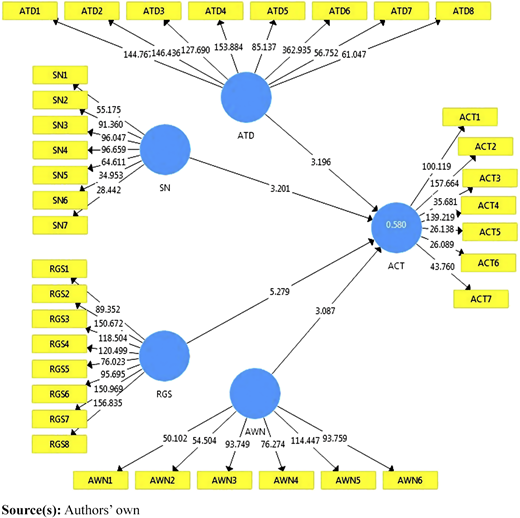
The results of the study show that the TRA model explains 58.0% of the variance in CAR takāful product acceptance (ACT). The result of R2 suggests that Bumiputera contractors' acceptance of the CAR takāful product is significantly explained by the variables ATD, SN, RGS and AWN. However, another 42.0% can be translated by other variables.
This study shows that the variables ATD (β = 0.180, t = 3.196, p = 0.001), SN (β = 0.122, t = 3.201, p = 0.001), RGS (β = 0.326, t = 5.279, p = 0.000) and AWN (β = 0.252, t = 3.087, p = 0.002) significantly affect Bumiputera contractors' acceptance of the CAR takāful product. Hence, hypotheses H1, H2, H3 and H4 are supported respectively.
Based on the findings, RGS scored the highest beta value and represents the most significant factor that affects Bumiputera contractors' acceptance of the CAR takāful product.
Conclusion and recommendation
The proposed extended TRA, which includes the religiosity and awareness factors within the TRA model, shows that these factors have a positive relationship with acceptance of CAR takāful. The results demonstrated that attitude, subjective norm, religiosity and awareness positively influence Bumiputera contractors' acceptance of the CAR takāful product. Moreover, the results of this study have shown a moderate R2 value of 0.58. The authors argue that the R2 value would be more substantial if other constructs are included in the model such as perceived behavioural control as suggested by Ajzen (1991). Therefore, future research should consider including the perceived behavioural control factor in their model.
The study results show that religiosity significantly affects Bumiputera contractors' acceptance of the CAR takāful product. The results suggest that the majority of contractors are Muslims, and Bumiputera contractors, in particular, are very concerned about religious values. This result indicates that most Bumiputera contractors do not choose conventional insurance due to Sharī'ah non-compliance. Therefore, CAR takāful is the best option for those in construction projects. Besides, the study also reported that subjective norm obtained the lowest beta value of 0.122. These findings suggest the high level of knowledge possessed by the respondents on CAR takāful. Therefore, the respondents do not depend on the opinion of others when deciding to participate in CAR takāful or not. Acceptance of CAR takāful is not mandatory so far; Bumiputera contractors still adopt CAR takāful on a voluntary basis.
These findings mean that takāful operators and their sales and marketing department should go one step further in promoting the benefits of investing in CAR takāful that follows Sharī'ah rules and principles and they should develop mechanisms to market CAR takāful better, thus accelerating its acceptance rate among contractors. It can be achieved effectively through modern methods such as billboard advertising, mobile advertising, i.e. Facebook, WhatsApp messenger, Telegram messenger and twitter, to create a positive perception of the CAR takāful product. Moreover, takāful operators need to further strengthen customer loyalty and develop retention programs by adding financial benefits to enhance customer relationships. Takāful operators can also offer marketing programs that reward loyal customers.
The findings concluded that religiosity is considered the most significant factor in Bumiputera contractors' acceptance of CAR takāful. It shows that takāful operators must remain steadfast in their compliance to Islamic principles. Takāful operators should emphasise religious values such as ethics and manners. The takāful operator and its agent must also clearly explain the contract details to customers without hiding any facts before they proceed with signing of the contract. Thus, customers will have a better understanding of the content of the contract and it may increase customers' satisfaction with and confidence in takāful services.
The authors suggest that takāful operators and takāful agents should provide customer-oriented services to ensure a sustainable model of operations. The industry's nature requires agents to provide advisory services to new and existing customers. Agents need to build a good and lasting communication network to provide customer satisfaction, especially in the case of Bumiputera contractors.

