This study develops a comprehensive ethical framework for the responsible use of generative artificial intelligence (AI) in education with particular attention to secondary schooling, informed by analysis across K-12 and higher education contexts. It addresses critical gaps in current ethical guidelines, particularly concerning privacy, bias and transparency issues in educational settings.
A systematic literature review was conducted using major databases like Scopus and Web of Science to identify the ethical implications of AI use in education. The research synthesised findings from diverse sources to propose a refined ethical framework tailored for secondary education and informed by practices across the wider education sector.
The study highlights significant gaps in existing ethical frameworks concerning AI applications in secondary education. These include inadequate measures to address privacy concerns, persistent biases in AI algorithms, weak mechanisms for accountability and a lack of transparency in AI decision-making processes within educational contexts, alongside limited attention to academic integrity.
The research is constrained by the availability and scope of existing studies on AI ethics in education and by its reliance on secondary data. Further empirical work in school settings is needed to test the framework’s effectiveness, adapt it to diverse contexts and refine its components based on real-world application.
The proposed ethical framework provides educators and policymakers with practical guidelines for integrating AI technologies responsibly in secondary education. It emphasises safeguarding student privacy, ensuring fairness in AI applications, supporting academic integrity and enhancing transparency.
Implementing the framework can support social equity in education by reducing the risk that AI technologies perpetuate existing biases and by promoting inclusive educational practices that respect student rights, diversity and the particular vulnerabilities of children and young people.
This study contributes original insights by synthesizing existing research into a coherent framework specifically designed for secondary education. It fills a notable gap in literature by focusing on the ethical challenges and needs at this educational level, which are often overlooked in broader AI ethics discussions.
Introduction
AI transforms education through personalised learning, tutoring, and adaptive tools (Zawacki-Richter et al., 2019; Holmes et al., 2019). From ChatGPT in universities to adaptive games in K–12 schooling, its reach is expanding, but so are the ethical risks. Recent work highlights concerns about bias, opacity, data privacy and the erosion of academic integrity in AI-supported teaching and assessment, especially in the context of generative AI (Cotton et al., 2023; Zeb et al., 2024). Building on children’s digital-rights scholarship, which shows that young people have limited control over their data and digital environments (Livingstone and Third, 2017), concerns about minors’ exposure to AI systems in schooling are especially acute. International guidelines, such as UNESCO’s Recommendation on the Ethics of Artificial Intelligence, offer high-level principles for trustworthy AI but provide limited guidance on how to operationalise these principles in everyday school and university practice (UNESCO, 2021). Emerging analyses of institutional AI policies in higher education further show that guidance is uneven and often fragmented across institutions (Spivakovsky et al., 2023; McDonald et al., 2025). As research on immersive technologies in schools has shown, context matters and generic policies often struggle to account for local conditions and diverse educational settings (Southgate et al., 2019). This study therefore proposes a context-sensitive ethical framework, grounded in deontological, utilitarian, virtue and care ethics, as well as social learning and social exchange theory, tailored to different educational levels and the rapidly evolving landscape of generative AI in education. To address these gaps, this study pursues three objectives:
Analyse intersections between AI, ethics, and digital citizenship.
Identify gaps in current AI ethics policies and guidelines, especially regarding K–12 learners.
Propose a flexible, level-sensitive ethical framework to guide responsible AI use in diverse educational settings.
In doing so, the paper aims to equip educators, administrators, and policymakers with actionable, theoretically grounded tools to ensure that AI enhances, rather than erodes, the core values of education: equity, integrity, transparency, and care.
Personalised learning and privacy concerns
AI's capacity to enable personalised learning experiences represents one of its most prominent benefits. Intelligent tutoring systems and adaptive learning platforms can tailor educational content and pacing to individual students’ needs, enhancing engagement and effectiveness. Empirical work on AI-based personalised learning systems shows that adaptive platforms which analyse students’ performance and behaviours can improve learning outcomes when they adjust materials to learners’ needs (Murtaza et al., 2022; Zawacki-Richter et al., 2019). However, the very mechanism that enables such personalisation, the extensive collection and analysis of student data, raises significant privacy and security concerns. Students, particularly minors, may not fully understand what data are collected or how they are used, which raises questions about whether consent can be considered meaningful in these contexts (UNESCO, 2021). International guidelines therefore stress the need for robust data-governance arrangements in AI-enhanced education, including data minimisation, strong security measures, parental oversight for younger learners and compliance with data-protection legislation (Zawacki-Richter et al., 2019).
Bias, integrity, and the double-edged nature of educational AI
AI systems in education can unintentionally reproduce or intensify existing social inequities. Reviews of algorithmic bias in education show that models trained on historical data can systematically disadvantage groups who are already marginalised, for example when early-warning or prediction systems disproportionately flag students from low-income or racialised communities as “at risk” compared to their peers with similar achievement profiles (Baker and Hawn, 2022). At a broader AI level, studies of commercial facial-recognition systems have documented much higher misclassification rates for darker-skinned women than for lighter-skinned men, illustrating how biased training data can embed structural racism into algorithmic systems (Buolamwini and Gebru, 2018). These findings underline the need to interrogate educational AI tools for disparate impacts rather than assuming they are neutral or objective. At the same time, generative AI tools such as ChatGPT raise new challenges for academic integrity. They can rapidly generate plausible essays, code and problem solutions, prompting concern about plagiarism, contract cheating and the erosion of authentic learning. Recent work on ChatGPT in higher education highlights both opportunities for feedback and support and serious risks to assessment validity and honesty, and calls for redesigned assessment practices, AI-literate pedagogy and clear institutional policies to govern use and misuse (Zeb et al., 2024; Cotton et al., 2023). Addressing bias and integrity therefore requires not only technical scrutiny of datasets and models but also cultural shifts in teaching, assessment and digital literacy across educational systems.
Transparency, accountability, and digital citizenship
Lack of transparency in AI decision-making undermines trust in educational settings. Complex models, including large language models, often function as opaque “black boxes”, which leaves educators and students unable to see how outputs are produced or to identify errors and biases. International AI and education guidance stresses transparency, explicability and human oversight, and argues that AI systems should provide information that enables users to understand, scrutinise and, where necessary, contest automated outcomes (UNESCO, 2021). Work on AI ethics more broadly likewise highlights accountability, emphasising that clear allocation of responsibility and accessible mechanisms for redress are essential when AI systems contribute to harm (Floridi et al., 2018). These issues are particularly acute for younger learners. Studies of children’s interactions with AI-driven conversational agents and voice assistants show that many children attribute intelligence or social qualities to these systems and do not always fully distinguish between human and machine agency in everyday use (Druga et al., 2017; Festerling et al., 2024). If children over-estimate what such systems “know” or “understand”, they may be less likely to question outputs or to recognise the commercial, data-driven infrastructures that shape them. In response, digital citizenship and AI-literacy initiatives are increasingly focused on helping students critique AI systems, recognise bias and understand the basic logic and limitations of automated decision-making. Conceptual work on AI literacy proposes competency frameworks that combine technical concepts, critical data awareness and ethical reflection, and argues that these capacities should be embedded across curricula rather than treated as optional extras (Holmes et al., 2022); however, most existing guidelines remain broad and impractical.
Methodology
Research design
This study follows a systematic literature review (SLR) design, complemented by bibliometric analysis techniques. The SLR approach was chosen to ensure a comprehensive and unbiased survey of the relevant literature, particularly given the rapidly evolving nature of AI. I employed science mapping methodology using bibliometric tools (e.g. CiteSpace) to visualise and identify major research themes, clusters, and trends within the literature.
Data sources and search strategy
The literature search encompassed Web of Science, Scopus, IEEE Xplore, Google Scholar, and ERIC, spanning the period from 2010 to early 2024. An iterative keyword strategy combined education terms (“education,” “schools,” “students,” “teaching,” “learning”) with AI-related terms (“artificial intelligence,” “machine learning,” “chatbot,” “ChatGPT,” “learning analytics”) and ethical/governance concepts (“ethics,” “privacy,” “bias,” “fairness,” “transparency,” “academic integrity,” “digital citizenship”). For example, a Scopus search used: TITLE-ABS-KEY (“artificial intelligence” OR “AI”) AND TITLE-ABS-KEY(“education” OR “students”) AND TITLE-ABS-KEY(“ethic” OR “privacy” OR “bias”). Syntax was adjusted according to the database, and filters were applied to peer-reviewed sources. Forward and backward snowballing were used to capture additional relevant literature, including references from key articles and recent special issues.
Inclusion and exclusion criteria
Inclusion criteria: Publications addressing AI use in educational contexts explicitly discussing ethical issues, implications, guidelines, or frameworks. Time frame 2010–2025, English language, peer-reviewed sources primarily. Exclusion criteria: Studies focusing on AI in education without addressing ethical implications; studies on AI ethics in other domains without connection to education; non-scholarly articles unless providing unique expert insights. Initial searches yielded over 5,000 records. After title/abstract screening and full-text review, 108 publications directly informed the analysis.
Data extraction, synthesis, and quality control
I extracted key details from each study, including education level, user group, AI type, ethical issues, theoretical lens, and findings, supplemented by co-citation and cluster analysis using CiteSpace—thematic synthesis identified five core concerns: privacy, bias, transparency, accountability, and integrity. High-quality, widely cited works were prioritised, with grey literature included to broaden the scope and reduce bias. This combined approach ensured a rigorous, evidence-based foundation for the proposed ethical framework.
Results
This review combines systematic analysis and science mapping to assess ethical issues in educational AI. Results are organised into two sections: (1) recurring ethical themes, and (2) key AI application areas and their specific risks. Findings are supported by evidence from the literature and visualised through bibliometric data where relevant. Each section links directly to the research objectives and broader trends in the field.
Key ethical themes in AI applications
The analysis affirmed several key ethical themes that pervade discussions of AI in education. These include privacy protection, bias mitigation, transparency and explainability, accountability, and academic integrity. Notably, these themes align closely with those identified in the literature review and were consistently highlighted in co-citation clusters of the bibliometric analysis. I elaborate on each theme below:
- (1)Privacy protection: Privacy is one of the most consistently highlighted ethical concerns in educational AI scholarship, particularly in relation to data-intensive systems such as learning analytics and adaptive platforms (Miao and Holmes, 2021; Nguyen et al., 2023; UNESCO, 2021). These studies and policy reports emphasise the importance of safeguarding student data and limiting secondary uses. However, they also show that implementation varies considerably across contexts. European and UK discussions often foreground compliance with the General Data Protection Regulation, including data minimisation, purpose limitation and clear legal bases for processing student data (Miao and Holmes, 2021; UNESCO, 2021) (see Figure 1). In contrast, United States debates typically frame student data through the Family Educational Rights and Privacy Act and a patchwork of state-level student-privacy laws, which shape how AI-enabled tools can handle educational records (Mutimukwe et al., 2022). Unresolved issues include data retention timelines, classification of AI-generated student content, and protections for children under 13. Without harmonised guidelines, practice remains inconsistent; some institutions enforce strict safeguards, while others rely solely on vendor defaults. This fragmentation underscores the need for robust, context-specific ethical frameworks and potential regulatory reform.Figure 1
 The scatter plot is titled “Regional Variations in Privacy Measures for Educational A I.” The horizontal axis is labeled “Region” and lists six regions from left to right as follows: “North America,” “Europe,” “Asia,” “Africa,” “South America,” and “Australia.” The vertical axis is labeled “Privacy Measure Implementation Score” and ranges from 0 to 10 in increments of 2 units. The data points for each region are as follows: North America: 8.002. Europe: 9.511. Asia: 5.003. Africa: 3.120. South America: 4. Australia: 7.102. Note: All numerical data values are approximated.
Conceptual illustration of regional variations in privacy measures for educational AI. Conceptual illustration comparing privacy frameworks across different regions, highlighting variations in data protection approaches, consent requirements, and regulatory compliance between European/UK (GDPR-focused), US (FERPA-focused), and other contexts. Source: Created by author based on systematic literature review findings (Miao and Holmes, 2021; Mutimukwe et al., 2022; Nguyen et al., 2023; UNESCO, 2021)
Figure 1The scatter plot is titled “Regional Variations in Privacy Measures for Educational A I.” The horizontal axis is labeled “Region” and lists six regions from left to right as follows: “North America,” “Europe,” “Asia,” “Africa,” “South America,” and “Australia.” The vertical axis is labeled “Privacy Measure Implementation Score” and ranges from 0 to 10 in increments of 2 units. The data points for each region are as follows: North America: 8.002. Europe: 9.511. Asia: 5.003. Africa: 3.120. South America: 4. Australia: 7.102. Note: All numerical data values are approximated.Close Figure 1Conceptual illustration of regional variations in privacy measures for educational AI. Conceptual illustration comparing privacy frameworks across different regions, highlighting variations in data protection approaches, consent requirements, and regulatory compliance between European/UK (GDPR-focused), US (FERPA-focused), and other contexts. Source: Created by author based on systematic literature review findings (Miao and Holmes, 2021; Mutimukwe et al., 2022; Nguyen et al., 2023; UNESCO, 2021)
- (2)Bias Mitigation: Algorithmic bias is a primary ethical concern in educational AI, with significant implications for fairness in assessment, prediction and support (Baker and Hawn, 2022). Empirical and conceptual work shows that prediction and recommendation systems can reproduce or amplify existing social inequalities, for example by allocating fewer opportunities or more punitive labels to students from minoritised or low-income backgrounds (Baker and Hawn, 2022; Kizilcec and Lee, 2022). In the broader machine-learning literature, surveys of bias and fairness describe a growing repertoire of technical approaches, including fairness-aware algorithms, debiasing of training data and post-hoc mitigation strategies (Mehrabi et al., 2021). However, reviews suggest that systematic adoption of such techniques in educational settings remains limited and often ad hoc, with many systems deployed without robust fairness audits or ongoing monitoring (Baker and Hawn, 2022; Kizilcec and Lee, 2022). Figure 2 visualises these disparities across educational AI applications, highlighting how the use of fairness-aware algorithms and bias-mitigation strategies varies between institutions.Figure 2
 The graph is titled “Trends in the Application of Fairness-Aware Algorithms in Various Educational Settings”. The horizontal axis is labeled “Year” and ranges from left to right from 2015 to 2022 in increments of 1 year. The vertical axis is labeled “Adoption or Effectiveness Score” and ranges from 50 to 85 in increments of 5 units. A legend in the top left indicates that the graph plots four lines. The line labeled “Public Schools” starts from (2015, 60), rises upward diagonally with slight fluctuations, and terminates at (2022, 80). The line labeled “Private Schools” starts from (2015, 55), rises upward diagonally with slight fluctuations, and terminates at (2022, 78.28). The line labeled “Universities” starts from (2015, 70), rises upward diagonally with slight fluctuation, and terminates at (2022, 85). The line labeled “Online Education Platforms” starts from (2015, 50), rises upward, and terminates at (2022, 75). Note: All numerical data values are approximated.
Visualisation of the adoption and implementation rates of fairness-aware algorithms and bias mitigation strategies across educational AI applications, highlighting significant disparities in practice. Source: created by the author based on systematic literature review findings (Baker and Hawn, 2022; Mehrabi et al., 2021; Kizilcec and Lee, 2022)
Figure 2The graph is titled “Trends in the Application of Fairness-Aware Algorithms in Various Educational Settings”. The horizontal axis is labeled “Year” and ranges from left to right from 2015 to 2022 in increments of 1 year. The vertical axis is labeled “Adoption or Effectiveness Score” and ranges from 50 to 85 in increments of 5 units. A legend in the top left indicates that the graph plots four lines. The line labeled “Public Schools” starts from (2015, 60), rises upward diagonally with slight fluctuations, and terminates at (2022, 80). The line labeled “Private Schools” starts from (2015, 55), rises upward diagonally with slight fluctuations, and terminates at (2022, 78.28). The line labeled “Universities” starts from (2015, 70), rises upward diagonally with slight fluctuation, and terminates at (2022, 85). The line labeled “Online Education Platforms” starts from (2015, 50), rises upward, and terminates at (2022, 75). Note: All numerical data values are approximated.Close Figure 2Visualisation of the adoption and implementation rates of fairness-aware algorithms and bias mitigation strategies across educational AI applications, highlighting significant disparities in practice. Source: created by the author based on systematic literature review findings (Baker and Hawn, 2022; Mehrabi et al., 2021; Kizilcec and Lee, 2022)
- (3)Transparency and Explainability: Transparency and explainability are increasingly emphasised as core requirements for ethical AI in both general AI ethics guidelines and education-specific reports (Holmes et al., 2022; Jobin et al., 2019; UNESCO, 2021). Scholars and policy bodies argue that systems used for tasks such as student placement, early-warning flags or grading should provide intelligible rationales for their outputs so that educators, students and families can understand, scrutinise and, where necessary, contest decisions (Holmes et al., 2022; UNESCO, 2021). Work on explainable AI (XAI) has produced methods and tools that indicate which features or inputs influenced a given decision, but much of this research remains at the level of general machine learning rather than educational deployment (Felzmann et al., 2020; Weller, 2019). For complex models, genuine explainability is technically challenging, which has led some authors to recommend simpler or hybrid models in high-stakes educational contexts where justification and contestability are crucial (Felzmann et al., 2020). Transparency is foundational for building trust: users are more likely to accept AI when its behaviour can be scrutinised and errors can be traced. It also underpins accountability, since transparent systems make it easier to identify responsibility and seek redress when harms occur (Jobin et al., 2019; UNESCO, 2021). Figure 3 illustrates the rising prominence of transparency and accountability in AI-in-education research from 2013 to 2025.Figure 3
 The radar chart is titled “A I Transparency and Accountability in Education.” The chart displays values across five categories, labeled in a clockwise sense from the right, as follows: “Clarity,” “Accountability,” “Adherence to standards,” “Explainability,” and “Interpretability.” Each category is represented by an axis radiating from the center, with 9 concentric rings marking intervals from 10 to 80 in increments of 10 units. Data points are plotted on each axis based on their respective values and are connected by a line to form a closed, irregular pentagon. The data values for each category are as follows: Clarity: 80. Accountability: 65. Adherence to standards: 88. Explainability: 75. Interpretability: 70. Note: All numerical data values are approximated.
Temporal evolution of transparency and accountability discourse in educational AI research (2013–2025). Longitudinal visualisation of the frequency of transparency, explainability and accountability themes in educational AI literature, based on bibliometric analysis using CiteSpace (Felzmann et al., 2020; Jobin et al., 2019; UNESCO, 2021)
Figure 3The radar chart is titled “A I Transparency and Accountability in Education.” The chart displays values across five categories, labeled in a clockwise sense from the right, as follows: “Clarity,” “Accountability,” “Adherence to standards,” “Explainability,” and “Interpretability.” Each category is represented by an axis radiating from the center, with 9 concentric rings marking intervals from 10 to 80 in increments of 10 units. Data points are plotted on each axis based on their respective values and are connected by a line to form a closed, irregular pentagon. The data values for each category are as follows: Clarity: 80. Accountability: 65. Adherence to standards: 88. Explainability: 75. Interpretability: 70. Note: All numerical data values are approximated.Close Figure 3Temporal evolution of transparency and accountability discourse in educational AI research (2013–2025). Longitudinal visualisation of the frequency of transparency, explainability and accountability themes in educational AI literature, based on bibliometric analysis using CiteSpace (Felzmann et al., 2020; Jobin et al., 2019; UNESCO, 2021)
- (4)
Academic Integrity and Responsible Use: Academic integrity has become a major ethical concern with the advent of generative AI. Recent work on ChatGPT in higher education documents a sharp increase in discussion of plagiarism, ghost-writing and cheating, alongside wider worries about the erosion of authentic learning (Kasneci et al., 2023; Cotton et al., 2023). Generative AI tools present a dual-use dilemma: they can scaffold writing, coding and problem solving, yet they can also be used to produce assignments with minimal student effort. Reported institutional responses include integrating AI into learning activities, redesigning assessments to foreground process, reflection and oral defence, and trialling AI-detection tools whose reliability and ethical status remain contested (Cotton et al., 2023; Kasneci et al., 2023). Scholars argue that integrity cannot be reduced to detection alone. Instead, they emphasise the need to build students’ ethical awareness and digital citizenship, helping them understand why unacknowledged AI use undermines learning and trust, and to clarify boundaries between acceptable assistance (for example grammar checking) and unacceptable outsourcing of work (Holmes et al., 2022; Long and Magerko, 2020). Survey-based studies indicate that many students remain uncertain about where these boundaries lie, underscoring the need for clear institutional guidelines and consistent communication (Cotton et al., 2023; Zeb et al., 2024).
AI application areas in education and associated ethical issues
The review also categorised findings by major AI application areas in education, since ethical considerations can manifest differently depending on how AI is used. I identified several primary domains of AI application in educational settings, each with its own profile of benefits and ethical challenges:
Learning Analytics and Prediction:
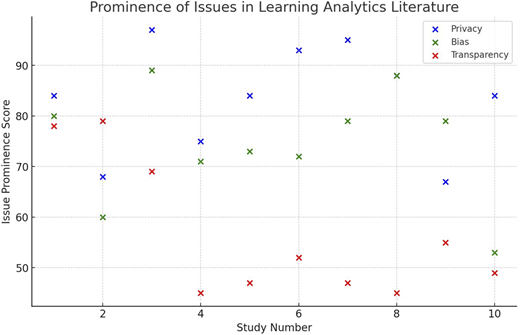
AI-driven learning analytics use student data, such as grades, attendance and clickstream logs, to forecast outcomes and inform targeted interventions. Privacy is a central ethical concern, given the volume and sensitivity of data involved. Early work on learning analytics highlighted dilemmas around consent, data minimisation and the risk of surveillance, and called for explicit institutional policies to govern data use (Sclater, 2017; Slade and Prinsloo, 2013). Subsequent studies, including the SHEILA policy framework and student-perception research, emphasise transparency about data practices, opportunities for student agency and robust governance arrangements (Arnold and Sclater, 2017; Tsai et al., 2018). Bias is equally significant. Predictive models can reproduce historical inequities, reinforcing negative expectations about students from marginalised groups. O’Neil (2016) documents how predictive risk models in education and other public services disproportionately flag low-income and minority populations as “at risk”, raising concerns about self-fulfilling prophecies and structural discrimination. Transparency, although less frequently discussed than privacy, is vital for trust, particularly when analytic outputs inform high-stakes decisions such as course progression or targeted interventions. When implemented with strong safeguards for privacy, fairness and human oversight, learning analytics can nonetheless support personalised learning and earlier, better-targeted support. Figure 4 illustrates the relative prominence of privacy, bias and transparency concerns within the learning-analytics literature.
AI-Driven Chatbots and Conversational Agents:
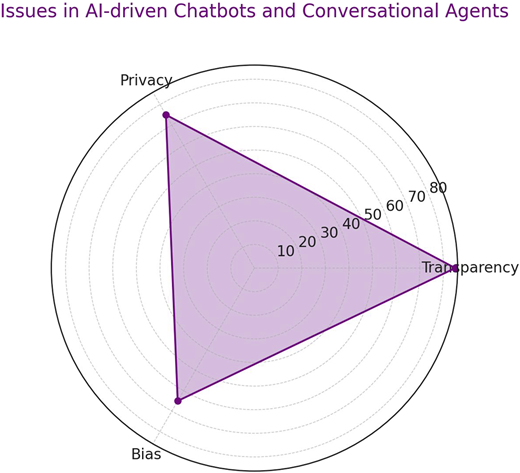
Conversational agents, including tutoring chatbots and question-answering assistants, are increasingly deployed in education. Reviews of educational chatbots and social robots highlight both pedagogical potential and ethical risk, including issues of trust, dependency and power (Winkler and Söllner, 2018; Belpaeme et al., 2018). Transparency is a key concern: students and educators often want to know whether they are interacting with a human or an AI system, how responses are generated and what sources underpin the information they receive (Winkler and Söllner, 2018). The tendency of large language models to provide fluent but incorrect answers has prompted calls for design features that signal uncertainty, provide references or explicitly encourage users to verify responses with teachers or trusted materials (Kasneci et al., 2023). Privacy is also critical, since chatbots may log detailed student queries and conversational histories that can contain sensitive personal information, raising questions about access, retention and secondary use (Holmes et al., 2022; UNESCO, 2021). Bias in language models remains a serious issue, with documented risks of stereotyping and microaggressions in dialogue, particularly for marginalised groups (Bender et al., 2021). Post-2023 discussions emphasise the need for curriculum-aligned outputs, robust content filters and age-appropriate guardrails when chatbots are used with children and adolescents (Holmes et al., 2022; Kasneci et al., 2023). Over-reliance is a further concern: some educators worry that students may begin to trust chatbots more than teachers or skip critical reflection. Design recommendations, therefore, stress that chatbots should supplement, not replace, human interaction, particularly in socio-emotional and pastoral roles (Kasneci et al., 2023). Figure 5 summarises how transparency, privacy and bias concerns intersect in educational chatbot research.
Intelligent Tutoring Systems and AI-Assisted Instruction:
Intelligent tutoring systems (ITS) and AI-assisted instruction adapt content, feedback and pacing in response to learners’ interactions. Decades of work in the learning sciences show that well-designed ITS can improve learning outcomes by providing step-by-step guidance and targeted hints (Koedinger et al., 2012). More recent systems draw on complex machine-learning models and natural language processing to generate feedback, explanations and practice activities. Ethical discussions in this domain highlight two closely linked issues: fairness and transparency. To provide equitable learning experiences, ITS should perform reliably for students from diverse linguistic, cultural and ability backgrounds and avoid embedding stereotypes or systematically lowering expectations for particular groups (Baker and Hawn, 2022). Where models of the learner are biased or incomplete, systems may misinterpret struggle as lack of ability or deliver suboptimal instruction. Transparency is needed so that students and teachers understand why particular tasks, hints or difficulty levels are being presented, and can challenge or override the system when it appears to misjudge a learner. Privacy concerns mirror those in learning analytics, because ITS often construct detailed learner profiles that must be securely stored, carefully governed and used only for clearly articulated pedagogical purposes (Sclater, 2017; Slade and Prinsloo, 2013).
Administrative and Decision Support Systems:
Beyond direct student-facing tools, AI is also deployed in educational administration, for example to optimise timetabling, predict enrolment patterns or support admissions and scholarship decisions. Although this was a smaller focus in the reviewed literature, similar ethical concerns apply. Bias in AI-driven administrative decisions, such as algorithmic screening in admissions or allocation of financial aid, can translate into systemic unfairness if historical inequities are encoded in training data or design choices (Baker and Hawn, 2022; O’Neil, 2016). Transparency and accountability are crucial where AI influences governance, staffing or resource-allocation decisions, since affected individuals require clear explanations and accessible routes for appeal. Human oversight remains essential to ensure that administrative AI tools support, rather than replace, professional judgement, particularly when decisions have long-term consequences for students’ educational trajectories.
Patterns and inconsistencies
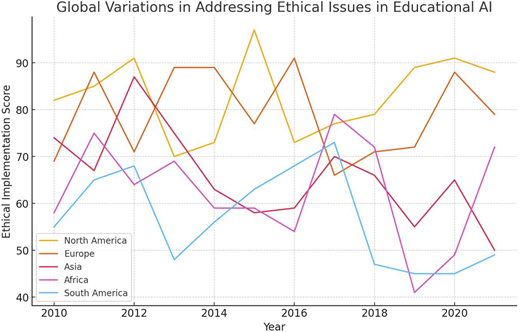
The review reveals significant disparities in how ethical issues in educational AI are addressed across regions and institutions. Some countries and well-resourced systems are proactively developing AI-ethics policies, whereas others have limited or fragmented guidance. Even within nations, implementation varies: some districts or universities have detailed policies on AI ethics and governance, while others rely largely on vendor terms or informal practices. Although a strong theoretical foundation for AI ethics has been articulated in global guidelines and academic frameworks, practical uptake in education remains uneven (Jobin et al., 2019; UNESCO, 2021). Many educators report a desire for training in AI ethics, yet formal programmes are rare and most teachers learn reactively through local trial and error (Holmes et al., 2022). This highlights the need for widely accessible standards and professional-development resources, potentially coordinated by international bodies such as UNESCO or the OECD and adapted locally to context. Sharing best practices and case studies across systems can support more consistent and ethically informed adoption of AI in diverse educational settings. Figure 6 visualises cross-national variations in AI-ethics policy development and implementation in education.
Integration with broader literature
These findings align with the wider AI ethics literature, which consistently foregrounds privacy, bias and transparency as core concerns across sectors (Jobin et al., 2019; UNESCO, 2021), and extend them through education-specific use cases. By incorporating recent studies on generative AI in higher education, the review addresses an emerging area that has only begun to be integrated into ethical frameworks. Work on ChatGPT and academic integrity and AI-in-education more broadly indicates that the effectiveness and ethicality of generative tools hinges on user literacy and institutional support: where teachers and students receive structured guidance, AI is more likely to be used in formative and transparent ways rather than as a shortcut that undermines learning (Cotton et al., 2023; Holmes et al., 2022; Kasneci et al., 2023; Long and Magerko, 2020; Zeb et al., 2024). Drawing on social learning and social exchange theories, the proposed framework emphasises that leadership support, professional learning and clear expectations are critical for embedding ethical AI practices in everyday educational work.
Implications for stakeholders
Educators: Need AI ethics training that goes beyond tool use to include discussions on plagiarism, bias, and data protection. Their behaviour directly shapes student ethics (social learning theory).
Institutional Leaders and Policymakers: Must mandate context-specific AI guidelines. The framework can inform national and institutional policy, including requirements for data privacy, transparency, and bias audits in educational tools.
Students and Society: Ethical AI instruction supports digital citizenship and prepares students to engage responsibly with AI in professional and civic life.
Developers: EdTech firms must anticipate ethical scrutiny. Products with explainability, privacy-by-design, and embedded fairness will gain stronger institutional trust and adoption.
Ethical framework
The framework is designed to be multi-layered, incorporating fundamental principles (the “why”), guidelines and best practices (the “what”), and recommended implementation strategies (the “how”) for various stakeholders. I also provide concrete examples and case studies to illustrate the framework in action. Finally, I acknowledge potential challenges in adopting this framework and suggest strategies to overcome them, ensuring that it is theoretically sound and practically viable.
Ethical theories and their relevance to AI in education
The framework draws on four core ethical theories, offering complementary lenses for guiding AI use in education:
Deontological Ethics, grounded in Kantian philosophy (Kant, 1785), focuses on rights and duties. In education, student rights, privacy, autonomy, and equitable treatment must not be compromised, regardless of the benefits that may be gained. A tool that improves performance but infringes on privacy or fairness remains unethical. While deontology offers clear boundaries, conflicts between duties (e.g. privacy vs. safety) require mediation through other approaches.
Utilitarianism, developed by Bentham (1789) and Mill (1863), evaluates actions by their outcomes. In educational AI, this supports tools that improve learning, access, or efficiency, if the harms are minimal. However, the framework rejects trade-offs that disadvantage minorities. For instance, AI that enhances outcomes for most but penalises students with different linguistic backgrounds would fail the equity threshold.
From Aristotle (circa 350 BCE), Virtue Ethics focuses on cultivating moral character. In education, this involves AI promoting intellectual honesty, fairness, and diligence —traits that support lifelong ethical learning. AI should encourage effort, not deception; clarity, not manipulation. Although challenging to encode, virtue ethics guides us in building systems that foster growth, not just compliance.
Care Ethics, articulated by Gilligan (1982) and Noddings (1984), emphasises empathy, attentiveness and relational responsibility. Applied to AI in education, care ethics highlights the importance of ensuring that technologies support rather than erode the teacher–student relationship, and that decisions about data use, automation and intervention remain sensitive to students’ emotional and relational needs. From this perspective, AI systems should be designed to augment human care, preserve space for professional judgement in sensitive situations and prioritise the well-being of learners who are most vulnerable to harm.
Together, these theories ensure that the framework balances principle (deontology), outcomes (utilitarianism), character (virtue ethics), and relationships (care ethics). This pluralist foundation enables the ethical, inclusive, and human-centred integration of AI in education.
Integrating Ethical Theories into the Proposed Framework
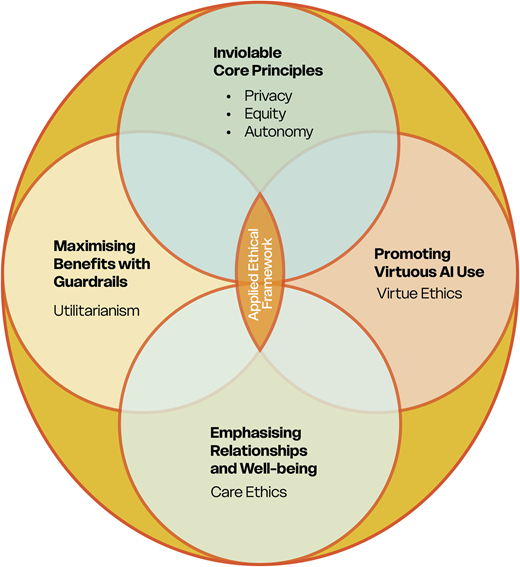
The proposed ethical framework draws upon the strengths of each ethical theory while mitigating their limitations through a pluralistic, context-sensitive approach. I have distilled the theoretical insights into guiding principles and practical guidelines. Below, I outline how each theory is woven into the framework and manifests in concrete guidance, referencing “Figure 7” as a visual representation of this integration.
Inviolable Core Principles (Deontological backbone): At the heart of the framework are certain non-negotiable ethical principles that align with deontological ethics. These include: Privacy, Equity, and Autonomy. These core principles are treated as inviolable rights that must be respected regardless of the situation or outcome. For example:
Privacy: The framework mandates clear guidelines for protecting student data. No AI application should be implemented without ensuring data security, minimal necessary data collection, and transparency to students/parents about data use. Students' personal information is a right, not to be bartered away for convenience.
Equity: Any use of AI must ensure equitable treatment of students. This might translate to guidelines like “AI systems must be tested for bias and adjusted to ensure they do not disadvantage any student group.” It also means proactively providing additional support or alternative solutions for students who might be less benefited by a given AI (for instance, if an AI requires high-speed internet, ensure accommodations for those without it).
Autonomy: Students and teachers should have a say in how AI is used in their environment. The framework thus encourages obtaining consent where appropriate, offering opt-out alternatives if feasible, and generally not using AI in ways that unduly constrain a student's freedom to learn or a teacher's freedom to teach. For instance, an AI that micromanages a teacher's lesson plan with no flexibility would violate teacher autonomy and is discouraged.
These core values form non-negotiable boundaries: any AI tool that violates them is excluded or must be revised. This directly addresses reviewer feedback by grounding the framework in Kantian ethics.
Maximising Benefits with Guardrails (Utilitarian Considerations): While upholding core duties, the framework also encourages the use of AI for the greater good of educational outcomes. This utilitarian influence is evident in guidelines that promote innovation and efficiency, provided they do not compromise the core principles. For example:
I encourage adopting AI tutoring systems or analytics tools that have evidence of improving learning outcomes, increasing engagement, or freeing teacher time – because these maximise positive impact. The framework might state, “Where an AI tool demonstrably enhances learning or well-being for students, educators should consider its use as long as it aligns with ethical safeguards.”
Resource allocation decisions (like which AI to invest in) should consider cost-benefit analyses to do the greatest good. Suppose the budget allows either a pricey AI for a few or a moderately effective AI for many. In that case, the framework leans towards broader benefit, again as long as no one's fundamental rights are compromised.
Importantly, the framework tempers utilitarianism with equity. The research explicitly rules out “sacrificing the minority for the majority.” If an AI helps 90% of students but severely hurts 10%, that is unacceptable; instead, the framework would push to tweak the solution or find an alternative that addresses the 10% (or provides them with something else of equal benefit). This might involve establishing a human mentor program to identify individuals for whom the AI does not serve well, ensuring that no group is left worse off, even as I pursue overall improvement.
Promoting Virtuous AI Use (Virtue Ethics in Design and Practice): The framework incorporates virtue ethics by setting expectations for the character of AI usage in education. This has two facets:
Design Virtues: Guidelines for developers or selectors of AI tools. I look for tools that embody virtues. For example, Honesty – AI should clearly indicate what it can or cannot do (no pretending to have authority it does not have). Fairness – similar to equity, ensuring the AI treats users impartially. Respect – AI should not demean or harm students’ self-esteem (e.g. avoid overly harsh automated feedback).
User Virtues: Guidelines for how teachers and students should use AI. The framework encourages educational communities to cultivate traits such as responsibility, honesty, and critical thinking in the use of AI. For instance, students should be taught that using AI to cheat undermines their virtue of honesty and hinders their own growth, whereas using AI to learn and citing it appropriately can be part of honest scholarship. Teachers should demonstrate wisdom in integrating AI – knowing when it is helpful and when to rely on human judgement.
The framework promotes virtue ethics by encouraging educators to model ethical AI use and integrate it into class discussions, positioning AI ethics as a component of character education, rather than just rule enforcement.
Emphasising Relationships and Well-being (Care ethics at the centre): Care ethics is reflected in the framework's emphasis on keeping education human-centric and relationship-oriented. Key points include:
AI should enhance rather than replace human interaction. For example, an AI tool might handle repetitive tasks or provide preliminary feedback; however, the framework would caution against using AI in ways that isolate students from their teachers or peers. The case study below will illustrate this.
Attentiveness to individual needs: The framework encourages use of AI to personalise support – a care perspective – but also mandates that unusual or sensitive cases get human attention. If an AI flags a student as struggling, a caring response would be a teacher or counsellor reaching out personally, rather than just the AI sending an automated message.
Emotional well-being: Guidelines include ensuring AI content is age-appropriate and emotionally considerate for younger children, perhaps requiring that AI interactions be monitored by or shared with a teacher to provide comfort or clarification.
Collaborative approach: The framework suggests involving students, parents, and educators in decisions about AI (as an expression of care by including those affected in the decision). For example, a school might hold a forum or survey before introducing a new AI system to gauge concerns and expectations.
Care ethics grounds the framework in educators' instinct to prioritise student wellbeing. It ensures technology adoption remains relational and compassionate. As Figure 7 shows, deontology sets boundaries, utilitarianism guides benefit, virtue ethics shapes values, and care ethics centres on human connection. This foundation supports the stakeholder-based ethical guidelines that follow.
Practical guidelines with case study application
To demonstrate practical implementation, I illustrate each guideline category through a case study: a secondary school piloting an AI-powered writing assistant with 10th-grade students.
Data Privacy and Security Guidelines (D = Deontological, U = Utilitarian, V = Virtue, C = Care ethics)
Core Principles: Minimal data collection (D), informed consent (D, V), secure practices (D, C), clear retention policies (D).
Case Study Application: Essays remain on local servers with pseudonymous identifiers. Students and parents receive clear information about the use of data. Explicit parental consent is obtained for cloud-based tools, with vendor agreements in place to prevent the reuse of data. Data deletion policies and encryption are implemented.
Fairness and bias mitigation guidelines
Core Principles: Bias audits using diverse test cases (U, D), algorithmic transparency (D, V), continuous monitoring (U), inclusive design (C, V).
Case Study Application: The English department tests the AI on writing samples from diverse linguistic backgrounds. When testing reveals bias against non-standard English phrasing, the school contacts vendors for adjustments and warns students that AI flags reflect training limitations, not errors in the text.
Transparency and accountability guidelines
Core Principles: User education (V, C), AI disclosure (D, V), precise accountability mechanisms (D, C), feedback channels (C, V).
Case Study Application: Teachers explicitly introduce the tool as “a helpful assistant, not a grader” and review all work. AI feedback uses distinct labelling. The school designates a vice-principal for AI-related issues, establishing clear accountability and appeal processes.
Academic Integrity and Responsible Use guidelines
Core Principles: Clear usage policies (D, V), strategic assessment design (U), AI as learning partner (V, C), graduated consequence framework (D, U, C).
Case Study Application: Using AI for draft feedback is permitted; generating entire essays constitutes cheating. Students submit initial drafts, AI feedback, and reflections on accepted/rejected suggestions. This process-oriented evaluation ensures active engagement while making dishonest use evident.
Human-centric and care-oriented guidelines
Core Principles: Human-in-the-loop oversight (C, D), augmentation not replacement (C, U), emotional well-being safeguards (C, V), inclusivity and accessibility (C, D).
Case Study Application: AI supplements teacher review without replacement. Teachers conduct check-ins when students report that feedback feels “blunt.” For students with learning differences, AI settings focus on higher-order concerns. Positive reinforcement supports emotional well-being.
Framework integration results: This implementation demonstrates the application of theoretical principles in practice, ensuring privacy through local processing, mitigating bias through testing, promoting transparency through disclosure, upholding integrity through process-based assessment, and prioritising care through human-centred design.
Implementation challenges and strategies
While the framework is comprehensive, I acknowledge, as do many sources in the review, that implementing ethical frameworks in practice presents challenges. Anticipating these, the outline common obstacles and recommended strategies in Table 1 (some observed in literature, some derived from analogous experiences in tech integration) to overcome them:
Conclusion
The rise of generative AI in education demands urgent ethical guidance. This paper extends the discussion across all educational levels through a systematic review (2010–2025), identifying five core concerns: privacy, bias, transparency, accountability and integrity. Analysed through deontological, utilitarian, virtue and care ethics, and framed by social learning and social exchange theory, I propose a flexible, theory-informed ethical framework. It offers actionable guidance on fairness, data protection and human-centred use. A writing-assistant case study illustrates its application, and practical strategies address key barriers such as resistance, resourcing and governance. Educators gain a path to responsible AI use, policymakers gain regulatory insight and students benefit from the ethically grounded integration of AI (e.g. Zeb et al., 2024), methods, and stakeholder clarity. In sum: AI should not displace educational values but be governed by them, centring equity, autonomy, and human dignity.