There is an ongoing transition from Industry 4.0 and Logistics 4.0 to Industry 5.0 and Logistics 5.0, which highlights the need not to exceed planetary boundaries. This motivates increased consideration of biological issues related to logistics. The purpose of this paper is to explain a new framing of logistics that emphasizes the importance of biological issues.
Exploratory research comprising three activities. Critical review of current framings. Survey research of biological, social and technological trends in African logistics. Formulation of propositions that were validated through negative case (NC) analysis.
Existing framings were found not to encompass biological, social and technological issues together. Lack of explicit consideration of biological issues in African logistics highlights the need for increased emphasis on biological issues. NC analysis validated seven propositions for a new framing: biosocial–technical interactions in logistics.
Biosocial–technical interactions in logistics should be considered throughout the world. For example, the expansion of logistics infrastructure can contribute to the loss of species habitats. Habitat loss can contribute to species migrations that can contribute to the emergence of zoonotic diseases, which can disrupt global supply chains.
Framing is important because framing effects decisions. Moreover, erroneous framing can provide an enduring rationale for a failing course of action, such as industrialization that exceeds planetary boundaries. Here, to better situate logistics in human development within planetary boundaries, a new framing of logistics is explained that encompasses biosocial–technical interactions.
1. Introduction
The purpose of this paper is to explain a framing of logistics that emphasizes the importance of biological issues. This purpose is situated in the context of the ongoing transition from Logistics 4.0 to Logistics 5.0 (Boz and Pinto, 2024; Jefroy et al., 2022). The 5.0 enumeration situates logistics within progress toward Industry 5.0 and Society 5.0. Overall, the 5.0 suffix indicates a trend to moving from focus on technological advancements to a broader focus that encompasses meeting human needs while not exceeding planetary boundaries (Carayannis and Morawska-Jancelewicz, 2022; Huang et al., 2022; Sidek et al., 2021).
The research reported here is motivated by several observations encompassing empirical evidence, systems thinking and ecological justice. Empirically, there is evidence of increasing environmental damage and detrimental health effects at the beginning of supply chains (Frazzoli et al., 2024; Weng et al., 2013). At the end of supply chains, increasing home deliveries involve increasing the production of packaging materials (Escursell et al., 2021). Increased production of packaging materials contributes to increased tree logging, which can contribute to reduced biodiversity and loss of carbon sinks (YLE, 2022). Thus, from a system thinking perspective, the sociotechnical trend toward increased shopping online is directly related to negative biological trends. Furthermore, severe disruptions to global logistics caused by COVID-19 highlight that a broader focus is needed for logistics. For example, the expansion of physical logistics infrastructure can contribute to the loss of species habitats (Fernández-Llamazares et al., 2018). Habitat loss changes the dynamics of species survival and migrations (Betini et al., 2015), which can contribute to the emergence of zoonotic diseases (Altizer et al., 2011; Mishra et al., 2021). Then, zoonotic diseases can cause severe disruptions to logistics throughout the world (Butt, 2022; Hohenstein, 2022). From an ecological justice perspective, a report by the Intergovernmental Platform on Biodiversity and Ecosystem Services, which has been approved by many countries, draws attention to the urgent need for more consideration of biological issues throughout human interactions with nature (IPBES, 2024). Hence, it is argued in this paper that there is a need for increased consideration of biological issues related to logistics.
Moreover, we hypothesize that logistics can be reframed to facilitate increased consideration of biological issues. This is because framing involves giving more emphasis to some aspects of a topic (Nisbet and Mooney, 2007) and is important because small changes in the presentation of a topic can produce large changes in opinion (Chong and Druckman, 2007). Previous framing of logistics has argued that logistics is often technology-driven (Mentzer et al., 2004). Subsequently, social aspects of logistics have been emphasized (Nilsson, 2006). In addition, there has been some use of the term “green” in relation to logistics theory (Liu, 2015). Green is a framing of logistics related to some of the biological aspects of supply chain management (SCM). However, there is not an existing framing of logistics that addresses biological, social and technological interactions in what can be described in scientific literature and in practice as joined-up thinking (Agyeman et al., 2012; Jones and Lucas, 2000; Stanley, 2009). To address this gap in logistics literature and practice, the exploratory research addressed two research questions listed below.
To what extent do existing framings of logistics address biological interactions with the social and the technological.
What are biological, social and technological trends in African logistics.
The exploratory survey research focused on Africa because meeting human needs within planetary boundaries is a very important topic in Africa (Chapman et al., 2022; Mwangi et al., 2022). For example, poverty persists in Africa (Adeyeye et al., 2023) amidst environmental degradation (Baloch et al., 2020). Yet, it has been recognized for some years that taking materials out of Africa threatens biodiversity in Africa (Moran and Kanemoto, 2017).
Three contributions to the development of a new framing are provided in the remaining sections of this paper. Methodology is described in Section 2. In Section 3, Theoretical background, the first contribution is to present a critical comparison of existing framings. In Section 4, Results, the second contribution is to report findings from our exploratory trend survey research; and the third contribution is to explain a framing of logistics that emphasizes biological issues. In Section 5, Discussion, theoretical contributions are summarized, practical implications are discussed, limitation are stated and directions for future research are proposed.
2. Methodology
Following from our hypothesis that logistics can be reframed to facilitate increased consideration of biological issues, our exploratory research comprised three activities: critical review of existing framings; African logistics trend survey; and formulation of propositions and recommendations.
Critical review involved reference to framing theory and focused on the extent to which existing framings of logistics address the biological, the social, the technological and interactions between them.
The trend survey was exploratory research of biological, social and technological trends in African logistics. Exploratory research can be used to gather information and reveal insights about complex phenomena that are currently not well documented. In this research, to overcome a lack of existing published trend analyses for African logistics, a multimethod approach was used in the exploratory survey research, which went beyond multivocal literature review (Adams et al., 2017; Patton, 1991) by also encompassing semi-structured interviews with logistics experts, workshops with logistics companies and analysis of logistics startups’ operations. Following recognition by the researchers that there was a lack of existing published analyses of African logistics, it was decided to expand the exploratory research to other potential sources that the researchers could access. This involved purposive snowball sampling (Campbell, 2020; Parker et al., 2019) of 14 African logistics experts, together with participants in workshops with 17 companies that were being carried out by the researchers and 12 startups which the researchers were already working with. This is consistent with the need for flexibility in exploratory research (Mbaka and Isiramen, 2021).
Propositions were formulated and validated through negative case (NC) analysis. This is a well-established method that involves challenging conclusions from qualitative research by identifying cases that are possible and that could contradict conclusions (Mahoney and Goertz, 2004). Here, the conclusions that could be contradicted are propositions.
3. Theoretical background
3.1 Framing theory
Extensive scientific research since the 1980s indicates decisions are affected by the way in which topics are framed (Homar and Cvelbar, 2021; Tversky and Kahneman, 1981). Ordering is important within framing. In what can be described as the serial position effect (Murdock, 1962), what is seen first and what is seen last can be most prominent in perception, memory and action (Logan, 2021). Also, it is important that the cognitive load should be minimized in framing. This is because we have evolved to be economical in the expenditure of brain energy (Padamsey et al., 2023), and less energy can be required for people to refer to their prior knowledge than to new information (Parr et al., 2023). For example, human working memory can handle only a very limited number of novel interacting elements at once (Paas et al., 2003), and some people may give up trying to understand new information if it comprises too many elements (Yoghourdjian et al., 2020). The potential for cognitive overload from new information can be increased when knowledge learnt in one context, such as a framing, could be transferred to another context (Si and Kim, 2011).
Framing can provide constraints in addressing a topic. However, constraints do not restrict creativity. Rather, constraints can lead to the creation of novel coherence in changing environments (Juarrero, 2023). Yet, how a topic is framed does affect evaluations and decisions about that topic (De Martino et al., 2006; Mowem and Mowem, 1986). Importantly, an erroneous framing can provide an enduring rationale for a failing course of action (Curseu et al., 2016; Rutledge, 1995).
3.2 Logistics framings
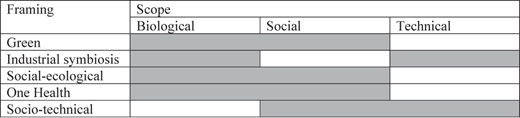
There are some framings that consider biological issues to some extent. Since the 1990s, green logistics is a framing of logistics related to some of the biological aspects of SCM through its focus on environmental sustainability (McIntyre et al., 1998; Murphy et al., 1996). More recently, the framing of green logistics has expanded to encompass societal issues in SCM. However, the green framing of logistics has been associated with greenwashing, which involves marketing intended to make activities seem to be more sustainable than they actually are (Chen and Duan, 2023; Dong et al., 2023; Inês et al., 2023).
An example of an already established framing that can be related to technical and biological aspects of logistics is an aspect of industrial ecology called industrial symbiosis (Turken and Geda, 2020). Overall, industrial ecology is concerned with the flows of energy and materials through industrial systems. It has been argued that industrial symbiotic networks can be based on natural ecological systems in order to develop synergistic networks within which hitherto separate organizations share resources and exchange wastes. Within this framing, resilience can be an emergent property (Chopra and Khanna, 2014).
An example of an established framing that can be related to social and biological variables is social-ecological framing. Recently, the social-ecological framing has been related to efforts to improve supply chain resilience from raw materials extraction to last-mile deliveries (Tsvetkova and Gammelgaard, 2024; Wieland et al., 2023). It has been argued that the social-ecological framing of resilience goes beyond the ability of a system to return to its previous form after a disruption. In particular, the social-ecological framing of resilience encompasses the capacity of a system to adapt and transform (Wieland and Durach, 2021).
An example of an established framing that has wide biological breadth by encompassing people, animals and the environment, which has been applied to the assessment of technologies, is the One Health framing (Gibbs, 2014; Alhaji et al., 2023). The One Health framing has been applied in assessments of negative effects from technological innovations. For example, per- and polyfluoroalkyl substances (PFAS) are used in a vast range of products, which can unintentionally lead to widespread environmental contamination (Hodgkins et al., 2019). Damage to public health and the environment from PFAS can be described as negative externalities. However, it has been pointed out that it is absurd to keep framing the harms from PFAS as externalities (Ng et al., 2021). Instead, they should be and can be assessed within integrative framings such as One Health (Melnyk et al., 2023). There has been some indirect application of One Health to logistics. For example, it has been argued from the One Health perspective that the spread of arbovirus is facilitated by global transportation systems (Gould et al., 2017).
There are many examples of negative unintended consequences from technological innovations not being assessed at the same time as intended positive consequences. For example, in the past, there was extensive pollution from horse-drawn vehicles. A positive consequence from the replacement of horse-drawn vehicles with vehicles that get their “horsepower” from internal combustion engines was the end of horse dung on roadways. However, negative unintended environmental consequences from vehicles powered by the internal combustion engine were belatedly recognized as being far more serious and remain intractable (Leach et al., 2020). As well as negative unintended consequences coming from vehicles used in logistics, there can be negative unintended consequences from human ecosystem engineering for logistics infrastructure. For example, over centuries, rivers have been engineered by people so as to change the environment in order to improve logistics. This has included flood plains being engineered to drain into rivers and rivers being straightened to speed up water-borne transportation. However, amidst extreme weather, such interventions can make waterways more vulnerable to both drying out and overflowing. Either of which can cause severe disruption to global supply chains. For example, when the drying out of rivers to impassibly shallow depths restricts the passage of water-borne vessels and when overflowing rivers destroy nearby infrastructure. Accordingly, there needs to be a rethinking of centuries of socio-technical interventions that have changed the environment with the aim of improving logistics (Gemmer et al., 2008; Halbe et al., 2018; Peters et al., 2021). Overall, many negative unintended consequences from logistics are external to the scope of socio-technical systems framings that are widely applied in industry and to logistics (Fischer, 2017; Lyons et al., 2006) because they do not encompass biological issues, even when they are considered as adaptive socio-technical systems (Behdani, 2012).
The need for biological, social and technological issues to be addressed together is becoming more widely recognized (Fox et al., 2020; de Campos et al., 2024), but, as summarized in Figure 1, not sufficiently within logistics management. Rather, with regard to RQ1, to what extent do existing framings of logistics address biological interactions with the social and the technological, there are several framings of logistics that encompass interactions between two but not all three.
4. Results
First, in this section, findings from the survey research are reported. Then, propositions are stated and evaluated.
4.1 Trends
As summarized in Table 1, the main finding from the exploratory survey research is that there is much less explicit consideration of biological trends than of social trends and technological trends. Findings from exploratory qualitative research have limited potential for generalizability. Nonetheless, this finding is consistent with studies indicating a lack of consideration of biological issues throughout the world (Frazzoli et al., 2024; IPBES, 2024; Rockström et al., 2023).
Some trends in African logistics were identified from more than one source. These trends were as follows: alternative energy (Alves, 2019), drones (Anim-Yeboah et al., 2022), e-commerce (Han et al., 2023), intra-continental cooperation (Arreyndip, 2021), platform economy (Johnson, 2020), automation (Olapoju, 2023), big data analytics (Machii et al., 2020), blockchain (Ejairu et al., 2024), cloud (Ochara et al., 2022), digital payment/non-physical payment (Oloveze et al., 2024), global navigation satellite systems (Adeitan et al., 2020), Internet of Things (Machii et al., 2020), sharing economy (Ochieng et al., 2024) and tracking systems (Yahaya et al., 2022).
Some trends were explicit only in the multivocal literature. Notably, there was only explicit mention of the need not to exceed planetary boundaries in the literature (Mwangi et al., 2022). Others identified only through multivocal literature review are artificial intelligence (Arakpogun et al., 2021), cybersecurity (Malatji, 2024), edtechs (Ochieng et al., 2023), mobile networks (GSMA, 2023), long-distance communication (GSMA, 2023), reduction of human work at borders (Malatji, 2024), shared earth policy (Obura and Treyer, 2022).
There were two trends that were mentioned explicitly only during the interviews. These trends were collaboration culture and supply chain resilience. However, these trends are related to the literature review findings. In particular, collaboration culture is mentioned in relation to intra-continental cooperation (Ajani and Conteh, 2025). In addition, supply chain resilience is a consideration in logistics within planetary boundaries (Mwangi et al., 2022).
Several other trends were explicitly mentioned only during company workshops. These were addressing systems, all-terrain vehicles, digital certification, digital map services, electric vehicles and single vehicle owner/operators. However, there is now some consideration of African digital addressing systems for physical buildings in the literature (Fianu et al., 2024). Also, digital certification is related to blockchain (Mavilia and Pisani, 2022) and digital map services are related to global navigation satellite systems (Fosu et al., 2007). In addition, electric vehicles and single vehicle owner/operators are two trends within platform economies (Sanguinetti et al., 2024). Although no mention of all-terrain vehicles was identified in the multivocal literature review, it is reported in the literature that Sub-Saharan Africa is the only region where road density has declined in recent decades (Azolibe and Okonkwo, 2020), which is consistent with there being need for all-terrain vehicles in Africa.
Analysis of startups’ operations revealed three broad trends into which many of the trends identified as being separate by other sources were being combined in diverse biosocial-technical logistics practice. In particular, within contexts often characterized by minimal logistics infrastructure, the startups make innovative combinations of established social resources with new technologies that can be mixed with older technologies in hybrid architectures. This is consistent with studies indicating that startups in uncertain resource-constrained contexts focus on trying to make positive effects within their limited means (Santoso, 2024) and do so by using whatever is at hand to create new solutions to problems as they arise (Archer et al., 2009). For example, one of the startups successfully delivers tonnes of goods every week in regions that do not have paved roads. Similarly, much of two of the other startups’ operations are in regions without paved roads. The startups use a variety of vehicles to make their deliveries in different types of conditions, with different load sizes and to different distributions of customers. For example, startups divide loads into small quantities for delivery by three-wheeled and two-wheeled vehicles. Furthermore, the startups operate successfully with minimal Internet connectivity and cloud storage. Such biosocial-technical logistics practice is consistent with conceptualizations of flexibility being enabled by adaptability. For example, flexible supply chains have been defined as being “able to adapt effectively to disruptions in supply and changes in demand whilst maintaining customer service levels” (Stevenson and Spring, 2007). The need to prioritize adaptability over efficiency has been highlighted by headlines such as “Covid shortages: supply chains must become less efficient” (Taherian, 2020).
Overall, the trends identified by different sources, as summarized in Table 1, have some consistency across sources and are supported by subsequent reference to the literature. However, Africa is a vast continent with ongoing developments in logistics. Accordingly, the authors make no claims for the identified trends being the only trends in African logistics. Nonetheless, the findings can provide an initial step in seeking a better truth approximation (Cevolani and Tambolo, 2013) in the description of African logistics.
Overall, with regard to RQ2, what are biological, social and technological trends in African logistics, the main finding from the exploratory survey research is that there is much less explicit consideration of biological trends than of social trends and of technological trends in at least some regions of Africa. This finding indicates that there is a need for a new framing of logistics that places more emphasis on biological issues. This need can be particularly important in sub-Saharan Africa, and other regions of the world including the Americas, Asia and Australasia, at the beginning of supply chains where environmental damage and detrimental health effects are being caused by increasing mining of raw materials (Frazzoli et al., 2024; Weng et al., 2013).
4.2 Propositions
In this section, each proposition (P) statement is preceded by a reference to relevant theoretical background and then followed by its NC analysis and its consequent proposition evaluation (PE). The first four propositions are concerned with the design of the framing. Subsequent propositions are concerned with the application of the framing.
As explained in Section 3.1, erroneous framing can provide an enduring rationale for a failing course of action, such as continuing to pay insufficient attention to biological considerations in logistics.
Framing should emphasise interactions of biological considerations with social and technological considerations in logistics.
NC1) There are already existing framings and these are sufficient.
PE1) It has been reported that “seven of eight globally quantified safe and just ESBs” (Earth System Boundaries) “and at least two regional safe and just ESBs in over half of global land area are already exceeded” (Rockström et al., 2023). Accordingly, it is evident that existing framings are not sufficient.
Also, as explained in Section 3.1, what is seen first and what is seen last in framing can be most prominent in perception, memory and action. Hence, the second proposition is as stated below.
A new framing of logistics should put biological considerations at the beginning and interactions at the end.
NC2) Ordering is not important and the ordering could be different.
PE2) The serial position effect has been considered in scientific research for more than one hundred years. It has been found to be robust and highly replicable (Logan, 2021). There is already more consideration of social and technological issues than there is of their interactions with biological issues. positioning biological considerations in the middle of a new logistics framing would not emphasize biological considerations as much as BSTI framing.
Furthermore, as explained in Section 3.1, people can prefer to refer to their prior knowledge rather than to new information, and some people may give up trying to understand information if it comprises too many new elements. Hence, the third proposition is as stated below.
A new framing of logistics should have the minimum number of novel elements.
NC3) A new framing of logistics could contain many novel elements.
PE3) Framings that do not clearly include social and technological considerations could be difficult to relate to logistics, and scientific research indicates that people can prefer to refer to their prior knowledge rather than expending mental effort to analyse new information (Pennycook and Rand, 2019). Furthermore, increased novel elements would increase intrinsic cognitive load. Heavy intrinsic cognitive load can exceed working memory capacity and so could prevent processing of all elements (Paas et al., 2010).
As explained in Section 3.2, there are several framings of logistics that encompass interactions between two of but not all three of biological, social and technological. Following from the preceding propositions, the fourth proposition is as stated below.
Biosocial-technical interactions (BSTI) is a framing that is consistent with Propositions 1 to 3, because it is a framing that clearly encompasses (P1) while structured in accordance with (P2) and minimizing the number of new elements (P3).
NC4) It is possible for there to be a new framing that does not encompass all three.
PE4) There are already framings, such as those described in Section 3.2. which do not clearly encompass all three and are not consistent with P2 and P3. As discussed in Section 1 and in Section 3.2, they are not sufficient.
To emphasize the need for human development to take place without exceeding planetary boundaries, there needs to be more attention on biological interactions with social and technological considerations in logistics. Hence, in accordance with the serial position effect discussed in Section 3.2, the fifth proposition is as stated below.
The middle positioning of social (S) considerations and technological (T) considerations in the BSTI framing is necessary to increase emphasis on their interactions with biological considerations.
NC5) It is possible that there could be alternative positionings of S and T such as SBTI.
PE5) However, decades of scientific research into the serial position effect (Logan, 2021) indicate that it may not be possible for such alternative positionings to increase emphasis on interactions with biological considerations.
As the BSTI framing minimizes divergence from existing framings, which are described in Section 3.2 and minimizes the number of new elements in the framing, it has potential for transfer to a wide variety of logistics contexts where currently there is often a lack of consideration of biological issues. For example, digitalization has the potential to introduce new opportunities for African logistics (Kuteyi and Winkler, 2022; Mkansi et al., 2020). However, there can be insufficient consideration of how the biological implications of extraction, transportation and processing of materials for digitalization, such as habitat loss and species migration, can lead to adverse unintended consequences for logistics and the whole world (Olapido et al., 2023). More broadly, there are emerging contexts for logistics, such as deep-seabeds (Cunningham, 2024) and extraterrestrial logistics (Pelech et al., 2019), where the BSTI framing could be applied in efforts to reduce the potential for new types of unintended negative consequences. Accordingly, the sixth proposition is as stated below.
The BSTI framing is applicable to a wide variety of logistics contexts including current contexts in which there has been insufficient consideration of BST interactions or future contexts where there could be potential for new types of BST interactions.
NC6) In new contexts, there are fundamental considerations outside of BST interactions.
PE6) More fundamental considerations include exchanges of information, energy and entropy (Menin, 2019; Petraccone, 2024). However, their description without practical BSTI examples can be difficult because they are high-level concepts in the ladder of abstraction from the concrete to the abstract (Seabury, 1991). By contrast, consideration of BST interactions can provide an initial practical framing for their approximate assessment in both planning and implementing logistics. For example, fundamental assessments of potential effects from new road construction in forests can be framed in terms of the biology of the wood wide web and of plant cognition (Giovannetti et al., 2006; Gefter, 2023).
As stated in Section 3.1, framing can provide constraints in addressing a topic, but constraints do not restrict creativity. Rather, constraints can lead to the creation of novel coherence in changing environments (Juarrero, 2023).
Emphasising biological considerations through the BSTI framing increases potential for new logistics offerings.
NC7) Emphasizing biological considerations through the BSTI framing reduces the potential for new logistics offerings.
PE7) It is argued that justice for non-human species is important for development within planetary boundaries (Gupta et al., 2024) and there are initiatives to allocate rights to biological entities, such rivers, which can be similar to rights that are allocated to social entities, such as corporations, and to technological entities such as artificial intelligence and ships (Gordon, 2021). So, it can be expected that logistics will need to comply with new legal requirements that put more emphasis on biological considerations. For example, major riverways are being allocated legal personhood (O'Donnell and Talbot-Jones, 2018). Hence, the BSTI framing can situate logistics innovation within new regulatory spaces from ideation onwards.
5. Discussion
First, in this section, contributions to theory development are described. Next, implications for practice are discussed. Then, limitations are clarified, and future research directions are proposed.
5.1 Theory development
Although there has been extensive scientific research indicating that decisions are affected by the way in which topics are framed (Homar and Cvelbar, 2021; Tversky and Kahneman, 1981), there have been few previous studies that have drawn attention to framings for logistics. One previous study drew attention to the need for broader framing of logistics (Akyelken and Keller, 2014), and one study has drawn attention to the potential for new framings to contribute to encouraging increased sustainability in logistics practice (Duan et al., 2022). The contribution of this paper to theory development in logistics management is that framing theory topics are applied to the framing of logistics. In particular, the serial position effect (Murdock, 1962; Logan, 2021) and cognitive load (Paas et al., 2003; Si and Kim, 2011). Consistent with framing giving more emphasis to some aspects of a topic (Nisbet and Mooney, 2007) through small changes (Chong and Druckman, 2007), the BSTI framing unifies and extends previous framings of logistics.
5.2 Implications for practice
In this subsection, implications for practice are listed as four recommendations: the first two for policy makers and the second two for enterprises.
Most broadly, within the BSTI framing, policy makers can draw upon theoretical biology to go beyond current definitions of resilience in supply chain logistics. Resilience is an established topic in literature concerned with supply chain logistics (Maharjan and Kato, 2024; Ponomarov et al., 2009). However, resilience is typically focused on the capability of human organizations to return to at least previous levels of performance after disruption without consideration of how the actions taken by individual human organizations to return previous levels of performance may undermine the resilience of other human organizations or the resilience of environments in which they and other human organizations are situated. This one-sided focus is addressed to some extent by the application of socio-ecological systems thinking in logistics (Wieland et al., 2023). Yet, reference to theoretical biology can enable one-sided disruption-recovery resilience to be superseded by recognition of the need for continuous synchronous vitality among all agents in environments. That is, a continuous balance between external flexibility and internal stability in environments that are always changing to some extent. The theoretical biology literature offers modelling techniques (Bruineberg et al., 2018; Ulanowicz et al., 2009), which could be applied by logistics policy makers in the future.
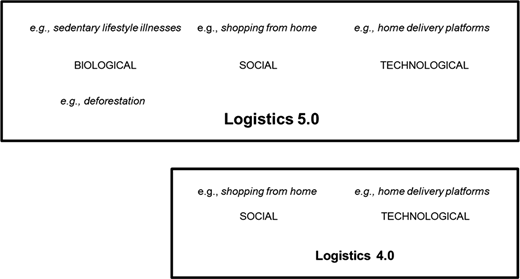
As summarized in Figure 2, policy makers can apply BSTI framing to relate Logistics 5.0 to Society 5.0. For example, as well as home deliveries having negative unintended biological consequences for forests, home deliveries can have negative unintended biological consequences for people. In particular, increasing home deliveries can lead to increasingly sedentary lifestyles for people who stay at home instead of going out to buy ingredients to prepare food, and for people who sit driving for long hours as they try to earn enough money to survive by driving for several delivery companies (Costa et al., 2023). These are negative unintended biological consequences for people because sedentarism is related to rising incidence of non-communicable diseases, such as obesity, diabetes and coronary heart disease (Park et al., 2020). This is an example of how the B in BSTI framing can relate to the biology of any living thing from people to trees: all of which can come to have rights in human societies (Stone, 2017).
Interactions between biological, social and technological variables can provide a basis for startup concept ideation, which can be performed with methodologies based on biomimicry (Kennedy, 2017) for business (Brennan, 2015) and for products (Ruiz-Pastor et al., 2023). Emphasising biosocial-technical interactions could make logistics more attractive to impact investors. That is, investors that are interested in creating positive environmental and social impacts as well as generating financial returns (Barber et al., 2021). Apropos, logistics startups that are based on new concepts informed by consideration of biosocial-technical interactions could be classified as “zebra startups,” which can prioritize social value, mutualism and resilience as well as financial profit (de Gennaro et al., 2023).
Scaling up logistics enterprises in changing environments requires that logistics enterprises balance internal stability and external adaptability within biological, social and technological constraints that will change as the world around them changes. For example, there can be increasing customer expectations and legal regulations concerned with biological issues that can lead to previously acceptable social practices and technological processes becoming unacceptable. For example, it may become unacceptable to use paper or plastic packaging for food, and there could be a return to traditional practices that are more sustainable, such as wrapping with banana leaves (Arumugam et al., 2024). Furthermore, hype about new technologies can increase and decrease depending on research into their potential unintended consequences. For example, it is possible that the operation of new electric vehicles may be more environmentally sustainable than fossil fuel vehicles. However, that depends on the means of electricity generation, and there can be a wide range of negative environmental consequences from electricity generation by renewable energy sources (Rahman et al., 2022). Moreover, the production of electric vehicles can have worse environmental consequences overall than the production of fossil fuel vehicles (Xia and Li, 2022). Accordingly, it is important that logistics enterprises give careful consideration to biological consequences before investing in any hyped technologies.
Framing propositions are related to practical recommendations in Table 2. As described in Section 4.2, the first propositions are concerned with the framing design, and the subsequent propositions are concerned with framing application.
As summarized in Table 2, it is most important for policy makers that there is more consideration of BST interactions in order to facilitate their going beyond established constructs such as resilience. It is most important for enterprises that the BSTI framing can expand their ideation of offerings for many different contexts. As can be seen from the summary in Table 1 in Section 4.2, there are many emerging social trends and technological trends that can contribute to many novel logistics offerings. BSTI can provide an urgently needed flexible framing to support the development of novel logistics offerings that can better contribute to progress toward Logistics 5.0.
5.3 Limitations and directions for future research
As summarized in Table 1, the main finding from the exploratory survey research is that there is much less explicit consideration of biological trends than of social trends and technological trends. Exploratory research can provide new insights, but there is much need for future research. The overall question to be addressed by future BSTI research is how can logistics contribute better to meeting human needs while not exceeding planetary boundaries.
Future research should encompass BST interactions that can lead to global setbacks in meeting human needs while not exceeding planetary boundaries. For example, global setbacks from the risks of logistics contributing to the global spread of diseases (Shao and Ye, 2022; Xie et al., 2023). This is an increasingly important topic as climate change is facilitating the spread of diseases throughout the world (McDermott, 2022). Currently, consideration of disease spread in logistics management is often focused on taking actions after a disease has already begun to spread. This is done within what can be described as emergency logistics (Zhang et al., 2022). However, this current practice is another example of negative unintended consequences being addressed after they have begun. BSTI framing of logistics can include assessing potential negative consequences, such as disease spread, which would otherwise be considered to be externalities.
At the same time, future research should be positive in considering how increased consideration of BST interactions can facilitate meeting human needs while not exceeding planetary boundaries. Such research should encompass the large-scale international initiatives of a few countries (Chen et al., 2020; Luke and Mageto, 2023) and emerging networks of many small local logistics organizations (Mkansi et al., 2020; Oluwakoya, 2023). Future BSTI research can seek to bring together hitherto separate research foci. For example, there is interest in the use of biodegradable materials in road construction (Luo, 2024) and in vehicle production (Choi et al., 2023). Also, there is interest in protecting wildlife (Santos et al., 2017) and preserving biodiversity (Sandström and Elander, 2021) in logistics developments.
Thus, overall, BSTI framing should be applied in future research concerned with preventing 5.0 setbacks and facilitating 5.0 progress through projects that bring together what could otherwise be separate research foci.
The authors thank Marit Spies and Markus Witthaut for their contributions to the research.