This paper investigates how strategic decision-making; structured project management methodologies and technology complexity jointly influence competitive advantage in the logistics sector.
Data were collected through a bilingual (English–Lithuanian) expert survey of 60 logistics professionals involved in technology implementation projects. The study reports bivariate correlations and estimates separate ordinal logistic regression models to test five theory-derived hypotheses grounded in the resource-based view (RBV) and the dynamic capabilities perspective; an additional reverse competitive advantage and strategic goals (CA → SG) specification is reported only as a supplementary exploratory feedback analysis.
The results indicate positive associations between (1) decision-making quality and competitive advantage, (2) strategic goal alignment and competitive advantage, (3) project management methodology and decision-making quality, (4) implementation speed and project management methodology, and (5) strategic decision-making quality and greater consideration of technology complexity. Across surveyed firms, digital technologies appear to be used primarily to support cost-based competitive advantage, while differentiation-oriented benefits are rated lower. Given the cross-sectional design, findings are interpreted as evidence of association rather than definitive causal confirmation.
Future research should test the model across diverse regions, industries, and technological contexts to enhance generalizability and uncover additional moderating factors influencing competitive advantage.
Practically, it provides guidance for phased digital transformation in logistics, emphasizing the need for structured decision-making, strategic alignment, and project management to navigate complex technologies.
The study showed that effective strategic decision-making increases competitive advantage, especially when it is aligned with clearly defined strategic goals and structured project management practices. The complexity of technology influences decision-making and project implementation, so adaptive, data-driven approaches are needed for successful digital technology adoption.
This study empirically tests an integrated, theory-derived (RBV/dynamic capabilities) capability-to-outcome framework for digital technology implementation in logistics. Based on the empirical estimates, the framework offers scholars and practitioners a structured basis for planning phased digital transformation, aligning technology portfolios with strategic objectives, and managing risks in complex logistics initiatives.
1. Introduction
The logistics sector is undergoing a profound transformation under the umbrella of Logistics 4.0, driven by technologies such as the Internet of Things (IoT), cyber-physical systems (CPS), artificial intelligence (AI), blockchain, and autonomous robotics (Hofmann and Rüsch, 2017; El Hamdi and Abouabdellah, 2022; Idrissi et al., 2024; Zhang et al., 2024). These innovations enable real-time visibility, automated decision-making, and responsive planning across the supply chain (Hofmann and Rüsch, 2017; El Hamdi and Abouabdellah, 2022). While offering opportunities to enhance efficiency, resilience, and value creation, they also introduce multidimensional challenges, including system integration, interoperability, computational requirements, and organisational adaptation (Younis and Wuni, 2023). In this study, the central premise is that digital technologies create value in logistics only when strategic goals are translated into execution through decision-making and project management mechanisms, particularly under high technology complexity.
Logistics firms are widely aware of Logistics 4.0 solutions and increasingly invest in IoT, AI, analytics and related tools. Yet implementation outcomes remain uneven: many initiatives stall at pilot stage, exceed time/cost expectations, or deliver less value than anticipated. This creates a managerial paradox high technological potential, but persistent difficulty in organisational realization and value capture.
These shortcomings are rarely caused by a lack of available technologies. Instead, they reflect organisational and managerial constraints: digital initiatives are frequently not aligned with clear strategic goals, decision rights and evaluation criteria are fragmented, and firms struggle with resource allocation and risk management across interdependent systems. Moreover, implementation requires selecting and executing an appropriate project management methodology under uncertainty and complexity, coordinating cross-functional stakeholders, and managing integration and interoperability challenges. As a result, logistics organizations often know what technologies exist, but still struggle with how to decide, prioritize, and implement them in a disciplined way.
This study is guided by the Resource-Based View (RBV) and the dynamic capabilities perspective. RBV explains sustained competitive advantage through firm-specific resources and capabilities that are valuable and difficult to imitate; in digital contexts, technologies themselves often diffuse rapidly, so advantage increasingly depends on complementary organisational capabilities. We therefore conceptualize strategic decision-making quality and structured project management as capability mechanisms that enable firms to select, orchestrate and implement digital technologies in alignment with strategic intent. From a dynamic capabilities view, these mechanisms reflect firms' ability to sense and seize digital opportunities and to reconfigure resources under technological change.
Effective strategic decision-making is crucial for navigating these challenges. Structured decision-making frameworks allow organizations to select, prioritize, and implement digital technologies in alignment with strategic objectives and operational capabilities (Kamble et al., 2018; Dubey et al., 2020a, b). Project and portfolio management methodologies further operationalise these strategic choices by coordinating resources, managing risks, and ensuring the timely execution of complex technology initiatives (Milosevic and Srivannaboon, 2006; Patanakul et al., 2010).
From an RBV/dynamic capabilities perspective, competitive outcomes depend on how strategic goals and implementation capabilities are configured, especially under high technology complexity. Accordingly, although the Logistics 4.0 literature is extensive, several specific gaps remain.
First, many studies emphasize technology adoption drivers or the performance potential of IoT/AI/blockchain but provide limited explanation of the organisational implementation mechanisms through which firms translate awareness into execution, particularly the joint role of strategic decision-making quality, project management, and the choice of project management methodology.
Second, technology complexity is frequently discussed as a general challenge, yet it is rarely modeled as a contingency factor that shapes how formalized decision processes and project management approaches must become to manage integration and interoperability demands.
Third, empirical work often focuses on intermediate outcomes (e.g. adoption intention or project success) and less often specifies a clear pathway from decision and execution mechanisms to competitive advantage (cost leadership, differentiation, and focus) in logistics.
Fourth, there is limited empirical testing of these relationships within a single model suitable for ordinal survey measures; few studies estimate how strategic goals, decision-making, project management methodology, complexity and implementation speed jointly relate to ordered competitive outcomes using ordinal logistic regression.
In our framework, competitive advantage is the focal outcome, strategic goals/alignment act as the key antecedent, project management methodology and strategic decision-making operate as closely related implementation constructs, greater consideration of technology complexity reflects a decision-related domain, and implementation speed is treated as a contextual condition influencing methodology choice.
Accordingly, this study is positioned as an empirical, theory-testing paper that estimates and tests the hypothesized relationships derived from RBV/dynamic capabilities using expert survey data and ordinal logistic regression. Specifically, the following primary hypotheses guide the research:
The use of a structured and effective project management methodology in organizations is positively associated with clearly defined decision-making processes.
Higher decision-making quality is positively associated with competitive advantage in logistics firms.
Strategically formulated goals help guide organizations toward achieving a competitive advantage.
Strategic decision-making quality is positively associated with greater consideration of technology complexity.
The selection of a project management methodology is significantly influenced by the speed of technology implementation.
As an additional exploratory analysis, we also examined whether existing competitive positioning is associated with the emphasis placed on strategic goals. However, this reverse association (CA → SG) is not treated as part of the primary causal hierarchy and is reported separately from the main hypothesis set in the results section. Accordingly, this study aims to operationalise and empirically test a theory-derived decision-making framework for digital technology implementation in the logistics sector. Section 2 reviews theoretical development from previous studies on competitive advantage, strategic goals, decision-making, technological complexity, project management methodologies, and implementation speed, while Section 3 covers methodology and detailed statistical analysis. The results are examined in Section 4, with a discussion subsequently presented in Section 5. Conclusions on theoretical and practical implications, alongside information regarding future research, appear in Section 6.
2. Theoretical development, research framework and associated hypotheses
2.1 Theoretical framework development
Digital technologies in Logistics 4.0 rarely generate competitive advantage through technology ownership alone. Instead, advantages tend to depend on whether firms develop and deploy complementary implementation capabilities that translate digital investments into coordinated execution and performance outcomes. We therefore ground the framework in the resource-based view (RBV) and the dynamic capabilities perspective, which together explain how firms align intent, make strategic choices, and reconfigure resources under technological change. Accordingly, we position strategic goal clarity as an alignment mechanism, strategic decision-making quality as a capability to evaluate trade-offs and allocate resources, and project management methodologies as an execution capability. Greater consideration of technology complexity reflects the extent to which technical interdependencies are explicitly recognised in strategic decision-making, while implementation speed is treated as a contextual condition that can shape methodology choice.
This study therefore adopts RBV and dynamic capabilities as the dominant explanatory logic for selecting constructs and specifying their relationships. Porter strategy is used only to operationalise competitive advantage (cost leadership, differentiation and focus), while agility, digital management and project management concepts are treated as capability manifestations and implementation mechanisms consistent with the RBV/dynamic capabilities logic rather than as parallel theories. In sum, the proposed explanation follows a directional association framework in which strategic goal alignment and decision-making quality are linked to competitive advantage, project management methodology is positively associated with decision-making quality, strategic decision-making quality is positively associated with greater consideration of technology complexity, and implementation speed is treated as a contextual condition influencing project management methodology.
Strategic decision-making and management are therefore central to technology implementation under Logistics 4.0 conditions: recent evidence from logistics enterprises suggests that adaptive management and digital transformation capabilities are positively linked to performance-relevant outcomes, while dynamic capabilities research emphasizes the need for a deliberate strategic roadmap to prioritize decisions and sequence integration efforts under uncertainty and interdependence (Li et al., 2022; Ostadi et al., 2024). Strategic decision-making quality therefore functions as a capability that structures trade-offs (e.g. cost versus flexibility, speed versus control), clarifies decision rights and evaluation criteria, and reduces the likelihood of technology–strategy misfit. From an RBV/dynamic capabilities perspective, these decision routines enable firms to sense and seize digital opportunities and to coordinate reconfiguration during implementation, thereby increasing the probability that digital investments translate into execution performance and competitive outcomes. Previous studies have examined strategic decision-making in logistics mainly through technology integration and project management agility. Advanced digital tools and infrastructure enhance logistics integration and enable faster, more agile decisions (Zhang et al., 2024), while decision-making speed is identified as a key driver of competitive advantage under uncertainty (Shepherd et al., 2021). Industry 4.0 based decision-support systems using IoT and big data strengthen agility in logistics (Choi et al., 2018). Yet the literature still offers limited insight into how decision-making, technology complexity, strategic goals, project management methodology and implementation speed jointly shape the adoption and execution of logistics innovations. To address this gap, we use the RBV/dynamic capabilities lens to integrate prior insights on strategy, decision-making and project execution into a single capability-to-outcome framework suited to Logistics 4.0 implementation. Importantly, the hypothesized core logic is specified as directional: strategic goal alignment and decision-making quality are associated with competitive advantage, project management methodology is associated with decision-making quality, strategic decision-making quality is associated with greater consideration of technology complexity, and implementation speed is treated as a contextual condition shaping methodology choice; any reverse association (competitive advantage → strategic goal emphasis) is treated as exploratory feedback and discussed separately in Section 2.4.
Under Logistics 4.0, digital initiatives create value through a set of related organisational mechanisms. First, strategic goal alignment provides the directional intent that guides competitive positioning. Second, higher-quality strategic decision-making improves the quality, transparency and timeliness of choices, thereby increasing the likelihood of competitive advantage and strengthening the explicit consideration of technology complexity. Third, structured project management methodologies help formalise decision routines and coordinate execution under uncertainty. Finally, when implementation speed requirements are high, organisations are more likely to rely on methodologies that support rapid coordination, short planning cycles and timely escalation. Together, these mechanisms help explain how digital implementation choices are associated with competitive advantage in logistics.
Strategic goals and digital alignment for competitive advantage. This is consistent with Porter's (2008) view that competitive advantage rests on cost leadership or differentiation and, in digital settings, increasingly emerges through the integration of advanced technologies (Dubey et al., 2020a, b; Queiroz and Wamba, 2019). From a resource-based perspective, valuable, rare and inimitable resources underpin sustained advantage (Barney, 2000), and recent work extends this logic to digital resources, showing that data analytics, AI and blockchain capabilities become strategic assets when aligned with organisational goals (Kamble et al., 2018; Wamba et al., 2020; Zhang et al., 2024). Strategically aligned Industry 4.0 initiatives can convert operational efficiency into agility, resilience and superior service quality, sustaining competitiveness in logistics (Ivanov and Dolgui, 2021). In this study, strategic goals (quality, time, cost and flexibility) are therefore treated as the directional intent that guides how implementation capabilities are deployed toward competitive outcomes.
Strategic decision-making in digital technology adoption. Evidence indicates that digital investments yield performance gains when guided by clear strategic choices. Logistics firms adopting tools such as real-time transportation planning and visibility platforms report short- and long-term improvements in reliability, speed and cost-efficiency, reinforcing competitive advantage (McKinsey & Company, 2023). Technology-enabled strategic decisions significantly improve logistics performance (Bag et al., 2020), and structured decision-making frameworks support higher agility, resilience and market responsiveness under Industry 4.0 conditions (Dubey et al., 2020a, b; Queiroz and Wamba, 2019). Practical cases, such as DHL's blockchain pilots in pharmaceutical logistics, illustrate how strategic digital initiatives enhance transparency, traceability and trust, generating competitive benefits (Saberi et al., 2019). Accordingly, we model decision-making quality as an implementation capability that improves the likelihood of selecting and orchestrating digital initiatives that yield competitive advantage.
Structured decision-making and project management methodologies. Well-defined decision-making processes are closely associated with the use of structured and efficient project management methodologies. Digitally mature firms are more likely to integrate formal project management frameworks that improve efficiency, collaboration and technology adoption success in logistics innovation projects (Queiroz and Wamba, 2019). Strategic decision-making supports the prioritisation of technology investments, resource allocation and risk mitigation in complex digital projects (Kamble et al., 2018), while standardised project management practices enhance transparency, accountability and timely execution (Patanakul et al., 2010). Structured decision-making also fosters cross-functional collaboration, crucial for implementing AI, IoT and blockchain in logistics (Dubey et al., 2020a, b), positioning firms to achieve operational excellence, innovation and competitive advantage (Zhang et al., 2024). In our model, project management methodologies operationalise decision-making into disciplined execution and are therefore treated as execution capability mechanisms rather than a separate theoretical perspective.
Technology complexity and decision-making challenges. Growing technological complexity in logistics makes system integration and decision-making increasingly demanding. Firms often operate multiple digital tools and face integration problems that erode value (McKinsey & Company, 2023), and complex logistics systems require multi-criteria methods, and robust optimisation approaches to capture multidimensional trade-offs and scenario uncertainty (Masłowski et al., 2020; Megow and Schlöter, 2021). Technologies such as AI and IoT introduce strong interdependencies that complicate decisions (Dubey et al., 2020a, b), while blockchain-based IoT solutions underline the need for structured approaches to complex digital projects (Ugochukwu et al., 2022). Studies on highly complex technological ecosystems highlight the importance of autonomous, data-driven decision-making to mitigate risks and ensure alignment (Sony and Naik, 2020) and document integration, configuration and interoperability challenges associated with hybrid logistics technologies (Roshid et al., 2024; Samad et al., 2023).
Implementation speed and project management methodology. In this study, implementation speed is treated as a contextual implementation condition rather than as an execution outcome. Prior research on digital supply chains shows that structured initiatives improve efficiency and responsiveness (Ghobakhloo et al., 2025), while digital management frameworks can enhance logistics performance (Emon and Khan, 2025). Research further indicates that strong project management and leadership support digital supply chain transformation by reducing resistance and facilitating adoption processes (Dubey et al., 2020a, b), and that agile methodologies can shorten the transition from pilot initiatives to broader deployment (Zielske and Held, 2020). Empirical studies also show that structured project management practices are associated with higher technology adoption success and stronger project outcomes (Daškevič and Burinskienė, 2025), while digitally mature organisations tend to implement digital solutions more reliably under formal project governance arrangements (Queiroz and Wamba, 2019). In complex logistics projects, coordinated resources, systematic risk management and formalised project frameworks remain important for reducing delays and implementation bottlenecks (Patanakul et al., 2010). Consistent with this literature, the present study interprets implementation speed as a situational condition that shapes methodology choice: when rollout-speed requirements are higher, organisations are more likely to rely on project management methodologies that support rapid coordination, shorter planning cycles and faster issue escalation.
2.2 Conceptual framework and hypotheses development
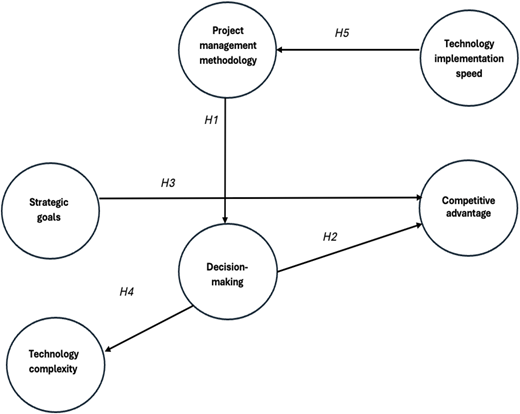
To clarify the causal hierarchy and support interpretation, we treat competitive advantage (CA) as the focal endogenous outcome and specify directional capability-to-outcome paths grounded in RBV/dynamic capabilities. Strategic goal alignment (SG) is modelled as the key antecedent of competitive advantage; decision-making quality (DM) and project management methodology (PM) are treated as closely related implementation constructs; greater consideration of technology complexity (TC) is treated as a decision-related domain; implementation speed (IS) is treated as a contextual implementation condition; and CA captures the focal competitive outcome. Consistent with ordinal logistic regression, each model estimates an ordinal outcome as a function of theoretically prior predictors. Any reverse association (CA → SG) is retained only as exploratory feedback and is not interpreted as part of the primary causal chain. The hypotheses are specified to reflect ordered outcomes in the survey measures; the empirical estimation approach is described in detail in Section 3. Grounded in RBV and dynamic capabilities, the model specifies how decision-making and project execution capabilities condition the value realization of digital technologies under varying levels of complexity.
To enable interpretable hypothesis testing within the RBV/dynamic capabilities logic, we specify a directional capability-to-outcome ordering of constructs. Competitive advantage (CA) is treated as the focal outcome. Strategic goal alignment (SG) is specified as an antecedent condition for competitive outcomes; decision-making quality (DM) and project management methodology (PM) represent implementation-related constructs; greater consideration of technology complexity (TC) captures the extent to which technical complexity is explicitly addressed in strategic decision-making; and implementation speed (IS) represents a contextual condition that can shape methodology choice. Although feedback effects may occur in practice, the empirical models are estimated and interpreted as directional associations consistent with the theoretical ordering shown in Figure 1. Any reverse association between competitive advantage (CA) and strategic goal alignment (SG) is examined only as an additional exploratory analysis and is not treated as part of the primary causal chain. This directional ordering is consistent with RBV/dynamic capabilities evidence showing that performance gains from digital and analytics-related technologies depend on complementary managerial capabilities and alignment mechanisms, rather than technology adoption alone (Dubey et al., 2020a, b; Zhang et al., 2024). Accordingly, we treat goal alignment as the main directional antecedent of competitive advantage, while project management methodology, decision-making quality, implementation speed and greater consideration of technology complexity are interpreted as positively associated implementation-related constructs within the proposed framework.
2.3 Project management methodologies and decision-making
In our RBV/dynamic capabilities framing, project management methodologies operationalise implementation capabilities by structuring coordination, management, risk management and execution discipline. In logistics technology implementation, the use of a structured methodology can also support more clearly defined decision-making by clarifying roles, routines, escalation paths and decision criteria during project execution (Queiroz and Wamba, 2019; Dubey et al., 2020a, b). Organisations using structured project management methodologies are better able to coordinate resources, manage risks and monitor execution consistently, thereby improving operational discipline and reducing ambiguity in implementation-related choices (Kamble et al., 2018; Bag et al., 2020). A formal methodology institutionalises routines for coordination, iteration and risk control, which in turn helps create clearer and more formalised decision-making processes under uncertainty. Building on these arguments, the following hypothesis is proposed:
H1: The use of a structured and effective project management methodology in organizations is positively associated with clearly defined decision-making processes.
In this study, project management methodology refers to how execution is organised (e.g. coordination routines, monitoring cadence and management structure), whereas decision-making quality refers to the clarity, consistency and formalisation of implementation-related choices (e.g. criteria, prioritisation, resource allocation and risk responses).
Project management methodologies are treated conceptually as key mechanisms through which organisations implement digital technologies in logistics, while the empirical measure used in this study captures project management effectiveness during implementation (Kamble et al., 2018; Dubey et al., 2020a, b; Queiroz and Wamba, 2019).
In this study, project management is operationalised more parsimoniously through two indicators of project management effectiveness reported in Table 2: (1) adherence to project timelines and budgets and (2) the quality of stakeholder communication. These indicators reflect how effectively project management is enacted in implementation practice, rather than capturing all methodological dimensions in full detail (Kamble et al., 2018; Dubey et al., 2020a, b). Daškevič and Burinskienė (2025) demonstrate that integrating Innovation Diffusion Theory with structured project management frameworks enhances digital technology adoption in logistics. Varajão et al. (2022) find that project risk management mediates the relationship between information systems and project success, and Jegan Joseph Jerome et al. (2024) emphasise the importance of managerial expertise for implementing digital technologies in digitised supply chains. Together, this body of work suggests that disciplined project management and formalised implementation routines are positively associated with clearer and more structured decision-making in digital logistics innovation projects.
2.4 Competitive advantage and decision-making
From an RBV/dynamic capabilities perspective, decision-making quality is a higher-order implementation capability that improves the likelihood of achieving competitive advantage through effective orchestration of digital initiatives. Effective decision-making in logistics is recognised as a critical driver of competitive advantage in digital technology adoption. Strategic decision-making enables organisations to select, prioritise and implement technologies that enhance operational efficiency, responsiveness and performance (Zhang et al., 2024; Shepherd et al., 2021). In digitalised logistics, choices regarding the integration of IoT, AI, big data analytics and related technologies directly affect process efficiency, cost reduction and value creation (Dubey et al., 2020a, b). Organisations that establish structured decision-making processes are better positioned to align technology adoption with strategic goals, improving both short-term performance and long-term competitive positioning (Bag et al., 2020). Decision-making agility understood as the speed and accuracy of strategic choices under technological and market complexity supports firms in capturing opportunities while mitigating risks in complex logistics environments (Queiroz and Wamba, 2019; Kamble et al., 2018). The mechanism linking decision-making quality to competitive advantage is primarily executional: better strategic decisions reduce technology–strategy misfit and prevent costly implementation errors, delays and rework. By improving prioritization, resource allocation and risk responses, structured decision-making increases the likelihood that digital initiatives deliver measurable performance gains (e.g. cost efficiency, reliability, responsiveness). These performance gains translate into competitive advantage, especially where Logistics 4.0 benefits depend on coordinated process and system integration rather than standalone tools. Building on these insights, the following hypothesis is proposed:
H2: Higher decision-making quality is positively associated with competitive advantage in logistics firms.
Competitive advantage in logistics is conceptualised as the organisation's ability to outperform rivals through operational efficiency, cost reduction and value creation under digital transformation (Zhang et al., 2024; Shepherd et al., 2021). In line with Porter's (2008) generic strategies of cost leadership, differentiation and focus, further elaborated by Porter and Heppelmann (2015), competitive advantage is conceptualised in this study as a market- and customer-relevant outcome of digital transformation in logistics (Zhang et al., 2024; Shepherd et al., 2021). Empirically, however, the construct is operationalised more parsimoniously through two observed indicators reported in Table 2: (1) improvement in market share due to digital technology adoption and (2) enhanced customer satisfaction through digital solutions. These indicators capture realised competitive outcomes associated with digital transformation and decision effectiveness (Dubey et al., 2020a, b; Bag et al., 2020), rather than the full theoretical breadth of Porter's cost leadership, differentiation and focus framework. Accordingly, Porter's generic strategies are used here as a conceptual background for interpreting competitive outcomes, whereas the empirical model captures competitive advantage through perceived market-position improvement and customer-related value outcomes.
Competitive advantage in digitally transforming logistics thus rests on aligning strategic decision-making with technology adoption. While traditional perspectives treat cost leadership and differentiation as separate routes, recent studies highlight that sustained advantage emerges from integrated decision-making processes that enhance efficiency, reduce risks and increase responsiveness (Dubey et al., 2020a, b). Decision-making effectiveness therefore acts as both a mechanism for technology integration and a strategic orientation enabling logistics firms to achieve long-term competitiveness in volatile, digitally intensive markets (Zhang et al., 2024).
2.5 Strategic goals and competitive advantage
Within the RBV/dynamic capabilities logic, strategic goals provide directional intent that guides capability deployment and resource reconfiguration toward competitive outcomes. Strategically formulated goals are essential for guiding organisations toward sustained competitive advantage, particularly in the context of digital transformation in logistics. Such goals provide a framework for aligning resources, processes and decision-making mechanisms with long-term visions of competitiveness, directing efforts toward digital technology adoption, project execution and operational improvement. Clearly defined strategic objectives help ensure that investments in Industry 4.0 technologies translate into measurable value (Grant, 2021; Kaplan and Norton, 2008). Building on this rationale, the following hypothesis is proposed:
H3: Strategically formulated goals help guide organisations toward achieving a competitive advantage.
As an additional exploratory analysis, we also examined whether existing competitive positioning is associated with the emphasis placed on strategic goals in practice. This reverse association between competitive advantage (CA) and strategic goal alignment (SG) is treated only as a supplementary feedback check and is not interpreted as part of the primary causal pathway of the framework.
In conceptual terms, strategic goal alignment in digital logistics may encompass quality, time, cost and flexibility priorities. The following dimensions are therefore discussed to clarify what strategic alignment may involve in logistics practice; however, in the present study they are treated as a broader conceptual framing rather than as separate empirical indicators in the regression models.
SG01: Quality orientation. A strong quality orientation ensures that digital technologies (e.g. IoT-enabled tracking, predictive analytics) enhance service reliability, traceability and transparency. Industry 4.0 developments emphasise transparent, data-driven quality management systems, with Quality 4.0 frameworks enabling real-time quality monitoring, greater operational efficiency and stronger stakeholder trust (Brandenburger et al., 2020).
SG02: Time orientation. Time-focused goals aim to reduce lead times, improve delivery punctuality and accelerate decision-making processes. Connectivity and integration within Industry 4.0 ecosystems have been shown to improve supply chain responsiveness and, in turn, overall performance (Reaidy et al., 2024).
SG03: Cost orientation. Cost efficiency remains central to competitive advantage. Digital technologies such as robotic process automation and advanced analytics support leaner operations by lowering transaction costs, optimising capacity utilisation and reducing waste. Empirical evidence confirms that technology-driven cost orientation raises logistics efficiency (Lam et al., 2024).
SG04: Flexibility orientation. Flexibility enables firms to adapt quickly to changing market demands and customer-specific requirements. Supply chain agility and resilience, supported by digital solutions, are increasingly recognised as key determinants of competitive advantage in uncertain environments (Tiwari et al., 2024). Strategic flexibility allows firms to customise services and reconfigure processes in response to volatility, strengthening their market position.
Together, these four dimensions provide a conceptual background for understanding how strategic intent may be framed in digital logistics practice (Brandenburger et al., 2020; Reaidy et al., 2024; Lam et al., 2024; Tiwari et al., 2024; Mohaghegh et al., 2025). Empirically, however, strategic goal alignment is operationalised more narrowly in this study through a single indicator reported in Table 2: the extent to which digital initiatives are aligned with the company's strategic goals.
2.6 Technology complexity and decision-making
Technology complexity functions as a contextual challenge in digital logistics implementation, and higher strategic decision-making quality is associated with greater consideration of that complexity during implementation planning and execution. Understanding technology complexity is critical for effective decision-making in logistics, as different levels of technical sophistication require tailored implementation strategies. Technology adoption increasingly depends on the complexity of Industry 4.0 digital solutions. Advanced innovations such as IoT ecosystems, AI applications and blockchain-enabled systems offer transformative potential but introduce challenges related to system integration, interoperability and sophisticated configuration requirements (Dubey et al., 2020a, b). High technical complexity can hinder digital transformation if organisations lack structured processes to address compatibility, reliability and performance trade-offs, particularly in cloud-based environments (Merlo et al., 2025). Additional challenges include computational demands, network scalability and cybersecurity risks, all of which must be managed carefully during adoption (Alzide, 2024).
Technologies in logistics can be broadly categorised by technical complexity. Simple technologies involve low sophistication, minimal integration and are relatively easy to adopt for example, basic warehouse management systems, simple tracking devices or standard reporting tools. They typically allow fast implementation with lower risk and straightforward decision-making. Medium-complexity technologies require greater integration, higher data processing capabilities and some interoperability with existing systems, such as advanced analytics platforms, IoT-enabled monitoring systems and automated inventory management. Their implementation demands careful planning, stakeholder engagement and structured decision-making to ensure alignment with organisational objectives (Ugbebor et al., 2024). High-complexity technologies include AI-based predictive systems, blockchain-enabled supply chain networks, robotics and AR/VR solutions. These involve significant integration challenges, high computational requirements and substantial organisational adaptation, making structured decision-making essential for managing risks, ensuring interoperability and aligning capabilities with strategic goals (Khan et al., 2022). As digital projects involve more interdependent components and interfaces, organisations must explicitly evaluate integration requirements, interoperability constraints and system-wide consequences. Higher strategic decision-making quality supports this evaluation through clearer criteria, cross-functional review and structured risk assessment. In this sense, stronger strategic decision-making quality is expected to be positively associated with greater consideration of technology complexity. Accordingly, while technology complexity is discussed conceptually as a challenge that heightens decision demands (Merlo et al., 2025; Alzide, 2024; Ugbebor et al., 2024; Khan et al., 2022), the empirical model captures this construct through implementation-related indicators of integration complexity and adaptability, as shown in Table 2.
On this basis, the following hypothesis is proposed:
H4: Strategic decision-making quality is positively associated with greater consideration of technology complexity.
In this study, technology complexity is operationalised through two observed indicators reported in Table 2: (1) the level of technology integration complexity and (2) the ease of use and adaptability of the implemented technology. These indicators capture respondents' perceptions of implementation difficulty and technological fit. Conceptually, greater technology complexity may require more structured and analytically grounded strategic decision-making, particularly when organisations must address interoperability, compatibility, scalability and integration challenges (Ugochukwu et al., 2022; Dubey et al., 2020a, b). This distinction allows the study to retain the theoretical link between strategic decision-making and technology complexity while aligning the empirical operationalization with the actual survey indicators.
2.7 Technology implementation speed and project management methodology
Implementation speed is treated as a contextual implementation condition that can influence how firms organise and manage technology rollout. The rate and effectiveness with which organisations deploy digital technologies significantly influence the achievement of project objectives. The speed at which organisations are expected to deploy digital technologies can shape the type of project management methodology they rely on during rollout. Faster implementation contexts increase pressure for rapid coordination, quick feedback loops and timely issue escalation, which may favour more adaptive or tightly managed methodological approaches (Kamble et al., 2018; Dubey et al., 2020a, b; Bag et al., 2020). Implementation speed creates time pressure and amplifies coordination and risk-management demands during rollout. When firms need to implement quickly due to competitive pressure, customer expectations, or tight operational windows they are more likely to select project management methodologies that enable rapid iteration, frequent feedback, and fast escalation of issues (e.g. Agile/Scrum/Kanban), rather than heavier, sequential approaches. Conversely, when implementation timelines are less compressed, firms can rely more on plan-driven methodologies (e.g. Waterfall) that prioritize upfront specification and formal control. In this logic, implementation speed functions as a situational driver that shapes methodology choice by increasing the value of flexibility, short planning cycles, and rapid decision loops. Based on these findings, the following hypothesis is proposed:
H5: The selection of a project management methodology is significantly influenced by the speed of technology implementation.
The variable Project Management refers to the structured processes, methodologies, and practices used to plan, execute, and monitor projects, ensuring timely and effective deployment of technologies. Key elements include task definition, resource allocation, risk management, and stakeholder communication, all of which contribute to successful technology implementation and project goal achievement (Kamble et al., 2018; Dubey et al., 2019; Queiroz and Wamba, 2019). Recent studies also indicate that project management choices are closely related to implementation conditions, including rollout tempo, coordination pressure and the need for adaptive planning in digital logistics initiatives (Masłowski et al., 2020).
3. Methodology
3.1 Research conceptual design
This study uses a bilingual (English–Lithuanian) expert survey of logistics professionals involved in digital technology implementation projects (n = 60). The survey operationalises strategic goals, decision-making quality, technology complexity, project management methodologies, implementation speed, and competitive advantage. We examine associations using Pearson correlation and test the hypotheses using ordinal logistic regression (OLR) in EViews.
Respondents were selected to represent a broad cross-section of the logistics sector, including 3PL providers, rail transport, airport logistics, freight transportation, courier services, warehousing, technology producers, and academic researchers specialising in logistics. The sample included both managers and specialists involved in technology implementation, with 50% reporting at least 10 years of professional experience. Detailed sample characteristics are reported in Table A1 ( Appendix 2).
Table 1 presents the broader conceptual domains used to frame the questionnaire design, whereas Table 2 reports the specific item-level indicators used for empirical operationalization in the statistical analysis.
The expert questionnaire was designed to capture key aspects of decision-making in the context of technology adoption, including strategic alignment, operational feasibility and expected impact on competitiveness. It further examined strategic objectives (quality, time, cost, flexibility), different levels of technological complexity (from simple to very complex systems) and the use of project management methodologies (Agile, Scrum, Kanban, Waterfall) in relation to project duration, deviations from the initial plan and timely achievement of technological goals (see Table 1). Responses were collected using a five-point Likert scale (1 – very low/strongly disagree to 5 – very high/strongly agree), allowing conversion into numerical scores for quantitative comparison across criteria (Table A2, Appendix 2). To contextualize the empirical models, we also collected descriptive assessments of implementation salience specifically, respondents' evaluations of decision-making method adequacy and the perceived importance of decision-making for technology rollout.
Pearson correlation coefficients were computed to summarize bivariate associations among the study constructs prior to the regression analysis. These correlations are treated as descriptive and are used only to indicate the strength and direction of pairwise linear associations (Equation 1). Because the dependent variables are measured on ordered Likert-type scales, the main empirical relationships were then estimated using ordinal logistic regression (OLR) in EViews, which models how predictors are associated with the likelihood of observing higher outcome categories (Hosmer et al., 2013; Menard, 2001).
where represents the Pearson correlation coefficient between variables X and Y
Higher correlation values indicate a stronger linear relationship between variables.
Low or near-zero correlations suggest minimal or no linear association.
Negative correlations highlight inverse relationships.
This provides valuable insights into patterns of digital technology adoption and their strategic implications for logistics management (see Equation (2)).
In Equation (2), denotes the ordinal outcome with J ordered categories, are the cut-point (threshold) parameters for j = 1,…,J−1j = 1,…,J−1, denotes the predictor variable(s), and β is the vector of coefficients for the predictor variables. A positive β indicates that higher predictor values are associated with higher odds of being observed in higher outcome categories, consistent with the proportional-odds interpretation. Model fit was assessed using McFadden's pseudo , reported consistently across all OLR models. The analysis was conducted for the full expert sample (n = 60) and, additionally, for a complexity-focused subsample (n = 30) consisting of respondents involved in complex or highly complex technology implementation projects.
3.2 Research design procedure
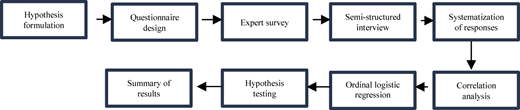
An illustration of the research procedure is provided in Figure A1 in Appendix 1, which summarises the overall sequence of the empirical study, from hypothesis formulation and questionnaire design to expert survey, semi-structured interviews, systematisation of responses, correlation analysis, ordinal logistic regression, hypothesis testing, and the summary of results.
3.3 Framework for evaluating key decision-making areas and indicators
This section summarizes the measurement framework used to operationalise the study constructs and ensure consistent data collection across respondents.
The questionnaire comprises five-point Likert items grouped into six areas aligned with the conceptual model competitive advantage, decision-making quality, strategic goal alignment, technology complexity, project management methodology, and implementation speed and the corresponding constructs are referenced in the Results section using the abbreviations CA, DM, SG, TC, PM, and IS; additionally, two supplementary indicators capturing cost reduction and capacity increase (CRC) were collected and are reported descriptively but not included in the ordinal regression models, with all item-level indicators listed in Table 2. These item-level indicators constitute the empirical operationalization used in the correlation and ordinal logistic regression analyses; broader conceptual dimensions discussed in Section 2 are used to motivate construct selection but are not always measured one-to-one in the survey instrument.
Competitive Advantage – measures how digital technologies help gain or sustain market position and improve service differentiation. Decision-Making Quality – reflects the clarity, accuracy and effectiveness of decisions made during technology adoption. Strategic Goal Alignment – evaluates how well technology adoption supports broader strategic objectives and long-term plans. Technology Complexity – assesses the difficulty of implementing and integrating new technologies, including compatibility and ease of use. Project Management Effectiveness – covers planning, resource allocation, stakeholder involvement and risk management in implementation. Implementation Speed – captures the timeliness and efficiency of technology rollout and adoption within the organisation. Together, these areas provide a structured framework for logistics companies to assess, manage and optimise digital transformation efforts, covering strategic alignment, technical challenges, project management and performance outcomes.
For each core area, specific measurable indicators were developed. Expert insights were collected via a structured questionnaire targeting diverse roles in technology implementation (e.g. CEOs, IT managers, project managers), as respondent diversity increases the reliability of the decision matrix (Okoli and Pawlowski, 2004). Responses populate a decision matrix in which rows represent decision-making areas and columns represent evaluation criteria. This structure enables the use of ranking methods to identify strengths, weaknesses and priority improvement zones. Expert consensus is used to rank decision areas by relative importance, transforming raw survey data into actionable strategic insights (Saaty, 2008).
3.4 Sampling and sample size
This study aimed to gather expert opinions on decision-making in logistics management; therefore, the chosen sample size needed to ensure sufficient expert diversity and reliability. In expert surveys, it is recommended to consider not only quantitative metrics but also respondents' qualifications and the specificity of the field (Memon et al., 2020; Martínez-Mesa et al., 2016; Batarlienė et al., 2024). Specifically, the literature emphasizes selecting participants with relevant experience, educational background, and managerial responsibilities, as well as ensuring an adequate sample size to capture diverse perspectives and increase the reliability of the findings. Such considerations enhance the validity of the results, particularly in applied logistics management contexts, where decision-making processes are complex and multifaceted. For expert survey studies, sample adequacy depends on the relevance, experience and diversity of respondents rather than on interview saturation alone (Memon et al., 2020; Martínez-Mesa et al., 2016; Batarlienė et al., 2024). In the present study, 60 expert responses were considered sufficient to ensure professional diversity and support reliable descriptive and associative analysis.
Specific respondents were selected to ensure the high quality of research, including professionals with at least 10 years of experience in logistics (50%), 7–10 years (11.67%), 4–6 years (16.67%), and 1–3 years (21.67%). Respondents were specifically chosen from those who have participated in or are currently involved in implementing technologies. Their positions encompassed a wide range of managerial and specialist roles, such as Head of Projects (26.67%), Chief Executive Officer (13.33%), Head of Commerce (13.33%), Head of Process (10%), Head of Operations (10%), Head of Logistics (6.67%), Head of Warehouse (5%), IT Manager (5%), Chief Financial Officer (1.67%), Head of Innovation (1.67%), Head of Quality and Customer Service (1.67%), Scientist (1.67%), Head of Sales (1.67%), and Head of Property Leasing (1.67%). The diversity of experience and expertise among participants contributed to the refinement of the survey design, supporting the clarification of relationships between the constructs and variables examined in the proposed framework.
Bilingual English–Lithuanian questionnaires were administered to ensure consistency in data collection across all observation units. Indicators were measured on a 5-point Likert scale. After the experts evaluated and rated the technology implementation factors, a matrix of technology implementation areas and corresponding indicators was developed. Each indicator represents a specific aspect of technology implementation and decision-making. The indicators are accompanied by targeted questions and measurement scales to directly capture information relevant to logistics organizations Table A2 ( Appendix 2).
4. Results
4.1 Descriptive survey results
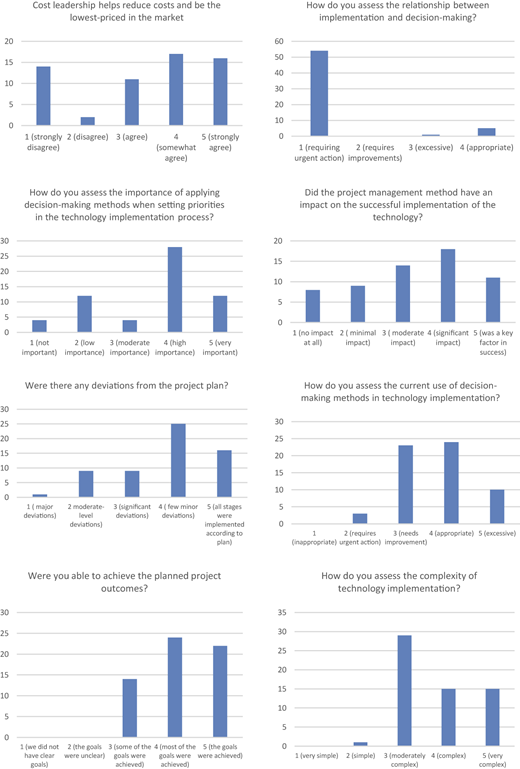
Descriptive results from the expert survey (n = 60) underscore the practical relevance of the study by highlighting a persistent “implementation challenge” in Logistics 4.0: while digital initiatives are widely pursued, respondents indicate that decision-making and management still require strengthening to secure planned outcomes under complexity. The data also point to a clear emphasis on cost-oriented competitive outcomes: 55.0% agreed/strongly agreed that cost leadership helps reduce costs and enables firms to offer the lowest prices, although responses were somewhat polarized (23.3% disagreed; 18.3% neutral). Decision-making practices were viewed as important for prioritizing technology implementation (66.7% rated the importance as high/very high), yet respondents also signaled room for improvement in current decision-making methods (38.3% “needs improvement” and 5.0% “requires urgent action,” versus 40.0% “appropriate”). In addition, most respondents assessed the implementation–decision-making relationship as requiring urgent attention (90.0%). Implementation-related items suggest generally favorable project outcomes alongside non-trivial complexity. Nearly half of respondents rated the project management method as having a significant or essential impact on successful implementation (48.3%), while 23.3% indicated a moderate impact. Plan adherence was largely positive: 68.4% reported either minor deviations or full implementation according to plan (41.7% and 26.7%, respectively). Technology implementations were most commonly assessed as moderately complex (48.3%), with a further 50.0% describing them as complex or very complex. Consistent with this, 76.7% reported achieving most or all planned project results (40.0% and 36.7%, respectively). Figure A2 ( Appendix 2) summarizes the descriptive results from the expert survey. Taken together, the descriptive evidence underscores the study's relevance by revealing a tension between active digitalisation efforts and the perceived need to strengthen decision-making and management to deliver planned results under complexity.
4.2 Correlation analysis
Correlation analysis is reported between the measured construct indicators, not between hypotheses. In Panel A, competitive advantage is presented descriptively through two dimensions CA orientation and CA outcome whereas Panel B reports the complexity-focused associations among DM, SG and TC.
The strongest positive associations were observed between strategic goal alignment and competitive advantage (r = 0.821) and between implementation speed and project management methodology (r = 0.793). Decision-making quality was positively related to competitive advantage (r = 0.496) and to project management methodology (r = 0.578). Decision-making quality was also positively related to technology complexity (r = 0.619), while technology complexity was positively related to strategic goal alignment (r = 0.426). Several correlations were weak or near zero (e.g., SG–DM: r = 0.002), indicating limited overlap between some construct pairs. Table 3 presents the correlation structure among the principal constructs.
Bivariate correlations indicate that the core constructs are related in the expected direction. These associations are descriptive and interpreted cautiously; the main empirical tests rely on the ordinal logistic regression models reported in Section 4.3.
4.3 Ordinal logistic regression
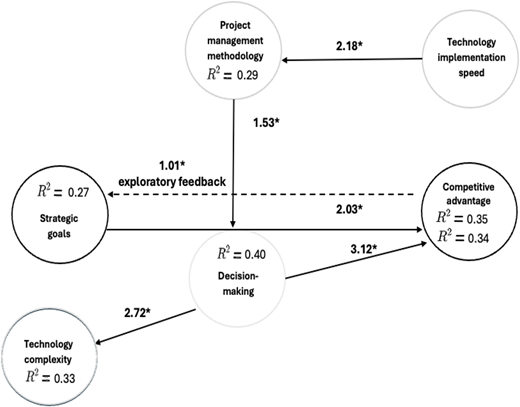
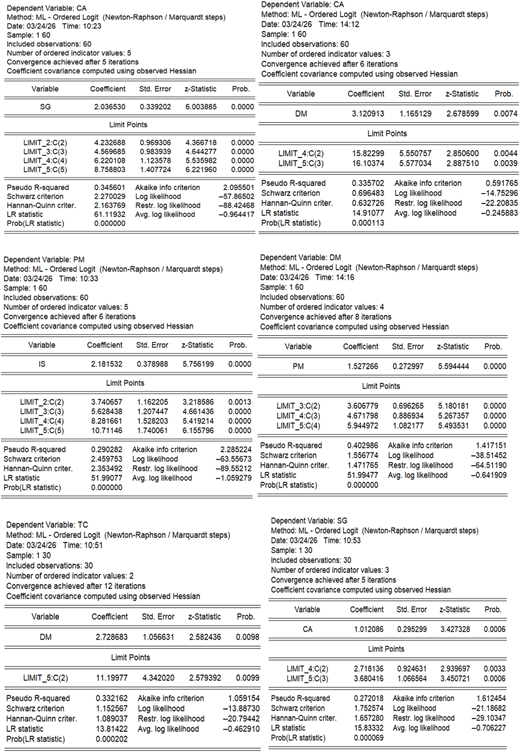
To test the hypothesized construct-to-construct relationships, we estimated separate ordinal logistic regression (OLR) models for each bivariate specification. Table 4 summarizes the estimated coefficients and fit statistics. Across models, coefficients are positive and statistically significant (all p ≤ 0.009), and McFadden's pseudo R2 values range from 0.272 to 0.402, indicating modest to moderate explanatory power across the specifications. Given the cross-sectional expert survey design, these results are interpreted as evidence of association consistent with the proposed capability-to-outcome logic rather than definitive causal confirmation. For completeness, the corresponding model output and estimated framework visualizations are provided in Figure A3 ( Appendix 3).
The OLR results indicate a consistent pattern of positive associations across the main specifications. Competitive advantage is positively associated with both decision-making quality and strategic goal alignment. In addition, project management methodology is positively associated with decision-making quality, strategic decision-making quality is positively associated with greater consideration of technology complexity, and implementation speed is positively associated with project management methodology. Across models, the reported McFadden's pseudo R2 values indicate modest to moderate explanatory power. Figure 2 visualises the solved research framework based on the full expert sample of 60 experts and summarises the significant ordinal logistic regression associations.
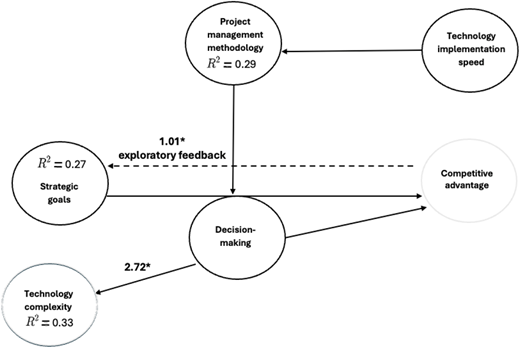
As an additional exploratory analysis, we estimated a reverse specification with strategic goal alignment (SG) as the outcome and competitive advantage (CA) as the predictor. The estimated association was positive and statistically significant (β = 1.012, SE = 0.295, p < 0.001; McFadden's pseudo R2 = 0.272), but it is reported only as a supplementary feedback check and is not interpreted as part of the primary causal chain. Figure 3 provides a visual summary of the reported OLR associations based on the complexity-focused subsample (n = 30).
4.4 Analysis of residual distributions
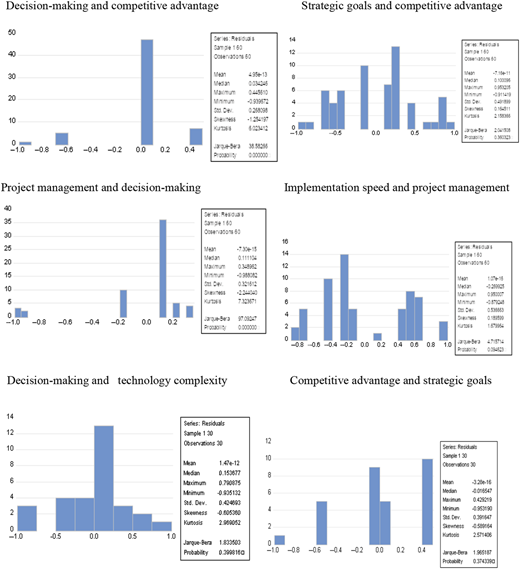
Decision-Making and Competitive Advantage exhibits residuals strongly concentrated around zero, with mean 4.95 × 10⁻¹³, standard deviation 0.26, skewness −1.25, and kurtosis 6.02, indicating a leptokurtic, left-skewed distribution. The Jarque–Bera test (JB = 38, p < 0.001) indicates a significant departure from normality, reflecting a highly centralized distribution with limited dispersion.
Strategic Goals and Competitive Advantage show a nearly symmetric pattern around zero, with mean 1.07 × 10⁻¹¹, standard deviation 0.49, skewness 0.16, and kurtosis 2.15. The Jarque–Bera test (JB = 2.04, p = 0.36) does not indicate a strong departure from normality, suggesting a balanced distribution with moderate dispersion.
Project Management Methodology and Decision-Making presents residuals concentrated near zero, with a mean of −7.30 × 10⁻¹⁵, standard deviation 0.53, skewness −2.24, and kurtosis 7.32. The Jarque–Bera test (JB = 97, p < 0.001) indicates a significant departure from normality, showing a sharply peaked, strongly left-skewed distribution.
Implementation Speed and Project Management Methodology is nearly symmetric around zero (mean 1.07 × 10⁻¹⁶), with standard deviation 0.54, skewness 0.184, and kurtosis 1.68, indicating slight positive asymmetry and a flatter-than-normal shape. The Jarque–Bera test (JB = 4.72, p = 0.095) suggests no strong departure from approximate normality in descriptive terms.
Decision-Making and Technology Complexity exhibits residuals centered at zero (mean 1.47 × 10⁻¹²) with moderate dispersion (SD = 0.43), slight negative skewness (−0.605), and kurtosis 2.97, consistent with a near-symmetric residual pattern. The Jarque–Bera test (JB = 1.83, p = 0.40) suggests no strong departure from normality in descriptive terms.
Competitive Advantage and Strategic Goals (exploratory feedback) demonstrates residuals centered at zero (mean −3.28 × 10⁻¹⁶; median −0.0165) with low dispersion (SD = 0.39), moderate negative skewness (−0.589), and slightly flat kurtosis (2.57). The Jarque–Bera test (JB = 1.97, p = 0.374) suggests no strong departure from normality in descriptive terms. Residual histograms and descriptive statistics are reported in Figure A4 ( Appendix 3).
4.5 Analysis of residual autocorrelation
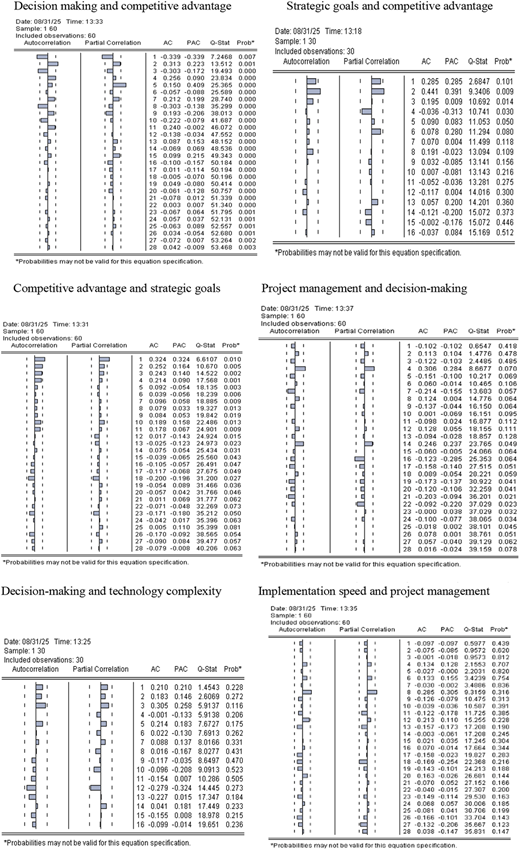
Given the cross-sectional design based on expert survey responses, the observations have no temporal ordering. Therefore, time-series autocorrelation diagnostics that rely on lag structures (e.g. correlograms and Ljung–Box tests) are not treated as core diagnostic tools for the present analysis. Model adequacy was evaluated using criteria more appropriate for ordinal logistic regression, including likelihood-based fit statistics and McFadden's pseudo R2 values reported in Table 4. In addition, bivariate correlations among constructs were inspected to identify potentially high pairwise associations that could affect the stability or interpretation of coefficients. For descriptive completeness, the corresponding autocorrelation and partial autocorrelation plots are reported in Figure A5 ( Appendix 3), but they are not interpreted as decisive diagnostic tests for the cross-sectional ordinal logistic models.
5. Discussion
The findings indicate positive associations between competitive advantage in Logistics 4.0 and (1) decision-making quality and (2) strategic goal alignment. In addition, the results indicate a positive association between project management methodology and decision-making quality, between strategic decision-making quality and greater consideration of technology complexity, and between implementation speed and project management methodology. The pattern of responses further suggests that cost-based competitive outcomes are emphasised more strongly than differentiation in the surveyed firms. Interpreted through an RBV/dynamic capabilities lens, these results are consistent with the view that digital technologies do not generate advantage per se; rather, competitive outcomes depend on complementary implementation capabilities that translate strategic intent into coordinated execution. Given the cross-sectional design and bivariate specifications, the evidence is interpreted as associative rather than causal.
The predominance of cost-based competitive advantage is consistent with the operational logic of logistics: many Logistics 4.0 initiatives (visibility platforms, automation, analytics) first generate value through efficiency gains, error reduction, and utilization improvements. By contrast, differentiation benefits (e.g., premium services, customization, new customer-facing offerings) typically require additional complementary assets service redesign, customer relationship capabilities, and innovation routines that may develop more slowly and therefore appear secondary in a cross-sectional expert assessment. Consistent with this interpretation, respondents rated the cost-leadership dimension of competitive advantage higher than the differentiation dimension. These descriptive tendencies should be interpreted as contextual patterns from the broader survey instrument rather than as direct item-level components of the CA construct used in the regression models. Managerially, this suggests that firms should not assume that digitalisation automatically yields differentiation; achieving differentiation may require complementing implementation discipline with service innovation routines, customer co-creation, and performance metrics that explicitly track differentiation outcomes alongside efficiency improvements.
These findings also have theoretical relevance, which is developed further in Section 6.1. By integrating strategic decision-making, project management and technology complexity into one framework, the study responds to prior research that has often analysed these constructs separately (Marinagi et al., 2023; Ning and Yao, 2023). The results support the interpretation of decision-making quality as an important capability in digitally intensive logistics contexts, consistent with studies linking structured decision-making and digital capabilities to competitive advantage (Bag et al., 2020; Zhang et al., 2024). In addition, the positive association between project management methodology and decision-making quality suggests that implementation discipline helps translate strategic choices into coordinated execution, supporting earlier findings on project management and digital technology implementation in logistics and supply chain contexts (Dubey et al., 2020a, b; Queiroz and Wamba, 2019). The findings also indicate that more complex technologies require more explicit evaluation of integration, interoperability and implementation risks, which is consistent with research on technological complexity and blockchain-/IoT-enabled logistics systems (Dubey et al., 2020a, b; Ugochukwu et al., 2022). Finally, strategic goal alignment remains central because it connects digital implementation choices with expected competitive outcomes, in line with resource-based and dynamic capability perspectives on strategy execution and value creation (Grant, 2021; Ivanov and Dolgui, 2021; Kaplan and Norton, 2008).
6. Conclusions
This study examined how strategic goal alignment, decision-making quality, project management methodology, greater consideration of technology complexity and implementation speed are associated within a structured decision-making framework for logistics technology implementation. Using expert survey data (n = 60) and ordinal logistic regression estimated as separate bivariate specifications, the results provide support for the hypothesized positive associations among the study constructs. Interpreted through an RBV/dynamic capabilities lens, the findings are consistent with a capability-to-outcome logic in which competitive outcomes depend less on digital technologies per se and more on complementary implementation capabilities particularly higher-quality decision-making and disciplined project management that translate strategic intent into execution.
Two substantive patterns stand out. First, strategic decision-making quality is positively associated with greater consideration of technology complexity, suggesting that more structured strategic decision processes help organisations evaluate integration demands, interoperability requirements and implementation risks more explicitly. Second, the pattern of responses suggests that Logistics 4.0 initiatives in the surveyed firms are oriented primarily toward efficiency and cost-based competitive outcomes, while differentiation-oriented outcomes are comparatively less emphasised implying that realizing differentiation may require additional complementary routines beyond implementation discipline (e.g., service innovation and customer co-creation).
Practically, the findings suggest that managers operating in similar contexts may benefit from explicitly linking digital initiatives to strategic goals, strengthening decision criteria and accountability, using project management methodologies that formalise implementation routines, and selecting methodology approaches that fit rollout speed and implementation tempo. Given the cross-sectional design and the regional expert sample, these results should be interpreted as evidence of association consistent with the proposed theoretical ordering rather than definitive causal confirmation. Future research using larger multi-region samples and longitudinal designs could strengthen causal inference, test more parsimonious specifications, and assess whether the cost-versus-differentiation pattern holds across logistics contexts.
6.1 Theoretical implications
The findings also generate several theoretical contributions to logistics management research.
First, by integrating strategic decision-making, project management and technology complexity into a single framework, the study extends prior work that typically analyses these constructs in isolation (Marinagi et al., 2023; Ning and Yao, 2023). This integration offers a more comprehensive understanding of how organisational capabilities interact to shape competitive advantage in logistics. Empirical evidence confirms that decision-making processes are strongly associated with competitive advantage, reinforcing the view that structured decision-making is a critical driver of firm performance (Bag et al., 2020; Zhang et al., 2024).
Second, the results indicate that structured project management methodology is positively associated with clearer and more formalised decision-making. This highlights project management as a relevant implementation capability in logistics technology projects. This extends prior research (Kamble et al., 2018; Dubey et al., 2020a, b; Queiroz and Wamba, 2019) by showing that decision-making alone is insufficient in complex technological environments; formal project management is needed to ensure effective adoption, coordination and risk mitigation.
Third, the results show that higher strategic decision-making quality is positively associated with greater consideration of technology complexity, indicating that advanced technologies require more explicit and analytically grounded evaluation of integration and interoperability challenges (Dubey et al., 2020a, b; Ugochukwu et al., 2022). Fourth, the study confirms the importance of strategic goal alignment particularly in quality, time, cost and flexibility for converting technology adoption into competitive advantage, supporting resource-based and dynamic capability perspectives (Grant, 2021; Ivanov and Dolgui, 2021; Kaplan and Norton, 2008). Collectively, the proposed framework offers a holistic lens for understanding and managing competitive advantage in digitally transforming logistics contexts.
6.2 Practical implications
The practical implications should be interpreted in light of the study design and context. They reflect patterns reported by a cross-sectional sample of 60 logistics experts from a specific regional setting and therefore should be treated as context-specific insights rather than general statements about the logistics sector. In the surveyed firms, competitive outcomes from Logistics 4.0 are most closely associated with goal alignment, higher-quality decision-making, and disciplined project management (Bag et al., 2020; Dubey et al., 2020a, b; Zhang et al., 2024). For managers operating in similar contexts, this highlights the value of explicit decision criteria, clear accountability, and management structures that fit technology complexity and rollout speed (Patanakul et al., 2010; Queiroz and Wamba, 2019). Several responses also suggest a tendency to emphasize near-term operational efficiency relative to broader system-level interdependencies (e.g., cross-functional coordination and longer-term capability development), which should be interpreted as a pattern within the present sample. Finally, the dominance of cost-oriented outcomes indicates that differentiation benefits (e.g. premium visibility services, customized offerings, proactive exception management) may require complementary routines such as service innovation processes, customer co-creation, and performance metrics that explicitly track differentiation outcomes beyond implementation discipline alone (Dubey et al., 2020a, b; Kaplan and Norton, 2008).
6.3 Limitations and future research
This study has several limitations that open avenues for future research. First, data were collected from logistics firms in a specific regional context, which may limit generalizability. Firms in regions with lower digital maturity, less-developed regulations, or different cultural settings may experience different dynamics in decision-making, project management, and technology adoption. Future research could replicate this framework across diverse geographies and industries to validate its applicability.
Second, the study relies primarily on quantitative analysis, which, while providing statistical rigor, may not fully capture contextual factors such as organisational culture, leadership styles, or inter-organisational collaboration. Qualitative or mixed-method approaches could explore these nuances and identify additional moderating or mediating influences.
Third, technology complexity was assessed broadly, covering AI, IoT, and blockchain. Future studies could investigate specific technologies in greater detail to understand their distinct impacts on decision-making, project management, and competitive advantage. Longitudinal research could also reveal the sustained effects of Industry 4.0 adoption on firm performance and resilience.
Finally, while this study emphasizes structured decision-making and strategic goal alignment, other organisational capabilities such as innovation culture, agility, and sustainability practices may influence Industry 4.0 outcomes. Extending the framework to include these factors would provide a more holistic understanding of how logistics firms can leverage digital technologies for sustainable competitive advantage.Figure A4 and A5