


This explorative study investigates the role of policy in freight transport systems and its implications for post-disaster freight movement. Using a qualitative scenario-based approach in the context of Aotearoa New Zealand, it examines how policy-related underlying causes affect freight performance after a major natural disaster.
Data were collected through semi-structured interviews with 30 industry and policy experts, followed by a thematic analysis to identify the key constraints in the post-disaster transport system under study. Building on the Theory of Constraints' theoretical perspective that most constraints within a system originate from policy-related root causes, a Current Reality Tree was built to capture and visualise these constraints, their cause-and-effect relationships, and their root causes.
The analysis identifies a complex web of interconnected constraints and causal relationships, revealing 18 underlying root causes that drive cascading and escalating effects across the freight system. These root causes trace back to six policy areas: government funding, infrastructure governance, emissions policy, land use and development, labour policy, and information governance.
This research shows that the performance of post-disaster transport systems is strongly influenced by government policy. Addressing key policy areas can enhance freight resilience, support continuity in the movement of goods, and ensure availability for production, trade, and consumption after a natural disaster.
1. Introduction
Freight transport systems consist of complex webs of nodes and links facilitating the efficient movement of goods (Eriksson et al., 2022). Each node and link is a potential point of failure capable of cascading and causing significant freight bottlenecks following a natural hazard (L'Hermitte et al., 2025). Efficient and reliable freight operations rely not only on the physical transport system, but also on other critical infrastructure networks, including fuel, electricity, and telecommunications. Due to the complex dependencies within and between these networks, the failure of any single infrastructure can cascade and substantially affect others (Rinaldi et al., 2001). While this interconnectedness ensures the efficient movement of goods during normal operations, it increases complexity and uncertainty in freight operations during a major disruption (Sanchez-Rodrigues et al., 2010). Owing to these complexities and dependencies, addressing only the visible constraints (symptoms) provides little relief if the deeper, underlying causes remain unresolved.
Although system constraints often appear physical, the Theory of Constraints (TOC) argues that most arise from a few root causes, typically policy-related rather than operational (Mabin et al., 2006). Understanding these cause-and-effect relationships and addressing policy-related constraints can alleviate systemic limitations and improve performance (Dettmer, 2007). This theoretical assertation has yet to be applied to freight systems.
This study addresses this gap by investigating whether policy is the underlying cause of the multiple constraints encountered in a post-disaster freight transport system. To do so, we take a qualitative systems approach (Gammelgaard, 2023), explore the intricate and interdependent mechanisms causing freight disruptions after a major natural event, and identify the root causes that trigger cascading and escalating effects. Therefore, this research is guided by the following question: What is the nature of the underlying causes triggering cascading and escalating effects in a post-disaster freight transport system?
In this study, TOC is used as a theory of disrupted freight systems, showing that many visible physical constraints are symptoms of deeper, often policy-related critical root causes. TOC is also applied in a practical manner. Specifically, a tool known as a Current Reality Tree is employed to address the above research question in the context of Aotearoa New Zealand (NZ). A Current Reality Tree is a logical diagram designed to analyse verbalised system problems and capture the constraints affecting system performance. It is commonly used to establish the cause-and-effect relationships within the system under study and identify the underlying root causes (Scheinkopf, 1999). By providing both practical and theoretical insights to this research, TOC enhances this explorative study's ability to provide valuable perspectives into the resilience and vulnerability of freight systems.
2. Literature review
This study sits at the intersection of freight resilience, transport disruption management, and complex systems. It examines the post-disaster continuity of freight flows across actors, modes, and critical infrastructure networks. It also aligns with work on risk governance by considering the influence of policy on freight resilience.
2.1 Post-disaster freight transport systems
Freight transport systems are crucial for the functioning of societies and economies (Mattsson and Jenelius, 2015). They enable the efficient movement of materials, components, and finished goods, ensuring timely availability for production, trade, and consumption (Crainic, 2000). These systems involve the transfer of freight between points of origin and destination (e.g. warehouses, factories, distribution centres) and other freight nodes (Roso et al., 2009), such as seaports and rail terminals (Rodrigue and Notteboom, 2009). At these nodes, freight may be consolidated, sorted, and transferred between transport modes and vehicles, which travel along webs of interconnected links, such as railways, roads, and waterways (Roso et al., 2009). Freight systems involve multiple actors, including terminal operators, carriers, shippers, and the government (Ambra et al., 2019). These systems must be resilient and capable of preparing for, responding to, and recovering from disruptions to maintain operational continuity (Ponomarov and Holcomb, 2009).
In particular, natural hazards, including earthquakes, cyclones, floods, and tsunamis affect the functionality of these complex systems and expose their vulnerability (Faturechi and Miller-Hooks, 2015). They can severely disrupt the transport network (Aghababaei et al., 2020), damaging infrastructure such as roads and bridges (Davies et al., 2017). This is compounded by dependencies within and between critical infrastructure systems, such as telecommunications, electricity, and fuel (Rinaldi et al., 2001). The failure of one infrastructure, or component, can have a direct impact, as well as an indirect impact due to dependencies, causing cascading and escalating effects at regional or national scales (Ouyang, 2014).
Freight disruptions are not only an infrastructure problem. They are also the result of governance issues and the lack of coordination across actors. Research on urban freight shows that public authorities often lack clear and enduring mechanisms to engage with industry partners. It also highlights that freight partnerships and governance platforms help build shared understanding and support collaboration (Gammelgaard et al., 2017; Lindholm and Browne, 2013). Beyond public-private interfaces, studies demonstrate that the quality of logistics services depends on effective horizontal cooperation between logistics service providers (Cruijssen et al., 2007). Evidence from crisis contexts further points to the coordinating role of logistics intermediaries. For example, Borgstrom et al. (2022) show how third-party logistics providers work closely with customers during a crisis to make sense of complexities and manage disruptions and capacity constraints. Inter-organisational governance and coordination mechanisms that bring together public and private actors (including collaborative information sharing, performance measurement, and transparent decision making) become even more important for resilience when disrupted operations and infrastructure blur responsibilities and decision making (Norrman and Eriksson Ahre, 2024).
Research on post-disaster freight disruptions is mostly in the field of engineering and grounded in mathematical modelling. Transport network models are useful for quantifying disruption impacts (Jenelius and Mattsson, 2012), but they are less suited to examining non-linear cascading effects across numerous freight constraints. L'Hermitte et al. (2025) acknowledge these limitations and demonstrate the value of qualitative research to fully capture and analyse the complexity inherent in post-disaster freight systems. Dependencies between infrastructure systems are also typically studied through an engineering lens, where their complexity is analysed using mathematical modelling and simulations (Hickford et al., 2018; Zorn et al., 2020). In these studies, the freight system is rarely the central focus. Even when transport is the focal point, critical infrastructure dependencies are often explored from the perspective of a single transport mode. For instance, Santos-Reyes et al. (2015) look at dependencies in a rail network, while Kajitani and Sagai (2009) explore dependencies in a road network.
2.2 The role of policy in freight resilience
Transport resilience is a public policy concern because the impact of disruptions and the continuity of freight movements after disasters depend on policy mechanisms. In particular, public investment and infrastructure standards can reduce exposure and outages. Resilience depends on asset condition and on effective restoration management after a disaster, including prioritisation, mobilisation of repair resources, and infrastructure performance targets (Faturechi and Miller-Hooks, 2015).
Beyond physical assets, policy choices influence how quickly and how well freight networks recover. For example, building redundancy into networks (e.g. alternative roads or railways) increases routing flexibility by providing options when critical links or nodes are inaccessible after a disaster (L'Hermitte et al., 2024). Governments can also build redundancy across transport modes and create an integrated intermodal freight network (Reggiani et al., 2000), where goods move efficiently between modes (Pfoser et al., 2022).
However, redundancy alone does not guarantee freight resilience. Policy must also account for the physical configuration of the freight system and the role of connectivity, which determines how well nodes and links fit together to create route options (Reggiani et al., 2015). Beyond physical configuration, policy plays a role in developing data standards and interoperability to enable digitally integrated transport systems and real-time data sharing (Ambra et al., 2019).
The literature also highlights policy trade-offs between upfront expenditure on preparedness and post-event spending on response and recovery (Miller-Hooks et al., 2012). Economic modelling shows that optimal timing depends on the probability of natural hazard events and uncertainty about prevention returns: early investment is preferable when probability is high and uncertainty is low, whereas delayed action is linked to low probability and high uncertainty (Xiao et al., 2015).
Although the above literature recognises the importance of policy in freight resilience, it often addresses specific policy areas, rather than providing a comprehensive view of how policy influences post-disaster freight performance.
3. Theoretical foundation
To fill the gaps identified and address the research question (What is the nature of the underlying causes triggering cascading and escalating effects in a post-disaster freight transport system?), this study draws on TOC. Initially introduced by Goldratt (Goldratt and Cox, 1984), TOC is widely used by practitioners and consultants in operations management and other fields (McCleskey, 2020) to optimise a system's capacity and achieve the maximum output by identifying and managing constraints (Watson et al., 2007).
TOC is also extensively discussed in the academic literature (Mabin and Balderstone, 2000) and used as a theoretical foundation to guide research (Gupta and Boyd, 2008; Naor et al., 2013). As argued by Dettmer (2007), TOC meets the criteria of a descriptive and prescriptive theory. In particular, TOC contends that all systems have constraints limiting their output and that a constraint is a key leverage point for increasing system capacity (Watson et al., 2007). Constraints can be physical (when the demand for a physical resource exceeds the available capacity), behavioural, practice-related, or policy-related. These constraints are intricately interconnected and ripple through the system in a complex and interdependent sequence of events (Dettmer, 2007). TOC also states that most physical constraints can be traced back to an underlying critical root cause, which constitutes the deepest level of causality within the system. Critical root causes are difficult to identify due to the numerous and intricate cause-and-effect relationships between constraints (Dettmer, 2007) and the complexity of interdependencies between systems. Following Dettmer's approach, and as further discussed later, this study distinguishes between root causes (which drive operational constraints) and critical root causes (which represent a deeper level of causality to which root causes can be traced).
Dettmer (2007) suggests that critical root causes are often policy-related. Dettmer (1995) illustrates the distinction between visible physical constraints and underlying policy-related root causes as follows. Highways requiring frequent repairs appear to be a physical constraint affecting traffic flows. However, when government policy awards contracts to the lowest bidder, contractors are incentivised to use lower-quality materials to minimise costs. Addressing the physical constraint (repairing roads) only leads to a recurrence of the problem if the critical root cause (the underlying government policy) remains unchanged. Building on this premise, we theorise that observable post-disaster freight constraints can be traced back to policy-related critical root causes.
To operationalise this theoretical claim, we developed a Current Reality Tree (CRT), which is TOC's prescribed tool to identify a system's multiple constraints (Watson et al., 2007). The CRT is used to visualise the constraints in the post-disaster freight system under study, create a model of the cause-and-effect relationships between these constraints, establish the impact of other critical infrastructure failures on freight performance, and ascertain whether the system's critical root causes are policy-related. Therefore, in addition to being an analytical tool, TOC provides a theoretical lens for explaining freight disruptions and transport performance under disruption.
4. Methodology
4.1 Research context
This study was conducted in NZ, which provides an appropriate research context due to its critical infrastructure being exposed to a wide range of natural hazards, including earthquakes, tsunamis, volcanic eruptions, cyclones, floods, and landslides. NZ's two main islands, the North Island and the South Island, are separated by the Cook Strait (see Figure 1). The freight system primarily relies on road transport, accounting for 92.8% of the total tonnage transported, followed by rail at 5.6%, sea at 1.6%, and air at less than 1% (Paling and King, 2019). Given the dependence on road transport and the Cook Strait separating the two islands, inter-island freight movements rely heavily on four Roll-on, Roll-off (RoRo) ferries, which serve as an extension of the North and South Islands' main road and rail line. Annually, the ferries perform around 6,300 one-way sailings (Stone and Wallis, 2023), making them a vital link in the domestic freight system.
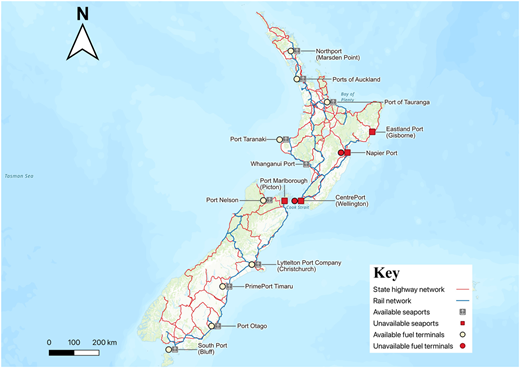
Two ferries are owned and operated by state-owned enterprise KiwiRail, under the brand Interislander, and two by the private company StraitNZ, under the brand Bluebridge. Both organisations use ferry terminals on both sides of the Cook Strait, namely in Wellington's CentrePort in the North Island and Picton's Port Marlborough in the South Island.
4.2 Research scenario
This study employs a scenario-based approach, a common methodology of the systems approach in logistics research (Gammelgaard, 2004) and one frequently applied to the investigation of freight disruptions (Aghababaei et al., 2020; Jenelius and Mattsson, 2012). Originally introduced by Kahn (1964), scenario-based research develops hypothetical sequences of events to examine complex issues and causal processes. It deepens the understanding of real-world situations and prepares for plausible future challenges (Bishop et al., 2007).
The design of our scenario was guided by two criteria: plausibility and fit with the research question. To ensure plausibility, our scenario focused on the aftermath of a major Hikurangi Subduction Zone earthquake (magnitude 8.5 or greater) and tsunami, an event with a 26% probability in the next 50 years (Pizer et al., 2021). Building on existing research (East Coast Lab, 2020; Popovich et al., 2021), we established that such an event would severely damage Picton, Wellington, Gisborne, and Napier, including the Cook Strait ferry terminals in Wellington and Picton. Further based on the work of the Wellington Lifelines Group (2019), the scenario proposes that for three months, Port Marlborough (Picton), CentrePort (Wellington), Eastland Port (Gisborne), and Napier Port, along with the fuel terminals in Napier and Wellington, would be damaged and unavailable. Sections of the main road and rail networks connecting these locations would also be inaccessible. Electricity and telecommunications networks would be disrupted for two and five days, respectively. Given the complexity and dependencies in post-disaster freight systems (as outlined in the literature review), this scenario is well suited to examine the intricate dynamics in freight systems under disruption, identify the underlying causes triggering cascading and escalating effects, and therefore, address the research question of this study.
However, as will be explained in the limitations section, this approach relies on participants' perceptions and judgement when interpreting a hypothetical disruption scenario. Consequently, it does not establish actual causality, which would require explanatory designs and quantitative causal tests. In addition, the scenario is contextually specific and reflects a particular geography, business setting, and freight configuration.
Figure 1 illustrates the scenario, showing state highway and rail layouts, as well as the location and availability of seaports and fuel terminals.
4.3 Data collection and analysis
This explorative study takes a qualitative approach following the rigorous, step-by-step approach prescribed by TOC to analyse verbalised systems problems and identify constraints, cause-and-effect relationships, and the underlying causes of cascading and escalating effects (Scheinkopf, 1999). We used semi-structured interviews with subject matter experts able to identify physical dependencies within and between critical infrastructure networks (Pederson et al., 2006). Semi-structured interviews enabled follow-up questions, which was crucial for exploring scenario details and capturing the complexity inherent in the post-disaster freight system. Purposive sampling ensured that participants were selected for relevant expertise. The participants were contacted by email and snowball sampling was used to recruit additional interviewees.
Twenty-six interviews were conducted with 30 participants: two ferry operators (FO), seven transport operators (TO) spanning road, rail, sea, and air, four seaport operators (SO), five retail organisations (RO), three government agencies (GA), four industry representatives (IR), and one emergency management agency (EA). Each organisation was assigned a code, as indicated in Table 1.
Interview participants
| Interview code | Participating organisation |
|---|---|
| (TO1) | Transport operator |
| (TO2) | Transport operator |
| (TO3) | Transport operator (x3 participants) |
| (TO4) | Transport operator |
| (RO1) | Retail organisation |
| (IR1) | Industry representative |
| (IR2) | Industry representative |
| (GA1) | Government agency (x2 participants) |
| (FO1) | Ferry operator |
| (FO2) | Ferry operator |
| (RO2) | Retail organisation |
| (GA2) | Government agency (x2 participants) |
| (RO3) | Retail organisation |
| (GA3) | Government agency |
| (TO5) | Transport operator |
| (IR3) | Industry representative |
| (RO4) | Retail organisation |
| (RO5) | Retail organisation |
| (SO1) | Seaport operator |
| (TO6) | Transport operator |
| (TO7) | Transport operator |
| (SO2) | Seaport operator |
| (IR4) | Industry representative |
| (EA1) | Emergency management agency |
| (SO3) | Seaport operator |
| (SO4) | Seaport operator |
Participants received detailed information and maps presenting the scenario in advance. Interview topics included job responsibilities, normal inter-island freight operations, previous disruptions, impacts of Cook Strait ferry outages, potential solutions, and the overall freight system resilience. A generic list of interview questions was developed, but given the variety of participants, questions were tailored to ensure that interviewees were only asked those relevant to their experience. In other words, different (but related) questions were developed for the various categories of participants. As an example, Table 2 shows the questions prepared for transport users, namely retailers conducting their own transport operations and transport operators.
Interview questions (freight users)
| Question categories | Questions |
|---|---|
| Respondent |
|
| Normal operations |
|
| Past disruptions |
|
| Cook Strait ferry outage |
|
| Potential solutions |
|
| Resilience |
|
The interviews, conducted between October and December 2023, lasted 35–67 min (50 min on average), and continued until data saturation was reached (Braun and Clarke, 2021). They were held in person, via Zoom or Teams, or by phone. All were recorded and professionally transcribed for accuracy. The data were coded and analysed thematically using NVivo to capture post-disaster freight constraints, cause-and-effect relationships between them and across infrastructure networks, and underlying causes. As the TOC literature recommends, five initial constraints were identified, then iteratively expanded as we traced the logic chain and examined the cause-and-effect relationships between system elements. Ultimately, nine themes emerged from the analysis, comprising transport modes (road, rail, sea, air), other critical infrastructure networks (fuel, electricity, telecommunications), the information required to support post-disaster operations, and impact on freight performance.
To validate the CRT content, we applied TOC's “Categories of Legitimate Reservation” tests. First, we confirmed that the constraints truly exist in the system and that the connections between the causes and effects are logical. We then used the insufficient cause test to determine whether a proposed cause is adequate or whether an additional cause is needed to reliably produce the stated effect. Finally, we applied the predicted effect test to assess whether a stated cause should logically produce further observable effects.
5. Findings
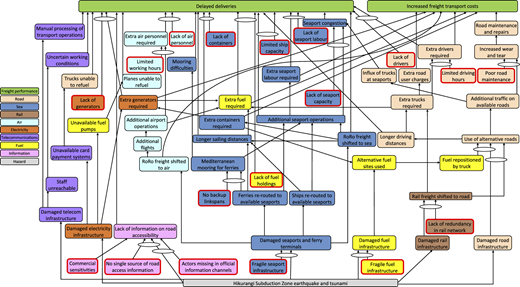
This section presents an analysis of the interview data used to build the CRT presented in Figure 2. To illustrate the richness of the data and support the narrative, this section incorporates direct quotations referenced using the interview codes shown in Table 1. We acknowledge that because the constraints are systemic, rather than mode-specific, some repetition in the mode-by-mode narrative is unavoidable. We chose not to compress the narrative to ensure readers have enough context to interpret the CRT's colour-coded structure. Each subsection identifies the operational constraints emerging from the scenario and traces them to the root causes shown in the CRT (depicted by red borders in Figure 2). The analysis then links these root causes to the underlying critical root causes (the six areas of policy illustrated in Figure 3).
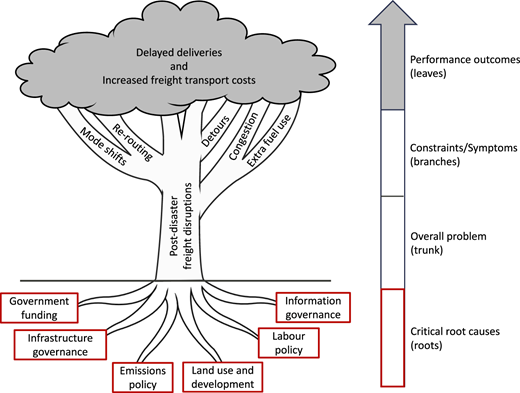
Policy-related critical root causes of post-disaster disruptions. Source: Authors' own work
Policy-related critical root causes of post-disaster disruptions. Source: Authors' own work
5.1 Ferry terminal infrastructure
The Cook Strait ferry connection linking the North and South Islands is “a critical piece of infrastructure” (RO3). Despite the connection's significance, the ferry terminals “are end of life, and they are not built to modern design standards. So, they are incredibly fragile” (FO2). This was obvious when a ferry “clipped the edge of the wharf […] and the end of the wharf just turned into dust” (IR4). This incident shows that “port infrastructure [the ferry terminals] needs to be made more resilient, whether that is replacing it or upgrading it” (IR4). The vulnerability of the ferry terminals stems from funding constraints, as the local governments owning them have limited capacity to generate revenue. Therefore, “maintenance is often deferred” (FO1). This short-term approach to asset management points to a gap in local government infrastructure policy.
With the ferry terminals unavailable, the ferries would need to be re-routed to alternative seaports. However, “the biggest weakness is we do not have decent contingencies at all” (TO1) across the Cook Strait. Only Wellington and Picton have appropriate linkspans that connect the ferries to the wharves enabling rail wagons and trucks to easily move from ship to shore. Without linkspans, the ferries would need to be Mediterranean moored at other seaports (FO1), where the ship's stern is secured perpendicular to the pier. This approach is less efficient, relying on seaport operations and resources (SO1) and is a somewhat difficult process (EA1).
A solution to this problem would be to “have [mobile] backup linkspans around the country, […] just in case both ports get taken out” (FO2). These linkspans should be portable so that they can be placed onto a barge and towed to suitable seaports (FO1). Because multiple actors would use these resources, such a solution “would need government intervention [funding]” (SO1). However, no such policy or funding mechanism currently exists, leaving this possible contingency measure unaddressed. Even with backup linkspans, the ferries are “not suitable for [travelling over] long distances [as] they are inefficient in terms of cargo space” (IR2), due to the nature of the design of RoRo ferries and their limited carrying capacity.
The CRT (Figure 2) identifies fragile seaport (ferry terminal) infrastructure and the absence of backup linkspans as root causes.
5.2 Air transport
Given these re-routing limitations, air freight would be the only means of achieving the current 1–2 days delivery timeframe the ferries normally offer between the islands. As one interviewee noted, “truck deliveries that would have gone by ferry, I now need to get them there by air freight” (IR3), which “is massively more expensive” (TO2). Given the increased transport costs, air freight would only be suitable for certain goods. This includes “healthcare products [and freight that] has urgency associated with it” (RO4), “but it has to be light and it has to be high value” (RO3).
Because of the significant volume of freight moved by the ferries, additional flights will need to be set up. Introducing extra flights would be costly and constraining (TO3), resulting in additional airport operations and requiring extra labour and aviation fuel (IR3). However, there is “a limited number of pilots, […] subject to a [limited] number of flying hours” (TO2). Similarly, there would be uncertainty around whether there are sufficient ground-based personnel available to accommodate additional flights, including aircraft engineers and ground handlers (IR3). Scaling the workforce is not straightforward because “everyone who touches the plane and walks around a plane is quite a skilled person and you cannot just go and hire them” (IR3).
The CRT identifies limited working hours and a shortage of air personnel as root causes. These constraints reflect the absence of a long-term workforce development policy for the aviation sector. Without a pipeline for training aviation personnel, the sector operates close to capacity under normal conditions, limiting its ability to scale during prolonged disruptions.
5.3 Sea transport
Due to re-routing challenges and airfreight limitations, “you would suddenly see a big shift to [non-ferry] coastal shipping for inter-island freight movement” (RO1). However, due to the limited service frequency in NZ, coastal shipping is much slower than road and rail freight travelling on the ferries. With the ferries, “you can get a container or a truck […] from Auckland to Christchurch in less than 48 h” (SO1), “coastal freight [can take] five days or a week” (RO5), resulting in delayed deliveries (TO1).
In addition, due to “the surge towards coastal shipping […], everyone would be going after containers” (TO3). However, NZ already faces an empty container deficit during normal operations: “we do not have enough import containers to support our export volume, so it is not like we have got massive container parks full of containers” (RO4). Moreover, generators are needed to power refrigerated containers to prevent spoilage. “If demand [for coastal shipping] pushed up [and] you did not have the refrigerator gear to move it, you are in trouble” (TO2). This issue is only exacerbated post-disaster, where “there is always a shortage of generators” (EA1).
Even with enough containers and generators, container ships must have sufficient carrying capacity to accommodate the shift to coastal shipping. However, only one domestic shipping line, Pacifica, currently operates in NZ with a nominal capacity of only 1,740 Twenty-foot Equivalent Units. In the proposed scenario, there would be a need to “offer a more frequent Auckland to Christchurch connection” to move freight between the islands during the ferry terminal outage (TO5). However, “the amount of volume that moves on those Cook Strait ferries every single day is a lot more than what Pacifica has” (RO4).
These constraints reflect a longstanding underinvestment in the domestic coastal shipping sector, leaving it ill-equipped to absorb a sudden surge in demand. They are also due to investment uncertainty in the sector. Operators with ageing vessels face a critical decision about replacement, but viable alternatives to diesel remain limited. As one participant explained, “the investment horizon for a new ship is 25–30 years […], so you do not want to invest millions of dollars […] and find in 10 years that the [fuel] technology might be obsolete because everyone is going for hydrogen rather than methanol” (TO5).
Diesel-operated vessels are not an option either: “if you think about what the price of carbon is going to be over the next 20 years, suddenly […] you just cannot afford to buy it because, in 10 years, you probably cannot afford to run it” (IR4). In the absence of a coherent government strategy for maritime decarbonisation and available alternatives, carbon pricing “is not incentivising you to move because you cannot move anywhere. It is just a tax” (IR4). Consequently, operators “put off buying a ship for 5, or 10 years, and then your whole fleet ages to the point where potentially it becomes less safe because you cannot afford to replace it, or there is so much uncertainty that it would be [financially] unwise to replace it right now” (IR4).
Even if there were certainty about future fuels, the necessary infrastructure is not available. “We can order and buy dual fuel ships now, but we do not have the refuelling infrastructure for that in NZ. So, if I came here with a methanol-powered ship, I could not find fuel” (TO5). This investment paralysis points to a critical gap in government policy. “All the policy documents in government recognise how critical coastal shipping is, even just on the resilience side, but there is no work done on how you actually help industry transition through that period” (IR4).
This policy gap extends to the maritime workforce itself. NZ remains reliant on international seafarers, and without efforts towards “recruiting or developing enough seafarers of our own” (IR4), the sector's capacity to provide resilient freight alternatives is undermined. Without a comprehensive strategy, coastal shipping's role in freight resilience remains acknowledged in policy but unsupported in practice.
The CRT identifies the lack of generators, containers, labour, and ship capacity as root causes.
5.4 Seaport infrastructure
With four seaports (Wellington's CentrePort, Picton's Port Marlborough, Gisborne's Eastland Port, and Napier Port) unavailable in the proposed scenario, the remaining seaports must have the necessary infrastructure and capacity to accommodate increased vessel traffic. However, as one interviewee noted, NZ has “not really invested much in port infrastructure” (RO1), meaning that “a reasonable amount of port infrastructure is not in good condition. For instance, when CentrePort was out [following the 2016 Kaikōura earthquake], you could go to Whanganui [Port], but the primary wharf is being allowed to deteriorate into such a state that you cannot put a proper crane on the wharf” (IR4). For smaller seaports, financial limitations constrain infrastructure upgrades, because “it is very difficult for them [Whanganui Port] to afford to essentially replace a wharf because they are a relatively small council [local government] with limited funds” (IR4). As with the ferry terminals (Section 5.1), this reflects a systemic pattern of chronic underinvestment in locally governed transport infrastructure and highlights a gap in government funding priorities for infrastructure maintenance.
Sometimes, policy can constrain seaport infrastructure upgrades. For instance, at the Port of “Tauranga, they are trying to get a resource consent for three or four years. And to me, those are more stroke of the pen exercises [because the port] is quite happy to put up the money. So, making sure that the ports can keep up with growth […], we need that, especially in our big ports. You need to create the framework [so] that people can invest in the infrastructure” (TO5) and “the ports are in a position to maintain resilience” (SO3). In this case, the constraint is not a lack of investment willingness, but rather regulatory policy that impedes timely infrastructure development, undermining seaport resilience.
The CRT identifies fragile seaport infrastructure as a root cause.
5.5 Seaport productivity
Not only do seaports require the necessary infrastructure, they also need to operate efficiently to be able to accommodate increased traffic following a disaster. However, the NZ seaports are not as efficient as they need to be, even during normal operations. This is partly due to capacity constraints. As one participant noted, “some of those port operations around the country are [at] relatively maximum capacity” (TO1) and if seaports get to “more than 80% [yard capacity], you get very congested, and you get into a position where you are moving cargo to get to other cargo” (SO3). This rehandling is unproductive and places additional pressure on limited port resources and equipment. An operational consequence of these capacity constraints is that “each shipping line […] has a [limited] number of moves allocated by the [seaport's] container cranes […] for discharge or loading, so [seaports] are generally maxing out on the move counts in each port rather than on the ship capacity” (TO5).
A surge in coastal shipping would have a significant impact on seaport yard and berth operations. As one interviewee noted, the “consequence of that [surge] would be capacity on the terminal [as we will be] holding a lot more coastal shipments [containers] that have not really been planned for. And potentially also vessel bunching” (SO4). As a result of increased seaport operations, “there definitely would be congestion” (SO4). Congestion is also due to labour availability: “our capacity is limited by our crane intensity […], the headcount will only stretch as far as x number of cranes [operating] per day […]. If you want to do more than that, you need to increase the headcount, which obviously comes with recruitment training and cost” (SO3). Therefore, labour “would be a challenge […] if we had to suddenly increase it” (SO3). This would be even more challenging at seaports with pre-existing labour shortages. As one seaport noted, “currently we do have a bit of a skills gap which we are training for, so we are in the recruitment phase for that” (SO4). These pre-existing skills gaps point to the absence of a coordinated workforce development policy for the maritime sector, leaving individual seaports unable to scale operations when demand surges.
The CRT identifies the lack of seaport capacity and seaport labour (seaport operators) as root causes.
5.6 Rail transport
Regardless of whether the post-disaster diverted freight is moved by air or sea, there must be sufficient capacity in the transport links. As one interviewee noted, “the rail network is pretty important for distributing [freight] once it has come through a port” (SO3), and benefits from requiring much less labour than road transport (RO2). However, the rail network “lacks redundancy and is a particularly weak point in the country's freight system” (RO2). In the proposed scenario, rail transport would be “severely impacted because […] there is very little rail in the Lower North Island, which means there is not a lot of rail getting into the upper North Island” (IR4). With rail lines unavailable, rail freight will need to be road-bridged, which involves taking a “multimodal container off rail, getting it onto the back of a truck and moving it [by road]” (TO4).
For rail to be a viable option when certain lines are damaged, there needs to be “better resilience across [the rail infrastructure] in both the North and South Islands” (SO4), which could be achieved by running a second main trunk line (RO5). Despite the value this redundancy would provide, funding tends to go towards extending the existing network, rather than increasing the resilience of the existing lines: “there is a lot of distraction around [introducing] rail lines into remote areas” (RO5). This reflects a misalignment in government rail investment policy, where network expansion is prioritised over the resilience of existing critical freight links.
The CRT identifies the lack of redundancy in the rail network as a root cause.
5.7 Road transport
Given the rail limitations, road transport will be crucial for intra-island freight movements. With the ferry terminals and some seaports unavailable, there would be an influx of trucks at seaports, leading to “congestion of [available] ports, [because] you would blow the ports to bits with massive queues of trucks” (TO3). Simultaneously, with damaged road infrastructure there would be “a lot more heavy vehicle freight on [alternative] roads [and] some of those roads just are not built for that. [Consequently], you would see quite a lot of road wear and tear [requiring] expensive road maintenance and repairs” (IR4). However, as explained by a government official, increasing the resilience of secondary roads is constrained by funding: “we want to upgrade our detour routes, but obviously there is only so much money we have got” (GA2). This funding shortfall reflects a broader policy challenge in prioritising investment in road network resilience, leaving secondary roads ill-equipped to serve as viable alternatives when primary links fail.
Even if alternative roads were upgraded, “any detour increases the journey length and time” (GA2), resulting in “extra road user charges [and] extra fuel costs” (TO3). Longer journeys also compound labour demands, as drivers cannot complete return trips within regulated shift limits. As one interviewee illustrated for the Christchurch to Nelson route: “I cannot […] get my truck loaded up, there and back in a 12-h shift […]. I have got to send someone to bring that guy home” (IR1). This increased demand for drivers reveals an underlying constraint in the form of the pre-existing driver shortages throughout the country (RO4).
Labour constraints across air (Section 5.2), sea (Section 5.5), and road transport point to a broader vulnerability rooted in insufficient workforce planning at the policy level. These labour shortages need to be addressed through “strategic policies and initiatives to have the appropriate workforce going forward” (IR1). Without such policy action, the freight system's reliance on labour-intensive road transport remains vulnerable.
The CRT identifies poor road maintenance, limited driving hours, and driver shortages as root causes.
5.8 Critical infrastructure dependencies
Beyond the transport challenges discussed above, post-disaster freight operations are further complicated by outages in other critical infrastructure networks, not least due to ageing fuel infrastructure vulnerable to damage (FO1). “If there were a rupture to one of those [fuel] pipes and tanks, there would be no fuel for the Cook Strait ferries” (SO1). If fuel infrastructure fails, “there may be some transport-related fuel shortages [but fuel] could be trucked in” (GA3) from alternative sites to affected areas. However, redundancy is lacking. As one participant observed, the single fuel pipeline serving a major airport was severed when “a farmer up in Northland puts a digger through the fuel pipeline […]. Who knew we only had one pipe?“, arguing that government needs to “put the open honest picture out there” and come up with strategies to address these issues (RO4). Adding to the complexity, there have been “three outages of aviation fuel in the last 12 months [NZ] could do with more onshore fuel stockholders” (IR3).
Some participants explained other dependencies between critical infrastructure networks and their impacts on freight operations. For example, fuel access depends on the electricity network, because “you need electricity to run the [fuel] pumps to get it into the planes” (IR3). For trucks, electricity outages would disable electronic payment systems at service stations, preventing truck drivers from paying for fuel (IR1). To overcome these outages, additional generators would be required (TO4), as initially raised in Section 5.3.
In addition, without functional telecommunications infrastructure, there would be “a lot of trouble contacting staff” (TO3). Because staff in affected areas, like Wellington, would be cut off, “you would not really be able to plan too much until you knew if the Wellington Depot [was] still standing and operational” (TO3), resulting in uncertain working conditions and delaying freight movement. Until infrastructure is restored, some organisations would switch to manual communication methods: “we are back to doing stuff with bits of paper, [which] can be produced in Christchurch and Auckland for the drivers to carry with them” (RO4). However, not all organisations would have such manual processes to fall back on, which could result in reduced freight volumes being moved (TO2) and causing delayed deliveries.
These vulnerabilities across fuel, electricity, and telecommunications infrastructure reflect a broader absence of integrated government planning for critical infrastructure resilience. Without such a coordinated strategy, the dependencies between these networks remain unaddressed, compounding the cascading effects on freight operations.
The CRT identifies fragile fuel infrastructure and the lack of fuel holdings as root causes.
5.9 Post-disaster information
Regardless of the constraints discussed above, effective post-disaster freight operations depend on timely access to information. To make informed decisions and implement alternative transport plans, operators need a variety of information: “What [infrastructure] is broken? Is it completely broken? Is it just down to half capacity, or total capacity?” (EA1). “What is going to be available [repaired] at what point in time?” (GA3). “What are the areas that we need to work around?” (RO4). “If there are delays and we do not know where those delays are, real bottlenecks [surface]” (RO3). However, this information would be scattered among the various actors involved. One participant provided an example of this for the road network: “there are probably four different websites you might choose to look at to understand what might be happening with the roading network” (RO4). Instead, freight actors need timely access to a “consolidated high-level view” (RO4) of post-disaster information. The distribution of this information is vital, because “communication is key for [freight] movement” (RO3) and without it, deliveries are delayed.
In addition, it is essential that all relevant stakeholders are included in official government information channels. Reflecting on Cyclone Gabrielle that struck NZ in 2023, damaging roads and rail lines, one interviewee noted that “a couple of the big boys [retail organisations] ran off and started trying to organise [coastal shipping] themselves, and the rest of the industry was left not quite knowing what was going on” (RO3). To prevent this, “the government would need to get in and coordinate […]. It should not be the biggest get the best, [but] what is most important for the country […]. Much more centralised coordination […] would be great. You do not want to hear today that, ‘oh, we are starting coastal shipping tomorrow.’ It would be good to have known a week earlier. ‘Hey, this is what we are looking at. These are [the] timings.’ Getting everyone who is involved into those conversations [is critical]” (RO3).
However, information can be commercially sensitive. “In my opinion […] there is a role for government to play, […] where they can be impartial [and perform] an enabling function around the provision of information” (TO6). The government could fulfil this enabling role by making a centralised and shared information platform available: “Everyone feeds into something […] which benefits everyone but has the appropriate securities and sensitivities in place” (TO6). Together, these findings point to a gap in government coordination and information sharing policy for freight operations during disruptions.
The CRT identifies the absence of actors from official information channels, commercial sensitivities, and the lack of a single source of road access information as root causes.
5.10 Current reality tree
The findings demonstrate how transport and other critical infrastructure failures ripple across the freight system following a disaster. The CRT (Figure 2) illustrates this complexity. The diagram is read from the bottom up, starting with the natural hazard event (a Hikurangi Subduction Zone earthquake and tsunami) that triggers cascading and escalating effects converging on two outcomes at the top: delayed deliveries and increased transport costs. The CRT serves as the analytical backbone of the argument developed across Sections 5.1 to 5.9. Each colour in Figure 2 corresponds to a subsection of the findings, with each subsection tracing operational constraints to their root causes. The following colours are used for transport modes: dark blue for sea (Sections 5.1, 5.3, 5.4, 5.5), light blue for air (Section 5.2), brown for rail (Section 5.6), and beige for road (Section 5.7). The following colours are used for critical infrastructure: orange for electricity, purple for telecommunications, and yellow for fuel (all in Section 5.8). Pink is used for information (Section 5.9). The natural hazard is shown in grey and the impact on freight in green. Arrows represent cause-and-effect relationships and ellipses are used where two causes are responsible for an effect. The root causes discussed in the previous sections are outlined in red.
To enable the reader to interpret the CRT as a representation of system behaviour, rather than a compilation of constraints, this paragraph and the next synthesise how the freight system as a whole behaves under the scenario and how critical infrastructure failure cascades across the system. The Hikurangi Subduction Zone earthquake and tsunami create an immediate system shock resulting in a three-month loss of the ferry terminals, key ports, and fuel terminals with concurrent road and rail inaccessibility, as well as short-duration electricity and telecommunications outages. In the first days, degraded telecommunications and electricity undermine basic coordination and resource access. Organisations struggle to make alternative transport plans due to information fragmentation and uncertainty. Transport operators lack clarity on what is damaged, what is available, and when capacity will return, which delays freight operations. In addition, fuel access becomes contingent on electricity, affecting fuel pumps and payment systems and requiring generators to keep operations running.
Inter-island freight flows are forced into alternative transport options, which drives a rapid increase in the demand for coastal shipping and air freight. This makes the lack of redundancy in the freight system rapidly apparent as carrying capacity is insufficient to absorb the diverted freight. Airfreight can only accommodate small volumes, is prohibitively expensive, and is constrained by labour capacity. Coastal shipping becomes the main alternative but it has limited frequency and is constrained by the lack of carrying capacity, container shortages, insufficient refrigerated capacity, the lack of generators, and labour shortages. The shift to coastal shipping concentrates demand on the available seaports, where yard and berth capacity is limited, creating queues and congestion. Simultaneously, the diverted freight flows and the lack of redundancy in rail infrastructure increases the demand for road transport within the islands. This escalates congestion at and around the seaports, increases travel distances and costs, and exposes driver-hour limits and existing driver shortages. These interconnected constraints escalate into delayed deliveries and increased transport costs.
In total, the CRT includes 43 constraints, 99 cause-and-effect relationships, and 18 root causes. The 18 root causes were consolidated into six critical root causes (the upstream policy factors from which the operational constraints emerge) by examining them for common underlying themes and grouping those that share a common policy dimension. For example, the lack of seaport labour (Section 5.5), the lack of air personnel and limited working hours (Section 5.2), pre-existing truck driver shortages, and regulated shift limits constraining journey durations (Section 5.7) all reflect a common shortcoming in labour policy across the freight system. Similarly, fragile ferry terminal infrastructure (Section 5.1) and fragile seaport infrastructure (Section 5.4) both reflect a pattern of deferred maintenance and underinvestment in publicly owned transport infrastructure, pointing to government funding as the underlying critical root cause.
By consolidating the root causes in this way, the analysis shifts from identifying the individual operational vulnerabilities to revealing the systemic policy gaps that underpin them. The six critical root causes and their associated root causes are discussed in the next section.
6. Discussion
6.1 Areas of policy (critical root causes)
Kiani Mavi et al. (2022) argue that the direct connection between policy and freight resilience calls for a regulatory framework ensuring preparedness for major disruptions. Our findings reinforce this by highlighting six policy-related critical root causes discussed in this section: government funding, infrastructure governance, emissions policy, land use and development, labour policy, and information governance. Figure 3 shows these six policy areas that underpin the theoretical framework of this study.
6.1.1 Government funding
This study's findings highlight the critical role of funding in building resilient national freight systems. When critical transport infrastructure is unavailable following a disaster, redundancy across transport links and nodes is essential to mitigate cascading and escalating effects. For example, our findings show that when seaports and the ferry terminals are unavailable, container ships and ferries must be re-routed to alternative seaports. Re-routing the ferries efficiently requires backup linkspans and a barge. Alternative seaports also need the necessary infrastructure and capacity to handle additional freight volumes (Loh et al., 2017; Verschuur et al., 2020). Since critical transport infrastructure, such as seaports, is often owned by public entities, including local and central governments (de Langen and Heij, 2014), public investment is vital to maintain port resilience and performance.
6.1.2 Infrastructure governance
The findings show that constraints can stem not from limited funding, but from how funding is allocated and governed. For instance, publicly owned infrastructure, such as seaports and roads, frequently lacks incentives for resilience investment because governments tend to prioritise short-term needs, like facility expansion, over long-term resilience investments (Meyer and Schwarze, 2019), including the development of additional, redundant transport modes.
As Ma et al. (2024) note, governments have a critical role to play in enhancing the flexibility of freight operations across different modes (e.g. sea and rail) to prevent freight cancellations and increase the overall transport network resilience. Japan's rail network illustrates the value of transport redundancy. Following the 2011 Tōhoku earthquake and tsunami, redundant rail lines enabled the continuity of rail freight movements despite outages (Suzuki and Li, 2012).
Funding allocation decisions and infrastructure governance issues are also related to other critical infrastructure affecting the functionality of freight systems. To enhance transport resilience and minimise the likelihood of other infrastructure failures, governments can build robustness and redundancy (Haimes et al., 2008). Taking the fuel infrastructure as an example, robustness can be achieved by reinforcing infrastructure nodes and links, such as aged fuel tanks and pipes, while redundancy can be ensured by maintaining adequate fuel supplies in fuel tanks. However, both robustness and redundancy incur costs and redundant resources carry the risk of obsolescence. For instance, increasing fuel stockholdings for resilience purposes (e.g. storing more diesel to power ships, trucks, and generators in an emergency) can prove pointless in the longer run if the country decarbonises (Boyd et al., 2024). Emission policy is further discussed in the next section.
Despite the need for resilient infrastructure, network operators often invest when the potential cost of an outage exceeds the investment required (Carr, 2016), leaving freight systems fragile and unprepared for potential disasters. In addition, operators must balance risk, investment, and customer costs, which can be challenging because they operate in competitive markets and regulated environments. Constrained by competition and price regulations, their ability to adjust user charges to recover resilience-related costs is limited (Berkeley et al., 2010). Therefore, government support is essential to enable the operators of critical infrastructure networks to pass their investment costs onto customers.
6.1.3 Emissions policy
The findings indicate that unclear decarbonisation and fuel policies create vulnerabilities in freight systems. Uncertain emissions rules and potential carbon penalties cause freight operators to defer acquiring new vehicles (e.g. new container ships) or existing vehicles (e.g. existing diesel vessels). This policy ambiguity results in aging assets and limited carrying capacity, which creates vulnerability in freight systems.
With over 100 countries committed to net-zero emissions by 2050, transitioning to cleaner fuels is essential (Mishra et al., 2022). To enhance the resilience of freight systems, governments must clarify their marine fuel policy and future fuel support. A definitive policy direction will enable operators to make informed investment decisions regarding vessel acquisition, thereby increasing the carrying capacity and the post-disaster transport options available.
6.1.4 Land use and development
The findings show that resource consent requirements can constrain infrastructure expansion. Globally, restrictive land-use policies often delay development and create vulnerabilities in freight systems. For example, before the application for expansion was considered, NZ's largest seaport, the Port of Tauranga had to provide extensive additional environmental and community engagement evidence (Port of Tauranga Limited, 2024). Consequently, the seaport ran out of berth capacity at its container terminal (Port of Tauranga Limited, 2025). Similarly, European seaports face ecological and societal challenges, as well as stringent environmental regulations, largely driven by European Union directives. This can significantly delay critical seaport expansion projects (Verhoeven, 2009).
Such constraints matter because seaports must have adequate capacity and equipment to operate efficiently when other ports are unavailable after a disaster. This becomes even more important when roads and rail lines are also inaccessible, requiring freight to shift to sea (L'Hermitte et al., 2024). Without sufficient infrastructure and equipment, seaports quickly become congested, causing delays (Loh et al., 2017). Therefore, policies must balance environmental and societal concerns with the need for timely seaport expansion to strengthen freight resilience.
6.1.5 Labour policy
This study demonstrates the role of labour policy in building resilient freight systems, particularly given the additional staff (e.g. truck drivers or seaport workers) required to keep goods moving after a disaster. Governments play a key role in addressing shortages of critical transport workers by implementing policies to train, upskill, or reskill the existing labour pool (Zwysen, 2024) and revising immigration policies to attract overseas talent (Dustmann et al., 2010). By reducing labour shortfalls, policymakers increase the resilience of freight systems and improve response capacity during major disruptions.
6.1.6 Information governance
The findings highlight the importance of information following a disaster and the contribution policy can make. Governments should develop robust information infrastructure (Kiani Mavi et al., 2022) and disseminate accurate and timely information on infrastructure damage, functionality, and response plans. As highlighted in Section 5.9, this information is often fragmented across agencies and platforms (e.g. different government websites) and unavailable to all relevant actors.
Collaboration between public and private organisations is essential to improve information sharing, align strategies, and ultimately, overcome barriers that hinder effective coordination in the wake of a disaster (Gabler et al., 2017). To address this issue, governments can establish a centralised database providing up-to-date information to all the actors across the freight system (L'Hermitte and Brutsch, 2025).
However, as the findings indicate, concerns about sharing sensitive data exist and competition legislation creates a barrier to operational information sharing in the private sector (Norrman and Eriksson Ahre, 2024). In this context, governments can act as intermediaries and facilitate the transfer of confidential information between actors. For instance, governments can serve as a conduit between two private sector actors, such as a seaport and a freight transport operator, ensuring the necessary information (e.g. about port and yard capacity) is available while addressing confidentiality concerns (Herbert et al., 2018). With such information readily accessible, actors can make more informed decisions to keep goods moving in a timely manner.
6.2 Symptoms vs causes
This study shows that a large variety of constraints, in the form of symptoms, surface when a freight system is disrupted. These symptoms include, among many others, detours, re-routing, congestion, extra fuel use, and mode shifts, causing delayed deliveries and increased transport costs. Systems thinking posits that addressing the visible symptoms (constraints) is suboptimal and provides little relief if the underlying causes are unaddressed (Monat and Gannon, 2015). Therefore, complex systems must be analysed holistically and the deepest level of causality (critical root causes) identified to inform leverage point interventions that address systemic problems, rather than surface-level symptoms (Dekker, 2011).
TOC's CRT provides a suitable tool to analyse post-disaster freight systems holistically and better understand the systems constraints, cause-and-effect relationships (escalating and cascading effects), and root causes. As argued by Dettmer (2007) and explained in the theoretical framework section, most physical constraints are symptoms resulting from root causes that can be traced back to an underlying critical root cause, which is often policy-related. Our research supports this theoretical assertion by contending that the 43 constraints and 18 root causes represented in Figure 2 can be linked to one of the six categories of underlying policy identified earlier as critical root causes. This supports the theoretical assertion that policy is a leading factor driving the performance of post-disaster freight systems and can be used to increase the resilience of transport. Figure 3 illustrates this theoretical assertion.
That said, the TOC lens shapes how we interpret causality in the CRT, particularly by emphasising underlying root causes. To maintain a balanced perspective, we recognise that constraints can occur independently of policy. Some arise at the operational level, including limited equipment (e.g. shipping containers) and work-time rules that restrict flexibility even when policy is unchanged. Others are organisational or inter-organisational, for example gaps in business continuity procedures and contractual arrangements. More broadly, some constraints reflect system complexity and interconnectedness between transport, energy, and communications infrastructures, where small failures cascade even without a specific policy trigger.
7. Contributions
This research makes a theoretical contribution by drawing on systems thinking and TOC to empirically explain freight systems under disruption and by establishing that both local and central government policy is a leading factor behind multiple cascading and escalating constraints affecting the performance of post-disaster freight operations. As such, the study highlights the critical need for policy intervention and identifies key policy drivers that enhance the resilience of freight systems. Specifically, it identifies government funding, infrastructure governance, emissions policy, land use and development, labour policy, and information governance as strategic leverage points. These areas should be prioritised by policymakers to build more resilient freight systems.
The above theoretical contribution adds to the academic debate on whether TOC can be seen as a theoretical tool, rather than only an analytical one (Gupta and Boyd, 2008; Naor et al., 2013). This study shows that TOC can be used to guide theory-grounded research on freight systems and identify systemic factors causing transport disruptions. This paper also presents a novel application of TOC by using it to define clear categories of constraints within post-disaster freight systems and to reveal the complex web of dependencies that underlie freight performance issues in the aftermath of a disaster. It is the first to use TOC to establish that this complexity spans four modes of transport (road, sea, rail, and air), three other critical infrastructure systems (electricity, fuel, and telecommunications), and access to essential post-disaster information.
In addition to making a theoretical contribution, this research provides practical value by helping freight practitioners and government agencies better understand the complexity of post-disaster freight operations. Typically, practitioners focus on observable physical constraints and their negative effects on freight performance. The CRT draws their attention to causal mechanisms that are typically embedded in the complex structure of the freight system and, therefore, not easily identified. These analytical insights can feed into their decision making and preparedness plans by enabling them to anticipate where bottlenecks will surface, how they will propagate, and what the consequences will be. The CRT also shows practitioners that prioritising the most visible problems (symptoms) is suboptimal and ineffective if these problems reflect deeper, policy-driven systemic constraints. As a result, practitioners and industry groups can use the CRT to engage with government and advocate for governance improvements through targeted policy changes.
Beyond theory and practice, the results have societal implications because freight continuity underpins the functioning of societies and economies by ensuring the availability of goods for production, trade, and consumption. As frequently highlighted in the humanitarian logistics literature, transport functionality is also critical for the distribution of emergency supplies to the communities affected by disasters.
Finally, this study advances freight transport research by positioning policy as a structural driver that shapes resilience and post-disaster freight performance.
8. Limitations and further research
This research has three limitations. Firstly, the design is exploratory and the findings (including the CRT presented in Figure 2) represent analytical causality derived from interviewees' perceptions and reasoning about the scenario. Although participants were selected for their expert judgement, the CRT should be interpreted as a theory-building model of plausible cause-and-effect mechanisms, rather than an empirically validated causal structure. In other words, the data do not allow us to claim empirically tested causality. An explanatory research design and quantitative causal analysis are needed to test the causal relationships proposed in the CRT.
Secondly, the findings are grounded in a specific disruption context: a three-month Cook Strait ferry terminal outage in NZ. Results may vary across institutional and geographic settings because the constraint structure is shaped by factors such as transport modes available and the level of redundancy, port governance and regulatory arrangements, and the extent of dependence on other critical infrastructures (e.g. fuel supply). Different contexts may generate different constraints or reconfigure the causal links in the CRT. Future research could test transferability by examining comparative cases across locations with different institutional settings and geographies. Such comparative work would help establish which constraint patterns are common across contexts and which policy and governance responses are contingent on local system design and institutions.
Thirdly, while this research identifies six key policy areas for increasing freight resilience, it does not establish a hierarchy of priorities among them. Future studies could delve deeper into each policy domain and conduct cost-benefit analyses to determine which areas would benefit the most from government investment. Such analyses would help policymakers allocate resources more effectively.
9. Conclusion
This scenario-based study provides a comprehensive examination of post-disaster freight operations, highlighting how critical infrastructure failures, such as a three-month Cook Strait ferry terminal outage, cascade and escalate through freight systems. It also analyses the dependencies between freight transport and other critical infrastructure systems, including electricity, fuel, and telecommunications. Theoretically grounded in TOC and systems thinking, the research investigates the role of government policy in building resilient freight systems. We show a hierarchy of causality where visible post-disaster freight constraints are symptoms that can be traced back to policy-related factors. The findings identify six policy domains underpinning freight performance after a disaster. These are government funding, infrastructure governance, emissions policy, land use and development, labour policy, and information governance. These areas should be prioritised by policymakers to ensure continuity in the movement of goods and the overall resilience of freight systems in the face of future disruptions.
This work was supported by Te Hiranga Rū QuakeCoRE, a Centre of Research Excellence (CoRE) funded by the Aotearoa New Zealand Tertiary Education Commission. QuakeCoRE's contribution was limited to the financial support provided. They did not play any role in the research process from study design to submission. The QuakeCoRE publication number is 1066.

