Against the backdrop of global digital transformation and rising unemployment, this study aims to explore the under-researched link between government digitization and unemployment.
Using 2002–2023 panel data from 134 countries, a fixed-effect model examines the link between government digitization and unemployment. Robustness checks validate results, followed by four fixed-effect models with interaction terms to analyze mechanisms. Heterogeneity analysis explores differential impacts on different labor groups, and group tests assess moderating effects of economic freedom, industrial upgrading and ruling ideology.
Government digitization reduces unemployment overall. While it can increase unemployment by cutting public-sector jobs (i.e. the employment substitution effect), it can curb unemployment by reducing enterprises’ non-productive expenses, alleviating financing constraints and decreasing economic policy uncertainty (i.e. the employment facilitation effect). Heterogeneous impacts on different labor groups and moderating effects of economic freedom, industrial upgrading and ruling party ideology are identified.
Unlike previous studies that treat digitization as a general economic phenomenon, this study isolates government digitization and uncovers its dual effects on unemployment: both reducing and increasing it through multiple mechanisms. This study further examines the heterogeneous effects of government digitization across labor groups and explores how national characteristics moderate its influence on unemployment. These findings offer new empirical evidence for the rationality of government digital transformation and provide practical guidance for countries addressing unemployment.
1. Introduction
With the continuous deepening of a new round of technological revolution, digital technologies have developed at an unprecedented pace, providing a robust technological foundation for governments to construct digital governance systems and enhance their digital governance capabilities (Gan et al., 2023). The digital transformation of public governance not only exerts a direct impact on the composition of government personnel, but also has significant influence on enterprise production through the interactions between governments and market entities. On one hand, government operations' digitization could result in the substitution of numerous positions traditionally occupied by government employees performing mechanistic and repetitive tasks with digital technologies, thereby exposing some employees to risks of unemployment. On the other hand, a digital government is more transparent and efficient. Its streamlined administrative processes and open sharing of government information create a more favorable business environment for enterprises, leading to cost reduction, production expansion, and increase labor demand.
Unemployment remains an urgent issue globally. In recent years, global labor markets have been increasingly shaped by a combination of structural transformations and rising uncertainties (Cook and Rani, 2024). The widespread adoption of digital technologies has begun to displace routine jobs, especially in the public sector. At the same time, geopolitical tensions, energy crises, and the fragmentation of global supply chains have amplified economic volatility, leading to uneven recovery and heightened unemployment risks across regions. These ongoing challenges highlight the importance of examining the labor market implications of government digitization to assess whether such transformation serve as a source of opportunity or disruption in the evolving world of work. Although the broader implications of digitization for unemployment are widely acknowledged, it is equally important to recognize the pivotal role that governments play in directing digital transformation efforts. As key actors in policy formulation and public service delivery, governments are instrumental in shaping digital strategies and realizing their employment-related outcomes. Accordingly, the manner in which governments apply digital technologies to enhance administrative functions and improve public services is of critical importance. As such, this paper does not analyze general digitization across society or the private sector. Instead, it focuses specifically on government digitization, investigating its global impact on unemployment, which is the core research objective of this paper.
Existing literature has conducted preliminary explorations on the impact of digitization on unemployment. Specifically, empirical estimates by Haykal and Makki (2022) show that increasing digitization can significantly lower unemployment rate. Supporting this, Azu et al. (2021) and Başol et al. (2023) reported similar reductions in unemployment in West Africa and Europe, respectively. However, Bertani et al. (2020) warned that an accelerated pace of digital transformation could lead to technological unemployment. Unlike the linear relationships suggested by previous studies, Abbasabadi and Soleimani (2021) concluded that the impact of digital technology expansion on unemployment follows an inverted U-shaped relationship. More detailed than other studies, Lederman and Zouaidi (2022) considered the economic characteristics of the sample countries and empirically confirmed that the role of a thriving digital economy in reducing unemployment is stronger in developing countries than in economically advanced ones.
While much of this literature treats digitization in broad terms, some studies on e-government adoption suggest positive spillovers for firm productivity and growth (Twizeyimana and Andersson, 2019; Mohamed et al., 2023), with potential employment effects. At the same time, some research warns that digital transitions could reinforce structural inequalities, disproportionately affecting routine occupations and vulnerable groups (Autor and Handel, 2013; International Labour Organization, 2021). However, these perspectives still do not explicitly distinguish government digitization, leaving its specific impact on the labor market largely unexplored.
A review of the existing literature reveals that while the broader impact of digitization on the labor market has been extensively discussed, the specific role of government digitization has received little attention. In other words, the relevant literature does not distinguish government digitization from the broader concept of digitization. This distinction is crucial, as government digitization influences unemployment through a set of unique channels, such as altering the staffing structure of the public sector and indirectly promoting labor demand in the private sector by improving the business environment. These channels are fundamentally different from those involved in the private sector's digital transformation. By conflating government digitization with broader digital trends, the existing literature overlooks the impact of public governance digital transformation on unemployment, leaving a critical gap in understanding how government digitization reshapes the labor market. As such, this study will use cross-country panel data [1] to empirically analyze the impact of government digitization on unemployment and the underlying mechanisms [2], making a valuable contribution to filling this gap.
Persistent structural inequalities in the labor market could cause government digitization to affect unemployment differently across labor groups. First, gender-based occupational segregation leads to unequal unemployment risks. Women are overrepresented in administrative and clerical roles, which are more susceptible to digital disruption due to their routine nature. As government digitization reduces demand for such positions, gender disparities in unemployment may worsen. Second, while digitization can improve the business environment and boost demand for low-skilled labor, highly educated workers are more capable of transitioning into emerging digital roles. In contrast, those with intermediate education, lacking both advanced skills and adaptability, could face unemployment pressure. This educational stratification could deepen structural employment imbalances in the digital era. Accordingly, this study conducts heterogeneity analyses by gender and education to examine differential impacts of government digitization on unemployment. Furthermore, to avoid biased conclusions, it also considers country-specific economic and political factors as potential moderators [3]. These heterogeneity and moderation analyses not only enrich the understanding of the comprehensive relationship between government digitization and unemployment as well as the transmission pathways of employment inequality in the digital era, but also offer empirical insights for targeted labor market policies.
This paper contributes to the literature in several ways. First, it addresses a critical gap by examining the impact of government digitization on unemployment, distinguishing it from broader digitization trends. Second, it comprehensively analyzes how government digitization affects unemployment among different labor groups, particularly in terms of gender and educational attainment, offering new insights into the potential intensification of employment inequality. Third, by incorporating economic and political variables, the study elucidates how national characteristics moderate this impact, offering context-specific policy recommendations for labor market interventions in the digital government era.
The following section formulates the hypotheses to be tested in this research. The third section outlines data and methodology utilized in the analysis. In Section 4, the empirical results are presented and discussed in detail. Finally, Section 5 offers concise conclusions, discusses policy implications, and addresses the limitations of the study that remain for future exploration.
2. Theoretical analysis and hypothesis development
2.1 The impact of government digitization on unemployment
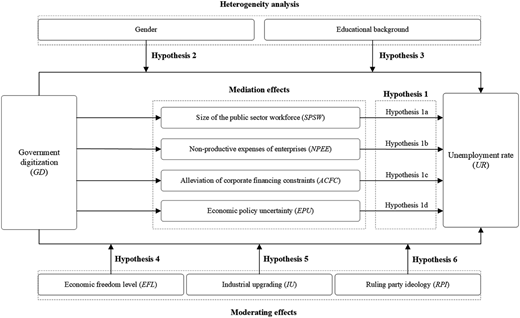
Government digitization can exert contrasting impacts on unemployment through various mechanisms. On one hand, the adoption of digital technologies in public governance can lead to the substitution of low-skilled positions in government sectors, thereby intensifying unemployment, which is referred to as the “employment substitution effect” (Hypothesis 1a). On the other hand, government digitization can help reduce unemployment by facilitating business expansion and enhancing productivity, thus giving rise to the “employment facilitation effect” (Hypotheses 1b to 1d). A detailed discussion of these two effects follows.
Government digitization can partially replace public sector jobs. Many government departments have traditionally depended on human labor for repetitive, routine, and rule-based tasks such as data entry, document review, and form processing. With digital transformation, these tasks can now be performed more efficiently and at lower cost by digital technologies. Consequently, clerical, administrative, and other low-skilled positions face significant reductions or elimination. This technological substitution not only displaces current workers but also reduces future demand for such roles. The impact is more severe for workers lacking the digital skills or education needed to transition into new positions. Accordingly, we propose
Government digitization can increase unemployment by reducing the size of the public sector workforce.
In traditional government administration, businesses often engage in public relations with officials to gain policy support or reduce administrative interference. These non-productive expenses neither directly contribute to output nor support production expansion, and they also compress profit margins, weakening firms' incentives to grow. According to Twizeyimana and Andersson (2019), digital technologies embed regulations into administrative systems, reducing the role of personal relationships in decision-making and lowering firms' incentives to invest in government relations. Moreover, governments' digital transformation, such as online platforms and electronic workflows, streamlines approval processes, saving time and compliance costs (Mohamed et al., 2023). The resulting decline in non-productive expenses frees up resources for productive use, increasing labor demand and helping to reduce unemployment. Accordingly, we propose
Government digitization can reduce unemployment by decreasing non-productive expenses of businesses.
Financial constraints are a key factor affecting both enterprise expansion and employment. When financing is limited, firms reduce investment, leading to lower labor demand. Government digitization can help ease these constraints. First, digital initiatives promote the sharing of enterprise data, such as tax, financial, and operational information, with financial institutions, reducing information asymmetry and improving credit access. Second, unified digital platforms enable real-time updates of fiscal subsidies and tax incentives, enhancing policy transparency and reducing arbitrary resource allocation. This allows eligible firms to access support more efficiently and alleviates financing pressure. By improving the financing environment, government digitization enables firms to expand production, thereby increasing labor demand and reducing unemployment. Accordingly, we propose
Government digitization can reduce unemployment by easing enterprises' financing constraints.
According to Baker et al. (2016), economic policy uncertainty makes enterprises more cautious in employment decisions, especially when labor demand is elastic, often resulting in workforce reductions. This is because uncertainty raises the opportunity cost of retaining excess labor, prompting firms to adjust human resource allocation to manage risk and improve efficiency. Government digitization helps reduce such uncertainty through its information denoising effect. In traditional policy dissemination, policy intent could be distorted due to multi-level administrative transmission (Zhang and Rosenbloom, 2018). In contrast, digital government initiatives establish unified information release systems, integrate real-time data, and provide online administrative services, thereby improving the accuracy and credibility of policy information received by enterprises. This reduces firms’ perceived uncertainty and mitigates conservative employment behavior. Furthermore, digital services streamline administrative approvals and reduce officials’ discretionary power, limiting inappropriate government intervention and stabilizing firms’ expectations. A clearer and more predictable policy environment encourages enterprises to expand production and increase hiring, ultimately improving labor market outcomes. Accordingly, we propose
Government digitization can reduce unemployment by lowering economic policy uncertainty.
The above analysis shows that government digitization can increase unemployment through the mechanism in Hypothesis 1a, while potentially reducing it via the mechanisms in Hypotheses 1b, 1c, and 1d. Accordingly, we propose an overarching
Government digitization can affect unemployment, with the direction of the effect depending on the relative strength of the four mechanisms.
2.2 The impact of government digitization on unemployment among different labor groups
Government digitization could have differing effects on unemployment by gender. Male workers are mainly employed in labor- and technology-intensive industries that are more responsive to the employment expansion effect of government digitization (Brookings Institution, 2019). These sectors benefit from enhanced administrative efficiency, reduced policy uncertainty, and improved financing access, which together drive enterprise growth and labor demand. In contrast, female workers are concentrated in administrative, clerical, and service roles (ibid), which involve standardized, repetitive tasks and are more vulnerable to automation and intelligent systems. Moreover, men generally possess stronger digital skills, greater job stability, and higher reemployment capacity (OECD, 2023), enabling smoother transitions into new technology-driven roles created by government digitization, such as data processing, system maintenance, and digital administration. Many male-dominated jobs also involve complex analytical tasks less prone to automation (Autor and Handel, 2013), experiencing productivity gains rather than job losses. By contrast, a significant skill mismatch limits women's ability to transition into these emerging roles (International Labour Organization, 2021). These differences in job substitution risk, industrial distribution, and adaptive capacity result in a more pronounced reduction in male unemployment compared to female unemployment under government digitization. Accordingly, we propose
The alleviation of male unemployment by government digitization tends to be stronger than that of female unemployment.
Beyond gender, the impact of government digitization on unemployment also varies by educational attainment. Workers with basic education are often employed in labor-intensive sectors that benefit from digital government initiatives, which create more entry-level or low-skilled job opportunities. In contrast, workers with advanced education tend to occupy roles that already require high-level cognitive or technical skills and are less affected by the immediate employment gains of government digitization. More critically, workers with intermediate education face greater risks. Although their roles are not as low-skilled, they are highly susceptible to automation and digital substitution. At the same time, they could lack the specialized digital skills needed to transition into emerging technology-driven positions. As a result, this group faces heightened displacement risk. Accordingly, we propose
Government digitization can alleviate unemployment more effectively among workers with basic education than among those with advanced education, but it can even exacerbate unemployment among workers with intermediate education [4].
2.3 The impact of three moderators on the relationship between government digitization and unemployment
Economic freedom enhances the effectiveness of government digitization in reducing unemployment. In high economic freedom environments, limited administrative intervention allows firms to redirect savings from reduced non-productive expenses toward production, thereby creating jobs. In contrast, low economic freedom could constrain firms with rigid regulations, hindering the conversion of savings into labor demand. Moreover, greater economic freedom increases firms' responsiveness to policy signals and strengthens their decision-making autonomy. When governments release policies via digital platforms, firms in freer markets can adjust strategies more effectively, without concerns over policy ambiguity or hidden conditions. This policy clarity stabilizes expectations and encourages hiring, amplifying the employment benefits of government digitization. In sum, by reducing administrative barriers and empowering market actors, economic freedom allows resources freed by government digitization to be more efficiently converted into production and employment. Accordingly, we propose
Economic freedom can positively moderate the alleviating effect of government digitization on unemployment.
Industrial upgrading can moderate the impact of government digitization on unemployment. As discussed, government digital transformation reduces unemployment by lowering non-productive expenses, easing financing constraints, and enhancing policy transparency. These mechanisms are more effective in labor-intensive industries, where cost savings are readily translated into job creation. As industrial upgrading occurs, the dominant sectors shift toward technology-intensive and high-end service industries (Xu and Ye, 2021), whose growth relies more on capital and technology than labor input. In this context, resources freed by government digitization could be directed toward automation or capital-labor substitution, weakening their impact on employment. Moreover, industrial upgrading shifts labor demand from quantity to quality, increasing the need for high-skilled talents. Since government digitization cannot directly address skill mismatches, its effectiveness in easing unemployment diminishes. In traditional sectors, government digitization helps expand low-skill employment by cutting costs. But in upgraded industries, low-skill jobs decline due to automation, and unmet demand for high-skilled labor leads to structural unemployment. Thus, the ability of government digitization to alleviate unemployment weakens as industrial upgrading advances. Accordingly, we propose
Industrial upgrading can negatively moderate the alleviating effect of government digitization on unemployment.
Ruling party ideology shapes government priorities (Ding et al., 2025), thereby influencing how government digitization affects unemployment. Left-wing parties generally support active government intervention and emphasize employment protection. These governments are more likely to implement public employment programs, expand social safety nets, and design digitization initiatives that directly address job creation or retraining for displaced workers. Therefore, in countries governed by left-leaning parties, government digitization could be more deliberately aligned with employment-related goals, potentially amplifying its impact on unemployment. In contrast, right-wing parties favor market liberalization and prioritize improving the business environment over direct labor market interventions. Their digital policies emphasize releasing resources such as cost savings and financing access for enterprises, with market forces guiding resource allocation. Firms pursuing profit maximization could invest these savings in technology, rather than in labor expansion. This market-driven approach could intensify labor substitution, weakening the role of government digitization in reducing unemployment under right-wing governance. Accordingly, we propose
Ruling party ideology can moderate the alleviating effect of government digitization on unemployment, and this effect is stronger when left-wing parties are in power.
Based on the above analysis, we propose the analytical framework shown in Figure 1, which visually illustrates the logical structure of this study.
3. Data and methodology
3.1 Data
In light of data availability, this paper uses data from 134 countries spanning 2002–2023 to empirically examine the impact of government digitization on unemployment. The dependent variable, unemployment rate (UR), is measured as the percentage of the unemployed population in the total labor force, with data sourced from the World Development Indicators (WDI) database. This study foregrounds government digitization (GD) as its core explanatory variable, drawing on Verma and Dawar's (2019) definition of GD as the systematic incorporation of advanced information and communication technologies (ICT) into public administration to streamline administrative processes and augment the accessibility and effectiveness of online government services. Under this conceptualization, following Ding et al. (2025), we utilize the online service index developed by the United Nations to measure GD [5]. Although the index has certain limitations in measuring GD, as it mainly focuses on the supply capacity of online government services while overlooking their actual usage, which could depend on the public's acceptance of digital technologies, it is still an acceptable choice in the absence of other better options. As an authoritative indicator developed by the United Nations, it quantifies the scope and effectiveness of digital services provided by governments through a standardized framework (Castro and Lopes, 2022). This approach not only aligns with Verma and Dawar's (2019) definition of GD but also provides an objective basis for comparing levels of government digitization across countries and over time. The data of GD can be obtained from Division for Public Institutions and Digital Government of the United Nations.
Building upon the framework proposed by Law and Law (2024), this study incorporates several control variables to account for economic factors that could influence unemployment. These variables comprise gross capital formation as a percentage of GDP (GCF), net inflow of foreign direct investment as a percentage of GDP (FDI), consumer price index (CPI), real GDP per capita (GDP), and exports of goods and services as a percentage of GDP (EGS). The data for these control variables is sourced from the WDI database. The descriptive statistics of the variables mentioned above are presented in Table 1.
3.2 Methodology
3.2.1 Benchmark regression and robustness checks
To verify Hypothesis 1, a fixed-effect model was constructed for benchmark estimation, as shown in Equation (1). In this equation, Z represents the control variables in our analysis. and signify the fixed effects for countries and years respectively. The coefficients to be estimated are , and , and is the error term. It is important to note that all variables except GD will be logarithmically transformed to deal with potential heteroscedasticity.
Three robustness checks will be conducted. First, a placebo test addresses the concern that the benchmark finding could reflect a placebo effect due to research design limitations. Following Ding et al. (2025), we remove all GD data, randomly reassign them across the sample, and re-estimate Equation (1).
The second robustness check involves addressing extreme values. Specifically, we winsorized all continuous variables at 1% and 99% levels. Then Equation (1) was re-estimated.
To alleviate potential endogeneity, we will apply the two-stage least squares (2SLS) technique to examine the GD-UR link as the third robustness check. Following Fisman and Svensson (2007), we treat GD as an endogenous variable and utilize the average GD of other countries in the same region for the corresponding year as the instrumental variable (IV) [6]. The rationale for selecting this IV is as follows. First, the direct causal link between neighboring countries’ government digitization and a country’s labor market is limited, since unemployment is mainly determined by domestic factors such as demand conditions, industrial structure, and national policies. In other words, the extent of government digitization abroad is difficult to directly influence domestic unemployment, thus meeting the exclusion restriction. Second, a country’s government digitization development could be shaped by the digitization efforts of its neighboring countries. In particular, advances in government digitization by nearby nations can serve as an informal benchmark, encouraging others in the region to adopt similar strategies. This imitation dynamic could foster a form of regional competition, where countries seek to improve or even outpace the government digitization progress of their neighbors in order to enhance administrative efficiency and maintain competitiveness.
3.2.2 Mechanism analysis
To test Hypotheses 1a–1d, we will adopt the mechanism-testing approach used by Ding et al. (2025), which involves adding two extra regressors to Equation (1). First, to examine how government digitization affects unemployment through the size of the public sector workforce (i.e. Hypothesis 1a), we included both the size of the public sector workforce (SPSW) and its interaction with government digitization (GD × SPSW) in Equation (1), yielding Equation (2). Following Baerlocher (2022), SPSW is measured by the number of public paid employees from the Worldwide Bureaucracy Indicators (WWBI) database. As SPSW figures for 2023 are not available, this estimation omits observations from this year.
Second, to determine whether government digitization influences unemployment via non-productive expenses of enterprises (i.e. Hypothesis 1b), we added the non-productive expenses of enterprises (NPEE) and its interaction with government digitization (GD × NPEE) to Equation (1), resulting in Equation (3). We use the Enterprise Surveys’ indicator “percent of firms expected to give gifts to public officials to get things done” as the proxy for NPEE. Although non-productive expenses also encompass entertainment, donations, and other forms, this measure focuses exclusively on gift-giving expenditures, capturing the informal costs firms incur to secure administrative conveniences. Such expenditures, which are extraneous to core production activities, embody the quintessential feature of institutional transaction costs and, under current data availability, offer a representative lens on non-productive expenses. Given that NPEE figures are available solely for 2006–2020, the scope of this estimation is correspondingly limited to this period.
Third, to assess whether government digitization reduces unemployment by easing corporate financing constraints (i.e. Hypothesis 1c), we incorporated the alleviation of corporate financing constraints (ACFC) and its interaction with government digitization (GD × ACFC) into Equation (1), producing Equation (4). ACFC is proxied by the indicator of “proportion of investment financed by banks” from the Enterprise Surveys database. This proxy is selected because bank loans are the primary channel for enterprise external financing, and the indicator directly measures their ability to obtain funds from formal financial institutions. A higher ratio indicates stronger bank support, reflecting less severe financing constraints and an improved financing environment. It should be noted that ACFC data are only available from 2006 to 2020, limiting the analysis to this period.
Finally, to test whether government digitization affects unemployment through economic policy uncertainty (i.e. Hypothesis 1d), we incorporated economic policy uncertainty (EPU) and its interaction with government digitization (GD × EPU) into Equation (1), as shown in Equation (5). Following Ryu and Yu (2022), the economic policy uncertainty index is used to measure EPU. Although the index provides monthly data, we use the maximum monthly value each year to capture the most severe policy shocks, which typically have the greatest influence on firms' investment and hiring decisions. As EPU data cover only 22 economies, this test is restricted accordingly [7].
3.2.3 Heterogeneity analysis
In this section, we will conduct heterogeneity analysis by replacing the dependent variable in Equation (1) with more specific indicators from two perspectives of gender and educational attainment. To assess gender-specific effects, we replaced the dependent variable with the male unemployment rate (UR_Male) and female unemployment rate (UR_Female), as shown in Equations (6) and (7). To examine education-specific effects, we replaced the dependent variable with the unemployment rates of laborers with basic (UR_Basic), intermediate (UR_Intermediate), and advanced education (UR_Advanced), as shown in Equations (8)-(10). Data for the five dependent variables in this section can be obtained from the WDI database.
3.2.4 Group tests
To test Hypotheses 4 and 5, that is, to examine the moderating effects of economic freedom level (EFL) and industrial upgrading (IU), we will employ the group-test method of Ding et al. (2025). Specifically, the full-sample will be divided into four sub-samples according to the median values of the two moderating variables, and Equation (1) will be then estimated separately for each sub-sample. If these moderating variables can significantly influence the GD-UR relationship, the estimated coefficients on the GD variable should differ across the sub-sample estimates. In accordance with Ciftci and Durusu-Ciftci (2021), we employ the Heritage Foundation's economic freedom index to measure EFL. IU is quantified following the procedure outlined by Ding et al. (2025) using Equation (11), whereby a greater IU score signifies a more advanced industrial structure. In this formulation, yi denotes the share of the i-th industry's output in total GDP. All necessary inputs for the IU calculation are drawn from the WDI database.
To test Hypothesis 6, we will assess the moderating effect of ruling party ideology (RPI) by classifying countries into left- and right-wing governments and estimating Equation (1) separately for each sub-group. Consistent with Fergusson et al. (2024), we source RPI information from the Inter-American Development Bank's Database of Political Institutions.
4. Empirical findings and discussion
4.1 Results of benchmark estimation and robustness checks
The benchmark estimation results in Column I of Table 2 show that GD obtained a statistically significant coefficient at the 1% level. This finding supports Hypothesis 1, confirming that government digitization has a significant effect on unemployment. Moreover, the negative coefficient (−0.098) indicates a net effect of reducing unemployment, suggesting that the combined influence of the mechanisms discussed in Section 2.1 enables government digitization to play a role in alleviating unemployment. Among all the control variables with statistically significant coefficients, only the coefficient of CPI deviates from expectation. Specifically, CPI yields a statistically significant positive coefficient, indicating that rising inflation significantly exacerbates unemployment, an outcome that contradicts the conventional Phillips curve perspective. Supporting this, Vermeulen (2017) empirically confirmed a positive relationship between inflation and unemployment in South Africa. This could be due to the fact that inflation increases uncertainty regarding future costs and demand, leading firms to scale down production and reduce hiring, ultimately pushing up the unemployment rate (Yotzov et al., 2023).
Column II of Table 2 presents the estimation results of the placebo test. The statistically insignificant coefficient of GD in this test suggests that the benchmark results are not driven by a placebo effect. Furthermore, after winsorizing all continuous variables at 1% and 99% levels (Column III of Table 2), and changing the estimation method to 2SLS (Table 3), GD still exhibits a negative and statistically significant coefficient at least at the 5% level. These results further confirm the robustness of the benchmark estimates.
4.2 Results of mechanism tests: substitution versus facilitation
Table 4 presents the results of mechanism tests based on Equations (2) to (5). In Column I, the statistically significant negative coefficient of SPSW indicates that increased labor absorption by public sectors significantly lowers the unemployment rate. Meanwhile, the interaction term GD × SPSW in Column II yields a positive and significant coefficient, suggesting that government digitization tends to reduce public sector employment, thereby increasing unemployment, which supports Hypothesis 1a. In Columns III and VII, both NPEE and EPU exhibit statistically significant positive coefficients, indicating that higher non-productive expenses and greater economic policy uncertainty are associated with higher unemployment rates. Correspondingly, GD × NPEE (Column IV) and GD × EPU (Column VIII) produce statistically significant negative coefficients, confirming that government digitization helps reduce unemployment by lowering non-productive expenses and mitigating policy uncertainty, consistent with Hypotheses 1b and 1d. Column V shows a statistically significant negative coefficient for ACFC, suggesting that reduced financing constraints on firms are associated with a notable decrease in unemployment. The interaction GD × ACFC in Column VI is also negative and significant at the 1% level, indicating that government digitization alleviates unemployment by easing firms' access to finance, which supports Hypothesis 1c. Taken together, the empirical results provide robust support for the proposed mechanisms in Section 2.1, confirming both employment substitution effect suggested by Hypothesis 1a and employment facilitation effect outlined in Hypotheses 1b through 1d. Moreover, the coefficients of the interaction terms in Columns IV, VI, and VIII are all larger than that in Column II, indicating that, in the process of government digitization, the employment facilitation effect outweigh the substitution effect. This finding is consistent with the benchmark estimation results, which suggest that government digitization reduces unemployment.
4.3 Results of heterogeneity analysis
The results of the heterogeneity analysis based on Equations (6) to (10) are summarized in Table 5, with Columns I to V corresponding to Equations (6) to (10), respectively. As shown in Columns I and II, a one-unit increase in government digitization corresponds to an average reduction of 0.120 in the male unemployment rate (p < 0.01), compared with a 0.039 decrease for females (0.01 < p < 0.05), indicating that men derive significantly greater employment gains from government digitization. This finding validates Hypothesis 2 and is consistent with the theoretical expectations outlined in Section 2.2. When laborers are stratified by educational attainment, the effects of government digitization also diverge markedly. For workers with basic education, the unemployment rate falls by 0.147 (p < 0.01), whereas those with intermediate education experience an increase of 0.034 (p < 0.01). The coefficient for highly educated workers is −0.355 but fails to reach statistical significance, which could be due to the skill barriers associated with these positions, as they typically require advanced cognitive or technical skills. As a result, the impact of government digitization on such jobs is limited, reflecting the barrier effect of digitization in the public sector. These patterns support Hypothesis 3 and align with the theoretical framework in Section 2.2, suggesting that government digitization most effectively reduces unemployment among low-educated labor, exacerbates job displacement risks for the intermediate group, and leaves the employment of highly educated workers relatively unaffected.
4.4 Results of group tests
Table 6 reports the results of group tests examining how the impact of government digitization on unemployment varies under different national contexts. Columns I and II show that the unemployment-reducing effect of government digitization is significantly stronger in countries with high economic freedom (−0.120, p < 0.01) than in those with low economic freedom (−0.035, p < 0.01). This finding indicates that a freer economic environment enhances the effectiveness of digital government initiatives in lowering unemployment, verifying Hypothesis 4. Columns III and IV present the estimates grouped by the level of industrial upgrading. The coefficient of GD is more negative in countries with lower levels of industrial upgrading (−0.126, p < 0.01) than in those with higher levels (−0.082, 0.05< p < 0.1), suggesting that the employment effect of government digitization are more pronounced in economies with less advanced industrial structure. The negative moderating effect of industrial upgrading on the GD-UR relationship proposed in Hypothesis 5 is thus verified. Columns V and VI explore the moderating role of ruling party ideology. The coefficient of GD is significantly negative in countries governed by left-wing parties (Column V), but statistically insignificant in right-wing countries (Column VI), implying that the employment benefit of government digitization are more likely to materialize under left-wing administrations. Hypothesis 6 is thus verified.
4.5 Comparison with previous studies
This study situates its findings within the broader literature on digitization and unemployment, both affirming prior insights and introducing novel perspectives that address critical gaps in understanding the unique role of government digitization. Consistent with Haykal and Makki (2022), Azu et al. (2021), and Başol et al. (2023), this research confirms the unemployment-reducing effect of digital transformation. However, by isolating government digitization, a distinct form of public-sector digital transformation, this study moves beyond generic analyses of digitization as a uniform force. While Bertani et al. (2020) warned of technological unemployment from rapid digitization, this research reveals that government digitization yields a net unemployment-reducing effect, driven by private-sector job growth (via reduced non-productive expenses, improved financing, and policy certainty) outweighing public-sector workforce substitution. This conclusion aligns with Lederman and Zouaidi (2022)'s emphasis on context-specific effects but sharpens the focus on governance-mediated mechanisms. Another contribution of this study is that it moves beyond traditional analyses based on skill differentials (Autor and Handel, 2013), uncovering that government digitization generates heterogeneous effects on the labor market through channels such as occupational gender segregation and educational stratification. This underscores the need for targeted policy interventions to support groups that are disproportionately impacted. Moreover, this study enriches the literature by integrating three economic and political moderators, a dimension largely absent in prior research. In particular, the examination of the moderating role of ruling party ideology bridges government digitization scholarship (Gan et al., 2023) and political economy, demonstrating how ruling party ideology moderates the conversion of government digitization into labor market outcomes. Taken together, this research extends the frontiers of digitization studies by establishing government digitization as a critical yet context-contingent driver of labor market transformation. Its focus on mechanisms, heterogeneous impacts, and political-economic moderators addresses a key gap in the literature, offering a nuanced understanding of how public-sector digitization reshapes employment in the digital era.
5. Conclusion
5.1 Summary of findings
This study conducted a series of empirical analyses and reached the following conclusions. (1) Government digitization can increase unemployment by reducing the number of public paid employees, but it also helps lower unemployment by cutting enterprises' non-productive expenses, easing firms' financing constraints, and reducing economic policy uncertainty. Overall, the net effect is a decrease in unemployment. (2) Government digitization has heterogeneous effects across labor groups. It reduces unemployment more effectively among men and workers with basic education, has weaker effects for women and highly educated workers, and even worsens unemployment for those with intermediate education. (3) The impact of government digitization on unemployment is moderated by economic freedom, industrial upgrading, and ruling party ideology. The unemployment-reducing effect is stronger in countries with greater economic freedom, lower-end industrial structures, and under left-wing governments.
5.2 Policy implications
This study provides empirical support for the rationale behind government digitization by identifying its net effect in reducing unemployment. In fact, several countries have already embarked on the path of government digitization. To name a few, driven by the pursuit of administrative efficiency, political will for reform, and strong public support for digital services, Estonia has emerged as a global leader in government digitization, pioneering innovations such as X-Road, the personal ID code, e-voting, and digital embassies (Robbins, 2018). Another example is China, which launched the “Internet Plus Government Services” pilot reform in 2016 across 80 cities, significantly accelerating the digitization of government services. This reform has since become a milestone in the development of China's digital government (Xu and Jin, 2024). Moreover, based on our findings regarding the underlying mechanisms, heterogeneity, and moderating effects, we propose the following policy implications to further support governments in addressing unemployment challenges.
5.2.1 Retraining and redeploying displaced workers
To address the dual impact of government digitization on unemployment, policymakers should pursue a balanced strategy that mitigates structural unemployment from task substitution while enhancing labor demand in the private sector. Specifically, governments could establish an integrated support system of “skill retraining, job matching, diversified deployment”. For displaced public-sector workers affected by digital substitution, targeted training in areas such as digital system operation, data verification, and online process management can enable their transition into digitally assisted administrative roles. Simultaneously, governments can collaborate with firms to develop public-service skill adaptation platforms. Centered on high-frequency digital government scenarios, such as e-certificate issuance and online subsidy applications, these platforms would provide focused training to improve unemployed workers' familiarity with administrative procedures and data-reporting standards. Fiscal incentives could further encourage firms to prioritize hiring these trainees as intermediaries between businesses and digital government services. Collectively, these measures ease structural unemployment and facilitate the effective redeployment of displaced public-sector labor into private-sector roles within the digital governance ecosystem.
5.2.2 Formulating targeted employment strategies for gender and educational stratification
Given the heterogeneous effects of government digitization across gender and education groups, targeted strategies are needed to narrow employment gaps among specific labor groups. For women facing higher unemployment risks in routine administrative roles, gender-sensitive policies should be embedded into digital governance. This could involve collaborating with industry associations to identify digital job opportunities suited for women, particularly in low-barrier roles like digital customer service, content management, and online administrative assistance. For workers with intermediate education who are more vulnerable to displacement from government digitization, industry-specific career development programs should be introduced. This includes establishing talent service alliances in key digital sectors, integrating business, academic, and research resources to offer training in digital equipment operation, basic data analysis, and related skills. Additionally, governments could apply big data to develop precise job-matching platforms that align worker capabilities with enterprise needs, enhancing their adaptability to semi-technical roles in the digital economy.
5.2.3 Harnessing moderators to amplify employment effects
The moderating effects of economic freedom, industrial upgrading, and ruling party ideology highlight that these factors can enhance the unemployment-reducing impact of government digitization. First, given the positive moderating role of economic freedom, governments should foster a freer economic environment by limiting market intervention. Second, in light of the negative moderating effect of industrial upgrading, while acknowledging its long-term importance, governments should avoid overly rapid transitions to high-end industries that exceed their employment carrying capacities. For economies with a large share of low-end industries, policies could prioritize digital transformation in traditional sectors rather than pursuing unidirectional industrial leapfrogging. Additionally, as the unemployment-reducing effect of government digitization is insignificant under right-wing governments, such governments could consider moderately aligning digitization efforts with employment safeguards while maintaining market-oriented principles. This could include encouraging private sector participation in digital public service delivery through public-private partnerships, thereby creating market-oriented employment opportunities.
5.3 Limitations of this study
Despite the rigorous implementation of this study, several limitations remain. First, due to data availability constraints, this study faced issues with missing observations and an unbalanced panel. Second, although this study highlights the moderating roles of economic freedom, industrial upgrading, and ruling party ideology, other potential moderators could have been overlooked. Future research could further refine the analysis by addressing these aspects.
Appendix
Sample countries
| Country | ||||
|---|---|---|---|---|
| Albania | Colombia | Indonesia | Morocco | Singapore |
| Algeria | Comoros | Iraq | Mozambique | Slovenia |
| Angola | Costa Rica | Ireland | Namibia | Solomon Islands |
| Armenia | Croatia | Israel | Nepal | South Africa |
| Australia | Cyprus | Italy | Netherlands | Spain |
| Austria | Denmark | Jamaica | New Zealand | Sri Lanka |
| Azerbaijan | Djibouti | Japan | Nicaragua | Sudan |
| Bahrain | Dominican Republic | Jordan | Niger | Suriname |
| Bangladesh | Ecuador | Kazakhstan | North Macedonia | Sweden |
| Belarus | El Salvador | Kenya | Norway | Switzerland |
| Belgium | Estonia | Kiribati | Oman | Tajikistan |
| Belize | Ethiopia | Kuwait | Pakistan | Thailand |
| Benin | Fiji | Latvia | Panama | Timor-Leste |
| Bhutan | Finland | Lebanon | Paraguay | Togo |
| Bolivia | France | Lesotho | Peru | Tonga |
| Bosnia and Herzegovina | Germany | Lithuania | Philippines | Tunisia |
| Botswana | Ghana | Luxembourg | Poland | Uganda |
| Brazil | Greece | Madagascar | Portugal | Ukraine |
| Brunei Darussalam | Guatemala | Malaysia | Qatar | United Arab Emirates |
| Bulgaria | Guinea | Maldives | Romania | United Kingdom |
| Burkina Faso | Guinea-Bissau | Mali | Russian Federation | United States |
| Cabo Verde | Guyana | Malta | Rwanda | Uruguay |
| Cambodia | Haiti | Mauritania | Samoa | Uzbekistan |
| Cameroon | Honduras | Mauritius | Saudi Arabia | Vanuatu |
| Canada | Hungary | Mexico | Senegal | Viet Nam |
| Chile | Iceland | Mongolia | Serbia | Zambia |
| India | Montenegro | Seychelles | Zimbabwe | |
Notes
These mechanisms are further detailed in Section 2.
These moderators are further detailed in Section 2.
The classifications of basic, intermediate, and advanced education in this paper follow ISCED 2011.
Given the absence of annual updates for the online service index, the empirical analysis herein is confined to an 12-year observation window corresponding to available data points: 2002, 2003, 2004, 2007, 2009, 2011, 2013, 2015, 2017, 2019, 2021 and 2023.
World Bank (2022) categorizes the world into seven regions: East Asia and Pacific, Europe and Central Asia, Latin America and Caribbean, Middle East and North Africa, North America, South Asia, and Sub-Saharan Africa.
The economic policy uncertainty index and the list of the 22 covered economies are available at: https://www.policyuncertainty.com/index.html