This study introduces the concept of gig crafting and develops and validates its scale. Gig crafting refers to proactive, self-directed strategies through which gig workers shape and optimize their work, including diversifying across platforms, adjusting working hours and pursuing income-enhancing opportunities under algorithmic management. The study also examines the nomological and predictive validity of the scale.
A six-stage, multi-study, cross-country process was conducted. Expert review and item generation (Study 1) were followed by exploratory factor analysis (Study 2, Turkish sample, n = 141) and confirmatory factor analysis with convergent and discriminant validity assessment (Study 3, a time-lagged sample from Pakistan, n = 188). The scale invariance across the four countries was tested and validated. Finally, a time-lagged sample from Australia and China (n = 319) was used to test cross-cultural measurement invariance and to examine nomological and predictive validity (Study 4).
The findings demonstrated that the gig crafting scale exhibited robust psychometric properties across four countries. The results also provided evidence of its nomological and predictive validity, showing that it is predicted by algorithmic management and positively associated with technostress and playful work design. Moreover, the scale was indirectly linked to the intention to continue working in gig economy settings through the serial mediation of technostress and playful work design.
This is the first study to conceptualize and measure gig crafting, providing a tool to examine how gig workers proactively adapt to algorithmically mediated work. The validated scale enables researchers and practitioners to assess proactive strategies in the gig economy, understand their outcomes and inform the design of supportive platform practices across diverse cultural contexts.
1. Introduction
The automation of core human resource management functions through algorithms has become a defining feature of the gig economy and digital labor platforms (Keegan and Meijerink, 2025). This evolution reflects the rise of algorithmic management (AM) through which platforms use data-driven systems and relies on self-learning algorithms to evaluate, allocate, and discipline gig workers (Kellogg et al., 2020). AM thereby reduces human oversight and replaces tasks typically performed by workers (Duggan et al., 2020). Platforms often combine autonomy-enhancing practices with tight control. This hybrid approach can align or misalign with strategic goals and worker expectations, shaping job design in mixed ways (Cropanzano et al., 2023). Despite growing interest in the consequences of AM, most previous studies have focused on negative outcomes (Parent-Rocheleau et al., 2024) and have rarely examined gig workers' behavioral responses beyond attitudes and well-being. For instance, gig workers experience marginalization and career precarity (Caza et al., 2022), yet responses vary: some withdraw or develop workarounds (Cram et al., 2022) while others adopt proactive strategies such as job crafting.
Recent reviews on AM (Cropanzano et al., 2023; Keegan and Meijerink, 2025; Wu and Huang, 2024) highlights the relevance of proactive behaviors to be successful in the gig economy. Because digital platforms restrict autonomy and render tasks monotonous (Parent-Rocheleau et al., 2024), workers may engage in proactive behaviors to reclaim control, manage performance pressures, and make their work more meaningful. Simultaneously, opaque AM, algorithmic experimentation, and fluctuating pay schemes create uncertainty and income instability (Ashford et al., 2018), requiring workers to continuously adapt to unpredictable conditions. In response, they engage in proactive, strategic behaviors to secure tasks, stabilize earnings, and navigate platform constraints. However, the literature lacks a conceptual framework that captures these agentic responses. Existing research often reduces such behaviors to multihoming—typically inferred from mobility or cross-platform data such as task logs, earnings records, or connection histories—to assess it (Guo et al., 2023; Yu et al., 2021). Such studies thereby overlook the intentional and strategic nature of these behaviors. To address this gap, we introduce Gig Crafting (GC) as a distinct form of crafting tailored to platform-mediated labor.
While GC may include multihoming, it extends beyond platform switching to encompass deliberate efforts to optimize schedules, target profitable tasks, position oneself in high-demand areas, and strategically pursue bonuses or surge incentives. Although rooted in the broader crafting tradition, GC differs from traditional job crafting, which typically unfolds within formal employment structures characterized by stable roles and organizational oversight (Mansour and Tremblay, 2020; Wrzesniewski and Dutton, 2001). In contrast, gig work is fluid, fragmented, and governed by AM, creating unique constraints and opportunities that existing crafting frameworks have struggled to capture (Caza et al., 2022; Demerouti, 2025).
Despite numerous job crafting scales (e.g. Leana et al., 2009; Tims et al., 2012), none address income optimization or economic stabilization—central features of platform work. Moreover, studies examining multihoming rely primarily on transactional data (e.g. task logs, earnings records), which do not capture workers' perceptions or intentions, even though prior HRM research demonstrates that subjective interpretations often drive behavioral outcomes (Nishii et al., 2008). Although GC is central to platform work, it remains underexplored in the crafting literature (Cropanzano et al., 2023). To date, no psychometric scale measures either multihoming or the broader proactive strategies encompassed by GC. Developing and validating a GC Scale is therefore essential to systematically assess these behaviors and their implications for well-being, income stability, and platform engagement.
Based on Conservation of Resources (COR) theory (Hobfoll, 1989), we argue that GC functions as a resource investment strategy through which gig workers acquire, protect, and leverage psychological and material resources (Hobfoll et al., 2018) in response to threats inherent in platform work, particularly those created by AM. COR theory posits that individuals engage in proactive behaviors to prevent resource loss and rebuild depleted resources, especially under conditions of scarcity and dependence. For instance, a recent study showed that in telework settings with limited resources, employees often engage in job crafting as a coping strategy to offset resource depletion and enhance performance (Mansour and Mohanna, 2024). In the gig economy, workers' economic reliance on platforms heightens the need to safeguard and optimize resources (Kuhn and Maleki, 2017). Under conditions of uncertainty and algorithmic opacity, GC enables workers to strategically stabilize earnings and restore a sense of control, thereby mitigating potential loss spirals. However, these proactive efforts require continuous interaction with digital interfaces and algorithmic systems, increasing exposure to technological demands. Such exposure may generate technostress—defined as strain arising when technological requirements exceed one's coping capacity (Tarafdar et al., 2019).
According to the Transactional Model of Stress (Lazarus and Folkman, 1984), stressors prompt a secondary appraisal in which individuals evaluate coping resources and select strategies to manage strain. In this framework, GC represents a primary, proactive coping strategy addressing resource threats from AM, whereas playful work design (PWD) operates as a secondary coping mechanism that helps buffer or reinterpret technostress. PWD refers to employees “personal initiative to change the psychological experience of work by redesigning work activities to be more fun or more competitive” (Dishon-Berkovits et al., 2024, p. 257). Together, these processes shape gig workers' intention to continue working, a key indicator of sustainability in platform labor (Cram et al., 2022).
This study advances knowledge in three ways. First, it conceptualizes GC as a distinct, agentic construct capturing income-optimizing strategies within volatile, algorithmically mediated labor markets. Second, it develops and validates a psychometric GC Scale, enabling systematic and cross-contextual examination of these proactive behaviors. Importantly, the cross-country, multi-study design is not intended to compare national contexts, but to test the construct's robustness across diverse institutional and cultural environments. By establishing measurement equivalence prior to aggregation, we assess whether GC reflects a stable behavioral adaptation to platform work rather than a context-specific phenomenon, thereby strengthening its external validity. Third, the findings offer practical insights for platforms and policymakers seeking to enhance worker well-being, transparency, and long-term engagement in algorithmically managed environments. How gig workers engage in GC and PWD allows platforms to design algorithms, task allocation, and reward systems that support worker well-being and performance. Policymakers can leverage these insights to promote fair and transparent algorithmic management, while platforms of all sizes can enhance retention, engagement, and sustainable work practices.
The remainder of the paper presents the conceptual model and clarifies GC's distinction from related constructs. We then outline the six-stage scale development process, from construct emergence and item generation to exploratory and confirmatory validation, culminating in tests of nomological and predictive validity.
2. GC: conceptualization and measurement
Job crafting refers to bottom-up (re)design behaviors through which employees proactively modify aspects of their jobs by balancing demands and resources (Tims et al., 2012), thereby enhancing meaning and engagement (Wrzesniewski and Dutton, 2001). Over the past decades, research has distinguished between approach and avoidance crafting, with evidence largely supporting the benefits of approach-oriented forms (Demerouti, 2025; Zhang and Parker, 2019). However, this literature has predominantly focused on stable organizational settings characterized by defined roles, structured supervision, and relatively predictable income streams.
Platform-based gig work differs fundamentally. It is governed by piece-rate pay, algorithmic management, and fluctuating compensation structures that create financial insecurity and limit workers' control (Wu and Huang, 2024; Keegan and Meijerink, 2025). Dynamic pricing, ratings, and temporary incentives further intensify volatility (Rahman, 2021). In contexts marked by weak institutional protections (Duggan et al., 2020), gig workers must actively manage income instability. Despite these pressures, many persist in platform work (Wong et al., 2021). This persistence despite structural volatility underscores the importance of examining how workers actively navigate algorithmic constraints (Cropanzano et al., 2023).
In response, workers develop strategic behaviors to secure and optimize income—such as switching across platforms, adjusting work hours to peak demand, relocating to high-demand areas, and prioritizing high-paying tasks. While multihoming such as working across competing platforms (Evans and Schmalensee, 2016), captures one dimension of this behavior, it represents only part of a broader strategic repertoire. Multihoming typically refers to cross-platform participation (Yu et al., 2021), and may be reactive or opportunistic. In contrast, Gig Crafting (GC) emphasizes deliberate, self-directed optimization across temporal, spatial, and economic dimensions. It captures intentional strategies through which workers construct, stabilize, and enhance their work under algorithmic governance.
We therefore define GC as:
GC is the set of proactive, self-directed strategies through which platform workers intentionally construct, optimize, and stabilize their work by diversifying across platforms, adjusting temporal and spatial work patterns, and pursuing income-maximizing opportunities within algorithmically managed labor markets.
Although numerous job crafting scales exist, none address income optimization or economic stabilization—central features of gig work. Prior studies examining crafting among platform workers rely on instruments developed for traditional employment contexts (e.g. Wong et al., 2021), which do not reflect algorithmically mediated decision-making and fragmented task structures. Similarly, research on multi-homing and task switching often relies on transactional or computational data (Guo et al., 2023; Yu et al., 2021). While informative, these approaches capture observable behavior but not workers' intentionality or subjective appraisal. Yet perceptions of control and optimization are likely more predictive of well-being, income stability, and continued engagement than objective switching patterns alone. To advance theory and enable systematic investigation of worker agency in platform labor, a validated GC Scale is therefore essential.
The process of creation and validation is presented in Figure 1.
3. Scale development
3.1 Stage 1: emergence of GC
Prior to formal scale development, the concept of GC emerged from several years of field engagement with gig workers across multiple countries, including ride-hailing, food delivery, and local micro-task platforms. Recurrent conversations revealed consistent strategic patterns, such as switching between applications, targeting bonuses, adjusting work hours to algorithmically defined peak periods, and relocating to high-demand zones. Similar strategies were widely discussed in online worker communities (e.g. Reddit), where gig workers exchanged tactics to maximize earnings under algorithmic systems. Collectively, these observations indicated a coherent behavioral domain that was theoretically distinct yet not captured by existing constructs.
3.1.1 Country selection
To cross-validate the scale, four countries—China, Pakistan, Turkey, and Australia—were selected to ensure meaningful variation in institutional regulation, platform maturity, and cultural orientations. Prior research suggests that gig workers interpret algorithmic management practices through locally embedded institutional and cultural frameworks (Kellogg et al., 2020; Wood et al., 2019). Examining diverse environments therefore provides a stringent test of whether GC reflects a context-specific phenomenon or a generalizable behavioral adaptation.
These countries represent distinct labor market regimes, ranging from relatively regulated employment systems (e.g. Australia) to rapidly digitizing economies where platform governance continues to evolve (e.g. China and Pakistan), with Turkey occupying an intermediate position. In addition to institutional variation, cross-cultural HRM research highlights differences in cultural orientations such as power distance and long-term orientation (Farndale and Sanders, 2017; Sanders et al., 2021). The selected countries vary meaningfully along these dimensions (Hofstede, 1984), providing a theoretically grounded basis for assessing GC across heterogeneous environments. Importantly, the objective was not to compare countries, but to examine whether GC operates consistently across varied institutional and cultural contexts, thereby strengthening the construct's external validity.
3.2 Stage 2: initial item pool development
Following Stage 1, we adopted a deductive scale development approach (Hinkin, 1995) to generate the initial item pool. Drawing on prior research on job crafting, proactive behavior, algorithmic management, and multi-homing, as well as insights from Stage 1, we reviewed 125 peer-reviewed articles (2015–2025), including recent meta-reviews (e.g. Cropanzano et al., 2023; Deng et al., n.d.; Keegan and Meijerink, 2025; Wu and Huang, 2024), as well as qualitative studies with interview transcripts (e.g. Duggan et al., 2020; Franke and Pulignano, 2023). Items were developed to capture proactive strategies aimed at income optimization and opportunity management across platforms, including platform switching, schedule adjustment to peak demand, selective task choice, and spatial relocation to high-demand areas. While theory-driven, item wording was informed by field observations to ensure behavioral realism. This process resulted in an initial pool of 15 items, which were subjected to pilot testing in Stage 3 to assess clarity, relevance, and preliminary reliability. For example, one item assessing multi-platform management reads: “I manage different platforms simultaneously to avoid missing work.”
3.3 Stage 3: Study 1 – items review and content validity
We conducted a pilot study with 40 active gig workers across multiple countries and task types (e.g. ride-hailing, food delivery, micro-tasks), consistent with recommendations for scale pretesting (e.g. Johanson and Brooks, 2010). Participants received a US$5 gift voucher compensation and evaluated each item for clarity, relevance, and importance, while providing qualitative feedback on comprehensibility. Ambiguous or overlapping items were revised or removed, and clarifying definitions were added where necessary. This refinement process reduced the pool from 15 to 7 theoretically grounded and clearly interpretable items, which were subsequently used in the exploratory factor analysis (Stage 4).
3.4 Stage 4: Study 2 – exploratory factor analysis (EFA)
3.4.1 Method
3.4.1.1 Sample and procedure
To examine the dimensionality of the seven items shown in Table A1, we conducted an exploratory factor analysis (EFA) with gig workers in Turkey. The survey was translated using a back-translation procedure (Brislin, 1980) and pretested by an organizational behavior expert. Participants (minimum 20 h/week, multi-platform experience) received a US$5 gift voucher for completing a 5–10-min survey. Stage 3 respondents were excluded, and attention checks were applied. After removing incomplete or invalid responses, 141 usable surveys remained (58% response rate). Items were rated on a 7-point frequency scale (1 = never, 7 = everyday). Principal axis factoring with Promax rotation was conducted in SPSS 31. Items with loadings ≥0.35 were retained (Costello and Osborne, 2005).
3.4.1.2 Results
The Turkish sample included workers from multiple gig platforms: BiTaksi (57.4%), Yemeksepeti (31.2%), and Getir (10.6%). Most participants worked over 20 h per week (51.1%: 20–30 h; 48.9%: >30 h). Regarding work type, 60.3% were ride-hailing, 28.4% food delivery, and 9.9% freelance, with 58.2% reporting gig work as their main job. The sample was gender-diverse (62.4% female, 27.0% male, 10.6% undisclosed) and educationally varied (53.9% college diploma/certificate, 23.4% bachelor's degree, 22.7% high school or less).
EFA results indicated excellent sampling adequacy (KMO = 0.937; Bartlett's test χ2(21) = 742.40, p < 0.001). A single-factor solution (eigenvalue >1) explained 68.37% of the variance. Factor loadings ranged from 0.80 to 0.87, and internal consistency was high (Cronbach's α = 0.92). These findings support a unidimensional GC construct and justify proceeding to confirmatory factor analysis in Stage 5.
3.5 Stage 5: Study 3 – confirmatory factor analysis, convergent and discriminant validity
To examine whether the one-factor GC structure was sample-specific, we conducted a confirmatory factor analysis (CFA) in a culturally distinct sample. This study also assessed convergent and discriminant validity by examining the relationship between GC and PWD. PWD is a proactive work design strategy in which individuals cognitively and behaviorally reframe work to enhance enjoyment and stimulation (Scharp et al., 2021). It involves introducing self-imposed challenges, competition, or playful reframing without altering formal task boundaries. In contrast, traditional job crafting assumes control over tasks and responsibilities—conditions typically unavailable to gig workers operating under algorithmic management. This can include creating imaginative stories or transforming tasks into entertaining activities (Scharp et al., 2023). PWD is conceptually closer to GC, as both reflect proactive behaviors enacted within existing structural constraints rather than through modifying task boundaries. However, they differ in focus: PWD enhances enjoyment and intrinsic motivation, whereas GC captures income-optimizing strategies in platform work (e.g. switching platforms, adjusting schedules, prioritizing higher-paying tasks). Given these conceptual distinctions (Scharp et al., 2023), we expected small positive correlations between GC and PWD, supporting convergent validity while demonstrating discriminant validity between the constructs.
3.5.1 Methods
3.5.1.1 Sample and procedure
Data were collected from 230 gig workers in Pakistan at Time 1, with 188 matched responses at Time 2 (71% final response rate). Participants received a US$5 gift voucher for completing a 10–15-min survey. Eligibility criteria mirrored Stage 4 (≥20 h/week, multi-platform experience, no prior participation in earlier stages). The survey was designed in English and translated into Urdu using the back-translation procedure (Brislin, 1980). Pretesting was conducted by a professor, a PhD student, and a postdoctoral researcher in organizational behavior. Responses with substantial missing data were excluded, resulting in a 71% final response rate.
Participants were distributed across platforms as follows: 43% FoodPanda, 17% Careem, 13% Fiverr, 8% Bykea, and 32% other platforms. Nearly all respondents (95%) worked over 30 h per week on their primary platform. Regarding occupational type, 44% engaged in other gig work, 25% in ride-hailing, 19% in food delivery, and 13% in freelance digital services. For most participants (93%), platform work was the main job. Education levels included college diploma (36%), bachelor's degree (33%), graduate degree (24%), and high school or less (7%).
3.5.1.2 Measures
GC was measured using our seven items developed in stage 1. For PWD, we measured it using the scale of Scharp et al. (2023), which consists of two factors: fun (6 items) and competition (6 items). Cronbach's alpha (α) was 0.90 for fun and 0.89 for competition, indicating high internal consistency.
3.5.1.3 Model fit, convergent and discriminant validity
Model fit was evaluated using χ2/df, CFI, TLI, GFI, NFI, RMSEA, and SRMR. Following established guidelines, (Byrne, 2001; Hu and Bentler, 1999; Kline, 2005), CFI, TLI, GFI, and NFI ≥0.90 and RMSEA and SRMR <0.08 indicate acceptable fit, while χ2/df < 3 reflects adequate model fit. Composite reliability (CR) and average variance extracted (AVE) were calculated to assess reliability and convergent validity (CR > 0.70; AVE >0.50; Fornell and Larcker, 1981). Discriminant validity was examined through CFAs across constructs.
3.5.1.4 Results
3.5.1.4.1 CFA
To test whether GC and PWD are distinct constructs, we compared three CFA models.
The one-factor model, with all items loading on a single latent factor, showed poor fit (χ2/df = 6.27, RMSEA = 0.167, CFI = 0.656, TLI = 0.61, NFI = 0.62, GFI = 0.52, SRMR = 0.21), indicating that GC and PWD cannot be represented as a single construct.
The two-factor model, separating GC and PWD, demonstrated excellent fit (χ2/df = 1.05, RMSEA = 0.01, CFI = 0.99, TLI = 0.99, NFI = 0.93, GFI = 0.92, SRMR = 0.04).
The three-factor model (GC, PWD Fun, PWD Competition) also showed excellent fit (χ2/df = 1.04, RMSEA = 0.01, CFI = 0.99, TLI = 0.99, NFI = 0.93, GFI = 0.92, SRMR = 0.04). However, discriminant validity between the two PWD dimensions was not supported (HTMT = 0.85), indicating that Fun and Competition are not empirically distinct. Given the nearly identical fit indices, the more parsimonious two-factor solution was retained.
3.5.1.4.2 Reliability, convergent and discriminant validity
As shown in Table 1, both constructs demonstrated strong reliability (GC: α = 0.919, CR = 0.919; PWD: α = 0.948, CR = 0.948). Convergent validity was supported, as AVE values exceeded 0.50 (GC = 0.620; PWD = 0.603). Discriminant validity between GC and PWD was confirmed: HTMT = 0.131 (below 0.85), and the square roots of AVE (0.788 for GC; 0.776 for PWD) exceeded the inter-construct correlation (r = 0.124). The small positive correlation between GC and PWD reflects theoretical relatedness while supporting empirical distinctiveness.
3.5.2 Invariance test between Pakistan and Turkey
To examine whether the GC Scale functioned equivalently across culturally distinct contexts, we tested measurement invariance across the Turkish and Pakistani samples using SmartPLS 4.1.1.6. Nested models (configural, metric, scalar, strict, and strict with latent means) were estimated, which are appropriate for relatively small samples (Hair et al., 2021). Chi-square difference tests were non-significant across all comparisons (p = 0.579, 0.415, 0.842, 0.123, 0.578). Chi-square difference tests were non-significant across all comparisons (p = 0.579, 0.415, 0.842, 0.123, 0.578), indicating that constraining loadings, intercepts, and residuals did not reduce model fit. These results support configural, metric, scalar, and strict invariance, demonstrating cross-cultural equivalence of the GC measure.
3.5.3 Conclusion of study 3
Stage 5 confirmed a robust one-factor structure for the GC Scale, along with high reliability and strong convergent and discriminant validity relative to PWD. Measurement invariance further demonstrated that the scale operates equivalently across culturally distinct samples.
Together, these findings establish GC as a distinct proactive behavior in gig work while suggesting potential connections with other platform-based strategies (e.g. algorithmic adaptation, social crafting, and self-regulation), offering directions for future research.
3.6 Stage 6: Study 4- nomological and predictive validity
The final validation stage assessed the nomological and predictive validity of the GC Scale. We examined its position within a broader construct network, focusing on algorithmic management (AM) as a predictor and technostress, PWD, and intention to continue working in the gig economy as outcomes.
3.6.1 Research hypotheses
3.6.1.1 GC as a resource-investing mechanism linking AM to technostress
In gig work, digital platforms use AM to monitor performance, allocate tasks, set goals, and determine compensation through ratings, nudges, and dynamic pricing. Although gig workers are formally autonomous, these mechanisms structure work opportunities and pressures (Duggan et al., 2020). Features of AM—such as opaque monitoring, performance ratings, rigid scheduling, and income volatility—can threaten key resources, including income stability, time, effort, and psychological well-being (Ashford et al., 2018). In line with the COR theory (Hobfoll et al., 2018), when individuals perceive resource loss or threat, they invest existing resources to protect and replenish their resource pool. We argue that gig workers engage in GC as a proactive resource-investment strategy to regain control, stabilize earnings, and cope with AM-induced uncertainty. In this sense, GC functions as a coping mechanism within an algorithmically constrained environment. We therefore hypothesized:
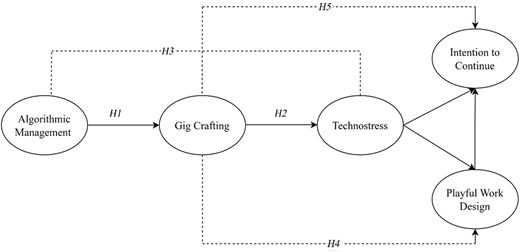
GC would be positively predicted by AM.
The effects of AM on worker well-being are complex and sometimes ambivalent (Cropanzano et al., 2023; Keegan and Meijerink, 2025; Meijerink and Bondarouk, 2023). Although certain features (e.g. monitoring or ratings) may enhance perceived fairness (Deng et al., n.d.). AM also intensifies technology-related demands. We focus on technostress, defined as stress arising from intensive technology use, including overload, complexity, uncertainty, invasion, and insecurity (Tarafdar et al., 2007). While the precarious nature of gig work could be demoralizing, it could also motivate workers to cope with adverse conditions (Wu and Huang, 2024). In gig work, continuous adaptation to algorithmic systems, platform volatility, and performance optimization requires sustained cognitive and emotional investment. From a COR perspective (Hobfoll et al., 2018), persistent resource investment without guaranteed returns may lead to resource depletion and stress. As gig workers engage in GC to cope with AM pressures—managing multiple platforms, adjusting strategies, and responding to algorithmic shifts—they may experience increased techno-overload, techno-uncertainty, and techno-insecurity. We therefore proposed:
GC would be positively associated with technostress.
Because AM compels workers to invest time, effort, and cognitive resources to maintain performance and income, GC may function as the mechanism through which AM translates into technostress. Accordingly, we proposed:
GC would mediate the relationship between AM and technostress.
3.6.1.2 GC: a pathway to PWD and continuance intention through technostress
Job stressors—such as workload and task complexity—can elicit strain but also be appraised as growth opportunities, motivating adaptive coping (Lepine et al., 2005). Following the transactional model of stress, individuals first evaluate technological demands (primary appraisal), then assess coping resources (secondary appraisal), and select strategies to manage demands (Tarafdar et al., 2019). Consistent with the transactional model of stress, the same stressor could be appraised simultaneously as both challenging and threatening (Lazarus and Folkman, 1984). For instance, Cram et al. (2022) found that Uber drivers experienced both techno-eustress and technostress in response to algorithmic control.
We propose that GC-induced technostress is interpreted as a challenge, motivating proactive coping through PWD. PWD comprises fun-oriented behaviors, which humanize and enrich tasks, and competition-oriented strategies, which involve self-imposed performance challenges (Scharp et al., 2023). Fun-oriented behaviors (e.g. listening to music, seeking humor) humanized and enriched work experiences, while competition-oriented strategies (e.g. personal performance goals) helped cope with agency-related demands (Scharp et al., 2021). These strategies allow gig workers to transform GC-related strain into engagement, expanding their resource pool. PWD thus functions as a secondary, resource-focused coping mechanism consistent with COR theory, which posits that individuals invest remaining resources to protect and potentially build new ones (Hobfoll et al., 2018).
Accordingly, we hypothesize:
GC would be indirectly associated with PWD through its impact on technostress.
By engaging in PWD, workers mitigate GC-induced technostress and replenish resources, reinforcing motivation and platform engagement. Resource-rich individuals cope better and acquire additional resources, enhancing well-being and performance, especially in resource-constrained environments (e.g. Mansour and Mohanna, 2024; Mansour et al., 2026). Therefore, GC is expected to influence continuance intention indirectly via a serial pathway through technostress and PWD:
GC would be indirectly associated with intention to continue through the serial mediation of technostress and PWD.
Our conceptual model is presented in Figure 2.
3.6.2 Methods
3.6.2.1 Sample and procedure
We conducted a time-lagged study among gig workers across multiple platforms in China and Australia, with university ethics approval. Data were collected via online surveys (Google Forms, Questionnaire Star) with support from research assistants and local students. Participants worked at least 20 h per week, had multi-platform experience, and provided informed consent. Surveys were administered in English and translated into Chinese using back-translation (Brislin, 1980) with pretesting by local experts. Participants received a US$5 gift voucher. Data collection occurred between December 2024 and January 2025.
The Time 1 survey included demographic information, AM, and GC. One month later, participants were invited to complete the Time 2 survey, which assessed technostress and PWD. Respondents provided the last four digits of their phone number to match responses across waves. After removing incomplete entries, 420 valid responses were obtained at Time 1 (China: 270, 69.8%; Australia: 150, 68.8%). At Time 2, 319 participants completed the follow-up survey, yielding response rates of 76.3% in China and 75.3% in Australia.
Participants worked predominantly 20–30 h per week, with gig types evenly distributed across food delivery, freelancing, ride-hailing, and other work. Most held a full-time job alongside gig work (84%). The sample was gender-diverse (45.5% men, 28.8% women, 25.7% undisclosed) and educationally varied (college/certificate: 37.3%, bachelor: 35.4%, graduate: 14.7%, high school or less: 12.5%).
3.6.2.2 Measures
AM was measured using the validated scale by Parent-Rocheleau et al. (2024), modeled as a second-order construct comprising five dimensions: monitoring, goal setting, task scheduling, performance rating, and compensation (α = 0.96; example item: “My platform tracks my performance through regular ratings”). GC was assessed with the seven-item scale developed in this study (α = 0.93; example item: “I actively prioritize high-paying gigs, even if they are less convenient”). Technostress was measured using a shortened version of the Tarafdar et al. (2007) scale. Retaining 15 items across five dimensions (α = 0.95; example item: “I must work faster than I can handle due to the platform”). PWD was measured using Scharp et al. (2023) scale, comprising two dimensions: fun (6 items; α = 0.90; example item: “I approach my gig work in a playful way”) and competition (6 items; α = 0.89; example item: “I try to set time records in my gigs”). Intention to continue as a gig worker was measured using a three-item scale from Goldbach et al. (2018). One example item: “I plan to work as a gig worker in the future”. AM and GC were measured at Time 1, while technostress, PWD, and intention to continue were assessed at Time 2. Items were slightly rewarded to reflect gig work and platform contexts. GC items are provided in Appendix.
3.6.3 Analytical approach
3.6.3.1 Common method bias
To reduce CMB, data were collected in two waves: AM and GC at Time 1, and technostress, PWD, and intention to continue as a gig workers at Time 2, minimizing priming and consistency bias. Additional procedural controls included anonymity, validated and pilot-tested scales, and careful translation/back-translation. Post-hoc tests confirmed minimal CMB: Harman's Single-Factor Test indicated a single factor explained only 25.76% of variance (<50%), VIFs were below thresholds, and construct correlations were <0.90 (Hair et al., 2021). Together, these results confirm that CMB does not compromise our findings.
3.6.3.2 Measurement invariance and construct validity across Australia and China
We applied covariance-based structural equation modeling (CB-SEM) using SmartPLS v4.1.1.6 to test the measurement and structural models simultaneously. This approach enabled assessment of latent constructs, mediation, and cross-country invariance (Australia vs. China). Fit indices (χ2/df, CFI, TLI, GFI, NFI, RMSEA and SRMR) were evaluated against standard thresholds (Byrne, 2001; Hu and Bentler, 1999). Reliability (CR) and convergent validity (AVE) were calculated (Fornell and Larcker, 1981), and CFA confirmed discriminant validity across constructs.
3.6.3.3 Hypothesis testing and mediation
All hypotheses were tested within a full CB-SEM model. Mediation effects were assessed using bias-corrected percentile bootstrapping with 10,000 resamples and 95% confidence intervals.
This rigorous procedure improves statistical power and reduces Type I error while ensuring robust estimation of direct, indirect, and serial effects (Preacher and Hayes, 2008).
3.6.4 Results
3.6.4.1 Measurement model in each sample
The measurement model was first assessed separately in China and Australia. High correlations among the five AM dimensions, the two PWD dimensions, and the five technostress dimensions confirmed their internal structure. To simplify the structural model, PWD and technostress were treated as single latent factors. Fit indices were acceptable in both samples (χ2/df < 1.3; RMSEA/SRMR ≤0.05; CFI/TLI ≥0.91), with high internal consistency (CR > 0.83; AVE >0.50). Discriminant validity was supported by the Fornell–Larcker criterion and HTMT ratios (<0.85), and all standardized loadings exceeded 0.70. No meaningful differences emerged between the two samples, justifying pooling for further analyses. These findings indicate that the measurement properties of the constructs are stable across the two cultural contexts. Detailed results are presented in Tables 2 and 3.
3.6.4.2 Measurement invariance between Australia and China
Nested invariance tests (configural, metric, scalar, strict, and strict with latent means) indicated good fit across all models (CFI = 0.91; RMSEA = 0.033–0.035), with non-significant chi-square differences (p > 0.54). This confirms that constructs—including GC, AM, technostress, PWD, and intention to continue as a gig worker—are interpreted consistently across cultures, supporting pooled analyses.
3.6.4.3 Measurement model (pooled samples)
A CFA on the pooled data specified a five-factor model: AM (second-order, five first-order dimensions), GC, technostress (single factor), PWD (single factor), and intention to continue. The model fit excellently (χ2/df = 1.15; RMSEA = 0.02; SRMR = 0.02; TLI/CFI = 0.98; NFI = 0.91) and outperformed alternative models collapsing constructs (four-, three-, and one-factor models). As shown in Tables 4 and 5, all constructs demonstrated strong reliability (CR > 0.87) and convergent validity (AVE >0.50). Discriminant validity was confirmed via Fornell–Larcker and HTMT (<0.85), and all standardized loadings were >0.70.
3.6.4.4 Structural model and hypothesis testing
The structural model showed excellent fit (χ2/df = 1.36; RMSEA = 0.02; SRMR = 0.04; TLI = 0.97; CFI = 0.97; NFI = 0.91), indicating strong alignment between the proposed relationships and the data.
3.6.4.5 Direct and indirect effects
Regarding direct effects, presented in Table 6, H1 predicted that AM would be positively associated with GC, and results strongly supported this hypothesis: AM had a positive and significant effect on GC (β = 0.83, p < 0.001), showing that higher levels of algorithmic management encourage gig workers to invest more intensively in GC. H2 proposed that GC would increase technostress, and consistent with this expectation, GC exhibited a positive and significant effect on technostress (β = 0.33, p < 0.05). These findings suggest that while GC is a proactive coping strategy, it also contributes to elevated levels of technostress as workers continuously adapt to algorithmic demands.
Indirect effects, presented in Table 6, provide support for H3, H4, and H5. Consistent with H3, GC significantly mediates the relationship between AM and technostress (β = 0.28, p < 0.01, 95% CI [0.08, 0.48]), indicating that AM-related pressures increase technostress partly by prompting workers to engage in proactive, resource-focused behaviors such as GC. Supporting H4, GC indirectly predicts PWD through its effect on technostress (β = 0.20, p < 0.01, 95% CI [0.06, 0.35]), showing that GC-induced technostress motivates gig workers to adopt playful work design behaviors, such as adding elements of fun or competition, to cope with technological demands. Finally, consistent with H5, the serial mediation pathway GC → technostress → PWD → intention to continue is significant (β = 0.12, p < 0.01, 95% CI [0.04, 0.21]), demonstrating that GC indirectly enhances workers' intention to continue on the platform by first generating technostress and then triggering PWD as a secondary coping strategy, ultimately supporting engagement and retention.
All control variables were non-significant and did not influence the outcomes. Together, these findings highlight the dual role of GC as a proactive mechanism: although it may initially increase strain through technostress, it simultaneously activates adaptive coping behaviors (PWD) that foster positive outcomes, including sustained engagement and platform continuance, demonstrating its importance as a strategic behavior in algorithmically mediated gig work contexts.
3.6.5 Discussion
The study aimed to introduce GC and develop a reliable measure. GC is defined as a set of proactive, self-directed strategies through which platform workers intentionally shape and optimize their work—diversifying across platforms, adjusting hours, and pursuing income-enhancing opportunities within algorithmically managed labor markets. Following a six-stage process, we conceptualized the construct, generated an initial item pool, conducted expert review (Study 1), performed exploratory factor analysis (Study 2), confirmed factor structure and validity (Study 3), and assessed nomological and predictive validity (Study 4).
To ensure robustness and cross-cultural applicability, data were collected from four independent samples in Turkey (n = 141), Pakistan (n = 188), Australia, and China (n = 319). The Turkish sample explored the GC factor structure, the Pakistani sample confirmed it and tested convergent, discriminant, and measurement invariance, and the Australian and Chinese samples assessed nomological and predictive validity across culturally diverse contexts. Together, these samples provide strong evidence that the GC construct and its measurement are reliable, stable, and generalizable internationally.
3.6.5.1 Theoretical contribution
This study contributes to the literature in several ways. First, by introducing GC, we extend job crafting research to the gig economy and algorithmically mediated work. While GC shares the proactive logic of job crafting, it differs in three respects. Unlike job crafting, which occurs in stable organizations with defined roles (Mansour and Mohanna, 2024; Wrzesniewski and Dutton, 2001), GC unfolds in fragmented, market-driven platform environments where algorithmic management dictates task allocation, pay fluctuations, and performance monitoring. GC unfolds in fragmented, market-driven platforms where algorithmic management dictates tasks, pay, and monitoring. Second, whereas job crafting targets engagement or well-being, GC focuses on stabilizing and optimizing income, reducing economic risk, and securing opportunities under volatile conditions. Third, GC requires responding to externally imposed and opaque factors such as dynamic pricing, unpredictable demand, spatial and temporal adjustments, task selection, and income-maximizing strategies.
Second, GC addresses limitations in prior research on multi-homing. Unlike transactional measures capturing only observable behaviors (Yu et al., 2021). GC encompasses multi-homing along with temporal adjustments, spatial mobility, selective task choice, and income-maximizing strategies, highlighting intentionality and strategic motivation. This agentic perspective allows linking proactive behaviors to outcomes such as well-being, income stability, career sustainability, and platform engagement. For instance, Cropanzano et al. (2023, p. 9) noted that “to adapt in the gig economy, workers may respond to the new psychological contract by collecting small, standardized work tasks into diversified portfolios and thus crafting a unique ‘job’ that fits their individual needs and skills”. Third, the GC Scale provides a reliable tool to measure these strategies. Existing measures from traditional contexts fail to capture the economic optimization and intentionality central to platform work. The GC Scale allows reproducible research, cross-context comparisons, and longitudinal studies on how gig workers navigate algorithmically mediated labor.
Fourth, the GC Scale enables exploration of its nomological network. Our findings show that GC can generate positive outcomes such as PWD and intention to continue as a gig worker, while also increasing technostress. Measuring GC allows investigation of its role as a mechanism, consistent with COR theory (Hobfoll et al., 2018) and transactional model of stress (Lazarus and Folkman, 1984), linking proactive strategies to both resource gains and drains. Overinvestment in GC may deplete personal resources, increasing techno-overload, uncertainty, privacy concerns, and job insecurity, highlighting its dual effects. GC-induced technostress motivates PWD behaviors, transforming algorithmic stressors into proactive coping strategies that enhance engagement and continuance intentions. This approach responds to calls for more research on the duality of AM (e.g. Keegan and Meijerink, 2025) and the underlying processes through which AM generates both positive and negative responses (Cram et al., 2022). In line with COR theory, in resource-scarce and high-pressure environments, GC represents deliberate resource investments to protect existing resources and potentially acquire new ones. Yet, GC may also have a potential dark side. Overinvestment in GC can deplete personal resources—time, effort, and cognitive capacity—especially when supportive resources are limited or platform algorithms are rigid. This overinvestment may increase techno-overload, interaction complexity, uncertainty, privacy concerns, and perceived job insecurity, echoing recent findings on approach crafting and burnout (e.g. Harju et al., 2021). Measuring GC extends both COR theory and the transactional model of stress by linking proactive behaviors to resource gains and drains, providing a framework to understand how gig workers navigate algorithmically mediated work. Based on the transactional model of stress, gig workers may cope proactively and playfully with technostress through PWD, a behavior aimed at making work more enjoyable (Dishon-Berkovits et al., 2024). Our study shows that technostress directly enhances PWD. Because technostress can be perceived as both a challenge and a threat, it elicits adaptive and maladaptive responses (Cram et al., 2022; Tarafdar et al., 2019). PWD thus serves as an emotional and motivational coping strategy for gig workers facing technostress.
Finally, conceptualizing and measuring GC contributes to work design, HRM, organizational behavior, and algorithmic management research, addressing an interdisciplinary gap (Keegan and Meijerink, 2025). While AM represents a top-down design, GC illustrates bottom-up strategies in the gig economy, highlighting mechanisms for worker involvement and agency in algorithmically mediated work. These findings advance theory in gig work, inform HRM transformation, and provide insight into evolving employment relationships (Cropanzano et al., 2023).
3.6.5.2 Practical implication
This study offers several practical implications. First, the GC Scale provides platforms with a diagnostic tool to understand how gig workers proactively navigate algorithmic systems. This insight allows firms to adjust reward structures, simplify algorithmic complexity, and design features that reduce technostress. By aligning algorithmic practices with workers' needs, platforms can enhance well-being, strengthen retention, and sustain performance in competitive markets. Policymakers can also use these findings to promote fair and transparent algorithmic management, encouraging platforms to incorporate structured channels for worker feedback and suggestions.
Second, recognizing bottom-up behaviors such as GC and PWD is critical. While these behaviors can boost engagement and performance (Cropanzano et al., 2023; Dishon-Berkovits et al., 2024), excessive investment in GC may deplete workers' resources, raising technostress and turnover risks. Platforms should therefore adjust rigid algorithmic features—especially reward and penalty systems—to better accommodate workers' preferences and well-being. Providing training can equip gig workers to navigate complex, evolving technological demands (Kellogg et al., 2020). Finally, encouraging PWD behaviors can help workers manage stress and sustain engagement in demanding platform-based work (Scharp et al., 2021).
3.6.5.3 Limitations
This study has several limitations, offering opportunities for future research. First, we relied on self-reported data, which may raise concerns such as common method bias. However, the use of a time-lagged design mitigates this issue. Although GC and AM were measured simultaneously in Study 4, this is unlikely to pose a major concern, as gig assignments are often automatic and completed within seconds (Duggan et al., 2020). Diary studies (Ohly et al., 2010) could provide a more fine-grained understanding of the dynamic interplay between AM, GC, and PWD.
Second, while we treated AM as a single construct in line with previous research (e.g. Parent-Rocheleau et al., 2024), individual practices may have distinct effects on GC and technostress. For example, monitoring, compensation, and performance ratings may be perceived as exploitative, whereas task scheduling and goal setting could help workers organize gigs and maximize earnings (Franke and Pulignano, 2023). Future studies should examine the separate impact of each AM dimension. Third, contextual factors may shape how gig workers respond to AM—some may resist algorithmic controls, while others leverage them strategically (Keegan and Meijerink, 2025).
Finally, while sample sizes were moderate, they were sufficient for CFA, measurement invariance, and structural analyses. Replicating the study with larger, country-specific samples could further test the external validity of GC and explore contextual moderators. The cross-country invariance tests support the scale's robustness, but future research could extend findings to traditional organizational contexts where algorithmic management is increasingly applied.
3.6.5.4 Conclusion
This study introduces GC and provides a validated scale to measure it in algorithmically mediated work. Gig workers actively engage in proactive strategies to navigate and optimize their work. GC increases technostress, triggering adaptive behaviors such as PWD and enhancing intention to continue as a gig worker. Findings highlight the dual nature of proactive strategies in the gig economy—supporting positive outcomes while creating new sources of strain—and contribute to a nuanced understanding of how workers cope with and shape experiences under AM.
The author thanks Dr. Sohaib Mustafa for his assistance with data collection and the experts involved in the scale pretesting process. The author also thanks the Associate Editor and the two anonymous reviewers for their valuable feedback.
An earlier version of this paper was selected as a Best Paper and will appear as a six-page excerpt in the Academy of Management Annual Meeting Proceedings (2026).