


This article investigates how intra-firm pay dispersion affects firm performance, distinguishing between vertical (across hierarchical levels) and horizontal (within occupational groups) pay differentials. It explores whether the impact arises from incentive effects for current employees or from the sorting effect through employee mobility, with a focus on managers and experts.
The study uses matched employer–employee microdata for Slovenian firms from 2006 to 2016. Firm performance is measured as value added per employee. Both static fixed-effects panel regressions and dynamic system Generalized Method of Moments (GMM) estimations are applied to disentangle direct (incentive) and indirect (sorting) effects of pay dispersion, while accounting for endogeneity and persistence in productivity.
The article finds robust evidence in both static and dynamic frameworks of a significant positive effect of horizontal pay dispersion among experts on firm labour productivity, driven by both incentive effects for current employees and sorting effects for prospective workers. The effect is amplified when the initial level of dispersion is lower. Evidence on vertical pay dispersion is less conclusive: while static results indicate a positive association mainly through incentives for current employees, the dynamic analysis does not confirm a causal link with productivity. Overall, the findings suggest that moderate pay dispersion – particularly among experts – enhances firm productivity without necessarily undermining equity in a low-inequality setting, whereas managerial turnover has the most adverse effects on performance.
Results indicate that moderate pay dispersion can foster firm productivity without necessarily undermining equity in a low-inequality setting.
The article contributes by jointly examining vertical and horizontal pay dispersion, distinguishing between incentive and sorting effects, and contrasting outcomes for managers and experts. Using comprehensive linked employer–employee data allows for a rare large-scale test of compensation strategies and labour mobility in a low-inequality institutional context.
1. Introduction
The link between employee compensation features and firm performance is of interest to both scholars and practitioners and both the role of money in motivating current employees and the role of money as an attractive feature to potential future employees have been discussed. This is especially the case in times of the global “war for talent,” where competition for talented employees is increasing and small companies in particular are having difficulty retaining highly qualified employees (Sels et al., 2006; Castro-Silva and Lima, 2023; Chuang and Hsu, 2004). Specifically, by adopting a specific pay strategy firms can shape their relative pay levels, pay mix, horizontal and vertical pay dispersion to (1) impact the productivity of the existing employees and (2) create a distinctive value proposition for prospective employees that is attractive enough to induce them to switch employers. Because workers compare their pays either internally (i.e. with workers within the same firm) or externally (i.e. with workers in other firms or industries), it is thus argued that pay dispersion affects the productivity of individual workers and thus average firm performance (Lallemand et al., 2004; Heyman, 2005; Honig-Haftel and Martin, 1993). On the other hand, inter-firm employee mobility importantly affects organizational-level outcomes of both source and destination firms due to the flow of human and relational capital from the source to the destination firms (Mawdsley and Somaya, 2015). In the human resource management literature, labour turnover is observed as cause of undesirable outcomes because it entails the loss of firm-specific human and social capital, disrupts operations and collective function, saddles remaining members with newcomer socialization and training, and increases recruitment and selection costs (see e.g. Hausknecht and Trevor (2011) for a narrative review).
One of the more prominent determinants of worker mobility that firms are in control of is their pay strategy. Accordingly, a question arises as to whether pay dispersion, through a sorting mechanism, can foster employee turnover that improves workforce composition, thereby attenuating the severity of the potentially adverse effects of employee turnover. This article aims to evaluate the role of pay dispersion on firm performance by examining both the direct effect of pay dispersion on firm performance through the incentive effect for existing workers and the indirect effect of pay dispersion on firm performance through the workforce sorting effect (Gerhart and Rynes, 2003; Lazear, 2000; Rynes, 1987). The latter effect refers to a change in pay strategy that improves performance not by changing the behaviour of current employees, but rather by changing who the current employees are (and what attributes they bring to the firm).
In economics, pay differences may reflect differential inputs and marginal products and be indicative of an internal career and pay path that may raise overall motivation levels (Shaw, 2014). Accordingly, the tournament theory (e.g. Lazear and Rosen, 1981) is also frequently used to ground the prediction that higher pay dispersion will be associated with better performance as a large spread in the rewards of workers stimulate their effort. In addition, wide pay dispersion will create workforce sorting, in which winners stay with the organization in order to compete for higher pay, whereas losers self-select out of the organization (Shaw, 2015). Moreover, high pay spreads serve not only to filter out poor performers over time, increasing average performance levels, but also to attract better applicants (Lazear, 2000). This is consistent with the idea of person-organization fit, which argues that people choose employers on the basis of their perceptions of the match between their own dispositions and organizational characteristics (Bretz and Judge, 1994; Rynes, 1987). Another stream of literature, though, argues for some degree of pay compression within a firm by emphasizing the importance of fairness and cooperation among the workforce (e.g. Akerlof and Yellen, 1990), believing that high pay dispersion “can undermine feelings of internal equity and damage cooperation and any sense of common purpose across the workforce as a whole” (Shaw, 2014).
Theories of compensation (e.g. reinforcement, expectancy, efficiency wage and agency) also largely agree that incentives and reinforcement are key drivers of important workplace behaviours such as employee performance (Zoghlami, 2021). The incentive effect of compensation schemes is even more pronounced in the case of executive pay. A pay-performance framework, based on agency theory, contemplates a positive association between an agency-based contract and firm performance. Accordingly, attractive executive compensation is to be an effective governance mechanism that would be able to align the manager’s interest with that of the firm shareholders and thereby improve the manager’s involvement in achieving the shareholders’ objectives. Meta-analytic evidence generally portrays a weak positive CEO pay–performance relationship (Gerhart and Fang, 2014), although some contingencies, i.e. firm characteristics as well as institutional, economic and cultural background, need to be taken into consideration (Zoghlami, 2021).
The specific role of firm pay strategies that increases a firm’s potential to attract high-quality switchers, i.e. employees switching from one employer to another, has also been recognized (review in Shaw, 2014; Zoghlami, 2021), although the organizational rank at which pay dispersion arises is often neglected (Kacperczyk and Balachandran, 2018). Namely, horizontal pay dispersion is a result of choices in the compensation system that increase dispersion in pay within occupations, such as individual incentives (pay for performance), skill-based pay and horizontal promotions (Balkin and Gomez-Mejia, 1990), whereas vertical dispersion relates to within-firm vertical pay differential, i.e. between the highest and lowest pay levels within a firm.
Empirical research exists separately (1) on effects of pay dispersion and firm performance (focusing on current employees) (Failla et al., 2025) along with separate work (2) on pay dispersion and turnover (focusing on departing employees) and (3) the impact of employee turnover on firm performance. There is a lack of research integrating all aspects (Shaw, 2014), although some studies investigate and empirically confirm both, the sorting and incentive effects of pay dispersion (Cadsby et al., 2007; Piekkola, 2005).
Meta-analyses of studies from the first group provide strong support for the incentive channel. They show that individual incentive pay is associated with higher productivity relative to fixed pay (Jenkins et al., 1998; Kim et al., 2022; Nyberg et al., 2018) and is robust to task type and incentive intensity. These studies often focus on a particular occupational group, most often on the role of executive pay dispersion for firm performance (e.g. Li et al., 2022; Ntim et al., 2019; Heyman, 2005). Some exceptions (e.g. Yergabulova et al., 2024) find the effect of vertical wage dispersion on performance to be negative. Fulmer et al. (2023) caution that designs focusing solely on incumbent workers likely underestimate the full performance impact of Performance-Related Pay (PFP), because they omit workforce reallocation effects that unfold over time. The second group of studies deals with the impact of pay dispersion on employee mobility. These studies mainly focus only on departing employees and do not differentiate between the within-firm horizontal and vertical aspects of pay dispersion (see review in Kacperczyk and Balachandran, 2018). Earlier field evidence (e.g. Lazear, 1986; Cadsby et al., 2007) already highlighted the importance of mobility mechanisms, which lead to changes in workforce composition rather than effort adjustments among incumbent workers. Kacperczyk and Balachandran (2018) show that vertical wage dispersion suppresses cross-firm mobility because it is associated with outcomes beneficial for employees and horizontal wage dispersion increases cross-firm mobility because it is associated with inequity concerns. Fulmer et al. (2023) conclude that despite this evidence, sorting remains underexamined in most pay–performance research, particularly in large-scale field settings. In the third group of studies, the negative relationship between labour turnover and firm performance is observed in the meta-study by Hancock et al. (2017), reporting that this relationship is moderated by firm size, occupational group and not necessarily linear (Li et al., 2022), suggesting that a certain amount of turnover can be beneficial. Much of the empirical evidence relies on cross-sectional or correlational designs, raising concerns about endogeneity, reverse causality and omitted variable bias. Although some studies employ longitudinal data or laboratory experiments, rigorous causal identification in field contexts remains relatively rare. Fulmer et al. (2023) explicitly call for greater use of designs that address endogeneity – such as quasi-experiments, instrumental variables and dynamic panel approaches – to strengthen causal inference in compensation research.
The article aims to disentangle the direct incentive effect – that is, how pay dispersion motivates incumbent employees – from the indirect sorting effect, whereby pay dispersion influences which employees join or leave the firm, and changes in workforce composition subsequently affect firm-level labour productivity. Building on the conceptual synthesis of Fulmer et al. (2023), we distinguish between incentive and sorting effects of intra-firm pay dispersion and empirically quantify both channels. The indirect channel operates through inward and outward employee mobility, which mediates the relationship between pay dispersion and firm-level productivity by altering workforce composition. The two effects are identified using a two-specification regression approach: one specification excludes and the other includes inward and outward switching employees, as explained in the following section and illustrated in Figure 1. The analysis focuses on Slovenia, a small open economy with low-income inequality – its 2019 Gini coefficient was 0.246, the second lowest among Organisation for Economic Co-operation and Development (OECD) countries. The study of a low-inequality economy such as Slovenia provides a novel context and complementary insights into the relationship between pay structures and organizational outcomes, as high-inequality contexts have received most attention in the literature on pay dispersion. Although many theoretical frameworks were developed in settings characterized by high pay dispersion or highly marketized incentives, they rest on inherently relative comparisons and relative pay differences persist even within a compressed wage structure such as Slovenia’s.
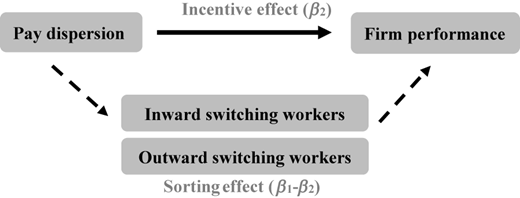
The incentive and sorting effects of pay dispersion on firm performance. Source: Authors’ own work
The incentive and sorting effects of pay dispersion on firm performance. Source: Authors’ own work
We use matched employer–employee data for Slovenian firms over 2006–2016, combining records on the economically active population, gross pay and firm financials. The merged dataset covers nearly 3.9 million observations and allows us to observe pay structures, worker mobility and firm performance within the same framework, enabling a more direct test of the sorting mechanism than is typical in the literature. To study the link between intra-firm pay dispersion, employee switching and firm performance, we apply static fixed-effects and dynamic system GMM panel estimators.
We contribute to the literature by studying the effect of vertical and horizontal pay dispersion separately and focus on the overall effects of pay dispersion as well as on specifics within particular occupational groups, i.e. managers and experts. Especially the latter occupational group has rarely been studied in the literature. We utilize a longitudinal employer-employee matched database that enables us to observe pay dispersions, worker mobility and firm performance within the same dataset and to simultaneously study the role of incentives and sorting for firm performance to provide solid, large-scale evidence on the studied topic.
2. Data and methodology
2.1 Data sources
We use matched employer-employee data for the population of Slovenian firms in the 2006–2016 period obtained from the Slovenian Statistical Office with information on economically active population (e.g. education level, occupation, gender, age and nationality) and the information on the employer. Additionally, the dataset includes data on gross pay from the Slovenian Tax Office and on firms’ financial statement data provided by the Agency of the Republic of Slovenia for Public Legal Records and Related Services. The merged database covers about 750,000 private-sector employees and 3.87 million observations for 2006–2016. Employee-level data matched with firm-level information allows us to measure wage dispersion, worker turnover and control factors, while firm performance (labour productivity) is estimated for over 7200 firms with at least 10 employees.
2.2 Identification strategy, empirical model specification and methodological issues
To analyse the role of pay dispersion and distinguish its direct effect (incentives for incumbent employees) from its indirect effect (sorting of incoming and outgoing workers) on firm-level labour productivity, we adopt a two-specification regression approach and estimate specifications (1) and (2), with specification (1) excluding and specification (2) including inward and outward switching employees as regressors:
where dependent variable is a firm-level performance in terms of labour productivity, measured as a natural logarithm of value added per employee (lnLprodjt) and subscripts j, k and t refer to firms, industries and years, respectively. The specification without job switchers (1) as regressors allows us to estimate the total effect of pay dispersion (β1), since the coefficient captures both the direct (incentive) and indirect (sorting) channels; worker turnover is not controlled for in this regression. In contrast, the specification including job switchers (Specification 2) controls for worker mobility, thereby absorbing the sorting channel that operates through employee turnover. Consequently, the coefficient on pay dispersion (β2) reflects the direct effect attributable to incentive mechanisms among incumbent employees. Consequently, the sorting effect can be indirectly identified as the difference β1 − β2, consistent with the mediation logic illustrated in Figure 1 [1] [2].
Firm pay dispersion strategy is identified based on both horizontal (Horizontal_dispjht) and vertical (Vertical_dispjt) pay dispersion, with the former measuring coefficient of variation, i.e. the standard deviation to mean ratio, of gross pays inside the occupational groups h (based on 1-digit International Standard Classification of Occupations 2008 by ILO [3]) within firms in the Slovenian economy. To ensure consistency with the measure of horizontal dispersion, which is based on occupational groups at the 1st ISCO level, we define the primary vertical pay dispersion measure (Vertical_dispjt) as the ratio of the average pay of the highest occupational group to that of the lowest occupational group within the same firm.
As a robustness check of our results, we employ alternative metrics that consistently capture the horizontal and vertical dimensions of within-firm pay dispersion, thereby minimizing the risk of using inappropriate measures. Among the pay dispersion measures commonly used in the literature (e.g. Bloom, 1999; Bloom and Michel, 2002; Carnahan et al., 2012; Sørensen and Sharkey, 2014; Kacperczyk and Balachandran, 2018), the Gini coefficient is particularly suitable for distinguishing dispersion within occupational groups (horizontal) from dispersion across occupational levels (vertical). To separate between-group and within-group dispersion, we follow the approach outlined by Kacperczyk and Balachandran (2018).
Horizontal wage dispersion is calculated as the Gini coefficient for each firm–occupation group–year:
where refer to firms, occupational groups and years, respectively; is the gross pay of the -th ranked individual in a given occupational group within firm in year , indexed in non-decreasing order and is the number of workers in occupational group .
To maintain alignment between measures of horizontal and vertical pay dispersion, we also implement the Gini coefficient as a robustness measure of vertical pay dispersion, capturing variance in pay across occupational groups. Following the standard approach based on grouped data (e.g. Cowell, 2011; Kacperczyk and Balachandran, 2018), we first calculate the average pay for each broad occupational group within a firm, and then compute the Gini coefficient across these group-level averages:
This approach ranks grouped occupation-level data at the firm level instead of individual wages within each occupational group, thereby capturing the between-group dispersion relevant for vertical wage inequality. The Gini coefficient–based measures of dispersion range from 0 (perfect equality) to 1 (maximum dispersion). Furthermore, as an additional measure of vertical pay dispersion, we use a measure that captures the gap between the highest gross pay and the median gross pay within a firm. In the next step, we test whether our results remain robust when using these alternative measures. As discussed later, our findings are largely robust to these alternative specifications.
Inward and outward mobility is included as the share of inward and outward job switchers in the total number of employees (sh_InSwitchjt and sh_OutSwitchjt). We also study the impact of mobility of employees from particular occupational groups, such as managers (sh_InSwitch_mngjt and sh_OutSwitch_mngjt) and experts (sh_InSwitch_expjt and sh_OutSwitch_expjt). Additionally, we control for average employees’ age (avg_Agejt) and share of employees with a higher level of education (sh_HighEducjt) to account for differences in the structure of employees. Model specification also controls for the impact of firm age, size, profit margin and firm export orientation. Firm age (FirmAgeit) denotes a firm’s age, counting from the formation year according to the Business Register of the Republic of Slovenia. Firm size is defined with the number of employees (Emplit) and capital intensity (Kintit) is measured as fixed assets per employee. All three are expressed in a natural logarithmic form and enter the empirical specifications as lagged values. Profit margin is measured with the return on sales (ROSit) and defined as a ratio of firm’s profit and its sales. We use the share of revenues earned abroad as an indication of firm’s export orientation (EXorit). A set of annual dummy variables (d_yeart) accounts for time-fixed effects that result from the macroeconomic and institutional environment in a particular year and the set of industry dummy variables (d_industryk) at the first level of the NACE classification to account for time-invariant sectoral specific effects.
To examine the role of pay dispersion for firm performance, we conduct both static and dynamic panel data analysis. In the static setting, we first estimate a linear panel regression with panel-corrected standard errors, using lagged regressors to address potential endogeneity. This estimator accounts for heteroskedasticity and contemporaneous correlation across panels. To further address potential within-firm correlation of the error terms, we provide additional estimates using a fixed-effects panel estimator with firm-level clustered standard errors. To account for potential endogeneity due to reverse causality [4] and the persistence of firm performance over time (Mueller, 1986), we also employ a dynamic panel data approach. This method allows the inclusion of lagged dependent variables among the regressors while efficiently addressing autocorrelation and unobserved heterogeneity across firms (Baltagi and Baltagi, 2008). We implement the system GMM estimator developed by Arellano and Bover (1995) and Blundell and Bond (1998). This estimator additionally controls for simultaneous bias arising from the joint determination of firm performance and firm-level characteristics, such as the share of switchers, pay dispersion, firm size, capital intensity, return on sales and export orientation. The consistency of the estimator, which relies on lagged instruments in the first-differenced equations, depends on the absence of second-order serial correlation in the first-differenced residuals. This assumption is tested using the AR(2) statistic. To address heteroskedasticity, we use the two-step procedure with Windmeijer-corrected robust standard errors. Finally, the Sargan test is used to assess the validity of instruments in an over-identified setting, which is crucial for ensuring that the instruments effectively mitigate concerns about reverse causality.
2.3 Descriptive statistics
Table 1 shows descriptive statistics for Slovenian firms with at least 10 employees over the ten-year period 2006–2016. On average, during the observed period, the ratio of the average pay of the highest occupational group was 2.7 times higher than that of the lowest occupational group within the same firm. Horizontal pay dispersion was higher within the managerial occupational group than among professionals. Newly hired employees in a given year accounted on average for 10% of all employees in a firm on average, while 13.3% of employees were those whose employment with a given employer ended in a given year. The average age of employees in the observed period was slightly over 40 years, and almost 22% of employees had higher education. The average value added per employee of the analysed firm in the observed period amounted to almost EUR 32,000 and the average wage in the observed firm was EUR 21,000. In the observed period, an average firm employed 68.6 people and owned around 60,000 EUR of fixed assets per employee. During the observed period, Slovenian companies achieved a low return on sales on average.
Descriptive statistics for the 2006–2016 period
| All firms | ||
|---|---|---|
| Mean | St. deviation | |
| Vertical_dispjt | 2.743 | 1.558 |
| Vertical_disp_Gjt | 0.196 | 0.934 |
| Horizontal_disp(Mng)jt | 0.391 | 0.247 |
| Horizontal_disp(Exp)jt | 0.324 | 0.177 |
| Horizontal_disp_G(Mng)jt | 0.111 | 0.116 |
| Horizontal_disp_G(Exp)jt | 0.101 | 0.092 |
| sh_InSwitchjt | 0.098 | 0.119 |
| sh_OutSwitchjt | 0.133 | 0.202 |
| sh_InSwitch(Mng)jt | 0.004 | 0.017 |
| sh_OutSwitch(Mng)jt | 0.006 | 0.021 |
| sh_InSwitch(Exp)jt | 0.011 | 0.035 |
| sh_OutSwitch(Exp)jt | 0.013 | 0.046 |
| lnLproductivityjt | 10.367 | 0.605 |
| avg_Wagejt | 21,076 | 14,486 |
| avg_Agejt | 40.1 | 4.355 |
| sh_HighEducjt | 0.218 | 0.236 |
| Empljt | 68.6 | 254.4 |
| Kintjt | 59,199 | 192,080 |
| ROSjt | 0.022 | 0.177 |
| EXorjt | 0.225 | 0.323 |
| No. of observations | 37,914 | |
Note(s): Firms with 0 employees not included; value added, wage and capital intensity in EUR
Table 2 shows how pay dispersion varies in the observed 2008–2016 period, where vertical and horizontal pay dispersions are measured as the ratio of the average pay of the highest occupational group to that of the lowest occupational group within the same firm, and as a coefficient of variation of pays within occupation groups within a firm, respectively. It is evident that vertical dispersion was highest at the beginning of the period and then decreased until 2014. In 2008, on average, the average pay of the highest occupational group exceeded the average pay of the lowest occupational group almost 3 times, while in 2016 this ratio was only around 2.6. The reasons behind the decreasing average firm-level ratio, however, differ in different years. During the global financial crisis and the period of economic recovery, the decrease in vertical pay dispersion resulted from both the reductions in the highest pays, e.g. managers and experts, and a noticeable minimum pay increase in 2010. In the latter years, the vertical pay dispersion decrease is a consequence of higher pays in the lowest deciles of the pay distribution. A declining trend throughout the period is also observed in horizontal pay dispersion across all occupational groups, with horizontal pay dispersion highest among managers and experts.
Annual dynamics of vertical and horizontal pay dispersion in the 2008–2016 period
| Average pay of the highest to lowest occupational group within firm | Horizontal pay dispersion (coefficient of variation) within ISCO occupation groups1 | |||||||||
|---|---|---|---|---|---|---|---|---|---|---|
| 1 | 2 | 3 | 4 | 5 | 6 | 7 | 8 | 9 | ||
| 2008 | 2.97 | 0.33 | 0.30 | 0.28 | 0.23 | 0.15 | 0.18 | 0.15 | 0.14 | 0.12 |
| 2009 | 2.95 | 0.32 | 0.29 | 0.27 | 0.23 | 0.15 | 0.18 | 0.15 | 0.14 | 0.12 |
| 2010 | 2.83 | 0.31 | 0.29 | 0.27 | 0.22 | 0.14 | 0.18 | 0.14 | 0.13 | 0.11 |
| 2011 | 2.79 | 0.31 | 0.28 | 0.26 | 0.22 | 0.14 | 0.17 | 0.14 | 0.12 | 0.10 |
| 2012 | 2.73 | 0.31 | 0.28 | 0.26 | 0.21 | 0.14 | 0.18 | 0.14 | 0.12 | 0.10 |
| 2013 | 2.65 | 0.30 | 0.27 | 0.25 | 0.21 | 0.13 | 0.17 | 0.14 | 0.12 | 0.10 |
| 2014 | 2.64 | 0.29 | 0.27 | 0.25 | 0.21 | 0.14 | 0.17 | 0.14 | 0.12 | 0.10 |
| 2015 | 2.66 | 0.29 | 0.27 | 0.25 | 0.21 | 0.14 | 0.17 | 0.14 | 0.12 | 0.10 |
| 2016 | 2.64 | 0.28 | 0.27 | 0.25 | 0.21 | 0.14 | 0.17 | 0.14 | 0.13 | 0.11 |
1 – Managers, 2 – Experts, 3 – Technicians, 4 – Clerks, 5 – Service and sales workers, 6 – Skilled agricultural, forestry and fishery workers, 7 – Craft workers, 8 – Plant and machine operators, and assemblers and 9 – Elementary occupations
3. Results
3.1 Static analysis
We begin with a static estimation employing the two-specification regression approach (Specifications 1 and 2) to examine how within-firm pay dispersion, both directly and indirectly through employee inter-firm mobility, influences firm performance, measured by value added per employee. Both specifications are estimated as linear panel models with panel-corrected standard errors. Table 3 presents the baseline results for vertical pay dispersion, whereas Table 4 reports the effects of horizontal pay dispersion on firm performance. In all empirical specifications, we only consider firms with at least 10 employees. The robustness check results, which employ alternative estimators, additional firm-level controls and/or alternative measures of pay dispersion, are reported in Appendices. Appendix 1 presents the results of the vertical pay dispersion models estimated using a fixed-effects panel estimator with robust firm-level clustered standard errors, where pay dispersion is measured as the ratio of the average pay of the highest occupational group to that of the lowest occupational group within a firm. Standard errors are adjusted for heteroskedasticity and clustered at the firm level, allowing for arbitrary correlation of the error terms within firms over time. Appendix 2 extends this specification by including the average wage of employees as an additional firm-level control. Appendix 3 reports the results of the empirical models using an alternative measure of vertical pay dispersion based on the Gini coefficient. For robustness checks of horizontal pay dispersion, Appendix 4 adopts an alternative measure of horizontal pay dispersion based on the Gini coefficient, whereas Appendix 5 further employs a fixed-effects panel estimator with robust firm-level clustered standard errors to account for firm-specific effects.
Linear panel regression model with panel-corrected standard errors of labour productivity of Slovenian firms in the 2006–2016 period; the role of vertical dispersion (measured as ratio of the average pay of the highest occupational group to that of the lowest occupational group within a firm)
| Dependent variable: labour productivity | |||||
|---|---|---|---|---|---|
| / | / | All switchers | Switchers managers | Switchers experts | |
| (1) | (2) | (3) | (4) | (5) | |
| Vertical_disp(−1) | 0.027*** | 0.051*** | 0.048*** | 0.051*** | 0.051*** |
| (0.002) | (0.005) | (0.005) | (0.005) | (0.005) | |
| Vertical_disp(−1)2 | −0.002*** | −0.002*** | −0.002*** | −0.002*** | |
| (0.001) | (0.001) | (0.001) | (0.001) | ||
| sh_InSwitchers(−1) | −0.069*** | −0.073 | 0.108 | ||
| (0.019) | (0.186) | (0.073) | |||
| sh_OutSwitchers(−1) | −0.374*** | −0.422*** | −0.110 | ||
| (0.023) | (0.157) | (0.074) | |||
| avg_Age | −0.007*** | −0.008*** | −0.008*** | −0.008*** | −0.008*** |
| (0.001) | (0.001) | (0.001) | (0.001) | (0.001) | |
| sh_HighEduc | 0.904*** | 0.898*** | 0.904*** | 0.901*** | 0.899*** |
| (0.022) | (0.022) | (0.022) | (0.022) | (0.022) | |
| sh_Female | −0.208*** | −0.210*** | −0.199*** | −0.208*** | −0.210*** |
| (0.017) | (0.017) | (0.017) | (0.017) | (0.017) | |
| lnEmpl(−1) | 0.004 | 0.000 | 0.004 | −0.000 | 0.000 |
| (0.004) | (0.004) | (0.004) | (0.004) | (0.004) | |
| lnKint(−1) | 0.108*** | 0.108*** | 0.105*** | 0.108*** | 0.108*** |
| (0.003) | (0.003) | (0.003) | (0.003) | (0.003) | |
| ROS(−1) | 0.001*** | 0.001*** | 0.001*** | 0.001*** | 0.001*** |
| (0.000) | (0.000) | (0.000) | (0.000) | (0.000) | |
| EXor(−1) | 0.120*** | 0.119*** | 0.121*** | 0.120*** | 0.119*** |
| (0.013) | (0.013) | (0.013) | (0.013) | (0.013) | |
| Constant | 9.112*** | 9.100*** | 9.199*** | 9.099*** | 9.096*** |
| (0.068) | (0.068) | (0.065) | (0.068) | (0.068) | |
| Industry dummies | Yes | Yes | Yes | Yes | Yes |
| Annual dummies | Yes | Yes | Yes | Yes | Yes |
| Wald test | χ2(27) = 8099.1*** | χ2(28) = 8191.5*** | χ2(30) = 9134.7*** | χ2(30) = 8284.6*** | χ2(30) = 8298.0*** |
| R-squared | 0.961 | 0.961 | 0.960 | 0.961 | 0.961 |
| Observations | 37,547 | 37,547 | 37,547 | 37,547 | 37,547 |
| Number of firms | 7,220 | 7,220 | 7,220 | 7,220 | 7,220 |
Note(s): Standard errors in parentheses, ***p < 0.01, **p < 0.05, *p < 0.1
Linear panel regression model with panel-corrected standard errors of labour productivity of Slovenian firms in the 2006–2016 period; the role of horizontal dispersion by occupation groups of managers and experts (defined as coefficient of variation of gross pays inside the occupational groups)
| Dependent variable: labour productivity | ||||
|---|---|---|---|---|
| (1) | (2) | (3) | (4) | |
| Switchers managers | Switchers experts | |||
| Horizontal_disp(Mng)(−1) | 0.079*** | 0.082*** | ||
| (0.020) | (0.020) | |||
| Horizontal_disp(Exp)(−1) | 0.166*** | 0.172*** | ||
| (0.028) | (0.028) | |||
| sh_InSwitch(−1) | −0.342 | 0.030 | ||
| (0.404) | (0.084) | |||
| sh_OutSwitch(−1) | −0.678*** | −0.230*** | ||
| (0.213) | (0.082) | |||
| avg_ Age | −0.009*** | −0.010*** | −0.009*** | −0.009*** |
| (0.002) | (0.002) | (0.002) | (0.002) | |
| sh_HighEduc | 0.974*** | 0.983*** | 0.856*** | 0.865*** |
| (0.039) | (0.039) | (0.036) | (0.036) | |
| sh_Female | −0.191*** | −0.185*** | −0.141*** | −0.137*** |
| (0.032) | (0.031) | (0.030) | (0.029) | |
| lnEmpl(−1) | 0.010* | 0.008 | −0.003 | −0.004 |
| (0.006) | (0.006) | (0.006) | (0.006) | |
| lnKint(−1) | 0.109*** | 0.109*** | 0.100*** | 0.101*** |
| (0.005) | (0.005) | (0.004) | (0.004) | |
| ROS(−1) | 0.001*** | 0.001*** | 0.001*** | 0.001*** |
| (0.000) | (0.000) | (0.000) | (0.000) | |
| EXor(−1) | 0.130*** | 0.131*** | 0.140*** | 0.140*** |
| (0.022) | (0.021) | (0.021) | (0.021) | |
| Constant | 9.277*** | 9.289*** | 9.390*** | 9.399*** |
| (0.107) | (0.107) | (0.111) | (0.111) | |
| Industry dummies | Yes | yes | yes | yes |
| Annual dummies | Yes | yes | yes | yes |
| Wald test | χ2(27) = 3145.7*** | χ2(29) = 3259.6*** | χ2(27) = 3088.6*** | χ2(29) = 3178.3*** |
| R-squared | 0.965 | 0.964 | 0.963 | 0.963 |
| Observations | 14,823 | 14,823 | 14,175 | 14,175 |
| Number of firms | 3,133 | 3,133 | 2,811 | 2,811 |
Note(s): Standard errors in parentheses, ***p < 0.01, **p < 0.05, *p < 0.1
Table 3 presents results of various specifications that investigate the role of vertical pay dispersion measured as the ratio of the average pay of the highest occupational group to that of the lowest occupational group within the same firm, for firm performance. Besides the list of control variables, described in the methodology section, results of the regression model specification (1) for total effect in columns (1) and (2) focus on the linear and non-linear impact of vertical pay dispersion on firm performance. Specification in column (3) adds the indirect link between the vertical pay dispersion and firm performance, that is mediated by employee mobility (regression model specification 2), while the specifications in columns (4) and (5) study the specific role of the mobility of managers and experts, respectively for firm performance. In the static model, we are not able to account for the endogeneity and labour productivity persistence, hence we only interpret the results in terms of correlations. Results show that vertical pay dispersion is significantly and positively related to labour productivity. However, the inclusion of the squared pay dispersion term indicates that the relationship is non-linear, inverse U-shaped and is diminishing with increasing vertical pay dispersions after the threshold [5], which is reached at the ratio of the average pay of the highest occupational group to that of the lowest, ranging between 12 and 12.75. Since the threshold ranks in the top percentile of the vertical pay dispersion found in our data, we can conclude that there was a positive overall association between vertical pay dispersion and average firm labour productivity in our sample. In columns (3), (4) and (5), where we additionally control for the share of the incoming and outgoing switching workers, the size of the regression coefficients of vertical pay dispersion remains almost unaltered compared to the ones in column 2. The largely unchanged magnitude of the estimated effect of vertical pay dispersion on firm performance across these specifications (i.e. statistically insignificant difference β1 ≈ β2) fails to provide evidence of an indirect relationship between pay dispersion and firm performance mediated by labour turnover (i.e. the sorting effect). When switchers from all occupation groups are considered, both the inward (sh_InSwitch) and the outward labour mobility (sh_OutSwitch), given the number of employees, negatively affect firm performance, consistent with the hypothesized negative relationship between labour turnover and organizational performance in the human resource management literature. The impact of managers’ and experts’ turnovers is less significant, with the exception of the strong negative effect of the share of outgoing workers in managerial positions. This indicates that turnover at higher hierarchical levels has a disproportionately large impact on firm performance compared with turnover among other occupational groups, reflecting the loss of organizational knowledge, leadership and continuity in decision-making.
These results are widely confirmed in a series of robustness checks reported in appendices. The fixed-effects estimation reported in Appendix 1 confirms the significant positive effect of vertical pay dispersion on firm performance; however, the inclusion of firm fixed effects with robust firm-level clustered standard errors reduces the magnitude of the impact, which becomes linear. In line with the baseline results, inward and outward labour mobility across all occupations negatively affects firm performance, while for managerial and export positions, the negative impact is associated only with outward mobility, which becomes even larger and significant for experts as well. The inclusion of the average wage of employees as an additional firm-level control in the specification reported in Appendix 2 fully supports the conclusions above, showing a linear association between vertical pay dispersion and firm performance and a strong negative effect of outward mobility among managers and experts. Similarly, using alternative measures of vertical pay dispersion based on the Gini coefficient (Appendix 3) again confirms the positive linear effect of vertical pay dispersion, while the effects of inward and outward job switches remain identical to the baseline specification [6]. Overall, we conclude that vertical pay dispersion is positively and significantly associated with firm performance. This relationship remains robust after controlling for job switchers and can therefore be attributed to incentive effects rather than sorting mechanisms. In contrast, general worker turnover is negatively related to firm performance, with the most pronounced adverse effect stemming from the share of outgoing managers.
Table 4 shows the results on the role of horizontal pay dispersion, i.e. measured as the coefficient of variation of gross pay within occupational groups, on firm performance in terms of productivity. We analyse the total effect of horizontal pay dispersion of managers (column (1)) and experts (column (3)) on firm labour productivity, since these groups are expected to have a large impact on firm performance. In columns (2) and (4), we additionally consider the effects of managerial and expert mobility, respectively, on firm performance, and isolate the direct effect, i.e. the incentive effect of horizontal pay dispersion of managers (column (2)) and experts (column (4)).
Both managerial pay dispersion and expert pay dispersion are positively correlated with firm performance overall, but the effect is larger for experts. The magnitude of the effect of horizontal pay dispersion for both occupational groups slightly increases when labour turnover is included, confirming a strong direct link of the horizontal pay dispersion through incentives for skilled incumbent employees. The inferred indirect sorting effect via potential new workers is negative, as indicated by the increase in the horizontal pay-dispersion coefficient when turnover is included. However, given that the magnitude of this increase is small, the implied negative sorting effect is considerably weaker than the positive incentive effect, resulting in an overall positive total effect. The observed negative effect of outward switchers on firm performance is supported in the human resource management literature, suggesting that labour churn is not only labour mobility but also human capital mobility. The comparison of the effects of pay dispersion and mobility on firm productivity between managers and experts suggests that the effects of pay dispersion are much more pronounced for experts, i.e. twice as large as for managers, and that the contribution of the turnover of managers to productivity is almost three times as large as the contribution of experts. This suggests that the incentive effect of pay dispersion is stronger for experts, while more intangible capital is intrinsic to managers. The latter corresponds to a higher correlation between firm performance and turnover for managers compared to other occupational groups found in Yu et al. (2019).
The results are largely robust to additional checks reported in Appendices 4 and 5. When an alternative measure of horizontal pay dispersion based on the Gini coefficient is used (Appendix 4), the results are highly consistent with the baseline findings, fully supporting all the conclusions presented above. The fixed-effects estimator with robust firm-level clustered standard errors, as applied in Appendix 5, reduces, as expected, the magnitude and statistical significance of pay dispersion effects. Nevertheless, it supports the conclusion that the direct association between firm performance and horizontal pay dispersion is stronger and more significant among experts, whereas this relationship becomes insignificant for workers in managerial positions. It also indicates an almost threefold larger negative contribution of managerial outward mobility to productivity compared to expert turnover. Moreover, the effect of inward switchers in managerial positions becomes significantly negative once firm fixed effects are controlled for.
Our analysis also shows that, other things being equal, firms with younger and better-educated employees on average perform better. These results are robust to model specification and occupational group selection. Surprisingly, the share of female employees is negatively related to firm performance in most specifications. Contrary to expectations based on stylized facts about the relationship between size and performance (see Lee, 2009), in our model, the effect of firm size on performance is not statistically significant and even becomes negative in fixed-effects specifications. The remaining control variables confirm that firm productivity is positively associated with the capital intensity of firm production, the price-cost margin, and the export orientation of the firm across a wide range of robustness tests. Consistent with the macroeconomic dynamics in Slovenia, the regression coefficients for the time dummy variables are significant and negative until 2014 and significant and positive from 2014, when a positive macro trend became characteristic of the Slovenian economy.
3.2 Dynamic analysis
In the next step, we estimate our model also in a dynamic setting to account for the potential performance persistence and eventual endogeneity of certain firm-level regressors. We apply the system GMM estimator (Arellano and Bover, 1995; Blundell and Bond, 1998) that controls for the possibility of endogeneity originating from the two-way causality between pay dispersion and labour productivity in the model. It also allows us to study the dynamic relationship between pay dispersion and labour productivity directly and through the sorting effect. The system GMM results with robust standard errors are reported in Table 5, where we present only the results for our core explanatory variables on pay dispersion and worker switching, as well as the test statistics, while the remaining results on the firm-specific control variables are reported in Appendix 6. The specifications in columns 1 and 2 test the effects of the vertical pay dispersion with and without job swithers, while the specifications in columns 3 and 4 test the role of the horizontal pay dispersion for the two groups of skilled occupations (i.e. managers and experts), also with and without regressors on worker mobility. Estimator’s consistency hinges heavily upon the assumption that there is no second-order serial correlation for the disturbances of the first-differenced equation. The absence of a serial correlation of order 2 is confirmed with the test statistics AR(2) as reported in Table 5. Sargan test of over-identifying restrictions confirms the adequacy of instruments for all specifications from Table 5. We use the two-step procedure to compute the variance–covariance matrix based on Windmeijer robust errors due to the presence of heteroscedasticity in our model.
Dynamic GMM panel data model of firm performance, horizontal and vertical pay dispersion
| Dependent variable: labour productivity (lnLprod) | ||||
|---|---|---|---|---|
| (1) | (2) | (3) | (4) | |
| Vertical pay dispersion | Vertical pay dispersion | Horizontal pay dispersion | Horizontal pay dispersion | |
| No switchers | Switchers included | No switchers | Switchers included | |
| lnLprod(−1) | 0.477*** | 0.487*** | 0.492*** | 0.535*** |
| (0.042) | (0.052) | (0.059) | (0.047) | |
| lnLprod(−2) | 0.103** | 0.143*** | 0.006 | 0.031 |
| (0.047) | (0.050) | (0.048) | (0.042) | |
| lnLprod(−3) | 0.127*** | 0.037*** | 0.067 | 0.074 |
| (0.046) | (0.012) | (0.054) | (0.045) | |
| lnLprod(−4) | 0.011 | 0.022*** | 0.045* | 0.040* |
| (0.009) | (0.008) | (0.024) | (0.022) | |
| Pay dispersion and switchers | ||||
| Vertical_disp(−1) | 0.035 | 0.037 | ||
| (0.025) | (0.025) | |||
| Vertical_disp(−2) | −0.023 | −0.026 | ||
| (0.018) | (0.018) | |||
| Horizontal_disp(Mng)(−1) | −0.005 | 0.132 | ||
| (0.190) | (0.163) | |||
| Horizontal_disp(Mng)(−2) | 0.025 | −0.071 | ||
| (0.126) | (0.117) | |||
| Horizontal_disp(Exp)(−1) | 0.476** | 0.336** | ||
| (0.228) | (0.154) | |||
| Horizontal_disp(Exp)(−2) | −0.339* | −0.296** | ||
| (0.177) | (0.143) | |||
| sh_InSwitch(Mng)(−1) | 0.122 | −0.484 | ||
| (0.544) | (0.838) | |||
| sh_InSwitch(Mng) (−2) | 0.054 | −0.908 | ||
| (0.415) | (0.741) | |||
| sh_OutSwitch(Mng) (−1) | −1.582* | −0.292 | ||
| (0.916) | (0.677) | |||
| sh_OutSwitch(Mng) (−2) | −0.722 | 0.325 | ||
| (0.849) | (0.792) | |||
| sh_InSwitch(Exp)(−1) | 0.343 | 0.069 | ||
| (0.328) | (0.502) | |||
| sh_InSwitch(Exp) (−2) | 0.384 | −0.295 | ||
| (0.268) | (0.355) | |||
| sh_OutSwitch(Exp) (−1) | 0.030 | −0.465 | ||
| (0.323) | (0.317) | |||
| sh_OutSwitch(Exp) (−2) | −0.229 | 0.401 | ||
| (0.359) | (0.301) | |||
| Instrumented | sh_In_switch(Mng), sh_In_switch(Exp), sh_Out_switch(Mng), sh_Out_switch(Exp), Vertical_disp, Horizontal_disp(Mng), Horizontal_disp(Exp), lnEmpl, lnKint, ROS, EXor, sh_HighEduc | |||
| Number of instruments | 227 | 386 | 237 | 361 |
| Wald χ2(df) | 1095.2(45)*** | 1886.1(48)*** | 762.6(47)*** | 1217.5(55)*** |
| (df) Sargan χ2 (p) | (181) 190.8 | (337) 364.3 | (189) 186.7 | (305)299.4 |
| AR(1) z(p) | −6.491*** | −7.980*** | −7.4742*** | −5.977*** |
| AR(2) z(p) | 0.568 | −0.836 | −0.5864 | −0.954 |
| Observations | 29,347 | 29,399 | 6,644 | 6,644 |
| Number of ms7_num | 6,124 | 6,139 | 1,504 | 1,504 |
Note(s): Windmeijer robust standard errors in parentheses; ***p < 0.01, **p < 0.05, *p < 0.1; Industry and annual dummies included in all specifications
We find relatively strong persistence in average firm labour productivity. The coefficient on the first lag of the dependent variable ranges from 0.48 to 0.54, implying that a 1% increase in firm productivity in the previous period is associated with approximately a 0.5% higher productivity in the current period, with the effects of changes in labour productivity persisting for up to four years. The positive overall effect of vertical pay dispersion (measured as the ratio of the average pay of the highest occupational group to that of the lowest occupational group within the same firm) on average firm labour productivity is not confirmed by the dynamic regression analysis (Table 5, column 1). This finding is reinforced by the insignificant regression coefficient for vertical pay dispersion reported in column (2) of Table 5, which incorporates incoming and outgoing workers. Specifically, the direct effect of vertical pay dispersion through incentives for current workers – identified in the static framework – largely disappears in the dynamic framework once we control for endogeneity, higher-order lags of pay dispersion and job switching, as well as persistence in labour productivity. Hence, we find no evidence of a causal effect running from vertical pay dispersion to labour productivity.
Regarding the effect of horizontal pay dispersion on labour productivity, the results in column (3) confirm a positive and statistically significant total effect for experts, while an increase in horizontal pay dispersion among managers does not lead to higher overall labour productivity. In the specification reported in column (4), which additionally controls for employee turnover and thus accounts for sorting effects, the regression coefficient for horizontal pay dispersion among experts remains statistically significant but changes in magnitude compared to column (3), whereas the effect for managers remains statistically insignificant. Hence, a causal relationship between horizontal pay dispersion and firm labour productivity is confirmed only for experts, further reinforcing the conclusions from the static analysis regarding the more pronounced role of pay dispersion among workers in expert positions.
Comparing the regression coefficient of expert pay dispersion in column (4), which tests the direct effect of expert pay dispersion on labour productivity, it is noticeably smaller in magnitude compared to the overall effect reported in column (3), but remains positive and statistically significant, suggesting that horizontal pay dispersion among experts incentivizes both incumbent employees and new hires. In addition, the negative and statistically significant coefficient on the lagged value of expert pay dispersion suggests that, for a given level of current-year horizontal pay dispersion among experts, firms with lower dispersion in the previous year exhibit higher labour productivity, indicating that changes in a firm’s expert pay strategy over time also affect productivity. This further implies that the positive effect of expert pay dispersion is stronger when the initial level of pay dispersion is lower. Regarding the effect of employee turnover itself in the dynamic specifications, the negative impact of outward worker mobility is not robustly confirmed, although it remains weakly negatively significant for outgoing managers.
The differences between the static and dynamic results suggest the presence of endogeneity and potential two-way causality between pay dispersion and labour productivity in the empirical specifications, thereby supporting the use of dynamic model frameworks and caution in the interpretation of the static results.
4. Conclusion
In our article, we analyse the determinants of labour productivity to identify the effects of the pay dispersion strategy and the mediating role of worker mobility on firm performance. In general, within-firm pay dispersion is positively associated with labour productivity. However, there are noticeable differences in the role that pay dispersion plays in promoting labour productivity, depending on horizontal and vertical pay dispersion on the one hand, and on static and dynamic analysis, direct and indirect effects, and different occupations on the other.
For vertical pay dispersion, we find evidence of a positive association with average value added per employee. Our static results suggest that vertical pay dispersion is mainly related to incentives for current employees, rather than to the sorting of prospective workers. At the same time, the comparison of static and dynamic specifications indicates that reverse causality – from productivity to pay dispersion – may also play an important role, suggesting that the observed relationship should be interpreted with caution.
As for horizontal within-firm pay dispersion, we confirm a strong positive overall effect of horizontal pay dispersion among experts on firm labour productivity in both static and dynamic analytical frameworks, arising from both direct and indirect effects. This suggests that horizontal pay dispersion among experts creates incentives for both incumbent employees and newly hired workers in expert positions. Moreover, the effect of pay dispersion is amplified when the initial level of dispersion is lower.
Regarding the effect of employee turnover itself on labour productivity, managerial turnover tends to have the most negative impact on firm performance relative to other occupational groups. This may suggest that for managers, turnover is the most powerful channel to influence firm performance. In contrast, compensation schemes and pay for performance are more important for experts because they are often more specialized and thus less mobile than managers.
From a managerial perspective, the results suggest that pay structures and employee mobility may jointly shape firm productivity, particularly in occupations requiring specialized expertise. Firms may therefore benefit from considering how their pay strategy motivates current employees to strive for and be rewarded for better performance and attracts new high-performing employees. In addition, as our study suggests that outflow of workers, especially managers and experts, has negative consequences and strategies for retaining firm’s human capital are also important.
From a policy perspective, the findings contribute to the broader debate on wage structures and labour market dynamics by illustrating how pay dispersion within firms may be linked to worker mobility and firm performance. As our results suggest, pay dispersion is a contributing factor to the performance of businesses, and rewarding efforts and contributions of employees is favourable to economic results.
Our article provides novel evidence based on employee–employer matched microdata on the firm population, explicitly distinguishing between vertical and horizontal pay dispersion and the different occupations of workers. Moreover, the longitudinal type of the datasets allows controlling for two-way causality in the relationship between pay dispersion strategy and labour productivity, as well as to identify job switching. While such a comprehensive database is an advantage over survey-based data, it also has certain limitations. First, we rely on microdata on workers and firms obtained from official statistical sources, which do not allow us to identify specific features of the compensation system, such as individual incentives (pay for performance), skill-based pay and horizontal promotions, and we can only measure the resulting effect by looking at pay dispersion within occupational groups in a firm. In addition, we do not consider the position of switchers in the pay distribution to capture the sorting effect of the pay system more directly. These limitations undoubtedly present possible avenues for further research.
Notes
Please note that in our model specifications, we do not decompose the employee turnover coefficients (λ1 and λ2) into sorting and human-capital-loss components; the sorting effect relates to the effect of pay dispersion operating via job switching and is identified indirectly from the coefficients on pay dispersion (β1 − β2) in a two-specification regression approach.
We acknowledge that our identification of sorting effects – based on comparing pay dispersion coefficients across specifications with and without employee turnover – relies on a strong exclusion restriction. Since employee turnover is itself an outcome and a key mediating channel through which pay dispersion may affect performance, including it as a control may absorb not only the sorting effect but also potentially over-control for other pathways through which pay dispersion influences performance via mobility.
Based on 1-digit ISCO 2008 classification, the analysed occupation groups include managers, professionals, technicians, clerical support workers, service and sales workers, skilled agricultural, forestry and fishery workers, craft and related trades workers, plant and machine operators and assemblers, and elementary occupations.
It could be that productivity increases lead to bonuses for the best-paid employees (Zhou, 2000) or that unobserved firm characteristics (e.g. union density) affect wage dispersion, productivity and turnover (Addison et al., 2023).
The threshold is calculated based on the estimated regression coefficients of the linear (β) and squared dispersion (γ) terms, i.e. .
The baseline results remain robust when using a measure that captures the gap between the highest and median gross pay within a firm. These results are available from the authors upon request.
The supplementary material for this article can be found online.

