


Our main purpose is to test the unemployment invariance hypothesis in Italy.
This paper provides an empirical investigation of the unemployment and labor force participation in Italy.
Cointegration analysis results strongly suggest a clear long-run relationship between unemployment and labor force participation revealing a persistent and general added worker effect.
Our results seem to confute the unemployment invariance hypothesis.
1. Introduction
The unemployment rate is probably the most widely used index of labor market status. It is believed to be an effective thermometer of worldwide economies providing fast and up-to-date feedback on the success or failure of newly introduced macroeconomic policies. An important tenet underlying labor market policies is the unemployment invariance hypothesis, which would suggest that the long-term unemployment rate is independent of the labor force, capital stock and productivity (Layard et al., 2005). By implication, policies or particular events reducing the magnitude of the labor force can have no effect on the long-run unemployment rate. However, literature is plenty of papers criticizing this approach, suggesting a general workforce sensitivity to market condition (as in Phelps, 1994), evidenced by a marked relationship between unemployment and labor participation.
The interdependence between labor supply and unemployment can produce two effects: a discouraged-worker and an added-worker effect. The first one is associated with workers withdrawing from the labor market because of failed searches, while the added-worker effect refers to the labor supply responses of women to their partners’ job losses (Gong, 2010).
From a methodological perspective, the long-term relationship between unemployment and participation has been quite standardly analyzed in literature by employing a cointegration approach (Johansen, 1988), adapting the research hypothesis to different countries (Österholm, 2010; Emerson, 2011). However, literature is lacking papers outlining the main dynamics of workforce driving variables in the short/medium run. In this context, a Markov Switching model (Quandt, 1972) is proposed to capture the rises and falls of gender labor market supply, crucial for identifying the emergence of possible added-worker effects. Additionally, the whole analysis will be addressed to the Italian case, where none of the two methodologies has been applied in the past. The paper is organized as follows: Section 2 provides a literature review on the topics at hand, while in Section 3, a detailed explanation of the data and the analysis conducted can be found. Section 4 concludes by providing conclusions and further policy implications.
2. Literature review
Despite its theoretical foundation, the “unemployment invariance hypothesis” has been extensively criticized from both a theoretical (Phelps, 1994; Rowthorn, 1999; Fitoussi et al., 2000; Karanassou and Snower, 2004) and an empirical (Österholm, 2010; Emerson, 2011; Kakinaka and Miyamoto, 2012; Dagsvik et al., 2013; Tansel et al., 2016) point of view.
The observation that the participation of the workforce is sensitive to general market conditions can reasonably imply a causal link ranging from unemployment to participation. A broad discussion on the possible absence of a clear dividing line between unemployment and nonparticipation has been launched, and the informative value of unemployment rates has been greatly questioned (Murphy and Topel, 1997).
There are two major patterns highlighting why the hypothesis of neutrality and invariance might not be realistic: (1) the discouraged-worker effect and the added-worker effect.
The discouraged-worker effect was first introduced by Long (1953) and confirmed as an alternative hypothesis in subsequent studies (see, for instance, Schweitzer and Smith, 1974; Fisher and Nijkamp, 1987). It refers to the worker’s tendency to enter the labor market when more jobs are available and to reduce their participation during periods of recession (i.e. periods with higher unemployment). From an empirical perspective, different papers found this theory convincing in explaining the real labor market dynamics: Benati (2001) for the US Case, Dagsvik et al. (2013) in Norway, and Tansel and Ozdemir (2018) for Canada. However, some alternative empirical essays attempted to depict a different portrait of the labor market scenario: Emerson (2011), while observing the results of a cointegration analysis between US unemployment and participation rate, found a reverse discouraged-worker effect for female, that is, the increase of unemployment and then the instability of the surrounding economic condition, does not frighten workers who actively continue to search for jobs. The higher magnitude of such effect for females is sound if another key issue of the labor market dynamics is taken into account: as Woythinski (1940), added that female workers might appear forcefully in the job market to smooth out fluctuations in family income when their family breadwinners’ unemployment has occurred or is about to occur.
Then, the so-called added-worker effect comes into question when women massively participate in the labor market despite the growth of the unemployment rate. Similar to Prieto-Rodríguez and César Rodríguez-Gutiérrez (2003), the added-worker effect is a proper indicator of both (1) advances of the women’s status in the society and (2) the presence of a smoothing factor preventing cyclical changes in unemployment and related income losses. Even if such an effect was not so evident in Europe in 2003, recent contributions introduced the existence of such effect during the 2008 great recession (Ghignoni and Veraschachina, 2016).
The evidence of the aforementioned workplace behavioral patterns might be useful for the policymakers in crafting future policies. Indeed, different programs have been introduced for encouraging workers during the period of economic difficulties (see, for instance, Johansson, 2002) and to increase women in the labor market (see, for instance, Del Boca et al., 2012).
With regard to the Italian context, there are no papers examining the long-run relationship between unemployment and participation rate and the possible existence and timing of short-medium run added-worker effects under specific market circumstances.
The Italian labor market has always been characterized by a high degree of structural rigidity with strong trade unions and national wage bargaining. However, compared to its European partners, the Italian labor market continues to stand out for its small size: the size of activity and employment rates are relatively low, while the unemployment rate is high. Although considered a developed country, most families conform to the traditional division of roles, with breadwinner husbands and caregiver wives. The poor social insurance programs and the absence of an integrated unemployment benefit system are unable to compensate completely for income losses associated with factory closings or layoffs, and consequently, undeclared work is notoriously a widespread practice. Reduced incomes can force more than the usual percentages of married women and even previously retired men to re-enter the labor force to increase family income. Therefore the existence of an added-worker effect in the Italian labor market is highly plausible.
The aim of this contribution is to explore the long-run relationship between unemployment and labor force participation in Italy. Following Österholm (2010) and Emerson (2011), we proceed to test the unemployment invariance hypothesis using a macroeconomic approach and resorting to cointegration techniques. Additionally, since this approach is not able to capture the varying short and medium run dynamics of the labor market activity, it is proposed a simple Markov Model with switching intercepts to check (de)synchronization among gender labor participation behavior, that is, to provide the existence of the added-worker effect.
3. Data and empirical analysis
3.1 Data description
We use seasonally adjusted quarterly data on unemployment () and labor force participation rates () for workers aged 16–64 in Italy over the sample period from January 1998 to July 2019 for a total amount of 87 observations for each time series. The data come from ISTAT (Italian National Institute of Statistics) databases. For testing our main working hypothesis, the disaggregated data for males and females unemployment and labor force participation are also used. Figure 1 shows the time series of the unemployment and labor force participation rate in Italy over the sample period, while Table 1 briefly outlines the main descriptive statistics.
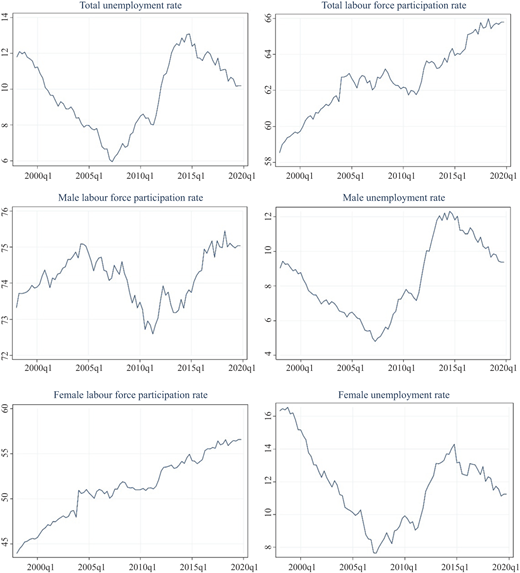
Unemployment and labor force participation rate in Italy, overall and by gender
Unemployment and labor force participation rate in Italy, overall and by gender
Descriptive statistics
| Variable | Mean | SD | Mininum | maximum |
|---|---|---|---|---|
| Labor participation rate (all) | 62.605 | 1.837 | 58.542 | 65.978 |
| Labor participation rate (male) | 74.147 | 0.670 | 72.593 | 75.454 |
| Labor participation rate (female) | 51.177 | 3.420 | 43.958 | 56.577 |
| Unemployment rate (all) | 9.761 | 2.014 | 5.954 | 13.072 |
| Unemployment rate (male) | 8.410 | 2.168 | 4.799 | 12.309 |
| Unemployment rate (female) | 11.77 | 2.300 | 7.643 | 16.548 |
As we can easily check, three noteworthy patterns are clearly visible: (1) the substantial fall in unemployment between 1998 and 2007 and the rapid increase during the economic crisis, (2) the recovery of males participation after the crisis (3) the constantly increasing trend of females participation rate over time. In a recent study, Mankart and Oikonomou (2016) find that the added-worker effect has increased in the past three decades due to three factors: a reduction of the gender pay gap, changes in labor market frictions, and reduced costs for the labor force participation of married women.
3.2 Cointegration analysis
First we proceed to analyze the time series properties using two different unit-root tests: the Augmented Dickey–Fuller test with GLS detrending (Elliott et al., 1992) and the KPSS test (Kwiatkowski et al., 1992). The Dickey–Fuller t-test for a unit root is a test in which the series has been transformed by a generalized least-squares regression. The KPSS test differs from the commonly used unit root tests (such as the Dickey–Fuller test) by having a null hypothesis of stationarity. The tests may be conducted under the null of either level stationarity or trend stationarity. Inference from this test is complementary to that deriving from tests based on the Dickey–Fuller distribution. The KPSS test is often used in conjunction with other ordinary tests to investigate the possibility that a series is fractionally integrated. The results of the two-unit root tests are shown in Table 2.
Univariate unit-root tests on individual series
| All pt | ut | Males pt | ut | Females pt | ut | |
|---|---|---|---|---|---|---|
| ADF-GLS | −1.718 | −1.436 | −1.348 | −1.560 | −1.913 | −0.736 |
| KPSS | 0.409*** | 0.422*** | 0.553*** | 0.383*** | 0.366*** | 0.912*** |
Note(s): ADF-GLS is the test-statistic from the augmented Dickey–Fuller test with GLS detrending, where lag length is chosen based on the Schwarz Information Criterion. KPSS is the test statistic from Kwiatowski, Phillips, Schmidt and Shin test where maximum lags are chosen according to Schwert criterion *** indicate significance at 1% level
Independently on the gender aggregation level, both tests confirm that unemployment () and labor force participation () rates are not stationary at a 1% significance level. Having shown that all the time series variables are unit-root processes, we proceed to check if there is a long-run relationship between them through a cointegration test. If variables are cointegrated, a relevant economic intuition can be inferred: the unemployment invariance hypothesis would not be confirmed. We test the cointegration by applying Johansen’s methodology (Johansen, 1988, 1991). The model is pretty standard with a finite-order VAR designed as:
where is a vector of nonstationary variables containing the labor force participation rate, , and the unemployment rate, , is a 2 × 2 matrix of parameters and is a 2 × 1 vector of residuals. Rewriting this unrestricted VAR we get:
where and The unemployment rate , and the labor force participation rate , are cointegrated if and only if the coefficients of matrix has rank equal to one. In this case is decomposed as , where and are 2 × 1 vectors, contains the adjustment parameters in the vector error correction model (VEC) and contains the cointegration vector.
Johansen’s approach produces two statistics: the Johansen’s trace , and Johansen’s maximum eigenvalue that allow to check the presence of cointegrating vectors in each relationship. The selection of lags for each cointegration analysis is conducted through the Akaike information criterion. Table 3 reports the results of the cointegration analysis.
Cointegration tests
| All | Males | Females | ||||
|---|---|---|---|---|---|---|
| Jmax | Jtrace | Jmax | Jtrace | Jmax | Jtrace | |
| H0 = 0 | 20.699*** | 22.775*** | 21.037*** | 28.950*** | 19.084** | 21.418** |
| H0 = 1 | 2.076 | 2.076 | 7.912 | 7.912 | 2.335 | 2.335 |
Note(s): Lag length of the VAR is selected using the Akaike information criterion. *** and ** indicate significance at 1% and 5% level, respectively
We show that only one cointegrated vector is supported in all three cases, although at different significance levels. These results would confirm that unemployment and labor force participation are related in the long run, and thus contrary to the unemployment invariance hypothesis.
To check what kind of relationship exists between the two variables, we proceed to estimate the coefficients of each cointegrated vector. The coefficients are shown in Table 4.
Estimated cointegrated vector
| All | Males | Females | |
|---|---|---|---|
| Α | −55.955 | −25.146 | −41.280 |
| βˆ | (1, −1.843)′ | (1, −0.319)′ | (1, −1.420)′ |
| se(βˆ) | 0.477 | 0.100 | 0.691 |
The VEC estimates seem to be consistent and interpretable as favoring a reverse discouraged-worker effect. As in Emerson (2011), unemployment rates of substantial size are constantly associated with strictly higher levels of labor force participation. Yet with a different magnitude between males and females. The extent of this effect seems to be more attenuated for males and is clearly stronger for females. The magnitude of the speed of correction is higher for females.
However, these estimates must be treated with caution since Johansen’s test is suspected of producing size distortions. Therefore, it is necessary to check whether our time series actually have an exact unit root by performing tests on some coefficient restrictions. The restrictions to be imposed are and . If we are not able to reject these restrictions, we would be led to conclude that the long-term relationship between unemployment and participation is simply spurious given that one series is merely stationary (participation rate in the first case and unemployment in the second). The p-values of the likelihood tests for all imposed restrictions are shown in the first two rows of Table 5. As we can check, all imposed restrictions are safely rejected at 10% or at a better level.
Tests of restrictions in cointegrated VAR
| Restriction | All | Males | Females |
|---|---|---|---|
| β = (1, 0)′ | 0.000 | 0.009 | 0.056 |
| β = (0, 1)′ | 0.056 | 0.036 | 0.043 |
| α = (α1, 0)′ | 0.702 | 0.932 | 0.490 |
| α = (0, α2)′ | 0.001 | 0.000 | 0.001 |
Note(s): The values reported are the p-values of the likelihood ratio test for the restrictions
Now, weak exogeneity would be another issue here. The cointegration vector shown in Table 4 is unable to provide us with information on the direction of adjustment. This information can be efficiently obtained from error correction terms. The restrictions to consider are now and . The first restriction implies that the unemployment rate does not error correct, but the participation rate does. The reverse is implicit in the second restriction. The p-values of the likelihood tests for these restrictions are shown in the last two rows of Table 5. The results appear consistent and pretty straightforward. For all three models, the first restriction cannot be rejected, whereas the second can. This implies that in all cointegrated vectors, participation rates adapt to unemployment rates but not vice versa; a result that further corroborates our conclusions about the presence of a general reverse discouraged-worker effect, a term coined by Emerson (2011).
3.3 Markov model with switching intercepts
As quickly introduced above, Markov Switching Model fits the different dynamics across the different states that a given phenomenon might assume. Such models are extensively used in different science fields. In the economic context, it turns useful in predicting the rises and falls of different indicators, such as the interest rates (Garcia and Perron, 1996) and economic growth (Hamilton, 1989), offering the possibility to measure the duration of up (down) phases and the switching from one period to the other. In the current topic, the switching model can be useful to observe the synchronization or desynchronization of the labor supply expansion. To wit, the added-worker effect is detected whether the female workforce is found in a growing phase with a high average level, contrary to the sudden reduction (i.e. a low average phase) of male worker participation in the labor market. For simplicity, we apply a standard (and basic) Markov model with switching intercepts. The formulation of the model can be expressed as follow:
with indicating the gender regarding the variable of interest y (i.e. the labor participation rate), and t is the time indicator. Intuitively, is the error term, while is the state varying intercept. To wit, the basis of the number of the selected states indicates the average value for each state. For a Markov process, it is important to identify the smoothed probability of being in one of the states s. For completeness, the transition probabilities () refers to the probability of being in a specific state the period t + 1, after having observed the state at time t. In the case of two states, we will have , that is, the probability of being in the same state, is the probability to move from one state to the other. A higher level of the latter probability indicates higher dynamicity in the system since it is reverting from one state to the other. For completeness, all these variables are reported in Table 6, even if we are interested in observing the Smoothed probability of being in a high average state of labor participation in each period (hereafter ). For simplicity, we select two states, one with a lower average value and the other with the highest one. It can be argued that an added-worker effect exists if females are in the higher state during the periods where males are in a down phase. for both males and females are shown in Figure 2.
Markov model with switching intercepts. High (H) and Low (L) are the two identified states
| Variable | Male labor participation | Female labor participation |
|---|---|---|
| 74.608 (0.385) | 52.894 (2.124) | |
| 70.490 (0.155) | 46.643 (1.362) | |
| PL,L | 0.979 | 0.958 |
| PL,H | 0.021 | 0.042 |
| PH,L | 0.056 | 0.000 |
| PH,H | 0.944 | 1.000 |
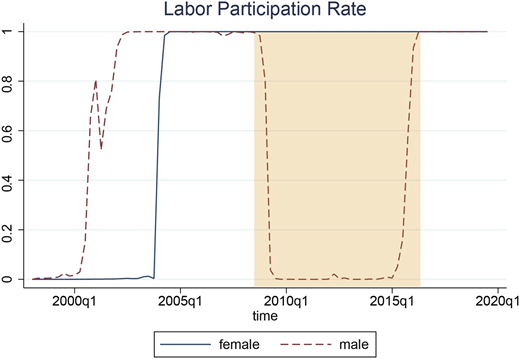
Smoothed probability of being in a higher state. The shaded area outlines the added worker effect
Smoothed probability of being in a higher state. The shaded area outlines the added worker effect
The main intuition deriving from the data description section is confirmed: after the 2008 Great Recession, a female added-worker effect is observed, since the male labor participation went down despite the continuous growth of the female participation. By observing the shaded area indicating the beginning and the end of the effect (since after that period, the male participation rate rose once again), it is also possible to identify the lasting from June 2009 to January 2015.
The effect found is in line with some intuitions deriving from other studies. For instance, Ghignoni and Veraschachina (2016) found an added-worker effect linked to the economic recession by employing survey data.
4. Concluding remarks and policy implications
This empirical contribution attempts to rediscuss the unemployment invariance hypothesis, evaluating the dynamicity of the unemployment and participation rate. To this extent, the discouraged-worker effect and the added-worker effect hypothesis for the Italian labor market have been checked by employing quarterly ISTAT data. As in Österholm (2010) and Emerson (2011), a cointegration analysis to test the long-run relationship between unemployment and participation rate has been proposed. Following their approach, a gender comparison has been conducted, finding the same positive relationship, suggesting a reverse discouraged-worker effect. In addition to the existing studies, a Markov Switching Model has been proposed to compare the dynamics of the labor market participation by gender. Here, it clearly emerges an added-worker effect related to the 2008 Great Recession.
From here, different implications can be drawn.
Labor market activity is crucial in defining the economic vitality of each country. Labor can be considered as the prime mover of social and income inequality, and the institutions are called to reduce such gap to foster economic development (Calderon and Chong, 2009). Surely, it offers a clear overview of the development state of each civilized society, composed of more job opportunities for both genders. As in Schober and Winter-Ebmer (2011), gender wage inequality is a real menace to economic expansion. The analysis is restricted to the Italian case, characterized by poor social insurance programs, absence of integrated unemployment benefit systems, and very lacking active labor market policies. All this can highlight the fragility of the system that can lead to an over (under) reaction of workers (and then nonneutrality) on the basis of specific circumstances observable through the lens of specific indicators, such as the unemployment rate.
By comparing the relationship between unemployment and labor participation, it is possible to observe that both men and women enter the labor market even when the unemployment rate is high. In particular, women enter more intensely the labor market in such periods. Part of this result is due, as observed thanks to the Markov Switching model, to the women’s stable participation after the recession, heavily lowering the men’s activity. All this supports the idea that labor market is not neutral to circumstances, positive/negative events, and policies and that institutions might intervene to lay down to basis for the economic growth, encouraging both genders to contribute to the economic growth.
The equality of gender participation might ensure growth, low social and income differences, and in turn, it can encourage higher participation.
From a methodological point of view, even if the cointegration analysis is largely applied in this field (Österholm, 2010; Emerson, 2011), the Markov Switching model has been scarcely employed in the past, and it offers interesting insights to be extended and reproposed for further future studies.
To conclude, this result refers to Italy, and further research can be extended considering countries with different labor policy programs. This can shed light on the possible systematic connection between labor market dynamics and the robustness of the institutional labor market plans.

