Project management practices often remain confined within their originating industries because existing knowledge transfer methods lack actionable guidance on bridging cultural and conceptual barriers. This paper proposes a practical, stepwise framework for translating domain-specific project practices between conceptually dissimilar industries.
This study examines four exemplar cases that successfully translated practices across industries. Narrative synthesis surfaced recurring patterns, themes and challenges, which were then used to construct a repeatable, five-step process. An illustrative set of practices translated from film production to software development then demonstrates the method in action.
The Real-to-Real method provides managers with a stepwise process for identifying candidate practices, abstracting guiding principles and implementing them in another domain. The illustrative example translates specific practices from film production to software development, offering actionable routines for software teams.
This study is exploratory, based on a purposive sample of successful cases and a single worked example. A follow-on study (Hawkey, 2024) extended validation through interviews with film producers and software project managers. Additionally, a comparative analysis of 307 software projects showed that adherence to the translated practices improved outcomes.
Project teams can use the Real-to-Real method as a structured process to access and adapt proven practices from conceptually distant industries, complementing benchmarking and other knowledge transfer approaches.
Recent literature has explored related concepts, such as analogical reasoning and triple-loop learning, and related tools, such as boundary objects, but practitioners lack a concrete method for practice translation. This paper contributes by offering an actionable, manager-ready process, positioned as a mid-level theoretical framework.
Introduction
This paper addresses challenges impeding the cross-pollination of management practices among projectized industries. While knowledge transfer can be difficult even within a single firm (Tallman et al., 2005), collaboration across industry boundaries is far more challenging (Hargadon and Bechky, 2006). Three issues compound this difficulty: conceptual boundaries, abstract practitioner guidance and gaps in process translation methods. This study builds on recent literature exploring approaches to these challenges by synthesizing a structured, stepwise method for translating domain-specific project management practices between conceptually dissimilar industries from four exemplar cases.
To guide this effort, the study is framed around two research questions:
What process patterns can be identified in prior successful efforts to translate project management practices across conceptually distant industries, in attempts that preserved the implementation detail needed for practical use?
How can these process patterns be combined to form a systematic method for such translations?
In response to these questions, this paper proposes the Real-to-Real method, a structured process for translating project management practices across industries. First, a review of recent literature situates the method among relevant concepts. The method results from a qualitative, interpretive analysis of four exemplar cases of cross-industry practice transfer between conceptually dissimilar industries separated by semantic boundaries (Carlile, 2002), which are summarized in the Background section. In each effort, differences in meaning, norms and mental models complicated knowledge transfer and required extensive reinterpretation and contextual adaptation. After presenting our methods, this paper identifies shared strategies, implicit patterns and recurring challenges across these cases through a process of narrative synthesis (Tranfield et al., 2003). These are then distilled into a stepwise method, which is illustrated and summarized in our Results section. The Real-to-Real method contributes a mid-level theoretical framework (Whetten, 1989), abstracting a transferable method from situated practice, and provides a grounded process enabling practitioners in one industry to benefit from the hard-won experience of another.
In the Discussion, this paper demonstrates the method through a translation of selected practices from the film production industry to software development. This example illustrates each step of the method in sequence and introduces three distinct strategies for translating practices between domains: adapt, adopt and develop. In addition to clarifying the method, the recommendations may offer immediate value to software development teams; this and other implications are summarized in the Conclusion.
Although this paper includes only a partial example, the Real-to-Real method was empirically tested in a follow-on study (Hawkey, 2024) that completed a translation of related film production practices to software development. This larger study focused on the management of hedonic requirements, which specify the intended emotional response of the user, and identified 16 film production practices relevant to that challenge. Using the Real-to-Real method, the study derived four guiding principles explaining the film industry strategy underlying those practices, and from those principles identified sixteen software development practices mirroring those used in film production.
Two rounds of semi-structured interviews with experienced film producers and software project managers were then conducted to independently verify each step of the translation. The interviewed film producers agreed with 98% of the predicted practice-to-principle pairings and confirmed that the selected film practices were used nearly universally in the film industry. Software practitioners, in turn, agreed with 93% of the expected principle-to-practice pairings, and affirmed the relevance of all 16 translated practices. Together, these results confirmed the overall accuracy of the translation from film to software.
To evaluate the effectiveness of the identified software development practices in managing hedonic requirements, the study then surveyed 307 completed software projects across five countries, collecting outcome data on the delivery of promised scope, stakeholder satisfaction and adherence to predicted budget and schedule. In addition, each respondent rated the criticality of hedonic requirements to the success of their project. Projects with high levels of hedonic requirements – those in which success depended on avoiding or eliciting specific emotional reactions from their users – adhered far more closely to the sixteen identified practices and reported markedly better outcomes than low-hedonic projects, across all measures of success. While this first analysis suggested that the identified practices were generally beneficial, an iterative process of fuzzy-set qualitative comparative analysis further showed that, to achieve similar levels of overall success, high-hedonic projects required close adherence to at least six of the identified practices, while low-hedonic projects required only two. Taken together, these results indicate that the Real-to-Real translation produced practices that are empirically beneficial for managing hedonic requirements specifically, supporting the method's value for other cross-industry applications.
Literature review
Knowledge transfer between industries is hindered by persistent barriers that combine to keep effective management practices locked within their originating domains. While recent literature has proposed concepts and tools to address these barriers, most remain abstract or fragmentary, offering little practical guidance for managers seeking to translate practices across industries.
Barriers to cross-industry practice transfer
Knowledge transfer across industries is constrained by the conceptual boundaries separating them, which complicate the sharing of practitioner experience and limit the dissemination of hard-won experience (Alves et al., 2022). Industries as varied as construction, emergency response and live theater rely on temporary project teams (Lundin and Söderholm, 1995), and each has developed its own norms, training systems and management practices based on decades of experience (Hobday, 2000; Cooke-Davies and Arzymanow, 2003). Depending on the field, these practices may be transmitted through retrospectives, literature, apprenticeship programs or after-action reports (Levitt and March, 1988). Lessons learned in one project must often be generalized for use in others, but this requires little abstraction within a single industry, as practitioners share a common knowledge base and similar mental models (Edmondson and Harvey, 2018).
Collaboration across industries is far more difficult. Practitioners in different fields develop distinct vocabularies, management structures and beliefs about the traits that drive success, creating conceptual barriers that restrict the flow of knowledge across domains (Levitt and March, 1988; Bechky, 2003; Edmondson and Harvey, 2018). In addition, face-to-face interaction is often preferred when conveying complex procedures, reducing opportunities for collaborative cross-industry practice transfer (Spraggon and Bodolica, 2012). As a result, effective practices often remain localized within their original domain (Argote and Ingram, 2000; Hawkey, 2016).
These cultural and conceptual boundaries between industries inhibit the translation of domain-specific knowledge, but without the frequent cross-pollination of ideas, innovation within each industry is reduced. Over time, industries may narrow their set of practices, as some become codified as best known methods, followed by rote as further innovation is stifled (Eisenhardt and Martin, 2000). These “competency traps” (Levitt and March, 1988) can leave teams entrenched in familiar routines and resistant to change. Additionally, project management practices have evolved at different rates across industries, resulting in varying levels of process maturity (Cooke-Davies and Arzymanow, 2003). The potential value of inter-industry learning increases as industry practices diverge: collaborations between dissimilar industries foster higher levels of innovation than those between similar ones (Enkel and Heil, 2014).
Unfortunately, despite their potential value, the specificity that makes effective practices actionable within one industry also makes them difficult to transfer between industries. Even practices proven to be beneficial in one context may lead to failure in another without careful adaption and a nuanced understanding of both domains (Philipp et al., 2022; Wallace et al., 2022). These factors often keep each industry's best practices locked within their original domain, providing little value to practitioners elsewhere.
A second challenge hindering the transfer of project management knowledge is that generalized, industry-agnostic guidance often lacks sufficient detail for practical use. Groups such as the Project Management Institute (2021) and Agile Alliance (n.d.) develop abstract theory from practitioner experience to advance project management as a discipline. This high-level guidance is essential for the field's growth but rarely provides step-by-step instructions for implementation. Instead, the specific tasks, artifacts, and methods needed for application are embedded within each industry's body of knowledge. These domain-specific practices provide the actionable detail required to carry out the broad recommendations of industry-agnostic theory.
For example, the Guide to the Project Management Body of Knowledge states that “Project success is dependent on effective communication” (Project Management Institute, 2021) but does not provide instructions on designing an effective and efficient communication plan within a specific project. Aside from noting that such plans should support a small set of goals, such as “facilitate rapid feedback” (Project Management Institute, 2021), project managers are left to develop a suitable communication plan themselves.
Communication planning is not a trivial example and requires substantial effort. Practitioners must develop goals, channels, artifacts and processes under tight time constraints, yet such practical detail is rarely documented in generalized guidance. As these domain-specific applications of theory become embedded in interactions among people, tasks and tools within an industry, knowledge transfer with other domains grows increasingly difficult (Argote and Ingram, 2000).
Although many domain-specific project management practices may hold value beyond their originating domain, existing methods inadvertently form a third barrier by offering little guidance on how to adapt practices for use in new contexts. Widely used approaches, such as benchmarking, may identify performance gaps between organizations, but their implementation phases often assume that externally developed practices can be adopted with minimal adaptation, sometimes offering only low-complexity examples and describing such translation as “relatively straightforward” (Camp, 1989). Reviews have repeatedly found that this critical step is left unaddressed: Emjellen (1997) found no structured adaptation processes in the benchmarking models he examined, and Anand and Kodali (2008) report the same gap across 35 models. This lack of guidance is especially concerning given that even well-established practices may fail if transferred without contextual adaptation (Bhutta and Huq, 1999; Philipp et al., 2022; Wallace et al., 2022). Without a structured method for translating practices between conceptually dissimilar industries, potentially valuable knowledge often remains trapped within its original domain.
Proposed approaches in recent literature
Many approaches to the challenges above have been proposed in recent literature. These vary widely in scope, from enabling organizational mindsets to isolated tools and process fragments disconnected from any larger framework (McClory et al., 2017; Carmona-Lavado et al., 2023; Ogink et al., 2023). Despite this activity, the literature lacks a stepwise method for translating assignable tasks, duties and methods between conceptually dissimilar industries (Carvalho and Choo, 2025; van Waveren et al., 2025). The following review outlines representative approaches to situate the Real-to-Real method within this landscape, presenting them as related context rather than competing methods. This review selectively examines recent work most relevant to cross-industry practice transfer, rather than attempting a comprehensive overview.
Among the broadest approaches discussed in recent research is the use of triple-loop learning, an organizational strategy aimed at ensuring that lessons learned reshape long-term processes rather than being lost or sequestered within any single, temporary project (McClory et al., 2017). While single-loop learning focuses on correcting immediate errors and double-loop learning questions governing tactics and assumptions, triple-loop learning questions underlying values, strategies and norms to embed new insights at the cultural or system level. Cross-industry practice transfer is only one type of learning enabled by a triple-loop approach, but the mindset facilitates the deep organizational learning needed to make such transfers sustainable.
A key activity supporting triple-loop learning is knowledge management, the coordinated activities by which organizations gather, share and apply information (Idrees et al., 2023). Among many other goals, this encompasses cross-industry practice transfer, as knowledge management involves acquiring external knowledge, converting it into new strategies and embedding those strategies into practice. Effective knowledge management relies on strong communication and supports organizational adaptability (Idrees et al., 2023), but existing literature offers managers little structured or stepwise guidance on practice transfer.
Dynamic capabilities are a firm's ability to sense, seize and transform external knowledge (Teece, 2007) and therefore also help to enable cross-industry practice transfer. These capabilities include absorptive capacity, the ability to assimilate, transform and apply external knowledge (Dultra-de-Lima and Brito, 2023), and have been shown to foster innovation (Alves and de Carvalho, 2023) and portfolio agility, which in turn drives portfolio success (Bechtel et al., 2023). Transforming external knowledge for local use requires clear guidance on desired outcomes, highlighting the need for a concrete, repeatable method (Engelmann, 2024). Empirical research also confirms the sequential nature of sensing, seizing and transforming, with only the full chain resulting in innovation and performance gains (Bechtel et al., 2023; Zabel and O'Brien, 2024), and highlights the need for more detailed practitioner guidance (Adam et al., 2020). These findings reinforce the need for systematic, stepwise methods for cross-industry practice transfer.
Recent research has increasingly emphasized the need to operationalize cross-industry practice transfer, a form of open innovation, or innovation activities that extend beyond the organization. Reviews of the broader open innovation literature note that studies focus on context, structures, actors, and outcomes while offering few specific mechanisms and no stepwise methods (Ogink et al., 2023). Growing environmental, social and governance pressures are further driving organizations to look externally for inspiration (Kyriakogkonas et al., 2022), yet here again the literature offers few practical, stepwise approaches.
Evidence shows that translated practices often outperform newly developed or directly adopted ones, but balancing necessary adaptation with fidelity to the original practice results in the challenging “adapt-adopt dilemma (Olsson et al., 2024).” Despite this challenge, knowledge transfer between organizations and industries is positively correlated with innovation, and effective management practices can facilitate successful transfers (Chacin et al., 2024). Unfortunately, knowledge often remains siloed unless specific mechanisms enable dissemination, and while Project Management Office structures can help (Carvalho and Choo, 2025; Gomo et al., 2021), a concrete process is still needed. Some attempts exist, such as design-by-analogy, which uses multi-domain knowledge to generate innovative ideas (Jing et al., 2025), but are not practitioner-focused and remain unwieldy for field use.
Once a decision has been made to seek inspiration beyond the organization, analogical reasoning offers a way to identify externally developed solutions to local problems. Although scale, complexity, and the cognitive trap of surface-level similarities pose challenges, disaggregating analogical reasoning into discrete steps makes it tractable for distributed agents (Kittur et al., 2019). A repeatable, systematic process may therefore mitigate those challenges, but a recent study found only 45 articles specifically addressing cross-industry innovation between 1997 and 2021, and reported no consensus on such a process (Carmona-Lavado et al., 2023).
Below the level of structured methods, several tools have been found to aid cross-industry knowledge transfer, but remain disconnected from any broader process. Analogical search engines may help identify solutions within cognitively distant domains (Kang et al., 2022), although current evaluations focus on novelty rather than utility. Cognitive digital twins, sophisticated modeling systems, may allow decision-makers to trial new practices through detailed “what if?” simulations prior to implementation (D’Amico et al., 2024). Lastly, boundary objects, artifacts supporting the informational needs of multiple domains (Star and Griesemer, 1989), are critical for building a shared understanding when working across disciplines (Gonzalez-Cristiano and Le Grand, 2025). Although boundary objects are sometimes presented as a method for project learning (Caccamo et al., 2023; Ferres and Moehler, 2023), they are best understood as a class of artifacts, or tools which must be embedded within a larger, stepwise process.
Summary
Taken together, the literature highlights three persistent gaps. First, while many studies identify barriers to cross-industry practice transfer, they rarely offer actionable, practitioner-level guidance. Second, existing approaches such as benchmarking, boundary objects, triple-loop learning and dynamic capabilities remain abstract or fragmented, without a stepwise method that links domain-specific practices to transferable tasks. Third, despite increasing interest in cross-industry innovation, recent reviews report no consensus on a process for translating practices between conceptually distant industries. This gap motivates the present study, which synthesizes a structured, five-step method for identifying, interpreting and adapting domain-specific practices for use in new contexts.
Background: exemplar cases of cross-industry practice transfer
Although the successful translation of management practices between conceptually dissimilar industries is relatively rare, several compelling cases show practitioners transferring assignable tasks, duties and methods across domains despite major cultural, linguistic and operational differences. This section reviews four such cases to surface the recurring challenges and strategies that informed the development of the Real-to-Real method.
These cases were purposively selected as an exploratory sample to identify possible patterns, not to build a representative dataset. The selection was biased toward successful transfers that documented enough actionable detail for cross-case comparison; no failed transfers were included. Most case materials came from peer-reviewed journal articles and doctoral dissertations, with one case synthesized from multiple sources describing a gradual transfer of practices. Though limited in number, these information-rich exemplars were chosen for their paradigmatic relevance (Flyvbjerg, 2006), consistent with accepted practices for building theory from cases (Eisenhardt and Graebner, 2007). Future research should extend this analysis using a broader and more systematically selected set of cases, including unsuccessful transfer efforts, to further test and refine the Real-to-Real method.
From live theater to product development
Lehner (2009) explored whether management practices from the culturally and operationally distinct world of live theater could be adapted to improve outcomes in product development projects. Live theater, which predates many other projectized industries, was chosen as a source of inspiration due to its long history of managing creative and uncertain projects. This selection was reinforced through an analysis of features shared between live theater and product development efforts: relatively low analyzability, high dynamism and uncertainty, and frequently unclear or conflicting goals.
The study hypothesized that the inherent conflict between these characteristics and traditional project management methodologies may form a barrier to success for product development projects. This apparent dissonance suggested potential value in adapting management practices from an industry that had long managed similar challenges.
Lehner examined live theater practices and classical directing methods to derive four guiding principles, each supported by a set of specific theater practices. He then paired each principle with corresponding practices in product development. For example, theater directors interpret the script to suit a specific cast. To mirror this activity, he suggested product development teams reinterpret their project plan to reflect the skills, experience and preferences of their members: “The project plan for product development projects is only a coarse description of … roles and responsibilities. It needs to be interpreted like a dramatic text (Lehner, 2009).” These similar theater and product development practices are paired through a shared adherence to the principle of Casting and Interpreting a Text. Each set of practices includes multiple domain-specific applications of that principle, and the full set of principles identified by Lehner thus combines to form a conceptual bridge between the two industries.
While Lehner's Staging Model offers a clear model of inter-industry learning, there is little evidence that it has been widely implemented. Nonetheless, it successfully bridged two very different industries, one guided by creative interpretation, the other by structured iteration, making it a compelling example of process-level translation across industry boundaries.
From software development to product development
Cooper and Sommer (2018) documented how firms in diverse manufacturing sectors adapted Agile Scrum practices, originally intended for the fast-paced and intangible environment of software development, to the development of physical products through a hybrid methodology called Agile-Stage-Gate. Drawing on six case studies, including LEGO, Honeywell and Danfoss, they described how Agile practices such as time-boxed sprints and daily planning meetings were embedded within traditional Stage-Gate processes.
At the time of the study, each firm had used these hybrid models for at least two years. Although formal metrics were scarce, firms reported increased design flexibility, faster response to market changes, improved communication and morale, and shorter time-to-market (Cooper and Sommer, 2018; Cooper, 2019; Salvato and Laplume, 2020). Even partial adoption improved outcomes, though less dramatically (Edwards et al., 2019).
Firms using Agile-Stage-Gate also faced common challenges: reconciling Agile and product development concepts, overcoming managerial skepticism and producing physical products with Agile's standard two-week sprint (Cooper and Sommer, 2018; Salvato and Laplume, 2020). Some teams encountered difficulty after initially applying Agile practices mechanically and without adaptation, attempting to use Agile “… without ever being Agile,” (Sommer, 2019). The cultural and operational contrasts, including digital versus physical deliverables and abstract versus material constraints, required meaningful reinterpretation rather than simple reuse.
To resolve these issues, teams returned to the core principles of the Agile Manifesto (Highsmith and Cockburn, 2002) and developed custom practices better suited to product development. For example, to satisfy downstream manufacturing teams' need for long-term scheduling while following the Agile principle of “responding to change over following a plan,” teams introduced tentative task schedules resembling traditional plans but explicitly recognized as flexible and revised at each sprint.
The new Agile-Stage-Gate hybrid methodologies provided the greatest value in projects with high ambiguity and uncertainty (Cooper and Sommer, 2018). Because such conditions are common in software development, this suggests that the translated practices were most effective when used in projects resembling those in the originating domain.
From oil and gas to construction
Mejlænder-Larsen (2019) sought to revitalize the stagnating construction industry by adopting innovative management practices from oil and gas, where projects involve very different risk profiles, safety cultures and regulatory environments. This industry was selected because, despite deep contextual divergence, it shares key operational features with construction: high projectization and similar team and shareholder structures. The oil and gas industry has also recently developed a number of innovative new practices not yet seen in construction.
To begin, Mejlænder-Larsen interviewed experienced oil and gas practitioners, capturing detailed insights into their practices, underlying principles and implementation contexts (Mejlænder-Larsen, 2015). These interviews then informed a larger series of case studies examining which practices might benefit construction. Believing that successful translation required separating practices from their original context, Mejlænder-Larsen emphasized codification and conceptual generalization, distilling the results into three clear and communicable sets of rules widely used in oil and gas.
These rule sets, organized around people, processes and technology, each addressed a key aspect of project execution. They were integrated into a comprehensive Project Execution Model, which adapted domain-specific practices from oil and gas to construction projects. While later research has explored the potential of this approach (Mejlænder-Larsen, 2018; Fakhimi et al., 2021; Waqar et al., 2023), empirical validation of the adapted practices remains limited.
From manufacturing to construction
Project management principles from manufacturing, a domain built on highly repeatable workflows, were gradually adapted to the variable, site-specific environment of construction through the development of the Lean Construction methodology (Abdelhamid et al., 2008). This shift began with Koskela's (1992) foundational analysis of traditional manufacturing approaches, craft, mass and lean, which detailed their origins, characteristics and relative strengths and weaknesses (Salem et al., 2005; Abdelhamid et al., 2008).
Traditionally, construction projects were managed as linear processes converting raw materials into finished products, mirroring older manufacturing models (Koskela, 1992). Inspired by the principles of Lean Manufacturing, practitioners began reframing construction work into three interrelated workflows: design, materials and execution (Koskela, 1992; Ballard and Howell, 1998). This conceptual shift enabled the transfer of Lean Manufacturing principles, such as waste reduction and just-in-time material delivery, to construction projects (Salem et al., 2005).
Over subsequent decades, this technical and conceptual reframing coalesced into a cohesive construction methodology. Studies and case examples consistently report improved outcomes on Lean Construction projects, including greater ease of management, enhanced safety, shorter timelines, reduced costs and higher quality (Abdelhamid et al., 2008; Badran and Abdallah, 2024). This long-running effort remains one of the most robust examples of process transfer between conceptually distant industries.
Methods: synthesizing a structured and repeatable process
This study adopts a qualitative, interpretive research design to develop a mid-level theoretical framework (Whetten, 1989) based on exemplar cases of practice transfer between projectized but conceptually distant industries. Rather than testing formal hypotheses, this study addresses the research questions presented in the Introduction through an inductive synthesis of observed patterns of cross-industry practice translation.
Although Tranfield et al. (2003) call for systematic, evidence-informed synthesis in management research, they note that aggregate approaches such as meta-analysis are rarely suitable because of the heterogeneity of management studies. This challenge is amplified in practice-transfer research, where published exemplars rarely detail their translation processes in consistent terms. Consequently, this study used a narrative synthesis approach to identify common strategies across diverse cases. While this study does not follow the exhaustive protocols typical of systematic literature reviews, it applies the principles of transparency and systematicity proportionally to the available evidence, aiming to balance rigor with the pragmatic orientation required for practitioner use.
The analysis followed the principles described by Denyer et al. (2008), who describe narrative synthesis as an iterative method for developing theoretical models using the CIMO-logic (context, intervention, mechanism, outcome). Consistent with their four-stage process, this paper presents the early stages of synthesis: (1) developing a theoretical model of how, why and when practice-transfer interventions work, and (2) developing a preliminary synthesis from the exemplar cases. Later stages, (3) exploring relationships between elements of the model and (4) assessing its robustness, were addressed in a separate follow-on study (Hawkey, 2024), which completed a full translation of practices from film production to software development, examined the mechanisms linking the translated practices to outcomes, and empirically tested their effectiveness.
Following Barnett-Page and Thomas (2009), this synthesis emphasized contextual richness and transparency over exhaustiveness. The four cases were selected from a larger set of documented practice-transfer efforts based on their unusually detailed descriptions of how practices were reinterpreted and implemented, not to fully represent the complete population of attempted transfers. This purposive sample is limited to successful transfers, which may introduce bias; future studies should incorporate a broader and more systematically selected set of cases to support generalizability.
Each exemplar was reviewed iteratively to trace how source industries were selected and their practices reframed, abstracted and adapted as they crossed industry boundaries. Attention was given to concrete actions, decision points and contextual factors mentioned in each account. These were compared across cases to identify recurring patterns despite differences in terminology and framing. The recurring elements were grouped into thematic clusters, then sequenced into a preliminary set of steps. This sequence was refined through repeated returns to the cases to confirm that it adequately explained each observed translation, reflecting the “creative realist” stance developed by Barnett-Page and Thomas (2009), and drawing on thematic analysis as described by Thomas and Harden (2008) to extract heuristics from diverse samples.
In the Results, Table 1 provides an audit trail for this analysis by showing illustrative quotes from the exemplar cases, matched to emergent themes and specific steps of the resulting method. This supports the transparency and rigor advocated by Tranfield et al. (2003) while maintaining the pragmatic orientation needed for practitioner use. The resulting method, presented in Table 2 and elaborated in the Results, is therefore best understood as an exploratory, field-grounded framework derived from information-rich exemplars rather than a definitive or comprehensive model.
Results: the Real-to-Real method for cross-industry practice transfer
The narrative synthesis surfaced a recurring series of actions across the four exemplar cases. Table 1 presents selected excerpts from the cases, showing how concrete actions and decision points were grouped into intermediate themes, or descriptive labels for recurring actions, and then aligned with the resulting steps of the Real-to-Real method. These examples are illustrative rather than exhaustive; they exemplify how shared strategies were abstracted from diverse sources to form the basis of a structured, stepwise process.
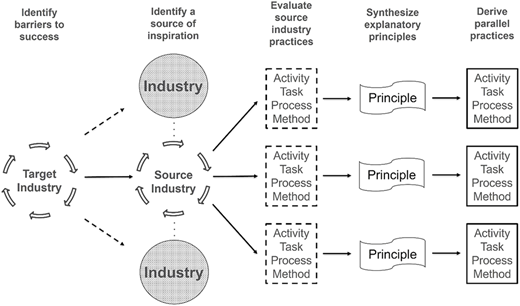
These themes were consolidated into a structured, five-step method for translating management practices between projectized and conceptually distant industries, illustrated in Figure 1 and summarized in Table 2. The Real-to-Real method is synthesized from shared patterns observed across the four exemplar cases. These steps trace a consistent pathway found in each exemplar, beginning with the selection of a managerial challenge in the target industry, followed by the identification of a source industry with experience in managing similar challenges. An analysis of the source industry's practices is then used to derive a set of guiding principles encapsulating its approach to managing those challenges. These principles serve as conceptual bridges, enabling practitioners to recontextualize source industry methods and identify or develop domain-specific equivalents within the target industry.
While these principles are an essential intermediary, the practical value of the Real-to-Real method lies in its preservation of specific, contextualized details from the source industry. Unlike abstract, industry-agnostic project management theory, which often leaves the details of application and implementation unexplained, this method retains informative detail on the assignable tasks, duties, and methods that operationalize each principle in practice.
For example, in Lehner's (2009) translation of live theater practices to product development, the observation that “the project plan for product development projects is only a coarse description of … roles and responsibilities. It needs to be interpreted like a dramatic text,” may be inspirational, but is not directly actionable. For practitioners, the utility of Lehner's work comes from understanding how the associated principle of Casting and Interpreting a Text is reified in live theatre projects: who is involved, which tasks are completed, when, where, and how. It is these details that enable the construction of effective parallel practices suitable for a new domain. The value of the Real-to-Real method lies in the details of the practices being translated, not in the necessarily abstract naming of each explanatory principle.
The full Real-to-Real method, summarized in Table 2 is composed of five steps. The method begins, mirroring the exemplars, with an assessment of potential barriers to project success within an industry (Step 1). As this first industry is the intended recipient of the effort, it is designated as the target. Next, a second industry with experience in managing those same challenges is selected for study (Step 2). This industry may be selected through benchmarking, reviewing project and industry characteristics, or other methods. This second industry is designated as the source of inspiration and may have developed different approaches to managing these shared difficulties. Project management practices within that source industry are then evaluated, again as seen in the selected exemplars (Step 3). This analysis is described in the Real-to-Real method as holistic, as it must consider not only the context and implementation of each practice, but also the broader system of interrelated practices that combine to form the source industry's overall approach.
With the results of this analysis, practitioners can then synthesize a set of principles (Step 4) that explain how the source industry addresses the challenges selected in Step 1. Each source industry practice is one means of instantiating these guiding principles. The resulting principles should thus be both more abstract and more generalized than the assignable activities, tasks, processes and methods which support them. Accurate construction of each principle relies on a thorough understanding of the source industry, including the mental models informing that domain, and verification with previous research or experienced source industry practitioners may add important context.
With these intermediary principles, it is now possible to derive a set of specific, assignable practices, suitable for the target industry, which mirror or parallel practices in the source industry [Step 5]. It may be possible to adopt source industry practices directly, but careful adaptation or the development of novel practices will often be necessary to fully support each principle in a new domain.
This study first addressed RQ1 by identifying common process patterns in prior successful translation efforts, then answered RQ2 by combining those patterns into a structured and repeatable approach. The resulting method starts with concrete, assignable practices in one industry, elevates to the level of abstract principles, then drives back down to real-world, tangible practices in another, thus leading from “Real-to-Real.”
Discussion
Generalized frameworks like the PMI's project management body of knowledge provide essential guidance to project management practitioners (Project Management Institute, 2021). Nevertheless, industry-agnostic recommendations are necessarily abstract and typically omit critical details on implementation that are crucial for practical success (Hawkey, 2024). Over time, each projectized industry has developed domain-specific practices that either reflect or have informed generalized, industry-agnostic frameworks (Hobday, 2000; Cooke-Davies and Arzymanow, 2003), but differences in operational settings and mental models hinder the translation of effective practices across industries (Spraggon and Bodolica, 2012; Edmondson and Harvey, 2018). Additionally, widely used process transfer methods, such as benchmarking, acknowledge the importance of adapting management practices to better suit each new setting, but do not provide structured procedures for doing so (Camp, 1989; Emhjellen, 1997; Anand and Kodali, 2008). The Real-to-Real method addresses this gap by offering a clear, five-step process for translating detailed, effective practices across industries.
Table 3 summarizes how the Real-to-Real method compares to related approaches discussed earlier, highlighting each approach's core idea and key differences. This positions the method within the broader landscape of related concepts, clarifying its distinct contribution. While some of these approaches represent enabling mindsets, such as triple-loop learning or dynamic capabilities, and others function as tools, such as boundary objects, none provide a structured, stepwise method for translating practices between conceptually distant industries.
For practitioners, the Real-to-Real method is most useful when teams face a persistent challenge that is not being resolved by existing industry practices. It provides a structured way to identify new approaches by exploring how other industries manage comparable issues. In practice, teams can apply the method after retrospectives surface recurring problems, during strategic reviews or when continuous-improvement cycles identify a stubborn issue. By selecting a conceptually distant industry that manages the challenge effectively and using the five steps to abstract, interpret and adapt relevant practices, teams can develop new approaches informed by proven but external expertise. The main barriers to adoption of the method are organizational inertia and the difficulty of distinguishing superficial similarities from deeper, principle-level analogies. By breaking the translation process into small, auditable steps, the method reduces those barriers and offers a manageable path for cross-industry learning.
Although the full Real-to-Real method is demonstrated through the four exemplar translation efforts detailed earlier, the following offers a new, illustrative case. While a complete example is beyond the scope of this paper, this section provides a partial translation. It discusses each step of the method in sequence and offers a clear walkthrough from future users. These results, although necessarily limited, may also highlight promising directions for future research.
Step 1: Assess potential barriers to project success in a target industry
As illustrated in Figure 1 and summarized in Table 2, each Real-to-Real translation effort begins by identifying a specific challenge believed to contribute to poor project outcomes. The industry in which this challenge occurs is referred to as the target industry, as it will be the recipient of the translated practices. This challenge may reflect a recurring issue or emerge from a single project that exposed a significant weakness, but it should be a problem for which existing practices appear insufficient. Potential challenges may be identified through project retrospectives, benchmarking, capability assessments or other structured reflections.
While many examples of barriers exist across industries, we elect to focus this partial case on the software development industry, where projects face significant risks of exceeding estimated budget and schedules (Hawkey and Roberts, 2023; Hawkey and Vans, 2024). One study found that 18% of custom software development projects finished at least 40% over budget and 130% over schedule (Budzier and Flyvbjerg, 2012). These risks remained stable, with no significant improvement, over 13 years (Budzier and Flyvbjerg, 2013; Flyvbjerg et al., 2022). More recent data likewise found that only 28% of software projects are completed successfully (Khoza and Marnewick, 2020). It is possible that hedonic requirements, which specify the intended emotional response of the user, are poorly supported by existing software development practices and may partially contribute to these outcomes (Hawkey and Vans, 2026). As an example barrier, difficulty in adhering to budget and schedule estimates appears to be well documented and is a perennial challenge in many industries, adding utility to this case.
Step 2: Identify, as a source of inspiration, another industry that has developed different approaches to similar challenges
In the second step of the Real-to-Real method, an industry with experience addressing the challenge identified in Step 1 is selected as the source. This industry will serve as the origin of practices to be studied and potentially transferred. It may be identified through benchmarking, cross-industry comparisons of project characteristics, practitioner experience or other informed selection techniques. Regardless of the method, the key is choosing an industry that appears to manage the selected challenge well, using approaches that differ from those in the target industry.
While adapting practices is widely recognized as essential to successful transfer (Camp, 1989; Bhutta and Huq, 1999; Philipp et al., 2022; Wallace et al., 2022), practices from conceptually similar industries may require little modification and a formal translation process may therefore be less necessary. Practices from more distant domains often require greater reworking, but this extra effort may yield more innovative results (Enkel and Heil, 2014). The Real-to-Real method provides structure to these more intensive efforts.
This partial example case will therefore select a source industry of at least moderate conceptual distance from software development, and one with experience in managing hedonic requirements. Although the film production industry may seem an unlikely choice, its projects operate under tight production windows, fixed release dates and temporary availability of key staff, with financing structures that demand completion on time and on budget (Lampel and Shamsie, 2003). While famous outliers exist, such as Waterworld, which was expected to cost $60 million and ultimately required $175 million (Meher, 2023), most films finish on time and within budget. Studio executives interviewed on the topic describe even small overruns as requiring “a lot of explaining” and agreed on a total average annual cost overrun of about 10% (Persse, 2008). In another study, an experienced film producer explained that “[Overages] can very dramatically affect the process for execution,” and shared that a film's producer may be fired and replaced in the middle of shooting the film, “to hold everybody accountable” (Hawkey, 2024).
Although an empirical analysis of film project outcomes, benefiting from access to internally developed estimates which are not typically publicly available, might reveal different results, exact overage rates are unnecessary for this illustrative case. It is sufficient that film production is operationally distinct from software development and uses different methods to enforce budget and schedule discipline (Rhyne, 2008). Translating these practices may therefore offer a valuable demonstration of the Real-to-Real method, regardless of the film industry's actual track record.
Step 3: Holistically evaluate project management practices used in that source industry
In this step, the selected source industry is analyzed to identify how it manages the challenge defined in Step 1. This evaluation should be holistic, considering not just individual tasks, duties and methods, but the broader system in which they operate, including interdependencies, cultural context and operational constraints. For this partial and illustrative example, only a focused subset of film production practices will be presented, each of which is widely used across the film industry, regardless of project size, genre or union affiliation (Hawkey, 2024).
These practices are drawn from different phases of production, performed by different roles, and in practitioner training materials, are rarely discussed in combination. Without the type of broader analysis this step of the Real-to-Real method encourages, they are unlikely to be recognized as a coherent set of interrelated methods. Nevertheless, each serves as an instantiation of the film industry's overall approach to ensuring adherence to budget and schedule estimates, and as a representative output of the broader evaluation that, in a real-world application of the Real-to-Real method, would occur in full. As the following step in the process involves the synthesis of guiding principles which underpin the practices identified during the analysis conducted in this step, each practice will be presented here descriptively, with interpretation and generalization deferred to Step 4.
The Assistant Director
The Assistant Director is a structurally unique role in film production, with few direct equivalents in other projectized industries. Rather than serving as the overall project lead, the Assistant Director operates in a supporting role, primarily focused on scheduling, coordination and daily execution, similar in some ways to a Schedule Manager. Typically among the first team members to join a film project, the Assistant Director initially reports to the Producer and works out of the Production Office, where they compile the project's first complete budget and schedule. Once filming begins, however, the responsibilities of the role shift both physically and organizationally. For the remainder of the project, the Assistant Director reports directly to the Director. They also begin working on set, rather than in the production office, and are responsible for tracking and reporting daily progress and expenses during filming (Clevé, 2018). This transition ensures that “… a single person is responsible for maintaining the budget and schedule throughout the project, even as the work surrounding those plans transitions from forecasting and estimation to measuring and reporting (Hawkey, 2024).”
The Daily Production Report
Once filming begins, progress and expenses are captured immediately and in great detail using a standardized document known as the Daily Production Report. This industry-standard artifact records which scenes were completed, how much film stock was used and any deviations from the planned schedule or budget (Clevé, 2018; Hawkey, 2024). Even small, incidental expenses, such as meals, office supplies or petty cash purchases, are tracked and submitted as hot costs to be reconciled daily (Persse, 2008; Patz, 2010). This report is circulated to the project's production office, film studio and financial backers (Hawkey, 2024). Templates are widely available online and reflect the industry's emphasis on consistency, granularity and accountability in daily operations.
The high frequency and detailed nature of the Daily Production Report enable real-time oversight, and even small budget or schedule variances may trigger immediate scrutiny and changes to the plan. Investors expect regular updates with recent data and are known to give prompt feedback (DeFillippi and Arthur, 1998). As one producer noted, financiers may insist that the project either “make up the time or cut something out” to avoid overruns (Hawkey, 2024), and the president of Legendary Pictures explained that projects undertaken by his studio were contractually prevented from reaching even ten percent over budget (Persse, 2008). The Daily Production Report's consistency, detail and frequency position it as a key mechanism for informing and coordinating decisions between all stakeholders.
Box office results and industry awards
In film production, project outcomes are normally publicly available in the form of box office results and industry awards. These results are widely reported in the international media (Box Office Mojo by IMDB Pro, 2025; The New York Times, n.d.; Variety Media, LLC, n.d.) and are easily discoverable by future collaborators, employers and audiences. Unlike many other industries, where project performance is reviewed only internally or remains proprietary, a film's financial and critical success is frequently tracked and shared in detail with the public, often within days or weeks of release. These outcomes may become associated with the reputations of individual contributors, including directors, producers, actors and even department leads, potentially shaping their future employment and professional standing within the industry.
Completion bonds
To obtain financing, many film projects are required to purchase a completion bond (Clevé, 2018; Hofmann, 2002), which typically requires a portion of the film's budget to be placed in escrow (Ryan, 2017). These bonds insure the project's delivery: if the original management team is unable to complete the film on time and on budget, the bond issuer may assume control and finish the project to its original specifications (Honthaner, 2013; Ryan, 2017). To evaluate the project's risk, most bond companies review the script, schedule and budget, along with résumés of key department heads and cast, and may also interview the director, producer, and other senior team members in person (Ryan, 2017). Most investors require a bond to be secured before filming begins (Ryan, 2017), helping to ensure that film projects that begin principal photography successfully deliver a finished product.
Despite the prevalence of completion bonds across the film industry, the presence of a bond company representative on set is rare and typically signals serious concerns. Anecdotal accounts from industry professionals suggest that such visits can provoke significant anxiety among the crew, as the bond company holds the authority to dismiss the production team and assume control of the project. In one colorful account, an experienced film producer described the presence of a “Bonder” on their film set as intimidating, because “they could fire everyone from the Producer on down whenever they feel like it” and were said to “eat ground glass for breakfast” (Patz, 2010).
Closing audits
After principal photography is complete, most film projects undergo a detailed financial audit (Patz, 2010). These audits are often a requirement imposed by investors seeking an accounting of how their funds were used and serve to formally close the financial books on the project (Hawkey, 2024). The project's parent company or film studio may also elect to perform an audit; these investigations can be extremely detailed, normally lasting five to ten working days and often including targeted interviews in addition to a thorough examination of project documentation (Honthaner, 2013). Insurance companies that have issued policies covering the project may also require an audit to assess potential deviations from the original estimate and adjust premiums accordingly (Ryan, 2017; Clevé, 2018). To support these reviews, film production teams maintain detailed records of progress and spending throughout the project, designed specifically to facilitate later financial audits.
While not every film production project undergoes a closing audit, the practice is so widespread that experienced practitioners routinely anticipate and prepare for them. As one experienced producer explained, “Typically, 100% of the time, we have someone come in towards the end of physical production … and sit down with Accounting (Hawkey, 2024).” Another clarified, “It's not every project. We prepare for it, but sometimes nobody checks,” before adding, “Before I wrap, I make sure all my documents are in for an audit, even if there isn't one (Hawkey, 2024).”
Step 4: Synthesize a set of explanatory principles those practices evidently support
After conducting a thorough review of source-industry management practices in Step 3, the Real-to-Real method now builds upon that analysis with a limited abstraction to higher-level principles. In this step, users following the method synthesize a set of guiding principles that describe the source industry's overall approach to managing the challenge identified in Step 1. Each principle should be more generalized and abstract than the specific tasks, methods and roles which collectively operationalize it in practice. This limited abstraction helps to decouple source industry practitioner experience from its original domain, allowing it to be reframed in the target industry, a process that is critical for repurposing old ideas in new contexts (Hargadon, 2002). These principles also serve as a conceptual bridge or intermediary, revealing the logic or intent underpinning the practices identified in the previous step and enabling their translation across domains.
The construction of each principle is typically an iterative process, informed by inductive reasoning and grounded in a holistic understanding of the source industry. During the review of source industry practices conducted in Step 3, potential explanatory principles will naturally emerge as the reviewer's understanding of the source industry's complete managerial approach increases. As new practices are identified and relationships between them grow more clearly understood, these draft principles should be repeatedly refined. Because project management practices are often shaped by a particular industry's mental models, norms and operational constraints, practitioners should draw on sources with deep domain expertise to ensure accurate interpretation.
The resulting principles do not replace the practices they summarize, but rather encapsulate their shared rationale, making it possible to identify meaningful parallels and necessary adaptations in the target industry during the following step. This step of the Real-to-Real process, the fulcrum around which the resulting translation between domains will pivot, is inherently subjective. Multiple valid constructions may explain source industry practices equally well. The goal, therefore, is not to determine fundamental or universal truths, but simply to build a useful and descriptive conceptual model of how the source industry manages the challenge selected in Step 1.
The film industry practices reviewed in Step 3 were selected for inclusion in this partial and illustrative example because, together, they suggest the presence of a single guiding principle. Through a combination of roles, artifacts, and processes, these five practices reflect a consistent managerial approach that we will term benefits management, concisely defined as: Estimate, track and report actual progress, spending and outcomes (Hawkey and Vans, 2024).
This principle is not unique to the film industry. Variations of it appear across many projectized domains, though often under different names. Related concepts such as value creation, business value and benefits realization are frequently used interchangeably in both practice and literature, although without a consistently defined operational process (Laursen and Svejvig, 2016). In contrast to other progress-tracking methods, benefits management emphasizes robust forecasting, a final comparison of actual outcomes to predicted outcomes, and the measurement and publication of achieved benefits (Laursen and Svejvig, 2016). Although this principle can be found in other domains, the film industry is noteworthy for the level of intensity and discipline it consistently applies. The scope of detail captured and reported, the frequency and immediacy of updates, the organizational distance over which reports are disseminated, the severity of enforcement and the public visibility of project outcomes all serve to reinforce alignment between estimated and actual performance in film projects.
This necessarily abstract principle is similar in form to the kind of industry-agnostic guidance that may already be familiar to practitioners (Agile Alliance, n.d.; Project Management Institute, 2021), but with a crucial difference. Unlike generalized frameworks, the Real-to-Real method does not discard the actionable details embedded in its supporting practices once a principle is named and defined. Those practices remain essential to the translation effort. In Step 5, they will guide the identification or development of contextually appropriate parallels in the target industry. Here, the principle is not a proposed solution, but rather a conceptual pivot point, allowing practices from one domain to be thoughtfully reimagined in another. It is an intermediary helping to bring answers into focus, not a banal aphorism divorced from supporting context.
Step 5: Adapt, Adopt or Develop practices suitable for the target industry which also support or adhere to these principles
With the guiding principles now defined, the final step of the Real-to-Real method is to design a set of specific, assignable practices suitable for the target industry that also support those principles. This step relies equally on both the abstracted principles and the detailed practices observed in the source industry. Without reference to the principles, one risks a simplistic transplantation, blindly copying practices without understanding their purpose or how they achieve it. Without drawing on the detail of source industry practices, one is left to invent solutions from scratch, without the benefit of hard-won practitioner experience.
The Real-to-Real method suggests three primary strategies for identifying suitable target industry practices: adapt, adopt or develop.
Adapt refers to modifying existing practices already used in the target industry to better align with source industry practices. In many cases, target domains will already include partial or approximate analogues to source industry practices. For example, projects in most industries typically report their progress and expenses to stakeholders in some manner, but these may vary greatly in granularity, frequency, or audience. A nuanced understanding of source industry practices can reveal gaps in the target industry's existing methods and help to determine what changes are necessary to strengthen alignment. Here, the associated source industry principle constructed in Step 4 can also help identify which characteristics of the practice are essential for adaptation. Continuing the example above, while projects in a given target industry may already disseminate status updates, existing reports might not adequately support the principle of benefits management. Comparing existing practices to source industry practices as well as to their associated principles can highlight areas requiring adaptation.
Adopt refers to duplicating a source industry practice in the target domain. This can be particularly useful when the original practice is robust and not overly constrained by the operational context in which it was developed. In some cases, minimal modification may be required. More commonly, adoption demands thoughtful tailoring to match the constraints, culture, and workflows of the target environment. Many elements may require adjustment, but reference to the holistic analysis of the source industry and the practice's guiding principle can help to ensure it remains aligned with its original intent.
Tailoring these elements to a new domain typically requires iterative reflection. A direct comparison of operational differences between the source and target industries may reveal characteristics requiring adjustment, such as upstream or downstream dependencies, data requirements, role assignment and others. Because many different aspects of a practice may require adjustment, insights from the holistic analysis conducted in Step 3 and the guiding principle synthesized in Step 4 can help clarify which elements are essential and which can be modified. For example, the holistic analysis may suggest that daily reporting is a critical element to ensure the modified practice continues to effectively support the associated principle. Alternatively, reflection on the overall goal of the principle may help in determining a set of desired outcomes that are both relevant to the target industry and sufficient to fully support that principle. In practice, such adjustment is rarely linear, with changes to the original practice considered in combination and refined through reflection on both the guiding principle and differences in operational context between the source and target industries.
Develop refers to creating entirely new practices for the target industry, intended to support a source industry principle. This may be necessary when significant cultural or operational differences prevent adaptation or adoption. In these cases, the principle serves as a conceptual touchstone, and the relationship between principle and practices should be mirrored across domains. Just as source industry practices instantiate the principle in their context, the newly developed target industry practices must also reify the same principle, using methods that fit their industry's needs and constraints. Although the specific practices may differ between industries, each set should combine to actualize that shared principle, in whatever manner is most suitable for their respective domain.
Together, these three strategies form the final step of the Real-to-Real method. The principle gives the translation cohesion and purpose; the practices provide implementation detail. Neither element is sufficient alone. This final step completes the translation, moving real practices from the source industry through abstracted principles and into real, actionable practices for the target industry.
Here, the culmination of the partial and illustrative case from film to software may help to provide clarity. In Step 1 of this example use of the Real-to-Real method, we selected the software development industry as our target and identified a recurring challenge in that domain: the persistent tendency for projects to exceed their estimated budgets or schedules (Khoza and Marnewick, 2020; Flyvbjerg et al., 2022). Step 2 selected the film production industry as a potential source of inspiration, based on its differing and disciplined approach to managing similar risks. Step 3 described five concrete film practices that address this challenge, and Step 4 synthesized those practices into a single guiding principle we termed benefits management: estimate, track, and report actual progress, spending and outcomes.
The principle of benefits management is not unique to the film industry and is already widely recommended for software development projects. Prior research has found that estimating, tracking and reporting both project costs and realized benefits is positively associated with overall project success (Serra and Kunc, 2015), especially when integrated with other project management processes (Badewi, 2016). Moreover, IT projects that apply benefits management practices are significantly less likely to suffer from cost and schedule overruns (Budzier and Flyvbjerg, 2012). Consistent definitions of cost overruns and detailed expense tracking, which are both core components of the film industry's approach, have also been shown to reduce budgetary risks (Flyvbjerg et al., 2018). Despite these recommendations, benefits management remains underutilized in software development practice. A study of 4,227 IT projects found that 1,606 projects with cost overruns lacked adherence to this principle, while only 25 over-budget projects had applied it, leading the authors to conclude that “Benefits Management might well be the single biggest deficiency in project management (Budzier and Flyvbjerg, 2013).” The film industry's rigorous implementation of this principle reinforces these findings and further suggests that it merits broader adoption in software development.
Similarly, the discovery of a principle already supported by prior research in this example use of the Real-to-Real method serves to validate the method itself, suggesting that it may be an effective means of identifying and translating beneficial practices across industries. Because industries differ in both their project management practices and process maturity (Hobday, 2000; Cooke-Davies and Arzymanow, 2003), future studies using the Real-to-Real method may uncover valuable practices or principles that are not yet widely adopted within the target domain. It is a promising sign for the method's future utility that this first application uncovered a demonstrably valuable principle.
It is now possible to conclude this example use of the method by producing a set of software development practices that support the principle of benefits management and closely parallel activities widely used in film production. Although many other constructions are possible, each of the following examples draws on both the specific film industry practices described in Step 3 and the guiding principle synthesized in Step 4. Together, they illustrate how real practices from one industry can be thoughtfully reimagined in another, offering potential strategies for improving cost and schedule adherence in diverse project contexts. As software project teams are increasingly tailoring their methodologies to better fit project-specific needs rather than strictly adhering to a single framework (Reed and Angolia, 2023), these practices may complement existing approaches rather than replace them.
Adapt: report progress and expenses frequently
While many software teams already report progress and expenses, the depth, rigor and immediacy of these reports often pale in comparison to the practices seen in film production. During the production phase, film projects generate a Daily Production Report that captures what was completed, how much was spent, and whether the team is still on track. These reports are compiled by the Assistant Director, reviewed daily and circulated to the film's producers and production staff, financiers, insurers and sometimes even product distributors. They include granular line items such as petty cash purchases or film stock usage, and deviations from plan trigger immediate attention and potential corrective action (Patz, 2010; Clevé, 2018). This high-frequency, high-fidelity reporting loop is a core mechanism through which film projects support the principle of benefits management.
In many organizations, software development projects report progress to internal managers on a weekly or biweekly basis, while cost data is frequently sequestered in accounting systems, inaccessible to technical decision makers due to policies on confidentiality. In some cases, progress reports may also be delayed, incomplete or ignored. Teams aiming to support benefits management more effectively could model their reporting practices on the film industry's approach, either by adapting the film industry's standardized and widely available Daily Production Report or by ensuring equivalent levels of detail, visibility, and accountability. For example, a team might assign responsibility for daily or weekly reporting to a specific role, akin to the Assistant Director, who ensures that updates cover completed features, time spent, variances from plan and the current rate of progress. Reports should reach not just internal team leads, but also product owners, finance representatives, and any external sponsors or stakeholders, and be immediately and carefully reviewed. Adopting this level of discipline in progress and expense reporting can help highlight issues more quickly, support rapid decision-making, and reinforce a shared commitment to project outcomes.
Adopt: define overage thresholds
In the film industry, even small budget or schedule overages are reviewed daily during production and may trigger immediate corrective action. This high level of responsiveness is driven by tight financial constraints and contractual obligations. Some investors may require specific actions, such as reducing scope, to bring the project back within its approved limits. In extreme cases, completion bonds authorize the replacement of the management team if a project exceeds predetermined thresholds. These measures reflect a strong commitment to benefits management.
Software development projects infrequently rely on external investors who impose contractual penalties for overruns, and may lack access to third-party insurers willing to underwrite project completion. Even without these elements, however, software development teams can mirror the film industry's practices and commitment to benefits management by defining overage thresholds in advance. These thresholds might represent percentage-based deviations from planned cost or schedule, and should be linked to specific corrective actions. For example, a team might agree to hold a formal replanning session if projected expenses exceed the original budget by more than 10%. Alternatively, falling behind schedule by the same amount could require a stakeholder review and reprioritization of remaining features. Defining these thresholds early reinforces accountability and enables timely course corrections. Teams interested in deeper implementation details, including examples of specific thresholds and responses, may look to the film industry practices described in Step 3 for further inspiration.
Adopt: publish a final audit
In the film industry, detailed and standardized expense tracking is maintained throughout the project to facilitate a closing audit. These audits, often conducted by third parties, provide investors and insurers with a formal account of how funds were used. The film's producers and accounting staff are expected to ensure that all relevant financial records are in place before production concludes, even when no audit ultimately occurs. This process supports the principle of benefits management by reinforcing transparency and accountability, and by offering a clear mechanism for comparing final spending to original estimates.
While software projects typically lack external financial stakeholders demanding a similar level of scrutiny, teams can still implement a closing audit internally. Although software teams may have fewer expense categories and limited visibility into labor costs due to confidentiality policies, a final accounting of actual costs, compared directly against original plans, can help identify deviations, clarify causes and support continuous improvement. Even if completed informally, such audits foster a culture of accountability. Ideally, results should be shared not just with internal leadership but with all relevant stakeholders. Teams seeking implementation detail may look to the film industry's practices for inspiration: clear expense documentation throughout the project, structured report formats and the assumption that audits are routine, not exceptional.
Develop: measure and report actual benefits
In the film industry, project outcomes are publicly visible in the form of box office results and industry awards. Both are widely reported in the international media, easily discoverable by collaborators and often tied to the reputations of individual contributors. Everyone involved in a film project understands that the results of their work will be publicly scrutinized, which may help to explain the industry's famously high levels of project commitment, reflected in the well-known adage, “the show must go on.” Clear, challenging goals have been shown to improve team motivation and performance (Locke and Latham, 2002). The direct measurement of achieved benefits is also a key aspect of benefits management (Chih and Zwikael, 2015; Laursen and Svejvig, 2016).
Software development projects rarely offer the same degree of outcome transparency. Delivered features may be decoupled from business results, and performance reviews may focus on the individual's impact on the project rather than the overall impact of the project. Software teams can better align with the principle of benefits management by measuring and reporting actual delivered benefits, such as user adoption, revenue impact or performance improvements. While these results need not necessarily be made public, they should at least be recorded, widely visible across the organization, and reviewed during project closeout.
This practice can also deepen project commitment, leading to improved outcomes. When outcomes are visible, team members are more likely to internalize the project's goals, feel a shared sense of responsibility and understand the reputational stakes of failure. These effects drive the affective, normative and continuance elements of commitment, respectively (Buvik and Tvedt, 2017). Publicly visible project outcomes may therefore help to foster a shared sense of identity and urgency among film teams, and higher levels of team commitment are consistently associated with project success (Neininger et al., 2010; Ehrhardt et al., 2014; Buvik and Tvedt, 2017). Film project outcomes are extremely public; by making similar outcome measurements a routine and expected part of their project plans, software teams may engender similar levels of commitment and significantly improve project outcomes.
Summary
This section demonstrated the application of the Real-to-Real method through a partial example translation from film production to software development. In doing so, it illustrated answers to both research questions: identifying recurring process patterns across prior successful translations (RQ1) and combining them into a structured, repeatable method (RQ2). The example walked through each step of the method in sequence, showing how concrete source-industry practices can be distilled into guiding principles and then re-expressed as new or adapted practices for a target industry.
Beyond serving as a pedagogical demonstration, this example also offered early evidence of the method's utility. The principle of benefits management, derived from five widely used film industry practices, is already supported in prior research as a success factor in software development projects. Notably, while these practices are common in film production, they are not typically described collectively or conceptually unified under benefits management. This illustrates how the Real-to-Real method can surface the implicit logic linking existing practices, reframing them in ways that support understanding and transfer. While these results are preliminary, they suggest that the method offers a practical, field-grounded approach to cross-industry practice transfer and may enable future studies to uncover valuable principles not yet widely used in their target domains.
Limitations
While the Real-to-Real method was derived from consistent patterns observed across four exemplar cases, its development was necessarily interpretive. Other researchers examining the same cases might derive different insights or structure the method differently. The small, purposive sample also constrains the generalizability of the findings, and broader analysis may reveal additional steps or alternative approaches. Although a follow-on study has provided initial empirical support for the method's effectiveness (Hawkey, 2024), it remains grounded in a limited set of exemplars, and further applications will be needed to confirm its broader utility. Effective use likely requires detailed knowledge of both the source and target industries. The method provides structure and guidance, but cannot replace the nuanced and thoughtful adaptation required when translating practices between domains. Finally, the software development practices shown in this paper are presented only as a partial illustrative example, and should not be interpreted as an exhaustive or prescriptive set of recommendations.
Opportunities for further study
Although a follow-on study has already applied the Real-to-Real method in a full translation from film production to software development and provided initial empirical support for its effectiveness (Hawkey, 2024), further applications are needed to confirm its broader utility. Future studies could apply the method to additional industry pairings, allowing replication and comparative analysis across varied contexts. These efforts could also use action-research crossover studies, enabling iterative refinement and contextual validation in real-world project environments.
The method may prove valuable in a wide range of domains. For example, it could be used to reverse the direction of translation in the exemplar cases presented here. Practices in the construction industry, where requirements are highly predictable, may support software development projects with low hedonic complexity. Other pairings, such as emergency response and event management, also appear promising.
Contributions
Theoretical contribution: Offers an exploratory, mid-level framework that advances understanding of cross-industry practice transfer. This framework was inductively synthesized from exemplar cases to capture recurring strategies for translating domain-specific practices across conceptual boundaries.
Practical contribution: Provides a structured, stepwise method to guide practitioners in adapting and implementing effective practices from distant industries. The partial translation from film production to software development also offers immediate, concrete recommendations for teams seeking to improve adherence to budget and schedule.
Methodological contribution: Demonstrates a transparent, repeatable qualitative approach for developing structured models from cross-domain exemplars, using narrative synthesis, thematic grouping and reflexive analysis to balance rigor with practical relevance.
Conclusion
While recent scholarship has proposed many strategies, tools and mindsets for inter-industry learning, none provide a concrete, stepwise process for translating management practices between conceptually distant industries. This study addressed that gap by using narrative synthesis to distill shared patterns from four exemplar cases, resulting in the Real-to-Real method. The method offers a structured yet flexible framework for transferring domain-specific practices, combining conceptual abstraction with practical implementation detail. It is best understood as an exploratory, field-grounded contribution, but it shows clear potential to help practitioners adapt proven practices from other industries to meet persistent challenges in their own. Learning from others' hard-won experience is always a best practice, and the Real-to-Real method brings more of that experience within reach.
Acknowledgements
During the preparation of this work, the authors used ChatGPT, an artificial intelligence-based tool, to validate the grammar, spelling, and structure of all text in this manuscript. The writing is the authors' own, and the authors take full responsibility for the content of the publication.