


Sustainability demonstration projects provide an important case context for both project learning and boundary spanning. These projects have knowledge sharing as a central focus, key driver and intended outcome. Despite the well-established potential of knowledge codification to overcome temporal, geographical and organisational barriers, little is known about how practitioners codify project learnings within boundary objects for effective knowledge transfer. This study addresses the following research question: How do practitioners perceive the relative importance of boundary object capacities for knowledge sharing when codifying project learnings in different types of sustainability demonstration projects?
A multiple-case analysis of 28 sustainability demonstration projects, applying surveys, interviews and multicriteria mapping (MCM) provides insights on practitioner perspectives relating to boundary object capacities for learning codification and sharing between sustainability demonstration projects.
The results show that all boundary object capacities were recognised as supporting effective learning codification and transfer, with “common language and syntax” and “interpretative and translation” capacities being most commonly prioritised. Codification strategies were found to be highly context-sensitive, with project type significantly influencing practitioner preferences and rationales.
These findings advance understanding of knowledge codification in sustainability-focused project environments and offer a practical framework for tailoring or analysing codification strategies to specific project contexts. The study contributes to the discussion of project artefact/boundary object design for learning and provides actionable insights for practitioners seeking to enhance knowledge transfer and collaboration in sustainability demonstration projects.
A significant research gap exists in relation to the capacities of boundary objects representing codified project learnings for knowledge sharing. Although boundary objects are widely studied, no primary research has evaluated how project practitioners perceive their capacity for project learning codification.
1. Introduction
Sustainability demonstration projects, undertaken in sustainability transition contexts (Kemp and Loorbach, 2006) as vehicles for socio-technical learning (Kivimaa et al., 2017), form an important environment for project learning research. Demonstration projects form a specific class of projects that create public-private collaborations (Bossink, 2020) to bring emerging technologies closer to large-scale market adoption (Gallagher et al., 2006; Lefevre, 1984). Situated in the “uncertain middle” of the technology development lifecycle (Hendry et al., 2010, p. 4507), demonstrations enable the development and deployment of new technologies and approaches (Fevolden et al., 2017), supporting both niche experimentation and upscaling (Ryghaug et al., 2019).
Learning is a key driver and intended outcome of such projects, with demonstration projects being uniquely positioned to facilitate learning (Fevolden et al., 2017) and knowledge development forming a central motivation for inter-organisational research (Bossink, 2020; Nemet et al., 2018; Manning, 2017). The learning that demonstration projects can deliver is a central focus across the sustainability domain, including socio-technical (Kivimaa et al., 2017; Mah et al., 2013) and social learning (Sanders et al., 2020; Clark et al., 2016; Baird et al., 2014; Muro and Jeffrey, 2008). System-wide sustainability transitions are significantly reliant upon learning and knowledge (Larruscain et al., 2017; Huenteler et al., 2016), while project organising is also critical to achieving sustainable development objectives (Gasparro et al., 2022; Adloff and Neckel, 2019). At present, the sharing of learnings between demonstration projects is rare, inconsistent and immature, with calls for further research in this field to be prioritised (Heiskanen et al., 2017; Clark et al., 2016).
As the project organisation becomes increasingly prevalent in modern society, enabling flexibility, innovation and change (Lindner and Wald, 2011; Mueller, 2015), effective project learning is also increasingly important. The sharing of learnings within and between projects can yield significant benefits, including avoiding “reinventing the wheel” (Dastaki et al., 2024; Yap et al., 2017; Abdul-Rahman et al., 2008; Julian, 2008) as the “cycle of praxes develops and evolves through constant learning” (Lehtimaki et al., 2023, p. 12). However, the characteristic that underpins project organising, temporality, also creates a “learning paradox” (Bakker et al., 2011, p. 494); although projects often create valuable knowledge, temporality constrains knowledge sedimentation, which leads to knowledge fragmentation (Cacciatori, 2008; Bakker et al., 2011). This situation has been described as the “elephant in the room” of the project management discipline: projects constantly repeat the same mistakes (Paver and Duffield, 2019), effective learning is rare (Duffield and Whitty, 2016) and knowledge is commonly lost due to time pressure, memory decay and sharing barriers (Iftikhar and Rashid, 2025).
For projects to learn from each other, knowledge sharing is required; these processes operate in parallel and are intertwined, iterative and mutually reinforcing (Scarbrough et al., 2004). Project learnings may be shared via a range of interfaces, including intra-project, project-to-project and project-to-permanent organisation sharing (Lindner and Wald, 2011) as knowledge workers explore, complement, map and model knowledge for sharing across domains (Dionne and Carlile, 2025). Knowledge sharing potential is influenced by transfer conditions that include transfer tools and techniques (including externalised documentation or personalised discussions and workshops), the relationships between involved actors (including commitment, trust and cultural distance) and the use of transfer facilitators (including expert engagement, visual tools and co-location) (Van Waveren et al., 2026). Where project learnings are shared using externalised or personalised tools or techniques, there is a trade-off between the “richness” of personalised sharing and the “reach” of externalised sharing (Boh, 2007). While learning is most often realised through personalised knowledge sharing (Mahura and Birollo, 2021), personalised sharing “reach” can be limited by reliance on individuals whose capacity is difficult to scale across temporal, geographical and organisational barriers between projects (Boell and Hoof, 2015; Boh, 2007; Hargadon and Sutton, 1997).
Externalised knowledge sharing has the potential to overcome “reach” barriers (Akkerman and Bakker, 2011); however, it requires knowledge relating to project learnings to be codified within boundary objects (Abraham et al., 2015; Mueller, 2015; Akkerman and Bakker, 2011; Prencipe and Tell, 2001; Kogut and Zander, 1992). In these circumstances, boundary objects can act as tools for collaboration facilitation within broader transfer processes (Hawkey and Vans, 2026). Ferres and Moehler (2024) reconceptualise the challenges of codification within boundary objects as a “gauntlet” of seven key learning codification challenges that practitioners must navigate; among these key challenges is the influence of object capacity (Rosenkranz et al., 2014; Sapsed and Salter, 2004) on the affordance of boundary objects to span increasingly complex boundary types (Whyte and Nussbaum, 2020; Abraham et al., 2015; Carlile, 1997, 2002). Accordingly, there is a direct link between boundary object capacity and project learning effectiveness; boundary objects must have sufficient capacity to enable boundary spanning, overcome the codification “gauntlet”, achieve externalised knowledge sharing “reach” and avoid knowledge fragmentation to enable the possibility of project learning at scale. Drawing on cross-domain literature, Ferres and Moehler (2023) reconceptualise a boundary object capacity schema of the four boundary object capacities needed to span complex boundaries and enable learning sharing, including corresponding internal object characteristics, establishing the foundations and key conceptualisations pursued and tested here. Consistent with Star and Griesemer's (1989) original boundary object conception, we have proceeded on the basis that boundary objects are “plastic enough to adapt to local needs and the constraints of the several parties employing them” (p. 393, i.e. with capacities that are responsive to use in practice) and “robust enough to maintain a common identity” (p. 393, i.e. with capacities that are relatively stable); accordingly, our references to boundary object capacity in this paper take the form of both responsive process and relative stable attribute.
From our literature review, a significant research gap exists in relation to the capacities of boundary objects representing codified project learnings for knowledge sharing. While the application of boundary objects has been explored in a wide range of domains and cases (Trompette and Vinck, 2009; Huvila et al., 2017), the topic of boundary object capacity has only received limited examination to date (see, for example, Wenger, 2000; Carlile, 2002, 2004; Abraham, 2013; Abraham et al., 2015). Outside project management, the most comparable capacity studies focus on system integration projects (Fong et al., 2007), enterprise architecture objects (Abraham et al., 2015) and boundary object assessment in product realisation contexts (Wlazlak and Safsten, 2025). Within project management, no primary research has yet engaged project practitioners in relation to their boundary object capacity perspectives for project learning codification in any project context, including sustainability demonstration contexts; as such, there is a significant research gap in the empirical understanding of how boundary object capacity and the boundary object capacity schema are perceived in practice. Importantly, this research gap is found at the point of overlap between scholarly domains: where practitioners codify learnings, applying codification strategies to create boundary objects and capacities; where project practitioners seek to share these project learnings and where sustainability demonstrations form an increasingly important source of learning and context for cross-project sharing.
We note also that this field has received a number of calls for further research – e.g. from Caccamo et al. (2023) for boundary object research in emerging innovation contexts and from Ferres and Moehler (2023) for primary research – to further understand the embeddedness of boundary object capacity schema as a result of intra-project learning and the legitimacy of boundary-spanning capacity.
Therefore, this study examines boundary object capacities to share sustainability demonstration learnings, leading to the following research question: How do practitioners perceive the relative importance of boundary object capacities for knowledge sharing when codifying project learnings in different types of sustainability demonstration projects? We anchor this research and our contribution to better understand current research gaps at the cross-domain intersection of project learning, knowledge management and transition studies (Figure 1).
 A Venn diagram with three overlapping circles. The first circle represents project learning across temporary organizations. The second circle represents knowledge management including codification utilizing boundary objects. The third circle represents transition studies including sustainability demonstration contexts. The overlapping area in the center signifies project learning and knowledge codification utilizing boundary objects in sustainability demonstration contexts.
Research anchored at the intersection of domains
A Venn diagram with three overlapping circles. The first circle represents project learning across temporary organizations. The second circle represents knowledge management including codification utilizing boundary objects. The third circle represents transition studies including sustainability demonstration contexts. The overlapping area in the center signifies project learning and knowledge codification utilizing boundary objects in sustainability demonstration contexts.Research anchored at the intersection of domains
This study engages project practitioners to understand the codification strategies they apply to codify intra-project learnings within project artefacts functioning as boundary objects. Specifically, the study seeks to identify the criteria and rationales that guide practitioner codification strategies and explore how boundary object capacities are prioritised and operationalised across diverse project contexts. This research has engaged project management practitioners across 28 sustainability demonstration case study projects, using the multicriteria mapping (MCM) method to explore stakeholder perspectives in relation to the boundary object capacity schema. The paper commences with a review of the boundary object capacity literature and its relation to the sustainability demonstration learning literature, followed by a description of the multi-faceted qualitative methodology applied to this study, our results, discussion and, finally, conclusions. This study aims to provide first empirical insights as to the importance practitioners assign to boundary object capacities for knowledge sharing, specifically codified learning sharing; thereby, it serves as a foundation for future studies in this emerging field, contributing to project learning scholarship and informing improvements in project learning practice.
2. Boundary object capacities
2.1 Boundary objects and object capacities
The field of knowledge boundaries and boundary objects has built on the early scholarship of Star (1989) and Star and Griesemer (1989), with significant definitional contributions from Wenger (1998, 2000) and Carlile (2002, 2004). Wenger (2000) observed that knowledge boundaries arise between practices, reflecting differences in histories, repertoires and communication approaches; the establishment of a distinct practice creates an inherent boundary between that practice and others (Wenger, 2000). In this study, we assume that each project, project type and stakeholder group (per Tables 1 and 2 below) will exhibit distinct differences in practice that create a knowledge-sharing boundary, in addition to a range of intra-project boundaries across disciplines, cultures, locations and organisations. Boundary objects provide a “nexus of perspectives” (Wenger, 1998, p. 107) that “motivate and allow project participants to collaborate” (Hetemi et al., 2022, p. 908); providing object capacity affords complex boundary spanning (Rosenkranz et al., 2014; Sapsed and Salter, 2004; Carlile, 2002). To understand the affordances of a boundary object, the literature offers a series of relevant foundational concepts: boundary types, spanning boundaries of progressively increasing complexity (Carlile, 2002, 2004) including syntactic, semantic, pragmatic and temporal boundaries (Carlile, 2002, 2004; Carlile and Rebentisch, 2003; Abraham et al., 2015); knowledge characteristics that shape these boundary types, including knowledge “difference”, “dependence”, “novelty” (Carlile and Rebentisch, 2003), “negative consequences” (Carlile, 2002) and “time” (Maaninen-Olsson and Müllern, 2009), and boundary capacities, which are required to span these boundaries, namely common language and syntax, interpretative and translation, transformation to new knowledge and temporal orientation (Carlile, 2002, 2004; Maaninen-Olsson and Müllern, 2009; Ferres and Moehler, 2023).
Case study project summary details
| Project type | Ref # | Project description (Geography; scale in AUD$m; workforce size; duration; stage at interview) |
|---|---|---|
| Renewable energy technology development | 1 | Solar photovoltaics for ultra-low-cost solar (Australia; $320m; 250; 2012–2030; mature research) |
| 2 | Electric vehicle orchestration (Australia; $7m; 30; 2020–2023; completed) | |
| 3 | Novel grid-connected solar energy generation and long-duration energy storage (Australia; $30m; 200; 2021–2024; implementation) | |
| 4 | Conversion of disused mine into pumped hydro storage facility (Australia; $800m; 1,000; 2014–2025; construction) | |
| 5 | Advancement of synchronous generator, synthetic inertia and battery operation technologies utilising AI virtual machines, auto-bidders and energy optimisation (Australia; $44m; 100; 2022–2044; handover) | |
| 6 | Solar photovoltaic deployment technology (Australia; $1m; 7, 2021–2024; proof of concept pilot) | |
| Climate mitigation in the built environment | 7 | Passive house certified building of unprecedented scale and application (Australia; $170m; undeclared; undeclared-2020; occupied) |
| 8 | Electrification of hot water heating systems at scale (Australia; $1m; 30; 2021–2022; completed) | |
| 9 | Passive house certification of unprecedented wooden mass accommodation structure (Australia; $30m; 350; 2017–2019; occupied) | |
| 10 | Precinct-scale microgrid development, demonstrating technology and market mechanisms, including AI-enabled generation and consumption prediction (Australia; $4m; 10; 2018–2022 completed) | |
| 11 | Novel stormwater harvesting systems (Australia; $7m+; 10; 2014-ongoing; ongoing for new builds) | |
| 12 | Community in–home energy efficiency upgrades (Australia; $4m; 30; 2023–2026; early implementation) | |
| Environmental restoration | 13 | Co-design of integrated water and waste solutions in a living laboratory on an Asia Pacific river system (Indonesia; $20m; 36, 2019-approx. 2029; pilot) |
| 14 | Processing of plastic waste within a polluted Asia Pacific river system (Indonesia; $<1m; 6; 2023–2024; implementation) | |
| 15 | Waste-to-resource processing of village-scale solid waste in an Asia Pacific riverine community (Indonesia; $<1m; 20; 2023–2024; multiple stages across elements) | |
| 16 | Knowledge hub network for sustainable urban transformation collaboration, including initiatives such as AI digital twin township planning (Indonesia and Malaysia; $<1m; 14; 2024–2025; Concept) | |
| 17 | Archaeological and microbial aspects of indigenous aquaculture restoration for sustainable food production, biodiversity and ecological resilience (Hawaii; $<1m; 12; 2020–2025; implementation) | |
| Climate adaptation and resilience | 18 | Pathways for change applying modified resilience planning processes in natural disaster impacted areas (Australia; Undeclared; 25; 2022–2025; implementation) |
| 19 | Innovative resilience enhancement project working with communities pre, during and post natural disasters (Australia; $70m; 70; 2020–2025; implementation) | |
| 20 | Placemaking as a collaborative and country-centred approach to improving the built and natural environments of natural disaster impacted communities (Australia; $<1m; 31; 2023–2025, implementation) | |
| 21 | Leading methods for resilience assessment in natural disaster impacted communities, including to measure resilience impacts against a baseline (Australia; $<1m; 24; 2023–2024; sharing findings) | |
| Regenerative design | 22 | Project addressing community design elements, roads and water management for a self-supporting sustainable residential development within a fragile ecosystem - Sunrise at 1770 (Australia; undeclared; 100; 2000–2005; occupied) |
| 23 | Project driving a leading example in sustainable development that incorporated conservation/biodiversity protection, sustainable design/technology, together with development of housing and recreational facilities - Sunrise at 1770 (Australia; $35m; 100; 1999–2003; mature) | |
| 24 | Regenerative development project (resort complex) with a range of sustainability objectives (Australia; $60m; 20; 2017–2026; design) | |
| 25 | Establishment of a sustainable rural eco-village, applying the philosophy of the Living Building Challenge (Australia; undeclared; undeclared; 2008–2024; occupied) | |
| Societal resilience and disease prevention | 26 | Project to improve living conditions in informal settlements in the Asia Pacific (Fiji/Indonesia; $50m; 150; 2017–2027; implementation) |
| 27 | Joint Venture up-scaling initiative as part of a global disease eradication program (Australia with international partners; undeclared; 80; 2000-ongoing; implementation) | |
| 28 | Resilience of island-based coastal urban settlements impacted by climate change (Kiribati; undeclared; undeclared; 2022–2032; multiple stages across elements) |
Syntactic boundaries establish a foundation for basic knowledge transfer where there is a “difference” in the accumulated knowledge between boundary parties (Carlile, 2004) and a level of “dependence” between boundary parties as they seek to achieve shared goals (Carlile, 2004). For example, a demonstration consortium might bring together an investment analysis team and a product engineering team; these teams could experience dependence as they contribute toward shared project goals. However, there may be a significant difference in the knowledge each team holds. Syntactic boundary spanning requires the capacity for a common language and syntax, including a shared and stable syntax or lexicon, to enable sufficiently accurate communication between a sender and a receiver (Carlile, 2002; Abraham et al., 2015).
Semantic boundaries represent the next level of boundary complexity, requiring the resolution of ambiguity arising from “novelty” compared to boundary norms (Carlile, 2002, 2004) in situations where practices “attribute different meanings to concepts … and have different interpretations” (Abraham et al., 2015, p. 5). For example, to avoid ambiguity in communication materials shared between cross-disciplinary demonstration consortium parties, it may be necessary to provide additional context, narrative, illustrations, quotations or information around authorship and approach. Semantic boundary spanning requires the capacity for interpretative and translation processes that support communication despite uncertainty (Carlile, 2002) and cognitive differences, thereby enabling the establishment of common meaning (Abraham et al., 2015).
Pragmatic boundaries are established in even more complex circumstances where the potential for negative sharing consequences emerges for one or more boundary party (Carlile, 2002) as a result of “different interests which affect … ability and willingness to share knowledge” (Abraham et al., 2015, p. 6). For example, diverging commercial interests between demonstration project parties could arise from the assignment of intellectual property rights, potentially leading to negative sharing consequences of this type. Importantly, note that “negative consequences” in this context relates to a specific boundary object characteristic of pragmatic boundaries rather than “negative” knowledge sharing outcomes. Pragmatic boundary spanning requires the capacity for transformation to new knowledge (Carlile, 1997), including learning, negotiation and alteration to move from current knowledge to new knowledge for mutual benefit (Carlile, 2002), the joint creation of common ground (Filstad et al., 2018) and the resolution of shifting contradictions and paradoxical tensions (Jarzabkowski et al., 2019) that require shared cognition across levels and groups (Handoko et al., 2023).
Temporal boundaries are yet a further class of complex boundary that are specifically relevant to projects. As projects evolve over their time-bound lifecycles (Maaninen-Olsson and Müllern, 2009), project stakeholders are impacted by knowledge entrainment with different teams developing different time orientations. For example, one demonstration project party may be primarily focused on the multi-month timeline of the project delivery phase, while another party is primarily focused on the multi-decade operational life of the delivered asset. Knowledge sharing across time orientations requires interpretation of the ongoing flow with temporal shifts impacting the past, present and future (Söderlund and Pemsel, 2022), each of which is influenced by temporal institutional complexity (Dille et al., 2018). Temporal boundary spanning requires temporal orientation capacity to overcome temporal discontinuities as practitioners negotiate their understanding of time to plan future outcomes in current practice, including “end state” understandings across multiple temporalities (Whyte and Nussbaum, 2020; Akkerman and Bakker, 2011).
The relationship between boundary types and their embedded knowledge characteristics, together with the boundary capacities required to span these increasingly complex boundaries between practices, is depicted in Figure 2 below. Importantly, Figure 2 also illustrates that while the higher order “transformation to new knowledge” and “temporal orientation” capacities are required to span higher levels of boundary complexity, the lower order “common language and syntax” and “interpretative and translation” capacities address “difference”, “dependence” and “novelty” boundary characteristics that are simpler and potentially more common and familiar to practitioners.
 A diagram illustrating the relationship between boundary types, knowledge characteristics, and boundary capacities. The diagram is organized into four rows, each representing a different type of boundary: syntactic, semantic, pragmatic, and temporal. Each row shows the transition from Practice x to Practice y, with increasing boundary complexity as you move down the rows. The columns represent different knowledge characteristics: difference, dependence, novelty, negative consequence, and temporal discontinuity. Each cell within the rows and columns highlights specific capacities required for crossing the boundaries, such as common language and syntax capacity for syntactic boundaries, interpretation and translation capacity for semantic boundaries, transformation to new knowledge capacity for pragmatic boundaries, and temporal orientation capacity for temporal boundaries. The diagram emphasizes that greater boundary complexity requires greater boundary object capacity.
Boundary types, knowledge characteristics and boundary capacities
A diagram illustrating the relationship between boundary types, knowledge characteristics, and boundary capacities. The diagram is organized into four rows, each representing a different type of boundary: syntactic, semantic, pragmatic, and temporal. Each row shows the transition from Practice x to Practice y, with increasing boundary complexity as you move down the rows. The columns represent different knowledge characteristics: difference, dependence, novelty, negative consequence, and temporal discontinuity. Each cell within the rows and columns highlights specific capacities required for crossing the boundaries, such as common language and syntax capacity for syntactic boundaries, interpretation and translation capacity for semantic boundaries, transformation to new knowledge capacity for pragmatic boundaries, and temporal orientation capacity for temporal boundaries. The diagram emphasizes that greater boundary complexity requires greater boundary object capacity.Boundary types, knowledge characteristics and boundary capacities
2.2 Boundary objects and knowledge sharing between projects
Boundary objects serve as critical tools in bridging diverse institutional logics and facilitating collaboration across different domains, enabling the integration of varied knowledge systems without constraining their diversity (Franco-Torres et al., 2020). Boundary objects have been extensively studied in project contexts (see, for example, Butters and Duryan, 2019; Iorio and Taylor, 2014), with a range of common project artefacts acting as boundary objects between practices including documents, terms and concepts (Wenger, 1998); blueprints, drawings, prototypes and Gantt charts (Carlile, 2002); databases, reports, processes and plans (Schindler and Eppler, 2003); guidelines and handbooks (Mueller, 2015) and digital design objects within an extranet (Whyte and Lobo, 2010). In sustainability transition contexts, the role of boundary objects is exemplified by their ability to translate and transform sustainability concepts, such as the Sustainable Development Goals (SDGs), into actionable business practices and value creation (Fagerlin et al., 2019); for example, an SDG “goal tracker” dashboard could be shared between practices as a sustainability-focused boundary-spanning object. The sustainability knowledge that boundary objects embed reflects the unique characteristics of sustainability demonstration projects as learning and knowledge-sharing environments (Ferres et al., 2024b) including the complexity of sustainability systems (Adloff and Neckel, 2019) and temporal considerations such as transition phase (Kemp and Loorbach, 2006), demonstration technology lifecycle (Bossink, 2020) and climate change response trajectory (Adloff and Neckel, 2019).
Boundary objects are instrumental in organisational learning, supporting the integration and institutionalisation of sustainability knowledge across organisational levels (Benn et al., 2013). Examples of diverse boundary object applications from interdisciplinary research include applying boundary objects to structure knowledge integration in urban mobility system transformations (Feldhoff et al., 2019); utilising boundary objects to promote cross-domain collaboration and the adaptation of local cultural heritage in product development (Suib et al., 2020); deploying boundary objects to enhance cross-community and cross-discipline cooperation for carbon capture and storage initiatives (Mota-Nieto et al., 2023) and creating boundary objects to maintain coherence across knowledge boundaries, facilitating multi-agency cooperation and the practical application of conservation science (Nel et al., 2016). Each of these scenarios underscores the importance of boundary objects for effective knowledge sharing, promoting common understanding, facilitating interdisciplinary collaboration and enabling the effective implementation of sustainability projects.
2.3 Literature review synthesis
Through our review of the literature, we have considered the role of boundary objects in knowledge sharing and project learning; how this role manifests in project, sustainability and sustainability demonstration project contexts and key boundary object concepts and schemas. We have reviewed the domains which are extensively addressed in the literature, including project learning, knowledge sharing, learning codification and boundary theory and spanning characteristics, types and capacities. We have also identified the domains which very few studies have specifically considered, including the capacities of boundary objects representing codified project learnings, project practitioner perspectives on boundary object capacities and boundary object capacities in sustainability demonstration contexts. It is to these under-examined domains that the primary research undertaken in this study seeks to contribute.
3. Research method
To inform our understanding of codification strategies in sustainability demonstration settings, this study has been designed to examine how project practitioners capture learnings for project-to-project sharing. Qualitative results relating to the criteria and rationales described by practitioners form a central focus, enabling the interpretation of the quantitative MCM scoring information and supporting our exploration of how boundary object capacities are prioritised and operationalised across diverse project contexts.
3.1 Research design
This research applies a qualitatively driven mixed-methods design, reflecting the complex, socio-technical and context-dependent nature of project knowledge sharing (Creswell and Plano Clark, 2018; Cameron et al., 2015). Our central focus is the contemporary phenomenon of practitioner perceptions of relative boundary object capacity importance, embedded within project learning codification processes, sustainability demonstration project contexts and knowledge sharing outcomes (Martinsuo and Huemann, 2021a; Yin, 2018). To explore, describe and explain this complex social phenomenon, we have conducted case study research, drawing on the advantages of this research type to address exploratory questions, investigate phenomena in real-world contexts (Yin, 2014) and enable theory building (Eisenhardt, 1989). Our case studies have been approached from an external researcher position and without experimental manipulation or transformation in the phenomenon (Martinsuo and Huemann, 2021a).
The study adopts a “multiple-case” approach (Martinsuo and Huemann, 2021a) for cross-case analysis to identify replications, patterns and contrasts (Yin, 2014, 2018; Martinsuo and Huemann, 2021a). The multiple cases are all sustainability demonstration projects, selected with purposive similarity (Yin, 2014) to enhance external validity and the generalisability of findings (Merriam, 1998). In total, we selected 28 case studies, which provide a breadth and diversity of perspectives to support robust investigation of alternative perspectives and accounts (Yin, 2014).
The cases, as units of analysis, are individual sustainability projects; the project managers, or equivalent role holders for each of these projects, are our key data sources and units of observation (Martinsuo and Huemann, 2021a). Our level of analysis has been focused on practitioner perceptions of relative importance (Martinsuo and Huemann, 2021b), with primary research data elicited through a combination of qualitative surveys, semi-structured interviews and MCM methods to deepen our contextual understanding of practitioner perceptions.
Ontologically, the study adopts a social constructivist (Creswell and Poth, 2016) and practice-based interpretivist (Bresnen et al., 2004) research philosophy (Martinsuo and Huemann, 2021a), informed by boundary object and project learning theory, with a pragmatic focus on improving project-to-project learning.
3.2 Case selection
Case selection was purposive and targeted the full population of sustainability demonstration projects associated with the Monash University Sustainable Development Institute, spanning Oceania, South East Asia and the Pacific. Inclusion required that each project have a project manager available for interview between January and May 2024 (see also Ferres et al., 2024a). Projects were included if they met five criteria: (1) management under a project manager or equivalent role, (2) application of a novel technology or approach with uncertain outcomes, (3) potential for wider-scale application if successful, (4) explicit sustainability objectives and (5) a clear knowledge-sharing or learning objective.
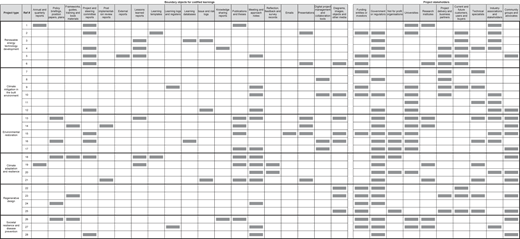
Ultimately, 28 projects were recruited, representing 6 types (see Table 1 for project details and Table 2 for boundary objects and stakeholder types identified by participants, where shaded cells indicate that the corresponding boundary object or stakeholder was specifically identified in interviews and unshaded cells indicate the corresponding boundary object or stakeholder was not specifically mentioned).
3.3 Interview method
We utilise an “interview” method (Jacob and Ferguson, 2012) with sampling focused on the case study project manager or an equivalent role. A semi-structured interview approach has been applied with a 60 min interview format, occasionally extended by 15–30 min where availability permitted. The interview was embedded within a broader engagement process, depicted in Figure 3 below, that included:
 The table describes the activities before and during each interview. Before each interview, activities include recruitment, pre-interview briefing materials, and a pre-interview survey. During each interview, activities include MCM option familiarization, MCM criteria self-nomination, MCM option scoring and weighting, and learning context information. The table is divided into two main sections: activities before each interview and activities during each interview. Each section contains three columns detailing the specific activities and their descriptions.
Participant engagement approach and interview method
The table describes the activities before and during each interview. Before each interview, activities include recruitment, pre-interview briefing materials, and a pre-interview survey. During each interview, activities include MCM option familiarization, MCM criteria self-nomination, MCM option scoring and weighting, and learning context information. The table is divided into two main sections: activities before each interview and activities during each interview. Each section contains three columns detailing the specific activities and their descriptions.Participant engagement approach and interview method
Recruitment and pre-interview briefing;
Completion of a pre-interview survey and
A semi-structured interview combining:
MCM option familiarisation;
Participant-led criteria self-nomination;
Option scoring and weighting and
Elicitation of learning context information.
The interview protocol was structured around the boundary object capacity schema (Ferres and Moehler, 2023) and learning context schema (Ferres et al., 2024b), with a semi-structured approach enabling sufficient flexibility to encourage interviewees to articulate their reasoning, examples and case contextual information to enhance the understanding of participant responses (King et al., 2018). The elicitation of learning context involved participants selecting learning context themes and engaging in a hybrid multi-criteria decision-making (MCDM) and best-worst method (BWM) approach (Greco et al., 2016; Dastaki et al., 2024). Our data collection has primarily relied on these one-on-one project manager interviews, with 28 interviews conducted in total.
3.4 Multicriteria mapping (MCM) method
MCM, a hybrid evaluation method for exploring contrasting perspectives on uncertain and contested issues (Stirling, 2010), was used to capture nuanced stakeholder insights through structured, criteria-based option scoring (Coburn et al., 2019; Stirling, 2008). MCM was selected following consideration of a range of hybrid methods, including MCDM approaches such as analytic network process (ANP), analytic hierarchy process (AHP), technique for order preference by similarity to an ideal solution (TOPSIS) and complex proportional assessment (COPRAS); after consideration, MCDM approaches were not selected for this study, noting the challenge of selecting an aligned approach, the potential for different MCDM approaches to yield different results, the potential for these differences to directly impact the ranking of alternatives and the complexity of applying MCDM to uncertain and ambiguous problems (Zavadskas et al., 2016). MCM enables the facilitated exploration of complex issues and is designed to capture different specialist stakeholder perspectives, preferences and rationales (Coburn et al., 2021). An important aspect of the MCM approach is its focus on “opening up” complex issues and revealing divergences in context, perspectives and interests rather than converging on a singular solution (Stirling, 2008). In this way, MCM reveals the plurality of rationales rather than converging on a singular evaluative hierarchy (Stirling, 2010).
As a participatory qualitative method, both quantitative and qualitative data are collected, with the elicited qualitative data being a central focus and enabling the interpretation of the quantitative information (Coburn et al., 2019, p. 10). The practitioner rationales captured through interviews represent contextualised sense-making rather than fixed preferences, and accordingly, qualitative reasoning that accompanies MCM scores should be understood as holding equal epistemic weight to the quantitative distributions (see Stirling, 2008; Coburn et al., 2019).
An illustrative view of the MCM tool is included in Figure 4 below.
 A horizontal bar graph titled Informs future needs. The graph compares four criteria: Common language/structure, Interpreting ambiguity, Collaborative alteration, and Time orientation. Each criterion is marked as Core. The horizontal axis represents performance scores ranging from 0 to 90, labeled as Poor to Good. Common language/structure has a score around 50. Interpreting ambiguity has a score around 70. Collaborative alteration has a score around 60. Time orientation has a score around 30. The bars are colored orange.
MCM tool sample screen
A horizontal bar graph titled Informs future needs. The graph compares four criteria: Common language/structure, Interpreting ambiguity, Collaborative alteration, and Time orientation. Each criterion is marked as Core. The horizontal axis represents performance scores ranging from 0 to 90, labeled as Poor to Good. Common language/structure has a score around 50. Interpreting ambiguity has a score around 70. Collaborative alteration has a score around 60. Time orientation has a score around 30. The bars are colored orange.MCM tool sample screen
Following established MCM protocols, the research proceeded through four main stages: (1) review of relevant options, (2) definition of participant-nominated criteria (Balfour et al., 2021), (3) range-based option scoring (with both optimistic and pessimistic perspectives) and (4) assignment of weightings to each criterion. As MCM was applied interpretatively to elicit participant rationales, rather than to test hypotheses, participants scored the importance of each boundary object capacity for knowledge sharing against their nominated criteria (yielding 24 scoring points per interview), provided scoring rationales and confirmed that scores reflected their individual judgement and experience.
3.5 Data analysis
Primary data sources included pre-interview survey responses, interview recordings and transcripts and MCM scoring records. MCM data were managed and analysed using an online MCM platform, consistent with MCM manual guidance (Coburn et al., 2019). Qualitative data were iteratively coded through initial coding, thematic analysis, thematic coding and transcript annotation, informed by the recommendations of Kiger and Varpio (2020) and Aguinis et al. (2019), focusing on criteria, scoring rationale and learning context. We did not specify a priori themes; instead, themes were developed inductively through iterative coding and constant comparison across the results dataset. Analytical outputs include quantitative distributions and rankings as well as qualitative themes, as presented in the research results section and supporting Appendix A.
Throughout the research process, reflexivity was maintained by continually reflecting on potential biases in data collection and analysis, including the positionality of the researchers and the influence of their professional backgrounds on the interpretation of participant responses. Research team members engaged in regular debriefings to challenge assumptions and an audit trail of coding decisions was maintained to support transparency.
Triangulation was employed to strengthen the validity of findings by integrating multiple data sources and perspectives. Data were collected through pre-interview surveys, semi-structured interviews and MCM records and were further supplemented by project documentation where available. The analysis incorporated quantitative scoring and qualitative thematic coding, allowing for cross-verification of patterns and ensuring that emergent themes were grounded in a robust evidentiary base.
4. Research results
This section presents our research results, including: Section 4.1 addressing option specification and exploration; Section 4.2 detailing criteria nominations; Section 4.3 summarising the overall rankings for option scoring across each of the boundary object capacity types (with capacity-specific scoring and scoring rationales expanded in further detail in Appendix A); Section 4.4 depicting both aggregated and disaggregated scoring; Section 4.5 providing learning context perspectives and Sections 4.6 and 4.7 summarising commonalities and differences in participant perspectives, respectively. As a participatory qualitative study, our results combine qualitative criteria and rationales described by practitioners with quantitative MCM practitioner scoring information, consistent with a wide body of MCM scholarship (see Yuana et al., 2023; Hargreaves et al., 2022; Coburn et al., 2021).
4.1 Option exploration
All participants were asked to appraise four options in total, aligned to the boundary object capacity schema of Ferres and Moehler (2023), namely common language and syntax, interpretative and translation, transformation to new knowledge and temporal orientation. As this predefined schema has guided the composition of this core option set, no discretionary options were applied in this case. Participants were familiarised with the boundary object capacities via pre-interview reference materials and an explanation of the capacities at the commencement of each interview, including the key characteristics of each capacity. All participants confirmed they were sufficiently confident in their understanding of the options to proceed with the MCM process and no alternative options were suggested; however, we recognise the potential for expert framing bias, which has been noted in our limitations.
4.2 Criteria development
Following option familiarisation, the interview process progressed to participants self-nominating criteria for option scoring. Through a facilitated process, each of the 28 participants confirmed their 3 most important criteria to be applied. In total, 84 discrete criteria were identified and subsequently coded into 10 distinct criteria groups. The distribution of criteria nominations across these groups is described in Figure 5 below.
 A horizontal bar graph compares the distribution of criteria nominations across different categories. The graph features ten horizontal bars, each representing a specific criterion. The x-axis ranges from zero to fifteen, indicating the number of nominations. The y-axis lists the criteria: Describes specific characteristics, actions and solutions; Enables sharing and application by others; Enables application by project team; Describes benefits, value, vision, criticality and key question outcomes; Describes why unexpected, surprising, not obvious information and questions; Supports continuous improvement, avoiding mistake repetition; Enables global, broad and systemwide adoption; Describes new, novel information; Supports comprehensive explanation and context; Demonstrated validation, evidencing and method. The color scheme is uniform, with all bars in gray. All values are approximated.
Distribution of criteria nominations
A horizontal bar graph compares the distribution of criteria nominations across different categories. The graph features ten horizontal bars, each representing a specific criterion. The x-axis ranges from zero to fifteen, indicating the number of nominations. The y-axis lists the criteria: Describes specific characteristics, actions and solutions; Enables sharing and application by others; Enables application by project team; Describes benefits, value, vision, criticality and key question outcomes; Describes why unexpected, surprising, not obvious information and questions; Supports continuous improvement, avoiding mistake repetition; Enables global, broad and systemwide adoption; Describes new, novel information; Supports comprehensive explanation and context; Demonstrated validation, evidencing and method. The color scheme is uniform, with all bars in gray. All values are approximated.Distribution of criteria nominations
4.3 Option scoring
After both option familiarisation and criteria self-nomination were completed, the interviews then proceeded to systematic scoring of the perceived importance of each boundary object capacity option for knowledge sharing in relation to each criterion. Figure 6 below summarises the ranking of mean scores for each of the four options, including the overall rankings and the criteria-specific rankings for each of the ten criteria groups. Ranking results are shown for both mean optimistic scoring data (see the upper section of Figure 6) and mean pessimistic scoring data (see the lower section of Figure 6). Optimistic scoring refers to the upper boundary of the range-based knowledge sharing importance score, while pessimistic scoring refers to the lower boundary of the range-based knowledge sharing importance score. During interview facilitation, participants were prompted to reflect on the range of learning codification scenarios they had encountered within the case project that corresponded to the capacity option and criteria being considered and to then provide a scoring range that spanned the scenario with the highest level of capacity option importance for the criteria (i.e. the optimistic score) and the scenario with the lowest level of capacity option importance for the criteria (i.e. the pessimistic score). For both data sections, the ranking of scores between the four options is indicated as either “most” optimistic or pessimistic, “second” most, “third” most or “least” optimistic or pessimistic.
 A table comparing mean optimistic and pessimistic scores across various criteria and overall performance. The table is divided into two sections: mean optimistic scoring and mean pessimistic scoring. Each section has 4 rows and 11 columns, including criteria and overall performance. The criteria include common language and syntax, interpretative and translation, transformation to new knowledge, and temporal orientation. Each row represents a different criterion, and each column represents a different aspect of the scoring. The values in the cells indicate the ranking of the scores. For mean optimistic scoring, the overall performance rankings are 2nd, 2nd, 3rd, and least optimistic. For mean pessimistic scoring, the overall performance rankings are 3rd, least pessimistic, 3rd, and most pessimistic.
Ranking of mean optimistic and pessimistic scores by criteria and overall
A table comparing mean optimistic and pessimistic scores across various criteria and overall performance. The table is divided into two sections: mean optimistic scoring and mean pessimistic scoring. Each section has 4 rows and 11 columns, including criteria and overall performance. The criteria include common language and syntax, interpretative and translation, transformation to new knowledge, and temporal orientation. Each row represents a different criterion, and each column represents a different aspect of the scoring. The values in the cells indicate the ranking of the scores. For mean optimistic scoring, the overall performance rankings are 2nd, 2nd, 3rd, and least optimistic. For mean pessimistic scoring, the overall performance rankings are 3rd, least pessimistic, 3rd, and most pessimistic.Ranking of mean optimistic and pessimistic scores by criteria and overall
The overall ranking results indicate that the interpretative and translation option received the overall most optimistic mean score, while the temporal orientation option received the overall most pessimistic mean score. By comparing the overall rankings to criteria-specific rankings, it can be seen that there is a level of variation in the criteria-specific results; for example, while the interpretive and translation option received the overall most optimistic mean score, for five of the ten criteria, it was the common language and syntax option that received the criteria-specific most optimistic mean scores.
A comparison of the mean optimistic scoring data and mean pessimistic scoring data also reveals areas of divergence from the mirroring that might be expected; notably, for the “enables sharing and application by others”, “enables application by project team” and “supports continuous improvement, avoiding mistake repetition” criteria, the least optimistic options were not also the most pessimistic options.
Please refer to Appendix A for detailed results data relating to each of the four boundary object capacity options.
4.4 Multicriteria mapping of options
4.4.1 Aggregated scoring
The overall aggregated mean scoring for all four options, derived from the MCM tool and based on combined participant appraisals, is shown in Figure 7. With the 4 options along the vertical axis and a relative scoring scale from 0 (lowest performance) to 100 (highest performance) on the horizontal axis, Figure 7 displays option scoring bars whose length represents the difference between mean pessimistic scores and mean optimistic scores.
 A horizontal bar graph compares four categories: Common language and syntax, Interpretative and translation, Transformation to new knowledge, and Temporal orientation. The x-axis ranges from 0 to 100, representing the mean scoring values. The y-axis lists the four categories. Common language and syntax and Interpretative and translation have the highest values, followed by Transformation to new knowledge and Temporal orientation. All values are approximated.
Aggregated mean scoring
A horizontal bar graph compares four categories: Common language and syntax, Interpretative and translation, Transformation to new knowledge, and Temporal orientation. The x-axis ranges from 0 to 100, representing the mean scoring values. The y-axis lists the four categories. Common language and syntax and Interpretative and translation have the highest values, followed by Transformation to new knowledge and Temporal orientation. All values are approximated.Aggregated mean scoring
At this aggregated level, two differentiated ranking levels are evident, consistent with our earlier reporting on mean optimistic and pessimistic option scoring by criteria (per Figure 6). Firstly, the common language and syntax and interpretative and translation options are the “higher two” highest-scoring options overall, receiving higher optimistic and pessimistic mean scores; the interpretative and translation option received the overall most optimistic mean score and the overall least pessimistic mean score. Secondly, the transformation to new knowledge and temporal orientation options are the “lower two” lowest scoring options overall, receiving lower optimistic and pessimistic mean scores; the temporal orientation option received the overall least optimistic mean score and the overall most pessimistic mean score. All options indicated a similar level of uncertainty, shown in the length of the scoring bars between optimistic and pessimistic mean scores, reflecting differences across projects, perspectives and the range of application scenarios contemplated by participants.
4.4.2 Disaggregated scoring by project type
The disaggregated ranking of all options, grouped by project type, is shown in Figure 8. In general, there is considerable similarity between many of the project types, with most project types retaining the “higher two” and “lower two” alignment of the overall aggregated scoring. While two project types do disrupt the overall “higher two” and “lower two” alignment, an examination of individual scoring for each of the four options shows that they each preserve their “higher two” and “lower two” alignment in five of the six project-type rankings. There are, however, a number of notable differences between project type perspectives, which are further explored in Sections 4.6 and 4.7 below.
 The image contains six vertical bar graphs, each representing rankings across different categories related to environmental and societal resilience. Each graph has a horizontal axis labeled with categories such as Common language and syntax, Interpretive and translation, Transformation to new knowledge, and Temporal orientation. The vertical axis is labeled with a scale from 0 to 100 percent. Panel A, titled Renewable energy technology development, shows varying lengths of bars for each category, with the longest bar in the Temporal orientation category. Panel B, titled Climate mitigation in the built environment, displays bars of different lengths, with the longest bar in the Interpretive and translation category. Panel C, titled Environmental restoration, shows bars with the longest in the Transformation to new knowledge category. Panel D, titled Climate adaptation and resilience, has the longest bar in the Common language and syntax category.
Disaggregated rankings
The image contains six vertical bar graphs, each representing rankings across different categories related to environmental and societal resilience. Each graph has a horizontal axis labeled with categories such as Common language and syntax, Interpretive and translation, Transformation to new knowledge, and Temporal orientation. The vertical axis is labeled with a scale from 0 to 100 percent. Panel A, titled Renewable energy technology development, shows varying lengths of bars for each category, with the longest bar in the Temporal orientation category. Panel B, titled Climate mitigation in the built environment, displays bars of different lengths, with the longest bar in the Interpretive and translation category. Panel C, titled Environmental restoration, shows bars with the longest in the Transformation to new knowledge category. Panel D, titled Climate adaptation and resilience, has the longest bar in the Common language and syntax category.Disaggregated rankings
4.5 Sustainability demonstration project learning context
Following MCM option scoring, the final stage of the interview introduced participants to the 13 sustainability demonstration “learning context themes” proposed by Ferres et al. (2024b), prompting nominations for the 3 “learning context themes” that best explained the learning context of the case projects.
Figure 9 below summarises the total number of nominations for each of the 13 learning context themes.
 A horizontal bar graph compares the distribution of top-three learning context theme nominations. The graph features twelve horizontal bars, each representing a different theme. The x-axis ranges from 0 to 12, indicating the number of nominations. The y-axis lists the themes: Learning from success and failure, Technical and non-technical learning, Learnings informing public policy, Influence of actors, Project and sustainability alignments, Climate response trajectory, Demonstration stage, Learning mechanism and strategy, Sustainability transition phase, Transience due to adaptive systems, SDG alignment, Influence of intellectual property, and Influence of organizational culture. The bars vary in length, with Learning from success and failure having the longest bar, followed by Technical and non-technical learning and Learnings informing public policy. The colors of the bars are not specified. All values are approximated.
Distribution of “top-three” learning context theme nominations
A horizontal bar graph compares the distribution of top-three learning context theme nominations. The graph features twelve horizontal bars, each representing a different theme. The x-axis ranges from 0 to 12, indicating the number of nominations. The y-axis lists the themes: Learning from success and failure, Technical and non-technical learning, Learnings informing public policy, Influence of actors, Project and sustainability alignments, Climate response trajectory, Demonstration stage, Learning mechanism and strategy, Sustainability transition phase, Transience due to adaptive systems, SDG alignment, Influence of intellectual property, and Influence of organizational culture. The bars vary in length, with Learning from success and failure having the longest bar, followed by Technical and non-technical learning and Learnings informing public policy. The colors of the bars are not specified. All values are approximated.Distribution of “top-three” learning context theme nominations
Participant remarks relating to the most frequently raised learning context themes, (1) “learning from success and failure”, (2) “technical and non-technical learnings” and (3) “learning informing public policy”, include:
Per (1): “How we can learn from success or failure […]. That's one we constantly talk about […]. With shareholders, with other investors, with governments and everyone […]. It's just such a critical piece. It's the reason why we build a demonstration plant so that you can make all the mistakes that you're going to make […]. Before you then deploy it at a larger scale […]. Make all the mistakes that you can […]. Knock those out the first time […]. But you also need to demonstrate the technology works” (C3).
Per (2): “For the project to be successful, you need to have a mix of both technical and non-technical […]. We've got to get the technical stuff right, but there's also the people piece […]. The contract piece […]. We've got to get those partnerships right with our service providers because we can't do this alone […]. There's got to be a really strong relationship” (C11).
Per (3): “I think one of the challenges that we face in this industry is that we keep on making the same mistakes, and there is not much learning […]. If we want to deliver buildings that have got higher levels of sustainability, performance or healthier buildings, we've really got to go and be generous with the way in which we share our information” (C4).
4.6 Commonalities in stakeholder perspectives
Across the study results, six key areas of commonality can be identified, with the most significant and relevant of these relating to MCM score ranking consistency. Other areas of commonality noted relate to participant recognition, self-nominated scoring criteria, scoring rationales and sustainability demonstration learning context.
4.6.1 MCM score ranking commonalities
Firstly and primarily, the results indicate that: (1) Most practitioners were of the view that all four boundary object capacities can contribute to effective project learning codification and sharing, with overall aggregated optimistic mean scoring well above the nominal scoring range midpoint of 50 for all capacities (per Figure 7), and (2) most practitioners considered common language and syntax and interpretative and translation boundary object capacities to be of greater importance for effective sharing of codified project learnings, while transformation to new knowledge and temporal orientation boundary capacities were considered of lesser importance. Throughout our results, we have described these recurring capacity pairings as the “higher two” and “lower two” alignment, a score ranking alignment that can be seen in overall scoring (see Figure 7) for both optimistic and pessimistic scores; in criteria-specific scoring (see Figure 6) for nine of ten optimistic scores and eight of ten pessimistic scores and in project-type disaggregated scoring (see Figure 8), where each of the “higher two” capacities ranks first or second in five of the six project types. As further described in Sections 5.1, 5.2 and 5.3, we observe this overall alignment while also recognising the range of perspectives evident when results are disaggregated by project type; we understand this variation to indicate that project type remains relevant to practitioner perspectives on the relative importance of boundary object capacities for knowledge sharing.
4.6.2 Participant recognition commonalities
Secondly, we note that all 28 participants were able to effectively engage with the research and complete the MCM process, a process that requires the participant to be fully confident that the results reflect their personal views. While none of the 28 participants came to the research familiar with the boundary object capacity nomenclature, through the use of descriptions and clarifications, all participants were able to relate the capacities to their practice, perform considered criteria-based scoring, articulate their scoring rationales and relate examples from their projects.
4.6.3 Scoring criteria commonalities
Thirdly, the MCM process revealed the frequency of scoring criteria nominations across the 28 participants and 84 individual criteria identified. All 84 criteria could be aligned to 10 criteria groups (see Figure 5) with 59.5% of all nominations aligning to the 4 highest frequency criteria groups of “describes specific characteristics, actions and solutions”; “enables sharing and application by others”; “enables application by project team” and “describes benefits, value, vision, criticality and key question outcomes”.
4.6.4 Scoring rationale commonalities
Fourthly, transcript coding revealed the frequency of codification strategy rationale themes across each of the four boundary object capacities. For each capacity, the majority of rationale references recorded were associated with that capacity's four most frequently cited rationale themes. For common language and syntax (see Appendix A, Figure 10), 73% of rationale references were associated with the “specialist terminology including acronyms”, “different language for different audiences”, “accessible and standard formats and messaging” and “cross-language and cross-culture challenges” rationale themes. For interpretative and translation (see Appendix A, Figure 11), 78% of rationale references were associated with the “importance of diagrams and images”, “power of storytelling and examples”, “explaining context” and “different topics or recipients, different modes” rationale themes. For transformation to new knowledge (see Appendix A, Figure 12), 62% of rationale references were associated with the “collaboration culture, context and change readiness”, “iterating learning concepts and interpretations”, “managing modifications and editors” and “keeping learnings up to date” rationale themes. For temporal orientation (see Appendix A, Figure 13), 59% of rationale references were associated with the “connecting project timeline to the future and the past”, “changing relevance, transience and adaptivity”, “sequencing and dependencies” and “time as part of storytelling and context” rationale themes.
 A table with six rows and five columns. The columns are labeled as Common language and syntax, Interpretative and translation, Transformation to new knowledge, and Temporal orientation. The rows are labeled as Renewable energy technology development, Climate mitigation in the built environment, Environmental restoration, Climate adaptation and resilience, Regenerative design, and Societal resilience and disease prevention. Row 1: Renewable energy technology development, First, Second. Row 2: Climate mitigation in the built environment, Second, First. Row 3: Environmental restoration, First, Overlapping Second, Overlapping Second. Row 4: Climate adaptation and resilience, Overlapping Second, First, Overlapping Second, Overlapping Second. Row 5: Regenerative design, First, Second. Row 6: Societal resilience and disease prevention, Second, First.
Summary of first- and second-ranked capacities by project type
A table with six rows and five columns. The columns are labeled as Common language and syntax, Interpretative and translation, Transformation to new knowledge, and Temporal orientation. The rows are labeled as Renewable energy technology development, Climate mitigation in the built environment, Environmental restoration, Climate adaptation and resilience, Regenerative design, and Societal resilience and disease prevention. Row 1: Renewable energy technology development, First, Second. Row 2: Climate mitigation in the built environment, Second, First. Row 3: Environmental restoration, First, Overlapping Second, Overlapping Second. Row 4: Climate adaptation and resilience, Overlapping Second, First, Overlapping Second, Overlapping Second. Row 5: Regenerative design, First, Second. Row 6: Societal resilience and disease prevention, Second, First.Summary of first- and second-ranked capacities by project type
4.6.5 Sustainability demonstration learning context commonalities
Finally, survey and interview-based questioning on sustainability demonstration learning context themes provided data on the frequency of top-three nominations across the examined cases. Of the 13 learning context themes conceptualised by Ferres et al. (2024b), 52.6% of all 78 top-3 nominations (see Figure 9) were associated with the 4 most frequently cited themes of “learning from success and failure”, “technical and non-technical learning”, “learnings informing public policy” and “influence of actors”.
4.7 Differences in stakeholder perspectives
Comparing MCM scoring results across the six project types, a number of divergences can be identified, primarily in relation to temporal orientation scoring, the consistency of “higher two” and “lower two” alignment and scoring uncertainty.
4.7.1 Temporal orientation scoring differences
Firstly, the “renewable energy technology development” and the “environmental restoration” project types (see Figure 8 “a” and “c”) scored temporal orientation capacity against the overall trend, with optimistic and pessimistic scores for temporal orientation that ranked above transformation to new knowledge and overlapped both the common language and syntax and interpretative and translation scoring bars. These two project types can be differentiated from the other cases on two grounds: (1) With regard to learning context, both of these project types are associated with the highest number of top-three nominations for “learning from success and failure” and “demonstration stage” learning context themes, and (2) with regard to boundary objects for learning codification, seven of the ten projects that referenced project and steering committee reports, and five of the six projects that referenced presentations, are found in these project types.
4.7.2 “Higher two” and “lower two” scoring differences
Secondly, as shown in Figure 10 below, the “environmental restoration” and “climate adaptation and resilience” project types (see Figure 8 “c” and “d”) were associated with the only deviations from the “higher two” and “lower two” alignments of the overall aggregated scoring. In the “environmental restoration” project-type scoring, optimistic scoring for temporal orientation capacity ranks slightly above interpretative and translation capacity, albeit with a higher level of uncertainty and a pessimistic score that remains in the “lower two”, resulting in an overlapping second-ranked capacity. In the “climate adaptation and resilience” project-type scoring, optimistic scoring for transformation to new knowledge capacity ranks very slightly above common language and syntax, albeit with a much higher level of uncertainty and the lowest pessimistic score of all four capacities, where these pessimistic scores overlap such that a clear second-ranked capacity cannot be determined at the project-type level. These two project types can be differentiated from the other cases on five grounds: (1) With regard to scoring rationale, these project types were the only projects to nominate “differing stakeholder time priorities” as a temporal orientation rationale theme; (2) with regard to project scale, all six projects with budgets less than AUD 1m are found in these project types; (3) with regard to project timespan, four of the five projects with durations of two years or less are found in these project types; (4) with regard to boundary objects for learning codification, seven of the nine projects that referenced publications and theses are found in these project types and (5) with regard to stakeholders, both of these project types are associated with fewer references to funder or investor stakeholders and more references to not-for-profit organisation stakeholders relative to the rest of the cases examined.
4.7.3 Scoring uncertainty differences
Finally, the “climate adaptation and resilience” project type (see Figure 8 “d”) features scoring bars with much wider ranges between optimistic and pessimistic scores than any of the other project types, reflecting participant uncertainty and scoring differences across projects, perspectives and the range of application scenarios contemplated by participants. This project type can be differentiated from the other cases on five grounds: (1) with regard to option scoring rationale, this project type has far fewer references to “specialist terminology including acronyms” than most project types, has more references to “explaining context” than most project types, is the only project type not to reference “managing modifications and editors” and is the only project type to reference “responding to natural event or climate timeframes”; (2) with regard to learning context, this is the only project type to put forward top-three nominations for “influence of organisational culture”; (3) with regard to project timespan, this is the only project type not to include a project of 10 years' duration or more; (4) with regard to boundary objects, this is the only project to include references to reflection, feedback and survey records and (5) with regard to stakeholders, this is the only project type not to reference funding entities or investors.
5. Discussion
Through this paper, we have aimed to better understand how practitioners perceive the relative importance of boundary object capacities for knowledge sharing when codifying project learnings in different types of sustainability demonstration projects. Addressing this research focus has required novel engagement with project practitioners through an early primary research study into boundary object capacity perspectives for project learning codification. The below discussion draws on Ambituuni et al.’s (2026) approach to interpreting context-specific configurations and includes a reflection on the “higher-two” and “lower-two” prioritisation inversion (Section 5.1), the role of project type as a contextual condition (Section 5.2), implications for codification practice (Section 5.3) and limitations and future research directions (Section 5.4).
5.1 The prioritisation inversion: exploring why lower-order capacities were prioritised
This study has found that two capacities, namely common language and syntax and interpretative and translation, were most frequently prioritised by practitioners. Interestingly, these are the capacities that are typically required to span the simpler syntactic and semantic boundary types, where project stakeholders must overcome difference, dependence and novelty between sender and receiver. Projects that strongly prioritised these two capacities were generally of larger scale (>AUD 1m) and longer duration (often exceeding 10 years), with stronger ties to funding entity and investor stakeholders. We note that these findings are consistent with research indicating the importance of common lexicons (Acharya et al., 2022), overcoming jargon or a lack of vocabulary (Foerderer et al., 2019) and spanning terminologies, codes, protocols or routines (Kotlarsky et al., 2015) for common meaning (Acharya et al., 2022) that overcomes different interpretations and sense-making in multidisciplinary settings (Kotlarsky et al., 2015). The practitioner data also indicated requirements of this type, frequently citing rationales for these “higher-two” capacities including “specialist terminology including acronyms”, “different language for different audiences”, “cross-language and cross-culture challenges”, “importance of diagrams and images”, “power of storytelling and examples”, “explaining context” and “different topics or recipients, different modes”.
In contrast, the transformation to new knowledge and temporal orientation capacities were less commonly prioritised. These are the capacities that are typically required to span the more complicated pragmatic and temporal boundary types, where project stakeholders must overcome negative consequences, different interests, complex sequences of activities, long duration works, high tempo performance cultures and the need for synchronisation across teams and organisations. The minority of projects that emphasised the importance of these capacities were found within the “environmental restoration” and “climate adaptation and resilience” project types, being generally of smaller scale (including all < AUD 1m projects) and shorter duration (all bar one of the <2 years projects), with stronger ties to not-for-profit stakeholders. Where projects assigned importance to these capacities, connection can be drawn to research on the role of common interest for effective knowledge transformation (Acharya et al., 2022), overcoming differences in practices and goals (Kotlarsky et al., 2015), addressing competing temporal understandings, perceptions and norms (Stjerne et al., 2019) and recognising unique temporal institutional complexities (Dille et al., 2018). The practitioner data were consistent with these literature connections, with the most frequently cited rationales for these “lower two” capacities including “collaboration culture, context and change readiness”; “iterating learning concepts and interpretations”; “connecting project timeline to the future and the past”; “changing relevance, transience and adaptivity” and “time as part of storytelling and context”.
We recognise the inherent tension in these findings; the boundary object capacities that are necessary to span more complex boundaries were less commonly prioritised, while the capacities required for simpler boundary spanning were more commonly prioritised. In other words, the higher-order capacities are the “lower two”, while the lower-order capacities are the “higher two” in our results. The root causes of this inversion remain elusive. Are the projects we examined associated with simpler knowledge sharing boundaries? The rich examples of complex pragmatic and temporal boundaries provided by participants would suggest not. Did our interviewed participant group have an aversion to the objects and object characteristics typically associated with higher order capacities? This also does not seem to be the case, with importance being assigned to all capacities and many consistent themes reinforcing the important role of higher order capacities within our case study projects. Does the inversion simply reflect that the lower-order capacities address “difference”, “dependence” and “novelty” boundary characteristics, which are simpler and potentially more common and familiar to practitioners? Perhaps, however, further research will be required to better understand the drivers of the practitioner perspectives we have identified in this study. At this time, our review of the literature identifies very few comparable studies that examine practitioner perspectives on the relative importance of boundary object capacities in any project context; accordingly, there is a limited existing body of knowledge against which our findings and the influence of project type on practitioner perspectives can be assessed.
We do observe, from our analysis, that project type, scale, duration and stakeholder composition appear to significantly shape which boundary object capacities are prioritised in learning codification strategies. Larger and longer-term projects tend to emphasise foundational capacities that facilitate consistent understanding across a range of disciplines and actors. In contrast, smaller and time-constrained projects require mechanisms to translate emergent learnings into actionable knowledge, despite competing timeframes and shifting priorities. These contextual conditions are further discussed below for each of the project types engaged through this study.
5.2 Project type as a contextual condition shaping codification strategy
Across the six sustainability demonstration project types, participants have described the project and learning contexts that have shaped their codification strategy priorities.
5.2.1 Renewable energy technology development projects
These renewable energy technology development projects, which focused on solar, hydro-electric, renewable storage and electric vehicle initiatives, were all based in Australia and typically involved ongoing work, with budgets exceeding AUD 10m and durations of three to nine years in most cases. These six initiatives can be understood as clear examples of Gasparro et al.’s (2022, p. 198) assertion that project-based delivery is central to achieving net-zero targets.
The most common learning boundary objects mentioned by participants were project and steering committee reports, lessons learned reports and presentations, corresponding with previous research by Wenger (1998), Carlile (2002) and Schindler and Eppler (2003), who identified such artefacts as key boundary objects in complex technical contexts. The most common knowledge sharing stakeholders mentioned by participants were customers, users and buyers as well as government or regulators and industry associations or stakeholders, reflecting the findings of Neij et al. (2017), Bossink (2020) and Sharp and Raven (2021) who emphasised the complexity of sustainability demonstration networks.
The majority of participants viewed common language and syntax capacity as being most important for successful knowledge sharing. Common rationale themes included “different language for different audiences” and “specialist terminology including acronyms”. One participant (C6) stated “it won't be the ‘cost’, it will be the ‘levelised cost of electricity’ […] and there'll be […] like a technical term that we'll use to refer to it”. These rationale themes conform with Abraham et al. (2015) observations on shared syntax, Renzl's (2007) findings on language and meaning, Mahami-Oskouei et al.’s (2024) examination of sharing between specialists and Carlile's (2002) consideration of specialised knowledge.
Conversely, the transformation to new knowledge capacity was viewed as being least important for knowledge sharing. Common rationale themes included “collaboration, culture, context and change readiness”; “keeping learnings up to date” and “two-way collaboration communication”. One participant (C4) stated “between the time that the learning was first written down or occurred, and when the learning has been put into practice […] you'll want to make sure that you have as much information […] relevant to that implementation as possible, which probably means, bringing in inputs from other parties as well”. These rationale themes align with findings from Bossink (2020), Sapsed and Salter (2004), Lin and Huang (2020), Abraham et al. (2015) and Wenger (2000).
When describing learning context, participants commonly cited the themes of “technical and non-technical learning”, “learning from success and failure” and “demonstration stage and lifecycle alignment” as being most important to understanding learnings from their projects. One participant (C1) stated “the funding agency values the non-technical learnings as much, if not more, so, I'm always trying to extract that value […] the broader impacts for the research, industry engagement, community consultations, that sort of stuff”. These learning context themes echo Kivimaa et al.’s (2017) socio-technical learning study, Kang et al.’s (2021) social and political context findings and Bossink's (2020) typical lifecycle observations.
5.2.2 Climate mitigation in the built environment projects
This climate mitigation in the built environment projects, which spanned passive building, energy efficiency, water efficiency, electrification and microgrid initiatives, were all based in Australia and typically involved completed work with budgets below AUD 10m and durations of three to nine years in most cases. These six initiatives are comparable to the climate mitigation-focused sustainability demonstrations described by Hendry et al. (2010).
The most common learning boundary objects mentioned by participants were meeting and approach notes and digital project management and collaboration tools, similar to previous project learning observations by Schindler and Eppler (2003) and the examination of digital boundary objects by Gram (2024). The most common knowledge sharing stakeholders mentioned by participants were universities and project delivery or business partners.
The majority of participants viewed interpretative and translation capacity as being most important for successful knowledge sharing. Common rationale themes included “importance of diagrams and images”; “power of storytelling and examples” and “explaining context”. One participant (C12) stated that when a learning is codified as a story “it gives it depth and […] goes from being a very dry set of steps or processes into being a process that people have actually gone through […] it gives you a sense of […] the flexibility within that structure and how strict it is, how […] kind of elastic or […] the reality of implementing it and what you might expect when you're trying to do it”. These rationale themes reinforce Schindler and Eppler's (2003) comments regarding graphical representation of learnings, Godbold's (2012) examination of narratives and Osterlund's (2008) observations on context description.
In contrast, the temporal orientation capacity was viewed as being least important for knowledge sharing. Common rationale themes included “sequencing and dependencies” and “changing relevance, transience and adaptivity”. One participant (C10) stated, “You've got to timestamp it, people need to know, at what time was (the learning) not obvious and […] unexpected […] because it might become obvious very soon after”. These rationale themes follow the research of Schindler and Eppler (2003), Stjerne et al. (2019) and Levin et al. (2013).
When describing learning context, participants commonly cited the themes of “technical and non-technical learning”, “learning informing public policy” and “project and sustainability alignments” as being most important to understand learnings from their projects. One participant (C8) stated, “It's part of the net zero journey, but also […] the way you've done the work and the specific assets that come out of it […] the sustainability of them […] that's also important, not just the purpose, but also how you do the work and the assets themselves”. These learning context themes include concepts consistent with Bossink's (2020) reflections on demonstration learnings informing public policy and Flyvbjerg’s (2020) investigation of project sustainability dimensions.
5.2.3 Environmental restoration projects
These environmental restoration projects, which included river restoration, aquaculture restoration, waste processing and urban transformation initiatives, were all based in South East Asian and Pacific regions and involved ongoing work with budgets below AUD 1m and durations of one to two years in most cases. These five initiatives are similar to the recent projects examined by scholars including Derak et al. (2024), Xing et al. (2024) and Ullah (2024).
The most common learning boundary objects mentioned by participants were publications and theses, together with presentations and diagrams, images, objects and other media, with the latter two reinforcing the visual representation objects identified by Eppler and Burkhard (2007). The most common knowledge sharing stakeholders mentioned by participants were government or regulators, universities and community groups or advocates.
The majority of participants scored capacity importance outside of the “higher two” and “lower two” trend with relatively high importance assigned to temporal orientation for successful knowledge sharing. Common rationale themes for temporal orientation included “connecting project timeline to the future and the past”, “changing relevance, transience and adaptivity” and “funding as a key timing consideration”. One participant (C13) stated, “I think there's a perception that you can […] revitalise a river really quickly, just by doing a few simple things, whereas, actually, it's probably going to be, you know, 20, 30, 40, 50 years before you actually see any improvement […] it's much quicker to pollute the river than to clean it up”. These rationale themes are consistent with Whyte and Nussbaum's (2020) research on project temporality and Bergman et al.’s (2023) notes on timing in the context of demonstration decision-making.
When describing learning context, participants commonly cited the themes of “learning from success and failure”, “learning informing public policy” and “influence of actors” as being most important to understand learnings from their projects. One participant (C14) stated, “As a researcher … whilst within a team meeting you discuss your failures, we rarely publish our failures”. These learning context themes include concepts reflecting Neij et al.'s (2017) consideration of demonstration actor diversity and local learning.
5.2.4 Climate adaptation and resilience projects
These climate adaptation and resilience projects, comprising initiatives advancing natural disaster resilience technologies and approaches, were all based in Australia and involved ongoing work, with declared budgets below AUD 1m and durations of three to nine years in most cases. These four initiatives are comparable to recent projects considered by Hugel and Davies (2024), Quadros Aniche et al. (2024) and Johns et al. (2024).
The most common learning boundary objects mentioned by participants were meeting and approach notes and publications and theses, with the latter aligning with the scholarship of Astrom et al. (2016) examining scientific publications as boundary objects. The most common knowledge sharing stakeholders mentioned by participants were government or regulators and community groups or advocates.
The majority of participants scored capacity importance outside of the “higher-two” and “lower-two” trend with relatively broad scoring ranges for both transformation to new knowledge and temporal orientation. Common rationale themes for transformation to new knowledge included “iterating learning concepts and interpretations” and “collaboration feasibility and methods”. One participant (C20) stated, “If we don't have those unexpected learnings or surprises, then how is transformation possible […] the surprise stuff comes from this aspect of community engagement […] where we'll put it out to the masses and see what we'll come back with and then make sense of it, which is quite scary for a very meticulous, hierarchical, process driven profession”. These rationale themes follow Carlile's (2002) consideration of knowledge iteration across boundaries and Wenger's (2000) work on enabling coordination between practices.
Turning to temporal orientation, common rationale themes included “responding to natural event or climate timeframes” and “time as part of storytelling and context”. One participant (C21) stated, “We are working with communities that have in recent years been impacted by floods and bushfires […] things that have been sometimes quite catastrophic that happened in the recent past with the idea that you know, those things are going to be faced again at some stage in the future, but that is unknown as to when […] this project is definitely portrayed as being sort of like a blip on the timeline between events”. These rationale themes correspond with the contribution of Brundiers (2018), regarding event impacts on transitions, and Schindler and Eppler (2003), regarding the codification of detailed narratives relating to project learnings.
When describing learning context, participants commonly cited the themes of “learning from success and failure”, “influence of actors”, “learning mechanism and strategy alignment” and “influence of organisational culture” as being most important to understanding learnings from their projects. One participant (C19) stated, “We have the appetite from our funders to fail […] it's kind of okay, so to speak, that we've had a few things that didn't work […] that feels really important in […] the ethos”. These learning context themes include concepts following Junginger (2005), on learning mechanisms in sustainability demonstrations, and Wiewiora et al. (2013), on cultural values and the willingness to share knowledge.
5.2.5 Regenerative design projects
These regenerative design projects, encompassing initiatives advancing community design and sustainable development technologies and approaches, were all based in Australia and typically involved completed work, with declared budgets exceeding AUD 10m and durations of three to nine years in most cases. As a project class, regenerative design projects such as these four initiatives aim to both enhance and restore ecosystems (Sadat et al., 2024) with a level of ambition that requires infrastructures to be “imagined and created anew” (Adloff and Neckel, 2019, p. 1016).
The most common learning boundary objects mentioned by participants were diagrams, images, objects and other media. The most common knowledge sharing stakeholders mentioned by participants were funding entities or investors together with government or regulators and current or future customers, users or buyers.
The majority of participants viewed common language and syntax capacity as being most important for successful knowledge sharing. Common rationale themes included “specialist terminology including acronyms” and “novel content”. One participant (C23) stated, “There's a lot of greenwashing […]. There's a lot of developers who talk the talk, but don't walk the walk, so therefore authenticity of language […]. It's really important […]. It's very important that there's a set of language and symbols and words that convey something that's genuinely a sustainable development to distinguish it from those that are not”. These rationale themes include concepts that conform with Carlile's (2004) examination of knowledge management in contexts where innovation and novel content creation are a central focus.
At the other end of the scoring spectrum, the temporal orientation capacity was viewed as being least important for knowledge sharing. Common rationale themes included “time as part of storytelling and context” and “changing relevance, transience and adaptivity”. One participant (C25) stated, “The ability to look forward and backwards is the ability to tell the story in a way that people can hear it”.
When describing learning context, participants commonly cited the themes of “sustainability transition phase”, “project and sustainability alignments” and “climate response trajectory” as being most important to understanding learnings from their projects. One participant (C23) stated, “Responding to climate change was really important […] how you came to it in a very positive way […] the whole project […] got it from the very beginning, all the way through execution […] about showcasing sustainability as a purpose […] as a way of doing business and a way of doing delivering”. These learning context themes include concepts that align with Kemp and Loorbach (2006), on managing transition phases, and Adloff and Neckel (2019), on the role of climate response trajectories in understanding sustainability futures.
5.2.6 Societal resilience and disease prevention projects
These societal resilience and disease prevention projects, which were made up of informal settlement condition improvement, settlement resilience and disease eradication initiatives, spanned teams based out of Australian, South East Asian and Pacific geographies and all involved ongoing work, with budgets that were undeclared and durations exceeding 10 years in most cases. These three initiatives can be understood as intersecting the multi-layered drivers and systems of societal resilience conceptualised by Wernli et al. (2021).
The most common learning boundary objects mentioned by participants were meeting and approach notes. The most common knowledge sharing stakeholders mentioned by participants were government and regulators.
The majority of participants viewed interpretative and translation capacity as being most important for successful knowledge sharing. Common rationale themes included “different topics or recipients, different modes”, “explaining context” and “power of storytelling and examples”. One participant (C28) stated, “Particularly given that we work in an environment, that's not our home environment, for a lot of us in the team […] there is a lot of slippage in understanding, often, unspoken assumptions or understandings, which we discovered way too late […] often words alone cannot convey that […] so being really aware of ambiguity is very critical for this”. These rationale themes include concepts echoing Mariano (2014), regarding multimedia learning and knowledge transfer.
Turning to lower scoring capacities, the temporal orientation capacity was viewed as being least important for knowledge sharing. The most common rationale theme expressed by participants was “timing of learning adoption for beneficial impact”. One participant (C27) stated, “The first thing I think about is applying the learnings early […] look at all the learnings before you do too much and apply what you can as early on as possible”. This rationale theme is similar to the research of Wisdom et al. (2014), regarding adoption approaches, and Tang et al. (2022), regarding adoption timing.
When describing learning context, participants most commonly cited the theme of “SDG alignment” as being most important to understand learnings from their projects. One participant (C27) stated, “The (SDG) goals gives us a way to try to kind of categorise and understand, to think about buckets or categories of projects and how to identify something which could broadly apply”. This learning context theme conforms with the investigations of Georgeson and Maslin (2018), exploring modes of application for the SDGs.
Across these six case study groupings, which demonstrate the broad diversity of the sustainability demonstration class, we observe that project type does influence practitioner preferences. With discernible differences in scale, duration, discipline, boundary objects, stakeholders, scoring rationale and learning context, this influence demonstrates the context-sensitivity of practitioner perceptions and corresponding codification strategy preferences.
5.3 Implications for project learning codification practice
The findings of this study provide significant insights for practice, including how boundary object capacities influence knowledge codification and the sharing of project learnings across sustainability demonstration projects. Codification is essential to enable knowledge transfer beyond the original project team, particularly in cases where geographic, organisational or temporal barriers limit direct interaction between stakeholders and projects; examples of these barriers in practice include situations where the contributing team has disbanded, where learning demand exceeds the availability of the original contributing team, where geography challenges the ability for interaction in-person and where the passage of time since project close exceeds memory, tenure, careers or even lifetimes. This ability to share with “reach” is especially important in sustainability demonstration contexts, where distributed teams, short-term funding cycles and evolving policy landscapes frequently hinder long-term, person-to-person knowledge exchange.
Practitioners consistently identified common language and syntax and interpretive and translation capacities as central to enabling the meaningful reuse of project learnings. The incorporation of common language and syntax capacity supports the creation of structured, accessible and adaptable knowledge artefacts that can be shared across teams and institutions; this is critical in cases where projects are handed over between teams, integrated into broader programs or referenced for future policy and infrastructure initiatives. Similarly, the incorporation of interpretative and translation capacity, which may take on forms including contextualisation, storytelling and diagrams, allows learnings to be understood by diverse audiences, including policymakers, investors and community stakeholders. Importantly, while our findings improve the understanding of practitioner perspectives on capacity importance, further research will be required to examine whether perceived higher importance correlates with enhanced knowledge sharing and project learning outcomes in practice and vice versa. Without an understanding of this correlation, we cannot yet identify indicated management responses. For example, should future research demonstrate a strong correlation between perceived importance and enhanced learning outcomes in practice, it may be that leaders should encourage the focus on “higher two” capacities; however, should future research demonstrate different correlations, it may be that leaders should then encourage equivalent focus on the “lower two” capacities as a compensatory measure. Given these potentially diverging management implications, we recommend that improving the understanding of knowledge sharing and project learning outcomes in practice should be a central consideration for future researchers.
Additionally, we have found that the role of project type as a contextual determinant reinforces the need for tailored codification strategies. Effective codification practices must be aligned with the project's purpose, stakeholder configuration and knowledge needs. In this way, boundary object capacities act not only as structuring mechanisms for learnings but also as enablers of cross-project communication, collaborative planning and capacity-building across the sustainability demonstration project ecosystem.
This study also highlights the value of participatory approaches that enable project teams to define their own criteria when codifying learnings. Practitioners most frequently prioritised criteria such as “describes specific characteristics, actions and solutions”, “enables sharing and application by others” and “enables application by the project team”, suggesting that codification is most effective when framed around practical reuse. These insights can inform the development of codification templates, knowledge sharing platforms and organisational standards that promote structured, reusable and context-sensitive project knowledge.
Finally, the findings suggest that structured reflection on learning context, including themes such as “learning from success and failure”, “technical and non-technical learning” and “learnings informing public policy”, enhances the depth and relevance of codified learnings, improving the ability of the receiver to understand the sender's intent. Embedding such reflective practices into project close-out procedures, funding arrangements or learning repositories could significantly enhance knowledge longevity and reusability across sustainability demonstration projects.
5.4 Limitations and future research
We acknowledge several limitations in this study, recognising the importance of comparing and contrasting our early primary research results in the context of broader empirical evidence and cross-study validation across varying project types. Each of these limitations offers valuable directions for future research on knowledge codification in sustainability demonstration projects.
Firstly, this study focused specifically on boundary object capacities related to project learning codification, without addressing the broader upstream or downstream processes involved in learning and knowledge sharing. While this narrowed scope enabled clearer prioritisation by practitioners and supported their engagement with the concepts, it did not account for the full spectrum of learning activities across the project lifecycle. As part of this capacity scoping, while participants were prompted to identify alternative capacity options to be recognised in addition to the boundary object capacity schema of Ferres and Moehler (2023), we acknowledge the potential for expert framing bias as a limitation. Future research should, therefore, explore how boundary object capacities, including potential capacities or capacity characteristics beyond the schema underpinning this study, interact with the generation, transfer and application of project knowledge and learnings beyond a narrow codification examination.
Secondly, the study did not differentiate between knowledge types, object types, practices, learning recipients or learning intents. These distinctions are important for understanding how different forms of knowledge (e.g. technical vs. experiential), objects (e.g. project closure report vs. learning database entry), practices (e.g. arising from distinct practices within a project, between projects and with stakeholders), recipients (e.g. policymaker vs. contractor) and intents (e.g. compliance vs. innovation) influence practitioner preferences. Future investigations could examine how boundary object preferences vary across these dimensions to improve the alignment between codification strategy and intended use, where this further examination may inform root causes of the inherent tension in our “upper-two” and “lower-two” findings.
Thirdly, the study did not explore the interplay or cumulative effect of different boundary object capacities or how preferences might relate to specific learnings, processes or object types. Further research should consider how combinations of capacities function together to support learning transfer, particularly in projects with high complexity, interdisciplinary teams and multiple stakeholder interfaces, where this direction of study may also contribute to a better understanding of the causes behind the “upper-two” and “lower-two” findings and inform the correlation between perceived importance and enhanced knowledge sharing and project learning outcomes in practice.
Fourthly, this study focused on a specific subset of sustainability demonstration projects. To enhance generalisability, future studies could examine other sustainability project types and broader project contexts. Comparative studies across different geographies, organisational settings or governance frameworks may also reveal how contextual variables influence codification strategy and boundary object use.
Lastly, this study did not examine contextual factors such as organisational learning culture, geographic setting, project delivery models or norms around collaboration and documentation. These variables may significantly influence practitioner engagement with boundary object capacities. Future research should consider these contextual mechanisms through in-depth case studies or cross-cultural comparisons to deepen understanding of learning codification practices in diverse project environments.
6. Conclusion
In this participatory qualitative study, we asked the following research question: How do practitioners perceive the relative importance of boundary object capacities for knowledge sharing when codifying project learnings in different types of sustainability demonstration projects? Having engaged 28 sustainability demonstration case study projects with a mixed-methods MCM approach, our findings offer several key insights.
Firstly, the results show that all four boundary object capacities are recognised as contributing to effective knowledge codification and knowledge transfer of innovation and learning. However, the common language and syntax and interpretative and translation capacities that are required to span the simpler syntactic and semantic boundary types were most frequently prioritised by practitioners. Secondly, project type influences practitioner preferences, reaffirming that codification strategies are highly context-sensitive and benefit from alignment to the characteristics of specific sustainability demonstration environments, knowledge bases and contextual closeness. In addition, clear themes emerged for knowledge bridging intent, codification strategy rationale and sustainability demonstration learning contexts.
This study contributes to sustainability and project management research by providing foundational insights into the role of boundary object capacities in structuring and sharing project knowledge. The findings advance the understanding of knowledge codification in practice and offer an applied framework for sense making and the development of more targeted strategies, tools and frameworks to enhancing learning transfer and collaboration between sustainability-focused initiatives. The practical application of this study is to guide better practice for “what information to capture”, in the context of very limited scholarship and industry standards, and to guide “when you need to choose, what information is viewed as most important”. For leaders seeking to enhance knowledge-sharing and project-learning outcomes in comparable project contexts, the findings suggest practitioners may prioritise common language and syntax and interpretative and translation capacities as they codify learnings for sharing. However, further research will be required to understand whether leaders should respond by encouraging this capacity focus (i.e. “double down” on perceived importance) or rather seek to encourage equivalent focus on the transformation to new knowledge and temporal orientation capacities that practitioners may de-prioritise despite being critical for complex boundary spanning (i.e. compensate for perceived importance). While our study advances the early primary research in this field and guides the development of better practice, the future form of that better practice remains an open question for future researchers.
Future research directions are encouraged to address the limitations of this study, better understand the root causes of practitioner perspectives, examine the correlations between perceived importance and project learning outcomes and explore how codification practices can be proactively designed to enhance innovation diffusion, improve policy uptake and strengthen inter-organisational learning across the lifecycle of sustainability demonstration projects.
We would like to thank the 28 participants for their involvement in our research, together with the leadership teams of the parent organisations of our case projects.
The supplementary material for this article can be found online.

