


Purpose
The purpose of this paper is to define the integration capability dimensions and create a model for self-assessing the integration capability in inter-organizational projects.
Design/methodology/approach
A theoretical construct of, referred in this study as integration capability framework is elaborated following a systematic literature review. Thereafter, an integration capability self-assessment model, based on maturity thinking, is derived from the theoretical framework. The self-assessment model is further developed and tested for validity within five inter-organizational project networks in cooperation with industry practitioners, representing construction, industrial engineering, and mining sectors.
Findings
The results show that inter-organizational projects can use the developed model in self-assessing the maturity levels of various integration mechanisms, thus the state of integration capability at any point in time during inter-organizational projects.
Originality/value
This study is an attempt to identify how the integration capability dimensions can be self-assessed in inter-organizational projects, through the maturity levels of various integration mechanisms. The results offer insights for both academics and project management practitioners.
Introduction
Every project faces significant integration challenges (Aagaard et al., 2014; Söderlund, 2011), with two fundamental challenges being related to cooperation and coordination issues (Söderlund, 2011). The cooperation problem originates from actors' conflicting goals and opportunistic behavior, whereas the coordination problem stems from task complexity and the need to communicate and synchronize activities (Söderlund, 2011). In the construction industry, an additional integration challenge relates to the segregation of project participants: Horizontal segregation is found between participants with similar roles, and vertical segregation between initiation, design, production, use, and maintenance participants (Atkinson and Westall, 2010), all of which need to be integrated to achieve the best possible project outcomes.
It is increasingly common for inter-organizational projects to strive for collaborative and integrative project practices. Yet, how can the degree of integration be assessed—and hence, improved—in complex inter-organizational projects? There is a shortage of evaluation tools for different project phases, even though good practical results have been reported (Chakkol et al., 2018) from the collaboration assessment exercises for bidding alliances during the procurement phase. Therefore, in this paper, we aim to, first, define the integration capability dimensions and second, evaluate how the dimensions of integration capability can be self-assessed in project network settings by the project practitioners. We assess the dimensions of integration capability through the integration mechanisms of inter-organizational projects, identified based on scientific literature.
Projects can be classified as temporary organizations (Bakker, 2010; Lundin and Soderholm, 1995), and some projects are embedded in networks consisting of inter-organizational relationships (DeFillippi and Sydow, 2016). Project networks connect legally independent but operationally interdependent organizations and individuals (Manning, 2017), and they can either sustain over individual projects or be formed only to execute a single inter-organizational project (DeFillippi and Sydow, 2016). The challenges of implementing a large inter-organizational project are related to difficulties in aligning multiple perspectives and achieving a shared understanding of project goals (Kujala et al., 2021).
The integration practices of different project parties can be effectively coordinated and streamlined by arranging both the structural and operational mechanisms, including the platform, behavior, and processes of collaboration, which leads to successful integration (Ibrahim et al., 2015). However, the ability to sustain and consistently drive integration practices in a complex project is an ongoing, everyday concern (Ibrahim et al., 2015). The integration mechanisms of inter-organizational projects include formal governance, organizational and relational arrangements, and technological systems (Hietajärvi et al., 2017a). Moreover, the integration capability of a complex project or a project alliance requires adopting a wide range of integration mechanisms and having the competency to adjust those mechanisms in everyday project situations (Hietajärvi et al., 2017a).
To understand the concepts of integration capability and integration capability building in a complex inter-organizational project setting, we take project capability research as our starting point. There are three organizational capabilities in project-based organizations—functional capabilities, strategic capabilities, and project capabilities—whereby project capabilities are the capabilities needed to prepare bids and execute projects after winning bids (Davies and Brady, 2000). In inter-organizational project settings, complex project or project alliance capabilities derive from those contractual, behavioral, relational, and operational skills that are required for project initiation and management (Hietajärvi et al., 2017b). The integration capability of inter-organizational projects relates to the competency to constantly use and adjust numerous integration mechanisms (Hietajärvi et al., 2017a).
With regard to capability building, organizational learning is essential in developing project capabilities (Davies and Brady, 2000) in both project-based organizations and inter-organizational project settings. Complex project or project alliance capability building has been strongly linked to, first, collective learning, especially to the organization learning to manage project alliances, and second, to inter-organizational learning related to knowledge transfer across organizational boundaries (Hietajärvi et al., 2017b; Wang and Rajagopalan, 2015). In other words, the project capability-building process can be analyzed and understood through project-based learning (Brady and Davies, 2004), where systematic training and continuous learning among the project parties and personnel are essential (Kujala et al., 2021)—a process that can be assumed to be analogous to integration capability building.
When it comes to proactively managing project performance, continuously assessing the key dimensions of inter-organizational integration over the project life cycle is critical (Baiden et al., 2006; Ibrahim et al., 2016). Relevant practical examples of this are found in projects that have made significant investments in measuring the collaborative behaviors and abilities of bidding alliances (Chakkol et al., 2018), whereas actor selection during procurement, considering suppliers, and project personnel are essential elements in the governance of project capability building (Kujala et al., 2021). However, more research is needed on how to assess the dimensions of inter-organizational integration in practice.
As integration capabilities in inter-organizational project networks have not been widely addressed in the previous literature, this study will assess integration capability in this context by building on the project integration literature on inter-organizational projects. Based on this reasoning, we will attempt to both identify the integration capability dimensions and to evaluate how an inter-organizational project network can self-assess its integration capabilities. Therefore, this study is guided by the following research question:
What are the integration capability dimensions and the associated integration mechanisms of inter-organizational project networks and how the integration capability can be self-assessed?
The paper is structured as follows. First, we conduct a systematic literature review to develop a theoretical framework for the integration mechanisms and dimensions to enable the identification of the integration capability dimensions. Second, in the empirical part of the study, we construct a model for self-assessing integration capability in a practical project setting and in cooperation with project practitioners. The self-assessment model is constructed during the research process as a combination of the theoretical framework, project practitioners' practical input and development of maturity level descriptions. As a result, we present a maturity model (Backlund et al., 2014) for assessing the integration capability, and we validate the model in real-life projects, the results of which are also presented. The concept of maturity indicates there might be a development of one capability level to another; in addition, maturity develops over time, and it can be recognized through certain stages (Backlund et al., 2014). It is also sensible to make an effort to characterize and measure maturity (Backlund et al., 2014). Maturity model provides a framework that is needed to develop certain capabilities (Backlund et al., 2014), and here it is used for the purposes of assessing integration capabilities.
Research process
Research strategy
To investigate the RQ the method we used can roughly be classified as design research or the design science paradigm (Ahlemann et al., 2013; March and Smith, 1995; Sein et al., 2011), whereby knowledge and understanding of the problem domain and its solution are achieved in building and applying the designed artifact (Hevner et al., 2004). The research approach we used broadly followed the theory testing lines of reasoning, in which hypotethico-deductive thinking is central (Ketokivi and Choi, 2014). Theory testing takes place within a certain context; thus, our approach can be considered situationally grounded (Ketokivi and Choi, 2014).
We decided on the design science approach, since it enabled us to explore the RQ with experienced practitioners, develop an assessment tool in an iterative, reflective, and collaborative manner with project practitioners, and undertake interventions in actual inter-organizational projects. We do not classify our research as a pure design science experiment, however, since our research was not a genuine problem-solving research exercise that attempted to design and implement a means to an end (Holmström et al., 2009). Instead, our research aimed at understanding the integration mechanisms and respective subcategories affecting integration capability and at creating a technique to assess it in inter-organizational project networks in cooperation with practitioners. Nevertheless, our study broadly aligns with design science for the project management discipline: theoretical grounding of the artifacts, testable artifacts, design as a cyclical research process, methodological pluralism, and artifact mutability (Ahlemann et al., 2013). Our research process is illustrated in Figure 1.
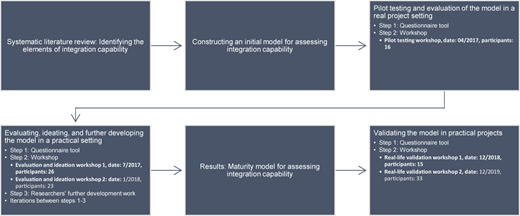
Research process: Development and evolution of the integration capability assessment model during the research activities
Research process: Development and evolution of the integration capability assessment model during the research activities
Systematic literature review
To identify the most essential integration mechanisms and systematically assess and classify the related capabilities, we performed a systematic literature review using a qualitative content analysis. Systematic literature review must be conducted in a systematic, explicit, and reproducible manner (Fink, 1998), and it is essential to identify keywords, publications, and databases, to identify high-quality studies by setting feasibility and methodological criteria, to read the literature and collect data in a standardized manner, to report on the review process and justify the methods to interpret the data, and to analyze and report on the findings (Fink, 1998). In qualitative content analysis, it is essential to read all the material to decide what part of the coding frame it belongs to, to use the same sequence of steps every time (Schreier, 2012), and to specify the main categories and subcategories either deductively or inductively (Schreier, 2012). In this study, the categories were developed inductively.
Our systematic literature review process began with a keyword search (“integration” and “project”) of the titles, abstracts, or keywords in the Scopus and Science Direct databases. We limited the publication years to 2000–2021. The purpose of the keywords used was to identify potential papers addressing integration mechanisms—thus, dimensions of integration capability—but the final decisions were made in the qualitative content analysis phase. The journals we targeted were key leading project management journals and a leading journal covering construction management: International Journal of Project Management (IJPM), Project Management Journal (PMJ), International Journal of Managing Projects in Business (IJMPiB), and Construction Management and Economics (CME). The initial keyword search resulted in 198 hits. A comprehensive Excel database was created for the articles.
Since our focus was on integration, especially in inter-organizational project networks, we excluded papers that considered, for example, integration in intra-organizational projects, integration within project-based organizations, or integration in program or portfolio management. In addition, since high-quality literature reviews are based on evidence resulting from experimentation and systematic observation (Fink, 1998), we excluded opinions, such as conceptual papers and papers that did not include empirical work or a thorough literature analysis. The final sample consisted of 105 articles. Each paper was reviewed in terms of project integration mechanisms, as these are associated with integration capability dimensions. These identified mechanisms were coded and marked up in an Excel sheet. The codes were further analyzed and clustered into subcategories and then into the related key dimensions.
Empirical research method and data
The aim of the empirical part of this study was to grasp how the integration capability of a project network could be self-assessed in a practical setting at a certain point in time. We then elaborated and further developed the theoretical framework derived from the literature in a practical setting with experienced project practitioners and among ongoing projects. The empirical research answers the RQ The unit of analysis in our study was an inter-organizational project network (Grabher, 2002; Manning, 2017) and inter-organizational projects (DeFillippi and Sydow, 2016), which are complex (Chakkol et al., 2018), and have shadow of the past (Ligthart et al., 2016).
Data collection and analysis
During the solution design and evaluation phases (Ahlemann et al., 2013), the research data were collected through a questionnaire tool assessing different integration capability dimensions and through five evaluation workshops (one pilot tool testing and initial results evaluation workshop, two further evaluation and development workshops for the integration capability assessment model, and two integration capability assessment workshops in a practical project environment). Details of the workshops are presented in Figure 1. The initial role of the workshops was to test and develop the assessment model and respective tool with project practitioners, and later to gain data from using the model in a practical setting. The elements of the questionnaire tool that we developed, the respective maturity model, in addition to the outcomes of integration capability assessments in practical project environments are presented in the results section. The questionnaire tools were filled in by project practitioners, who were also the workshop participants, and the respective workshops took place between 2017 and 2020.
The development of the model for assessing integration capability and the related questionnaire tool for project practitioners was an iterative process. First, the researchers developed an initial assessment model based on the literature review. This pilot model was tested in a real construction project environment, and the results were evaluated in a workshop. Based on the initial results, the researchers further developed the model, which was again tested in a practical construction project setting and evaluated in a workshop; these iterations took place twice. In the last stage, the final integration capability assessment maturity model was used and evaluated in a practical project setting in an industrial engineering project and a mining project. The model does not include field-specific things, which allowed it to be tested, evaluated, and validated in different industries.
During the workshops, experienced project managers and project participants involved in complex projects ideated, tested, evaluated, and used the integration capability assessment model in real project settings. Group discussions took place after practitioners had filled in the integration capability assessment tools, generating both practice-oriented propositions for further development of the assessment model and initiatives to develop the actual project practices taking place in real project settings. The researchers continued the development work on the assessment model and respective questionnaire tool between the workshops in an iterative manner.
Examples of the quotes from the project practitioners in the workshops:
The four main dimensions of integration capability resonate well with the experiences from the practical setting.
The classification into four dimensions of integration capability makes the self-assessment model easier to communicate.
Right and important themes have been chosen to be included in the assessment model.
Academic terminology is sometimes confusing.
The self-assessment model is suitable for developing the project activities.
It is very valuable to know where we as a project are at the moment. It enables us to develop the actions to achieve the next level.
One important realization that came from the development workshops was that maturity model scaling within each subcategory of the integration capability assessment model was introduced to reduce the subjectivity of the assessment; this stemmed from a query made by research participants, as they found it difficult to assess the actual level of project performance without an illustrative scale highlighting the levels and respective requirements of ideal and non-ideal performance.
Empirical context
Our empirical project sample consisted of three inter-organizational projects and one somewhat looser inter-organizational project network. All sample projects and project networks had a so-called shadow of the past, meaning that the project participants had some previous experience of working together (Ligthart et al., 2016) either in collaborative projects or in more traditional project settings. The sample consisted of complex projects, which have three characteristics: temporary project-based partnerships, highly complicated and unique, and ambiguous organizational structures and hierarchies involving multiple organizations and teams (Chakkol et al., 2018). The sample was collected from complex construction projects, industrial engineering projects, and mining sector projects, all of which include multiple operators from different sectors, such as builders and construction organizations, designers, industrial equipment suppliers, assemblers, and government officials. One sample project was a project alliance, two sample projects used traditional contracting, and the sample project network used some forms of integrated project delivery (IPD).
Systematic literature review to develop a framework for the integration capability dimensions and the associated integration mechanisms
Integration capability dimensions: integration mechanisms
Based on the systematic literature review, the following theoretical framework for the integration mechanisms and dimensions (i.e. integration capabilities) was identified. The framework developed in the systematic literature review is presented in Figure 2 and discussed in further detail below, in addition to tables demonstrating the identified literature sources related to each framework category and subcategory. Altogether, the integration mechanisms in inter-organizational project networks were divided into four main categories representing the integration capability dimensions: administrative, organizational, and contractual; behavioral and relationship-based; technological and process; and the capability for continuous management and the adaptation of integration and collaboration. The theoretical framework presented forms the basis for creation a practical integration capability self-assessment model, presented in the results section.
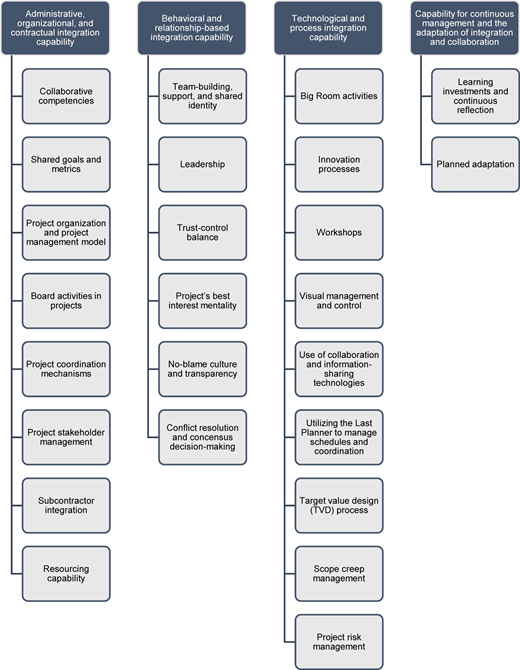
Integration capability dimensions: Integration mechanisms identified in the literature
Integration capability dimensions: Integration mechanisms identified in the literature
Administrative, organizational, and contractual integration capability
Administrative, organizational, and contractual integration capability building forms the basis of the integration capability of an inter-organizational project network and mostly addresses the coordination integration challenge. The literature tackling the topic is elaborated in the text, and for a comprehensive listing of all the literature sources and respective classification into subcategories, see Table 1. Building collaborative behavior, encouraging and supporting the building of a collaborative culture, is one approach toward improving project outcomes in complex projects (Brady and Davies, 2014) and supporting integration through collaborative competencies. Building shared goals and respective metrics to guide project network integration is also essential, as the alignment of interests and objectives is one of the most influential drivers of project performance (Mesa et al., 2016).
Administrative, organizational, and contractual integration capability
| Main dimension | Subcategory | Integration mechanisms identified in the literature |
|---|---|---|
| Administrative, organizational, and contractual integration capability | Collaborative competencies | Cultural barriers can impact both the adoption and implementation of partnering (Mollaoglu et al., 2015) |
| Collaborative practices as an antecedent for project performance through team-working quality (Suprapto et al., 2015b) | ||
| Well-known IPD process as a cornerstone for creating integrated teams (Aapaoja et al., 2013) | ||
| A collaborative relationship is a crucial factor in contractual arrangements (Ndoni and Elhag, 2010) Collaborative behaviors (Brady and Davies, 2014) Collaborative working leads to knowledge integration in an informal relationship not based on contractual commitment (Ruan et al., 2012) | ||
| Shared goals and metrics | Goal setting as a planned integration mechanism related to formal governance (Hietajärvi et al., 2017a, b) Defining objectives for relationship management as a critical success factor (Zou et al., 2014) | |
| Alignment of interests and objectives as the most influential drivers of project performance (Mesa et al., 2016) | ||
| Contractual model influencing key risk indicators (KRIs) of team integration (Khairil et al., 2015) | ||
| Operational monitoring influences the KRIs of team integration (Khairil et al., 2015) | ||
| Standardized forms for reporting results supporting knowledge integration (Enberg, 2012) | ||
| Monitoring as a control-oriented practice in supplier integration (Martinsuo and Ahola, 2010) | ||
| A causation model for guiding project governance actions (Cardenas et al., 2017) | ||
| Integrating project baseline scheduling, schedule risk analysis, and project control to control project time performance (Vanhoucke, 2012) | ||
| Technical dimension of systems integration, integration of technical and contractual elements (Liinamaa and Gustafsson, 2010) | ||
| Flexible contractual arrangements as a part of system integration (Davies and Mackenzie, 2014) | ||
| Integrating sustainability into the operational level through a common framework (Matar et al., 2008) | ||
| Client's proactive role in choosing procurement approach and contractual conditions, creating incentives and balance between control and flexibility (Rahman and Kumaraswamy, 2005) | ||
| Coherent, explicit standards and organizing mechanisms as collaborative practices (London and Pablo, 2017) | ||
| Design of profit-sharing mechanisms have an ability to manage uncertainty to a great extent (Guo et al., 2021) | ||
| Social sustainability integration (Goel et al., 2020) | ||
| Project organization and project management model | Written policies and decision-making plans as a planned integration mechanism related to formal governance, in addition to organization charts and job descriptions (Hietajärvi et al., 2017a, b) | |
| Early establishment of integrative work practices (Buvik and Rolfsen, 2015) | ||
| Planning and process specifications supporting knowledge integration (Enberg, 2012) | ||
| Boundary objects as a control-oriented practice in supplier integration (Martinsuo and Ahola, 2010) | ||
| Defining the partnering scope between transactional and relational as a strategy for initiating building information modeling (BIM)-related supply chain management (SCM) (Papadonikolaki et al., 2017) | ||
| Benefits of combining project management and change management early in the project life cycle (Gordon and Pollack, 2018) | ||
| Board activities in projects | Coordinating bodies as a planned integration mechanism related to organizational and relational arrangements (Hietajärvi et al., 2017a, b) | |
| Coordinating body as an integration mechanism (Artto et al., 2016) | ||
| Top management control of both process and knowledge content integration (Enberg, 2012) | ||
| Commitment from the project alliance board is a key indicator (KI) for team-integration performance (Ibrahim et al., 2013) | ||
| Project coordination mechanisms | Knowledge integration refers to the exchange of knowledge to all stakeholders and project parties and the sharing of previous and current knowledge (Demirkesen and Ozorhon, 2017) | |
| Integration of the divisions as a critical success factor of relationship management (Zou et al., 2014) | ||
| Professional boundary action as a renewal initiative (Gustavsson and Gohary, 2012) | ||
| Communication as the most influential driver of project performance (Mesa et al., 2016) | ||
| Project action boundary, project knowledge boundary, and project social boundary allow for successful knowledge integration (Ratcheva, 2009) | ||
| By appropriately managing social capital coordination and knowledge, integration can be increased (Di Vincenzo and Mascia, 2012) | ||
| Integrative persons as a cooperation-oriented practice in supplier integration (Martinsuo and Ahola, 2010) | ||
| A process for processing client requirements simultaneously with setting up the project organization (Kamara et al., 2001) | ||
| Reducing life-cycle costs by integrating planning, construction, and operations (Kleiss and Imura, 2006) | ||
| Standardized processes as a part of system integration and meta-system integration (Davies and Mackenzie, 2014) | ||
| Systems integration focusing on the systems that projects deliver, and on the contexts of use (Whyte and Davies, 2021) | ||
| Improved safety by integrating design and construction through communication and cooperation, and a positive relationship (Atkinson and Westall, 2010) | ||
| Knowledge integration and activity coordination simultaneously influence the project execution (Klessova et al., 2020) | ||
| A choice of project control modes improves knowledge integration (Lin et al., 2019) | ||
| Project stakeholder management | Stakeholder boundary action as a renewal initiative (Gustavsson and Gohary, 2012) | |
| Early involvement and assessment of stakeholders as a cornerstone for creating integrated teams (Aapaoja et al., 2013) | ||
| A network perspective strategy and consideration given to project relationships (Ndoni and Elhag, 2010) | ||
| Early involvement of participants and coordination are key to integrating design and construction (Austin et al., 2002) | ||
| Improved risk management through understanding stakeholders' socio-cultural context (Dyer, 2017) | ||
| Continuous adjustment of legislative framework (Kleiss and Imura, 2006) | ||
| Stakeholder management as a part of meta-system integration (Davies and Mackenzie, 2014) | ||
| Early involvement of suppliers and architect participation as a strategy for initiating BIM-related SCM (Papadonikolaki et al., 2017) | ||
| Aligning the stakeholders around a vision of the meta-project and active meta-project management (Alderman and Ivory, 2010) | ||
| Evaluating and managing a social license among stakeholders (Boutilier and Zdziarski, 2017) | ||
| Multi-stakeholder engagement in all project phases (Miković et al., 2020) | ||
| Sustainability considerations in relation to stakeholder management (Sabini et al., 2019) | ||
| Subcontractor integration | Integration of suppliers into the processes and knowledge-sharing mechanisms (Demirkesen and Ozorhon, 2017) | |
| Subcontractor smallness as a driver for informal collaboration (Aagaard et al., 2014) | ||
| Supplier selection as a control-oriented practice in supplier integration (Martinsuo and Ahola, 2010) | ||
| Communication and information sharing in addition to sustainable procurement plans (Zuo et al., 2009) | ||
| Strong client leadership to drive subcontractor integration and transparent and mutually beneficial processes for all parties in the supply chain (Dainty et al., 2001) | ||
| A strategic plan and consideration of critical success factors are essential for successful implementation of a commercial information exchange system (Pala et al., 2016) | ||
| BIM-competence partner selection as a strategy for initiating BIM-related SCM (Papadonikolaki et al., 2017) | ||
| Technology cluster management as an approach to integrating the supply chain (Al-Bizri and Gray, 2010) | ||
| Early involvement of specialists as a best practice (Glass, 2005) | ||
| Decision-making model for supply chain optimization and supply-chain management strategies (Le et al., 2021) | ||
| Resourcing capability | Integration of project staff into the current processes (Demirkesen and Ozorhon, 2017) | |
| Clear role expectations (Buvik and Rolfsen, 2015) | ||
| Alternative resource-allocation strategy (Zerjav, 2015) |
To achieve inter-organizational project network integration through a common project organization and management model, written policies on integration mechanisms, decision-making plans, organization charts, job descriptions (Hietajärvi et al., 2017a), and the early establishment of the respective integrative work practices (Buvik and Rolfsen, 2015) are essential. The importance of coordinating bodies as integration mechanisms (Artto et al., 2016; Hietajärvi et al., 2017a) is a finding that stresses the overall importance of board activities in projects. Project coordination mechanisms building the administrative, organizational, and contractual integration capability were also identified in the literature, and many were related to knowledge integration (Atkinson and Westall, 2010; Demirkesen and Ozorhon, 2017; Di Vincenzo and Mascia, 2012; Ratcheva, 2009; Zou et al., 2014). Professional boundary action, as a renewal initiative (Gustavsson and Gohary, 2012), was recognized in relation to project coordination.
Project stakeholder management was extensively discussed in the project integration literature. In addition, stakeholder boundary action was identified as a renewal initiative (Gustavsson and Gohary, 2012). Finally, alternative resource-allocation strategies (Zerjav, 2015), thus a resourcing capability as a part of the overall administrative, organizational, and contractual integration capability, were distinguished based on the literature.
Behavioral and relationship-based integration capability
The characteristics we classified as the behavioral and relationship-based integration capability can be viewed as the softer side of inter-organizational integration, as it relates to the cooperation integration challenge. A comprehensive listing of the literature sources covering the topic and the related subcategories are found in Table 2 and elaborated here.
Behavioral and relationship-based integration capability
| Main dimension | Subcategory | Integration mechanisms identified in the literature |
|---|---|---|
| Behavioral and relationship-based integration capability | Team-building, support, and shared identity | Fostering a cooperative culture and relational practices is a planned integration mechanism related to organizational and relational arrangements (Hietajärvi et al., 2017a, b) |
| External image and an internal identity as integration mechanisms (Artto et al., 2016) | ||
| Integrated team approach creating value for money in purchasing power parity (PPP) (Clifton and Duffield, 2006) | ||
| Joint capability and structure perspective to improve relationships (Suprapto et al., 2015b) | ||
| Project team-related barriers can impact successful implementation of partnering (Mollaoglu et al., 2015) | ||
| Team-working as the most influential driver of project performance (Mesa et al., 2016) | ||
| Team's joint capability as an antecedent for project performance through team-working quality (Suprapto et al., 2015a) | ||
| Team formation influencing the KRIs of team integration (Khairil et al., 2015) | ||
| Single team focus and objectives, and seamless operation without organizational boundaries (Baiden and Price, 2011) | ||
| Team-building improves mechanical productivity (Shan et al., 2011) | ||
| Project team collaboration and integration as innovation-leading indicators (Gambatese and Hallowell, 2011) | ||
| Client's proactive role in choosing team members and early involvement of selected members (Rahman and Kumaraswamy, 2005) | ||
| Shared understanding in integrating the divergent knowledge of individual team members and support collaborative knowledge building (McCarthy et al., 2021) | ||
| Behavioral integration and engagement to collaborative interactions of the top management team as a critical success factor (Wang et al., 2021) | ||
| Task, team and individual needs affect the development of an integrated team (Jones et al., 2021) | ||
| Leadership | Commitment and participation of senior executives as a critical success factor for relationship management (Zou et al., 2014) | |
| Senior leadership pair perspective to improve relationships (Suprapto et al., 2015a) | ||
| Relational attitudes of senior management as an antecedent for project performance through team-working quality (Suprapto et al., 2015a) | ||
| Commitment from top management is a KI for successful team integration (Khairil et al., 2015) | ||
| Strong client leadership and capabilities (Brady and Davies, 2014) | ||
| Owner influence and upper management support as innovation-leading indicators (Gambatese and Hallowell, 2011) | ||
| Team leadership is a KI for team-integration performance (Ibrahim et al., 2013) | ||
| Client's proactive role in creating basis for the emergence of relational integration (Rahman and Kumaraswamy, 2005) | ||
| Trust–control balance | Execution-focused team perspective, build on trust and contractual targets, to improve relationships (Suprapto et al., 2015a) | |
| Trust as the most influential driver of project performance (Mesa et al., 2016) | ||
| Trust and good chemistry, and a previously successful collaboration history as drivers for informal collaboration (Aagaard et al., 2014) | ||
| Promoting ethical and trustworthy behavior increases trust and thus integration in the supply chain (Manu et al., 2015) | ||
| Shared climate of trust (Buvik and Rolfsen, 2015) | ||
| Trust and respect are KIs for successful team integration (Khairil et al., 2015) | ||
| Good relationships and trust as a team-integration practice (Baiden et al., 2006) | ||
| Impact of national culture (Bony, 2010) | ||
| Trust as a cooperation-oriented practice in supplier integration (Martinsuo and Ahola, 2010) | ||
| Trust and respect are KIs for team-integration performance (Ibrahim et al., 2013) | ||
| Developing an ethos of trust as a best practice (Glass, 2005) | ||
| Procurement-specific and dyad-specific factors mediate in turning project trust into project performance (Jagtap and Kamble, 2020) | ||
| Level of trust between team members effects the degree of collaboration and project management success (Bond-Barnard et al., 2018) | ||
| “Project's best interest” mentality | Development of a common philosophy (Buvik and Rolfsen, 2015) | |
| A single team focus on goals and objectives is a KI for successful team integration (Khairil et al., 2015) | ||
| Cultural change as a cornerstone for creating integrated teams (Aapaoja et al., 2013) | ||
| Project culture of working toward a common goal as a team-integration practice (Baiden et al., 2006) | ||
| Committed relationships in collaborative working connect all organizations tightly in a knowledge-supporting network (Ruan et al., 2012) | ||
| No-blame culture and transparency | Open communication (Buvik and Rolfsen, 2015) | |
| No-blame culture is a KI for successful team integration (Khairil et al., 2015) | ||
| Free-flowing communication is a KI for successful team integration (Khairil et al., 2015) | ||
| Continuous communication and interaction as a cornerstone for creating integrated teams (Aapaoja et al., 2013) | ||
| No-blame culture as a team-integration practice (Baiden et al., 2006; Baiden and Price, 2011) | ||
| Unrestricted sharing of information (Baiden and Price, 2011) | ||
| Communication as an innovation-leading indicator (Gambatese and Hallowell, 2011) | ||
| Free-flowing communication as a KI for team-integration performance (Ibrahim et al., 2013) | ||
| Dynamic project environments, high project team integration, and high interdependence between project tasks lead to high individual psychological empowerment (Tuuli, 2018) | ||
| Mutual support and responsibility sharing | Shared team responsibility perspective to improve relationship (Suprapto et al., 2015a) | |
| Gain–pain sharing as the most influential driver of project performance (Mesa et al., 2016) | ||
| The teamwork principle influences the KRIs of team integration (Khairil et al., 2015) | ||
| Collective understanding is a KI for team-integration performance (Ibrahim et al., 2013) | ||
| Championing, shared goals, a comprehensive pool of skills, and openness to change as collaborative practices (London and Pablo, 2017) | ||
| A shared sense of purposefulness (Çıdık and Boyd, 2020) | ||
| Positive association between shared project mission, mutual trust, mutual influence and knowledge integration (Rauniar et al., 2019) | ||
| Conflict resolution and consensus decision-making | Equitable team relationships and respect for all as a team-integration practice (Baiden et al., 2006; Baiden and Price, 2011) | |
| Collaborative problem-solving strategy (Zerjav, 2015) | ||
| Unanimous decision-making as a strategy for initiating BIM-related SCM (Papadonikolaki et al., 2017) | ||
| Single team focus on project objectives and key result areas are KIs for team-integration performance (Ibrahim et al., 2013) |
One key subcategory in the literature was team-building, support, and shared identity, whereas external image and internal identity (Artto et al., 2016), and fostering a cooperative culture and relational practices (Hietajärvi et al., 2017a) were identified as integration mechanisms, in addition to joint capability and structure (Suprapto et al., 2015b), and shared understanding (McCarthy et al., 2021). Integration capabilities can be assessed through the lens of team-building integration mechanisms, especially through a single team focus and objectives (Baiden and Price, 2011), in addition to pinpointing team-working as the most influential driver of project performance (Mesa et al., 2016) and innovation (Gambatese and Hallowell, 2011). In addition, the importance of the client's proactive role in choosing team members and the early involvement of the selected members (Rahman and Kumaraswamy, 2005) were stressed.
Another important subcategory affecting the behavioral and relationship-based integration capability was leadership. The commitment and participation of senior executives is a critical success factor in relationship management (Zou et al., 2014) and team integration (Ibrahim et al., 2015). In turn, the different origins of leadership promoting integration existed in the literature, such as strong client leadership and capabilities (Brady and Davies, 2014; Rahman and Kumaraswamy, 2005), owner influence (Gambatese and Hallowell, 2011), and team leadership (Ibrahim et al., 2013). Furthermore, a trust–control balance was stressed, especially regarding the importance of developing trust and respect (Baiden et al., 2006; Buvik and Rolfsen, 2015; Glass, 2005; Martinsuo and Ahola, 2010) as integrative practices. Notably, trust and good chemistry within the inter-organizational project network were linked to previously successful collaboration histories (Aagaard et al., 2014).
One of the positively connotated subcategories—the project's best interest mentality—arises from the cultural change within integrated teams (Aapaoja et al., 2013), involving the development of a common philosophy (Buvik and Rolfsen, 2015), and creating practical team integration through a project culture of working toward a common goal (Baiden et al., 2006). A no-blame culture (Baiden et al., 2006; Baiden and Price, 2011; Ibrahim et al., 2015) and transparency, in the form of free-flowing information (Aapaoja et al., 2013; Buvik and Rolfsen, 2015; Gambatese and Hallowell, 2011), were also widely discussed.
Mutual support and responsibility sharing as an integration mechanism, culminating in behavioral and relationship-based integration capabilities, may take the form of gain–pain sharing (Mesa et al., 2016), for example, and may be practically enhanced through championing, shared goals, a comprehensive pool of skills, and openness toward change (London and Pablo, 2017). Conflict resolution and consensus decision-making have the capacity to enhance integration capabilities through collaborative problem-solving strategies (Zerjav, 2015), unanimous decision-making (Papadonikolaki et al., 2017), and equitable relationships (Baiden et al., 2006).
Technological and process integration capability
The technological and process integration capability refers to the tools, processes, and practices operating as integration mechanisms within an inter-organizational project network, thus enhancing the integration capability in the respective area. For details of the literature sources referred to, see Table 3, with a summary below.
Technological and process integration capability
| Main dimension | Subcategory | Integration mechanisms identified in the literature |
|---|---|---|
| Technological and process integration capability | Big room activities | Co-location in the Big Room as a planned integration mechanism related to organizational and relational arrangements (Hietajärvi et al., 2017a, b) |
| Geographical boundary action in the form of joint offices as a renewal initiative (Gustavsson and Gohary, 2012) | ||
| Creation of a single, co-located team (Baiden and Price, 2011) | ||
| Team processes as a cooperation-oriented practice in supplier integration (Martinsuo and Ahola, 2010) | ||
| Co-located teams as a part of system integration (Davies and Mackenzie, 2014) | ||
| Strategic co-locations as a strategy for initiating BIM-related SCM (Papadonikolaki et al., 2017) | ||
| Creation of a single co-located team is a KI for team-integration performance (Ibrahim et al., 2013) | ||
| Investment in relationships, shared spaces, and mutual problem-solving as collaborative practices (London and Pablo, 2017) | ||
| Innovation processes | Integrating forward in the value stream from the customer to the project (Kirsila et al., 2007) | |
| Defined processes for collaborative working, such as innovation management as a planned integration mechanism related to formal governance (Hietajärvi et al., 2017a, b) | ||
| Incentives to foster ongoing innovations in PPP (Clifton and Duffield, 2006) | ||
| Innovative approaches (Brady and Davies, 2014) | ||
| Successful implementation of renewable energy technologies through the social construction of the technology approach between relevant social groups (Boyd et al., 2015) | ||
| Innovation champion as an innovation-leading indicator (Gambatese and Hallowell, 2011) | ||
| Diffusion of innovation through external lateral and vertical communication and external integration (Widén and Hansson, 2007) | ||
| Managing the innovation paradox through temporal separation and contextual ambidexterity (Liu et al., 2012) | ||
| Integration of environmental principles (Li et al., 2020) | ||
| Workflow analysis and governance tools enhancing the value creation through innovation and systems integration capabilities (Eriksson et al., 2019) | ||
| Workshops | Inter-organizational meetings and working sessions as a planned integration mechanism related to organizational and relational arrangements (Hietajärvi et al., 2017a, b) | |
| Practitioner's underestimation of the potential of early value-management workshops (Ellis et al., 2005) | ||
| Visual management and control | Visual tools as planned integration mechanisms related to technological systems, such as the use of Last Planner and visual process maps in the Big Room (Hietajärvi et al., 2017a, b) | |
| Decision support systems should be model-driven and function as early warning systems, utilizing visual tools (Hazir, 2015) | ||
| Graphical technique for integrating cost range estimating and probabilistic scheduling (Isidore et al., 2001) | ||
| Integrating time and cost management in an IT system accessible for SMEs (Perera and Imriyas, 2004) | ||
| The use of collaboration and information-sharing technologies | Knowledge integration includes the input of all data into the current knowledge-transfer system (Demirkesen and Ozorhon, 2017) | |
| Project bank, visual, and virtual tools as planned integration mechanisms related to technological systems (Hietajärvi et al., 2017a, b) | ||
| BIM as an integrative technology (Oraee et al., 2017) | ||
| Small and medium-sized projects gain more project success from technology usage than large projects do (Yang et al., 2006) | ||
| Evaluation of risks related to application outsourcing (Currie, 2003) | ||
| Sufficient estimation of the efforts related to electronic-application integration projects (Wagner et al., 2017) | ||
| Integration of electronic commerce and information (Wang et al., 2007) | ||
| A tool for evaluating the state of system integration (Magnaye et al., 2014) | ||
| A 5D BIM-based framework for cash flow analysis and project financing (Lu et al., 2016) | ||
| Use of digital technologies (Brady and Davies, 2014) Automation and integration of information systems improving mechanical productivity (Shan et al., 2011) | ||
| Integrating health and safety issues into management tools for all members of the project team (Cameron and Hare, 2008) | ||
| Effective management of explicit and tacit knowledge as a best practice (Glass, 2005) | ||
| Partial, stepwise integration of BIM systems for facility maintenance (Korpela et al., 2015) | ||
| BIM-based collaboration includes both structural collaboration and agential aspects of knowledge sharing and innovation (Papadonikolaki et al., 2019) | ||
| Utilizing the last planner to manage schedules and coordination | Last Planner as a visual tool enabling technological systems-related planned integration mechanisms (Hietajärvi et al., 2017a, b) | |
| The target value design (TVD) process | Open-book delivery in a PPP project (Clifton and Duffield, 2006) | |
| Client satisfaction during the course of a project as a driver for informal collaboration (Aagaard et al., 2014) | ||
| Service innovations through integrating a service-providing organization and the users of the service (Bygstad and Lanestedt, 2009) | ||
| Pre-project planning improving mechanical productivity (Shan et al., 2011) | ||
| Client's requirements' value specificity leads to project goal specificity, which improves project outcomes when integrated with conflict resolution (Leung and Liu, 2003) | ||
| Scope creep management | Use of integrative activities reflects the priorities between cost, time, and scope (Ahola et al., 2017) | |
| Integration of project control and forecasting mechanisms (Batselier and Vanhoucke, 2017) | ||
| Integration of project completion estimates and knowledge sources (Caron et al., 2013, 2016) | ||
| Predicting implementation cost contingencies (Van et al., 2019) | ||
| Project risk management | In the bundled PPP model, all risks are retained by the concessionaire (Carpintero and Petersen, 2015) | |
| Efficient risk allocation among project partners in PPP projects creates value for money (Clifton and Duffield, 2006) | ||
| Organizational barriers related to unfair risk sharing can impact the adoption of partnering (Mollaoglu et al., 2015) | ||
| Risks and the related costs of not minimizing the risks as a driver for informal collaboration (Aagaard et al., 2014) | ||
| Risks associated with coordination of on-site and off-site project dimensions cause the most significant deviations from project objectives (Arashpour et al., 2017) | ||
| Integrated risk management of on-site and off-site uncertainties (Arashpour et al., 2016) | ||
| Quantifying project risks in financial terms and treating risks as costs for the project (Espinoza, 2014) | ||
| Integrating safety risk data into project schedules (Esmaeili and Hallowell, 2013) | ||
| Project financial risk evaluation and management using decoupled net present value (DNPV) (Espinoza and Morris, 2013) | ||
| Plotting safety risk over time by integrating safety risk data with the schedule (Hallowell et al., 2011) | ||
| Integration of risk management into logical framework approach into project management (Rodríguez-Rivero et al., 2021) | ||
| Integration of capabilities at transitions to balance the risks (Abd Razak et al., 2020) |
Collaborative co-locational space (i.e. Big Room activities as a key integrative practice) was an area where the project and construction management literature was in strong agreement (Baiden and Price, 2011; Davies and Mackenzie, 2014; Gustavsson and Gohary, 2012; Hietajärvi et al., 2017a; Ibrahim et al., 2013; London and Pablo, 2017; Papadonikolaki et al., 2017). Conversely, when it comes to the subcategory of workshops, the practitioner's underestimation of the potential of early value-management workshops was highlighted (Ellis et al., 2005), even though inter-organizational meetings and working sessions are noted as a planned integration mechanism (Hietajärvi et al., 2017a). Innovation processes as an activity to improve integration capabilities was identified in the literature through, for example, incentives fostering ongoing innovations (Clifton and Duffield, 2006), innovation champions (Gambatese and Hallowell, 2011), or the diffusion of innovation through external lateral and vertical communication and external integration (Widén and Hansson, 2007).
Visual management and control can be used as a technology-enhancing inter-organizational integration capability (Isidore et al., 2001; Perera and Imriyas, 2004) in the form of Last Planner technology to manage schedules and coordination (Hietajärvi et al., 2017a). In addition, using collaboration and information-sharing technologies (Brady and Davies, 2014), such as building information modelling (BIM) (Korpela et al., 2015; Lu et al., 2016; Oraee et al., 2017), were mentioned in the literature.
Scope creep management—using integrative practices reflecting the priorities between cost, time, and scope (Ahola et al., 2017)—can be enhanced through integrating project control and forecasting mechanisms (Batselier and Vanhoucke, 2017), for example. The literature also identified an area, which we classified as inter-organizational project network risk management, as a key integration mechanism (Aagaard et al., 2014; Arashpour et al., 2016, 2017; Mollaoglu et al., 2015).
Capability for continuous management and the adaptation of integration and collaboration
We subcategorized the capability for continuous management and the adaptation of integration and collaboration into two: planned adaptation, and learning investments and continuous reflection. A comprehensive listing of the literature sources is found in Table 4.
Capability for continuous management and the adaptation of integration and collaboration
| Main dimension | Subcategory | Integration mechanisms identified in the literature |
|---|---|---|
| Capability for continuous management and the adaptation of integration and collaboration | Learning investments and continuous reflection | Prospects for future collaboration as a driver for informal collaboration (Aagaard et al., 2014) |
| Cooperative benchmarking (Li et al., 2001) | ||
| Improving project learning through an event-based approach, which codifies lessons learned and promotes the measurement of benefits (Fuller et al., 2011) | ||
| Suppliers actively participate in integration when motivated by future collaboration (Ahola et al., 2017) | ||
| An outcome-driven approach (Brady and Davies, 2014) | ||
| Safety improves mechanical productivity (Shan et al., 2011) | ||
| Education of BIM and SCM, diffusion of SCM philosophy, and learning sessions as strategies for initiating BIM-related SCM (Papadonikolaki et al., 2017) | ||
| Lessons learned as an innovation-leading indicator (Gambatese and Hallowell, 2011) | ||
| Systematic collection and use of defect data through a plan–do–check–act (PDCA) cycle enabling quality improvements (Lundkvist et al., 2014) | ||
| Planned adaptation | Integration of changes through evaluation of change requests and making respective modifications (Demirkesen and Ozorhon, 2017) | |
| Flexibility and responsiveness to change as a team-integration practice (Baiden et al., 2006) | ||
| All integrative activities used by suppliers are emergent (Ahola et al., 2017) | ||
| Social dimension of system integration and customer integration (Liinamaa and Gustafsson, 2010) | ||
| The ability to be adaptive and responsive (Brady and Davies, 2014) |
Learning investments and continuous reflection is an integrative practice through, for example, codifying lessons learned and promoting the measurement of benefits (Fuller et al., 2011). Also, the prospect for future collaboration (Aagaard et al., 2014; Ahola et al., 2017) was noted as an integration mechanism within an inter-organizational project network and as a component of the respective learning capability building. Planned adaptation may take the form of, for example, change integration (Demirkesen and Ozorhon, 2017), or flexibility and responsiveness (Baiden et al., 2006), and the ability to be adaptive and responsive (Brady and Davies, 2014).
Results
In this section, we describe the results gained during the empirical research process. Overall, the empirical data supported the existence and practical importance of the integration capability dimensions identified in the literature review, which were also presented in the form of a theoretical framework. Below we summarize a practical integration capability self-assessment maturity model created during the research process. A summary of the findings is presented below.
Model for assessing the integration capability in an inter-organizational project network
The model for assessing integration capabilities in inter-organizational project networks is divided into four main categories, as identified in the literature review: administrative, organizational, and contractual integration capability; behavioral and relationship-based integration capability; technological and process integration capability; and the capability for continuous management and the adaptation of integration and collaboration. All these categories are divided into subcategories and are presented in Figure 2, with the key elements describing the maturity levels being covered in each section.
Administrative, organizational, and contractual integration capability
Collaborative competencies lay the basis for integration capability through collaborative working, practices, and collaborative behaviors that together enable collaboration between project participants. When assessed based on a maturity scale, optimizing mature level project network organizations understand the significance of interdisciplinary collaboration, respecting different opinions and aspiring to understand the views of other parties. In addition, unnecessary barriers and hierarchies are removed between project participants. Conversely, at an initial maturity level, projects are characterized by a culture of individual competition. Each organization's own goals are focal even in collaborative projects, which is why collaboration between companies may even end in finger-pointing.
Shared goals and the metrics of inter-organizational project networks operate as an integrative mechanism, and are thus an essential building block in creating integration capability. Optimizing mature level organizations have well-defined processes for goal setting and metric formulation, and the metrics guide the development of project activities. Conversely, if the maturity level is initial, there is no commitment to shared goals within the organization, and project activities are solely guided by optimizing each participant's efforts.
Defining the project's organization and project management model creates an integration capability through integrative work practices and supplier integration, for example. At an optimizing maturity level, the project's actors have a clear understanding of their roles, responsibilities, and task descriptions. At an initial maturity level, organizations rush the project execution without properly planning the project's organization.
Board activities in projects build the integration capability, and a key to integrating the project parties is top management commitment. An indicator of optimizing maturity in board activities is a relatively small coordinating body, which has been allocated sufficient time, expertise, and resources to focus on the management work. Initial maturity project network organizations, in turn, have large boards operating unsystematically and inefficiently.
Project coordination mechanisms, as a part of the integration capability, refer to the activities related to enhancing communication and knowledge integration and the use of integrative persons between project participants. At an optimizing maturity level, project coordination is considered from the perspective of interdependency management and knowledge integration, whereas an insufficient information flow between technical problem fields and problems in accessing the information indicate an initial maturity level.
Project stakeholder management, from the perspective of the early involvement of key stakeholders, is one essential integration capability. In an optimizing mature level project network, there are defined processes and clear responsibilities for stakeholder management, identified stakeholder needs, and empowered key stakeholders involved in project activities. Initial maturity is demonstrated by randomness and reactive actions toward stakeholder needs that arise.
Subcontractor integration in the processes and knowledge-sharing mechanisms of an inter-organizational network is also an integration capability. Optimizing maturity level networks encourage and ensure suppliers work toward collaborative goals. At an initial maturity level, traditional contracts are used with no collaborative goal incentives.
Resourcing capability relates to resourcing processes and practices. An optimizing maturity level is manifested by sufficient, competent, and timely allocated resources. At an initial maturity level, resourcing activities are random and driven by unnecessary competition and rivalries.
Behavioral and relationship-based integration capability
Team-building, support, and a shared identity as a part of the integration capability are tied to the level of team integration and collaboration—the more integrated the project team is, the better the project outcomes are. At an optimizing maturity level, the project team shares an identity, works toward common goals, and every member is equally appreciated. Instead, with initial maturity, team members advance their personal goals, which differ from the project goals.
Leadership, in the form of relational attitudes, commitment, and management participation, creates an integration capability. If maturity is optimizing in an inter-organizational project network, managers are competent, motivating, and show leadership in tackling challenging situations. In addition, the project team is supported by the top management and the necessary resources are allocated. Initial maturity is indicated by confusion, bottlenecks, and unethical and individual behavior in decision-making.
The trust–control balance is also a critical aspect of the integration capability. At an optimizing maturity level, project actors trust each other and parties working toward common goals, without control. When maturity is initial, mistrust and power struggles prevail.
The project's best interest mentality is a cultural matter, and when maturity is high, actions and decisions are made only with the project's best interests in mind, even though all actions do not directly benefit some project parties. At an initial maturity level, project parties work toward their home organization's goals, which differ from project goals.
A no-blame culture and transparency are important for an integrative capability and are related to interpersonal relationships and information sharing. At an optimizing maturity level, problems are collectively identified and solved without finding someone to blame. Errors are allowed. If maturity is initial, a single party is solely responsible for problem solving, and individuals are blamed for errors. Information is not freely available.
Mutual support and responsibility sharing at an optimizing maturity level is manifested by project actors having the knowledge, opportunities, and competencies to make decisions in the project's best interests. Gains and pains are shared between project participants, whereas at an initial maturity level, project actors only feel responsible for their own actions and do have the mentality to share information and teach each other.
Conflict resolution and consensus decision-making as an integration capability are only possible when the project participants share the same understanding of the state of the project and its operating environment. Where maturity is optimizing, a clear process for conflict resolution exists and project parties are able to resolve conflicts in a collaborative manner. In contrast, when maturity is initial, the threat of litigation is always present and conflicts often remain unsolved.
Technological and process integration capability
Big Room activities are an essential subcategory in integration capability creation through geographical boundary action. If maturity is optimizing, Big Room activities are planned, managed, and developed in a systematized manner, for example, through careful optimization of the co-located spaces, predefined Big Room schedules, and work facilitation. At an initial maturity level, experts work in silos, and Big Rooms are not perceived as constructive environments.
Innovation processes, at an optimizing maturity level, originate from encouraging a culture of innovation. In mature project network organizations, systematic processes for innovation activities exist, and ideas that arise are collected in a systematized way. A suitable incentive system is in place, in addition to the innovation coordinator role. Where maturity is initial, innovation activities are unsystematic and random, and seen as trivial. Innovation processes are not managed, and even if incentives are set, they fail to motivate.
Workshops, in contrast to ineffective meetings, are an integration mechanism in collaborative projects, thus forming a part of integration capability. At an optimizing maturity level, several workshop models and methods are available and used effectively, and project actors receive workshop training. When a workshop takes place, it is well-planned, facilitated, documented, and the results are communicated. In turn, when maturity is initial, project participants are unable to differentiate between workshops and regular meetings.
Visual management and control is a core element of collaborative projects. If maturity is optimizing, visual elements are systematically employed in strategic and operational project management. Project members feel that visual management facilitates the flow of information, whereas when maturity is initial, members are still learning to use visual management systems, which are not systematically in use, either.
Use of collaboration and information-sharing technologies is one aspect in which the creation of integration capabilities can be supported. The technologies used can be of various types, but a common feature at an optimizing maturity level is that technologies automate and facilitate effective project activities and support decision-making and knowledge sharing. At an initial maturity level, the use of technologies is situational, and the systems themselves are difficult and unintuitive to use. Information may be stored in a system, but it is difficult to find when needed.
Utilizing Last Planner to manage schedules and coordination is a separate component of integration capability based on the project practitioners' views in our research. An indicator of optimizing maturity is a clear and systematic process for using Last Planner, sufficient experience and offering training to use it, in addition to constant development of the Last Planner activities. When maturity is initial, the method is only used on individual occasions.
The target value design (TVD) process, as a collaborative design process involving clients, users, designers, builders, and key subcontractors, was another integration capability component identified by project practitioners and also by the literature. An optimizing maturity level is manifested by TVD workshops, organized in Big Room environments as integral to project activities. Work between parties is effortless. In turn, at an initial maturity level, a significant part of the project network organization does not understand the core benefits of the process nor is it fully familiar with it.
At an optimizing maturity level, scope creep management involves dedicating a person to examine project-related change processes in relation to scope creep. When maturity is optimizing, changes to the scope are also approved by the project board. If the maturity level is initial, the management process pays no attention to scope creep.
Project risk management has an evident part to play in integration capability building. When maturity is optimizing, the risk management process has a process owner who is supported by risk management coordinators. Risk management is an integral part of daily project activities, and risk owners are allocated whenever issues arise. The process also includes opportunity management. Initial maturity is manifested by randomness, and risks are not systematically monitored or prioritized.
Capability for continuous management and the adaptation of integration and collaboration
Learning investments and continuous reflection are essential for integration capability creation, whereas continuous reflection and a philosophy of continuous improvement are integral to collaborative projects. At an optimizing maturity level, project actors, also managers, actively reflect on their roles and contributions in relation to project goals. Tools are used to support the reflection process. If maturity is initial, reflection is not seen as valuable during other project activities.
Planned adaptation is the last element in our model for assessing integration capability. It refers to the ability to adapt both known and unknown factors in the project environment. When maturity is optimizing, actions and processes are adjusted flexibly and quickly whenever needed. In turn, at an initial maturity level, project activities are not actively nor sufficiently monitored and adjusted.
Practical validation: self-assessing integration capability in an inter-organizational project network
In this section, we only present the results from two projects used for validation purposes, since the integration capability assessment model itself was not further changed during the validation phase. In practice, self-assessing the integration capability of an inter-organizational project or project network took place in two phases. The first phase was a questionnaire assessing the maturity level of the elements related to integration capability, which was filled in individually by each selected key project practitioner. The second phase was an evaluation workshop, in which the collective results were summarized, analyzed, and further actions decided.
As Figures 3 and 4 show, the integration capability maturity level varied from one project to another, but the highest scores were found in a project network engaged in IPD. In contrast, lower maturity levels were found in a project using traditional contracting. The visual presentation of the results also helps to evaluate the state of the integration within projects in an easily approachable manner.
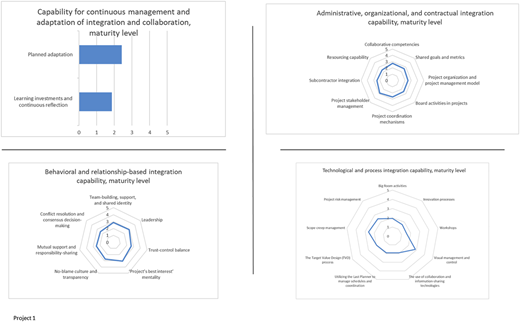
Elements of the integration capability and levels of maturity for the first evaluated project
Elements of the integration capability and levels of maturity for the first evaluated project
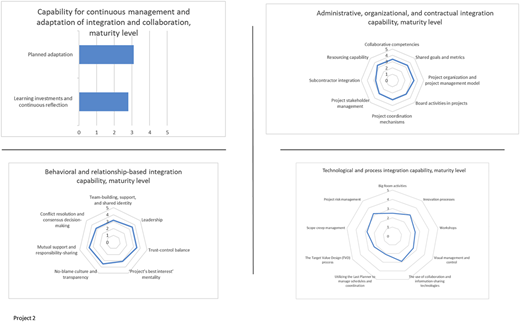
Elements of the integration capability and levels of maturity for the second evaluated project
Elements of the integration capability and levels of maturity for the second evaluated project
The practical experience of using collaborative project management practices varied significantly in the researched inter-organizational projects, project networks, and project management professionals. During the empirical work, there were indicators regarding the value of the integration capability self-assessment model not necessarily being in the outcomes of the assessment per se, but rather in the questions and insights it provoked among the project management professionals. Furthermore, it was noted that the whole process of assessing the integration capability operated as an integrative activity in itself. This included both the integrative effects of the workshops where the results from the self-assessment model were analyzed and the effects of individual project actors filling in the questionnaire prior to the evaluation workshop. For example, one identified integrative effect originated from the increased knowledge level, first, related to the elements of integration capability, and second, related to identifying optimizing mature level project activities. Overall, using the model provoked various insights among the participants related to enhancing project practices in action, thus operating as an integrative activity.
What we found during the model's practical application was that self-assessing the integration capability level could take place one or more times during a project. The knowledge gained from the analysis can be used to design integrative activities and interventions in strategically important or other selected areas, or simply to identify components that need focused on during projects. As the integration capability level is not static, as it fluctuates during different project phases, to get the most out of the assessment exercise, it should be conducted several times during a project, with results from previous rounds being compared and contrasted, and actions designed accordingly. If the integration capability level is assessed only once during a project, the most fruitful phase, according to our experiments, would be right at the beginning of the design or execution phase, whereby the results may initiate activities enhancing the integration between project participants, which eventually has the potential to improve project outcomes.
As a result, the practical application of the model proved that it actually worked in real project settings. The project practitioners felt both the self-assessment process and the respective results were insightful and provided essential information to further develop actual project practices. It also resulted in the notion that the model could be used as an integrative practice and as a tool for guiding improvements in project practices.
Conclusion and discussion
To conclude, the purpose of this study was, first, to identify the integration capability dimensions within inter-organizational project networks, and second, to explore how the integration capability in such networks can be self-assessed. The integration capability dimensions were elaborated through an extensive systematic literature review of project management- and construction management-related journals. Furthermore, a maturity model for self-assessing integration capability was developed in cooperation with project management professionals; the model was iteratively developed, tested, and validated in five practical project settings.
This study advances our understanding of the components of inter-organizational integration and the respective integration capabilities in temporary project network organizations, whereas the traditional integration literature (Galbraith, 1974; Lawrence and Lorsch, 1967) has mainly focused on the intra-organizational integration of manufacturing organizations (Bechky, 2006; Hietajärvi et al., 2017a).
As a practical and managerial implication, this study has created a model that can be used in assessing the integration capability of inter-organizational projects in various project phases. The project practitioners who participated the empirical research thought the main value of the self-assessment model was in its suitability for developing the project activities. As one of the participants put it: “It is very valuable to know where we as a project are at the moment. It enables us to develop the actions to achieve the next level.” Indeed, the assessment points out, in a quantitative and visualizable form, the subcategories in which the project parties perform well. Respectively, the focal areas for improvement activities can be determined from the assessment results. Furthermore, the assessment model was found to operate as an integrative activity in itself within an inter-organizational project. The results are in line with the notion that the benefits of maturity assessment in the field of project management lie in setting directions, prioritizing actions, and beginning cultural change, rather than in primarily identifying the current level at which the project organization is performing (Backlund et al., 2014).
Naturally, there are several limitations to this study. The literature that was systematically analyzed only covered project management-related journals in addition to one construction management journal. The research data were gathered through assessment tool questionnaires and workshops, but the research efforts included no systematic longitudinal analysis of the inter-organizational projects and the project network in question, which represented different industries. A definite aim for future analysis would be to evaluate how the use of the integration capability assessment model actually affects real-life project practices. Moreover, the relations between the integration mechanisms and dimensions of integration capability are a source for further research.
The Finnish Foundation for Technology Promotion has provided an encouragement grant for this work.
References
Supplementary data
Supplementary data to this article can be found online at https://doi.org/10.1108/IJMPB-04-2021-0085.

