


While project practitioners confront a minefield of misbehaviours, ethical decision-making remains insufficiently understood. Ethical tensions prevail particularly in Africa since project management education and training are based on Western philosophies, yet decision-making styles are influenced by traditional beliefs. Thus, it is unclear whether project practitioners manage consistently with their traditional cultures or with what they are taught or strike a compromise or otherwise. This paper investigates how ethical dimensions of project practitioners affect their decision-making styles.
Seven thought experiments were posed to 148 South African project practitioners to determine whether their ethical space (a combination of deontology, consequentialism and ubuntu ethics) influences their decision-making style (normative, behavioural/descriptive or prescriptive preference).
The results reveal that there is no dominant ethical space, but the preferred decision-making style is normative, i.e. decisions focus on what should be done. Due to their education and training, which are influenced by Western thinking, project practitioners in South Africa pull from both their Western and African belief systems.
The paper provides a novel framework grounded in the business ethics literature, which we coin the “ethical space of the decision-maker”, in which a project manager navigates ethical tensions in different circumstances. The paper sheds light on the potential relationship between the ethical space of a decision-maker and their decision-making style. It suggests that project practitioners who understand their ethical space can contextually utilise it as a guiding framework for their choices and actions.
1. Introduction
There is an elephant in the room when it comes to project management. While project practitioners confront a minefield of misbehaviours such as padding costs, strategic misrepresentation, bribery, collusion and corruption (Kaufmann and Kock, 2023; Locatelli et al., 2017; Robb, 1996; Signor et al., 2022), the all-important ethical decision-making phenomenon remains insufficiently understood to provide proper guidance (Baker and Niederman, 2023; Warner et al., 2024).
This guidance is keenly missing in Africa where project management comes with its own set of struggles, yet research has focused little on these different contexts and unique ways of seeing the world (Bredillet et al., 2012; Ika and Saint-Macary, 2014; Ika et al., 2021). Project practitioners are confronted with an ethical decision-making challenge in their day-to-day practice. On the one hand, they are taught project management in a typically Western way with approaches, tools and techniques grounded in Western (ethical) decision-making theories (Hodgson, 2002; Hodgson and Cicmil, 2007; Marnewick et al., 2018). On the other hand, this form of project management education and training does not reflect traditional cultures such as ubuntu (Matolino, 2020; Metz, 2007; Rwelamila et al., 1999; Woermann and Engelbrecht, 2019).
Project practitioners in Africa face a tension between in use and espoused project management, which affects their actual decision-making (Dalcher, 2014; van der Walt, 2024). Indeed, it is common in practice to come across applications of ethical theories including deontology where the focus is on duties, rules and obligations (e.g. “doing the right things”), consequentialism where the emphasis is on the consequences for action notably for the greater good of most people (e.g. “the ends justify the means”), and ubuntu where community, compassion and interconnectedness matter the most (e.g. “I am because you are; and since we are, therefore I am” (Helgadóttir, 2008; Rwelamila et al., 1999; Woermann and Engelbrecht, 2017). However, the interplay of these ethical theories in African project contexts often creates tensions (de la Cruz et al., 2022). For instance, infrastructure projects that negatively impact the environment (Sichombo et al., 2009; Zulu et al., 2022) may be justified from a consequentialist perspective considering their public benefits, but deontological and ubuntu ethics challenge such decisions from a rights violations and lack of consultation perspective. Similarly, donor-funded projects focusing on rural development and poverty alleviation (Pade et al., 2005) may neglect participatory processes and local ownership, violating ubuntu's call for relational harmony and inclusiveness.
Therefore, when it comes to the practice of project management, we still do not know whether project practitioners manage (1) consistently with their traditional cultures, (2) consistently with what they are taught in business schools or (3) strike some compromise (Lutz, 2009). While we agree with Lutz (2009) that this discrepancy between traditional African cultures and the dominant Western theoretical base for management education and training in general is problematic, we submit that it creates ethical tensions particularly for the practice of project management (Cabana and Kaptein, 2021; Reid et al., 2021). Yet, the nexus between these tensions and ethical decision-making in projects remains understudied (Baker and Niederman, 2023; Warner et al., 2024) notably in (South) Africa (Adeleye et al., 2020; Woermann and Engelbrecht, 2019).
Taking up the call by Cicmil et al. (2006) to research the actuality of projects and the invitation by Ika et al. (2021) to “bring in Africa” into the conversation in, on and around projects, this study attempted to fill this gap and investigated how ethical tensions are lived by African [1] project practitioners, and how they affect their decision-making. To this end, through thought experiments (Aguinis et al., 2023), we empirically categorised and contrasted these ethical tensions considering different ethical decision theories (Drašček et al., 2021, p. 804). Since our intent was not to investigate the 34 types of ethics covered in The Stanford Encyclopaedia of Philosophy or the “19 underlying ethical theories in the empirical studies of ethical decision-making” (Drašček et al., 2021, p. 804), we settled for three ethical decision theories, namely deontology, consequentialism, and ubuntu, which we construe as both virtue and relational ethics (Helgadóttir, 2008; Rwelamila et al., 1999; Woermann and Engelbrecht, 2017), and examined how they affect three decision-making styles, namely normative, behavioural/descriptive, and prescriptive (Bell et al., 1988).
The contribution of this research is threefold. Firstly, from a scholarly standpoint, it sheds light on the relative importance of the ethical dimensions of deontology, consequentialism and ubuntu in decision-making in projects (Helgadóttir, 2008; Rwelamila et al., 1999; Woermann and Engelbrecht, 2017) and thus goes beyond the all-too common appeal to the theoretical Western roots of ethics (Metz, 2007; van Oosterhout et al., 2004). It also provides a novel framework grounded in the business ethics literature, which we coin the “ethical space of the decision-maker”, in which a project manager navigates, hence following Drašček et al. (2021, p. 803) observation that “managers use different ethical theories in different circumstances”. In so doing, it contributes to a better understanding of the tensions these ethical dimensions elicit in a culturally diverse world where research on ethical decision-making and projects remains scant. Secondly, from a methodological perspective and in pure ethical research tradition, the paper is the first to use thought experiments (Aguinis et al., 2023) in ethical decision-making studies in projects. Thirdly, from a practical perspective, the research offers a richer picture of ethics to practitioners and sheds light on the potential relationship between the ethical space of a decision-maker and their decision-making style. It suggests that project practitioners who understand their ethical space can contextually utilise it as a guiding framework for their choices and actions.
The paper is organised into six sections. Section 2 provides a review of the literature on (ethical) decision-making theories and styles in projects. The conceptual framework is derived in section 3 and the hypotheses based on that literature review are specified. Section 4 is a discussion of the methodological approach along with the underlying thought experiments. The findings are reported in section 5. The theoretical contribution and practical implications of the research are highlighted in section 6. Section 7 provides concluding comments and suggestions are made for further research.
2. Literature review
Ethical decision-making is crucial for executives, as unethical behaviour has a detrimental impact on organisations and stakeholders, from legal liability to loss of revenue, if not goodwill (Drašček et al., 2021; Roy et al., 2024). As Warner et al. (2024, p. 843) note, every “new scandal in the business or political worlds reminds us that ethical decision-making is of vital importance to society, yet remains insufficiently understood to help us make the ethical advances that we desire”. Similarly, ethical decision-making is critical for project practitioners, as unethical behaviour comes with financial and cultural setbacks for their assigned projects (Baker and Niederman, 2023; Robb, 1996). As Baker and Niederman (2023, p. 334) observe, developing a deeper understanding “of how project managers approach ethical scenarios and what actions they take to arrive at responding actions can provide organizations with knowledge to build programs for prospective ethical decision-making rules and guidance”.
Not surprisingly, since the 1960s, research has focused on ethical decision-making in both the field of management and its project management domain, with insights from various disciplines, including moral psychology, social psychology, behavioural ethics, management studies and the neurosciences (see Baker and Niederman (2023) and Warner et al. (2024) for a review). As our geographical focus in this paper rests on Africa and as the philosophical discipline of ethics “serves as a theoretical basis for the ethical decision-making of managers” (Drašček et al., 2021, p. 803), the remainder of this literature review delves into the ethical theories of deontology, consequentialism and ubuntu in projects notably in South Africa, where ubuntu originates from (Helgadóttir, 2008; Lutz, 2009; Rwelamila et al., 1999; Woermann and Engelbrecht, 2019) and normative, behavioural/descriptive and prescriptive decision-making styles (Bell et al., 1988).
2.1 Ethical decision-making theories in projects
From a Western philosophy perspective, four overarching ethical theories percolate the ethical decision-making landscape of executives and project practitioners: Immanuel Kant's deontology, David Hume, Jeremy Bentham and John Stuart Mill's consequentialism/utilitarianism, virtue ethics grounded in Aristotelian philosophy, and relational ethics grounded in moral philosophy (Drašček et al., 2021, p. 804; Helgadóttir, 2008, p. 745).
In this paper, we construe “ethics as a form of practice” (Clegg et al., 2007, p. 107) and argue that these four normative ethical theories provide both empirical guidance AND foundational principles that ethics applies in specific project contexts. In particular, we proffer that each of these theories is “dependent on the other” and consider “how neither is singularly The Approach to business ethics” (Werhane, 2019, p. 25). In other words, as noted in the introduction to the paper, we suggest that these theories “in their mutual interdependence” (Drašček et al., 2021, p. 807) help promote “ethical ambidexterity” (Drašček et al., 2021, p. 804) and respond to the call of considering “ethical action as a process of “coming into right relation (dwelling) vis-à-vis those affected by their decisions and actions” (Ladkin, 2006, p. 87). Two reasons may explain such a pretension.
Firstly, virtue ethics reinforces its role as a basis for the other two ethical traditions, that is, deontology and consequentialism (MacIntyre, 1984). As Drašček et al. (2021, p. 805) note: “What separates virtue ethics from the other two theories, however, is the importance of virtues of decision makers itself. While utilitarianism considers virtues to be characteristics that result in good consequences and deontology considers them to be characteristics of someone who fulfils his duties, virtue ethics resists any definition of ethics that does not rely on virtues (e.g. justice)”. Virtue ethics inherently involves the development of character traits that influence how individuals interact with others, i.e. a relational dimension. The virtues promoted by virtue ethics, such as justice and temperance, are crucial in fostering meaningful and ethical relationships (Swanton, 2015).
Secondly, relational ethics, for its part, emphasizes the importance of relationships in moral decision-making and ethical conduct. It considers the web of relationships and relational networks as essential components of moral circumstances (Creed et al., 2009). It is inherently contextual, situating ethics within the specific circumstances and relationships involved, rather than relying solely on universal principles or rules. Ethical responsibility and accountability are constructed through relational responsiveness, highlighting the dynamic and interactive nature of ethical practice (Zaharia and Zaharia, 2015). As de la Cruz et al. (2022, p. 208) notes, at least three levels of relationships can be considered “the micro-level or personal (behavior of individuals working within or interacting with businesses); the meso-level or organizational (activities, policies and structures of organizations); and the macro-level or social or environmental (the structure of markets, the environment and the regulatory framework)”. In in a globalized and technologically advanced business environment (Triantari and Vavouras, 2024), such relational ethics thus manifests not only in human relationships but also organisational culture and stakeholder engagement (Treviño et al., 2006), not to mention project settings (Jonasson and Ingason, 2013). Using a particular relational ethics in context is a well-established research practice (Carlin and Strong, 1995; Pérezts et al., 2020; Rošker, 2021; Tan and Snell, 2002; Verbos and Humphries, 2014; West, 2014; Woermann and Engelbrecht, 2019).
In project situations, however, while the normative nature of ethics involves establishing standards for behaviour and prescribing what individuals ought to do, projects remain communicational, institutional and social systems (Aal, 2022; Seidl and Becker, 2006; Zheng et al., 2021). Therefore, for the sake of this empirical research in South Africa, in addition to the ethical decision-making theories of deontology and consequentialism, we included ubuntu from both a virtue ethics perspective (Matolino, 2020) and a relational ethics perspective (Lutz, 2009; Metz, 2007). Put differently, the prevalent ethical theories that influence decision-making would be deontology and consequentialism (Western) and ubuntu (African), which form the basis of our literature review.
Indeed, much of Africa has been colonised mostly by Western (European) countries such as England, France, Portugal, Spain and Germany. Colonisation disrupted Africa's religious and belief systems, with ethical implications rooted in ubuntu. Traditional African religions, which were integral to the continent's cultural identity, faced systematic suppression as colonial powers promoted Christianity and, to a lesser extent, Islam (Wiredu, 1998). The erasure of indigenous religions not only alienated people from their ancestral heritage but also imposed a worldview that prioritised Western values over African ones. For example, Christian values were promoted at the detriment of African rituals such as Vodun. The resulting religious fragmentation has led to enduring conflicts and identity crises, as many Africans navigate the tensions between traditional beliefs and introduced religions.
From an educational perspective, colonisation had an impact on Africa's education systems, shaping them in ways that continue to influence the continent today (Motala et al., 2021). Before colonisation, African societies had their own systems of education, which were largely informal and community-based. These systems focused on practical skills, cultural values and social responsibilities. Colonisation introduced Western-style formal education, which often devalued and replaced indigenous knowledge systems (Marnewick et al., 2018). The curricula introduced by colonial powers were designed to serve colonial interests. They emphasised European history, languages (especially English, French and Portuguese) and values, often at the expense of African languages, histories and cultures (Motsaathebe, 2019). For example, while project management approaches are deeply rooted in Western individualism, African cultures remain fundamentally collectivist (Muriithi and Crawford, 2003).
2.1.1 Deontology
The first ethical theory that underpins decision-making is deontology, also referred to as Kantian ethics (White, 2009). The principle of deontology states that the morality of an action depends on the intrinsic nature of the action (e.g. harming others is wrong, regardless of its consequences). Within deontological ethics, obligations are of prime importance (i.e. end/outcomes may not justify the means). It focuses on which choices are morally required, forbidden, or permitted. In other words, deontology guides and assesses choices of what can be done. It measures intention and internal logic (Waters, 2020).
2.1.2 Deontology and ethics in project management: the PMI Code of Ethics and Professional Conduct
In project management, deontology as process-based ethics is insightful for project managers: “Always act in such a way that your actions as a project manager can become a universal law” (Helgadóttir, 2008, p. 746). The application of deontological ethics by project managers faced with various ethical challenges and decisions during the project's life cycle is found, for instance, in the Project Management Institute (PMI) Code of Ethics and Professional Conduct (Project Management Institute, 2024). The code sets standards for project practitioners, emphasising four values: responsibility, respect, fairness and honesty. It applies to all PMI members, certification holders and volunteers. It outlines both aspirational and mandatory standards to guide ethical behaviour. The code aims to instil confidence in the profession and help individuals make better decisions, even in challenging situations. Strict adherence to the code is mandatory, with disciplinary actions for violations. Within the domain of ethical decision-making theories, deontology, which stipulates that decisions must be made that are always applicable in all situations, stands in opposition to consequentialism.
2.1.3 Consequentialism
In the utilitarian or consequentialist approach, decisions are chosen based on the greatest amount of benefit obtained for the greatest number of individuals. Measurement is based on pleasure and pain (Waters, 2020). This perspective is also known as the consequentialist approach, since the outcomes determine the morality of the intervention. Decisions are made based on the greatest happiness principle, i.e. the greatest pleasure for the greatest number of people. The principle of utilitarianism implies that the morality of an action is determined by its consequences (e.g. harming others is acceptable if it increases the well-being of a greater number of people).
2.1.4 Consequentialism and ethics in project management: the IPMA Code of Ethics and Professional Conduct
Consequentialism as outcome-based ethics is full of lessons for project managers: “Always act in such a way that your actions as a project manager will lead to what is best for as many people as possible.” The application of consequentialist ethics by project managers is found, for instance, in the IPMA Code of Ethics and Professional Conduct (International Project Management Association, 2015). This code outlines principles and obligations for project professionals, emphasising integrity, accountability and transparency in dealing with project owners, stakeholders, employees, society and the environment. It covers aspects such as ethical behaviour, responsibility, sustainability and cultural and social diversity. The document prohibits bribery and mandates confidentiality, fair treatment of workers, environmental awareness and adherence to legal standards. It aims to guide ethical conduct and maintain the integrity of the project management profession.
2.1.5 Ubuntu: virtue and relational ethics
Virtue ethics can be traced to Aristotle and is concerned with what constitutes a good person or, in our case, a good project manager (Bredillet et al., 2015). Such virtues include, but are not limited to, courage, generosity, honesty, loyalty and politeness. Here, the goal of virtue ethics is to ensure a happy, successful life. Relational ethics, for its part, emphasises the importance of relationships, context and interconnectedness in decision-making (Deschenes and Kunyk, 2019). It focuses on how actions impact others, prioritising empathy, mutual respect and responsibility within relationships. Relational ethics is particularly relevant in project settings where the quality of interpersonal relationships directly affects ethical outcomes. In the context of this paper, considering our focus on ethical decision-making notably in South Africa we settled on ubuntu as both relational and virtue ethics.
The meaning of ubuntu is vague (Lutz, 2009) and various authors define ubuntu in different ways (Matolino, 2020). Mangaliso (2001) considers ubuntu as humanness, with the emphasis on caring and community, harmony and hospitality, respect and responsiveness. Metz (2007, p. 341), in his seminal paper, defines ubuntu as the “basic obligation to promote harmonious relationships and to prevent discordant ones”. Thus, ubuntu can be perceived as relational ethics.
However, according to other authors, ubuntu can also be considered virtue ethics. As Matolino (2020, p. 15) writes: “In the avoidance of shame, the individual's humanity comes to be realized as behaviourally attuned to acts that are considered to be of virtue. The point is not that virtue is dependent on one landing in a shameful situation; it is the failure to live up to virtue that makes one realize one's shortcomings and be ashamed of it. The triad of communally prescribed virtue, the individual's interiorization of such virtue, and reaction of shame to failure, indicates the manner in which the individual and the community are one in their understanding of how communal prescriptions are received by and what they are to the individual.”
2.1.6 Ubuntu: virtue and relational ethics in project management
The message of virtue and relational ethics as outcomes-based ethics to project managers is clear-cut: “Always act in such a way that you as a project manager will be happy with yourself, your conduct and the project you are responsible for” (Helgadóttir, 2008, p. 746). Little has been written on ubuntu in the project management literature (see Marnewick et al. (2018) for a recent exception).
However, if ubuntu is understood as virtue and relational ethics, then each project practitioner should behave in ways that enhance the well-being of fellow humans and promote the interconnectedness that exists between project stakeholders and their expectations. “If Ubuntu is understood as a virtue ethic, its application will be one that promotes each agent to behave in ways that enhance the well-being of fellow humans.” (Matolino, 2020, p. 27).
Ika et al. (2010, p. 83) note the criticality of the ubuntu-based MIST cardinal principles of morality, interdependence, spirit of man and totality: “First, the belief that moral base is fundamental to project success and the PM must be committed to fair practices; second, the belief that every project stakeholder is part of the project success formula; third, the belief that a project is present to serve man with unconditional respect and dignity, and a failure to so condemns its existence; last, the belief that a PM system is made of a number of variables and that for it to be a success, it requires a number of improvements from every internal client.” Thus, the challenge of ubuntu for project management is to take the project, not as a nexus of contracts, but instead as a community or a nexus of relationships, and stakeholders as “relationholders” or parties that seek to maintain more harmonious relationships and aspire to the common good (Woermann and Engelbrecht, 2017).
2.2 Decision-making styles in projects
As Kahneman (2012, p. 418) suggests, an organisation, or a project in our case, “is a factory that manufactures judgments and decisions”. Thus, executives and project practitioners seek to deliver success through the decisions they make. A great deal of research has long focused on decision-making in organisations and projects and its subsequent consequences (Bell et al., 1988; Kahneman, 2012; Stingl and Geraldi, 2017). Keren and Wagenaar (1985), for example, trace the roots of modern decision theory to the 17th century when French mathematicians explored optimal gambling behaviour. Since then, various decision-making approaches have seen the light in both organisations and projects. When it comes to individual decision-making, two main styles are applicable: normative and descriptive (Małecka, 2020; Peterson, 2017). Bell et al. (1988) added a third style called prescriptive decision-making, which is a combination of normative and descriptive decision-making styles.
Normative decision-making style: This approach seeks to provide advice on how to make the best decisions. Human beings by nature are assumed to be by and large rational and the focus is on what project members should do in theory, not what really happens in practice (Keren and Wagenaar, 1985). Normative decision-making prescribes how people should behave and make choices (Małecka, 2020) and posits, as noted earlier, logical rationality including well-defined preferences and unbiased beliefs and expectations (Kahneman, 2012). A decision is perceived as the rational deduction of the logically best alternative (Peterson, 2017), consistent with preferences and making decisions in accordance with these preferences (Thoma, 2021). Normative decision-making is grounded in economics literature which sought to understand individuals' preferences in games of chance (Kahneman, 2012). Normative decision-making tends to rely on Von Neumann and Morgenstern (1944) expected utility theory axioms (1944) which posit that rational individuals should choose the available option with the highest expected utility theory, which represents the rational choice. Decisions are evaluated based on the degree to which the decisions provide acceptable rational choice.
Behavioural/descriptive decision-making style: In contrast to normative decision-making, which seeks to characterise optimal behaviour and brings about predictions that are not borne out of actual behaviour, this approach entails characterising and explaining regularities in the choices that people make. The focus is on understanding real human decision-making behaviour (Idler and Spang, 2019) or what project members do or did; in other words, decisions are evaluated based on the extent to which they correspond with observed choices and actions (Bell et al., 1988). For example, an alternative to normative Von Neumann-Morgenstern's expected utility theory, which assumes logical rationality of people, is prospect theory, which assumes bounded rationality of people (Kahneman and Tversky, 1979). In other words, while the “Econs” of normative utility theory are assumed not to make foolish mistakes, the “Humans” of descriptive prospect theory are assumed to be unreasonably short-sighted in the evaluations of their decision outcomes (Kahneman, 2012). The premise of behavioural/descriptive decision-making is to start with basic rules that any rational individual would adhere to when they need to make a decision. Rules should be rational and determine what conduct is permissible (Ford, 2008). The decision-maker is left to determine factual issues. This contrasts with principles where the decision-maker must consider permissible conduct as well as factual issues.
Prescriptive decision-making style: This approach focuses on providing guidance and methods to improve decision-making (Svejvig, 2021). It seeks to bridge the gap between normative and behavioural/descriptive decision-making styles by helping individuals and organisations make better decisions from a practical perspective (Bell et al., 1988). The focus is on what project members should and can do in a particular context from a practical perspective and not from a theoretical perspective (normative decision theory). Evaluation is based on the ability of the decisions to assist project members in making better decisions (Bell et al., 1988).
3. Conceptual framework
3.1 Different ethical dimensions prevail in different decision-making situations
Overall, our literature review has shown that project practitioners, particularly in (South) Africa, may need to balance three ethical dimensions, i.e. deontology, consequentialism and ubuntu, in different situations in their ethical decision-making (Allen, 2011; Drašček et al., 2021; Helgadóttir, 2008; Ika et al., 2010; Rwelamila et al., 1999). Again, following the work of Drašček et al. (2021, p. 803) who suggest that “managers use different ethical theories in different circumstances”, we propose:
Various dimensions of ethics such as deontology, consequentialism and ubuntu prevail in different situations in decision-making in projects.
To operationalise the ethical dimensions of deontology, consequentialism and ubuntu, we draw from the PMI Code of Ethics and Professional Conduct (Project Management Institute, 2024), the IPMA Code of Ethics and Professional Conduct (International Project Management Association, 2015) and the works of authors such as Mangaliso (2001), Metz (2007) and (Matolino, 2020), respectively.
Table 1 lists items which we asked respondents to assess in our seven thought experiments, i.e. situations S1 to S7. For example, for Solidarity, which pertains to ubuntu, the item read as follows: “I organize a meeting with the whole team and reinforce the fact that each individual team member can count on me, and that a team should show solidarity.” For Honesty, which is a key characteristic of deontology, we used this item: “I do not engage in dishonest behavior thus I would not low-ball the project estimate.” Finally, for Sustainability, which belongs to the consequentialism scale, we used this item: “Through project product and supporting documentation, I think long-term with regard to the environment and thus strive for sustainable development.”
Measures of deontology, consequentialism and ubuntu
| Items | Ubuntu (U) Mangaliso (2001), Matolino (2020), Metz (2007) | Deontology (D) Project Management Institute (2024) | Consequentialism (C) International Project Management Association (2015) |
|---|---|---|---|
| 1. Solidarity | X (S1) | ||
| 2. Compassion | X (S7) | ||
| 3. Respect | X (S2) | X (S1) | X (S3) |
| 4. Dignity | X (S4) | ||
| 5. Humanness | X (S6) | ||
| 6. Caring | X (S3) | ||
| 7. Sharing | X (S5) | ||
| 8. Responsibility | X (S5) | X (S2) | |
| 9. Fairness | X (S3) | X (S4) | |
| 10. Honesty | X (S2) | ||
| 11. Integrity | X (S4) | X (S1) | |
| 12. Compliance/duty | X (S6) | X (S5) | |
| 13. Sustainability | X (S7) | ||
| 14. Stakeholder | X (S7) | X (S6) | |
| 7 | 7 | 7 |
Note(s): S1 = Situation 1; S2 = Situation 2; S3 = Situation 3; S4 = Situation 4; S5 = Situation 5; S6 = Situation 6 and S7 = Situation 7
3.2 Ethical space of a decision-maker
Building on the notion of “ethical ambidexterity”, we design an ethical framework, which we call “ethical space”, where a decision-maker, in this case, a project practitioner, navigates among three ethical decision-making theories in different situations (Drašček et al. (2021, p. 803). Our literature review reveals that deontology focuses on making the right decisions all the time, irrespective of the outcomes, that consequentialism focuses on the outcomes of the decision and that ubuntu presents both virtue and relational ethics in which project practitioners engage in an inclusive circular decision-making process where a decision is made once all opinions of project stakeholders have been heard and consensus has been reached (Allen, 2011; Helgadóttir, 2008; Mangaliso, 2001; Matolino, 2020; Metz, 2007). We also learn that different decision-making styles exist: a normative approach, which is associated with principles (Von Neumann and Morgenstern, 1944); a behavioural/descriptive approach, which is associated with rules and processes (Kahneman, 2012); and a prescriptive approach, which combines the first two types of approaches (Bell et al., 1988). In this research, we posit that decision-making styles in projects are influenced by the project practitioner's ethical space, which combines the ethical dimensions of deontology, consequentialism and ubuntu. The ethical space of an individual is 100% in total, that is the sum of the combined three ethical dimensions. Hence, we propose:
The ethical space of a decision-maker, based on their deontology, consequentialism and ubuntu ethics, influences their decision-making styles such as normative, behavioural and prescriptive.
To operationalise the decision-making styles, we constructed, based on the work of Bell et al. (1988), items such as normative style (N) – “I assess the situation and proceed with the approach I think will ensure the best outcome for the situation” (N), behavioural/descriptive style (B) – “I take the best possible and less risky decision with regards to the specific situation” and prescriptive style (P) – “I rely on existing procedures” and asked respondents to assess them in our seven thought experiments. Table 2 offers a summary of thought experiment situations on the ethical dimensions, items coverage and decision-making styles.
Summary of thought experiment situations on the ethical dimensions, items coverage and decision-making styles
| Ethical dimensions/coverage of the items (action alternative to be ranked in each situation) | Decision-making styles (decision choice to be ranked in each situation) | |||||
|---|---|---|---|---|---|---|
| Situations | Ubuntu (U) | Deontology (D) | Consequentialism (C) | Prescriptive (P) | Normative (N) | Behavioural/Descriptive (B) |
| 1 Initiation | Solidarity | Respect | Integrity | P | N | B |
| 2 Planning | Respect | Honesty | Responsibility | P | N | B |
| 3 Planning | Caring | Fairness | Respect | P | N | B |
| 4 Execution and control | Dignity | Integrity | Fairness | P | N | B |
| 5 Execution and control | Sharing | Responsibility | Compliance | P | N | B |
| 6 Execution and control | Humanness | Compliance | Stakeholder | P | N | B |
| 7 Close-out | Compassion | Stakeholder | Sustainability | P | N | B |
4. Research methodology
4.1 Research design and data collection
In alignment with the goal of the study and its conceptual framework, thought experiments were considered an appropriate research approach to determine the influence of a person's ethical space on their decision-making style. A thought experiment is a hypothetical scenario designed to explore the implications, consequences and principles of a concept or theory (Aguinis et al., 2023). It is a mental exercise that involves envisioning a situation to examine its logical consistency, ethical considerations, or the potential outcomes of different decisions. Thought experiments are used to probe the nature of reality, clarify concepts and test the validity of hypotheses without the need for physical experimentation (Aguinis et al., 2023; Bouchard and del Forno, 2012).
A survey questionnaire was deployed as the research instrument where respondents were asked to rank the above items by order of preference, i.e. from most preferred (3) to least preferred (1). The questionnaire consisted of three sections. The first section focused on biographical information with the intention to identify trends regarding the project management profession in (South) Africa. The second section focused on decision-making and what informs the decision. This was based on the thought experiments. The respondents evaluated seven situations, which related to the project life cycle (S1 for initiation, S2 and S3 for planning, S4, S5 and S6 for execution and control and S7 for close-out). The situations were based on (1) ethical dimensions such as deontology, consequentialism and ubuntu and (2) decision-making styles such as normative, behavioural/descriptive and prescriptive. An example of the first thought experiment (Situation 1) is presented in Figure 1.
 The text at the top reads: “You are the project manager of mid-size I S slash I T project which is comprised of an anticipated team of 5 people. An expected team member belonging to a functional department appears to have a latent conflict with another team member. Several team members have noticed it and have commented. This has resulted in previous project delays and created emotional challenges for the whole team”. Below the text, a heading states, “In this situation, I choose the following alternatives ellipses”. Three rectangular boxes with up and down arrow selectors list the following responses: “I would organize a meeting with the whole team and reinforce the fact that each individual team member can count on me, and that a team should show solidarity”. “I would advise the two team members who have a conflict to directly address the situation”. “Regardless the potential conflict, I hire people who are well-suited for the project based on their background and experience”. Further down, a line marked with an asterisk and the number “14” reads: “For this choice ellipses (rank by order of preference most preferred (3) to least preferred (1))”. Three additional ranking options follow: “I rely on existing procedures”. “I assess the situation and proceed with the approach I think will insure the best outcome for the situation”. “I take the best possible and less risky decision with regards to the specific situation”.
Example of a thought experiment – Situation 1. Source: Authors’ own work
The text at the top reads: “You are the project manager of mid-size I S slash I T project which is comprised of an anticipated team of 5 people. An expected team member belonging to a functional department appears to have a latent conflict with another team member. Several team members have noticed it and have commented. This has resulted in previous project delays and created emotional challenges for the whole team”. Below the text, a heading states, “In this situation, I choose the following alternatives ellipses”. Three rectangular boxes with up and down arrow selectors list the following responses: “I would organize a meeting with the whole team and reinforce the fact that each individual team member can count on me, and that a team should show solidarity”. “I would advise the two team members who have a conflict to directly address the situation”. “Regardless the potential conflict, I hire people who are well-suited for the project based on their background and experience”. Further down, a line marked with an asterisk and the number “14” reads: “For this choice ellipses (rank by order of preference most preferred (3) to least preferred (1))”. Three additional ranking options follow: “I rely on existing procedures”. “I assess the situation and proceed with the approach I think will insure the best outcome for the situation”. “I take the best possible and less risky decision with regards to the specific situation”.Example of a thought experiment – Situation 1. Source: Authors’ own work
The third section, which focused on the respondents' familiarity with project management best practices, is not part of this paper.
4.2 Sample and data analysis strategy
Simple random sampling was used for this study since we wanted to gather insights from the sub-Saharan African project management population. The survey was hosted on SurveyMonkey for a period of three months and 182 valid responses were gathered during this period. The survey was administered in English, as it is an official language in all the respondents' countries and widely used in formal education, business, and government communication. This choice ensured consistency in data collection and reduced the risk of translation bias. Five responses were removed as the respondents were outside the African continent, leaving a total sample size of 177 project practitioners, including project managers, portfolio managers, programme managers and line managers involved in projects. Since most of the respondents came from South Africa (n = 148), where the philosophy of ubuntu is prominent (e.g. Lutz (2009)), it was decided to remove the other responses from the other Anglophone sub-Saharan African countries, as depicted in Figure 2 (Note that these countries such as Nigeria were colonised by the British Empire in the late 19th and early 20th centuries).
 The map of Africa shows countries shaded in varying tones with numerical labels indicating the number of respondents from each location. Countries with data are displayed as follows: “Ghana 1”. “Nigeria 1”. “Ethiopia 1”. “Kenya 1”. “Tanzania 2”. “Zambia 4”. “Namibia 5”. “Zimbabwe 6”. “Mozambique 2”. “South Africa 148”. The largest number, “South Africa 148”, is shown in the darkest shade. Lighter shades represent countries with fewer respondents.
Distribution of respondents. Source: Authors’ own work
The map of Africa shows countries shaded in varying tones with numerical labels indicating the number of respondents from each location. Countries with data are displayed as follows: “Ghana 1”. “Nigeria 1”. “Ethiopia 1”. “Kenya 1”. “Tanzania 2”. “Zambia 4”. “Namibia 5”. “Zimbabwe 6”. “Mozambique 2”. “South Africa 148”. The largest number, “South Africa 148”, is shown in the darkest shade. Lighter shades represent countries with fewer respondents.Distribution of respondents. Source: Authors’ own work
The respondents would have been exposed to Western and African philosophies and were thus ideal to participate in this study.
In what follows, descriptive statistics are used to analyse the biographical information and ternary plots are used to analyse the thought experiments. Ternary plots represent the distribution of data with respect to three identified significant variables (Chatzipetrou et al., 2015). In this instance the three identified significant variables were (1) deontology, consequentialism and ubuntu, as well as (2) normative, behavioural/descriptive and prescriptive decision-making styles. The biographical information is presented in Table 3.
Biographical information of respondents
| Frequency | Valid percentage | |
|---|---|---|
| Gender | ||
| Female | 63 | 42.6 |
| Male | 85 | 57.4 |
| Age | ||
| 18 to 24 | 3 | 2 |
| 25 to 34 | 43 | 29.1 |
| 35 to 44 | 51 | 34.5 |
| 45 to 54 | 31 | 20.9 |
| 55 to 64 | 15 | 10.1 |
| 65 to 74 | 5 | 3.4 |
| Education level | ||
| Graduated from high school | 7 | 4.7 |
| Bachelor’s degree | 58 | 39.2 |
| Honours degree | 45 | 30.4 |
| Master's degree | 36 | 24.3 |
| PhD | 2 | 1.4 |
| Project management experience | ||
| Up to 5 years | 58 | 39.7 |
| 6–10 years | 36 | 24.7 |
| 11–15 years | 15 | 10.3 |
| 16–20 years | 13 | 8.9 |
| 21 or more years | 24 | 16.4 |
| Project type | ||
| Infrastructure/building/construction | 38 | 25.7 |
| Engineering/installation | 27 | 18.2 |
| Information systems and technology | 36 | 24.3 |
| Organisational change | 26 | 17.6 |
| International development | 2 | 1.4 |
| Research and development | 19 | 12.8 |
| Role | ||
| Other | 12 | 8.1 |
| Project manager | 69 | 46.6 |
| Team leader | 12 | 8.1 |
| Programme manager | 8 | 5.4 |
| Portfolio manager | 2 | 1.4 |
| Project management office manager | 4 | 2.7 |
| Head of department | 6 | 4.1 |
| Business analyst | 9 | 6.1 |
| Project control manager | 2 | 1.4 |
| Member of the management board | 8 | 5.4 |
| Change manager | 1 | 0.7 |
| Team member | 15 | 10.1 |
Males were the dominant gender, with 57.4% of all respondents classified as male. This ratio has changed over the last two decades as males used to present 63% of project practitioners versus 31% females (Marnewick, 2013). Most of the respondents were in the age range of 25–44 years (63.6%). This is comparatively still the same as Marnewick (2013) (65.1%) with a 10% increase of project practitioners between the ages of 25 and 34. Most of the respondents, as per Table 3, indicated that they had a postgraduate qualification, with a small percentage that only graduated from high school. The two popular disciplines that the respondents majored in were engineering and business administration. A large percentage (11%) indicated that they majored in other disciplines, such as journalism, marketing and even quantity surveying.
The second part of the biographical information section focused on project management, as this was the focus of the study. As per Table 3, most of the respondents had between 1 and 10 years of experience in project management. This correlates with the data where most of the respondents were between the ages of 25 and 44. The respondents also had to indicate the types of projects that they were involved in most of the time. As per Table 3, most of the respondents were involved in engineering and construction (25.7%) or IT (24.3%) projects.
Table 3 also indicates the respondents' position in the organisation. Most were project managers (46.6%). 8.1% indicated their position as Other. Some of the positions listed were consultants, technicians or project team members. Apart from the position of project manager, various respondents indicated their direct involvement in projects with positions such as portfolio manager (1.4%), project control manager (1.4%) and programme manager (5.4%).
5. Results
5.1 Hypothesis 1
This section addresses our first research hypothesis, which states that various dimensions of ethics such as deontology, consequentialism and ubuntu prevail in different situations in decision-making in projects. The seven thought experiments were analysed to determine which ethical space was the dominant one. For each of the seven thought experiments, the results were analysed to determine the preferred order of the ethical space as well as the decision-making style. These results were then translated into Tables 4 and 5. As per Figure 3, there was no preferred dominant ethical space. Ubuntu featured three times as the preferred ethical space, with deontology and consequentialism both featuring twice as the preferred ethical space.
Order of ethical space preferences
| Ethical space | 1st choice | 2nd choice | 3rd choice |
|---|---|---|---|
| Ubuntu | 3 | 2 | 2 |
| Consequentialism | 2 | 3 | 2 |
| Deontology | 2 | 2 | 3 |
Order of decision theory preferences
| Decision-making style | 1st choice | 2nd choice | 3rd choice |
|---|---|---|---|
| Prescriptive | 6 | 1 | 0 |
| Normative | 0 | 0 | 7 |
| Behavioural/Descriptive | 1 | 6 | 0 |
 The triangular radar chart features an upright equilateral triangle with three labeled corners: the top vertex is “first”, the bottom right is “second”, and the bottom left is “third”. Each category is represented by an axis radiating from the center, with concentric triangles marking intervals from 0 to 3 in increments of 0.5 units. The chart includes 3 categories for “Ubuntu”, “Consequentialism”, and “Deontology”. The data values for each category are as follows: Ubuntu: First: 3. Second: 2. Third: 2. Consequentialism: First: 2. Second: 3. Third: 2. Deontology: First: 2. Second: 2. Third: 3. Note: All numerical data values are approximated.
Ethical space. Source: Authors’ own work
The triangular radar chart features an upright equilateral triangle with three labeled corners: the top vertex is “first”, the bottom right is “second”, and the bottom left is “third”. Each category is represented by an axis radiating from the center, with concentric triangles marking intervals from 0 to 3 in increments of 0.5 units. The chart includes 3 categories for “Ubuntu”, “Consequentialism”, and “Deontology”. The data values for each category are as follows: Ubuntu: First: 3. Second: 2. Third: 2. Consequentialism: First: 2. Second: 3. Third: 2. Deontology: First: 2. Second: 2. Third: 3. Note: All numerical data values are approximated.Ethical space. Source: Authors’ own work
A detailed breakdown is provided in Table 4. It is evident from this detailed breakdown that no ethical space was preferred above the other two ethical spaces.
In the case of decision-making styles, the respondents preferred to make decisions based on a calculation to ensure the best possible outcome, i.e. normative decision-making. The second preference was behavioural/descriptive, with prescriptive as the least favourable preference.
Figure 4 is a graphical summary illustrating that normative decision-making was the preferred choice, even when it was not first in the order of preference.
 The triangular radar chart features an upright equilateral triangle with three labeled corners: the top vertex is “first”, the bottom right is “second”, and the bottom left is “third”. Each category is represented by an axis radiating from the center, with concentric triangles marking intervals from 0 to 6 in increments of 1 unit. The chart includes 3 categories for “Prescriptive”, “Normative”, and “Behavioural”. The data values for each category are as follows: Prescriptive: First: 6. Second: 1. Third: 0. Normative: First: 1. Second: 6. Third: 0. Behavioural: First: 0. Second: 0. Third: 7. Note: All numerical data values are approximated.
Decision-making style. Source: Authors’ own work
The triangular radar chart features an upright equilateral triangle with three labeled corners: the top vertex is “first”, the bottom right is “second”, and the bottom left is “third”. Each category is represented by an axis radiating from the center, with concentric triangles marking intervals from 0 to 6 in increments of 1 unit. The chart includes 3 categories for “Prescriptive”, “Normative”, and “Behavioural”. The data values for each category are as follows: Prescriptive: First: 6. Second: 1. Third: 0. Normative: First: 1. Second: 6. Third: 0. Behavioural: First: 0. Second: 0. Third: 7. Note: All numerical data values are approximated.Decision-making style. Source: Authors’ own work
Ternary plots are used to graphically depict the ratios of the three variables as positions in an equilateral triangle. Each corner of the triangle corresponds to a condition, where one of the three variables is 100% and the other two are 0%. The three axes of the ternary plot represent the three variables (e.g. A, B and C), typically labelled at the vertices of the triangle. Refer to Figure 5. Each point on the plot represents a specific combination of the three variables. To read the values of a point, follow the lines parallel to each axis. The closer a point is to a vertex, the higher the proportion of the corresponding variable. The values of the three variables for any point will sum to 100%. For example, if a point is halfway along one of the edges, that indicates a 50/50 split between the two variables along that edge, with 0% of the third. Ternary plots are used in scenarios where the relative proportions of three components are important, such as in decision-making models.
 The ternary plot, in the shape of an upright equilateral triangle, is divided into a grid of smaller triangles by several lines. The triangle’s corners are labeled as follows: the top corner as “A”, the bottom left as “B”, and the bottom right as “C”. The “B Scale” descends downward from the top center (“A”) to the bottom left (“B”). It is marked at intervals: 20 percent (near top center), followed by 40 percent, 60 percent, 80 percent, and “B 100 percent” at the bottom left corner. The “A Scale” ascends upward from the bottom right (“C”) to the top center (“A”). It is marked at 20 percent (near bottom right), followed by 40 percent, 60 percent, 80 percent, and “A 100 percent” at the top center. The “C Scale” moves rightward along the base, from bottom left (“B”) to bottom right (“C”). It is labeled at intervals: 20 percent (near bottom left), followed by 40 percent, 60 percent, 80 percent, and “C 100 percent” at the bottom right corner. Inside the triangle, numeric markers “1”, “2”, “3”, and “4” are plotted from top to bottom for the values mentioned below. A rectangular textbox below the triangle contains four examples demonstrating how combinations of percentages sum to 100 percent, listed from top to bottom as follows: 1. “60 percent A, 20 percent B, 20 percent, equals 100 percent”. 2. “25 percent A, 40 percent B, 35 percent C, equals 100 percent”. 3. “10 percent A, 70 percent B, 20 percent C, equals 100 percent”. 4. “0.0 percent A, 25 percent B, 75 percent C, equals 100 percent”.
Example of a ternary plot and its reading. Source: Authors’ own work
The ternary plot, in the shape of an upright equilateral triangle, is divided into a grid of smaller triangles by several lines. The triangle’s corners are labeled as follows: the top corner as “A”, the bottom left as “B”, and the bottom right as “C”. The “B Scale” descends downward from the top center (“A”) to the bottom left (“B”). It is marked at intervals: 20 percent (near top center), followed by 40 percent, 60 percent, 80 percent, and “B 100 percent” at the bottom left corner. The “A Scale” ascends upward from the bottom right (“C”) to the top center (“A”). It is marked at 20 percent (near bottom right), followed by 40 percent, 60 percent, 80 percent, and “A 100 percent” at the top center. The “C Scale” moves rightward along the base, from bottom left (“B”) to bottom right (“C”). It is labeled at intervals: 20 percent (near bottom left), followed by 40 percent, 60 percent, 80 percent, and “C 100 percent” at the bottom right corner. Inside the triangle, numeric markers “1”, “2”, “3”, and “4” are plotted from top to bottom for the values mentioned below. A rectangular textbox below the triangle contains four examples demonstrating how combinations of percentages sum to 100 percent, listed from top to bottom as follows: 1. “60 percent A, 20 percent B, 20 percent, equals 100 percent”. 2. “25 percent A, 40 percent B, 35 percent C, equals 100 percent”. 3. “10 percent A, 70 percent B, 20 percent C, equals 100 percent”. 4. “0.0 percent A, 25 percent B, 75 percent C, equals 100 percent”.Example of a ternary plot and its reading. Source: Authors’ own work
Figure 6 is a ternary plot for the ethical space. The ratios displayed in this figure correspond with the results in Figure 3 and Table 4. There is no clear distinction between the three ethical space preferences. However, the ternary plot does indicate a slight bias towards ubuntu and consequentialism.
 The ternary plot has an upright equilateral triangle divided into smaller triangular grid cells. The left side is labeled “U”, the right side is labeled “D”, and the bottom side is labeled “C”. A group of small dots is tightly clustered near the center of the grid.
Ternary plot for ethical space. Source: Authors’ own work
The ternary plot has an upright equilateral triangle divided into smaller triangular grid cells. The left side is labeled “U”, the right side is labeled “D”, and the bottom side is labeled “C”. A group of small dots is tightly clustered near the center of the grid.Ternary plot for ethical space. Source: Authors’ own work
Figure 7 illustrates the preferential ratio of normative and behavioural/descriptive decision-making as the ternary plot is skewed towards the N(ormative) and B(ehavioural) axis of the plot.
 The ternary plot, has an upright equilateral triangle, divided into smaller triangular grid cells. The left side is labeled “P”, the right side is labeled “N”, and the bottom side is labeled “B”. Within the triangle, numerous small dots are clustered tightly near the center, indicating most data points are balanced between “P”, “N”, and “B”, though the spread has a minimal skew toward “N” and “B”.
Ternary plot for decision-making styles. Source: Authors’ own work
The ternary plot, has an upright equilateral triangle, divided into smaller triangular grid cells. The left side is labeled “P”, the right side is labeled “N”, and the bottom side is labeled “B”. Within the triangle, numerous small dots are clustered tightly near the center, indicating most data points are balanced between “P”, “N”, and “B”, though the spread has a minimal skew toward “N” and “B”.Ternary plot for decision-making styles. Source: Authors’ own work
5.2 Hypothesis 2
At this point, it was not evident whether ethical space influenced decision-making style. Each of the three ethical spaces was isolated to determine whether ethical space influences the preference of a decision-making style as per the formulation of our second hypothesis.
Figure 8 presents the information where ubuntu is the preferred ethical space. The ratio is towards ubuntu and deontology, but it is not evident what decision-making style is used. The decision-making style leans towards normative supported by behavioural/descriptive decision-making.
 Two ternary plots are placed side by side, each displayed within an upright equilateral triangle grid divided into smaller triangular grid cells. The first plot is labeled “Ternary plot: Ethical space”. The left side is labeled “U”, the right side is labeled “D”, and the bottom side is labeled “C”. Several small dots are distributed near the center region of the triangle, slightly concentrated toward the upper middle area. The second plot is labeled “Ternary plot: Decision-making style”. The left side is labeled “P”, the right side is labeled “N”, and the bottom side is labeled “B”. Multiple small dots are scattered throughout the triangle.
Comparison where U > D & C. Source: Authors’ own work
Two ternary plots are placed side by side, each displayed within an upright equilateral triangle grid divided into smaller triangular grid cells. The first plot is labeled “Ternary plot: Ethical space”. The left side is labeled “U”, the right side is labeled “D”, and the bottom side is labeled “C”. Several small dots are distributed near the center region of the triangle, slightly concentrated toward the upper middle area. The second plot is labeled “Ternary plot: Decision-making style”. The left side is labeled “P”, the right side is labeled “N”, and the bottom side is labeled “B”. Multiple small dots are scattered throughout the triangle.Comparison where U > D & C. Source: Authors’ own work
In the case where deontology is the preferred ethical space, consequentialism is the supporting ethical space, as illustrated in Figure 9. The decision-making style leans towards the normative:behavioural/descriptive ratio, with normative the dominant decision-making style. It can be derived that the ethical space of deontology influences the normative decision-making style.
 Two ternary plots are placed side by side, each displayed within an upright equilateral triangle grid divided into smaller triangular grid cells. The first plot is labeled “Ternary plot: Ethical space”. The left side is labeled “U”, the right side is labeled “D”, and the bottom side is labeled “C”. Multiple dots are clustered toward the right-central region of the triangle, closer to the “D” side, forming a tight grouping within the middle layer of nested triangles. The second plot is labeled “Ternary plot: Decision-making style”. The left side is labeled “P”, the right side is labeled “N”, and the bottom side is labeled “B”. Several dots are spread across the central and upper regions of the triangle, with a moderate concentration leaning slightly toward the “N” corner.
Comparison where D > U & C. Source: Authors’ own work
Two ternary plots are placed side by side, each displayed within an upright equilateral triangle grid divided into smaller triangular grid cells. The first plot is labeled “Ternary plot: Ethical space”. The left side is labeled “U”, the right side is labeled “D”, and the bottom side is labeled “C”. Multiple dots are clustered toward the right-central region of the triangle, closer to the “D” side, forming a tight grouping within the middle layer of nested triangles. The second plot is labeled “Ternary plot: Decision-making style”. The left side is labeled “P”, the right side is labeled “N”, and the bottom side is labeled “B”. Several dots are spread across the central and upper regions of the triangle, with a moderate concentration leaning slightly toward the “N” corner.Comparison where D > U & C. Source: Authors’ own work
Consequentialism is paired with ubuntu when consequentialism is the preferred ethical space – see Figure 10. The decision-making style leans towards the normative:behavioural/descriptive ratio, with normative the dominant decision-making style. It can be derived that the ethical space of consequentialism influences the normative decision-making style.
 Two ternary plots are placed side by side, each displayed within an upright equilateral triangle grid divided into smaller triangular grid cells. The first plot is labeled “Ternary plot: Ethical space”. The left side is labeled “U”, the right side is labeled “D”, and the bottom side is labeled “C”. Several dots are concentrated toward the lower central region of the triangle, indicating higher values for “C”. The second plot is labeled “Ternary plot: Decision-making style”. The left side is labeled “P”, the right side is labeled “N”, and the bottom side is labeled “B”. The dots are distributed mostly across the central and lower sections, with a mild concentration near “B” and “N”.
Comparison where C > U & D. Source: Authors’ own work
Two ternary plots are placed side by side, each displayed within an upright equilateral triangle grid divided into smaller triangular grid cells. The first plot is labeled “Ternary plot: Ethical space”. The left side is labeled “U”, the right side is labeled “D”, and the bottom side is labeled “C”. Several dots are concentrated toward the lower central region of the triangle, indicating higher values for “C”. The second plot is labeled “Ternary plot: Decision-making style”. The left side is labeled “P”, the right side is labeled “N”, and the bottom side is labeled “B”. The dots are distributed mostly across the central and lower sections, with a mild concentration near “B” and “N”.Comparison where C > U & D. Source: Authors’ own work
In summary, the analysis highlights that irrespective of the ethical space, the main style is normative supported by behavioural/descriptive decision-making. The summary is presented in Table 6.
A person’s ethical space and decision-making style are dependent on various factors and context.
5.3 Further investigations with control variables
The next sections deal with whether aspects such as gender, age, type of project and the seniority of the role are a factor in an individual's ethical space and decision-making style.
5.3.1 Gender
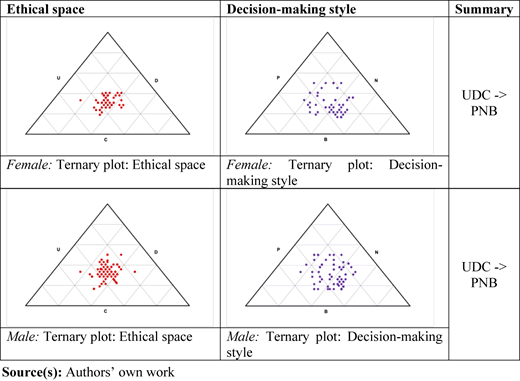
The results in Table 7 indicate that women applied an ethical space of consequentialism that motivated the normative decision-making style. Men, on the other hand, had no dominant ethical space but also used a normative decision-making style.
The next aspect was whether age influenced the ethical space and subsequent decision-making style.
5.3.2 Age
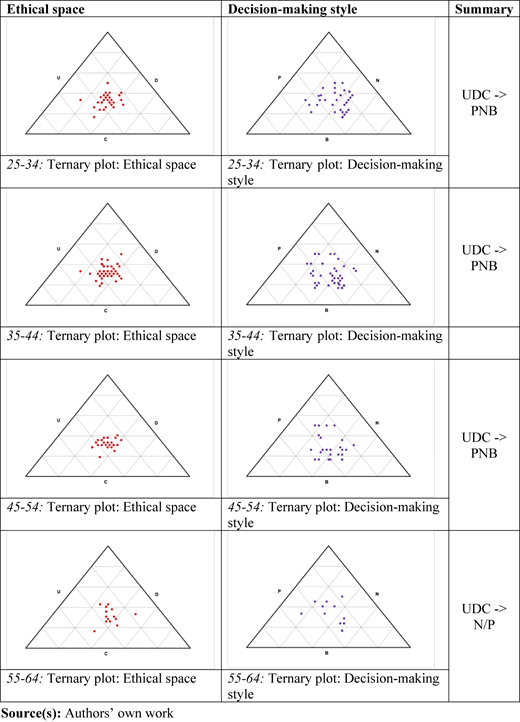
The age group 25–34 had no dominant ethical space but used normative decision-making. The age group 35–44 differed and had an ethical space of consequentialism that influenced decision-making to be normative supported by behavioural/descriptive. Neither of the age groups 45–54 and 55–64 had a dominant ethical space. In the case of the age group 45–54, the supporting decision-making style was behavioural/descriptive but was prescriptive in the age group 55–64. The respective ternary plots are displayed in Table 8.
5.3.3 Type of project
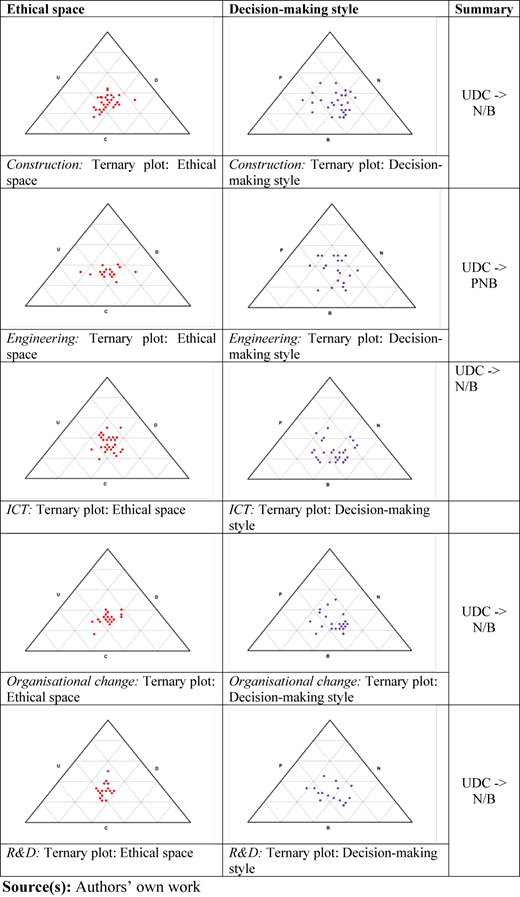
The third aspect was whether the type of project influenced the ethical space and subsequent decision-making style. The types of projects were engineering, construction, ICT, organisational change and R&D. The type of project was found to have an impact on the ethical space and decision-making style, as illustrated in Table 9. Construction, engineering, ICT and organisational change projects had no dominant ethical space. In the case of engineering projects, no dominant decision-making style was present. Normative decision-making supported by behavioural/descriptive decision-making was used in construction, ICT and organisational change projects. Consequentialism was used as an ethical space in R&D projects, resulting in normative decision-making supported by behavioural/descriptive decision-making.
5.3.4 Managerial level
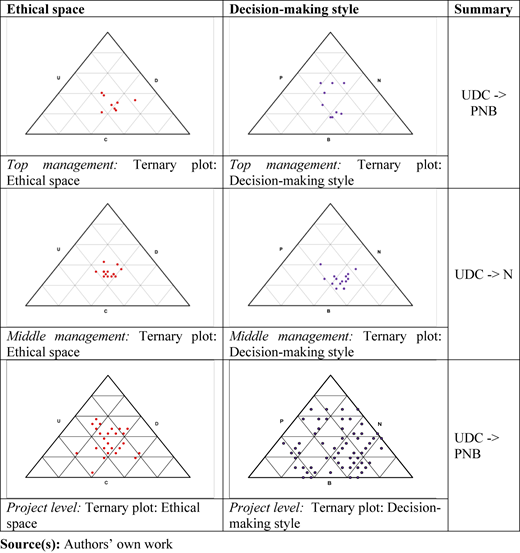
The fourth aspect was whether the managerial level influenced the ethical space. As per Table 10, the various roles were grouped into top management, middle management and project level.
Mapping of roles to management levels
| Position | Frequency | Level |
|---|---|---|
| Portfolio manager | 2 | Top management |
| Member of the management board | 8 | |
| Programme manager | 8 | Middle management |
| Project management office manager | 4 | |
| Head of department | 6 | |
| Project manager | 69 | Project level |
| Team leader | 12 | |
| Business analyst | 9 | |
| Project control manager | 2 | |
| Change manager | 1 | |
| Team member | 15 |
For the top level of management, no dominant ethical space or dominant decision-making style were apparent. For middle management, there was also no dominant ethical space, but normative decision-making was preferred. At the project level, again no ethical space was dominant, but normative decision-making took precedence. Refer to Table 11.
The next section covers the influence of education on decision-making.
5.3.5 Level of education
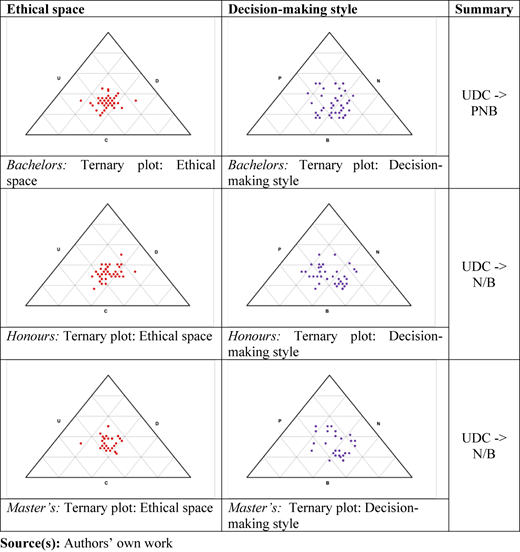
It was important to investigate the aspect of education. African academic programmes are influenced by colonial thoughts, perspectives and ideas. It must be noted that most project management curricula are informed by the PMBOK Guide® of PMI. Table 12 provides an overview of the influence of education on the ethical space and decision-making style. The dominant ethical space for bachelor students was consequentialism. The decision-making style was normative, irrespective of the level of education.
5.3.6 Project management experience
The sixth aspect focused on the project management experience of the respondents. Refer to Table 13. Apart from the inexperienced respondents (consequentialism), there was no dominant ethical space. The overriding decision-making style was normative supported by behavioural/descriptive. However, respondents with 6–10 years of project management experience made use of all three decision-making styles.
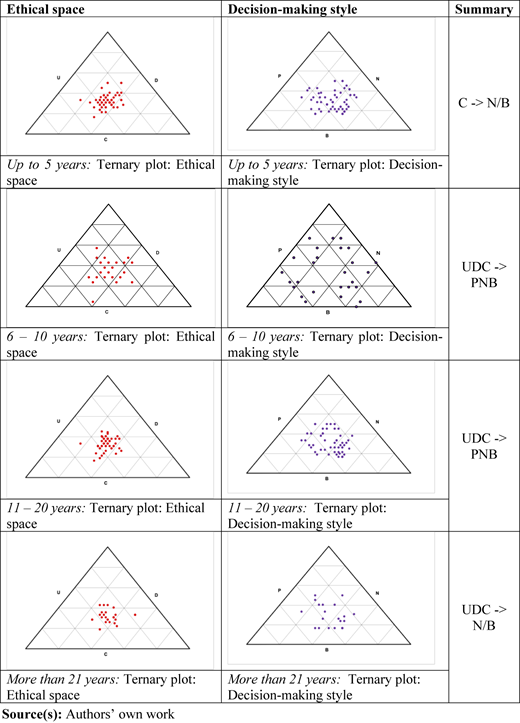
The analysis is summarised in Table 14. It is apparent that no ethical space was dominant in most instances, but that normative decision-making was dominant. If a supporting decision-making style was present, it was always behavioural/descriptive.
Ethical space and decision-making style
| Ethical space | Decision-making style | Supporting decision-making style | |
|---|---|---|---|
| Female | No dominant space | No dominant space | |
| Male | No dominant space | No dominant space | |
| 25–34 | No dominant space | No dominant space | |
| 35–44 | No dominant space | No dominant space | |
| 45–54 | No dominant space | Normative | Behavioural/Descriptive |
| 55–64 | No dominant space | Normative | Prescriptive |
| Construction | No dominant space | Normative | Behavioural/Descriptive |
| Engineering | No dominant space | No dominant space | |
| ICT | No dominant space | Normative | Behavioural/Descriptive |
| Organisational change | No dominant space | Normative | Behavioural/Descriptive |
| R&D | No dominant space | Normative | Behavioural/Descriptive |
| Top management | No dominant space | No dominant space | |
| Middle management | No dominant space | Normative | Behavioural/Descriptive |
| Project level | No dominant space | No dominant space | |
| Bachelors | No dominant space | No dominant space | |
| Honours | No dominant space | Normative | Behavioural/Descriptive |
| Master's | No dominant space | Normative | Behavioural/Descriptive |
| Up to 5 years | Consequentialism | Normative | Behavioural/Descriptive |
| 6–10 years | No dominant space | No dominant space | |
| 11–20 years | No dominant space | No dominant space | |
| More than 21 years | No dominant space | Normative | Behavioural/Descriptive |
6. Discussion
To reiterate, the hypotheses we tested in this study were that various dimensions of ethics constitute the ethical space of a project practitioner (Hypothesis 1) and that the ethical space influences decision-making style (Hypothesis 2).
Regarding the first hypothesis, three ethical dimensions were discussed in this paper, i.e. ubuntu, consequentialism and deontology. Ubuntu is cemented in (South) African philosophy (Metz, 2007), whereas consequentialism and deontology are cemented in Western philosophy (Drašček et al., 2021; Helgadóttir, 2008). These different and somehow opposing ethical dimensions were investigated, as project practitioners in South Africa – our empirical focus in this research – are educated and trained from a Western perspective but their traditional beliefs are also grounded in indigenous ubuntu. As Van Norren (2014, p. 262) observes, the “Western social contract school takes the competitive human being and homo economicus as its starting point and the African ubuntu school the cooperative human being; neither excludes the other but merely seem to take it as the exception rather than the rule. Examples of cooperation in ubuntu are shosholoza (‘work as one’, teamwork) and collective enterprises, stokvels, in which profits are equally shared and may never be gained at the expense of the other”.
Overall, the results of our seven thought experiments (Aguinis et al., 2023) with 148 South African project practitioners highlight that there was no dominant ethical dimension. Although ubuntu was the first choice three times, there is no clear indication that the respondents preferred one ethical dimension above another. The details as per Table 4 clearly highlight that the respondents fluctuated between the three ethical dimensions.
These findings thus add support to the first hypothesis that various ethical dimensions constitute the ethical space of South African project practitioners. Indeed, while there are tensions between the three ethical dimensions of deontology, consequentialism and ubuntu, our findings reveal that they coexist in the ethical decision-making landscape of project management in South Africa. This is consistent with existing literature focused on Africa in management (Adeleye et al., 2020; Woermann and Engelbrecht, 2017) and project management (Marnewick et al., 2018; Rwelamila et al., 1999). In other words, these findings suggest that South African project practitioners strike a compromise between their traditional cultures and what they are taught in schools (Lutz, 2009, p. 318). Thus, this research contributes to the project management literature in general and its underrepresented Africa stream in particular where we read little on ethical decision-making (Baker and Niederman, 2023) in contexts that may challenge project management theories (Ika et al., 2021).
The second hypothesis infers that the ethical space of the decision-maker influences their decision-making style. Since the first hypothesis already suggests that there is no dominant ethical dimension, the inference can be made that there is also no dominant decision-making style. Surprisingly, however, the results as per Table 5 highlight that the normative decision-making style prevails. The implication is that the second hypothesis should be rejected at face value as there is no dominant ethical dimension, yet there is a dominant decision-making style. Further analysis was performed, as a person's ethical space and decision-making style are dependent on various factors and context. As per Table 14, the dominant decision-making style is normative, irrespective of gender, age, industry, managerial level, experience or level of education (Bell et al., 1988; Kahneman, 2012; Peterson, 2017). In most instances, there is no dominant ethical space apart from the following five instances: gender is female, age is 35–44, industry is R&D, level of qualification is a bachelor's degree and experience is up to five years. In these exceptional instances, the ethical dimension is consequentialism. To a certain extent, it can be concluded that the ethical space of consequentialism always predicts a normative decision-making style.
These findings raise the question of what led to these anomalies where there is no dominant ethical space and yet normative decision-making is predominant. Can and should this be rectified? Two dominant issues identified in our literature review spring to mind that may influence the ethical space and the decision-making style: the colonisation of religion and education, which, again, led to a disconnection between education and the lived realities of African communities. Generally, religion serves as a foundation for an ethical system (Wiredu, 1998) e.g. both Christianity and Islam are associated, for example, with virtue ethics. Therefore, if a person's religion is colonised, it may also have an impact on the person's ethical stance. Missionary schools discouraged local languages and practices (Wiredu, 1998), while colonial curricula focused on European history and values, devaluing African worldviews (Marnewick et al., 2018). This led to identity conflicts, cultural loss, and education systems that failed to address local socio-economic needs. This is still the case with project management education where the content, syllabi (Hunter, 2012) and textbooks (Gray and Larson, 2008; Meredith et al., 2016) are still based on project management as perceived by Western academics and institutions, as Muriithi and Crawford (2003), Ika (2012), and Rwelamila and Purushottam (2012) note. Further, Marnewick et al. (2018) conclude that the true infusion of African management philosophy such as ubuntu should be facilitated between academics, students and stakeholders. They also argue that certain project management processes and practices are independent of African or Western philosophies (see also Rwelamila et al. (1999) and Ika et al. (2010)). This observation resonates with George et al. (2016) that (project) management research can benefit from infusing African ethics and beliefs, and Locatelli et al. (2023) for cross-fertilisation between project studies and business studies.
This study contributes to these calls by applying the “big” ethical decision-making theories to an understudied African context (Adeleye et al., 2020; George et al., 2016) and by making a connection between ethical decision-making theory and project management practice (Baker and Niederman, 2023; Drašček et al., 2021; Helgadóttir, 2008; Warner et al., 2024) and in particular the actuality of projects (Cicmil et al., 2006). More specifically, the study makes three key contributions.
Firstly, by embracing “ethical ambidexterity” Drašček et al. (2021) and going beyond the all-too common appeal to the theoretical Western roots of ethics (Metz, 2007; van Oosterhout et al., 2004), it extends the ethical theories of deontology, consequentialism and ubuntu in decision-making in projects (Helgadóttir, 2008; Rwelamila et al., 1999; Woermann and Engelbrecht, 2017) in the understudied and culturally different African continent, where little research has focused on the nexus between ethical decision-making and project management (Ika et al., 2021; Marnewick et al., 2018; West, 2014). Relatedly, it proposes a new ethical decision-making framework, which we coin the “ethical space of the decision-maker”, in which a project practitioner navigates among the ethical dimensions of deontology, consequentialism and ubuntu in different circumstances (Drašček et al., 2021).
Secondly, from a methodological perspective, the paper provides a novel thought experiment-based approach (Aguinis et al., 2023) to the study of ethical decision-making in projects. Thirdly, the paper is also important from a practical perspective, as it illuminates the relationship between the ethical space of a decision-maker and their decision-making style, which can be of a normative, a behavioural/descriptive, or a prescriptive nature (Bell et al., 1988). It hence argues that project practitioners who are more ethically aware are more likely to make consistent and balanced decisions that weigh both practical and ethical considerations that reflect this awareness. Now, we shall move on to the limitations and outlook of this research.
The first limiting factor of the study is the self-report survey. This might introduce biases such as recall bias and social desirability which might impact the reliability and validity of the results. While these biases were addressed through anonymity and awareness during the interpretation of the results, semi-structured interviews could be conducted to really capture how project practitioners navigate ethical tensions in (South) Africa. In particular, research should attempt to dig into how project practitioners handle lived ethical tensions in their decision-making.
The second limiting factor of the research scope is that its empirical focus rests squarely with South Africa. While the rest of Africa is no stranger to ubuntu (Lutz, 2009; Van Norren, 2014), the findings warrant further empirical investigation in the rest of Africa. Research might examine, through though experiments, whether the ethical space (a combination of deontology, consequentialism and ubuntu ethics) influences the decision-making style (normative, behavioural/descriptive, or prescriptive preference) of project practitioners in the rest of Africa (e.g. Ghana, Nigeria).
The third limiting factor is that the paper does not single out other African philosophies but only ubuntu. Widening the research to incorporate, for example, different virtue ethics traditions in Côte d’Ivoire, Ghana, Nigeria, and Kenya may prove enlightening (Ogunyemi, 2020).
The fourth and last limiting factor is that the research is solely focused on African ethics. Future research might replace the ubuntu dimension of the ethical space with any other ethical dimension rooted in traditional belief systems or philosophies such as Native American relational ethics (Verbos and Humphries, 2014), Hinduism (Sur, 2017) and Buddhism (Vallabh and Singhal, 2014) in India, Taoism (Hsu and Chiu, 2008) and Confucianism (Kao, 2017) in China.
7. Conclusions
African project practitioners are exposed to Western as well as African beliefs, values and philosophies. These beliefs, values and philosophies filter through into project management education and training as well as decision-making in a project environment. Based on this tension, we propose that various dimensions of ethics, such as deontology, consequentialism and ubuntu, constitute the ethical space of a project practitioner, which in turn influences their decision-making style such as normative, behavioural/descriptive, or prescriptive. Through seven thought experiments, 148 respondents of a survey questionnaire in South Africa indicated that they did not have a preferred ethical space but that their decision-making was essentially of a normative style.
Decision-making in projects is influenced by the project practitioner's education and training. South African education and training are influenced by Western thinking and content and this may be the main reason why decisions appear to be based on a normative style. Combining this with the cultural beliefs of ubuntu, we found that there is no dominant ethical space and that project practitioners in South Africa pull from their Western as well African belief systems.
Over the last two decades, various calls have been made by academics to decolonise (project) management theory (Banerjee, 2022) or infuse the teaching of management (George et al., 2016; Goldman, 2013; Lutz, 2009) or project management with African philosophy such as ubuntu (Marnewick et al., 2018). This raises the question whether a change in an ethical space (from deontology/consequentialism to ubuntu) will result in a change in decision-making style and in better decisions. In response to Greenwood and Freeman (2018), who encourage scholars to undertake deep ethical analysis in business ethics, this paper connects ethical decision-making theory to project management practice. Although no relationship could be established between ethical space and decision-making style, this study provides a baseline for future research on the influence of African and Western ethics on decision-making in project management not only in different countries of Africa, but in the rest of the world.
Last but not least, echoing Ika et al. (2021, p. 2) that “Africa can also shape project management theory and practice”, the findings call for a pluralistic theorising of ethics that goes beyond the all-too common appeal to the theoretical Western roots of ethics (Metz, 2007; van Oosterhout et al., 2004).
Note
African denotes all races.

