Total factor productivity (TFP) has become a prominent concept in agriculture economics and policy over the last three decades. The main aim of this paper is to obtain a detailed picture of the field via bibliometric analysis to identify research streams and future research agenda.
The data sample consists of 472 papers in several bibliometric exercises. Citation and collaboration structure analyses are employed to identify most important authors and journals and track the interconnections between main authors and institutions. Next, content analysis based on bibliographic coupling is conducted to identify main research streams in TFP.
Three research streams in agricultural TFP research were distinguished: TFP growth in developing countries in the context of policy reforms (1), TFP in the context of new challenges in agriculture (2) and finally, non-parametric TFP decomposition based on secondary data (3).
This research indicates agenda of future TFP research, in particular broadening the concept of TFP to the problems of policy, environment and technology in emerging countries. It provides description of the current state of the art in the agricultural TFP literature and can serve as a “guide” to the field.
1. Introduction
Rapid growth of world population poses a major challenge to the agricultural sector due to the rising demand for food over the coming decades (Hubert et al., 2010). Increasing production by greater inputs use is unlikely. In developed countries, it is due to scarcity of agricultural land and available labour force. In turn, developing countries face capital shortage. In addition, agricultural policy (e.g. in the European Union) imposes environmental requirements which impact agricultural intensity. These factors raise the importance of productivity change, which occurs when the index of inputs changes at a different rate than the index of output (Kumbhakar and Lovell, 2000). What is more, nowadays productivity is often related to environmental issues and agricultural policy which results in the inclusion of these elements in productivity studies (Baráth et al., 2020; Liu et al., 2021; Han et al., 2020).
Total factor productivity (TFP) measures overcome drawbacks of partial indicators: land, labour and capital productivity. For example, considering only one of the partial measures may produce a hasty conclusion, because increasing value of one indicator does not always mean that another is also growing (cf. Alston and Pardey, 2014). TFP is the ratio of output (usually concerning agricultural production) to aggregate and weighted inputs. As such, it is more suitable for comparison across entities and over time (Coelli et al., 2005) which may justify the rapid growth of popularity of measuring it and searching for its drivers. The ambiguity of the TFP concept and diversity of its estimation methods grow in the literature. Which methods are suitable for particular analysis, which issues remain unresolved, what are the main challenges for productivity research in emerging economies; answering these questions sets a premise for an in-depth literature review.
There are few different literature review techniques (cf. Maditati et al., 2018). Systematic literature reviews, content analysis (cf. Iyer et al., 2020), meta-analysis (cf. Santeramo and Lamonaca, 2019; Minviel and Latruffe, 2017) are already established in agricultural economics, but bibliometric analysis is scarce. Most of bibliometric analyses are focused on general aspects of agriculture, such as environment and sustainability (cf. López-Felices et al., 2020 or Chen et al., 2020). To our knowledge, the only bibliometric analysis in regard to economic aspects of agriculture so far is the work of Novickytė (2019) who studied theoretical insights and developments in agricultural risk. When it comes to review on TFP (not in agriculture) two methodological papers should be highlighted. The first one reviews the strengths and weaknesses of different partial and TFP measures (Murray, 2016), the second discusses, i.a. simultaneity and selection bias and the use of deflated values of inputs and outputs (Van Beveren, 2012).
As noted by Guo et al. (2019), traditional literature reviews are mostly qualitative and subjective in nature, however, sometimes they also follow strict and rigorous methodology (cf. Yadav and Bansal, 2020). Bibliometric analysis, in turn, allows to map the evolution of the research field in a more formal and quantitative way. It can be used to highlight most influential authors, papers, institutions; to identify major past and future research streams; and to map the authors and institutions collaboration structure or to map co-citation structure (Nita, 2019). In this context it seems plausible to apply bibliometric analysis in literature review for complex and multithreaded topics, such as TFP in agriculture.
In this paper we aim to answer three research questions: which journals, authors and institutions are the most cited and have the biggest impact on agricultural TFP research? (Q1), what are the TFP measurement methods and technical developments in empirical analysis? (Q2); and what are the main research streams regarding agricultural TFP (agTFP) between 2010 and 2019 (Q3). Q1 will be addressed by using bibliometric citation analysis and collaboration structure analysis. For Q2 and Q3 we first employ cluster network analysis based on bibliographic coupling and content analysis of selected papers. This is intended to supplement the formal bibliometric research via a thorough review of 60 most coupled papers in three identified research streams.
There are several contributions of this study. First we reveal most influential centres of agTFP research. Second, we synthesize existing research streams in agTFP for different parts of the world, in particular emerging markets. Third, we identified new technical approaches to agTFP calculations which can be used to address some well-known estimation problems. Fourth, we demonstrate that agTFP leans to include problems of climate change, human capital and research and development (R&D). Fifth, we show how agricultural productivity depends on policy and institutional reform in developing and emerging markets. Numerous studies from China and developed countries provide significant implications for these markets. Sixth, we structure future research agenda.
The paper is organised as follows. The following section contains definitions of the TFP concept and a short story of its origins. Then, we present main information about the sample and describe the methodology. Next, we show the results of citation and collaboration structure analysis. In the two proceeding sections we provide the results of the content analysis based on bibliographic coupling and indicate future research agenda. The final section contains conclusions.
2. Origins and definitions of the TFP concept
The idea of the TFP originates from economic growth theory. Since the pioneer work of Solow (1957), TFP has been identified with technical progress and has been residual in nature. TFP can be understood as the portion of output not explained by the amount of inputs used in production. This residual is believed to play a crucial role in economic fluctuations, economic growth and differences in income per capita among countries. Among the theories involving the use of TFP we can mention real business cycle theory by Kydland and Prescott and endogenous growth theory by Romer, Aghion and Howitt (Comin, 2018).
A lot of attention is paid to proper TFP measurement. Earliest works such as Solow (1957) and the Tornqvist–Theil index (Diewert, 1978) followed the non-frontier approaches to TFP measurement. They assume that a given entity is fully efficient and the growth in productivity is exogenous in nature. In reality, the entities are often not fully efficient which means that they could enhance their output from given inputs, or they could sustain output level while reducing inputs without any change in exogenous technology. This ties closely the issue of TFP measurement with efficiency and optimality assessment, which dates back even earlier, to seminal works of Edgworth (1881) and Pareto (1909).
To assess efficiency we need to know the frontier, based on the theory of production. If one assumes the existence of a production function which corresponds to the set of maximum attainable output level for a given input combination (frontier), then productivity improvement may result from getting closer to the frontier (technical efficiency change) or from shift of the frontier (technological progress). The biggest advantage of frontier methods is therefore the possibility of TFP decomposition. Among frontier approaches two are especially popular: non-parametric Malmquist index obtained from DEA-based (data envelopment analysis) linear programming (Färe et al., 1994) and parametric stochastic frontier analysis (SFA) firstly introduced by Aigner et al. (1977) and Meeusen and van Den Broeck (1977). The main difference between these two is that in SFA a certain form of production function must be assumed (usually Cobb–Douglas or translog) which is not the case in DEA. On the other hand, in SFA error term can be divided into random noise component and inefficiency component, while in DEA the former is not accounted for. The evolution of the TFP theory has been reviewed in detail by Hulten (2001).
According to Emrouznejad and Yang (2018) agriculture is the most popular field of application of DEA methods. Currently, several new or modified methods for TFP estimation in agriculture have emerged, including for example SFA-based random-coefficient models (Emvalomatis, 2012), generalized maximum entropy measures (Rezek et al., 2011), latent-class models (Kellermann and Salhofer, 2014) and green TFP (GTFP) which incorporates environmental effects (usually carbon dioxide emission) as undesirable output (Wang et al., 2019; Zhan et al., 2017; Xu et al., 2019).
3. Data and methods
Broadus (1987, p. 376) has proposed the following definition of bibliometrics: “Bibliometrics is the quantitative study of physical published units, or of bibliographic units, or of surrogates for either”. This definition emphasized that bibliometric analysis may be conducted on different levels, such as documents or citations (Alon et al., 2018). Similar to other literature review methods, it is applied to summarize existing literature by identification of key topics, problems and suggestions for future research (Maditati et al., 2018), or even for articles published in a particular journal (cf. Nita, 2019). Bibliometrics can be considered a part of scientometrics (Mingers and Leydesdorff, 2015).
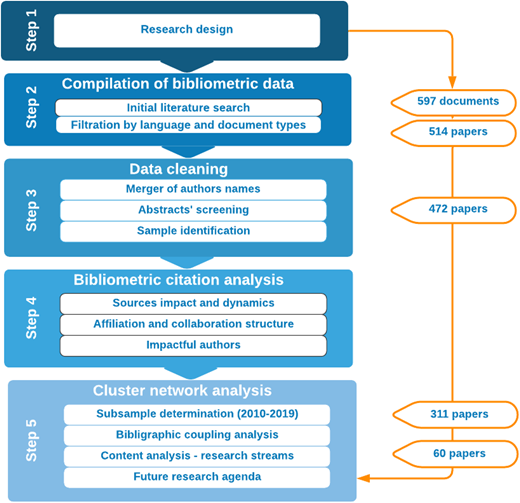
In this research we follow Zupic and Čater (2015) who indicate that the workflow for conducting bibliometric analysis should consist of several steps, including: research design, compilation of bibliometric data, analysis (including data-cleaning), visualisation and interpretation. In the design phase of this study, we formulated three research questions (cf. Introduction). Consequently, we need to employ different bibliometric methods: citation analysis and collaboration structure analysis (Q1), and bibliographic coupling extended by content analysis (Q2 and Q3) [1].
We searched for articles on TFP measurement in agriculture from ISI Web of Science (WoS). Despite the larger coverage of social science, the reliability and quality of Google Scholar data may be poorer, as it covers many journals of only local importance and numerous entries are duplicated (Mingers and Leydesdorff, 2015). An alternative database is Scopus but until now it is technically difficult to combine multiple databases in bibliometric analysis in a meaningful way. In order to find all relevant documents, we used a following phrase: (farm* OR agriculture*) AND (“total factor productivity” OR “multifactor productivity” OR “multi-factor productivity”). We searched in topics, i.e. titles, abstracts and keywords. We did not specify a starting period of search and the oldest documents came from 1991. After initial search we received 597 documents. However, in the next step we left only research articles published in English until the end of 2019 and then we did abstract screening to eliminate irrelevant papers (e.g. papers on wind farms). We reached a sample of 472 articles. When preparing the dataset, we employed a data-cleaning procedure to merge different ways of recording the authors' names (e.g. K. Fuglie or K.O. Fuglie).
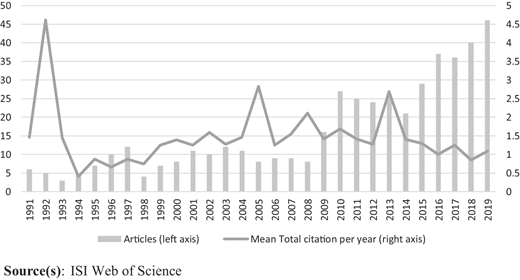
Papers used for the analysis were published in numerous sources (201), mostly as a result of teamwork (the average number of authors was 2.58) – only 17.8% were single-authored. The average citation number per document was 13.89. The distribution of papers in time is highly unequal (cf. Figure 1).
Until 2009 the analyses on TFP in agriculture were moderately popular and the number of papers did not exceed 20 a year. Starting from 2010 we observe a rapid growth of agTFP papers which may be due to the growing interest in productivity analysis in emerging markets, China in particular. Inflation in research is not followed by citations growth. Due to the shift of interest in TFP calculations some of our analyses were run for 2010–2019 only (cf. Figure 2).
Next, we employed citation and collaboration structure to capture the general picture of the field. We identify the most impactful research sources: authors, journals and institutions. We provide a country collaboration map to highlight the geographical distribution of collaboration between scientific institutions. All of these analyses were run using bibliometrix package for R (Aria and Cuccurullo, 2017).
There are two main methods of mapping a scientific field – co-citation analysis and bibliographic coupling (cf. Vogel and Güttel, 2013). There are important differences between these two concepts. Co-citation analysis is biased toward older works as it highlights the role of milestone papers. It also includes papers out of the sample. It is especially problematic in applied disciplines, such as agricultural economics, where many technical, econometric papers or textbooks – not always relevant to agriculture – are cited.
Bibliographic coupling, in turn, has been less commonly used so far (García-Lillo et al., 2020). It shifts the attention to the citing documents. Two papers are coupled if they have at least one common unit in the references list. The higher the number of common references, the higher is the strength of coupling between given pair of papers. Bibliographic coupling is therefore a static concept – the strength of coupling between two papers does not change over time. When this method is applied, only sample papers are taken into consideration.
The choice of the method to be used depends on the research objective. As the goal of this paper is to reveal recent technical developments in TFP analysis and highlight main contemporary streams in the TFP research, we decided to pursue bibliographic coupling. This method may only be used for a limited timeframe (Zupic and Čater, 2015). Hence, for bibliographic coupling we narrowed the sample to papers published since 2010 (311 articles). Nine papers were not linked to any other documents so finally the sub-sample consisted of 302 papers. To distinguish the main research stream, we ran a cluster analysis in VosViewer software applying the minimum threshold of papers in one cluster as 30 (to avoid small clusters) and association normalization method which is default. This software uses a unified approach to mapping and clustering of bibliometric networks which is a kind of weighted variant of modularity-based clustering (Waltman et al., 2010).
We obtained three clusters of papers and ranked them by the total link strength in each cluster. Finally, we conducted content analysis using 20 most coupled papers in each cluster. There is no strict rule on how many papers should be analysed to accurately establish main research streams. However, in comparison to other works (Zamore et al., 2018; Alon et al., 2018; Maditati et al., 2018), 60 papers seem to be a substantial number considering the sample size. Regarding the idea behind bibliographic coupling, the selected papers should be most representative for a given research stream since they have the highest total link strength, but it does not necessarily mean they become most cited in the future. Figure 2 summarizes our methodological approach.
4. Initial bibliometric results – citation analysis and collaboration structure
As noted, there are 472 papers on agTFP published between 1991 and 2019. These papers come from 201 different sources; however, there are only a few journals that dominate the field. 165 papers, which is more than a third of the whole sample, were published in top 10 journals (cf. Table 1).
Journals in Table 1 were ranked by the widely used h-index and then g-index if the former had the same value for more than one journal. The most influential journals were Agricultural Economics (AEs) and American Journal of Agricultural Economics (AJAEs). These two journals were also the most productive ones. Papers published in these journals were by far most cited, with the total citation number exceeding 900. The average number of citations per item is much higher than h-index so the g-index is clearly higher than h-index. This is because some papers in these sources had a very high number of citations (e.g. Fan, 1991). The list of top ten sources features only one journal from outside the agricultural economics field – Journal of Productivity Analysis (JPA).
Research on TFP in agriculture is conducted mostly in English-speaking countries, i.e. the USA, Australia, South Africa and the UK (cf. Table 2). Notably, researchers from the Economic Research Service of the US Department of Agriculture were authors or co-authors of 32 articles that were cited 387 times. Researchers from University of Queensland have published 12 papers but their work was the most cited with the average citation number per item equalled to 38.7. Some important and impactful researchers in the field of efficiency and productivity analysis are affiliated at this University, including Tim Coelli, Christopher J. O'Donell or Viet-Ngu Hoang. In the top ten most productive institutions only two are located outside the English-speaking zone. These are Wageningen University from the Netherlands, a world-leading institution in agricultural research, and Chinese Academy of Science.
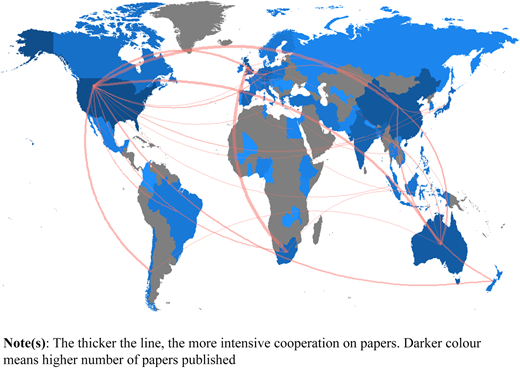
Authors from 66 countries were engaged in agricultural TFP research. However, international collaboration does not prove very strong, with the exception of English-speaking countries and China (cf. Figure 3). The most intensive collaboration occurred between authors affiliated in the UK and South Africa (15 joint articles), China and the USA (14) and Australia and the USA (10). Remarkably, a vast majority of papers written by authors affiliated in English-speaking countries or China present the results for these countries. There are only some exceptions, especially if one of the authors originally came from a different country, such as the work of Salim et al. (2019) on Bangladesh or Muyanga and Jane (2019) on Kenya. It means that problems of agricultural productivity are extensively explored in only few countries whereas the level, dynamics and determinants of productivity are still neglected or only barely touched in big parts of the world. In Figure 3 we marked all country pairs which collaborated on at least two papers.
The influence of an author can be measured by several different indicators. The most popular are citation numbers and h-index (and its variations). Relying on only one indicator may lead to a hasty conclusion as all metrics have advantages and drawbacks (Mingers and Leydesdorff, 2015). In Table 3 we present top 10 authors ranked by h-index and then, total citation number if the h-index has the same value for more than one author.
The two most impactful (as measured by h-index) and most productive authors regarding TFP in agriculture are Colin Thirtle and Jenifer Piesse. Both these authors have collaborated closely since the 1990s and published together 11 papers, most often using the UK and South African agriculture examples. Jikung Huan is affiliated at Peking University. He collaborated closely with Scott Rozelle (Stanford University) and published 10 papers on Chinese agriculture. Keith Fuglie and David Schimmelpfenning work for the US Department of Agriculture (Economic Research Service). The latter authors collaborated with Thirtle (4 out of 7 papers) and deal with productivity in different parts of the world. Fuglie focuses on the US but also international agriculture. Another important researcher is Eldon V. Ball from Economic Research Service (USDA). He focuses on the US agriculture and received a decent number of citations (180). However, these citations (135/180) come primarily from two old papers (Ball et al., 1997) and (Ball et al., 1999) and that is why his h-index is relatively low.
5. Results of the content analysis
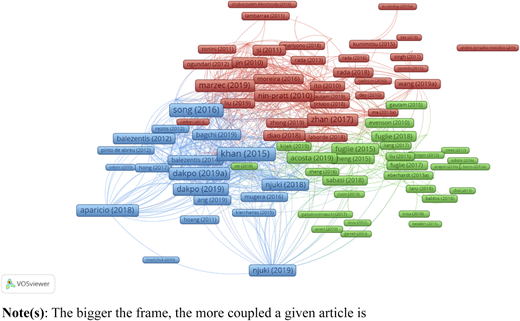
To understand the development of the topic, different review techniques should be used together, including content analysis (cf. Bahoo et al., 2020). For this study, a content analysis was done to establish the major streams of contemporary research. We ran a bibliographic coupling analysis in VoSViewer, and we received three clusters as seen in Figure 4 In Section 5.1, we briefly describe the research agenda of each cluster. In the following sections, we focus on the major themes in the literature on agricultural TFP. Those themes were organised based on the prerogative of their content and practical implications. The themes are: methodological developments in TFP calculations, sources of TFP growth, institutional and policy reforms impact on TFP, human capital as a determinant of TFP, agricultural productivity in the context of climate change and TFP growth for ensuring food security. A summary of findings from the content analysis is provided in Table 4. We followed Shakil et al. (2020) and concentrated on geographical scope and methods used. Detailed information on papers used for the content analysis is available upon request to the corresponding author.
5.1 Main research clusters in agricultural TFP
Bibliographic coupling revealed three major clusters of studies. They differ in several aspects: the most commonly used research methods, the level of analysis (farm/region/country), time span (short term vs long term), and orientation towards developing or emerging or high-income economies. Analysis of these clusters allowed us to determine the main research streams in agTFP.
The first cluster was concentrated on TFP growth in developing or emerging economies via institutional and policy reform. However, one may also find examples of research on developed countries, including Poland (Marzec and Pisulewski, 2019), Chile (Moreira and Bravo-ureta, 2016), Ireland (Carroll et al., 2011), Germany (Emvalomatis, 2012; Kellermann and Salhofer, 2014) as well as on the EU (Cechura et al., 2017). Analysis of TFP in developing countries usually covered whole farming sectors (or at least most of the important commodities), and they were conducted on the province/county or international level. Papers assessing TFP in developed countries used farm-level data for a particular country or region except for Cechura et al. (2017) who used farm-level data for 24 EU member states. The “gold standard” of productivity research is first to estimate a production function (translog or Cobb–Douglas) based on different stochastic frontier panel models and then to calculate changes in TFP using those estimates. Interestingly, in developed and emerging economies, technological progress was found to be the main contributor to TFP growth, while the effect of greater efficiency was often negligible or even negative.
The second cluster is characterised by a strong focus on two specific aspects. These are the impact of R&D and environmental factors on TFP in different regions of the world. This stream is oriented mostly towards high-income countries. The cluster includes studies which aim at introducing a TFP measurement method, determining factors of TFP, measuring levels of TFP and TFP convergence. The empirical analyses in the second literature stream covered long periods so it enables to employ non-frontier approaches to TFP estimations. Overall, the results of the studies in this cluster confirmed the role of research capacity in achieving long-term productivity growth in agriculture, regardless of the level of economic development. However, they also pointed out that links between research and technology transfer should be increased to improve the chances for further productivity growth (Acosta and De los Santos-Montero, 2019).
The third cluster is distinguished by the wide use of DEA-based TFP index decomposition. It covers mostly developed countries and deals with the problems of research and development and the natural environment. From the 20 most representative papers in this cluster, 10 analysed provinces as decision-making units (DMUs), while research based on European examples was mainly driven by farm-level data, which could be explained by the existence of Farm Accountancy Data Network (FADN). In the third cluster, it is common to see widely recognised methods applied for the first time to scarce data from the countries being studied. Other common patterns are comparing the efficiency of different farming types (Darku et al., 2016; Dakpo et al., 2019a; Baležentis et al., 2012; Baležentis and Baležentis, 2016) or farms with different economic and resource characteristics (Martinez Cillero and Thorne, 2019; Keizer and Emvalomatis, 2014).
5.2 Methodological developments
The ultimate goal of methodical improvements in agTFP is to enhance the robustness of the results. Results of crucial works are presented in the following subsections.
5.2.1 DEA vs SFA
First, we consider the two most common procedures for assessing productivity: stochastic frontier analysis (SFA) and data envelopment analysis (DEA). DEA was particularly popular in papers from the third cluster. Despite its popularity, however, DEA is a non-parametric method. So, it has often been criticised because its results are affected by stochastic noise. A popular solution for that issue was a bootstrap procedure (Simar and Wilson, 2000). It was applied by Song et al. (2016) and by Baležentis and Baležentis (2016) and Bagchi et al. (2019).
The SFA approach is dominant in the first and second clusters. The greatest problem with this method came from the way potential determinants of efficiency were included in the model. In their seminal paper, Headey et al. (2010) looked for determinants of TFP growth in a subsequent regression analysis (two-step estimation). Despite criticism of that approach by Schmidt (2011), it has gained some attention, and it was used in other analysed documents (Song et al., 2016; Rahman and Salim, 2013). A more appropriate econometric procedure requires determinants to be modelled simultaneously in one step. Such procedure was applied by Jin et al. (2010), Si and Wang (2011) and Moreira and Bravo-ureta (2016).
5.2.2 Productivity indices and their decomposition
With SFA, changes in TFP were usually decomposed using the formula proposed by Orea (2002). That formula enabled the decomposition of an TFP index into technical efficiency change, technological progress (technical change) and scale efficiency change (cf. Zhan et al., 2017; Hou et al., 2012). Some authors used a slightly different formula, which made it possible to decompose TFP into four elements, adding allocative efficiency (cf. Si and Wang, 2011; Moreira and Bravo-ureta, 2016). Even more detailed decompositions have been applied by Yong-fu et al. and Julien et al. (2019).
With the DEA research in the third cluster, the most recognised work is a paper by O'Donnell (2010). It criticised the Malmquist index and it proposed an alternative, the Hicks–Moorsteen index. However, the Malmquist TFP index is still widely used, despite the criticism by O'Donnell. As an improvement to this method, the Färe–Primont index was proposed by several studies (Khan et al., 2015; Dakpo et al., 2019a, b; Temoso et al., 2015; Rahman and Salim, 2013; Martinez Cillero and Thorne, 2019), since it could be used to make reliable multilateral and multi-temporal comparisons (Khan et al., 2015).
Two other alternatives have been proposed: the Lowe index (Sotelsek-Salem and Laborda Castillo, 2019) is similar in properties to Färe–Primont, but it allows for different decomposition, and the Luenberger–Hicks–Moorsteen (LHM) index, used by Shen et al. (2019). In contrast to the Malmquist index, LHM is an additively complete index (it is based on differences, not ratios), and it allows some variables to be equal to or close to zero. Furthermore, LHM allows non-oriented generalised indicators, while Malmquist is input- or output-oriented. Like some other indices, LHM can be further decomposed into three components.
Works classified in the second cluster brought less novelty to the issue of productivity indices. However, they do include important papers by O'Donnell (2012, 2016) who introduced the Lowe index noted above. Finally, a work by Plastina and Lence (2018) is worth mentioning because of its novel sequential primal-dual estimation approach to calculate and decompose changes in TFP. It uses a multi-output input distance function in the first stage, followed by a cost minimisation routine in the second stage.
5.2.3 Time-series modelling
Ma and Feng (2013) calculated TFP and determinants for its components based on basic two-way fixed models and seemingly unrelated regression (SUR) models. Nin-Pratt et al. (2010) used a unit root test that allowed for structural breaks in the data (see Baum, 2005). Using sequential technology in the Malmquist index (meaning that technology from past periods is always available and is a part of period t technology) may be seen as an important guideline in further research. Alene (2010) has shown that there are substantial differences in TFP calculations using conventional approaches (long-run average annual TFP growth in African countries estimated at 0.3%) and sequential setting (1.8%). In the next step the authors tried to find TFP determinants based on a model proposed by Alston et al. (1995), namely distributed lagged variables.
Similarly, Salim et al. (2019) used a panel counterpart of the autoregressive distributed lag model, a pooled mean group estimator to estimate the long-run relationship between variables, and a panel vector autoregression model to trace the responsiveness of TFP to a shock. For the analysis of convergence, the Pesaran unit root test was applied (Esposti, 2010; Kijek et al., 2019). In the analyses of R&D elasticity, Fuglie (2018) used gamma lag structures.
5.2.4 Panel data
These techniques are more developed in the SFA research framework. The most remarkable improvement might be the application of the true fixed- and true random-effects models, originally proposed by Greene (2005a, b). These models separate the unobserved heterogeneity from the inefficiency term. Carroll et al. (2011) found that TFP estimates derived from “standard” stochastic models with Greene's model setting were similar, but the technical efficiency component was somehow different. Greene's models also perform better in econometric terms (see Sauer et al., 2006). An even more advanced approach is applied by Acosta and De los Santos-Montero (2019) who adapted the model proposed by Kumbhakar et al. (2014). It decomposes error into four components: time-invariant efficiency, time-variant efficiency, a random shock and country heterogeneity.
Eberhardt and Teal (2012) noticed that standard approaches neglected two important issues: cross-section correlation and time-series properties for long panels (including possible non-stationarity). The authors used a common correlated effect estimator with mean group (CCEMG), and they proposed an extension of applying (exogenous) weight matrices before computing the cross-section averages. In effect, this imposes more structure on the nature of cross-section correlation in the data. Authors found that new model setting changes results and suggested using diagnostic testing to determine favourable specification(s) and estimator(s). In particular, parameter heterogeneity plays a crucial role in investigating cross-country productivity for agriculture.
5.2.5 Heterogeneity in production function and population
Continuing the point made by Eberhardt and Teal (2012), we can distinguish the research approach that addresses the issue of heterogeneity. In the standard procedure, one implicitly assumes that all farms in a sample could have access to the same technology represented by the frontier. In practice this assumption does not hold, especially when the farms being analysed are in countries or regions with different levels of development. There are at least three ways to deal with the issue presented in the literature. The first is to use a meta-frontier approach. Meta-frontiers are based on subgroups frontiers designated by the researcher. These subgroups are designated by the researcher (see Wang and Rungsuriyawiboon, 2010; Cechura et al., 2017). Two other approaches to account for heterogeneity are a random coefficient stochastic production frontier (e.g. Emvalomatis, 2012; Julien et al., 2019) and latent class models (cf. Kellermann and Salhofer, 2014).
Several papers compared the efficiency of farms that differed in other ways. The most straightforward application of this concept is to compare different farming types (Darku et al., 2016; Dakpo et al., 2019a; Balezentis et al., 2012; Baležentis and Baležentis, 2016). Another feature used for comparison was ownership status (Effendy, 2018). Among multicriterial delimitation methods, Martinez Cillero and Thorne (2019) used latent class analysis to distinguish seven types of farms based on several features, such as size, inputs and outputs, subsidies and soil quality. Keizer and Emvalomatis (2014) used a regression tree method, based on the milk yield and the economic size of the farm.
5.2.6 Endogeneity
Finally, standard procedures for estimating TFP from production functions raise the issue of endogeneity. There are different potential sources of endogeneity, but simultaneity seems to be very common. In farming sector, inputs (explanatory variables) are not fully independent from outputs, which is usually total production. Ito (2010) estimated a modified Cobb–Douglas function by three-stage least squares regression (3LS). In addition, the author divides production technology into biochemical and machinery technology and runs regressions for determinants for these two. However, that is not a panel analysis – calculations were made separately for 1991 and 2004.
5.3 Institutional reforms and public policy
Institutional and policy reforms occurred in many studies in the first cluster. However, the policy environment is also important for transition and developed economies, but policy priorities may vary as key challenges are different. It is also worth noting that the impact of the policy and institutional environment is sometimes investigated formally, using econometric methods (cf. Nin-Pratt et al., 2010; Headey et al., 2010), but quite often they are addressed only indirectly – policy change is used as a justification for the results obtained (cf. O'Donnell, 2010; Song et al., 2016).
5.3.1 Developing and emerging economies
Long-run analyses revealed an important impact of policy reforms on TFP dynamics in emerging economies (Nin-Pratt et al., 2010). TFP growth clearly accelerated after reforms in China and India, but in China the growth was much larger, as reforms launched in the late 1970s were more fundamental. Song et al. (2016) attributed the notable increase in agricultural TFP in China in 2002–2003 to policy reforms. However, Si and Wang (2011), who studied productivity in the soybean sector only (from 1983 to 2007), estimated a TFP change of 1.5% per annum, but they noticed that it was stochastic, and technical efficiency was decreasing in general. They claimed that market liberalisation led to higher import rates, which had a negative impact on domestic productivity. Ma and Feng (2013) claimed that the decline in technical efficiency in Chinese agriculture may end soon, as the Chinese economy becomes more open.
Yong-fu et al. (2013) found a positive effect of subsidies on TFP growth. Alene (2010) proved a positive and significant association between reforms of trade policy and TFP in African agriculture. Julien et al. (2019) found that the technical efficiency of farmers (in Malawi, Tanzania and Uganda) was very low. Smaller farms were more productive, and they could benefit from expanding conventional inputs. Scale effect was the most important factor for small farms, while public investments affected larger entities the most.
From the perspective of developing countries, the capacity for technological absorption had crucial benefits from technology transfer (Eberhardt and Teal, 2012; Evenson and Fuglie, 2010). Between 1992 and 2014, most developing regions were not catching up with developed economies in terms of improved efficiency (Acosta and De los Santos-Montero, 2019), and high-income countries were achieving higher productivity levels (Fuglie, 2015). Global growth in agricultural TFP accelerated after 1980, but it was very uneven across developing countries (Evenson and Fuglie, 2010).
5.3.2 Transition and high-income countries
In developed countries, public policy may contribute to a more equal distribution of TFP growth, i.e. TFP convergence, however, according to Esposti (2010), there is no clear evidence of the convergence of growth in agricultural TFP. Sabasi and Shumway (2018) confirmed that within-state public research and spill-in from neighbouring US states had significant positive impacts on both technical change and TFP change. Ball et al. (2013) showed the importance of global shocks to the agricultural sector. Public policy may also encourage the use of new technologies if farms are slow to adapt to environmentally friendly technology (Hoang and Coelli, 2011).
Surprisingly, Marzec and Pisulewski (2019) estimated a decline in TFP for crop farms in Poland after that country's accession to the EU (2004–2011). This was mainly because of the deterioration of efficiency. Cechura et al. (2017) noticed that, in general, new member states (NMSs) in the EU could not catch up to the old member states (OMSs) in productivity in the dairy sector. This meant that the tools of common agricultural policy were not successful in narrowing the productivity gap. Productivity was higher in OMS, especially in northwest countries. TFP growth was faster there, and technological change remained positive, while in most of NMS it was negative (except for the Czech Republic and Slovakia).
5.4 Research and development and agricultural TFP
5.4.1 Regionality and productivity
Whereas the positive impact of R&D on TFP can be found in all regions of the world, its strength depends on the local capacity and scale of R&D (Evenson and Fuglie, 2010). The average total R&D elasticity in 1990–2011 was higher in developed countries (0.67) compared to developing countries (0.38), and especially compared to sub-Saharan Africa (0.17) (Fuglie, 2018). This issue is related to the problem of interregional technology transfer and adoption. There are several findings which corroborate this dilemma:
cooperation in agriculture research may lead to a strong interregional spillover effect (Zhan et al., 2017; Ito, 2010);
within-state public research and spill-in from neighbouring states (provinces) have positive impacts on technical change and TFP change (Sabasi and Shumway, 2018);
the innovation gap between different regions may widen as an effect of differences in the effects of public R&D spill-ins (Salim et al., 2019);
interregional spillovers can be a crucial force that eventually prevents regional TFP growth rates from diverging (Esposti, 2010);
agricultural R&D encourages sharing or trading new technology so emerging countries become capable of generating technologies with large spillover potential (Fuglie et al., 2017).
Hence, in developing countries, research is focused on local adaptation rather than advancing the productivity frontier (Fuglie et al., 2017).
5.4.2 Public vs private R&D
So far, most of the studies investigated the impact of public R&D on productivity. Yet the increase of private R&D (and its measurement) has attracted growing attention by scholars (in particular, Fuglie et al., 2017; Fuglie, 2018). The technical basis for this might be the accessibility of data. There are several findings in this area:
despite the growing importance of private R&D, public policy remains crucial for promoting spillover and commercialisation (Fuglie et al., 2017).
government stimulates private R&D by opening new technological opportunities and facilitating their introduction to the market or protecting intellectual property (Fuglie et al., 2017);
declining public R&D spending may jeopardise productivity growth in the forthcoming decades (e.g. Hoang and Coelli, 2011; Fuglie, 2015);
public R&D contributes to TFP convergence, provided that appropriate policies are adopted (Esposti, 2010);
policy plays a key role in balancing the distribution of funds and preventing them from being captured by strong and rich regions (Esposti, 2010).
Overall, researchers agree that private R&D does not fully substitute for public funding, nor can it replace public policy on research.
5.4.3 The factor of human capital
Studies of agricultural productivity suggest that productivity is driven by positive technology change while technical efficiency is often negative or stagnant. According to researchers, this may be related to the role of human capital and the impact of R&D on agriculture:
negative technical efficiency may be explained by the fact that rapid agricultural growth leads to disequilibrium, i.e. producers need time to learn how to apply new technology, so efficiency decreases (Jin et al., 2010);
increases in expenditures on extension services can affect the dissemination of the latest innovations among farmers (e.g. Temoso et al., 2015; Effendy, 2018; Rahman and Salim, 2013).
Investment in human capital may mitigate this effect by:
educating the population, reducing illiteracy and supporting labour reallocation (Mulungu and Ng'ombe, 2017);
recognition of the importance of education oriented to rural communities and the modernisation of teaching methods (Salim et al., 2019).
5.5 Agricultural productivity in the context of climate change
Environmental issues are becoming an increasing part of TFP analysis in the agricultural sector, in particular in the second and third clusters. We identified two main approaches. In the more common one, purely economic results are “corrected” by including new inputs that account for the impact of the environment on agriculture. In the second one, new outputs, often referred to as “bad outputs” or “by-products”, are included to explain the impact of agriculture on the environment.
5.5.1 Input-based approaches
Input studies include i.a. tropical climate and relief (Headey et al., 2010), rainfall (Temoso et al., 2015), precipitation and temperature (Njuki et al., 2018). Most of these environmental variables have a significant impact on agricultural output. Sabasi and Shumway (2018) found that in a long period climate change had the largest impact on TFP change in the United States, but it was heterogeneous across states. Interestingly, they suggested that continuing public development and private investment in adaptation strategies can help offset the effects of climate change and global warming. Sheng et al. (2015) found that TFP was highly sensitive to climatic variables (such as temperature and rainfall). These factors may therefore contribute to differences in TFP growth.
5.5.2 Output-based approaches
While they do not have the same properties as the “good” outputs, “bad outputs” cannot be simply added to the model, so this approach is more complex. Usually, they are jointly or weakly disposable, so one cannot minimise them freely without changing input volume. To account for that specificity, Dakpo et al. (2019b) modified how efficiency is calculated, including pollution as a by-product of agricultural production and modelling it on a different technology frontier. An important advantage of this approach is that it did not violate the materials balance principle. The authors also proposed a pollution-adjusted Färe–Primont TFP index and its decomposition. Including the emissions of GHG affected the TFP change components differently. Hoang and Coelli (2011) proposed nutrient-orientated environmental efficiency measures to construct a nutrient total factor productivity index (NTFP). Their results indicated that environmental TFP growth was smaller than traditional TFP growth and suggested that OECD countries should be able to produce current outputs with at least 50% less aggregate eutrophying power.
6. Agenda for future research
Literature on agricultural productivity is growing, yet there are still several research gaps and questions which require further study. We adopted a three-step approach based on Paltrinieri et al. (2019). First, we identified 60 articles during bibliographic coupling. Next, in the scope of the content analysis, we determined topics (streams) for future research. Third, we identified research questions and gaps based on the authors' suggestions and the content of these papers. We found 7 research fields and 33 specific questions and issues to be explored further. We present them in Table 5.
We found an existing gap in terms of the methods applied in TFP measurement, which is related to the techniques of data collection, the scope of data collection and data comparability. These create challenges for empirical studies across sectors and regions and over time. Apart from that, several issues related to the mechanisms behind TFP growth, transfer and absorption of technology across regions, social impact and future challenges such as climate change, ageing populations and consumer expectations are still to be explored by productivity experts.
7. Conclusions
In the present paper we put three research questions regarding journals, institutions and authors impact on agTFP research, TFP measurements methods and their evolution as well as present and possible future research in the topic. We ran a bibliometric analysis using a sample of 472 papers downloaded from the Web of Science from the 1991–2019 time period. However, due to the growing attention in agTFP research in the last 10 years, in content analysis we have focused on the years 2010–2019.
We showed that research on the topic was concentrated in a few major sources – English-speaking countries and, lately, growing interest in China and African countries. AgTFP research streams include comparative studies (including regional), agTFP measurement, institutional reforms in developing and emerging countries, as well as human capital and R&D. We also identified an emerging research direction, namely environmental agTFP. Environmental aspects are now often directly incorporated to TFP estimates in the form of nutrient balance, undesirable effects or by-products.
There are several detailed findings offered by this research.
The method applied depends on the quality of data, which leads to differences of research scope for developing and emerging vs developed economies.
We observed that the “no mangos in the tundra” effect applied to states and provinces, regardless of income level and geographic location.
The focus on education is crucial in developing markets, but once the threshold of the quality of human capital is reached, R&D becomes a goal of its own.
There is evidence of the growth of TFP after 1960 in different parts of the world, but the rate of TFP growth was diversified across regions, and it was lowest in Africa.
Technical change (progress) was found to be the main contributor to TFP growth, both in advanced economies and in developing countries – efficiency change was often negligible or negative. This implies that agriculture develops mostly by incorporating progress created outside the sector.
New technical approaches to TFP calculations are an important issue in the literature on productivity: there is a shift from using Malmquist and Hicks–Moorsteen indices towards Färe–Primont and Lowe indices. For SFA, it seems promising to use methods that allow for a more adequate decomposition of error terms. These methods account for the heterogeneity of units, and they make it possible to derive “pure” technical efficiency terms and to designate a frontier in an appropriate way.
Meta-frontier approaches, latent class models and random coefficient models should become increasingly popular. Bayesian approaches are not very common, but an increase in interest in this type of methods also may be anticipated.
The last contribution of this paper is the agenda for future research related to established streams: methods and data in agricultural TFP; factors of TFP components; regionalism and TFP; TFP and society; the impact of TFP on development, and TFP, markets and technology. The agenda also includes emerging agTFP research streams, such as the impact of climate change. The influence of such studies could be crucial for agriculture policy in this complex sector in coming years. Our study also revealed the potential for another review of the topic, namely a meta-analysis of the deviation in TFP values in relation to estimation techniques or the form of the production function.
Funding: Supported by the National Science Center in Poland, Grant No. UMO-2016/23/N/HS4/03453).
Note
See (Zupic and Čater, 2015) for a systematic summary of different bibliometric methods.