Artificial intelligence (AI) is reshaping recruitment by improving efficiency, scalability and perceived objectivity. Despite these advantages, AI-driven recruitment systems present ethical and governance challenges, including the risk of reinforcing historical biases and increasing workplace surveillance. This paper critically examines how algorithmic hiring affects recruitment outcomes, fairness and accountability.
A comprehensive review of scholarly literature, industry practices, and regulatory developments is conducted to assess the implications of AI in recruitment. The analysis considers the relevance of general governance frameworks, such as the EU AI Act, and evaluates their applicability to human resource (HR) contexts. Insights from human resource management, organisational behaviour and technology ethics inform an integrated assessment.
Existing AI regulations provide only indirect oversight of recruitment, failing to address the specific ethical risks of algorithmic hiring. The lack of mandatory mechanisms—such as bias audits, explainability requirements and candidate appeals—leaves AI-driven HR practices largely unregulated. This gap may exacerbate socio-economic inequities by reducing candidates to opaque algorithmic classifications. Targeted regulation and stronger corporate accountability are needed to align innovation with ethical standards.
Employers should adopt transparent AI recruitment practices, including explainable systems, third-party bias audits, and clear candidate redressal pathways. Policymakers are encouraged to extend regulatory frameworks to explicitly cover HR-specific AI applications, ensuring fair access and safeguarding employment rights.
This paper offers an interdisciplinary critique of AI hiring, bridging HRM, algorithmic ethics and regulatory policy. It contributes to responsible AI governance by advocating for sector-specific regulation to prevent exclusionary outcomes in labour markets.
1. Introduction
Artificial intelligence (AI) is no longer a peripheral tool in recruitment—it is rapidly becoming its engine. As of 2025, an estimated 87% of companies worldwide utilise AI-driven tools to enhance their hiring processes, a trend reflecting a significant shift in global recruitment practices (Kumar, 2025). The AI recruitment market, valued at USD 661.56 million in 2023, is projected to reach USD 1.12 billion by 2030, growing at a CAGR of 6.78% (Kumar, 2025). Recruiters cite time savings (44%), improved candidate sourcing (58%), and reduced hiring costs as key drivers of adoption. Simultaneously, the broader AI market is experiencing explosive growth, expanding from USD 279.22 billion in 2024 to a forecasted USD 1,811.75 billion by 2030, driven by increasing enterprise reliance across various industries (Grand View Research, 2025).
Despite this global embrace, the use of AI in hiring is not without tension. Approximately 66% of US adults report hesitancy to apply for jobs involving AI in hiring decisions, while 35% of recruiters worry that these systems may overlook candidates with unique or unconventional profiles (Kumar, 2025). These concerns are rooted in the potential ethical hazards AI poses when applied to recruitment.
AI-driven hiring technologies promise unprecedented efficiency, scalability, and predictive accuracy (Cai et al., 2024). They are designed to reduce human bias, automate candidate assessments, and enhance decision-making using data-driven models. However, the same systems also risk codifying and obscuring discrimination, especially when trained on historical hiring data that reflect entrenched social inequalities (El-Ghoul et al., 2024; Mori et al., 2024). Rather than eliminating bias, algorithmic models—if left unchecked—may institutionalise it in subtle, opaque ways, presenting exclusion as neutrality. This issue is compounded by the lack of transparency in AI decision-making, where candidates can be screened out based on complex, non-interpretable criteria, leaving both applicants and employers unclear about how outcomes are determined (Malin et al., 2024). In this sense, algorithmic opacity not only conceals bias but also limits avenues for contesting unfair outcomes, thereby reinforcing inequality under a veneer of efficiency.
Beyond selection, AI systems are increasingly embedded into broader workplace surveillance practices—assessing candidate speech, facial expressions, and online behaviour (Ore and Sposato, 2022). These developments raise additional ethical concerns about consent, privacy, and the deepening of asymmetrical power relations in digital hiring.
Nevertheless, AI should not be dismissed as an inherently exclusionary force. When guided by robust ethical frameworks, these technologies can enhance fairness, reduce unconscious bias, and promote diversity (Alrakhawi et al., 2024; Madhavi and Kaveri, 2024). Realising this potential requires more than technological sophistication—it demands intentional governance. Measures such as mandatory bias audits, explainable AI models, human oversight, and appeal processes are crucial to the responsible deployment of AI (Sandeep et al., 2025). Regulatory initiatives, such as the EU AI Act, offer a foundational response; however, further HR-specific frameworks are necessary to address sector-specific risks (Meshram, 2023).
However, significant gaps persist in the literature. There is limited discussion on how general AI regulations apply to the unique context of recruitment, a lack of empirical focus on AI's ethical impacts in HR-specific settings, and an absence of clarity on how fairness and accountability can be operationalised in algorithmic hiring. To address these issues, this review is guided by the following research questions:
How do AI-based hiring technologies shape recruitment practices, and to what extent do they reproduce or reduce bias?
What ethical and governance challenges emerge from the growing use of AI in recruitment?
What regulatory and organisational mechanisms are necessary to ensure responsible and equitable AI adoption in hiring?
These questions are rooted in the identified gaps above and aim to build an integrated understanding across HRM, ethics, and regulatory scholarship.
This review paper critically explores the convergence of AI, ethics, and governance in the context of recruitment. It argues that the challenge is not whether AI will shape the future of hiring—it already is—but how it can be managed to safeguard fairness. By exploring different configurations of AI–human collaboration in recruitment, this paper advocates for proactive oversight that ensures AI technologies empower rather than marginalise. With global adoption accelerating, the imperative is clear: the future of recruitment must be both intelligent and just (Zahedi et al., 2024).
2. Algorithmic power and the transformation of recruitment
AI has fundamentally reshaped recruitment by promising enhanced efficiency, scalability, and reduced human bias (Cai et al., 2024). However, the adoption of AI-driven hiring systems presents complex challenges regarding fairness and accountability. While AI models can mitigate subjective prejudices, they are frequently trained on historical hiring data that embed systemic biases, risking the codification and perpetuation of discrimination in subtle and opaque ways (El-Ghoul et al., 2024; Rigotti and Fosch-Villaronga, 2024). This duality—AI as both a tool for fairness and a potential enforcer of inequality—frames the ongoing transformation of hiring practices.2.2 Who Controls AI Recruitment?
2.1 The evolution and control of AI recruitment
The recruitment AI market is dominated by technology firms such as LinkedIn, HireVue, and Pymetrics, whose proprietary algorithms have a significant influence on candidate screening (El-Ghoul et al., 2024). Despite their efficiency gains, these “black box” systems often lack transparency, creating accountability challenges for HR professionals and leaving candidates unable to contest adverse decisions (Malin et al., 2024; Madhavi and Kaveri, 2024). This opacity demands urgent attention to ensure hiring AI systems are explainable and fair, reinforcing trust between employers and applicants.
2.2 Algorithmic gatekeeping and the need for governance
AI recruitment tools can serve as either equitable facilitators or exclusionary gatekeepers depending on governance and design. Without transparency, accountability, and bias mitigation, AI risks institutionalising unregulated economic gatekeeping and restricting employment opportunities based on hidden algorithmic preferences (Mori et al., 2024; Lodra et al., 2024). Emerging regulatory frameworks such as the EU AI Act represent foundational steps toward balancing innovation with ethical hiring practices (Talwar and Agarwal, 2022). Yet, HR-specific guidelines and governance models remain underdeveloped.
The following section will explore the ethical dilemmas surrounding AI recruitment and examine how responsible governance can make AI hiring an inclusive, unbiased, and equitable process.
3. The ethical minefield: bias, discrimination, and employee surveillance
The promise of AI’s objectivity in hiring is challenged by its potential to entrench systemic biases and surveillance practices, raising significant ethical concerns.
3.1 Bias at scale: automating discrimination or enhancing fairness?
AI’s reliance on historical employment data often embeds existing gender, racial, and socio-economic biases into automated decisions, disadvantaging marginalised groups (Rigotti and Fosch-Villaronga, 2024; El-Ghoul et al., 2024). However, AI also offers corrective potential when integrated with fairness interventions, such as bias detection algorithms and diverse training datasets. The critical question remains whether AI systems are governed and designed to act as equitable correctives or digital amplifiers of discrimination.
3.2 Algorithmic invisibility and candidate exclusion
Opaque AI decision-making often results in candidates being filtered out without explanation or recourse, raising concerns about fairness and a lack of contestability (Na, 2024; Madhavi and Kaveri, 2024). Transparent, explainable AI models and policies enabling candidate appeals are essential to ensure that AI recruitment processes remain accountable and fair.
3.3 Legal and ethical accountability: the governance deficit
Responsibility for biased AI hiring outcomes is often diffused between vendors and employers, creating a regulatory and ethical vacuum (Hemalatha et al., 2021). At the same time, the EU AI Act offers a pioneering regulatory approach, fragmented global governance limits comprehensive oversight (Talwar and Agarwal, 2022). Closing this gap is vital to prevent unchecked deployment of discriminatory AI tools.
3.4 Striking a balance: ethical AI or algorithmic exclusion?
Without stringent ethical frameworks and regulatory safeguards, AI risks becoming a “black box” gatekeeper that deepens exclusion under the guise of efficiency. Collaborative efforts among policymakers, corporations, and technologists are needed to embed fairness, transparency, and accountability into AI recruitment systems.
4. The future of recruitment: AI-driven efficiency or algorithmic totalitarianism?
The trajectory of AI in recruitment straddles a precarious divide: it offers efficiency, scalability, and objectivity yet risks entrenching algorithmic control over human employment. Proponents champion AI’s ability to streamline hiring, reduce subjectivity, and expand access to opportunities. However, unchecked AI-driven recruitment could lead to a rigid, exclusionary, and opaque employment landscape. This section explores three possible futures for AI-driven hiring, the ethical risks of predictive analytics, and the broader implications of reducing human candidates to mere data points.
4.1 Three possible futures of AI recruitment
4.1.1 The Human-AI hybrid model: AI as an assistive tool
The most ethically sustainable future envisions AI as a supplementary tool rather than a replacement for human decision-making. In this model, AI automates routine hiring tasks—such as résumé screening, skill assessments, and initial shortlisting—while human recruiters retain final decision-making authority. This hybrid approach enhances efficiency without entirely displacing human oversight, allowing for consideration of contextual factors such as career breaks, unconventional trajectories, or non-traditional skill sets (Cai et al., 2024). However, while this model mitigates some risks of bias, it does not eliminate them. AI tools remain dependent on historical hiring data, which, if unchecked, may perpetuate existing disparities (Rigotti and Fosch-Villaronga, 2024). The challenge lies in ensuring that AI remains a supportive aid rather than a deterministic filter of employability.
4.1.2 Full algorithmic hiring: the decline of human oversight
A more radical future envisions AI assuming near-total control over recruitment, with human input reduced to minimal oversight or compliance functions. In this model, AI-driven platforms dictate candidate selection based on pre-set metrics, automating decision-making from application screening to final hiring recommendations. While this approach maximises cost-effectiveness and efficiency, it risks reinforcing algorithmic bias by privileging historical hiring trends over dynamic, evolving workforce needs (El-Ghoul et al., 2024). Moreover, AI struggles to assess nuanced human attributes such as ethical judgement, adaptability, and emotional intelligence—factors crucial for many roles (Rigotti and Fosch-Villaronga, 2024). Without regulatory safeguards, this model risks transforming hiring into a rigid, exclusionary process governed by predefined algorithmic preferences rather than holistic assessments of human potential.
4.1.3 Algorithmic control: AI as the arbiter of entire careers
The most extreme scenario extends AI’s influence beyond hiring into workplace surveillance, performance monitoring, promotions, and even terminations. AI-driven tracking systems are already being deployed to measure employee productivity, engagement, and behavioural patterns (Alrakhawi et al., 2024). If unchecked, AI could evolve into a totalitarian force, dictating career trajectories based on predictive analytics rather than individual agency. This shift raises profound ethical concerns regarding privacy, autonomy, and the dehumanisation of labour as algorithmic assessments become the final authority on professional advancement and retention (Malin et al., 2024). The unchecked expansion of AI from hiring into comprehensive career governance risks reducing workers to mere statistical probabilities rather than dynamic individuals with evolving potential.
4.2 The ethical risks of predictive hiring
A significant and growing concern in AI-driven recruitment is the rise of predictive hiring, wherein algorithms forecast candidates’ future job performance based on historical and behavioural data. While this approach aims to enhance precision and efficiency, it often serves as a mechanism of preemptive exclusion. Candidates may be filtered out for reasons such as past employment instability, non-linear career trajectories, or even social media activity—factors that often have little or no direct bearing on actual job performance (Madhavi and Kaveri, 2024). These practices risk embedding and amplifying socio-economic biases already present in historical data, disproportionately disadvantaging marginalised groups and reinforcing systemic inequalities (Na, 2024). Rather than expanding access to opportunity, predictive hiring tends to narrow the definition of the “ideal” candidate to fit rigid, algorithmic criteria, sidelining individuals whose backgrounds or experiences do not conform to traditional norms.
This reductionist approach to recruitment extends beyond mere exclusion; it challenges a fundamental principle of ethical hiring by reducing candidates to commodities. Traditional recruitment methods incorporate holistic evaluations that consider creativity, ethical reasoning, adaptability, and interpersonal skills—qualities that are difficult to quantify but crucial to job performance and organisational culture. In contrast, AI systems predominantly rely on quantifiable proxies such as personality scores, linguistic patterns, or micro-expressions to assess candidate suitability (Hemalatha et al., 2021). This reliance on data-driven metrics risks dehumanising candidates, treating them as interchangeable data points rather than complex individuals with diverse skills and experiences (Lodra et al., 2024).
The trajectory of AI recruitment thus raises a critical question: Will AI remain a supportive augmentation to human decision-making, or will it evolve into an unchecked algorithmic arbiter that dictates not only hiring outcomes but entire career paths? Without robust regulatory oversight, ethical governance, and transparency, AI risks becoming a digital gatekeeper that enforces algorithmic preferences over human potential. To prevent such outcomes, policymakers, organisations, and technologists must collaborate to embed fairness, accountability, and respect for fundamental human rights at the core of AI hiring systems, ensuring these technologies serve to enhance—not dictate—the future of work.
5. Governing AI in recruitment: policy, regulation, and corporate responsibility
As AI-driven hiring systems become increasingly embedded in organisational recruitment strategies, the absence of robust governance frameworks poses significant ethical, legal, and socio-economic risks. While some jurisdictions have initiated regulatory measures, AI hiring remains self-regulated mainly, with corporations exercising considerable discretion and minimal external oversight. This section critically examines current regulatory gaps, proposes a comprehensive governance framework, and argues for more government intervention to prevent unchecked algorithmic control over employment decisions.
5.1 Current regulatory gaps
5.1.1 The EU AI act and the regulatory gaps in the U.S. and Australia
The European Union has taken a proactive approach to AI governance through the proposed EU AI Act, classifying AI-driven hiring as a high-risk technology subject to stringent oversight, transparency, and bias mitigation measures (Hunton, 2024). This framework mandates explainability, accountability, and external auditing to prevent algorithmic discrimination.
In contrast, Australia lacks comprehensive AI-specific legislation and relies on general anti-discrimination and labour laws that do not fully address the risks of algorithmic hiring. However, the government is considering national AI regulations, with discussions around mandatory rules for high-risk AI by 2025 (The Guardian, 2024).
The United States lacks a unified federal AI regulation, though state-level initiatives are emerging. The Colorado AI Act, enacted in May 2024, imposes duties on developers and deployers of high-risk AI systems (White & Case, 2024).
This regulatory vacuum in Australia and the US creates a fragmented global landscape where opaque hiring algorithms operate with limited legal scrutiny, raising concerns about bias, exclusion, and the erosion of job seekers’ rights.
5.1.2 The dangers of corporate self-regulation
In the absence of external regulation, corporations have adopted a self-regulatory approach, often prioritising efficiency, cost reduction, and market competitiveness over ethical considerations. AI vendors frequently market their hiring tools as neutral and objective despite mounting evidence of systemic bias, opacity, and discriminatory decision-making (Rigotti and Fosch-Villaronga, 2024). Companies are not incentivised to conduct rigorous fairness audits without mandated ethical safeguards, leading to the unchecked deployment of flawed AI models that may perpetuate bias and exclusion (Na, 2024).
Corporate self-regulation has historically proven insufficient in preventing discriminatory hiring practices, as profit motives often supersede ethical commitments. Without legally enforceable standards, AI-driven hiring risks becoming a digital gatekeeping mechanism, restricting access to employment based on algorithmic preferences rather than equitable hiring principles.
5.2 Proposed governance framework for AI recruitment
Addressing these significant governance deficits requires a multi-faceted framework that balances innovation with accountability and safeguards fundamental rights. Key principles include:
Mandatory AI Transparency: Employers must disclose how AI-driven hiring systems evaluate candidates, detailing specific data inputs, the relative weighting of criteria (e.g. skills, experience, psychometric results), and whether human oversight modifies algorithmic recommendations (Cai et al., 2024). Transparency prevents hiring algorithms from becoming inscrutable “black boxes,” enabling candidates to understand and challenge decisions and allowing organisations to detect and address embedded biases before they entrench systemic discrimination.
Independent Bias Audits: Regular, independent audits conducted by external regulatory bodies—not internal corporate teams—are crucial for objectively assessing fairness, bias, and discriminatory patterns in algorithmic hiring (El-Ghoul et al., 2024). Such audits help identify exclusionary practices early, ensure alignment with legal and ethical standards, and provide regulators with empirical evidence necessary for informed oversight. Without compulsory audits, AI tools may operate unchecked, reinforcing socio-economic disparities and narrowing equitable access to jobs.
Right to Explanation and Appeal: Job candidates must have enforceable legal rights to receive clear, human-readable explanations for AI-driven hiring decisions, particularly when facing rejection (Hemalatha et al., 2021). Moreover, structured appeals processes should empower applicants to seek human review of decisions. These mechanisms are fundamental to fairness, due process, and trust in AI recruitment. Without them, algorithmic hiring risks becoming an unaccountable system that excludes candidates without recourse, perpetuating systemic bias and eroding confidence in the technology.
6. Contributions, limitations, and future research
This paper advances the existing literature by critically synthesising the ethical, practical, and regulatory dimensions of AI-driven recruitment, a rapidly evolving yet under-explored field (Alrakhawi et al., 2024; Lodra et al., 2024). It contributes to scholarly and practitioner discourse by integrating insights on algorithmic bias, transparency challenges, and governance gaps with an emphasis on emerging regulatory frameworks such as the EU AI Act (Hunton, 2024; Meshram, 2023). Importantly, it articulates a comprehensive governance framework addressing transparency, independent bias audits, and candidate rights—elements often absent in prior studies (El-Ghoul et al., 2024; Sandeep et al., 2025). However, the analysis is constrained by the rapid pace of AI development and the limited empirical data on the long-term outcomes of AI hiring implementations, particularly across diverse geopolitical contexts (Parveen et al., 2025; Zahedi et al., 2024). The manuscript primarily relies on secondary sources, underscoring the need for future empirical research to investigate the real-world efficacy of governance measures and candidate experiences in AI-mediated recruitment.
Future research should prioritise longitudinal, cross-sectoral studies that evaluate the impacts of regulatory interventions and ethical frameworks in practice, including potential unintended consequences of AI adoption in hiring (Mori et al., 2024; Na, 2024). Additionally, an interdisciplinary inquiry that combines legal, technological, and human resource perspectives will be crucial in developing nuanced, context-sensitive policies that balance innovation with fairness (Rigotti and Fosch-Villaronga, 2024; Ore and Sposato, 2022). By clarifying these contributions and acknowledging limitations, this paper lays a foundation for ongoing scholarly debate. It informs policymakers, practitioners, and technologists committed to the responsible use of AI in recruitment.
7. A theoretical framework
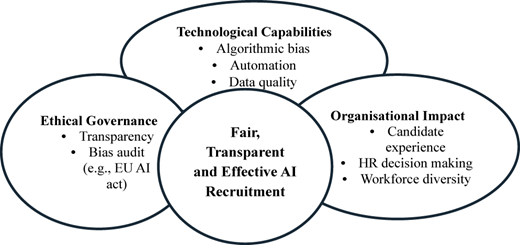
Based on the above review of AI’s role in recruitment, Governance, and ethical challenges, this paper proposes a multidimensional theoretical framework (Figure 1) that integrates three core domains: technological capabilities, ethical Governance, and organisational impact.
Technological Capabilities encompass AI’s algorithmic decision-making power, automation potential, and limitations, including inherent biases embedded in training data (Cai et al., 2024; El-Ghoul et al., 2024).
Ethical Governance refers to the regulatory and corporate oversight mechanisms, transparency requirements, and fairness audits necessary to ensure the accountable deployment of AI (Hunton, 2024; Talwar and Agarwal, 2022).
Organisational ImpactImpact examines how AI adoption affects HR practices, candidate experiences, and broader workforce dynamics (Alrakhawi et al., 2024; Zahedi et al., 2024).
Figure 1 highlights the interplay between AI technology, governance structures, and human-centric outcomes, offering a cohesive lens for analysing AI-driven recruitment. It guides future research by identifying where gaps remain—in transparency, regulatory enforcement, and ethical implementation—and underlines the necessity of integrating these dimensions to foster fair and effective AI hiring practices.
8. Conclusion
AI-driven hiring reshapes recruitment, promising efficiency, cost reduction, and enhanced decision-making. However, beneath these promises lies a stark reality: AI is concentrating power within opaque, proprietary systems, reinforcing biases, and creating an unregulated hiring dystopia. The unchecked expansion of algorithmic recruitment risks transforming employment into an exclusionary process dictated by data-driven decisions that lack human oversight and ethical safeguards.
Without comprehensive regulation, algorithmic hiring will evolve into a closed-loop system where AI assesses, selects, rejects, and continuously monitors candidates with minimal transparency or accountability. The absence of legally mandated auditing and explainability mechanisms enables corporations to deploy high-risk AI models without scrutiny, exacerbating discrimination and systematically disadvantaging marginalised groups. Existing anti-discrimination laws, such as those in the US and Australia, are insufficient to address the unique risks posed by AI recruitment. At the same time, the EU’s AI Act offers a crucial, albeit regionally limited, model for regulatory intervention.
Governments must act decisively to prevent AI hiring from becoming a tool of digital exclusion. A legally enforceable governance framework—grounded in transparency, fairness, and accountability—is essential to ensure AI recruitment enhances, rather than undermines, human employment rights. Independent audits, candidate redress mechanisms, and explainable AI mandates should be central to any regulatory approach. Without such safeguards, algorithmic hiring will erode the fundamental rights of job seekers, transforming workplaces into spaces of automated exclusion rather than opportunity.
If AI is hiring you, then who truly controls your career? The answer depends on whether policymakers choose to intervene or allow the invisible hand of AI to dictate the future of employment. The time for action is now.