The European Union (EU) member states are obligated to implement the separate collection of textile waste by the year 2025. Nowadays, non-profit organizations (NPOs) are the largest collectors of post-use textiles. In support of upcoming changes, this study develops an understanding of barriers and drivers for establishing partnerships between NPOs and companies in reverse textile supply chains.
This study adopts the embedded single-case design. The main data source is semi-structured interviews with NPOs, companies and research institutes in Finland, identified through intensity case sampling. The drivers and barriers are categorized into seven categories: environmental, economic, social, institutional, technological and informational, supply chain and organizational categories.
This study elaborates on the barriers and drivers in a new context of textile valorization and prioritizes them. The study identifies the alignment of interests and goals, increased transparency and clarity of terminology and other main factors in establishing the partnership.
Expanding the geographical boundaries of current research will capture the experiences of NPOs and companies in other contextual settings.
This study contributes to the existing knowledge with a broad picture of different barriers and drivers. The findings intend to support the integration of NPOs in reverse textile supply chains.
The partnership can potentially minimize the export of post-use textiles to developing countries, thus reducing the negative environmental footprint and social impact of the textile industry.
The study looks at an emerging form of partnership between NPOs and companies in reverse supply chains for enabling valorization of post-use textiles.
1. Introduction
The fashion industry estimates that the amount of textile waste will increase by 60% between the years 2015 and 2030, producing a global footprint of 150 tons of textile waste (GFA and BCG, 2017). Fast fashion culture has cultivated a perception of replaceability and throwaway attitude among clothing consumers (Brydges, 2021). It has led to overconsumption and accumulation of post-use textiles in municipal solid waste (Birtwistle and Moore, 2007; Sandvik and Stubbs, 2019), acknowledged by the waste management (WM) companies (Dahlbo et al., 2017). This increase is also notable within the overwhelmed second-hand clothing market and the growing export of used clothing to developing countries (Nørup et al., 2019a, b; Brooks, 2015).
Fortunately, increased awareness of the environmental impact has been cultivating a global interest in valorization of post-use textiles (Nørup et al., 2019a; Palm et al., 2014). This study focuses on post-use (in some sources, post-consumer) textiles that originate from the consumer disposal, and not the production-side streams (Pensupa et al., 2017). This study takes the perspective of untraditional, often overlooked actors in reverse textile supply chains – non-profit organizations (NPOs). Nowadays, NPOs are the largest collectors of post-use textiles worldwide (Pal, 2017). In the Nordic countries – the geographical context of this study – NPOs collect around 20% of all post-use textiles as direct voluntary donations (Dahlbo et al., 2017; Palm et al., 2014). NPOs aim to primarily collect reusable post-use textiles that can be sold in their charity stores (Pal, 2017). However, only a small portion of post-use textiles collected by NPOs finds its way to the second-hand market in the country of collection. As a result of quality assessment, large quantities of post-use textiles not suitable for domestic reuse as clothing join international export. Operating in this direction, the Nordic countries have grown their export of post-use textiles by 25% in the past three years (Nørup et al., 2019b).
This situation is on the edge of rapid change. By the year 2025, all European Union (EU) member states are obligated to implement separate collection of textile waste (Directive, 2018/851). As a result, the Directive has brought other actors to textile collection. In support of this upcoming change, this study develops an understanding of the partnerships between NPOs and companies for textile valorization. The study aims to build on the knowledge about such partnerships, with a broad picture of the barriers and drivers in the context of reverse textile supply chains. Thus, this study follows the NPOs' attempts to partner with companies and aims to answer the following research questions:
How do NPOs, companies and research institutes perceive the barriers and drivers in establishing a partnership for domestic valorization of post-use textiles?
How can these barriers and drivers be prioritized among each other?
The study captures the perceptions of NPOs, companies and research institutes, and as a result, categorizes the barriers and drivers into seven categories: environmental, economic, social, institutional, technological and informational, supply chain and organizational. The following section provides a literature overview and introduces the umbrella framework chosen for the study.
2. Partnership for textile valorization
The upstream textile supply chain has been a dominant focus area in research over an extended period of time (Hvass, 2014). Reverse supply chains generally remained “the wrong way on a one-way street” (Rogers and Tibben-Lembke, 2001) until the beginning of the 2000s, when the discipline gained substantial attention, mainly focusing on manufacturing, automobile and electronic industries (Prajapati et al., 2019). Interest toward textile waste has increased only in recent years, strongly promoted by raising awareness of the environmental impact and legislation on separate collection of post-use textiles (Nørup et al., 2019a; EU Directive, 2018/851).
Post-use textiles are often considered a single waste fraction (Nørup et al., 2018); recent studies have proved this assumption wrong and identified three fractions: reusable, recyclable and non-recyclable textiles. In the Nordics, the largest part of post-use textiles ends up in solid municipal waste. This means that around 80% of textiles (despite the fraction) are incinerated with no possibility for reuse or material recovery (Norden, 2015; Nørup et al., 2019b). NPOs collect most of the remaining post-use textiles; the rest is collected by small private collectors, initiatives of fashion retailers like H&M and Lindex, take-back and garment repair services, and clothing exchange between individuals (Dahlbo et al., 2017; Brydges, 2021). The non-profit collectors sort and export textiles that cannot be reused in the country of collection. Export is an economically viable solution that provides a possibility for creating a material loop. For this reason, the non-profit collectors transport these textiles to the larger sorting centers in the Baltic countries where textiles are sorted into different fractions (Nørup et al., 2019b). However, despite the economic benefits and valorization opportunities, there is a strong need for the development of domestic valorization practices. Firstly, textile export generates unnecessary emissions in transportation that reduce the overall environmental benefits of textile valorization. Secondly, a recyclable textile fraction will soon be demanded in the Nordic countries. Some recycling companies have previously reported insufficient availability of textiles for their recycling operations (Norden, 2015). In addition, the textile recycling plant, which is currently piloted in Finland, will require sufficient inflow of post-use textiles to keep its operations viable (LSJH, 2020). Thus, the domestic demand for recyclable post-use textiles will significantly increase.
The remainder of this section, firstly, takes a closer look at NPOs as an actor in reverse textile supply chains. Then, it provides an overview of the categories of barriers and drivers for establishing circular business.
2.1 Non-profit organizations as an actor in reverse textile supply chains
NPOs take the central position in the collection of reusable post-use textiles. The primary aim of NPOs is to collect textiles that can be used again in their original condition or after little processing (Pal, 2017). In practice, they receive all fractions, which are sorted into different categories by textile reusability (Nørup et al., 2019b). The categories might contain textiles not suitable for domestic reuse, textiles for rags or incineration (Brooks, 2013). The worn-out condition and defects such as stains, missing parts of decoration or functional elements prevent post-use textile reuse as clothing in the country of collection (Nørup et al., 2019a).
NPOs have become an actor of reverse supply chains for post-use textile valorization. The attributes of such reverse supply chains are: (1) a system for collection that makes products available for further processing, (2) quality assessment, sorting by categories and repair if needed, as well as (3) market development for used products (Guide and Van Wassenhove, 2009; Jahre, 1995). Despite their role and developed practices in the collection and sorting of post-use textiles (Heikkilä et al., 2019), the NPOs are seldom considered as actors for textile valorization. The primary interest motivating their involvement lies in monetary fund generation for social development work, and in some cases, in providing direct clothing donations (Sandberg et al., 2018). From the textile industry perspective, NPOs are often seen as a possible market for overstock products, cause-related marketing partners or a third-party collector in post-retail initiatives of fashion retailers (Hvass, 2014). In return, NPOs receive access to resources and capabilities, therefore resulting in better collection and higher reusability of textiles (Pal, 2017). Such collaboration efforts have left a footprint on the nature of NPOs, making them more alike to social for-profit enterprises (Maier et al., 2016) in terms of business-like goals, level of service delivery and business terminology usage (Dart, 2004).
The demand for improved valorization practices is currently growing and will be further facilitated by the EU-level regulation (EU Directive, 2018/851). For this reason, it is important to advance our understanding of NPOs as actors in reverse textile supply chains and partnerships with companies for domestic textile valorization.
2.2 Barriers and drivers for establishing circular business
In establishing the partnerships for textile valorization, NPOs and companies will potentially face certain constraints and positively affecting factors. Collaboration and sharing enable the distribution of responsibilities and risks among the partners and provide opportunities for the development of valorization solutions (Bocken et al., 2019). At the same time, a partnership demands the coordination of resources and activities beyond a single organization in the supply chain, creating management complexity (Gripsrud et al., 2006). To build a more holistic understanding of the barriers and drivers, the remainder of this section reviews the categories of barriers and drivers identified in the existing literature.
For this study, the framework of barriers and drivers developed by Tura et al. (2019) has been selected as an umbrella for the discussion. This framework has been selected because it provides a comprehensive summary of barriers and drivers identified in the previous literature and classifies them into large categories (Table 1). The umbrella framework captures the complexity of circular economy (CE), its systematic nature and both economic and non-economic perspectives of the circular business identified in the sustainable socio-technical change literature (Corvellec et al., 2013; Blomsma and Brennan, 2017). Some of these barriers and drivers take their roots in the supply chain management (SCM) literature that address sustainable SCM, reverse and closed-loop SCM. For example, the social category of the framework captures well-established barriers and drivers such as the establishment of joint communication activities to mitigate complexity, socio-economic differences in buyer–supplier relationships and increased sustainability awareness (Busse et al., 2016; Gripsrud et al., 2006). The supply chain category of the framework addresses general SCM issues of transparency (Pagell and Wu, 2009), cooperation and integration in the supply chain and development of joint goals (Perry and Towers, 2013; Govindan and Bouzon, 2018). Depending on the context, these issues can become both supply chain barriers and drivers. The economic category, for example, emphasizes the importance of economic viability in sustainable SCM and cost pressure that the actors might experience as a barrier (Pagell and Wu, 2009; Busse et al., 2016). Other general SCM barriers and drivers are found across categories such as regulatory pressure, technical constrains and innovation capabilities, as well as organizational culture and management orientation (Govindan and Bouzon, 2018; Pagell and Wu, 2009).
Addressing the nature of the research subject, the following aspects link the CE stream with the SCM literature. Firstly, closed-loop supply chains and supportive logistics function for collection, sorting and treatment are considered the main building blocks of CE (Lüdeke-Freund et al., 2019; De Angelis, 2018). Secondly, a growing attention in the SCM literature has recently been given to waste valorization, slowing or closing the material loops (Lüdeke-Freund et al., 2019). Such focus has highlighted issues of coordination and configuration of the supply chain for waste valorization and the adoption of an interorganizational perspective, which is emphasized in the CE literature (Ciulli et al., 2020; Lüdeke-Freund et al., 2019). It also addresses the novel types of relationships in supply chains, such as the partnership between traditional and untraditional actors for exchange of materials or products (Ciulli et al., 2020; Guide and Van Wassenhove, 2009). The multi-disciplinary research that captures noneconomic stakeholders, such as NPOs, produces insights on managing sustainability trade-offs and representing the perspectives of all supply chain actors (Pagell and Shevchenko, 2014).
The following part of this article introduces the umbrella framework and the barriers and drivers across seven categories (Table 1).
An awareness of the environmental impact and the importance of taking action to reduce the impact are seen as the root causes for sustainable initiatives in many of the studies (Tura et al., 2019; Prajapati et al., 2019; Govindan and Bouzon, 2018; Govindan and Hasanagic, 2018). In addition to environmental sustainability, creating a more sustainable society and supporting economic growth are seen as well-understood benefits of CE (Aminoff and Pihlajamaa, 2020; De Angelis, 2018). Some reverse supply chain studies classify environmental drivers into the category of social or societal drivers (Govindan and Bouzon, 2018; Prajapati et al., 2019). CE studies, in their turn, tend to distinguish environmental and societal categories (Govindan and Hasanagic, 2018; Tura et al., 2019). For example, Tura et al. (2019) consider the societal pressure on companies and authorities to find alternatives for traditional, linear business and awareness of sustainability needs as the drivers of societal origin.
The economic factors are indeed widely recognized but also often favored in decision-making (Aminoff and Pihlajamaa, 2020). Valorization has strong economic potential (Guide and Van Wassenhove, 2009; Govindan and Hasanagic, 2018). The economic drivers are associated with business growth, increase in margin and profits (Tura et al., 2019) and obtaining value that has previously been uncaptured (Yang et al., 2017). The economic barriers concern a lack of initial capital and investments (Govindan and Bouzon, 2018) and a long-term process of receiving a return on investments, which contradicts short-term profit objectives of companies (Aminoff and Pihlajamaa, 2020). The challenges also originate from the fact that CE development is driven by the existence of waste, but not by market demand (Aminoff and Pihlajamaa, 2020). The owners of waste experience a lack of incentives for finding a sustainable WM solution, inconsistent quality and quantity of waste, and lack of support between the supply chain members (Govindan and Bouzon, 2018). By contrast, supply chain-related drivers include possibilities for multi-disciplinarity and increased availability of resources and capabilities (Tura et al., 2019; Jia et al., 2020). The barriers include a conflict of interest and modes of operation between the supply chain actors, no clear responsibilities of the CE projects and challenges of validating all of the environmental effects of CE (Tura et al., 2019).
As a part of the institutional category, legislative support is seen as a driver of equal importance along with societal awareness and financial aspects (Ranta et al., 2018; Govindan and Hasanagic, 2018). Directing regulations and standard requirements create policy grounds and cultivate effective post-use textile handling (Tura et al., 2019; Govindan and Bouzon, 2018; Ranta et al., 2018; Dahlbo et al., 2017). In their study, as one of the barriers, Ranta et al. (2018) highlight that current regulations offer little institutional support for reuse, rather placing an emphasis on the promotion of recycling. Thus, the institutional factors can include guidance and support from the policymakers as the drivers (Prajapati et al., 2019; Jia et al., 2020) and, in contrast, include complex and overlapping regulative mechanisms as the barriers (Tura et al., 2019).
The technological and informational category addresses emerging process technologies, information sharing and management technologies (Tura et al., 2019). The barriers concern technological capabilities and the process of handling reverse material flows (Brydges, 2021). Waste as the material is heterogeneous, which brings uncertainty and complexity to reverse supply chains and circular business (Tura et al., 2019; Govindan and Bouzon, 2018; Aminoff and Pihlajamaa, 2020). On the other hand, the drivers emphasize practices for enhanced information sharing and adoption of emerging technology, as these practices enable increasingly efficient process options and transparency (Tura et al., 2019). To make the reverse supply chain more attractive from the business perspective, the processes of product return management, technological issues and market development for recycled products should be bottleneck-free and well-integrated. A lack of used products of the right quality at the right place and time and lack on the market has an even stronger impact than constraints of the process technology (Guide and Van Wassenhove, 2009).
The category of technological and informational factors is strongly linked to the organizational category. The organizational drivers include skills and capability development, organizational structure, strategy and supportive culture (Tura et al., 2019). The barriers originate from weak management support and a lack of shared understanding within the organization, as well as between the partners in the supply chain. Obtaining the knowledge of best practice in the reverse supply chains is difficult due to fear of risks and silo thinking in both internal and external contexts (Tura et al., 2019; Govindan and Bouzon, 2018).
3. Methodology
The study is qualitative in nature and based on embedded single-case study research design as the strategy of inquiry. The case study is widely considered to be an appropriate strategy for exploring such novel topics (Eisenhardt, 1989). Such research design also benefits the study with possibilities to capture sub-units of a single case and to develop an in-depth understanding of the phenomenon in a real-life context (Yin, 2009). The embedded units of analysis are the case organizations' perceptions in relation to the barriers and drivers in establishing the partnership.
The reverse supply chain for post-use textile valorization in Finland has been selected as a case for a number of reasons. Firstly, the country aims to implement the regulations on separate collection ahead of the official schedule, by the year 2023. Thus, WM companies are already running multiple tests on the post-use textile collection and sorting (LSJH, 2020). Secondly, NPOs and companies in Finland have already had a few attempts to establish partnerships for increasing domestic valorization of post-use textiles. For example, NPOs have had small-scale partnerships with private companies, which transform post-use textiles into non-woven industrial products or manufacture cleaning rags (Dahlbo et al., 2017). In addition, NPOs have done small-scale pilots with municipal WM companies to understand consumer decision-making in post-use textile sorting.
We followed the advice of Eisenhardt (1989) and Miles et al. (2014), specifying that the samples selected for qualitative research should be purposeful and based on some theoretical criteria. Our purposeful case selection process involved two phases. First, we selected the NPOs. The main selection criterion for the NPOs was their attempts to partner for textile valorization with companies. The selected two case NPOs are both among the largest non-profit collectors in Finland. These types of cases are information-rich (Piekkari et al., 2010), providing us with a lot to learn from. Next, we searched for the organizations that have relationships with the case NPOs. Table 2 presents the case organizations, explaining their core activities and informing about the data collection sources.
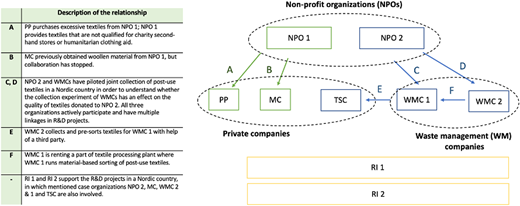
The sampling logic resembled the intensity case selection type (Patton, 2002); the relationships between the case organizations are further explained in Figure 1.
The primary data collection method was semi-structured interviews. The interviews were complemented with other data sources, such as company webpages, press releases and reports as well as webinar recordings and blog posts. The interviews followed a general thematic guide that included the following topics: the interviewee's profile and roles, current engagements and collaboration with other actors, their challenges and drivers. The interviews were recorded and transcribed verbatim. The transcribed data were coded by using NVivo.
The coding and analysis processes were iterative with discussions between two researchers and going back to the literature. This process started with getting to know the data, e.g. by reading all interview transcripts and additional secondary data. This phase included descriptive coding (Saldaña, 2016) and memos related to connections between different observations. Different secondary data sources presented in Table 2 were complementary in building a rich picture of the relationships between the case organizations. This process triggered the literature search that could explain emerging observations. The framework developed by Tura et al. (2019) was considered useful to advance the understanding of the partnership between NPOs and other organizations. In the second cycle of coding (Saldaña, 2016), we re-coded the whole dataset with the codes derived from the framework and contrasted the findings from our data to the literature on barriers and drivers.
The procedures for prioritization of barriers and drivers include drawing mind maps, writing analytic memos and linking the observations to each other (Saldaña, 2016). We reduced the data into matrix displays, e.g. by combining the vast array of material into an “at-a-glance” format that enables reflection, verification and conclusion drawing (Miles et al., 2014). The prioritized barriers and drivers were then grouped and recorded in relation to a particular actor group (NPOs, WM companies or private companies) and their relationships with one another.
Table 3 synthetizes all tactics for improving validity and reliability applied in the study. The quality of the research was improved by involving two researchers in the data collection and analysis, and using multiple data sources (Yin, 2009) as a part of the data triangulation. The tactics for enhancing the external validity include application of purposeful sampling with intensity sampling logic and finding the case companies across different sectors (non-profit, public and private). In addition, the researchers used a shared interview guide and jointly conducted the interview process, coding and data analyses. The results were discussed with the main contact persons to ensure the validity of the findings (Yin, 2009).
4. Results
This section introduces identified barriers and drivers. The section follows the categorization of barriers and drivers adopted from Tura et al.'s (2019) framework (environmental, economic, social, institutional, technological and informational, supply chain and organizational categories). These main categories are further divided into sub-categories, which have been adapted to match the context of textile valorization. A summary of the barriers and drivers as well as interview quotes are provided in Tables 4 and 5. The new sub-categories that have emerged in the study are indicated as “NEW” in the tables. These categories are presented using the actor-based approach so that they emphasize which group(s) of actors is most or least affected by the particular barriers or drivers. The three main actor groups are: NPOs, municipal WM companies and private companies, as previously presented in Figure 1.
In the environmental category, both the private and municipal WM companies emphasized their desire to minimize the environmental impact as a driver for establishing the partnership for textile valorization. These actors believe that domestic recycling and incineration of post-use textiles are more environmentally friendly solutions than the export of these textiles abroad from the country of collection (as in the relationships B and F, Figure 1). On the other hand, only one case NPO (NPO 2) emphasized the importance of environmental objectives along with their charitable work; the environmental objectives have been driving their attempts for collaboration with the WM companies. NPO 1 emphasized that they are not particularly interested in such partnerships because the organization would like their charitable objectives to remain dominant over the environmental ones. No environmental barriers were identified.
As the economic driver for establishing the partnerships, both the municipal WM companies and private companies see the potential in generating value from recyclable post-use textiles. In the collaboration attempts between the NPOs and WM companies (relationships C and D), the WM companies were driven by the opportunity to valorize the textiles that the NPOs could not sell in the country of collection. In another attempt, the private manufacturing company (MC) was interested in the wool products that the NPO 1 could supply as the raw material for the company's production line (relationship B). In these types of relationships (B and A), NPO 1 was driven by a possibility to generate an additional revenue stream using textiles not suitable for their charity stores.
Among all these actor groups, only the NPOs have their own established models in reusable clothing business, driving their strong leadership in this area. The private companies are driven by and engaged in the partnership because of the potential of sustainable solutions for textile valorization to be economically viable. By contrast, a dominance of the economic indicators is an economic barrier for the NPOs in those cases where economic factors are prioritized over the environmental concerns in the decision-making process. This barrier prevents the NPOs from establishing domestic partnerships as an alternative to international export. Export activities bring NPOs additional monetary funds and support their objectives in fund generation for the global development work. Domestic partnerships with municipal WM companies (relationships C and D) might initially create additional logistics costs for the NPOs and distract them from the primary objective of fund generation.
Within the social category, the charitable background of NPOs is seen by all actor groups as a driver that enhances the NPOs' collection of reusable textiles. The charitable causes of NPOs' operations motivate textile donors to bring their used products to the NPOs collection and to maintain a simple sorting routine to assess the reusability of textiles. This social driver enhances the economic driver related to established models and leadership of NPOs in the reusable textile business. Another social driver is observed within the WM and private companies. These actor groups have a shared understanding of “being in the same boat” of textile valorization: having the willingness to reduce the environmental impact, to create value from textile waste and to reach business potential. For these reasons, all actor groups emphasized the role of joint research and development projects and “bringing the actors to the same table.” These projects support actors in identifying future development directions, information sharing and increasing the “spirit of cooperation in their field.” The WM and private companies explained that the joint projects help them mitigate social barriers such as lacking awareness of industry needs and the uncertain customer requirement to have post-use textiles as raw material. An inclusion of the NPOs in these discussions about the domestic collection system for post-use textiles has had its strategic importance. The NPOs have developed a “mindset” required for managing post-use textiles throughout the years of hands-on collection and sorting experience. Both the WM and private companies consider the need for a “different mindset” in relation to collection and sorting of other waste fractions as a social barrier. A good example is the sorting of vintage clothing. This sorting routine requires a deep understanding of current fashion trends and those of the past. These textiles are also sorted by different quality standards because in this case, small defects do not reduce the strong reusability potential of vintage clothing.
A need to implement the EU-level regulations on the separate collection of post-use textiles is a strong institutional driver by the municipal WM companies. The WM companies and research institutes believe that the EU Directive will bring new actors to the textile industry and stabilize the inflow of post-use textiles. As a result, it will lead to an advancement of existing valorization practices, development of new partnerships in the field and risk reduction associated with insufficient textile quantities needed for valorization systems to function. This institutional driver has also initiated the development of the national collection system for post-use textiles (e.g. the relationships E and F). The Directive has brought attention of higher-level stakeholders from the governmental institutions; based on the previous experience, e.g. the research institutes (RI 1 and 2) believe it brings the issue of textile waste to a politically higher level of priority. On the other hand, all actor groups, especially NPOs and WM companies, have pointed at existing complexity in the legislative mechanisms as an institutional barrier, which create difficulties in establishing the partnerships between the organizations of different sectors (private, non-profit or public). For the partnership between the NPOs and municipal WM companies, the legislative mechanisms should provide more support for enabling an exchange of collected textiles between the actors (such as the relationships C and D).
In the technological and informational category, the WM and private companies indicated new technologies for detecting fiber blends as a technological driver for the development of valorization solutions and the partnership between these actor groups. As a strong informational driver, the WM companies and NPOs emphasized a positive impact of instructing the stakeholders (including all actor groups and consumers) about the collection and sorting practicalities. The WM and private companies admitted an increased difficulty in handling post-use textiles as a technological barrier. The companies emphasized the challenging process of textile preparation for mechanical or chemical recycling (recognizing fiber blends, removing decorations and functional elements) and inconsistency of textile inflows (both quality- and quantity-wise). This barrier is tightly connected with two other technological and informational barriers: a lack of technological readiness for commercial scale (e.g. in the technology for fiber detection) and an information gap between various stakeholders.
The supply chain category includes the barriers and drivers related to collaboration between the actors, their goals and motivations, modes of operation and interests in relation to textile valorization. Both the WM and private companies emphasized an increased availability of knowledge, technology and access to joint resources through collaboration as a supply chain driver for the partnerships. These actor groups also reflected on NPOs as a valuable source of insights on the post-use textile collection and sorting practices. As a strong supply chain barrier, the WM companies and NPOs pointed out the conflicts of interests and operation modes. The conflicts arise from mismatching interests and focus on different fractions of post-use textiles (e.g. suitability for reuse or recycling), different goals (fund generation and recycling) and instability of the non-profit collectors' position, threatened by the emerging national collection system. For example, the NPOs are not interested in the collection of recyclable post-use textiles as their collection system is driven by the fund generation objectives through textile reuse. The NPOs believe that if they start sorting the recyclable textiles in their sorting centers as well, it could confuse their donors and increase their logistics costs. In addition, an increasing demand for transparency and visibility is another supply chain barrier for the NPOs and WM companies. The WM companies want to be able to explain “what is really happening with textiles” to the citizens. In this case, the NPOs experience difficulties in achieving complete transparency for their entire supply chain, when it comes to international export.
As an important organizational driver, all actor groups emphasized a shared understanding of the major targets of textile valorization. The actors believe in the “big target” of closing the loop in the textile industry, prioritizing quality over quantity in their valorization solutions and establishing partnerships to achieve efficiency in post-use textile collection. As an organizational barrier, the NPOs addressed the fear of risks associated with a need to adapt or change their existing mode of operations in textile collection, sorting and redistribution. Another revealed organizational barrier is related to misinterpretations of terminology and legislation, specifically emphasized by the WM companies and NPOs. For example, the term “discarded textiles” [1] is interpreted differently by NPOs and WM companies. Aside from the terminology, the differences in interpretation were found in the discussions of legislative mechanisms when these were applied to the partnerships between the actors of different sectors (e.g. the NPOs and WM companies).
5. Discussion and conclusions
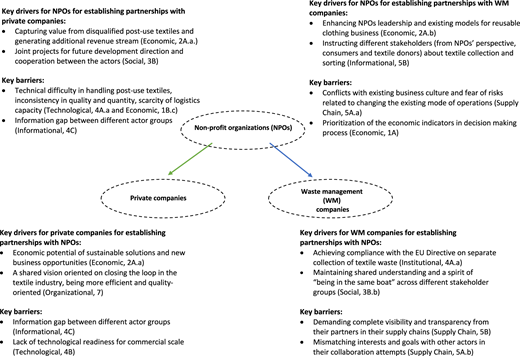
The results presented in the previous section illustrate the multitude of individual barriers and drivers, in several categories, that drive or hinder the partnerships for domestic textile valorization. Seeking contextual explanations has resulted in further prioritization of these barriers and drivers, as synthesized in Figure 2. The codes in the figure (e.g. Economic, 2A.a) refer to the main category, sub-category and then to the barrier and driver by the actor group identified in the study, thus linking Figure 2 to Tables 4 and 5.
One of the main drivers for NPOs to partner with companies is the enhancement of their leadership in reusable textile clothing business. Thus, the NPOs were motivated by the opportunity to instruct the stakeholders (including the consumers) about the reusable textile collection in light of the implementation of the national collection system. In these attempts, the NPOs faced certain conflicts with the companies in terms of interests, goals and business culture. When establishing such partnerships, the NPOs found it difficult to maintain their operational focus on reusable textiles. The NPOs expressed a fear that clothing donors could misinterpret the NPOs' intentions to partner with WM companies if the NPOs would start the collection of all post-use textile fractions. For them, it may result in a lower quality of donations and an increase in their logistics costs. The WM companies emphasized a lack of transparency as one of the main barriers. Transparent domestic valorization is seen as a “selling point” due to an opportunity to openly inform consumers on the valorization outcomes. Obtaining visibility beyond their own organization would increase SCM complexity for the NPOs. However, a lack of transparency in the international export activities of NPOs reduces their attractiveness and may prevent their partnership with other actors seeking a reliable partner on the secondary clothing market. For the NPOs, increasing transparency would require two actions. NPOs should track their export flows of post-use textile beyond their own sorting facilities and calculate the environmental impact of logistics activities, including textile export.
In addition, the study also found some misinterpretations of terminology and legislative mechanisms across these actor groups. Clarifying the terminology is an important step toward more efficient collection of post-use textiles; as a result, the NPOs and companies can unlock the informational driver of sharing and instructing the stakeholders about the textile collection and sorting. For the NPOs in particular, it can potentially lead to an increase in the quality of donated textiles and, consequently, reduction of sorting costs and higher valorization outcomes. Despite these existing barriers, all actor groups were brought together to “one table” by the joint development projects. The companies especially valued a shared understanding of “being in the same boat” and the platform for a dialogue between the NPOs and companies developed through the joint projects.
This study has two main theoretical contributions. Firstly, the study identified a broad picture of different barriers and drivers for emerging partnerships between the NPOs and companies. This gave a structure to the complex and multisided challenge of establishing the partnership between the NPOs and companies. The study also highlighted a unique, two-fold role of NPOs. The NPOs' role is traditionally defined by their charitable background and social work. However, their role has evolved in the partnerships with the companies. The NPOs are becoming more alike to social for-profit enterprises with a unique social focus and non-financial outcomes of their business activities (Maier et al., 2016).
Secondly, the study has context sensitivity (Lüdeke-Freund et al., 2019), and it elaborates the drivers and barriers in the context of reverse supply chains for textile valorization. Previous studies (Tura et al., 2019, Lüdeke-Freund et al., 2019) claim that these barriers and drivers are highly context-specific; thus, this study answered the call of Tura et al. (2019) for testing the framework in diverse settings. Taking an actor approach in this study allowed an understanding of how these barriers and drivers influence different actor groups, including NPOs, WM and private companies, to develop.
The results of this study have managerial and societal contributions as well. Understanding the main barriers is a critical step toward removing the obstacles pertaining to domestic textile valorization. For example, the actors will have to overcome the conflicts of interest and goals, close the information gap and solve technical difficulties while handling post-use textiles. Accordingly, the successful implementation of the partnerships for textile valorization is strongly motivated by the drivers. For instance, the study revealed the importance of high-level stakeholder engagement in the joint development projects and roadmaps and a shared understanding of “being in the same boat” of textile valorization. Going through all of the environmental, economic, social, supply chain, institutional, technological and organizational drivers and barriers systematically is a way to take the first step. On the societal level, this study produces new insights that can potentially minimize the export of post-use textiles to developing countries, thus reducing the negative environmental footprint and social impact of the industry on the other end of textile supply chains. The study results support the development of domestic textile valorization, which enhances the growth of sustainable solutions to close the loop in the textile industry.
Future research directions should tackle the supply chain aspects related, e.g. to the change in the operation mode and alignment of interest and goals of the textile collectors in the national collection system for post-use textiles. Another interesting research problem is related to misinterpretations and making actors “speak the same language” in their partnerships. Lastly, expanding the geographical boundaries of current research would capture the experience of NPOs and companies in other settings than in Finland.
The authors are thankful to Liikesivistysrahasto (The Foundation for Economic Education) in Finland for providing the study grant for this research work.
Note
Translated from “poistotekstiili” in Finnish.