


The objective of this paper is to study the role of artificial intelligence (AI) in supporting the supplier scouting process, considering the information and the capabilities required to do so.
Twelve cases of IT and information providers offering AI-based scouting solutions were studied. The unit of analysis was the AI-based scouting solution, specifically the relationship between the provider and the buyer. Information processing theory (IPT) was adopted to address information processing needs (IPNs) and capabilities (IPCs).
Among buyers, IPNs in supplier scouting are high. IT and information providers can meet the needs of buyers through IPCs enabled by AI-based solutions. In this way, the fit between needs and capabilities can be reached.
The investigation of the role of AI in supplier scouting is original. The application of IPT to study the impact of AI in business processes is also novel. This paper contributes by investigating a phenomenon that is still unexplored and unconsolidated in a business context.
Introduction
The COVID-19 pandemic, the global chip shortage of 2020 and 2021, and the scarcity of raw materials are just the most recent disruptions plaguing supply chains (Manupati et al., 2022; Chen et al., 2022) and making procurement increasingly complex. Buyer firms have aggressively searched for alternative solutions for obtaining necessary resources, often through scouting for new suppliers (Scoutbee, 2021). This phenomenon is very likely to remain a valid concern in the future as firms seek to streamline the scouting and identification of new short-term suppliers.
Even before the latest emergencies, supplier scouting was relevant, as buyer firms have always needed to gather information on potential suppliers, assess their offerings and select the best one (Monczka et al., 2016). Thanks to structured, responsible supplier scouting, procurement can contribute to value creation. Indeed, supplier selection impacts the sustainability of a firm (Bag, 2020) because suppliers need to demonstrate their reliability to buyers.
In today's volatile and uncertain business environments, firms are reshaping the way they manage their supply chain by developing the current supply base (e.g. Calvi et al., 2020) and scouting for new suppliers (e.g. Zhan et al., 2021; Saghiri and Mirzabeiki, 2021). Supplier scouting, defined as a buyer firm's market exploration to identify potential new suppliers (Luzzini et al., 2014; Lee et al., 2011), has become crucial and requires the development of new models and digital tools for data handling and analysis.
The strategic management of procurement in general and supplier scouting in particular (Bienhaus and Haddud, 2018) requires the adoption of digital technologies (Batran et al., 2017; Lorentz, 2021). In this vein, artificial intelligence (AI) allows buyers to upgrade their scouting for new suppliers through the automation of activities and through AI's predictive power (Handfield et al., 2019). Although scholars have not yet delved into the topic, the role of AI in supplier scouting is a clear avenue for expansion among industry professionals. The most striking example is the success of Scoutbee, a start-up that uses AI to transform the way organizations discover and connect with suppliers. In 2019, Scoutbee was recognized in the technology category at the World Procurement Awards; in 2022, it ranked 31st in Procurement Magazine's top 100 companies [1].
However, for most buyer firms, the efforts to digitize supplier scouting are still limited, thus preventing digital integration (Richey et al., 2007; Singh et al., 2018). Thus, the object of this study is to investigate the role of AI solutions in the supplier scouting process in terms of existing applications and the algorithms behind them. We focus on the information required for supplier scouting and the capabilities necessary for the exploitation of such information as enabled by AI technology. For this reason, information processing theory (IPT) is the appropriate theoretical lens for this study. The validity of this theory's application to AI in supplier scouting is corroborated by previous research (i.e. Bensaou and Venkatraman, 1995; Cegielski et al., 2012; Lorentz et al., 2020) although the role of AI in supplier scouting has not been investigated so far.
The paper addresses one exploratory research question:
How does the adoption of AI in supplier scouting affect the fit between the information processing needs and capabilities of procurement?
The research was conducted through 12 case studies of procurement technologies being used by information providers, with a view towards leveraging their expertise on AI-based scouting solutions and their use by buyer firms.
To address this research question, this paper relies on the two constructs of IPT: we first identify the buyer firms' information processing needs (IPNs) in the supplier scouting process; then we consider the information processing capabilities (IPCs) enabled by the adoption of AI-based supplier scouting solutions.
Literature review
Supplier scouting
Supplier scouting consists of market exploration used to identify potential new suppliers (Luzzini et al., 2014; Lee et al., 2011) and to increase knowledge about the supply market (Spina, 2008).
There are several factors that trigger the scouting process among buyer firms. The first and most frequent trigger is the lack of a qualified supplier that can supply what is required. However, scholarly opinion regarding this phenomenon varies. According to Spina (2008), if the development of a new product requires a component that can be supplied by qualified suppliers, it is preferable to rely on them again. In this way, fewer burdens are incurred in scouting and qualifying new suppliers, and the risk of establishing the relationship is lower (Spina, 2008; Bartezzaghi and Ronchi, 2005).
Sundquist and Melander (2021) discuss the new interfaces between buyer and supplier that are triggered by new product development. Indeed, the unavailability of a needed resource triggers scouting for a new supplier that can provide it. This affects the characteristics of the new product and the configuration of the network of the focal firm that is looking for the new resource, which can be material, financial or intellectual (Park and Lee, 2018).
These relationships and interfaces affect buyers and suppliers and lead to the involvement of other actors in the scouting activities (Waluszewski et al., 2019). Indeed, in the exchanges between buyer and supplier, scouting activities are often the triggering event, with the IT provider playing a bridging role between the two firms (Bartezzaghi and Ronchi, 2005; Sundquist and Melander, 2021).
According to Melnyk et al. (2010), the scouting process – and supply base management more generally – must become a source of leverage to strengthen the competitiveness of the buyer firm. The scouting phase must be managed strategically, as the supplier base, like the business environment in which it operates, is dynamic and changes over time. According to Melnyk et al. (2010), scouting activities should also aim to enhance the buyer firm's attractiveness as a potential partner for suppliers. Supplier scouting also fulfils a competitive intelligence function within the supply chains of major competitors (Spina, 2008).
Scouting for new suppliers can be conducted in many ways. Often, the suppliers themselves approach the buyer firm with a commercial offer (Melnyk et al., 2010). Otherwise, the buyer will look for new partners by attending industry expositions, surfing the internet, consulting industry-specific journals and/or meeting informally with professionals from other firms (Spina, 2008; Lee et al., 2012).
Sometimes, the buyer firm leverages business agencies and websites (such as Alibaba or Amazon Business). These solutions are gaining traction in the industry, as they foster connections among players of any size and location (Sundquist and Melander, 2021). However, they are mostly exploited for less relevant purchasing categories, as they often provide very general and succinct information about potential suppliers (Lee et al., 2012). Buyer firms can also resort to services operators for industrial companies (Bartezzaghi and Ronchi, 2005). These operators equip the buyer firm with the electronic platform and software applications necessary to support the scouting activity. In this way, the buyer can collect additional information about the suppliers regarding product descriptions, certifications, etc. (Bartezzaghi and Ronchi, 2005). Thus, in most buyer companies, a structured supplier scouting process does not exist, despite its strategic importance.
In the supplier scouting process, high-quality information is crucial (Hazen et al., 2014). However, buyers often lack access to up-to-date databases, which are expensive and may be incomplete. Alternatively, buyers must gather information manually, thus wasting their efforts given the amount of data required to perform supply market scouting. In this way, the scouting process often results in a high degree of uncertainty. Therefore, buyers need to be aware of suppliers' information processing needs (IPNs), including the type of data required and their sources (Handfield et al., 2019). Nowadays, the amount of information available is enormous, but data processing requires appropriate techniques and capabilities (Zhu et al., 2019). For this reason, AI can play a fundamental role in guiding supplier scouting.
Artificial intelligence as support to supplier scouting and selection
AI is still missing a unique definition: computer science focuses on creating intelligent systems capable of replicating human behaviour, while engineering focuses on AI for problem-solving (Guo and Wong, 2013). The same holds true for the application of AI in business: a single classification is difficult to delineate. In his definition, Min (2010) emphasizes more precisely the cognitive aspect of AI and the support it provides in solving practical problems: “Artificial intelligence is referred to as the use of computers for reasoning, recognizing patterns, learning or understanding certain behaviours from experience, acquiring and retaining knowledge, and developing various forms of inference to solve problems in decision-making situations where optimal or exact solutions are either too expensive or difficult to produce” (pp. 13–14).
Table 1 presents the key definitions of AI techniques and the algorithms relevant to the present research.
AI techniques and algorithms
| AI techniques | |
| Natural Language Processing | “Natural Language Processing is a theoretically motivated range of computational techniques for analysing and representing naturally occurring texts at one or more levels of linguistic analysis for the purpose of achieving human-like language processing for a range of tasks or applications” (Liddy, 2001) |
| Recommendation system | “Recommender systems can be defined as programs which attempt to recommend the most suitable items (products or services) to particular users (individuals or businesses) by predicting a user's interest in an item based on related information about the items, the users and the interactions between items and users” (Lu et al., 2015, p. 12) |
| Robotic Process Automation (RPA) | Robotic Process Automation (RPA) is defined as “a preconfigured software instance that uses business rules and predefined activity choreography to complete the autonomous execution of a combination of processes, activities, transactions, and tasks in one or more unrelated software systems to deliver a result or service with human exception management” (IEEE Corporate Advisory Group, 2017) |
| Virtual assistant or chatbot | “A chatbot system is a software program that interacts with users using natural language” (Shawar and Atwell, 2007, p. 29) |
| Algorithms | |
| Classification | “Classification models are supervised learning methods for predicting the value of a categorical target attribute. Starting from a set of past observations whose target class is known, classification models are used to generate a set of rules that allow the target class of future examples to be predicted” (Vercellis, 2009, p. 221) |
| Regression | “The purpose of regression models is to identify a functional relationship between the target variable and a subset of the remaining attributes contained in the dataset. [ …] On one hand, regression models serve to highlight and interpret the dependency of the target variable on the other variables. On the other hand, they are used to predict the future value of the target attribute, based upon the functional relationship identified and the future value of the explanatory attributes” (Vercellis, 2009, p. 153) |
| Fuzzy logic | Fuzzy logic is a technique used to map an input space into an output space by means of a list of linguistic rules consisting of if-then statements (Bih, 2006). Fuzzy logic can be described as an evolution of Boolean logic that distinguishes between 0 and 1 and allows a certain statement to be true, false, partly true, or partly false. This gradual transition allows for the mathematical expression of objects with varying conditions and states |
Source(s): Table created by authors
In supply chain management, AI facilitates supply chain analysis by processing a wide variety of data sources to identify market trends and predict customer preferences (Srinivasan and Swink, 2018). Many applications of AI are designed to support the selection of the best supplier, often functioning as multi-criteria decision models (Ho et al., 2010). Looking at previous research, Pitchipoo et al. (2013) introduced a hybrid decision-making model to evaluate and select the supplier based on a multi-criteria approach. In the same vein, Zair et al. (2019) designed an agent-based model in which negotiation and supplier selection are conducted by a purchasing dyad, i.e. the buyer and the buyer's customers, with the aim of including customer preferences in the negotiation algorithm and thus leading the buyer to choose the best supplier. Scott et al. (2015) proposed an integrated method to deal with multicriteria and multistakeholder supplier selection using a combined analytic hierarchy process/quality function deployment. However, these applications perform the selection of the best supplier from a list of potential partners already available to the buyer firm rather than scouting new suppliers. AI-related research currently neglects supplier scouting, which is certainly relevant to practice. Moreover, evidence suggests that the digital maturity of firms is at an early stage (Wang et al., 2016), and the potential of AI is untapped in many procurement activities, including supplier scouting.
Information processing theory
This research takes information processing theory (IPT) as the overarching lens to study the adoption of AI in supplier scouting. As mentioned by Galbraith (1974) and Roßmann et al. (2018), this theory is especially advantageous in the context of technologically triggered changes in business organizations. Moreover, scoping out the information requirements and the means of enhancing information is critical in knowledge-intensive processes such as supplier scouting (Lorentz et al., 2020).
IPT relies on the concept of uncertainty, which is generated by missing information about decision-making situations and related outcomes (Duncan, 1972). Many different types of uncertainty such as environment, task and partnership uncertainty determine information processing needs (IPNs) (Galbraith, 1974). IPNs can be managed through information processing capabilities (IPCs), which are classified by Bensaou and Venkatraman (1995) into structural, process and information technology mechanisms. Thus, firms manage uncertainty by reaching the fit between IPNs and IPCs (Tushman and Nadler, 1978; Bensaou and Venkatraman, 1995).
In the context of our research, uncertainty is generated when a buyer firm scouts for new suppliers. Supplier scouting activities, which involve several decision-making variables and stakeholders, generate uncertainty in the buyer firm, leading to IPNs. To counter these IPNs in the process of scouting new suppliers, buyer firms can resort to AI-based solutions accessed through procurement platforms to leverage the IPCs of the IT provider delivering the scouting solution. In this way, the IT provider's IPCs match the buyer company's IPNs through the AI-based supplier scouting solution (see Table 2).
IPT constructs
| Reference from a seminal work | Findings from sourcing management discourse | |
|---|---|---|
| Environmental Uncertainty | ||
| Sociopolitical component | Governmental regulatory control over the industry, the public political attitude towards the industry and its particular product, and the industry's relationship with trade unions that have jurisdiction in the organization (Duncan, 1972) | Buyer firms are subject to both international regulations and pressures from multiple stakeholders such as customers and nongovernmental organizations (Nair et al., 2016). Macro-changes in a buyer firm's environment entail changes to government policies, regulatory norms, cultural ethics and political and social changes (Dubey et al., 2015). Institutional pressures occur in the form of coercive data regulation or normative pressure for excellence, driving information processing interventions for automatic data storage and management in the procurement process (Lorentz et al., 2020) |
| Environmental dynamism | Environmental dynamism reflects the need for the organizational design to respond to the general characteristics of external dynamism. It is better defined by the maturity of the underlying technologies, among other things (Bensaou and Venkatraman, 1995) | In the digital procurement domain, the maturity of the underlying technology refers to a company's ability to embrace and use new technological assets. Technological readiness comprises the IT infrastructure that enables digital procurement (Kosmol et al., 2019) |
| Environmental complexity | The heterogeneity and range of an organization's activities. From the resource-dependence perspective, environmental complexity refers to competition in the industry that requires many different inputs or that produces many different outputs (Bensaou and Venkatraman, 1995) | Many different requirements are demanded of potential new suppliers, necessitating a significant amount of input information tailored to the specific requirements of the buyer firm. Supplier scouting systems become complex by reflecting user (i.e., buyer firm) requirements for functions or services. Supplier scouting solutions are developed by focusing on the embodiment of functions according to user demand in order to improve and accommodate the buyer's opinions (Lee et al., 2012) |
| Task Uncertainty | ||
| Organizational personnel component | Employees' educational and technological background and skills, including previous technological and managerial skills, individual members' involvement and commitment to attaining the system's goals, interpersonal behaviour styles and the availability of manpower for utilization within the system (Duncan, 1972) | The organizational personnel component comprises human resources, including the knowledge and skills to implement digital technologies in the digital procurement domain (Bals et al., 2019; Kosmol et al., 2019) “Top management support denotes the degree to which top managers understand and appreciate the value potential of digital procurement, as well as the degree to which they champion and promote the use of digital technologies and practices in procurement” (Kosmol et al., 2019, p. 5) |
| Organizational functional and staff units component | The technological characteristics of organizational units, the interdependence of organizational units in carrying out their objectives and intra-unit and inter-unit conflict among organizational functional and staff units (Duncan, 1972) | In the digital procurement domain, the organizational functional and staff units component refers to “the roles, responsibilities, and interfaces for the coordination and integration of digital procurement both in the company and with external partners. Coordination and integration of these units can be achieved through vertical mechanisms (e.g. centralized under a chief digital officer) or through lateral mechanisms (e.g. decentralized across cross-functional teams)” (Kosmol et al., 2019, p. 5) |
| Task analysability | The extent to which there is a known procedure that specifies the sequence of steps to be followed when performing a task (Bensaou and Venkatraman, 1995) | The scouting process is not formalized in the literature. Market research may be outsourced to external providers such as Beroe (https://www.beroeinc.com/). After data collection, the purchasing team must process and integrate the data to ensure that they are effectively used for scouting activities (Monczka et al., 2016) |
| Task variety | The number of exceptions or the frequency of unanticipated and novel events that require different methods or procedures for doing the job (Bensaou and Venkatraman, 1995) | The process of scouting for new suppliers is different for more strategic components or standardized commodities; each scouting process has its own characteristics. The services operators for industrial firms offering scouting solutions return several different pieces of information about the potential supplier (Bartezzaghi and Ronchi, 2005; Monczka et al., 2016) |
| Knowledge intensity | The extent to which a firm depends on the knowledge inherent in its activities and outputs as a source of competitive advantage (Cegielski et al., 2012) | The whole point of conducting market research is to access knowledge about suppliers, understand prevailing market conditions and ascertain the ability of potential new suppliers to deliver the product or service effectively. Supply market intelligence is a source of competitive advantage (Monczka et al., 2016) |
| Partnership Uncertainty | ||
| Level of mutual trust | A factor that can help reduce uncertainty about the opportunistic behaviour of the other partner (Bensaou and Venkatraman, 1995) | When both the buyer and the supplier can objectively trust one another because there are no grounds for opportunism on either side, the development of mutual trust and the collaborative sharing of information between buyers and suppliers become key for the success of the relationship. In all other cases – which we believe to be predominate in business exchanges – such approaches may prove problematic (Cox, 2001) |
| Supplier's asset specificity | The extent to which the supply of a good/service requires capabilities and skills unique to a supplier (Bensaou and Venkatraman, 1995) | When a supplier's asset specificity is significant, buyer firms will face high switching costs and high search costs. On the other hand, this makes the supplier's offering relatively unique, increasing the power of the supplier in the negotiation (Cox, 2015) |
| Structural Mechanisms | ||
| Formalization | The process of formalizing – in terms of rules and procedures – the information exchange, or the extent to which the information exchange is used for coordination versus control purposes (Bensaou and Venkatraman, 1995) | The level of formalization of the supplier scouting process can vary in terms of activities and procedures to be accomplished, how information flows and how coordination occurs among the involved stakeholders (Spina, 2008) |
| Process Mechanisms | ||
| Commitment | The extent to which there exists an equal bearing of risks, burdens and benefits between the two firms (Bensaou and Venkatraman, 1995) | Digital procurement can provide a basis for exploring capabilities for broader value contribution based on knowledge and market intelligence sharing as well as collaboration and integration (Lorentz et al., 2020). In the present study, the commitment included in value creation involves the buyer firm, the suppliers and the IT provider synergistically delivering the scouting solution |
| Joint action | The extent to which there exists joint efforts and cooperation between the two companies in terms of long-range planning, product planning, product engineering, process engineering, tooling development, technical assistance and training/education (Bensaou and Venkatraman, 1995) | Supply market intelligence acquisition requires discussions and meetings with suppliers, internal and external stakeholder meetings for leads and the maintenance of personal contact networks. In particular, the role of experts in the field is recognized as a way to attain new supply market intelligence (Lorentz et al., 2020). In the present research, joint action is intended as a two-way effort in the relationships between the buyer firm, the suppliers and the IT provider delivering the scouting solution |
| Technological Mechanisms | ||
| Compatibility | The ability to share information across any type of technology platform (Byrd, 2000; Cegielski et al., 2012) | “This parameter may be an appropriate measure for control and coordination of communications among partners in a supply chain. Furthermore, this dimension is particularly apt for assessing the information processing capability of a supply chain member organization because it captures the perspective of an organization's information systems to adapt to meet the needs of the users throughout the organization as a whole rather than assessing the single usefulness of a specific application or software program to facilitate a specific task” (Cegielski et al., 2012, p. 189) |
| Data processing capabilities | A firm's ability to collect and analyse data to gain critical insights (Agarwal and Dhar, 2014). Analytics capability is the organizational facility with tools, techniques and processes that enable a firm to process, organize, visualize and analyse data, thereby producing insights that enable data-driven operational planning, decision-making and execution. “Analytics capability enables firms to increase their information processing capacity, whereby firms gather data from various sources and analyse it to gain insights for supply chain managers” (Srinivasan and Swing, 2018, p. 1851) | In the supply market intelligence context, data processing capability includes a broad range of mechanisms, such as analyses focused on different sources of information: commercial databases and sourcing tools, ERP-based supplier scorecards and Internet-based reports. It can also include higher-level features of the system, such as subscription-based newsfeeds. In some cases, this mechanism enables the use of collaborative platforms, and these, as a side effect, also provide intelligence about supply markets. Such platforms have a high capacity for conveying rich information because they may be used to gather data from many different stakeholders, process these data and produce interesting insights for the buyer firm (Lorentz et al., 2020) |
| Data quality | The degree to which data can be used to process information (Cegielski et al., 2012). “The degree to which data can be used is largely determined by their quality. Poor quality data can have a direct impact on business decisions” (Hazen et al., 2014, p. 72) | In the digital procurement domain, a technology intervention pertains to data quality. This intervention requires combining a high volume, variety and velocity of data from heterogeneous internal and external sources, sharing data with external stakeholders for a specific purpose, and organizing data to ensure the access, quality and use of such data (Lorentz et al., 2020) |
| ERP integration | The ability to integrate with the organizational ERP package in order to enable real-time information sharing and the integration of business functions (Bag, 2020) | The integration of the ERP in the procurement process proves useful in the adoption of Procurement 4.0 systems (Huang and Handfield, 2015) |
Source(s): Table created by authors
Confirming our choice of IPT as the foundation for this study, many previous studies in the supply chain domain have been designed based on the IPT constructs, including Cegielski et al.’s (2012) study of cloud computing in supply chains, Busse et al.’s (2017) study of sustainable supply chain management and Lorentz et al. (2020) study of supply market intelligence.
Methodology
Since this study applies IPT to a new research domain, we adopt a case study methodology due to the exploratory nature of our research (Eisenhardt, 1989; Yin, 2018) and due to this methodology's capacity to assist in building theories (Voss et al., 2002).
Sample description
Empirical data were collected from twelve case studies involving IT and information providers, relying on previous studies in the same context (e.g. Handfield et al., 2019; Yarramalli et al., 2020). The sample size is in keeping with the suggestions of Handfield and Melnyk (1998) and the methodological standards of Eisenhardt (1989). Twelve is considered a good number of respondents, resulting in good comparability of results while allowing for an in-depth analysis of each case – both of which are fundamental for theory-building research. IT and information providers are best suited for investigating data processing in supplier scouting activities for many reasons:
They are key informants about the information processing needs (IPNs) in supplier scouting, having served the IPNs of the buyer firms directly, including accessing their data and analysing and improving their scouting process.
They offer supplier scouting solutions, often customized based on the reference industry and supporting buyer firms with different characteristics (e.g. size, industry and purchasing categories), thus giving them significant experience in different applications of AI-based scouting solutions.
They develop the supplier scouting solutions implemented by the buyer firm, which involves knowing the required capabilities better than the buyer firms themselves, as said buyers simply adopt the digital solution they need without delving into the technical knowledge behind the solution's capabilities.
By offering their scouting solutions to several buyer firms, IT providers pool good practices from all of them and standardize the scouting process, which is poorly formalized and highly influenced by specificities. Therefore, their solutions are scalable, as well-structured AI-based solutions become viable for large and small firms in different industries.
Aiming at heterogeneity among respondents, we selected providers with strong experience in AI-based solutions for supplier scouting. Leading IT providers' solutions are used by major buyer firms around the world that are oriented towards technological innovation. Given the novelty of AI, start-ups are also relevant as they are agile players that pioneer digital innovation. AI-based solutions also require information to fuel the algorithms; therefore, the sample also includes information providers (see Table 3).
Sample of case
| Provider | Type of provider | Turnover | Number of employees | Headquarters |
|---|---|---|---|---|
| Provider A | Start-up | €870K in funding over three rounds | 11–50 | Italy |
| Provider B | Start-up | $4 million | 11–50 | Italy |
| Provider C | Start-up | < €1 million | 1–10 | Italy |
| Provider D | Start-up | €2.3 million | 20 | Italy |
| Provider E | Established IT provider | €5.4 million | 60 | Italy |
| Provider F | Established IT provider | $1.3 billion | 2,360 | USA |
| Provider G | Established IT provider | $250 million | 1,200 | USA |
| Provider H | Established IT provider | $63 million | 300 | USA |
| Provider I | Established IT provider | $1 billion | 5,000 | USA |
| Provider J | Information provider | $84.3 million in funding over two rounds | 5,000 | UK |
| Provider L | Information provider | $235.8 million in funding over six rounds | 721 | France |
| Provider K | Information provider | $1.8 million in funding over three rounds | 45 | Italy |
Source(s): Table created by authors
Data collection
To ensure construct validity, we collected data while triangulating different sources of information. We conducted a preliminary review of the solutions offered through provider websites, including informative sections, whitepapers and case studies. Where available, we also ran a demo to test the solutions. The information was cross-checked with reports from industry analysts (e.g. Gartner). These insights supported the use of the semi-structured interview approach (see Table 4) for primary data collection and helped ensure the reliability of the construct. The interview protocol was intended as a checklist rather than a strict guideline for the interview, thus leaving room for interactions between the respondent and the interviewer. To ensure validity, at least two researchers were present during each interview to take notes about the answers. The interviews were recorded and transcribed and then sent back to the primary informant for an additional check that the information was accurately recorded. After the validation of the transcript, the results were traced in a structured database for the within- and cross-case analysis.
Interview protocol
| Questions in the interview protocol | Main construct addressed |
|---|---|
| What AI techniques do you use for supplier scouting? | AI techniques and algorithms |
| Which algorithms support these applications? | AI techniques and algorithms |
| How do purchasing category features (strategic relevance, customization, etc.) affect the supplier scouting process and its uncertainty? | Environmental uncertainty |
| What is the impact of the supply market features (regulation, market turbulence, competition, etc.) on the supplier scouting process, and how can they affect the possibility of adopting the AI? | Environmental uncertainty |
| How much variability lies in the scouting process: is it made of repetitive tasks coded by standard procedures, or can it significantly vary based on interdependencies with other business units? | Task uncertainty |
| What role do data and information play in the supplier scouting process? | Task uncertainty |
| What data sources (e.g. sensor data, social data, transactional data, operational data, partner data, machine-to-machine data or cloud-service data) are the most relevant to the supplier scouting process? | Task uncertainty |
| Which data types (structured or unstructured) are the most relevant for the supplier scouting process? | Task uncertainty |
| How does asset specificity and the type of supplier relationship (e.g. spot transaction, mid-term relationship, partnership, strategic alliance, upstream integration, etc.) affect the adoption of AI in the supplier scouting process? | Partnership uncertainty |
| How does internal formalization (formal control or coordination) affect the scouting process and the exchange of information with the suppliers? | Structural mechanisms |
| How does the relationship among the actors involved (in terms of commitment, conflict resolution, joint action, etc.) affect the information exchange with the suppliers? | Process mechanisms |
| How are buyer firms' capabilities to process data, in terms of different types of data, quality of the firms' databases, and ease of exchange? | Technological mechanisms |
| How is the transparency of buyer firms' IT systems? | Technological mechanisms |
| How is the collaboration and integration with technological providers and procurement solutions providers? | Technological mechanisms |
| How is the collaboration with other information providers that provide supplier data for the scouting process? | Technological mechanisms |
Source(s): Table created by authors
Data analysis
We assume the AI-based supplier scouting solution as the unit of analysis in order to investigate the dynamics between the IT provider and the buyer firm adopting the solution.
First, we conducted a within-case analysis to understand the relationships existing among the variables within each individual case. Then, the cross-case analysis allowed us to focus on the convergence or divergence among the twelve cases. To obtain solid results through a detailed coding process, in keeping with Gioia and Pitre (1990), we built a coding tree based on the IPT constructs ( Annexure). In this way, the uncertainties were assessed as high or low and the mechanisms as strong or weak, as we diligently followed classical IPT formulations (e.g. Bensaou and Venkatraman, 1995). Furthermore, each uncertainty's underlying IPNs and each mechanism leading to IPCs was qualified through more descriptive codes developed from the in vivo analysis of the interviews.
Results and discussion
To address the results of the study, the available AI-based solutions for supplier scouting are identified and summarized in Table 5.
AI techniques and algorithms for supplier scouting
| Technique | Quotes from the case studies | Role |
|---|---|---|
| Natural language processing | “The potential of natural language processing is exploited in the collection of information for supplier scouting”. – Provider I “NLP technology can be used to populate a database in a very short time with all the most interesting information”. – Provider E | Search for detailed information about a specific supplier or for the supplier delivering the required product or service Support the decision-making process and monitor trends and performances Extract data from Excel sheets and align them with a standard classification |
| Image and video analysis | “The information gathering process can be improved through image and video analysis”. – Provider J “Image processing algorithms can access the catalogue of potential suppliers, and after a comparison with the bill of materials (BOM) in the buyer ERP, they find the best option to fulfil the procurement requirements”. – Provider G | Extract unstructured data from image sources and convert them into structured data Define the technical specifications of the product required by the new supplier or provide information about the supplier itself through the extrapolation of maps, photos and videos |
| Recommended system | “Recommendation systems support the choice of the best supplier, or group of suppliers, identifying the best fit based on the data collected during the training phase of the algorithm”. – Provider G | Understand the preferences of the organization and define its clusters of suppliers that match the criteria |
Source(s): Table created by authors
Information processing needs
Summarizing the findings from the case studies, the IPNs used in supplier scouting are described in Table 6, which also considers the nature and level of underlying uncertainties.
Uncertainties from the case studies
| Main construct | Quotes from the case studies | Descriptive in vivo code | IPT code value |
|---|---|---|---|
| Environmental Uncertainty | |||
| Environmental complexity | |||
| Product level of customization | “Buyers require the implementation of questionnaires to be submitted to potential suppliers, and the resulting scorecard has to be highly according to the specific service asked for by the buyer”. – Provider L “Customers that resort to purchasing platforms to perform the scouting process are typically looking for a very specialized solution tailored to their business needs”. – Provider B “AI in supplier scouting helps in channelling specific purchasing requests so the complexity of the AI-based solution is significant. If the buyer has generic requirements for the scouting process, traditional solutions work well”. – Provider K | IT provider's level of customization of the supplier scouting solution required by the buyer firm | customized product |
| Environmental dynamism | |||
| Maturity of the underlying technology | “Companies are craving AI and the innovation it can bring in the scouting process. However, actual implementations are still in an early stage and technology providers are struggling to deliver what they promised, as the technology has yet to reach the maturity stage of adoption”. – Provider I “The adoption of AI in procurement is very low; only around 2% of Italian firms use digital platforms for supplier scouting”. – Provider D “The maturity of AI application in scouting is still too low to justify massive investments in this kind of solutions, even though it shows a huge potential growth in its adoption rate”. – Provider E | Maturity of the AI technology and maturity of the procurement department in embracing the change suggested by AI | new technology |
| Sociopolitical component | |||
| Governmental regulatory control over the industry | “Firms have to deal with frequent changes in regulations about the management of suppliers' data and the level of control over the supply chain”. – Provider C “In highly a regulated industry, such as the oil & gas or energy sectors, the buyer firm is exposed to many regulations that change very quickly over time, so it is necessary to conduct informed scouting activities when a new supplier is required”. – Provider A | Requirements and changes in regulatory control over the industry | high regulatory control |
| Sourcing strategy | |||
| Strategic relevance of the purchasing category | “Having a high strategic relevance, core purchasing categories are a source of uncertainty as you have to define the right approach and the consequent impact on the strategic level of the organization. Scouting for a supplier of an indirect category is different; this kind of supplier is not differential in terms of strategic impact. So, applying AI in scouting for the management of core purchasing category can be considered as relevant at the strategic level”. – Provider F | Complexity of data gathering and analysis due to the strategic relevance of the purchasing category | from low to high depending on the category |
| Task Uncertainty | |||
| Organizational personnel component | |||
| Education and technological background and skills | “The lack of a true digital culture at the buyer firm is a problem for the implementation of AI in supplier scouting: if managers do not understand the value of the tons of data they have, they feed the procurement platform with poor quality data or misinterpret the results”. – Provider G “Most buyer miss a proactive approach to scouting, as they scout for new suppliers only when a new purchasing category is required”. – Provider D “Companies don't perceive the importance of digitalizing processes, and the involvement in digitalization projects is low. Only after the first applications do they start to understand the benefits of switching to digital and intelligent technologies”. – Provider F “Customers are experiencing adoption issues when it comes to AI, mostly due to a lack of appropriate background technological skills”. – Provider I | Level of digital competence among the procurement representatives in the buyer firm | low |
| Individual members' involvement and commitment to attaining the system's goals | “The top management of buying firms rarely has the right amount of commitment in pursuing complex and costly projects, like digitalizing and improving the scouting process, as they tend to look at the costs more than the potential benefits”. – Provider C “Organizations' lack of the culture needed to implement the innovation is a problem of change management: within the firm, every change is always seen as an obstacle, since they do not want to modify the current way of doing things and they do not feel the need to apply the AI”. – Provider H | Change management, top management endorsement and prioritization of procurement innovation projects | low |
| Organizational functional and staff units component | |||
| Inter-unit conflict among organizational functional and staff units | “Different organizational units approach purchasing as stand-alone, causing a higher complexity as compared to the case of centralized purchasing requirements for the whole organization”. – Provider D “Firms have shown a lack of data consistency within different business units of the same organization, ultimately resulting in internal communication problems and data asymmetries”. – Provider H | Centralization of the supplier scouting process and information asymmetries among different units | low |
| Task analysability | |||
| Extent to which established practices and procedures are followed in performing the task | “The scouting process does not follow a structured approach based on the definition of procedures, but every instance is managed differently”. – Provider D “The approach to data gathering for the scouting process is typically conducted in a reactive way, as the lack of standard practices and procedures for proactively and systematically searching for relevant information prevents buying firms from predictively analysing real-time supplier data”. – Provider F | Standardized procedures for the supplier scouting activities and visibility of the whole process | low |
| Knowledge intensity | |||
| Intensity of knowledge required by the processes | “Suppliers are reluctant to share their data publicly without a guarantee that their data will remain safe and accessible by selected customers”. – Provider B “The scouting and qualification of new suppliers require an extensive amount of data. In some countries, the government publishes detailed information about organizations operating in that country (e.g. in the UK). This facilitates the task of collecting data for these countries, but in many other countries (e.g. in Italy), these data are not available”. – Provider J “The adoption of AI in the supplier scouting process requires an extensive range of different data, as buying firms are not interested only in the economic data of their suppliers. To build an efficient scouting system, the presence of the right data is mandatory for the training phase of the algorithm”. – Provider K | Access to knowledge and insights about the supply network and the industrial context | high |
| Partnership Uncertainty | |||
| Supplier's asset specificity | |||
| Extent to which the supply of the good/service requires capabilities | “Most customers seek for long-term, strategic partnership, as a more extensive knowledge of supplier data and a greater level of supplier engagement calls for more effective supplier-development projects”. – Provider J | Buyers' search for strategic partnerships and long-term relationships | high |
| Mutual trust | |||
| Degree of comfort about sharing sensitive information with the provider | “Customers are not willing to share their data about the supply base with their competitors or other potential suppliers”. – Provider C “Suppliers aren't comfortable in sharing their data with every customer on the platform, just with the selected ones”. – Provider K “Providers have to protect the confidentiality of data of their customers and their relationship with potential suppliers in order to avoid information spill overs”. – Provider L | Willingness of buyer and supplier firms to share data between themselves and with the IT provider | weak |
Source(s): Table created by authors
Environmental uncertainty
Environmental complexity is fully realized in the customization of the supplier scouting solution, which buyer firms require of IT providers. Case studies reveal how, during their scouting activities, buyer firms have many specificities linked to the characteristics of their business and the requirements demanded of the suppliers. By increasing the parameters to be considered in scouting for new suppliers, both uncertainty and the information to be processed increase. All this converges into a high level of customization required of the IT provider. In the required solutions, each specific piece of information must be collected, analysed and enhanced through a solution that is tailored to the buyer and its potential supplier base. In this way, the level of customization of the scouting solution increases the IPNs.
As described by Provider B, buyer firms that resort to scouting solutions typically require very specialized products available through a limited number of suppliers.
Describing collaboration systems that enable scouting for new suppliers, Lee et al. (2012) refer to the development of solutions embedding all the functionalities needed to meet user demand. However, following the aim to improve and accommodate user needs, the resulting solutions become complex, reflecting all the buyer firm's requirements for functionalities or services.
Environmental dynamism is affected by the low maturity of AI technology for supplier scouting, whose potential has not yet been fully exploited and whose actual implementation is still limited. The case studies highlight how the maturity of AI technology and the adoption of advanced supplier scouting solutions are in a virtuous circle that struggles to get going. Indeed, innovative supplier scouting solutions need a reliable and trusted underlying technology; on the other hand, AI cannot develop further if it does not provide the field with actual applications. Moreover, the spread of AI applications in scouting is still too low to justify massive investment in this kind of solution, despite the huge potential growth shown by adoption rates (Provider G). Thus, the maturity of the underlying technology depends on the potential achieved by AI and also on the maturity of procurement in embracing the change triggered by AI.
According to the traditional formalization of the IPT (Bensaou and Venkatraman, 1995), the maturity of the underlying technology within the environmental dynamism is an external variable. However, given the key role of the buyer firm in the deployment of AI solutions, technological maturity also depends on the digital readiness of the adopting actors (Kosmol et al., 2019).
The environmental uncertainty can also be exacerbated by sociopolitical issues, in terms of regulatory control over the industry. When scouting for a new supplier, buyer firms must pay attention to several requirements imposed by local or international regulations. Thus, a lot of detailed information is required about potential suppliers, especially regarding their production processes, raw materials and certifications. This is necessary for building a regulation-compliant supplier base. Of course, the frequent change in regulations results in a high level of uncertainty plaguing the buyer firm, leading to higher IPNs (Dubey et al., 2015).
From the empirical analysis, a further source of uncertainty emerges that was not considered in the IPT framework: the strategic relevance of the purchasing category. In many case studies (as reported by Providers C, D, E, F, H and I), the respondents stated that the strategic relevance of the purchasing category had a high impact on the scouting process. Managing a core purchasing category increases the level of environmental uncertainty perceived by the buyer firms, as more complex data gathering and analysis are required due to the higher strategic relevance, which amplifies the importance of finding the most appropriate supplier. Although this source of uncertainty was not made explicit in the formulation of IPT, it is significantly reflected in the procurement literature. Addressing sourcing and supplier scouting solutions, Bartezzaghi and Ronchi (2005) describe a fundamental role attached to IT providers when dealing with highly specialized purchasing categories: they are entrusted with an advisory role in supporting the buyer firm during the scouting activities.
Task uncertainty
Task uncertainty is impacted by the skills of the personnel in the purchasing department: according to the case studies, digital competencies that support the scouting activities and help conduct the purchasing process are lacking. Indeed, people involved in these activities still lack the technological skills to fully understand and exploit the support of AI in supplier scouting. This finding is in line with Bals et al. (2019), who did not include digital competencies among current buyer skills but recognized them as fundamental for future development.
At the level of individual members' commitment in the transition to the new systems, Providers A, C, H and I mention the problem of change management, as buyer firms suffer from cultural barriers when it comes to implementing innovative technologies. In fully embracing the changes, the endorsement and prioritization of top management are crucial (Kosmol et al., 2019). Top management – in this study, the Chief Procurement Manager and the CEO – are called on to understand and appreciate the role of AI in the supplier scouting process in order to act as a catalyst for adopting valuable new supply relationships.
Task uncertainty is also impacted by the organizational functional and staff units component. The presence of conflict among units is common where the purchasing process is not centralized and is delegated among several units, each with a partial view of the situation (Kosmol et al., 2019). Providers D and H emphasize the inter-unit conflict arising within the organization when different units approach procurement separately. This affects the scouting process as well, including duplicated efforts in the search for new suppliers and information asymmetries and silos hampering the potential of AI to assist in supplier scouting.
Furthermore, many buyer firms still do not have a structured approach to data analysis for supplier scouting, making task analysability a source of uncertainty. Task variety is an issue, as buyer firms may lack complete visibility on these activities and scout for new suppliers without a structured process. Indeed, each firm has its own needs when it comes to scouting, and even within the same company, different requirements are managed through different approaches. Thus, variety increases uncertainty (Bartezzaghi and Ronchi, 2005; Monczka et al., 2016).
Partnership uncertainty
Considering partnerships, Providers B, C, F, L and K describe a low degree of comfort about sharing sensitive information between buyers and suppliers by means of the procurement platform. More precisely, these providers describe their scouting solutions as pooling information from different companies in the same data lake and making them accessible to any player using the solution. Thus, a buyer's supply base information is available to all the players who can access the same solution – with proper management of sensitive data. In this setting, suppliers are not interested in sharing their data publicly in the digital environment managed by the IT provider. On the other hand, buyer firms are not willing to share information about their supply base with competitors or other potential suppliers who might access the same services through the procurement platform. Therefore, mutual trust is missing from multiple players: buyers and suppliers trust neither each other nor the IT provider. The missing trust among the stakeholders involved is not new to the procurement domain (i.e. Shore and Venkatachalam, 2003; Cox, 2001), but it remains an open issue.
In dealing with supplier scouting, suppliers' asset specificity is relevant as well. Strategic suppliers are not easy to substitute, both due to high asset specificity and for practical reasons that require a significant amount of information to scout for alternatives (Bartezzaghi and Ronchi, 2005; Cox, 2015).
Information processing capabilities
Summarizing the findings from the case studies, Table 7 describes the IPCs enabled by the IT providers and transferred to the buyer firms through the AI-based supplier scouting solution.
Mechanisms from the case studies
| Main construct | Quotes from the case studies | Descriptive in vivo code | IPT code value |
|---|---|---|---|
| Structural Mechanisms | |||
| Formalization | |||
| Extent to which the scouting process is formalized | “The scouting process requires some sort of formalization to define standard tasks. Considering the complexity of supplier scouting, it cannot be based only on human activities or a simple Google search. Relying on an AI solution could be a good way to formalize the scouting methodology itself”. – Provider K “The IT provider takes control of the customer's whole procurement process, allowing for a higher degree of structure and formalization”. – Provider A “The platform takes care of the entire scouting process on behalf of the buyer firm”. – Provider C “The adoption of an AI-based platform helps the customer to achieve a greater level of formalization and methodological approach. In some cases, the user needs to be guided during the technological change and the process re-design”. – Provider G | Advisory role of IT providers in the formalization and re-design of the scouting process | high (thanks to the IT provider) low (for Providers C, D, E) |
| Process Mechanisms | |||
| Commitment | |||
| Extent to which there exists an equal sharing of risks, burden and benefits between the two firms | “Both buyers' and suppliers' data sharing is intermediated by the platform provider that grants the security of the data and does not disclose them without the direct authorization of each buyer or supplier”. – Provider G “In many cases, suppliers are more willing to share their data to the IT provider instead of the buyer, as the IT provider is an intermediary and is not interested in sharing sensitive data outside their proprietary platform”. – Provider B “The platform has a layered structure, in which every supplier has a public layer with generic information that can be accessed by every customer in the platform, and a set of more specific layers that allow the supplier to disclose the information they desire of the customer they accept”. – Provider F “Supplier data are protected from any spill overs and kept secret, as the closed structure of the platform guarantees that only the entitled customer can view the data from a certain supplier”. – Provider H | Intermediation role of IT providers in guaranteeing data security | high |
| Joint action | |||
| Extent to which there exists joint effort and cooperation between the two companies | “The data gathering process could be improved by a higher level of joint action, especially from the supplier side, as they are not always prompt in providing the right data on the platforms”. – Provider E “The system is based on a network of collaboration that provides the buyer firm with more and more information about the potential suppliers to support the supplier scouting process. The network fosters reciprocal and proactive communication on both the supplier and the buyer sides”. – Provider F | Effort of buyer and supplier firms in feeding the positive network externality coming from the shared platform | high low (for Providers C, D, E) |
| Technological Mechanisms | |||
| Compatibility | |||
| Ability to access systems across platforms | “The platform is deployed in a cloud, so it is easy to access from every other system of both suppliers and customers”. – Provider B “The solution consists of a single platform where all data are stored and can be accessed effortlessly from any platform”. – Provider G “The supplier database can be accessed across different platforms and organizations. Customers may decide to share the information about their suppliers in communities that allow them to exchange relevant information with their peers”. – Provider J “Easy-to-read scores and simple user interface allows all the members of the procurement department to easily navigate the system”. – Provider K | Ability to access the supplier scouting solution through different systems | high |
| Transparency of interfaces between systems | “Our AI-based solution consists of a single platform where all data are stored and can be accessed. The buyer firms that are part of the network let the provider access their system to have full visibility on different elements. This kind of transparency is also guaranteed internally to the buyer firm, as all the involved stakeholders in the company can have visibility on the processes of interest”. – Provider G “The platform offers several tools for data viewing, and it allows viewers to have a complete and transparent view of all the relevant data, while also integrating information coming from outside the company”. – Provider H “The solution is provided through a collaborative platform where all the procurement team have visibility and access, thanks to the possibility of integrating the solution with ERPs and other procurement tools”. – Provider L | Transparency on the scouting activities and on the whole procurement process | high |
| Variety of processed data types | “The platform includes data coming from structured sources only, such as official financial statements”. – Provider D “Among the wide variety of processed data, unstructured data represent the vast majority. This data includes news from the main newspapers, industry-specific reports, websites and even O-data, and allows us to gather direct insights on the analysed suppliers”. – Provider F | Ability to process data from a variety of sources relevant to supplier scouting | high |
| Data processing capabilities | |||
| Analytics capabilities | “We are able to gather a wide variety of data from different sources, offering the buyers a high degree of knowledge about the suppliers in their database. On the other hand, we lack specific data analytics skills and know that there is still room for improvement”. – Provider E “Data coming from multiple sources, particularly in an unstructured form (websites and news), is processed through a semantic analysis algorithm that ranks the reliability of the information and collects data about supply risk”. – Provider F “The implementation of AI is embedded in a wider platform that combines data processing skills and a managerial approach about the insight given by those data”. – Provider I | Capabilities of the IT provider to provide advanced analytics and AI-based solutions supporting supplier scouting | high low (for Providers C, D, E) |
| Data quality | |||
| Data accuracy | “The accuracy of the provided data is granted with a tier-based approach. First, a check of documents is automatically run via integration with third parties. The second tier is a further control we run to verify the accuracy of the data. Eventually, the third tier consists of audits”. – Provider J “All the supplier data in the platform is automatically checked to ensure that it is trustworthy and that certifications are not expired”. – Provider B “The database in our solution is fed by our customer. User-generated data does not have any kind of input control. Manual checks are done, but data accuracy is still low”. – Provider C “Data are gathered from third-party information providers: their data are certified and can be considered reliable”. – Provider D | Accuracy of the data used in supplier scouting coming from the buyer and suppliers' database and from external sources | high low (for Providers C, D, E) |
| Data timeliness | “All data in the platform is real-time updated; alerts are set about the expiration of due documentation”. – Provider B “Real-time data are analysed and processed in our solution, as the algorithms do not require data to be stored in a local database”. – Provider F | Timeliness of the data used in supplier scouting coming from the buyer and suppliers' database and from external sources | high low (for Providers C, D, E) |
| Data consistency | “Data consistency is enhanced by the fact that the main input data comes from the suppliers who are required to upload them in a certain format”. – Provider H “Customers are given the option to choose the most relevant information, and the platform designs the database in accordance with their decisions. This allows for consistent databases where all the information are kept in the same format”. – Provider F | Consistency of the data used in supplier scouting coming from the buyer and suppliers' database and from external sources | high low (for Providers C, D, E) |
| Data completeness | “AI algorithms can be applied only if data are complete and significant”. – Provider K | Completeness of the data used in supplier scouting coming from the buyer and suppliers' database and from external sources | high low (for Providers C, D, E) |
| ERP integration | |||
| Capability to integrate with ERP package for daily operation | “Integrating with the ERP of both buyers and suppliers allows us to respond quickly to the purchasing needs of our customers, directly accessing all the relevant information without any need for intermediation. With the support of AI this goal is easier to reach”. – Provider A “The AI-based platform is ERP-native, making it an end-to-end procurement solution. This allows suppliers and buyers to access the broader picture by not focusing only on the scouting, but having a wider platform to make sure that the scouting process is aligned with the whole purchasing process”. – Provider F “The integration with the ERP system of the buyer firm and the scouting solution is considered to be a plus that increases the process of data gathering”. – Provider G “The solution can be accessed outside of the provider's platform, and it can be directly integrated in the customer's ERP for easier access”. – Provider K | Integration of the AI-based supplier solutions with the ERP of the buyer and suppliers' firms | high |
| Integration with information providers | |||
| Presence of integrations with information providers for data gathering | “Collaborations with info providers allow the platform to gather descriptive information about suppliers that help the platform in labelling each supplier's purchasing category”. – Provider B “In order to gather more information, depending on the buyer-specific requirements, the IT provider can rely on other information providers”. – Provider K “Integrating with information providers helps to retrieve significant data about the potential suppliers in real time. Thanks to this integration, the IT provider only needs the ID number of the supplier to collect the related data if the supplier is present in the information providers' databases”. – Provider F “The integration with information providers represents a source of reliable data that are easy to access, allowing users to unlock documents and information that could take a long time to be processed if they are required to be sent directly to suppliers”. – Provider J | Integration of the AI-based supplier solution with the services offered by information providers to feed the algorithms and update the supply market intelligence database | high |
Source(s): Table created by authors
Structural mechanisms
Structural mechanisms consist of the formalization of the scouting process. According to almost all the respondents in the sample, the collaboration between the buyer firm and the IT provider allows the former to increase the level of formalization of procurement processes. Indeed, IT providers typically support their clients in redesigning processes that are fundamental to effective supplier scouting, following a more structured approach. This approach increases the buy firm's IPCs. In most cases, the IT provider takes care of the scouting process on behalf of the buyer firm and redesigns the buyer's internal process to standardize as many tasks as possible, as addressed by Provider G.
Thus, only considering the buyer firm, the level of formalization is mostly low. However, the level of formalization increases thanks to the IT provider, which brings structure to the buyer firm's processes and thus increases its IPCs. This is in line with the advisory role of the IT providers established in previous research (Bartezzaghi and Ronchi, 2005): besides solutions, they also provide professional consulting services in structuring and performing the main activities of a procurement department.
Process mechanism
The commitment mechanism is mainly exercised through the role of the IT provider in intermediating between the suppliers and the buyer. Indeed, the procurement platform guarantees the security of any information provided by the actors, as providers do not have any interest in disclosing data. Almost all the providers in the sample confirm that this mechanism solves the problem of confidentiality while ensuring an equal sharing of benefits among the parties. Providers F and L explain that the platform is built with a layered structure in which every supplier has a public layer – where the information that is publicly available in the network is stored – and a private layer – where the information shared with selected players in the network is stored. In this way, buyers and suppliers can store and share information while still protecting the data. Furthermore, strict non-disclosure agreements are key to ensuring the non-disclosure of sensitive data and fostering collaborative behaviour. In this way, only the entitled buying firms can acquire specific information about potential suppliers (see Provider G's statement). The IT provider thus has the role of catalyst and guarantor for the parties involved in data sharing, which is essential for pooling information and benefiting from a large dataset of supplier scouting information. However, these statements may bear biases due to the IT providers' comforting claims about data security. Data sharing is still a significant hurdle for many firms.
Providers also state that their databases are enriched with data coming directly from suppliers who are invited by the buyer firms to join the network and add more information, moving towards a community where different actors take joint actions in sharing relevant information. Indeed, the buyer firm is also required to communicate data about the supply base to provide the platform with sufficient information for conducting the scouting process. On the other hand, Providers E, H and K emphasize that the data gathering process is limited within their platforms and could be improved by a higher level of joint action, especially from suppliers (e.g. Provider E). However, Provider H does not trust the network effect coming from the joint action mechanism underlying a procurement platform: “The network of collaboration is limited within the platform. Every client is managed as a stand-alone instance without any communication with other use cases. This allows for a more tailored service to the customer, but it doesn't allow to exploit network externalities”.
The process mechanisms identified are related to data sharing and exploitation, mainly those impacting the relationship between the IT provider and the buyer firm, but also including suppliers. This is key in the proper adoption of AI in the scouting process. The issues related to data management and information sharing were already being debated in the procurement literature, as in Lorentz et al. (2020). In this study, the information processing interventions for data storage and management are presented as tools for process improvement and strategic alignment, in keeping with the concept of process mechanism identified in IPT.
Technological mechanism
Dealing with AI and its applications in business, the technological mechanism is the most important one, and the compatibility mechanism constitutes its initial step. Compatibility can be assessed through several features of the procurement platform, such as the ease of access to the platform (e.g. Provider B). Moreover, simple user interfaces allow buyers to easily navigate the platform.
Indeed, the transparency of the interfaces is described as relevant as well. Many IT providers state that they offer services allowing for a high level of process transparency, including sharing information among different business units and granting visibility throughout the procurement process. This transparency allows users to find consistent information quickly.
The compatibility mechanism is further empowered by the variety of data feeding AI-based solutions for supplier scouting.
In line with Cegielski et al. (2012), the accessibility of the solution, transference between interfaces and strong data integration create a virtuous circle that is crucial for the success of AI-based supplier scouting solutions. These dimensions enhance the compatibility of the solution as a means of controlling and coordinating communication between all the actors involved in the process: the buyer firm, the complex network of potential suppliers, the IT provider and the information provider.
In all cases, IT providers' analytics capabilities are fundamental and perceived as an intangible asset transferred to the buyer firm through the procurement platform. However, different degrees of capability were found among the different case studies, highlighting the varying maturity of supplier scouting solutions available to buyer firms today. For some of them, such as Providers F and I, analytics capabilities are high because the platform allows them to combine the data processing skills and supporting capabilities of the buyer.
However, Providers C, D and E report low analytics capabilities within their platforms. Provider D states that their platform is only able to provide stand-alone analyses of a selected supplier. Provider E says that their platform can handle multiple sets of data and information, but specific analytics-related skills are lacking, suggesting that there is still room for improvement. Therefore, analytics capabilities are crucial: according to the case studies, a lack of analytics capabilities constitutes a barrier preventing the adoption of AI in supplier scouting. The advanced analytics capabilities at the base of AI should be used to decompose, combine and integrate information (Srinivasan and Swink, 2018) while discovering useful insights for supplier scouting. However, buyer firms lack these skills (Bals et al., 2019) and rely on specialized IT suppliers. When IT providers have strong analytics capabilities, the collaboration with the buyer takes off, and AI becomes the arm of advanced supplier scouting. By contrast, when IT providers lack these skills, the potential of AI is untapped.
A provider that assures high analytics capabilities needs to guarantee high data quality as well, in terms of accuracy, timeliness, consistency and completeness. According to all the providers in the sample, the quality of the input data in AI-based solutions is crucial for reliable results.
As far as accuracy is concerned, the relevance is high. However, two critical factors arise from the case studies. For Provider C, the control for data accuracy is done manually. In the case of Provider E, no control is done since the platform involves only first-tier suppliers considered to be trustworthy.
Regarding the timeliness of the data, many providers in the sample state that the information in the platform is constantly being updated. Moreover, Providers B, L and K emphasize the capability of the platform to check for any expired data or new information and to notify the user about items of note.
Providers F, K and H emphasize the importance of dealing with consistent data to increase information processing capabilities. Provider H believes that data consistency is high, as the main input data come from suppliers, who are required to upload the information within a certain format. These consistent data allow for the application of AI in the scouting process.
The case studies emphasize the benefits of an effective integration between the procurement platform and the ERP systems of the buyers and suppliers. From a broad perspective, one of the most promising applications of AI in business is the support of ERP systems' machine intelligence. According to Hinova (2021), AI complements and optimizes the human factor in the interaction with ERP systems, guiding people in making the right decisions. This is corroborated by the case studies, as Providers A, F, G and K confirm the enabling role of AI in ERP integration, especially when it comes to the alignment between internal and external data.
Provider G describes the support of processing images in the scouting activities: their AI-based solution compares the data in the buyer ERP (i.e. the bill of materials and other information about the procurement requirements) with the images in the catalogues of potential suppliers, speeding up the recognition of the right product from a wide range of available alternatives in the supply market.
Indeed, integration with ERP systems increases the IPCs of the IT providers, which are then transferred to the buyer firm. This approach allows IT providers to directly plug the supplier scouting platform into the buyer firm's available systems, guaranteeing a broader control over each process and procurement need. However, Provider K reported that this mechanism does not always result in the expected benefits. Nevertheless, this experience was limited to a few cases where integration had not been successful, and Provider K still recognizes the value of this mechanism for increasing the IPCs. This aligns with Huang and Handfield (2015), who found that the strategic sourcing activities of firms implementing ERPs as compared to non-ERP users lead to better performance for the procurement department.
In analysing the IPCs described in the case studies, an additional construct was found within the technological mechanism: integration with information providers.
Matching information processing needs and capabilities
The empirical analysis of the case studies reveals a rich overview of the uncertainties for the buyer firm regarding supplier scouting activities and the mechanisms that enable them to cope with this uncertainty, especially the AI-based solutions offered by IT providers (see Figure 1). The resulting framework fits well within the formulation of the IPT constructs developed by Bensaou and Venkatraman (1995).
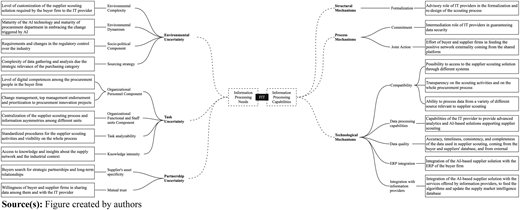
We adopt the “fit as matching” perspective established by Bensaou and Venkatraman (1995) by comparing IPNs with IPCs (Premkumar et al., 2005). Following this method, common patterns and differences can be found in the AI-based scouting solutions we analysed.
All the case studies demonstrate a high level of environmental, task and partnership uncertainty, meaning that the buyer firms scouting for new suppliers face significant uncertainty, which leads to high IPNs. On the other hand, the level of IPCs, defined by the structural, process and technological mechanisms, varies across the cases.
Although it is not possible to identify a one-to-one relationship between IPNs and IPCs (Tushman and Nadler, 1978), AI supports and sustains the development of appropriate mechanisms to manage uncertainty in supplier scouting. Structural and process mechanisms are fundamental to the adoption of AI and to extracting maximum value from it, as they are enablers necessary for adopting the new technology rather than actual AI-enabled mechanisms.
Technological mechanisms are certainly more substantial and directed towards the adoption of AI. In many of the case studies, sophisticated data analysis and natural language processing algorithms enable web crawling to run the supply market intelligence and inform supplier scouting with the integration of data from different sources. These mechanisms also result in higher data quality, which is fundamental in supplier scouting: AI enables automatic data quality checks, triangulation with data from internal (e.g. ERP) and external (e.g. structured data from information providers or unstructured data from news and social media) sources, and the harmonization of all the information available. The most advanced AI-based supplier scouting systems have actual recommendations for the buyer firm.
Most of the providers in the sample have the capability to process the required information: they have high IPCs, which are transferred to the buyer firm through their AI-based solution. Thus, the solutions offered by high-capability providers match the high IPNs of the buyers. Among the providers studied, there are large technology providers (Providers A, B, F, G, H and I) capable of merging data from internal and external sources, which ensures a view of the whole process and results in intelligent recommendations during the scouting activities and the automation of ancillary tasks. Matching the IPNs and IPCs demonstrates that information providers (Providers J, L and K) also play a key role: they are mainly focused on gathering data from sources external to the buyer firm, enabling these providers to process data and guarantee a high level of data quality. Being involved as data gatherers and providers, they are sceptical about offering explicit recommendations to the buyer firm.
However, smaller providers and start-ups (Providers C, D and E) are not able to provide the IPCs needed to manage the uncertainty inherent in supplier scouting, leading to a mismatch with the buyer firm's IPNs. These providers do not support the development of technological mechanisms through adequate investments, resulting in a low capability to process information and grant the required data quality. Furthermore, providing their solutions mainly to small and mid-sized buyer companies, these providers struggle to gain a good level of commitment in deploying the structural mechanisms in the suppliers' onboarding and in the formalization of the scouting process.
Conclusions
This paper contributes to theory and practice by studying an under-investigated phenomenon that is relevant for companies, namely the role of AI in supplier scouting. This study identified buyer firms' IPNs and found a high level of uncertainty in scouting for new suppliers. This study also identified the IPCs enabled by AI, helping to understand how AI copes with high uncertainty. The case studies reveal that the most advanced IT providers achieve a match between IPNs and IPCs, providing the buyer firm with a sophisticated AI-based solution to support the scouting of new suppliers.
Theoretical contribution
This paper contributes to the advancement of scientific knowledge in several ways since the application of AI in the procurement domain is still a novel, little discussed phenomenon. Indeed, previous contributions about the role of AI in procurement are few, often missing the process perspective and the specific activities carried out by the buyer firm (Min, 2010; Nguyen et al., 2018). This is even more true when it comes to supplier scouting, which, although key within the procurement process, remains scarcely investigated in terms of activities, information requirements and technologies. Thus, the supplier scouting process is a fertile ground for a new avenue of research focused on AI technology.
From a theoretical perspective, this study demonstrates the applicability of IPT to the context of AI implementation in supporting buyer firms' supplier scouting activities, thus contributing to the purchasing domain and to IPT research. This paper illustrates how IPCs reduce the buyer firms' uncertainty in scouting for new business partners. In this way, the IPCs developed by IT providers and transferred to buyer firms in AI-based platforms represent a fundamental enabler for increased competitive advantage stemming from supplier scouting. In addition, starting from the original intra-firm (Galbraith, 1974) and inter-firm (Bensaou and Venkatraman, 1995) IPT formalizations, the case studies reveal how uncertainty arises within the buyer firm perimeter and how the boundaries are extended thanks to the capabilities of the IT providers, which match the high IPNs in supplier scouting.
IPT is fundamental in providing a solid and consistent structure to the findings: the theory supports the validity of the study from the early stages of research design by considering all the constructs relevant to the adoption of AI in supplier scouting. Additionally, IPT has been developed over several years through various formulations, additions and applications in different domains. Thus, applying IPT to a largely new area of investigation enables a renewal of its validity and further confirms the robustness of its constructs. By adopting the IPT lens, this paper contributes to theory by identifying the IPNs of the scouting process, the IPCs offered by AI-based solutions and the match between IPNs and IPCs in a structured way.
Managerial contribution
The empirical data gathered directly by relevant players yield highly relevant takeaways for practitioners. Generally, the value of case studies is the investigation of a contemporary and complex issue (Yin, 2018) – in this case, the adoption of AI in the supplier scouting process – in a way that is fully embedded in the reference context and that urgently calls for the involvement of the key actors – in this case, IT and information providers. The IT and information providers in the sample offer an insider perspective by considering actors directly involved in the design of AI-based solutions for supplier scouting. Working with several buyer firms, IT and information providers hold a stock of knowledge related to different applications in terms of industry, type of buyer firms and purchasing categories required. Thanks to this internal perspective, we were able to precisely identify the needs of buyer firms when they approach the supplier scouting process in terms of data required and IPNs. Moreover, we also focused on IPCs, identifying the capabilities that are fundamental for buyers and that providers offer to compensate for current deficiencies. The implementation of AI is a critical problem for companies, especially when it comes to internally demonstrating why such technology is relevant and which problems it is going to address. This paper offers insights into the elements to consider in this implementation process to reduce internal uncertainty by managing and simplifying the scouting process.
Therefore, when analysing the constructs of IPT in the study of AI adoption in supplier scouting, the fit between IPNs and IPCs represents a further contribution for managers. This fit may be considered a proxy in the matching of supply and demand in the digital procurement solutions market since IPNs elucidate the needs of the buyer firms and IPCs describe the mechanisms through which IT and information providers address business needs. This focus on fit may represent an important contribution for both users and IT providers: users are supported in identifying the contribution of IT providers, and providers are better able to present their value to the users.
Limitations and future research
This study also has limitations. First, although the perspective of information and IT providers contributes important insights into the application of AI in supplier scouting, this perspective is still biased in many respects. In fact, information and IT providers' point of view is often skewed by commercial intent, as was unintentionally expressed by respondents: according to someone who designs, develops and sells a digital procurement service, the solutions provided are often considered to be very powerful and highly innovative. IT and information providers tend to be optimistic about AI adoption in a buyer firm's procurement process, particularly in the case of supplier scouting. Moreover, although providers can boast of longitudinal experience across different types of buyers, actual application cases are still few. Certainly, engaging the buyer firms in the collection of empirical data would be extremely valuable and could be taken into consideration for further research. Furthermore, the buyer's perspective should be addressed in specific industries or business contexts, as the scouting activities are affected by industry contingencies and specific supplier selection issues, and the type of AI support may change accordingly.
Second, this paper is qualitative in nature, as it only uses a case study methodology because of the novelty of the research. The combination of qualitative and quantitative methods would better support future research and provide an opportunity to move from theory building to theory testing.
Note
References
Annexure
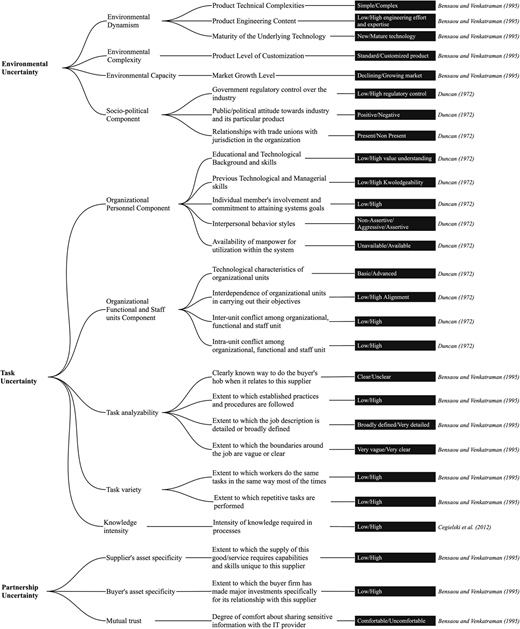
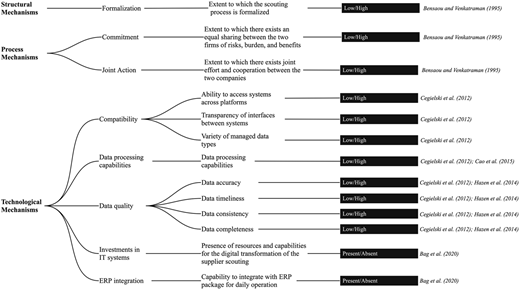
From codes to IPNs' level
| Main construct | Code | Impact on IPNs |
|---|---|---|
| Product technical complexities | Simple | ↓ |
| Complex | ↑ | |
| Product engineering content | Low engineering effort and expertise | ↓ |
| High engineering effort and expertise | ↑ | |
| Maturity of the underlying technology | New technology | ↑ |
| Mature technology | ↓ | |
| Product level of customization | Standard product | ↓ |
| Customized product | ↑ | |
| Market growth level | Declining market | ↓ |
| Growing market | ↑ | |
| Government regulatory control over the industry | Low regulatory control | ↓ |
| High regulatory control | ↑ | |
| Public/political attitude towards industry and its particular product | Positive | ↓ |
| Negative | ↑ | |
| Relationships with trade unions with jurisdiction in the organization | Present | ↑ |
| Non present | ↓ | |
| Education and technological background and skills | Low value understanding | ↑ |
| High value understanding | ↓ | |
| Previous technological and managerial skills | Low knowledgeability | ↑ |
| High knowledgeability | ↓ | |
| Individual member's involvement and commitment to attaining systems goals | Low | ↑ |
| High | ↓ | |
| Interpersonal behaviour styles | Non-assertive | ↓ |
| Assertive | ↑ | |
| Availability of manpower for utilization within the system | Unavailable | ↑ |
| Available | ↓ | |
| Technological characteristics of organizational unit | Basic | ↑ |
| Advanced | ↓ | |
| Interdependence of organizational units in carrying out their objectives | Low interdependence | ↓ |
| High interdependence | ↑ | |
| Inter-unit conflict among organizational, functional and staff unit | Low | ↓ |
| High | ↑ | |
| Intra-unit conflict among organizational, functional and staff unit | Low | ↓ |
| High | ↑ | |
| Clearly known way to do the buyer's job when it relates to this supplier | Clear | ↓ |
| Unclear | ↑ | |
| Extent to which established practices and procedures are followed | Low | ↑ |
| High | ↓ | |
| Extent to which the job description is detailed or broadly defined | Broadly defined | ↑ |
| Very detailed | ↓ | |
| Extent to which the boundaries around the job are vague or clear | Very vague | ↑ |
| Very clear | ↓ | |
| Extent to which workers do the same tasks in the same way most of the times | Low | ↑ |
| High | ↓ | |
| Extent to which repetitive tasks are performed | Low | ↑ |
| High | ↓ | |
| Intensity of knowledge required in processes | Low | ↓ |
| High | ↑ | |
| Extent to which the supply of this good/service requires capabilities and skills unique to this supplier | Low | ↓ |
| High | ↑ | |
| Extent to which the buyer firm has made major investments specifically for its relationship with this supplier | Low | ↓ |
| High | ↑ | |
| Degree of comfort about sharing sensitive information with the IT provider | Comfortable | ↓ |
| Uncomfortable | ↑ |
From codes to IPCs' level
| Main construct | Code | Impact on IPCs |
|---|---|---|
| Extent to which the scouting process is formalized | Low | ↓ |
| High | ↑ | |
| Extent to which there exist an equal sharing between the two firms of risks, burden and benefits | Low | ↓ |
| High | ↑ | |
| Extent to which there exists joint effort and cooperation between the two companies | Low | ↓ |
| High | ↑ | |
| Ability to access systems across platforms | Low | ↓ |
| High | ↑ | |
| Transparency of interfaces between systems | Low | ↓ |
| High | ↑ | |
| Variety of managed data type | Low | ↓ |
| High | ↑ | |
| Data processing capabilities | Low | ↓ |
| High | ↑ | |
| Data accuracy | Low | ↓ |
| High | ↑ | |
| Data timeliness | Low | ↓ |
| High | ↑ | |
| Data consistency | Low | ↓ |
| High | ↑ | |
| Data completeness | Low | ↓ |
| High | ↑ | |
| Presence of resources and capabilities for the digital transformation of the supplier scouting | Present | ↑ |
| Absence | ↓ | |
| Capability to integrate with ERP package for daily operations | Present | ↑ |
| Absence | ↓ |

