


How does right-wing populist discourse evolve in response to increased parliamentary influence over time? This study analyses party leader debates of the Sweden Democrats (SD) in the Swedish parliament between 2010 and 2024, focusing on four key populist elements: people-centrism, anti-elitism, popular sovereignty and antagonism.
Drawing on the inclusion-moderation thesis and existing theories of populist communication, we map and interpret shifts in the discourse over time. Previous research has often focused on highly mediatized arenas, such as news media outlets and social media, which are also posited to be conducive to “sloganized” and sensationalist forms of communication. The study adds to current research by redeploying earlier conceptualizations of populist communication in a highly formalized and regulated environment. Using a mixture of qualitative and quantitative analyses, we assess changes in the frequency and configuration of populist elements in the SD’s discourse.
Our findings reveal that the SD have largely maintained its populist discourse as per configuration, while the overall frequency of populist instances has declined between 2010 and 2024. The discourse emphasizes a strong focus on being representatives of the “people” as opposed to the corrupt “elites” throughout the years.
Observed shifts in how this internal logic is substantiated shed light on the adaptable nature of populist communication. These results offer new insights into the evolving nature of populist communication in a parliamentary context.
Introduction
The rise of right-wing populist (RWP) parties is one of the major political changes of our time. While many of these parties were initially excluded from cooperation, their continued electoral success has led to increasing inclusion in government coalitions. This success has also sparked scholarly interest in examining how their radicalism evolves as they gain acceptance by established parties.
Research in this area often builds on the inclusion-moderation thesis, which suggests that integrating radical parties into democratic institutions and procedures leads to a moderation of their ideological positions (Akkerman et al., 2016, pp. 31-32). However, much of the existing scholarship has focused on the rise of RWP parties and their shifts in policy positions or discursive strategies within social or “mainstream” media contexts (e.g. Hegedüs, 2021; Luther, 2011; Bobba and McDonnell, 2016).
By contrast, we have limited knowledge about how RWP parties adapt their populist discourse in formal political settings. While it is often argued that populist rhetoric is likely to be toned down in such contexts, empirical studies testing this claim remain relatively scarce (Schwörer, 2022). Furthermore, most research to date has concentrated on the content of political communication, paying comparatively less attention to the specific characteristics of party discourse itself. This imbalance leaves significant gaps in our understanding of whether and how populist discourse evolves when these parties operate within institutionalized democratic frameworks.
Against this background, this study poses the overarching question: How does the populist discourse of RWP parties adapt to increasing parliamentary influence? To address this question, the study analyzes the parliamentary discourse of the RWP Sweden Democrats (SD) in party leader debates between 2010 and 2024. This case represents a “most-likely case” for observing moderation in discourse. First, the SD have transitioned from being entirely ostracized upon their parliamentary entry in 2010 to gradually gaining acceptance, culminating in an extensive collaboration with the center-right government after the 2022 election (Aylott and Bolin, 2023). Second, rule-based formal settings, such as party leader debates, are more likely to encourage moderation than less formal channels like social media or campaign rhetoric. Overall, the results indicate that the relative frequency of populist references has declined between 2010 and 2024, although the configuration of the elements has largely maintained similar structure.
This study contributes to the growing literature on the consequences of RWP parties’ increasing participation in power and, more specifically, to understanding their populist discourse. In addressing this academic gap, the study also enhances knowledge about the validity of the frequently argued claim that integrating RWP parties into the political mainstream neutralizes the threat they are often perceived to pose to liberal democracy.
Literature review
The growth of RWP parties has sparked tremendous scholarly interest. A significant part of this literature focuses on what happens when such parties transition from being excluded to becoming increasingly accepted as coalition partners within the framework of parliamentary democracy. There is, for example, research indicating that this progress has contributed to a radicalizing effect on the political establishment, resulting in a “moving of the center” whereby “mainstream” policies and discourse successively adapt to right-wing populism (Mondon and Dawes, 2023; Krzyżanowski, 2020; Akkerman et al., 2016). In general, the growing acceptance of collaborating with RWP parties in Europe has been characterized as traditional parties turning towards a more active engagement strategy. Hereby, mainstream parties cooperate with and co-opts RWP policies. Moreover, shifting “back” towards disengagement strategies (such as reverting back to a cordon sanitaire after abandoning it) is uncommon (Biard, 2021, pp. 81-82).
Although to a somewhat lesser extent, recent research has increasingly focused on whether the success of RWP parties also affects the parties themselves. This body of literature often takes the inclusion-moderation thesis as its starting point. This thesis states that as radical parties become politically included, the incentives to emphasize extreme policies decrease. The results from this research are mixed, suggesting both examples where parties have moderated and cases where inclusion has not been accompanied by deradicalization. Counterintuitively, some parties might also succeed in “subjugating” so-called “establishment” parties, in tandem with cooperative and negotiatory dealings, and undermine ongoing democratization (Tepe, 2019). Furthermore, others posit that (accounting for national and cultural differences) an “exclusion-moderation” thesis is more relevant whereby political exclusion forces a moderate effect (Kaya, 2019).
Moreover, some describe a susceptibility of some mainstream parties to be smitten with a so-called RWP “contagion effect”. This denotes the co-opting of RWP policies by traditional parties, although not collaborating with them. Thereby, even traditional parties who do not engage directly with the RWPs can co-opt aspects of the party programme, policies, or rhetoric-especially when in opposition (Biard, 2021, p. 81). Consequently, this also complicates notions of moderation and inclusion, as the RWP party might successfully transfer aspects of their ideological and rhetorical frameworks without necessarily engaging with the political mainstream. Finally, the ways in which disengagement strategies can take form also differs, from legal party bans to informal agreements to not collaborate with the RWP.
Another potential problematisation is the closely related notion of “mainstreaming”, describing the process of the RWP party becoming a part of the mainstream which it criticizes. If it simply relates to the relative distance between the RWP and the established parties as per issue positions or rhetorical style, the definitional criteria are dependent on upon the contingent context. In other words, the mainstream can move closer to the RWP, as well as vice versa. Some scholars argue that the former trajectory should be differentiated from the latter, as the RWP succeeds in radicalizing the political center (Akkerman et al., 2016, pp. 6-7). Relating to a larger debate on the differentiation between moderate and radical, some even ask if such a conceptual framework is “useless” as the specificities of political, religious and legal differences makes broader extrapolation too difficult (Schwedler, 2011, p. 352). Other scholars posit that the mainstreaming is decidedly in favor of the RWP party family, arguing that there is an ongoing normalization of authoritarianism, populism and nationalism (Mudde, 2019).
The parliamentary arena represents a communicative environment where political struggle is discursively concretized. Crucially, expected adversarial engagement with other party representatives is also marked by collaborative opportunities. Thereby, this allows for a dual-purpose strategy of confrontation and potential collaboration (Ilie, 2003, 2006). In relation to populist discourse, earlier research has highlighted references to “the people” as commonplace in parliamentary address. This has contributed to several concerns for representative democracy, among them the viewpoint of political representatives as “disconnected” from the popular will. More specifically, while parliamentarians oftentimes claim to represent the people, the demos as such are not physically present (Truan, 2019). This discursive gap enables populist parties to effectively frame “establishment” actors as unable, or unwilling, to consider the will of the people.
Within this literature, importance is placed on the specificity of how “the people” is articulated within populist discourse. While a fundamental component of populism, the invocation of “the people” is also realized discursively relative to identified out-groups and elitist actors (Mansbridge and Macedo, 2019). In other words, the populist argument hinges not only on the referencing of a popular will, but also on a negation of its opposites. Consequently, with the exception of some minimalist conceptualizations, populist communication becomes contingent upon the internal structuring of the discourse (Ekström et al., 2018). For example, the identification and delimitation of “elites”, “others” or “the people” can offer grounds for differentiation between different kinds of populism. The transition of the SD from political pariah to key support party exemplifies evolving constraints and opportunities while employing a populist style within a parliamentary context. Moreover, the highly formalized and consensus-oriented parliamentary tradition in Sweden underlines the tension between populist anti-elitist antagonism and inter-party negotiation. Thus, the study contributes to ongoing debates regarding the political and rhetorical normalization of RWP parties by examining both the changing prevalence and the internal structure of populist discourse in parliamentary settings.
Research has so far primarily examined the extent to which the political content of RWP parties changes. With only a few exceptions, relatively little attention has been devoted to how their political discourse is affected by their increasing inclusion. Although the findings are not entirely consistent, they suggest that moderation is at least partly conditioned on the relative position of the populist party in relation to other coalition partners. A party’s populist discourse can thus be expected to persist when the party does not need to adapt to non-populist senior partners in government. In contrast, a weaker position is more likely to create greater incentives for alignment with the discourse of the political establishment. For instance, Bobba and McDonnell find that two Italian RWP parties, which shared government, “maintained their recourse to populist discourse in and out of office” (Bobba and McDonnell, 2016, p. 296) whereas Hegedüs (2021) concludes that the Hungarian RWP Fidesz, another party not constrained by non-populist coalition partners, instead radicalized its populist discourse during its time in government from 2010 to 2018.
This relationship is explicitly supported by the comparative study by Capaul and Ewert (2021, p. 794), who conclude that moderation is more likely when an RWP party is a junior coalition member or supports a minority government, as it then “must find a compromise with the other coalition members as it does not have enough power to maintain its own radical positions”. Another finding from this literature is that even in cases where inclusion is not followed by moderation, the discourse may change in character. For example, parties may shift their emphasis on different elements of populism. Populists in power, for instance, may target different types of elites compared to their time in opposition (Bobba and McDonnell, 2016; Schwörer, 2022).
In sum, this study contributes to further investigating this question by examining the SD, a party that has undergone a significant transformation from being completely excluded to becoming a support party for a center-right government. Based on previous research findings that populist discourse is expected to moderate when the party finds itself in a position where compromises with establishment parties are required, we expect that the discourse of the SD has moderated overall as the party has increased its parliamentary influence.
Case selection and context
The starting point for this study is to examine the inclusion-moderation thesis. Unlike much of the previous research, this study focuses on the extent to which the populist discourse of RWP parties changes as a consequence of inclusion. We argue that the Swedish RWP, the SD, represents a most-likely case for moderation through inclusion. Initially ostracized as a radical right party, it has recently faced reduced hostility from some other parties, making it a particularly suitable case for investigating this phenomenon (Aylott and Bolin, 2023). At the same time, some scholars highlight that political ostracism can also result in a maintained radicalism, rather than having a moderating effect (Van Spanje and Van Der Brug, 2007).
Within a broader European context, SD’s growth is both akin to, and significantly different from, other RWP parties. For example, whereas legal prohibition of RWP party activity in Belgium was preceded by amendments to the constitution, this was not the case in Sweden (Biard, 2021, p.81). On the other hand, both the Swedish SD and the Belgian Vlaams Belang faced strong resistance by traditional parties (Aylott and Bolin, 2023). Moreover, the establishment of a cordon mediatique in regional Wallonia (whereby RWP parties were partly excluded from participation in media) sets the Belgian split party system apart (De Jonge, 2021). By contrast, the Danish People’s Party (DPP) were part of several government constellations during the early 2000s, whereas the SD were largely seen as pariah in Swedish politics. However, as the SD have successively increased their electoral support since 2010, the election results for the DPP have proven less consistent (Fryklund, 2013; Etzerodt and Kongshøj, 2022; Rothstein, 2023). These differences highlight the need to examine SD in its own right while also situating it within the broader landscape of European RWP parties. In particular, insights from SD’s trajectory can inform our understanding of similar movements elsewhere, while comparisons have to take the unique political and media environment into account. Moreover, the consistency with which the SD has advanced in spite of resistance from establishment parties, underscores the suitability of investigating whether political inclusion fosters increased radicalism or moderation. Finally, this invites a discussion where the Swedish case is theoretically juxtaposed through cross-referencing other (dis)similar cases in order to gauge generalizability.
Since their entrance into parliament in 2010, the party was the subject of a strictly maintained cordon sanitaire. Thereby, the SD were severely ostracized in parliament even though the party were undeniably electoral victors. Furthermore, as what some describe as an effort to normalize the party, previous ties to Nordicist and racist ideology have been actively cut (Towns et al., 2014). Consequently, the classification of the party as RWP, radical right-wing, ethno-nationalist or far right has been the focus of some debate. However, most scholars agree that the SD maintain both a right-wing and populist identity as per their issue positions and communicative approach although some slightly deprioritize the populist dimension (Oskarson and Demker, 2015; Hellström et al., 2012). Since the inception of the SD in 1988, the party has moved further away from racist or xenophobic ideology with some even arguing for a possible “taming” preceding the introduction of the party into the government (Hellström and Nilsson, 2010). However, previous research has also found that an overall normalization of radical right discourse is ongoing in Swedish mainstream news reporting (Ekström et al., 2020).
Parliamentarily, however, the refusal to cooperate with the SD has been thoroughly maintained by the Social Democrats, the Center Party, the Green Party and the Left Party. The Conservatives and the Christian Democrats were the first to propose potential cooperation with the SD with varying degrees of staunchness between 2017 and 2019. Furthermore, both the Conservatives and the Liberals saw their respective party leaders resign during the period preceding the 2022 election. Moreover, the Conservatives lost their position as second-largest party for the first time since 1979 (Rothstein, 2023). Thereby, current governmental influence and inter-party cooperation must be seen within the context of a previously maintained cordon sanitaire which managed to remain largely vigorous despite loss of electoral support. The Tidö-agreement, through which the SD was finally allowed conditional governmental influence, was signed the 14th of October in 2022.
Methodology and data
This study applies a sequential explanatory design within a mixed methods research approach, consisting of an initial quantitative content analysis followed by a qualitative document analysis. In line with Van der Brug and Mughan (2007), the party leader can be seen as a primary catalyst for populist communication, or a vehicle by which the discourse is transmitted. Consequently, populism can be thought of as a political communication style, signified by certain identifiable hallmarks (Jagers and Walgrave, 2007). This suggests identifying populist references in text as informed by a conceptual framework. As such, the study operationalizes populism in a similar manner, by the referencing of four main elements as envisaged by Mudde (2004, p. 543): people-centrism, anti-elitism, popular sovereignty and antagonism.
The four main components of populism
The populist family tree has been extensively discussed and analyzed (as per both left-wing and right-wing variants) since at least the 1970s. Herein, the definitional criteria for the populist discourse has often been outlined as fundamentally consisting of two major, juxtaposed components- “the establishment” versus “the people”. As such, the former is derogatorily described as “corrupt” or “disconnected” from the people (Mudde, 2014). On the other hand, the latter is described complimentarily and oftentimes with securitized undertones. In a way, the struggle between the seemingly ultra-democratic “good” (as represented by “the people”) is politically instrumentalized in opposition to the conversely anti-democratic “evil” (as represented by “the elites”, or “the establishment”).
Historically, elites have been construed as both “capitalist extorters” and as “communist thieves” as per different historical contexts and depending on the specific variants of populism (Hawkins, 2009; Rydgren, 2006, p. 8). Mudde (2014) also defines populism as marked by appeals to popular sovereignty, whereby the “will of the people” becomes the only source of legitimate governance. Additionally, appeals to popular sovereignty are marked by a potentially illiberal turn, whereby governmental affairs are solely dependent upon the people. Thereby, liberal-democratic notions of minority rights, independent judiciaries and media are sometimes made suspect (Gwiazda, 2021).
In order to assess the change in populist communication within the parliamentary discourse of the SD over time, we conducted a quantitative content analysis of party leader debates between 2010 and 2024. Within the transcribed text, each quasi-sentence (an individual statement which conveys an explicit thought or idea) became the unit of analysis.
The study analyses the frequency of populist references over time. The number of quasi-sentences containing a populist reference (people-centrism, anti-elitism, popular sovereignty, antagonism) were measured relative to the total word count of the transcribed text. This allowed for a year-by-year comparison of the relative number of populist references. Thus, the annual frequency of different populist references was compared to the total number (N = 139,365) of words for each year. The yearly average was 9,291 with a standard deviation of 2,627 words. The selection criteria for the time period of 2010–2024 was primarily based upon 1) the entrance of the SD into parliament (2010) and 2) the SD accessing governmental influence (2022). In addition, this also allowed for access to most party leader debates since the SD entered parliament. Finally, in order to assess changes in the configuration of the discourse, the relative emphasis of each element was compared.
Each quasi-sentence where an assertion, call, claim or representation is present could constitute grounds for coding. Within this context of content analysis, we are looking for explicit references of populist communication. Below follows an outline of the coding criteria for each element alongside an illustrative excerpt.
People-centrism: The coder looks for quasi-sentences wherein “the people” (or practical equivalent, such as “Swedes”, “citizens”, “wage-earners” etc.) is presented as a homogenous entity. In order to apply such a code, two criteria must be fulfilled. First, a reference to the people is present. Second, this reference portrays the people as a homogenous entity. Here the coder looks for a generalized portrayal wherein, for example, “Swedes” or “wage-earners” are used in a ubiquitous manner as a representative sample of “the people”.
A statement during a 2011 debate conveying a people-centric narrative:
(Original) Swedish: “Det handlar också om att återuppbygga tryggheten för alla de hårt arbetande hederliga svenskar som verkligen förtjänar det.”
English translation: “It is also about rebuilding safety for all the hard-working, honest Swedes who really deserve it.”
Source: Statement by Jimmie Åkesson, “Partiledardebatt”, January 2011
Anti-elitism: The coder looks for quasi-sentences wherein an elite actor (e.g. the European Union (EU) or establishment/mainstream parties) is denigrated in its totality. In order to apply such a code, two criteria must be fulfilled. First, a reference to an elite actor is present. Second, this reference portrays this elite actor in wholly denigrating terms. For example, the coder can look for generalized wording wherein the elite actor is represented as “disconnected from reality” or “responsible for the current disastrous environment”. Note: simply criticizing an elite actor without also submerging the entirety would not warrant an anti-elitist coding (e.g. critique of an elite actor within a specific political discussion, which is expected and normal in most inter-party debate).
A statement during a 2011 debate conveying an anti-elitist narrative:
(Original) Swedish: “Hur långt är Miljöpartiet berett att gå när det gäller att straffa människor i lands-och glesbygd?”
English translation: “How far is the Green Party prepared to go when it comes to punishing people in rural and sparsely populated areas?”
Source: Statement by Jimmie Åkesson, “Partiledardebatt”, October 2011
Popular sovereignty: The coder looks for quasi-sentences wherein a call for more power to the people (or a lamentation of the lack thereof) is present. In order to apply such a code, two criteria must be fulfilled. First, a reference to the people’s power is present (for example, the ability of Swedes to influence political decision-making). Second, a description of this power as not sufficient, at risk of being undercut or in need of promotion. For example, a reference to “the autonomy of Swedes” in tandem with a description of being “under threat” would constitute a call for popular sovereignty.
A statement during a 2011 debate conveying that the autonomy of Swedes is threatened:
(Original) Swedish: “… förmodligen till allt möjligt som på olika sätt begränsar svenskars möjlighet att forma sin egen framtid …”
English translation: “… probably to everything possible that in various ways limits Swedes' ability to shape their own future …”
Source: Statement by Jimmie Åkesson, “Partiledardebatt”, October 2011
Antagonism: The coder looks for quasi-sentences where the elites are pitted against the people as per a fundamental conflict or clash of interests. In order to apply such a code, two criteria must be fulfilled. First, a reference to both the people and the elites are present. Second, their relationship is portrayed as being fundamentally shaped by the elites as not invested in the welfare (or interests) of the people. For example, a statement accusing the “establishment” of betraying “their own people” would be considered antagonistic.
A statement during a 2011 debate conveying an antagonistic narrative:
(Original) Swedish: “Jag vet att det här är Mona Sahlins sista partiledardebatt och att hon kanske hade hoppats på att få mer blommor än mothugg, men jag skulle gärna vilja ha ett svar: Varför sviker man sina väljare i fråga om a-kassan?”
English translation: “I know that this is Mona Sahlin’s last party leader debate and that she might have hoped for more flowers than backstabbing, but I would like an answer: Why do you betray your own voters when it comes to the social security fund?”
Source: Statement by Jimmie Åkesson, “Partiledardebatt”, January 2011
The material is composed of party leader debates in the Swedish Parliament (Swedish: Riksdag) entirely provided by the official website (riksdagen.se). The total number of debates amounted to 36 which further yielded 5,691 populist references by the SD party leader. The analysis consisted of a two-pronged approach.
Firstly, quasi-sentences containing at least one reference to one of the main elements of populist communication (people-centrism, anti-elitism, popular sovereignty or antagonism) were identified. In order to ensure a comparability in time and event, debates were chosen on the basis of the participation of the party leader and the non-specialized theme of the debates. For example, debates specifically about upcoming EU-elections (or where the party leader was not present) were not included. Since the interpretative task of coding the statements is liable to concerns of conceptual grasp, the study drew upon earlier research where similar hermeneutic challenges were faced (Bernhard, 2020).
Secondly, excerpts containing one of the four codes were qualitatively analyzed, allowing for contextual and narrative patterns to emerge whilst still retaining conceptual alignment. The study employed a qualitative document analysis in order to examine themes within, and between, the populist dimensions. We purposively sampled excerpts within the text-body of documents based upon the presence of key elements. Within mixed methods research, being able to combine quantitative and qualitative pathways iteratively allows the researcher to evade, at least in part, some trappings of a pre-conceived conceptual prison. In the context of this study, a need arose to extend and complete the quantitative findings which motivated the mixed methods approach (Creswell et al., 2006). Moreover, by adopting an interpretive analytical add-on alongside a conceptualization of key elements, the study reduces its dependence on earlier conceptual notions whilst not embarking on a wholly exploratory quest.
Moreover, since the coder looks for explicit populist references within the transcribed text, the study had to delineate between what would be considered suggestive or not. For example, even though each quasi-sentence constituted the unit of analysis, the coder nevertheless had to take into consideration the general line of connected reasoning and context of the argument. As a result, some quasi-sentences that contained multiple aspects of populist messaging could be assigned multiple sub-codes. However, this was not due to overlapping conceptual categories. Instead, it was influenced by the varying lengths of quasi-sentences and the fact that preceding sentences and the broader context sometimes led to a single quasi-sentence conveying different aspects of populism.
Finally, the codebook and coder instructions were revised multiple times in order to ensure inter-coder reliability and conceptual rigor. Inter-coder reliability tests were conducted on 10% of the total sample and yielded creditable results with a mean Cohen’s kappa (k) of 0.765. Additionally, reliability was assessed for each individual populist element: people-centrism (k = 0.77), anti-elitism (k = 0.82), popular sovereignty (k = 0.73) and antagonism (k = 0.72).
Results and analysis
In this section, we present the changes in overall populist presence and configuration within the SD’s discourse between 2010 and 2024.
Overall populist content (2010–2024)
As represented by Figure 1, the frequency of populist elements (people-centrism, anti-elitism, popular sovereignty, antagonism) declines between 2010 and 2024, particularly after 2022. Comparatively, 2014–2018 marks successive years where the relative frequency was at its highest.
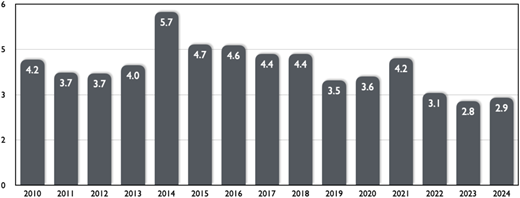
Presence of populist elements within total sample (per cent). Source: Authors’ own work
Presence of populist elements within total sample (per cent). Source: Authors’ own work
Populist rhetoric was compared across four parliamentary cycles (2010–2014, 2015–2018, 2019–2022, and 2023–2024). A Kruskal–Wallis H-test examining whether the distributions of populism differed across these periods indicated a statistically significant difference (H(3) = 10.01, p = 0.018).
To identify which specific cycles differed from one another, pairwise comparisons were conducted using Dunn’s test, with p-values adjusted for multiple testing using Bonferroni correction. As shown in Table 1, populist rhetoric was significantly higher during the 2015–2018 cycle compared to 2023–2024 (z = 2.85, p = 0.013). No other differences were statistically significant at the 0.05 level. However, the difference between 2015–2018 and 2019–2022 approached conventional significance (p = 0.072), suggesting a potential rhetorical shift after the 2018 election. A weaker but directionally similar pattern was observed between 2010–2014 and 2023–2024 (p = 0.125).
Pairwise comparisons of populism across parliamentary cycles
| Comparison | z-value | p-value |
|---|---|---|
| 2010–2014 vs 2015–2018 | −1.14 | 0.767 |
| 2010–2014 vs 2023–2024 | 1.25 | 0.639 |
| 2010–2014 vs 2023–2024 | 2.04 | 0.125 |
| 2015–2018 vs 2019–2022 | 2.26 | 0.072 |
| 2015–2018 vs 2023–2024 | 2.85 | 0.013 |
| 2019–2022 vs 2023–2024 | 1.00 | 0.947 |
Note(s): Results based on Dunn’s post-hoc test following Kruskal–Wallis. p-values are adjusted using Bonferroni correction
Source(s): Authors’ own work
To assess overall temporal trends, a non-parametric Kendall’s tau-b correlation was used, which is appropriate for monotonic trends in time series data and does not assume linearity. The result showed a statistically significant negative trend over time (τβ = −0.425, p = 0.033), indicating a gradual decrease in populist rhetoric across the observed period.
Substantively, the findings point to a peak in populist communication during the 2015–2018 term followed by a decline in subsequent years. While the magnitude of the trend is moderate, the consistency across both group-based and time-based analyses strengthens the interpretation of a downward shift.
At the same time, despite the overall frequency dropping below 3% after 2022, coinciding with the establishment of the Tidö government, populist communication is adaptive. Thereby, an overall drop in frequency might not be accompanied by a discursive-structural change. In other words, if the internal logic of the populist argument is maintained, a downturn in propensity to deploy it does not necessarily signal a retreat. Furthermore, by relating to earlier wrong-doing, a “past-to-present” maintenance of populist logic can be substantiated. For example, in the second debate following the ratification of the Tidö-agreement, party leader Jimmie Åkesson emphasizes the importance of remembering the historical failures of the “old parties” (including the current incumbents). While similar themes were visible during preceding years, this reiteration emerged within the qualitative analysis as a salient example of a focus on remembrance. The excerpt also highlights the persistent feature of anti-elitist framing within the discourse:
Mr Speaker! All the other parties in the assembly, who babbled through the ruinous politics, who loved to stand here and talk about responsibility, took no responsibility. They shirked responsibility. They were blinded by their self-constructed excellence. At the same time, they forgot where they come from. They forgot their own country. I know that many people think that all this is now history and that we should not talk about it. But it is not history, because we still, on a daily basis, suffer the consequences of these policies. My party and I will continue to remind both the colleagues in this assembly and the Swedish people of this as long as we find reason to do so. There will be for a long time – unfortunately.
In conclusion, the overall frequency of populist elements might suggest that this downturn could be attributed, in some way, to gaining conditional governmental influence in 2022. However, external factors, such as the migration crisis of 2015 or coinciding elections, also has to be taken into account when comparing the change over time. Finally, adaptive discursive strategies could allow for a maintenance of internal populist logic, despite a downturn in overall presence.
Configuration of populist discourse (2010–2024)
In this section, the configuration of populist elements is presented through highlighting relative emphasis over time.
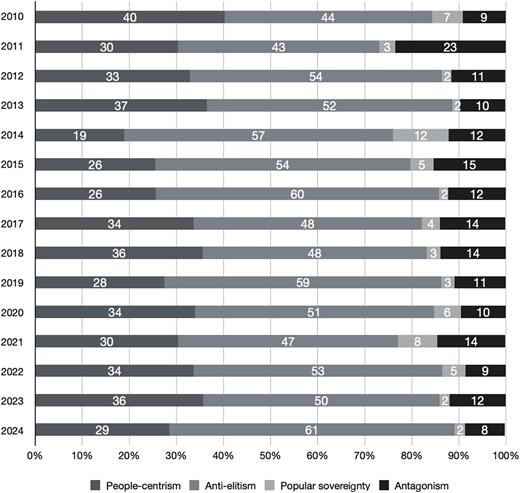
As seen in Figure 2, the discourse of the SD emphasizes “people-centrism” as a central component within the amalgamated populist discourse. While some notable fluctuations occur, as for example in 2014, the element occupies a key position within the overall configuration.
This instancing did not disallow specific rendering of certain segments within the people as a whole. A clear pattern that emerged from the qualitative analysis was Åkesson’s particularized focus on elderly pensioners and wage-earners within an overall “people”. In this characterization, Åkesson oftentimes employs inclusive, generalized language alongside an emphasis on their plight. However, the description of “the people” also contained qualifiers within. For example, this could include differentiations between “ethnic Swedes”, “foreign-born”, “immigrants” or “real” refugees. Typical of populist leaders, this lamentation can subsequently be transformed into accusations aimed at the alleged inducers.
Between 2010 and 2024, the discourse of the SD emphasizes “anti-elitism” most strongly. Moreover, continual representations of the “people” and opposing “elites” further qualifies the discourse as structurally populist.
The findings also indicate that anti-elitist statements tend to portray the elite actor as caught up in an idealistic, naive and already failing utopian vision with gross disregard for the consequences. With some similarity to other populist appeals, Åkesson employs a generalized imagery whereby the “establishment” is collectively named and framed. The “left-liberal establishment”, composed of all parties except the SD, is thereby posited as responsible for mass-migration and the “dismantlement of the welfare state”. Beyond this, an interlinkage between different elites is evidenced by the implication of actors such as the EU. Here, alleged breaches of popular sovereignty, such as federalist collusion, supplies anti-elitist framing of another. For example, when responding to statement made by then-incumbent prime minister Stefan Löfven (Social Democrats), Åkesson disparages his view that the EU should be strengthened further:
For me, cooperation in Europe is self-evident, especially in the troubled times prevailing globally today. This goes without saying, but it does not mean that we should have to see a federalist state formation in Europe, and that is what Great Britain is now fighting against. I had wished that our Swedish Prime Minister had also been prepared to take the same fight.
In a later exchange with Anna Kinberg-Batra (the Conservatives), a further disparagement was extended onto her based upon an alleged openness to “allow Stefan Löfven four more years”. When combined with the generalized groupings, such as “left-liberal establishment”, such anti-elitist messaging could allow for a transmission of guilt from one actor to another. Furthermore, such interlinkage between the elements strengthens the conceptual notions of populist communicatory deployment.
The SD also emphasizes the “power of the people” as a key component. However, the degree to which this is present in the discourse fluctuates between years, highlighting a less pervasive power in comparison to “people-centrism” and “anti-elitism”. Within the rendering of the element, Åkesson frames “parental leave quotas”, or other alleged state-overreaches in family life, as threatening the people’s freedom. At the same time, posited supra-national overreach (e.g. EU legislation) within Swedish society is also posited as threatening the people’s sovereignty. Thereby, this sovereignty takes on both a national and a popular form. Subsequently, the power of the people, their welfare and safety are put aside in favor of “naive” and “utopian” elitist ideals (which have already proven to be a catastrophe). In particular, “establishment” actors are accused of enacting a “politics of fragmentation”, by which society is successively disunited, and groups marginalized.
Finally, the different elements effectively provide a baseline for antagonistic portrayals within the populist discourse. Throughout, “antagonism” remained pervasive within the configuration of the elements although generally less emphasized than “people-centrism” and “anti-elitism”. In relation to other elements, antagonistic messaging underlines the populist linkage, rather than simply denigrating elite actors or lamenting the plight of the people. In other words, while other parties also engage in rhetorical inter-party conflict, and attempt to voice the concerns of the electorate, antagonistic messaging sets the populist discourse apart by emphasizing the division between “corrupt elites” and “virtuous people”. Similar to the rendering of other elements, antagonistic portrayals take on differing forms by implicating a diverse (but ultimately connected) set of enemies. Overall, the continued presence of the element indicates that the SD have also remained steadfast in their antagonizing stance.
In sum, anti-elitism remains the most emphasized aspect of the SD” populist discourse across all years. Moreover, as the SD largely maintains a focus on people-centrism, reinforcing the argument that they represent the interests of the “ordinary” people against elites. However, whilst antagonism is a persistent feature of the discourse, the results indicate that it tends to be less emphasized than anti-elitism and people-centrism. References to popular sovereignty are generally fewer, although fluctuations occur. While some aspects of the discourse changes in either frequency of discursive rendering, the overall configuration of the discourse does not indicate major changes between 2010 and 2024.
Conclusions
The study began with an overarching research question: How does RWP discourse adapt to increasing parliamentary influence? Through a two-pronged analysis of the SD’ discourse between 2010 and 2024, the findings indicate that the SD’s populist discourse has largely maintained discursive-structural coherence while adapting to the party’s increasing parliamentary influence. This stability supports existing theories that populist parties maintain their inherent populist logic to sustain voter appeal and preserve their distinct identity, even as their political roles evolve (Mudde, 2004, pp. 542-543).
At the same time, the relative frequency of populist references decreases over time, suggesting a decline over time which could indicate that the SD has moderated their discourse after becoming less politically ostracized. However, adaptable and chameleonic populist rendering, whereby the discursive structure is maintained in spite of a downturn in frequency, somewhat complicates this argument. Moreover, successive electoral victories between 2010 and 2024 might have provided little incentive to substantially alter the configuration of their communication.
The inclusion-moderation thesis posits that radical parties eventually moderate as a result of successive integration into “mainstream” political normalcy. Our findings highlight a general reliance on populist logics within the discourse of the SD, while at the same time revealing a noticeable decrease in the relative frequency of populist elements over time. Moreover, the configuration of the four populist elements (people-centrism, anti-elitism, popular sovereignty and antagonism) maintained a comparable instantiation throughout, albeit with some exceptions. Finally, our qualitative findings highlight the adaptable nature of populist communication within, and between, these elements.
A limitation of the study is derived from its narrow focus on the presence and configuration within the SD’ discourse, limiting the ability to account for external factors driving changes in communication (e.g. immigration crises or economic downturns). Moreover, the study faces challenges in relation to the generalizability of the findings, in particular with respect to comparative cases and external influences. Moreover, the lack of comparable reference points in relation to the level(s) of populism within a Swedish context, limits the ability to assess the relative novelty of the findings within the surrounding political landscape. Consequently, the paper could be considered as an initial stepping stone into mapping the party’s rhetorical evolution over time. Furthermore, as the study employs a focus on the populist dimension of party discourse, other aspects within the discourse might be overlooked. For example, the conceptualization of “antagonism” focuses specifically on the juxtaposition of “the people” versus “the elites”. However, RWP discourse also antagonizes between “the people” and “the other” (e.g. immigrants or other marginalized groups). Finally, a systematic analysis of contextual factors and external influences in relation to discursive shifts would allow for a better understanding of the observed changes in populist discourse.
Future research could examine how the trajectory of the discourse is received by the broader electorate or SD voters. This could provide insights into how shifts in populist messaging are perceived by the party’s core voter base. More research is also needed to fully understand the complexities of SD’s discursive strategization as per different communicative arenas and political ambitions. Furthermore, future research could also examine the discursive trajectory of “establishment” parties who cooperate with RWP parties and whether these are accommodating their discourse to better match their new governmental partners. Additionally, comparative perspectives could be particularly useful in order to better understand how populist discourse overlaps across different political and cultural environments.
Corrigendum: It has come to the attention of the publisher that the article, Holt, V.E., Bolin, N. and Wadbring, I. (2025), “Resilient populism? The Sweden Democrats’ discourse in parliament, 2010–2024”, International Journal of Public Leadership, Vol. ahead-of-print No. ahead-of-print. https://doi.org/10.1108/IJPL-01-2025-0011 published the incorrect version of Table 1.
The intended Table lacks three yearly intervals and now it is corrected in the online version.
The publisher asks that tables are clearly provided at submission and confirmed at proof stage.

