


The literature highlights the key role of human resource management in developing effective organizational performance measurement and management. To understand the state of the art of this role, the paper reviews the literature on human resource management in the performance measurement and management domain.
The paper conducts a bibliometric literature review on 1,252 articles to identify the prevailing research trends and the conceptual structure of human resource management in the performance measurement and management domain.
The study highlights a growing number of publications and four themes related to human resource management in performance measurement and management. It also underlines the shift from static to the dynamic performance measurement and management systems within organization which is expected to be more suited to current and future contexts.
The paper highlights the need to manage the identified themes as strategic organizational assets and further develop the strategic dimension of human resource management practices leveraging on project management and information systems.
The paper goes beyond the traditional focus on performance appraisal of human resource management studies and assumes the challenge of connecting two research fields: human resource management and performance measurement and management.
1. Introduction
Organizational performance measurement and management system (PMMS) is described as an integrated system for supporting the decision-making process through a set of performance measures on tangible and intangible assets (Smith and Bititci, 2017). This system gives feedback to employees on the outcome of actions reflecting the procedures used to implement business strategy. Since the introduction of the first performance measurement and management (PMM) models, human resource management (HRM) has been considered a relevant intangible asset for creating a competitive advantage (Kaplan and Norton, 1996; Neely et al., 2001). Human resources represent the employees under direct control of the company; their management is the process or processes focused on maximizing employee performance to achieve the employer's strategic objectives (Wood, 1999). Despite the recognized relevance of HRM, the available studies on its role in developing organizational PMM models remain embryonic and at an exploratory stage (Bourne et al., 2018; Sardi et al., 2019). On one hand, the PMM literature outlines the importance of having qualified leaders at all levels; for instance, to move organizations towards continuous process improvement and knowledge sharing (Bititci, 2015; Bourne et al., 2013; Garengo et al., 2005). This literature creates the condition for integrating HRM in organizational PMMS; however, it rarely happens (Sardi et al., 2020b). On the other hand, the HRM literature primarily focuses on HRM issues; for instance, human resource performance management practices and employee performance appraisal, i.e. “the process by which we evaluate the individual performance of an employee over some time” (DeNisi and Smith, 2014). However, this literature rarely proposes approaches for developing effective organizational performance measurement and management systems (Sardi et al., 2020b). Although several researchers have underlined the need to further investigate the role of HRM in the PMM domain (Bourne et al., 2013; Smith and Bititci, 2017), to date no scholar or practitioner have developed an effectively integrated view that applies a dual approach equally based on HRM in PMM research conventions.
To address this research gap, this paper aims to map HRM studies in the PMM domain and identify the most relevant themes and their role in PMM. A bibliometric literature is conducted to answer three specific research questions: (1) What is the trend of HRM publications in the PMM domain? (2) What is the conceptual structure of the HRM research in the PMM domain? (3) What are the thematic evolutions in the HRM research in the PMM domain? To answer these questions, a systematic literature review is performed using two different approaches: performance bibliometric analysis and science mapping technique. Both approaches are suitable to answer the research questions at hand (Cobo et al., 2011; Taticchi et al., 2015).
This paper is organized into five sections as follows. The following section details the methodology chosen to conduct the literature review using a bibliometric approach. This section also synthesizes the useful findings for answering the three specific research questions. The findings section subsequently discusses the main themes that emerge and synthesizes key evidence. Finally, the conclusion summarizes the main contributions of this paper to the PMM literature and practice.
2. Methodology
The paper explores the literature over three time periods (i.e. 1976–1996; 1997–2007 AND 2008–2019) consistent with the evolution of PMM research (Bititci et al., 2012). The three periods were identified are all about ten years long, and they refer to the evolution of PMM field. The first period is characterized by the introduction of BSC (Kaplan and Norton, 1996; Neely et al., 1995), then several papers describe its evolution (Franco-Santos et al., 2007; Kaplan and Norton, 2005; Neely, 2005) and finally, new trends of PMM are described according to a holistic and systematic view (Bititci et al., 2012; Bourne et al., 2018). Table 1 describes the research protocol for the data collection, and Table 2 presents the methods applied to analyse the data. The performance bibliometric analysis and the science mapping technique were chosen as they are effective in objectively examining the evolutionary trend of research studies and have been effectively applied in prior business literature reviews (Dabic et al., 2014; Garengo and Sardi, 2020; Hassini et al., 2012; Neely, 2005; Sardi et al., 2020a; Taticchi et al., 2015). These analyses provide a means for the objective, systematic and quantitative consideration of the published articles (Furrer and Sollberger, 2007). The advantage of employing performance bibliometric analysis is the ability to demonstrate the relevance of a research topic based on the number of published papers and their citation numbers (Culnan and Swanson, 1986). The science mapping technique is a useful tool for assessing and analysing academic research output by contributing to the progress of knowledge based on an objective analysis (Martínez et al., 2015). It highlights the evolution of a given theme over a fixed period and supports a better understanding of each research theme within the literature. Furthermore, it highlights the relationships between the themes and the evolution of these relationships over time (Furrer et al., 2008; Furrer and Sollberger, 2007).
Data collection: research protocol
| Data-set | Elsevier's scopus | ||
|---|---|---|---|
| Time | From 1976 to 2019 | ||
| Source | Abstract–Title–Keyword | ||
| Document type | Paper, Review | ||
| Source type | Journal | ||
| Subject area included | “Business, Management and Accounting” and “Social Science” and “Engineering” and “Economics, Econometrics and Finance” and “Computer Science” and “Decision Science” | ||
| Subject area excluded | All the other subjects | ||
| Language | English | ||
| Research keywords | “Human Resource” or “Human Relation” or “Human Capital” or “Personnel Management” | and | “Performance Management” or “Performance Measurement” or “Performance Appraisal” or “Performance Evaluation” |
| Enter query string This string was performed Feb 04, 2020* | (TITLE-ABS-KEY(“human resource”)ORTITLE-ABS-KEY(“human capital”)OR TITLE-ABS-KEY(“human relation”)OR TITLE-ABS-KEY(“personnel management”)AND TITLE-ABS-KEY(“performance management”) OR TITLE-ABS-KEY(“performance measurement”)OR TITLE-ABS-KEY(“performance appraisal”)OR TITLE-ABS-KEY(“performance evaluation”))AND (LIMIT-TO (SRCTYPE, “j”))AND(LIMIT-TO (DOCTYPE,“ar”) OR LIMIT-TO(DOCTYPE,“re”))AND (LIMIT-TO(SUBJAREA,“BUSI”)OR LIMIT-TO(SUBJAREA,“SOCI”)OR LIMIT-TO(SUBJAREA,“ENGI”) OR LIMIT-TO(SUBJAREA, “COMP”)OR LIMIT-TO SUBJAREA, “DECI”)OR EXCLUDE (SUBJAREA,“MEDI”)OR EXCLUDE(SUBJAREA,“NURS”)OR EXCLUDE(SUBJAREA,“PSYC”)OR EXCLUDE(SUBJAREA,“ARTS”)OR EXCLUDE (SUBJAREA,“MATH”)OR EXCLUDE (SUBJAREA,“HEAL”)OR EXCLUDE (SUBJAREA,“ENVI”)OR EXCLUDE(SUBJAREA “MATE”)OR EXCLUDE(SUBJAREA, “AGRI”)OR EXCLUDE(SUBJAREA, “ENER”)OR EXCLUDE(SUBJAREA,“BIOC”)OR EXCLUDE(SUBJAREA,“DENT”)OR EXCLUDE(SUBJAREA,“EART”)OR EXCLUDE(SUBJAREA,“CENG”)OR EXCLUDE (SUBJAREA,“VETE”)OR EXCLUDE(SUBJAREA,“PHAR”)OR EXCLUDE(SUBJAREA, “PHYS”)OR EXCLUDE(SUBJAREA,“MULT”)) *If this string will be performed successfully to this data, the number of publications may be higher because some publications may be accepted by editors and published on Scopus | ||
Data analysis: methods and dimensions of analysis
| Method | Dimensions of analysis |
|---|---|
| Group 1. Performance bibliometric analysis | Distribution of documents |
| Distribution of citation | |
| Most productive countries | |
| Most prolific journals | |
| Most prolific authors | |
| Most cited papers | |
| Group 2. Science mapping analysis | The conceptual structure |
| The thematic evolution |
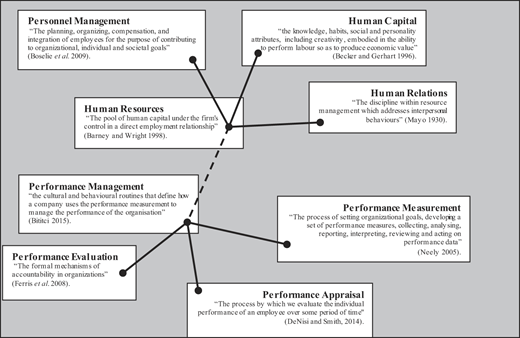
Data collection: as this paper seeks to review the literature on HRM in the PMM domain, it selected research that addresses issues related to HRM and PMM together. Using the terminology of the two research fields, the authors identified useful keyword strings to investigate this research domain adopting the process suggested by Tranfield et al. (2003). The authors of this study investigated the field through a preliminary qualitative literature review and interviews with academics, practitioners and consultants to identify the useful main issues to investigate this field. The collected information supported the identification of the main keyword strings necessary to investigate the literature on HRM in the PMM domain (Tranfield et al., 2003). Figure 1 presents and defines each keyword according to the most recognized definitions. The data collection process gathered 1,252 documents.
2.1 Data analysis
The authors applied a bibliometric analysis to the selected studies (Cobo et al., 2011, 2015; Neely, 2005; Taticchi et al., 2015) in the three periods. The data analysis was performed using two dimensions of analysis: performance bibliometric analysis to answer the first research question (Table 2 – Group 1) and a science mapping technique to answer the second and third research questions (Table 2 – Group 2).
Performance bibliometric analysis (group 1) allows for investigating a certain body of knowledge under different perspectives, such as the publication number and most prolific journals. The authors adopted this research methodology to provide a complete representation of the research areas in terms of quantity and quality of scientific enquiry and gaps in the literature (Taticchi et al., 2015). In conducting the performance bibliometric analysis, the authors analysed the distribution of the number of publications by periods to draw a “frame” of the state of the art of HRM studies in the PMM domain.
Science mapping analysis (group 2) comprises co-word analysis to identify the main themes in HRM in the PMM domain along with their evolution (Cobo et al., 2011). Themes (or clusters) are main groups of similar and closely linked keywords. Each theme includes a sub-group of keywords (or sub-themes) that are strongly linked to each other (Callon et al., 1991). The name of each theme was extracted from the densest sub-themes belonging to the same theme. The methodological foundation of co-word analysis is the idea that the co-occurrence of keywords should describe the contents of the documents. As such, the more keywords that two papers share in common, the more similar the two publications are and, thereby, the more likely they are to derive from the same research field (Van Eck and Waltman, 2009). The themes are visualized by strategic diagrams, which are graphical representations of the most important research themes investigated in HRM within the PMM domain. In these graphical representations, themes are represented by spheres whose volume is proportional to the number of papers associated with each theme (Thomé et al., 2016).
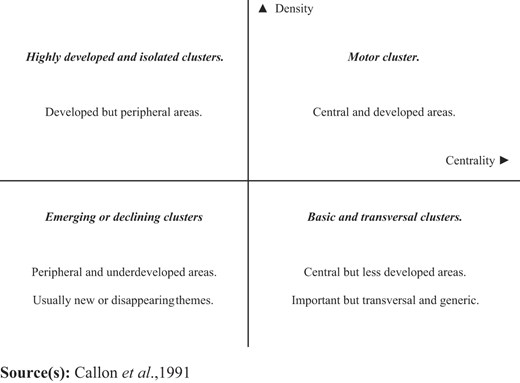
The role of each theme is visualized in the strategic diagram through two dimensions: centrality and density of the themes in the research domain (Callon et al., 1991; Cobo et al., 2011). Centrality refers to the links of a theme with other themes. The stronger and numerous these links are, the more this theme represents a set of research problems that are considered crucial by the community. Meanwhile, density determines the strength of the links that tie the keywords in a cluster. The stronger these links are, the more the research problems corresponding to the cluster constitute a coherent and integrated role. Density provides an effective representation of the cluster's capacity to maintain itself and to develop over time in the field under consideration (Callon et al., 1991). Figure 2 details the content of the four quadrants of the strategic diagram (Callon et al., 1991; Cobo et al., 2015).
To understand the conceptual structure of the HRM research in the PMM domain, the most predominant centrality clusters and density clusters were selected for investigation in each period. First, the themes with the highest centrality were analysed using a cluster network analysis to understand their constituent keywords (or sub-themes) and their relationship. The most central cluster identified the main keyword of a theme as the centre of the network. Two keywords were considered connected if they appear in the same documents. The thickness of the line connecting the keywords represents the depth of their mutual relationships. Second, to better understand the conceptual structure of the HRM research in the PMM domain, the authors read the papers belonging to the four themes and sub-themes to synthesize the main evidence.
In order to answer the third research question, the evolution of the research field was investigated along the three consecutive periods using the inclusion index defined below and through synthesizing the results in a thematic evolution map (Figure 6).
U = each detected theme in the sub-period t
V = each detected theme in the next sub-period t + 1
t = sub-period
Tt = the set of detected themes of the sub-period t
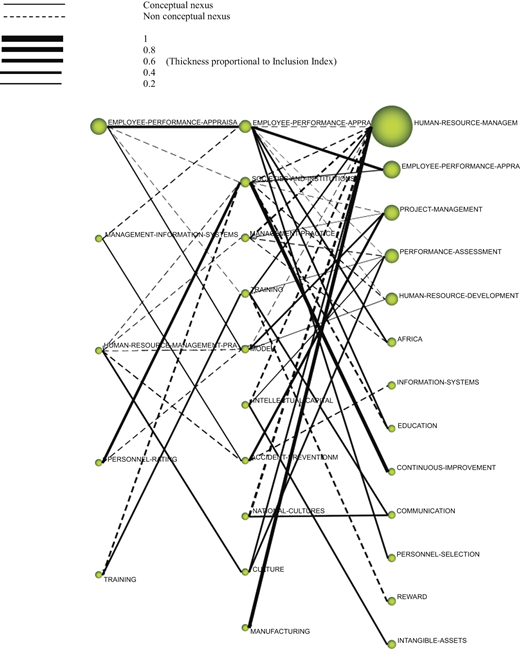
The inclusion index reveals a thematic evolution from theme U (period t) to theme V (period Tt+1) if there are keywords that appear in both associated thematic networks. Thus, V is a theme that evolved from U. Moreover, keywords k ∈ U∩V are considered a “conceptual nexus”(Cobo et al., 2011), graphically represented by a line (see Figure 5). In this way, if there is a “conceptual nexus” between U and V (i.e. if they share some elements in common), a line links themes in sub-period t to themes in sub-period t + 1. The thickness of the lines is proportional to the strength of the links among themes from one period to another. Concerning the type of lines, a solid line indicates that the theme maintains the same name in the next period, or that the theme is incorporated within a theme of the following period. Meanwhile, a dotted line indicates that a theme does not maintain the same name and is not incorporated within a theme of the following period (non-conceptual nexus). However, in this case, the theme shares important elements with clusters of the following period.
3. Findings
3.1 The trend in HRM studies in the PMM domain
The performance bibliometric analysis of the 1,252 papers revealed a growing relevance of HRM studies in PMM domain. The number of papers substantially increased, particularly in the last ten years (Figure 3).
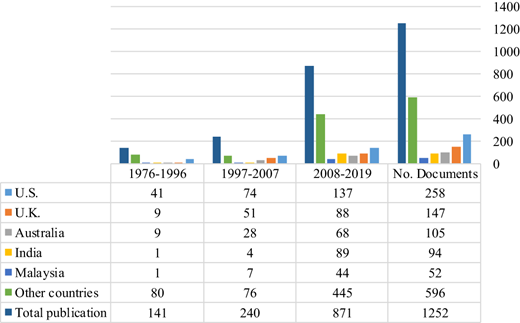
The analysis of the number of papers and citations by author's country indicates that the US is the country with the highest number of publications (258 papers). The investigated research area developed its roots in the US, and a large gap remains between the number of publications from the US and other countries. However, authors from additional countries recently started to investigate this research area, including scholars from the United Kingdom, Australia, India, Malaysia and Canada (Figure 3).
The analysis of the journals' published papers affirmed that the investigated topic is configured as a cross-disciplinary research area, even if the most prolific journals are largely related to the HRM area (Table 3). The International Journal of Human Resource Management publishes the highest number of papers and devotes significant attention to strategic HRM in a global environment, international business and organizational behaviour. In the last period, the second most prolific journal is International Journal of Productivity and Performance Management. It publishes innovative developments in performance measurement and management oriented to improve individual, group and organizational performance (Abbaspour and Dabirian, 2019; Ensslin et al., 2013; Rompho, 2017; Zigan et al., 2008).
Most prolific journals
| Journal | No Papers 1976–96 | No Papers 1997–2007 | No Papers 2008–2019 | No Papers 1976–2019 |
|---|---|---|---|---|
| Int. Journal of Human Resource Management | 6 | 16 | 43 | 65 |
| Asia Pacific Journal of Human Resources | 17 | 7 | 11 | 35 |
| Harvard Business Review | 6 | 15 | 4 | 25 |
| Public Personnel Management | 2 | 9 | 11 | 25 |
| Personnel | 23 | 0 | 0 | 23 |
| Int. Journal of Productivity and Performance Management | 0 | 0 | 21 | 21 |
The analysis of the most prolific authors in the literature suggests that there are five main scholars (Table 4). Wickramasinghe, Stanton and Long were the most productive authors in the last decade. Wickramasinghe, based out of the University of Moratuwa, Sri Lanka, is the most prolific author in this area. He has published seven documents on different topics such as performance management in SMEs, total quality management and HRM practice (Wickramasinghe, 2012; Wickramasinghe and Liyanage, 2013). Stanton (Melbourne University), who examines job performance evaluation using empirical approaches, has served as co-author for six relevant papers and published studies in six different journals – see, for instance – (Nankervis and Stanton, 2010; Nankervis et al., 2012; Stanton and Nankervis, 2011; Vo and Stanton, 2011). Besides, he has written empirical papers on HRM practices focussing on different countries (Australia, Vietnam, the US, Japan and Singapore). Meanwhile, Long (Universiti Teknologi, Malaysia) published five papers in seven years. Three of the papers explored HRM practices that are associated with performance measurement and management practices, whereas the others examined the skills and competencies of HRM specialists (Long and Ismail, 2008; Long and Perumal, 2014; Shahnaei and Long, 2014).
Most prolific authors
| Author | No. Papers 1976–96 | No. Papers 1997–2007 | No. Papers 2008–2019 | No. Papers 1976–2019 |
|---|---|---|---|---|
| Wickramasinghe, V. | 0 | 0 | 7 | 7 |
| Long, C.S. | 0 | 0 | 6 | 6 |
| Stanton, P. | 0 | 0 | 6 | 6 |
| Ismail, W.K.W. | 0 | 0 | 4 | 4 |
| Mura, M. | 0 | 0 | 4 | 4 |
| Iazzolino, G. | 0 | 0 | 4 | 4 |
As depicted in Table 5, analysis of the citations of the 1,252 selected papers revealed the most important papers in the existing literature that are considered reference points in HRM study in PMM research (Castilla, 2008; Igbaria and Baroudi, 1995; Meyer and Smith, 2000; Mithas et al., 2011; Pulakos and Wexley, 1983; Sturman, 2003).
Most cited papers
| Title, author and year | Citations |
|---|---|
| From 1976 to 1996 | |
| Convergence or divergence: Human resource practices and policies for competitive advantage worldwide (Sparrow et al., 1994) | 182 |
| The relationship among perceptual similarity, sex, and performance ratings in manager-subordinate dyads (Pulakos and Wexley, 1983) | 125 |
| The impact of job performance evaluations on career advancement prospects: an examination of gender differences in the is workplace (Igbaria and Baroudi, 1995) | 106 |
| From 1997 to 2007 | |
| Coming up short on nonfinancial performance measurement (Ittner and Larcker, 2003) | 411 |
| Searching for the inverted U-shaped relationship between time and performance: Meta-analyses of the experience/performance, tenure/performance and age/performance relationships (Sturman, 2003) | 319 |
| HRM practices and organizational commitment: test of a mediation model (Meyer and Smith, 2000) | 293 |
| From 2008 to 2019 | |
| How information management capability influences firm performance (Mithas et al., 2011) | 398 |
| Gender, race, and meritocracy in organizational careers (Castilla, 2008) | 258 |
| Green marketing strategies: An examination of stakeholders and the opportunities they present (Cronin et al., 2011) | 242 |
The findings related to the first research question show the relevance of HRM research in the PMM domain; there has been an increase in the number of journals, papers and citations interested in HRM within PMM in recent years, as well as a broadening of authors' countries of origin. Although most of the papers are published by authors from the United States, authors from other countries have recently started to investigate issues related to HRM in PMM domain. The number of papers published by authors in the United Kingdom and Australia as well as authors from developing countries (e.g. India and Malaysia) is also beginning to increase. Thus, HRM research in PMM domain is becoming a global phenomenon.
3.2 Conceptual structure of HRM research in the PMM domain
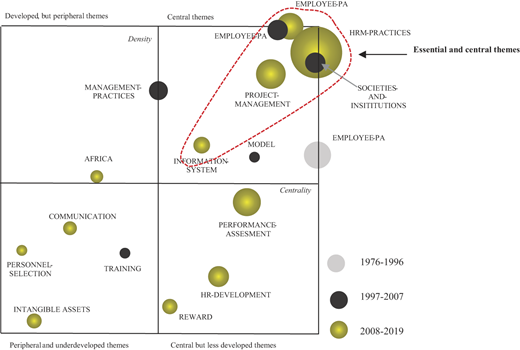
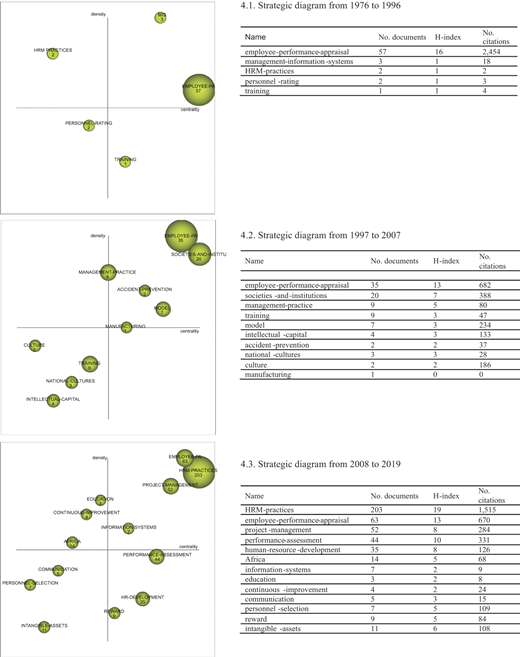
Analysis of the conceptual structure of HRM research in the PMM domain confirms its growing relevance. The conceptual structure also reflects the growing number of themes related to HRM and PMM, as visualized in Figure 4. Within HRM research in the PMM domain, four main themes currently prevail HRM practices, employee performance appraisal, project management and information systems. These themes are central in the existing literature. As depicted in Figure 4, they exhibit the highest density and highest strength of links with sub-themes. As such, the four main themes are classified as motor clusters, which mean that they are considered crucial themes by the scientific community and are researched in relationship with numerous sub-themes.
3.3 Thematic evolution of the HRM research in the PMM domain
The analysis of the thematic evolution of the HRM research in the PMM domain highlights several changes in the key themes across the investigated periods. Some themes grew in relevance over the investigated periods, while others appeared as distinctly new themes, as reflected in the thematic evolution map (Figure 5).
The thematic evolution of the HRM research in the PMM domain suggests an accelerating change in the most relevant themes, particularly in recent years. Only the employee performance appraisal theme was present and maintained high importance over all three periods of study. As Figure 5 demonstrates, some new themes emerged in this time (such as human resource management practices and project management), while others were absorbed into more relevant themes (such as management practices and training).
The authors synthesized an overall strategic diagram with the main themes (i.e. the themes that appear in more than five papers) appearing in the three investigated periods (Figure 6). To better understand the conceptual structure of the HRM research in the PMM domain and its future trend, the authors reviewed the papers associated with the four motor clusters (i.e. HRM practices, employee performance appraisal, project management and information systems) to provide useful insights for understanding the role of HRM in the PMM domain.
3.3.1 HRM practices
Since the early 1970s, several HRM studies have highlighted the key connection between HRM practices and business strategy (Sparrow et al., 1994; Wright and Mcmahan, 1992), and several papers have investigated the human resource practices associated with various business strategies (Golden and Ramanujam, 1985; Lengnick-Hall et al., 2009). On one hand, the HRM literature has investigated strategic performance measurement as a key HRM practice, and particular attention has been devoted to the key role of the strategic approach in fostering coordination and congruence among HRM practices (Guest, 1997; Wright et al., 2005). On the other hand, the PMM literature has highlighted the key role of PMMSs in aligning HRM practices to achieve organizational strategic objectives and effectively manage organizational performance (Bititci, 2015; Kaplan and Norton, 1996; Neely and Adams, 2001).
Recent research has emphasized the growing relevance of PMMS in creating organizational alignment (Hanson et al., 2011; Micheli and Manzoni, 2010), investigating the balanced scorecard as a strategical communication and management-control device (Malina and Selto, 2015). Burney and Widener (2013), for example, underlined the increasing use of performance measurement and management systems that “translate a firm's strategy to its employees” to facilitate internalized motivated behaviours (Burney and Widener, 2013). Malina and Selto (2015) demonstrated the need for using PMMS to drive employees' attention towards the company's strategic objectives (Malina and Selto, 2015). Melnyk et al. (2014) further defined PMMS as “ultimately responsible for maintaining alignment and coordination” between all organizational resources (Melnyk et al., 2014). Moreover, Shahsavari-Pour et al. (2017) underlined the need to use the strategy maps introduced by Kaplan and Norton (2000) to communicate simply and effectively with employees “about how to achieve the companies' strategic goals and will not miss any value drivers in the management process” (Shahsavari-Pour et al., 2017). According to this literature, the alignment of HRM practices and organizational strategic objectives is increasingly essential for the effective design of organizational PMMS.
3.3.2 Employee performance appraisal
Employee performance appraisal is defined as the system through which an organization provides employees with feedback about their performance, and it is essential in improving individual performance (Chattopadhayay and Ghosh, 2012; DeNisi and Murphy, 2017; DeNisi and Smith, 2014). Employee performance appraisal studies focused on employee measurement issues, with attention paid to issues such as the impact on working engagement (Bartram et al., 2015; Lappalainen et al., 2019; Poovathingal and Kumar, 2018) and employees' turnover intentions (Appelbaum et al., 2011; Iqbal et al., 2015; Poon, 2004). However, the literature shows that the implementation of the performance appraisal needs the understanding of the social context within which it operates (Levy and Williams, 2004) and that global uncertainty to be wielding a significant influence on performance management (Maley and Kramar, 2014). Furthermore, the literature underlines that the relationship between performance appraisal satisfaction and work performance is both mediated and moderated by employees' intrinsic work motivation; it is a negative relationship for employees with low intrinsic motivation, positive relationship for those with high intrinsic motivation (Kuvaas, 2006).
Employees have to experience positive appraisal reactions for performance appraisal to positively influence employee behaviour (Kuvaas, 2007). The relationship between perceptions of developmental performance appraisal and self-reported work performance is mediated by employees' intrinsic motivation and strongly moderated by their autonomy orientation. The relationship was positive for employees with a weak autonomy orientation, but the relationship was negative for those with a strong autonomy orientation (Kuvaas, 2007).
To manage employees as effective strategic assets, an organization should use PMMS to align HRM to company values and strategic goals (Crain, 2009). According to Caruth and Humphreys (2008), if performance appraisal is not included in PMMS and thereby in the systematic strategy implementation process, its definition “becomes an exercise in futility instead of a vital control measurement” (Caruth and Humphreys, 2008). However, despite the relevance recognized in the literature concerning employee performance appraisal and management in the last 20-years (Maley et al., 2020), its poor employee acceptability (Maley et al., 2020) and effective integration in organizational performance measurement and management system remain poorly understood in many organizations (Smith, 2018; Sardi et al., 2020b).
The existing literature underlines the need for adopting a multidisciplinary approach that integrates employee motivation, leadership, fairness, behaviour, emotional aspects (Dewettinck and van Dijk, 2013; Ding et al., 2015; Kampkötter, 2017; Lakshman, 2014) and the need for creating a strong link between employee performance appraisal and company strategy (Smith and Bititci, 2017). In the last few years, several scholars have emphasized the growing relevance of strategic management of employee performance appraisal and its impact on performance measurement and management system effectiveness. If employee performance appraisal is linked to the overall PMMS, managers are pushed to be more proactive in communicating any relevant issues related to strategy to the top management (Butterfield et al., 2004; Dewettinck and van Dijk, 2013; Hooi, 2019; Jääskeläinen and Laihonen, 2013; Mondal and Ghosh, 2012). Finally, the analysis of theme shows that employee performance appraisal is increasingly necessary for favouring the alignment of individual employees' endeavours with the organizational strategic objectives and in the developing of effective PMMS.
3.3.3 Information system
To date, the literature has devoted particular attention to the role of information systems in supporting strategy implementation and PMMS adoption through fostering a connective relationship between employees, customers and suppliers (Dewettinck and van Dijk, 2013; Nudurupati et al., 2016). Several scholars have also underlined the strong impact of information systems (ISs) on key HRM practices such as job design, recruitment, retention, performance management and training, along with the growing relevance of human resource information systems (Blount, 2011; Garengo and Bititci, 2007; Igbaria and Greenhaus, 1992).
The rapid development of information technology over the last decade has further affirmed the key role of information system in leveraging an organization's human resources to achieve its strategic objectives and support the development of a PMMS. A human resource information system is an essential decision support tool in achieving strategic and operational objectives (Kavanagh et al., 2007). Several studies have recently denoted the use of technology as a medium of connection and integration to supplement task fulfilment in organizations and support the effective adoption of PMMS. These studies examined issues such as Internet-based resource management (Marler and Parry, 2016), business-to-employee (“B2E”) (Huang et al., 2004) and electronic human resource management (e-HRM) (Stanton and Coovert, 2004; Strohmeier, 2007). As described to this literature, the information system is largely supporting the alignment of HRM with organizational strategic objectives and the development of effective PMMS.
3.3.4 Project management
The literature review reflects the decreasing relevance of PMMS models (such as balanced scorecard and Performance Prism), which are often as inflexible, and the increasing attention paid to project management, which is identified as an important emerging theme in the PMM literature (Taticchi et al., 2015). Some researchers have highlighted the growing need for project management activities such as planning, executing and closing the work of a team to achieve specific strategic objectives and create the bases for a PMMS (Kim et al., 2018; Yun et al., 2016). Scholars also studied the effectiveness of project management in improving the integration and development of employees' competencies and its role in fostering integration with performance evaluation (Chen and Lee, 2007).
In the last few years, the research on PMMS models has shifted from the design of organizational PMMS to the development of quantitative methodologies to solve specific issues related to PMM and HRM. Gemünden et al. (2018) investigated the creation of strategic measurement systems as a priority to ensure that any system is aligned with the goals and objectives of the organization (Gemünden et al., 2018). Also, Chen and Lee (2007) investigate the performance indicators of people who manage projects (Chen and Lee, 2007). They proposed a performance evaluation method for project managers based on managerial practices that incorporate leadership and positive behaviours. Chen (2014) further highlighted that project human factors are essential stimulants in innovation performance, which in turn affects the performance of capital projects (Chen, 2014). Moreover, Wickramasinghe and Liyanage (2013) underlined the need to include projects measures related to teamwork, communication, performance evaluation, empowerment, rewards and recognition, and skill-development practices in PMMS (Wickramasinghe and Liyanage, 2013). It is clear that in the current business environment, the most relevant issue is not the choice of an effective PMMS model, but the definition of project management activities related to measuring HRM practices (Zhang and Li, 2009) and their effective integration with strategy management, human resources practices and employee performance (Crain, 2009).
The shifting attention from rigid performance measurement models to flexible project management tools may be the added value of this study. This shifting attention may favour the alignment of HRM practices with specific strategic project objectives.
4. Discussion
The findings highlight a high relevance of HRM research in the PMM domain. As indicated by the bibliometric analysis, there has been an increasing trend of all information analysed. The conceptual structure of this research area point out themes such as HRM practices, employee performance appraisal, project management and information systems. Below, the authors discuss the main evidence to represent research findings.
Since the 1950s, the literature has highlighted the need to face the rapid change in the environmental condition with the adoption of an organic form of organization. Burns and Stalker (1969) addressed companies towards an organic organizational structure to quickly adapt to frequent and fast environmental changes (Burns and Stalker, 1969). In this scenario, organizational performance measurement and management and HRPM have evolved over the decades. On the one hand, organizational PMM highlights the need to manage multicultural collaboration, open innovation, sustainability, etc. (Bititci et al., 2012; Bourne et al., 2018). On the other hand, HR performance management highlights the need to keep employees happy and groom them for progress, to have organizational agility, regular checks with employees and promotes teamwork (Cappelli and Tavis, 2016). Some companies worry that align individual and organizational goals, award merit raises and identify poor performers are becoming a hard challenge. Managing and developing organisation and people became a greater concern. Companies had to find new ways of meeting that need (Bititci, 2015; Cappelli and Tavis, 2016). However, until now, not enough attention has been given to the development of organic systems supporting the high adaptability and flexibility required by companies (Bititci et al., 2012; Bourne et al., 2018).
The strategic management of the four identified themes and their inclusion in an integrated PMMS should, thus, favour a new way of managing organizational control. Integrated PMMS should be based on the integrated conception of the organization where overall firm optimization requires managing interdependent organizational assets and its interaction. This interaction could also become the basis of the learning process, i.e. the process of gaining, sharing and utilizing the knowledge accumulated by individuals and transferring it through the organization to meet its strategic goals and trigger a process of systematic revision (Franco-Santos et al., 2007).
Integrated PMMS becomes essential to communicate strategic objectives and activate the double-loop learning process using performance information by feedback (Kaplan and Norton, 2005; Nudurupati et al., 2021). This means that integrated PMMS should not simply be a control mechanism but also an organic and innovative learning system (Molleman and Timmerman, 2003) able to drive managers' actions in effectively structuring, bundling and leveraging firm resources with particular attention to HRM practices, employee performance appraisal, project management and information systems. The analysed literature describes that producing performance increments may be best achieved by orienting the performance measurement and management system to promote employee engagement (Bititci, 2015; Gruman and Saks, 2011; Smith and Bititci, 2017). In particular, organizations should innovate HR performance management practices to move companies away from heavy to simpler process (Pulakos et al., 2019); it should be moved from formal system to focussing on the performance management behaviours that matter every day (Pulakos et al., 2015).
The findings of this literature review can be represented by the definition of a conceptual framework which describes a need to translate strategic objectives into effective managerial practices and favour the alignment and interaction of the four identified themes (Figure 7). The strategy is the glue that binds these themes together, favouring the development of integrated PMMS and, as a consequence, the growth of firm sustainable performance.
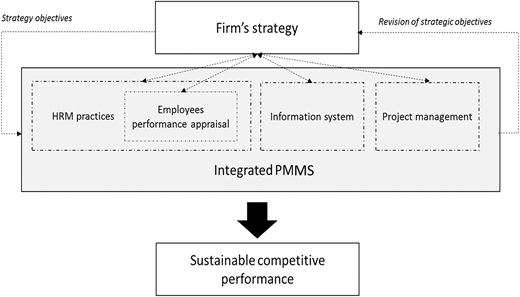
According to this conceptual framework, PMMS should be configured as an organic system able to evolve and adapt itself to the changing business environment through adaptation and alignment processes (Garengo et al., 2005; Smith and Bititci, 2017). These processes should be favoured by the intrinsic capability of PMMS in supporting the translation of business strategy in action and the integration of the key organisational themes. The integrated PMMS becomes an effective strategic system as it captures, in a non-occasional fashion, the strategy at the level of management choices and actions leveraging on the key themes. The main evidence of this study seems to be the shifting attention from rigid performance measurement models to flexible project management tools favours the alignment of HRM management practices with specific strategic project objectives. It highlights the shift from static to the dynamic and integrated organizational performance measurement and management systems with HRM within organization which is expected to be more suited to current and future contexts (Bianchi et al., 2017). Furthermore, it allows to engage employees in conversation about people and organizational performance every day (Bititci, 2015; Pulakos et al., 2015) and also by online chats integrated into performance measurement and management systems (Sardi et al., 2020c).
5. Conclusion
The paper confirms that the high relevance of HRM in the PMM domain is undeniable for scholars and practitioners. As described in the previous sections, in the last ten years, there is a growing relevance of the HRM research in the PMM domain along with an increasing number and rapid evolution of the main investigated themes.
The research gives useful theoretical and practical insights for developing an integrated PMMS. First, it provides a conceptual framework that supports the translation of strategic objectives into effective managerial practices and favours the strategic alignment and integration of the main themes related to PMM and HRM to foster firms' influential performance. Second, it suggests that the development of PMMS integrated with strategic HRM leveraging project management and information systems; however, it has to shift from a static to the dynamic performance systems for being more suited to current business contexts. The authors encourage case studies to explore, test and validate the conceptual framework and further detail the relationship between the four identified themes.
The authors recognized two main limitations. First, the search process could have been influenced by the different meanings assigned to the keyword strings by the PMM and HRM studies. Second, as a result of the use of broad criteria and keywords in selecting papers, some of the identified papers were not closely related to the PMM fields and therefore could not effectively contribute to the findings. Although these limitations may represent potential weaknesses of this study, the authors believe that these limitations are also strength of this research. These limitations fostered the inclusion of many contributions from different research streams, which supported the objective identification of a wide range of themes useful to define the conceptual structure of HRM in the PMM domain.

