


This paper responds to recent theoretical calls to identify domain-specific resources in the digital work era. It examines the internal regulatory mechanism through which ICT demands impact managers' well-being, job performance and presenteeism in hybrid work environments, focussing on the mediating role of digital well-being as a previously underexplored regulatory pathway.
Drawing on the job demands-resources (JD-R) theory, recently refined to address digital workplace complexities, this study explores how digital well-being, as a personal resource, mediates the relationship between ICT demands and managerial outcomes. The study employed purposive sampling to survey 350 managers from various industries in Poland via computer-assisted telephone interviewing (CATI). Structural equation modelling (SEM) was used to analyse the data.
ICT demands were not directly associated with managers' well-being or job performance, but were positively associated with presenteeism. Digital well-being significantly mediated these relationships. High ICT demands tended to deplete this personal resource, whereas maintaining digital well-being reduced the negative impact of ICT demands, sustaining better well-being and job performance while decreasing presenteeism. These findings highlight digital well-being as a crucial protective factor in digitally intensive work contexts.
This study extends the JD-R framework by validating digital well-being as a specific ICT-related resource essential for self-regulation in hybrid work. It offers practical guidance for organisations to mitigate digital presenteeism and enhance job performance by incorporating digital well-being into organisational strategies through training, boundary-setting, and promoting sustainable ICT use habits.
Introduction
The development of Information and Communication Technologies (ICTs) has significantly transformed the modern workplace, particularly with the rise of hybrid work models that combine remote and on-site work. These models rely on digital technologies to enable communication and collaboration across locations (Hopkins and Bardoel, 2023). However, this shift challenges traditional supervision and requires a rethinking of management practices to maintain performance in a dispersed environment (Giovanis et al., 2026; Naqshbandi, 2025).
ICT can be defined as any electronic device or technology that has the ability to gather, store, or send information (Day et al., 2012, p. 473). While ICTs can enhance efficiency and flexibility, they also reshape managerial work, affecting workplace well-being and job performance (Williams and Shaw, 2025). Existing research acknowledges that ICTs can act as both job demands and resources (Day et al., 2010; Baumeister et al., 2021). Technologies may offer autonomy but also increase work intensity, blur work-life boundaries, and generate technostress (Choi et al., 2024; Tarafdar et al., 2015). In particular, ICT demands, such as constant connectivity and digital overload, are linked to psychological strain and reduced performance.
However, despite growing interest in the strain effects of ICT demands, the mechanisms through which they influence managerial outcomes remain underexplored. Notably, there is a lack of precise taxonomies and measurement methods (cf. Hu et al., 2021), as well as issues related to the overlap between ICT demands and general job demands (cf. Stadin et al., 2021). While recent studies indicate that hybrid work engagement and job performance depend heavily on job characteristics and personal resources (Naqshbandi et al., 2024), little is known about how managers internally regulate these specific digital demands. Existing work largely documents negative effects but offers limited insight into the internal regulatory processes managers use to handle ICT demands and how these processes influence outcomes such as well-being, performance, and presenteeism (Pansini et al., 2023).
To address these limitations, this study introduces digital well-being as a distinct, ICT-specific personal resource. Digital well-being captures managers' capacity to engage with digital technologies in a balanced, productive, and mindful manner, combining cognitive-behavioural regulation of ICT use with psychological resilience to sustain benefits while mitigating strain (cf. Septania et al., 2026; Yue et al., 2021). This construct extends existing work by offering a mechanism-oriented explanation for how managers navigate digital demands, thereby clarifying a key regulatory pathway that is absent from existing models.
Guided by the Job Demands-Resources (JD-R) model (Bakker and Demerouti, 2018, 2024), this study investigates whether digital well-being mediates the relationship between ICT demands and managerial outcomes. Based on the JD-R framework, which emphasises the importance of personal resources in maintaining performance and well-being (Bakker and Demerouti, 2007), we assume that fostering managers' ability to build and maintain a digital balance can be beneficial. Digital well-being, as a resource, can help overcome ICT demands and, in the long term, enhance job performance and workplace well-being for managers while also reducing presenteeism.
Our central research question is: How do ICT demands influence managerial outcomes through the mediating role of digital well-being?
The conceptual contribution of this study refers to defining and positioning digital well-being as a novel personal resource relevant to digitalised managerial work. Theoretically, it identifies a previously untested mechanism linking ICT demands to well-being, performance, and presenteeism, thereby extending the JD-R model to contemporary digital work conditions. As Demerouti (2025) suggests in her recommendations for future theoretical developments of the JD-R model, a particularly promising direction involves extending its conceptual framework to incorporate new categories of resources related to digital upskilling and digital literacy, understood as both personal and organisational assets that may buffer technology-related job demands, strengthen the motivational pathway by enhancing self-efficacy. This study investigates these new resources related to digital well-being and, in this context, aligns with the recommendations while providing a novel theoretical contribution. Additionally, addressing the findings from the literature review conducted by Septania et al. (2026) and Negi et al. (2025), this study contributes to theory by highlighting the underrepresentation of non-Western perspectives, advancing the exploration of culturally sensitive measurement, and investigating the causal relationships between digital behaviours and well-being.
Practically, this study contributes by highlighting the protective role of digital well-being. It provides a roadmap for mitigating the adverse effects of ICT demands and offers actionable insights for organisations seeking to design hybrid work environments that support digital balance, reduce strain, and sustain managerial performance.
The remainder of this paper is structured as follows: The next section presents the theoretical background and develops the hypotheses. Subsequently, the methodology, including sampling and data collection procedures, is described. The results section presents the analysis of the structural model. Finally, the paper concludes with a discussion of the findings, managerial implications, limitations, and directions for future research.
Theoretical background and hypotheses
This study draws upon the Job Demands-Resources (JD-R) theory (Bakker and Demerouti, 2018), recently refined to address modern workplace complexities (Bakker and Demerouti, 2024; Demerouti, 2025), which posits that employee outcomes result from the interplay between job demands and resources. In the context of hybrid work, recent studies emphasise that engagement and job performance are increasingly dependent on how leaders manage specific job characteristics and emotional demands (Naqshbandi et al., 2024). Accordingly, we conceptualise ICT demands as a specific job demand and digital well-being as a personal resource that helps managers navigate the complexities of the hybrid environment.
Positive and adverse effects of ICT demands on employee well-being
ICTs enhance managerial efficiency and flexibility by enabling geographic mobility, supporting work-life integration, and automating routine tasks through artificial intelligence (AI) (Day et al., 2019; Bankins et al., 2024). They also foster continuous digital communication, strengthen virtual team cohesion, and promote collaboration, which can boost job satisfaction and organisational commitment (Lee, 2022; van Zoonen and Banghart, 2018). Despite these benefits, ICT also presents certain drawbacks for employee well-being due to demands related to constant changes in ICTs. Generally, ICT demands are experienced when individuals perceive negative aspects of that technology that result in strain, or when ICT use requires mental and physical effort at work (Cho et al., 2020; Day et al., 2010). The constant connection to work can lead to frequent interferences, which disrupt workflow (Baethge and Rigotti, 2013; Keller et al., 2019), extend working hours, and create a paradox where employees feel continuously tethered to their work (Li et al., 2024).
The blurring of boundaries between job and private life is another significant issue, leading to work-life conflicts and difficulties in detaching from work (Park et al., 2020; Mikołajczyk et al., 2024). This can increase the feeling of losing control over working time. Additionally, the accelerated and fragmented pace of digital communication can generate misunderstandings and communication overload (Park et al., 2020). Employees may experience these ICT-induced interruptions and intrusions as invasive, particularly when work demands spill over into personal time (McCartney et al., 2023).
According to the JD-R model (Bakker and Demerouti, 2017), such ICT demands represent job stressors that deplete employees' psychological resources, leading to strain and reduced well-being. Empirical studies support this reasoning: high ICT demands are linked to increased work-related stress (Kao et al., 2020; Marsh et al., 2024), burnout, and reduced job satisfaction and organisational commitment (Ninaus et al., 2021; Wu and Yu, 2022), as well as adverse mental (Zinke et al., 2023) and physical health outcomes (Shifrin and Michel, 2021; Reimann et al., 2024).
Grounded in these theoretical frameworks and empirical findings, we expect that ICT demands, as a source of job strain, will be negatively associated with employees' well-being. Therefore, we hypothesise that:
ICT demands are negatively related to well-being.
The impact of ICT demands on job performance
ICTs can both enhance and hinder job performance. On the one hand, ICTs support productivity through various HRM subfunctions (Budhwar et al., 2023) and contribute to organisational performance, for example, by fostering entrepreneurial behaviour via social media use during work (Famei et al., 2023) or through widespread ICT implementation (Comi et al., 2017). Effective upskilling and reskilling, as well as information ergonomics practices, further enhance this potential (Bordi et al., 2018). On the other hand, the relationship between ICT demands and job performance is complex. It is important to distinguish between productivity and performance. Productivity is a measure of output relative to input, while performance is a broader term for how well an employee executes their duties and achieves goals (Haromszeki, 2025; Stor, 2023). While high performance often leads to increased productivity, this study focuses on job performance – the effective execution of managerial tasks.
Research suggests that employee job performance is significantly influenced by the interplay between leadership abilities and the perception of job characteristics (Choudhary et al., 2017). High ICT demands can act as hindrance stressors, reducing performance by contributing to technostress (Dragano and Lunau, 2020; Harley, 2022), information overload (Tarafdar et al., 2007; Taser et al., 2022), and work overload (Khanchel-Lakhoua and Kadri, 2024).
Although ICTs can support performance, the evidence consistently shows that high ICT demands drain employees' cognitive resources, fragment attention, and disrupt task execution through overload, interruptions, and technical problems. These conditions hinder the behavioural processes that underlie effective performance. When ICT demands exceed employees' regulatory capacity, their ability to carry out work tasks efficiently declines. This integrated evidence leads to the following hypothesis:
ICT demands are negatively related to job performance.
ICT demands and presenteeism
Presenteeism, defined as working while ill or unwell, is often associated with negative outcomes, including adverse health effects (Baethge and Rigotti, 2013; Johns, 2010) and decreased work performance (Koopman et al., 2002; Aboagye et al., 2019). However, positive aspects have also been acknowledged. It has been argued that workers can be more productive during periods of presenteeism compared to when they are absent (Karanika-Murray and Biron, 2020; Lohaus and Habermann, 2021). The vast majority of research has been focused on on-site workers so far. Nevertheless, an increasing number of studies investigate presenteeism concerning remote workers and their ICT environment at work. Recent studies on remote workers have linked presenteeism to work intensification (Choi et al., 2024; Gerich, 2022) and increased psychosocial demands related to ICT and work-related stress (Biron et al., 2021; Ruhle and Schmoll, 2021). Other mentioned causes of digital presenteeism intensification include the blurring of boundaries between work and home, being “always on”, and work extension (Goñi-Legaz et al., 2024).
Remote work has enabled a new form of digital presenteeism, where employees continue working while ill via ICT, often from home (Ruhle and Schmoll, 2021). The lack of commuting, flexible hours, and absence of in-person contact, especially in cases of contagious illness, make working while sick easier and more common. Some workers also fear their illness may not be taken seriously by employers, leading them to remain digitally present despite poor health. As a result, digital presenteeism may be more frequent than absenteeism (Fiorini, 2024; Shimura et al., 2021). Additionally, the flexible nature of telework allows employees to work while unwell without informing supervisors, making digital presenteeism more likely (Biron et al., 2021). Furthermore, some organisations may foster presenteeism, directly or indirectly. Ferreira et al. (2022) argue that digital workplace transformation, especially under remote work, enables increased electronic surveillance, affecting attendance behaviours. As employees become aware of constant monitoring, they may feel compelled to demonstrate performance, even when unwell, reinforcing pressure to remain constantly available.
From a theoretical standpoint, the JD-R model (Bakker and Demerouti, 2017) suggests that when job demands, such as ICT overload, work interferences, and surveillance, are high, employees may cope maladaptively by maintaining attendance despite illness to meet perceived expectations. This behaviour often leads to resource depletion, which exacerbates strain and contributes to long-term health deterioration (Cristea and Leonardi, 2019; Miraglia and Johns, 2016). This mechanism aligns with findings that link presenteeism to negative outcomes, including exhaustion, anxiety, depression, and job dissatisfaction.
In summary, while the relationship between ICT demands and presenteeism remains underexplored, converging evidence suggests that pressures associated with ICT, constant connectivity, and electronic surveillance create conditions that encourage employees to remain digitally present despite being unwell.
ICT demands are positively related to presenteeism.
ICT demands and managerial digital well-being from the perspective of the JD-R model
According to the JD-R model, employee outcomes result from the interplay between job demands (requiring sustained effort) and job resources (stimulating growth) (Bakker and Demerouti, 2018). Importantly, the newly revised JD-R theory suggests that decreased performance arises not only from work demands but also from the interaction of demands across various life domains. Similarly, motivation is driven not just by job resources but by the interplay of resources from multiple areas of life (Demerouti and Bakker, 2023).
In the context of hybrid work, ICTs operate precisely at this intersection, acting as both demands and resources. While essential for efficiency, excessive ICT use often becomes a hindrance stressor. When challenge demands, such as communication volume, become overwhelming, they deplete energy and lead to strain, ultimately outweighing the potential performance benefits of connectivity (Podsakoff et al., 2023; Xanthopoulou et al., 2007).
Research confirms that in hybrid environments, the pressure to respond promptly and manage constant interruptions is linked to physical and cognitive burnout (Bouvier et al., 2024; Naqshbandi, 2025). Consequently, if managers cannot regulate these demands, they risk prolonged stress and lower job performance (Saunders et al., 2017; Sonnentag et al., 2018). However, the JD-R model suggests that personal resources can mitigate these effects. For instance, digital networking ability has been shown to reduce emotional exhaustion (Scheuerer et al., 2024). Therefore, we assume that developing digital well-being as a personal resource is crucial for coping with ICT complexity.
Digital well-being refers to a manager's ability to use technology intentionally and mindfully while maintaining a sustainable work-life balance and preventing negative consequences such as distraction or overuse (Bordi et al., 2018; Gui et al., 2017; Chen et al., 2025). It is not about forcibly limiting screen time, but about cultivating a dynamic combination of knowledge, skills, and attitudes to ensure that online and offline activities complement each other (Büchi, 2024; Vanden Abeele, 2021; Rad et al., 2022; Mikołajczyk, 2024). From an organisational perspective, supporting this resource contributes to greater well-being and enhanced job performance (Duarte and Dias, 2023). Achieving digital well-being is a continuous process of personal development that depends more on cultivating awareness than on imposing restrictions (Monge Roffarello and Russis, 2023).
Integrating the JD-R framework, we propose that digital well-being serves as a key psychological mechanism that transmits the impact of ICT demands on outcomes. Just as leaders' emotion management ability is essential for navigating challenging job characteristics (Choudhary et al., 2017), digital well-being represents a reservoir of regulatory capacity. Theoretically, the JD-R model highlights the mediating role of personal resources, wherein resources enhance managerial outcomes by fostering growth, learning, and development. Managers with a high level of digital well-being, in turn, exhibit positive job outcomes, including improved well-being, higher job performance, and decreased presenteeism. However, excessive ICT demands tend to deplete this personal resource, triggering the health impairment process described in the JD-R model. Specifically, constant connectivity and digital overload exhaust managers' mental and physical resources. When digital well-being is eroded (i.e. the capacity to self-regulate is lost), this exhaustion translates into strain. This strain, characterised by digital fatigue and a lack of psychological detachment, directly lowers general well-being and reduces the cognitive resources available for effective job performance (Scholze and Hecker, 2024). Furthermore, the inability to set boundaries (low digital well-being) makes managers more susceptible to the pressure of being “always-on”, thereby increasing presenteeism (Goñi-Legaz et al., 2024). Thus, rather than merely buffering stress, digital well-being acts as the conduit through which the negative pressure of ICT demands translates into managerial outcomes.
Raising such awareness can foster a new generation of managers who view digital well-being as a critical resource enabling mindful ICT use, healthy boundaries, effective recovery, and ultimately, higher performance in ICT-based work. The above analysis of the relationship between ICT demands and digital well-being enables the formulation of the second main hypothesis and three auxiliary hypotheses:
Digital well-being mediates the relationship between ICT demands and managers' outcomes.
Digital well-being mediates the relationship between ICT demands and well-being.
Digital well-being mediates the relationship between ICT demands and job performance.
Digital well-being mediates the relationship between ICT demands and presenteeism.
Methods
The quantitative study, based on a questionnaire survey, was preceded by a pilot test. The authors developed the questionnaire, and the data were collected using the Computer-Assisted Telephone Interviewing (CATI) method. This method was chosen over web-based surveys to ensure higher data quality, as trained interviewers could clarify any ambiguities in real-time, thereby minimising respondent error and missing data (Dillman et al., 2014). Furthermore, this approach was deemed particularly suitable for reaching managers; given their time constraints and heavy workloads, a facilitated telephone interview was preferred to increase participation rates compared to self-administered questionnaires.
Sampling and research procedure
The study sample consisted of 350 carefully selected managers representing micro, small, medium-sized, and large enterprises across various industries operating in Poland. We employed a purposive sampling strategy, which is particularly effective in organisational research when the phenomena under study, such as hybrid managerial work, require participants with specific expertise and lived experience (Creswell and Plano Clark, 2011; Patton, 2015). Out of a total of 1,141 initially identified individuals, 791 were excluded due to not meeting the hybrid work mode requirement. The sampling frame, following the Classification of Economic Activities in the European Community (NACE), included companies from sections: C (Manufacturing – 26%), S (Other Service Activities – 17%), F (Construction – 11%), G (Wholesale and Retail Trade; Repair of Motor Vehicles and Motorcycles – 11%), J (Information and Communication – 11%), M (Professional, Scientific, and Technical Activities – 6%), D (Electricity, Gas, Steam, and Air Conditioning Supply – 5%), H (Transportation and Storage – 4%), K (Financial and Insurance Activities – 3%), A (Agriculture, Forestry, and Fishing - 2%), E (Water Supply; Sewerage, Waste Management, and Remediation Activities – 2%), B (Mining and Quarrying – 1%) and P (Education −1%). All managers participating in the study work in a hybrid model. The HR or management departments of the organisations were contacted by telephone to identify suitable managers for the survey. 71% of managers performed most of their hybrid work in the office and less remotely. 17% of respondents worked mainly remotely and less in the office, while 12% indicated an equal split between office and remote work. 64% of the respondents were employed in micro (<10 employees) and small (10–50 employees) enterprises, 23% in medium-sized (51–250 employees) enterprises, and 13% in large (>251 employees) enterprises. This distribution reflects the structure of the business sectors in Poland, where small and medium-sized enterprises (SMEs) constitute the largest portion of the market. The sample consisted of 53% men and 47% women. The majority of the sample was composed of respondents aged over 50 years (45%), followed by those aged 40–49 years (33%) and 20–39 years (22%). University-educated individuals constituted the majority of the sample (88%). The managers surveyed had a relatively long tenure in their current companies, with 28% of subjects reporting having worked there for over 20 years, and 28% having worked for 10–20 years. Additionally, 55% of the respondents managed teams of 1–5 subordinates, 33% managed 6–20 subordinates, and 12% managed between 21 and over 40 subordinates. The socio-demographic characteristics of the managers' sample are described in Table 1.
Sample characteristics
| Characteristic number | N = 350 | % | |
|---|---|---|---|
| Sex | Female | 164 | 47 |
| Male | 186 | 53 | |
| Age | 20–29 | 13 | 4 |
| 30–39 | 62 | 18 | |
| 40–49 | 114 | 33 | |
| 50–54 | 75 | 21 | |
| >55 | 86 | 24 | |
| Education | Secondary education | 43 | 12 |
| University education | 307 | 88 | |
| Managerial tenure | <1 | 8 | 3 |
| 1–5 years | 77 | 22 | |
| 6–10 | 68 | 19 | |
| 11–20 | 98 | 28 | |
| >20 | 99 | 28 | |
| Company size | <10 employees | 114 | 32 |
| 10–50 employees | 113 | 32 | |
| 51–250 employees | 82 | 23 | |
| >251 employees | 41 | 13 | |
| Team size | 1–5 subordinates | 194 | 55 |
| 6–20 subordinates | 113 | 33 | |
| 21–40 subordinates | 22 | 6 | |
| >40 subordinates | 21 | 6 | |
Ethical considerations
The Ethics Committee at SGH Warsaw School of Economics in Poland approved the study (approval No. 11/2023). The research adhered to the principles outlined in the Declaration of Helsinki. Participants were fully informed about the study's purpose, the voluntary nature of participation, anonymity and confidentiality principles, and their right to withdraw from the interview at any time without explanation. Informed consent was obtained from each participant before conducting the interviews.
Measures
To conduct the study, adaptations of items from existing research tools were used, except for the development of an original tool for measuring digital well-being. Each variable was measured using appropriate scales, adapted to the research context and objectives. All items were subjected to back-translation. The reliability of all scales (Cronbach's alpha values) exceeded 0.7 and the scales were thus deemed acceptable (see Appendix for full details).
ICT demands (Cronbach's α = 0.75) were assessed using a self-developed 7-item tool inspired by the Day et al. (2012) questionnaire and Beer and Mulder's (2020) systematic review of ICT demands. Responses were recorded on a 5-point scale ranging from 1 (never) to 5 (almost always). The performed CFA showed a good fit to the data (χ2 = 15.588, df = 14; p = 0.339; RMSEA = 0.045; CFI = 0.969; TLI = 0.954; SRMR = 0.045).
Digital well-being (Cronbach's α = 0.83) was measured with a self-developed 12-item tool based on a comprehensive literature review. Responses were provided on a 5-point scale ranging from 1 (never) to 5 (almost always). In the process of developing the tool, following the item generation stage based on the literature, an Exploratory Factor Analysis (EFA) with Varimax rotation (using Kaiser Normalisation) was conducted. Based on the factor analysis (KMO = 0.733; χ2 = 209.818; df = 66; p < 0.001), three factors were isolated: Digital confidence (α = 0.78), Digital fatigue (α = 0.73) and Reduce digital demands (α = 0.71). Jointly, they account for 61% of variances. The performed CFA showed an appropriate fit to the data (χ2 = 64.025, df = 51; p = 0.104; RMSEA = 0.068; CFI = 0.941; TLI = 0.932; SRMR = 0.067).
Employee workplace well-being (Cronbach's α = 0.82) was measured with a 5-item tool adapted from Zheng et al. (2015). Responses were given on a 7-point Likert scale ranging from 1 (strongly disagree) to 7 (strongly agree). The sub-original scale is a 6-item scale, but in the validation process, one statement (Work is a meaningful experience for me) was below the threshold of acceptance and was removed from the tool. The five-item CFA model performed showed a perfect fit to the data (χ2 = 1.917, df = 5; p = 0.861; RMSEA = 0.001; CFI = 0.999; TLI = 0.999; SRMR = 0.008).
Job performance (Cronbach's α = 0.76) was measured with a 7-item scale related to in-role performance adapted from Williams and Anderson (1991). Responses were recorded on a 5-point Likert scale ranging from 1 (strongly disagree) to 5 (strongly agree). The performed CFA showed a very good fit to the data (χ2 = 9.479, df = 14; p = 0.799; RMSEA = 0.001; CFI = 0.999; TLI = 0.999; SRMR = 0.013).
Presenteeism (Cronbach's α = 0.85) was measured using the well-known 6-item SPS-6 Stanford Presenteeism Scale by Koopman et al. (2002). Responses were provided on a 5-point Likert scale ranging from 1 (strongly disagree) to 5 (strongly agree). The measure of this variable included only individuals who had previously reported health problems. For these reasons, it was not included in the measurement model, and its factor analysis was conducted separately (χ2 = 10.691, df = 7; p = 0.153; RMSEA = 0.098; CFI = 0.975; TLI = 0.947; SRMR = 0.065).
In the measurement procedure, we also controlled variables such as gender, seniority in the current job, and the number of employees in the subordinate team for dependent variables (well-being, job performance and presenteeism), and age and education for the mediation variable (digital well-being). The sensitivity of variables due to respondent characteristics was considered. Numerous studies indicate that these control variables may influence managers' outcomes, digital well-being, and perceived ICT demands. For instance, gender differences have been noted in presenteeism, with women exhibiting higher levels than men (Akanni et al., 2023) and prioritising health over performance, unlike men, who focus on protecting performance (Luksyte et al., 2023). Gender also influences well-being, as women may experience different techno-stressors and job satisfaction levels compared to men, who tend to report more positive emotions and less emotional distress at work (Hülsheger and Schewe, 2011; Simon, 2014). Seniority and age often correlate with greater experience and familiarity with job tasks, leading to improved job performance and higher digital well-being due to developed ICT proficiency over time (Ng and Feldman, 2010; van Deursen and van Dijk, 2014). Additionally, managing larger teams can pose challenges that impact well-being and job performance if not handled effectively (Bernerth et al., 2021). Lastly, higher education levels are generally linked to better ICT skills and adaptability, enhancing digital well-being and equipping individuals with strategies to manage digital stress more effectively (Pratama, 2017; Ragu-Nathan et al., 2008).
Control for Common Method Bias
Since data for both the predictor (ICT demands) and criterion variables (well-being, job performance, presenteeism) were collected from the same respondents at a single point in time, we addressed the potential issue of Common Method Bias (CMB). Following the recommendations of Podsakoff et al. (2003) and recent guidelines on method variance (Podsakoff et al., 2024), we employed both procedural and statistical remedies.
Procedurally, we ensured respondent anonymity and separated the measurement of the predictor and criterion variables in the survey design to reduce social desirability bias. Statistically, we conducted Harman's single-factor test using unrotated exploratory factor analysis on all items. The results showed that the first factor accounted for 17% of the variance, which is below the 50% threshold. Moreover, we analysed the measurement models and assessed the construct and discriminant validity (which we report later in this study). Consequently, we assume that CMB is not a pervasive issue in this study and does not significantly distort the interpretation of the results.
Analytical strategy
The objective of this study was to examine the impact of ICT demands upon managers working in a hybrid work model on their well-being, job performance and presenteeism. The specific focus was on the mediating role of digital well-being treated as a job resource in the research model. Based on the theoretical review and our experiences, we established an analytical model outlining the hypothesised relationships (see Figure 1).
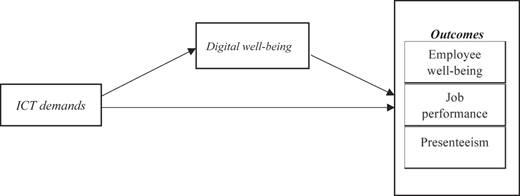
We applied structural equation modelling (SEM) with the maximum likelihood method to assess all hypotheses. AMOS software (Version 29) was used to verify the research model. Based on good practices in using SEM, we employed a three-stage approach. First, we conducted a confirmatory factor analysis (CFA) to evaluate the fit indices of the measurement model (χ2 test, RMSEA – root mean square error of approximation, CFI – comparative fit index, TLI – Tucker Lewis index, SRMR – standardised root mean square residual; Kline, 2016), and then we evaluated construct and discriminant validity using a recommendation provided by Henseler et al. (2015), and finally we examined the hypotheses using the structural model.
Findings
Descriptive statistics
Descriptive statistics and intercorrelations among measures are presented in Table 2. Statistical analyses were conducted with SPSS software (version 29).
Descriptive statistics and intercorrelation
| M | SD | 1 | 2 | 3 | 4 | 5 | 6 | 7 | 8 | 9 | |
|---|---|---|---|---|---|---|---|---|---|---|---|
| 1. Job performance | 4.64 | 0.29 | (0.74) | ||||||||
| 2. Well-being | 5.97 | 0.77 | 0.376** | (0.83) | |||||||
| 3. Presenteeism | 2.13 | 1.00 | −0.432** | −0.431* | (0.85) | ||||||
| 4. Digital well-being | 3.89 | 0.61 | 0.254** | 0.170** | −0.395** | (0.83) | |||||
| 5. ICT demands | 2.83 | 0.79 | −0.075 | 0.001 | 0.251 | −0.093 | (0.75) | ||||
| 6. Gender | 1.47 | 0.50 | 0.164** | 0.045 | 0.228 | 0.015 | −0.190** | ||||
| 7. Age | 4.46 | 1.15 | 0.073 | 0.069 | 0.234 | 0.059 | 0.043 | −0.203** | |||
| 8. Education | 5.82 | 0.56 | 0.022 | −0.042 | 0.037 | 0.131* | 0.059 | 0.110* | −0.150** | ||
| 9. Seniority | 4.48 | 0.79 | 0.083 | 0.080 | 0.310** | −0.016 | 0.034 | −0.170** | 0.723** | −0.125** | |
| 10. Team size | 1.60 | 0.85 | 0.043 | 0.130* | −0.080 | −0.032 | 0.041 | −0.157** | 0.066 | 0.049 | 0.110* |
Note(s): In parentheses, reliability Cronbach's alpha. Gender: 1 – males, 2 – females
N = 350; *p < 0.05; **p < 0.01
Measurement models
CFA was used to verify the research model, and the results are shown in Table 3. This study used a baseline (four-factor) model and estimated all the theorised relationships between the stated constructs. Presenteeism was not included in the measurement model because only individuals (N = 54) who reported health problems in occupational functioning answered questions about this construct. The values of these fit indices (χ2 = 1141.022, df = 727; p < 0.001; RMSEA = 0.040; CFI = 0.934; TLI = 0.925; SRMR = 0.071) indicated that the measurement model provided the best fit for the data.
Comparison of the measurement model
| Model | Structure | χ2 | df | CFI | TLI | SRMR | RMSEA |
|---|---|---|---|---|---|---|---|
| Baseline model | Four-factor | 1141.022 | 727 | 0.934 | 0.925 | 0.071 | 0.040 |
| Model 1 | Three-factor ICT-D, JP, WB + DWB | 1563.153 | 730 | 0.756 | 0.763 | 0.099 | 0.066 |
| Model 2 | Two-factor ICT-D, JP + WB + DWB | 2121.436 | 734 | 0.675 | 0.549 | 0.111 | 0.074 |
| Model 3 | One-factor | 2380.939 | 736 | 0.596 | 0.566 | 0.135 | 0.080 |
Note(s): ICT-D – ICT demands; WB – Well-being; DWB – Digital well-being; JP – Job performance; + – variables combined
Construct validity was evaluated using composite reliability (CR) and discriminant validity. Consistency reliability was tested using Cronbach's α and the CR index. CR results ranged from 0.752 to 0.847, higher than the threshold value of 0.7, thereby confirming internal consistency reliability (Fornell and Larcker, 1981). The discriminant validity of the measurement model was evaluated using the Fornell and Larcker criterion. The conducted analyses showed that all latent variables that represent different theoretical concepts are statistically different, thus confirming the existence of discriminant validity in the constructs (see Table 4).
Construct reliability, convergent and discriminant validity coefficients
| Fornell and Larcker criterion | |||||
|---|---|---|---|---|---|
| CR | 1 | 2 | 3 | 4 | |
| 1. Job performance | 0.745 | 0.441 | |||
| 2. Well-being | 0.837 | 0.393 | 0.664 | ||
| 3. Digital well-being | 0.821 | 0.318 | 0.198 | 0.521 | |
| 4. ICT demands | 0.732 | −0.142 | −0.022 | −0.094 | 0.531 |
Note(s): CR – Composite reliability; AVE – Average variance extracted
Testing the hypothesis
In the first step of the procedure to test the hypothesis, SEM with maximum likelihood was used to test the direct relationships between ICT demands and managers' outcomes (job performance, well-being and presenteeism), concerning the control variables.
Per Hypotheses 1a and 1b, ICT demands should be significantly and negatively related to a manager's well-being and job performance. The results obtained did not confirm predictions about well-being and job performance. As shown in Table 5. ICT demands are not associated with well-being (β = 0.019, p = 0.743) and job performance (β = −0.014, p = 0.470); thus, Hypotheses 1a and 1b are not supported. Hypothesis 1c assumed that the relationship between ICT demands and presenteeism should be significant and positive. These predictions were empirically validated, demonstrating that ICT demands significantly explain variance in digital presenteeism (β = 0.421, p < 0.001). Hypothesis 1c was thus supported empirically.
Direct and indirect effects of tested variables
| Relations | Independent variable | Dependent variable | Estimate | SE | C.R./p-value | |
|---|---|---|---|---|---|---|
| H1a (−) | ICT demands | → | Well-being | 0.022 | 0.050 | 0.446 |
| Gender | → | Well-being | 0.154 | 0.080 | 1.922 | |
| Seniority | → | Well-being | 0.088 | 0.034 | 2.607** | |
| Number of employees in team | → | Well-being | 0.130 | 0.047 | 2.773** | |
| H1b (−) | ICT demands | → | Job performance | −0.009 | 0.019 | −0.471 |
| Gender | → | Job performance | 0.108 | 0.030 | 3.632*** | |
| Seniority | → | Job performance | 0.019 | 0.012 | 1.484 | |
| Number of employees in team | → | Job performance | 0.026 | 0.017 | 1.527 | |
| H1c(+) | ICT demands | → | Presenteeism | 0.459 | 0.130 | 3.526*** |
| Gender | → | Presenteeism | 0.631 | 0.206 | 3.063** | |
| Seniority | → | Presenteeism | 0.290 | 0.087 | 3.344*** | |
| Number of employees in team | → | Presenteeism | −0.033 | 0.121 | −0.273 | |
| H2(+) | ICT demands | → | Digital well-being | −0.080 | 0.040 | −2.000* |
| Education | → | Digital well-being | 0.162 | 0.057 | 2.856** | |
| Age | → | Digital well-being | 0.045 | 0.028 | 1.626 | |
| H2a (+) | Digital well-being | → | Well-being | 0.229 | 0.066 | 3.473*** |
| Standardised effects from ICT demands to well-being via digital well-being | ||||||
| Total effect | 0.004 | |||||
| Indirect effect of digital well-being | −0.019 | |||||
| H2b (+) | Digital well-being | → | Job performance | 0.122 | 0.024 | 4.986*** |
| Standardised effects from ICT demands to job performance via digital well-being | ||||||
| Total effect | −0.050 | |||||
| Indirect effect of digital well-being | −0.027 | |||||
| H2c (+) | Digital well-being | → | Presenteeism | −0.542 | 0.170 | −3.187*** |
| Standardised effects from ICT demands to presenteeism via digital well-being | ||||||
| Total effect | 0.385 | |||||
| Indirect effect of digital well-being | 0.033 | |||||
Note(s): In parentheses: (+) supported hypothesis; (−) unsupported hypothesis; C.R. – Critical ratio
*p < 0.05; **p < 0.01; ***p < 0.001
Hypothesis 2 posited that digital well-being mediates the relationship between ICT demands and managers' outcomes, and the obtained results supported this. ICT demands lead to lower levels of digital well-being (β = −0.097, p < 0.05), and the formed level of digital well-being then explains well-being (β = 0.274, p < 0.001), job performance (β = 0.110, p < 0.001), and managers' presenteeism (β = −0.543, p < 0.01). The standardised indirect effect of digital well-being for managerial well-being (H2a) was −0.024; for job performance (H2b) −0.028; and for managerial presenteeism (H2c) 0.041. Therefore, hypotheses 2a, 2b and 2c are supported. Thus, the results obtained indicate that as a consequence of ICT demands upon managers, their level of digital well-being decreases, which then leads to lower levels of well-being, poorer job performance, and greater readiness for presenteeism.
Discussion
This study examined the impact of ICT demands on employee well-being, job performance, and presenteeism among managers in a hybrid work environment, with a particular focus on the mediating role of digital well-being as a personal resource within the JD-R model. While well-being is widely recognised as a key factor affecting managers' outcomes across various contexts (Kowalski and Loretto, 2017; Kuoppala et al., 2008; Nielsen et al., 2017; Sutton, 2020), this study offers an original contribution by empirically validating digital well-being as the specific regulatory mechanism through which ICT demands influence these outcomes.
The findings indicate that ICT demands do not significantly affect managers' well-being or job performance, contrary to formulated hypotheses (H1a, H1b). This suggests that ICT demands alone may not directly degrade outcomes, but rather exert their influence indirectly through the depletion of personal resources. This result diverges from some previous research suggesting that ICT hassles have a direct detrimental impact (Bessière et al., 2006; Day et al., 2012; Zimmerman et al., 2014; Korkeakunnas et al., 2023). This discrepancy could be due to the unique context of hybrid work environments, where the role of digital well-being as a resource might be more prominent. Our finding regarding job performance (H1b) aligns with recent diary studies on hybrid work. Specifically, Toscano et al. (2025) demonstrate that working from home can actually enhance performance through increased daily concentration and work engagement, which may offset or mask the potential strain of digital demands until digital resources are exhausted. Conversely, ICT demands are positively and significantly associated with presenteeism (H1c). This supports the observation that the ‘always-on’ culture and connectivity pressure in hybrid settings introduce a new form of digital presenteeism, compelling managers to work through illness (Bierla et al., 2011; Demerouti et al., 2009; Ruhle and Schmoll, 2021). This is consistent with the latest findings by Mat-Artun and Küskü (2025), who argue that in remote and hybrid environments, virtual presenteeism acts as a maladaptive coping mechanism triggered by high digital demands, which ultimately threatens long-term well-being.
Crucially, the mediating role of digital well-being was confirmed (H2, H2a, H2b, H2c), highlighting its importance in transforming ICT demands into positive outcomes. This finding provides a deeper contextualisation of the JD-R model in the digital era. Our results resonate strongly with recent studies on hybrid work dynamics. For instance, Naqshbandi et al. (2025) argue that while flexible working enhances performance through motivation, its effectiveness is maximised only among employees with high levels of self-control, particularly when facing task variety. Our study extends this by identifying digital well-being as a specific form of this self-control in the ICT domain. Just as general self-control enables employees to thrive in flexible settings (Naqshbandi et al., 2025), digital well-being allows managers to regulate their engagement with technology, thereby preventing the depletion of cognitive resources. Traditional boundaries of demands and resources are being redrawn in hybrid settings, requiring leaders to develop specific digital competencies to maintain team cohesion (Coulston et al., 2025). Furthermore, Van Zyl et al. (2025) highlight the potential 'cracks' in the general JD-R model when applied to high-intensity digital environments, where standard resources like general job crafting may fail. This justifies our focus on a domain-specific personal resource – digital well-being – as a more precise predictor of managerial resilience than general personal resources. Our conceptualisation of digital well-being as a mediator reflects the three overarching perspectives identified in recent reviews: the perceived impact of digital engagement, a strategy for balanced use, and its influence on eudaimonic well-being (Septania et al., 2026). Digital literacy and competencies, core elements of digital well-being, are directly linked to employee performance and engagement in the digital transformation era (Meena and Santhanalakshmi, 2025).
Furthermore, our findings expand upon Nguyen and Hargittai (2023), who showed that disconnecting from ICT (reducing digital demands and fatigue) improved employee well-being, particularly when face-to-face meetings replaced online ones. Similarly, a study by Vanden Abeele et al. (2022) concerned taking voluntary breaks from tablets, laptops, smartphones, social media, and other online tools to increase awareness of consumption habits and reduce stress caused by cognitive overload. Also, Fritz et al. (2010) research showed that psychological detachment from work during non-work time improves well-being and job performance. We show that these behaviours are not isolated acts but manifestations of a broader personal resource – digital well-being – which builds “digital confidence”. This also complements Wojtczuk-Turek et al. (2022), who found that job crafting helps managers handle ICT dema nds: our study suggests that digital well-being provides the necessary psychological capital to engage in such crafting. Importantly, the effects of ICT demands on managers' outcomes at work are likely to be influenced by various individual and contextual factors that were not considered in this study. According to Bessière et al. (2006), when faced with ICT-induced demands, some managers employ adaptive coping strategies, which can help them transform ICT-related stress into energy that enables them to better manage these demands. In contrast, others tend to rely on maladaptive coping strategies, reacting with aggression or withdrawal, which exacerbates the situation. Earlier research revealed that managers frequently fail to recognise the negative aspects of ICT, or they may be unaware of them, leading to a reduced likelihood of control over usage behaviour (Singer and Alexander, 2017). The ultimate impact of telework depends on organisational support and emotional regulation (Giovanis et al., 2026; Katsaros, 2025), further supporting digital well-being as a key regulatory mechanism. To more effectively navigate the digital era, managers will need to exercise greater self-regulation to manage the challenges posed by ICT, which increasingly incorporates AI (Mandal and Hawamdeh, 2025). According to the newly revised JD-R theory, in addition to individual regulatory strategies, regulatory strategies of the family, leader, and organisation/team are also suggested to modify the impact of demands and resources on outcomes (Bakker et al., 2023). Therefore, developing the resource of digital well-being among managers can, at the same time, help strengthen their ability to shape adaptive coping strategies for dealing with ICT demands at work and increase their outcomes (Janicke-Bowles et al., 2023). Our study confirms that in the hybrid workspace, technology itself is not the sole predictor of performance or strain; rather, it is the manager's internal capacity to regulate their digital interaction (digital well-being) that determines whether they experience high performance or exhaustion.
Managerial implications
Organisations can increase performance by implementing policies and guidelines for sustainable ICT usage (Camarena and Fusi, 2021) that support the development of digital well-being among employees. Our findings offer actionable insights for organisations seeking to optimise hybrid work models. We present three key implications for management practice:
Developing digital competence beyond technical skills: A diverse array of strategies and tools, including time management, digital detoxification, and promoting digital literacy, can be employed to enhance digital well-being. These approaches can be effectively implemented at both individual and organisational levels, for instance, through formal policies and the use of dedicated applications (Uslu, 2025). Organisations must recognise that technical proficiency is insufficient for maintaining performance. HR strategies should prioritise the development of digital well-being as a core managerial competency. Training programmes should focus on digital hygiene, self-regulation strategies, and boundary management. As suggested by the link between self-control and performance in hybrid work (Naqshbandi et al., 2025), helping managers develop the discipline to manage notifications and disconnect effectively is an investment in their productivity.
Mitigating digital presenteeism: Given the strong link between ICT demands and presenteeism, leaders must actively dismantle the “always-on” culture (Mat-Artun and Küskü, 2025). Organisations should implement clear “right to disconnect” policies and explicitly communicate that working while unwell is counterproductive. Since managers serve as role models, they must be encouraged to take genuine sick leave rather than working remotely while ill, as this behaviour sets a precedent for their teams.
Structural support and work design: To support individual digital well-being, organisations must adjust the structural demands of work. This includes limiting the number of synchronous online meetings to the essential minimum, promoting asynchronous communication, and ensuring that ICT demands do not exceed managers' regulatory capacity (Katsaros, 2025). By reducing unnecessary digital noise, organisations can create an environment where managers' personal resources are conserved for high-value tasks, leading to sustained job performance.
Limitations and directions for future research
This study has several limitations. First, participants were based in Poland, and most (71%) primarily worked on-site with a small component of remote work, limiting generalisability. The diversity of hybrid work models may lead to differing ICT demands. Second, although we employed statistical remedies (Harman's single-factor test) to control for Common Method Bias, the reliance on cross-sectional, self-reported data limits causal inferences. Future research should employ longitudinal designs to track the fluctuations of digital well-being over time.
The directions for future research should focus on the intersection of AI and well-being. As automation and AI increasingly integrate into managerial tasks, understanding how these technologies affect the “human” aspect of digital well-being will be crucial. Furthermore, future studies could integrate the perspective of task variety to examine if high digital well-being buffers the strain of multitasking in highly complex hybrid roles. Expanding the sample to an international context would also capture cultural differences in digital work habits.
Conclusion
This study examined how ICT demands in hybrid work settings affect managers' well-being, job performance, and presenteeism, highlighting the mediating role of digital well-being. Based on survey data from 350 managers, our findings suggest that improving digital well-being serves as a vital personal resource, empowering managers to internally regulate ICT demands effectively and sustain high levels of job performance.
The results point to a critical organisational challenge: in the absence of supportive structures, hybrid work may normalise digital presenteeism and lead to hidden performance costs. Integrating digital well-being into performance management strategies through training, realistic expectations, and work design can mitigate these risks and prevent resource depletion.
Our study contributes to the field of organisational behaviour and performance management by showing that digital well-being is not only an individual concern but also a strategic organisational resource within the JD-R framework. Addressing ICT-related strain at the structural level can help build more resilient, efficient, and sustainable work environments in an era of ongoing digital transformation.
Financed by the Minister of Science under the “Regional Excellence Initiative” Programme.
Appendix
Items used in the study
| α | Factor loadings | |
|---|---|---|
| ICT demands | 0.75 | |
| I am expected to keep up-to-date with technological progress related to my work | 0.435 | |
| I feel the need to use ICT at all times and feel anxious and irritated if I do not have access to it | 0.394 | |
| People from my work contact me outside of regular working hours | 0.683 | |
| I am expected to learn computer programmes that are not directly applicable to my work | 0.667 | |
| Technology makes me do more work | 0.568 | |
| Technology allows members of my team to contact me at any time | 0.496 | |
| I am expected to respond to emails immediately | 0.417 | |
| Digital well-being | 0.83 | |
| Digital confidence | 0.78 | |
| My digital competencies are sufficient to meet my professional requirements | 0.629 | |
| I use digital tools effectively in my work to achieve my goals | 0.627 | |
| I feel at ease when working with Information and Communication Technology (ICT) | 0.781 | |
| Working with Information and Communication Technology (ICT) allows me to be flexible | 0.726 | |
| Digital fatigue | 0.73 | |
| I have difficulty focussing on a task because handling all the necessary ICT requires me to multitask constantly | 0.667 | |
| I feel fatigue from online meetings (video conferences) | 0.512 | |
| I experience various psycho-physical complaints caused by too much time spent working at the computer (e.g. irritability, fatigue, back pain, numbness, burning eyes, dizziness, etc.) | 0.714 | |
| I have enough time to keep up with new ICT functionalities at work | 0.655 | |
| Reduce digital demands | 0.71 | |
| When using screen-based devices (e.g. smartphone, laptop/desktop computer, tablet, etc.), I try to limit the time of use as much as possible | 0.534 | |
| When I am working conceptually, I limit the number of notifications on my smartphone, computer (e.g. turn off notification sounds, vibration, text notifications on a blank screen) | 0.656 | |
| After work, I unplug from technology without hesitation and pursue my passions, setting aside time for loved ones | 0.730 | |
| I take care to recover myself without relying on modern technologies (e.g. physical activity, contact with nature, spending time with loved ones, etc.) | 0.641 | |
| Job performance | 0.75 | |
| Adequately complete assigned duties | 0.583 | |
| Fulfil responsibilities specified in the job description | 0.532 | |
| Perform tasks that are expected | 0.601 | |
| Meet formal performance requirements of the job | 0.370 | |
| Engage in activities that will directly affect performance evaluation | 0.412 | |
| Neglect aspects of the job that are required to perform (R) | 0.749 | |
| Fail to perform essential duties (R) | 0.743 | |
| Presenteeism | 0.85 | |
| Completing work | 0.73 | |
| Despite having my (health problem) I was able to finish hard tasks in my work | 0.741 | |
| At work, I was able to focus on achieving my goals despite my (health problem) | 0.443 | |
| Despite my (health problem), I felt energetic enough to complete all my work | 0,878 | |
| Avoiding distraction | 0.72 | |
| Because of my (health problem), the stresses of my job were much harder to handle | 0.765 | |
| My (health problem) distracted me from taking pleasure in my work | 0.467 | |
| I felt hopeless about finishing a certain work task, due to my (health problem) | 0.687 | |
| Employee workplace well-being | 0.81 | |
| I am satisfied with my work responsibilities | 0.791 | |
| In general, I feel fairly satisfied with my present job | 0.914 | |
| I find real enjoyment in my work | 0.768 | |
| I can always find ways to enrich my work | 0.600 | |
| I feel basically satisfied with my work achievements in my current job | 0.431 |
Note(s): α = Cronbach's alpha

