The article identifies sufficient combinations of managerial conditions for public value-oriented integrated strategic planning in inter-municipal networks, addressing the limited cross-fertilization between the public value, strategic planning and network management literatures.
A configurational perspective is adopted, applying a fuzzy-set qualitative comparative analysis to 24 Italian unions of municipalities. The aim is to examine how and to what extent combinations of political leadership, integrated planning, measurability and collaboration shape the orientation of strategic planning towards public value.
Public value-oriented integrated strategic planning emerges through multiple, equifinal configurations of conditions. Three alternative pathways are identified, highlighting the substitutable and complementary roles of political leadership, collaboration and externally anchored multidimensional measurement systems.
The study examines a single national context. The positioning of Italian unions along established international taxonomies of inter-municipal governance supports their analytical value as a comparative reference point. Future research could test the configurations in other institutional settings.
The equifinal structure of the findings serves as a navigational guide for public managers. The measurability-only pathway is particularly accessible to resource-constrained unions, where externally validated frameworks can substitute for more demanding internal coordination mechanisms.
The study connects the public value, strategic planning and inter-municipal and collaborative governance literatures. It positions itself explicitly within ongoing debates on the operationalization of public value, demonstrating its analytical value.
1. Introduction
Small local governments increasingly face complex service demands under limited administrative capacity, fiscal stress and rising societal expectations (Bryson et al., 2024; Tavares and Camões, 2010; Cepiku et al., 2016). Inter-municipal cooperation has emerged as a central response, pooling resources without sacrificing political autonomy (Drew and Dollery, 2014) and within these arrangements, integrated strategic planning performs a critical governance function (Feiock and Scholz, 2010), aligning actors, resources and priorities around shared public value goals (Bryson et al., 2014). Yet the conditions under which it does so remain poorly understood, a gap sustained by the largely separate development of the strategic planning and network management literatures (Cepiku and Mastrodascio, 2021): while prior research examined how individual factors affect collaboration in inter-municipal networks (Tavares and Raudla, 2018), their configurational and interactive nature has received limited attention.
This article addresses the following research question: which combinations of managerial conditions are sufficient for public value-oriented integrated strategic planning in local government networks?
By applying fuzzy-set qualitative comparative analysis (fsQCA) to 24 Italian unions of municipalities, a configurational perspective is adopted for capturing conjunctural causation, whereby outcomes result from the interplay of multiple conditions and equifinality, meaning that different combinations of conditions can independently produce the outcome (Rihoux and Ragin, 2009). Although the empirical setting is national, the Italian case is instructive beyond its borders. Because unions of municipalities are broadly comparable to other institutionalised forms of inter-municipal cooperation across Europe, such as German Gemeindeverbände, French communautés de communes and Spanish mancomunidades, the conditions identified here can inform strategic planning across a wide range of networked local-government settings that straddle the government–governance divide.
The analysis identifies three equifinal configurations, each sufficient to orient planning towards public value and none individually necessary: leadership with externally anchored, multidimensional measurability; measurability alone compensating for weak integration and collaboration; and leadership, integration and collaboration absent advanced measurement. Theoretically, this reframes public value-oriented integrated strategic planning as fundamentally equifinal; practically, it lets managers match effort to their starting capacities rather than investing in every dimension at once. In doing so, the study connects three literatures developed largely in parallel: public value, strategic planning and inter-municipal governance.
2. Literature review
Fragmentation, limited administrative capacity and growing expectations regarding the quality and equity of public services are particularly acute in systems with many small municipalities (Tavares and Camões, 2010), motivating emphasis on whole-of-government approaches to overcoming sectoral and jurisdictional fragmentation (Aoki et al., 2024). Public value creation becomes especially demanding there, as local governments must contribute to territorial cohesion, social inclusion and institutional legitimacy under persistent resource scarcity (Mendez et al., 2024).
Inter-municipal cooperation has progressively emerged as a central feature of local governance. By organizing functions and services through networked arrangements, unions of municipalities seek to compensate for size-related limitations while preserving political autonomy and proximity to citizens (Steiner, 2003). While collaboration can positively impact public value creation (Kitchener et al., 2023), it poses new managerial challenges for collaborating organizations, including the need to manage strategic planning collaboratively in networked settings (Ackermann and Eden, 2011).
Rather than a formal requirement (Vandersmissen and George, 2024), strategic planning can integrate fragmented decision-making and orient collective action towards long-term shared priorities. Its effectiveness should therefore be assessed by its capacity to orient organizations and multi-actor systems towards public value rather than internal goals alone (Thabit et al., 2025). Cooperation does not in itself guarantee improved outcomes, since networked arrangements amplify coordination problems, multiply decision arenas and blur accountability (Cristofaro et al., 2025); inter-municipal cooperation thus depends on mechanisms aligning actors, priorities and resources over time.
Despite their evident interdependence, the literatures on public value, strategic planning and network management have largely developed in parallel, with limited cross-fertilization (Cepiku and Mastrodascio, 2021). Addressing this gap requires articulating a construct capable of bridging these literatures and accounting for the relational, distributed nature of strategy-making in networked governance.
2.1 Towards a construct of public value-oriented integrated strategic planning
The construct of public value-oriented integrated strategic planning is built at the intersection of three distinct yet complementary streams of literature, each one addressing the phenomenon only partially. The construct is explicitly proposed as a provisional synthesis from the available scholarship rather than as a pre-existing conceptualization established in prior work. Accordingly, its dimensional structure and boundaries would benefit from further conceptual refinement and empirical validation in future studies.
The first stream concerns public value, the value created by government that improves societal conditions by aligning internal performance metrics with outcomes that matter to the public (Meynhardt, 2009; Williams and Shearer, 2011; Brown et al., 2021; Virtanen and Jalonen, 2024). Recent scholarship articulates public value governance as a strategic orientation requiring deliberate managerial and institutional design (Bryson et al., 2024). Yet its empirical tractability remains problematic (Talbot, 2011; Hartley et al., 2017): no single operationalization captures its relational and evaluative dimensions (Meynhardt and Bartholomes, 2011), and these boundaries intensify in networked contexts, where the relational nature of value creation amplifies the concept's operational ambiguity (Stoker, 2006; Page et al., 2015).
The second stream concerns integrated strategic planning (George and Bryson, 2025). Recent work on strategic management-at-scale problematizes how integration operates across organizational and jurisdictional boundaries, and the complexity that arises when it must be achieved among multiple autonomous actors (Bryson et al., 2024; Ongaro et al., 2026; Cifolelli et al., 2025); whether and how integration translates into outcomes that matter to society remains insufficiently theorized.
The third stream concerns the management of public networks (Kickert et al., 1997; Rhodes, 1997; George, 2017; Bracci et al., 2025), where value is co-produced through public and non-state actors holding overlapping mandates and competing claims (Bryson et al., 2017), and where configurational research shows that no single condition explains network outcomes: performance emerges from combinations of governance, structural and managerial factors (Cepiku et al., 2021).
Integrating the three streams, we conceptualize public value-oriented integrated strategic planning as a governance approach in which strategic planning is simultaneously oriented towards public value as its primary objective, integrated across managerial functions, units and planning cycles, and embedded within networked arrangements that align strategic intent with the relational, distributed nature of inter-municipal cooperation, ensuring that public strategy is both outcome-oriented and systemically coordinated across functions and actors (Grant, 2021; Thabit et al., 2025).
3. Theoretical framework
Public value orientation is adopted as the outcome for both practical and theoretical reasons. Practically, the legitimacy and usefulness of planning cannot be assessed in procedural terms alone (Bryson et al., 2014); this is acute in inter-municipal networks under resource scarcity and competing priorities, where a public value orientation anchors planning to outcomes recognizable beyond the perimeter of any single member municipality (Vandersmissen et al., 2024). Theoretically, it offers a substantive outcome variable distinguishing meaningful strategic engagement from purely formal routines, consistent with calls to assess strategic planning by its capacity to orient multi-actor systems towards public value (Thabit et al., 2025) and with the public value governance perspective, which frames strategic management around societal value creation rather than internal performance metrics (Moore, 1995). Building on the construct outlined above, we identify four managerial conditions the literature suggests are particularly relevant for public value-oriented integrated strategic planning in unions of municipalities.
3.1 Public value orientation (Y)
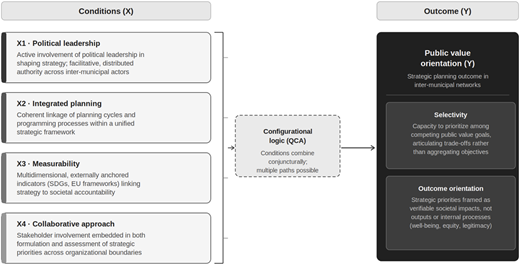
Public value is understood as a strategic orientation emerging from how public organizations perceive and address public needs (Meynhardt, 2009; Williams and Shearer, 2011). The outcome examined here is the orientation of strategic planning towards public value, not the realized creation of societal value (Hulst et al., 2009). The two are distinct yet connected: value creation depends on a wider set of implementation, contextual and political factors beyond planning itself (Bryson et al., 2009, 2018; George, 2021), while the orientation embedded in planning is a necessary though not sufficient precondition for the systematic pursuit of societal value (Thabit et al., 2025). Planning that lacks it produces societal value only incidentally, whereas planning that embeds it provides the institutional foundation on which subsequent value creation can be built (George et al., 2019). It therefore requires strategic priorities directed at societal impact rather than internal performance or administrative routines (Moore, 1995), expressed through identifiable choices that frame collective action in relation to shared societal concerns. Being inherently plural, public value orientation cannot be captured as a monolithic attribute and is approached here as a single outcome articulated along two interconnected dimensions. The first, selectivity, is the capacity to prioritize among several public value goals that are all relevant but jointly unfeasible under limited resources (Talbot, 2011; Williams and Shearer, 2011); this becomes particularly salient in inter-municipal settings of shared authority and fragmented responsibilities, where the accumulation of municipal-level objectives risks diluting strategic direction. The second, outcome orientation, refers to the extent to which public value objectives are expressed as relevant and verifiable societal impacts rather than activities, outputs or internal processes (Meynhardt, 2009; Brown et al., 2021), which is easier where planning is integrated and supported by plural, non-reductionist approaches to measurability (Virtanen and Jalonen, 2024).
3.2 Political leadership (X1)
Political leadership is portrayed as a key element in articulating strategic intent, legitimizing priorities and sustaining direction over time, particularly in contexts where public action is exposed to multiple and potentially conflicting expectations (Moore, 1995; Alford and O’Flynn, 2009). This role becomes especially striking in networked governance arrangements, where leadership is distributed among multiple actors (Cepiku and Mastrodascio, 2021; Sørensen et al., 2021). Empirical research suggests that when political leaders engage substantively with strategic processes, planning is more likely to function as a meaningful orientation mechanism (Virtanen and Jalonen, 2024). Conversely, limited or purely formal engagement tends to weaken the strategic role of planning, especially where coordination depends on voluntary alignment.
3.3 Integrated planning (X2)
Fragmentation across planning cycles is frequently identified as a key obstacle to strategic capacity, as it tends to generate parallel documents that coexist without meaningfully informing one another (Bryson et al., 2014). Integration matters because it enables public organizations to relate objectives, resources and actions to broader societal goals, rather than to isolated functional or compliance-driven requirements (Alford and O’Flynn, 2009). In networked settings, where responsibilities are distributed across multiple actors, the absence of integration further amplifies coordination problems and weakens the orienting role of strategy. Empirical studies point to persistent difficulties in achieving effective integration across planning domains. At the same time, higher levels of integration strengthen coherence and learning over time, particularly in inter-organizational contexts.
3.4 Measurability (X3)
Public value measurability concerns the multidimensional nature of public value, which resists reduction to single indicators or performance metrics (Meynhardt, 2009; Talbot, 2011). In collaborative and networked governance settings, this challenge is further amplified, as assessment practices must accommodate diverse mandates, value claims and accountability expectations (Page et al., 2015). In this light, the use of externally shared reference frameworks and multidimensional indicators can support legitimacy and transparency, while limiting the risks of self-referential planning practices (Guarini et al., 2022). When public organizations adopt such approaches, strategic objectives tend to be more outcome-oriented, even within complex and networked governance arrangements (Virtanen and Jalonen, 2024).
3.5 Collaborative approach (X4)
Public value orientation implies that strategic planning is embedded in the decision-making arena where the definition of priorities is inherently relational and unfolds across organizational boundaries. Literature consistently warns against assuming that collaboration and participation are inherently beneficial. Stakeholder involvement, for instance, may enhance legitimacy and shared understanding, while also introducing coordination costs and risks of symbolic engagement. These dynamics are particularly salient in inter-municipal settings (Virtanen and Jalonen, 2024). The relevance of a collaborative approach lies in the extent to which interaction with stakeholders is incorporated into both the formulation and the assessment of strategic priorities. Figure 1 shows the theoretical framework adopted for the analysis.
Although primarily exploratory and not designed to test pre-specified hypotheses, the analysis draws on the literature reviewed above for directional expectations: the presence, rather than the absence, of each condition should foster a public value orientation. X1 provides direction and legitimacy; X2 aligns objectives and resources coherently across planning cycles; X3 anchors strategy to societal outcomes and limits self-referential practices and X4 embeds stakeholder concerns into strategic priorities. The literature thus predicts the simultaneous presence of all four conditions as the most theoretically grounded path, while the relational, distributed nature of strategy-making in inter-municipal networks leaves open that different configurations may emerge.
4. Research aims and method
While prior research has examined individual factors shaping cooperation in inter-municipal networks (Tavares and Raudla, 2018), inter-municipal development unfolds through multiple, complex patterns rather than a single linear pathway (Lagendijk et al., 2020). Although Bryson et al. (2018) emphasize that useful findings on strategic planning emerge from multiple methodologies, including qualitative comparative case studies, the field still calls for more sophisticated analytical techniques such as QCA (Hernaus et al., 2024).
QCA is particularly appropriate for examining how the presence or absence of a defined set of causal conditions leads to a given outcome (Fainshmidt et al., 2020). It captures causal complexity through conjunctural causation, where outcomes result from the interplay of multiple conditions rather than single factors; equifinality, whereby different configurations can be sufficient to produce the outcome; and causal asymmetry, whereby the conditions explaining an outcome's presence may differ from those explaining its absence (Rihoux and Ragin, 2009; Rihoux, 2016). We employ fsQCA specifically because it captures degrees of set membership rather than relying on dichotomous classifications (Ragin, 2000, 2009), offering a finer-grained representation of empirical variation. Using four conditions, this article runs a fsQCA to identify configurational paths fostering the outcome (Y) of strategic planning in 24 Italian unions of municipalities.
4.1 Operationalization of conditions and outcome
The four managerial conditions identified in the theoretical framework were operationalized as follows. Political leadership (X1) captured the active role of the political apex in the integrated planning process; integrated planning (X2) the connection of distinct planning and programming processes within a unified strategic framework, together with its integrated monitoring across the strategic plan; measurability (X3) the use of extra-organizational and multidimensional metrics to express public value objectives and collaborative approach (X4) stakeholder involvement in developing the strategic plan content and evaluating objectives. The outcome, public value orientation (Y), captured whether the integration of planning processes increased objectives aimed at creating public value and whether such objectives refer to relevant and verifiable impacts. Full item wording, response scales, reliability coefficients and per-condition calibration criteria are reported in Supplementary Material (SM1).
5. Empirical context
Italian unions of municipalities were selected as the empirical setting precisely because of their analytically strategic institutional position: they occupy a hybrid position between the multi-tiered and the linked-functions models (Savitch and Vogel, 2000). They resemble multi-tiered arrangements in that they are established by national law (Law 142/1990), endowed with their own legal personality, governed by formal political and administrative bodies, and constituted as an additional administrative layer with autonomous accountability. At the same time, they share key features of the linked-functions model in that membership is voluntary, member municipalities retain full political autonomy and the union supplements rather than supplants pre-existing local governments, with functions that can be added, modified or withdrawn over time.
Introduced by Law 142/1990, unions numbered only 16 after a decade; Law 265/1999 removed administrative burdens, and their number grew to 537 by 2018. In January 2026, 433 unions are registered, comprising 2,797 municipalities, 10,439,502 inhabitants and 119,039 square kilometres. Their distribution shows a predominance in the north (152 northwest, 82 northeast), with 56 in the central regions, 65 in the south and 78 in the islands. Most unions are small: 274 comprise fewer than 6 municipalities and only 159 more than 6, with the largest group (101) serving populations between 10,001 and 20,000 inhabitants. Supplementary material (SM2) shows the municipal composition of the 24 unions included in the analysis and the overall distribution of municipal unions in Italian regions in 2026.
Among OECD countries, Italy adopted public value planning in 2021, introducing a new instrument, the Integrated Plan of Activities and Organization (PIAO), aimed at strengthening strategic planning and orienting it more towards public value, while simultaneously simplifying performance management administrative burdens (Gherardi et al., 2021; Guyadeen et al., 2023). The PIAO establishes that administrations with more than 50 employees must consolidate all planning – previously divided into multiple plans – into this single document, covering performance management, human resources management, smart working, organization, training, corruption prevention and transparency promotion. The PIAO has a three-year timeframe, and to date 31,705 plans have been published on the government digital portal.
6. Results
6.1 Analysis of necessary conditions
The analysis of necessary conditions assesses whether a given condition constitutes a prerequisite for the presence or absence of the outcome. A condition is considered necessary if it exhibits a consistency score exceeding the minimum threshold of 0.90 (Schneider and Wagemann, 2010) and a coverage level of at least 0.60 (Mattke et al., 2022) across all instances in which the outcome occurs (Ragin et al., 2006). As shown in Supplementary material (SM3), the absence of one condition (i.e. collaborative approach) is deemed necessary for the lack of a public value-oriented strategic planning approach, since both consistency (0.931246) and coverage (0.745911) exceed the thresholds recommended.
6.2 Sufficient configurational paths
The number of possible configurational paths is determined by the number of conditions included in the analysis. Given that the configurational model in this study comprises four conditions, a total of 16 logically possible configurations emerge (2ˆk, where k denotes the number of conditions), shown in the truth table in the Supplementary material (SM4), which displays the combinations of conditions associated with both the presence and the absence of the outcome. Consistent with the literature on small-N studies (Mattke et al., 2022), only confirmations that exceeded a consistency above the commonly recommended minimum of 0.75 (Mattke et al., 2022) and met a frequency cut-off of at least one case were included in the logical minimization process.
The truth table contains seven logical remainders, that is, configurations with no empirical instances among the 24 unions. This is consistent with the expectations of the method: in small- and intermediate-N applications, limited diversity is the rule rather than the exception, and the presence of unobserved configurations does not in itself undermine the analysis (Ragin, 2009; Schneider and Wagemann, 2012). Rather than treating remainders as missing data, we relied on intermediate solutions, which incorporate only the simplifying assumptions consistent with the directional expectations derived from the literature. The pattern of remainders is itself substantively informative: the unobserved configurations are largely those in which integration or collaboration would be present in the absence of political leadership, indicating that in Italian unions of municipalities these governance levers tend not to develop without prior political direction.
Results are presented using the notation system of Ragin and Fiss (2008), where a black circle (•) indicates high membership, a crossed-out circle (⊗) low membership and a blank space shows the condition is irrelevant to the outcome. Following other public management studies (Cepiku et al., 2021; Vidè et al., 2025), we focus on intermediate solutions, which include plausible logical remainders (Rihoux, 2016) while balancing between parsimonious solutions, which risk oversimplification (Park et al., 2020), and complex solutions, which rely only on observed configurations and may miss potential pathways to the outcome (Park et al., 2020; Ragin, 2009). Using intermediate solutions ensures results are empirically grounded, substantively meaningful and guided by directional theoretical expectations regarding the influence of conditions (Ragin, 2009). Configurations leading to public value orientation in strategic planning are shown in Table 1.
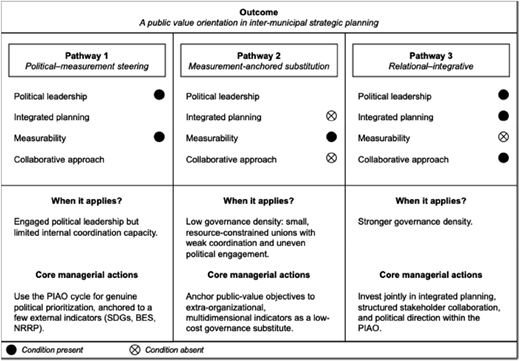
The analysis identified three configurations leading to a high level of the outcome. The first combines high political leadership with high measurability based on extra-organizational and multidimensional metrics, a sufficient configuration for strategic planning oriented towards public value in unions of municipalities.
The second combines high measurability with low planning integration and a weak collaborative approach, making political leadership irrelevant to the outcome.
The third shows that the joint presence of strong political leadership, high integrated planning and a collaborative approach is sufficient to achieve the outcome, even without advanced measurability systems. Here, political leadership provides direction and commitment, integration across planning and programming processes ensures coherence within the PIAO framework, and stakeholder collaboration contributes substantive inputs and shared legitimacy. The overall solution shows a consistency of 0.72 and a coverage of 0.84; each individual configuration also exceeded the recommended threshold values.
QCA also allows identification of configurations associated with the absence of the outcome, namely, a limited orientation of strategic planning towards public value, acknowledging that the drivers of presence and absence may differ due to causal asymmetry (Fiss, 2011; Ragin, 2009). Two configurations lead to a weak public value orientation: the first is characterized by low integrated planning and a weak collaborative approach, while the second shows that even high political leadership fails to produce a public value-oriented strategy when the collaborative approach remains weak (Table 2). Overall, without a collaborative governance approach, strategic planning in unions of municipalities struggles to develop a coherent and verifiable orientation towards public value (consistency 0.81, raw coverage 0.88).
7. Discussion
Addressing the limited cross-fertilization between the public value, strategic planning and network management literatures, the analysis demonstrates that public value-oriented strategic planning in inter-municipal settings does not stem from the formal adoption of integrated planning tools but from specific combinations of factors, consistently with accounts emphasizing that public value creation is contingent, relational and shaped by institutional conditions rather than isolated managerial choices (Brown et al., 2021; Thabit et al., 2025).
Even in contexts where integrated planning instruments such as the PIAO are formally mandated, public value orientation emerges only when planning processes are meaningfully embedded within governance arrangements (Alford and O’Flynn, 2009). In inter-municipal networks, where authority is dispersed and coordination relies on voluntary alignment, the orienting function of strategic planning becomes particularly fragile and dependent on supporting organizational and governance conditions (Cristofaro et al., 2025).
The first configuration aligns with leadership-centred accounts of public value, in which political leaders articulate direction under plural and conflicting expectations (Moore, 1995; Alford and O'Flynn, 2009), while measurability anchors objectives to shared standards and limits self-referential planning, providing a common language for coordination and an outcome-oriented framing (Guarini et al., 2022; Meynhardt, 2009; Virtanen and Jalonen, 2024). The second challenges assumptions placing leadership and coordination at the centre of value-oriented planning (Bryson et al., 2014): measurability alone functions as a structuring device orienting action towards externally recognized outcomes, sustaining legitimacy and strategic clarity where political engagement is limited or uneven (Talbot, 2011; Guarini et al., 2022; Virtanen and Jalonen, 2024). The third follows a contrasting, relational logic in which strong leadership, integrated planning and collaboration jointly compensate for the absence of measurability; leadership overcoming fragmentation, integration ensuring coherence and collaboration embedding public value into strategic priorities (Moore, 1995; Alford and O'Flynn, 2009; Brown et al., 2021; Virtanen and Jalonen, 2024).
Read together, these three pathways carry a theoretical implication that extends beyond the specific conditions examined. The principal contribution of this study is not that political leadership, integrated planning, measurability and collaboration matter individually, but that public value-oriented integrated strategic planning in inter-municipal networks is fundamentally equifinal. Distinct governance architectures can generate a comparable public value orientation, and the analysis specifies which of these combinations are sufficient under the conditions examined. This finding is not confined to the Italian setting. Because equifinality is a property of the phenomenon rather than of the case, the theoretical expectation that travels to other institutional contexts is that no single governance configuration should be treated as a precondition for orienting inter-municipal strategy towards public value, even if the specific set of sufficient combinations varies with institutional design.
The configurations associated with the absence of the outcome show that weak collaboration consistently accompanies limited public value orientation, so strong political leadership alone is not sufficient. This is neither tautological nor self-evident. First, it concerns specifically weak collaboration, an empirically measured low level of substantive stakeholder engagement, not the absence of any interaction. Second, collaboration is not a necessary condition, since the second path shows the outcome can emerge under low collaboration when compensated by externally anchored measurability. Third, a logic in which strong leadership offsets weak collaboration would have been plausible but is not observed. Collaboration thus operates less as a driver of success than as a critical condition whose absence prevents other governance levers from compensating for weak stakeholder engagement. This reinforces warnings against treating collaboration as inherently beneficial, given its documented tendency to remain symbolic, introduce coordination costs or produce only superficial engagement when weakly connected to core strategic choices (Brown et al., 2021).
The findings show a mix of confirmations and theoretically significant departures. The four-condition combination predicted by the literature is observed among cases displaying the outcome but is neither the only nor the most parsimonious sufficient configuration: two narrower paths also produce it, illustrating equifinality (one combining leadership and measurability, the other, most unexpectedly, showing externally validated measurability suffices even without integration and collaboration), operating as a functional equivalent of more demanding coordination. Conversely, several plausible configurations correspond to logical remainders, indicating that integration and collaboration tend not to develop without political direction; leadership thus operates less as a substitutable condition than as a recurrent precondition for activating other levers.
These findings also speak to the debate on operationalizing public value in networked settings, where its contested nature resists reduction to single indicators (Hartley et al., 2017; Faulkner and Kaufman, 2018). The recurrence of measurability across two of the three sufficient configurations suggests the operationalization challenge can be partially addressed by leveraging extra-organizational reference systems rather than forging purely internal measures. Externally shared frameworks supply autonomous municipalities with a ready-made architecture of goals: they align priorities without internal negotiation, simplify the contested notion of public value into a finite, tractable set of dimensions, confer legitimacy through supra-organizational authority and furnish accountability via verifiable external reference points. External measurability thus operates less as a feature of weak governance than as its functional equivalent, discharging externally the coordinating, sense-making, legitimating and accountability functions that leadership, integration and collaboration would otherwise perform from within (Talbot, 2011; Guarini et al., 2022). This does not resolve the measurement debate but reframes it: the analytical question becomes less whether public value can be measured in absolute terms than whether and how it can be anchored to recognizable external frameworks capable of providing shared reference points across heterogeneous actors.
Finally, the configuration centred on strong political leadership, planning integration and stakeholder collaboration is consistent with a multi-tiered logic, in which public value orientation depends on substantive internal governance, political direction and relational density across the union. By contrast, the configuration in which extra-organizational measurability is sufficient on its own, even in the absence of leadership engagement, planning integration and collaboration, resembles a linked-functions logic, in which alignment among autonomous actors is achieved through externally anchored standards and shared reference frameworks rather than through deliberative internal coordination (Savitch and Vogel, 2000).
8. Conclusion
This study contributes to three interconnected streams. First, it advances the debate on operationalizing public value governance in dispersed settings, addressing concerns about empirical tractability and the predominance of indirect proxies. Second, it bridges strategic planning and network management research through a configurational lens capturing the multi-causal, non-linear character of strategic processes in networks. Third, it clarifies when weak collaboration becomes a structural constraint on strategic capacity, moving beyond the assumption that collaboration is inherently beneficial. Together, these contributions reinforce the view that the conditions for public value orientation are relational, contingent and configurational rather than the product of any single lever.
Practically, the findings offer actionable guidance for managers in inter-municipal contexts, particularly under resource constraints. The configurational structure of the results shows that public value-oriented planning does not require maximal investment in every governance dimension at once: managers can identify which of the three sufficient pathways best matches their starting capacities and concentrate effort, accordingly, treating equifinality as a navigational guide rather than a uniform prescription. Figure 2 summarizes the three pathways, their dominant conditions and the managerial profile to which each is most applicable.
This translates into three scenarios. First, in unions with engaged political leadership but limited internal coordination, managers can use externally validated frameworks (SDGs, EU objectives) as steering tools for the political apex, using the PIAO cycle for substantive prioritization around a limited number of externally anchored priorities rather than as compliance. Second, in unions with limited governance density (low coordination and uneven political engagement, typical of many small unions), the most accessible path is to anchor public value objectives entirely to extra-organizational multidimensional indicators, a low-cost substitute that also supports legitimacy and transparency. Third, in unions with stronger governance density, the most effective strategy is to invest jointly in integrated planning, structured stakeholder collaboration and substantive political direction, thus connecting performance, budget, human resources and anti-corruption planning within the PIAO and creating deliberative spaces where priorities are jointly defined and revised. Even resource-constrained unions can sustain minimal collaboration through low-cost mechanisms (periodic consultative meetings, brief user surveys, university partnerships), preventing strategic drift without extensive investment.
Three limitations should be acknowledged. First, the outcome examined is the orientation of strategic planning towards public value, not the downstream realization of societal value in service delivery, citizen well-being or equity (Han, 2017); orientation is a necessary but not sufficient precondition for value creation, and capturing the latter requires longitudinal, outcome-based designs. Second, the cross-sectional design captures orientation at a specific moment in PIAO implementation and allows no conclusions about its evolution over time. Third, while the positioning of Italian unions on the Savitch and Vogel (2000) spectrum supports their value as a comparative reference point, direct transferability to inter-municipal arrangements with substantially different institutional features should not be assumed.
These limitations open promising avenues for research. Comparative studies extending the analysis to other European inter-municipal arrangements would test the transferability of the identified configurations and clarify how institutional features shape the conditions for public value-oriented planning. Longitudinal designs tracking unions as the PIAO matures would capture temporal dynamics, including the persistence and transformation of configurational pathways. Case-based qualitative designs could finally explore theoretically plausible combinations that are rarely observed in practice.
The supplementary material for this article can be found online.