This study examines the components that public administrations consider when designing remote work and whether these components combine into distinct organisational configurations.
The study adopted an exploratory sequential mixed-methods design. The empirical material consisted of 30 Integrated Plans of Activities and Organization (PIAOs), the strategic planning document through which Italian public administrations formalise remote work arrangements. A qualitative content analysis, based on Parker and Grote's (2022) four-component work design model, identified the key components of remote work design. These findings informed a cluster analysis used to identify distinct remote work design configurations and examine their association with organisational size, sector and geographical location.
Results suggest that public administrations design remote work through a combination of strategic, regulatory, technological, HR-related and work design components, including eligibility criteria, working conditions, coordination mechanisms and performance monitoring. Four distinct remote work design configurations emerged. Of the organisational characteristics examined, only geographical location was significantly associated with cluster membership, suggesting that territorial context is related to remote work design.
Building on a sociotechnical systems perspective, this study extends Parker and Grote's (2022) work design model to the public administration context. It reframes remote work as a structured organisational configuration embedded in strategic planning rather than merely as a flexible work arrangement.
Introduction
Remote work encompasses flexible work arrangements such as telework, working from home, and hybrid work, all characterised by the decoupling of work from a fixed workplace and, in some cases, from fixed working hours (Toscano and Zappalà, 2020). All such arrangements require a reconfiguration of coordination mechanisms, supervisory practices, and task allocation processes. In public administrations, this means, from one side, offering flexibility to employees, and, from the other side, maintaining coordination, accountability, technological integration, and service continuity. Work design offers a useful analytical lens for examining these issues, as it concerns the alignment of structures, formal processes, and coordination mechanisms (Turner and Miterev, 2019).
After the pandemic, many countries sought to stabilise remote work as structural component of employment systems, and, across Europe, different regulatory trajectories have emerged. Some countries, such as Spain and Portugal, adopted legislation-driven models, with detailed legal frameworks regulating remote work. Others, such as Belgium and France, relied more strongly on collective bargaining, with limited statutory provisions complemented by agreements defining working time, cost allocation, and health and safety measures. A third configuration, observed in countries such as Austria and Italy, combines broad legislative principles with implementation delegated to collective agreements or individual contracts (Mariotti et al., 2025).
Where legislation provides only broad principles, public administrations retain considerable discretion in defining key design features, such as intensity, eligibility criteria, technological infrastructure, training or monitoring systems (Di Tommaso et al., 2024) and in deciding whether remote work is primarily framed as an employee-oriented flexibility measure or a lever for improving service delivery and creating public value (Ruggiero et al., 2026). Consequently, remote work becomes an organisational design choice rather than merely a regulatory requirement (Ruggiero et al., 2026). From this perspective, remote work represents a contingent organisational configuration whose effectiveness depends on the alignment between institutional, organisational, technological, and human resource factors (Van de Ven et al., 2013).
In line with the growing debate on remote and hybrid work arrangements, Palumbo et al. (2022) emphasise the need to integrate organisational-centred and human-centred redesign approaches to simultaneously support employee well-being and organisational effectiveness in digitally enabled service settings. Existing research has primarily examined remote work from regulatory or individual perspectives, while only a few studies have explored, through single-case analyses, how individual public administrations formally design remote work (e.g. Zappalà et al., 2021). Consequently, limited attention has been devoted to understanding how remote work is designed and institutionalised across public administrations at the organisational level (Palumbo et al., 2022; Eisenhard and Morgeson, 2025; Ruggiero et al., 2026). Although remote work may improve flexibility and engagement, it may also generate unintended consequences for employees, such as greater work-related fatigue and work–life conflict (Palumbo, 2020). These mixed outcomes highlight the importance of understanding how public managers translate remote work policies into organisational practices and design choices aligned with public-sector objectives, such as service continuity, responsiveness, productivity, and public value creation (Ruggiero et al., 2026).
Addressing this gap requires an integrated perspective capable of capturing the interdependence between organisational structures, technological systems, managerial practices, and human capabilities. For this reason, the present study combines a sociotechnical systems perspective, which emphasises the joint optimisation of social and technical subsystems (Guest et al., 2022), with a work design perspective, which focuses on how work is organised, structured, and managed (Parker and Grote, 2022).
This study examines how public administrations design remote work. The empirical setting of the study is the Italian public administration, in which the Integrated Plan of Activities and Organisation (PIAO) represents a formal planning document used by public administrations to define organisational priorities, resource allocation and, among other aspects, remote work arrangements. PIAO documents offer a suitable source to examine how public administrations organise, support, monitor, and promote remote work (Deidda Gagliardo and Saporito, 2021). Previous research has examined the PIAO in relation to public value creation (Deidda Gagliardo, 2024; Papi et al., 2025) but little is known about how remote work is designed in the PIAO.
Accordingly, this study uses the Italian case as an illustrative empirical setting to examine how public administrations design remote work in the PIAO, identifying the design components adopted by public administrations and exploring whether these components combine into distinct organisational configurations. Thus, this study addresses the following questions:
When designing remote work arrangements, which components do public administrations take into account?
Do some design components combine into different remote work configurations that are related to organisational characteristics?
To answer these questions, the study adopts an exploratory sequential design combining qualitative and quantitative methods. First, a qualitative content analysis of the PIAO documents of 30 public administrations identifies the key dimensions used to design remote work. These qualitative findings inform the quantitative phase, and a cluster analysis is used to explore and map whether distinct remote work design configurations emerge and whether they are associated with three organisational characteristics, namely organisational size, administrative service domain, and geographical context.
This study contributes to public management research in three ways. First, it shifts attention from legal frameworks and individual-level outcomes to organisational design of remote work. Second, it provides empirical evidence on how remote work is institutionalised through configurations involving technology, human resources, coordination, monitoring, and accountability systems. Third, it links remote work design to broader processes of administrative modernisation, highlighting the conditions under which it can support organisational transformation.
Theoretical background
The work design and socio-technical approach
Work design is a comprehensive framework that focuses on how work is structured, organised, and experienced within organisations. Building on traditional job design models, such as the Job Characteristics Model (Hackman and Oldham, 1980), mainly focused on role definition, tasks description and required skills, contemporary work design adopts a broader perspective that encompasses task, relational, cognitive, environmental, and organisational dimensions of work (Fraccaroli et al., 2024; Parker et al., 2017).
This integrative work design framework, addressing both structural and contextual dimensions, provides a robust framework for analysing labour in complex, technology-mediated environments (Wang and Parker, 2023). For example, the design of remote work may involve decisions regarding which tasks perform remotely and which one in the office, levels of autonomy when working remotely, digital communication practices, coordination mechanisms with colleagues and supervisors, or the configuration of both physical and virtual workspaces. However, effective remote work design requires a broader organisational design which integrates work arrangements with organisational structures, technologies, and institutional objectives (Guest et al., 2022; Parker and Grote, 2022; Van de Ven et al., 2013).
In remote work settings, where direct supervision is reduced, employees must increasingly self-regulate their work. Consequently, work design becomes critical for structuring tasks, coordination mechanisms, and communication flows (Parker and Grote, 2022). Similarly, when employees work in some days from the office and in other days from another, external, location, work design has to address issues such as workspace setup, task coordination, information sharing, or relationships with colleagues working in different locations (Donati et al., 2024). Beyond task-level considerations, work design is also shaped by broader or “molar” factors, such as organisational-level (Eisenhard and Morgeson, 2025), national culture and organisational strategies (Wang et al., 2025) and technological advancements (Parker et al., 2025), which guide strategic choices and define constraints and opportunities.
To integrate these multiple influences on work design, Parker and Grote (2022) conceptualise work design in the digital era as the result of the interaction between macro-level (organisational and national) and micro-level (individual and task-related) factors, organised into four key dimensions. The first one, named higher-level factors, addresses organisational strategies and macro-level factors such as national policies or institutional culture. Organisational strategy, for instance, establishes, among others, organisational regulations on remote work frequency and intensity. Technology characteristics concern the digital infrastructure supporting remote work, including collaboration platforms, cloud systems, and AI-enabled tools. The third dimension includes employees' individual characteristics, such as demographics, competences, or work motivation. Remote work design, in fact, has to establish eligibility criteria or digital competencies and attitudes toward technology that employees should possess (Fraccaroli et al., 2024; Wang et al., 2021). Social support or training to help remote workers to manage, for instance, work-life boundaries, are also aspects of this dimension (Gajendran et al., 2024; Toscano et al., 2025). Finally, the fourth dimension, work design, refers to how tasks, autonomy, coordination, and performance monitoring are organised in remote settings. Overall, the model highlights that effective remote work design depends on the alignment of technology, organisational structures, managerial practices, and individual capabilities.
Remote work design and organisational characteristics
Organisational characteristics are key determinants of how work is structured and coordinated (Van de Ven et al., 2013). In public organisations, institutional, political, and service-related constraints require context-sensitive approaches to organisational design (Geraldi et al., 2011; Miterev et al., 2017). Building on Ruggiero et al. (2026), this study examines whether three organisational characteristics – namely organisational size, sector of activity, and geographical location – are associated with different remote work design configurations.
Organisational size influences structural complexity and coordination mechanisms (Van de Ven et al., 2013). Larger organisations generally possess greater capacity to invest in technological infrastructure, organisational development, and performance management systems supporting remote work. Consequently, they may be better positioned than smaller organisations to institutionalise stable and integrated remote work arrangements (Donati et al., 2021; Ruggiero et al., 2026).
The sector of activity, or the sector of provided service, represents another dimension that may define the boundaries of remote work design. In the Italian context, for instance, different public administration sectors are governed by sector-specific collective labour agreements (Contratti Collettivi Nazionali di Lavoro, CCNL), such as the CCNL for Local Authorities (2019–2021), which set formal rules regarding working time, eligibility for remote work, and modes of supervision. These frameworks may therefore constrain or enable specific forms of remote work adoption. For example, knowledge-intensive and administrative institutions, such as universities or ministries, may have greater opportunities for remote work compared to more frontline-oriented services, such as healthcare, law enforcement, or social services (Mergel et al., 2021). Work design has, thus, to comply with sectoral rules while, at the same time, adapt to specific functional requirements (Humphrey et al., 2007; Ruggiero et al., 2026).
Finally, geographical location constitutes a relevant dimension, as administrations are embedded in territories with varying levels of infrastructural development and socio-political complexity which reflect the tensions between stakeholders and the divergent agendas that characterise the local context (Geraldi et al., 2011). Location, therefore, might serve as a proxy for the territory's capacity to facilitate or hinder organisational innovation. Regional disparities may also shape innovation capacity, digital infrastructure, and employees' digital readiness, which can affect how remote work is designed and implemented (Miterev et al., 2017). Taken together, organisational size, administrative sector, and geographical location represent contextual conditions that may shape remote work design across public administrations.
In the Italian public sector, design choices are formally documented in the PIAO, the integrated planning instrument through which public administrations define organisational priorities, performance objectives, resource allocation, and remote work arrangements. The following section introduces this planning instrument.
Research context: PIAOs and organisational agreements on remote work
Introduced in 2021 and operational since July 2022, the Integrated Plan of Activities and Organization (Piano Integrato di Attività e Organizzazione, PIAO) consolidates previously separate plans (performance, personnel, anti-corruption, and remote working) into a single three-year strategic document (Deidda Gagliardo and Saporito, 2021). In the PIAO, public administrations define strategic and operational objectives, identify the actions and resources needed to achieve them, and align organisational choices to performance and public value goals.
Section 3.2 of the PIAO (titled “Organisation of Remote Work”) embeds remote work within the broader organisational planning framework. Remote work is not considered as a stand-alone administrative requirement but is formally connected to organisational objectives, enabling conditions, operational rules, and monitoring tools. Some administrations also complement the PIAO with dedicated regulations which further specify implementation criteria and procedures.
Accordingly, this study uses the PIAO as a primary source to examine how public administrations design remote work. Using Parker and Grote's work design framework, it first identifies the key components of remote work design; then, it examines whether these components combine into distinct remote work configurations which are associated to organisational size, administrative sector, and geographical location.
Methods
Research design
This study adopts an exploratory sequential mixed-methods design (Creswell and Plano Clark, 2018), in which qualitative findings informed a subsequent quantitative analysis. Specifically, this study is articulated into four different steps. First, a sample of 30 PIAO documents was selected. Second, Section 3.2 of each PIAO was analysed using a theory-guided qualitative content analysis based on Parker and Grote's (2022) work design model. Third, the resulting qualitative themes were transformed into a set of variables used in a cluster analysis to identify distinct approaches to remote work design. This quantitative phase was exploratory and classificatory in nature, rather than hypothesis-testing, and aimed to distinguish administrations according to recurring configurations of remote work design. Finally, associations between the resulting clusters and organisational size, sector, and geographical location were tested.
Characteristics of selected PAs and PIAOs
PIAO documents are publicly available on the website of the Italian Ministry for Public Administration. Thirty PIAOs were selected to ensure variation in: (1) institutional type (four types were included: local authorities, healthcare institutions, education and research organisations, and central government bodies); (2) organisational size (small, medium, and large PAs); and (3) geographical location (north, centre, and south of Italy) (full list of administrations in Appendix). Documents were retrieved in June 2024. Most referred to the 2024–2026 planning cycle; however, for three administrations whose plan, as of June 2024, had not yet been published, their previously available 2023–2025 PIAO was instead analysed.
Table 1 summarises some characteristics of the selected PIAOs. The remote work section averaged 8.4 pages, although considerable variation is observed in approval timing, document length and content structure.
Analytical strategy
The qualitative phase aimed to identify the key components used to design remote work. The analysis, conducted using QSR NVivo 14, focused on Section 3.2 of each PIAO and, where available, on complementary remote work regulations specifying the criteria and procedures mentioned in the plan. Thematic analysis was chosen because it enables the systematic identification and organisation of institutional narratives, strategic orientations, and formalised organisational choices (Adams, 2008).
The coding procedure was conducted in two steps. In the first step, all content identified in the PIAO section devoted to remote work that could be associated with any of the four dimensions of Parker and Grote's (2022) model – namely, higher-level factors, technology characteristics, individual characteristics, and work design characteristics – was inclusively assigned to the corresponding dimension, which served as the overarching analytical framework. In the second step, within each dimension, conceptually similar elements were grouped into subthemes, allowing recurrent patterns to emerge from the data. For example, within the higher-level dimension, four subthemes were detected: state of remote work adoption in the organisation, legislation used to frame remote work, reasons for the adoption of remote work, and types of remote work arrangements adopted.
Coding was iterative. Themes emerging from the documents were progressively refined, grouped, and integrated into coherent analytical categories. Emerging codes, thematic labels, and classification decisions were jointly discussed among the researchers to improve consistency, ensure replicability, and reduce interpretative bias (Corrington, 2022). The final coding procedure reflected Parker and Grote's four dimensions while also capturing context-specific adaptations adopted by public administrations.
The qualitative findings informed the quantitative phase. Specifically, four of the eleven identified themes were selected for clusters analysis because they represented the most recurrent and analytically meaningful design features across the documents. Each one of them corresponded not only to one of the four dimensions of the Parker and Grote (2022) model, but also to core mechanisms of work design in digitally transforming organisations – namely task structure, technology, employee capability building, and performance monitoring (Parker and Knight, 2024); the four themes were operationalised as: presence of one or more types of remote work arrangements; technologies and digital infrastructures used or planned; training and competence-development initiatives (including upskilling, change management, or leadership development); and presence of systems for monitoring and assessing remote work performance.
In the quantitative phase, a two-step cluster analysis was performed to identify distinct remote work design typologies. This approach was appropriate for the exploratory aim of the study, the relatively small sample, and the use of categorical variables (Sarstedt and Mooi, 2014). Rather than testing causal hypotheses or pursue statistical generalisation, the analysis aimed to classify administrations according to recurring design configurations.
Finally, the resulting clusters were examined in relation to three organisational characteristics mentioned above. Associations between the resulting clusters and the three organisational characteristics were examined using the likelihood ratio test, which is more appropriate than Pearson's chi-square for small samples with low expected cell frequencies. Analyses were conducted using IBM SPSS Statistics 29.
Results
Qualitative phase
Table 2 reports the four dimensions of Parker and Grote (2022) model, themes and sub-themes, and examples of practices observed in the remote work section.
The first dimension of the model, higher-level factor, comprises four sub-themes. The first one, Trends and State of Remote Working Approaches, describes the historical trajectory of remote work adoption in that public administration. This is a content that is present in almost all PIAOs. For instance, remote work was initially adopted reactively during the COVID-19 emergency and progressively institutionalised in the PIAO (e.g. Municipality of Syracuse, decree no. 42). Over time, remote work has been associated with broader modernisation and sustainability goals (e.g. INAIL [social security] reports a 70% reduction in commuting-related CO2 emissions).
The second theme, Objectives and Reasons for the Adoption of Remote Work, describes the purpose of remote work. Remote work is often framed as a strategic opportunity to enhance employee well-being, improve citizen satisfaction, promote cost efficiency, or redefine organisational culture. Principles such as autonomy, accountability, and flexibility are frequently cited as foundational. For instance, the health institution ASL Gallura frames remote work as a trust-based agreement, summarised by the motto “far but close”, emphasising that social and organisational connections have to be maintained despite physical distance.
The third theme, Types of Remote Work, captures the diversity of remote work arrangements. In addition to remote and hybrid models, administrations have introduced other types of arrangements, such as teleworking, or satellite and co-working solutions, each characterised by distinct legal, organisational and operational requirements. Teleworking typically involves fixed working hours and a designated location outside the office, thus imposing constraints on time and place. Satellite and co-working centres offer decentralised workspaces with the same infrastructure of central offices. For example, while Sapienza University adopted only the hybrid model, the University of Bologna implemented a more diversified system combining satellite centres, traditional telework, and hybrid arrangements.
The fourth theme, Adopted Legislation to Frame Remote Work, includes the legal frameworks supporting remote work design and implementation. Laws, such as the Madia Law (Law 81/2017), the Relaunch Decree (Legislative Decree 34/2020), and national collective labour agreements (CCNL) provide the regulatory foundation for remote work arrangements. Legislation serves to standardise practices across institutions and, depending on the legal framework adopted, to allow adaptations.
The second dimension of the model, technology, appears consistently across all examined institutions and underlines the centrality of digital infrastructures and tools. It includes only one theme: Technologies, Digitalisation, and Re-engineering Processes. The theme refers to the technologies that are used, or planned to use, and the financial investments required for software and hardware. Examples of technology include CiviliaNEXT in the Municipality of Syracuse, which integrates local and national digital infrastructures; Google Workspace at Sapienza University; or the Digital Workplace rollout at IUAV, a University in Venice. These tools are expected to enhance flexibility and efficiency but also introduce new systems for monitoring and data control (e.g. INPS: timestamping applications). Technology thus seems to embody a dual logic: (1) empower employees' autonomy, and (2) reinforce accountability and surveillance, highlighting a key socio-technical tension in remote work design.
The third dimension, individual factors, includes two themes. The first one, Training and Competences Development, encompasses initiatives for upskilling and reskilling the workforce. Training focuses on digital competencies, soft skills, remote work methodologies or managerial capabilities. For example, Sapienza University launched a digital skills program; the Municipality of Milan promoted remote and collaborative competencies, and San Camillo Hospital integrated technological and relational training into management curricula. The other theme, Innovative HR Practices, reflects HR initiatives useful to navigate a modern digitalised workplace, such as a training for managers on how to lead through accountability and trust (health institution ASL Calabria 5), or a participatory change management approach to support the transition to remote work (Municipality of San Benedetto del Tronto).
The fourth dimension, work design, includes four themes. The first one, Eligibility Conditions, outlines prerequisites for remote work eligibility – such as tasks being assessed as suitable for remote work (e.g. Unione Valle Savio specified that tasks must be monitorable) or being a vulnerable worker, who may be prioritised for remote arrangements (e.g. Unione Romagna Faentina). The second theme, Conditions for Carrying Out Remote Work, includes operational conditions and parameters such as amount of time and intensity of remote work, microbreaks and the right to disconnect, as well as availability of secure digital tools and workspaces (e.g. IUAV Venice required VPN and SPID for secure access). The third theme, Monitoring and Evaluation of Performance, refers to mechanisms for assessing both employee performance and outcomes. To monitor individual and team performance, institutions are embedding reporting and evaluation systems in the digital platforms. For example, the Municipality of Taranto monitored progress through milestone achievement rather than daily reporting, emphasising goal-oriented evaluation. At ASL Perugia 3, employees uploaded their task reports that were verified by the supervisor, ensuring accountability and traceability. The Municipality of Pesaro adopted a team-based assessment approach, highlighting collective performance and collaboration. Thus, different strategies were used to balance flexibility with accountability. The final theme, Remote Workspace and Time Review, addresses changes and restructuring of office spaces or co-working areas because of flexibility. For example, Unione Valle Savio decided to redesign office layouts in accordance with activity-based work methodology. Furthermore, ASL Calabria 5 planned periodic reviews of remote workers' time schedules to balance organisational productivity and employee well-being.
Quantitative phase
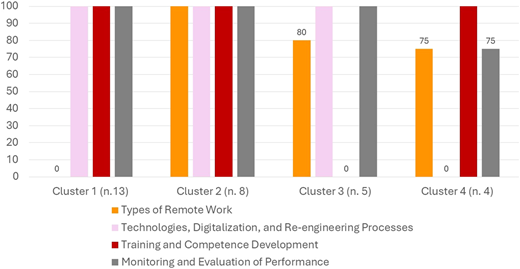
Based on the four themes identified in the qualitative phase, four distinct clusters were identified, representing different approaches to remote work design. The high silhouette score (0.9) indicates a robust clustering solution, and Figure 1 illustrates the different configurations of the four design factors across clusters.
Technology and training showed the highest predictor importance (1.00), followed by types of remote work arrangements (0.77) and performance monitoring (0.19). Cluster labels reflect the overall configuration across the four design variables rather than any single dominant component. Cluster 1, labelled Advanced Single Remote Work Type, represents the 43.3% of the sample and includes 13 public administrations that adopted a single remote work system (i.e. teleworking, or remote work, or co-working/satellite arrangements), while combining it with substantial investments in training and competence development, structured performance monitoring, and a strong push for technologies. Cluster 2, the Advanced Multiple Remote Work Type, includes eight public administrations (26.7% of the sample) that, differently from Cluster 1, presented two or more types of remote work arrangement. Instead, like Cluster 1, they invested in training and competence development, performance monitoring tools and methods, and technologies. Cluster 3, the Technology-Driven Approach, includes five administrations (16.7% of the sample) focused on digitalisation as main driver of remote work design. These administrations mainly focus on technology to design telework processes (the arrangement most frequently used in these organisations), with technology and monitoring systems playing a central role, whereas training initiatives were less prominent. Finally, Cluster 4, the KSAO-Driven Remote Work, consists of four public administrations (13.3% of the sample) whose attention mainly goes on training and skills development (we labelled it as driven by KSAO – Knowledge, Skills, Abilities and Other Characteristics). Three out of the four organisations considered some form of monitoring and evaluation of employee performance, whereas investment in technology was not mentioned in their PIAOs, distinguishing this group from the other technology-oriented clusters. Table 3 shows the distribution of the different institutions across the four clusters. Cluster 1 primarily includes health organisations (38.5%), local authorities (38.5%), and research and education institutions (23.1%), with no central government bodies. Most PAs of cluster 1 are located in Northern Italy (53.8%) and are equally distributed in terms of size. Cluster 2 includes institutions from all sectors, with a slight predominance of health organisations (37.5%) and a smaller share of research and education (12.5%). Geographically diverse, it has a relative majority from the South (37.5%) and a minority from the North (12.5%). Most institutions in this cluster are large (62.5%), including two out of the three central administrations examined. Cluster 3 is mainly composed of research and education institutions (60%), with no health organisations. Most institutions are located in Southern Italy (40%), and mainly small (40%) and medium-sized (40%). Cluster 4 includes only health and research/education organisations (50% each), with no local or central government bodies. All are in Central Italy, and are medium (50%) or large (50%) in size. Likelihood ratio, reported in the bottom line of Table 3, show that only geographical location was significantly associated with cluster membership (χ2(9) = 18.79, p = 0.03), with Cluster 4 entirely composed of organisations based in Central Italy, and Cluster 1 not including any national level institution. No significant associations emerged for organisational size or administrative sector.
Discussion
This study investigated how Italian public administrations design remote work in the Integrated Plan of Activities and Organization (PIAO), a recently introduced planning instrument to define organisational priorities, resource allocation, performance objectives, and remote work arrangements. Consistent with the premise that remote work does not simply relocate work outside the office, findings show that its formal design involves a broader reconfiguration of coordination mechanisms, technological infrastructures, human resource practices, monitoring systems, and accountability arrangements.
The study identified a heterogeneous, but structured set of remote work design components and four distinct configurations. These findings suggest that public administrations do not follow a single standardised model of remote work. Rather, they configure remote work according to different combinations of institutional conditions, technological capacity, human resource strategies, managerial assumptions, and local constraints. While grounded in the Italian public sector, the findings are relevant to broader public management research, as many administrative systems face similar challenges in aligning digital transformation, strategic planning, HRM policies, and public value creation (OECD, 2020, 2025).
Interpretation of findings
The qualitative phase identified and organised themes and subthemes used to design remote work in public administrations. These themes reflect the four dimensions of Parker and Grote's (2022) work design model. Higher-level factors include strategic orientations, regulatory references, stated objectives, and the adopted types of remote work arrangements. Technology-related factors concern digital infrastructures, digitalisation processes, software platforms, secure access systems, and process re-engineering. Individual-level factors include training, competence development, managerial support, and HR practices aimed at sustaining remote work. Finally, work design factors include eligibility criteria, working conditions, task allocation, coordination mechanisms, performance monitoring, safety provisions, and the redesign of workspaces and working time.
These findings answer the first research question by showing that remote work is designed as a multidimensional organisational arrangement. In the analysed PIAOs, remote work is not only a flexible work option, but an arrangement requiring decisions about who can work remotely, under which conditions, with which technologies, with what forms of support, and through which monitoring and accountability mechanisms. This confirms that remote work in public administrations should be understood as a work design issue that requires to align organisational, technological, social, and managerial components.
The quantitative phase identified four distinct clusters of remote work design reflecting different emphasis on one or multiple types of remote work arrangements, technological infrastructure, and human resource development practices. These clusters answer the second research question by showing that remote work design varies across public administrations through distinct pathways. Some administrations adopt integrated configurations which combine technology, training, and monitoring. Others emphasise only specific dimensions: the Technology-Driven and KSAO-Driven clusters are particularly informative because they adopted partial approaches to remote work design, centred primarily on technological transformation or competence development, that do not capture the full socio-technical complexity of remote work.
The significant association between clusters and geographical location further suggests that territorial context may shape remote work design. This result should be interpreted cautiously, given the exploratory nature of the study and the limited sample size. However, geographical location may reflect differences in digital infrastructure and broadband availability, labour market characteristics, local innovation ecosystems, or access to competence-development providers. In this sense, location does not operate merely as a geographic variable, but as a proxy for a broader set of contextual resources and constraints that may influence organisational design choices.
Overall, the findings provide empirical evidence that remote work in public administrations is institutionalised through multiple design configurations. These configurations differ according to the attention devoted to technological infrastructures, human capabilities, managerial practices, performance monitoring, and organisational conditions. This conclusion supports the idea that remote work should be analysed as a contingent organisational configuration rather than a uniform policy instrument.
Theoretical contributions
This study contributes to work design theory in three main ways. First, it applies Parker and Grote's (2022) work design model to public administrations, an empirical setting that has received limited attention in the work design literature. The findings show that the four dimensions of the model are observable in PAs planning documents and can be used to analyse how public organisations design remote work. This is an important result because previous research has mainly focused on individual outcomes, task-level arrangements, or team-level coordination, with less attention to how remote work is formally embedded in organisational strategies and governance systems (Eisenhard and Morgeson, 2025; Zhang et al., 2025).
Second, the study connects work design theory with organisational design by showing that remote work is shaped not only by job characteristics or individual preferences, but also by broader institutional and organisational conditions. These include regulatory frameworks, planning instruments, technological infrastructures, and strategic objectives. In this sense, remote work design reflects the operationalisation of overarching principles into concrete organisational arrangements, thereby supporting a contingency-oriented perspective: meaning and effectiveness of remote work depend on the alignment between institutional requirements, organisational structures, technologies, and human resource practices (Van de Ven et al., 2013).
Third, the study provides empirical support for a sociotechnical interpretation of remote work design. The findings suggest that effective remote work design requires the joint alignment of technological systems, human capabilities, managerial practices, and work organisation. This is consistent with sociotechnical systems theory, which emphasises the joint optimisation of social and technical subsystems (Guest et al., 2022). Some clusters present configurations which combine multiple design elements, whereas others present configurations which privilege either technology or competence development.
The study also contributes to public management research by linking remote work design to strategic planning and public value creation. The adoption of PIAO encourages PAs to make remote work design choices explicit, comparable, and embedded within broader performance and planning frameworks. While previous research has examined the PIAO mainly in relation to public value creation (Deidda Gagliardo, 2024; Papi et al., 2025), this study shows that remote work is one of the organisational domains where public administrations translate strategic priorities into concrete arrangements. In this regard, remote work can be considered as a component of public value-oriented planning, as it may contribute to service delivery, employee well-being, environmental sustainability, and organisational resilience.
Practical and policy implications
From a managerial perspective, the findings highlight the importance of planning instruments, such as the PIAO, as mechanisms to align remote work with organisational strategy. Remote work should not be treated as a residual HR practice, or as a simple continuation of emergency arrangements. It requires, as we have shown, deliberate choices about eligibility, intensity, technologies, training, coordination, and so on.
The more integrated configurations, particularly the Advanced Single, and the Advanced Multiple, Remote Work Type, suggest that remote work design is stronger when digital infrastructure, competence development, and performance monitoring are considered together. These configurations appear better equipped to balance flexibility with accountability, and to connect remote work with broader organisational objectives. In contrast, a technology-driven approach may assume that digital tools are sufficient to make remote work effective, or a KSAO-driven approach may overemphasise individual readiness without adequately considering infrastructure, coordination, and monitoring systems.
This has important implications for public managers. First, administrations should avoid treating remote work as a purely technological project. Digital platforms, secure access, and monitoring tools are necessary, but they do not automatically generate effective work arrangements. Second, they should also avoid treating remote work only as an employee benefit. Work-life balance and employee well-being are important, but remote work also needs to be connected to service continuity, public accountability, and organisational performance. Third, administrations should develop integrated design processes that bring together HR managers, ICT units, line managers, employee representatives, occupational safety experts, and performance management units.
The findings also have implications for policymakers. The heterogeneity observed across public administrations suggests that broad regulation alone is insufficient to ensure coherent and effective remote work design. National guidelines and legal frameworks can define principles and minimum standards, but administrations also need operational support, shared benchmarks, inter-organisational learning platforms, and mechanisms for disseminating effective models. This is particularly important in contexts marked by territorial inequalities in digital infrastructure, administrative capacity, and workforce digital competencies. Reducing digital divides, supporting competence development, and strengthening administrative capacity are therefore essential to prevent remote work from becoming a new source of organisational and territorial inequality.
Finally, the findings reinforce the need to frame remote work as part of administrative modernisation and public value creation. Sustainable modernisation requires investment in digital technologies, but also attention to work quality, employee well-being, accountability, and service delivery (Warhurst and Knox, 2022). From this perspective, remote work can become a strategic lever for public sector transformation when it is embedded in coherent organisational design choices rather than implemented as a compliance-oriented or technology-led practice.
Limitations and future research
This study has several limitations. First, it focuses on Italian public administrations and is based on a relatively small sample of 30 PAs. Although the sample was designed to include heterogeneity in terms of size, sector, and geographical location, the findings should be interpreted as exploratory rather than representative. Future comparative studies across countries would be useful to assess whether similar remote work design configurations are observed in different administrative, cultural, and regulatory contexts. In this regard, the same analytical strategy could be used in other countries, applying it to comparable organisational-level sources used by public administrations to formalise remote or hybrid work arrangements. Although such documents may be more dispersed than Italian PIAOs, which are downloadable from a single institutional portal, they can allow to examine how public organisations design remote work arrangements. Relevant sources may include agency telework policies, departmental hybrid working policies, flexible working frameworks, workforce plans, internal HR guidance, or remote work agreements, such as those issued by US federal agencies or UK public organisations.
Second, the study relies only on PIAO documents. This is appropriate for examining the formal design and institutional discourse surrounding remote work, but it does not capture actual implementation practices or employee experiences. There may be a gap between how remote work is planned and how it is enacted in everyday organisational life. Future research should therefore complement document analysis with interviews, surveys, observations, or case studies to examine how managers and employees interpret, negotiate, and implement formal remote work provisions.
Third, this study did not include outcome indicators. As a result, it cannot determine whether specific remote work design configurations are associated with better organisational performance, employee well-being, service quality, or citizen satisfaction. Future research should collect outcome data to assess these relationships.
Fourth, the study considered organisational size, sector, and geographical location, but did not directly examine other potentially relevant factors, such as organisational culture, trust, digital maturity, unionrelations, managerial capability, or previous experience with flexible work arrangements. These factors may strongly influence how remote work is designed and institutionalised. Future research should investigate how these factors shape the effectiveness of remote work design in public administrations.
Finally, the cluster analysis should be interpreted only as an exploratory classification. The identified clusters offer a useful first mapping of remote work design configurations, but they require validation in larger samples and in different contexts. Further research could also refine the indicators, or themes, used to capture components of remote work design.
Conclusion
This study shows that remote work in public institutions is not simply a relocation of work outside the office, but an organisational and work design issue. By analysing the section of PIAO documents devoted to remote work, the study identified how Italian public administrations operationalise broad regulatory principles into concrete remote work arrangements, involving organisational structures, technological infrastructures, HR practices, coordination and monitoring mechanisms, and accountability. The findings indicate that remote work can be described by four distinct configurations, each reflecting a different combination of work design components. The association with geographical location further suggests that these configurations may reflect territorial differences in administrative capacity, digital readiness, and organisational resources.