Skip to article sections
Purpose

This paper explores challenges and solutions between artificial intelligence (AI) and social equity within the public sector. A cross-disciplinary synthesis explains where equity risks originate and which governance levers are most effective in mitigating them.

Design/methodology/approach

The literature was examined across three databases (Web of Science, EBSCO and Scopus). A final corpus of 128 peer-reviewed articles (2016–January 2025) was qualitatively coded and analyzed for study type, AI modality, equity challenges and remedies aligned to governments' roles.

Findings

Interest has expanded rapidly since 2021, with conceptual work still dominant but empirical studies growing. Scholarship disproportionately centers on regulatory and user roles, while enabler and leader roles remain underdeveloped yet pivotal for upstream capability distribution and downstream accountability.

Research limitations/implications

The framework simplifies a complex governance reality and requires empirical validation; longitudinal and practitioner-engaged studies are needed to track long-term equity effects.

Practical implications

The framework helps policymakers match equity risks to concrete instruments–regulatory audits and due process (regulator), human in the loop design and appeals (user), market shaping procurement and capacity building (enabler) and sovereign infrastructure and solidarity mechanisms (leader).

Social implications

As AI transforms society, awareness of the complexities to manage and the potential solutions is a critical frontier to investigate and disseminate to support the government in the new digital age. Given the centrality of social equity for governmental organizations, a critical analysis of potential challenges and solutions is essential, particularly considering the complexity of government roles concerning AI adoption.

Originality/value

The study integrates social equity theory with a role-based framework to map practical levers for equitable AI in government and to expose role interdependencies.

As governments increasingly rely on AI to improve the efficiency of public services, equity is a critical dimension (McDonald et al., 2022; Young et al., 2025). Despite extensive work on efficiency and effectiveness in digital government (Cordella and Paletti, 2018), social equity remains underexamined even as AI reallocates discretion and reshapes distributional outcomes (Frederickson, 2015; Valle-Cruz et al., 2024), with only a few exceptions (Lahat and Nathansohn, 2025). Social equity is a constitutive value guiding who receives public services, on what terms and with what dignity. In practice, equity conditions trust, legitimacy and the fair distribution of burdens and benefits across populations: precisely the domains AI is poised to reshape (Acemoglu and Johnson, 2023; Wong et al., 2024). AI is particularly salient for equity because it relocates discretion: from caseworkers to data, from procedures to models and from local knowledge to generalized predictions (Covilla, 2025; Kulal et al., 2024).

Most studies approach the AI–equity question from narrow, discipline-specific angles, such as application domains (Bonomi Savignon et al., 2024; Jones and McKelvey, 2024; Selten and Meijer, 2021; Jin and Ryu, 2025), specific geographical settings (Margetts et al., 2024; Baykurt, 2022; Plantinga, 2024), or technical prerequisites (Ratner and Thylstrup, 2024; Varona et al., 2021). In this paper, we argue that organizing evidence according to different but interconnected potential government roles clarifies distinct levers of distributive impact and reveals interdependencies often hidden in domain-specific analyses.

This systematic literature review spans across disciplines to develop a framework for social equity challenges and solutions in AI-mediated public services, considering the different roles of governments in AI adoption (Guenduez and Mettler, 2023). Building on Guenduez and Mettler's analysis of national AI strategies, governments tend to adopt four roles. As regulators, they establish rules and remedies to ensure AI aligns with rights and accountability. As users, they implement systems in service delivery and determine how human judgment, automation and avenues for appeal should work together. As enablers, they invest in skills, standards and shared infrastructure, allowing public and private actors to develop and adopt AI. As leaders, they set directions and foster collaborations both domestically and internationally. These roles serve as narrative frameworks influencing problem and solution definitions, with their importance varying over time and across countries (Guenduez and Mettler, 2023).

We opt for a multidisciplinary approach to understand how governments can shape more equitable public services through AI. Indeed, including literature from different fields in the review improves evidence on how equity should be created by considering interdependent government roles, not only through regulation or front-line use.

Therefore, our research question is: “Considering the different roles governments play in developing, implementing, and governing AI technologies, what are the main challenges and solutions for governments delivering AI-driven equitable public services?” The answer aims to uncover latent tensions and propose solutions for both policy and practice.

The article is structured as follows: Section 2 defines social equity and justifies the four-role framework; Section 3 details the method; Section 4 reports descriptive and qualitative findings; Section 5 discusses implications and a research agenda; Section 6 concludes with recommendations and limitations.

Social equity has been central to public administration since the 1968 Minnowbrook Conference (Fredrickson, 1971), though its concept continues to evolve (Nabatchi and Carboni, 2019). Modern public management research evolves from focusing on efficiency to prioritizing social equity (Cepiku and Mastrodascio, 2021; McDonald et al., 2022; Wiley et al., 2025). However, social equity has different and sometimes conflicting meanings. Definitions vary among references to inputs, processes, outputs and outcomes, reflecting the heterogeneous conceptualization given by public management scholars (Riccucci and Van Ryzin, 2017). A widespread and shared definition is provided by the U.S. National Academy of Public Administration (NAPA) in which social equity is considered as “the fair, just and equitable management of all institutions serving the public directly or by contract; and the fair and equitable distribution of public services, and implementation of public policy; and the commitment to promote fairness, justice, and social equity in the formation of public policy” (NAPA, 2005: p. 11).

The relationship between AI and social equity presents an interdisciplinary challenge that modern scholars of public administration and public management should confront (McDonald et al., 2022). Investigating the social equity implications of AI facilitates a deeper understanding of how disruptive technologies shape public sector values in contemporary contexts (Peters and Torfing, 2025). Understanding AI’s dual role in improving public services and potentially increasing inequalities is vital to ensure AI advances public sector social equity goals (Wiley et al., 2025).

Indeed, AI can be seen as a “double-edged sword,” with the potential to either mitigate or reinforce existing biases (Ravanera and Kaplan, 2021). On the one hand, AI can create positive outcomes for marginalized groups in situations where human decisions may be clouded by cognitive biases, by removing the negative impact of human error in decision-making (Kleinberg et al., 2018). AI in practice, however, does not necessarily act as a counterweight to discrimination, as technology often reflects and reproduces the social dynamics of the context in which it is adopted and used, and AI is not an exception. Societal power relations and inequality may shape the data, the algorithms and how these algorithms are used; therefore, AI support to humans will be biased as a consequence (Garcia, 2016).

In public services, model design, data provenance and human–AI interaction jointly determine accountability and legitimacy (Mittelstadt et al., 2016; Busuioc, 2021; Grimmelikhuijsen and Meijer, 2022). Potential benefits of algorithmic decisions are weakened by the tendency of both decision-makers and street-level bureaucrats to select AI recommendations that align with their stereotypes and experience (Alon-Barkat and Busuioc, 2023; Selten and Meijer, 2021).

Regarding AI, we adopt the broad and updated OEDC (2024) definition of “a machine-based system that generates outputs […] that can influence both physical and virtual environments by inferring from received inputs to meet explicit or implicit objectives”. We operationalize this definition by distinguishing four loci of potential equity claims: data collection and representativeness (inputs), modeling choices and explainability (processes), allocation and eligibility decisions (outputs) and rights protections (outcomes). The regulator–user–enabler–leader framework maps these four equity loci to concrete levers: rules and redress (regulator), operational practice and discretion (user), infrastructures, skills and standards (enabler) and strategic direction and countervailing power (leader) (Guenduez and Mettler, 2023). More in detail, as regulators, governments define constraints and remedies (e.g., audit mandates, due process and non-discrimination) that influence upstream design and downstream compensation (Dwivedi et al., 2021). As users, they implement AI in high-stakes decisions, where hybrid human-machine arrangements and participatory assessments determine actualized equity (Schiff et al., 2022; Taylor et al., 2024). As enablers, they invest in infrastructures, skills and partnerships that govern who can develop and benefit from AI innovations (Ulnicane et al., 2021). As leaders, they establish strategic directions and balanced powers (Margetts, 2022), aligning AI development with democratic values and global justice. Each role addresses a different equity challenge and, importantly, these roles influence one another in practice. This proposed framework complements equity loci (inputs, processes, outputs, outcomes) by mapping them to concrete governmental levers, enabling cumulative comparison across domains.

A systematic literature review was chosen to consolidate past and ongoing research findings (Briner and Denyer, 2012; Rousseau, 2012) across multiple disciplines, recognizing that AI’s impact on social equity cannot be fully understood from a single perspective.

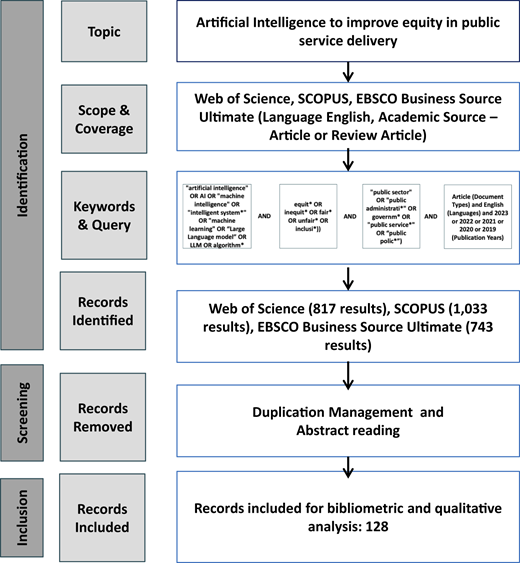
We searched Web of Science, Scopus and EBSCO using AI, equity and public-sector terms, without imposing a start date (PRISMA in Figure 1). The earliest included article is from 2016; searches were updated to January 2025. The Figure shows our literature search strategy, which combines three key elements: AI-related terms (including “artificial intelligence,” “machine learning,” and “algorithms”), equity-focused language (covering fairness, inclusion and related concepts) and public sector terminology (spanning government, public administration and services). By linking these components with AND operators, we ensured our search captured only studies examining AI’s equity implications specifically within government contexts.

We associated equity implications with AI, different types of technologies (GenAI, LLM, Algorithms for decision-making, Facial recognition systems), when disclosed and specifically coded cases with an unspecified type.

After applying the search query to the three databases, an initial set of results was obtained, then a filter was applied to include only English-language publications and the outputs were limited to academic articles. We did not restrict the search to specific subject categories, as the review aims to combine different disciplinary perspectives.

This process yielded the following results: Web of Science (817), Scopus (1,033) and EBSCO (743). The next step involved removing duplicates across three databases, then two authors independently reviewed abstracts. Inclusion criteria focused on relevance to the public sector, considering government roles in AI and social equity.

We used a consensus process to resolve disagreements about study inclusion: when the two reviewers differed, they discussed their reasons and a third reviewer made the final decision if needed.

Studies were eligible if they directly examined the intersection of AI, social equity and the public sector; reported domain-specific implementations (e.g., healthcare, education, social services) with explicit equity analysis; proposed guidelines, standards, or best practices for equitable government AI; or evaluated strategies and policies that advance AI while mitigating unfair or discriminatory impacts.

We included n = 128 studies and conducted structured qualitative coding to extract role, modality, challenges and solutions. Each article was then assigned a government role, based on Guenduez and Mettler (2023).

The full research protocol is illustrated in the diagram in Figure 1.

We first outline sample characteristics, then synthesize qualitative insights by role.

Interest in AI and equity topics has surged over the past decade, highlighting their growing importance in academia and policy. The 2016 paper is a foundational work that discusses ethical challenges, including opacity, bias and accountability. It calls for interdisciplinary approaches to develop governance frameworks that ensure transparency and fairness (Mittelstadt et al., 2016).

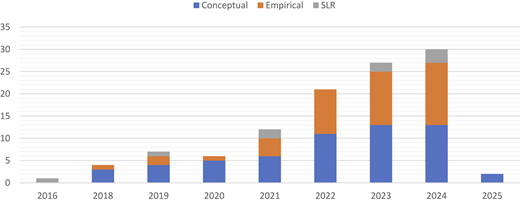
In our final sample (n = 128), conceptual articles predominate, followed by a marked growth in empirical studies after 2021; systematic reviews emerged subsequently. Regarding technologies, decision-support algorithms are most common; 56 articles refer to “AI” without specifying a technology, while robotic process automation and facial recognition appear in only three articles each. Overall, the sample mainly treats AI as an overarching category or discusses “algorithms” without specifying subtypes. This pattern is most evident in empirical legal and social science studies, where institutional design, accountability and rights are the primary focus and the technical foundation is regarded as secondary background (Figure 2).

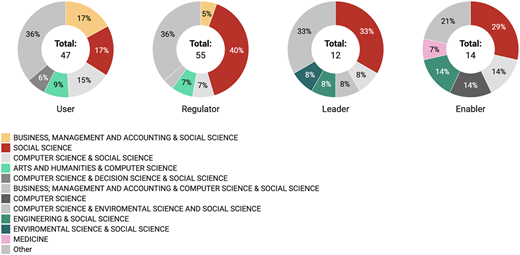
The current academic debate primarily focuses on government regulation of AI, with limited attention to government leadership or enabling roles, which have recently gained some interest. Our analysis (Figure 3) reveals the regulatory role in forty-nine papers, particularly from 2021 onward, with 19 papers published in 2024. The user role is featured in eleven papers, highlighting the practical use of AI in public services. The enabler role is featured in eleven papers, primarily in 2022, while the leader role appears in ten papers, with a peak in 2024. The distribution of publications along the four roles confirms the topic's interdisciplinary nature, with specific concentrations in particular subject areas. Government Information Quarterly is the most represented journal, with eleven articles. AI & Society contributed eight publications, offering a unique perspective from the humanities and computer science. Big Data & Society and Public Administration Review each published five articles, examining the topic from data science and public management angles, respectively. Figure 3 shows the distribution based on roles and research categories (source: Scimago Journal & Country Rank (SJR)). The Social Science domain shows diverse engagement, especially in the Regulatory category, with a strong presence across all roles. The discipline primarily examines how AI influences societal structures and institutions, with a focus on regulation. Business, management and accounting, often combined with other disciplines, have eight publications in the User category, emphasizing practical use. Computer science, alone or in collaboration with others, is represented in user and regulatory roles, emphasizing both technical and governance focus. Engineering and medicine make selective but significant contributions, mainly in enabling roles.

This disciplinary pattern indicates a compartmentalization of studies that may obscure equity externalities at the ecosystem level: legal and governance scholars analyze rules and tools, while organizational scholars observe implementation; very few studies integrate market-shaping policies, capacity building and geopolitical asymmetries into a comprehensive equity analysis.

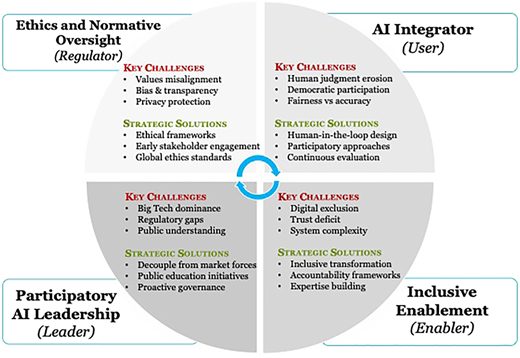
The analysis of how AI and social equity interact in the context of each of the four roles of government inspires the definition of a comprehensive taxonomy of challenges and potential solutions that governments must navigate in the era of AI. Table 1 summarizes challenges and instruments by role, highlighting distinct decision logics and metrics. We elaborate on each quadrant below.

However, the literature demonstrates how roles are often deeply interconnected and overlap. Their balance may also shift over time as AI technologies and societal needs evolve. For this reason, in the discussion, we dedicate a specific paragraph to highlight the interconnection between some challenges and solutions and the potential synergy among the government's roles. The four-role taxonomy analytic labels clarify their conceptual distinctions and practical implications: (1) Ethics and normative oversight (Regulator): anticipatory, context-specific rules, audits and redress; (2) Equitable Integration (User): hybrid human-in-the-loop arrangements, participatory impact assessments and algorithmic literacy; (3) Inclusive Enablement (Enabler): market-shaping investments, skills and infrastructure for underserved communities and concrete standards translating ethics into enforceable requirements; (4) Participatory AI Leadership (Leader): long-range public value orientation, countervailing power to platform dominance and global justice commitments.

4.2.1 Government as regulator

By acting as regulators, governments should manage the potential conflict between AI development and public values (Selten and Meijer, 2021; Nzobonimpa and Savard, 2023; Margetts, 2022; Robles and Mallinson, 2023). While AI can foster efficiency in public services, it can exacerbate issues of transparency and inclusivity of marginalized communities, affecting government accountability (Busuioc, 2021). Early engagement of disadvantaged groups in AI adoption and governance, along with specific regulations targeting bias and discrimination, could safeguard social equity in system and service design (Gaozhao et al., 2023). Overall, proactive measures to ensure that algorithmic systems are designed and implemented in ways that promote equitable outcomes–including mechanisms for civic participation, legal frameworks and closer monitoring of algorithms–are essential regulatory actions to ensure legitimacy and protect marginalized communities (Grimmelikhuijsen and Meijer, 2022; Kaur et al., 2023). Adaptive instruments, such as regulatory sandboxes with equity guardrails, tiered audit requirements proportional to decision stakes and due-process rights for algorithmic decisions, are potential solutions to balance fast-evolving technologies and asymmetric impacts.

4.2.2 Government as user

AI adoption risks eroding human discretion and judgment, raising concerns about reliance on technology (Levy et al., 2021; Young et al., 2019; König and Wenzelburger, 2021). A hybrid human-machine model is preferred, enabling caseworkers to handle complex cases and appeals (Ranerup and Henriksen, 2022; Waldman and Martin, 2022). Insufficient citizen involvement in AI-based service co-design may harm human autonomy (Park and Humphry, 2019). Governments should engage communities, conduct participatory system design and assessments for social equity, create oversight bodies with community input and explore alternative visions that enhance citizen participation (Moon, 2023). To mitigate risks, governments must inform users they are interacting with an AI, continually evaluate AI systems, avoid gender role assumptions in AI design and apply the “Principled AI” framework in development (Varona et al., 2021). Promoting algorithmic literacy and involving communities in AI design and oversight are essential for trustworthy AI services (Wang et al., 2024). Equitable Integration can be strengthened by concrete practices, such as remit-specific “equity playbooks” that translate abstract principles into decision frameworks and appeals procedures for services (e.g., benefits eligibility, permitting) and ongoing, mixed-methods evaluation that triangulates model metrics with lived experience data from affected communities.

4.2.3 Government as enabler

When enabling AI adoption across the public service ecosystem, pressing challenges mostly relate to digital divides in access and skills (Bonomi Savignon et al., 2024). Forward-thinking governments are investing in their workforce’s digital skills while creating oversight systems that promote innovation without compromising accountability (Gibbons, 2021). Indeed, trust and the opacity of AI systems present another challenge, particularly when these systems make decisions that could impact citizens’ lives. The lack of transparency makes it challenging for administrators to explain decisions and maintain public confidence while still advocating for technological progress (Margetts, 2022). However, rather than merely establishing rules, some governments are actively shaping AI integration, turning abstract ethical guidelines into practical standards that balance innovation with accountability (Fernandez-Aller et al., 2021). Market-shaping interventions, such as public data trusts with equity clauses, procurement criteria that reward fairness benchmarks and subsidized civic-tech incubators focused on underserved populations, could be implemented.

4.2.4 Government as leader

Steering AI calls for a new kind of public digital leadership. As Big Tech firms draw on public data, governments risk dependency for essential services and infrastructure (Valle-Cruz et al., 2024). States should decouple digitalization from marketisation and govern core digital infrastructures as public utilities with clear distributional stakes. Core welfare sectors, health, education and social protection, require statutory safeguards against overreach and excessive reliance on the private sector that can undermine public values (Sharon and Gellert, 2024). Data should be protected from extractive uses and benefits should also be distributed in the Global South (Taylor, 2024). National AI strategies should be presented as public-value charters, featuring transparent capability roadmaps, sovereign infrastructures for essential services and solidarity mechanisms such as compute credits and equitable licensing to reduce data extraction and distribute gains more fairly.

Our synthesis shows that equity challenges and remedies cluster by role but operate as a system. Regulatory and user roles are disproportionately represented because they fit existing institutional arrangements, data availability and near-term incentives; enablement and leadership require longer horizons, cross-sector coordination and political mandates, and thus remain underdeveloped. This imbalance risks portraying equity as remediation at the point of use rather than as a matter of design and proactive governance upstream.

Modality non-disclosure weakens external validity: equity claims built on one family (e.g., risk scoring) are tacitly generalized to others (e.g., biometrics, generative models), encouraging one-size-fits-all remedies. Two forces likely drive this ambiguity. First, empirical legal and social science work often scrutinizes institutions – rules, discretion, legitimacy – rather than artifacts, pulling analysis away from model classes and toward governance arrangements. Second, disclosure constraints and fast-changing toolchains complicate precise labeling in practice: commercial confidentiality to mitigate competition, the fast evolution of AI development tools, with constantly updated libraries and emerging frameworks integrating different components and versions, create challenges to maintain accurate, up-to-date system labels and proper definitions. The costs are nontrivial: weaker external validity, limited replication and difficulty aligning safeguards to concrete harms.

These limits do not undermine role-based synthesis; rather, they clarify where each role can close the modality gap. Ethics and normative oversight should be anticipatory and proportionate (regulator); equitable integration should institutionalize participation and appeals (user); inclusive enablement should rebalance who innovates and who benefits (enabler); and participatory leadership should pursue strategic autonomy and global justice (leader). Figure 4 presents a taxonomy that links role-specific challenges to instruments, emphasizing interdependencies across roles.

Cross-cutting principles remain pivotal. Transparency, accountability and legitimacy are necessary conditions but not sufficient on their own (Mittelstadt et al., 2016; Busuioc, 2021; Grimmelikhuijsen and Meijer, 2022). Meaningful human oversight requires capability, authority and information to override model outputs (user); enablement requires inclusive access and enforceable standards (enabler); leadership requires culturally sensitive strategies that counter platform dominance and dependency (leader) (Ranerup and Henriksen, 2022; Sharon and Gellert, 2024). Regulatory frameworks engage with questions of distributive justice, so they should incorporate adjustments to mitigate the historical distribution of inequities (Minow, 2023; Mittelstadt et al., 2016). Governments should therefore approach “adaptive oversight”. Namely, mechanisms that can grow alongside the technologies they govern, adopting regulatory sandboxes and including potential underrepresented communities (Margetts, 2022; Jobin et al., 2019).

As AI users, governments can achieve the most immediate and tangible benefits for society. Our findings suggest that the most successful AI implementations preserve, rather than diminish, human involvement in judgment (Alon-Barkat and Busuioc, 2023; Young et al., 2019). Hybrid models that enhance human capabilities while maintaining human accountability are adequate to support government functions (Ranerup and Henriksen, 2022; König and Wenzelburger, 2021). However, meaningful human oversight necessitates that human operators possess the capability, authority and relevant information to override AI recommendations when necessary (Levy et al., 2021; Waldman and Martin, 2022).

As enablers, Governments are challenged to develop more sophisticated approaches to digital inclusion, building AI literacy, supporting public investment in AI applications serving underserved communities and fostering public-private partnerships with explicit equity requirements (Bonomi Savignon et al., 2024; Arnaout et al., 2023; Gibbons, 2021).

Although still understudied, the government as an AI leader is the most ambitious role among others. It requires more than strategic planning to articulate visions for AI’s role in society while building the institutional capacity to realize those visions (Valle-Cruz et al., 2024; Hjaltalin and Sigurdarson, 2024). This is particularly challenging, especially in small national contexts where public resources are scarce, given the dominance of large technology companies (Sharon and Gellert, 2024) and necessitates building domestic capacity to develop AI applications that serve national priorities and values (Taylor, 2024; Plantinga, 2024).

Regulatory and user roles dominate due to tractability (existing institutions and data), salience (visible harms) and incentives (short-term measurability). Enabler and leader roles require broader perspectives and stronger cross-sector coordination, which hampers both implementation and academic research documentation. However, without Inclusive Enablement and participatory AI leadership, equity potentially becomes a remedial action after regulation or a local optimization during use. The upstream distribution of capabilities and downstream distribution of power remain under-theorized, weakening the transformative potential of many technical reforms.

We thus embed design-oriented implications in each quadrant. Adaptive oversight should be anticipatory and proportionate; equitable integration should institutionalize participation and appeals; inclusive enablement should re-balance who innovates and who benefits; participatory AI leadership should pursue strategic autonomy and global justice.

When we examine how governments engage with AI across their various roles, it emerges that those roles influence each other and fundamentally reshape how public institutions can pursue social equity. Overall, governments create rules and then must adhere to them when deploying AI systems (Ranerup and Henriksen, 2022).

Governments attempting to encourage AI adoption across society (the enabler role) face a trustworthiness challenge. Private actors are more likely to follow government enablement when the public sector demonstrates competent deployment and credible oversight. Scandals involving biased algorithms in their public systems, such as the health system (Fountain, 2022), can diminish the effectiveness of government enablement efforts for stakeholders in the ecosystems. Leadership in AI governance cannot simply be declared but is earned through competence in the other roles (Hjaltalin and Sigurdarson, 2024).

To support governments navigating these interconnections, public management scholars should investigate potential managerial solutions to provide institutional arrangements where regulatory, operational and strategic dimensions are oriented towards specific needs (Criado et al., 2025). The measurement challenge extends beyond traditional performance frameworks that treat regulatory compliance and operational effectiveness as distinct categories. What emerges from our review is the need for integrated assessment approaches that capture the dynamic relationships between different governmental functions (Grimmelikhuijsen and Meijer, 2022; Waldman and Martin, 2022). Governments have started to experiment with “relational indicators”, intended as metrics designed to track not isolated outcomes but the interactions between regulatory frameworks and operational realities. These approaches recognize that a regulation’s actual impact only becomes visible through its implementation, while operational experiences continually reshape regulatory understanding (Wang et al., 2024). Thus, AI governance must be led by public managers who can engage with technical teams, have sufficient regulatory knowledge to ensure compliance and strategic thinking to connect AI with broader public purposes (Madan and Ashok, 2023; Bernhard and Wihlborg, 2022). A solution could be the piloting of relational indicators that connect, for example, the enforcement of audit mandates (regulator) to appeal volumes and resolutions (user), to supplier diversity and fairness benchmarks in procurement (enabler) and to platform dependency measures in critical services (leader).

Managing the tension between innovation and precaution as a productive friction yields more robust and equitable outcomes (Margetts, 2022; Valle-Cruz et al., 2024; Busuioc, 2021). Considering the discussion, we propose a research agenda, acknowledging a fundamental challenge: the object of study evolves more rapidly than our analytical capacity. Yet this temporal mismatch makes rigorous investigation even more relevant.

Our review reveals that governments face multifaceted challenges across several domains. The solutions to these challenges offer fertile ground for scholarly inquiry. Table 2 maps potential research directions across the four quadrants outlined in Figure 4, providing a framework for future investigation.

We argue that equity cannot be bolted on at the point of use: it must be designed into infrastructures (enabler) and safeguarded through strategic capacity (leader), with regulation and use completing the system (Mittelstadt et al., 2016; Williams et al., 2022; Busuioc, 2021).

A recurring constraint is definitional blur: “AI” is too often a catch-all, yet different systems entail different risks and safeguards. Future work should name the technology and task (e.g., risk scoring, FRT, LLMs) and meet minimum reporting standards on data provenance, deployment context, human-in-the-loop and appeal routes. Therefore, we provide the following suggestions for future research.

First, to reframe equity as a system of interconnected roles: the taxonomy links different levers, rules (regulator), practices (user), infrastructures and skills (enabler) and strategy and countervailing power (leader). Devote more scholarly attention to the ecosystem dimension of AI through the leadership and enablement functions of governments. Secondly, in recognition of the multidisciplinary nature of AI, to specify the AI technology under analysis in every field of study: equity claims should be limited to the specific AI technology involved (e.g., risk scoring, facial recognition, generative systems), with implications for due process, audit design, explanation and redress. We suggest minimum reporting standards for cumulative science and cross-disciplinary analysis (such as the modality and task; describe data origin; outline deployment context and human-in-the-loop arrangements, etc.).

Actionable implications for practice include:

For Regulators: mandate risk audits tied to decision stakes; codify process rights (notice, reasons, appeal) for decisions supported by algorithm; require participatory impact assessments for high-risk deployments; use adaptive oversight (e.g., sandboxes) that includes underrepresented communities (Waldman and Martin, 2022; Grimmelikhuijsen and Meijer, 2022; Mittelstadt et al., 2016; Jobin et al., 2019; Margetts, 2022; Kaun, 2022; Busuioc, 2021; Taylor et al., 2024; Horvath et al., 2023; James et al., 2023).

Service managers (users): adopt remit-specific equity playbooks; install human-in-the-loop checkpoints with clear authority to override; combine model metrics with lived-experience monitoring; ensure accessible appeal routes and feedback loops into model maintenance (Alon-Barkat and Busuioc, 2023; Young et al., 2019; Ranerup and Henriksen, 2022; Levy et al., 2021; König and Wenzelburger, 2021; Waldman and Martin, 2022; Wang et al., 2024; Varona et al., 2021).

Enablers: fund shared data/compute with enforceable standards for access, quality and representativeness; invest in AI literacy for officials and affected communities; include equity clauses in public-private partnerships and procurement; support applications targeted at underserved groups (Williams et al., 2022; Fernandez-Aller et al., 2021; Ulnicane et al., 2021; Gibbons, 2021; Bonomi Savignon et al., 2024; Arnaout et al., 2023; Pah et al., 2022; Saldanha et al., 2022).

Leaders: reduce strategic dependence on dominant platforms for critical services; align national roadmaps with public-value charters; back cross-border cooperation that advances interoperability, rights and equitable access; support Global South capacity through compute credits, open tooling and fair licensing (Valle-Cruz et al., 2024; Sharon and Gellert, 2024; Hjaltalin and Sigurdarson, 2024; Plantinga, 2024; Taylor, 2024; Ulnicane et al., 2021).

Equity in AI is inseparable from democratic legitimacy. Meaningful oversight requires capability, authority and information for humans to contest and reverse automated recommendations; inclusion requires that communities help set problem definitions, not only react to harms; and fair distribution requires rebalancing who gets to innovate and who benefits. In a geopolitically concentrated AI economy, leadership also entails building domestic capacity and acting collectively to counter lock-in to proprietary infrastructures that may constrain public values.

To conclude, we acknowledge that our research has limitations. First, categorizing challenges and solutions within a government role framework helps identification and classification, but may miss some interconnections between the four quadrants. While the framework synthesizes findings, it simplifies a complex reality and requires further validation through empirical research. Future studies could include case studies, content analysis of documents and practitioner engagement. Longitudinal research could examine AI’s long-term social equity effects and solution effectiveness.
Abiteboul
,
S.
and
Stoyanovich
,
J.
(
2019
), “
Transparency, fairness, data protection, neutrality: data management challenges in the face of new regulation
”,
Journal of Data and Information Quality
, Vol. 
11
No. 
3
, pp. 
3
-
9
, doi: .
Acemoglu
,
D.
and
Johnson
,
S.
(
2023
),
Power and Progress: Our Thousand-Year Struggle Over Technology and Prosperity
,
Basic Books
,
Hachette
, ISBN:
1541702557, 9781541702554
.
Aizenberg
,
E.
and
Van Den Hoven
,
J.
(
2020
), “
Designing for human rights in AI
”,
Big Data and Society
, Vol. 
7
No. 
2
, 2, doi: .
Alnemr
,
N.
(
2023
), “
Democratic self-government and the algocratic shortcut: the democratic harms in algorithmic governance of society
”,
Contemporary Political Theory
, Vol. 
23
No. 
2
, pp. 
205
-
227
, doi: .
Alon-Barkat
,
S.
and
Busuioc
,
M.
(
2023
), “
Human–AI interactions in public sector decision making: ‘automation bias’ and ‘selective adherence’ to algorithmic advice
”,
Journal of Public Administration Research and Theory
, Vol. 
33
No. 
1
, pp. 
153
-
169
, doi: .
Aoki
,
N.
,
Tatsumi
,
T.
,
Naruse
,
G.
and
Maeda
,
K.
(
2024
), “
Explainable AI for government: does the type of explanation matter to the accuracy, fairness, and trustworthiness of an algorithmic decision as perceived by those who are affected?
”,
Government Information Quarterly
, Vol. 
41
No. 
4
, 101965, doi: .
Arnaout
,
A.
,
Oseguera-Arasmou
,
M.
,
Mishra
,
N.
,
Liu
,
B.M.
,
Bhattacharya
,
A.
and
Rhew
,
D.C.
(
2023
), “
Leveraging technology in public-private partnerships: a model to address public health inequities
”,
Frontiers in Health Services
, Vol. 
3
, 1187306, doi: .
Arnesen
,
S.
,
Broderstad
,
T.S.
,
Fishkin
,
J.S.
,
Johannesson
,
M.P.
and
Siu
,
A.
(
2024
), “
Knowledge and support for AI in the public sector: a deliberative poll experiment
”,
AI and Society
, Vol. 
40
, pp.
3573
-
3589
, doi: .
Aysolmaz
,
B.
,
Müller
,
R.
and
Meacham
,
D.
(
2023
), “
The public perceptions of algorithmic decision-making systems: results from a large-scale survey
”,
Telematics and Informatics
, Vol. 
79
, 101954, doi: .
Balayn
,
A.
,
Lofi
,
C.
and
Houben
,
G.-J.
(
2021
), “
Managing bias and unfairness in data for decision support: a survey of machine learning and data engineering approaches to identify and mitigate bias and unfairness within data management and analytics systems
”,
The VLDB Journal
, Vol. 
30
No. 
5
, pp. 
5
-
768
, doi: .
Barn
,
B.S.
(
2019
), “
Mapping the public debate on ethical concerns: algorithms in mainstream media
”,
Journal of Information, Communication and Ethics in Society
, Vol. 
18
No. 
1
, pp. 
124
-
139
, 1, doi: .
Baykurt
,
B.
(
2022
), “
Algorithmic accountability in U.S. cities: transparency, impact, and political economy
”,
Big Data and Society
, Vol. 
9
No. 
2
, doi: .
Bélisle-Pipon
,
J.-C.
,
Monteferrante
,
E.
,
Roy
,
M.-C.
and
Couture
,
V.
(
2023
), “
Artificial intelligence ethics has a black box problem
”,
AI and Society
, Vol. 
38
No. 
4
, pp. 
4
-
1522
, doi: .
Bernhard
,
I.
and
Wihlborg
,
E.
(
2022
), “
Bringing all clients into the system – professional digital discretion to enhance inclusion when services are automated
”,
Information Polity
, Vol. 
27
No. 
3
, pp. 
373
-
389
, doi: .
Bodó
,
B.
and
Janssen
,
H.
(
2022
), “
Maintaining trust in a technologized public sector
”,
Policy and Society
, Vol. 
41
No. 
3
, pp. 
3
-
429
, doi: .
Bonomi Savignon
,
A.
,
Zecchinelli
,
R.
,
Costumato
,
L.
and
Scalabrini
,
F.
(
2024
), “
Automation in public sector jobs and services: a framework to analyze public digital transformation’s impact in a data-constrained environment
”,
Transforming Government: People, Process and Policy
, Vol. 
18
No. 
1
, pp. 
49
-
70
, doi: .
Briner
,
R.B.
and
Denyer
,
D.
(
2012
), “Systematic review and evidence synthesis as a practice and scholarship tool”, in
Rousseau
,
D.M.
(Ed.),
The Oxford Handbook of Evidence-Based Management
, (1st ed.) ,
Oxford University Press
, pp. 
112
-
129
, doi: .
Buslón
,
N.
,
Cortés
,
A.
,
Catuara-Solarz
,
S.
,
Cirillo
,
D.
and
Rementeria
,
M.J.
(
2023
), “
Raising awareness of sex and gender bias in artificial intelligence and health
”,
Frontiers in Global Women’s Health
, Vol. 
4
, 970312, doi: .
Busuioc
,
M.
(
2021
), “
Accountable artificial intelligence: holding algorithms to account
”,
Public Administration Review
, Vol. 
81
No. 
5
, pp. 
825
-
836
, doi: .
Cabrera-Medina
,
J.
,
Magaña Frade
,
I.
,
Diaz
,
A.
and
Cruz
,
I.
(
2024
), “
Crossing digital borders: technology in the migration process across the United States, Mexico, Honduras, and Chile
”,
Frontiers in Political Science
, Vol. 
6
, 1487769, doi: .
Cepiku
,
D.
and
Mastrodascio
,
M.
(
2021
), “
Equity in public services: a systematic literature review
”,
Public Administration Review
, Vol. 
81
No. 
6
, pp. 
1019
-
1032
, doi: .
Chakraborty
,
S.
and
Bhojwani
,
R.
(
2018
), “
Artificial intelligence and human rights: are they convergent or parallel to each other?
”,
Novum Jus
, Vol. 
12
No. 
2
, pp. 
14
-
42
, doi: .
Chen
,
Y.-C.
,
Ahn
,
M.J.
and
Wang
,
Y.-F.
(
2023
), “
Artificial intelligence and public values: value impacts and governance in the public sector
”,
Sustainability
, Vol. 
15
No. 
6
, 6, doi: .
Cole
,
M.
,
Cant
,
C.
,
Ustek Spilda
,
F.
and
Graham
,
M.
(
2022
), “
Politics by automatic means? A critique of artificial intelligence ethics at work
”,
Frontiers in Artificial Intelligence
, Vol. 
5
, 869114, doi: .
Cordella
,
A.
and
Paletti
,
A.
(
2018
), “
ICTs and value creation in public sector: manufacturing logic vs service logic
”,
Information Polity
, Vol. 
23
No. 
2
, pp. 
125
-
141
, doi: .
Covilla
,
J.C.
(
2025
), “
Artificial intelligence and administrative discretion: exploring adaptations and boundaries
”,
European Journal of Risk Regulation
, Vol. 
16
No. 
1
, pp. 
36
-
50
, doi: .
Criado
,
J.I.
,
Dias
,
T.F.
,
Sano
,
H.
,
Rojas-Martín
,
F.
,
Silvan
,
A.
and
Filho
,
A.I.
(
2021
), “
Public innovation and living labs in action: a comparative analysis in post-new public management contexts
”,
International Journal of Public Administration
, Vol. 
44
No. 
6
, pp. 
451
-
464
, doi: .
Criado
,
J.I.
,
Sandoval-Almazán
,
R.
and
Gil-Garcia
,
J.R.
(
2025
), “
Artificial intelligence and public administration: understanding actors, governance, and policy from micro, meso, and macro perspectives
”,
Public Policy and Administration
, Vol. 
40
No. 
2
, pp. 
173
-
184
, doi: .
Dankloff
,
M.
,
Skoric
,
V.
,
Sileno
,
G.
,
Ghebreab
,
S.
,
Ossenbruggen
,
J.V.
and
Beauxis-Aussalet
,
E.
(
2024
), “
Analysing and organising human communications for AI fairness assessment: use cases from the Dutch public sector
”,
AI and Society
, Vol. 
40
, pp.
2347
-
2367
, doi: .
De Almeida
,
P.G.R.
,
Dos Santos
,
C.D.
and
Farias
,
J.S.
(
2021
), “
Artificial intelligence regulation: a framework for governance
”,
Ethics and Information Technology
, Vol. 
23
No. 
3
, pp. 
3
-
525
, doi: .
Dekker
,
R.
,
Koot
,
P.
,
Birbil
,
S.I.
and
Van Embden Andres
,
M.
(
2022
), “
Co-designing algorithms for governance: ensuring responsible and accountable algorithmic management of refugee camp supplies
”,
Big Data and Society
, Vol. 
9
No. 
1
, 1, doi: .
Delfos
,
J.
,
Zuiderwijk
,
A.M.G.
,
Van Cranenburgh
,
S.
,
Chorus
,
C.G.
and
Dobbe
,
R.I.J.
(
2024
), “
Integral system safety for machine learning in the public sector: an empirical account
”,
Government Information Quarterly
, Vol. 
41
No. 
3
, 101963, doi: .
Desiere
,
S.
and
Struyven
,
L.
(
2021
), “
Using artificial intelligence to classify jobseekers: the accuracy-equity trade-off
”,
Journal of Social Policy
, Vol. 
50
No. 
2
, pp. 
2
-
385
, doi: .
Dobell
,
R.
and
Zussman
,
D.
(
2018
), “
Sunshine, scrutiny, and spending review in Canada, Trudeau to Trudeau: from program evaluation and policy to commitment and results
”,
Canadian Journal of Program Evaluation
, Vol. 
32
No. 
3
, pp. 
371
-
393
, doi: .
Dwivedi
,
Y.K.
,
Hughes
,
L.
,
Ismagilova
,
E.
,
Aarts
,
G.
,
Coombs
,
C.
,
Crick
,
T.
,
Duan
,
Y.
,
Dwivedi
,
R.
,
Edwards
,
J.
,
Eirug
,
A.
,
Galanos
,
V.
,
Ilavarasan
,
P.V.
,
Janssen
,
M.
,
Jones
,
P.
,
Kar
,
A.K.
,
Kizgin
,
H.
,
Kronemann
,
B.
,
Lal
,
B.
,
Lucini
,
B.
,
Medaglia
,
R.
,
Le Meunier-FitzHugh
,
K.
,
Le Meunier-FitzHugh
,
L.C.
,
Misra
,
S.
,
Mogaji
,
E.
,
Sharma
,
S.K.
,
Singh
,
J.B.
,
Raghavan
,
V.
,
Raman
,
R.
,
Rana
,
N.P.
,
Samothrakis
,
S.
,
Spencer
,
J.
,
Tamilmani
,
K.
,
Tubadji
,
A.
,
Walton
,
P.
and
Williams
,
M.D.
(
2021
), “
Artificial intelligence (AI): multidisciplinary perspectives on emerging challenges, opportunities, and agenda for research, practice and policy
”,
International Journal of Information Management
, Vol. 
57
, 101994, doi: .
Engstrom
,
D.F.
and
Haim
,
A.
(
2023
), “
Regulating government AI and the challenge of sociotechnical design
”,
Annual Review of Law and Social Science
, Vol. 
19
No. 
1
, pp. 
1
-
298
, doi: .
Eom
,
D.
,
Newman
,
T.
,
Brossard
,
D.
and
Scheufele
,
D.A.
(
2024
), “
Societal guardrails for AI? Perspectives on what we know about public opinion on artificial intelligence
”,
Science and Public Policy
, Vol. 
51
No. 
5
, pp. 
1004
-
1013
, doi: .
Fernandez-Aller
,
C.
,
De Velasco
,
A.F.
,
Manjarres
,
A.
,
Pastor-Escuredo
,
D.
,
Pickin
,
S.
,
Criado
,
J.S.
and
Ausin
,
T.
(
2021
), “
An inclusive and sustainable artificial intelligence strategy for Europe based on human rights
”,
IEEE Technology and Society Magazine
, Vol. 
40
No. 
1
, pp. 
46
-
54
, doi: .
Fountain
,
J.E.
(
2022
), “
The moon, the ghetto and artificial intelligence: reducing systemic racism in computational algorithms
”,
Government Information Quarterly
, Vol. 
39
No. 
2
, 101645, doi: .
Frederickson
,
H.G.
(
2015
),
Social Equity and Public Administration: Origins, Developments, and Applications: Origins, Developments, and Applications
, (1st ed.) ,
Routledge
,
New York, NY
, doi: .
Fredrickson
,
H.G.
(
1971
),
Toward a New Public Administration: The Minnowbrook Perspective
,
Chandler Publishing Company
,
Scranton, PA
.
Gaozhao
,
D.
,
Wright
,
J.E.
and
Gainey
,
M.K.
(
2023
), “
Bureaucrat or artificial intelligence: people’s preferences and perceptions of government service
”,
Public Management Review
, Vol. 
26
No. 
6
, pp. 
1
-
28
, doi: .
Garcia
,
M.
(
2016
), “
Racist in the machine
”,
World Policy Journal
, Vol. 
33
No. 
4
, pp. 
111
-
117
, doi: .
Gibbons
,
E.D.
(
2021
), “
Toward a more equal world: the human rights approach to extending the benefits of artificial intelligence
”,
IEEE Technology and Society Magazine
, Vol. 
40
No. 
1
, pp. 
25
-
30
, doi: .
Grewal
,
D.
,
Guha
,
A.
and
Becker
,
M.
(
2024
), “
AI is changing the world: for better or for worse?
”,
Journal of Macromarketing
, Vol. 
44
No. 
4
, doi: .
Grimmelikhuijsen
,
S.
(
2023
), “
Explaining why the computer says no: algorithmic transparency affects the perceived trustworthiness of automated decision-making
”,
Public Administration Review
, Vol. 
83
No. 
2
, pp. 
2
-
262
, doi: .
Grimmelikhuijsen
,
S.
and
Meijer
,
A.
(
2022
), “
Legitimacy of algorithmic decision-making: six threats and the need for a calibrated institutional response
”,
Perspectives on Public Management and Governance
, Vol. 
5
No. 
3
, pp. 
232
-
242
, doi: .
Guenduez
,
A.A.
and
Mettler
,
T.
(
2023
), “
Strategically constructed narratives on artificial intelligence: what stories are told in governmental artificial intelligence policies?
”,
Government Information Quarterly
, Vol. 
40
No. 
1
, 1, doi: .
Guevara-Gómez
,
A.
,
De Zárate-Alcarazo
,
L.O.
and
Criado
,
J.I.
(
2021
), “
Feminist perspectives to artificial intelligence: comparing the policy frames of the European Union and Spain
”,
Information Polity
, Vol. 
26
No. 
2
, 2, doi: .
Haraguchi
,
M.
,
Funahashi
,
T.
and
Biljecki
,
F.
(
2024
), “
Assessing governance implications of city digital twin technology: a maturity model approach
”,
Technological Forecasting and Social Change
, Vol. 
204
, 123409, doi: .
Hermstrüwer
,
Y.
and
Langenbach
,
P.
(
2023
), “
Fair governance with humans and machines
”,
Psychology, Public Policy, and Law
, Vol. 
29
No. 
4
, pp. 
4
-
548
, doi: .
Hjaltalin
,
I.T.
and
Sigurdarson
,
H.T.
(
2024
), “
The strategic use of AI in the public sector: a public values analysis of national AI strategies
”,
Government Information Quarterly
, Vol. 
41
No. 
1
, 101914, doi: .
Hoff
,
J.-L.
(
2023
), “
Unavoidable futures? How governments articulate sociotechnical imaginaries of AI and healthcare services
”,
Futures
, Vol. 
148
, 103131, doi: .
Horvath
,
L.
,
James
,
O.
,
Banducci
,
S.
and
Beduschi
,
A.
(
2023
), “
Citizens’ acceptance of artificial intelligence in public services: evidence from a conjoint experiment about processing permit applications
”,
Government Information Quarterly
, Vol. 
40
No. 
4
, 101876, doi: .
Hülter
,
S.M.
,
Ertel
,
C.
and
Heidemann
,
A.
(
2024
), “
Exploring the individual adoption of human resource analytics: behavioural beliefs and the role of machine learning characteristics
”,
Technological Forecasting and Social Change
, Vol. 
208
, 123709, doi: .
Ingram
,
K.
(
2020
), “
AI and ethics: shedding light on the black box
”,
The International Review of Information Ethics
, Vol. 
28
, doi: .
James
,
A.
,
Hynes
,
D.
,
Whelan
,
A.
,
Dreher
,
T.
and
Humphry
,
J.
(
2023
), “
From access and transparency to refusal: three responses to algorithmic governance
”,
Internet Policy Review
, Vol. 
12
No. 
2
, 2, doi: .
Jin
,
S.V.
and
Ryu
,
E.
(
2025
), “
Unraveling the dynamics of digital equality and trust in AI-empowered metaverses and AI-VR-convergence
”,
Technological Forecasting and Social Change
, Vol. 
210
, 123877, doi: .
Jobin
,
A.
,
Ienca
,
M.
and
Vayena
,
E.
(
2019
), “
The global landscape of AI ethics guidelines
”,
Nature Machine Intelligence
, Vol. 
1
No. 
9
, pp. 
389
-
399
, doi: .
Johnson
,
B.A.M.
,
Coggburn
,
J.D.
and
Llorens
,
J.J.
(
2022
), “
Artificial intelligence and public human resource management: questions for research and practice
”,
Public Personnel Management
, Vol. 
51
No. 
4
, pp. 
4
-
562
, doi: .
Jones
,
M.
and
McKelvey
,
F.
(
2024
), “
Deconstructing public participation in the governance of facial recognition technologies in Canada
”,
AI and Society
, Vol. 
40
No. 
3
, pp.
1837
-
1850
, doi: .
Kaplan
,
A.
and
Haenlein
,
M.
(
2019
), “
Siri, Siri, in my hand: who’s the fairest in the land? On the interpretations, illustrations, and implications of artificial intelligence
”,
Business Horizons
, Vol. 
62
No. 
1
, pp. 
1
-
25
, doi: .
Karippur
,
N.K.
,
Liang
,
S.
and
Balaramachandran
,
P.R.
(
2020
), “
Factors influencing the adoption intention of artificial intelligence for public engagement in Singapore
”,
International Journal of Electronic Government Research
, Vol. 
16
No. 
4
, pp. 
4
-
93
, doi: .
Kaun
,
A.
(
2022
), “
Suing the algorithm: the mundanization of automated decision-making in public services through litigation
”,
Information, Communication and Society
, Vol. 
25
No. 
14
, pp. 
14
-
2062
, doi: .
Kaur
,
D.
,
Uslu
,
S.
,
Rittichier
,
K.J.
and
Durresi
,
A.
(
2023
), “
Trustworthy artificial intelligence: a review
”,
ACM Computing Surveys
, Vol. 
55
No. 
2
, pp. 
1
-
38
, doi: .
Khan
,
M.S.
,
Shoaib
,
A.
and
Arledge
,
E.
(
2024
), “
How to promote AI in the US federal government: insights from policy process frameworks
”,
Government Information Quarterly
, Vol. 
41
No. 
1
, 101908, doi: .
Kleinberg
,
J.
,
Ludwig
,
J.
,
Mullainathan
,
S.
and
Sunstein
,
C.R.
(
2018
), “
Discrimination in the age of algorithms
”,
Journal of Legal Analysis
, Vol. 
10
, pp. 
113
-
174
, doi: .
König
,
P.D.
and
Wenzelburger
,
G.
(
2021
), “
The legitimacy gap of algorithmic decision-making in the public sector: why it arises and how to address it
”,
Technology in Society
, Vol. 
67
, 101688, doi: .
Kuberkar
,
S.
,
Singhal
,
T.K.
and
Singh
,
S.
(
2022
), “
Fate of AI for smart city services in India: a qualitative study
”,
International Journal of Electronic Government Research
, Vol. 
18
No. 
2
, 2, doi: .
Kulal
,
A.
,
Rahiman
,
H.U.
,
Suvarna
,
H.
,
Abhishek
,
N.
and
Dinesh
,
S.
(
2024
), “
Enhancing public service delivery efficiency: exploring the impact of AI
”,
Journal of Open Innovation: Technology, Market, and Complexity
, Vol. 
10
No. 
3
, 100329, doi: .
Lahat
,
L.
and
Nathansohn
,
R.
(
2025
), “
Challenges and opportunities for equity in public management: digital applications in multicultural Smart cities
”,
Public Management Review
, Vol. 
27
No. 
2
, pp. 
520
-
543
, doi: .
Law
,
T.
and
McCall
,
L.
(
2024
), “
Artificial intelligence policymaking: an agenda for sociological research
”,
Socius: Sociological Research for a Dynamic World
, Vol. 
10
, doi: .
Levy
,
K.
,
Chasalow
,
K.E.
and
Riley
,
S.
(
2021
), “
Algorithms and decision-making in the public sector
”,
Annual Review of Law and Social Science
, Vol. 
17
No. 
1
, pp. 
309
-
334
, doi: .
Li
,
R.G.
(
2024
), “
Institutional trustworthiness on public attitudes toward facial recognition technology: evidence from U.S. policing
”,
Government Information Quarterly
, Vol. 
41
No. 
3
, 101941, doi: .
López
,
C.
,
Davidoff
,
A.
,
Luco
,
F.
,
Humeres
,
M.
and
Correa
,
T.
(
2024
), “
Users’ experiences of algorithm-mediated public services: folk theories, trust, and strategies in the Global South
”,
International Journal of Human-Computer Interaction
, Vol. 
41
No. 
8
, pp. 
1
-
18
, doi: .
Mac
,
T.A.
(
2024
), “
Bias and discrimination in ML-based systems of administrative decision-making and support
”,
Computer Law and Security Review
, Vol. 
55
, 106070, doi: .
Madan
,
R.
and
Ashok
,
M.
(
2023
), “
AI adoption and diffusion in public administration: a systematic literature review and future research agenda
”,
Government Information Quarterly
, Vol. 
40
No. 
1
, 101774, doi: .
Mahmoudi
,
D.
,
Aufseeser
,
D.
and
Sabatino
,
A.
(
2025
), “
Uneven development and the anti-politics machine: algorithmic violence and market-based neighborhood rankings
”,
Political Geography
, Vol. 
116
, 103247, doi: .
Manjarrés
,
Á.
,
Fernández-Aller
,
C.
,
López-Sánchez
,
M.
,
Rodríguez-Aguilar
,
J.A.
and
Castañer
,
M.S.
(
2021
), “
Artificial intelligence for a fair, just, and equitable world
”,
IEEE Technology and Society Magazine
, Vol. 
40
No. 
1
, pp. 
19
-
24
, doi: .
Margetts
,
H.
(
2022
), “
Rethinking AI for good governance
”,
Dædalus
, Vol. 
151
No. 
2
, pp. 
360
-
371
, doi: .
Margetts
,
H.
,
Dorobantu
,
C.
and
Bright
,
J.
(
2024
), “
How to build progressive public services with data science and artificial intelligence
”,
The Political Quarterly
, Vol. 
95
No. 
4
, pp. 
653
-
662
, doi: .
Marjanovic
,
O.
,
Cecez-Kecmanovic
,
D.
and
Vidgen
,
R.
(
2022
), “
Theorising algorithmic justice
”,
European Journal of Information Systems
, Vol. 
31
No. 
3
, pp. 
3
-
287
, doi: .
McDonald
,
B.D.
,
Hall
,
J.L.
,
O'Flynn
,
J.
and
Van Thiel
,
S.
(
2022
), “
The future of public administration research: an editor’s perspective
”,
Public Administration
, Vol. 
100
No. 
1
, pp. 
59
-
71
, doi: .
McNamara
,
R.G.
and
Tikka
,
P.
(
2023
), “
Well-founded fear of algorithms or algorithms of well-founded fear? Hybrid intelligence in automated asylum seeker interviews
”,
Journal of Refugee Studies
, Vol. 
36
No. 
2
, pp. 
2
-
270
, doi: .
Minow
,
M.
(
2023
), “
Equality, equity, and algorithms: learning from justice Rosalie Abella
”,
University of Toronto Law Journal
, Vol. 
73
No. 
Supplement 2
, pp. 
163
-
178
, doi: .
Mittelstadt
,
B.D.
,
Allo
,
P.
,
Taddeo
,
M.
,
Wachter
,
S.
and
Floridi
,
L.
(
2016
), “
The ethics of algorithms: mapping the debate
”,
Big Data and Society
, Vol. 
3
No. 
2
, doi: .
Moon
,
M.J.
(
2023
), “
Searching for inclusive artificial intelligence for social good: participatory governance and policy recommendations for making AI more inclusive and benign for society
”,
Public Administration Review
, Vol. 
83
No. 
6
, pp. 
1496
-
1505
, doi: .
Nabatchi
,
T.
and
Carboni
,
J.L.
(
2019
), “Assessing the past and future of public administration”, In
IBM Center for the Business of Government
,
available at:
 http://www.businessofgovernment.org/report/assessing-past-and-future-public-administration-reflections-minnowbrook-50-conference (Ungated)
Nam
,
J.
and
Bell
,
E.
(
2024
), “
Efficiency or equity? How public values shape bureaucrats’ willingness to use artificial intelligence to reduce administrative burdens
”,
Public Performance and Management Review
, pp. 
1
-
34
, doi: .
NAPA
(
2005
),
Sounding the Call to the Public Administration Community: The Social Equity Challenge in the US
,
National Academy of Public Administration, Panel on Social Equity, Research Committee
,
Washington, DC
.
Nicolás
,
M.A.
and
Sampaio
,
R.C.
(
2024
), “
Balancing efficiency and public interest: the impact of AI automation on social benefit provision in Brazil
”,
Internet Policy Review
, Vol. 
13
No. 
3
, doi: .
Nwafor
,
I.E.
(
2021
), “
AI ethical bias: a case for AI vigilantism (AIlantism) in shaping the regulation of AI
”,
International Journal of Law and Information Technology
, Vol. 
29
No. 
3
, pp.
225
-
240
, eaab008, doi: .
Nwafor
,
I.E.
(
2024
), “
Gender mainstreaming into African artificial intelligence policies: Egypt, Rwanda and Mauritius as case studies
”,
Law, Technology and Humans
, Vol. 
6
No. 
2
, pp. 
53
-
68
, doi: .
Nzobonimpa
,
S.
and
Savard
,
J.
(
2023
), “
Ready but irresponsible? Analysis of the government artificial intelligence readiness index
”,
Policy and Internet
, Vol. 
15
No. 
3
, 3, pp. 
397
-
414
, doi: .
OEDC
(
2024
), “
Explanatory memorandum on the updated OECD definition of an AI system
”,
OECD Artificial Intelligence Papers No. 8; OECD Artificial Intelligence Papers
, Vol. 
8
, doi: .
Oravec
,
J.A.
(
2019
), “
Artificial intelligence, automation, and social welfare: some ethical and historical perspectives on technological overstatement and hyperbole
”,
Ethics and Social Welfare
, Vol. 
13
No. 
1
, pp. 
18
-
32
, doi: .
Ozmen Garibay
,
O.
,
Winslow
,
B.
,
Andolina
,
S.
,
Antona
,
M.
,
Bodenschatz
,
A.
,
Coursaris
,
C.
,
Falco
,
G.
,
Fiore
,
S.M.
,
Garibay
,
I.
,
Grieman
,
K.
,
Havens
,
J.C.
,
Jirotka
,
M.
,
Kacorri
,
H.
,
Karwowski
,
W.
,
Kider
,
J.
,
Konstan
,
J.
,
Koon
,
S.
,
Lopez-Gonzalez
,
M.
,
Maifeld-Carucci
,
I.
,
McGregor
,
S.
,
Salvendy
,
G.
,
Shneiderman
,
B.
,
Stephanidis
,
C.
,
Strobel
,
C.
,
Ten Holter
,
C.
and
Xu
,
W.
(
2023
), “
Six human-centered artificial intelligence grand challenges
”,
International Journal of Human-Computer Interaction
, Vol. 
39
No. 
3
, pp. 
3
-
437
, doi: .
Pah
,
A.R.
,
Schwartz
,
D.L.
,
Sanga
,
S.
,
Alexander
,
C.S.
,
Hammond
,
K.J.
and
Amaral
,
L.A.N.
and
SCALES OKN Consortium
(
2022
), “
The promise of AI in an open justice system
”,
AI Magazine
, Vol. 
43
No. 
1
, pp. 
69
-
74
, doi: .
Papalexopoulos
,
T.P.
,
Bertsimas
,
D.
,
Cohen
,
I.G.
,
Goff
,
R.R.
,
Stewart
,
D.E.
and
Trichakis
,
N.
(
2022
), “
Ethics-by-design: efficient, fair and inclusive resource allocation using machine learning
”,
Journal of Law and the Biosciences
, Vol. 
9
No. 
1
, 1, doi: .
Park
,
S.
and
Humphry
,
J.
(
2019
), “
Exclusion by design: intersections of social, digital and data exclusion
”,
Information, Communication and Society
, Vol. 
22
No. 
7
, pp. 
7
-
953
, doi: .
Peeters
,
R.
(
2020
), “
The agency of algorithms: understanding human-algorithm interaction in administrative decision-making
”,
Information Polity
, Vol. 
25
No. 
4
, pp. 
507
-
522
, doi: .
Peters
,
B.G.
and
Torfing
,
J.
(
2025
), “
Theoretical framing of public administration research
”,
International Journal of Public Administration
, Vol. 
48
Nos
5-6
, pp. 
1
-
15
, doi: .
Piñeiro-Martín
,
A.
,
García-Mateo
,
C.
,
Docío-Fernández
,
L.
and
López-Pérez
,
M.D.C.
(
2023
), “
Ethical challenges in the development of virtual assistants powered by large language models
”,
Electronics
, Vol. 
12
No. 
14
, p.
3170
, doi: .
Plantinga
,
P.
(
2024
), “
Digital discretion and public administration in Africa: implications for the use of artificial intelligence
”,
Information Development
, Vol. 
40
No. 
2
, pp. 
332
-
352
, doi: .
Purdy
,
J.
and
Glass
,
B.
(
2023
), “
The pursuit of algorithmic fairness: on ‘correcting’ algorithmic unfairness in a child welfare reunification success classifier
”,
Children and Youth Services Review
, Vol. 
145
, 106777, doi: .
Qu
,
Y.
and
Wang
,
J.
(
2024
), “
Performance and biases of large language models in public opinion simulation
”,
Humanities and Social Sciences Communications
, Vol. 
11
No. 
1
, p.
1095
, doi: .
Ramos-Maqueda
,
M.
and
Chen
,
D.L.
(
2025
), “
The data revolution in justice
”,
World Development
, Vol. 
186
, 106834, doi: .
Ranerup
,
A.
and
Henriksen
,
H.Z.
(
2022
), “
Digital discretion: unpacking human and technological agency in automated decision making in Sweden’s social services
”,
Social Science Computer Review
, Vol. 
40
No. 
2
, pp. 
2
-
461
, doi: .
Ratner
,
H.F.
and
Thylstrup
,
N.B.
(
2024
), “
Citizens’ data afterlives: practices of dataset inclusion in machine learning for public welfare
”,
AI and Society
, Vol. 
40
, pp.
1183
-
1193
, doi: .
Ravanera
,
C.
and
Kaplan
,
S.
(
2021
),
An Equity Lens on Artificial Intelligence. Institute for Gender and the Economy, Rotman School of Management
,
University of Toronto
,
available at:
 https://fsc-ccf.ca/wp-content/uploads/2024/04/SSHRC-An-Equity-Lens-on-Artificial-Intelligence-Public-Version-English.pdf
Reeves
,
N.P.
,
Ramadan
,
A.
,
Sal Y Rosas Celi
,
V.G.
,
Medendorp
,
J.W.
,
Ar-Rashid
,
H.
,
Krupnik
,
T.J.
,
Lutomia
,
A.N.
,
Bello-Bravo
,
J.M.
and
Pittendrigh
,
B.R.
(
2023
), “
Machine-supported decision-making to improve agricultural training participation and gender inclusivity
”,
PLoS One
, Vol. 
18
No. 
5
, 5, doi: .
Rehill
,
P.
and
Biddle
,
N.
(
2024
), “
Transparency challenges in policy evaluation with causal machine learning: improving usability and accountability
”,
Data and Policy
, Vol. 
6
, p.
e43
, doi: .
Riccucci
,
N.M.
and
Van Ryzin
,
G.G.
(
2017
), “
Representative bureaucracy: a lever to enhance social equity, coproduction, and democracy
”,
Public Administration Review
, Vol. 
77
No. 
1
, pp. 
21
-
30
, doi: .
Robinson
,
S.C.
(
2020
), “
Trust, transparency, and openness: how inclusion of cultural values shapes Nordic national public policy strategies for artificial intelligence (AI)
”,
Technology in Society
, Vol. 
63
, 101421, doi: .
Robles
,
P.
and
Mallinson
,
D.J.
(
2023
), “
Catching up with AI: pushing toward a cohesive governance framework
”,
Politics and Policy
, Vol. 
51
No. 
3
, pp. 
3
-
372
, doi: .
Rodolfa
,
K.T.
,
Lamba
,
H.
and
Ghani
,
R.
(
2021
), “
Empirical observation of negligible fairness–accuracy trade-offs in machine learning for public policy
”,
Nature Machine Intelligence
, Vol. 
3
No. 
10
, pp. 
10
-
904
, doi: .
Roehl
,
U.B.U.
and
Hansen
,
M.B.
(
2024
), “
Automated, administrative decision-making and good governance: synergies, trade-offs, and limits
”,
Public Administration Review
, Vol. 
84
No. 
6
, pp. 
1184
-
1199
, doi: .
Rousseau
,
D.M.
(
2012
),
The Oxford Handbook of Evidence-Based Management
, (1st ed.) ,
Oxford University Press
,
Oxford
, doi: .
Ruschemeier
,
H.
and
Hondrich
,
L.J.
(
2024
), “
Automation bias in public administration – an interdisciplinary perspective from law and psychology
”,
Government Information Quarterly
, Vol. 
41
No. 
3
, 101953, doi: .
Saldanha
,
D.M.F.
,
Dias
,
C.N.
and
Guillaumon
,
S.
(
2022
), “
Transparency and accountability in digital public services: learning from the Brazilian cases
”,
Government Information Quarterly
, Vol. 
39
No. 
2
, 101680, doi: .
Schiff
,
D.S.
,
Schiff
,
K.J.
and
Pierson
,
P.
(
2022
), “
Assessing public value failure in government adoption of artificial intelligence
”,
Public Administration
, Vol. 
100
No. 
3
, pp. 
3
-
673
, doi: .
Selten
,
F.
and
Meijer
,
A.
(
2021
), “
Managing algorithms for public value
”,
International Journal of Public Administration in the Digital Age
, Vol. 
8
No. 
1
, pp. 
1
-
16
, doi: .
Selten
,
F.
,
Robeer
,
M.
and
Grimmelikhuijsen
,
S.
(
2023
), “
‘Just like I thought’: street-level bureaucrats trust AI recommendations if they confirm their professional judgment
”,
Public Administration Review
, Vol. 
83
No. 
2
, pp. 
263
-
278
, doi: .
Sha
,
K.
,
Taeihagh
,
A.
and
De Jong
,
M.
(
2024
), “
Governing disruptive technologies for inclusive development in cities: a systematic literature review
”,
Technological Forecasting and Social Change
, Vol. 
203
, 123382, doi: .
Sharon
,
T.
and
Gellert
,
R.
(
2024
), “
Regulating big tech expansionism? Sphere transgressions and the limits of Europe’s digital regulatory strategy
”,
Information, Communication and Society
, Vol. 
27
No. 
15
, pp. 
2651
-
2668
, doi: .
Shin
,
D.
,
Zhong
,
B.
and
Biocca
,
F.A.
(
2020
), “
Beyond user experience: what constitutes algorithmic experiences?
”,
International Journal of Information Management
, Vol. 
52
, 102061, doi: .
Sidhu
,
D.
,
Magistro
,
B.
,
Allen Stevens
,
B.
and
Loewen
,
P.J.
(
2024
), “
Why do citizens support algorithmic government?
”,
Journal of Public Policy
, Vol. 
44
No. 
3
, pp. 
659
-
677
, doi: .
Smith
,
R.A.
and
Desrochers
,
P.R.
(
2020
), “
Should algorithms be regulated by government?
”,
Canadian Public Administration
, Vol. 
63
No. 
4
, pp. 
563
-
581
, 4, doi: .
Smith
,
M.
and
Miller
,
S.
(
2023
), “
Technology, institutions and regulation: towards a normative theory
”,
AI and Society
. doi: .
Taylor
,
R.D.
(
2024
), “
Saving global human rights: a ‘Global South + AI’ strategy
”,
The Information Society
, Vol. 
41
No. 
2
, pp. 
1
-
16
, doi: .
Taylor
,
R.R.
,
Murphy
,
J.W.
,
Hoston
,
W.T.
and
Senkaiahliyan
,
S.
(
2024
), “
Democratizing AI in public administration: Improving equity through maximum feasible participation
”,
AI and Society
, Vol. 
40
, pp.
3653
-
3662
, doi: .
Trajkovski
,
G.
(
2024
), “
Bridging the public administration-AI divide: a skills perspective
”,
Public Administration and Development
, Vol. 
44
No. 
5
, pp. 
412
-
426
, doi: .
Turner Lee
,
N.
(
2018
), “
Detecting racial bias in algorithms and machine learning
”,
Journal of Information, Communication and Ethics in Society
, Vol. 
16
No. 
3
, pp. 
252
-
260
, doi: .
Ulnicane
,
I.
,
Eke
,
D.O.
,
Knight
,
W.
,
Ogoh
,
G.
and
Stahl
,
B.C.
(
2021
), “
Good governance as a response to discontents? Déjà vu, or lessons for AI from other emerging technologies
”,
Interdisciplinary Science Reviews
, Vol. 
46
Nos
1-2
, pp. 
1–2
-
93
, doi: .
Valle-Cruz
,
D.
,
García-Contreras
,
R.
and
Gil-Garcia
,
J.R.
(
2024
), “
Exploring the negative impacts of artificial intelligence in government: the dark side of intelligent algorithms and cognitive machines
”,
International Review of Administrative Sciences
, Vol. 
90
No. 
2
, pp. 
353
-
368
, doi: .
Van Toorn
,
G.
and
Carney
,
T.
(
2024
), “
Decoding the algorithmic operations of Australia’s national disability insurance scheme
”,
Australian Journal of Social Issues
, Vol. 
ajs4
No. 
1
, pp. 
342
-
39
, doi: .
Van Toorn
,
G.
and
Scully
,
J.L.
(
2023
), “
Unveiling algorithmic power: exploring the impact of automated systems on disabled people’s engagement with social services
”,
Disability and Society
, Vol. 
39
No. 
11
, pp. 
1
-
26
, doi: .
Vandersluis
,
R.
and
Savulescu
,
J.
(
2024
), “
The selective deployment of AI in healthcare: an ethical algorithm for algorithms
”,
Bioethics
, Vol. 
38
No. 
5
, pp. 
391
-
400
, doi: .
Varona
,
D.
,
Lizama-Mue
,
Y.
and
Suárez
,
J.L.
(
2021
), “
Machine learning’s limitations in avoiding automation of bias
”,
AI and Society
, Vol. 
36
No. 
1
, pp. 
197
-
203
, doi: .
Waldman
,
A.
and
Martin
,
K.
(
2022
), “
Governing algorithmic decisions: the role of decision importance and governance on perceived legitimacy of algorithmic decisions
”,
Big Data and Society
, Vol. 
9
No. 
1
, 1, doi: .
Walker
,
D.
(
2024
), “
Deprogramming implicit bias: the case for public interest technology
”,
Dædalus
, Vol. 
153
No. 
1
, pp. 
268
-
275
, doi: .
Wang
,
Y.-F.
,
Chen
,
Y.-C.
,
Chien
,
S.-Y.
and
Wang
,
P.-J.
(
2024
), “
Citizens’ trust in AI-enabled government systems
”,
Information Polity
, Vol. 
29
No. 
3
, pp. 
293
-
312
, doi: .
Westerstrand
,
S.
(
2024
), “
Reconstructing AI ethics principles: Rawlsian ethics of artificial intelligence
”,
Science and Engineering Ethics
, Vol. 
30
No. 
5
, p.
46
, doi: .
Wiley
,
K.
,
Young
,
S.
and
Cepiku
,
D.
(
2025
),
Social Equity and Public Management Theory: A Global Outlook
,
Routledge
,
New York, NY
, doi: .
Williams
,
R.
,
Cloete
,
R.
,
Cobbe
,
J.
,
Cottrill
,
C.
,
Edwards
,
P.
,
Markovic
,
M.
,
Naja
,
I.
,
Ryan
,
F.
,
Singh
,
J.
and
Pang
,
W.
(
2022
), “
From transparency to accountability of intelligent systems: moving beyond aspirations
”,
Data and Policy
, Vol. 
4
, p.
e7
, doi: .
Wong
,
W.
,
Wong
,
T.
and
Lo
,
M.F.
(
2024
), “Public management for social equity in the AI era”, in
Wiley
,
K.
,
Young
,
S.
and
Cepiku
,
D.
(Eds),
Social Equity and Public Management Theory
, (1st ed.) ,
Routledge
, pp. 
191
-
211
, doi: .
Young
,
M.M.
,
Bullock
,
J.B.
and
Lecy
,
J.D.
(
2019
), “
Artificial discretion as a tool of governance: a framework for understanding the impact of artificial intelligence on public administration
”,
Perspectives on Public Management and Governance
, Vol. 
2
No. 
4
, pp.
301
-
313
, gvz014, doi: .
Young
,
S.L.
,
Wiley
,
K.K.
and
Cepiku
,
D.
(
2025
), “
Intersecting public management and social equity introduction to the special issue of public management review
”,
Public Management Review
, Vol. 
27
No. 
2
, pp. 
385
-
394
, doi: .
Zajko
,
M.
(
2022
), “
Artificial intelligence, algorithms, and social inequality: sociological contributions to contemporary debates
”,
Sociology Compass
, Vol. 
16
No. 
3
, 3, doi: .
Published by Emerald Publishing Limited. This article is published under the Creative Commons Attribution (CC BY 4.0) licence. Anyone may reproduce, distribute, translate and create derivative works of this article (for both commercial and non-commercial purposes), subject to full attribution to the original publication and authors. The full terms of this licence may be seen at Link to the terms of the CC BY 4.0 licence.

Data & Figures

Figure 1
A flow chart illustrating a systematic review process for a research topic.The process is divided into three main stages on the left-hand side: “Identification,” “Screening,” and “Inclusion.” Identification Stage: This has two textboxes, one on the left representing steps and the other on the right showing the corresponding descriptions: Step 1: Topic: The research topic is “Artificial Intelligence to improve equity in public service delivery.” Step 2: Scope and Coverage: The databases searched were “Web of Science, SCOPUS, and E B S CO Business Source Ultimate (Language English, Academic Source- Article of Review Article.” Step 3: Keywords and Query: The search query combined several sets of keywords using “OR” and “AND” operators. Group 1: “artificial intelligence” OR A I OR “machine intelligence” OR “intelligent system asterisk” OR “machine learning” OR “large language models” OR L L M OR algorithms asterisk. Group 2: equity asterisk OR inequit asterisk OR fair asterisk OR unfair asterisk OR inclusi)). Group 3: “public sector” OR “public administration” OR governm asterisk OR “public service asterisk” OR “public policy asterisk”). Final Group: Article (Document Types) and English (Language) and (2023 or 2022 or 2021 or 2020 or 2019 (Publication Year).” All the groups are separated by an “AND” operator. Step 4: Records Identified: Web of Science (817 results), SCOPUS (1,033 results), and E B S C O Business Source Ultimate (743 results). Screening Stage: This has one textbox, one on the left representing a step, and the other on the right showing the corresponding description: Step 1: Records Removed: This step includes: Duplication Management and Abstract Reading. Inclusion Stage: This has one textbox, one on the left representing a step, and the other on the right showing the corresponding description: Records Included: Records included for both bibliometric and qualitative analysis: 128.

PRISMA flow diagram. Figure by authors

Figure 1
A flow chart illustrating a systematic review process for a research topic.The process is divided into three main stages on the left-hand side: “Identification,” “Screening,” and “Inclusion.” Identification Stage: This has two textboxes, one on the left representing steps and the other on the right showing the corresponding descriptions: Step 1: Topic: The research topic is “Artificial Intelligence to improve equity in public service delivery.” Step 2: Scope and Coverage: The databases searched were “Web of Science, SCOPUS, and E B S CO Business Source Ultimate (Language English, Academic Source- Article of Review Article.” Step 3: Keywords and Query: The search query combined several sets of keywords using “OR” and “AND” operators. Group 1: “artificial intelligence” OR A I OR “machine intelligence” OR “intelligent system asterisk” OR “machine learning” OR “large language models” OR L L M OR algorithms asterisk. Group 2: equity asterisk OR inequit asterisk OR fair asterisk OR unfair asterisk OR inclusi)). Group 3: “public sector” OR “public administration” OR governm asterisk OR “public service asterisk” OR “public policy asterisk”). Final Group: Article (Document Types) and English (Language) and (2023 or 2022 or 2021 or 2020 or 2019 (Publication Year).” All the groups are separated by an “AND” operator. Step 4: Records Identified: Web of Science (817 results), SCOPUS (1,033 results), and E B S C O Business Source Ultimate (743 results). Screening Stage: This has one textbox, one on the left representing a step, and the other on the right showing the corresponding description: Step 1: Records Removed: This step includes: Duplication Management and Abstract Reading. Inclusion Stage: This has one textbox, one on the left representing a step, and the other on the right showing the corresponding description: Records Included: Records included for both bibliometric and qualitative analysis: 128.

PRISMA flow diagram. Figure by authors

Close Figure 1
Figure 2
A stacked bar chart shows annual scientific production by type.The horizontal axis is labeled “Year” and ranges from 2016 to 2025 in increments of 2 years. The vertical axis shows the number of publications, from 0 to 35 in increments of 5 units. Each bar is divided into three segments, representing different types of scientific production, as indicated by the legend at the top: Blue: Conceptual publications, Orange: Empirical publications, and Gray: S L R. The chart shows the following data for each year: 2016: S L R publication: 0 to 1. 2018: Conceptual: 0 to 3. Empirical publication: 3 to 4. 2019: Conceptual: 0 to 4. Empirical: 4 to 6. S L R: 6 to 7. 2020: Conceptual: 0 to 5. Empirical: 5 to 6. 2021: Conceptual: 0 to 6. Empirical: 6 to 10. S L R: 10 to 12. 2022: Conceptual: 0 to 12. Empirical: 12 to 21. 2023: Conceptual: 0 to 13. Empirical: 13 to 25. S L R: 25 to 27. 2024: Conceptual: 0 to 13. Empirical: 13 to 27. S L R: 27 to 30. 2025: Conceptual: 0 to 3. Note: All numerical values are approximated.

Annual scientific production by type. Figure by authors

Figure 2
A stacked bar chart shows annual scientific production by type.The horizontal axis is labeled “Year” and ranges from 2016 to 2025 in increments of 2 years. The vertical axis shows the number of publications, from 0 to 35 in increments of 5 units. Each bar is divided into three segments, representing different types of scientific production, as indicated by the legend at the top: Blue: Conceptual publications, Orange: Empirical publications, and Gray: S L R. The chart shows the following data for each year: 2016: S L R publication: 0 to 1. 2018: Conceptual: 0 to 3. Empirical publication: 3 to 4. 2019: Conceptual: 0 to 4. Empirical: 4 to 6. S L R: 6 to 7. 2020: Conceptual: 0 to 5. Empirical: 5 to 6. 2021: Conceptual: 0 to 6. Empirical: 6 to 10. S L R: 10 to 12. 2022: Conceptual: 0 to 12. Empirical: 12 to 21. 2023: Conceptual: 0 to 13. Empirical: 13 to 25. S L R: 25 to 27. 2024: Conceptual: 0 to 13. Empirical: 13 to 27. S L R: 27 to 30. 2025: Conceptual: 0 to 3. Note: All numerical values are approximated.

Annual scientific production by type. Figure by authors

Close Figure 2
Figure 3
A set of four pie charts shows the distribution of primary roles by research field.Each chart represents a different primary role: User, Regulator, Leader, and Enabler. The total number of publications for each role is specified in the center of the chart. A legend at the bottom left specifies the colors for each research field, including: “Business, Management and Accounting and Social Science,” “Social Science,” “Computer Science and Social Science,” “Arts and Humanities and Computer Science,” “Computer Science and Decision Science and Social Science,” “Business; Management and Accounting and Computer Science and Social Science,” “Computer Science,” “Computer Science and Environmental Science and Social Science,” “Engineering and Social Science,” “Environmental Science and Social Science,” “Medicine,” and “Other.” The data from each chart is as follows: User (Total: 47): 36 percent Other, 17 percent from Social Science, 17 percent from Business, Management and Accounting and Social Science, 15 percent from Computer Science and Social Science, 9 percent from Arts and Humanities and Computer Science, and 6 percent from Computer Science and Decision Science and Social Science. Regulator (Total: 55): 36 percent from Others, 5 percent from Business, Management and Accounting and Social Science, 40 percent from Social Science, 7 percent from Computer Science and Social Science, 7 percent from Arts and Humanities and Computer Science. Leader (Total: 12): 33 percent from Others, 33 percent from Social Science, 8 percent from Computer Science and Social Science, 8 percent from Computer Science and Environmental Science and Social Science, 8 percent from Engineering and Social Science, and 8 percent from Environmental Science and Social Science. .Enabler (Total: 14): 29 percent from Social Science, 21 percent from Others, 14 percent from Computer Science and Social Science, 14 percent from Computer Science, 14 percent from Engineering and Social Science, and 14 percent from Medicine.

Primary role distribution by research field. Figure by authors

Figure 3
A set of four pie charts shows the distribution of primary roles by research field.Each chart represents a different primary role: User, Regulator, Leader, and Enabler. The total number of publications for each role is specified in the center of the chart. A legend at the bottom left specifies the colors for each research field, including: “Business, Management and Accounting and Social Science,” “Social Science,” “Computer Science and Social Science,” “Arts and Humanities and Computer Science,” “Computer Science and Decision Science and Social Science,” “Business; Management and Accounting and Computer Science and Social Science,” “Computer Science,” “Computer Science and Environmental Science and Social Science,” “Engineering and Social Science,” “Environmental Science and Social Science,” “Medicine,” and “Other.” The data from each chart is as follows: User (Total: 47): 36 percent Other, 17 percent from Social Science, 17 percent from Business, Management and Accounting and Social Science, 15 percent from Computer Science and Social Science, 9 percent from Arts and Humanities and Computer Science, and 6 percent from Computer Science and Decision Science and Social Science. Regulator (Total: 55): 36 percent from Others, 5 percent from Business, Management and Accounting and Social Science, 40 percent from Social Science, 7 percent from Computer Science and Social Science, 7 percent from Arts and Humanities and Computer Science. Leader (Total: 12): 33 percent from Others, 33 percent from Social Science, 8 percent from Computer Science and Social Science, 8 percent from Computer Science and Environmental Science and Social Science, 8 percent from Engineering and Social Science, and 8 percent from Environmental Science and Social Science. .Enabler (Total: 14): 29 percent from Social Science, 21 percent from Others, 14 percent from Computer Science and Social Science, 14 percent from Computer Science, 14 percent from Engineering and Social Science, and 14 percent from Medicine.

Primary role distribution by research field. Figure by authors

Close Figure 3
Figure 4
A circular diagram shows four key roles in the context of Artificial Intelligence (A I).Each quadrant represents a different role and is labeled on the outer ring. The text inside each quadrant is broken into “KEY CHALLENGES” and “STRATEGIC SOLUTIONS.” A central circular arrow indicates that the roles overlap and are interconnected. The four roles are as follows: Ethics and Normative Oversight (Regulator): Challenges: Values misalignment, Bias and transparency, Privacy protection. Solutions: Ethical frameworks, Early stakeholder engagement, Global ethics standards. A I Integrator (User): Challenges: Human judgment erosion, Democratic participation, Fairness versus accuracy. Solutions: Human-in-the-loop design, Participatory approaches, Continuous evaluation. Participatory A I Leadership (Leader): Challenges: Big Tech dominance, Regulatory gaps, Public understanding. Solutions: Decouple from market forces, Public education initiatives, Proactive governance. Inclusive Enablement (Enabler): Challenges: Digital exclusion, Trust deficit, System complexity. Solutions: Inclusive transformation, Accountability frameworks, Expertise building. A concluding statement at the bottom reads: “Government roles overlap and evolve, requiring a balance among regulation, usage, and innovation to uphold democratic values.”

Challenges and solutions to address social equity according to potential government roles. Figure by authors

Figure 4
A circular diagram shows four key roles in the context of Artificial Intelligence (A I).Each quadrant represents a different role and is labeled on the outer ring. The text inside each quadrant is broken into “KEY CHALLENGES” and “STRATEGIC SOLUTIONS.” A central circular arrow indicates that the roles overlap and are interconnected. The four roles are as follows: Ethics and Normative Oversight (Regulator): Challenges: Values misalignment, Bias and transparency, Privacy protection. Solutions: Ethical frameworks, Early stakeholder engagement, Global ethics standards. A I Integrator (User): Challenges: Human judgment erosion, Democratic participation, Fairness versus accuracy. Solutions: Human-in-the-loop design, Participatory approaches, Continuous evaluation. Participatory A I Leadership (Leader): Challenges: Big Tech dominance, Regulatory gaps, Public understanding. Solutions: Decouple from market forces, Public education initiatives, Proactive governance. Inclusive Enablement (Enabler): Challenges: Digital exclusion, Trust deficit, System complexity. Solutions: Inclusive transformation, Accountability frameworks, Expertise building. A concluding statement at the bottom reads: “Government roles overlap and evolve, requiring a balance among regulation, usage, and innovation to uphold democratic values.”

Challenges and solutions to address social equity according to potential government roles. Figure by authors

Close Figure 4
Table 1

Government roles, challenges and solutions to promote social equity within and through AI

RoleChallengesPossible solutionsReferences
Regulator
Ethics and normative oversight
  • Conflict between AI development and public values

  • Perpetuation of biases and discrimination

  • Lack of transparency and accountability

  • Privacy and data protection

  • Misrepresentation surrounding AI capabilities

  • Adopt a proactive, context-specific approach to AI regulation

  • Establish robust accountability mechanisms (explainability, transparency, fairness)

  • Engage disadvantaged groups in AI adoption and governance

  • Implement legally binding regulations on social equity

  • Promote accurate narratives reflecting AI’s capabilities and limitations

Abiteboul and Stoyanovich (2019), Aizenberg and Van Den Hoven (2020), Alnemr (2023), Aoki et al. (2024), Arnesen et al. (2024), Bodó and Janssen (2022), Busuioc (2021), Cabrera-Medina et al. (2024), Chakraborty and Bhojwani (2018), De Almeida et al. (2021), Delfos et al. (2024), Engstrom and Haim (2023), Gaozhao et al. (2023), Grewal et al. (2024), Grimmelikhuijsen and Meijer (2022), Grimmelikhuijsen (2023), Guenduez and Mettler (2023), Guevara-Gómez et al. (2021), Haraguchi et al. (2024), Hjaltalin and Sigurdarson (2024), Ingram (2020), James et al. (2023), Jobin et al. (2019), Jones and McKelvey (2024), Kaur et al. (2023), Khan et al. (2024), Law and McCall (2024), Mac (2024), Mahmoudi et al. (2025), Margetts et al. (2024), Marjanovic et al. (2022), Minow (2023), Mittelstadt et al. (2016), Nicolás and Sampaio (2024), Nwafor (2021, 2024), Nzobonimpa and Savard (2023), Oravec (2019), Plantinga (2024), Robinson (2020), Robles and Mallinson (2023), Ruschemeier and Hondrich (2024), Selten and Meijer (2021), Sha et al. (2024), Smith and Desrochers (2020), Smith and Miller (2023), Taylor et al. (2024), Turner Lee (2018), Ulnicane et al. (2021), Van Toorn and Carney (2024), Vandersluis and Savulescu (2024), Walker (2024), Zajko (2022) 
User
Equitable Integration
  • Erosion of human discretion and professional judgment

  • Amplification of existing inequities

  • Ethical concerns and value trade-offs

  • Technological limitations and risks (misinformation, hallucinations, biases)

  • Maintain a hybrid human-machine model (human-in-the-loop)

  • Prioritize citizen engagement in AI design and implementation

  • Conduct impact assessments focused on social equity

  • Navigate ethical concerns through stakeholder involvement and alignment with public values

  • Promote algorithmic literacy and engage communities in AI design and oversight

Alon-Barkat and Busuioc (2023), Aysolmaz et al. (2023), Balayn et al. (2021), Baykurt (2022), Bélisle-Pipon et al. (2023), Chen et al. (2023), Criado et al. (2021), Dankloff et al. (2024), Dekker et al. (2022), Desiere and Struyven (2021), Fountain (2022), Hermstrüwer and Langenbach (2023), Hoff (2023), Horvath et al. (2023), Johnson et al. (2022), Kaplan and Haenlein (2019), Karippur et al. (2020), König and Wenzelburger (2021), Kuberkar et al. (2022), Levy et al. (2021), Li (2024), López et al. (2024), McNamara and Tikka (2023), Moon (2023), Nam and Bell (2024), Ozmen Garibay et al. (2023), Papalexopoulos et al. (2022), Park and Humphry (2019), Peeters (2020), Piñeiro-Martín et al. (2023), Purdy and Glass (2023), Ramos-Maqueda and Chen (2025), Ranerup and Henriksen (2022), Ratner and Thylstrup (2024), Reeves et al. (2023), Rodolfa et al. (2021), Roehl and Hansen (2024), Schiff et al. (2022), Selten et al. (2023), Shin et al. (2020), Sidhu et al. (2024), Van Toorn and Scully (2023), Varona et al. (2021), Waldman and Martin (2022), Wang et al. (2024), Young et al. (2019) 
Enabler
Inclusive Enablement
  • Opacity, complexity and accountability challenges

  • Societal trust and ethical concerns

  • Communication and interpretability of AI

  • Translate abstract principles into concrete, enforceable requirements

  • Foster expertise in AI development and management

  • Employ AI for policy simulation to anticipate societal needs

Arnaout et al. (2023), Bernhard and Wihlborg (2022), Bonomi Savignon et al. (2024), Buslón et al. (2023), Cole et al. (2022), Fernandez-Aller et al. (2021), Gibbons (2021), Jin and Ryu (2025), Kaun (2022), Madan and Ashok (2023), Margetts (2022), Pah et al. (2022), Saldanha et al. (2022), Williams et al. (2022) 
Leader
Participatory AI Leadership
  • Negative influence of large technology companies

  • Ethical, legal and human rights challenges

  • Need for culturally sensitive and contextual AI implementation

  • Decouple digitalization from marketization and regulate Big Tech influence

  • Build trust with communities through collaboration and information with local organizations

  • Ensure benefits accrue also to the Global South

Barn (2019), Dobell and Zussman (2018), Eom et al. (2024), Hülter et al. (2024), Manjarrés et al. (2021), Qu and Wang (2024), Rehill and Biddle (2024), Sharon and Gellert (2024), Taylor (2024), Trajkovski (2024), Valle-Cruz et al. (2024), Westerstrand (2024) 
Source(s): Table by authors
Table 2

Future research directions

Empirical prioritiesTheoretical contributionsMethodological innovations
Ethics and normative oversight (regulator)
  • Longitudinal assessments of regulatory effectiveness, with attention to implementation gaps between Global North and South contexts

  • Comparative analysis of participatory governance models beyond consultation

  • Adaptive and anticipatory regulatory frameworks

  • Reconceptualizing algorithmic sovereignty for resource-constrained nations

  • Theorizing the intersection of procedural and distributive justice in automated decision-making

  • Development of regulatory agility indicators

  • Methods to detect regulatory capture in technical domains

  • Multi-dimensional trust measurement beyond survey instruments

  • Cross-domain impact assessment tools

Equitable integration (user)
  • Ethnographic studies of human-AI collaboration in government settings

  • Documentation of citizen experiences

  • Analysis of professional identity transformation in algorithmic environments

  • Reformulating street-level bureaucracy for hybrid decision-making

  • Understanding value tensions in human-machine teams

  • Theorizing the reconstruction of professional discretion

  • Techniques for eliciting tacit knowledge in automated systems

  • Quality metrics for collaborative decision-making

  • Longitudinal equity tracking across complex service pathways

Inclusive enablement (enabler)
  • Critical evaluation of public-private AI partnerships, including failure analysis

  • Impact assessment of digital literacy initiatives on marginalized communities

  • Conceptualizing the state’s market-shaping role in AI development

  • Theorizing mission-oriented innovation for public benefit

  • Analyzing power dynamics in AI enablement relationships

  • Ecosystem analysis capturing informal networks and dependencies

  • Inclusive innovation metrics beyond participation rates

  • Public value assessment in complex partnerships

Participatory AI leadership (leader)
  • Comparative analysis of national AI strategies and their material outcomes on economies and society

  • Evaluation of multi-stakeholder governance experiments

  • Redefining sovereignty for the algorithmic age

  • Conceptualizing new forms of technological leadership

  • Strategic metrics across temporal and organizational scales for disruptive technologies

Source(s): Table by authors

Supplements

References

Abiteboul
,
S.
and
Stoyanovich
,
J.
(
2019
), “
Transparency, fairness, data protection, neutrality: data management challenges in the face of new regulation
”,
Journal of Data and Information Quality
, Vol. 
11
No. 
3
, pp. 
3
-
9
, doi: .
Acemoglu
,
D.
and
Johnson
,
S.
(
2023
),
Power and Progress: Our Thousand-Year Struggle Over Technology and Prosperity
,
Basic Books
,
Hachette
, ISBN:
1541702557, 9781541702554
.
Aizenberg
,
E.
and
Van Den Hoven
,
J.
(
2020
), “
Designing for human rights in AI
”,
Big Data and Society
, Vol. 
7
No. 
2
, 2, doi: .
Alnemr
,
N.
(
2023
), “
Democratic self-government and the algocratic shortcut: the democratic harms in algorithmic governance of society
”,
Contemporary Political Theory
, Vol. 
23
No. 
2
, pp. 
205
-
227
, doi: .
Alon-Barkat
,
S.
and
Busuioc
,
M.
(
2023
), “
Human–AI interactions in public sector decision making: ‘automation bias’ and ‘selective adherence’ to algorithmic advice
”,
Journal of Public Administration Research and Theory
, Vol. 
33
No. 
1
, pp. 
153
-
169
, doi: .
Aoki
,
N.
,
Tatsumi
,
T.
,
Naruse
,
G.
and
Maeda
,
K.
(
2024
), “
Explainable AI for government: does the type of explanation matter to the accuracy, fairness, and trustworthiness of an algorithmic decision as perceived by those who are affected?
”,
Government Information Quarterly
, Vol. 
41
No. 
4
, 101965, doi: .
Arnaout
,
A.
,
Oseguera-Arasmou
,
M.
,
Mishra
,
N.
,
Liu
,
B.M.
,
Bhattacharya
,
A.
and
Rhew
,
D.C.
(
2023
), “
Leveraging technology in public-private partnerships: a model to address public health inequities
”,
Frontiers in Health Services
, Vol. 
3
, 1187306, doi: .
Arnesen
,
S.
,
Broderstad
,
T.S.
,
Fishkin
,
J.S.
,
Johannesson
,
M.P.
and
Siu
,
A.
(
2024
), “
Knowledge and support for AI in the public sector: a deliberative poll experiment
”,
AI and Society
, Vol. 
40
, pp.
3573
-
3589
, doi: .
Aysolmaz
,
B.
,
Müller
,
R.
and
Meacham
,
D.
(
2023
), “
The public perceptions of algorithmic decision-making systems: results from a large-scale survey
”,
Telematics and Informatics
, Vol. 
79
, 101954, doi: .
Balayn
,
A.
,
Lofi
,
C.
and
Houben
,
G.-J.
(
2021
), “
Managing bias and unfairness in data for decision support: a survey of machine learning and data engineering approaches to identify and mitigate bias and unfairness within data management and analytics systems
”,
The VLDB Journal
, Vol. 
30
No. 
5
, pp. 
5
-
768
, doi: .
Barn
,
B.S.
(
2019
), “
Mapping the public debate on ethical concerns: algorithms in mainstream media
”,
Journal of Information, Communication and Ethics in Society
, Vol. 
18
No. 
1
, pp. 
124
-
139
, 1, doi: .
Baykurt
,
B.
(
2022
), “
Algorithmic accountability in U.S. cities: transparency, impact, and political economy
”,
Big Data and Society
, Vol. 
9
No. 
2
, doi: .
Bélisle-Pipon
,
J.-C.
,
Monteferrante
,
E.
,
Roy
,
M.-C.
and
Couture
,
V.
(
2023
), “
Artificial intelligence ethics has a black box problem
”,
AI and Society
, Vol. 
38
No. 
4
, pp. 
4
-
1522
, doi: .
Bernhard
,
I.
and
Wihlborg
,
E.
(
2022
), “
Bringing all clients into the system – professional digital discretion to enhance inclusion when services are automated
”,
Information Polity
, Vol. 
27
No. 
3
, pp. 
373
-
389
, doi: .
Bodó
,
B.
and
Janssen
,
H.
(
2022
), “
Maintaining trust in a technologized public sector
”,
Policy and Society
, Vol. 
41
No. 
3
, pp. 
3
-
429
, doi: .
Bonomi Savignon
,
A.
,
Zecchinelli
,
R.
,
Costumato
,
L.
and
Scalabrini
,
F.
(
2024
), “
Automation in public sector jobs and services: a framework to analyze public digital transformation’s impact in a data-constrained environment
”,
Transforming Government: People, Process and Policy
, Vol. 
18
No. 
1
, pp. 
49
-
70
, doi: .
Briner
,
R.B.
and
Denyer
,
D.
(
2012
), “Systematic review and evidence synthesis as a practice and scholarship tool”, in
Rousseau
,
D.M.
(Ed.),
The Oxford Handbook of Evidence-Based Management
, (1st ed.) ,
Oxford University Press
, pp. 
112
-
129
, doi: .
Buslón
,
N.
,
Cortés
,
A.
,
Catuara-Solarz
,
S.
,
Cirillo
,
D.
and
Rementeria
,
M.J.
(
2023
), “
Raising awareness of sex and gender bias in artificial intelligence and health
”,
Frontiers in Global Women’s Health
, Vol. 
4
, 970312, doi: .
Busuioc
,
M.
(
2021
), “
Accountable artificial intelligence: holding algorithms to account
”,
Public Administration Review
, Vol. 
81
No. 
5
, pp. 
825
-
836
, doi: .
Cabrera-Medina
,
J.
,
Magaña Frade
,
I.
,
Diaz
,
A.
and
Cruz
,
I.
(
2024
), “
Crossing digital borders: technology in the migration process across the United States, Mexico, Honduras, and Chile
”,
Frontiers in Political Science
, Vol. 
6
, 1487769, doi: .
Cepiku
,
D.
and
Mastrodascio
,
M.
(
2021
), “
Equity in public services: a systematic literature review
”,
Public Administration Review
, Vol. 
81
No. 
6
, pp. 
1019
-
1032
, doi: .
Chakraborty
,
S.
and
Bhojwani
,
R.
(
2018
), “
Artificial intelligence and human rights: are they convergent or parallel to each other?
”,
Novum Jus
, Vol. 
12
No. 
2
, pp. 
14
-
42
, doi: .
Chen
,
Y.-C.
,
Ahn
,
M.J.
and
Wang
,
Y.-F.
(
2023
), “
Artificial intelligence and public values: value impacts and governance in the public sector
”,
Sustainability
, Vol. 
15
No. 
6
, 6, doi: .
Cole
,
M.
,
Cant
,
C.
,
Ustek Spilda
,
F.
and
Graham
,
M.
(
2022
), “
Politics by automatic means? A critique of artificial intelligence ethics at work
”,
Frontiers in Artificial Intelligence
, Vol. 
5
, 869114, doi: .
Cordella
,
A.
and
Paletti
,
A.
(
2018
), “
ICTs and value creation in public sector: manufacturing logic vs service logic
”,
Information Polity
, Vol. 
23
No. 
2
, pp. 
125
-
141
, doi: .
Covilla
,
J.C.
(
2025
), “
Artificial intelligence and administrative discretion: exploring adaptations and boundaries
”,
European Journal of Risk Regulation
, Vol. 
16
No. 
1
, pp. 
36
-
50
, doi: .
Criado
,
J.I.
,
Dias
,
T.F.
,
Sano
,
H.
,
Rojas-Martín
,
F.
,
Silvan
,
A.
and
Filho
,
A.I.
(
2021
), “
Public innovation and living labs in action: a comparative analysis in post-new public management contexts
”,
International Journal of Public Administration
, Vol. 
44
No. 
6
, pp. 
451
-
464
, doi: .
Criado
,
J.I.
,
Sandoval-Almazán
,
R.
and
Gil-Garcia
,
J.R.
(
2025
), “
Artificial intelligence and public administration: understanding actors, governance, and policy from micro, meso, and macro perspectives
”,
Public Policy and Administration
, Vol. 
40
No. 
2
, pp. 
173
-
184
, doi: .
Dankloff
,
M.
,
Skoric
,
V.
,
Sileno
,
G.
,
Ghebreab
,
S.
,
Ossenbruggen
,
J.V.
and
Beauxis-Aussalet
,
E.
(
2024
), “
Analysing and organising human communications for AI fairness assessment: use cases from the Dutch public sector
”,
AI and Society
, Vol. 
40
, pp.
2347
-
2367
, doi: .
De Almeida
,
P.G.R.
,
Dos Santos
,
C.D.
and
Farias
,
J.S.
(
2021
), “
Artificial intelligence regulation: a framework for governance
”,
Ethics and Information Technology
, Vol. 
23
No. 
3
, pp. 
3
-
525
, doi: .
Dekker
,
R.
,
Koot
,
P.
,
Birbil
,
S.I.
and
Van Embden Andres
,
M.
(
2022
), “
Co-designing algorithms for governance: ensuring responsible and accountable algorithmic management of refugee camp supplies
”,
Big Data and Society
, Vol. 
9
No. 
1
, 1, doi: .
Delfos
,
J.
,
Zuiderwijk
,
A.M.G.
,
Van Cranenburgh
,
S.
,
Chorus
,
C.G.
and
Dobbe
,
R.I.J.
(
2024
), “
Integral system safety for machine learning in the public sector: an empirical account
”,
Government Information Quarterly
, Vol. 
41
No. 
3
, 101963, doi: .
Desiere
,
S.
and
Struyven
,
L.
(
2021
), “
Using artificial intelligence to classify jobseekers: the accuracy-equity trade-off
”,
Journal of Social Policy
, Vol. 
50
No. 
2
, pp. 
2
-
385
, doi: .
Dobell
,
R.
and
Zussman
,
D.
(
2018
), “
Sunshine, scrutiny, and spending review in Canada, Trudeau to Trudeau: from program evaluation and policy to commitment and results
”,
Canadian Journal of Program Evaluation
, Vol. 
32
No. 
3
, pp. 
371
-
393
, doi: .
Dwivedi
,
Y.K.
,
Hughes
,
L.
,
Ismagilova
,
E.
,
Aarts
,
G.
,
Coombs
,
C.
,
Crick
,
T.
,
Duan
,
Y.
,
Dwivedi
,
R.
,
Edwards
,
J.
,
Eirug
,
A.
,
Galanos
,
V.
,
Ilavarasan
,
P.V.
,
Janssen
,
M.
,
Jones
,
P.
,
Kar
,
A.K.
,
Kizgin
,
H.
,
Kronemann
,
B.
,
Lal
,
B.
,
Lucini
,
B.
,
Medaglia
,
R.
,
Le Meunier-FitzHugh
,
K.
,
Le Meunier-FitzHugh
,
L.C.
,
Misra
,
S.
,
Mogaji
,
E.
,
Sharma
,
S.K.
,
Singh
,
J.B.
,
Raghavan
,
V.
,
Raman
,
R.
,
Rana
,
N.P.
,
Samothrakis
,
S.
,
Spencer
,
J.
,
Tamilmani
,
K.
,
Tubadji
,
A.
,
Walton
,
P.
and
Williams
,
M.D.
(
2021
), “
Artificial intelligence (AI): multidisciplinary perspectives on emerging challenges, opportunities, and agenda for research, practice and policy
”,
International Journal of Information Management
, Vol. 
57
, 101994, doi: .
Engstrom
,
D.F.
and
Haim
,
A.
(
2023
), “
Regulating government AI and the challenge of sociotechnical design
”,
Annual Review of Law and Social Science
, Vol. 
19
No. 
1
, pp. 
1
-
298
, doi: .
Eom
,
D.
,
Newman
,
T.
,
Brossard
,
D.
and
Scheufele
,
D.A.
(
2024
), “
Societal guardrails for AI? Perspectives on what we know about public opinion on artificial intelligence
”,
Science and Public Policy
, Vol. 
51
No. 
5
, pp. 
1004
-
1013
, doi: .
Fernandez-Aller
,
C.
,
De Velasco
,
A.F.
,
Manjarres
,
A.
,
Pastor-Escuredo
,
D.
,
Pickin
,
S.
,
Criado
,
J.S.
and
Ausin
,
T.
(
2021
), “
An inclusive and sustainable artificial intelligence strategy for Europe based on human rights
”,
IEEE Technology and Society Magazine
, Vol. 
40
No. 
1
, pp. 
46
-
54
, doi: .
Fountain
,
J.E.
(
2022
), “
The moon, the ghetto and artificial intelligence: reducing systemic racism in computational algorithms
”,
Government Information Quarterly
, Vol. 
39
No. 
2
, 101645, doi: .
Frederickson
,
H.G.
(
2015
),
Social Equity and Public Administration: Origins, Developments, and Applications: Origins, Developments, and Applications
, (1st ed.) ,
Routledge
,
New York, NY
, doi: .
Fredrickson
,
H.G.
(
1971
),
Toward a New Public Administration: The Minnowbrook Perspective
,
Chandler Publishing Company
,
Scranton, PA
.
Gaozhao
,
D.
,
Wright
,
J.E.
and
Gainey
,
M.K.
(
2023
), “
Bureaucrat or artificial intelligence: people’s preferences and perceptions of government service
”,
Public Management Review
, Vol. 
26
No. 
6
, pp. 
1
-
28
, doi: .
Garcia
,
M.
(
2016
), “
Racist in the machine
”,
World Policy Journal
, Vol. 
33
No. 
4
, pp. 
111
-
117
, doi: .
Gibbons
,
E.D.
(
2021
), “
Toward a more equal world: the human rights approach to extending the benefits of artificial intelligence
”,
IEEE Technology and Society Magazine
, Vol. 
40
No. 
1
, pp. 
25
-
30
, doi: .
Grewal
,
D.
,
Guha
,
A.
and
Becker
,
M.
(
2024
), “
AI is changing the world: for better or for worse?
”,
Journal of Macromarketing
, Vol. 
44
No. 
4
, doi: .
Grimmelikhuijsen
,
S.
(
2023
), “
Explaining why the computer says no: algorithmic transparency affects the perceived trustworthiness of automated decision-making
”,
Public Administration Review
, Vol. 
83
No. 
2
, pp. 
2
-
262
, doi: .
Grimmelikhuijsen
,
S.
and
Meijer
,
A.
(
2022
), “
Legitimacy of algorithmic decision-making: six threats and the need for a calibrated institutional response
”,
Perspectives on Public Management and Governance
, Vol. 
5
No. 
3
, pp. 
232
-
242
, doi: .
Guenduez
,
A.A.
and
Mettler
,
T.
(
2023
), “
Strategically constructed narratives on artificial intelligence: what stories are told in governmental artificial intelligence policies?
”,
Government Information Quarterly
, Vol. 
40
No. 
1
, 1, doi: .
Guevara-Gómez
,
A.
,
De Zárate-Alcarazo
,
L.O.
and
Criado
,
J.I.
(
2021
), “
Feminist perspectives to artificial intelligence: comparing the policy frames of the European Union and Spain
”,
Information Polity
, Vol. 
26
No. 
2
, 2, doi: .
Haraguchi
,
M.
,
Funahashi
,
T.
and
Biljecki
,
F.
(
2024
), “
Assessing governance implications of city digital twin technology: a maturity model approach
”,
Technological Forecasting and Social Change
, Vol. 
204
, 123409, doi: .
Hermstrüwer
,
Y.
and
Langenbach
,
P.
(
2023
), “
Fair governance with humans and machines
”,
Psychology, Public Policy, and Law
, Vol. 
29
No. 
4
, pp. 
4
-
548
, doi: .
Hjaltalin
,
I.T.
and
Sigurdarson
,
H.T.
(
2024
), “
The strategic use of AI in the public sector: a public values analysis of national AI strategies
”,
Government Information Quarterly
, Vol. 
41
No. 
1
, 101914, doi: .
Hoff
,
J.-L.
(
2023
), “
Unavoidable futures? How governments articulate sociotechnical imaginaries of AI and healthcare services
”,
Futures
, Vol. 
148
, 103131, doi: .
Horvath
,
L.
,
James
,
O.
,
Banducci
,
S.
and
Beduschi
,
A.
(
2023
), “
Citizens’ acceptance of artificial intelligence in public services: evidence from a conjoint experiment about processing permit applications
”,
Government Information Quarterly
, Vol. 
40
No. 
4
, 101876, doi: .
Hülter
,
S.M.
,
Ertel
,
C.
and
Heidemann
,
A.
(
2024
), “
Exploring the individual adoption of human resource analytics: behavioural beliefs and the role of machine learning characteristics
”,
Technological Forecasting and Social Change
, Vol. 
208
, 123709, doi: .
Ingram
,
K.
(
2020
), “
AI and ethics: shedding light on the black box
”,
The International Review of Information Ethics
, Vol. 
28
, doi: .
James
,
A.
,
Hynes
,
D.
,
Whelan
,
A.
,
Dreher
,
T.
and
Humphry
,
J.
(
2023
), “
From access and transparency to refusal: three responses to algorithmic governance
”,
Internet Policy Review
, Vol. 
12
No. 
2
, 2, doi: .
Jin
,
S.V.
and
Ryu
,
E.
(
2025
), “
Unraveling the dynamics of digital equality and trust in AI-empowered metaverses and AI-VR-convergence
”,
Technological Forecasting and Social Change
, Vol. 
210
, 123877, doi: .
Jobin
,
A.
,
Ienca
,
M.
and
Vayena
,
E.
(
2019
), “
The global landscape of AI ethics guidelines
”,
Nature Machine Intelligence
, Vol. 
1
No. 
9
, pp. 
389
-
399
, doi: .
Johnson
,
B.A.M.
,
Coggburn
,
J.D.
and
Llorens
,
J.J.
(
2022
), “
Artificial intelligence and public human resource management: questions for research and practice
”,
Public Personnel Management
, Vol. 
51
No. 
4
, pp. 
4
-
562
, doi: .
Jones
,
M.
and
McKelvey
,
F.
(
2024
), “
Deconstructing public participation in the governance of facial recognition technologies in Canada
”,
AI and Society
, Vol. 
40
No. 
3
, pp.
1837
-
1850
, doi: .
Kaplan
,
A.
and
Haenlein
,
M.
(
2019
), “
Siri, Siri, in my hand: who’s the fairest in the land? On the interpretations, illustrations, and implications of artificial intelligence
”,
Business Horizons
, Vol. 
62
No. 
1
, pp. 
1
-
25
, doi: .
Karippur
,
N.K.
,
Liang
,
S.
and
Balaramachandran
,
P.R.
(
2020
), “
Factors influencing the adoption intention of artificial intelligence for public engagement in Singapore
”,
International Journal of Electronic Government Research
, Vol. 
16
No. 
4
, pp. 
4
-
93
, doi: .
Kaun
,
A.
(
2022
), “
Suing the algorithm: the mundanization of automated decision-making in public services through litigation
”,
Information, Communication and Society
, Vol. 
25
No. 
14
, pp. 
14
-
2062
, doi: .
Kaur
,
D.
,
Uslu
,
S.
,
Rittichier
,
K.J.
and
Durresi
,
A.
(
2023
), “
Trustworthy artificial intelligence: a review
”,
ACM Computing Surveys
, Vol. 
55
No. 
2
, pp. 
1
-
38
, doi: .
Khan
,
M.S.
,
Shoaib
,
A.
and
Arledge
,
E.
(
2024
), “
How to promote AI in the US federal government: insights from policy process frameworks
”,
Government Information Quarterly
, Vol. 
41
No. 
1
, 101908, doi: .
Kleinberg
,
J.
,
Ludwig
,
J.
,
Mullainathan
,
S.
and
Sunstein
,
C.R.
(
2018
), “
Discrimination in the age of algorithms
”,
Journal of Legal Analysis
, Vol. 
10
, pp. 
113
-
174
, doi: .
König
,
P.D.
and
Wenzelburger
,
G.
(
2021
), “
The legitimacy gap of algorithmic decision-making in the public sector: why it arises and how to address it
”,
Technology in Society
, Vol. 
67
, 101688, doi: .
Kuberkar
,
S.
,
Singhal
,
T.K.
and
Singh
,
S.
(
2022
), “
Fate of AI for smart city services in India: a qualitative study
”,
International Journal of Electronic Government Research
, Vol. 
18
No. 
2
, 2, doi: .
Kulal
,
A.
,
Rahiman
,
H.U.
,
Suvarna
,
H.
,
Abhishek
,
N.
and
Dinesh
,
S.
(
2024
), “
Enhancing public service delivery efficiency: exploring the impact of AI
”,
Journal of Open Innovation: Technology, Market, and Complexity
, Vol. 
10
No. 
3
, 100329, doi: .
Lahat
,
L.
and
Nathansohn
,
R.
(
2025
), “
Challenges and opportunities for equity in public management: digital applications in multicultural Smart cities
”,
Public Management Review
, Vol. 
27
No. 
2
, pp. 
520
-
543
, doi: .
Law
,
T.
and
McCall
,
L.
(
2024
), “
Artificial intelligence policymaking: an agenda for sociological research
”,
Socius: Sociological Research for a Dynamic World
, Vol. 
10
, doi: .
Levy
,
K.
,
Chasalow
,
K.E.
and
Riley
,
S.
(
2021
), “
Algorithms and decision-making in the public sector
”,
Annual Review of Law and Social Science
, Vol. 
17
No. 
1
, pp. 
309
-
334
, doi: .
Li
,
R.G.
(
2024
), “
Institutional trustworthiness on public attitudes toward facial recognition technology: evidence from U.S. policing
”,
Government Information Quarterly
, Vol. 
41
No. 
3
, 101941, doi: .
López
,
C.
,
Davidoff
,
A.
,
Luco
,
F.
,
Humeres
,
M.
and
Correa
,
T.
(
2024
), “
Users’ experiences of algorithm-mediated public services: folk theories, trust, and strategies in the Global South
”,
International Journal of Human-Computer Interaction
, Vol. 
41
No. 
8
, pp. 
1
-
18
, doi: .
Mac
,
T.A.
(
2024
), “
Bias and discrimination in ML-based systems of administrative decision-making and support
”,
Computer Law and Security Review
, Vol. 
55
, 106070, doi: .
Madan
,
R.
and
Ashok
,
M.
(
2023
), “
AI adoption and diffusion in public administration: a systematic literature review and future research agenda
”,
Government Information Quarterly
, Vol. 
40
No. 
1
, 101774, doi: .
Mahmoudi
,
D.
,
Aufseeser
,
D.
and
Sabatino
,
A.
(
2025
), “
Uneven development and the anti-politics machine: algorithmic violence and market-based neighborhood rankings
”,
Political Geography
, Vol. 
116
, 103247, doi: .
Manjarrés
,
Á.
,
Fernández-Aller
,
C.
,
López-Sánchez
,
M.
,
Rodríguez-Aguilar
,
J.A.
and
Castañer
,
M.S.
(
2021
), “
Artificial intelligence for a fair, just, and equitable world
”,
IEEE Technology and Society Magazine
, Vol. 
40
No. 
1
, pp. 
19
-
24
, doi: .
Margetts
,
H.
(
2022
), “
Rethinking AI for good governance
”,
Dædalus
, Vol. 
151
No. 
2
, pp. 
360
-
371
, doi: .
Margetts
,
H.
,
Dorobantu
,
C.
and
Bright
,
J.
(
2024
), “
How to build progressive public services with data science and artificial intelligence
”,
The Political Quarterly
, Vol. 
95
No. 
4
, pp. 
653
-
662
, doi: .
Marjanovic
,
O.
,
Cecez-Kecmanovic
,
D.
and
Vidgen
,
R.
(
2022
), “
Theorising algorithmic justice
”,
European Journal of Information Systems
, Vol. 
31
No. 
3
, pp. 
3
-
287
, doi: .
McDonald
,
B.D.
,
Hall
,
J.L.
,
O'Flynn
,
J.
and
Van Thiel
,
S.
(
2022
), “
The future of public administration research: an editor’s perspective
”,
Public Administration
, Vol. 
100
No. 
1
, pp. 
59
-
71
, doi: .
McNamara
,
R.G.
and
Tikka
,
P.
(
2023
), “
Well-founded fear of algorithms or algorithms of well-founded fear? Hybrid intelligence in automated asylum seeker interviews
”,
Journal of Refugee Studies
, Vol. 
36
No. 
2
, pp. 
2
-
270
, doi: .
Minow
,
M.
(
2023
), “
Equality, equity, and algorithms: learning from justice Rosalie Abella
”,
University of Toronto Law Journal
, Vol. 
73
No. 
Supplement 2
, pp. 
163
-
178
, doi: .
Mittelstadt
,
B.D.
,
Allo
,
P.
,
Taddeo
,
M.
,
Wachter
,
S.
and
Floridi
,
L.
(
2016
), “
The ethics of algorithms: mapping the debate
”,
Big Data and Society
, Vol. 
3
No. 
2
, doi: .
Moon
,
M.J.
(
2023
), “
Searching for inclusive artificial intelligence for social good: participatory governance and policy recommendations for making AI more inclusive and benign for society
”,
Public Administration Review
, Vol. 
83
No. 
6
, pp. 
1496
-
1505
, doi: .
Nabatchi
,
T.
and
Carboni
,
J.L.
(
2019
), “Assessing the past and future of public administration”, In
IBM Center for the Business of Government
,
available at:
 http://www.businessofgovernment.org/report/assessing-past-and-future-public-administration-reflections-minnowbrook-50-conference (Ungated)
Nam
,
J.
and
Bell
,
E.
(
2024
), “
Efficiency or equity? How public values shape bureaucrats’ willingness to use artificial intelligence to reduce administrative burdens
”,
Public Performance and Management Review
, pp. 
1
-
34
, doi: .
NAPA
(
2005
),
Sounding the Call to the Public Administration Community: The Social Equity Challenge in the US
,
National Academy of Public Administration, Panel on Social Equity, Research Committee
,
Washington, DC
.
Nicolás
,
M.A.
and
Sampaio
,
R.C.
(
2024
), “
Balancing efficiency and public interest: the impact of AI automation on social benefit provision in Brazil
”,
Internet Policy Review
, Vol. 
13
No. 
3
, doi: .
Nwafor
,
I.E.
(
2021
), “
AI ethical bias: a case for AI vigilantism (AIlantism) in shaping the regulation of AI
”,
International Journal of Law and Information Technology
, Vol. 
29
No. 
3
, pp.
225
-
240
, eaab008, doi: .
Nwafor
,
I.E.
(
2024
), “
Gender mainstreaming into African artificial intelligence policies: Egypt, Rwanda and Mauritius as case studies
”,
Law, Technology and Humans
, Vol. 
6
No. 
2
, pp. 
53
-
68
, doi: .
Nzobonimpa
,
S.
and
Savard
,
J.
(
2023
), “
Ready but irresponsible? Analysis of the government artificial intelligence readiness index
”,
Policy and Internet
, Vol. 
15
No. 
3
, 3, pp. 
397
-
414
, doi: .
OEDC
(
2024
), “
Explanatory memorandum on the updated OECD definition of an AI system
”,
OECD Artificial Intelligence Papers No. 8; OECD Artificial Intelligence Papers
, Vol. 
8
, doi: .
Oravec
,
J.A.
(
2019
), “
Artificial intelligence, automation, and social welfare: some ethical and historical perspectives on technological overstatement and hyperbole
”,
Ethics and Social Welfare
, Vol. 
13
No. 
1
, pp. 
18
-
32
, doi: .
Ozmen Garibay
,
O.
,
Winslow
,
B.
,
Andolina
,
S.
,
Antona
,
M.
,
Bodenschatz
,
A.
,
Coursaris
,
C.
,
Falco
,
G.
,
Fiore
,
S.M.
,
Garibay
,
I.
,
Grieman
,
K.
,
Havens
,
J.C.
,
Jirotka
,
M.
,
Kacorri
,
H.
,
Karwowski
,
W.
,
Kider
,
J.
,
Konstan
,
J.
,
Koon
,
S.
,
Lopez-Gonzalez
,
M.
,
Maifeld-Carucci
,
I.
,
McGregor
,
S.
,
Salvendy
,
G.
,
Shneiderman
,
B.
,
Stephanidis
,
C.
,
Strobel
,
C.
,
Ten Holter
,
C.
and
Xu
,
W.
(
2023
), “
Six human-centered artificial intelligence grand challenges
”,
International Journal of Human-Computer Interaction
, Vol. 
39
No. 
3
, pp. 
3
-
437
, doi: .
Pah
,
A.R.
,
Schwartz
,
D.L.
,
Sanga
,
S.
,
Alexander
,
C.S.
,
Hammond
,
K.J.
and
Amaral
,
L.A.N.
and
SCALES OKN Consortium
(
2022
), “
The promise of AI in an open justice system
”,
AI Magazine
, Vol. 
43
No. 
1
, pp. 
69
-
74
, doi: .
Papalexopoulos
,
T.P.
,
Bertsimas
,
D.
,
Cohen
,
I.G.
,
Goff
,
R.R.
,
Stewart
,
D.E.
and
Trichakis
,
N.
(
2022
), “
Ethics-by-design: efficient, fair and inclusive resource allocation using machine learning
”,
Journal of Law and the Biosciences
, Vol. 
9
No. 
1
, 1, doi: .
Park
,
S.
and
Humphry
,
J.
(
2019
), “
Exclusion by design: intersections of social, digital and data exclusion
”,
Information, Communication and Society
, Vol. 
22
No. 
7
, pp. 
7
-
953
, doi: .
Peeters
,
R.
(
2020
), “
The agency of algorithms: understanding human-algorithm interaction in administrative decision-making
”,
Information Polity
, Vol. 
25
No. 
4
, pp. 
507
-
522
, doi: .
Peters
,
B.G.
and
Torfing
,
J.
(
2025
), “
Theoretical framing of public administration research
”,
International Journal of Public Administration
, Vol. 
48
Nos
5-6
, pp. 
1
-
15
, doi: .
Piñeiro-Martín
,
A.
,
García-Mateo
,
C.
,
Docío-Fernández
,
L.
and
López-Pérez
,
M.D.C.
(
2023
), “
Ethical challenges in the development of virtual assistants powered by large language models
”,
Electronics
, Vol. 
12
No. 
14
, p.
3170
, doi: .
Plantinga
,
P.
(
2024
), “
Digital discretion and public administration in Africa: implications for the use of artificial intelligence
”,
Information Development
, Vol. 
40
No. 
2
, pp. 
332
-
352
, doi: .
Purdy
,
J.
and
Glass
,
B.
(
2023
), “
The pursuit of algorithmic fairness: on ‘correcting’ algorithmic unfairness in a child welfare reunification success classifier
”,
Children and Youth Services Review
, Vol. 
145
, 106777, doi: .
Qu
,
Y.
and
Wang
,
J.
(
2024
), “
Performance and biases of large language models in public opinion simulation
”,
Humanities and Social Sciences Communications
, Vol. 
11
No. 
1
, p.
1095
, doi: .
Ramos-Maqueda
,
M.
and
Chen
,
D.L.
(
2025
), “
The data revolution in justice
”,
World Development
, Vol. 
186
, 106834, doi: .
Ranerup
,
A.
and
Henriksen
,
H.Z.
(
2022
), “
Digital discretion: unpacking human and technological agency in automated decision making in Sweden’s social services
”,
Social Science Computer Review
, Vol. 
40
No. 
2
, pp. 
2
-
461
, doi: .
Ratner
,
H.F.
and
Thylstrup
,
N.B.
(
2024
), “
Citizens’ data afterlives: practices of dataset inclusion in machine learning for public welfare
”,
AI and Society
, Vol. 
40
, pp.
1183
-
1193
, doi: .
Ravanera
,
C.
and
Kaplan
,
S.
(
2021
),
An Equity Lens on Artificial Intelligence. Institute for Gender and the Economy, Rotman School of Management
,
University of Toronto
,
available at:
 https://fsc-ccf.ca/wp-content/uploads/2024/04/SSHRC-An-Equity-Lens-on-Artificial-Intelligence-Public-Version-English.pdf
Reeves
,
N.P.
,
Ramadan
,
A.
,
Sal Y Rosas Celi
,
V.G.
,
Medendorp
,
J.W.
,
Ar-Rashid
,
H.
,
Krupnik
,
T.J.
,
Lutomia
,
A.N.
,
Bello-Bravo
,
J.M.
and
Pittendrigh
,
B.R.
(
2023
), “
Machine-supported decision-making to improve agricultural training participation and gender inclusivity
”,
PLoS One
, Vol. 
18
No. 
5
, 5, doi: .
Rehill
,
P.
and
Biddle
,
N.
(
2024
), “
Transparency challenges in policy evaluation with causal machine learning: improving usability and accountability
”,
Data and Policy
, Vol. 
6
, p.
e43
, doi: .
Riccucci
,
N.M.
and
Van Ryzin
,
G.G.
(
2017
), “
Representative bureaucracy: a lever to enhance social equity, coproduction, and democracy
”,
Public Administration Review
, Vol. 
77
No. 
1
, pp. 
21
-
30
, doi: .
Robinson
,
S.C.
(
2020
), “
Trust, transparency, and openness: how inclusion of cultural values shapes Nordic national public policy strategies for artificial intelligence (AI)
”,
Technology in Society
, Vol. 
63
, 101421, doi: .
Robles
,
P.
and
Mallinson
,
D.J.
(
2023
), “
Catching up with AI: pushing toward a cohesive governance framework
”,
Politics and Policy
, Vol. 
51
No. 
3
, pp. 
3
-
372
, doi: .
Rodolfa
,
K.T.
,
Lamba
,
H.
and
Ghani
,
R.
(
2021
), “
Empirical observation of negligible fairness–accuracy trade-offs in machine learning for public policy
”,
Nature Machine Intelligence
, Vol. 
3
No. 
10
, pp. 
10
-
904
, doi: .
Roehl
,
U.B.U.
and
Hansen
,
M.B.
(
2024
), “
Automated, administrative decision-making and good governance: synergies, trade-offs, and limits
”,
Public Administration Review
, Vol. 
84
No. 
6
, pp. 
1184
-
1199
, doi: .
Rousseau
,
D.M.
(
2012
),
The Oxford Handbook of Evidence-Based Management
, (1st ed.) ,
Oxford University Press
,
Oxford
, doi: .
Ruschemeier
,
H.
and
Hondrich
,
L.J.
(
2024
), “
Automation bias in public administration – an interdisciplinary perspective from law and psychology
”,
Government Information Quarterly
, Vol. 
41
No. 
3
, 101953, doi: .
Saldanha
,
D.M.F.
,
Dias
,
C.N.
and
Guillaumon
,
S.
(
2022
), “
Transparency and accountability in digital public services: learning from the Brazilian cases
”,
Government Information Quarterly
, Vol. 
39
No. 
2
, 101680, doi: .
Schiff
,
D.S.
,
Schiff
,
K.J.
and
Pierson
,
P.
(
2022
), “
Assessing public value failure in government adoption of artificial intelligence
”,
Public Administration
, Vol. 
100
No. 
3
, pp. 
3
-
673
, doi: .
Selten
,
F.
and
Meijer
,
A.
(
2021
), “
Managing algorithms for public value
”,
International Journal of Public Administration in the Digital Age
, Vol. 
8
No. 
1
, pp. 
1
-
16
, doi: .
Selten
,
F.
,
Robeer
,
M.
and
Grimmelikhuijsen
,
S.
(
2023
), “
‘Just like I thought’: street-level bureaucrats trust AI recommendations if they confirm their professional judgment
”,
Public Administration Review
, Vol. 
83
No. 
2
, pp. 
263
-
278
, doi: .
Sha
,
K.
,
Taeihagh
,
A.
and
De Jong
,
M.
(
2024
), “
Governing disruptive technologies for inclusive development in cities: a systematic literature review
”,
Technological Forecasting and Social Change
, Vol. 
203
, 123382, doi: .
Sharon
,
T.
and
Gellert
,
R.
(
2024
), “
Regulating big tech expansionism? Sphere transgressions and the limits of Europe’s digital regulatory strategy
”,
Information, Communication and Society
, Vol. 
27
No. 
15
, pp. 
2651
-
2668
, doi: .
Shin
,
D.
,
Zhong
,
B.
and
Biocca
,
F.A.
(
2020
), “
Beyond user experience: what constitutes algorithmic experiences?
”,
International Journal of Information Management
, Vol. 
52
, 102061, doi: .
Sidhu
,
D.
,
Magistro
,
B.
,
Allen Stevens
,
B.
and
Loewen
,
P.J.
(
2024
), “
Why do citizens support algorithmic government?
”,
Journal of Public Policy
, Vol. 
44
No. 
3
, pp. 
659
-
677
, doi: .
Smith
,
R.A.
and
Desrochers
,
P.R.
(
2020
), “
Should algorithms be regulated by government?
”,
Canadian Public Administration
, Vol. 
63
No. 
4
, pp. 
563
-
581
, 4, doi: .
Smith
,
M.
and
Miller
,
S.
(
2023
), “
Technology, institutions and regulation: towards a normative theory
”,
AI and Society
. doi: .
Taylor
,
R.D.
(
2024
), “
Saving global human rights: a ‘Global South + AI’ strategy
”,
The Information Society
, Vol. 
41
No. 
2
, pp. 
1
-
16
, doi: .
Taylor
,
R.R.
,
Murphy
,
J.W.
,
Hoston
,
W.T.
and
Senkaiahliyan
,
S.
(
2024
), “
Democratizing AI in public administration: Improving equity through maximum feasible participation
”,
AI and Society
, Vol. 
40
, pp.
3653
-
3662
, doi: .
Trajkovski
,
G.
(
2024
), “
Bridging the public administration-AI divide: a skills perspective
”,
Public Administration and Development
, Vol. 
44
No. 
5
, pp. 
412
-
426
, doi: .
Turner Lee
,
N.
(
2018
), “
Detecting racial bias in algorithms and machine learning
”,
Journal of Information, Communication and Ethics in Society
, Vol. 
16
No. 
3
, pp. 
252
-
260
, doi: .
Ulnicane
,
I.
,
Eke
,
D.O.
,
Knight
,
W.
,
Ogoh
,
G.
and
Stahl
,
B.C.
(
2021
), “
Good governance as a response to discontents? Déjà vu, or lessons for AI from other emerging technologies
”,
Interdisciplinary Science Reviews
, Vol. 
46
Nos
1-2
, pp. 
1–2
-
93
, doi: .
Valle-Cruz
,
D.
,
García-Contreras
,
R.
and
Gil-Garcia
,
J.R.
(
2024
), “
Exploring the negative impacts of artificial intelligence in government: the dark side of intelligent algorithms and cognitive machines
”,
International Review of Administrative Sciences
, Vol. 
90
No. 
2
, pp. 
353
-
368
, doi: .
Van Toorn
,
G.
and
Carney
,
T.
(
2024
), “
Decoding the algorithmic operations of Australia’s national disability insurance scheme
”,
Australian Journal of Social Issues
, Vol. 
ajs4
No. 
1
, pp. 
342
-
39
, doi: .
Van Toorn
,
G.
and
Scully
,
J.L.
(
2023
), “
Unveiling algorithmic power: exploring the impact of automated systems on disabled people’s engagement with social services
”,
Disability and Society
, Vol. 
39
No. 
11
, pp. 
1
-
26
, doi: .
Vandersluis
,
R.
and
Savulescu
,
J.
(
2024
), “
The selective deployment of AI in healthcare: an ethical algorithm for algorithms
”,
Bioethics
, Vol. 
38
No. 
5
, pp. 
391
-
400
, doi: .
Varona
,
D.
,
Lizama-Mue
,
Y.
and
Suárez
,
J.L.
(
2021
), “
Machine learning’s limitations in avoiding automation of bias
”,
AI and Society
, Vol. 
36
No. 
1
, pp. 
197
-
203
, doi: .
Waldman
,
A.
and
Martin
,
K.
(
2022
), “
Governing algorithmic decisions: the role of decision importance and governance on perceived legitimacy of algorithmic decisions
”,
Big Data and Society
, Vol. 
9
No. 
1
, 1, doi: .
Walker
,
D.
(
2024
), “
Deprogramming implicit bias: the case for public interest technology
”,
Dædalus
, Vol. 
153
No. 
1
, pp. 
268
-
275
, doi: .
Wang
,
Y.-F.
,
Chen
,
Y.-C.
,
Chien
,
S.-Y.
and
Wang
,
P.-J.
(
2024
), “
Citizens’ trust in AI-enabled government systems
”,
Information Polity
, Vol. 
29
No. 
3
, pp. 
293
-
312
, doi: .
Westerstrand
,
S.
(
2024
), “
Reconstructing AI ethics principles: Rawlsian ethics of artificial intelligence
”,
Science and Engineering Ethics
, Vol. 
30
No. 
5
, p.
46
, doi: .
Wiley
,
K.
,
Young
,
S.
and
Cepiku
,
D.
(
2025
),
Social Equity and Public Management Theory: A Global Outlook
,
Routledge
,
New York, NY
, doi: .
Williams
,
R.
,
Cloete
,
R.
,
Cobbe
,
J.
,
Cottrill
,
C.
,
Edwards
,
P.
,
Markovic
,
M.
,
Naja
,
I.
,
Ryan
,
F.
,
Singh
,
J.
and
Pang
,
W.
(
2022
), “
From transparency to accountability of intelligent systems: moving beyond aspirations
”,
Data and Policy
, Vol. 
4
, p.
e7
, doi: .
Wong
,
W.
,
Wong
,
T.
and
Lo
,
M.F.
(
2024
), “Public management for social equity in the AI era”, in
Wiley
,
K.
,
Young
,
S.
and
Cepiku
,
D.
(Eds),
Social Equity and Public Management Theory
, (1st ed.) ,
Routledge
, pp. 
191
-
211
, doi: .
Young
,
M.M.
,
Bullock
,
J.B.
and
Lecy
,
J.D.
(
2019
), “
Artificial discretion as a tool of governance: a framework for understanding the impact of artificial intelligence on public administration
”,
Perspectives on Public Management and Governance
, Vol. 
2
No. 
4
, pp.
301
-
313
, gvz014, doi: .
Young
,
S.L.
,
Wiley
,
K.K.
and
Cepiku
,
D.
(
2025
), “
Intersecting public management and social equity introduction to the special issue of public management review
”,
Public Management Review
, Vol. 
27
No. 
2
, pp. 
385
-
394
, doi: .
Zajko
,
M.
(
2022
), “
Artificial intelligence, algorithms, and social inequality: sociological contributions to contemporary debates
”,
Sociology Compass
, Vol. 
16
No. 
3
, 3, doi: .

Languages

or Create an Account

Close subscription notice
Close access options