


Institutional change (IC) programs in the public sector are often driven by sustainability and digitalisation as contextual factors, contributing to the development of digital and sustainable governance (DSG) systems. This study aims to explore the longitudinal impact of ICs on DSG advancements.
We collected and analysed data of 200 public sector organisations in two European countries and conducted a longitudinal analysis, focusing on the impact of European Union-funded IC programs.
Results show that steps towards digital governance (DG) are demonstrably linked to environmental efforts, and EU-funded IC programs could have a long-term positive impact on digital and environmentally sustainable governance in Europe. Findings, however, highlight the unbalanced nature of sustainability governance, as environmental and policy-related conditions and activities seem to be overemphasised.
Environmental policy seems to be established, but future DG initiatives should consider more environmental polity conditions and activities (e.g. dedicated departments), as well as economic and social sustainability to ensure well-balanced governance systems.
To the best of our knowledge, this is the first study that explores empirically how prior IC programs affect future DSG in the public sector.
1. Introduction
Besides balancing environmental, social and economic aspects (Greiling et al., 2015) for sustainable development (SD), digitalisation and digital transformation (DT) are argued to be emerging tools for policymakers (Lei et al., 2024). Relevant goals include efficiency gains and SD (Janowski, 2015), which indicate the necessity of digital governance (DG) and sustainability governance (SG). Nevertheless, managing institutional changes (ICs) is also required to develop digital and sustainable governance (DSG). There are, however, fundamental challenges related to ICs – e.g. a risk-averse culture, a lack of awareness or rigid internal systems (Maddock, 2002). Moreover, further complexity could come from DSG ambitions aimed to generate positive impact (e.g. resource efficiency) on the external environment (Schmidthuber et al., 2019). This study aims to analyse the impact of ICs, which derive from external pressures for SD and opportunities for DT, translated into DSG.
While the literature explores in detail the technology-based aspects of change, for example, from a DG perspective (Gil-Garcia et al., 2018; Young, 2020; Janowski, 2015) and also organisational aspects of SD (Klein et al., 2022), little is known about the longitudinal impact of these changes. For example, at the theoretical level, successful change programs can be built upon by new ones (Daft, 2010; Senge, 1990), but there is a lack of longitudinal analyses in public sector management on how past ICs have had a long-term impact on actual adaptation (i.e. how they affect future DSG). Instead, regarding the levels of analysis, SD and DG were longitudinally analysed only at the country level (Castro and Lopes, 2022). In the case of SD-oriented changes within the public sector, relevant studies so far mainly focused on sustainability reports (Greiling et al., 2015) or provided a current snapshot of SG system profiles (Bornemann and Christen, 2018).
This research focuses on ICs of public sector organisations: (1) based on implemented IC programs as the initial basis for a coherent sample selection and (2) building on a large amount of supplementary empirical data collection on subsequent DSG advancements to enable a longitudinal approach. The overall research question is the following:
What is the impact of implemented IC programs on the development of DSG in the public sector?
The context of this research is Central Europe, and the research focuses on those IC programs, which were funded by the European Union (EU). EU-funded IC and regional transformation in Central Europe have been recurrently important research areas for decades, for example, through the lens of societal changes (Kovách and Kučerová, 2006), innovation strategies (Blažek et al., 2013) or economic impact (Surubaru, 2021). Nevertheless, the Central European region is still an underrepresented context in the field of SG and DG.
2. Literature review and hypotheses development
2.1 Research framework
In the following, the research context, the fundamental constructs and the conceptual model are briefly introduced. After that, hypotheses are developed focusing on ICs and DSG, based on the literature.
2.1.1 Research context
The context of this research is public sector governance. It involves institutions, rules, limits and incentives (Gascó, 2003), ensuring accountability concerning policy goals and impacts and the coordination of actors, partly by hierarchical forms, i.e. government (Almquist et al., 2013). Public sector governance, as “a broader concept describing forms of governing” (Saxena, 2005, p. 499), must focus on effectiveness (doing the right things), while public sector management ensures efficient day-to-day operation (doing things right) (Amsler and O’Leary, 2017). Concerning the right things to do, SD is a clear priority in the public sector (Adams et al., 2014), but SD ambitions might induce new governance forms (i.e. ICs) affecting goals and control mechanisms (Atkinson and Klausen, 2011).
2.1.2 Digital transformation and sustainable development as drivers of institutional changes
Institutions could be interpreted as “the essential filter of, and guide to the development process”, and they “represent not only instruments for action but have inherent value beyond their mere instrumentality” (McGill, 1995, pp. 63–65). (1) Regarding instruments for action, pressure to exploit opportunities of digitalisation has been argued for decades. For example, citizens expect to streamline public services through e-government adoption (Patergiannaki and Pollalis, 2024), but its transformational effects (i.e. DT) or gradual change effects on stakeholder relationships and institutions have also been explored (Córdoba-Pachón and Orr, 2009). Such ICs can involve the reorganisation of work, public information, knowledge and officials–citizens relations (Petrakaki, 2018). The recent literature also underlines the “transformative potential of digitalization in driving economic and environmental sustainability” (Lei et al., 2024, p. 3).
(2) Regarding inherent values, recent research shows that institutions must incorporate the responsibility to meet SD-related requirements. In particular, sustainable development goals are at the core of a wider debate, which includes the role of public sector authorities, institutions and managers in designing sound policies, strategies, programs and actions” (Matos et al., 2023, p. 441). This means that public managers need to adapt to external stakeholders’ requirements, e.g. through green public procurement (Dimand, 2022) and transparent environmental disclosures (Che Ku Kassim et al., 2020), because sustainability initiatives can derive from societal expectations (Rodriguez et al., 2018).
2.1.3 Mechanisms of institutional changes and their impact on governance system
Based on the above, the literature suggests that DT and SD are influential external drivers of ICs in the public sector. These ICs can happen by different mechanisms, and they can impact multiple elements in the governance system.
The main mechanisms of ICs include (1) displacement, i.e. the removal of such elements and introducing new ones; (2) layering, i.e. adding new elements but retaining the existing ones; (3) conversion, i.e. modifying the enactment or deployment of existing elements based on their possible ambiguity, and (4) drift, i.e. new external factors affecting only the impact of existing and unchanged system elements (Lindholst et al., 2016). This research focuses on potential displacement, layering and conversion which are consequences of external IC drivers. In contrast, drift – when “rules and procedures are not changed” (Lindholst et al., 2016, p. 460) – is not relevant within this research.
Displacement, layering and conversion could affect structures, policies or other institutional elements of the governance system. For example, recent public sector governance research usually associates institutions with central bodies and decentralised administrative units which make or control decisions (Waheduzzaman, 2019) or political and economic system elements, e.g. rules, procedures and norms (Meynhardt et al., 2024; Lindholst et al., 2016). From a governance perspective, policy and polity conditions and activities can be also differentiated. Institutional development can involve policy change, such as laws, regulations and frameworks (McGill, 2006), while polity “is a stable, legitimised, “routinised” form of governance in which political behaviour is ordered by long-established, widely accepted structures and processes” (Bellamy and Taylor, 1996, p. 57). Thus, polity refers to other elements of institutional development, such as organisational structures, staffing and training and planning processes (McGill, 2006).
2.1.4 Conceptual model
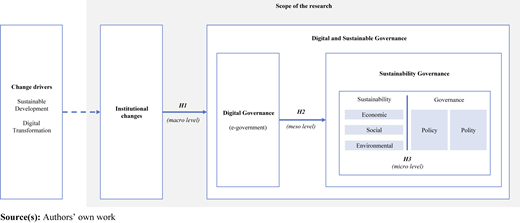
To explore the impact of implemented IC programs on DSG in the public sector, we developed a conceptual model (Figure 1). At the macro level, the model focuses on the impact of IC programs on DSG. At the meso level, the model outlines a relationship between the two parts of the DSG, i.e. DG and SG. At the micro level, it explores the variety of possible SG configurations, considering the two dimensions of the SG, i.e. the sustainability dimension and the governance dimension. In the following, these relationships will be elaborated based on the review of the literature.
2.2 Hypotheses development
2.2.1 Macro level: the impact of prior institutional change programs
Adaptation of public sector organisations would mean responding to external SD and DT contextual factors (Palumbo, 2022; Roberto et al., 2020) by implementing IC programs, e.g. local green economy development (Kaye Nijaki and Worrel, 2012), smart city management (Bifulco et al., 2016) or transformative resilience in urban governance (Asadzadeh et al., 2023). Sroufe (2017) also argues that SD-oriented changes can be triggered by external forces, environmental, social and stakeholder-based opportunities and internal forces. The author mentions the importance of “evolving systems” affecting “strategy, actions, plans, programs structure” and digital systems (Sroufe, 2017, pp. 316–317). Similar to SD ambitions, DT ambitions could be also transformative, e.g. DT could induce changes in organisational capabilities (Konopik et al., 2022) and public value creation (c.f. SD) (AbdulKareem et al., 2024).
These multi-faceted relationships among system elements during ICs (e.g. policies can affect structures, competencies can affect actions or vice versa) reflect the general role of IC programs in adaptation, i.e. successful IC programs could be the accelerators of subsequent developments, according to both linear (Daft, 2010) and cyclic change models (Senge, 1990). Consequently, we assume the following:
Prior ICs, which were at least partly concerned with DT and SD, had a significant positive effect on DSG system development.
2.2.2 Meso level: the impact of digital governance development on sustainability governance
In the organisational context, certain factors can enable SD-oriented changes, such as teams, capital (financial, social and natural), environmental management systems, information systems (Sroufe, 2017) and technological aspects (e.g. digitalisation opportunities) (Thakur and Mangla, 2019). Exploiting digitalisation opportunities in the public sector could support sustainability. For example, the digital solutions can also help to reduce administrative costs (i.e. efficiency) for economic sustainability or improve engagement and performance management systems (Young, 2020). Additionally, digital technologies can also be relevant to transparency and inclusion (Gil-Garcia et al., 2018), which contribute to social sustainability. Considering the governance systems, DG could mean e-government functions, external engagement of stakeholders and contextualisation with external sectoral or community impact (Janowski, 2015). These initiatives could concern ecosystem building for the co-production of social innovations (Perikangas et al., 2023) or collaboration-based smart city governance (Broccardo et al., 2019; Tomor, 2019). Since implementation challenges of SG instruments (e.g. complexity and rigidity) could be managed by regenerative responses with flexibility, fostering collaboration and communication, engagement and learning (Gerhards and Greenwood, 2021), public sector organisations might improve their DG systems to handle these challenges, accelerate SG and eventually contribute to SD (Janowski, 2015; Castro and Lopes, 2022).
Consequently, it can be assumed that
Steps towards a DG could have a significant positive impact on the development of SG.
2.2.3 Micro level: possible configurations of sustainability governance
SG systems should be reflexive, participative, adaptive and enable social learning (Lange et al., 2013). To gain a detailed understanding of SG profiles of public sector organisations, the sustainability dimension and the governance dimension can be explored by the assignment of different SG indicators. Regarding the sustainability dimension, the content of SG can refer to.
Economic;
Social and
Environmental elements (Greiling et al., 2015).
Regarding the governance dimension, not only policy and polity elements can be explored (Bellamy and Taylor, 1996; McGill, 2006), but also conditions and activities (Bornemann and Christen, 2018) as follows:
Policy conditions: Strategy and concept;
Policy activities: Program and project;
Polity conditions: Dedicated department and
Polity activities: Report, impact assessment or training.
Based on these elements, SG profiles could be different. For example, Greiling et al. (2015) found that public utilities and educational service providers could have different performances in certain sustainability dimensions and standards; Bornemann and Christen (2018) found that Swiss cantons could have different SG profiles based on the content of policies and polities, such as problem-oriented, management-oriented, strategy-oriented or network-oriented. Further variety of SG could be explored if these elements are considered in a matrix with 12 indicators (3 sustainability × 4 governance elements).
Based on the above, we can assume that.
The SG system can be unbalanced according to the sustainability dimensions (environmental, social and economic) and the governance dimensions (policy and polity conditions and activities).
3. Methodology
3.1 Database construction
The scope of the data collection involved the above-mentioned 12 indicators for SG. Additionally, one more indicator was formulated for DG, focusing on municipal e-government services (Patergiannaki and Pollalis, 2024). We used content analysis based on data collection from websites, which is an established method in case of both sustainability and public sector research (Amey et al., 2020; Joseph et al., 2019). Considering that qualitative data can be coded quantitatively for statistical purposes, e.g. assigning numerical labels to data (Baralt, 2012), we used a similar coding system with scoring as presented by An et al. (2020), who focused on online sustainability reporting, also at public sector organisations. Instead of a binary scoring system, however, the indicators were scored on a scale of 1–3 to gain more detailed results, using integers to assess the presence of the indicator on the website of the organisation under study. A value of 1 was assigned in all cases for the absence of relevant content. A value of 2 was assigned if relevant content for the indicator appeared only at the mention level. For example, the title of a project or the name of a department was displayed, but no further information was available. A score of 3 is the highest score in all cases. In this case, relevant content was found for the given indicator, complemented by ample information on the topic. For example, a detailed description of the tasks of the department or a strategy is available as a PDF file. In addition to the indicators above, we have included to the analysis as variables the size of the municipality (large city over 100,000 inhabitants, medium city between 20,000 and 100,000 inhabitants, small town between 5,000 and 20,000 inhabitants and municipality under 5,000 inhabitants), the type of organisation (regions, local municipalities, county municipalities, local government associations, local action groups, foundations and associations and other organisations belonging to the public finance system) and the country to observe their possible distorting effects. Only information that was generated as a result of the focus programmes or after the implementation period of the focus programmes was included in the data collection.
The database was compiled by Central European organisations involved in IC programs, i.e. an “institutional change group” (n = 100) and a “control group” (n = 100). In sum, data from 200 public sector organisations were collected and analysed from two countries: the Czech Republic and Hungary. The Czech organisations were selected based on an association for municipal and urban development (National Healthy Cities Network, Czech Republic). The association has been active for 30 years and involves 135 cities, municipalities and regions. It accelerates cooperation between town hall professionals; provides, for example, accredited training, hundreds of good practices, a digital system with state-of-the-art online data and tools and uses indicators to assess the quality of life and health of residents, and its members are also involved in EU grant projects. Likewise, The Hungarian IC program (State Reform Operational Programme) was an organisational and process development-focused (OPD) program involving 859 organisations, which aimed to improve the performance of public administration, as measured by the satisfaction index of citizens and businesses. The performance indicator in this area was a 10% improvement compared to the 2006 baseline. Planning for the program started in 2005 and implementation continued until 2015. This EU-funded program was also partly concerned with sustainability and digitalisation issues. Only those change projects were financed where the organisation accepts and fulfils at least one environmental sustainability criterion (environmental management, green procurement, material, energy and resource efficiency and environmental health) as a self-obligation, and the horizontal objective of the program also included socio-economic sustainability in addition to the environmental aspect of sustainability. Furthermore, the program was realised concurrently with another national program (Hungarian Municipality Application Service Provider) for IT infrastructure development.
The “change group” and the “control group” for the dataset were both selected by random sampling. The organisations in the “control group” were not members of the Czech association or beneficiaries of the Hungarian OPD program.
3.2 Statistical analyses
Statistical analyses were performed using International Business Machines Corporation (IBM) Statistical Package for Social Sciences (SPSS) Statistics (Version 27) software. Statistical analyses were carried out using the data series generated from the indicators and variables scored as previously described. Comparisons were based on “change” and “control” labelled group. After the data series were examined and filtered, descriptive statistics were used to characterise them. For further analysis, normality tests were performed using both Shapiro–Wilk and Kolmogorov–Smirnov methods. The Mann Whitney test was used to test the statistical similarity of the groups, which is a procedure to verify the median agreement between two independent samples. The null hypothesis is that the two populations belong to the same distribution. The Spearman correlation was used to characterise the relationships between individual indicators or variables. The Spearman correlation measures the extent to which the magnitude of one variable determines the magnitude of the other variable, as well as the direction and strength of the relationship. Its main measure is the correlation coefficient (symbol: r), which ranges from −1 to +1. The closer the correlation coefficient is to the two extreme values, the stronger the correlation.
4. Results
4.1 Descriptive statistics
Descriptive statistical results are presented in Table A.1. The database containing data from the two countries was also analysed using a different clustering criterion, where the existence/non-existence of an IC program was the clustering factor. The results of this are presented in Table A.2, which shows that the group of IC programs generally has higher average scores for the indicators, with three exceptions. These exceptions include Report_impact assessment_training_Econ, which has an average score of 1.42, while the control has an average score of 1.49. Also, such indicators are Dedicated_department_Soc (1.52), control (1.60) and Dedicated_department_Econ (1.55), control 1.60. However, these differences are not decisive, and the “change” group clearly scored higher on the other indicators.
4.2 Comparison of study groups
When examining the data set, the data did not show a normal distribution (Tables B.1 and B.2), so further analysis had to be performed using non-parametric statistical methods. The Mann–Whitney test was performed with IC program as the clustering factor. We only found significant differences between the study groups for environmental programs/projects (Table 1). Thus, the effect of the IC program was only detectable for programs/projects with an environmental objective.
Mann–Whitney test by institutional change program grouping factor
| Organisation type | Settlement size | Strategy_concept_Econ | Strategy_concept_Soc | Strategy_concept_Env | Program_project_Econ | Program_project_Soc | Program_project_Env | |
|---|---|---|---|---|---|---|---|---|
| Mann–Whitney U | 4880.500 | 2144.000 | 4388.000 | 4723.000 | 4388.000 | 4416.000 | 4376.000 | 4105.000 |
| Wilcoxon W | 9930.500 | 4355.000 | 9438.000 | 9773.000 | 9438.000 | 9466.000 | 9426.000 | 9155.000 |
| Z | −0.353 | −0.771 | −1.726 | −0.787 | −1.744 | −1.665 | −1.754 | −2.689 |
| Asyimp. Sig. (2-tailed) | 0.724 | 0.441 | 0.084 | 0.432 | 0.081 | 0.096 | 0.079 | 0.007** |
| Dedicated_ department_Econ | Dedicated_ department_Soc | Dedicated_ department_Env | Report_impact assessment_training_Econ | Report_impact assessment_training_Soc | Report_impact assessment_training_Env | e_administration_function | |
|---|---|---|---|---|---|---|---|
| Mann–Whitney U | 4808.000 | 4970.000 | 4643.000 | 4887.500 | 4925.000 | 4666.500 | 4876.500 |
| Wilcoxon W | 9858.000 | 10020.000 | 9693.000 | 9937.500 | 9975.000 | 9716.500 | 9926.500 |
| Z | −0.579 | −0.088 | −0.996 | −0.371 | −0.246 | −0.836 | −0.331 |
| Asyimp. Sig. (2-tailed) | 0.562 | 0.930 | 0.319 | 0.710 | 0.806 | 0.403 | 0.741 |
Note(s): **p < 0.01
Source(s): Authors' own work
4.3 Correlation analyses
The Spearman correlation analysis was used to characterise the strength and direction of the relationships between the indicators and variables. Only those cases where the correlation was statistically significant are discussed. For the IC program, only the indicator Program, project_Env showed a significant relationship (r = −0.191; p < 0.007) (Table C.1). The correlation with a negative sign is related to the group coding (0 and 1) used in the statistical software, where 0 represents the group of IC program. Therefore, lower values of group membership were associated with higher indicator values, and this explains why the statistical test indicated an inverse proportionality. Therefore, in this case, it indicates the advantage of organisations participating in the IC program. It can be concluded that there is a demonstrable increase in the number of environmental programs/projects implemented and their visibility as a result of IC programs; however, in the case of other sustainability indicators, it was not possible to demonstrate the impact of IC programs by examining the data of the two countries representing the region together.
The size of the settlement (Table C.1) showed a medium relationship with economic (r = 0.361; p < 0.000), social (r = 0.416; p < 0.000) and environmental (r = 0.392; p < 0.000) strategies/concepts. Settlement size showed a slightly weaker association with economic (r = 0.265; p = 0.002) and social (r = 0.296; p = 0.000) projects. The strength of the relationships was strongest with dedicated organisational departments (economic (r = 0.475; p = 0.000), social (r = 0.423; p = 0.000) and environmental (r = 0.472; p = 0.000). Within the indicators of reporting, impact assessment, training and settlement size showed the strongest relationship with the environmental theme (r = 0.478; p = 0.000), while e-government showed a weak relationship (r = 0.223; p = 0.009). These results show the advantage of larger municipalities in the areas of strategic planning, projects, thematic organisational elements and public reports impact assessments and, to a lesser extent, e-government.
The analysis of the database revealed a remarkably high correlation and strong relationships between the different strategies (Table C.1). The correlation coefficient between economic and social strategies was r = 0.926 (p < 0.000), between economic and environmental strategies was r = 0.813 (p < 0.000) and between social and environmental strategies was r = 0.818 (p < 0.000), all indicating a strong relationship. This may indicate the prevalence of integrated development strategies, or it may mean that once strategic planning has become established in one area of an organisation, it is fertile ground for similar strategies and concepts in other areas. It can therefore be effective to support the creation of integrated development strategies or even just one thematic strategy.
The correlations between the program/project and strategy/concept indicators were typically of medium strength (Table C.1). Most prominent was the indicator Program, project_Soc, which was significantly related to all three types of strategy/concept (_Econ: r = 0.367; p < 0.000; _Soc: r = 0.390; p < 0.000; _Env: r = 0.395; p < 0.000). While the indicator of environmental programs/projects showed the least strong relationship with the strategies (_Econ: r = 0.287; p < 0.000; _Soc: r = 0.297; p = 0.000; _Env: r = 0.308; p < 0.000), this was not considered to be negligible either. This highlights the link between strategic planning and economic, social and environmental programs/projects. In particular, the stronger statistical relationship of social projects with all three strategy indicators is noteworthy, indicating that strategic planning is essential for the implementation of SD-oriented social projects.
The existence of strategies and concepts and dedicated organisational departments showed a slightly stronger correlation (Table C.1). The highest correlation coefficients were observed for departments with an economic function with different stratagems (_Econ: r = 0.455; p < 0.000; _Soc: r = 0.485; p = 0.000; _Env: r = 0.413; p < 0.000). Strategic planning and ICs are closely related. The existence of sustainability departments also showed almost similar relationships with the different programs/projects (Table C.1). In this context, the relationship between environmental departments and economic strategies was the strongest (r = 0.344; p < 0.000). This certainly indicates that the organisations studied are striving to create environmental departments in parallel with their economic development planning, which often has a significant environmental burden to counteract the negative effects of economic growth on the environment.
The report/impact study/education indicators are moderately correlated with the three strategies (Table C.1). The most prominent of these was environmental reporting/impact study/training (_Econ: r = 0.475; p < 0.000; _Soc: r = 0.482; p < 0.000; _Env: r = 0.411; p < 0.000). The relationship of reporting/impact study/training with strategies/concepts is probably a side effect of strategy formulation due to the lack of studies or studies to inform it or to measure back the implementation of the strategy.
The relationship between the dedicated organisational departments (Table C.1) showed a similar pattern to the strategies. Their relationship was found to be significant (_Econ/_Soc: r = 0.820; p < 0.000; _Econ/_Env: r = 0.786; p < 0.000), but most marked for the social and environmental elements (r = 0.855; p < 0.000). This is also a relevant result to consider in the field of ICs. It indicates the complexity of sustainability issues to which the parallel operation of organisational elements with different themes may be one answer, since, for example, an environmental problem can have significant social and economic consequences.
For DG, a significant but mostly weak relationship was found for all variables except for the country and the IC program groupings. A notable result is that we observed an inverse correlation with a negative sign but a higher value (r = −0.376; p < 0.000) for the size of the municipality compared to the other indicators (Table C.1). This indicates that, at a regional scale, access to e-government for people living in small municipalities may be adequate. Our analysis also shows that digitisation is demonstrably linked to environmental ambitions, as the existence of an environmental program/project (r = −0.325; p < 0.000) and dedicated organisational departments (r = −0.355; p < 0.000) had the strongest correlation coefficients in the sample (Table C.1).
5. Discussion
5.1 Theoretical implications
5.1.1 Macro level: DSG advancements as a result of implemented institutional change programs
The results showed that organisations that participated in the focal IC programs have a higher performance of SG in certain dimensions than organisations that did not participate in the focal programs. A significant correlation was identified, for example, for a project or program related to environmental sustainability. The results also suggest that public sector organisations that implement ICs are more likely to achieve higher SG levels in the future than those that do not.
Reaching back to the conceptual background, IC programs indeed positively affected the DSG of public sector organisations. The results showed that the forms of ICs (Lindholst et al., 2016) could be interrelated in DSG. For example, displacement might lead to layering, e.g. replacing a personalised function with an e-government function (DG) can induce new programs for environmental sustainability (SG) based on the empirical data.
5.1.2 Meso level: developing digital governance functions to accelerate sustainability governance
The empirical results showed that there is a significant relationship between DG development and certain parts of the SG system. The relevant indicators include, e.g. (1) economic, social and environmental strategies or concepts and programs or projects and (2) economic, social and environmental programs or projects, environmental departments and environmental impact assessments. Thus, steps towards DG can generate further advancements for SG (Córdoba-Pachón and Orr, 2009), for example, regarding the configuration of work (e.g. dedicated sustainability departments) and public information, knowledge (e.g. reports and impact assessment) (Petrakaki, 2018). The results also reinforced the role of digitalisation as an enabler of SG.
In this framework, sustainability is the main goal, while managing ICs towards DG and SG is the main tool. Some approaches in the literature suggest similar solutions for sustainability challenges, even if they seem to be different at first sight. For example, Bifulco et al. (2016) mentioned that sustainability and information and communication technology can be the tools to enable the “smartisation process”. This process, however, might represent change (i.e. IC), which is necessary to implement smart city interventions, new services and projects (i.e. for DSG). Other approaches focus on different constructs that are important but beyond our IC scope. For example, while our framework focused on the internal mechanisms (ICs for DSG), the collaborative public management approach would also be relevant to improve governance (Amsler and O’Leary, 2017). For example, Broccardo et al. (2019) found that collaboration could be a key tool for creating smart cities, which would lead to increased sustainability performance.
5.1.3 Micro level: exploring SG system imbalance
The results suggest that the SG system may be unbalanced or inconsistent according to the governance and sustainability dimensions. In addition, Table 2 shows that in all cases, environmental sustainability is the most dominant of the three sustainability dimensions, followed by social sustainability and economic sustainability.
The (im)balance of sustainability governance in the central European public sector in the presence and absence of institutional change programs
| Governance dimensions | Change group | Control group | |||||||
|---|---|---|---|---|---|---|---|---|---|
| Sustainability dimensions | Average | Sustainability dimensions | Average | ||||||
| Economic | Social | Environ-mental | Economic | Social | Environ-mental | ||||
| Policy | Conditions (strategy and concept) | 2.40 | 2.37 | 2.46 | 2.41 | 2.06 | 2.23 | 2.17 | 2.15 |
| Activities (program and project) | 1.91 | 2.37 | 2.72 | 2.33 | 1.74 | 2.10 | 2.41 | 2.08 | |
| Average | 2.2 | 2.37 | 5.18 | 2.37 | 3.80 | 2.16 | 2.29 | 2.12 | |
| Polity | Conditions (dedicated organisational department) | 1.55 | 1.52 | 1.78 | 1.61 | 1.60 | 1.60 | 1.67 | 1.62 |
| Activities (reports, impact assessments and training) | 1.42 | 1.46 | 1.86 | 1.58 | 1.49 | 1.43 | 1.66 | 1.53 | |
| Average | 1.48 | 1.49 | 1.82 | 1.59 | 1.54 | 1.51 | 1.67 | 1.57 | |
Source(s): Authors' own work
Nevertheless, the currently unbalanced SG could be balanced through specified DG developments, as shown above. These results induce practical implications, which are elaborated in the following section.
5.2 Practical implications
5.2.1 DSG-oriented institutional change programs
Based on the above, policymakers can expect further DSG system developments based on implemented ICs. Nevertheless, it is necessary to ensure the balance between sustainability dimensions (economic, social and environmental) and governance dimensions (policy and polity). Central European policymakers should support DSG-oriented ICs, concerning not only the overemphasised environmental policy but also social and economic sustainability and their polity conditions and activities. From a sustainability perspective, new DSG-oriented IC programs could be combined with social projects instead of environmental ones, since (1) linkages between environmental ambitions and DG could emerge organically without IC programs, (2) and implemented social projects were associated with strategy formulation in all sustainability areas in the Central Europe data.
From a governance perspective, DSG-oriented IC programs might be less relevant to improving policy-related conditions and activities, especially different sustainability strategies, as results suggests that sustainability policy elements are already existing, and strategy formulation in a certain sustainability area (e.g. environmental) can lead to strategy formulation in another (e.g. social). Instead, IC programs focusing on dedicated departments, training, impact assessments and reports for DSG could help to realise missing polity conditions and activities.
5.2.2 The role of ICs and platform governance in increasing the adaptive capacity of public sector organisations
Findings suggest that implemented ICs have increased the adaptive capacity of public sector organisations in response to IC drivers, i.e. DT and SD. This adaptive capacity is embodied in the phenomenon that successfully implemented, top-down IC programs could lead to bottom-up, cyclical changes, i.e. successful IC programs can be built upon by new ones, and moreover, these might diverge from digitalisation to sustainability. Nevertheless, such divergence from one SG element to another might be limited, as environmental policy elements seem to dominate SG in Central Europe. The results thus contradict the research of Greiling et al. (2015), focusing on Austria, Germany, and Switzerland, which ranked sustainability reports in order of (1) economic, (2) environmental and (3) social aspects.
Compared to the explored SG profiles of Swiss cantons (Bornemann and Christen, 2018), Central European data show a new or hybrid SG profile. Regarding policy, an overall policy planning scheme can be identified (conditions), with engagement in sustainability-oriented problem-solving (activities). Regarding polity, specialised departments hardly exist (conditions) but procedures and instruments are designed and implemented for optimisation and shaping opportunities (activities). This profile could be called “embedded” or “decentralised” if there is no need for formal (structural) legitimation and the whole governance system internalised sustainability values. ICs in this configuration can be flexible enough to respond to emerging challenges; however, if central coordination is missing, synergies can be overlooked, resources could be used inefficiently or actions could be superficial without substantial impact.
In the case of DG, empirical results showed that fundamental e-government functions seem to be available in the case of Central European municipalities, and such advancements are linked to environmental projects. Future research can concern DSG-oriented ICs in the novel paradigm for the digital age, i.e. platform governance would mean opportunities, and could support SD by linking data, services, technologies and people (Janowski et al., 2018). Table D.1 presents an initial framework about platform governance relationships, which could be combined with possible SG profiles based on the Central European empirical data. For example, Santolamazza et al. (2024) argue that citizens could be involved through participatory budgeting, based on the example of Rome, Italy, which could also be relevant in SD topics.
6. Conclusions
This research focused on the longitudinal effect of IC programs on DSG in the public sector based on empirical data from Central Europe. According to H1, those implemented IC programs, which were at least partly concerned with DT and SD, had a significant positive effect on subsequent advancements in DSG. The empirical analysis, however, showed that H1 is only partly acceptable. However, the implemented IC programs had a positive impact on the development of DSG in the public sector. A closer look shows, however, that regarding DG, the difference between the “change group” and the “control group” was not significant, and regarding SG, the impact could not be statistically demonstrated in all sustainability and governance dimensions. In contrast, H2, which assumed that steps towards DG could have a positive impact on SG, can also be accepted, as the analysis showed a significant relationship between the DG function and all SG indicators. Likewise, H3 can also be accepted, as the SG systems were unbalanced according to the sustainability dimensions (environmental, social and economic) and the governance dimensions (policy and polity conditions and activities).
The first theoretical contribution of the study is that these results reveal that EU-funded ICs towards DSG increased the adaptability of governance responding to the trends of DT and SD. Successfully implemented IC programs can be built upon by new ones in the public sector, which means that general change management theory from business and management research is applicable to DSG in public sector research. The second theoretical contribution of the study is that it confirms the supporting role of digitalisation in SD-oriented changes at the governance level. The third theoretical contribution of the study is that sustainability dimensions (environmental, social and economic) and governance dimensions (policy and polity) could be analysed in a matrix to highlight potential imbalances within the SG system. The main practical implication of this study is that Central European policymakers should support DG development as it could improve SG. Nevertheless, these programs should be (re-)oriented to social and economic issues, as well as polity (e.g. dedicated departments), not only towards environmental policy initiatives.
This study has three main limitations. First, since it was not focusing on comparing regional patterns and outcomes, or single cases, but interactions of ICs within a region, it does not enable to clearly identify current or potential best practices from Central Europe. Future studies could compare the outcomes of the Central European DSG profile with other regions or local systems by in-depth analysis. Second, the empirical data came from only two Central European countries, which certainly have distinctive socio-cultural traditions and economic conditions, affecting governance systems. Another opportunity could be to test results in another context, e.g. focusing on Western European public sectors. Third, as this research was based on quantitative data and statistical methods, the diversity of the potential DSG development opportunities could not be explored, which emerge depending on, e.g. size, economic opportunities or location of different public sector organisations. Thus, a further research direction could be the qualitative, in-depth analysis of DSG conditions and activities in a smaller number of organisations.
References
The supplementary material for this article can be found online.

