The role of retailers in influencing consumer attitude during a brand scandal is quite complex, as retailers are in direct contact with both marketers and consumers. The purpose of the exploratory research is to propose a theoretical model to capture the influences retailers exercise on consumers during brand scandals.
A qualitative approach has been adopted in the study. The study employs the grounded theory approach on the data collected by conducting in-depth interviews with 25 retailers.
Four contextual conditions and six behavioral antecedents of the retailer's role in the context of the brand scandal were identified. Then, the study finds that companies tend to follow two broad approaches during a brand scandal to address retailers' queries and apprehensions. On these bases, the study proposes a six-pronged typology to better understand retailers' role in shaping consumers' brand perception.
Existing literature has not paid adequate attention to this aspect of retailers' role in influencing consumer choices during brand scandal. To the best of the authors' knowledge, there is no prior research which investigates the role and influence of retailers in shaping consumer attitude during brand scandals. It is important to underline that the current research advocates retailers' significant role during a performance-based brand scandal. Specifically, the authors explored a health-related defective scandal of a well-known food brand. In addition, the study focuses on traditional grocery retailers, which already have special relationships with their consumers. Based on retailer perspectives, the authors' contribution is also updating the discussion of branding theory in case of scandals. The identified variables and constructs may be used for empirical investigation on the role of retailers in shaping consumer attitudes toward the scandalized brand.
1. Introduction
When a brand scandal happens, it might cause severe consequences for the corporate owning that brand (Yakut and Bayraktaroglu, 2020; Khamitov et al., 2020), causing disruptions and damage along the entire supply chain (Behzadi et al., 2018) consumers included (Kennedy and Guzmán, 2020). Regaining consumer confidence after food safety scandals is extremely challenging (Wang and Alexander, 2018), but some researchers implied that if the brand is loved and has a strong market position, it may be forgiven (Zhang et al., 2020; Wei et al., 2020). This research, based on a case study, argue that also some members of the distribution channel may have played an active role in supporting that brand to survive the scandal. Our main assumption is that in some markets, if a misalignment between consumer's expectations and brand's promise exists, a supply chain member might save a brand and it could be the retailer. This role may be particularly impactful where local traditional grocery retailers represent the great majority of the share of domestic retail and Fast-Moving Consumer Goods (FMCG) sales (Mishra, 2019). During the 2020 pandemic, some governments in developing countries permitted grocery retailers, which account for 60% of store-based retailing sales, to continue their operations (Sullivan, 2020). Thus, unorganized retailers represent the distribution backbone for fulfilling consumer essential item needs (Euromonitor International, 2020).
Past studies largely examined brand wrongdoings and their impact on brand–consumer relationships (Baghi and Gabrielli, 2019; Huber et al., 2010; Liu et al., 2018; Roy et al., 2018). Nevertheless, some authors also assert that brand managers should go beyond a narrow understanding of the relationship between target consumers and brands (Herstein and Zvilling, 2011) and that further research should focus on more complex sets of relationships among consumers, retailers and manufacturers (Cleeren et al., 2017). Hence, this study's primary objective is to develop a conceptual framework on the role of retailers during brand scandals, exploring the Nestle's Maggi brand case. Previously, other researchers selected this specific case study to understand how brands need to communicate and how consumers behave from a post-crisis perspective (Dhanesh and Sriramesh, 2018; Mishra and Sharma, 2019; Srivastava, 2019; Mishra, 2017; Banerjee, 2018). However, they mainly explored the consequences of wrongdoings only after their occurrence and did not focus on managing the triadic relationship during a scandal to prevent worsening of the situation into a brand crisis.
Updating and reviewing the same case from a different perspective, we assumed that retailers may have played an active role in managing this scandal, through their direct relationships with consumers, even without specific guidance from the brand managers. A scandal can push further detrimental to brands if consumers' and retailers' perceptions become mismatched (Gautam and Sharma, 2019). Given a lack of research investigating distribution intermediaries' potential influence on consumer attitudes and preferences in case of brand scandal, this study attempts to contribute to this gap by observing the retailers' role during and after brand scandals (Cleeren et al., 2017). In particular, our study is exploring the relationship management role of intermediaries during a brand scandal that are not yet theorized.
This paper begins with presenting a review of relevant literature and the resulting research questions to be explored in the next section. Catering to the article's exploratory research design, it then conceptualizes retailers' responses using grounded theory methodology. Then, findings from open and axial coding, concerning retailers view about themselves, consumers and corporate action at the time of brand scandal, are presented. Based on these qualitative results, a conceptual framework on the role of retailers during the brand scandal is theoretically presented, contributing to the scandal management theory. Drawing it on relationship management, some implications for managers and future studies suggestions are concluding this paper.
2. Literature background and research questions
Sims (2009) defines brand scandal as an unethical action or event that causes outrage against a particular brand (Tucker and Melewar, 2005). Recently, Kapoor and Banerjee (2021) described brand scandal as an issue leading to either loss of consumer confidence in the brand entirely or creating indecisive future brand purchase intention among them. Brand scandals are complex situations in which products are found to be defective, unsafe or even dangerous (Vassilikopoulou et al., 2009). Such events may lead to a brand crisis (Li and Wei, 2016), which if not correctly managed, may impact brand value with severe consequences and limited-time responses (Xu and Li, 2013). Product-harm wrongdoings are often causes of brand scandals that disappoint consumers and have negative consequences on brand reputation and financial assets (Coombs, 2007; Huber et al., 2010), cause revenue losses (Cleeren et al., 2013), deterioration in brand equity (Dawar and Pillutla, 2000) and negative brand perceptions and lower-purchase intentions (Huber et al., 2010). Brand scandals are not synonymous of crisis: while former answers how consumers perceive a brand's wrongdoing, the latter underlines brand's perceptions and actions thereafter to deal with a wrongdoing that could possibly threaten their physical existence (Pauchant and Mitroff, 1992). As consumers are not always in direct contact with brand managers, retailers may play an important role in scandal management. Further studies on this role are called by an extensive literature review that revealed a gap in research on the triadic relationship between consumers, channel members and marketers in case of brand scandals (Kapoor and Banerjee, 2021).
The initial purpose of this study was then to analyze a famous brand scandal through the retailers' eyes to investigate retailer–consumer relationships when a manufacturer's brand scandal happens. The Maggi scandal has been selected for our research because it comprises defective food product performance of a fast-moving consumer good that widely impacted consumers nationwide, had prolonged effect overtime and its distribution chain relies on unorganized local retailers. Besides this particular brand case, numerous other case studies have discussed scandals of well-known brands like General Motors (Maiorescu, 2016), Toyota (Hegner et al., 2016; Gaustad et al., 2020), Samsung (Yuan et al., 2020) and Volkswagen (Yakut and Bayraktaroglu, 2020). Some researchers have explored the consumer's point of view, examining post-scandal consumer trust, purchase intention, consumer's brand identification, consumer's forgiveness and consumer brand reliability (Yuan et al., 2020; Hegner et al., 2016; Gaustad et al., 2020). Few others focused on the industrial brand perspective, exploring scandal response strategies, identifying scandal type, brand diagnosticity, brand reputation and gender-specific communication strategies (Maiorescu, 2016; Gaustad et al., 2020; Yakut and Bayraktaroglu, 2020). To the best of our knowledge, case studies on brand scandals adopting the retailers' point of view are scarce.
2.1 The importance of understanding retailers' perceptions about brand scandals
Many retailers have direct contact with consumers and observe changes in consumers' brand preferences and buying behavior, and thanks to retail evolution, stronger bonds with consumers are likely to emerge (Grewal et al., 2018). Retailers can provide appropriate economic and social functional benefits, leading to store loyalty. Reliability in retailers overtime develops and bolsters trust and loyalty in them: the more consumers are convinced about the retailer's reliability, the greater is the consumers' willingness to purchase the products marketed by them (Ladwein and Romero, 2021). These strong bonds give influential power to retailers that could be even stronger during some negative events, like scandals involving product brands. In fact, it seems that consumers' purchase decision-making process is not always based on their trust in the brand due to absence of direct connection between them and the scandalized brand marketers (Ladwein and Romero, 2021). Since time pressure does not impact consumers' grocery shopping experience (Nilsson et al., 2017), it leads to prolonged consumer–retailer interactions heightening their purchase intentions for the offered product (Nair and Shams, 2020; Dang et al., 2021). In specific conditions, retailers are de facto acting as key influencers for consumers and are enabled to either ruin or bolster a brand's image during difficult times. During scandals, retailers daily transact with several consumers and gather multiple perspectives on the scandalized brand from them (Jeyachandran et al., 2019). It is crucial then to clearly understand which and how different influences can impact the retailers' view of a scandal to be able to highlight those elements that might influence their behavior impacting relationship with consumers. Given a lack of previous research on the retailers' perceptions during and after a scandal, the first research question is as follows:
Which elements can influence retailers' perceptions of a brand scandal?
2.2 Retailers insights on consumer behavior in case of brand scandals
Retailers continuously make brands available to consumers and build connections with them (Maggioni, 2020). This forms the basis for customer–retailer identification, leading to the development of meaningful relationships by bolstering the emotional associations between consumers and retailers (Maggioni, 2020). Customer–retailer identification also positively impacts consumers' post-purchase evaluations and behavior; many consumers assign affective qualities and human personality traits to retailers and retail stores (Darden and Babin, 1994). Emotions like nostalgia, comfort, and routine visits to the same retailer lead to higher consumer–retailer engagement and stronger emotional relationships (Khare, 2014). Retailers can also quickly identify the level of warmth or apathy displayed by consumers toward them (Vlachos and Vrechopoulos, 2012). In some countries, on average, many consumers visit their neighborhood grocery retailers, at least, twice or thrice a week (Jeyachandran et al., 2019). So consumers have more significant interactions and personal connections with retailers than brands or marketers. Accordingly, when a brand gets scandalized, consumers may find it easier to reach out to retailers to clear their doubts about the brand or scandal. As such, during brand scandals, consumers are offering retailers a great source of information that is important to monitor (Kapoor and Banerjee, 2021), but very little is known about consumers' inquiring to retailers: this missing information could explain some antecedents potentially shaping the retailers' role during scandals. Hence to address this gap, the second research question is as follows:
How do consumers inquires can shape retailers intervention during a brand scandal?
2.3 Suppliers' role in guiding local retailer's interaction with consumers in case of brand scandal
Suppliers are aware that customers' self-concept and retailers' image are crucial dimensions for building strong consumer–retailer relationships (Willems and Swinnen, 2011). In addition, retailers collect relevant consumer information, including personality traits, emotions, choices, influential attributes and desires that are crucial for marketers (Maggioni, 2020). Local retailers are much more aware of their neighboring community and consumers' shopping behavior; as opposed to large retail, they authentically adopt a market-centric approach while dealing with consumers (Smith and Sparks, 2000). Many consumers want to engage in retail store communities, impacting their store commitment (Peters and Bodkin, 2021). In particular, local retailers are preferred for grocery shopping due to personal interactions, familiarity and trust (Khare, 2014).
In case of brand scandals, consumers are often unsure about the negative news spread via different mediums (Bozic and Kuppelwieser, 2019) and assume that retailers are in direct contact with marketers. These more personal interactions with consumers motivate these retailers to deliver better service value and reduce consumer defections (Baker and Cameron, 1996), and this service value could further be enhanced with professional guidance from the marketers, in particular, when facing problems. Hence, suppliers should play an active role in supporting retailers, communicating honest and timely information to deliver to final consumers. Retailers may act as brand ambassadors and communication vehicles, behaving as brand gateways to connect with consumers, and brand's first information should flow through them during scandals. Suppliers often rely on the information gathered by retailers about contemporary consumers' behavior (Maggioni, 2020). Accordingly, they may involve retailers in addressing consumers' queries and skepticism during such eventualities. Recently, Ladwein and Romero (2021) showcase the importance of supplier–retailer relationship. It held that consumers' trust in suppliers and retailers both impact their purchase intention for quality products.
However, what relevant guidance do retailers actually receive from marketers, in dealing with consumer apprehension during a brand scandal, is not investigated yet. Additionally, lack of research exists in understanding how marketers support is really impacting retailer–consumer interaction in case of scandals as seen by the retailer side. So, the third research question is as follows:
How do suppliers actions are impacting the retailers' intermediating role with consumers during a brand scandal?
2.4 Retailers management of consumer–brand relationship in case of brand scandals
Grocery retailers from rural and urban areas know their local customers very well (Carpenter and Moore, 2006). Consumers approach retailers based upon brands' assortment, transactional convenience and informal shopping experiences (Carpenter and Moore, 2006; Lee et al., 2008). Retailers indulge consumers in discussions and share knowledge. These strengthen customer–retailer identification and retailer loyalty and trust in the long run (Maggioni, 2020). Lee et al. (2008) explained that strong ties between consumers and small retailers improve retailers' capability to tackle consumer grievances and enhance community involvement. Moreover, familiarity with the retailers and their presence in the neighborhood may influence consumers' preferences and visits (Paswan et al., 2010): this motivates retailers' efforts to build and manage consumer–brand relationships (Tuškej et al., 2013). At the beginning of a scandal, due to complex information to process and multiple discordant sources, consumers may feel a sense of uncertainty, at least, until an initial trust repair activity is undertaken by the concerned brand (Bozic and Kuppelwieser, 2019). Thanks to their bonds with local retailers, consumers ask for help from them and do not interact directly with the brand manager. In this case, retailers are playing as advisors, intermediating the consumer–brand relationship bridging the gap between both the ends of the supply chain, brands and consumers. However, it is unclear how retailers manage this role in case of brand scandals: in academic research, such an integrative approach of exploring customer–brand relationships on the retailer's side is still immature (Kapoor and Banerjee, 2021) So the fourth research question is as follows:
How do retailers manage consumer–brand relationships during brand scandals?
3. Methodology
In general, exploring retailers' views about brand scandals and influencing consumers' buying decisions is challenging. This study uses the phenomenology approach (Goulding, 2002) holding a social constructivist worldview that is leading the researchers to look for the complexity of views (Crotty, 1998). This approach addresses questions catering to what the individuals experienced and in what context or situation in which they experienced (Moustakas, 1994). Additionally, it involves utilization of case study wherein sub-questions (related to broad research question) pertain to the description of the case and emerging themes are then discussed. Specifically, this research explores the well-known Nestle's Maggi scandal from the retailer side, in a context in which it has a dominant market share, with consumers often visiting local retailers for food category products. Maggi scandal storyline is provided in Table 1. This study mainly covered the period May–July 2019 during the latest scandal, with ongoing follow-ups for another 18 months.
Exploring this phenomenon with a qualitative inquiry based on grounded theory procedures (Glaser and Strauss, 2017), that help discovering new theoretical insights and avoiding conventional logical deductive reasoning (Connell and Lowe, 1997), it was possible to build a new theoretical framework showcasing the role of retailers during brand scandals. In particular, the four research questions address the problem from the retailers' point of view considering a triadic relationship perspective: which external potential influences on retailers' own perceptions (RQ1 Which elements can influence retailers' perceptions of a brand scandal?); consumers' behavior and interactions may determine retailer responses (RQ2 How do consumers inquires can shape retailers'intervention during a brand scandal?); suppliers' actions supporting or not the intermediary (RQ3 How do suppliers actions are impacting the retailers' intermediating role with consumers during a brand scandal?); and then trying to link related type of retailers' intervention (RQ4 How do retailers are managing consumer-brand relationships during brand scandals?).
Theoretical sampling is used in grounded theory to unwind the theory grounded in data, and purposeful sampling (Locke, 2000) is suitable for directly approaching a few retailers by the emerging themes/concepts, categories, and evolving theory (Coyne, 1997). This sampling design comprised retailers dealing with different noodles brands, including Maggi and other FMCG products. Retailers, in this context, refer to owners of mom-and-pop stores, convenience stores, and grocery stores; unorganized retailers were purposefully selected because of their familiarity with consumers. Paswan et al. (2010) show that consumers prefer family-owned retail stores (mom-and-pop stores) due to their familiarity with the retailers; familiarity includes knowing the retail store owner and a family-friendly environment, which encourages a sense of loyalty towards the retailers. The multi-stage selection process began with directly known contacts that helped in including other colleagues, leading to ease of conducting interviews and quality discussions (Okumus et al., 2007). This sample included 25 participants after reaching the theoretical saturation (Charmaz, 2014). All of the participants were Indian retailers to better fit with the scandal context. Sample description is provided in Table 2.
Data collection type relied on intensive in-depth interview technique (Creswell et al., 2007; Joo, 2011), adopting qualitative face-to-face interviews with participants. The interview protocol (provided in Appendix 1) consisted of open-ended questions and was semi-structured, as Charmaz (2014) recommended, and questions mainly concerned retailers' views on Maggi scandal. The interviews lasted between 45 and 60 min. Interviews were audio and video recorded with a prior request of permission and then transcribed and analyzed. Memos and notes were collected simultaneously by researchers. As the study progressed, researchers kept turning to theoretical sampling to explain the theorizing process (Rennie, 1998). Following the grounded theory approach, data collection and its analysis were conducted simultaneously in the study.
Data analysis was conducted in two steps (Strauss and Corbin, 1998): the first involved going through all the collected information to obtain a broad understanding of the responses; after underlining core words, sentences, and phrases, the data was coded in the second stage. The objective herein was to identify and isolate significant issues, processes, and relationships. The coding procedure (Strauss and Corbin, 1998) was assisted by NVivo12 software, from first-order analysis to the more abstract second-order concepts that form our grounded theory. A preliminary open coding identified 78 themes that fit in the data. The line-by-line technique was implemented twice in order to avoid repetition of identified themes. Then, a progressive aggregation of broad themes with axial coding identified 25 concepts. Furthermore, selective coding identified integrated core concepts based upon their interrelationship. Hence, this study was grounded in two core categories: ‘Antecedents of the retailer's role in case of a brand scandal’ and ‘Types of retailer's intervention’ (See Appendix 2 for coding examples).
Four validity methods were identified upon analyzing and revaluating different methodologies to assess the quality of qualitative research: descriptive validity, interpretive validity, theoretical validity, and generalizability (Patton, 2014; Lincoln and Guba, 1999; Maxwell, 1992). Descriptive validity was achieved by measuring the interview transcripts' accuracy verbatim against the actual video/audio recordings collected before analyzing the data. Interpretive validity was attained successfully by reducing self-reporting bias due to impression management: it involved concealing knowledge about the conceptual framework bolstering the interview protocol (Eisenhardt and Graebner, 2007). The theory's theoretical validity so developed was accomplished by minimizing threats to these two validity methods. Moreover, adapting purposeful sampling and convergent interview techniques reduced the threat to theoretical generalizability, supported by numerous informal follow ups for results discussion with participants. Finally, reliability is assured by the consistent research approach and intercoder agreement (Guest et al., 2012), performed by a research team composed of three members from two different countries.
4. Findings and insights
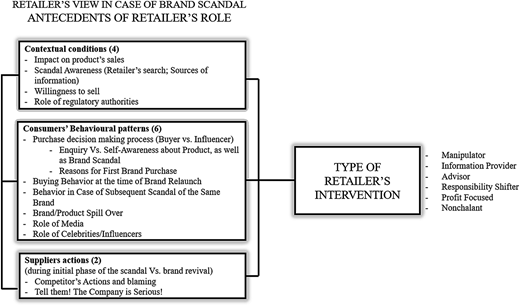
By examining retailers' perceptions of a well-known brand scandal, this qualitative study provides numerous insights regarding retailers' points of view, in particular, demonstrating that retailers are playing an active role in scandal management and that their actions may be influenced by numerous factors, some of them related to the retailer–brand relationship and others to the retailer–consumer relationship. Findings show four contextual conditions, six behavioral antecedents of consumers and two suppliers' actions relevant to retailers in the context of a brand scandal. In addition, this study reveals different kind of intervention taken by retailers in supporting consumer during scandals. Selected quotes are presented in Table 3.
4.1 Contextual conditions regarding retailers' perceptions of a brand scandal
Our results revealed four contextual conditions that are influencing retailers' view about a brand scandal (RQ1), and they are based on brand current sales trends, awareness about the scandal, willingness to sell the scandalized brand and their understanding of regulatory authorities' role during such a scandal (selected interview quotes for each condition are provided in Table 3).
Retailers' perception of the brand scandal is often based on the scandalous brand's sales level. Consumer perception about the negative news associated with the brand might change consumer brand preferences, eventually impacting their purchase behavior. However, if consumers are loyal and trust a brand, it may be difficult for them to accept negative news, and some consumers are not able to immediately change their habits and shift to alternative brands. On the other side, retailers' awareness about the brand scandal is essential to justify consumer inquiries. Retailers tend to gain information about the scandal through various sources (mainly news on television) but do not deliberately search about it. Many participants show different awareness levels of the Maggi case, with most of them not sure about the scandal's real reasons. Some of them did not know that a product quality-related issue existed, revealing personal opinions distant from reality, such as hidden monetary issues, sporadic events in limited areas; cleanliness of machines in the factory; a rival brand's intention to defame the market leader.
Note that many retailers are still willing to sell a scandalized brand if consumers continue to demand it; in fact, many believe that they are just sellers and the responsibility to maintain the quality of the product lies with the company. Others justify their willingness to sell to highly demanding customers, despite being aware of the scandal, because of celebrity endorsements, untouched trust in the brand and stamp of approval by government agencies (like FSSAI, Food Safety and Standards Authority of India). However, a few retailers provide unavailability or ban of the product as justification for not selling it. Many participants were afraid of losing their profit, continuing to sell the scandalized brand's product until it is banned by the Government.
About the role of regulatory authorities, retailers trust the authenticity of quality checks, food safety and security agencies' approvals for the products. So participants believe that it is the Government's responsibility to ban products since they do not know the production process and that authorities should be strict in policymaking and implementation. As such, responses to the first research question report that retailers' perceptions about a brand scandal are dynamic and changing over time, being influenced by many contextual conditions that could suddenly change.
4.2 Behavioral patterns of consumers during brand scandals
Exploring, from the retailer's side, how consumers inquire about the brand scandal (RQ2), results have identified six consumers' behavioral patterns: purchase decision-making process; buying behavior at the time of brand re-launch; behavior in case of subsequent scandal; brand/product spillover; the role of media and celebrities (selected interview quotes are provided in Table 3).
According to retailers, Maggi is a loved brand, frequently purchased by the mass market and its value is related to product attributes,being readily available, easy to use and consume. Consumers do not blindly purchase products offered by retailers; brand value, brand name, quality and the quantity of the product offered against the price charged further influence consumers' buying behavior. Usually, no consumer wants to buy harmful products. Mothers are often decision-makers for their children and extended family and sometimes influence them. However, during a brand scandal, mothers cannot influence their children to stop buying the scandalized brand because they are exposed to advertisements and see the products displayed at their local retailers. Some retailers reported that mothers stop purchasing the brand and even strictly deny it to their children (only youngsters whom their mothers could easily manipulate) when it gets scandalized, and they allow them to buy alternative brands even if more expensive. During this scandal, the majority of consumers visited retailers to inquire about the brand's possible re-launch. Consumers even ask about its availability, though retailers could only tell them that it was no longer available. According to retailers, consumers behaved curiously due to a lack of information about the brand scandal.
Notwithstanding news about the brand scandal, retailers could successfully sell it before its ban. So when the brand was re-launched, it received an overwhelming response from consumers even though they shifted to rival brands when it was banned. Consumers returned to the brand when it was declared safe, as they could not adjust to other rival products' tastes.
Regarding behavior in the case of subsequent scandal, our data show that while a few retailers were unsure about possible consumer behavior, others took a logical stance about the brand being embroiled in another scandal. Retailers believe that consumers are humanizing some brands. Humans forgive each other for their first mistake but become skeptical about a subsequent mistake. This skepticism phase fades slowly, and consumers gradually return to the brand because of its functional utility, addiction and absence of a strong competitor brand. Some participants argued that rival brands could change consumer loyalty if they successfully market themselves and pose a challenge for the scandalized brand to regain lost ground.
Retailers reported that the effects of the brand scandal caused one hazardous product to spill over to other brand products. However, such a spillover's intensity may not be significant enough for some consumers to overpower trust in the company gained over a long period. Retailers observed that consumers did not purchase the brand with ingredients similar to the banned product, affecting the entire product category in general: this shows that many consumers are very concerned about the unsafe product ingredients. Moreover, retailers observed that brand synonymy and similarity heightened consumers' animosity toward them.
In line with previous studies, research participants believe that media tends to change consumers' purchase behavior and attitude toward brands. Media influences consumers through positive or negative news about the brand and brings awareness through advertisements of products. Consumers get motivated to demand and purchase different products from retailers through such advertisements. Media creates a brand image that helps consumers recall information about the brand while making a purchase decision. Apart from advertisements on traditional and social media, consumers' experiences and feedback shared via different social media platforms influence their purchase decisions. The media further supports scandalized brands in regaining lost market share by spreading information about its safety and approvals.
According to participants, in their culture, people easily get influenced by celebrity endorsements of different brands. When children view their favorite celebrities wearing, eating or using a brand, they demand the same brand from retailers, no matter if that brand is facing a scandal. As per retailers, even adults identify themselves with celebrities and prefer to purchase brands endorsed by them. Celebrity endorsements decrease consumers' susceptibility to information about the advertised product even though many consumers know celebrities are paid for advertisements. Retailers suggest that celebrities play a role in recalling as well as re-launching a scandalized brand's products. While celebrities may be of less importance to consumers addicted to brands, they nevertheless provide a mental assurance that the brand sells good-quality products.
The second research question results are not only demonstrating that retailers are a great source of information about consumers' reactions to scandals, but also that they are intertwined in the consumer–brand relationship, being specifically called for personalized support and services.
4.3 Marketers' management of brand scandals and support to retailers
This case study reveals a minimalistic approach followed by marketers of the scandalized brand to support intermediaries (RQ3) and report the way retailers were instructed by the company to manage consumers' queries regarding the brand scandal. Brand managers during the scandal tried to make unorganized efforts to undo its deeds and re-launch its products by gaining consumer confidence and retailer engagement. Our findings show two main approaches during brand scandal to address retailers' apprehensions: competitor's action and blaming and highlighting the company's actions (selected interview quotes are provided in Table 3).
According to retailers, a brand scandal with no physical harm evidence is often considered a competitor brand's strategy to defame the former in consumers' minds deliberately. Many participants believe that a brand's hyperactive efforts to enter a market with the market leader's simultaneous scandalization indicate much. Other rival brands may take advantage of the brand scandal by launching new products, adopting different pricing strategies and massive advertising campaigns to convince consumers that their products are safe.
During the initial phase of the scandal, Maggi's managers sent personnel to each retail store to collect its product's leftover stock, because retailers began to avoid selling the brand but did not offer any guide or advice to manage final consumers. According to retailers, a responsible company should be active enough to handle any wrongdoing from the very beginning and support retailers during bad times. During the revival phase, the brand re-launch was positively supported by advertisement, product quality and safety-related messages. Intensive advertisement campaigns using hashtags and catchy slogans quickly brought changes in consumer attitudes about the brand. Communication about improvement in the product's quality by removing the excess chemicals created a positive brand image in consumers' minds. However, any direct training and communication to retailers was provided by suppliers during the scandal, and it is undoubtedly a missed link considering that many consumers are searching for an open discussion with their trusted retailers to be finally convinced. For some participants, a missing support from suppliers may negative influence their type of intervention. Thus, as per retailers, the company's main task should be to assure existing demand for the scandalized brand product and make consumers aware of its re-launch also empowering intermediaries.
4.4 Types of retailer intervention
Results show that consumers' behavioral outcome is not a direct result of their understanding and personal experiences about the brand scandal. It opines that retailers' intervention is directly associated with consumers' attitudes about the scandalized brand. Theoretically, retailers may be suggestive, share their own and other consumers' experiences and feedback for alternative brands' products in case of a brand scandal. While some retailers avoid sharing wrong information about the scandalized brand, a few others hesitate to share negative news about the brand, as they do not wish to lose their customers to any other alternate retailer. Retailers do not forcefully or deliberately try to manipulate consumers, as they consider them as aware and educated. However, they may act supporting the ultimate decision-maker, primarily when it boils down to children's stubbornness to buy the scandalized brand. Retailers are good conversationalists but limited to the consumers' willingness to get involved in discussions and longevity of their familiarity. In response to RQ4, we have found different types of retailers' intervention, discovering six retailers' profiles (selected interview quotes are provided in Table 3):
Manipulators – They could manipulate a consumer by removing the scandalized product from their shelves and influencing them to buy alternative brands. They tend to agree with parents when they tell their children about the unsuitability of a particular brand's products.
Information providers – They share their personal experiences with the brand and other customers' experiences and feedback but are hesitant to share information about the brand scandal until inquired by consumers. They like to inform consumers on news provided by the marketers.
Advisors – They do not force or try to manipulate consumers because they consider consumers to be educated and well acquainted with different brands. As such, only provide suggestions when they are short of the product demanded by them or have better quality products provided by alternative brands stocked. They believe that it is the brand's advertising that performs the function of providing information.
Responsibility shifters – Retailers are afraid of losing customers to neighboring retail stores and often shift the blame either on the Government or on the company at the time of the brand scandal.
Profit-oriented – They find nothing wrong in selling a scandalized brand until the Government bans it. They are more concerned about their short-term revenues than losing customers to neighboring retailers in the long term. They do not waste time by proactively indulging in conversations about the scandal event. They sometimes pitch an alternative brand's product to consumers based on the level of incentive provided to them.
Nonchalant – They are passive and leave the decision to purchase a product onto consumers. They agree to continue to sell a scandalized brand's product if consumers continue to demand it. They discuss about brand scandals with their regular and loyal consumers only. Their ignorance about the integrity of negative news associated with the brand and consumers' eagerness to buy the product on its re-launch further heightened retailers' unwillingness to inform consumers.
It is important to underline that data interpretation did not assign a label to each participant but to each interaction, because these retailers played many different roles with different customers and in different moments of the scandal cycle. It seems that multiple elements, conditions and actions are dynamically influencing retailers in their intermediating role of brand supporters during a scandal.
5. Conclusion
This qualitative study, aiming to contribute to the literature gap on retailers' role during brand scandals, is proposing a new perspective observing that phenomenon through the retailer's side. Grounded in the data, Figure 1 proposes a new draft of a conceptual framework on various retailers' roles during a brand scandal and their antecedents, summarizing all of the previous results.
Findings reveal six different roles of retailers, with different types of intervention: manipulators, information providers, advisors, responsibility shifters, profit-focused and nonchalant. Each profile may play a positive, negative or indifferent influence in interacting with consumers. We found that these kinds of interventions are interlinked with three groups of factors as antecedents: contextual conditions (four variables), consumers' behavioral patterns (six) and suppliers' actions (two). This novel conceptual framework on the role of retailers during brand scandals is contributing to update the scandal management theory under the umbrella of relationship marketing.
5.1 Theoretical implications
This research advocates retailers' significant role during a health-related defective scandal of a well-known food brand. Note that this scandal lasted for more than five years, living reignited negative events, with market withdrawing, an economic crisis for the Maggi brand with 17.5% decline in annual sales (The Economic Times, 2016) and heavy impact on distributors and retailers (Singh, 2017). Nevertheless, as previous researches already confirmed, customers are still in love with Maggi's brand (Mishra and Sharma, 2019; Mishra, 2017; Srivastava, 2019; Roy et al., 2018). This evidence of forgiven scandal has been interpreted through the theory of brand love. Within its lens, consumers tend to humanize brands they love and may forgive the brand as humans do on someone's first mistake (MacInnis and Folkes, 2017). Thus, consumers may forgive a scandalized brand for once (Zhang et al., 2020), but subsequent scandals may jeopardize the consumer–brand relationship. So reinterpreting Maggi's scandal, focusing on traditional grocery retailers' strong of special relationships with their consumers, we discovered that those intermediaries have been really proactive during this scandal and had the power to potentially protect or harm the consumer–brand love. This case context was in distant markets with scandalized brand management not effectively providing specific support to retailers and reaching final consumers with credibility.
This reinterpretation of retailers–consumer–brand love relations is opening new perspective to the brand scandal theory that should include this kind of intermediaries for a more complete and correct scandal management. In fact, a well-managed triadic relationship between consumer–retailers–brand seems to be crucial in this kind of negative events. So adopting the total relationship marketing approach (Gummesson, 2017), we are offering a new update of scandal management, as “the management of unethical action or event that causes outrage against a particular brand throughout dedicated interactions in networks of relationships.” In practice, it means that brand managers of scandalized brands, being now aware about the important role of retailers, should provide specific services and assign active roles to distributors. As a consequence, retailers will shift from passive communicators or spontaneous advisors, to active managers contributing to protect consumer–brand relations. In consumer–retailer relations exists reciprocity: it causes increased cooperation, stronger bonds and deep and broadened exchange relationships (Pathak and Kandathil, 2020). Specifically, the relation built between consumers and retailers enhances reliability and trust concerning the latter's information. It seems that consumers trust retailers' opinions about brands due to a halo effect of familiarity generated for a sustained period of interaction.
The new scandal management definition is now including the relationship management role of intermediaries during a brand scandal that were not yet theorized. This theoretical update also may have implications in retail supply chain management for both retailers and upstream echelons in the supply chain, particularly, when information quality and sharing seem to be the most important dimensions (Hamister, 2012).
5.2 Managerial implications
This study provides managerial implications both for retailers and brand managers. Reviewing results in this study, participants became aware of their critical role in supporting consumers and managing the scandals. Retailers not only act as scandal communicators (Diers-Lawson, 2020), raising awareness of the scandal, but can also adopt specific behaviors/roles to reduce the overall effects. However, this study reveals that the retailers' role in scandal management is often marginal, relying on spontaneous inputs of intermediaries in informing their customers and solving market doubts.
Focusing on the importance of corporate initiatives that could mold consumers' buying behavior toward a scandalized brand, the findings show that the same brand scandal can be viewed quite differently by different retailers, and they may influence consumers in multiple manners. Thus, it is crucial to understand varied retailer perceptions to develop proper communication strategies, customizing ad hoc support for different retailer profiles. The retailers' need for more active actions by their suppliers confirms the importance of integrating the marketing channels through supply chain management with quality and timely bidirectional information flows (Mentzer et al., 2001).
Moreover, retailer's interviews depict that consumer's love for a well-known brand persists beyond wrongdoings and also thanks to retailer's intervention. Marketers should leverage this positive sentiment of consumers and trust retailers to retain and regain a positive attitude toward scandalized brands. Companies should make retailers their brand advocates, who, in turn, should remind customers of their long association and positive experiences with the brands in question. Thus, to influence consumers, it is recommended that companies invest resources to train and support a well-informed pool of retailers during and after brand scandal.
5.3 Limitations and future research
In this research, we used in-depth interviews to collect data about retailers' role in shaping consumers' behavior during the brand scandal. As memory is fallible, collected data may include “historical reconstruction” under the influence of subsequent experiences (Blaikie, 2009). We continued to follow up with the retailers, post-data collection, to address the issue for about two years. Participating retailers remembered the scandal well because of their long association with the brand.
Additional data analysis tried to approach consequences of determinants through the notion of retailers' attitude rather than role. However, in this case study and context, we noted that retailers' attitude toward this brand was highly positive before the scandal and did not changed much during and after the scandal, confirming the loved brand forgiveness depicted on consumers (Zhang et al., 2020). Our data could not extract an answer for understanding how attitude toward a brand is influencing each member of this triadic relationship. Further research studies could deduce if a positive attitude toward a brand might be a moderator of retailers' intervention type and intensity.
As inductive qualitative research, this study does not have statistical generalizability; instead, it can be used for “naturalistic generalization” (Stake, 1978). The proposed conceptual model may be empirically validated to test its general applicability. Another limitation is that this study focuses on traditional retailers in developing country; further research might test this framework in different contexts, with a comparative cross-country analysis across varied cultures and international markets. We suggest that future research should also explore modern versus traditional retailer's intervention in case of a brand scandal. The identified elements may be useful constructs for future research to validate retailers' role in shaping consumer attitudes toward the scandalized brand. Finally, for a more holistic understanding, researching company personnel's views responsible for managing scandalized brands could enrich this discussion.
References
Further reading
Appendix
The Appendix available online for this article.