Omnichannel (OC) logistics is undergoing a significant transformation in grocery retail. To shed light on this important but underresearched phenomenon, this study aims to investigate how grocery retailers transform and why some are more successful in transforming OC logistics.
Applying dynamic capabilities as a theoretical lens, a multiple case study was conducted with three grocery retailers at different stages of their transformation.
Six microfoundations of dynamic capabilities were identified as critical for enabling OC transformation. The study highlights important differences in dynamic capabilities, which can be attributed to investment decision-making, governance and creating co-specialization. Finally, the authors propose seven propositions for contextualization of dynamic capabilities for OC transformation in grocery retail.
This study is original by contextualizing microfoundations in grocery OC retailing. The study contributes to theory and practice by showing the value of dynamic capabilities, stressing the important interrelation among a retailer's governance structure, leadership and capability to make investment decisions, increase logistics coordination and co-specialize.
1. Introduction
The transformation toward OC has accelerated in the grocery sector (Hübner et al., 2019). The seamless customer experience across numerous sales channels and touchpoints has increased the complexity of order fulfillment, and retailers struggle with plunging profit margins (Verhoef et al., 2015). Therefore, many grocery retailers seek new ways to configure their back-end logistics network (Kembro et al., 2018); they invest in new logistics processes and resources, such as warehouses, automation technology and IT (Information technology) systems, and transform their organizations (Wollenburg et al., 2018; Eriksson et al., 2019). This implies that decisions such as what, where and how to configure logistics networks and the various material-handling nodes have increased in strategic importance. Previous research (e.g. Wollenburg et al., 2018; Zhang et al., 2021) has highlighted the OC transformation of the logistics network as fundamental and explored successful practices for grocery retail. However, knowledge is limited on how these retailers actually transform to achieve a sustainable competitive advantage. To address this research gap, this study aims to investigate how and why grocery retailers succeed in transforming their OC logistics. Two research questions (RQs) are addressed as follows:
How are grocery retailers transforming their OC logistics?
Why some are succeeding faster in transforming OC logistics, i.e. which dynamic capabilities have been essential and necessary?
The dynamic capabilities theory is increasingly used as a theoretical lens to understand the ongoing change (e.g. Martinelli et al., 2018; Haag et al., 2019). The theory focuses on organizations' capabilities to responsively, purposefully and efficiently adapt their current ordinary capabilities (i.e. routine activities, administration and basic governance; Teece, 2018) to external changes (Helfat et al., 2007). This theoretical lens, which has been defined as “the firm's ability to integrate, build, and reconfigure (transform) internal and external competencies to address rapidly changing environments” (Teece et al., 1997, p. 516), is thus useful for investigating and understanding the OC transformation in grocery retail characterized by rapid growth, changing customer expectations and new technological development.
2. Conceptual foundation
2.1 Dynamic capabilities theory
Dynamic capabilities theory was introduced by Teece and Pisano (1994) to describe and explain firms' abilities to change their ordinary capabilities to better adapt to a dynamic environment. For this purpose, Teece (2018) defines ordinary capabilities as “the routine activities, administration, and basic governance that allow any organization to pursue a given production program, or defined set of activities, more or less efficiently” (p. 40). In other words, a firm has a set of ordinary capabilities that needs to be adapted to the environment, and the ability to make this transformation is referred to as dynamic capabilities.
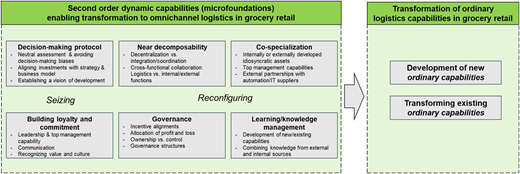
The three higher-order dynamic capabilities include (1) sensing opportunities and threats, (2) seizing identified opportunities (e.g. committing resources) and (3) managing reconfiguration (transformation) (Teece, 2007). This paper focuses on seizing and transformation, which, according to Teece (2018), concerns the transformation of existing ordinary capabilities, as well as the investment in new ordinary capabilities. The seizing and transforming capabilities are operationalized into secondary dynamic capabilities, or microfoundations, which provide detailed explanations (e.g. distinct skills, processes, procedures, organizational structures, decision rules and disciplines) of the reconfiguration (Teece, 2018). Four microfoundations help explain the transformation of existing ordinary capabilities: near decomposability (decentralization vs integration), co-specialization, governance and learning/knowledge management (Teece, 2007). For investment in new ordinary capabilities, two microfoundations are described: decision-making protocols for investments and building loyalty and commitment (Teece, 2007). We use this as our conceptual foundation (Figure 1).
2.2 Dynamic capabilities and microfoundations used in the logistics context
While dynamic capabilities theory is used in many research disciplines, its application to the retail context is limited to a few relevant contributions. A few studies (e.g. Martinelli et al., 2018; Rajaguru and Matanda, 2019; Sandberg and Hultberg, 2021) have focused on the managerial and organizational application of dynamics capabilities in retail. Studied topics include fashion retailers' internationalization (Frasquet et al., 2018) and logistics service quality from customers' perspective (Hüseyinoglu et al., 2018). A number of researchers have combined dynamic capabilities with logistics (Table 1), often suggesting specific supply chain/logistics capabilities. In these studies, the unit of analysis differs (e.g. logistics flexibility, Sandberg, 2021; sustainable supply chain management, Beske et al., 2014 and logistics organizational learning, Esper et al., 2007). Although distinctions between different types and orders of capabilities are lacking, the original microfoundations of Teece (2007) are implicitly represented to varying degrees (Table 1). While studies have stressed integration, co-specialization and learning together with leadership more generally, limited attention is paid to governance, building commitment and decision-making processes for investments. Next, we go through each of the microfoundations relevant for transforming existing capabilities and investing in new ordinary capabilities.
The first microfoundation, selecting decision-making protocols for investments, emphasizes the ability to commit resources and invest in new ordinary capabilities to complement old capabilities (the output of sensing) (Teece, 2018). This concerns when, what and how much to invest, as well as aligning the investment with an organization's strategy and business model. Investments in new ordinary capabilities related to technology (e.g. automation solutions), new facilities [e.g. online fulfillment centers (OFCs)] and new internal processes seem to be prerequisites for OC grocery retailers to be competitive (Marchet et al., 2018; Eriksson et al., 2019). According to Teece (2007), the decision-making protocol should ensure a neutral assessment of both old and new investments. Investing in new automation systems, for example, implies committing substantial financial resources to a vision of future technology and market position, and predicting the future always means high uncertainty (Teece, 2007).
The second microfoundation, building loyalty and commitment, includes demonstrating leadership, communicating and recognizing values and culture (Teece, 2007). Leadership capabilities, such as top management's communication and actions, are critical for creating loyalty and commitment to innovation and efficiency improvements in the logistics network (Teece, 2007; Haag et al., 2019). Management must create an organization where everyone involved in the investment decision feels safe and comfortable being honest and objective. In the end, “some level of managerial consensus will be necessary to allow investment decisions to be made” (Teece, 2007, p. 28).
The third microfoundation, governance, includes, for example, the connection between ownership and control of management. Teece (2007) argues that an organization's ability to reconfigure continuously will deteriorate as the separation between ownership and control increases. Explicit connections between board-level and top management, as well as leadership skills among board members and top managers, are crucial to overcoming these governance issues (Teece, 2007). Furthermore, governance includes incentive alignment, for example, redesigning incentives to ensure that all business units (BUs) are aligned toward the same vision. Research on dynamic capabilities in logistics and supply chains seems to overlook this microfoundation. However, in retail, a more or less complex governance and ownership structure exists, for e.g. franchise or cooperation (Ingene and Pelton, 2020). For OCs, designing an incentive system in organizations with centralized governance structures is relatively easy but more difficult for decentralized structures (e.g. franchise) involving allocation between different entities (Xu and Cao, 2019). In addition, more decentralized governance structures create higher hurdles to achieve centralized online solutions (Wollenburg et al., 2018).
The fourth microfoundation, near decomposability, means balancing between decentralization and integration/coordination, for e.g. the tension between having autonomous organizational units making decisions rapidly vs capturing economies of scale and coordination of activities. As OC transformation implies increasingly complex network configurations (Kembro et al., 2018; Hübner et al., 2019), the balancing act between decentralization and integration/coordination gets more important for grocery retailers. Cross-functional integration and coordination are recurring themes in the logistics literature (cf. Norrman and Naslund, 2019) and can be described as continuous routines critical for the ability to reconfigure (Beske, 2012; Sandberg, 2021). Cross-functional integration can entail increased collaboration with top management, integration between different company functions (e.g. logistics and marketing) and collaboration with external actors (Haag et al., 2019; Sandberg and Abrahamsson, 2011).
Fifth, Teece (2007) highlights the microfoundation co-specialization, implying that combining assets could enhance their individual value. Co-specialized assets are idiosyncratic and more difficult for competitors to copy. As the asset owner might not understand its value for others, integrated operations and internal coordination are prerequisites to capture co-specialization benefits and achieve strategic advantage (Teece et al., 1997). Also important is the top management's ability to identify co-specialized assets to invest in either through internal development or external partnerships. OC development requires more collaborations across, and beyond, the retailer's logistics organization (cf. Zhang et al., 2021), and in logistics research on dynamic capabilities, partner development and supply chain collaborations as means to develop co-specialized assets are recurring (Defee and Fugate, 2010; Gruchmann et al., 2019).
The last microfoundation, learning and knowledge management, facilitates continuous reconfiguration and development of existing and new routines, processes and skills (Defee and Fugate, 2010) and the conversion of “learning outcomes to new logistics management strategies, tactics, and operations in support of further developing other logistics capabilities” (Esper et al., 2007, p. 63). In OC transformation, the old processes and skills of retailers' logistics organizations may be less valuable and lack best practices (Eriksson et al., 2019). Therefore, the company's learning process aims to absorb as much knowledge as possible from external and internal sources (Esper et al., 2007; Sandberg and Abrahamsson, 2011). Thus, combining knowledge from both external and internal actors is a key to unique resources (Eriksson, 2014). From an external perspective, joint learning benefits all involved partners by accessing external resources and new competencies (Beske et al., 2014; Sandberg, 2021).
3. Methodology
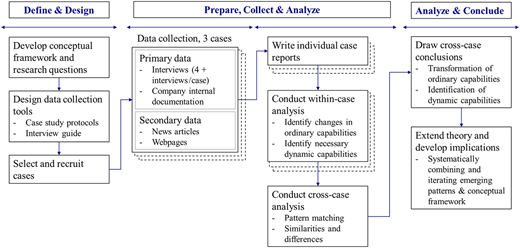
Phenomenon-driven research has traditionally been dominated by qualitative methods (Schwarz and Stensaker, 2016). We are studying an emerging and contemporary phenomenon in a real-life context, which motivates our multiple case study (Meredith, 1998; Yin, 2014). This theory-elaborating case research (Ketokivi and Choi, 2014) is informed by Yin (2014) (see Figure 2) and aims to contextualize the dynamic capability theoretical lens for OC logistics.
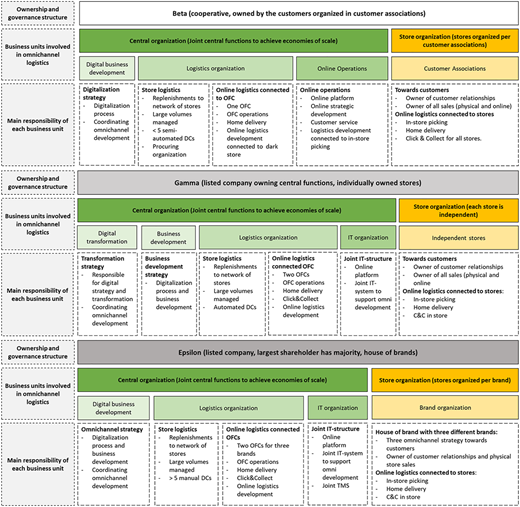
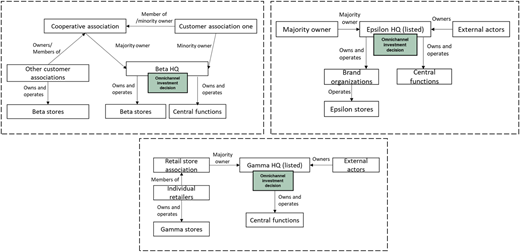
Case selection is vital when using multiple cases (Eisenhardt, 1989; Voss et al., 2002). To represent our unit of analysis, “the ordinary logistics capabilities and dynamic capabilities of a grocery retailer in OC transformation”, we searched for appropriate grocery retailers transforming their OC logistics. Our selection of cases and informants aimed to maximize conceptual insights and understanding (Darby et al., 2019), using purposeful sampling to maximize information thickness rather than generalization properties (Flyvbjerg, 2006). Criteria for cases were them (1) being in a transformation toward OC, (2) having both stores and online channels and (3) participating and providing the researcher access to the people with relevant knowledge to interview. Three grocery retailers meeting all criteria were included in the study. They were similar in size (among the leaders in their countries) but represented different ownership and governance structures (Figure 3), geographical coverage, online organizations and different stages in OC development (see Section 4), where OC refers to the ability to provide customers with a seamless experience across numerous sales channels and touchpoints (Verhoef et al., 2015). To guarantee anonymity, they are referred to as Beta, Gamma, and Epsilon, and no specifics regarding the country or market share will be provided.
The case-research approach enabled the triangulation of multiple data sources (Meredith, 1998) and perspectives. Semi-structured interviews (of several representatives from each case representing different functions (Table 2)) gave primary data, capturing all aspects of the current logistics organization, OC transformation and dynamic capabilities. The interview guide was based on our conceptual foundation and reviewed by three different researchers (available upon request). The interviews started with broad, open-ended questions to ensure open conversation and proceeded with more specific questions while the detailed questions came last (Yin, 2014). The interviews covered both changed ordinary logistics capabilities and enabling dynamic capabilities, asking for reasons for certain decisions and reflections on experiences from transformation. To help informants prepare (Voss et al., 2002), questions were shared before any interview and progressively updated.
At least four informants per case company were interviewed, and each interview lasted 90–120 min (Table 2), with interviews recorded and transcribed. Much effort went into identifying the right roles within the organization to interview. All interviewees received an interview summary that they approved. Also, secondary data (web pages, news articles and annual reports) were used to validate the primary data. This triangulation helps providing the most accurate picture of the events.
Coherent with our research approach, former theory and empirical data were examined simultaneously and in a balanced manner (Ketokivi and Choi, 2014). To elaborate theory, data analysis proceeded through abductive iterations between the framework and the data (Ketokivi and Choi, 2014). Steps included concurrent data reduction, data display, coding and drawing and verification of conclusions (Miles and Huberman, 1994) (first individually and then jointly by the two researchers) (Miles and Huberman, 1994; Voss et al., 2002). The raw data (transcripts) for each case were first coded longitudinally to display phases of the transformation of ordinary logistics capabilities. Through cross-case pattern matching (Eisenhardt, 1989), five areas emerged as most interesting in the transformation of ordinary logistics capabilities. To identify relevant elements of the dynamic capability reconfiguration, a within-case analysis was conducted to openly code and understand the key elements of the longitudinal reconfiguration before similarities and differences between the cases were coded, compared and contrasted (Miles and Huberman, 1994). The matched patterns that emerged were systematically compared with the conceptual foundation in a highly iterative process (Eisenhardt, 1989) to build and elaborate theory and draw conclusions.
Generalizing from cases (transferability) is claimed not to be “proof” in a statistical sense; thus, we make analytical generalizations (leveraging literal and theoretical sampling logic) to explain similarities and differences between different cases (Voss et al., 2002; Yin, 2014). To reach trustworthiness, actions of Lincoln and Guba (1986) were followed (see Table 3).
4. Empirical description of the OC transformation of ordinary logistics capabilities
4.1 Developing a joint OC strategy across the organization and establishing the role of logistics
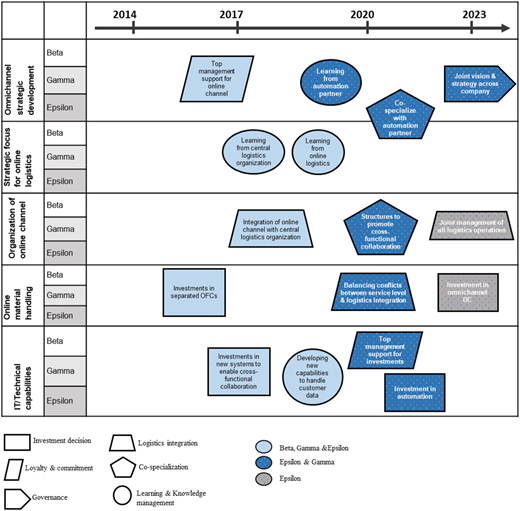
The first theme concerns the OC strategy and cross-brand vision, showing differences between the cases. Epsilon's central strategy, along with a joint vision for all brands and cross-functional BUs, provided a clear role for logistics. This was explicitly defined as key for a successful OC strategy (Epsilon_Dig). Like Epsilon, Gamma developed a joint vision for both stores and central organizations, with logistics taking on a more central role. Gamma's stores have independent owners, and this previously made it difficult to develop a joint company strategy, which partly slowed down decision-making (Gamma_Dig). By adopting a joint vision and strategy, Gamma was able to overcome challenges connected to ownership structure and decentralized decision-making (Gamma_OFC). Beta still lacks (but works toward) a joint, clear company strategy and vision across channels. This made logistics' role and responsibility unclear from a strategic perspective (Beta_ToP).
4.2 The strategic focus of online logistics develops similarly for all cases
For all cases, the strategic focus of online logistics started with a phase prioritizing growth and increased market shares over cost. Online logistics' primary goal was to fulfill customer expectations and requirements, which were managed by allowing fast decision-making through the decentralization of the online organization (Beta_HoO). All cases were then moved into the current phase, with a more established online channel and larger sales volumes. This phase focused on developing online logistics through scaling up: Epsilon focuses on setting the necessary logistics conditions for expansion and growth (Epsilon_Dig) and Gamma_Dig operationalizes logistics, while Beta “rationalize[s] and streamline[s] existing online operations” (Beta_ToP). Capturing economies of scale and coordinating activities are now, to some extent, prioritized over rapid decision-making.
The cases' online channels are yet to show profit, which is a challenge that permeates the entire industry. Thus, future focus will be on achieving online channel profitability, and thus, all cases find the current upscaling of online logistics essential. For example, Gamma currently focuses on making the right logistics investments to ensure that the online channel can be profitable in the future (Gamma_Strat). Similarly, Epsilon's decision to automate its OC distribution center (OCDC) is primarily motivated by a reduced cost ratio for online fulfillment (Epsilon_PM).
4.3 Integration of the online channel with the established organization is a key to enabling OC
All cases' respondents argued that integrating the online channel with the established organization is a key for transformation toward OC. Both Beta and Gamma initially had separate organizations operating their OFCs. In 2019 and 2020, Beta's and Gamma's top management-initiated strategic re-organizations, giving the established logistics organization responsibility for OFCs. The re-organization allowed the central organization to utilize their existing knowledge to improve and streamline OFC operations (Beta_ToP, Beta_OLog and Gamma_Dig).
While cross-channel collaborations between online and established store logistics have increased for Beta, their online BU still controls strategic development. Gamma's all stores are independently owned and operated, while its central organization owns joint functions, such as logistics and purchasing. As a result, Gamma has struggled to balance decentralization and integration. Going forward, Gamma finds it crucial to involve both IT and logistics in the strategic development of an online channel (Gamma_Dig) and therefore has established a cross-functional strategic forum. Furthermore, logistics are represented in the online channel's management team. While the established logistics function has responsibility for online logistics operations, Gamma's chief strategy and digital officer simultaneously has the overall strategic responsibility for the online channel, including logistics. In comparison, although Epsilon entered the online market after Beta and Gamma, Epsilon first created a more integrated organization (Epsilon_Dig). In 2019, Epsilon announced its construction of an automated OCDC combining both stores and online, which required Epsilon to establish a cross-functional OC program with a central OC strategy.
4.4 Current logistics network combines OFCs and in-store picking for online order fulfillment
All cases combined OFCs and in-store picking to fulfill online orders. Beta and Epsilon use selected stores, mostly related to the geographical area and population density, while Gamma lets each independent storeowner to decide. Gamma and Epsilon had two OFCs in two different urban regions, while Beta chose one in the biggest urban region. All OFCs are operated by central logistics but with stores responsible for in-store picking.
All three cases offer home delivery (from OFC or store) and pick-up in-store [click-and-collect (C&C)]. For Epsilon, the established logistics organization is responsible for the last mile, by itself or using outsourced carriers. For Beta and Gamma, the established logistics organization is responsible for the last mile from OFC by outsourcing transportation to carriers, but each store handles its last mile by itself.
4.5 Ordinary logistics capabilities related to IT, technology and automation display several differences
Epsilon is currently building a large, automated OCDC that will serve a large part of its market, cross-channels and cross-brands. Simultaneously, Epsilon closes several DCs (distribution center) serving stores today. Their new OCDC will open in 2023, which is complemented by OFCs and in-store picking in other geographical regions. This new type of OCDC is rare globally, making Epsilon collaborate tightly with its provider. Epsilon also invested in a new transportation management system (TMS) to support OC development as part of the DC project.
Gamma partnered with a provider of complete online solutions, including OFC automation and an online platform (going live 2022), with all different parts fully integrated. Gamma believes that investing in a complete solution will make them quickly jump forward, with the automated OFC increasing both picking efficiency and capacity (Gamma_Strat). They target more than double-picking efficiency compared to current manual OFCs. Unlike Epsilon, Gamma chose a separate OFC because of channel optimization. Despite investing in two different automation/warehouse solutions, both Gamma and Epsilon will continue collaborating with their respective providers when the warehouse is in operation. Their providers will be responsible for operating the entire automation system and work closely with site employees.
Beta recently invested in, and implemented, a new online platform to support the OC customer experience, stating this as a first step to ensure online integration with Beta's other systems. Beta is currently investigating future technical options for online order fulfillment but has not yet made decisions. All of Beta's representatives argue that a pre-condition is a joint OC strategy across the organization.
5. Analysis and discussion of dynamic capability enabling transformation of OC logistics
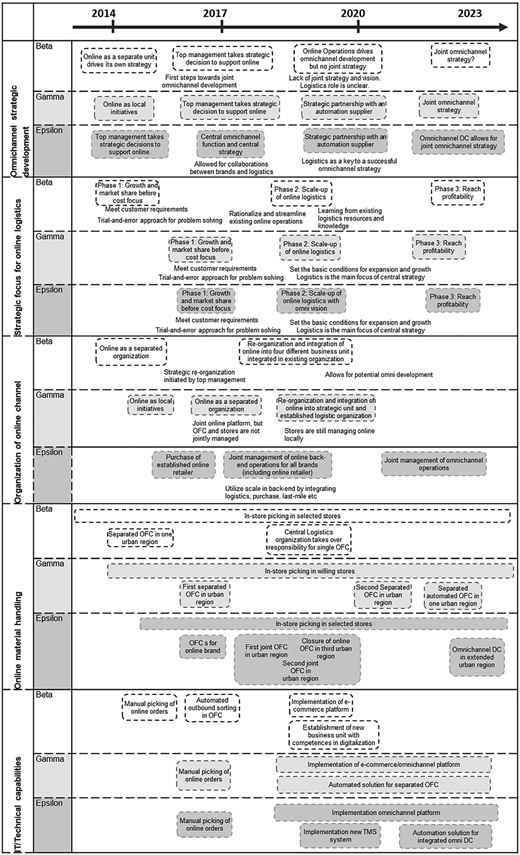
Next, to understand how the three grocery retailers enable their transformation toward OC logistics (Figure 4), we used our conceptual foundation (Figure 1) to analyze the necessary microfoundations (Figure 5). Detailed coding and corresponding interview quotes are included in Table A2, and the following sections present key findings.
5.1 Investment decision-making process and building loyalty and commitment
As the investment decision-making process and building loyalty and commitment are tightly intertwined among our cases, these two microfoundations are presented together. Several significant investments related to OC logistics were identified across the cases, especially in IT/technical capabilities, process development and organizational changes. The retailers' objectives were to create logistics resources that enabled OC. However, we observed critical differences in investment decision processes regarding how they build loyalty and commitment, which can be explained by the retailers' different governance structures.
First, Epsilon and Gamma made significant investments in automation, new facilities and process development. Several aspects were included in the decision-making. As listed companies, Epsilon's and Gamma's boards formally decide these significant investments, implying that top management and the board are well aligned and work toward the same OC vision. Second, significant investment implies the commitment of substantial financial resources to a vision of future technology and market position. Both cases explained that although OC capacity need is a complex question, they had to commit to a scenario and vision of online market growth to start their projects (Epsilon_Lo and Gamma_Dig). Finally, the joint vision and created scenario also helped align different organizational functions, making everyone committed to the investments. Thus, the OC visions and scenarios developed by Epsilon and Gamma, combined with top management abilities, seem to be critical for investment decision-making.
Both Gamma and Epsilon stressed the importance of anchoring investments in the organization and aligning all involved BUs. The decision-making process was crucial for both cases' success. They included key people from all units being impacted by the decision, building loyalty and commitment toward the transformation. In comparison, all of Beta's respondents stated that an investment in automation for online order fulfillment would be necessary to compete in the OC market. However, aspects such as lack of joint OC strategy and vision, further complicated by the lack of ability to predict the growth rate of online volumes, make it difficult for Beta to commit to a specific solution (Beta_ToP, Beta_OLog and Beta_HoO).
5.2 Governance and ownership
Governance structures, including ownership models (Figure 6), differ between our cases. Epsilon has the most centralized governance and ownership structure, where stores are owned and operated by the company, which seems to simplify investment decisions.
Gamma and Beta have more decentralized and complex governance structures, often recurring in grocery retail. Gamma's stores are individually owned and operated but represented on Gamma's board through membership in the retail store association. Each store purchases joint services (such as store replenishment) from Gamma's central functions and decides the prices against the customer. This governance structure has been a challenge when it comes to driving a centralized online strategy. The store owners are self-employed and not forced to join the central online channel, which has historically slowed down decision-making. However, since the stores (through the retail store association) and Gamma HQ (headquarters) agreed on a strategy and vision for online, execution has been fast (Gamma_Dig). Gamma's joint strategy created similarities between Gamma and Epsilon; both have a listed headquarters company and now a joint strategy that the long-term majority owner represented in the board drives.
Beta is not a listed company and has a more complex governance structure where stores are owned by either different store associations or the HQ, and all are run by hired store managers. Beta HQ has two different customer associations as owners. Customer associations are responsible for P&L (Profit and Loss) and operations, and each association has its CEO (Chief Executive Officer) who wants to pursue its own agenda (Beta_ToP). This decentralized governance structure creates challenges related to decision-making for online stores. Beta's representatives argue that a joint strategy with clearer incentive structures between online and stores will be required to overcome challenges with a decentralized governance model.
5.3 Near decomposability: integration and coordination in and beyond the logistics organization
An important part of OC development seems to be increased integration and collaboration between the logistics organization and other BUs. All cases have been reorganized to enable cross-functional, cross-channel and cross-brand work connected to OC. Epsilon, Gamma and Beta all argue that BUs (such as IT, logistics, business development and stores) must collaborate more closely to co-specialize and succeed with the OC transformation.
A specific aspect of cross-functional integration observed in our cases was logistics integration. All cases favor the integration of online logistics with the existing logistics organization and describe how this creates economies of scale and more efficiently utilized logistics resources (Epsilon_Log). The insight is that retailers working toward OC should view the logistics network as one unit instead of separate channels to utilize existing systems, resources and processes and build volumes in the online logistics network. Although seeing several benefits from logistics integration for online orders, all cases see potential tensions related to service levels. The considerable investments Gamma and Epsilon made in automated centralized material handling for online orders imply a large shift from their current logistics set-up (Gamma_Strat). The logistics organization may need to drive volumes to the centralized unit to justify the automation investment. In contrast, the marketing organization may want stores to handle more orders to enable shorter and more flexible deliveries. This potential conflict depends on the market development for grocery retail online (Epsilon_Log). Gamma's organizational set-up further contributes to the tension between in-store picking and driving volumes to a centralized unit. Beta has not yet decided its future online automation, but Beta_HoO sees risks with a centralized solution and questions whether the competitors' services will satisfy the customers.
5.4 Co-specialization: between internal BUs and with an external partner
The longitudinal mapping of transformed ordinary capabilities (Figure 4) illustrates that Epsilon and Gamma are ahead of Beta in becoming “true” OC retailers. A critical difference is the management of cross-functional collaborations internally and externally and how they are utilized to co-specialize. Epsilon has created a cross-functional “OC programme” responsible for OC development, where representatives across BUs and the three brand organizations work together. The logistics organization drives the program, but Epsilon finds it crucial to involve all affected actors to create a long-term transformation (Epsilon_PM).
As for now, Gamma's joint assessment finds it best to separate online from regular business due to the online channel's unique requirements. Strategic development is, therefore, part of Gamma_Dig BU. This assessment is also reflected in Gamma's investment decisions to opt for a separate, highly automatized OFC. However, with a growing online channel and OC maturity, online development and digitalization increasingly affect Gamma's organization. Thus, online business development is no longer a “one team show” but requires a transformation of more BUs and internal coordination. This transformation is driven by business development, but logistics and IT are also becoming more involved early (Gamma_Dig).
Lastly, both Gamma and Epsilon collaborate tightly with their respective automation providers as a way to co-specialize. The long-term partnerships include developing and adjusting the automation solutions to fit with the idiosyncrasies of Gamma's and Epsilon's respective contexts. Gamma and Epsilon have chosen two fundamentally different types of automation solutions. Epsilon's automation provider wants to develop a successful worldwide showcase of a new type of OCDC and has thus been very active in the design phase (Epsilon_PM). Gamma opted for an existing solution. While Gamma and its provider try to adapt to Gamma's contingencies, the provider has already defined many requirements (Gamma_PM).
5.5 Learning and knowledge management
Learning is critical for OC transformation in two primary ways for all cases, while Epsilon and Gamma also learn in a third way. First, to integrate entrepreneurial online logistics with the established logistic organization and support online operations' learning from existing resources, an operationalization of online logistics is currently taking place. Beta is, for example, utilizing its existing knowledge from store replenishment logistics to improve the efficiency and profitability of online logistics (Beta_ToP).
Learning also goes in the opposite direction. All cases' representatives agree that certain OC aspects require new knowledge that the existing logistics organizations currently do not possess, for example, to learn how to respond to new demand patterns and customer requirements. Epsilon will implement new processes and innovative automation types in their OCDC, needing new types of knowledge and competence (Epsilon_Log); hence, Epsilon is currently focused on identifying new processes, evaluating related gaps and identifying learnings needed to close them (Epsilon_ODC). Similarly, Gamma expresses the need to learn and improve how to handle online customers' new expectations (Gamma_PM). Gamma closes this gap by ensuring that the logistics department, responsible for future OFC operations and recruitment, works closely with the ongoing OFC project.
Lastly, Gamma and Epsilon learn from their respective automation providers during the design and implementation phase. Both will continue this when the warehouses are in operation. Epsilon describes this collaboration as dynamic (Epsilon_ODC), where they continuously meet in different teams, revise and exchange experiences and challenge each other. Likewise, Gamma's provider relationship is described as a long-term partnership, with both parties active and involved in implementing the solution and developing new processes. Gamma finds another advantage of collaborating with an established solution provider in its experience with grocery retailers in other geographic markets. This supports Gamma's ambition to collaborate with other international partners and access their competencies and capabilities (Gamma_Dig), for example, exemplified with exchanged experiences and lessons learned during the coronavirus disease 2019 (COVID-19) pandemic.
6. Cross-case discussion of ordinary and dynamic capabilities in OC logistics transformation
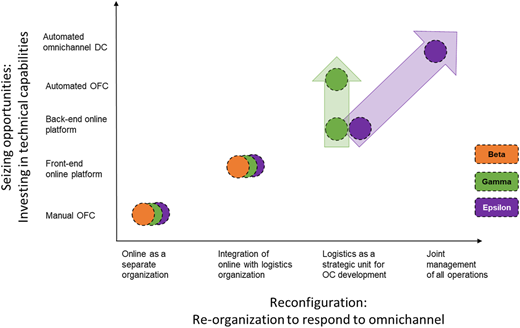
The three grocery retail cases show interesting similarities and differences in their transformation of OC logistics. Beta seems less transformational, which is potentially explained by differences in second-order dynamic capabilities (microfoundations). Two noticeable differences are related to the development of new capabilities by investing in new technical capabilities and how they are reconfiguring their logistics organization by integrating different units (Figure 7).
Developing new ordinary capabilities in a dynamic environment almost always includes investments (Teece, 2018). All cases have made investments (seizing) in manual OFCs and front-end platforms, while Gamma and Epsilon have continued to invest heavily in back-end platforms and automation for online order fulfillment. Although Beta states (sense) that these investments are necessary to become profitable and competitive in a future OC market, Beta lacks the ability to seize identified opportunities (cf. Teece, 2007).
To reap the benefits of their respective new investments, all cases reconfigured and reorganized existing ordinary logistics capabilities in several ways. We see a pattern of integrating entrepreneurial online logistics with more established logistics. The established logistics organization has gradually become responsible for OFC operations and logistics development connected to the online channel. For Gamma and Epsilon, continuous integration goes in parallel with increasing investments.
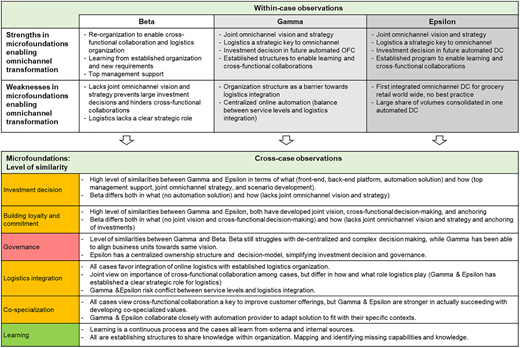
While Figure 8 gives an overview of observed cross-case differences and similarities of microfoundations, we will discuss potential reasons.
Different aspects of the microfoundations of governance and building loyalty and commitment (leadership) seem to be root causes explaining why Gamma and Epsilon are stronger (relative Beta) in developing new ordinary capabilities by making investment decisions for technical capabilities. In our cases, the online channel represents a small share of total sales but drives high investments compared to the traditional store channel. A central part of creating commitment in the cases was including all impacted BUs in the decision-making process. Gamma and Epsilon highlight the importance of anchoring the decision across the organization to create acceptance, loyalty and commitment (cf. Teece, 2007) toward the investment decision. Both Gamma's and Epsilon's boards are well aligned with the strategic directions, while Beta is struggling with aligning all parts of the organization toward the same vision. Strong leadership capabilities among top management, with an explicit connection to board level, thus seem to contribute to stronger dynamic capabilities and the capacity/ability to make more significant investments (cf. Haag et al., 2019; Teece, 2018). This created a cross-functional understanding and commitment to significant investment in ordinary logistics capabilities and helped align the work across BUs.
A complicating factor for investments, common in retail, is different ownership and governance structures (e.g. franchise, cooperative or independent store owners). Epsilon's centralized structure, with a strong majority owner, seems to facilitate significant investments in new ordinary capabilities. Gamma and Beta have both decentralized governance structures with a division between central functions and stores, which seems to act as a barrier toward central investments in online ordinary capabilities. For Gamma, the stores (through the retail store association) and Gamma HQ agreed on a joint strategy and vision for online. The joint strategy created a governance structure for Gamma's central organization like Epsilon. Gamma now has centralized OC decision-making and a strong majority owner driving a long-term joint strategy. In comparison, Beta's governance structure, with a number of different CEOs driving their own agendas and a lack of joint strategy, can potentially explain the weakness in seizing.
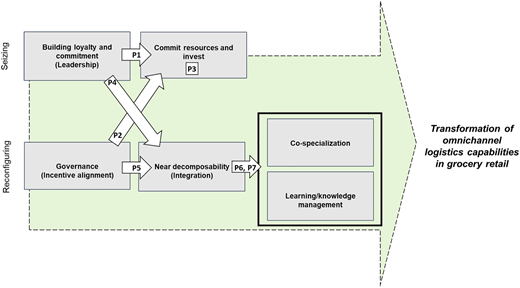
For grocery retail OC logistics, we propose the contextualizations as follows (Figure 9):
With more decentralized ownership and governance structure of retail stores …
P1: … the more important for leadership to develop loyalty and commit resources for joint OC logistics investments.
P2: … the more important to develop aligned incentives (governance mechanisms) and joint vision to be able to get resource commitment to joint OC logistics investments.
Furthermore, in the decision-making process, Gamma and Epsilon built on the joint vision and established a detailed scenario for how online sales volumes and demands would develop. This scenario was a fundamental condition for the ability to commit to a specific solution. Conversely, representatives from Beta argued that their lack of joint OC vision was one main barrier to making the automation investment decision. In line with Teece (2007), our study thus confirms that establishing a joint vision is important; but for logisticians, creating a detailed scenario of how the organization expects the market and technology to develop is crucial for the ability to make OC investments.
P3: For investments in ordinary OC logistics capabilities, detailed scenarios of market and technology development are required for investment decision making.
Gamma's and Epsilons's top management leadership has established a joint vision and strategy for the whole organization, including establishing logistics as a strategic unit for OC development. The logistics integration of the online and the established logistic organization improves internal coordination, economies of scale, pooling of resources (Sandberg, 2021) and logistics learning from both directions (e.g. Esper et al., 2007; Haag et al., 2019). Establishing joint visions and structures for cross-functional integration is crucial for their development (something Beta lacks). Several microfoundations enable this.
For all cases, the re-organization aims to promote cross-functional integration between stores and online within the logistics organization. This has forced both store and online logistics to improve their understanding of each other's objectives. While Gamma and Epsilon initially reconfigured their organizational set-up similarly, they now deviate in terms of automation solutions and their corresponding organization. Each path is, however, well connected to their respective strategic vision of OC development. By establishing logistics as a strategic unit for OC development and aligning organizational structures, Gamma and Epsilon improved cross-functional integration between BUs (especially marketing, business development, IT and logistics) and strengthened their ability to co-specialize. Thus, the top management-initiated re-organization strengthens the microfoundations near decomposability (integration/coordination), which seems to be a foundation for both co-specialization and learning. Conversely, for Beta, the logistics' role and responsibility are strategically unclear, making it more difficult for logistics to add value (i.e. improving co-specialization).
To reconfigure existing ordinary capabilities in the transformation of OC logistics in grocery retail …
P4: … leadership capabilities to develop cross-functional loyalty and understanding for logistics strategic role in OC will increase near decomposability through integration (cross-functional, cross-brands, cross-channels).
P5: … well-designed governance mechanisms will increase near decomposability through integration (cross-functional, cross-brands, cross-channels), especially for retailers characterized by decentralized ownership.
P6: … close decomposability through integration (cross-functional, cross-brands, cross-channels) is supporting both (a) co-specialization and (b) learning needed.
An important aspect of dynamic capabilities is integrating and reconfiguring external ordinary logistics capabilities (Beske, 2012; Sandberg, 2021). External partnerships allow Gamma and Epsilon to access knowledge and resources they do not have internally (learning). Gamma and Epsilon have established long-term partnerships with their respective automation providers with whom they exchange experience and adapt the automation solution to the retailer's specific contingencies.
P7: External integration, e.g. long-term partnership with technical capability suppliers, allows the grocery retailer to (a) co-specialize by adapting technical capabilities to their specific contingencies and to (b) improve learning by accessing knowledge and resources they lack internally.
The contextualization of the dynamic capabilities for the OC transformation of grocery retail (implied by the propositions) stresses a few characteristics as follows:
The importance of balancing a decentralized ownership and governance structure with a joint vision and strategy;
The strength of microfoundations for seizing, e.g. leadership (building loyalty and commitment) and investment decision, creates a foundation for reconfiguring (transformation);
There seems to be a sequential/casual relationship between a dynamic capability's microfoundations, meaning they are not independent and
There are also cross-capability relationships between microfoundations [e.g. governance (transformation) influences investment decisions (sense)].
7. Contributions, limitations and future research
This study contributes to OC knowledge in several ways. First, the longitudinal mapping and categorization of how grocery retailers transform their ordinary logistics capabilities (RQ1) makes an empirical contribution to current research on OC logistics in grocery retail (e.g. Marchet et al., 2018; Wollenburg et al., 2018; Galipoglu et al., 2018). Second, while previous research focused on what OC transformation might change for grocery retailers' logistics, we elaborate on why certain grocery retailers seem to transform OC logistics faster than others (RQ2). We base our analysis on six second-order dynamic capabilities (microfoundations) presented by Teece (2007, 2018) and contribute theoretically by seven propositions. Specifically, we identify and develop the importance of governance issues related to decentralized ownership structures, as well as leadership building cross-functional loyalty and commitment understanding logistics' strategic role, for the capabilities to make investment decisions, develop near decomposability (integration) and co-specialization. Our study thereby extends the current dynamic capabilities research (cf. Teece, 2007; Beske et al., 2014), especially in the retail and logistics domains.
By using second-order dynamic capabilities (microfoundations) to explain the transformation of ordinary capabilities, we extend how dynamic capability is used in logistics research. We focus on OC logistics and thus complement previous studies on dynamic capabilities in, for example, logistics flexibility (Sandberg, 2021), retail internationalization (e.g. Haag et al., 2019) and sustainable supply chains (e.g. Beske et al., 2014). Our study confirms the importance of, for example, increased integration and cross-functional collaborations (e.g. Zhang et al., 2021), partner development (e.g. Sandberg, 2021) and logistics learning (e.g. Esper et al., 2007). Also, the findings highlight the importance of strengthening microfoundation governance, which is an aspect often lacking in previous research but that seems important in the (decentralized) retail context.
Lastly, as dynamic capabilities are quite a novel concept in OC grocery retail, our study elaborates the theoretical concept in this specific context. Our results confirm the applicability of dynamic capabilities as a theoretical lens to understand the transformation toward OC in grocery retail and point at specific issues, such as the balancing governance act between decentralized store ownership and investments for centralized logistics cross-functional integration and co-specialization. We also point to interrelations between different microfoundations.
The summary of crucial ordinary and dynamic capabilities could help practitioners to increase competitiveness in OC grocery retail. The longitudinal map of how ordinary logistics capabilities transform, including enabling elements of dynamic capabilities, allows practitioners to benchmark. In particular, a joint commitment to a shared OC vision seems essential.
Despite presenting second-order dynamic capabilities critical to transforming OC logistics in grocery retail, we did not differentiate their importance. Future research could compare their relative influence and study if some dynamic capability elements for transformation are more important and why and if their relevance differs for certain types of markets and retail sectors. Another limitation is the use of three cases from the same country. By analyzing additional cases from other markets, potentially different far in the OC transformation, the study's transferability/external validity could be improved, for example, whether retailers in different geographical markets or retail sectors transform ordinary logistics capabilities similarly. Finally, by studying retailers' transformation longitudinally, interesting aspects can be explored, such as what ordinary capabilities contribute to successful OC and why.
This research study was funded by the Hakon Swenson Foundation. The authors specially thank the omnichannel retailers for participating in the study. The authors also gratefully acknowledge the Editors and the anonymous reviewers for the guidance and constructive comments.