
Skip to article sections
Purpose

The objective of this paper is to study how specific online shopping variables (online customer experience, e-satisfaction and e-trust) influence customer privacy concerns on the omnichannel consumer journey through privacy and risk calculus mechanisms.

Design/methodology/approach

The methodology is based on 1,123 surveys of Spanish consumers: one sample is of omnichannel behaviour and the other of those who searched and purchased only online.

Findings

In general, the three variables exert a significant influence on privacy concerns, but online customer experience has the greatest impact. Privacy and risk calculus mechanisms influence customer privacy concerns through e-satisfaction and e-trust, respectively. Both mechanisms are interconnected, so that privacy calculus influences risk calculus. While privacy and risk calculus mechanisms significantly influence privacy concerns on the online consumer journey, only online customer experience has a significant influence on the omnichannel consumer journey.

Originality/value

To analyse privacy concerns comparing omnichannel shopping with online shopping.

According to the European Commission (2023), “72% of respondents expect that digital products and online services better adapted to their personal needs would significantly facilitate their daily use of digital technologies”. However, “only 50% of the respondents believe the EU protects their rights in the online environment well, i.e. respect for the confidentiality of communications and information on devices”. This data demonstrates a dichotomy for European citizens regarding online privacy: the benefit that self-disclosure provides for the personalisation of digital products, and privacy concerns about the use that will be made of personal data in an online environment .

Privacy concerns have deserved the attention of researchers since the emergence of social media and online services (Li, 2011). Some studies have shown that privacy concerns are a key antecedent in purchase intentions in the online context (Bansal and Nah, 2022), although other studies consider it a moderating variable (Cloarec et al., 2024; Cheah et al., 2022; Tajvidi et al., 2020). In the context of online shopping, some studies found that privacy concerns have some negative effects, such as a lower willingness to disclose personal information, a reduced intention to use online services, and lower levels of trust (Tajvidi et al., 2020).

As can be seen in Table 1, most studies focus on contexts such as social media (Nguyen et al., 2024; Aboulnasr et al., 2022), retailing (Cheah et al., 2022; Aiello et al., 2020; Okazaki et al., 2020), banking–insurance (Lu, 2024; Alalwan et al., 2024; Lappeman et al., 2023; Bouhia et al., 2022), and e-commerce (Rodríguez-Priego et al., 2023; Gouthier et al., 2022; Maseeh et al., 2021). However, privacy concerns in the omnichannel consumer journey have been little studied (Wang, 2021; Moliner and Tortosa-Edo, 2024). This research adresses privacy concerns in the context of multirooming behaviour (consumers that search information across channels and purchase online).

In addition, Okazaki et al. (2020) and Quach et al. (2022) propose as a future agenda the identification of the factors that a retailer can activate to reduce privacy concerns. The literature has identified some antecedents based on privacy calculus theory: perceived benefits and perceived risks (Lu, 2024; Aboulnasr et al., 2022; Bouhia et al., 2022; Gouthier et al., 2022; Maseeh et al., 2021; Li, 2011). Another antecedent that has proven to be highly relevant is trust (Rodríguez-Priego et al., 2023; Broeder, 2023; Bleier et al., 2019). However, drivers of privacy concerns specific to online context, such as online customer experience (OCX) and e-satisfaction, have not deserved much attention from researchers.

The objective of this paper is to study how online shopping variables (OCX, e-satisfaction, and e-trust) influence customer privacy concerns in the omnichannel consumer journey. More specifically, three research questions are established:

RQ1.

How do specific online shopping variables (OCX, e-satisfaction, e-trust) function as antecedents of privacy concerns within an omnichannel journey?

RQ2.

How important are privacy and risk calculus mechanisms in privacy concerns in online shopping?

RQ3.

What are the differences in privacy concerns between the omnichannel and online consumer journey?

The paper is structured in sections. The first section outlines a theoretical background based on dual privacy calculus theory. The hypotheses in which OCX, e-trust, and e-satisfaction are related to customer privacy concerns are then developed. The methodology is based on a survey of customers who have made purchases online. The results are then presented and a sample of customers exhibiting omnichannel behaviour (multirooming) is compared with a sample of customers who searched and made only purchases online. The final section presents the discussion, theoretical contributions, practical recommendations, limitations, and future research directions.

As shown in Table 1, the privacy calculus theory is the most widely used to explain privacy concerns (Nguyen et al., 2024; Lu, 2024; Bouhia et al., 2022; Gouthier et al., 2022). This theory states that consumers' privacy concerns depend on the trade-off between expected benefits and privacy risks (Lu, 2024; Lappeman et al., 2023; Lu, 2024, ; Bouhia et al., 2022; Gouthier et al., 2022; Li, 2011).

Li (2011) proposes the dual-calculus model: an integrative theory that establishes that the individual carries out double rational decision-making when disclosing personal information— privacy calculus and risk calculus (Cloarec et al., 2024). Privacy calculus is the comparison between the expectation of positive and negative outcomes that self-disclosure will provide (Nguyen et al., 2024; Lu, 2024; Gouthier et al., 2022; Maseeh et al., 2021), while risk calculus is the difference between perceived risks and the self-efficacy to cope with them (Lu, 2024; Bouhia et al., 2022; Maseeh et al., 2021; Li, 2011). When perceived benefits are low and lower than perceived costs, and perceived self-efficacy is low, customer privacy concerns are very strong. When perceived benefits are higher than costs and perceived self-efficacy is high, customer privacy concerns are very weak (Li, 2011).

The two mechanisms work simultaneously by generating expectations about benefits, costs, and risks. In privacy calculus, expected benefits include access to personalised services, enjoyment, usefulness, social rewards, financial rewards, and convenience, while costs refer to loss of privacy, vulnerability, insecurity, and potential misuse of data (Cloarec et al., 2024; Nguyen et al., 2024; Lu, 2024; Gouthier et al., 2022; Li, 2011). In risk calculus, a number of factors related to online shopping that reduce perceived risk (trust, reputation, familiarity, and informativeness) have been identified (Rodríguez-Priego et al., 2023; Lappeman et al., 2023; Aiello et al., 2020), as well as some contextual traits of the individual that may moderate risk perception (previous experience with privacy invasion, self-efficacy, and information sensitivities) (Rodríguez-Priego et al., 2023).

From the perspective of the risk calculus mechanism, e-trust plays a relevant role in privacy concerns (Rodríguez-Priego et al., 2023; Lappeman et al., 2023; de Carvalho et al., 2024; Aiello et al., 2020). The absence of in-person interactions in an online context causes the consumer to use other mechanisms when assessing risk (Hajli et al., 2017). In this context, positive OCX and e-trust reduce perceived risk.

There is consensus in the literature that trust on the website (e-trust) reduces privacy concerns and therefore favours disclosure of personal information and intention of online shopping (Rodríguez-Priego et al., 2023; Maseeh et al., 2021; Bleier et al., 2019). Okazaki et al. (2020) conducted a meta-analysis of 60 research studies published between 1996 and June 2018, and they confirmed that customers with high privacy concerns exhibit low trust in retailers. Jaspers and Pearson (2022) found that trust in domestic IoT in New Zealand significantly influences privacy concerns in a negative way. Finally, Swani et al. (2021) analysed the evolution of the relationship between trust and privacy concerns between 1997 and 2017. They concluded that, although the strong relationship between the two constructs is maintained, it has decreased over the last twenty years.

From the point of view of dual-calculus mechanism, Website trustworthiness is generated from perceived ability, willingness, and integrity during customer interaction with website touchpoints (Cloarec et al., 2024). E-trust influences privacy concerns through a risk calculus mechanism, such that an increase in consumer trust on the website will lead to a reduction in privacy concerns due to a lower perception of risk associated with online shopping (Cloarec et al., 2024; Rodríguez-Priego et al., 2023; Lappeman et al., 2023; Aiello et al., 2020). Furthermore, if a website is perceived as trustworthy, users will be willing to sacrifice their vulnerability and reduce privacy concerns in exchange for the benefits associated with the purchase (Cloarec et al., 2024).

H1.

Customer e-trust in the shopping website negatively influences customer privacy concerns.

OCX is the cognitive, emotional, social, and sensory response generated in the user because of interactions with touchpoints throughout the online consumer journey (Moliner and Tortosa-Edo, 2024; Silva et al., 2024). At an operational level, four dimensions of OCX have been identified (Bleier et al., 2019; Molinillo et al., 2020; Chen et al., 2021): informativeness (cognitive), entertainment (affective), social presence (social), and sensory appeal (sensory). Some of these dimensions have been considered in isolation as elements that diminish customer privacy concerns: informativeness (cognitive dimension) and entertainment (affective dimension) (Maseeh et al., 2021).

Some empirical studies have investigated the impact of OCX on privacy concerns to a limited extent. Aiello et al. (2020) found that customer privacy concerns are linked to different phases of the consumer purchasing journey, where a positive perception of warmth in the customer–retailer relationship decreases privacy concerns. In a two-wave longitudinal survey, Li et al. (2025) found that perceived experience with an AI service robot negatively affects customer privacy concerns, an influence moderated by hedonic value, trust, and ideal self-congruence.

According to the dual-calculus mechanism, a positive OCX increases perceived benefits and decreases perceived risks in online shopping thanks to aspects such as informativeness, entertainment, or uniqueness. This implies that a better OCX increases perceived benefits and reduces perceived risks, resulting in a reduction of privacy concerns.

H2.

OCX negatively influences customer privacy concerns.

Several studies have examined the impact of OCX on e-trust. Micu et al. (2019) found that cognitive and affective online experiences had a significant positive influence on e-trust in Romania and Tunisia. Meanwhile, Saoula et al. (2023) identified that certain OCX elements, such as reliability, perceived ease of use, and website design, had a positive influence on e-trust. Pires et al. (2024) tested the significant positive influence of CX on e-commerce trust in Portugal. Finally, Upadhyay et al. (2024) found that OCX significantly influences e-trust in the mobile food app market. They stated that OCX is a major factor in building trust, particularly during the initial stages of consumer awareness.

The risk calculation mechanism enables the identification of an indirect relationship between OCX and privacy concerns through e-trust (Bleier et al., 2019). Trust in a website can be defined as a psychological state comprising the intention to accept vulnerability based on positive expectations of the website's intentions or behaviours (Nunkoo and Smith, 2014). These positive expectations materialise in the evaluation of the website's competence, benevolence, and integrity (Alzaidi and Agag, 2022; Kähkönen et al., 2021). The lack of both in-person interaction and information about the e-seller in the online context leads to suspicion, uncertainty, and increased perceived risk in online exchanges (Hajli et al., 2017). Elements of OCX such as referrals, informativeness, social presence, transaction safety, or reputation are part of trust-building strategies because they increase trust on the website (Cloarec et al., 2024; Hajli et al., 2017).

H3.

OCX positively influences customer e-trust.

Privacy calculus mechanism refers to the balance that consumers make between the benefits and costs associated with providing personal information during online shopping. According to Li (2011), consumers generate expectations about the consequences of voluntarily disclosing their data. The dual-calculus model highlights the relevance of expectations because both calculus generate expectations that affect privacy concerns and lead to an intention to disclose personal information.

When discussing expectations, talking about satisfaction is inevitable. E-satisfaction is the consumer's psychological or emotional state resulting from comparing their expectations with a website after the shopping experience (Szymanski and Hise, 2000; Molinillo et al., 2020; Luceri et al., 2022). The main difference between satisfaction and e-satisfaction is the absence of human–human interaction in the online environment (Evanschitzky et al., 2004; Hult et al., 2019).

E-satisfaction has been little studied as an antecedent of privacy concerns. Maseeh et al. (2021) find that when customers are satisfied with their online shopping experience, their privacy concerns tend to diminish. Cloarec et al. (2024) demonstrated that e-satisfaction can lead to lower privacy concerns, particularly when satisfaction is derived from user-friendly interfaces and positive customer service interactions. Although both mechanisms of the dual-calculus model are involved, e-satisfaction has a closer relationship with the privacy calculus mechanism. E-satisfaction compares the actual value of online shopping with the expected value, which implies a comparison between the benefits and sacrifices, including an evaluation of the impact of disclosing personal information. Therefore, positive e-satisfaction implies that the actual value is equal to or greater than expected, which reduces privacy concerns.

H4.

E-satisfaction negatively influences customer privacy concerns.

OCX is an antecedent of e-satisfaction (Barari et al., 2020;Moliner and Tortosa-Edo, 2024; Cloarec et al., 2024). In the offline context, there is extensive literature on testing a causal relationship between customer experience and satisfaction. However, this relationship has been little studied in the online environment, where consumers generate expectations about online shopping based on the informativeness, entertainment, social presence, and sensory appeal of the website (Barari et al., 2020).

Pires et al. (2024) tested a significant positive influence of CX on satisfaction with e-commerce. de Oliveira et al. (2023) also investigated the positive impact of CX on customer satisfaction with the Alexa device. Upadhyay et al. (2024) found that OCX significantly influences e-satisfaction in the mobile food app market, stating that customers seek distinctive experiences in their online journeys, which create lasting impressions.

Then, from the privacy-calculus mechanism point of view, customers expect to have a positive and beneficial experience throughout the consumer journey. This experience therefore influences e-satisfaction. Similarly, negative OCX is positively associated with e-dissatisfaction (Barari et al., 2020).

H5.

OCX positively influences customer e-satisfaction.

Although e-satisfaction is directly related to the privacy calculus mechanism, it also participates in the risk calculus mechanism: meeting online shopping expectations generates e-trust, which in turn reduces privacy concerns. The relationship between satisfaction and trust is one of the strongest in academic literature. Although this relationship has barely been studied in the online context, it is logical to accept that e-satisfaction generates e-trust, while e-dissatisfaction generates e-mistrust. Some studies have recently tested this relationship, such as Upadhyay et al. (2024) in mobile food app market, and Yahia and Berraies (2025) in mobile banking context.

H6.

E-satisfaction positively influences customer e-trust.

All this implies that e-satisfaction influences privacy concerns directly through the privacy calculus mechanism (H4) and indirectly through the risk calculus mechanism due to its influence on e-trust (H6). Therefore, a hypothesis of indirect effects between OCX and privacy concerns is proposed, with e-trust and e-satisfaction as mediating variables (H7).

H7.

E-trust and e-satisfaction mediate the relationship between OCX and customer privacy concerns

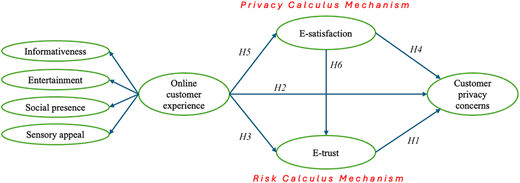
The relationship model is shown in Figure 1.

The questionnaire consists of items adapted from scales previously validated in the academic literature. A 5-point Likert scale is used. The OCX scale proposed by Bleier et al. (2019) was utilised, which identifies four dimensions: informativeness, entertainment, social presence and sensory appeal. The measurement of e-satisfaction was conducted utilising the scale proposed by Hult et al. (2019). For the purpose of measuring e-trust and customer privacy concerns, the scales proposed by Cheah et al. (2022) were employed.

The final version of the questionnaire was distributed on social media (Facebook and Instagram), between August and December 2021. In relation to the sampling approach, it was non-probabilistic, with a combination of convenience sampling and self-selection by respondents who voluntarily chose to participate in the research. We obtained 1,123 valid responses from Spanish consumers who had recently made online purchases. The estimated sampling error is ±2.92%, assuming a 95% confidence level and maximum variability (p = q = 0.5). Of all these responses, 918 were answered by individuals who had visited several websites before deciding to buy the product or service from a particular website, and 205 were given by people who had followed a multirooming behaviour, searching and comparing offers through online and offline channels before making an online purchase.

With respect to the sample profile, 50.6% of respondents have a university degree, while 34.1% have completed high school. 78.3% are female. The average age is 40.1 years. The age distribution of the sample was: 17.1% are between 18 and 29, 63.8% are between 30 and 49, and 18.6% are between 50 and 69.

Data analysis was conducted using structural equation modelling (EQS 6.4). We used maximum likelihood (ML) estimation with robust statistics, such as Satorra-Bentler scaled chi-square. Robust statistics are particularly suitable for handling non-normal data.

Three criteria were used to assess the potential presence of CMB in the data. Firstly, we used Harman's single factor analysis. The results of this analysis, with the 24 indicators loading onto a single factor, demonstrated a poor fit (Satorra–Bentler χ2 = 6227.65; df = 299; p-value<0.05; χ2/df = 20.82; CFI = 0.57). Secondly, we used principal component analysis to examine the unrotated factor solution. The result revealed six factors with eigenvalues above 1, which explained 68.70%, with the first factor explaining 37.43%. Thirdly, we included two marker variables in the research model that were not related to at least one of the study's key variables: occupation and place of residence. Non-significant correlations were identified, except between the main occupation marker variable and sensory appeal. Furthermore, the pattern and magnitude of the correlations remained largely unchanged following the inclusion of the marker variables. For all these reasons, the common method bias seems not to be a concern in this research.

Finally, we also verified the lack of signs of multicollinearity by testing the variance inflation factor among the items in the model. The results were between 1.014 and 6.285, lower than the maximum value of 10. This result falls within the range of moderate collinearity (5 < VIF <10), which has been considered acceptable in previous studies (Sasmita and Suki, 2015).

First, we tested the multidimensional structure of the second-order construct. The Lagrange multiplier test recommended a modification of the error correlation between two pairs of items. The final measurement model of the OCX construct had an acceptable fit (Table 2).

Second, we analysed a full measurement model with the OCX construct and the other three main constructs. One item from e-trust and one item from customer privacy concerns were removed because their factor loadings were below the 0.6 threshold. Then, the measurement model showed an acceptable fit. In addition, we considered composite reliability and Cronbach's alpha to assess the reliability of the scales. The results were above the 0.7 threshold (Table 2).

The convergent validity of the first and second-order variables was tested with the BBNFI, which showed a value (0.94) above 0.9, and with the AVE, which yielded values higher than 0.5. Finally, we tested the discriminant validity by means of the heterotrait-monotrait (HTMT) ratio (Table 3). All values below the diagonal are less than 0.85 (Henseler et al., 2015).

Table 4 shows the results of the structural model. Different statistics corroborate an acceptable model fit.

The results supported the first hypothesis because, e-trust is negatively and significantly related to customer privacy concerns. The second hypothesis is supported because there is a negative and significant relationship between OCX and customer privacy concerns. However, the results do not support the third hypothesis as there is no significant relationship between OCX and e-trust. The fourth hypothesis is supported because e-satisfaction is negatively and significantly related to customer privacy concerns. Moreover, the results support the fifth hypothesis because there is a positive and significant relationship between OCX and e-satisfaction. The sixth hypothesis is also supported as there is a positive and significant relationship between e-satisfaction and e-trust. The seventh hypothesis has been tested in part. Finally, age is the only control variable that is significantly related to customer privacy concerns. Older customers in the research sample reported greater privacy concerns.

We divided the sample into customers who had visited several websites before deciding to buy a product or service from a particular website (n = 918) and customers who had followed a multirooming behaviour (n = 205). We conducted a multigroup analysis, via EQS 6.4. Measurement and structural invariances are examined. Measurement invariance was assessed by examining the configural and metric invariances. For the multigroup model, different statistics corroborate an acceptable fit (Table 5), which indicates the existence of configural invariance. We analysed the metric invariance by comparing the multigroup model with one model in which the factor loadings and paths were constrained to be equal across the two subsamples. The result of this test was statistically non-significant.

We also tested structural invariance. First, we estimated the unconstrained model with structural relationships set free to vary in each subsample. We compared the multigroup model with a constrained model in which the structural relationships were constrained to be equal across both subsamples. The result of this test was statistically non-significant.

Finally, we conducted invariance tests of the paths analysed between factors, and between control variables and the online variables. In all cases, the results of this test were statistically non-significant, except for the relationship between customers' gender and e-satisfaction. Moreover, two causal relationships between factors (e-satisfaction and customer online privacy concerns; e-trust and customer online privacy concerns) are significant in the subsample who had visited several websites, but not in the subsample who had exhibited multirooming behaviour. Regarding the control variables of the model, there is a significant relationship between age and online privacy concerns for customers who had visited several websites. In the subsample with multirooming behaviour, there is a significant relationship between age and e-satisfaction and between gender and online privacy concerns.

In relation to the hypotheses, from these results the following can be considered: H2, H5, and H6 are supported; H1, H4 and H7 are partially supported (because the differences between the two subsamples); but H3 is not.

The objective of this paper is to study how specific online shopping variables (OCX, e-satisfaction, and e-trust) influence customer privacy concerns on the omnichannel consumer journey through the privacy and risk calculus mechanisms.

In relation to RQ1, all three online variables significantly impact privacy concerns, with OCX exhibiting the greatest influence both directly and indirectly. This finding aligns with previous research indicating that specific OCX components, such as informativeness and entertainment, contribute to a reduction in perceived vulnerability and an enhancement in users' propensity to share personal data (Maseeh et al., 2021; Bleier et al., 2019; Aiello et al., 2020). In the context of e-trust, the present study corroborates the prevailing notion of its deleterious impact on privacy concerns, a finding that aligns with extant research in the domain of e-commerce (Rodríguez-Priego et al., 2023; Broeder, 2023) and digital banking settings (Lappeman et al., 2023). E-trust is a pivotal mechanism for mitigating perceived risk in online environments devoid of human interaction (Jaspers and Pearson, 2022; Swani et al., 2021; Aiello et al., 2020; Hajli et al., 2017). In a similar vein, e-satisfaction has been shown to have a substantial impact on privacy concerns. Previous research findings suggest that satisfaction derived from functional and hedonic value serves to mitigate privacy anxieties (Cloarec et al., 2024; Maseeh et al., 2021).

An unexpected result is that the influence of OCX on e-trust is not significant, which contradicts much of the literature on the subject (Micu et al., 2019; Saoula et al., 2023; Pires et al., 2024; Upadhyay et al., 2024). The explanation for this result may be due to the risk calculus mechanism, since the lack of both in-person interaction and information about the e-seller in the online context leads to suspicion, uncertainty, and increased perceived risk in online exchanges (Hajli et al., 2017).

Regarding RQ2, we verify that the dual privacy calculus model provides a comprehensive explanation of the mechanisms through which these antecedents operate. E-satisfaction aligns with the privacy calculus mechanism, as it reflects the evaluation of perceived benefits versus expectations (Lu, 2024; Bouhia et al., 2022), while e-trust operates via the risk calculus, by reducing perceived threat (Nguyen et al., 2024; Gouthier et al., 2022). The findings suggest that privacy calculus holds greater significance in addressing privacy concerns in comparison to risk calculus, given its direct and indirect influence on privacy concerns. This study demonstrates a recursive relationship between e-satisfaction and e-trust, thereby corroborating the conceptual propositions of Li (2011) and Cloarec et al. (2024). However, this relationship has not yet been empirically validated.

Finally, with respect to RQ3, whilst the dual-calculus mechanisms are of significance to customers engaged solely in online shopping, their explanatory power is diminished in omnichannel contexts. In the context of multirooming behaviours, which entail the integration of online and offline channels, only OCX has been found to exert a substantial influence on privacy concerns. Offline interactions provide alternative trust cues that reduce reliance on e-trust and e-satisfaction (Nguyen et al., 2024; Aiello et al., 2020). This shift may be attributed to the increased availability of physical experiences, which have been shown to engender trust and satisfaction independently of online performance (Szymanski and Hise, 2000; Hajli et al., 2017).

Then, online shopping behaviour cannot be considered homogenous with respect to privacy concerns. The omnichannel consumer journey, in which the consumer combines online inspiration and information with visits to physical retail outlets, substitutes the need for online-based reassurance mechanisms such as e-satisfaction and e-trust. The offline environment has a positive effect on privacy concerns since e-satisfaction and e-trust are no longer significant on the omnichannel consumer journey, where there is in-person interaction. This is in line with Hajli et al. (2017), who state that, in the absence of direct interaction, consumers rely more heavily on their online experiences and trust in the digital environment to form their privacy perceptions. OCX remains significant across both journey types, reaffirming the central role of customer experience in building engagement and reducing perceived privacy risks (Upadhyay et al., 2024; Pires et al., 2024).

This paper makes three contributions to the literature. First, we conducted a study of the online antecedents of customer privacy concerns by comparing omnichannel and online consumer journeys. Prior research has predominantly focused on online-only contexts without considering the unique dynamics of omnichannel environments. The results show that privacy concerns are context-dependent.

Second, we studied the importance of privacy and risk calculus mechanisms, using e-satisfaction and e-trust. The results show that, on the online consumer journey, privacy calculus is more relevant than risk calculus, although the offline environment prevails on the omnichannel consumer journey. We have identified interdependence between privacy and risk calculus mechanisms, which is a novel contribution to the literature.

Third, the role of OCX is highlighted. On both the omnichannel and online consumer journeys, OCX is the main antecedent of customer privacy concerns. Moreover, on the omnichannel journey, OCX is the only significant antecedent, since privacy and risk calculus seem to depend on offline interactions.

Regarding managerial implications and recommendations, for online and omnichannel consumer journeys, e-commerce websites should invest in user-friendly, informative, and engaging online shopping interfaces that provide good OCX, because OCX dimensions (informativeness, entertainment, social presence, and sensory appeal) significantly influence customer privacy concerns.

The offline experience has considerable bearing on the omnichannel consumer journey and should be aided by competent front-line personnel, personalised services, and seamless integration with online channels. The existence of a physical store, in which the consumer can make e-commerce more tangible, helps reduce privacy concerns, a circumstance that is more significant for women. Also recommended is the development of marketing campaigns that emphasise data security, trustworthiness, and the added value that self-disclosure offers the customer.

When the consumer visits physical stores and makes purchases online, an important part of privacy concerns are resolved in the offline environment. The challenge lies in using integrated online and offline systems that provide a cohesive cross-channel experience and that ensure that online and offline data are synchronised and used effectively. Additionally, continuous monitoring of the perception of privacy concerns in OCX will help implement continuous improvements and adaptations of e-commerce websites to changing customer needs.

To activate the privacy calculus mechanism on the online consumer journey, e-commerce websites should provide clear information on how customer data will be used, respecting the regulations in force in each country, and the benefits that data sharing will provide. To activate the risk calculus mechanism, e-commerce websites should focus on an e-trust-building strategy, implement good practices in website transparency, invest in secure payment mechanisms, and make privacy policies visible. The use of trust signals, such as third-party certifications (e.g. ePrivacyseal) and customer reviews, can be of great help. It is recommended that privacy-enhancing technologies are implemented, such as differential privacy for anonymised data analytics, and blockchain for securing transaction records. Offering user-friendly privacy options, so that customers need not click on a multitude of options, which can cause distrust, would be useful. It is also worth noting that older consumers can have more privacy concerns.

The main limitation of this work is the country-specific sample. This research should be extended to other countries and cultures to validate the results. Furthermore, field work carried out on social networks may incur a self-selection bias, such that the sample is not fully representative of the general population. However, this bias is minimised when online purchasing behaviours are studied because the entire population does not make purchases online and those who do, do so through social networks. Another limitation is that the sample has a higher percentage of women, aged 30–49. It is also worth noting that this overrepresented segment constitutes an important consumer group in the digital market, and the insights derived from their behaviour provide valuable information for understanding current online shopping trends.

Future research should examine other multichannel consumer behaviours, such as webrooming and showrooming, and compare the significance of the antecedents of privacy concerns. The results of this study should be analysed and extended to other countries and cultures. Finally, the literature highlights the relevance of consumer contextual factors, which represents an opportunity to analyse how personality or situational factors influence consumer privacy concerns.
Aboulnasr
,
K.
,
Tran
,
G.A.
and
Park
,
T.
(
2022
), “
Personal information disclosure on social networking sites
”,
Psychology and Marketing
, Vol. 
39
No. 
2
, pp. 
294
-
308
, doi: .
Aiello
,
G.
,
Donvito
,
R.
,
Acuti
,
D.
,
Grazzini
,
L.
,
Mazzoli
,
V.
,
Vannucci
,
V.
and
Viglia
,
G.
(
2020
), “
Customers' willingness to disclose personal information throughout the customer purchase journey in retailing: the role of perceived warmth
”,
Journal of Retailing
, Vol. 
96
No. 
4
, pp. 
490
-
506
, doi: .
Alalwan
,
A.A.
,
Baabdullah
,
A.M.
,
Al-Debei
,
M.M.
,
Raman
,
R.
,
Alhitmi
,
H.K.
,
Abu-ElSamen
,
A.A.
and
Dwivedi
,
Y.K.
(
2024
), “
Fintech and contactless payment: help or hindrance? The role of invasion of privacy and information disclosure
”,
International Journal of Bank Marketing
, Vol. 
42
No. 
1
, pp. 
66
-
93
, doi: .
Alzaidi
,
M.S.
and
Agag
,
G.
(
2022
), “
The role of trust and privacy concerns in using social media for e-retail services: the moderating role of COVID-19
”,
Journal of Retailing and Consumer Services
, Vol. 
68
 103042, doi: .
Bansal
,
G.
and
Nah
,
F.F.H.
(
2022
), “
Internet privacy concerns revisited: oversight from surveillance and right to be forgotten as new dimensions
”,
Information and Management
, Vol. 
59
No. 
3
 103618, doi: .
Barari
,
M.
,
Ross
,
M.
and
Surachartkumtonkun
,
J.
(
2020
), “
Negative and positive customer shopping experience in an online context
”,
Journal of Retailing and Consumer Services
, Vol. 
53
 101985, doi: .
Bleier
,
A.
,
Harmeling
,
C.M.
and
Palmatier
,
R.W.
(
2019
), “
Creating effective online customer experiences
”,
Journal of Marketing
, Vol. 
83
No. 
2
, pp. 
98
-
119
, doi: .
Bouhia
,
M.
,
Rajaobelina
,
L.
,
PromTep
,
S.
,
Arcand
,
M.
and
Ricard
,
L.
(
2022
), “
Drivers of privacy concerns when interacting with a chatbot in a customer service encounter
”,
International Journal of Bank Marketing
, Vol. 
40
No. 
6
, pp. 
1159
-
1181
, doi: .
Broeder
,
P.
(
2023
), “
Self-disclosure and trust in the shared economy: a cross-cultural comparison
”,
Tourism and Management Studies
, Vol. 
19
No. 
3
, pp. 
73
-
82
, doi: .
Cheah
,
J.H.
,
Lim
,
X.J.
,
Ting
,
H.
,
Liu
,
T.
and
Quach
,
S.
(
2022
), “
Are privacy concerns still relevant? Revisiting consumer behaviour in omnichannel retailing
”,
Journal of Retailing and Consumer Services
, Vol. 
65
 102242, doi: .
Chen
,
J.-S.
,
Le
,
T.-T.-Y.
and
Florence
,
D.
(
2021
), “
Usability and responsiveness of artificial intelligence chatbot on online customer experience in e-retailing
”,
International Journal of Retail and Distribution Management
, Vol. 
49
No. 
11
, pp. 
1512
-
1531
, doi: .
Cloarec
,
J.
,
Meyer‐Waarden
,
L.
and
Munzel
,
A.
(
2024
), “
Transformative privacy calculus: conceptualizing the personalization‐privacy paradox on social media
”,
Psychology and Marketing
, Vol. 
41
No. 
7
, pp. 
1574
-
1596
, doi: .
de Carvalho
,
G.J.
,
Machado
,
M.C.
and
Correa
,
V.S.
(
2024
), “
Omnichannel and consumer and retailer perceived risks and benefits: a review
”,
International Journal of Retail and Distribution Management
, Vol. 
52
No. 
3
, pp. 
295
-
311
, doi: .
de Oliveira
,
G.G.
,
Lizarelli
,
F.L.
,
Teixeira
,
J.G.
and
de Sousa Mendes
,
G.H.
(
2023
), “
Curb your enthusiasm: examining the customer experience with alexa and its marketing outcomes
”,
Journal of Retailing and Consumer Services
, Vol. 
71
 103220, doi: .
European Commission
(
2023
), “
Special eurobarometer 532 on the digital decade
”,
available at:
 file:///Users/miguelangel/Downloads/ebs_532_digital_decade_report.pdf
Evanschitzky
,
H.
,
Iyer
,
G.R.
,
Hesse
,
J.
and
Ahlert
,
D.
(
2004
), “
E-satisfaction: a re-examination
”,
Journal of Retailing
, Vol. 
80
No. 
3
, pp. 
239
-
247
, doi: .
Gouthier
,
M.H.J.
,
Nennstiel
,
C.
,
Kern
,
N.
and
Wendel
,
L.
(
2022
), “
The more the better? Data disclosure between the conflicting priorities of privacy concerns, information sensitivity and personalization in e-commerce
”,
Journal of Business Research
, Vol. 
148
, pp. 
174
-
189
, doi: .
Hajli
,
N.
,
Sim
,
J.
,
Zadeh
,
A.H.
and
Richard
,
M.O.
(
2017
), “
A social commerce investigation of the role of trust in a social networking site on purchase intentions
”,
Journal of Business Research
, Vol. 
71
, pp. 
133
-
141
, doi: .
Henseler
,
J.
,
Ringle
,
C.M.
and
Sarstedt
,
M.
(
2015
), “
A new criterion for assessing discriminant validity in variance-based structural equation modeling
”,
Journal of the Academy of Marketing Science
, Vol. 
43
No. 
1
, pp. 
115
-
135
, doi: .
Hult
,
G.T.M.
,
Sharma
,
P.N.
,
Morgeson
,
F.V.
III and
Zhang
,
Y.
(
2019
), “
Antecedents and consequences of customer satisfaction: do the differ across online and offline purchases?
”,
Journal of Retailing
, Vol. 
95
No. 
1
, pp. 
10
-
23
, doi: .
Jaspers
,
E.D.
and
Pearson
,
E.
(
2022
), “
Consumers' acceptance of domestic Internet-of-Things: the role of trust and privacy concerns
”,
Journal of Business Research
, Vol. 
142
, pp. 
255
-
265
, doi: .
Kähkönen
,
T.
,
Blomqvist
,
K.
,
Gillespie
,
N.
and
Vanhala
,
M.
(
2021
), “
Employee trust repair: a systematic review of 20 years of empirical research and future research directions
”,
Journal of Business Research
, Vol. 
130
, pp. 
98
-
109
, doi: .
Lappeman
,
J.
,
Marlie
,
S.
,
Johnson
,
T.
and
Poggenpoel
,
S.
(
2023
), “
Trust and digital privacy: willingness to disclose personal information to banking chatbot services
”,
Journal of Financial Services Marketing
, Vol. 
28
No. 
2
, pp. 
337
-
357
, doi: .
Li
,
Y.
(
2011
), “
Empirical studies on online information privacy concerns: literature review and an integrative framework
”,
Communications of the Association for Information Systems
, Vol. 
28
No. 
1
, p.
28
, doi: .
Li
,
G.
,
Wang
,
T.
,
Yang
,
M.
and
Guo
,
F.
(
2025
), “
The impact of perceived experience on customer privacy concerns during AI-Human interaction: the chain mediating effect of hedonic value and trust
”,
International Journal of Human-Computer Interaction
, pp. 
1
-
14
, doi: .
Lu
,
C.-H.
(
2024
), “
The moderating role of e-lifestyle on disclosure intention in Mobile banking: a privacy calculus perspective
”,
Electronic Commerce Research and Applications
, Vol. 
64
, 101374, doi: .
Luceri
,
B.
,
Bijmolt
,
T.H.A.
,
Bellini
,
S.
and
Aiolfi
,
S.
(
2022
), “
What drives consumers to shop on Mobile devices? Insights from a meta-analysis
”,
Journal of Retailing
, Vol. 
98
No. 
1
, pp. 
178
-
196
, doi: .
Maseeh
,
H.I.
,
Jebarajakirthy
,
C.
,
Pentecost
,
R.
,
Arli
,
D.
,
Weaven
,
S.
and
Ashaduzzaman
,
M.
(
2021
), “
Privacy concerns in e-commerce: a multilevel meta-analysis
”,
Psychology and Marketing
, Vol. 
38
No. 
10
, pp. 
1779
-
1798
, doi: .
Micu
,
A.E.
,
Bouzaabia
,
O.
,
Bouzaabia
,
R.
,
Micu
,
A.
and
Capatina
,
A.
(
2019
), “
Online customer experience in e-retailing: implications for web entrepreneurship
”,
The International Entrepreneurship and Management Journal
, Vol. 
15
No. 
2
, pp. 
651
-
675
, doi: .
Molinillo
,
S.
,
Navarro-García
,
A.
,
Anaya-Sánchez
,
R.
and
Japutra
,
A.
(
2020
), “
The impact of affective and cognitive app experiences on loyalty towards retailers
”,
Journal of Retailing and Consumer Services
, Vol. 
54
, 101948, doi: .
Moliner
,
M.A.
and
Tortosa-Edo
,
V.
(
2024
), “
Multirooming: generating e-satisfaction throughout omnichannel consumer journey design and online customer experience
”,
The Journal of Research in Indian Medicine
, Vol. 
18
No. 
3
, pp. 
349
-
369
, doi: .
Nguyen
,
T.T.
,
Tran
,
V.T.T.
and
Tran Hoang
,
M.T.
(
2024
), “
How peer privacy concerns affect active and passive uses of social networking sites: a dual peer privacy calculus model
”,
Social Science Computer Review
, Vol.
42
No.
6
, pp.
1440
-
1463
.
Nunkoo
,
R.
and
Smith
,
S.L.
(
2014
), “Trust, tourism development, and planning”, in
Trust, Tourism Development and Planning
,
Routledge
, pp. 
1
-
8
.
Okazaki
,
S.
,
Eisend
,
M.
,
Plangger
,
K.
,
de Ruyter
,
K.
and
Grewal
,
D.
(
2020
), “
Understanding the strategic consequences of customer privacy concerns: a meta-analytic review
”,
Journal of Retailing
, Vol. 
96
No. 
4
, pp. 
458
-
473
, doi: .
Pires
,
P.B.
,
Prisco
,
M.
,
Delgado
,
C.
and
Santos
,
J.D.
(
2024
), “
A conceptual approach to understanding the customer experience in e-commerce: an empirical study
”,
Journal of Theoretical and Applied Electronic Commerce Research
, Vol. 
19
No. 
3
, pp. 
1943
-
1983
, doi: .
Quach
,
S.
,
Thaichon
,
P.
,
Martin
,
K.D.
,
Weaven
,
S.
and
Palmatier
,
R.W.
(
2022
), “
Digital technologies: tensions in privacy and data
”,
Journal of the Academy of Marketing Science
, Vol. 
50
No. 
6
, pp. 
1299
-
1323
, doi: .
Rodríguez-Priego
,
N.
,
Porcu
,
L.
,
Prados-Peña
,
M.B.
and
Crespo-Almendros
,
E.
(
2023
), “
Perceived customer care and privacy protection behaviour: the mediating role of trust in self-disclosure
”,
Journal of Retailing and Consumer Services
, Vol. 
72
, 103284, doi: .
Saoula
,
O.
,
Shamim
,
A.
,
Suki
,
N.M.
,
Ahmad
,
M.J.
,
Abid
,
M.F.
,
Patwary
,
A.K.
and
Abbasi
,
A.Z.
(
2023
), “
Building e-trust and e-retention in online shopping: the role of website design, reliability and perceived ease of use
”,
Spanish Journal of Marketing-ESIC
, Vol. 
27
No. 
2
, pp. 
178
-
201
, doi: .
Sasmita
,
J.
and
Suki
,
N.M.
(
2015
), “
Young consumers' insights on brand equity: effects of brand association, brand loyalty, brand awareness, and brand image
”,
International Journal of Retail and Distribution Management
, Vol. 
43
No. 
3
, pp. 
276
-
292
.
Silva
,
S.C.
,
Silva
,
F.P.
and
Dias
,
J.C.
(
2024
), “
Exploring omnichannel strategies: a path to improve customer experiences
”,
International Journal of Retail and Distribution Management
, Vol. 
52
No. 
1
, pp. 
62
-
88
, doi: .
Swani
,
K.
,
Milne
,
G.R.
and
Slepchuk
,
A.N.
(
2021
), “
Revisiting trust and privacy concern in consumers' perceptions of marketing information management practices: replication and extension
”,
Journal of Interactive Marketing
, Vol. 
56
No. 
1
, pp. 
137
-
158
, doi: .
Szymanski
,
D.M.
and
Hise
,
R.T.
(
2000
), “
E-satisfaction: an initial examination
”,
Journal of Retailing
, Vol. 
76
No. 
3
, pp. 
309
-
322
, doi: .
Tajvidi
,
M.
,
Richard
,
M.O.
,
Wang
,
Y.
and
Hajli
,
H.
(
2020
), “
Brand co-creation through social commerce information sharing: the role of social media
”,
Journal of Business Research
, Vol. 
121
, pp. 
476
-
486
, doi: .
Upadhyay
,
Y.
,
Baber
,
R.
,
Paul
,
J.
,
Baber
,
P.
and
Cain
,
L.
(
2024
), “
Beyond de first bite: understanding how online experience shapes user loyalty in the mobile food app market
”,
Electronic Commerce Market
, Vol. 
24
No. 
2
, pp. 
799
-
823
, doi: .
Wang
,
C.L.
(
2021
), “
New frontiers and future directions in interactive marketing: inaugural editorial
”,
The Journal of Research in Indian Medicine
, Vol. 
15
No. 
1
, pp. 
1
-
9
, doi: .
Yahia
,
K.B.
and
Berraies
,
S.
(
2025
), “
Banks' e-reputation and customers' e-loyalty in the mobile-banking applications: e-trust and e-satisfaction as mediators and frequency of use as moderator
”,
European Journal of International Management
, Vol. 
25
No. 
1
, pp. 
98
-
121
, doi: .
Published by Emerald Publishing Limited. This article is published under the Creative Commons Attribution (CC BY 4.0) licence. Anyone may reproduce, distribute, translate and create derivative works of this article (for both commercial and non-commercial purposes), subject to full attribution to the original publication and authors. The full terms of this licence may be seen at Link to the terms of the CC BY 4.0 licence.

Data & Figures

Figure 1
A flowchart shows how online customer experience, privacy concerns, and e-trust affect e-satisfaction.The flowchart starts with a first oval labeled “Online customer experience.” Four leftward arrows from “Online customer experience” lead to four ovals arranged vertically and labeled from top to bottom as follows: “Informativeness,” “Entertainment,” “Social presence,” and “Sensory appeal.” A rightward arrow labeled H 2 from “Online customer experience” leads to a sixth oval on the far right labeled “Customer privacy concerns.” A diagonal upward arrow labeled H 5 from “Online customer experience” leads to a seventh oval on the top right labeled “E-satisfaction.” A diagonal downward arrow labeled H 3 from “Online customer experience” leads to an eighth oval at the bottom right labeled “E-trust.” An arrow labeled H 4 from “E-satisfaction” leads to “Customer privacy concerns.” An arrow labeled H 1 from “E-trust” leads to “Customer privacy concerns.” A downward arrow labeled H 6 from “E-satisfaction” leads to “E-trust.” “E-satisfaction” is labeled “Privacy Calculus Mechanism.” “E-trust” is labeled “Risk Calculus Mechanism.”

Causal model. Source: Authors’ own work

Figure 1
A flowchart shows how online customer experience, privacy concerns, and e-trust affect e-satisfaction.The flowchart starts with a first oval labeled “Online customer experience.” Four leftward arrows from “Online customer experience” lead to four ovals arranged vertically and labeled from top to bottom as follows: “Informativeness,” “Entertainment,” “Social presence,” and “Sensory appeal.” A rightward arrow labeled H 2 from “Online customer experience” leads to a sixth oval on the far right labeled “Customer privacy concerns.” A diagonal upward arrow labeled H 5 from “Online customer experience” leads to a seventh oval on the top right labeled “E-satisfaction.” A diagonal downward arrow labeled H 3 from “Online customer experience” leads to an eighth oval at the bottom right labeled “E-trust.” An arrow labeled H 4 from “E-satisfaction” leads to “Customer privacy concerns.” An arrow labeled H 1 from “E-trust” leads to “Customer privacy concerns.” A downward arrow labeled H 6 from “E-satisfaction” leads to “E-trust.” “E-satisfaction” is labeled “Privacy Calculus Mechanism.” “E-trust” is labeled “Risk Calculus Mechanism.”

Causal model. Source: Authors’ own work

Close modal
Table 1

Main research on consumer privacy concerns

StudyContextTheory usedAntecedents of privacy concernsJourney typeOnline antecedents included
Lu (2024) Mobile bankingPrivacy calculusPerceived benefits and risksOnline onlyOCX (✖), e-trust (✖), e-satisfaction (✖)
Nguyen et al. (2024) Social mediaPrivacy calculusSubjective utility, benefit–risk evaluationOnline onlyOCX (✖), e-trust (✖), e-satisfaction (✖)
Cloarec et al. (2024) Social mediaDual privacy calculusTrust, information collection concerns, happiness with the internetOnline onlyOCX (✖), e-trust (✔), e-satisfaction (✔)
Lappeman et al. (2023) Digital banking (chatbots)Trust (risk calculus)Privacy concerns, trustOnline onlyOCX (✖), e-trust (✔), e-satisfaction (✖)
Rodríguez-Priego et al. (2023) E-commerce (Amazon)TrustTrust, perceived control, privacy concernOnline onlyOCX (✖), e-trust (✔), e-satisfaction (✖)
Broeder (2023) Sharing economy (Airbnb)TrustTrustOnline onlyOCX (✖), e-trust (✔), e-satisfaction (✖)
Quach et al. (2022) GeneralStructuration theoryMultiple privacy dimensionsNot specifiedOCX (✖), e-trust (✖), e-satisfaction (✖)
Bouhia et al. (2022) Auto insurance (chatbot)Privacy calculusCreepiness, perceived riskOnline onlyOCX (✖), e-trust (✖), e-satisfaction (✖)
Gouthier et al. (2022) E-commercePrivacy calculusSubjective expected utility, privacy concernsOnline onlyOCX (✖), e-trust (✖), e-satisfaction (✖)
Aboulnasr et al. (2022) Social networkingSocial identity + privacy calculusIdentification, benefits, risksOnline onlyOCX (✖), e-trust (✖), e-satisfaction (✖)
Cheah et al. (2022) Omnichannel retailingPsychological reactance theoryPrivacy concerns as moderatorOmnichannelOCX (✖), e-trust (✖), e-satisfaction (✖)
Aiello et al. (2020) RetailCustomer journey + social judgementPerceived warmth, privacy concernsOmnichannel (phases)OCX (✖), e-trust (✖), e-satisfaction (✖)
Bleier et al. (2019) General (data-driven marketing)Information privacy theoryTrust, control, transparency, culture, privacy calculusNot specifiedOCX (✖), e-trust (✖), e-satisfaction (✖)
This studyE-commerce (multirooming)Dual privacy calculusOCX, e-satisfaction, e-trustOmnichannel vs online-onlyOCX (✔), e-trust (✔), e-satisfaction (✔)
Source(s): Authors’ own work
Table 2

Dimensionality, reliability, and convergent validity of the scales of the model

ItemsMeanStandard DevFactor loading (standardised)t-test
Online customer experience
AVE = 0.78, composite reliability = 0.91, Cronbach's alpha = 0.91
Informativeness (AVE = 0.59, composite reliability = 0.81, Cronbach's alpha = 0.84
P.1.1 Information obtained from the website is useful4.190.820.69Fixed
P.1.2. I learnt a lot from using the website3.700.950.85*22.62
P.1.3. I think the information obtained from the website is helpful4.040.860.77*26.47
Social presence (AVE = 0.85, composite reliability = 0.94, Cronbach's alpha = 0.94
P.1.4. There is a sense of human contact in the webpage3.261.160.90Fixed
P.1.5. There is a sense of human warmth in the webpage3.111.160.96*55.48
P.1.6. There is a sense of human sensitivity in the webpage2.991.160.91*46.81
Sensory appeal (AVE = 0.50, composite reliability = 0.75, Cronbach's alpha = 0.81
P.1.7. The product presentation on this webpage is lively3.751.000.77Fixed
P.1.8. I can acquire product information on this webpage from different sensory channels3.001.270.67*23.61
P.1.9. This webpage contains product information exciting to senses2.921.270.68*24.03
Entertainment (AVE = 0.68, composite reliability = 0.86, Cronbach's alpha = 0.87
P.1.10 Not fun/fun3.441.160.79Fixed
P.1.11 Not enjoyable/enjoyable3.671.120.81*26.83
P.1.12 Not at all entertaining/very entertaining3.591.130.87*27.16
E-satisfaction (AVE = 0.77, composite reliability = 0.91, Cronbach's alpha = 0.91
P.2.1. My expectations with the website have been met.4.160.870.84Fixed
P.2.2. I am satisfied with the service I have received from this website4.190.880.91*35.59
P.2.3. I am satisfied with this website4.230.840.88*29.13
E-trust (AVE = 0.75, composite reliability = 0.92, Cronbach's alpha = 0.92
P.3.1 This website is reliable4.460.770.89Fixed
P.3.2 This website is trustworthy4.450.800.92*39.29
P3.3 The products and services on this website are reliable4.330.830.81*34.21
P.3.4 This website provides secure transactions4.450.780.85*24.97
Customer privacy concerns (AVE = 0.59, composite reliability = 0.74, Cronbach's alpha = 0.75
P4.1 I did not feel comfortable sharing my information with this website2.571.130.79Fixed
P.4.2 This website causes serious privacy problems2.351.080.75*18.76
Control variables
P.5. Customer's age40.0611.00  
P.6. Customer's gender (male, female)1.780.41  
P.7. Customer's level of education4.310.82  

Note(s): Fit of the model: Satorra-Bentler χ2 = 805.474; df. = 228; p-value = 0.000; Satorra-Bentler χ2/df = 3.53; CFI = 0.96; BBNFI = 0.94; BBNNFI = 0.95; IFI = 0.96; RMSEA = 0.05

* Significant at p ≤ 0.05

- The following items have been removed in this analysis as they had a factor loading below 0.6: Item P3.5. (There is no need to take precautions with this website) and Item P.4.3 (I am sensitive to the way this website handles my personal information.)

Source(s): Authors’ own work
Table 3

Discriminant validity of the scales using the HTMT method

Factors(1)(2)(3)(4)(5)(6)(7)
(1) Informativeness1.000      
(2) Entertainment0.5111.000     
(3) Social presence0.5740.4801.000    
(4) Sensory appeal0.6740.5840.8411.000   
(5) E-satisfaction0.7680.4770.3820.4961.000  
(6) E-trust0.6490.3500.2640.3460.7781.000 
(7) Customer privacy concern0.6140.4650.5450.6080.5870.5121.000
Source(s): Authors’ own work
Table 4

Hypothesis testing

Parameter estimates (standardised values)SEt-test
Direct relationship
H1: E-trust → Customer privacy concerns−0.117*0.09−1.82
H2: Online customer experience → Customer privacy concerns−0.538**0.11−9.23
H3: Online customer experience → E-trustn.s0.05−0.19
H4: E-satisfaction → Customer privacy concerns−0.154**0.10−1.98
H5: Online customer experience → E-satisfaction0.628**0.0616.42
H6: E-satisfaction → E-trust0.778**0.0515.67
Indirect relationship
H7: Online customer experience → E-trust0.488**0.0610.95
H7: Online customer experience → Customer privacy concerns−0.153**0.07−4.40
H7: E-satisfaction → Customer privacy concerns−0.091*0.06−1.80
Relations between control variables and dependent variables
Customer's age → E-Satisfactionn.s0.00−1.14
Customer's gender → E-Satisfactionn.s0.040.50
Customer's level of education → E-Satisfactionn.s0.020.39
Customer's age → E-trustn.s0.00−1.01
Customer's gender → E-trustn.s0.03−0.48
Customer's level of education → E-trustn.s0.021.25
Customer's age → Customer privacy concerns0.053*0.001.80
Customer's gender → Customer privacy concernsn.s0.060.93
Customer's level of education → Customer privacy concernsn.s0.04−1.00
Measurement model
Online customer experience → Informativeness0.844Fixed
Online customer experience → Social presence0.787**0.0916.56
Online customer experience → Sensory appeal1**0.0919.07
Online customer experience → Entertainment0.631**0.0913.38
Dependent factorR2
E-satisfaction0.395
E-trust0.603
Customer privacy concern0.525
Goodness-of-fit indices for the structural modelSatorra–Bentler χ2 = 820.232; df = 231; p-value = 0.000; Satorra–Bentler χ2/df = 3.55;
CFI = 0.96; BBNFI = 0.94; BBNNFI = 0.95
IFI = 0.96; RMSEA = 0.05

Note(s): **Significant at p ≤ 0.05

*Significant at p ≤ 0.1

n.s.: non-significant

Source(s): Authors’ own work
Table 5

Multigroup analysis

Structural model for customers who had visited several websitesStructural model for customers who had followed a multirooming behaviourBoth subsamples
Parameter estimates (standardised values)t-testParameter estimates (standardised values)t-testStructural invariance for each path
Direct relationship
H1: E-trust → Customer privacy concerns−0.14**−1.99n.s0.43p-value >0.05
H2: Online customer experience → Customer privacy concerns−0.51**−7.93−0.78**−4.14p-value >0.05
H3: Online customer experience → E-trustn.s0.26n.s−0.71p-value >0.05
H4: E-satisfaction → Customer privacy concerns−0.14*−1.65n.s−0.62p-value >0.05
H5: Online customer experience → e-satisfaction0.61**14.230.82**9.63p-value >0.05
H6: E-satisfaction → E-trust0.75**13.830.92**5.57p-value >0.05
Indirect relationship
H7: Online customer experience → E-trust0.46**9.760.76**4.54p-value >0.05
H7: Online customer experience → Customer privacy concerns−0.15**−3.91n.s−0.54p-value >0.05
H7: E-satisfaction → Customer privacy concerns−0.10*−1.95n.s0.42p-value >0.05
Relations between control variables and dependent variables
Customer's age → E-Satisfactionn.s0.05−0.16**−2.65p-value >0.05
Customer's gender → E-Satisfactionn.s0.640.13**2.88p-value <0.05
Customer's level of education → E-Satisfactionn.s0.70n.s−0.41p-value >0.05
Customer's age → E-trustn.s−0.90n.s0.05p-value >0.05
Customer's gender → E-trustn.s−0.16n.s−1.01p-value >0.05
Customer's level of education → E-trustn.s0.99n.s0.88p-value >0.05
Customer's age → Customer privacy concerns0.06*1.73n.s0.81p-value >0.05
Customer's gender → Customer privacy concernsn.s0.16n.s1.51p-value >0.05
Customer's level of education → Customer privacy concernsn.s−0.95n.s−0.02p-value >0.05
 Goodness-of-fit indices for the subsample
Satorra-Bentler χ2 = 692.079; df = 231; p-value = 0.000; CFI = 0.96; BBNFI = 0.93; BBNNFI = 0.95; IFI = 0.96; RMSEA = 0.05
Goodness-of-fit indices for the subsample
Satorra-Bentler χ2 = 355.250; df = 231; p-value = 0.000; CFI = 0.96; BBNFI = 0.89; BBNNFI = 0.95; IFI = 0.96; RMSEA = 0.05
 
Goodness-of-fit indices for the unconstrained multigroup modelχ2 = 1494.769; Satorra-Bentler χ2 = 1030.900; df = 462; p-value = 0.000; CFI = 0.96;
BBNFI = 0.93; BBNNFI = 0.95; IFI = 0.96; RMSEA = 0.05
Structural invariance for both models
Δχ2 = 8.259
Δχ2 Satorra-Bentler = 5.74
Δdf = 6 p-value = 0.46
Goodness-of-fit indices for the constrained multigroup modelχ2 = 1503.028; Satorra-Bentler χ2 = 1036.640; df = 468; p-value = 0.000; CFI = 0.96;
BBNFI = 0.93; BBNNFI = 0.95; IFI = 0.96; RMSEA = 0.05

Note(s): ** Significant at p ≤ 0.05

* Significant at p ≤ 0.1

n.s.: non-significant

Source(s): Authors’ own work

Supplements

References

Aboulnasr
,
K.
,
Tran
,
G.A.
and
Park
,
T.
(
2022
), “
Personal information disclosure on social networking sites
”,
Psychology and Marketing
, Vol. 
39
No. 
2
, pp. 
294
-
308
, doi: .
Aiello
,
G.
,
Donvito
,
R.
,
Acuti
,
D.
,
Grazzini
,
L.
,
Mazzoli
,
V.
,
Vannucci
,
V.
and
Viglia
,
G.
(
2020
), “
Customers' willingness to disclose personal information throughout the customer purchase journey in retailing: the role of perceived warmth
”,
Journal of Retailing
, Vol. 
96
No. 
4
, pp. 
490
-
506
, doi: .
Alalwan
,
A.A.
,
Baabdullah
,
A.M.
,
Al-Debei
,
M.M.
,
Raman
,
R.
,
Alhitmi
,
H.K.
,
Abu-ElSamen
,
A.A.
and
Dwivedi
,
Y.K.
(
2024
), “
Fintech and contactless payment: help or hindrance? The role of invasion of privacy and information disclosure
”,
International Journal of Bank Marketing
, Vol. 
42
No. 
1
, pp. 
66
-
93
, doi: .
Alzaidi
,
M.S.
and
Agag
,
G.
(
2022
), “
The role of trust and privacy concerns in using social media for e-retail services: the moderating role of COVID-19
”,
Journal of Retailing and Consumer Services
, Vol. 
68
 103042, doi: .
Bansal
,
G.
and
Nah
,
F.F.H.
(
2022
), “
Internet privacy concerns revisited: oversight from surveillance and right to be forgotten as new dimensions
”,
Information and Management
, Vol. 
59
No. 
3
 103618, doi: .
Barari
,
M.
,
Ross
,
M.
and
Surachartkumtonkun
,
J.
(
2020
), “
Negative and positive customer shopping experience in an online context
”,
Journal of Retailing and Consumer Services
, Vol. 
53
 101985, doi: .
Bleier
,
A.
,
Harmeling
,
C.M.
and
Palmatier
,
R.W.
(
2019
), “
Creating effective online customer experiences
”,
Journal of Marketing
, Vol. 
83
No. 
2
, pp. 
98
-
119
, doi: .
Bouhia
,
M.
,
Rajaobelina
,
L.
,
PromTep
,
S.
,
Arcand
,
M.
and
Ricard
,
L.
(
2022
), “
Drivers of privacy concerns when interacting with a chatbot in a customer service encounter
”,
International Journal of Bank Marketing
, Vol. 
40
No. 
6
, pp. 
1159
-
1181
, doi: .
Broeder
,
P.
(
2023
), “
Self-disclosure and trust in the shared economy: a cross-cultural comparison
”,
Tourism and Management Studies
, Vol. 
19
No. 
3
, pp. 
73
-
82
, doi: .
Cheah
,
J.H.
,
Lim
,
X.J.
,
Ting
,
H.
,
Liu
,
T.
and
Quach
,
S.
(
2022
), “
Are privacy concerns still relevant? Revisiting consumer behaviour in omnichannel retailing
”,
Journal of Retailing and Consumer Services
, Vol. 
65
 102242, doi: .
Chen
,
J.-S.
,
Le
,
T.-T.-Y.
and
Florence
,
D.
(
2021
), “
Usability and responsiveness of artificial intelligence chatbot on online customer experience in e-retailing
”,
International Journal of Retail and Distribution Management
, Vol. 
49
No. 
11
, pp. 
1512
-
1531
, doi: .
Cloarec
,
J.
,
Meyer‐Waarden
,
L.
and
Munzel
,
A.
(
2024
), “
Transformative privacy calculus: conceptualizing the personalization‐privacy paradox on social media
”,
Psychology and Marketing
, Vol. 
41
No. 
7
, pp. 
1574
-
1596
, doi: .
de Carvalho
,
G.J.
,
Machado
,
M.C.
and
Correa
,
V.S.
(
2024
), “
Omnichannel and consumer and retailer perceived risks and benefits: a review
”,
International Journal of Retail and Distribution Management
, Vol. 
52
No. 
3
, pp. 
295
-
311
, doi: .
de Oliveira
,
G.G.
,
Lizarelli
,
F.L.
,
Teixeira
,
J.G.
and
de Sousa Mendes
,
G.H.
(
2023
), “
Curb your enthusiasm: examining the customer experience with alexa and its marketing outcomes
”,
Journal of Retailing and Consumer Services
, Vol. 
71
 103220, doi: .
European Commission
(
2023
), “
Special eurobarometer 532 on the digital decade
”,
available at:
 file:///Users/miguelangel/Downloads/ebs_532_digital_decade_report.pdf
Evanschitzky
,
H.
,
Iyer
,
G.R.
,
Hesse
,
J.
and
Ahlert
,
D.
(
2004
), “
E-satisfaction: a re-examination
”,
Journal of Retailing
, Vol. 
80
No. 
3
, pp. 
239
-
247
, doi: .
Gouthier
,
M.H.J.
,
Nennstiel
,
C.
,
Kern
,
N.
and
Wendel
,
L.
(
2022
), “
The more the better? Data disclosure between the conflicting priorities of privacy concerns, information sensitivity and personalization in e-commerce
”,
Journal of Business Research
, Vol. 
148
, pp. 
174
-
189
, doi: .
Hajli
,
N.
,
Sim
,
J.
,
Zadeh
,
A.H.
and
Richard
,
M.O.
(
2017
), “
A social commerce investigation of the role of trust in a social networking site on purchase intentions
”,
Journal of Business Research
, Vol. 
71
, pp. 
133
-
141
, doi: .
Henseler
,
J.
,
Ringle
,
C.M.
and
Sarstedt
,
M.
(
2015
), “
A new criterion for assessing discriminant validity in variance-based structural equation modeling
”,
Journal of the Academy of Marketing Science
, Vol. 
43
No. 
1
, pp. 
115
-
135
, doi: .
Hult
,
G.T.M.
,
Sharma
,
P.N.
,
Morgeson
,
F.V.
III and
Zhang
,
Y.
(
2019
), “
Antecedents and consequences of customer satisfaction: do the differ across online and offline purchases?
”,
Journal of Retailing
, Vol. 
95
No. 
1
, pp. 
10
-
23
, doi: .
Jaspers
,
E.D.
and
Pearson
,
E.
(
2022
), “
Consumers' acceptance of domestic Internet-of-Things: the role of trust and privacy concerns
”,
Journal of Business Research
, Vol. 
142
, pp. 
255
-
265
, doi: .
Kähkönen
,
T.
,
Blomqvist
,
K.
,
Gillespie
,
N.
and
Vanhala
,
M.
(
2021
), “
Employee trust repair: a systematic review of 20 years of empirical research and future research directions
”,
Journal of Business Research
, Vol. 
130
, pp. 
98
-
109
, doi: .
Lappeman
,
J.
,
Marlie
,
S.
,
Johnson
,
T.
and
Poggenpoel
,
S.
(
2023
), “
Trust and digital privacy: willingness to disclose personal information to banking chatbot services
”,
Journal of Financial Services Marketing
, Vol. 
28
No. 
2
, pp. 
337
-
357
, doi: .
Li
,
Y.
(
2011
), “
Empirical studies on online information privacy concerns: literature review and an integrative framework
”,
Communications of the Association for Information Systems
, Vol. 
28
No. 
1
, p.
28
, doi: .
Li
,
G.
,
Wang
,
T.
,
Yang
,
M.
and
Guo
,
F.
(
2025
), “
The impact of perceived experience on customer privacy concerns during AI-Human interaction: the chain mediating effect of hedonic value and trust
”,
International Journal of Human-Computer Interaction
, pp. 
1
-
14
, doi: .
Lu
,
C.-H.
(
2024
), “
The moderating role of e-lifestyle on disclosure intention in Mobile banking: a privacy calculus perspective
”,
Electronic Commerce Research and Applications
, Vol. 
64
, 101374, doi: .
Luceri
,
B.
,
Bijmolt
,
T.H.A.
,
Bellini
,
S.
and
Aiolfi
,
S.
(
2022
), “
What drives consumers to shop on Mobile devices? Insights from a meta-analysis
”,
Journal of Retailing
, Vol. 
98
No. 
1
, pp. 
178
-
196
, doi: .
Maseeh
,
H.I.
,
Jebarajakirthy
,
C.
,
Pentecost
,
R.
,
Arli
,
D.
,
Weaven
,
S.
and
Ashaduzzaman
,
M.
(
2021
), “
Privacy concerns in e-commerce: a multilevel meta-analysis
”,
Psychology and Marketing
, Vol. 
38
No. 
10
, pp. 
1779
-
1798
, doi: .
Micu
,
A.E.
,
Bouzaabia
,
O.
,
Bouzaabia
,
R.
,
Micu
,
A.
and
Capatina
,
A.
(
2019
), “
Online customer experience in e-retailing: implications for web entrepreneurship
”,
The International Entrepreneurship and Management Journal
, Vol. 
15
No. 
2
, pp. 
651
-
675
, doi: .
Molinillo
,
S.
,
Navarro-García
,
A.
,
Anaya-Sánchez
,
R.
and
Japutra
,
A.
(
2020
), “
The impact of affective and cognitive app experiences on loyalty towards retailers
”,
Journal of Retailing and Consumer Services
, Vol. 
54
, 101948, doi: .
Moliner
,
M.A.
and
Tortosa-Edo
,
V.
(
2024
), “
Multirooming: generating e-satisfaction throughout omnichannel consumer journey design and online customer experience
”,
The Journal of Research in Indian Medicine
, Vol. 
18
No. 
3
, pp. 
349
-
369
, doi: .
Nguyen
,
T.T.
,
Tran
,
V.T.T.
and
Tran Hoang
,
M.T.
(
2024
), “
How peer privacy concerns affect active and passive uses of social networking sites: a dual peer privacy calculus model
”,
Social Science Computer Review
, Vol.
42
No.
6
, pp.
1440
-
1463
.
Nunkoo
,
R.
and
Smith
,
S.L.
(
2014
), “Trust, tourism development, and planning”, in
Trust, Tourism Development and Planning
,
Routledge
, pp. 
1
-
8
.
Okazaki
,
S.
,
Eisend
,
M.
,
Plangger
,
K.
,
de Ruyter
,
K.
and
Grewal
,
D.
(
2020
), “
Understanding the strategic consequences of customer privacy concerns: a meta-analytic review
”,
Journal of Retailing
, Vol. 
96
No. 
4
, pp. 
458
-
473
, doi: .
Pires
,
P.B.
,
Prisco
,
M.
,
Delgado
,
C.
and
Santos
,
J.D.
(
2024
), “
A conceptual approach to understanding the customer experience in e-commerce: an empirical study
”,
Journal of Theoretical and Applied Electronic Commerce Research
, Vol. 
19
No. 
3
, pp. 
1943
-
1983
, doi: .
Quach
,
S.
,
Thaichon
,
P.
,
Martin
,
K.D.
,
Weaven
,
S.
and
Palmatier
,
R.W.
(
2022
), “
Digital technologies: tensions in privacy and data
”,
Journal of the Academy of Marketing Science
, Vol. 
50
No. 
6
, pp. 
1299
-
1323
, doi: .
Rodríguez-Priego
,
N.
,
Porcu
,
L.
,
Prados-Peña
,
M.B.
and
Crespo-Almendros
,
E.
(
2023
), “
Perceived customer care and privacy protection behaviour: the mediating role of trust in self-disclosure
”,
Journal of Retailing and Consumer Services
, Vol. 
72
, 103284, doi: .
Saoula
,
O.
,
Shamim
,
A.
,
Suki
,
N.M.
,
Ahmad
,
M.J.
,
Abid
,
M.F.
,
Patwary
,
A.K.
and
Abbasi
,
A.Z.
(
2023
), “
Building e-trust and e-retention in online shopping: the role of website design, reliability and perceived ease of use
”,
Spanish Journal of Marketing-ESIC
, Vol. 
27
No. 
2
, pp. 
178
-
201
, doi: .
Sasmita
,
J.
and
Suki
,
N.M.
(
2015
), “
Young consumers' insights on brand equity: effects of brand association, brand loyalty, brand awareness, and brand image
”,
International Journal of Retail and Distribution Management
, Vol. 
43
No. 
3
, pp. 
276
-
292
.
Silva
,
S.C.
,
Silva
,
F.P.
and
Dias
,
J.C.
(
2024
), “
Exploring omnichannel strategies: a path to improve customer experiences
”,
International Journal of Retail and Distribution Management
, Vol. 
52
No. 
1
, pp. 
62
-
88
, doi: .
Swani
,
K.
,
Milne
,
G.R.
and
Slepchuk
,
A.N.
(
2021
), “
Revisiting trust and privacy concern in consumers' perceptions of marketing information management practices: replication and extension
”,
Journal of Interactive Marketing
, Vol. 
56
No. 
1
, pp. 
137
-
158
, doi: .
Szymanski
,
D.M.
and
Hise
,
R.T.
(
2000
), “
E-satisfaction: an initial examination
”,
Journal of Retailing
, Vol. 
76
No. 
3
, pp. 
309
-
322
, doi: .
Tajvidi
,
M.
,
Richard
,
M.O.
,
Wang
,
Y.
and
Hajli
,
H.
(
2020
), “
Brand co-creation through social commerce information sharing: the role of social media
”,
Journal of Business Research
, Vol. 
121
, pp. 
476
-
486
, doi: .
Upadhyay
,
Y.
,
Baber
,
R.
,
Paul
,
J.
,
Baber
,
P.
and
Cain
,
L.
(
2024
), “
Beyond de first bite: understanding how online experience shapes user loyalty in the mobile food app market
”,
Electronic Commerce Market
, Vol. 
24
No. 
2
, pp. 
799
-
823
, doi: .
Wang
,
C.L.
(
2021
), “
New frontiers and future directions in interactive marketing: inaugural editorial
”,
The Journal of Research in Indian Medicine
, Vol. 
15
No. 
1
, pp. 
1
-
9
, doi: .
Yahia
,
K.B.
and
Berraies
,
S.
(
2025
), “
Banks' e-reputation and customers' e-loyalty in the mobile-banking applications: e-trust and e-satisfaction as mediators and frequency of use as moderator
”,
European Journal of International Management
, Vol. 
25
No. 
1
, pp. 
98
-
121
, doi: .

Languages

or Create an Account

Close Modal
Close Modal
