
Skip to article sections
Purpose

The study aims to provide a comprehensive review of re-commerce business models in the secondhand fashion sector, identifying key drivers, challenges, and research gaps. As secondhand fashion gains popularity, understanding the evolving landscape of re-commerce is essential for both academics and practitioners.

Design/methodology/approach

This study employs a systematic literature review approach, analysing peer-reviewed articles and grey literature on fashion re-commerce. An online search was conducted across three academic databases – Scopus, EBSCOhost, and Emerald – selected for their disciplinary coverage and relevance.

Findings

This study identifies three fashion re-commerce business models, their characteristics, key drivers, and challenges. Key factors driving fashion re-commerce include consumer motivations such as convenience, environmental concerns, and economic value; retailer motivations linked to the financial viability of the business model and sustainability commitments; and the enabling role of technology. Key challenges involve perceived risks in online purchases, supply uncertainty, and operational hurdles. Literature gaps identified in the study inform future research directions.

Originality/value

This study contributes to the growing field of fashion re-commerce by exploring its business models, key drivers, and challenges, an area often overlooked in favour of consumer behaviour research.

The fashion industry is one of the largest sectors globally in terms of production volume, resource intensity, and environmental pollution (Cobbing et al., 2022; Khairul Akter et al., 2022). Unlike sectors such as furniture or electronics, the fashion industry operates with short product lifecycles, rapidly changing trends, and high disposal rates, resulting in substantial waste (Claxton and Kent, 2020). Consequently, it is widely regarded as a priority sector for driving the transition to a circular economy (EMF, 2020). One way the industry has begun to operationalise circular economy practices is through product reuse (Hultberg, 2024). Secondhand fashion gained mainstream popularity within the circular economy agenda, driven by consumers' shift toward more sustainable consumption habits (Persson and Hinton, 2023). This shift is further accelerated by the impending legislation and policy discourse, such as extended producer responsibility (EPR) legislation, which mandates the collection of used clothes for reuse or recycling (EU Commission, 2023). This transition is the key driver behind traditional fashion retailers' increasing engagement in the secondhand market (Hellström and Olsson, 2024). With the emergence of new retail channels and evolving consumer preferences, secondhand fashion retail is gradually becoming a dynamic and competitive space. This market has expanded rapidly during the last decade and is projected to outpace fast fashion in growth (Zanjirani Farahani et al., 2022). For instance, in the U.S. alone, secondhand fashion is expected to account for 18% of the fashion market by 2032, double the 9% share anticipated for fast fashion (ThreadUP, 2023).

Re-commerce refers to the buying and selling of secondhand products online (Agrawal et al., 2023). The rise of re-commerce has significantly transformed the traditional retail landscape, allowing a rapid growth of secondhand fashion in the digital marketplace (Calvo-Porral et al., 2024a). In 2024, the global secondhand fashion market was valued at $177 bn, with re-commerce generating $99 bn in revenue, and is projected to reach $448 bn in 2029 (Statista, 2024). Recognising the strong commercial potential of the resale market, fashion brands are increasingly expanding into resale activities (Hellström and Olsson, 2024). According to ThreadUp (2025), the number of brands operating resale platforms has increased from just 9 in 2020 to 148 in 2025, with leading fashion brands such as American Eagle, H&M, and Athleta being the top-ranked resellers by volume. Notably, H&M reported an 85% increase in revenue from its resale partnership with Sellpy (Searles, 2023), underscoring the commercial viability of the resale sector.

Despite the growth of re-commerce in secondhand fashion retail, this sector has received relatively limited scholarly attention. Previous research has primarily focused on consumer interest and business strategies in physical secondhand fashion markets, and a holistic overview of re-commerce business models remains limited (Bae et al., 2022; Calvo-Porral et al., 2024a). The only comprehensive review conducted to date, by Liu et al. (2023), has focused solely on the Chinese context. Thus, a critical gap remains in the literature: no existing review provides a comprehensive and systematic account of how fashion re-commerce business models operate, nor does it consolidate knowledge on the key drivers and barriers that shape their operationalisation. To address this research gap, this study aims to answer two key questions: (1) What business models exist in fashion re-commerce, and how are they operated? (2) What are the key drivers and barriers facing the fashion re-commerce busienss models?

The novelty of this study lies in addressing this gap by being the first systematic review to offer an integrated perspective on fashion re-commerce business models, alongside the factors that support or constrain the operationalisation and growth. By doing so, the study contributes both to academic understanding and practical applications, guiding future research and informing practitioners, policymakers, and brand strategists seeking to navigate or enter the fashion re-commerce space.

The global fashion industry has long been associated with unsustainable consumption, excessive waste, and negative environmental impacts (Hellström and Olsson, 2024). As sustainability becomes the central concern, circular business models have emerged as a key strategy for transforming the fashion industry toward more sustainable production and consumption practices (Hultberg and Pal, 2023). According to EMF (2021a), the primary circular business models in the fashion industry include resale, rental, repair, and remake, all of which contribute to environmental benefits by extending product life and reducing pollution. Among these business models, reuse stands out as the most preferred and widely adopted business model (Valor et al., 2022). While the reuse of clothing was once primarily associated with poverty (Wang et al., 2025), shifting consumer attitudes, greater environmental awareness, and a growing commitment to sustainability have transformed perceptions of secondhand fashion consumption (Koay et al., 2022; Silva et al., 2021). Today, the secondhand fashion market demonstrates strong growth potential and offers a business model that is both profitable and scalable (EMF, 2021a; Hultberg, 2024). By facilitating the exchange and resale of pre-owned garments, it contributes to the conservation of resources, reduction of energy consumption, and mitigation of greenhouse gas emissions associated with textile production and disposal (Ek Styvén and Mariani, 2020; Hur, 2020).

The secondhand fashion retail business model has been adopted by a broad range of stakeholders, including charities, fashion brands, independent resellers, and individual sellers (Machado et al., 2019; Yeap et al., 2022). This shift is accelerated by the policy debates, such as EPR, which holds fashion producers accountable for managing post-consumer textile waste (European Commission, 2025). Under EPR, producers are encouraged to implement preventive measures and adopt circular business models, such as reuse and recycling (Owusu-Wiredu, 2024). Unlike recycling, which often involves significant operational and technological challenges (Brändström et al., 2024), reuse offers a more economically viable business strategy with minimal processing (Machado et al., 2019; Yeap et al., 2022). Consequently, fashion brands are increasingly integrating resale business models to strengthen their commitment to circularity (ThreadUp, 2025). Today, the secondhand fashion market has evolved into a multi-billion-dollar industry with significant growth potential (Statista, 2024). It spans various segments, including vintage, luxury, and mass-market categories, and operates through diverse business models such as thrift stores, online marketplaces, auctions, and peer-to-peer resale platforms (Yrjölä et al., 2021).

Digitalisation has reshaped secondhand markets, shifting them from traditional in-store sales to online platforms accessible via websites and mobile apps (Sun and Choo, 2023), making buying and selling pre-owned fashion more convenient than ever before (Price, 2019). In the literature, the terms secondhand retail and re-commerce are often used interchangeably; however, this conflation can be misleading. While secondhand retail may take place either in-store or online, re-commerce (or secondhand e-commerce) refers specifically to online retail (Agrawal et al., 2023). Fashion re-commerce differs significantly from traditional in-store retail in several aspects. Unlike in-store settings, where consumers can physically inspect garments before purchase, re-commerce transactions are based solely on digital representations, typically images and descriptions presented on an online platform (Charnley et al., 2022). As a result, re-commerce entails several additional processes that are not required in physical retail environments (Liu et al., 2023), including photographing each garment, creating individualised product descriptions, managing online listings, operating the digital sales platform, and coordinating packaging and shipping logistics. These added steps reflect the digital nature of re-commerce that contributes to its distinct operational and resource demands.

The integration of re-commerce into traditional fashion retail is boosted by its competitive advantages and growth potential, allowing retailers to reach a broader customer base (Nasution et al., 2021). Initially driven by general e-commerce websites such as eBay, re-commerce has evolved into specialised websites and mobile apps that offer simplicity, convenience, and social engagement (Weinswig, 2017). This digital shift has expanded the reach of secondhand fashion, making it more accessible to customers worldwide. Additionally, shifting consumer attitudes toward secondhand fashion, coupled with the rise of online shopping during COVID-19 restrictions, has further accelerated the expansion of the online secondhand fashion market (Kim et al., 2021). This digital revolution created positive social and environmental impacts while boosting profitability (Godinho Filho et al., 2024). Online resale platforms have attracted a large customer base eager to buy or sell secondhand clothing (Bae et al., 2022), including luxury fashion (Shen et al., 2020). With more consumers embracing secondhand fashion and transaction volumes increasing, diverse trading platforms have emerged to support sales (Gu et al., 2023; Hinojo et al., 2022; Kim et al., 2023). According to the Resale Report 2024, online resale grew by 23% in 2023 compared to 2022, and projections suggest that the amount will be doubled over the next five years, reaching $40 billion by 2028 (ThredUp, 2024).

A systematic literature review (SLR) was identified as the most suitable method for gathering and analysing relevant research on fashion re-commerce (Xiao and Watson, 2019). SLR is a structured, transparent, and replicable approach to reviewing the literature, which allows for identifying and critically assessing pertinent studies (Snyder, 2019). An online search was conducted across three academic databases- Scopus, EBSCOhost, and Emerald-selected for their disciplinary coverage and relevance (Gusenbauer, 2022). A combination of relevant keywords was utilised to identify peer-reviewed literature. The search string [“re-commerce” OR “ecommerce” OR “online”] AND secondhand AND [“fashion” OR “cloth” OR “textile”]. The search was limited to articles published from 2000 to 2024 and written in English. Before the year 2000, secondhand clothing was primarily sold through physical channels like thrift stores and flea markets (Yeap et al., 2022) and the scholarly interest at that time focused overwhelmingly on physical retail. With the rise of digital marketplaces such as Vinted and Threadup in the early 2000s, researchers gradually started to acknowledge online resale systems. This paper confines its literature review to post-2000 scholarship, reflecting that meaningful research on online secondhand fashion emerges primarily after that point.

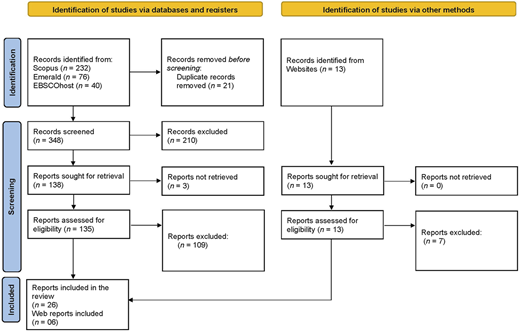
The results yielded 232 articles in Scopus, 40 articles in EBSCOhost, and 76 articles in Emerald. SLR adhered to the methodology outlined in the Preferred Reporting Items for Systematic Reviews and Meta-Analyses (PRISMA) framework (Page et al., 2021). The search results were screened based on predefined inclusion and exclusion criteria. A two-stage screening process was conducted, consisting of a review of titles and abstracts, followed by a full-text assessment. Articles were included if they specifically focused on the online sale of secondhand fashion products, while those addressing re-commerce in other industries or offline secondhand fashion resale were excluded, and the final selection comprised 26 articles. The PRISMA flow diagram illustrating the selection process is presented in Figure 1.

Due to the limited availability of peer-reviewed research on fashion re-commerce, this study also incorporates grey literature to provide a more comprehensive understanding of the research questions. Using grey literature is a well-established method in management and organisational research, offering a broader evidence base and bridging gaps in academic discourse (Adams et al., 2017). By integrating these sources, the study enhances the contextual depth of scholarly discussions, increasing its findings' relevance and practical impact, particularly in areas where academic research remains scarce (Mahood et al., 2014). To identify relevant grey literature, a structured search was conducted using Google, following the procedure outlined by Godin et al. (2015). The search was limited to the first 10 pages of results, and sources were evaluated for relevance through a two-step screening process: first, by reviewing document titles, and second, by reading full texts to assess their suitability. This process yielded six relevant web articles.

The data analysis employed both descriptive and content analysis. Descriptive analysis presents an overview of the selected journal articles, including research focus, trends, ab limitations, to identify patterns and gaps in the existing body of knowledge. Content analysis followed a deductive approach, structured around the two specific research questions guiding this study. Data from each article were systematically categorised into three overarching themes: re-commerce business models, their key drivers, and associated challenges. Within the re-commerce business models theme, relevant data were extracted to identify and analyse various business models and their operational structures. The drivers and challenges were further refined into sub-themes, which emerged from recurring topics identified in the literature. This approach ensured a comprehensive and systematic data analysis, offering deeper insights into fashion re-commerce.

A comprehensive overview of the reviewed journal articles is presented in Table 2Appendix), categorised by authors, geographic focus, study objectives, methodologies, key findings, and limitations. Research on fashion re-commerce has accelerated rapidly since 2021, driven by the sector's post-COVID shift to online channels, which positioned secondhand fashion as an emerging business model of scholarly interest. However, the dominant theme emerging from the literature is consumer behaviour and attitudes toward purchasing secondhand fashion online. Only a few exceptions expand beyond consumer-centric perspectives. For instance, Gu et al. (2023) explore dynamic pricing in online secondhand retail, Shen et al. (2022) examine the role of technology in disclosing product quality, while Parker and Weber (2013) investigated the structural transformation of secondhand markets. Turunen and Gossen (2024) shifted the lens towards sellers, examining their business and marketing strategies. Similarly Yang et al. (2017) addressed broader themes related to sustainable retailing.

This section provides a content analysis of the articles to provide a comprehensive literature review of the current state of fashion re-commerce, highlighting the key drivers and challenges shaping the sector. Section 4.2.1 elaborates on fashion re-commerce business models, and Section 4.2.2 explores the factors driving its growing popularity and transforming consumer engagement. Section 4.2.3 examines the challenges that hinder the expansion of fashion re-commerce.

4.2.1 Fashion re-commerce business models

The growth of re-commerce platforms introduces innovative business models for secondhand fashion resale, driven by advanced technology (Bae et al., 2022). The current secondhand fashion retail landscape offers multiple re-commerce avenues, with an increasing number of retailers leveraging online sales platforms to reach consumers (Calvo-Porral et al., 2024b). Currently, fashion re-commerce primarily operates through three business models: business-to-business-to-consumer (B2B2C), business-to-consumer (B2C), and consumer-to-consumer or peer-to-peer (C2C or P2P) (Calvo-Porral et al., 2024b; Godinho Filho et al., 2024). While each business model enables sellers to offer secondhand fashion directly or indirectly to consumers, they differ in revenue structure and operational dynamics (Kim et al., 2021).

A B2B2C business model involves a company providing products or services to another business, which then delivers them to the end consumer, creating value for both the intermediary business and the final customer. For instance, third-party re-commerce platforms such as Trove enable brands and resellers to integrate with their operating platform through customised services (EMF, 2021b). These platforms provide the necessary technology and logistics to support brands in establishing their resale channels. These platforms typically charge a commission for using the platform, either through listing fees or a share of profit (Kim et al., 2021). The commission percentage varies depending on the services offered by the platform, such as item preparation for listing, pricing, shipping, and payment processing (Kim et al., 2021).

In contrast, the B2C business model allows brands/retailers to sell directly to consumers without intermediaries. This model operates in two distinct ways: retailer-led re-commerce platforms and third-party platforms. Retailer-led platforms are operated by traditional fashion brands/retailers or independent secondhand sellers, such as charities. These retailers handle all logistics operations, including collection, sorting, and pricing, and resell through their re-commerce platform. For instance, Patagonia operates its re-commerce platform for selling secondhand Patagonia garments (McKinsey&Company, 2021). On the other hand, third-party platforms source and sell secondhand fashion independently. Third-party platforms such as ThreadUp operate a B2C model, along with B2B2C and C2C, by collecting, sorting, and selling directly to consumers (EMF, 2021b).

In the C2C (or P2P) model, consumers play a dual role by acting as both buyers and sellers. C2C platforms operate through various models, including third-party consignment services, marketplaces, and social-commerce platforms. In the third-party consignment model, individuals provide their items to a re-commerce company, which manages the selling process on their behalf. A commission or profit share is deducted for the service provided (Weinswig, 2017), such as pricing, photography, online listing, and shipping logistics (Price, 2019). In contrast, P2P platforms allow individuals to register, upload product photos with descriptions, and handle shipping independently (Price, 2019). P2P re-commerce platforms, such as OfferUp and Depop, have gained popularity due to their innovative, user-friendly technology (Weinswig, 2017). A growing trend in C2C re-commerce is social commerce (s-commerce), where platforms such as Facebook Marketplace and WhatsApp integrate social networking with P2P retail (Godinho Filho et al., 2024; Sharma et al., 2024). S-commerce platforms offer sellers full control over pricing without commission fees. Additionally, built-in chat features enable real-time communication, making transactions quicker and more convenient than traditional re-commerce platforms (Godinho Filho et al., 2024). Due to their ease of use and faster transaction processes, S-commerce platforms have become increasingly popular among consumers (Turunen and Gossen, 2024).

Based on the literature review, Table 1 represents a summary of fashion re-commerce business models and their key characteristics.

4.2.2 Drivers

4.2.2.1 Consumer motivation toward engaging in re-commerce

Literature identifies multiple motivations for consumers to purchase secondhand fashion online, although scholars present contradictory perspectives regarding their priorities. Calvo-Porral et al. (2024b) noted that environmental considerations are the predominant motivating factor; however, several other studies suggest that economic value constitutes the primary motivation (Mazanec and Harantová, 2024; Sharma et al., 2024; Sihvonen and Turunen, 2016). Kim et al. (2021) argue that online purchase of secondhand fashion is not solely an environmentally driven trend, but a dynamic phenomenon shaped by diverse preferences. Many consumers prefer the opportunity to acquire high-quality items at a cheaper price (Hinojo et al., 2022). Additionally, consumers are motivated to buy branded secondhand fashion available at significantly low prices, making brand image highly relevant (Herziger and Shmuely, 2024), which is a behaviour referred to as a “brand upgrading shortcut” (Liu et al., 2023). The growth of re-commerce is further driven by millennials' penetration, seeking cost savings and treasure hunting for unique products (Tangri and Yu, 2023; Weinswig, 2017).

Another factor influencing consumer engagement with re-commerce is the convenience. Online platforms offer a seamless and enjoyable shopping experience, allowing consumers to compare product attributes and prices across a wide range of fashion items (Calvo-Porral et al., 2024a). Additionally, these platforms provide essential product information, enable price comparisons between alternatives, and eliminate geographical barriers (Godinho Filho et al., 2024), making secondhand shopping more accessible and time-saving (Sharma et al., 2024). However, consumers' prior experience with online shopping positively influences their likelihood of engaging in re-commerce (Yeap et al., 2022). Institutional factors, such as the unavailability of retail stores nearby and internet literacy, also contribute to growing engagement with re-commerce (Hinojo et al., 2022).

4.2.2.2 Reseller motivation toward engaging in re-commerce

Driven by sustainability commitments and profitability, fashion re-commerce enables retailers to diversify revenue streams and expand their customer base through online sales (Yang et al., 2017). Recognising that consumers prefer to purchase from brands over peer sellers (Herziger and Shmuely, 2024), traditional retailers have launched new secondhand platforms to leverage brand equity in the re-commerce space (Hinojo et al., 2022; Kim et al., 2021). Economic factors are influential in luxury secondhand fashion, where high resale value is the primary driver of re-commerce (Murtas and Pedeliento, 2024; Tangri and Yu, 2023). Luxury secondhand fashion provides a competitive advantage over traditional off-price retailers, which typically sell discounted branded items through physical stores with limited reach, making re-commerce a more attractive option (Weinswig, 2017).

Alternative business models have emerged in the B2B2C domain. For instance, third-party re-commerce platforms offer a revenue-sharing model that splits profits between the retailer and the platform owner (Shen et al., 2020). This approach enables retailers to engage in re-commerce operations without building or managing their re-commerce structure, thereby reducing operational costs while capitalising on the market growth. In contrast, C2C platforms thrive on the financial motivations of individual sellers (Kaur and Manna, 2024), and empower consumers to monetise their secondhand clothing to earn extra income (Weinswig, 2017). These financial gains further strengthen the growth of fashion re-commerce, making it a commercially viable and increasingly mainstream retail segment.

4.2.2.3 Advanced technology

Advanced information technology is becoming an important driver in the growth of fashion re-commerce, enhancing user experience, logistics efficiency, and transparency. For instance, Artificial Intelligence (AI) is widely used in re-commerce to enhance user experience by personalising recommendations based on user preferences and behaviour, thereby increasing sales (Kerloch, 2024). Some re-commerce platforms also utilise AI-supported authentication services to verify product authenticity and reduce the risk of counterfeit products (Kim et al., 2021). AI has also been used in P2P platforms, such as Letgo, for image recognition and efficient categorisation of products. In addition to AI, logistics automation technologies such as smart drop-boxes and automated delivery options are used to enhance logistics efficiency while reducing costs and improving user satisfaction with fast, flexible delivery options (Kerloch, 2024). For example, the P2P re-commerce platform Mercari recently partnered with UPS to simplify the shipping process for sellers (Price, 2019). Moreover, to overcome information asymmetry challenges regarding product quality and traceability, blockchain technology is increasingly being adopted, as it supports enhanced supply chain transparency and product ownership history (Jain et al., 2022). By linking a product to its digital identity through cryptographic codes, blockchain ensures authenticity and facilitates secure ownership transfers with digital approvals, thereby strengthening trust between buyers and sellers (ibid).

4.2.3 Challenges

4.2.3.1 Uncertainty of supply

The secondhand fashion industry faces unpredictable and inconsistent supply chains. This irregularity creates a major challenge for re-commerce platforms that depend on a steady flow, as well as for consumers who experience limited availability and difficulty in consistently finding desired brands and styles. (Mazanec and Harantová, 2024). For retailers, securing a consistent supply chain to source secondhand fashion is particularly challenging (Parker and Weber, 2013). Purchasing bulk inventory from wholesalers offers a more stable option, but it comes with drawbacks, such as the need for upfront payments and the lack of uniform quality across products (Parker and Weber, 2013). Since fashion re-commerce demands high-quality secondhand fashion, competition among re-commerce platforms and offline secondhand retailers has intensified, making it even more challenging to ensure desirable inventory for online sale (Bae et al., 2022; Fernando et al., 2018). Furthermore, C2C resale platforms have surged in popularity, flooding the market with individuals offering secondhand fashion directly to consumers (Liu et al., 2023). This shift creates additional obstacles for B2C platforms that rely on sourcing secondhand fashion items from donations. As C2C platforms offer users a convenient selling experience, more consumers are opting to sell their items independently rather than donating or exchanging them for store credits. (Sharma et al., 2024).

4.2.3.2 Preserved risk of online purchases

Risks associated with re-commerce primarily stem from the sellers' reputation, the inability to make a physical judgment regarding the product before purchase, the lack of detailed product information, and the security concerns related to sharing financial information online (Calvo-Porral et al., 2024a; Godinho Filho et al., 2024). For instance, second-hand products are often subject to contamination effects and hygiene concerns, as items have been previously owned (Fernando et al., 2018; Liu et al., 2023), and the cleanliness of the product cannot be confirmed in online transactions. These uncertainties about the actual condition of the garment create significant barriers to purchase (Calvo-Porral et al., 2024a). Building trust is vital for reducing these risks and motivating consumers to participate in online purchases. Consumers often rely on brand reputation as a substitute for tactile assessment (Sihvonen and Turunen, 2016). Consumers' purchase intention increases, and perceived contamination decreases when the product is sold by an attractive seller (Kim et al., 2023). Non-reputed online vendors are perceived as strangers, complicating trust-building in digital transactions (Sihvonen and Turunen, 2016).

Information asymmetry creates another risk, because the availability of detailed product information significantly influences the consumer's purchasing decision (Liu and Wang, 2024; Pandey et al., 2024). Trust can be enhanced by providing a comprehensive product history and detailed product information (Kim et al., 2021). Additionally, concerns regarding online transaction security can also discourage customers from making online purchases (Mazanec and Harantová, 2024). Re-commerce platforms that rely on third-party payment gateways pose an insecurity in financial transactions due to the risk of internet scams (Liu et al., 2023). Both B2B2C and B2C platforms provide more structured transactions, where consumers make purchases directly from the platform, benefiting from standardised product displays and lower transaction risks (Liu et al., 2023; Murtas and Pedeliento, 2024). In contrast, C2C re-commerce platforms build trust through transaction history and seller ratings (Weinswig, 2017). Negative experiences of consumers regarding product quality and misalignment of expectations can lead to reduced trust and a decline in sales (Murtas and Pedeliento, 2024).

4.2.3.3 Operational challenges

Operational challenges in fashion re-commerce are rarely discussed in the literature, with only a few insights into addressing practical barriers. One major challenge is the complexity of handling logistics, which involves additional operational steps in re-commerce compared to physical resale (Liu et al., 2023). For re-commerce operations, sellers must invest a significant effort in photographing garments, uploading images and descriptions, and ensuring transparency in product conditions, which incurs additional time and costs (Sihvonen and Turunen, 2016). These challenges are further compounded by the typically lower and restricted profit margins of secondhand fashion (Liu et al., 2023), making it difficult to maintain profitability.

This systematic review offers a comprehensive analysis of fashion re-commerce business models, key drivers, and challenges. The findings suggest that re-commerce is becoming a strategic priority and a major catalyst for the growth of secondhand fashion retail. Yet the findings invite reflection on whether current growth signals a fundamental reconfiguration of fashion consumption or a market trend dependent on platform-specific dynamics. Although rising engagement across digital resale platforms suggests strong potential, more critical evaluation is needed to understand the extent to which it reflects durable shifts in consumer behaviour rather than a profit-driven initiative. Given that the secondhand market is growing more rapidly than the fast fashion sector (Zanjirani Farahani et al., 2022), a more critical evaluation is needed to understand how secondhand consumption can avoid replicating the characteristics and consumption patterns typically associated with fast fashion.

Consumer participation in C2C platforms demonstrates an increased accessibility to secondhand fashion, yet challenges such as trust scams remain significant. Liu et al. (2023) suggest that regulatory mechanisms could improve safety, ensuring a safer marketplace for C2C transactions. In comparison, B2C platforms such as Patagonia's Worn Wear offer structured re-commerce systems for consumers as sellers, where the product owner receives credits of 50% of the product's resale value (Agrawal et al., 2019). However, strong consumer preference for C2C platforms demands further investigations on the trade-off between the operational complexity of B2C models and the autonomy and flexibility that consumers experience in C2C environments.

The study highlights that consumer motivations extend beyond economic or environmental considerations to include brand value and product quality. This broadening of motivations suggests a maturing market. However, it also raises questions about accessibility. If demand is driven primarily by branded and high-quality items, the benefits of re-commerce may disproportionately favour consumers with access to desirable products to resell. This indicates the need for deeper empirical exploration of how different consumer groups participate, or are potentially excluded, from fashion re-commerce markets.

Unlike in C2C platforms, where consumers handle individual garments, B2B2C and B2C platforms manage large volumes of secondhand fashion items, requiring sophisticated logistics and operational solutions to accommodate diverse product varieties. As noted by Hultberg (2024) and Llach et al. (2023), accuracy in product representation and the demand for additional reverse logistics activities, such as photography and online listing, require capabilities that differ significantly from physical retail. This reveals a critical research gap in understanding how re-commerce actors develop logistics-related resources and capabilities to develop sustainable, scalable operational models that align with the increasing expectations of the fashion re-commerce market.

This study contributes to the re-commerce literature by synthesising existing knowledge on fashion re-commerce business models. By systematically mapping these models, the paper clarifies their structural characteristics, value creation mechanisms, and distinct market roles. It integrates business model characteristics with consumer-related drivers, such as trust, perceived value, sustainability motivations, and price sensitivity, offering a more cohesive theoretical understanding of how behavioural factors shape the performance of different re-commerce models. This linkage contributes to the theory by illustrating how business models rely on specific consumer behaviours and how these dependencies create opportunities, tensions, or constraints within the circular economy. As such, the study provides a conceptual foundation for examining how re-commerce models may coexist, compete, or evolve in response to shifting consumer expectations, operational demands, and institutional pressures, enriching theoretical debates on fashion re-commerce business models.

The findings also provide practical insights for actors developing or refining re-commerce strategies. By clarifying core characteristics of re-commerce models, the review assists practitioners in selecting a suitable business model based on their market positioning and operational capabilities. The synthesis of key drivers highlights the importance of fostering consumer trust, communicating value effectively, and aligning pricing strategies with customer expectations to enhance engagement and sales performance. Recognising barriers, such as quality risks, logistical complexity, and competitive pressures, enables practitioners to develop targeted interventions that address these challenges.

While this study provides a synthesis of fashion re-commerce business models and the associated drivers and challenges, it has certain limitations. First, as a systematic review, the analysis relies on the availability and quality of existing literature, which is heavily skewed toward consumer behaviour studies on online platforms, particularly C2C formats. Consequently, insights into operational, logistical, and supply-side aspects remain limited. Furthermore, the review highlights the methodological limitations of current research, such as the predominance of surveys focused on consumers, and calls for multi-method and longitudinal approaches that integrate platform-level and operational data to generate more comprehensive insights.
Adams
,
R.J.
,
Smart
,
P.
and
Huff
,
A.S.
(
2017
), “
Shades of grey: guidelines for working with the grey literature in systematic reviews for management and organizational studies
”,
International Journal of Management Reviews
, Vol. 
19
No. 
4
, pp. 
432
-
454
, doi: .
Agrawal
,
V.V.
,
Atasu
,
A.
and
Van Wassenhove
,
L.N.
(
2019
), “
New opportunities for operations management research in sustainability
”,
Manufacturing and Service Operations Management
, Vol. 
21
No. 
1
, pp. 
1
-
12
, doi: .
Agrawal
,
S.
,
Kumar
,
D.
,
Singh
,
R.K.
and
Singh
,
R.K.
(
2023
), “
Analyzing coordination strategy of circular supply chain in re-commerce industry: a game theoretic approach
”,
Business Strategy and the Environment
, Vol. 
32
No. 
4
, pp. 
1680
-
1697
, doi: .
Bae
,
Y.
,
Choi
,
J.
,
Gantumur
,
M.
and
Kim
,
N.
(
2022
), “
Technology-based strategies for online secondhand platforms promoting sustainable retailing
”,
Sustainability
, Vol. 
14
No. 
6
, 3259, doi: .
Brändström
,
J.
,
Jazairy
,
A.
and
Roos Lindgreen
,
E.
(
2024
), “
Barriers to adopting circular business models: a cross-sectoral analysis
”,
Business Strategy and the Environment
, Vol. 
33
No. 
May 2023
, pp. 
1
-
20
, doi: .
Calvo-Porral
,
C.
,
Orosa-González
,
J.
and
Viejo-Fernández
,
N.
(
2024a
), “
Barriers to online second-hand purchase behavior
”,
Marketing Intelligence and Planning
, Vol. 
42
No. 
2
, pp. 
213
-
233
, doi: .
Calvo-Porral
,
C.
,
Orosa-González
,
J.
and
Viejo-Fernández
,
N.
(
2024b
), “
Second-hand online stores: an examination of consumers' purchase behaviour
”,
International Review of Retail Distribution and Consumer Research
, Vol. 
34
No. 
4
, pp. 
489
-
512
,
Routledge
, doi: .
Charnley
,
F.
,
Knecht
,
F.
,
Muenkel
,
H.
,
Pletosu
,
D.
,
Rickard
,
V.
,
Sambonet
,
C.
,
Schneider
,
M.
and
Zhang
,
C.
(
2022
), “
Can digital technologies increase consumer acceptance of circular business models? The case of second hand fashion
”,
Sustainability
, Vol. 
14
No. 
8
, 4589, doi: .
Claxton
,
S.
and
Kent
,
A.
(
2020
), “
The management of sustainable fashion design strategies: an analysis of the designer’s role
”,
Journal of Cleaner Production
, Vol. 
268
, 122112.
Cobbing
,
M.
,
Daaji
,
S.
,
Kopp
,
M.
and
Wohlgemuth
,
V.
(
2022
),
Poisoned Gifts: from Donations to the Dumpsite - Textiles Waste Disguised as Second-Hand Clothes Exported to East Africa
,
Greenpeace
,
Greenpeace, Hamburg
,
available at:
 https://es.greenpeace.org
Ek Styvén
,
M.
and
Mariani
,
M.M.
(
2020
), “
Understanding the intention to buy secondhand clothing on sharing economy platforms: the influence of sustainability, distance from the consumption system, and economic motivations
”,
Psychology and Marketing
, Vol. 
37
No. 
5
, pp. 
724
-
739
, doi: .
EMF
(
2020
), “
Circular economy growth potential by sector
”,
Ellen Macarthur Foundation, available at:
 https://content.ellenmacarthurfoundation.org/m/c5930d73a88a7d4/original/Electronics-Circular-economy-growth-potential-by-sector.pdf
EMF
(
2021a
), “
Rethinking business models for a thriving fashion industry
”,
Ellen MacArthur Foundation, available at:
 https://www.ellenmacarthurfoundation.org/fashion-business-models/overview
EMF
(
2021b
), “
Keeping clothing in use to reduce waste: thredup
”,
Ellen MacArthur Foundation, available at:
 https://www.ellenmacarthurfoundation.org/circular-examples/keeping-clothing-in-use-to-save-us-money-and-reduce-waste-thredup
EU Commission
(
2023
),
European commission-press release circular economy for textiles: taking responsibility to reduce
,
Reuse and Recycle Textile Waste and Boosting Markets for Used Textiles
.
European Commission
(
2025
), “
Commission welcomes provisional agreement to enhance the circularity of textiles and reduce food waste
”,
European Commission, available at:
 https://ec.europa.eu/commission/presscorner/detail/en/ip_25_548
Fernando
,
A.G.
,
Sivakumaran
,
B.
and
Suganthi
,
L.
(
2018
), “
Comparison of perceived acquisition value sought by online second-hand and new goods shoppers
”,
European Journal of Marketing
, Vol. 
52
Nos
7-8
, pp. 
1412
-
1438
, doi: .
Godin
,
K.
,
Stapleton
,
J.
,
Kirkpatrick
,
S.I.
,
Hanning
,
R.M.
and
Leatherdale
,
S.T.
(
2015
), “
Applying systematic review search methods to the grey literature: a case study examining guidelines for school-based breakfast programs in Canada
”,
Systematic Reviews
, Vol. 
4
No. 
138
, pp. 
1
-
10
,
Systematic Reviews
, doi: .
Godinho Filho
,
M.
,
Miller Devós Ganga
,
G.
,
Lizarelli
,
F.L.
,
Cárdenas Blaz
,
C.L.
and
Tavares
,
T.M.
(
2024
), “
Circular economy via chat: evaluation of adoption and use of whatsapp instant messaging platform for trading second-hand products
”,
Journal of Cleaner Production
, Vol. 
460
February
, 142510, doi: .
Gu
,
W.
,
Luo
,
J.
,
Yu
,
X.
,
Zhang
,
W.
and
Li
,
B.
(
2023
), “
Dynamic decisions between sellers and consumers in online second-hand trading platforms: evidence from C2C transactions
”,
Transportation Research Part E: Logistics and Transportation Review
, Vol. 
177
 
May 2022
, 103257,
Elsevier Ltd
, doi: .
Gusenbauer
,
M.
(
2022
), “
Search where you will find Most: comparing the disciplinary coverage of 56 bibliographic databases
”,
Scientometrics
, Vol. 
127
No. 
5
, pp. 
2683
-
2745
, doi: .
Hellström
,
D.
and
Olsson
,
J.
(
2024
), “
Let's go thrift shopping: exploring circular business model innovation in fashion retail
”,
Technological Forecasting and Social Change
, Vol. 
198
 
Nvember 2023
, 123000, doi: .
Herziger
,
A.
and
Shmuely
,
S.
(
2024
), “
Reimagining secondhand consumption: can reseller identity (De)Motivate sustainable consumption?
”,
Journal of Cleaner Production
, Vol. 
471
 
August
, 143425, doi: .
Hinojo
,
P.
,
Suárez
,
D.
and
García-Mariñoso
,
B.
(
2022
), “
Drivers of consumer participation in online second-hand transactions
”,
Sustainability
, Vol. 
14
No. 
7
, pp. 
1
-
13
, doi: .
Hultberg
,
E.
(
2024
), “
Scaling circular business models: strategic paths of second-hand fashion retail
”,
Journal of Fashion Marketing and Management
, Vol. 
29
No. 
2
, pp. 
181
-
197
, doi: .
Hultberg
,
E.
and
Pal
,
R.
(
2023
), “
Exploring scalability from a triple bottom line perspective: challenges and strategic resources for fashion resale
”,
Circular Economy and Sustainability
, Vol. 
3
No. 
4
, pp. 
2201
-
2231
, doi: .
Hur
,
E.
(
2020
), “
Rebirth fashion: secondhand clothing consumption values and perceived risks
”,
Journal of Cleaner Production
,
Elsevier Ltd
, Vol. 
273
, 122951, doi: .
Jain
,
G.
,
Kamble
,
S.S.
,
Ndubisi
,
N.O.
,
Shrivastava
,
A.
,
Belhadi
,
A.
and
Venkatesh
,
M.
(
2022
), “
Antecedents of blockchain-enabled E-commerce platforms (BEEP) adoption by customers – a study of second-hand small and medium apparel retailers
”,
Journal of Business Research
, Vol. 
149
 
May
, pp. 
576
-
588
, doi: .
Kaur
,
M.
and
Manna
,
R.
(
2024
), “
Sale of second-hand goods by consumers: mediating role of satisfaction between perceived value and behavioural intentions
”,
International Review of Retail Distribution and Consumer Research
, Vol. 
00
No. 
00
, pp. 
1
-
22
,
Routledge
, doi: .
Kerloch
,
E.
(
2024
), “
How to create a second-hand marketplace like Vinted
”,
Origami Marketplace, available at:
 https://origami-marketplace.com/en-gb/create-c2c-marketplace-like-vinted/
Khairul Akter
,
M.M.
,
Haq
,
U.N.
,
Islam
,
M.M.
and
Uddin
,
M.A.
(
2022
), “
Textile-apparel manufacturing and material waste management in the circular economy: a conceptual model to achieve sustainable development goal (SDG) 12 for Bangladesh
”,
Cleaner Environmental Systems
, Vol. 
4
 
January
, 100070,
The Authors
, doi: .
Kim
,
N.(L.)
,
Woo
,
H.
and
Ramkumar
,
B.
(
2021
), “
The role of product history in consumer response to online second-hand clothing retail service based on circular fashion
”,
Journal of Retailing and Consumer Services
, Vol. 
60
 
July 2020
, 102457, doi: .
Kim
,
N.L.
,
Jin
,
B.E.
and
Kim
,
T.H.
(
2023
), “
Negative and positive contamination in secondhand fashion consumption: does culture matter?
”,
International Marketing Review
, Vol. 
40
No. 
6
, pp. 
1509
-
1530
, doi: .
Koay
,
K.Y.
,
Cheah
,
C.W.
and
Lom
,
H.S.
(
2022
), “
An integrated model of consumers' intention to buy second-hand clothing
”,
International Journal of Retail and Distribution Management
, Vol. 
50
No. 
11
, pp. 
1358
-
1377
, doi: .
Liu
,
S.F.
and
Wang
,
S.
(
2024
), “
An integrated analysis of consumer purchase decision-making on second-hand trading platforms: evidence from China
”,
Journal of Organizational Computing and Electronic Commerce
, Vol. 
35
No. 
1
, pp. 
72
-
88
,
Taylor & Francis
.
Liu
,
S.
,
Lang
,
C.
and
Liu
,
C.
(
2023
), “
A systematic review and meta-analysis of Chinese online fashion resale: toward recipes to stimulate circular fashion
”,
Sustainable Production and Consumption
, Vol. 
41
 
September
, pp. 
334
-
347
, doi: .
Llach
,
J.
,
Vila-Brunet
,
N.
and
Manresa
,
A.
(
2023
), “
Which antecedents contribute Most to the loyal behaviour of online second-hand market shoppers?
”,
International Journal of Quality and Reliability Management
, Vol. 
40
No. 
9
, pp. 
2064
-
2082
, doi: .
Machado
,
M.A.D.
,
Almeida
,
S.O.
,
Bollick
,
L.C.
and
Bragagnolo
,
G.
(
2019
), “
Second-hand fashion market: consumer role in circular economy
”,
Journal of Fashion Marketing and Management
, Vol. 
23
No. 
3
, pp. 
382
-
395
, doi: .
Mahood
,
Q.
,
Van Eerd
,
D.
and
Irvin
,
E.
(
2014
), “
Searching for grey literature for systematic reviews: challenges and benefits
”,
Research Synthesis Methods
, Vol. 
5
No. 
3
, pp. 
221
-
234
, doi: .
Mazanec
,
J.
and
Harantová
,
V.
(
2024
), “
Gen Z and their sustainable shopping behavior in the second-hand clothing segment: case study of the Slovak Republic
”,
Sustainability
, Vol. 
16
No. 
8
, 3129, doi: .
McKinsey&Company
(
2021
), “
C2C e-commerce: could a new business model sell more old goods?
”,
available at:
 https://www.mckinsey.com/industries/technology-media-and-telecommunications/our-insights/c2c-ecommerce-could-a-new-business-model-sell-more-old-goods#/
Murtas
,
G.
and
Pedeliento
,
G.
(
2024
), “
Investigating the customer journey in second-hand fashion platforms: implications for luxury brand management
”,
Journal of Consumer Behaviour
, Vol. 
24
No. 
2
, pp. 
655
-
672
, doi: .
Nasution
,
M.D.T.P.
,
Rafiki
,
A.
,
Lubis
,
A.
and
Rossanty
,
Y.
(
2021
), “
Entrepreneurial orientation, knowledge management, dynamic capabilities towards e-commerce adoption of SMEs in Indonesia
”,
Journal of Science and Technology Policy Management
, Vol. 
12
No. 
2
, pp. 
256
-
282
, doi: .
Owusu-Wiredu
,
P.
(
2024
), “
From a disposable to a sustainable fashion industry: a review of the shameful trade flows of used textiles and the need to address fast fashion
”,
Corporate Governance and Sustainability Review
, Vol. 
8
No. 
1
, pp. 
32
-
44
, doi: .
Page
,
M.J.
,
McKenzie
,
J.E.
,
Bossuyt
,
P.M.
,
Boutron
,
I.
,
Hoffmann
,
T.C.
,
Mulrow
,
C.D.
,
Shamseer
,
L.
,
Tetzlaff
,
J.M.
,
Akl
,
E.A.
,
Brennan
,
S.E.
,
Chou
,
R.
,
Glanville
,
J.
,
Grimshaw
,
J.M.
,
Hróbjartsson
,
A.
,
Lalu
,
M.M.
,
Li
,
T.
,
Loder
,
E.W.
,
Mayo-Wilson
,
E.
,
McDonald
,
S.
,
McGuinness
,
L.A.
,
Stewart
,
L.A.
,
Thomas
,
J.
,
Tricco
,
A.C.
,
Welch
,
V.A.
,
Whiting
,
P.
and
Moher
,
D.
(
2021
), “
The PRISMA 2020 statement: an updated guideline for reporting systematic reviews
”,
Systematic Reviews
, Vol. 
10
No. 
1
, pp. 
1
-
11
,
Systematic Reviews
, doi: .
Pandey
,
S.
,
Mittal
,
S.
and
Chawla
,
D.
(
2024
), “
Tackling consumer information asymmetry and perceived uncertainty for luxury re-commerce through seller signals
”,
Journal of Retailing and Consumer Services
, Vol. 
79
 
October 2023
, 103736, doi: .
Park
,
H.H.
(
2023
), “
Scarce fashion products consumption in the C2C second-hand trading platform
”,
Family and Consumer Sciences Research Journal
, Vol. 
51
No. 
3
, pp.
216
-
230
.
Park
,
H.H.
(
2024
), “
Scarcity effect in collaborative fashion consumption via the C2C online platform: moderating effect of consumer price sensitivity and gender
”,
International Journal of Fashion Design, Technology and Education
, pp.
1
-
11
.
Parker
,
B.
and
Weber
,
R.
(
2013
), “
Second-hand spaces: restructuring retail geographies in an era of e-commerce
”,
Urban Geography
, Vol. 
34
No. 
8
, pp. 
1096
-
1118
, doi: .
Persson
,
O.
and
Hinton
,
J.B.
(
2023
), “
Second-hand clothing markets and a just circular economy? exploring the role of business forms and profit
”,
Journal of Cleaner Production
, Vol. 
390
, 136139.
Price
,
M.
(
2019
), “
Fashion disruptors: welcome to the era of secondhand retail apps
”,
CNET, available at:
 https://www.cnet.com/home/smart-home/features/rise-of-secondhand-retail-poshmark-thredup-letgo-mercari-ebay-thrift-clothing-selling-apps/
Searles
,
K.
(
2023
), “
CASE STUDY H&M partners to rapidly build second-hand business
”,
available at:
 https://internetretailing.net/case-study-hm-partners-to-rapidly-build-second-hand-business/
Sharma
,
R.
,
Sharma
,
S.
and
Singh
,
G.
(
2024
), “
Exploring customer engagement on Facebook marketplace for second-hand clothing
”,
Social Responsibility Journal
, Vol. 
20
No. 
10
, pp. 
2149
-
2173
, doi: .
Shen
,
B.
,
Xu
,
X.
and
Yuan
,
Q.
(
2020
), “
Selling secondhand products through an online platform with blockchain
”,
Transportation Research Part E: Logistics and Transportation Review
, Vol. 
142
 
August
, 102066,
Elsevier
, doi: .
Shen
,
B.
,
Dong
,
C.
,
Tong
,
X.
and
Ngai
,
E.W.T.
(
2022
), “
Emerging technologies in e-commerce operations and supply chain management
”,
Electronic Commerce Research and Applications
, Vol. 
55
, 101203, doi:
Sihvonen
,
J.
and
Turunen
,
L.L.M.
(
2016
), “
As good as new – valuing fashion brands in the online second-hand markets
”,
The Journal of Product and Brand Management
, Vol. 
25
No. 
3
, pp. 
285
-
295
, doi: .
Silva
,
S.C.
,
Santos
,
A.
,
Duarte
,
P.
and
Vlačić
,
B.
(
2021
), “
The role of social embarrassment, sustainability, familiarity and perception of hygiene in second-hand clothing purchase experience
”,
International Journal of Retail and Distribution Management
, Vol. 
49
No. 
6
, pp. 
717
-
734
, doi: .
Snyder
,
H.
(
2019
), “
Literature review as a research methodology: an overview and guidelines
”,
Journal of Business Research
, Vol. 
104
 
August
, pp. 
333
-
339
,
Elsevier
, doi: .
Statista
(
2024
), “
Second-hand e-commerce- statistics and facts
”,
available at:
 https://www.statista.com/topics/9448/second-hand-e-commerce/#topicOverview
Sun
,
Y.
and
Choo
,
H.J.
(
2023
), “
Chinese consumers ’ intention to use Re-Commerce platforms
”,
Fashion and Textiles Research Journal
, Vol. 
25
No. 
1
, pp. 
24
-
40
, doi: .
Tangri
,
K.
and
Yu
,
H.
(
2023
), “
Why buy used? Motivators and barriers for re-commerce luxury fashion
”,
International Journal of Retail and Distribution Management
, Vol. 
51
Nos
9-10
, pp. 
1095
-
1114
, doi: .
ThreadUP
(
2023
), “
Resale report 2023
”,
available at:
 https://www.thredup.com/resale
ThreadUp
(
2025
), “
The recommerce 100
”,
available at:
 https://www.recommerce100.com/
ThredUp
(
2024
), “
Resale report 2024
”, p.
17
.
Turunen
,
L.L.M.
and
Gossen
,
M.
(
2024
), “
From preloved to reloved: how second-hand clothing companies facilitate the transaction of used garments
”,
Journal of Sustainability Research
, Vol. 
6
No. 
1
, pp. 
1
-
22
.
Valor
,
C.
,
Ronda
,
L.
and
Abril
,
C.
(
2022
), “
Understanding the expansion of circular markets: building relational legitimacy to overcome the stigma of second-hand clothing
”,
Sustainable Production and Consumption
, Vol. 
30
, pp. 
77
-
88
,
Elsevier Ltd
, doi: .
Wang
,
C.
,
Zhang
,
X.
,
Hu
,
X.
,
Lim
,
M.K.
,
Xu
,
Y.
,
Chang
,
P.C.
and
Ghadimi
,
P.
(
2025
), “
Dynamics and drivers of global secondhand clothing trade: implications for sustainable energy and circular economy in fashion
”,
Renewable and Sustainable Energy Reviews
, Vol. 
209
 
November 2024
, 115116,
Elsevier Ltd
, doi: .
Weinswig
,
D.
(
2017
), “
Deep dive : fashion Re-Commerce update — 12 catalysts for apparel resale growth
”, pp. 
1
-
13
.
Xiao
,
Y.
and
Watson
,
M.
(
2019
), “
Guidance on conducting a systematic literature review
”,
Journal of Planning Education and Research
, Vol. 
39
No. 
1
, pp. 
93
-
112
, doi: .
Yang
,
S.
,
Song
,
Y.
and
Tong
,
S.
(
2017
), “
Sustainable retailing in the fashion industry: a systematic literature review
”,
Sustainability
, Vol. 
9
No. 
7
, pp. 
1
-
19
, doi: .
Yeap
,
J.A.L.
,
Ooi
,
S.K.
,
Yapp
,
E.H.T.
and
Ramesh
,
N.
(
2022
), “
Preloved is reloved: investigating predispositions of second-hand clothing purchase on C2C platforms
”,
Service Industries Journal
, Vol. 
44
Nos
13-14
, pp. 
993
-
1017
, doi: .
Yrjölä
,
M.
,
Hokkanen
,
H.
and
Saarijärvi
,
H.
(
2021
), “
A typology of second-hand business models
”,
Journal of Marketing Management
, Vol. 
37
Nos
7-8
, pp. 
761
-
791
,
Routledge
, doi: .
Zanjirani Farahani
,
R.
,
Asgari
,
N.
and
Van Wassenhove
,
L.N.
(
2022
), “
Fast fashion, charities, and the circular economy: challenges for operations management
”,
Production and Operations Management
, Vol. 
31
No. 
3
, pp. 
1089
-
1114
, doi: .
Published by Emerald Publishing Limited. This article is published under the Creative Commons Attribution (CC BY 4.0) licence. Anyone may reproduce, distribute, translate and create derivative works of this article (for both commercial and non-commercial purposes), subject to full attribution to the original publication and authors. The full terms of this licence may be seen at Link to the terms of the CC BY 4.0 licence.

Data & Figures

Figure 1
A flowchart shows identification, screening, and inclusion of studies from databases, registers, and other methods.The flowchart is titled “Identification of studies via databases and registers” and “Identification of studies via other methods”, shown as two headers at the top. The diagram is organized into three vertical stages along the left side, labeled from top to bottom as “Identification”, “Screening”, and “Included”. Under “Identification of studies via databases and registers”, in the Identification stage, a text box states “Records identified from: Scopus (n equals 232), Emerald (n equals 76), and E B S C O host (n equals 40)”. A right-pointing arrow leads to a text box labeled “Records removed before screening: Duplicate records removed (n equals 21)”. In the Screening stage, a downward arrow leads to a text box labeled “Records screened (n equals 348)”. A right-pointing arrow from this box leads to “Records excluded (n equals 210)”. A downward arrow from “Records screened (n equals 348)” leads to “Reports sought for retrieval (n equals 138)”. A right-pointing arrow from this box leads to “Reports not retrieved (n equals 3)”. A downward arrow leads to “Reports assessed for eligibility (n equals 135)”, with a right-pointing arrow to “Reports excluded (n equals 109)”. Under “Identification of studies via other methods”, in the Identification stage, a text box reads “Records identified from Websites (n equals 13)”. In the Screening stage, a downward arrow leads to “Reports sought for retrieval (n equals 13)”, followed by a right-pointing arrow to “Reports not retrieved (n equals 0)”. A downward arrow then leads to “Reports assessed for eligibility (n equals 13)”, with a right-pointing arrow to “Reports excluded (n equals 7)”. In the Included stage, downward arrows from both “Reports assessed for eligibility (n equals 135)” and “Reports assessed for eligibility (n equals 13)” converge on the final text box labeled “Reports included in the review (n equals 26)” and “Web reports included (n equals 06)”.

PRISMA flow diagram of the material selection process. Source(s): Author's own work

Figure 1
A flowchart shows identification, screening, and inclusion of studies from databases, registers, and other methods.The flowchart is titled “Identification of studies via databases and registers” and “Identification of studies via other methods”, shown as two headers at the top. The diagram is organized into three vertical stages along the left side, labeled from top to bottom as “Identification”, “Screening”, and “Included”. Under “Identification of studies via databases and registers”, in the Identification stage, a text box states “Records identified from: Scopus (n equals 232), Emerald (n equals 76), and E B S C O host (n equals 40)”. A right-pointing arrow leads to a text box labeled “Records removed before screening: Duplicate records removed (n equals 21)”. In the Screening stage, a downward arrow leads to a text box labeled “Records screened (n equals 348)”. A right-pointing arrow from this box leads to “Records excluded (n equals 210)”. A downward arrow from “Records screened (n equals 348)” leads to “Reports sought for retrieval (n equals 138)”. A right-pointing arrow from this box leads to “Reports not retrieved (n equals 3)”. A downward arrow leads to “Reports assessed for eligibility (n equals 135)”, with a right-pointing arrow to “Reports excluded (n equals 109)”. Under “Identification of studies via other methods”, in the Identification stage, a text box reads “Records identified from Websites (n equals 13)”. In the Screening stage, a downward arrow leads to “Reports sought for retrieval (n equals 13)”, followed by a right-pointing arrow to “Reports not retrieved (n equals 0)”. A downward arrow then leads to “Reports assessed for eligibility (n equals 13)”, with a right-pointing arrow to “Reports excluded (n equals 7)”. In the Included stage, downward arrows from both “Reports assessed for eligibility (n equals 135)” and “Reports assessed for eligibility (n equals 13)” converge on the final text box labeled “Reports included in the review (n equals 26)” and “Web reports included (n equals 06)”.

PRISMA flow diagram of the material selection process. Source(s): Author's own work

Close Figure 1
Table 1

Fashion re-commerce business models

Business modelB2B2CB2CC2C
ConsignmentRetailer-led3rd party platformsP2P appsS-commerceConsignment
DescriptionBrands/secondhand retailers partnering with re-commerce platformsBrands/secondhand retailers directly source and sellThird-party platforms directly source and sellEstablish a direct connection between the buyer and sellerEstablish a direct connection between the buyer and sellerThe re-commerce platform manages sales on behalf of the seller
SellerThird-party platformRetailerThird-party platformIndividual sellersIndividual sellersThird-party platform
Revenue modelCommission on sales, service fees, or profit sharingDirect salesDirect sales of own stockDirect salesDirect salesCommission on sales, listing fee
Logistics responsibilityDepending on the agreement, logistics are mostly handled by the platform companyRetailers sort, photograph, upload product details, and handle shippingPlatform company sorts, photographs, uploads product details, and handles shippingIndividual sellers sort, photograph, upload product details, and handle shippingIndividual sellers sort, photograph, upload product details, and handle shippingIndividual sellers sort, photograph, upload product details, and handle shipping
ExamplesThredUp, TrovePatagonia Worn WearRealReal, ThredUpOfferUp, DepopFacebook marketplace, WhatsAppVinted, Poshmark
Source(s): Author's own representation based on the literature reviewed
Table 2

Overview of journal articles

NoAuthor(s) and yearCountryPurposeMethodologyFindingsLimitations/research gaps
1Bae et al., (2022) South KoreaTo explore technological trends in C2C online resaleCase studies (C2C platforms), surveys, and interviews with consumersUser experience (UX) and user interface (UI) based strategies positively enhance consumer experienceLimited to C2C platforms and user experience
2Calvo-Porral et al. (2024a) SpainExamine factors that prevent consumers from purchasing used products onlineConsumer survey based on a web questionnaireContamination, lack of trust, low perceived product reliability, and quality prevent consumers from shopping for used products onlineLimited to consumer purchasing behaviour, exploring barriers to purchasing online
3Calvo-Porral et al. (2024b) SpainExamine consumer purchasing behaviour via online storesConsumer survey based on a web questionnaireThe key drivers are environmental motivation and trust. Price plays only a moderating roleLimited to consumer purchasing behaviour for secondhand products in general
4Fernando et al. (2018) IndiaExamine the differences in the value sought by online new goods and secondhand shoppersHypothesis testing based on a consumer surveySecondhand shoppers perceive higher levels of uncertainty, lower acquisition values, and are less frugal than new goods shoppersLimited to consumer purchasing behaviour for secondhand products in general
5Godinho Filho et al. (2024) BrazilAdoption of the Instant Messaging Platform for buying and selling second-hand productsOnline survey questionnaireEffort expectancy, hedonic motivations, initial trust, habit, and perceived risk have the power to influence consumer behaviour in WhatsApp IMPLimited to consumer purchasing behaviour and a single platform, WhatsApp
6Gu et al., (2023) ChinaDynamic pricing behaviours of sellers and their subsequent impact on consumer choiceData collected through a C2C online platform and model analysisSeller pricing is influenced by the duration since release, consumer engagement with product features, emotive descriptions, and feedback from market informationLimited to pricing in one of the C2C platforms, the results may vary for other platforms
7Herziger and Shmuely (2024) IsraelWhether and why a reseller's identity may (de)motivate consumers to engage in secondhand consumptionConsumer survey questionnaireConsumers prefer secondhand garments sold by the manufacturing brand, as compared to a peer consumerLimited to consumer purchasing behaviour
8Hinojo et al. (2022) SpainWhy do consumers choose to engage in online second-hand marketsConsumer survey questionnaireThe use of online platforms is more likely when being male, young, with children, a frequent internet user, with employment and living in a household with some price-consciousness and environmental awarenessLimited to consumer purchasing behaviour
9Jain et al., (2022) IndiaIdentify and analyse the antecedents to the Blockchain-Enabled re-commerceConsumer survey questionnaireBlockchain technology promotes behavioural intention towards online second-hand fashion clothing shoppingLimited to consumer purchasing behaviour
10Kaur and Manna (2024) IndiaExamines perceived value and its effects on satisfaction and behavioural intentionsConsumer survey questionnaireDifferential consumer-to-consumer behaviour intentions exist while selling or purchasing secondhand goods vs. new productsLimited to consumer purchasing behaviour
11Kim et al. (2021) USABehavioural effects of providing the product history of secondhand clothesConsumer survey questionnaireProviding product history enhances consumers' trust toward the service and the perceived hedonic, social, and economic benefits of the serviceLimited to a consumer study
12Kim et al. (2023) South Korea and the USAInvestigate cultural differences between South Koreans and Americans by examining the perception of contamination and purchase intentions for secondhand apparelConsumer survey questionnaireConsumers' purchase intentions increased, and perceived contamination decreased when the transaction type was B2C, the item had been owned for a shorter period, and the item was sold by an attractive sellerLimited to consumer purchasing behaviour
13Liu et al. (2023) ChinaTo examine the Chinese online resale market.A systematic reviewDrivers and barriers shaping Chinese consumers' participation in online fashion resale, obstacles faced by Chinese resale platforms and challenges confronting the Chinese fashion resale market.Limited to consumer purchasing behaviour in the Chinese market.
14Mazanec and Harantová (2024) Slovak RepublicOnline shopping behaviour of Gen ZConsumer survey questionnairePrice is the biggest advantage of shopping for secondhand clothes; the environmental aspect plays a significant roleLimited to consumer purchasing behaviour
15Murtas and Pedeliento (2024) ItalyConsumer experiences, perceptions, and decision-making when purchasing second-hand luxuryInterviews with consumersConsumers experience the endless availability of luxury items and the opportunity to compare different listings. Still, concerns over brand dilution, counterfeiting, and the absence of a luxury experience pose significant challengesLimited to consumer purchasing behaviour toward purchasing luxury items
16Pandey et al. (2024) IndiaExplore strategies luxury re-commerce e-tailers can utilise to address customer uncertainty issuesConsumer survey questionnairePerceived product certainty, followed by website quality, positively impacts the purchase intention of online second-hand luxury buyersLimited to consumer purchasing behaviour in luxury re-commerce
17Park (2024) KoreaScarcity on purchase intention in a collaborative fashion consumption situation using a C2C platformConsumer survey questionnaire and mixed factorial designConsumers with high price sensitivity show greater purchase intention under low scarcity, whereas consumers with low price sensitivity show greater purchase intention under high scarcityLimited to consumer purchasing behaviour
18Park (2023) KoreaIdentify the psychological mechanisms underlying the consumption of scarce fashion products on C2C secondhand online platformsConsumer survey questionnaire and mixed factorial designConsumers with low environmental consciousness mediated ease of justification when exposed to scarce information, thereby increasing their impulse purchase intentions, while consumers with high environmental consciousness did notLimited to consumer purchasing behaviour
19Parker and Weber (2013) ChicagoInvestigate the restructuring of second-hand markets in ChicagoA single case study in Chicago and a secondhand retailer survey for data collectionSourcing challenges vary among retailers, and costs have increased due to the increased number of sellers. The presence of eBay has restructured supply, demand, and spatialized practices of buyers and sellers.Future research can investigate key supply and demand-side factors driving the intermingling of primary and secondary markets, and the spatial outcomes of such processes
20Sihvonen and Turunen (2016) FinlandHow consumers determine the perceived value of fashion brands in online flea marketsAnalysis of messages and discussions on online flea markets in FinlandIn the context of flea markets, the perceived value is negotiated and evaluated through six antecedents: perceived quality, price, design, origin, authenticity and brand availabilityLimited to consumer purchasing behaviour in flea markets
21Sharma et al. (2024) FijiExplore customers' second-hand clothing purchases and their engagement on the Facebook marketplaceConsumer survey questionnaireEconomic, convenience, ideological, and environmental concerns impact customers' purchase intentionsLimited to consumer engagement in Facebook marketplaces
22Shen et al. (2020) ChinaValue of blockchain for disclosing secondhand product quality in a supply chainQuantitative study based on testing propositionsInsights into the optimal pricing and quality strategies, the value of blockchain use, and the impacts of horizontal integration for secondhand and new productsLimited to one secondhand trading platform and one supplier
23Tangri and Yu (2023) USAThe linkage between the motivators and barriers toward re-commerce in luxury fashionA survey of USA secondhand luxury fashion shoppersEconomic reasons, originality and self-extension were found to be statistically significant motivators of attitudes toward re-commerce, while status consumption, nostalgia and ecological motivators were notLimited to consumer purchasing behaviour toward luxury secondhand fashion
24Turunen and Gossen (2024) FinlandExamine the business and marketing strategies, distribution channels, and communications of secondhand companiesObservations of physical secondhand stores and online platformsCompanies use different operating models in digital and physical space, and a variety of marketing practices to attract consumers, such as pricing, discounts, and seller credits, which may lead to higher consumptionObservations were limited to a single geographical area
25Yang et al. (2017)  Investigate the sustainable retailing in the fashion industrySystematic literature reviewMost prominent areas in sustainable retailing are disposable fashion, fast fashion, slow fashion, green branding and eco-labelling, retailing of secondhand fashion, reverse logistics in fashion retailing, and emerging retailing opportunities in e-commerceLimited to the Scopus database, highlighting the importance of grey literature in future research
26Yeap et al. (2022) MalayasiaMotivations affecting one's attitude and intention towards purchasing second-hand clothing on C2C platformsConsumer survey questionnaireSustainability motivations, economic motivations, and situational frugality positively affect attitude. Performance risk and social risk negatively moderate the relationship between attitude and intention to purchaseLimited to consumer purchasing behaviour on C2C platforms
Source(s): Author's own representation based on the literature reviewed

Supplements

References

Adams
,
R.J.
,
Smart
,
P.
and
Huff
,
A.S.
(
2017
), “
Shades of grey: guidelines for working with the grey literature in systematic reviews for management and organizational studies
”,
International Journal of Management Reviews
, Vol. 
19
No. 
4
, pp. 
432
-
454
, doi: .
Agrawal
,
V.V.
,
Atasu
,
A.
and
Van Wassenhove
,
L.N.
(
2019
), “
New opportunities for operations management research in sustainability
”,
Manufacturing and Service Operations Management
, Vol. 
21
No. 
1
, pp. 
1
-
12
, doi: .
Agrawal
,
S.
,
Kumar
,
D.
,
Singh
,
R.K.
and
Singh
,
R.K.
(
2023
), “
Analyzing coordination strategy of circular supply chain in re-commerce industry: a game theoretic approach
”,
Business Strategy and the Environment
, Vol. 
32
No. 
4
, pp. 
1680
-
1697
, doi: .
Bae
,
Y.
,
Choi
,
J.
,
Gantumur
,
M.
and
Kim
,
N.
(
2022
), “
Technology-based strategies for online secondhand platforms promoting sustainable retailing
”,
Sustainability
, Vol. 
14
No. 
6
, 3259, doi: .
Brändström
,
J.
,
Jazairy
,
A.
and
Roos Lindgreen
,
E.
(
2024
), “
Barriers to adopting circular business models: a cross-sectoral analysis
”,
Business Strategy and the Environment
, Vol. 
33
No. 
May 2023
, pp. 
1
-
20
, doi: .
Calvo-Porral
,
C.
,
Orosa-González
,
J.
and
Viejo-Fernández
,
N.
(
2024a
), “
Barriers to online second-hand purchase behavior
”,
Marketing Intelligence and Planning
, Vol. 
42
No. 
2
, pp. 
213
-
233
, doi: .
Calvo-Porral
,
C.
,
Orosa-González
,
J.
and
Viejo-Fernández
,
N.
(
2024b
), “
Second-hand online stores: an examination of consumers' purchase behaviour
”,
International Review of Retail Distribution and Consumer Research
, Vol. 
34
No. 
4
, pp. 
489
-
512
,
Routledge
, doi: .
Charnley
,
F.
,
Knecht
,
F.
,
Muenkel
,
H.
,
Pletosu
,
D.
,
Rickard
,
V.
,
Sambonet
,
C.
,
Schneider
,
M.
and
Zhang
,
C.
(
2022
), “
Can digital technologies increase consumer acceptance of circular business models? The case of second hand fashion
”,
Sustainability
, Vol. 
14
No. 
8
, 4589, doi: .
Claxton
,
S.
and
Kent
,
A.
(
2020
), “
The management of sustainable fashion design strategies: an analysis of the designer’s role
”,
Journal of Cleaner Production
, Vol. 
268
, 122112.
Cobbing
,
M.
,
Daaji
,
S.
,
Kopp
,
M.
and
Wohlgemuth
,
V.
(
2022
),
Poisoned Gifts: from Donations to the Dumpsite - Textiles Waste Disguised as Second-Hand Clothes Exported to East Africa
,
Greenpeace
,
Greenpeace, Hamburg
,
available at:
 https://es.greenpeace.org
Ek Styvén
,
M.
and
Mariani
,
M.M.
(
2020
), “
Understanding the intention to buy secondhand clothing on sharing economy platforms: the influence of sustainability, distance from the consumption system, and economic motivations
”,
Psychology and Marketing
, Vol. 
37
No. 
5
, pp. 
724
-
739
, doi: .
EMF
(
2020
), “
Circular economy growth potential by sector
”,
Ellen Macarthur Foundation, available at:
 https://content.ellenmacarthurfoundation.org/m/c5930d73a88a7d4/original/Electronics-Circular-economy-growth-potential-by-sector.pdf
EMF
(
2021a
), “
Rethinking business models for a thriving fashion industry
”,
Ellen MacArthur Foundation, available at:
 https://www.ellenmacarthurfoundation.org/fashion-business-models/overview
EMF
(
2021b
), “
Keeping clothing in use to reduce waste: thredup
”,
Ellen MacArthur Foundation, available at:
 https://www.ellenmacarthurfoundation.org/circular-examples/keeping-clothing-in-use-to-save-us-money-and-reduce-waste-thredup
EU Commission
(
2023
),
European commission-press release circular economy for textiles: taking responsibility to reduce
,
Reuse and Recycle Textile Waste and Boosting Markets for Used Textiles
.
European Commission
(
2025
), “
Commission welcomes provisional agreement to enhance the circularity of textiles and reduce food waste
”,
European Commission, available at:
 https://ec.europa.eu/commission/presscorner/detail/en/ip_25_548
Fernando
,
A.G.
,
Sivakumaran
,
B.
and
Suganthi
,
L.
(
2018
), “
Comparison of perceived acquisition value sought by online second-hand and new goods shoppers
”,
European Journal of Marketing
, Vol. 
52
Nos
7-8
, pp. 
1412
-
1438
, doi: .
Godin
,
K.
,
Stapleton
,
J.
,
Kirkpatrick
,
S.I.
,
Hanning
,
R.M.
and
Leatherdale
,
S.T.
(
2015
), “
Applying systematic review search methods to the grey literature: a case study examining guidelines for school-based breakfast programs in Canada
”,
Systematic Reviews
, Vol. 
4
No. 
138
, pp. 
1
-
10
,
Systematic Reviews
, doi: .
Godinho Filho
,
M.
,
Miller Devós Ganga
,
G.
,
Lizarelli
,
F.L.
,
Cárdenas Blaz
,
C.L.
and
Tavares
,
T.M.
(
2024
), “
Circular economy via chat: evaluation of adoption and use of whatsapp instant messaging platform for trading second-hand products
”,
Journal of Cleaner Production
, Vol. 
460
February
, 142510, doi: .
Gu
,
W.
,
Luo
,
J.
,
Yu
,
X.
,
Zhang
,
W.
and
Li
,
B.
(
2023
), “
Dynamic decisions between sellers and consumers in online second-hand trading platforms: evidence from C2C transactions
”,
Transportation Research Part E: Logistics and Transportation Review
, Vol. 
177
 
May 2022
, 103257,
Elsevier Ltd
, doi: .
Gusenbauer
,
M.
(
2022
), “
Search where you will find Most: comparing the disciplinary coverage of 56 bibliographic databases
”,
Scientometrics
, Vol. 
127
No. 
5
, pp. 
2683
-
2745
, doi: .
Hellström
,
D.
and
Olsson
,
J.
(
2024
), “
Let's go thrift shopping: exploring circular business model innovation in fashion retail
”,
Technological Forecasting and Social Change
, Vol. 
198
 
Nvember 2023
, 123000, doi: .
Herziger
,
A.
and
Shmuely
,
S.
(
2024
), “
Reimagining secondhand consumption: can reseller identity (De)Motivate sustainable consumption?
”,
Journal of Cleaner Production
, Vol. 
471
 
August
, 143425, doi: .
Hinojo
,
P.
,
Suárez
,
D.
and
García-Mariñoso
,
B.
(
2022
), “
Drivers of consumer participation in online second-hand transactions
”,
Sustainability
, Vol. 
14
No. 
7
, pp. 
1
-
13
, doi: .
Hultberg
,
E.
(
2024
), “
Scaling circular business models: strategic paths of second-hand fashion retail
”,
Journal of Fashion Marketing and Management
, Vol. 
29
No. 
2
, pp. 
181
-
197
, doi: .
Hultberg
,
E.
and
Pal
,
R.
(
2023
), “
Exploring scalability from a triple bottom line perspective: challenges and strategic resources for fashion resale
”,
Circular Economy and Sustainability
, Vol. 
3
No. 
4
, pp. 
2201
-
2231
, doi: .
Hur
,
E.
(
2020
), “
Rebirth fashion: secondhand clothing consumption values and perceived risks
”,
Journal of Cleaner Production
,
Elsevier Ltd
, Vol. 
273
, 122951, doi: .
Jain
,
G.
,
Kamble
,
S.S.
,
Ndubisi
,
N.O.
,
Shrivastava
,
A.
,
Belhadi
,
A.
and
Venkatesh
,
M.
(
2022
), “
Antecedents of blockchain-enabled E-commerce platforms (BEEP) adoption by customers – a study of second-hand small and medium apparel retailers
”,
Journal of Business Research
, Vol. 
149
 
May
, pp. 
576
-
588
, doi: .
Kaur
,
M.
and
Manna
,
R.
(
2024
), “
Sale of second-hand goods by consumers: mediating role of satisfaction between perceived value and behavioural intentions
”,
International Review of Retail Distribution and Consumer Research
, Vol. 
00
No. 
00
, pp. 
1
-
22
,
Routledge
, doi: .
Kerloch
,
E.
(
2024
), “
How to create a second-hand marketplace like Vinted
”,
Origami Marketplace, available at:
 https://origami-marketplace.com/en-gb/create-c2c-marketplace-like-vinted/
Khairul Akter
,
M.M.
,
Haq
,
U.N.
,
Islam
,
M.M.
and
Uddin
,
M.A.
(
2022
), “
Textile-apparel manufacturing and material waste management in the circular economy: a conceptual model to achieve sustainable development goal (SDG) 12 for Bangladesh
”,
Cleaner Environmental Systems
, Vol. 
4
 
January
, 100070,
The Authors
, doi: .
Kim
,
N.(L.)
,
Woo
,
H.
and
Ramkumar
,
B.
(
2021
), “
The role of product history in consumer response to online second-hand clothing retail service based on circular fashion
”,
Journal of Retailing and Consumer Services
, Vol. 
60
 
July 2020
, 102457, doi: .
Kim
,
N.L.
,
Jin
,
B.E.
and
Kim
,
T.H.
(
2023
), “
Negative and positive contamination in secondhand fashion consumption: does culture matter?
”,
International Marketing Review
, Vol. 
40
No. 
6
, pp. 
1509
-
1530
, doi: .
Koay
,
K.Y.
,
Cheah
,
C.W.
and
Lom
,
H.S.
(
2022
), “
An integrated model of consumers' intention to buy second-hand clothing
”,
International Journal of Retail and Distribution Management
, Vol. 
50
No. 
11
, pp. 
1358
-
1377
, doi: .
Liu
,
S.F.
and
Wang
,
S.
(
2024
), “
An integrated analysis of consumer purchase decision-making on second-hand trading platforms: evidence from China
”,
Journal of Organizational Computing and Electronic Commerce
, Vol. 
35
No. 
1
, pp. 
72
-
88
,
Taylor & Francis
.
Liu
,
S.
,
Lang
,
C.
and
Liu
,
C.
(
2023
), “
A systematic review and meta-analysis of Chinese online fashion resale: toward recipes to stimulate circular fashion
”,
Sustainable Production and Consumption
, Vol. 
41
 
September
, pp. 
334
-
347
, doi: .
Llach
,
J.
,
Vila-Brunet
,
N.
and
Manresa
,
A.
(
2023
), “
Which antecedents contribute Most to the loyal behaviour of online second-hand market shoppers?
”,
International Journal of Quality and Reliability Management
, Vol. 
40
No. 
9
, pp. 
2064
-
2082
, doi: .
Machado
,
M.A.D.
,
Almeida
,
S.O.
,
Bollick
,
L.C.
and
Bragagnolo
,
G.
(
2019
), “
Second-hand fashion market: consumer role in circular economy
”,
Journal of Fashion Marketing and Management
, Vol. 
23
No. 
3
, pp. 
382
-
395
, doi: .
Mahood
,
Q.
,
Van Eerd
,
D.
and
Irvin
,
E.
(
2014
), “
Searching for grey literature for systematic reviews: challenges and benefits
”,
Research Synthesis Methods
, Vol. 
5
No. 
3
, pp. 
221
-
234
, doi: .
Mazanec
,
J.
and
Harantová
,
V.
(
2024
), “
Gen Z and their sustainable shopping behavior in the second-hand clothing segment: case study of the Slovak Republic
”,
Sustainability
, Vol. 
16
No. 
8
, 3129, doi: .
McKinsey&Company
(
2021
), “
C2C e-commerce: could a new business model sell more old goods?
”,
available at:
 https://www.mckinsey.com/industries/technology-media-and-telecommunications/our-insights/c2c-ecommerce-could-a-new-business-model-sell-more-old-goods#/
Murtas
,
G.
and
Pedeliento
,
G.
(
2024
), “
Investigating the customer journey in second-hand fashion platforms: implications for luxury brand management
”,
Journal of Consumer Behaviour
, Vol. 
24
No. 
2
, pp. 
655
-
672
, doi: .
Nasution
,
M.D.T.P.
,
Rafiki
,
A.
,
Lubis
,
A.
and
Rossanty
,
Y.
(
2021
), “
Entrepreneurial orientation, knowledge management, dynamic capabilities towards e-commerce adoption of SMEs in Indonesia
”,
Journal of Science and Technology Policy Management
, Vol. 
12
No. 
2
, pp. 
256
-
282
, doi: .
Owusu-Wiredu
,
P.
(
2024
), “
From a disposable to a sustainable fashion industry: a review of the shameful trade flows of used textiles and the need to address fast fashion
”,
Corporate Governance and Sustainability Review
, Vol. 
8
No. 
1
, pp. 
32
-
44
, doi: .
Page
,
M.J.
,
McKenzie
,
J.E.
,
Bossuyt
,
P.M.
,
Boutron
,
I.
,
Hoffmann
,
T.C.
,
Mulrow
,
C.D.
,
Shamseer
,
L.
,
Tetzlaff
,
J.M.
,
Akl
,
E.A.
,
Brennan
,
S.E.
,
Chou
,
R.
,
Glanville
,
J.
,
Grimshaw
,
J.M.
,
Hróbjartsson
,
A.
,
Lalu
,
M.M.
,
Li
,
T.
,
Loder
,
E.W.
,
Mayo-Wilson
,
E.
,
McDonald
,
S.
,
McGuinness
,
L.A.
,
Stewart
,
L.A.
,
Thomas
,
J.
,
Tricco
,
A.C.
,
Welch
,
V.A.
,
Whiting
,
P.
and
Moher
,
D.
(
2021
), “
The PRISMA 2020 statement: an updated guideline for reporting systematic reviews
”,
Systematic Reviews
, Vol. 
10
No. 
1
, pp. 
1
-
11
,
Systematic Reviews
, doi: .
Pandey
,
S.
,
Mittal
,
S.
and
Chawla
,
D.
(
2024
), “
Tackling consumer information asymmetry and perceived uncertainty for luxury re-commerce through seller signals
”,
Journal of Retailing and Consumer Services
, Vol. 
79
 
October 2023
, 103736, doi: .
Park
,
H.H.
(
2023
), “
Scarce fashion products consumption in the C2C second-hand trading platform
”,
Family and Consumer Sciences Research Journal
, Vol. 
51
No. 
3
, pp.
216
-
230
.
Park
,
H.H.
(
2024
), “
Scarcity effect in collaborative fashion consumption via the C2C online platform: moderating effect of consumer price sensitivity and gender
”,
International Journal of Fashion Design, Technology and Education
, pp.
1
-
11
.
Parker
,
B.
and
Weber
,
R.
(
2013
), “
Second-hand spaces: restructuring retail geographies in an era of e-commerce
”,
Urban Geography
, Vol. 
34
No. 
8
, pp. 
1096
-
1118
, doi: .
Persson
,
O.
and
Hinton
,
J.B.
(
2023
), “
Second-hand clothing markets and a just circular economy? exploring the role of business forms and profit
”,
Journal of Cleaner Production
, Vol. 
390
, 136139.
Price
,
M.
(
2019
), “
Fashion disruptors: welcome to the era of secondhand retail apps
”,
CNET, available at:
 https://www.cnet.com/home/smart-home/features/rise-of-secondhand-retail-poshmark-thredup-letgo-mercari-ebay-thrift-clothing-selling-apps/
Searles
,
K.
(
2023
), “
CASE STUDY H&M partners to rapidly build second-hand business
”,
available at:
 https://internetretailing.net/case-study-hm-partners-to-rapidly-build-second-hand-business/
Sharma
,
R.
,
Sharma
,
S.
and
Singh
,
G.
(
2024
), “
Exploring customer engagement on Facebook marketplace for second-hand clothing
”,
Social Responsibility Journal
, Vol. 
20
No. 
10
, pp. 
2149
-
2173
, doi: .
Shen
,
B.
,
Xu
,
X.
and
Yuan
,
Q.
(
2020
), “
Selling secondhand products through an online platform with blockchain
”,
Transportation Research Part E: Logistics and Transportation Review
, Vol. 
142
 
August
, 102066,
Elsevier
, doi: .
Shen
,
B.
,
Dong
,
C.
,
Tong
,
X.
and
Ngai
,
E.W.T.
(
2022
), “
Emerging technologies in e-commerce operations and supply chain management
”,
Electronic Commerce Research and Applications
, Vol. 
55
, 101203, doi:
Sihvonen
,
J.
and
Turunen
,
L.L.M.
(
2016
), “
As good as new – valuing fashion brands in the online second-hand markets
”,
The Journal of Product and Brand Management
, Vol. 
25
No. 
3
, pp. 
285
-
295
, doi: .
Silva
,
S.C.
,
Santos
,
A.
,
Duarte
,
P.
and
Vlačić
,
B.
(
2021
), “
The role of social embarrassment, sustainability, familiarity and perception of hygiene in second-hand clothing purchase experience
”,
International Journal of Retail and Distribution Management
, Vol. 
49
No. 
6
, pp. 
717
-
734
, doi: .
Snyder
,
H.
(
2019
), “
Literature review as a research methodology: an overview and guidelines
”,
Journal of Business Research
, Vol. 
104
 
August
, pp. 
333
-
339
,
Elsevier
, doi: .
Statista
(
2024
), “
Second-hand e-commerce- statistics and facts
”,
available at:
 https://www.statista.com/topics/9448/second-hand-e-commerce/#topicOverview
Sun
,
Y.
and
Choo
,
H.J.
(
2023
), “
Chinese consumers ’ intention to use Re-Commerce platforms
”,
Fashion and Textiles Research Journal
, Vol. 
25
No. 
1
, pp. 
24
-
40
, doi: .
Tangri
,
K.
and
Yu
,
H.
(
2023
), “
Why buy used? Motivators and barriers for re-commerce luxury fashion
”,
International Journal of Retail and Distribution Management
, Vol. 
51
Nos
9-10
, pp. 
1095
-
1114
, doi: .
ThreadUP
(
2023
), “
Resale report 2023
”,
available at:
 https://www.thredup.com/resale
ThreadUp
(
2025
), “
The recommerce 100
”,
available at:
 https://www.recommerce100.com/
ThredUp
(
2024
), “
Resale report 2024
”, p.
17
.
Turunen
,
L.L.M.
and
Gossen
,
M.
(
2024
), “
From preloved to reloved: how second-hand clothing companies facilitate the transaction of used garments
”,
Journal of Sustainability Research
, Vol. 
6
No. 
1
, pp. 
1
-
22
.
Valor
,
C.
,
Ronda
,
L.
and
Abril
,
C.
(
2022
), “
Understanding the expansion of circular markets: building relational legitimacy to overcome the stigma of second-hand clothing
”,
Sustainable Production and Consumption
, Vol. 
30
, pp. 
77
-
88
,
Elsevier Ltd
, doi: .
Wang
,
C.
,
Zhang
,
X.
,
Hu
,
X.
,
Lim
,
M.K.
,
Xu
,
Y.
,
Chang
,
P.C.
and
Ghadimi
,
P.
(
2025
), “
Dynamics and drivers of global secondhand clothing trade: implications for sustainable energy and circular economy in fashion
”,
Renewable and Sustainable Energy Reviews
, Vol. 
209
 
November 2024
, 115116,
Elsevier Ltd
, doi: .
Weinswig
,
D.
(
2017
), “
Deep dive : fashion Re-Commerce update — 12 catalysts for apparel resale growth
”, pp. 
1
-
13
.
Xiao
,
Y.
and
Watson
,
M.
(
2019
), “
Guidance on conducting a systematic literature review
”,
Journal of Planning Education and Research
, Vol. 
39
No. 
1
, pp. 
93
-
112
, doi: .
Yang
,
S.
,
Song
,
Y.
and
Tong
,
S.
(
2017
), “
Sustainable retailing in the fashion industry: a systematic literature review
”,
Sustainability
, Vol. 
9
No. 
7
, pp. 
1
-
19
, doi: .
Yeap
,
J.A.L.
,
Ooi
,
S.K.
,
Yapp
,
E.H.T.
and
Ramesh
,
N.
(
2022
), “
Preloved is reloved: investigating predispositions of second-hand clothing purchase on C2C platforms
”,
Service Industries Journal
, Vol. 
44
Nos
13-14
, pp. 
993
-
1017
, doi: .
Yrjölä
,
M.
,
Hokkanen
,
H.
and
Saarijärvi
,
H.
(
2021
), “
A typology of second-hand business models
”,
Journal of Marketing Management
, Vol. 
37
Nos
7-8
, pp. 
761
-
791
,
Routledge
, doi: .
Zanjirani Farahani
,
R.
,
Asgari
,
N.
and
Van Wassenhove
,
L.N.
(
2022
), “
Fast fashion, charities, and the circular economy: challenges for operations management
”,
Production and Operations Management
, Vol. 
31
No. 
3
, pp. 
1089
-
1114
, doi: .

Languages

or Create an Account

Close subscription notice
Close access options
