


Current online business development redistributes last-mile logistics (LML) from consumer to retailer and producer. This paper identifies how empirical LML research has used and defined logistic performance measures for key grocery industry actors. Using a multi-actor perspective on logistic performance, the authors discuss coordination issues important for optimising LML at system level.
A semi-systematic literature review of 85 publications was conducted to analyse performance measurements used for effectiveness and efficiency, and for which actors.
Few empirical LML studies exist examining coordination between key actors or on system level. Most studies focus on logistic performance measurements for retailers and/or consumers, not producers. Key goals and resource utilisations lack research, including all key actors and system-level coordination.
Current LML performance research implies a risk for sub-optimisation. Through expanding on efficiency and effectiveness interplay at system level and introducing new research perspectives, the review highlights the need to revaluate single-actor, single-measurement studies.
No established scientific guidelines exist for solving LML optimisation in the grocery industry. For managers, it is important to thoroughly consider efficiency and effectiveness in LML execution, coordination and collaboration among key actors, avoiding sub-optimisations for business and sustainability.
The study contributes to current knowledge by reviewing empirical research on LML performance in the grocery sector, showing how previous research disregards the importance of multiple actors and coordination of actors, efficiency and effectiveness.
Introduction
As with other retail sectors facing omni-channel logistic challenges (Bèzes, 2021; Jocevski et al., 2019; Kembro and Norrman, 2019), the increased demand and home deliveries of perishable products via online ordering has changed the retail supply chain in the grocery sector (Salhieh et al., 2021; Seghezzi and Mangiaracina, 2020; Xiao et al., 2018). This includes a shift in last-mile logistic (LML) costs and executions from consumers to retailers and, potentially, producers (Castillo et al., 2022; Melkonyan et al., 2020) and thereby an increased need to coordinate among actors (Bressolles and Lang, 2019; Kuhn and Sternbeck, 2013; Olsson et al., 2019). Coordination complexity increases with the number of actors, which dilutes the logistic performances measured (Belavina et al., 2017; Hübner et al., 2016) and highlights the importance of both efficiency and effectiveness of resource use and goal fulfilment for the actors to minimise sub-optimisations in the supply chain (Melkonyan et al., 2020; Salhieh et al., 2021).
This paper aims to identify how empirical research on LML has used and defined logistic performance measures for key grocery industry actors. We examine if, and how, previous LML empirical studies combine efficiency and effectiveness in relation to multiple actors in the grocery retail supply chain. By using a multi-actor perspective, we can discuss coordination issues that are important for optimising LML when it is transferred from consumers to retailers and producers. In doing so, we argue for the importance of considering a system-level perspective on LML. Based on limited findings related to our core search objective, we synthesise how efficiency and effectiveness have been studied in relation to single actors in the grocery sector while indicating avenues for future research.
The primary contribution of this paper is the identification of present perspectives on efficiency and effectiveness on LML. Over time, an increasing number of literature reviews on LML have been published. These focused directly on LML as a distribution structure based on the movement of products to consumers (Lim et al., 2018), concerned sustainability (He, 2020; Mangiaracina et al., 2015; Olsson et al., 2019), treated logistical issues as secondary or concerned non-perishable products (Bourlakis et al., 2008; Crainic et al., 2018; Delafenestre, 2019; Jain et al., 2017; Kannan and Li, 2017). None of these have captured multi-actor focus, coordination or system levels in the grocery sector combined with efficiency and effectiveness as two sides of the same coin. Our semi-systematic literature review adds to previous studies and contributes to a widening of LML research by reviewing past research focusing on actor(s), efficiency and effectiveness foci, enabling an updated research agenda and a broadening of current research perspectives.
Theoretical lens
To provide a theoretical background to our review, we introduce below the components of our argued ideal of a system level with logistics performance measures related to both effectiveness and efficiency.
Logistic performance: effectiveness and efficiency
In the logistics literature, efficiency and effectiveness have been identified through several measures, partly contingent on what actor is described. Examples of effectiveness measures are profit maximisation (Salhieh et al., 2021), service quality, market share, loyalty (Chow et al., 1994) and sustainability (Sallnäs and Björklund, 2020). Efficiency measures include optimised delivery costs (e.g. de Borba et al., 2020; Milioti et al., 2020; Paidi et al., 2020), product offer (Lim et al., 2018; Zondag et al., 2017), website costs and functions (Bèzes, 2021; Xing and Grant, 2006), production costs (Abushaikha et al., 2018; Shah and Khanzode, 2017; Zhang et al., 2019) and consumer relationship management (Zondag et al., 2017).
For the consumer, effectiveness measures are more likely related to purchase satisfaction (Cotarelo et al., 2021; Oeser et al., 2018; Sorkun et al., 2020). Efficiency measures are related to delivery costs (Hagberg and Holmberg, 2017; Xiao et al., 2018), product offer and costs (Jain et al., 2017), website functions (Kannan and Li, 2017) and attachment (Bouzaabia et al., 2013; Kumar and Anjaly, 2017).
While varying definitions and measures exist for logistic effectiveness and efficiency, the connection between the two can be understood as optimised resource utilisation (efficiency) in relation to goal achievement (effectiveness) (Fugate et al., 2010; Seghezzi and Mangiaracina, 2020). Including goals and resource utilisation provides an integrated framework (Bressolles and Lang, 2019; Elgazzar et al., 2019; Fernie et al., 2010), where different measures may contrast, or potentially reinforce, each other (Fugate et al., 2010).
Coordination and system level LML performance
An integrated framework including both efficiency and effectiveness is a first step towards grasping a more holistic view on LML. In addition, a multi-actor perspective would be vital as the grocery retail supply chain changes. A multi-actor perspective may either mean that actors are considered as contextual to each other (Bèzes, 2021; Cotarelo et al., 2021; Hübner et al., 2016), or how a system-level perspective is adopted (Crainic et al., 2018; Wiese et al., 2012).
Contextualisation includes how other parties or factors affect a focal firm's logistic efficiency and effectiveness and draws attention to coordination (Kumar et al., 2017; Mackelprang et al., 2014). Examples of contextual factors are supply-chain control (Fernie et al., 2010), consumer density (Belavina et al., 2017; He, 2020; Hübner et al., 2016) and product characteristics (Boyer et al., 2009). Boyer et al. (2009) argued that perishable product offerings may not be justified if the possibility of route planning flexibility does not exist. Contextualisation emphasises coordination from a single actor's point of view. In contrast to this, a holistic, system-level perspective (cf. Churchman, 1968 and those following his idea) means that multiple actors – consumers, retailers and producers – are considered simultaneously (Wiese et al., 2012) and is a rejuvenated perspective in logistics studies, not least when discussing sustainability (Öberg et al., 2012). The system level would emphasise optimisation for actors combined, rather than for individual parties, and would stress coordination for efficiency and effectiveness for the system. During times of change, a system-dynamics perspective enables the capturing of interplay among actors (Baporikar, 2020; Mingers and White, 2010) and their redistribution of tasks, responsibilities and performances. In the study of system dynamics, coordination would be raised as an issue affecting system-level performance, where, for instance, badly coordinated activities would lead to inefficient, non-optimised resource uses.
While it is most common to view logistics as a demand-driven process (Fernie et al., 2010), or possibly as a quantifiable part of a system (Mingers and White, 2010), logistic performance at the system level would need to take goal coordination into consideration. This means that the system-level approach to LML would explain how efficiency and effectiveness for producers, retailer and consumers combined become the consequence of trade-offs and coordination among the actors, argued in this paper as an ideal perspective to capture LML when the grocery retail supply chain changes.
Methods
Having noted the lack of past reviews on LML efficiency and effectiveness for multiple actors, our literature review focused on empirical (including empirical-based simulations and optimisation studies) publications related to LML, to analyse how effectiveness and efficiency were discussed, defined and measured for various actors, and for those actors combined.
Semi-systematic review
While previous reviews on LML have been bibliometric (e.g. Delafenestre, 2019), systematic (e.g. He, 2020), semi-structured/systematic (e.g. Mangiaracina et al., 2015), or unstructured (e.g. Bourlakis et al., 2008), we conducted a semi-systematic literature review that was open, adaptable and iterative (Tranfield et al., 2003), to allow for the inclusion of multidisciplinary contributions. Compared to other review methods, this approach concentrates on the content of articles and ensures that included publications have the intended focus through qualitative evaluations and directed searches.
Table 1 describes conducted searches, rationales and total articles reviewed. Using Google Scholar for initial searches provided the possibility to cover several different disciplines and allowed us to include books and chapters, while Web of Science helped to verify search results and analyse publications by using text-mining techniques. The following words functioned as keywords in our search string: e-commerce, delivery, business models and grocery, while -home electronics, -clothes, -furniture, -developing country, -law and -emerging markets functioned as exclusion commands.
Review selection process and rationales
| Step | Process | Rationale | Number of publications included for review (n = 85) |
|---|---|---|---|
| Inclusion | |||
| 1st search | Title and first three rows in Google Scholar | Used keywords and concepts: food, omni-channel, digital supply, last mile, click and collect, distribution, local produce, independent, logistics, rural, urban, business-to-business, business-to-consumer and supply chain. Patents and citations were disabled. The words were used to select articles for further classification, while the concepts were considered complementary to the keywords or part of the keywords | 70 |
| Using Google Scholar for initial searches provided the possibility to cover several different disciplines and allowed us to include books and chapters | |||
| Search date | May 25, 2019, ≈24,100 articles in Google Scholar, where the first 1,000 publications, sorted by relevance, were screened for potential inclusion. A total of 167 publications screened for full inclusion | ||
| 2nd search | Identification of frequently used journals | Journals with more than four articles on the topic were searched again. Most articles from the first selection were published in the International Journal of Retail & Distribution Management (11 articles), International Journal of Physical Distribution and Logistics Management (10), Industrial Management and Data Systems (6), International Journal of Electronic Commerce (6), Journal of Operation Management (5) and Sustainability (4). The same search string was used in the specified journals Added articles: Colla and Lapoule, 2012; Eriksson et al., 2019; Huang and Oppewal, 2006; Ring and Tigert 2001 | 4 |
| Search date | February 6, 2020, using the same search string and the same inclusion eligibilities as in the first search | ||
| 3rd search | Strategic choice of journals | The topic is efficiency and effectiveness issues pertaining primarily to logistics, supply chain, business and consumer logic. Articles in the previous steps fall under Academic Journal Quality Guide (AJG) categories of Marketing (14 journals, six of grade three or four), Operations, technology and management (13, seven of grade three or four), Information management (10, five of grade three) and General management (7, three of grade three or four). Most of the articles in previous steps are of a practical nature, and all grade four journals were searched in General management (seven journals), Information management (two journals) and Marketing (five journals). These journals provide theoretical and practical studies of high quality, and the AJG is relatively stable in its rankings (Morris et al., 2009). In the category of operations, technology and management, one journal is ranked level four according to AJG (Journal of Operations Management). The same search string was used Added articles: none | 0 |
| Search date | February 6, 2020, using the same search string and the same inclusion eligibilities as in the first search | ||
| 4th search | Identifying in-press articles | At the end of the analytical process, we searched Google Scholar to identify in-press articles. The same search string and inclusion/exclusion criteria as in the 1st search were used for a time interval between 2020 and 2021 Jan Added articles: Hillen and Fedoseeva, 2021; Liu et al., 2020; Pelet et al., 2020; Zhu et al., 2021 | 4 |
| Search date | February 9, 2021, using the same search string and the same inclusion eligibilities as in the first search | ||
| 5th search | Comparison of 500 most cited articles | Web of Science helped to verify search results and analyse publications by using text-mining techniques. To ensure that our dataset captured our intended focus, we used the same search string in Web of Science to identify the 500 most cited articles to compare with through text-mining illustration and excluded redundant subject areas, such as microbiology and surgery Through reading abstracts on those articles from the Web of Science search for years with the largest discrepancy in number of articles between the samples (2018-2020), we found an additional seven articles that we included in our further analysis Added articles: Chen et al., 2020; Gee et al., 2019; Heard et al., 2019; Rai et al., 2019; Sousa et al., 2020; Vazquez-Noguerol et al., 2020; Wang et al., 2020 | 7 |
| Exclusion | |||
| 1st search | Quality of journal or book | Articles or books required to be ranked on at least two of three rankings: AJG/ABS 2018, Norwegian List, or Scimago. This allowed us to exclude research of low quality, regardless of discipline | |
| Language | Only articles or books written in English to avoid translations | ||
| Topic out of scope for LML and grocery | Examples of areas with a focus on, e.g. other type of products, previous literature | ||
| Type of publications | Publications in the form of editorial summaries, working papers, or similar, are excluded as they failed to meet the review standards | ||
| Total number of reviewed publications | 85 | ||
A publication was considered eligible for inclusion (Rationale in Table 1) if the visible information contained one or more keywords, or concepts, broadly capturing an organisational setup of the e-commerce business model focusing on delivery (Belavina et al., 2017; Lim et al., 2018). From 1,000 publications, 70 publications were relevant for inclusion and of empirical nature. To verify the Google Scholar search (Halevi et al., 2017), we identified journals with the most published articles in the second search and the top-tier journals in the third search, leading to the inclusion of four, respectively zero, more articles. To ensure that no in-press articles were missed, a control search (fourth search) was conducted, which resulted in four additional articles.
Lastly, to ensure that the publications derived in the semi-systematic review process reflected our topic of focus, we compared these to the 500 most cited articles (fifth search) according to Web of Science. We used NVivo's word frequency query to identify the 1,000 most frequent words/concepts in article titles, abstracts and keywords in the respective set of articles. Word cloud visualisation (Figure 1) helped to determine the quality of the Google Scholar data and allowed identification of missing articles from our sample by timewise comparison. The word clouds indicated that our main sample was representative (also verified by how the reading of abstracts from the 500 articles only led to an additional seven articles for inclusion in our sample). With that said, grocery, as the sector of interest, was not well represented in the larger 500-article sample. This indicates that the targeted, semi-systematic search more effectively captured publications of interest. The clouds contain various actors, and to a lesser extent expression of efficiency and effectiveness measures, while not showing how authors used or combined these, thus leaving questions unanswered, which our content-based analysis answered.
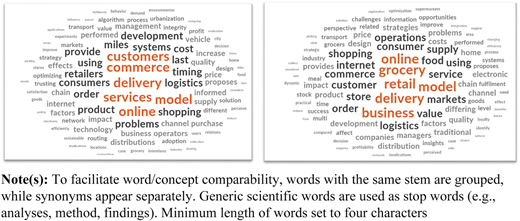
Word cloud: Based on 500 most cited in Web of Science (left) and our sample (right)
Word cloud: Based on 500 most cited in Web of Science (left) and our sample (right)
Data analysis
As seen in Table 1, the selection process rendered 85 publications for review (see Appendix for the specific publications). We conducted a thematic analysis of the publications. Their methodological approaches were manually coded in NVivo (Figure 2). Then, we identified indicators of effectiveness and efficiency for individual or combined actors (see Table 2).
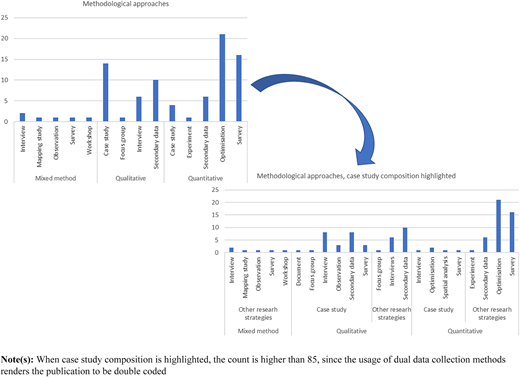
Methods and data collection in reviewed articles (85). Multiple methods and data may apply to the individual articles
Methods and data collection in reviewed articles (85). Multiple methods and data may apply to the individual articles
Example of thematic analysis
| Measurement | Indicator (examples) | |
|---|---|---|
| Effectiveness* | Profit maximisation | Revenue/pricing strategy, business value creation, market size, sale ratio, availability of KPI |
| Consumer purchase satisfaction | Time saving, physical ease, convenience, price, product offer | |
| Market share | Competition | |
| Service quality | Possibility for returns, consumer services, total offer quality | |
| Sustainability | Economic feasibility, energy use, resource usage, material usage, social compliance | |
| Efficiency | Delivery costs | Delivery time, delivery distance, delivery quality, service quality, price for delivery, market density, missed deliveries, number of returns, security, route planning |
| Production cost | Competition, price, warehouse cost, order system, economies of scale, production automation, digitalisation | |
| Web design | Layout, functionality, attractiveness, purchase security | |
| Product offer | Product characteristics, availability, product differentiation, food waste | |
| Relationships | Trust, loyalty, opportunism, information aesthetics, corporate alliances |
Note(s): While it would be reasonable to assume that profit maximisation and consumer purchase satisfaction are two parts of the same goal, it is equally reasonable to assume that consumers would not consider goals related to, e.g. market share or profit maximisation, or resource utilisation regarding, e.g. production costs
Next, we focused on potential trade-off situations of logistic performance measurements in terms of (1) performance measures themselves, (2) coordination among actors and (3) to what extent a system level was considered along the axes of measures and/or actors. This helped us identify research gaps for effectiveness and efficiency, as well as actors or actor combinations, in line with our proposed system-level perspective including all actors, efficiency and effectiveness.
Findings
Methods used in the reviewed publications
Figure 2 presents the methodological approaches and data collection methods used in the 85 publications. The three most used approaches are (1) optimisation studies applying a combination of secondary data and qualified estimations, (2) surveys and (3) case studies. For case studies interviews and secondary data dominated qualitative data collections, while optimisation dominated the quantitative case studies (see diagram to the right in Figure 2).
Performance measurements used by key actors in LML
Table 3 presents the findings from the thematic review.
Result of studies using effectiveness and efficiency measurements by actor
| Performance measurement | Producer | Retailer | Consumer | |
|---|---|---|---|---|
Effectiveness and efficiency | Profit maximisation and delivery costs | Xiao and Chen (2012) | Campbell and Savelsbergh (2006), Cao (2014), CoIla and Lapoule (2012), Faugère and Montreuil (2020), Lunce et al. (2006), Palmer et al. (2000), Plant et al. (2003), Ring and Tigert (2001), Stritto and Schiraldi (2013), Wei et al.(2018) | |
Consumer purchase satisfaction and delivery costs | San-Martín and Jimenez (2017), Wilson-Jeanselme and Reynolds (2005) | |||
Profit maximisation and product offer | Davies et al. (2019), Ring and Tigert (2001), Stritto and Schiraldi (2013) | |||
Consumer purchase satisfaction and product offer | Cui and Wang (2010), San-Martín and Jimenez (2017), Wang et al., (2020), Wolfinbarger and Gilly (2001) | |||
Consumer purchase satisfaction and the Web | Bressolles et al. (2015), Prud'homme and Boyer (2005), San-Martín and Jimenez (2017), Wilson-Jeanselme and Reynolds (2005) | |||
Profit maximisation and production costs | Xiao and Chen (2012) | Colla and Lapoule (2012), Lunce et al. (2006), Ring and Tigert (2001), Starr (2003), Stritto and Schiraldi (2013) | ||
Consumer purchase satisfaction and relationships | Lunce et al. (2006), Stritto and Schiraldi (2013) | Heim and Sinha (2005), San-Martín and Jimenez (2017) | ||
Sustainability and organization/product utilization | Seok et al., (2018) | Aljohani and Thompson (2019), Thornton and Marche (2003) | ||
Sustainability and product offer | Heard et al. (2019) | Gee et al. (2020), Heard et al. (2019) | Gee et al. (2020), Heard et al. (2019) | |
Sustainability and delivery costs | Heard et al. (2019) | Chen et al. (2020), Heard et al. (2020), Gee et al. (2019) | Gee et al. (2020), Heard et al. (2019) | |
Sustainability and production costs | Heard et al. (2019) | Heard et al. (2019) | ||
Effectiveness | Profit maximisation | Dussart (2000), Hillen and Fedosveeva (2021), Liu et al.(2008), Picoto et al. (2013), Roberts et al. (2016) | ||
Performance measurement | Producer | Retailer | Consumer | |
Consumer purchase satisfaction | Anckar et al. (2002), Asdemir et al.(2009), Lewis (2006), Morganosky and Cude (2002) | |||
Service quality | Dussart (2000) | |||
Market share | ||||
Sustainability | ||||
Efficiency | Delivery costs | Arnold et al. (2018), Boyer et al. (2003), Boyer and Hult (2005), Burn and Barnett (2000), Chhetri et al. (2017), Deutsch and Golany (2018), Dubosson-Torbay et al.(2002), Emeç et al. (2016), Hübner et al. (2016), Kämäräinen et al. (2001a), Kämäräinen et al. (2001b), Lim et al. (2009), Liu et al., (2020), Mahar et al. (2014), Mkansi et al. (2018), Murphy (2003), Ogawara et al.(2003), Pan et al. (2017), Rai et al. (2019), Rudolph and Gruber (2017), Steinfield et al. (2002), Sung (2006), Vazquez-Noguerol et al. (2020), Wong et al. (2018), Wygonik and Goodchild (2018), Yrjölä (2001), Zhu et al.(2021) | Boyer and Hult (2005), Boyer and Hult (2006), Chen et al. (2014), Doherty et al.(2006), Faraoni et al. (2019), Huang and Oppewal (2006), Kamarainen et al.(2001a), Seitz et al. (2017), Sousa et al.(2020) | |
Product offer | Adebanjo et al. (2006) | Boyer et al. (2003), Hübner et al. (2016), Mkansi et al.(2018), Quader and Quader (2008), Steinfield et al.(2002), Sung (2006), Vazquez-Noguerol et al. (2020), Wong et al. (2018), Yrjölä (2001), Zhu et al. (2021) | Boyer and Hult (2005), Boyer and Hult (2006), Chen et al. (2014), Cho et al.(2019), Doherty et al. (2006), Huang and Oppewal (2006), Pelet et al. (2020) Seitz et al. (2017), Sousa et al. (2020) | |
Web | Jahanshahi et al. (2013), Lewis et al. (2014), Lim et al.(2009), Quader and Quader (2008), Sung (2006), Weber and Badenhorst-Weiss (2018), Westerman et al. (2014) | Boyer and Hult (2005), Cho et al. (2019), Faraoni et al. (2019), Gounaris et al.(2005), Pelet et al. (2020) | ||
Production costs | Burn and Barnett (2000), Boyer et al. (2003), Boyer and Hult (2005), Eriksson et al. (2019), Ghezzi et al. (2012), Hübner et al. (2016), Kotzab (1999), Kamarainen et al.(2001b), Mason and Lalwani (2007), Mkansi et al.(2018), Ogawara et al. (2003), Rai et al. (2019), Wong et al. (2018), Yrjölä (2001), Zhu et al. (2021) | |||
Relationship | Adebanjo et al. (2006) | Jahanshahi et al. (2013), Liu et al. (2020) | Boyer and Hult (2005), Cho et al. (2019), Faraoni et al. (2019), Gounaris et al.(2005), Huang and Oppewal (2006), Seitz | |
Performance measurement | Producer | Retailer | Consumer | |
et al. (2017), Sousa et al. (2020), Verona and Prandelli (2002), Zott et al. (2000) | ||||
Note(s):Shaded areas indicate effectiveness measurements that would reasonably not be considered by an actor. Full article reference information can be found in Appendix A | ||||
Table 3 shows that there were a limited number of publications focusing on both effectiveness and efficiency and that these were dominated by a single-actor focus. A multi-actor perspective only applied in two life-cycle assessment studies dealing with sustainability. Only a few publications took into consideration several logistic performance measurements simultaneously for retailers or consumers, while producers remained rare.
As for effectiveness, no publications considered the producer, and in the studies on retailers or consumers, multiple actors' effectiveness was not considered, nor was coordination of goals among actors.
Considerably more studies focused on efficiency, dominated by assumptions of resource utilisation for retailers or consumers. Only one empirical study focused on the local food producer's efficiency measures, but did not consider coordination between actors, despite the raised benefits for producers in joining forces with other actors. Using multiple efficiency measures was more common for consumers than retailers. Only one publication (Boyer and Hult, 2005) covered multiple actors while adopting several efficiency measures. They connected consumers to the operational resources that retailers used to create an online purchasing context, including how direct store-based delivery led to high delivery costs, low picking efficiency, low capital investments and high consumer convenience. Indirect distribution-centre delivery was described as leading to low delivery costs, high picking efficiency, high capital investments and low consumer convenience. Although Boyer and Hult (2005) did not single out LML, their study indicated how trade-offs are necessary in terms of operational variability and resource utilisation in relation to order fulfilment and delivery, thereby indicating different LML efficiency solutions at the system level. Figure 3 highlights the reviewed publications performance measure and actor focus.
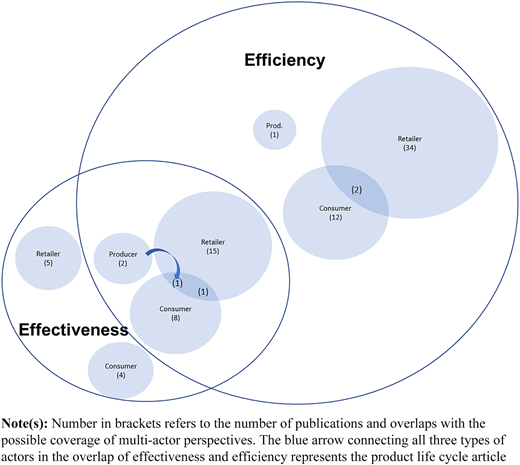
Visualisation of the usage of effectiveness and efficiency measurements in the reviewed literature
Visualisation of the usage of effectiveness and efficiency measurements in the reviewed literature
With the domination of single-actor, single-measure perspectives and the retailer's efficiency being the most frequent focus, we raise three plausible explanations for this. Firstly, research has implicitly viewed LML as a problem within the retailer's boundaries, with focus on the resource utilisation for delivery and production (see Table 3 Efficiency). In the reviewed publications, this is done by assuming that the retailer handles the LML as inbound transportation and decides about the product assortment, which could explain the continuing assumption that the retailer carries extensive expenses for LML (e.g. Kuhn and Sternbeck, 2013).
Secondly, viewing LML as a transfer cost has implicitly led to the assumptions that it can be separately quantifiable from other LML issues and actors, such as relationships or website configurations. This separation is also visible in the few articles that use several efficiency measures, or when effectiveness and efficiency are considered simultaneously. It is not until more recent sustainability studies that a system level of both efficiency and effectiveness is adopted to capture the complexity of consequences and the boundary-spanning effects on the environment (see Table 3 Effectiveness and efficiency). However, the focus has been on environmental efficiency for the sake of society rather than considering coordination of activities at the system level.
The third explanation relates to methodology. Applying methods weighted towards quantitative measurements (see Figure 2) results in the reviewed studies focusing on the operationalisation of separate measures, and normally this requires the researcher to disregard coordination issues or multiple actors as primary informants. This is also the case even when a more complex approach to the efficiency of LML is used, since it is common to treat the other parties as secondary to the retailer's task to optimise LML.
Concluding discussion
This study identified how empirical research on LML has used and defined performance measures for key grocery industry actors. With past single-actor, single-measures, there are risks of leaving parties out, disregarding consequences and sub-optimising LML, especially as the development includes a redistribution of tasks along the grocery retail supply chain. To achieve efficient and effective LML under new market conditions, optimisation would follow from system-level coordination among, rather than for, individual actors.
Fugate et al. (2010) have previously argued for the need to simultaneously consider efficiency and effectiveness in logistics, and sustainability studies have started to address system-level responsibilities and consequences of logistics (e.g. Öberg et al., 2012; Sallnäs and Björklund, 2020), while activities distributed and redistributed among parties would also have system-level business effects. A system perspective would place multiple actors' goal and resource coordination in focus, a subject that does not seem to have been investigated empirically in previous LML research. This would require collaboration among actors in the grocery retail supply chain to ensure that goods, for instance, are delivered on time, that waste is curtailed and that costs and transport are minimised on the system level. This collaboration would focus on questions regarding who does what and how activities and risks distributed among parties are compensated by others.
Logistic network optimisation studies may fuel ideas related to efficiency, while Fugate et al. (2010) could help to expand and combine across efficiency and effectiveness measures at the system level. Tools, such as agent-based modelling, location analyses, cause-and-effect diagrams and multi-objective techniques, may help to achieve the system-level efficiency and effectiveness. The multi-actor perspective would generally include two considerations: (1) the aggregated efficient use of resources on the system level and (2) the measure of frictionless coordination and goal-alignment among parties. Measures of coordination would depart from the relationships among parties (e.g. relationship effectiveness and efficiency) rather than the actors themselves, while the system level would emphasise shared risk schemes, return transports to minimise total distances and measure filling rates across the supply chain.
Illustratively, Figure 4 depicts coordination of resources used for deliveries aiming at minimising empty transports and achieving profitability. The coordination means that it is through the relationships among actors that it is possible to discuss a potential redistribution of activities, who is responsible for what and how deliveries should be pursued (between what actors and, on the broader system level, in relation to other producers, retailers and consumers). This is accomplished by connecting the firms' individual operations to each other, the balancing of, for instance, the price among actors to achieve system level profitability combined with consumer satisfaction.
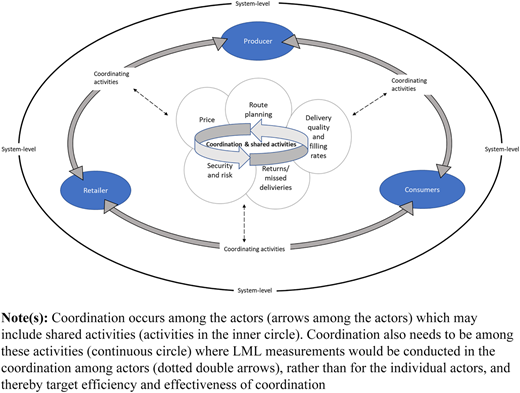
Suggested illustration of LML performance at the system-level, given reviewed literature
Suggested illustration of LML performance at the system-level, given reviewed literature
The figure depicts how coordination deals with both efficiency and effectiveness where such measures are transferred from the individual actors to efficiency and effectiveness in the coordination of actors (arrows in Figure 4) and thereby how goals and resource utilisation at the system level can reinforce each other. Trust, loyalty and information aesthetics would play a vital part here to determine the efficiency at the system level, since those measurements can be considered as relational goals and resource utilisation. Meanwhile, system-level measures would concern the optimal, aggregated resource use alone, as there is no (individual) actor's interest that represents the system level. The dilemma of setting boundaries, though, is delicate in practice and includes coordination with additional producers, retailers and consumers in the planning and execution of LML. Challenges further include the use of factual logistical data with customer data, since the latter is often of perceptual nature and needs to be transformed or merged to function as if it were logistical data.
A research agenda
Our literature review shows a need for more empirical evaluations of LML performance in the grocery sector using system-level analysis to determine LML performance, i.e. the function's effectiveness and efficiency. We therefore suggest the following avenues for future research:
LML system-level studies
The single-actor perspective dominating across research on efficiency and/or effectiveness for LML fails to cover the logic of LML. As a result, and as our main point in this paper, coordination of resources and goals is essential to consider in future empirical research. Such research should reach beyond contextualising other parties to a focal firm (e.g. Chhetri et al., 2017; He, 2020; Hübner et al., 2016) and empirically investigate coordination on system levels, as well as how efficiency and effectiveness are affected by the redistribution of activities, how coordination is best achieved and how activities should ideally be distributed across the system. This is also in line with the increased sustainability focus, while including additional efficiency and effectiveness measures. Designing LML research as multiple case studies, or comparative studies, would provide a means of viewing LML performance from multiple perspectives, based on various types of data, while exploring additional performance measures related to said perspectives. Such studies are essential since the conceptualisation of logistic performance is heterogenic, as is the conceptualisation of LML.
Producer and relationship inclusion
The demonstrated lack of research, including the producer's perspective, creates a limitation that hinders the conceptualisation of coordination and redistribution of activities at the system level. The producer's perspective should be included in proposed future research on multi-actor system LML studies, specifically due to the shift in LML cost and execution related to online operations. Additionally, while the retailer's relationship to consumers is of essential focus in other research streams (e.g. general e-commerce), it does not seem to have been a focus in LML research. Hence, we propose studies that integrate a system-level perspective with in-depth studies on producers and coordination between producer, retailer and consumer. This would help to establish the resource usage connected to LML efficiency, with specific focus on how relationships can work as a coordinating resource within a system.
Web resource utilisation for online business
Going further into detail on resource usage and its relation to online business, research on website costs and functions beyond consumers is limited (e.g. Faraoni et al., 2019; Weber and Badenhorst-Weiss, 2018). While consumers are interested in the functionality of the web, the actual platform resources (financial and operational) are most likely invested in by the other actors in the system. It is thereby of interest to further compare and analyse how web efficiency for LML can be coordinated to achieve both consumer satisfaction and profit maximisation. Here, COVID-19 has amplified web solutions and home delivery, while the gig economy has introduced new players to LML, allowing for opportunities to study web resource utilisation among actors.
Perishable product particularities
Perishable products may be damaged and therefore difficult for consumers to return, hence influencing both satisfaction and profit. As a result, coordination among actors would be assumed to be more demanding than for other types of products. Studies focusing specifically on perishable products and coordination among actors would be desirable, not least since consumers move away from being a main actor in LML and since perishable-product LML are vulnerable to temperature and timing, which means that additional items need to be included in any LML analysis.
By forwarding a system-level perspective when reviewing research, including both efficiency and effectiveness to better capture LML when multiple actors are involved and the distribution of tasks become unclear, this paper contributes to past research by indicating research gaps and important directions for future research. The study adds to past reviews on LML, creating ground for future studies to extend present knowledge on LML and highlighting how research and practice may potentially have become increasingly detached regarding the LML scope in the grocery sector.
The authors would like to acknowledge the funding from The Kamprad Family Foundation for Entrepreneurship, Research & Charity (Grant no. 20180076) for this research. The funding organisation did not influence the research process of the study. The authors are also grateful to the Editor and Reviewers for their comments on the manuscript throughout the revision process.
References
Appendix
Reviewed articles
| Journal | Articles |
|---|---|
| African Journal of Science, Technology, Innovation and Development |
|
| Annals of Operations Research |
|
| Asia Pacific Journal of Marketing and Logistics |
|
| |
| British Food Journal |
|
| |
| Business Horizons |
|
| California Management Review |
|
| Central European Journal of Operations Research |
|
| Cogent Business and Management |
|
| Communications of the Association for Information Systems |
|
| Computers & Industrial Engineering |
|
| Computers and Operations Research |
|
| Decision Sciences |
|
| Environment and Planning A: Economy and Space |
|
| European Journal of Operational Research |
|
| |
| European Management Journal |
|
| |
| |
| European Transport Research Review |
|
| Industrial Management and Data Systems |
|
| |
| |
| |
| Information Systems and e-Business Management |
|
| Integrated Manufacturing Systems |
|
| International Journal of Electronic Commerce |
|
| |
| |
| International Journal of Engineering Business Management |
|
| |
| International Journal of Hospitality Management |
|
| International Journal of Information Management |
|
| International Journal of Logistics: Research and Applications |
|
| International Journal of Operations & Production Management |
|
| |
| International Journal of Physical Distribution & Logistics Management |
|
| |
| |
| International Journal of Production Research |
|
| International Journal of Retail & Distribution Management |
|
| |
| |
| |
| |
| |
| |
| |
| |
| |
| |
| |
| |
| Journal of the Academy of Marketing Science |
|
| Journal of Business Economics and Management |
|
| Journal of Business & Industrial Marketing |
|
| Journal of Business Research |
|
| Journal of Cleaner Production |
|
| |
| Journal of Global Information Technology Management |
|
| Journal of Intelligent Manufacturing |
|
| Journal of Management Information Systems |
|
| Journal of Marketing Management |
|
| |
| Journal of Organizational Computing and Electronic Commerce |
|
| Journal of Operations Management |
|
| |
| Journal of Retailing |
|
| Journal of Retailing and Consumer Services |
|
| |
| Journal of Small Business and Enterprise Development |
|
| Journal of Service Research |
|
| |
| MIT Sloan Management Review |
|
| Research in Transportation Business and Management |
|
| Resources, Conservation & Recycling |
|
| |
| Sustainability |
|
| Technological Forecasting and Social Change |
|
| Thunderbird International Business Review |
|
| Transportation Research Part D: Transport and Environment |
|
| Transportation Science |
|
| Trends in Food Science and Technology |
|
| Other types of publications |
|

