Micro-credentials are increasingly positioned within European higher education as flexible learning pathways that support the digital and green transitions while widening access, equity and lifelong learning. This paper aims to examine the design and evaluation of sustainability-focused micro-credentials using an integrated model combining Analysis, Design, Development, Implementation and Evaluation (ADDIE), ABC Learning Design and GreenComp: The European Sustainability Competence Framework.
This small-scale practice evaluation was conducted in two phases. Phase 1 adopted a design-based approach to examine the collaborative instructional design process undertaken by the research team as practitioner-designers. Phase 2 piloted the evaluation of learners’ self-reported sustainability competences within a single sustainability-focused micro-credential using a post-module survey that asked participants to retrospectively rate their perceived competences before and after completing the module.
Findings from this small-scale pilot suggest that the integrated model supported coherent curriculum and pedagogical design while facilitating the embedding of sustainability competences. Learners reported increased confidence and a greater perceived capacity to apply sustainability concepts in educational settings.
The study offers insights to guide the effective design and evaluation of sustainability-focused micro-credentials that advance transformative education for sustainable development.
1. Introduction and rationale
The definition of micro-credentials varies and there is no universal agreement on the term (UNESCO, 2022; Brown et al., 2021a). However, the European Commission, through the European Education Area, proposes that a micro-credential is a quality-assured, transparent and comparable record of assessed learning outcomes achieved through a small volume of learning, aligned with the European framework to ensure clarity on content, workload, level and value for learners, institutions and employers (European Commission, 2022a). They may be standalone or combined into larger credentials and can be delivered in face-to-face, blended or online formats. The term “micro-credential” is commonly used to refer both to the credential itself and the educational or training programme that leads to it.
The Council Recommendation on a European Approach to Micro-Credentials for Lifelong Learning and Employability is underpinned by the collaborative structures of the Bologna Process and the European Higher Education Area (EHEA), which together ensure quality, comparability and transparency through mechanisms such as the European Credit Transfer and Accumulation System (ECTS), Qualifications Frameworks and the European Standards and Guidelines for Quality Assurance (ESG). In this study, micro-credentials are therefore understood as quality-assured, competency-focused units of assessed learning that are designed to be transparent, portable and aligned with established European educational frameworks.
This small-scale practice evaluation study examines the design and delivery of sustainability-focused micro-credentials using an integrated instructional design model that combines Analysis, Design, Development, Implementation and Evaluation (ADDIE), ABC Learning Design (ABC-LD) and GreenComp: The European Sustainability Competence Framework. It investigates how collaborative design processes support coherent, high-quality micro-credential development (Phase 1) and pilots an evaluation of learners’ perceived sustainability competences before and after completing a micro-credential (Phase 2). The findings contribute to wider discussions on the effective design and evaluation of sustainability-focused micro-credentials, while also informing future iterations of the micro-credential evaluated in Phase 2.
1.1 Global and European context of upskilling and the role of micro-credentials for lifelong learning
In recent years, global organisations have increasingly emphasised the transformation of education systems to support lifelong learning as a common good. In 2020, UNESCO called for schools and universities to evolve into lifelong learning institutions, prioritising vulnerable groups and positioning lifelong learning at the heart of equitable and sustainable development (UNESCO Institute for Lifelong Learning, 2020). Similarly, the Organisation for Economic Co-operation and Development (OECD), in Skills Outlook (OECD, 2021): Learning for Life urged governments to create learning systems that are inclusive, affordable, accessible and adaptable, equipping individuals with skills that endure across the lifespan (OECD, 2021). It also emphasised the importance of recognising diverse learning pathways and validating skills gained across formal and informal settings.
Within this context, micro-credentials have gained policy support for their potential to widen participation through shorter, modular and stackable forms of learning that can be accumulated over time (European Commission, 2022b; UNESCO Institute for Lifelong Learning, 2020). In a rapidly changing and increasingly digital world, where people live and work longer, learning is expected to become more flexible, personalised and continuous (Gratton and Scott, 2016). However, scholars have questioned whether such agendas are driven as much by economic competitiveness as by social equity, potentially reinforcing neoliberal conceptions of education as a tool for labour market adaptation rather than personal or civic development (Salmon, 2023). Consequently, although micro-credentials are frequently promoted as pathways for lifelong learning, there remains limited empirical evidence regarding how these promises are realised in pedagogical practice and learner experience.
At a European level, the growing emphasis on micro-credentials also reflects policy responses to digital and green skills needs, recognising the requirement for citizens to continually update their knowledge, skills and competences to meet the demands of the twin transitions (Wylie et al., 2023; CEDEFOP, 2022; European Commission, 2020; European Commission, 2022a). These developments signal a broader shift from time-based qualifications towards competence-based and modular learning systems. Yet little is known about how such ambitions translate into Education for Sustainable Development (ESD) within universities. While micro-credentials are increasingly positioned as vehicles for advancing sustainability competences, their potential impact cannot be achieved through policy alignment alone. Without intentional and pedagogically robust design, sustainability risks becoming an add-on or a form of symbolic ESD lacking the depth required to foster transformative learning, behavioural change and genuine competence development. This positions instructional design as central to translating policy ambition into meaningful educational practice.
1.2 The rise of micro-credentials in European higher education: Innovation and tensions
Micro-credentials can currently be understood as a policy-led structural reform in higher education, characterised by uneven implementation, innovation and unresolved tensions. Traditionally, higher education has been characterised by long, structured programmes designed to deliver comprehensive disciplinary knowledge over extended periods. However, meeting these demands has become increasingly challenging in the context of today’s dynamic and rapidly evolving workforce (Gamage and Dehideniya, 2025). As learners and employers alike seek more flexible pathways, micro-credentials have emerged as a complementary model and are gaining significant traction in European academic environments (European Commission, 2025). Within Europe, the European Universities Initiative has accelerated the development and harmonisation of micro-credentials, reinforcing their strategic importance within the EHEA. As of 2025, more than 50 European University Alliances are actively developing and implementing micro-credentials (European Commission: Directorate-General for Education, Youth, Sport and Culture, 2025). Among them, the European Consortium of Innovative Universities (ECIU) became the first alliance to issue e-sealed micro-credentials, digitally signed and tamper-evident certificates designed to ensure the authenticity, integrity and interoperability of learner records across institutions. Similarly, European University for Smart Urban Coastal Sustainability (EU-CONEXUS) a European university alliance comprising nine partner universities, including the researchers’ home institution, has been actively developing micro-credentials that advance smart urban coastal sustainability. These are designed in response to labour market trends, focusing on the development of entrepreneurial, green and digital competences that align with the European Skills Agenda and Green Deal priorities (EU-CONEXUS, 2024).
Emerging evidence also suggests that students perceive micro-credentials positively within sustainability education contexts. Recent pilot research found that learners viewed micro-credentials as a valuable mechanism for integrating sustainability into higher education curricula and potentially supporting retention, despite relatively low familiarity with the concept (Zalewska, 2025). Broader European policy research similarly indicates that micro-credentials are increasingly positioned as strategic tools for supporting the twin digital and green transition, particularly through flexible, targeted and employability-orientated learning opportunities, although challenges remain regarding quality assurance, funding and long-term system integration (Sanchez Barrioluengo et al., 2025).
At the same time, the growing prominence of micro-credentials has generated important critique. While they are frequently presented as drivers for innovation, accessibility and flexibility, they also risk reinforcing market-driven forms of reform within higher education. Ralston (2021) argues that the micro-credentialing “craze” reflects not only the unbundling of university curricula into smaller and more marketable units, but also a broader shift towards vocationalism and profit-orientated efficiency (Ralston, 2021). From this perspective, micro-credentials do not simply expand learning opportunities; they may also reconfigure higher education in ways that privilege employability and responsiveness to labour market needs over broader educational purposes. Relatedly, some scholars caution that the movement risks contributing to a “supermarket model” of tertiary education (Peters et al., 2025, p. 3), potentially undermining coherence, academic integrity and the wider developmental aims of higher education. While such concerns warrant serious attention, others argue that robust, competence-aligned design models can help safeguard pedagogical quality and educational value (Gamage and Dehideniya, 2025). As Brown et al. (2021b) observe, the international micro-credentials landscape remains fragmented and poorly defined, a situation compounded by limited institutional understanding and reluctance among senior leaders to act as change agents, resulting in uneven implementation across the sector (McGreal and Olcott, 2022).
2. The need for quality-assured sustainability-focused micro-credentials
As micro-credentials gain momentum across global higher education and lifelong learning, questions regarding their quality assurance have become increasingly significant (ENQA, 2023). The MICROBOL Project examined how existing Bologna tools, including the ECTS, qualifications frameworks and established quality assurance standards, could be applied to micro-credentials within the EHEA (MICROBOL, 2022). The project concluded that micro-credentials should be subject to the same internal and external quality assurance processes as other university offerings. It further emphasised key principles including institutional responsibility for quality assurance, transparent and participatory quality processes involving learners, recognition aligned with the Lisbon Recognition Convention and the development of national and regional registers of trusted providers.
2.1 Quality assurance challenges in micro-credentials
A survey undertaken by ENQA revealed that while many agencies recognise the importance of quality assurance for micro-credentials, few have yet formalised their approaches (ENQA, 2023). This reveals a critical disconnect between policy ambition and pedagogical enactment, where frameworks for recognition and transparency are advancing more rapidly than the instructional design practices required to realise them in learning environments. As discrete, often modular learning units, micro-credentials are effectively ‘packaged’ educational offerings, where the coherence, depth and integrity of learning depend on how content, activities and assessment are intentionally designed and aligned (Desmarchelier and Cary, 2022).
2.2 Instructional design as a quality mechanism
The development of high-quality micro-credentials necessitates the application of established instructional design frameworks to ensure pedagogical coherence and alignment with clearly articulated learning outcomes. A range of frameworks are currently used across European micro-credential initiatives, including the Analysis, Design, Development, Implementation and Evaluation (ADDIE) model (Briggs, 1970), Carpe Diem (Salmon and Wright, 2014), ABC-LD (Young and Perović, 2024) and Backwards Design (Wiggins and McTighe, 2005). These frameworks provide structured approaches for aligning learning outcomes, activities and assessment with emerging skills and competency demands.
Evidence from the European Basic Skills Network (EBSN) Professional Development Series further reinforces the value of intentionally selecting a framework in micro-credential design. Wylie, Widger, Brett and Murphy (2023) highlight that micro-credential development within cross-national European partnerships demands a structured yet flexible approach, particularly when design teams operate across diverse institutional, cultural and linguistic contexts. Their analysis demonstrates that Salmon’s Carpe Diem framework was particularly suited to this environment, as it supports persona development, collaborative storyboarding and iterative prototype building. They note that more linear models, such as ADDIE, although widely used, were less appropriate for collaboratively generated content, while Backwards Design lacked the explicit blueprinting and persona creation stages required for cross-partner consensus-building. This highlights an important tension between structured and collaborative design approaches, suggesting that no single framework is sufficient to address the complex, multi-stakeholder nature of micro-credential development.
2.3 Rationale for an integrated analysis, design, development, implementation and evaluation–ABC learning design–GreenComp model
In this study, the integration of ADDIE with ABC-LD demonstrates how systematic planning at the macro level, combined with collaborative, activity-focused design at the meso and micro levels (Young and Perović, 2024), can support the development of sustainability-focused micro-credentials. This approach enables the intentional embedding of GreenComp competences across learning activities and assessments while aligning with European expectations for quality assurance and transparency. Blending systematic models such as ADDIE with collaborative and design-orientated approaches like ABC-LD or Carpe Diem allows developers to achieve this balance, supporting the creation of micro-credentials that are pedagogically robust, contextually appropriate and aligned with evolving European expectations for transparency, mobility and learner-centred credentialing.
Competency-based education is central to European micro-credential policy, which requires learning experiences to describe and assess defined competences rather than rely on traditional overarching learning outcomes (European Commission, 2022b). The integrated ADDIE–ABC-LD–GreenComp model proposed in this study provides a coherent way to embed competences systematically across the design process. At the macro level, ADDIE ensures that learning outcomes and skills needs are identified and aligned; ABC-LD then translates these outcomes into learning activities, while GreenComp ensures that discipline-specific and sustainability competences are intentionally embedded and assessed throughout. This structured approach differentiates the model from more linear approaches, as it enables competences to be embedded in each design phase rather than inserted retroactively. Its configuration directly addresses a gap noted in both practice and research, which is the lack of empirically tested instructional design models that operationalise competence-based education within micro-credential development. By uniting planning, collaborative pedagogy and a European competence framework, the proposed model provides a scalable and transparent approach that aligns with the European Commission’s recommendations around micro-credentials.
Although limited research has directly examined the integration of ABC and ADDIE within a unified learning design framework, substantial evidence supports their underlying principles independently. The ADDIE model is widely recognised for its systematic, structured approach and its effectiveness in online and blended learning environments (Spatioti, Kazanidis and Pange, 2022), while research on microlearning and micro-credentials similarly emphasises the value of needs analysis, iterative development and rigorous evaluation. At the same time, emerging studies highlight the importance of agile, learner-centred design practices, particularly in micro-credential contexts where flexibility, authentic learning and rapid iteration are critical; for example, Shakeel, Mamun and Haolader (2022) show that combining ADDIE with agile principles enhances learner engagement and outcomes. Overall, this body of literature supports a hybrid approach that retains ADDIE’s rigour while incorporating flexible, activity-based and learner-centred elements, as reflected in ABC-LD framework.
3. Research aim and questions
This small-scale practice evaluation study examined how sustainability-focused micro-credentials can be designed and evaluated using an integrated instructional design model combining ADDIE, ABC-LD and GreenComp. The research was conducted in two interconnected phases.
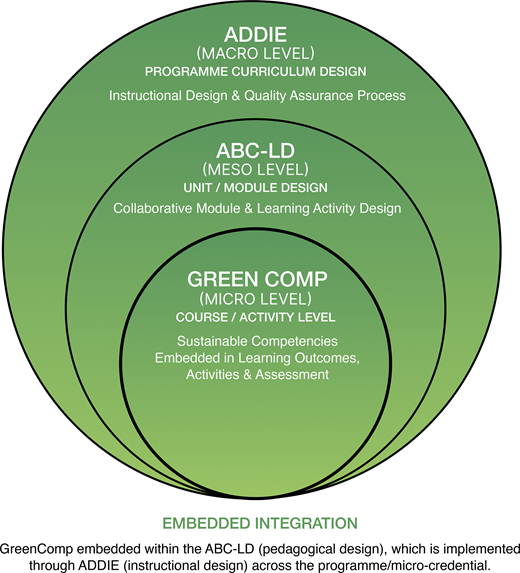
Phase 1 adopted a design-based approach to examine the collaborative instructional design process undertaken by the research team as practitioner-designers in the co-creation of eight sustainability-focused micro-credentials. Data were generated through workshop insights, facilitator reflections and design artefacts produced during routine professional development activities while adapting the ADDIE model (Briggs, 1970), the ABC-LD model (Young and Perović, 2024) and the European Sustainability Competence Framework (GreenComp) (Bianchi et al., 2022) (see Figure 1). The micro-credentials in development in Phase 1 were co-created as part of a deliverable for the European University Alliance, EU-CONEXUS, which focuses on smart urban coastal sustainability.
Phase 2 involved the internal pilot evaluation of a standalone micro-credential titled Environmental Sustainability in Education. This learner-facing phase examined students’ self-assessed sustainability competences and perceived learning experiences through a post-module survey in which participants retrospectively rated their perceived competences before and after completing the micro-credential. Table 1 provides a summary and overview of the study structure, which is elaborated upon in the Methodology section:
How can sustainability competences be embedded into micro-credentials through an integrated instructional design model aligned with European quality assurance principles?
What perceptions of competence development, sustainability awareness and learning experience were reported by students following participation in the pilot micro-credential?
4. Integrated instructional design frameworks used in phase 1
This study explores how an integrated instructional design model (ADDIE, ABC-LD and GreenComp) can serve as a mechanism for ensuring alignment with European quality assurance principles, particularly those outlined by ENQA (2023) and the MICROBOL project (2022), in the design and delivery of sustainability-focused micro-credentials. Building on the identified need for quality-assured, sustainability-focused micro-credentials, this study draws on a multi-layered theoretical and conceptual framework to guide both the design and evaluation of the learning experience. The initiative embedded principles of ESD through the integration of three interrelated frameworks: ADDIE, ABC-LD and the European Sustainability Competence Framework (GreenComp). Together, these frameworks provided complementary structures for curriculum development, pedagogical design and competence alignment, ensuring that sustainability competences were embedded systematically and collaboratively throughout the micro-credential design process (see Figure 1).
The three complementary models (ADDIE, ABC-LD and GreenComp) created a multi-layered design ecosystem that supported the systematic development, pedagogical coherence and sustainability alignment of the micro-credentials examined in this study (see Figure 1). At the macro (curriculum) level, ADDIE provided a structured framework for content planning, development, implementation and quality assurance. At the meso (learning design) level, ABC-LD supported the collaborative design of learning activities, helping to ensure constructive alignment between learning outcomes, teaching methods and assessment. At the micro (competency) level, GreenComp guided the intentional embedding of sustainability competences and values, ensuring that ESD principles were explicitly integrated throughout the learning experience. Collectively, these frameworks offered a coherent model through which sustainability-focused micro-credentials could be designed, delivered and evaluated.
4.1 The analysis, design, development, implementation and evaluation model
The ADDIE model provides a systematic and iterative framework for instructional design and curriculum development (Molenda, 2003). In this study, ADDIE functioned as the macro-level framework, structuring the entire design process from the initial needs analysis through to post-implementation evaluation. During the analysis phase, design teams engaged in persona development and skills gap analysis to identify learner needs, professional contexts and labour market demands. The EU-CONEXUS (2024) Skills Survey served as a key needs assessment, identifying priority thematic areas for curriculum development across the alliance. The ADDIE design and development phases then involved mapping intended learning outcomes and sequencing learning activities through a series of workshops with teams of subject-matter experts from across the University Alliance.
Crucially, the ADDIE framework supported transparency, documentation and alignment across all stages of the design process, reflecting not only the principles of European quality assurance as outlined by the European Association for Quality Assurance in Higher Education (ENQA) (2023) and the Standards and Guidelines for Quality Assurance in the EHEA (European Association for Quality Assurance in Higher Education (ENQA), 2015) but also the core design principles for micro-credentials in Europe (European Commission, 2022a). These principles emphasise clarity in learning outcomes, workload, level, assessment and quality assurance mechanisms to ensure that micro-credentials are comparable, verifiable and portable across institutions. By embedding these elements from the outset, the ADDIE model ensured that learning outcomes, content and assessment were coherently linked and evidence-based. As such, it not only structured the design process but also operationalised internal quality assurance and supported external recognition within the broader EHEA.
4.2 ABC learning design: meso level
At the meso level, the ABC-LD model (Young and Perović, 2024) functioned as the collaborative and pedagogical design vehicle through which sustainability competences were actively translated into learning experiences. The ABC-LD framework uses rapid (typically 90-minute), activity-based planning to visualise the learner journey across six distinct types of learning activity; acquisition, inquiry, practice, production, discussion and collaboration (Laurillard, 2012). Its speed and structure make it particularly well-suited to the design of micro-credentials. The workshop-based, visual nature of ABC-LD supports interdisciplinary co-creation, enabling design teams to achieve constructive alignment within limited development timelines while fostering shared understanding and innovation across collaborators. Within this study, these activity types were used to ensure alignment between intended learning outcomes, pedagogical strategies and assessment methods (Laurillard, 2012). Moreover, the model’s flexibility allows for localisation of learning activities and the integration of frameworks such as GreenComp, positioning ABC-LD as an agile, innovation-orientated methodology for designing high-quality, competence-based micro-credentials.
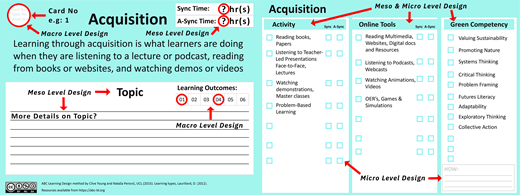
In this study, the ABC-LD model was adapted to serve as a transporter of sustainability competences, enabling academic teams not only to design teaching for sustainability but also to raise awareness, foster critical thinking, develop systems thinking and inspire action (see Figure 2). This was achieved through the careful selection and sequencing of transformative pedagogical techniques, for example, inquiry-based exploration of real-world sustainability challenges, dialogic discussion to surface assumptions and collaborative production activities that required learners to apply sustainability principles in context. Since emerging in the 1960s, sustainability education and related movements such as ESD have been closely associated with transformative learning (Mezirow, 1978; Bourn and Soysal, 2021), which seeks to profoundly shift perspectives, beliefs and behaviours through reflection and critical engagement. By integrating GreenComp mapping into each stage of the ABC-LD process, this adaptation enabled transformative curriculum design, ensuring that sustainability was embedded not only as content but also as an experiential and reflective learning process.
Figure 2 illustrates how GreenComp competences were embedded within the pedagogical layers of ADDIE and ABC-LD. This multi-framework approach supported the use of industry-informed challenges, iterative design, cross-disciplinary collaboration and the consistent integration of ESD principles into every phase of micro-credential development.
4.3 GreenComp framework: Micro level
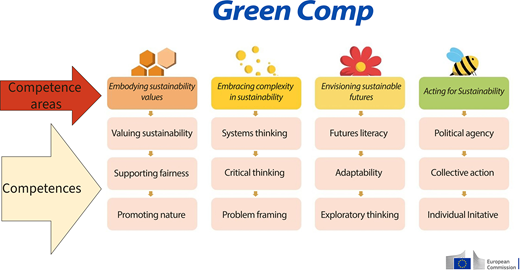
ESD emphasises the development of knowledge, skills, values and attitudes that empower learners to act for sustainability at individual and collective levels. It promotes critical thinking, systems awareness and transformative learning, all essential for navigating complex sustainability challenges (UNESCO, 2020). To operationalise these aims, this study adopts the European Sustainability Competence Framework (GreenComp) (Bianchi et al., 2022), developed by the Joint Research Centre of the European Commission. GreenComp identifies 12 interrelated competences organised across four domains (see Figure 3):
Embodying sustainability values;
Embracing complexity in sustainability;
Envisioning sustainable futures; and
Acting for sustainability.
These competences collectively support a holistic approach to learning for sustainability. In the present study, GreenComp was used as both a design lens and an evaluation framework, enabling alignment between intended learning outcomes, learning activities and assessment practices. Embedding GreenComp ensured that educators promoted transformative learning, not only gaining knowledge about sustainability but also developing the attitudes and agency necessary to act within their professional and educational contexts.
In this study, GreenComp was used not merely as a reference document but as a design and alignment tool within the ABC-LD framework. Academic teams mapped GreenComp competences to each ABC-LD learning activity, ensuring that engagement and assessment were purposefully designed to cultivate transformative competences such as systems thinking, futures literacy, critical reflection and collective action. This adaptation operationalised ESD at the micro level, fostering learning experiences that encouraged participants to question assumptions, reflect on values and act with agency in their professional and educational contexts. By coupling GreenComp with ABC-LD’s participatory design process, the initiative produced curricula that were both pedagogically coherent and competency-aligned, ensuring that sustainability education was delivered through authentic, transformative and rich learning experiences.
5. Methodology
Building on the two-phase structure outlined in Table 1, this section details the context, participants and data-collection procedures for each phase. This study adopted a design-based qualitative approach to examine the development and impact of sustainability-focused micro-credentials within higher education. The study was structured in two interconnected phases that correspond to distinct stages of the micro-credential lifecycle design and implementation. This phased approach allowed the researchers to evaluate how the integrated design model functioned in both institutional co-design and classroom delivery contexts. A summary of the two-phase design is presented in Table 1.
5.1 Context and setting
The study was conducted across two interconnected contexts. Phase 1 took place within the EU-CONEXUS European University Alliance, where academic teams collaboratively developed sustainability-focused micro-credentials linked to Smart Urban Coastal Sustainability priorities. Phase 2 was implemented locally at South East Technological University (SETU) Ireland, where one of these micro-credentials, Environmental Sustainability in Education, was piloted and evaluated with postgraduate students.
5.1.1 Phase 1: Collaborative design of sustainability micro-credentials.
5.1.1.1 Purpose.
To document and analyse how the integrated ADDIE–ABC-LD–GreenComp model supported curriculum co-creation and sustainability competence alignment across the EU-CONEXUS alliance.
5.1.1.2 Participants.
Eight multidisciplinary academic teams (approximately 20–30 participants) from EU-CONEXUS partner institutions took part. Each team co-designed a sustainability-focused micro-credential aligned with the alliance’s Smart Urban Coastal Sustainability priorities. The themes of these micro-credentials were informed by a mixed-method, pan-European skills needs assessment conducted across the EU-CONEXUS alliance (EU-CONEXUS, 2024), which identified emerging labour market and educational needs related to sustainability. The resulting micro-credentials addressed topics such as leadership and change for sustainability, sustainable tourism, business and artificial intelligence (AI) for sustainable innovation, renewable energy systems, coastal management, education for sustainable development and environmental science. Teams represented a range of disciplines.
5.1.1.3 Design activities.
A series of five workshops was conducted: three online sessions (90 min each) and two face-to-face sessions hosted at SETU (South East Technological University). Activities included: persona development and needs analysis (ADDIE “Analysis” phase), collaborative learning design and storyboard creation (ABC-LD), mapping of course content to GreenComp competences and assessment alignment and quality review. Figure 2 illustrates an example of the ABC-LD storyboard used to visualise learning activities and align assessments to sustainability competences.
5.1.1.4 Data sources.
Developmental reflections, facilitator notes and participant feedback were collected as part of routine evaluation within EU-CONEXUS professional development activities. These reflections were part of standard professional development activities within the EU-CONEXUS alliance and were not collected as research data under formal ethical approval. Therefore, they are presented here as contextual design insights rather than analysed findings.
5.1.1.5 Data analysis.
Reflective logs, peer and expert feedback and workshop documentation generated during Phase 1 were analysed using an inductive thematic approach to identify recurring design patterns and practical insights. Data sources included facilitator debrief reflections, emails and comments from design team members, meeting minutes, participant feedback forms, notes from five workshops, 11 feedback forms on the ABC-LD process and eight pages of reflective notes recorded by the lead researcher between January and June 2024. These materials were produced by the lead researcher, co-facilitators, participating academics and workshop attendees.
The lead researcher reviewed all materials iteratively, with initial coding focused on identifying what worked well, what challenges emerged and priorities for future refinement. Codes were then grouped into broader themes relating to design challenges (e.g. balancing content scope and time constraints), success factors (e.g. persona-driven design and visualisation of learning activities) and insights into collaboration and interdisciplinary integration across academic teams.
Initial coding was undertaken by the lead researcher and subsequently reviewed and discussed with co-authors to strengthen interpretive credibility. To reduce bias, reflections were recorded as close as possible to workshop completion, interpretations were revisited through ongoing team dialogue and multiple sources of practitioner evidence were compared during analysis.
5.1.2 Phase 2: Pilot implementation and evaluation.
5.1.2.1 Purpose.
To explore learner experiences and perceived competence development following participation in Environmental Sustainability in Education, designed using the same integrated framework as in Phase 1. Phase 2 constituted a small-scale pilot evaluation of learner perceptions and outcomes.
5.1.2.2 Participants.
Although fifteen students were eligible, only five completed the post-module survey. The limited response rate reflects the small cohort size and voluntary nature of participation, as data collection occurred after final grades were released. Consequently, findings from Phase 2 should be interpreted as indicative rather than generalisable. Ethical approval for Phase 2 was obtained from the SETU Faculty of Education and Lifelong Learning Research Ethics Committee. Participation was voluntary, informed consent was obtained and all responses were anonymous.
5.1.2.3 Micro-credential delivery.
The module ran over six weeks in a blended learning format through the university’s virtual learning environment (VLE). Learning included online lectures, guided readings, reflective discussions and a final assessment task. Designer observations were recorded throughout delivery to capture engagement and logistical insights.
5.1.2.4 Data collection.
Given the exploratory nature of this pilot phase and the focus on learner perceptions, self-assessment was selected as an appropriate measure of perceived competence development. Phase 2 involved the internal pilot evaluation of a standalone micro-credential titled Environmental Sustainability in Education. Data were collected through a post-module mixed-methods survey combining quantitative retrospective self-assessment items and qualitative open-ended questions exploring learner experiences. Self-assessment is widely recognised as a valuable educational strategy for promoting reflection, metacognition and awareness of learning progression. Structured self-assessment processes can help learners identify growth over time while also providing useful evaluative feedback for educators (Boekaerts, 1997; Mok et al., 2006). The survey included 12 Likert-scale items aligned with GreenComp’s 12 sustainability competences. Students were asked to rate their perceived level of competence for each GreenComp domain both before and after completing the module, using a 5-point Likert scale (1 = Strongly Disagree to 5 = Strongly Agree). This design enabled a reflective self-assessment of perceived learning gains across the 12 sustainability competences. In addition, the survey contained four open-ended qualitative questions exploring students’ learning experiences, perceived behavioural change and competence development.
5.1.2.5 Data analysis.
Consistent with the pilot nature of Phase 2 and the small sample size (n = 5), analyses were limited to descriptive statistics rather than inferential interpretation, highlighting indicative patterns of competence growth across domains. Mean scores were calculated for each GreenComp competency. To summarise overall perceived competence, each participant’s mean rating across the 12 competences was calculated, and the mean and standard deviation of these participant-level scores were then reported. Open-ended survey responses were analysed thematically following Braun and Clarke’s (2006) six-phase approach to thematic analysis. This process involved familiarisation with the data, generation of initial codes and the identification and refinement of themes. To enhance the richness of interpretation, quantitative and qualitative findings were integrated during analysis. This involved examining areas of convergence and divergence between self-assessed competence ratings and participants’ reflective accounts of their learning experiences, enabling a more comprehensive understanding of perceived learner development within the pilot micro-credential.
6. Findings/results
6.1 Overview of findings
The findings are presented in two parts corresponding to the study’s two phases. Phase 1 reflects on the collaborative design process of sustainability-focused micro-credentials developed through the EU-CONEXUS alliance, while Phase 2 presents results from the implementation and evaluation of the standalone micro-credential Environmental Sustainability in Education. Together, the results offer insights into both the instructional design process and learner outcomes within the integrated ADDIE–ABC-LD–GreenComp framework.
6.2 Phase 1: Design-based practice (design facilitator’s reflections)
Reflections gathered throughout the design process from both facilitators and members of the academic team highlighted several areas of growth and learning. Practitioner reflections and design documentation indicated that while the ABC-LD approach provided a highly engaging and structured method for collaborative curriculum development, several challenges emerged in its application to micro-credential design, particularly within the context of joint development across multiple institutions. As this was a multi-university co-design process involving diverse teams, time zones and institutional systems, coordination demands were considerable; by contrast, implementing the same process at a local level would likely be more streamlined, requiring less logistical negotiation and digital alignment. In this context, inviting industry representatives to participate in the design process also proved challenging, given scheduling constraints and the complexity of coordinating across institutions.
Another key challenge was ensuring that all of these newly created micro-credentials had learning outcomes and topics that were clearly defined and in a robust position before initiating the ABC-LD process, as uncertainty at this stage often blurred the line between curriculum development and pedagogical design. It was observed that AI tools would support the creation of initial content outlines or activity prompts to save time and stimulate ideas. Developing a content wireframe in advance was considered essential for reducing design obstacles and helping teams maintain focus on pedagogical alignment rather than content generation. Facilitators and academic teams also reflected on several practical insights and recommendations to enhance future ABC-LD design with GreenComp intertwined. The introduction of GreenComp, while an important and valuable addition to the process, was also noted as a complex element that required careful consideration. The GreenComp framework was shared and introduced to all participating academics during the online workshops; however, facilitator reflections indicated that deeper and more meaningful engagement with the framework would require additional time before its integration into the ABC-LD process.
Facilitating GreenComp-integrated ABC-LD was regarded as a steep learning curve. It also required familiarity with the digital tools available across partner universities, including Zoom, Teams and institutional VLEs. It was observed that activities proposed during ABC-LD design workshops did not always translate seamlessly into practice, underscoring the importance of aligning technological capabilities with pedagogical intent—for example, planning a podcast activity without identifying who would create a high-quality recording. Therefore, awareness of available digital resources and technical support was highlighted as essential for realistic and sustainable design planning. Overall, while the reflections describe the ABC-LD workshop process as intense and cognitively demanding, it also “inspired and motivated” academics. It was regarded as student-centred, deeply rewarding and effective in fostering sustainability in education innovation, collaboration and shared pedagogical insight.
6.3 Phase 2: Implementation (learner perspectives)
Phase 2 examined learner responses following the pilot delivery of the standalone micro-credential Environmental Sustainability in Education. Findings are presented through quantitative self-assessment data and qualitative reflections to provide an exploratory understanding of participants’ perceived competence development, learning experiences and application of sustainability concepts. Given the small sample size, results should be interpreted as indicative rather than generalisable.
6.3.1 Quantitative findings.
Descriptive statistics were calculated to summarise learners’ self-reported sustainability competence before and after completing the Environmental Sustainability in Education micro-credential. Given the small sample size and exploratory nature of the pilot, inferential testing was not undertaken. One post-module response contained invalid zero entries across all items and was therefore excluded from the post-module calculations. As a result, pre-module descriptive statistics were based on five valid responses, while post-module descriptive statistics were based on four valid responses. The findings should therefore be interpreted cautiously as indicative trends in perceived competence development rather than as evidence of statistically tested change.
Across the 12 GreenComp competences, the average retrospective pre-module score was M = 3.11 [standard deviation (SD) = 0.76], compared with M = 4.05 (SD = 0.42) post-module. Because the responses were anonymous and the valid sample sizes differed, these figures represent aggregated group-level ratings rather than matched individual change.
Table 2 presents the descriptive statistics for each of the 12 GreenComp competences, including pre-module mean scores, post-module mean scores and mean differences following completion of the micro-credential. Overall, post-module ratings were higher across all competency domains, indicating a broad pattern of perceived learner development in sustainability-related knowledge, skills and attitudes. The largest perceived competence development were found in Systems Thinking (mean difference = 1.70), Exploratory Thinking (mean difference = 1.70), Critical Thinking (mean difference = 1.60) and Collective Action (mean difference = 1.50), suggesting notable growth in learners’ capacity to understand complexity, engage creatively with sustainability challenges, critically evaluate issues and collaborate with others towards sustainable action. Moderate improvements were also reported in futures literacy (mean difference = 0.95), adaptability (mean difference = 0.95) and valuing sustainability (mean difference = 0.75). Smaller but higher retrospective post-module ratings were identified in supporting fairness, promoting nature, political agency and individual initiative. While the sample size was small and findings are descriptive in nature, the higher post-module ratings across all 12 GreenComp competences suggest a consistent pattern of perceived competence development among the respondents.
6.3.2 Qualitative findings.
Thematic analysis generated two key themes reflecting participants’ transformative learning experiences and growing sense of sustainability agency.
6.3.2.1 Theme 1: Transformative learning activities.
Transformative learning, a key theoretical driver underpinning the GreenComp framework, was evident in participants’ reflections. Several respondents described the experience as transformative in raising awareness of sustainability realities and prompting a change in perspective. One participant noted, “It awakened me to reality.” Activities that promoted critical reflection and staged, scaffolded learning, notably the Climate Fresk workshop, a collaborative climate-education activity based primarily on evidence from IPCC reports (Climate Fresk, 2026), were valued for facilitating insight and practical teaching-skill development. Another participant explained that “the reflection activities kept the process moving and encouraged collaboration between students, which I found very beneficial to my learning.” Such reflections suggest that structured reflection functioned as both an individual meaning-making tool and a catalyst for peer dialogue, supporting the integration of ESD principles into professional practice.
6.3.2.2 Theme 2: from awareness to agency.
Participants reported moving beyond the acquisition of knowledge to applying sustainability principles meaningfully in their teaching. As one educator reflected, “It helped me understand how to apply environmental ideas in real-life education,” while another added, “I realised sustainability can be taught in many practical ways, not just as theory.” These reflections indicate that the micro-credential deepened awareness while also fostering competence and confidence to translate understanding into pedagogical action. This progression from awareness to agency aligns with the aims of the GreenComp framework to empower educators to embed sustainability knowledge, values and skills authentically within their classroom contexts.
Integration of quantitative and qualitative findings indicated substantial convergence between self-reported competence trends and learners’ reflective accounts. The overall increase in aggregated competency ratings corresponded with participants’ descriptions of enhanced understanding of sustainability concepts, increased confidence and heightened awareness of sustainability realities. Reflections on activities such as Climate Fresk and staged reflective tasks provided insight into the learning processes that may underpin reported improvements in areas such as systems thinking, critical thinking and collective action. No major contradictory patterns were evident within the limited data set. Collectively, these findings suggest that participants perceived growth in sustainability competence and reported meaningful shifts in how they understood and applied sustainability within educational contexts.
7. Discussion
7.1 Quality assurance and recognition of micro-credentials
Micro-credentials, like any educational innovation, continue to generate both enthusiasm and scepticism within higher education. While widely promoted as a mechanism for flexible, accessible lifelong learning, concerns persist regarding their long-term efficacy and the potential commodification of higher education through fragmented credentialing (Wheelahan and Moodie, 2022; Peters et al., 2025). Despite these tensions, micro-credentials are now firmly embedded within European higher education policy, yet formalised quality assurance procedures remain uneven across member states (ENQA, 2023; MICROBOL, 2022).
Against this backdrop, the present study provides practical insight into how quality assurance can be embedded from the earliest stages of micro-credential development. Reflections from academic participants revealed that the integrated ADDIE–ABC-LD–GreenComp approach not only facilitated collaborative curriculum co-creation but also deepened participants’ understanding of what constitutes a credible and high-quality micro-credential. By explicitly linking intended learning outcomes to mapped sustainability competences, assessment criteria and pedagogical activities, academic teams reported a stronger grasp of validation and quality alignment processes. This participatory design model therefore operationalises quality assurance as an embedded pedagogical practice, addressing sector-wide concerns about superficial or fragmented credentialing, what Peters et al. (2025) term the “supermarket model.” The findings suggest that quality assurance is most effective when designed into the process from the outset rather than retrofitted at validation or review stages.
7.2 From awareness to agency: Operationalising education for sustainable development through transformative micro-credential design
Initiated within the framework of a European university alliance focused on smart urban coastal sustainability, this project aligns with the European Green Deal’s vision for integrating sustainability and digital innovation across higher education. However, the model adopted in this study does not merely symbolically address the ambitions of the Green Deal; it meaningfully embodies ESD through transformative learning approaches that foster green competences and empower learners to contribute to meaningful sustainability action. Transformative learning, as described by Bourn and Soysal (2021), involves a process through which learners critically reflect on their assumptions and worldviews, leading to shifts in perspective that enable them to act as agents of change for sustainability. This aligns with the European Commission’s (2022) Recommendation on Learning for the Green Transition and Sustainable Development, where the European Education Area emphasises that learning for sustainability must be transformative and interdisciplinary, engaging cognitive, practical and socio-emotional dimensions. It also resonates with UNESCO’s (2020) ESD framework, which calls for education systems to empower learners to make informed decisions and take responsible actions for environmental integrity, economic viability and social justice for present and future generations. Such learning moves beyond awareness of environmental issues to cultivate agency and action, enabling individuals to participate meaningfully in decisions that shape a sustainable future.
Building on these policy ambitions, the integrated ADDIE–ABC-LD–GreenComp model developed in this study operationalises ESD in practice by aligning sustainability competences with learning outcomes, activities and assessment from the outset. Findings from Phase 2 of this research revealed that participants experienced a dual transformation: a deepened self-awareness of sustainability and an enhanced ability to activate this awareness within their teaching practice. Through reflective and experiential learning activities, learners moved from understanding sustainability conceptually to enacting it pedagogically, illustrating the transformative learning process central to ESD. The model used in our practice bridges policy aspirations and educational pedagogy, cultivating the knowledge, values and agency required to foster authentic behavioural and systemic change towards a sustainable future and demonstrating a replicable approach for embedding ESD principles within higher education micro-credential design.
Although designers of micro-credentials may recognise which competences need to be embedded, thoughtfully working them through from conception to delivery, ensuring that learning outcomes, activities and assessments consistently reflect sustainability values, creates a cascading impact. This intentional design process deepens the coherence between curriculum aims and learner experience, ensuring that sustainability is not treated as an add-on but is woven throughout the educational journey in ways that inspire meaningful reflection, action and long-term change.
7.3 Pedagogical implications
As observed in the reflections of the researchers, the integrated ADDIE–ABC-LD–GreenComp model draws a distinct line between curriculum design and pedagogical design, establishing a structured yet participatory framework that can be scaled across higher education. The design levers within the ABC-LD model, in particular, foster a culture of collaborative curriculum co-creation and pedagogical literacy (Young and Perović, 2024; Laurillard, 2012). When viewed through the lens of inclusive pedagogy, the ABC-LD approach naturally bolsters Universal Design for Learning (UDL) by encouraging educators to design learning activities that engage multiple modes of representation, action and expression, principles that are central to UDL (Center for Applied Special Technology (CAST), 2018; Gormley et al., 2023). This alignment between ABC-LD and UDL supports diverse learner needs, promotes equitable participation and ensures that sustainability pedagogy is grounded in inclusion and diversity goals (Rose, Meyer and Gordon, 2013; Seale, 2014). In doing so, this approach helps micro-credentials achieve their intended purpose, not only to validate competence but to advance equality, access and inclusion across the higher education landscape. Therefore, if adopted institutionally, this integrated model may function not as a one-off project but as a repeatable and systemic design infrastructure, supporting ongoing quality assurance, staff development and strategic alignment with sustainability and lifelong learning goals. Such infrastructure is critical for ensuring that micro-credentials are developed through transparent and rigorous processes that align learning outcomes, assessments and competences from conception to delivery (Molenda, 2003; European Association for Quality Assurance in Higher Education, 2023; Quality and Qualifications Ireland, 2025).
The ABC-LD model demonstrates significant flexibility, enabling diverse and localised adaptations (Young and Perović, 2024). This adaptability has been evidenced in multiple case studies, such as the Formation Experiences Didactics Competences Evaluation Organisation Reflexivity Innovation (F.E.D.E.R.I.C.O.) project (Perna and Nunziante, 2021), which successfully adapted the ABC cards for an online workshop environment. In the present study, the ABC-LD model was similarly selected for its capacity to accommodate localised contextual modifications. Specifically, the ABC-LD cards were adapted to display GreenComp competences, including a dedicated section summarising how these competences could be integrated within the curriculum development. The inherent flexibility of the model also allows for the inclusion of alternative competency frameworks, such as the DigiComp or other frameworks in a similar fashion, thereby extending its applicability across a range of pedagogical contexts.
Following the incorporation of GreenComp competences, a trial implementation of the ABC workshop revealed the need for additional refinements to the card’s design. Adjustments included:
The introduction of a card numbering system to facilitate organisation when cards are stacked.
The addition of a topic/task description.
A learning outcome table row allowing facilitators to indicate which outcomes were addressed by the activity by circling or highlighting the outcomes covered by each card.
A Synchronous versus. Asynchronous time estimation box to support scheduling and workload balance.
These design enhancements, illustrated in Figure 2, further demonstrate the adaptability of the ABC-LD model to specific educational contexts. Moreover, the modifications underscore the model’s scalability and potential for broader application in diverse curriculum development settings.
7.4 Governance implications
At the governance level, embedding this model can strengthen institutional capability by creating shared frameworks and language around learning design, ESD, sustainability competence and quality assurance. This, in turn, enhances institutional readiness for alignment with emerging European approaches to micro-credentials (MICROBOL, 2022; McGreal and Olcott, 2022). Further, the participatory nature of ABC-LD allows for the inclusion of diverse stakeholders, including industry partners, community representatives and learners, ensuring that sustainability competences remain relevant and applicable to real-world contexts (Brown et al., 2021a). Our instructional design model also functions as an institutional governance tool for advancing transformative ESD; consistent with Scott’s (2015) argument that ESD requires systemic, institution-wide approaches.
8. Limitations
This study comprised two interconnected phases, each with distinct methodological limitations. As a practice-based evaluation, Phase 1 relied on self-reported reflections from researchers and participants. This may have introduced limitations related to researcher positionality, selective recall and the potential influence of social desirability on participants’ reflections (Creswell and Poth, 2018).To mitigate these limitations, several strategies were used: reflective data were collected contemporaneously during workshops to reduce retrospective bias; synthesis of reflections helped ensure balanced interpretation; and reflexivity was maintained throughout, with researchers critically examining their dual roles as facilitators and evaluators (Finlay, 2002; Schön, 1983). These approaches align with best practice in reflective and participatory design-based research, where practitioner insight is considered both valid and contextually grounded evidence (Creswell and Poth, 2018). Phase 2 focused on learner experience and competence development and was limited by its small sample size, single-site implementation and the reliance on self-reported data. While these constraints limit the generalisability of findings, they provided valuable exploratory insights into the effectiveness of the integrated design model. Mitigation strategies included data triangulation, combining quantitative (pre- and post-module survey) and qualitative (open-ended reflections) data to enhance credibility and interpretive depth. Ethical safeguards were also observed, including post-grading recruitment, informed consent and participant anonymity, which minimised potential power dynamics and reinforced the integrity of the research process. Future studies should expand the scope of inquiry through larger, cross-institutional samples to test the scalability and adaptability of the integrated design model.
9. Conclusion
This study set out to examine how sustainability-focused micro-credentials can be designed and implemented in ways that uphold pedagogical integrity, embed GreenComp competences and align with emerging European quality assurance expectations. Through its two-phase structure, the research demonstrated how an integrated instructional design model can support both collaborative curriculum development and learners’ perceived competence development.
Findings from Phase 1 highlighted that the combination of ADDIE and ABC-LD offered a structured yet participatory framework for co-design across a multi-institutional alliance. The process revealed both the affordances and challenges of collaborative sustainability curriculum development, including the need to distinguish clearly between curriculum design (the structuring of learning outcomes, scope, sequencing and assessment expectations) and pedagogical design (the planning of learning activities, methods and interactions). Importantly, the integrated approach not only clarified these boundaries but also helped create a shared design language across the alliance, strengthening coherence in how partners conceptualised pedagogy, sustainability competences and learner pathways. This collective design process supported alignment between learning outcomes and activity sequences, maintained design momentum across diverse teams and enabled more meaningful and consistent integration of GreenComp competences throughout the learning journey. In doing so, it provided a unifying pedagogical scaffold that supported partners in advancing transformative ESD practices within their respective institutional contexts. Phase 2 demonstrated that embedding GreenComp competences within pedagogical activities and assessments supported transformative learning. Learners reported increased awareness, confidence and agency in applying sustainability concepts in their educational contexts. Descriptive trends similarly indicated positive shifts across all 12 GreenComp domains, reinforcing the value of competency-aligned design for short learning experiences.
Taken together, the two phases illustrate a scalable, transparent approach to designing quality-assured sustainability micro-credentials within and beyond European University Alliances. While the sample size in Phase 2 was small and findings remain indicative rather than generalisable, the coherence between design insights and learner outcomes strengthens the relevance of the proposed model for future development. As higher education continues to expand its micro-credential offerings, intentional design processes that embed sustainability competences from the outset will be essential. Based on the findings of this study, several recommendations are proposed to guide future iterations and enhance the long-term impact of sustainability-focused micro-credentials.
9.1 Recommendations
Based on the findings of this study, five strategic recommendations are proposed for institutions, alliances and programme teams seeking to develop sustainability-focused micro-credentials.
Firstly, embed quality assurance within the design process rather than treating it as a final validation step. The findings suggest that frameworks such as ADDIE can function not only as instructional models but also as quality assurance mechanisms by ensuring early alignment between learning outcomes, assessment, workload, competences and recognition requirements.
Secondly, use sustainability competence frameworks such as GreenComp as active design tools rather than passive reference documents. Competence frameworks should shape curriculum decisions, learning activities and assessment from the outset so that sustainability is meaningfully integrated across the learner experience rather than added superficially.
Thirdly, prioritise transformative and practice-orientated pedagogy within sustainability micro-credentials. Activities that foster reflection, systems thinking, dialogue, collaboration and applied problem-solving appeared particularly valuable in supporting movement from awareness to agency. Future offerings should therefore emphasise experiential and action-orientated learning approaches.
Fourthly, institutionalise collaborative learning design processes as part of staff development and curriculum innovation. The study indicates that models such as ABC-LD can create shared pedagogical language, strengthen interdisciplinary collaboration and build educator capacity for designing competence-based micro-credentials at scale.
Fifthly, strengthen future evaluation through longitudinal and multi-site research. While this pilot provides promising exploratory insights, future studies should examine learner outcomes across larger and more diverse cohorts, include follow-up measures of behavioural application and test the transferability of the integrated model across disciplinary and institutional contexts.
Collectively, these recommendations suggest that sustainability-focused micro-credentials will realise their promise only when underpinned by rigorous design, competence alignment and pedagogies capable of translating sustainability ambitions into meaningful educational practice.
The authors gratefully acknowledge the academic colleagues across the EU-CONEXUS European University Alliance who contributed to the collaborative design of the sustainability-focused micro-credentials through the partnership activities undertaken in Phase 1.
Note
Figure 2 illustrates the dual-sided structure of the ABC Learning Design (ABC-LD) “Acquisition” card used during curriculum co-design workshops. The front of the card defines the acquisition learning type, guiding educators to identify topics and learning activities that promote knowledge building through lectures, readings, or multimedia engagement. The reverse side demonstrates the adapted version used in this study, which integrates the European Sustainability Competence Framework (GreenComp) by linking acquisition activities and digital tools to relevant sustainability competences such as systems thinking, critical thinking, futures literacy, and collective action. This adaptation enabled academics to embed Education for Sustainable Development (ESD) principles directly into the design of each learning activity.