


This study examines how leadership quality relates to employee outcomes in small and medium-sized enterprises (SMEs) under contemporary work conditions characterized by increasing remote work. Specifically, the study investigates whether innovation climate mediates the relationship between leadership quality and employee outcomes (commitment, communication and collaboration), and whether the proportion of remote work moderates these relationships.
A two-wave longitudinal survey design was used with white-collar employees from 16 Swedish SMEs at baseline (T1, N = 489) and 14 SMEs at follow-up (T2, N = 276). Structural equation modeling (SEM) was applied to test cross-sectional and longitudinal mediation and moderated mediation models. Innovation climate was examined as a mediator between leadership quality and employee outcomes, while remote work was modeled as a contextual moderator.
Leadership quality was positively associated with innovation climate across cross-sectional and longitudinal models. Innovation climate mediated the relationship between leadership quality and employee commitment, communication and collaboration. Remote work strengthened the relationship between leadership quality and innovation climate and consequently intensified the indirect effects of leadership on employee outcomes via innovation climate.
The findings highlight the importance of leadership capabilities that foster innovation-supportive climates, particularly in remote settings where informal interaction is reduced.
This study advances workplace health management research by showing how leadership quality may contribute to psychosocially sustainable work environments in SMEs through innovation-supportive climates that strengthen employee commitment, communication, and collaboration, particularly under higher levels of remote work.
Introduction
Contemporary work is increasingly flexible, digital, and interactive, demanding new approaches to organization, coordination, communication, and leadership (Gilli et al., 2024). Driven by workplace digitalization, this shift enables remote and hybrid work arrangements (Karanika-Murray and Ipsen, 2022; Kirchner and Ipsen, 2023). While technology facilitates remote work and alters employee interaction (Erhan et al., 2022), the pandemic showed that prolonged remote work can strain social interaction, teamwork, and visible leadership (Karanika-Murray and Ipsen, 2022). Consequently, beyond digital leadership capabilities, leaders must foster open, connected, and collaborative cultures within boundaryless, networked systems (Cortellazzo et al., 2019; Gilli et al., 2024; Zapata et al., 2024).
In small and medium-sized enterprises (SMEs), where formal structures are often less developed and managerial roles are more proximal, leadership plays a particularly central role in shaping employees' everyday work experiences and collective functioning (Anning-Dorson, 2021; Ametefe et al., 2025). For SMEs, innovation is not merely a strategic choice but often a prerequisite for survival and competitiveness (Azeem and Kotey, 2023), as these firms typically operate with limited resources and heightened market pressures. The ability to continuously generate and implement new ideas can strengthen organizational commitment, enhance adaptability, and support long-term viability. Prior research consistently indicates that leadership quality is associated with employee outcomes such as commitment, communication, and collaboration, although these relationships may vary depending on work context and organizational conditions (Lee et al., 2007; Zach, 2016; Boccoli et al., 2024; Asfahani, 2025), also in work contexts characterized by geographical dispersion and virtual collaboration (Eisenberg et al., 2019). From a workplace health management perspective, these changes are important because leadership, communication, collaboration, and commitment are not only related to organizational effectiveness (Eng et al., 2026), but also constitute central features of the psychosocial work environment (Flovik et al., 2020). Thus, understanding how leadership quality shapes work environment conditions in remote SME settings is relevant for developing healthy and sustainable workplaces. However, there is still a limited understanding of how these relationships unfold within SMEs and under contemporary work conditions.
Leadership quality may also be shaped by broader cultural expectations regarding leadership behaviours. Findings from the GLOBE study suggest that leadership ideals in Nordic contexts, including Sweden, tend to emphasize participative, team-oriented, and humane-oriented leadership styles (House et al., 2004). These leadership profiles align with relational and supportive behaviours, which are also reflected in the present study's operationalization of leadership quality, capturing aspects such as support, planning, and conflict management. The Swedish cultural context may therefore influence how employees perceive and evaluate leadership quality, and how such perceptions translate into shared innovation-supportive climates in SMEs.
One way to advance this understanding is to focus on employees' shared perceptions of the work environment. Organizational climate, and more specifically innovation climate, reflects the extent to which employees perceive that creativity, idea sharing, and experimentation are encouraged and supported in their organization (Newman et al., 2020). Such perceptions are shaped by leadership behaviors and day-to-day practices, and may influence not only innovation-related activities but also broader employee outcomes (Erhan et al., 2022). This implies that prior research suggests that innovation-supportive climates are characterized by openness, participation, and communication, and are therefore likely to be linked not only to innovation itself but also to broader relational and organizational outcomes. Examining innovation climate as a contextual feature of the work environment, therefore, offers a useful lens for understanding how leadership quality may be linked to employee commitment, communication, and collaboration in SMEs.
This study aims to examine how leadership quality is related to employee outcomes that are central to a healthy and sustainable psychosocial work environment, specifically commitment, communication, and collaboration, among white-collar employees in Swedish SMEs. The study further investigates innovation climate as a mediating work environment mechanism and remote work as a contextual condition shaping these relationships.
Innovation climate
Innovation climate refers to employees' shared perceptions of the extent to which team or organizational processes encourage and enable innovation. It captures how supportive the work environment is for generating, developing, and implementing new ideas. In this way, innovation climate reflects organizational conditions that shape employees' opportunities and motivation to engage in innovative behaviours (Anderson and West, 1998; Newman et al., 2020; Nguyen and McGuirk, 2022).
Organizational climate thus represents a key contextual mechanism through which leadership influences innovative work behavior. Innovation arises not only from firm-level strategies and resources, but also from employees' everyday experiences of their work context. The extent to which employees generate creative ideas depends not only on individual characteristics, but also on how they perceive support for participation, communication, and idea development (Amabile et al., 2004; Shanker et al., 2017). This suggests that employees' perceptions of support for participation, communication, and idea development are central for enabling innovative behaviour.
This perspective also aligns with broader theories of organizational culture. Foundational work on national and organizational culture highlights how shared values, norms, and assumptions shape how employees interpret and respond to their work context (Hofstede, 1980; Schein, 2010). While these approaches conceptualize culture at a more general and relatively stable level, innovation climate can be understood as a more proximal and perceptual manifestation of such underlying cultural conditions.
Leadership quality and innovation
Leadership quality refers to employees' perceptions of how effectively their immediate manager supports and facilitates their work. It encompasses behaviours such as providing guidance, planning work tasks, supporting employee development, and managing interpersonal issues. In this sense, leadership quality reflects a relational and functional dimension of leadership that shapes employees' everyday work experiences and their perceptions of the work environment, as conceptualized in research on psychosocial working conditions (Lund et al., 2005; Burr et al., 2019). As such, leadership quality may play a central role in shaping shared perceptions of innovation-supportive environments in SMEs.
Through their day-to-day behaviors, leaders influence how work is organized and experienced by employees, which in turn affects employee motivation, involvement, and performance (Huang et al., 2022). By signaling priorities, allocating attention and resources, and modeling acceptable risk-taking, leaders contribute to shared perceptions regarding whether creativity and innovation are encouraged and supported in the organization and the broader work environment (Sarros et al., 2008; Srirahayu et al., 2024).
Innovation in organizations can be understood as a process in which employees generate, share, and implement new ideas that contribute to organizational renewal and value creation (Dwivedi et al., 2021; Azeem and Kotey, 2023). Although ideas may originate from multiple sources, prior research shows that internal ideas, particularly those originating from employees, are central to innovation. However, their impact depends on the extent to which organizations provide supportive structures, leadership, and incentives. Thus, innovation is not solely an individual behavior but is strongly shaped by organizational conditions (Abdel Aziz and Rizkallah, 2015).
Innovation climate and employee outcomes (commitment, communication, and collaboration)
When employees perceive their work environment as supportive of innovation, this climate is not only relevant for innovative behavior per se, but is also likely to shape broader employee outcomes. Prior research consistently suggests that such environments are characterized by open communication, participation, and shared understanding, which are also linked to higher levels of engagement, more effective communication, and stronger collaboration among employees (Kivimäki et al., 2000). This suggests that innovation-supportive climates may also be associated with broader relational and organizational outcomes, beyond innovation itself. These outcomes are therefore likely to be influenced indirectly by leadership through its effects on innovation climate.
Based on this reasoning, we propose the following hypotheses:
(direct effect): Leadership quality (LQ) will be positively related to innovation climate (IC).
(Mediation): Innovation climate (IC) will mediate the positive relationship between leadership quality (LQ) and employee outcomes (commitment, communication, and collaboration).
Remote work as a contextual condition for leadership and innovation climate
Remote work refers to arrangements in which employees perform their tasks outside the employer's premises, using information and communication technologies to remain connected with colleagues and supervisors (Allen et al., 2015; Gajendran et al., 2024). Such arrangements alter everyday work conditions by reducing informal interaction, spontaneous communication, and direct managerial oversight. Previous research suggests that remote work may constrain informal and co-located social processes that often support innovation, such as spontaneous conversations, observational learning, and shared situational awareness (Cramton, 2001; Hinds and Bailey, 2003; Waizenegger et al., 2020).
In remote work contexts, where informal interaction and spontaneous coordination are reduced, employees may rely more strongly on leadership to signal whether innovation and collaboration are encouraged and supported (Gibson and Gibbs, 2006; Lee et al., 2007; Boccoli et al., 2024; Coun et al., 2021). As a result, leadership quality may become increasingly important for shaping shared perceptions of the work environment under higher levels of remote work. Leader behaviors influence employees' perceptions, affective experiences, and performance (Amabile et al., 2004). Leadership in digitally mediated settings thus becomes increasingly important to compensate for reduced informal interaction by clearly articulating a shared vision, fostering trust, encouraging idea sharing, and creating structured opportunities for communication and collaboration (Carnevale and Hatak, 2020; Chatterjee et al., 2022).
Based on this reasoning, we propose the following hypotheses:
(moderation): The positive effect of leadership quality (LQ) on innovation climate (IC) will be moderated by the proportion of remote work, such that this relationship is stronger among employees with higher levels of remote work.
(moderated mediation): The indirect effect of leadership quality (LQ) on employee outcomes (commitment, communication, and collaboration) through innovation climate (IC) will be conditionally strengthened by higher levels of remote work.
Figure 1 summarizes the hypothesized moderated mediation model examined in this study.
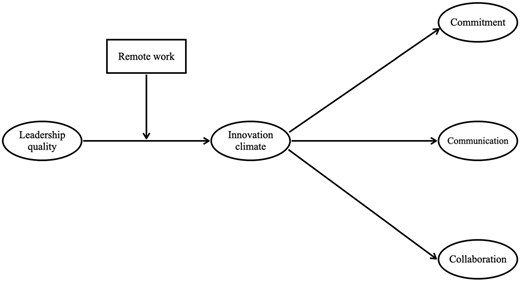
Conceptual model of leadership quality, innovation climate, and employee outcomes. Source: Authors' own work
Conceptual model of leadership quality, innovation climate, and employee outcomes. Source: Authors' own work
Method
Sample and procedure
This study employed a two-wave longitudinal survey design with a time lag of approximately 12–18 months between measurement points. The study population consisted of white-collar employees working in 16 SMEs at baseline. At follow-up, employees from 14 of these SMEs participated in the second wave of data collection. The reduction from 16 to 14 SMEs at follow-up was due to organizational changes, as two of the participating companies ceased operations and were therefore unable to participate in the second wave of data collection. SMEs were defined according to the European Commission's definition as enterprises employing fewer than 250 employees (European Commission, n.d.). Participation was voluntary.
The participating SMEs were recruited through existing collaboration networks and direct contact with organizations in central Sweden. The sample includes companies from a range of sectors, including manufacturing, finance, and consulting. The selection aimed to capture variation in organizational contexts while focusing on SMEs where both on-site and remote work arrangements were feasible for white-collar employees.
The study was approved by the Swedish Ethical Review Authority in Uppsala (Dnr, 2017/528), and all participants provided informed consent prior to participation.
Data collection
Data were collected using a web-based questionnaire administered through SUNET Survey© software (Artologik Survey & Report). An invitation containing study information and a survey link was distributed via e-mail to employees in the participating companies. The questionnaire was available in both Swedish and English. Participation was voluntary, and informed consent was obtained electronically prior to survey completion. To enhance response rates, two to three reminder e-mails were sent at approximately one-week intervals during each data collection wave.
Baseline data (T1) were collected between June 2023 and February 2024. A total of 749 employees, including both white- and blue-collar workers, were invited to participate, and 568 responded (response rate = 76%). After applying the inclusion criteria (white-collar positions), 489 respondents constituted the analytical baseline sample.
The follow-up survey (T2) was conducted between February and March 2025 and was distributed to 645 eligible employees. A total of 380 employees responded (response rate = 59%). Following application of the inclusion criteria, 276 respondents were retained for the longitudinal analyses. Of the 489 baseline participants, 276 completed the follow-up survey, corresponding to a retention rate of 56.4% The lower response rate at T2 is consistent with common patterns in longitudinal organizational research, where participant attrition between waves is expected. As reported above, attrition analyses indicated no systematic differences in key study variables between retained and non-retained participants, suggesting that the impact on the results is limited. The extended data collection period at T1 reflects the sequential recruitment of organizations, where companies were onboarded at different time points. In contrast, the follow-up (T2) was conducted over a shorter period, as it targeted an already established sample of participating organizations.
The longitudinal design allows for a stronger examination of temporal ordering between leadership quality, innovation climate, and employee outcomes compared to cross-sectional designs. By separating measurements over time, the study reduces the risk of common method bias and enables a more robust assessment of how earlier perceptions of leadership are associated with later work environment conditions and outcomes.
Demographic characteristics of the baseline sample are presented in Table 1.
Sample characteristics at baseline (T1)
| n | % | |
|---|---|---|
| Gender | ||
| Male | 299 | 61.1 |
| Female | 189 | 38.7 |
| Age | ||
| ≤24 | 20 | 4.1 |
| 25–39 | 185 | 37.8 |
| 40–54 | 206 | 42.1 |
| 55–66 | 77 | 15.7 |
| ≥67 | 1 | 0.2 |
| Education | ||
| Primary school (or equivalent compulsory school) | 1 | 0.2 |
| Upper secondary school | 112 | 22.9 |
| Post-secondary education | 80 | 16.4 |
| University or college | 294 | 60.1 |
| Born in Sweden | ||
| Yes | 450 | 92.0 |
| No | 36 | 7.4 |
| Tenure (years) | ||
| <1 | 26 | 5.3 |
| 1–10 | 334 | 68.3 |
| 11–20 | 83 | 17.0 |
| 21–30 | 34 | 7.0 |
| >30 | 11 | 2.2 |
| Remote work (share of weekly hours) | ||
| 0% | 119 | 24.3 |
| <20% | 92 | 18.8 |
| 20–40% | 102 | 20.9 |
| 40–60% | 77 | 15.7 |
| 60–80% | 35 | 7.2 |
| 80–100% | 49 | 10.0 |
| Marital status | ||
| Married/cohabiting/registered partner | 374 | 76.5 |
| Single | 109 | 22.3 |
| Employment status | ||
| Permanent contract | 465 | 95.1 |
| Other | 20 | 4.1 |
| Managerial responsibility | ||
| Yes | 100 | 20.4 |
| No | 374 | 76.5 |
Note(s): Values represent percentages. Percentages are calculated using the total baseline sample as the denominator (N = 489). Counts may not sum to N due to item-level missingness (including “prefer not to answer”). Remote work was measured as the proportion of weekly working hours performed remotely
To examine whether attrition was selective, we compared baseline (T1) scores on the main study variables between participants who completed both waves (retained sample) and those who participated only at T1 (attrited sample). Independent-samples t-tests indicated no statistically significant differences between groups across leadership quality, innovation climate, commitment, communication, collaboration, or remote work (all ps > 0.05), with the exception of a marginal trend for commitment (Cohen's d = 0.18, p = 0.054). Overall, these results suggest that attrition was not systematically related to the focal constructs. Detailed results are provided in the Supplementary Material (Supplementary Table S1).
Measures
Leadership quality was assessed at T1 and T2 with three items from the COPSOQ III Quality of leadership scale (Burr et al., 2019). Items capture perceptions of the immediate manager's ability to support employee development, plan work, and handle conflicts. Responses were provided on a five-point response format scored in 25-point intervals (0–100). Internal reliability was good (T1 & T2: α = 0.86).
The COPSOQ III Quality of Leadership scale was selected due to its theoretical foundation within occupational health research and its widespread use in studies of psychosocial working conditions. The scale captures core aspects of leadership relevant for employee well-being and functioning, such as support, planning, and conflict management, making it particularly suitable for examining leadership in relation to work environment and employee outcomes.
Innovation climate was measured at T1 and T2 with three items from the QPSNordic climate for innovation content (Dallner et al., 2026), reflecting whether employees take initiative, are encouraged to improve, and whether communication is sufficient within the department. Items were rated on a five-point scale (1 = very seldom/never, 5 = very often/always). Reliability was acceptable (T1 α = 0.69; T2 α = 0.65).
Organizational commitment was assessed at T1 and T2 using three items from the COPSOQ III Commitment to the workplace content (Burr et al., 2019), capturing willingness to recommend the workplace, pride in the organization, and turnover intentions. Responses were provided on a five-point response format scored in 25-point intervals (0–100). Internal reliability was satisfactory (T1 α = 0.78; T2 α = 0.80).
Communication was assessed at T1 and T2 with two study-specific items capturing employees' communication and knowledge-sharing with colleagues in the organization. One item assessed the extent of collaboration and shared knowledge/information with colleagues, and the second item assessed the level of shared knowledge/information in the organization. Items were rated on a five-point scale (1 = not at all, 5 = to a very high extent). Internal reliability was good (T1 α = 0.81; T2 α = 0.76).
Collaboration was measured at T1 and T2 with three items reflecting social community at work (i.e. good atmosphere among colleagues, good cooperation between colleagues, and feeling part of a community), consistent with COPSOQ content (Burr et al., 2019). Responses were given on a five-point scale. Reliability was acceptable (T1 α = 0.72; T2 α = 0.74).
Remote work was assessed at both T1 and T2 using two single-item questions capturing (a) the number of hours worked remotely per week and (b) the total number of hours worked per week. Based on these responses, we calculated the proportion of weekly working hours performed remotely (remote hours/total hours) at each wave and categorized it into six levels: 0%, <20%, 20–40%, 40–60%, 60–80%, and 80–100%.
Control variables (all measured at T1) in this study included age, gender, and education.
Data analysis
All analyses were conducted in Mplus 9 using robust maximum likelihood estimation (MLR; Muthén and Muthén, 2017). Missing data were handled with full information maximum likelihood (FIML), which generally provides less biased parameter estimates than listwise deletion under missing at random assumptions (Enders and Bandalos, 2001). Model fit was evaluated using CFI, TLI, RMSEA, and SRMR (Hu and Bentler, 1999).
We first estimated confirmatory factor analyses and compared alternative measurement models to examine reliability and validity among study variables. Harman's single-factor test was also conducted to check potential common method variance (CMV; Podsakoff et al., 2003). We then tested the hypothesized mediation and moderated mediation using three SEMs: a cross-sectional model at T1, a cross-sectional model at T2, and a longitudinal model in which leadership quality at T1 predicted innovation climate at T2, which in turn predicted T2 outcomes. Indirect effects were evaluated using 5,000 bias-corrected bootstrap resamples (Preacher and Hayes, 2008). Then, moderation by remote work was tested with latent interactions estimated via XWITH using the latent moderated structural equations approach (Klein and Moosbrugger, 2000; Maslowsky et al., 2015). Significant interactions were probed with simple slopes and Johnson–Neyman plots.
Results
Preliminary analysis
Descriptive statistics, reliabilities, and bivariate correlations are reported in Table 2.
Descriptive statistics, bivariate correlations, and reliability
| Variable | Mean (SD) | α/ω | AVE | 1 | 2 | 3 | 4 |
|---|---|---|---|---|---|---|---|
| 1. Leadership quality T1 | 3.72 (0.84) | 0.86 | 0.67 | 0.86 | |||
| 2. Leadership quality T2 | 3.71 (0.87) | 0.86 | 0.66 | 0.56*** | 0.86 | ||
| 3. Innovation climate T1 | 3.87 (0.67) | 0.69 | 0.43 | 0.44*** | 0.28*** | 0.69 | |
| 4. Innovation climate T2 | 3.75 (0.62) | 0.65/0.66 | 0.40 | 0.40*** | 0.48*** | 0.54*** | 0.66 |
| 5. Commitment T1 | 3.96 (0.81) | 0.78 | 0.54 | 0.40*** | 0.33*** | 0.42*** | 0.37*** |
| 6. Commitment T2 | 3.75 (0.86) | 0.80/0.81 | 0.58 | 0.45*** | 0.56*** | 0.38*** | 0.47*** |
| 7. Communication T1 | 4.36 (0.72) | 0.81 | 0.68 | 0.21*** | 0.22*** | 0.22*** | 0.20** |
| 8. Communication T2 | 4.30 (0.78) | 0.76 | 0.62 | 0.16* | 0.19** | 0.16* | 0.32*** |
| 9. Collaboration T1 | 4.36 (0.52) | 0.72 | 0.47 | 0.35*** | 0.29*** | 0.29*** | 0.35*** |
| 10. Collaboration T2 | 4.32 (0.52) | 0.74 | 0.49 | 0.35*** | 0.44*** | 0.17** | 0.43*** |
| 11. Remote work T1 | 1.92 (1.61) | – | – | 0.04 | −0.12 | 0.10* | 0.04 |
| 12. Remote work T2 | 2.02 (1.63) | – | – | −0.09 | −0.11 | 0.05 | 0.03 |
| Variable | 5 | 6 | 7 | 8 | 9 | 10 | 11 | 12 |
|---|---|---|---|---|---|---|---|---|
| 1. Leadership quality T1 | ||||||||
| 2. Leadership quality T2 | ||||||||
| 3. Innovation climate T1 | ||||||||
| 4. Innovation climate T2 | ||||||||
| 5. Commitment T1 | 0.78 | |||||||
| 6. Commitment T2 | 0.60*** | 0.81 | ||||||
| 7. Communication T1 | 0.17*** | 0.17** | 0.81 | |||||
| 8. Communication T2 | 0.19** | 0.27*** | 0.41*** | 0.76 | ||||
| 9. Collaboration T1 | 0.38*** | 0.30*** | 0.27*** | 0.19** | 0.72 | |||
| 10. Collaboration T2 | 0.25*** | 0.44*** | 0.22*** | 0.34*** | 0.51*** | 0.74 | ||
| 11. Remote work T1 | 0.01 | −0.11 | −0.08 | −0.15* | −0.06 | −0.14* | – | |
| 12. Remote work T2 | −0.09 | −0.15* | −0.03 | −0.17** | −0.13* | −0.19** | 0.78*** | – |
Note(s): The column α/ω reports Cronbach's alpha and McDonald's omega when both are shown; otherwise the single value represents Cronbach's alpha. Diagonal italic values are composite reliability. *p < 0.05, **p < 0.01, ***p < 0.001
We next evaluated the measurement structure using confirmatory factor analysis (CFA). All standardized factor loadings were statistically significant and ranged from 0.52 to 0.85. The CFA model, including all constructs at both waves, showed acceptable fit, χ2 = 625.49, CFI = 0.91, TLI = 0.89, RMSEA = 0.05, and SRMR = 0.06. Internal reliability was acceptable to good across constructs (α = 0.65–0.86; ω = 0.66–0.86; CR = 0.66–0.86). The AVE values ranged from 0.40 to 0.68. Although the AVE for innovation climate and collaboration was below 0.50 at both waves, their composite reliability was acceptable (CR ≥ 0.66) and factor loadings were meaningful, which can still indicate adequate convergent validity when CR is satisfactory (Fornell and Larcker, 1981). Discriminant validity was examined by comparing competing measurement models at both waves. Since the model comparisons at T1 and T2 yielded similar conclusions, and to meet space constraints, we report the baseline (T1) results in Table 3. As shown, model fit improved substantially as constructs were separated, and the hypothesized multi-factor model provided the best fit among the tested alternatives (CFI = 0.92, TLI = 0.89, RMSEA = 0.07, SRMR = 0.06), with Satorra–Bentler scaled difference tests indicating significant improvements over more constrained models.
Confirmatory factor analysis results for competing measurement models at baseline (T1)
| Measurement models | S-B Δχ2(df) | χ2(df) | CFI | TLI | RMSEA | SRMR |
|---|---|---|---|---|---|---|
| 1-factor model | 917.59 (77) | 0.57 | 0.50 | 0.15 | 0.11 | |
| 2-factor model | 133.85 (1)*** | 685.75 (76) | 0.69 | 0.63 | 0.13 | 0.09 |
| 3-factor model | 17.50 (2)*** | 670.56 (74) | 0.70 | 0.63 | 0.13 | 0.09 |
| 4-factor model | 286.49 (3)*** | 463.01 (71) | 0.80 | 0.75 | 0.11 | 0.08 |
| 5-factor model | 226.10 (4)*** | 220.62 (67) | 0.92 | 0.89 | 0.07 | 0.06 |
Note(s): S–B Δχ2(Δdf) denotes the Satorra–Bentler scaled chi-square difference test for nested model comparisons, reported for each model relative to the immediately preceding (more constrained) model. The hypothesized five-factor model specifies leadership quality, innovation climate, commitment, communication, and collaboration as distinct constructs at T1. The same conclusion regarding relative model fit was obtained at T2. *p < 0.05, **p < 0.01, ***p < 0.001
Finally, following Podsakoff et al. (2003), Harman's single-factor test suggested that common method variance was unlikely to be a major concern, as a single-factor solution did not account for the majority of variance (<50%).
Hypotheses testing
Overall model fit was acceptable across the three models (T1 cross-sectional: χ2 = 287.38, CFI = 0.91, TLI = 0.89, RMSEA = 0.06, SRMR = 0.06; T2 cross-sectional: χ2 = 255.85, CFI = 0.90, TLI = 0.87, RMSEA = 0.07, SRMR = 0.06; longitudinal: χ2 = 238.19, CFI = 0.90, TLI = 0.87, RMSEA = 0.07, SRMR = 0.06). Parameter estimates for the direct, indirect, and interaction effects are summarized in Table 4.
SEM results for cross-sectional (T1, T2) and longitudinal models
| Time 1 (N = 489) | Time 2 (N = 276) | Longitudinal (N = 276) | |||||||
|---|---|---|---|---|---|---|---|---|---|
| Path | B | β | p | B | β | p | B | β | p |
| Direct effects | |||||||||
| LQ → IC | 0.43 | 0.69 | <0.001 | 0.31 | 0.78 | <0.001 | 0.31 | 0.63 | <0.001 |
| IC → CM | 1.03 | 0.61 | <0.001 | 2.14 | 0.79 | <0.001 | 1.71 | 0.74 | <0.001 |
| IC → CC | 0.49 | 0.35 | <0.001 | 1.05 | 0.43 | <0.001 | 0.91 | 0.45 | <0.001 |
| IC → CL | 0.39 | 0.49 | <0.001 | 0.83 | 0.67 | <0.001 | 0.63 | 0.60 | 0.001 |
| Mediations | |||||||||
| LQ → IC → CM | 0.45 | 0.42 | <0.001 | 0.66 | 0.62 | <0.001 | 0.53 | 0.47 | <0.001 |
| LQ → IC → CC | 0.21 | 0.24 | <0.001 | 0.32 | 0.33 | <0.001 | 0.28 | 0.28 | <0.001 |
| LQ → IC → CL | 0.17 | 0.34 | <0.001 | 0.25 | 0.52 | <0.001 | 0.20 | 0.38 | <0.001 |
| Moderation | |||||||||
| RW * LQ → IC | −0.01 | −0.01 | 0.802 | 0.04 | 0.19 | 0.002 | 0.07 | 0.22 | 0.010 |
Note(s): Standardized coefficients (β) are reported. Indirect effects (mediations) were tested using 5,000 bias-corrected bootstrap resamples (95% confidence intervals). Abbreviations: LQ = leadership quality; IC = innovation climate; CM = commitment; CC = communication; CL = collaboration; RW = remote work
Direct and indirect effects. Consistent with H1a, leadership quality was positively related to innovation climate in all three models. This association was robust at T1 (β = 0.69, p < 0.001), at T2 (β = 0.78, p < 0.001), and in the longitudinal model where leadership quality at T1 predicted innovation climate at T2 (β = 0.63, p < 0.001). Innovation climate was, in turn, positively associated with commitment, communication, and collaboration across models (all ps ≤ 0.001). Supporting H1b, the indirect effects of leadership quality on all three outcomes via innovation climate were significant in the T1 and T2 cross-sectional models as well as in the longitudinal model (all ps < 0.001), based on 5,000 bias-corrected bootstrap resamples (Table 4). These findings indicate that innovation climate functions as a robust mediating mechanism linking leadership quality to employee commitment, communication, and collaboration across both cross-sectional and longitudinal models.
Moderation and moderated mediation. H2 was not supported in the T1 cross-sectional model, as the interaction between remote work and leadership quality on innovation climate was not significant. In contrast, the same interaction was significant at T2 (B = 0.04, β = 0.19, p = 0.002) and in the longitudinal model (B = 0.07, β = 0.22, p = 0.01). As illustrated in Figures 2 and 3, the positive association between leadership quality and innovation climate became stronger as the proportion of remote work increased. Johnson–Neyman analyses further indicated that the conditional effect of leadership quality on innovation climate increased with remote work and was statistically significant across a broad range of remote work values.
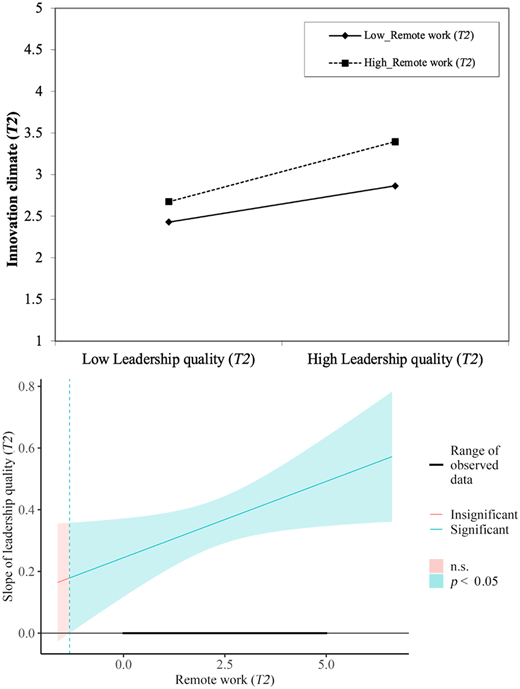
Remote work moderates the association between leadership quality and innovation climate at T2. Note. The upper part shows the interaction (simple slopes) between leadership quality (LQ) and remote work (RW) in predicting innovation climate (IC) at T2. The lower part presents the Johnson–Neyman plot indicating the range of RW for which the conditional effect of LQ on IC is statistically significant. Source: Authors' own work
Remote work moderates the association between leadership quality and innovation climate at T2. Note. The upper part shows the interaction (simple slopes) between leadership quality (LQ) and remote work (RW) in predicting innovation climate (IC) at T2. The lower part presents the Johnson–Neyman plot indicating the range of RW for which the conditional effect of LQ on IC is statistically significant. Source: Authors' own work
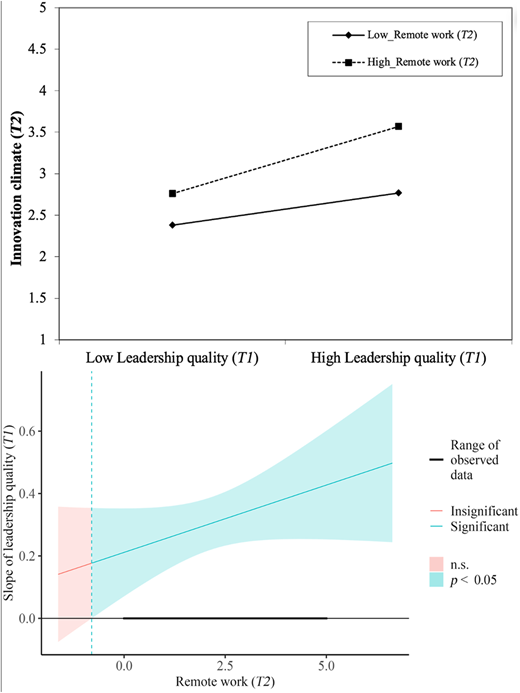
Remote work at T2 moderates the lagged effect of leadership quality at T1 on innovation climate at T2. Note. The upper part shows the interaction (simple slopes) between leadership quality (LQ) at T1 and remote work (RW) at T2 in predicting innovation climate (IC) at T2. The lower part presents the Johnson–Neyman plot identifying the range of RW at T2 for which the conditional effect of LQ at T1 on IC at T2 is statistically significant. Source: Authors' own work
Remote work at T2 moderates the lagged effect of leadership quality at T1 on innovation climate at T2. Note. The upper part shows the interaction (simple slopes) between leadership quality (LQ) at T1 and remote work (RW) at T2 in predicting innovation climate (IC) at T2. The lower part presents the Johnson–Neyman plot identifying the range of RW at T2 for which the conditional effect of LQ at T1 on IC at T2 is statistically significant. Source: Authors' own work
For H3, conditional indirect effects via innovation climate were stronger under high (vs low) remote work. In the T2 model, the high–low differences in indirect effects were significant for commitment (Δ = 0.63, p = 0.001), communication (Δ = 0.31, p = 0.011), and collaboration (Δ = 0.25, p = 0.003). Similarly, in the longitudinal model, the high–low differences in indirect effects were also significant for commitment (Δ = 0.76, p = 0.02), communication (Δ = 0.41, p = 0.042), and collaboration (Δ = 0.29, p = 0.046). These findings suggest that remote work strengthens the indirect associations from leadership quality to employee outcomes through innovation climate, supporting H3.
Discussion
The present study examined the relationships between leadership quality, innovation climate, and employee outcomes (commitment, communication, and collaboration) in Swedish SMEs, accounting for increasing levels of remote work.
The findings highlight innovation climate as a key mediating mechanism and show that the importance of leadership quality increases as remote work becomes more prevalent. From a workplace health management perspective, these results suggest that leadership contributes to psychosocially sustainable work environments by fostering conditions that support employee involvement, coordination, and social functioning, particularly in remote and hybrid contexts where informal interaction is reduced.
The mediating role of innovation climate
Consistent with Hypotheses 1a and 1b, results across all models, both cross-sectional (T1, T2) and longitudinal, indicate that leadership quality is a significant predictor of a positive innovation climate. This suggests that leaders in SMEs, through their everyday behaviors and resource allocation decisions, communicate to employees that creativity, experimentation, and idea generation are expected and valued (Dunne et al., 2016; Hoang et al., 2020). Furthermore, the study confirmed that innovation climate serves as a key mediating mechanism through which leadership influences broader employee outcomes (commitment, communication, and collaboration). This implies that when leaders create an environment where new ideas are encouraged, it does not merely lead to innovation climate that facilitates innovation, but also enhances workplace commitment, communication, and collaboration (Shanker et al., 2017; Newman et al., 2020). Rather than indicating direct performance effects, these findings highlight how leadership may shape relational and organizational conditions that support everyday work functioning. These findings suggest that innovation climate is a central contextual pathway that translates proximal managerial support into long-term organizational viability and employee engagement (Yu et al., 2018).
These findings can also be interpreted in light of broader organizational culture perspectives. Prior research suggests that cultural elements such as trust, openness, and supportive social environments play a central role in fostering creativity and innovation (Gulev, 2016). From this perspective, innovation climate may be viewed as a more proximal and perceptual manifestation of such underlying cultural conditions, shaped through leadership practices and everyday interactions. The present findings therefore support the view that leadership contributes to innovation not only directly, but by cultivating a broader cultural context that enables communication, collaboration, and commitment.
Remote work as a contextual moderator
A primary contribution of this research is the identification of remote work as a boundary condition for the leadership–innovation relationship. This means the study shows that leadership behaviors that typically foster innovation may work differently (or not at all) depending on the level or presence of remote work (Busse et al., 2017; Coun et al., 2021). While the moderation effect (H2) was not significant at the baseline (T1), it became significant at T2 and in the longitudinal analysis. Specifically, the positive impact of leadership quality on innovation climate was significantly stronger for employees with higher levels of remote work. This “lagged” moderating influence suggests that as remote work has become more established, the reliance on formal leadership increases. This pattern suggests that as remote work becomes more established, employees may rely more on leadership to interpret expectations and coordinate work. In remote settings, especially when physical proximity is absent, the reduction of informal, spontaneous interactions and co-located social processes may create a void that must be filled by high-quality, digitally skilled leadership to maintain performance, engagement, and innovation (Contreras et al., 2020; Coun et al., 2021; Bravo-Duarte et al., 2025).
Moderated mediation and practical implications
The support for Hypothesis 3, the moderated mediation model, further emphasizes that remote work intensifies the entire process, indicating that the indirect effects of leadership quality on employee commitment, communication, and collaboration via innovation climate are contingent upon the extent of remote work. Specifically, higher levels of remote work strengthened these indirect pathways, suggesting that leadership quality becomes increasingly consequential for shaping innovation climate and, in turn, social–relational employee outcomes as physical distance from the workplace increases. This finding aligns with perspectives that view leadership as a critical sense-making and coordinating mechanism in distributed work contexts, where informal interactions and shared situational awareness are reduced (Bartsch et al., 2020; Contreras et al., 2020).
These findings also contribute to emerging leadership-at-a-distance perspectives by demonstrating that remote work does not merely alter work structures but amplifies the importance of leadership as a contextual resource shaping innovation-relevant climates and collective employee outcomes (Anderson et al., 2014). This aligns with recent discussions in workplace health management, highlighting the need for leadership approaches that maintain communication, connection, and coordination in increasingly distributed work environments (Karanika-Murray and Ipsen, 2022). From a practical standpoint, these results underscore the strategic importance of leadership development in SMEs, where leadership tends to be more proximal and relational. As remote work becomes more prevalent, targeted investments in leadership capabilities that stimulate idea generation, participation, and constructive communication, thereby fostering an innovation-supportive climate characterized by openness, trust, and collaborative norms, seem central to sustaining employee commitment and effective collective functioning (Bartsch et al., 2020; Contreras et al., 2020; Coun et al., 2021). Such capabilities may help sustain key work environment conditions, rather than directly influencing broader organizational outcomes.
From a workplace health management perspective, these findings suggest that leadership may contribute to psychosocial working conditions by shaping communication, collaboration, and employee involvement, particularly in remote work contexts where informal interaction is reduced. Investments in leadership capabilities related to communication, conflict management, and employee development may therefore be particularly relevant in remote settings (Cooper and Kurland, 2002). More broadly, the findings suggest that organizations may need to adapt leadership support and resources as levels of remote work increase, as leadership quality appears to become more important for maintaining communication, coordination, and shared understanding in distributed work arrangements.
Beyond organizational practice, these findings also have broader implications for research and workplace development. By identifying remote work as a contextual boundary condition, the study contributes to a more nuanced understanding of when and how leadership influences innovation-supportive climates and related employee outcomes. This highlights the importance of considering work context in leadership and workplace health research, particularly in increasingly digital and distributed work environments.
From a practical perspective, the findings suggest that organizations, especially SMEs, should not treat remote work solely as a logistical arrangement, but as a context that reshapes the role and importance of leadership. Supporting managers in developing communication, trust-building, and coordination practices may therefore be essential not only for organizational performance but also for sustaining employee well-being and effective collaboration in evolving work environments.
Strengths, limitations, and future research
This study has several strengths, including its longitudinal design and the inclusion of employees from multiple SMEs, which enhances the robustness of the findings and provides a broader understanding of leadership processes across organizational contexts. By including employees from multiple independent companies, the study mitigates the risk that the findings reflect unique characteristics of a single organization. Despite its strengths, this study has limitations. Data was collected via self-administered questionnaires, which introduces the possibility of common method variance, although statistical tests suggested this was not a major concern in this sample. In addition, communication was assessed with study-specific items rather than a widely established scale, although the items showed acceptable internal reliability and behaved as expected in the measurement model. Additionally, the study focused exclusively on white-collar employees in Swedish SMEs, which may limit the generalizability of the findings to other occupational groups and organizational contexts. Moreover, the study does not include direct measures of health or well-being, and the findings should therefore be interpreted as reflecting work environment conditions rather than health outcomes per se. Future research could therefore examine whether similar relationships emerge in occupational settings where remote work is less feasible, as well as in larger organizations where formal structures and leadership practices may differ from those typically found in SMEs.
Future research could also extend these findings by examining intervention-based designs aimed at strengthening leadership capabilities that foster innovation-supportive climates, particularly in remote or hybrid settings. Experimental or quasi-experimental studies would further clarify the causal mechanisms linking leadership quality, innovation climate, and employee outcomes.
Conclusion
This study demonstrates that leadership quality is consistently associated with innovation and positive employee outcomes in SMEs. By fostering an innovation-supportive climate, leaders can enhance employee commitment, communication, and collaboration. Importantly, leadership becomes even more consequential as work becomes increasingly remote, suggesting that distributed work arrangements amplify the need for clear direction, relational support, and structured opportunities for idea sharing.
From a practical perspective, these findings highlight the importance for SMEs to invest in leadership development initiatives that strengthen managers' capabilities to facilitate communication, trust, and innovation in remote and hybrid settings. As smaller firms often operate with limited structural support systems, leadership quality may represent a particularly critical resource for sustaining organizational cohesion and competitiveness in digitally mediated work environments.
The supplementary material for this article can be found online.

