


Workplace incivility is a social stressor. It comprises multiple actors, consisting of organisational insiders and outsiders. Drawing on the Job Demands-Resources Theory, this study aimed to examine how incivility experienced from co-workers (i.e. insider incivility) versus incivility from pupils' parents (i.e. outsider incivility) differentially relate to burnout; and the potential moderating role of two personal resources (i.e. trait resilience and trait self-efficacy) in the incivility-wellbeing relationship.
Using a lagged design, we collected data from 202 primary, secondary, and special education teachers in Ireland via two surveys, separated by two weeks. Insider incivility, outsider incivility, trait resilience and trait self-efficacy were assessed at Time 1. Burnout was measured at Time 2.
Hierarchical regression indicated that both incivility sources at Time 1 (Insider Incivility: ß = 0.24, p < 0.001; Outsider Incivility: ß = 0.21, p = 0.001) predicted burnout at Time 2, and self-efficacy and resilience did not buffer the relationship. Although we found a significant interaction between insider incivility and resilience in predicting burnout (ß = 0.21, p = 0.015), results indicated that the positive relationship was stronger at high compared to low levels of resilience, which was contradictory to our expectations.
The findings extend the existing body of literature on workplace incivility by specifically evaluating the varying effects of incivility sources on well-being within the education sector. It also underlines management's critical role in promoting a respectful workplace.
Introduction
Teachers are one of the most influential groups in society because of their ability to provide quality education (UNESCO, 2021). However, the COVID-19 pandemic brought uncertainties and additional workload to teachers. For instance, they had to prepare for distance learning on short notice, which required substantial personal and professional energy (Burke and Dempsey, 2021). As restrictions gradually relaxed and students returned to classrooms, it became necessary to implement additional safety measures alongside their instructional workload (Burke and Dempsey, 2021). One can argue that workplace incivility in the teaching context increased during this challenging time for two reasons. First, the implementation of online learning was an added responsibility among parents. As a result, they may have channelled their frustration to the teachers. Second, the quick adaptation to new working methods also caused frustration among teachers (Burke and Dempsey, 2021).
Workplace incivility refers to low-intensity discourteous behaviours with ambiguous intent to harm (Andersson and Pearson, 1999). It is prevalent in the workplace (Geldart et al., 2018) and is consistently linked to impaired well-being (e.g. Arnold and Walsh, 2015) and negative organisational outcomes (e.g. Fritz et al., 2019). Despite this, important questions remain about which source of incivility is most detrimental and whether personal resources can influence the relationship between experienced incivility and well-being. The present study addresses these questions by examining teachers' well-being in relation to different sources of incivility and by testing whether personal resources buffer these effects. Thus, the present research makes notable contributions to the incivility literature.
The first contribution concerns the source of incivility. Although research shows uncivil behaviours from colleagues (e.g. Sakurai and Jex, 2012) and organisational outsiders (e.g. Wilson and Holmvall, 2013) can undermine well-being and performance, little is known about their differential impact on teachers. This gap is important because incivility is more pervasive than other forms of mistreatment and its meaning may vary depending on who enacts it (Sliter et al., 2010). For instance, mistreatment from co-workers may be interpreted as a violation of professional norms and fairness expectations (Caza and Cortina, 2007), whereas mistreatment from outsiders, such as customers or clients, may be viewed as part of the job and therefore less personally threatening (Hochschild, 1983). To address this limitation, the present study examines how uncivil episodes from colleagues and pupils' parents differentially relate to teachers' burnout.
The second contribution involves the potential buffering role of personal resources, specifically resilience and self-efficacy. These personal resources shape how individuals respond to environmental demands and adversities (Luthans et al., 2007) and, unlike stable personality traits, can be strengthened through training and development (Maffoni et al., 2020). Self-efficacy reflects confidence in one's ability to handle challenging tasks (Bandura, 1977), while resilience refers to the capacity to recover and adapt in the face of adversity (Luthans et al., 2007). Therefore, understanding whether these resources protect teachers from the strain of incivility is essential for identifying practical pathways to support well-being.
The Job Demands-Resources (JD-R; Bakker et al., 2023) theory provides the framework for this investigation. JD-R proposes that job demands, whether physical, psychological, or social, require sustained effort and can deplete employees' mental and physical well-being, leading to strain and health impairment. Job and personal resources (Xanthopoulou et al., 2007), in contrast, help employees meet demands and may buffer their negative effects. We conceptualise uncivil interactions as social job demands that drain teachers' emotional and cognitive resources, particularly because incivility is subtle, ambiguous, and difficult to address directly. Over time, this depletion may contribute to energy loss and, ultimately, burnout. Consistent with JD-R, we propose that resilience and self-efficacy function as personal resources that can mitigate the health-impairment process. Teachers who possess these resources may be better equipped to manage uncivil encounters, maintain perspective, and prevent the escalation of strain.
This study is the first to examine how insider and outsider incivility differentially relate to teachers' well-being in the Irish context and to assess whether resilience and self-efficacy buffer these effects. By integrating source-specific incivility with personal resources, the study advances a more nuanced understanding of how social demands shape teacher burnout and identifies actionable levers for supporting well-being.
Literature review
The differential effects of insider and outsider incivility on teachers' well-being
A growing body of research highlights the consequences of insider incivility, particularly when the instigator is a supervisor or colleague. Incivility from supervisors has been shown to compromise employees' psychological well-being (Sood and Kour, 2022) and increase job dissatisfaction (Alola et al., 2019). Similarly, incivility among colleagues is associated with heightened exhaustion and organisational inefficiency (Viotti et al., 2018). Although early work on incivility focused primarily on internal sources, more recent studies demonstrate that incivility also arises from external sources, such as customers, clients, and other stakeholders. For instance, Kim and Qu (2019) reported that interactions with uncivil customers elicit negative emotional responses in employees, while Sliter and Boyd (2015) found that uncivil treatment from individuals outside the organisation contributes to declines in physical health and increased absenteeism. In educational settings, Itzkovich and Dolev (2021) showed that teachers encounter incivility from parents (outsiders), colleagues, and managers (insiders). McClendon and colleagues (2021) further emphasised that co-worker incivility remains a persistent issue among teachers.
Much of the existing research linking incivility to strain has focused on emotional exhaustion, particularly in studies of insider incivility. For example, co-worker rudeness has been shown to predict heightened emotional exhaustion (Karatepe et al., 2019), and incivility among nurses contributes to emotional exhaustion and cynicism (Babenko-Mould and Laschinger, 2014). Emotional exhaustion refers to the physical and emotional reactions to stress and often represents the earliest sign that individuals are struggling with their professional responsibilities (Maslach and Leiter, 2017). It arises when employees feel overwhelmed by work demands and depleted emotional resources. However, emotional exhaustion represents only one component of a broader syndrome.
Burnout encompasses emotional exhaustion, cynicism, and reduced personal accomplishment (Leiter et al., 2008), capturing the full progression of strain rather than its initial stage alone. Because burnout reflects the cumulative effects of persistent stressors, focusing on burnout rather than a single component provides a more comprehensive understanding of how incivility affects teachers' well-being.
In line with the JD-R theory (Bakker et al., 2023), burnout develops through the health impairment process, whereby persistent job demands erode employees' energy and psychological resources. Incivility, whether from insiders or outsiders, can operate as such a demand, with repeated exposure intensifying strain and contributing to burnout. Empirical evidence supports this pattern. Zhou et al. (2019) found that nurses' daily encounters with uncivil patients and visitors predicted burnout. Similar patterns have been observed in the restaurant (Cho et al., 2016) and the retail sector (Yang and Lau, 2019), where customer incivility has been linked to elevated burnout levels.
Existing research has predominantly examined one source of incivility at a time, leaving a limited understanding of whether different instigators exert comparable or distinct effects on employee well-being. Only a handful of studies have considered multiple sources simultaneously. For example, Sliter and colleagues (2012) found that customer and colleague incivility interacted to predict declines in performance and increases in absenteeism. More recently, Yaranon et al. (2024) showed that only insider mistreatment impaired affective well-being among healthcare professionals, suggesting that outsider mistreatment may be normalised as part of the job. Although informative, such work remains rare and does not directly compare the unique contributions of each source to employee well-being.
Conceptually, one might expect insider incivility, particularly from co-workers, to exert a more pronounced influence on well-being. Co-worker relationships tend to be ongoing, less transient, and embedded in daily work routines, requiring frequent interaction and interdependence (Andel et al., 2022). Experiencing discourteous treatment from co-workers also represents a breach of trust and violates organisational norms that emphasise professionalism and mutual respect. In contrast, outsider interactions, such as those with customers, or in this context, students' parents, are often episodic and less relationally anchored, potentially shaping employees' responses in different ways.
Although both insider and outsider incivility have been linked to employee strain, research rarely examines these sources side by side. This limits understanding of whether different instigators trigger distinct burnout processes or exert similar effects. By distinguishing between these sources and examining their respective associations with burnout, the present study addresses this gap and advances a more nuanced account of how social demands shape teacher well-being. Therefore, we hypothesise:
(a) Insider incivility (T1) and (b) outsider incivility (T1) are positively related to burnout (T2).
Insider incivility significantly influences burnout more than outsider incivility.
The role of personal resources
Personal resources such as resilience and self-efficacy may help employees cope with the strain associated with workplace incivility (Goussinsky, 2020). Within the JD-R framework (Bakker et al., 2023), these resources shape how individuals interpret and respond to demanding situations, thereby reducing the likelihood that stressors escalate into burnout (Xanthopoulou et al., 2007). Employees with greater personal resources tend to maintain engagement (Mache et al., 2014) and manage challenging conditions more effectively (Judge et al., 1998), suggesting that such resources may buffer the adverse effects of incivility on well-being.
Self-efficacy
Self-efficacy refers to perceived competence, the belief that one can effectively carry out the behaviours necessary to achieve desired outcomes (Bandura, 1977). Goussinsky (2020) argued that self-efficacious individuals tend to interpret occupational stressors, including workplace incivility, as challenges rather than threats. Consequently, they are more likely to persevere and invest effort when confronted with obstacles or stressors (Luthans et al., 2007). As Makara-Studzińska and colleagues (2019) suggest, self-efficacy is a relevant personal resource that mitigates the influence of perceived stress on burnout symptoms.
The protective role of self-efficacy is well documented in the workplace mistreatment literature. Employees high in self-efficacy are more likely to employ effective coping strategies, reducing the negative impact of customer aggression on emotional exhaustion (Goussinsky, 2012). Self-efficacy has also been shown to protect health professionals from the adverse effects of bullying (Livne and Goussinsky, 2018). Rhee and colleagues (2017) found that self-efficacy buffered the relationship between co-worker incivility and emotional exhaustion, such that the positive relationship was weaker for employees with high self-efficacy. Among teachers, Vaezi and Fallah (2011) demonstrated that those with higher self-efficacy reported lower levels of occupational stress.
In sum, self-efficacy reflects individuals' confidence in their ability to navigate challenging situations. Employees with high self-efficacy tend to handle uncivil interactions more constructively, maintaining engagement and productivity despite stressors. Accordingly, we expect that self-efficacy will buffer the relationship between experienced incivility and burnout.
Self-efficacy will moderate the positive relationship of (a) insider incivility and (b) outsider incivility with burnout such that these relationships are weaker for high levels of self-efficacy compared to low levels of self-efficacy.
Resilience
Resilience refers to positive adaptation and growth in response to stressors (Fisher et al., 2019; Hartmann et al., 2020). It reflects the capacity to sustain and rebound by drawing on facilitative resources when confronted with challenges and adversity (Bryan et al., 2019), including interpersonal difficulties at work (Martinez-Corts et al., 2015). Adversity encompasses situations or conditions that disrupt normal functioning (Hoegl and Hartmann, 2021). Uncivil interactions can therefore be conceptualised as a form of workplace adversity. Resilient individuals tend to experience greater well-being (Avey et al., 2009) and lower distress (Utsey et al., 2008), even under demanding circumstances.
Empirical evidence supports resilience as a personal resource that buffers the effects of incivility and workplace mistreatment on well-being. Al-Zyoud and Mert (2019) found that resilience moderated the positive relationship between co-worker incivility and psychological distress, showing that highly resilient employees experienced lower distress even when incivility levels were high. Al-Hawari et al. (2020) demonstrated that the negative impact of customer incivility on emotional exhaustion was more pronounced among frontline employees low in resilience. Among working students, Sommovigo and colleagues (2019) reported that highly resilient individuals maintained strong service recovery performance despite high levels of customer incivility. These findings suggest that resilience protects employees from adverse reactions by efficiently enabling them to draw on other personal resources (Fredrickson et al., 2008).
Overall, resilience enables individuals to recover quickly from setbacks and adapt effectively to adversity. In the context of workplace incivility, resilience functions as a protective shield, allowing employees to view uncivil interactions as temporary setbacks rather than personal affronts. Consequently, highly resilient employees are less likely to internalise or dwell on negative behaviours, helping them maintain their well-being. In line with these, it is hypothesised that:
Resilience will moderate the positive relationships between (a) insider incivility and (b) outsider incivility and burnout, such that the relationships are weaker for high levels of resilience compared to low levels of resilience.
Figure 1 presents the conceptual framework that guides the present study. In line with the reviewed literature, we propose that both insider and outsider incivility will adversely affect employees' well-being (i.e. burnout), with insider incivility having a greater impact. We further propose that resilience and self-efficacy can potentially mitigate the positive relationship between experienced incivility from these two sources and burnout.
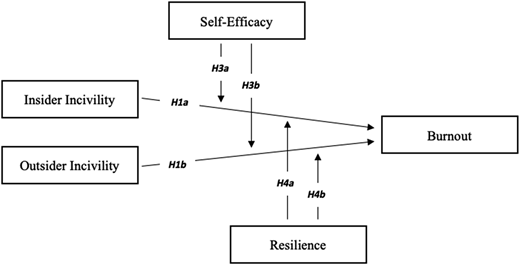
The proposed conceptual model of resilience and self-efficacy moderating the effect of insider and outsider incivility on burnout. Source: Author's own work
The proposed conceptual model of resilience and self-efficacy moderating the effect of insider and outsider incivility on burnout. Source: Author's own work
Methods
Sample and procedure
The participants of this study were qualified primary and secondary school teachers across Ireland. In recruiting participants, we employed a combined convenience and snowball sampling strategy. The primary method involved disseminating the survey through online forums for teachers on social media platforms, specifically aimed at primary and secondary school teachers. This approach enabled the rapid distribution of the survey. Additionally, we utilised a snowball sampling technique in which initial respondents were encouraged to share the survey link with their colleagues and professional networks, thereby enhancing the reach and diversity of the study sample. While we recognised the potential sampling bias inherent in these methods, these approaches were considered effective for promptly obtaining a large and varied cohort of teachers.
Data collection was conducted in February 2021. This study was approved by the Research Ethics Committee from [Redacted]. Participation was voluntary, and participants were informed of the nature of the research. We distributed and administered the surveys using the online platform Qualtrics. This platform generated an anonymous link to the two waves of data collection, which the research team distributed to all prospective participants. For Time 1 (T1), we requested that participants provide the last four digits of their mobile number as a code to link the two surveys and an email address [1] for us to distribute the surveys at Time 2 (T2). Along with these, informed consent, demographics, predictor variables and the moderators were measured.
The aim was to send the second survey a week after the first survey. However, it coincided with the schools' mid-term break [2]. To avoid the vacation effect (i.e. the confounding effects of recovery experiences) (Sonnentag and Fritz, 2007; Syrek et al., 2018), we decided to delay the second data collection and conducted it a week after the mid-term break, which was two weeks after the distribution of the first survey.
Considering the lagged design of the study, in which the outcome, predictor, and moderating variables were assessed at different time points, to be eligible in the final sample, a participant should be (a) working as part of a teaching team, (b) interacted with students' parents, (c) completed both T1 and T2 surveys, and (d) provided informed consent. A total of 347 participants completed the first survey, and 203 (59%) answered the second survey. Therefore, the final sample did not include the participants who dropped out after the T1 survey. The final sample comprised primary (n = 153), secondary (n = 43) and special education (n = 7) teachers. Among the 203 respondents, 76.4% were female. The age range was from 22 to 60 years. In addition, 65% of the participants held an honours bachelor's degree, while 35% held a master's degree. Participants indicated that their teaching delivery methods included online sessions (n = 108), face-to-face sessions (n = 73) or a blended structure of the two formats during the time of the data collection (n = 22).
The software G*Power (Faul et al., 2009) was utilised in assessing power a-priori. We calculated the sample size required to achieve statistical significance for both small and medium effects. Given an estimated power of 0.8, probability of 0.05, and small effect size of 0.1, G*Power recommended 143 participants. In contrast, a medium effect size of 0.25 with the same estimated power (0.8) and probability (0.05) recommended a sample size of 62. Thus, the final sample size of 205 is acceptable based on the expectation of effect sizes for the dependent variables being small and medium effects, as well as previous studies that applied similar methodology (e.g. Liu et al., 2019).
Measures
We measured outsider and insider incivility, resilience, and self-efficacy at T1, and burnout was assessed at T2 [3]. All measures had acceptable internal consistency in previous research studies (Nunnally and Bernstein, 1994).
The 10-item patient subscale of the Nursing Incivility Scale (Guidroz et al., 2010) measured perceived incivility from students' parents (outsider incivility). Because there was no available incivility questionnaire that captured uncivil interactions with people outside the organisation, we modified items from the NIS to fit the teaching context. A sample item was “Since the term started, parents of my students/pupils did not trust the information I gave them and asked to speak with someone of higher authority”. The response scale ranged from 1 (strongly disagree) to 5 (strongly agree). Internal consistency reliability was (α = 0.96).
The 7-item Workplace Incivility Scale (Cortina et al., 2001) measured perceived co-worker incivility (insider incivility). A sample item was “Since the term started, colleague(s) made demeaning or derogatory remarks about you”. The response scale ranged from 0 (never) to 4 (most of the time). Internal consistency reliability was (α = 0.91).
As for personal resources, we used the resilience and self-efficacy subscales of Psychological Capital (Luthans et al., 2007). The resilience subscale (Wagnild and Young, 1993) is comprised of six items that assessed how individuals recover from adversity and challenges. A sample item was “Since the term started, I usually take stressful things at work in stride”. The internal consistency reliability was (α = 0.69). The self-efficacy subscale (Chen et al., 2001) comprised of six items that assessed teachers' confidence to attempt and invest the required effort to succeed at challenging and demanding tasks. A sample item was “Since the term started, I feel confident analysing a long-term problem to find a solution”. The internal consistency reliability was (α = 0.83). The response scale for both resilience and self-efficacy ranged from 1 (strongly disagree) to 6 (strongly agree).
Burnout was measured using the 16-item Maslach Burnout Inventory-General Survey (Maslach et al., 1996). Participants indicated the frequency with which they experienced emotional exhaustion (e.g. I felt used up at the end of the workday), cynicism (e.g. I doubted the significance of my work), and professional efficacy (e.g. In my opinion, I was good at my job). The response scale ranged from 0 (never) to 6 (always) on all subscales. Burnout as a unidimensional showed excellent internal consistency reliability (α = 0.91).
Results
Preliminary analyses
Considering the attrition rate, we conducted dropout analyses using t-tests to compare participants who answered both surveys with those who only responded to the first survey using the variables measured at Time 1. There were no significant differences between those who completed one compared to two surveys regarding resilience (t(313) = −1.52, p = 0.129), self-efficacy (t(313) = −0.43, p = 0.670), outsider incivility (t(313) = −0.47, p = 0.637), and insider incivility (t(313) = −0.41, p = 0.682).
Common method variance was unlikely to be a significant concern in this study. The unmeasured latent method factor explained 11.03% of the total variance, which is less than 25%, the average observed variance in self-report research (Podsakoff et al., 2012). As the professional inefficacy component of burnout could arguably be seen as overlapping with self-efficacy as a construct, we conducted two contrasting confirmatory factor analyses to demonstrate that self-efficacy was distinct from the professional inefficacy component of burnout (see Table 1). Comparing a four-factor model (emotional exhaustion, cynicism, professional inefficacy, and self-efficacy) to a three-factor model, which collapsed professional inefficacy and self-efficacy into one factor, we found that the four-factor model (separating self-efficacy from professional inefficacy) fit the data acceptably, while the three-factor model demonstrated poorer fit. Supporting this, the latent correlation between professional inefficacy and self-efficacy was small (r = −0.16, p < 0.001), suggesting these constructs are empirically distinct.
Confirmatory factor analysis to assess discriminant validity of self-efficacy and components of burnout
| χ2 | df | CFI | TLI | RMSEA | SRMR | ||
|---|---|---|---|---|---|---|---|
| Model 1 | Four-factor model | 380.45* | 203 | 0.906 | 0.893 | 0.066 | 0.071 |
| Model 2 | Three-factor model | 551.20* | 206 | 0.817 | 0.794 | 0.091 | 0.085 |
Note(s): N = 202; *p < 0.001; χ2 = Chi-square; df = Degrees of Freedom; CFI = Comparative Fit Index; TLI = Tucker Lewis Index; RMSEA = Root Mean Square Error of Approximation; SRMR = Standardised Root Mean Square; Model 1: The proposed four-factor model where emotional exhaustion, cynicism, professional inefficacy, self-efficacy loaded on their respective factors; Model 2: Emotional exhaustion and cynicism loaded on their respective factors, professional inefficacy and self-efficacy loaded on one common factor
Table 2 provides the means, standard deviations, and intercorrelations among the study variables. As expected, resilience was positively correlated with self-efficacy, r(202) = 0.66, p < 0.001. Burnout was positively correlated with both insider incivility, r(202) = 0.38, p < 0.001, and outsider incivility, r(202) = 0.36, p < 0.001, and negatively correlated with both resilience, r(202) = −0.42, p < 0.001, and self-efficacy, r(202) = −0.44, p < 0.001. Insider incivility showed a positive, moderate correlation with outsider incivility (r(202) = 0.29, p < 0.001), reflecting their shared role as strain-inducing workplace stressors. Kuriakose and Sreejesh (2023) demonstrated that although these behaviours originate from different sources, they drain employee well-being through the same resource-depleting process, ultimately exhausting their emotional capacity. We also found that self-efficacy was negatively related to both sources of incivility (r(202) = −0.24, p < 0.001). Self-efficacy functions as a buffer against interpersonal stressors, reducing the tendency to perceive ambiguous actions as uncivil.
Means (M), standard deviations (SD), and correlations between the focal study variables
| M | SD | 1 | 2 | 3 | 4 | ||
|---|---|---|---|---|---|---|---|
| 1 | Self-Efficacy (T1) | 4.34 | 0.84 | – | |||
| 2 | Resilience (T1) | 4.36 | 0.66 | 0.66** | – | ||
| 3 | Insider Incivility (T1) | 0.64 | 0.72 | −0.24** | −0.30** | – | |
| 4 | Outsider Incivility (T1) | 1.78 | 0.87 | −0.24** | −0.27** | 0.29** | – |
| 5 | Burnout (T2) | 2.51 | 0.86 | −0.44** | −0.42** | 0.38** | 0.36** |
Note(s): *p < 0.05; **p < 0.01; T1 = Time 1; T2 = Time 2
Hypotheses testing
Analyses were conducted in Mplus 8.5 Version 1.8 (1) (Muthén and Muthén, 1998–2012). Hierarchical regression models examined the effects of insider and outsider incivility, self-efficacy, and resilience on burnout, followed by tests of whether self-efficacy and resilience moderated these relationships. To reduce multicollinearity, all predictors were standardised. Variables were entered in three steps: insider and outsider incivility in Step 1, personal resources in Step 2, and the interaction terms (incivility x personal resources) in Step 3. When an interaction was significant, simple slopes were examined at high and low levels of the moderator (±1SD; Aiken and West, 1991).
Table 3 reports the results of the hierarchical regression analyses with burnout as the dependent variable. In the third step, the model reported a significant R2 and showed a variance explained of 35%. Significant effects were found for insider incivility. ß = 0.24, p < 0.001, and outsider incivility, ß = 0.21, p = 0.001, which were both positively related to burnout. Thus, Hypotheses 1a and 1b were confirmed. Hypothesis 2 proposed that insider incivility had a more significant influence on burnout than outsider mistreatment. To formally compare the relative impact of insider and outsider incivility on burnout, a formal equality-constraint (Wald) test was conducted. The Wald test comparing the two standardised regression coefficients indicated that the difference between the effects was not significant (difference = 0.012, p = 0.886). This finding shows that insider and outsider incivility exert statistically equivalent impacts on burnout when examined within the same model. Therefore, Hypothesis 2 was rejected.
Moderated hierarchical regressions to measure main and interaction effects of incivility sources and personal resources on burnout
| Burnout | ||||||||||||
|---|---|---|---|---|---|---|---|---|---|---|---|---|
| Step 1 | Step 2 | Step 3 | ||||||||||
| ß | SE | t | CI | ß | SE | t | CI | ß | SE | t | CI | |
| Insider Incivility | 0.31*** | 0.06 | 4.87 | 0.18,0.43 | 0.23*** | 0.06 | 3.70 | 0.11,0.35 | 0.24*** | 0.06 | 3.79 | 0.12,0.36 |
| Outsider Incivility | 0.27** | 0.06 | 4.28 | 0.15,0.39 | 0.20** | 0.06 | 3.22 | 0.08,0.32 | 0.21** | 0.06 | 3.49 | 0.12,0.36 |
| Self-Efficacy | −0.25** | 0.08 | −3.27 | −0.40,-0.10 | −0.25** | 0.08 | −3.35 | −0.40,-0.11 | ||||
| Resilience | −0.14 | 0.08 | −1.75 | −0.29,0.02 | −0.13 | 0.08 | −1.64 | −0.28,0.03 | ||||
| IN × SE | −0.06 | 0.09 | −0.71 | −0.23,0.11 | ||||||||
| IN × RES | 0.21* | 0.09 | 2.44 | 0.04,0.38 | ||||||||
| OUT × SE | −0.01 | 0.09 | −0.15 | −0.18,0.16 | ||||||||
| OUT × RES | −0.08 | 0.09 | −0.82 | −0.26,0.11 | ||||||||
| Model R2 | 0.21*** | 0.33*** | 0.35*** | |||||||||
| ΔR2 | 0.12 | 0.2 | ||||||||||
Note(s): *p < 0.05; **p < 0.01; ***p < 0.001
Beta values are standardised coefficients
IN × SE = Insider Incivility x Self-Efficacy; IN × RES = Insider Incivility x Resilience; OUT × SE = Outsider Incivility x Self-Efficacy
OUT × RES = Outsider Incivility x Resilience
Between the two personal resources, only self-efficacy was negatively associated with burnout, ß = −0.25, p = 0.001, but resilience was not significantly related, ß = −0.13, p = 0.103. The interactions insider incivility × self-efficacy, ß = −0.06, p = 0.481, and outsider incivility × self-efficacy, ß = −0.01, p = 0.885, were not significant. In addition, the outsider incivility × resilience interaction was also not significant, ß = −0.08, p = 0.413. However, we found a significant interaction between insider incivility and resilience, ß = 0.21, p = 0.015, and the interaction plot is displayed in Figure 2.
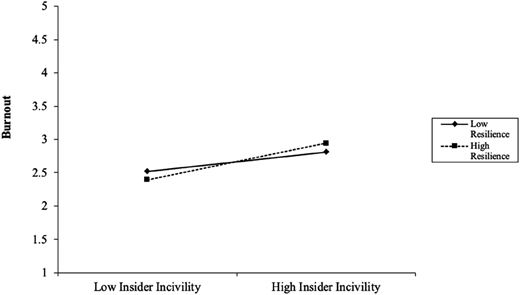
Simple slopes analysis showing the interaction between insider incivility and resilience in predicting burnout. Source: Authors' own work
Simple slopes analysis showing the interaction between insider incivility and resilience in predicting burnout. Source: Authors' own work
Simple slopes analysis indicated that at 1SD above the mean of resilience, the relationship between insider incivility and burnout was strong and significant (ß = 0.38, SE = 0.09, t = 4.22, p < 0.001). At the mean level, the relationship remained significant but was weaker (ß = 0.20, SE = 0.05, t = 3.73, p < 0.001). Finally, at 1SD below the mean, the relationship was not significant (ß = 0.02, SE = 0.09, t = 0.23, p = 0.817). Therefore, Hypotheses 3 and 4 were rejected.
Discussion
This study examined the teachers' experiences of incivility from co-workers (insider incivility) and students' parents (outsider incivility) and their differential impact on burnout. The study also investigated whether self-efficacy and resilience, as personal resources, would mitigate the relationship between incivility and burnout. The findings show that insider and outsider sources of incivility were predictors of burnout. Between these two sources, our findings show that incivility from both insiders and outsiders affects burnout to a comparable degree. Finally, the interaction between resilience and insider incivility was significant in predicting burnout; however, in contrast to our expectations, the positive relationship between insider incivility and burnout was stronger at high levels compared to low levels of resilience. We found no significant interactions between self-efficacy and the two sources of incivility.
Theoretical implications
The study contributes to the incivility literature by adopting a broad approach that simultaneously examines the differential effects of incivility sources on employee well-being. The findings suggest that both insider and outsider sources of incivility were positively associated with burnout among teachers two weeks later. The results were consistent with previous findings that showed incivility from insider (e.g. Alola et al., 2019; Karatepe et al., 2019) and outsider sources (e.g. Cho et al., 2016; Itzkovich and Dolev, 2021) is a social job demand, which can contribute to impaired well-being (i.e. burnout) (Leiter et al., 2008). However, previous research has primarily concentrated on one source of incivility, predominantly among co-workers.
A key contribution of this study is the comparison of two conceptually related forms of incivility. The equality–constraint test showed that insider and outsider incivility did not differ significantly in the strength of their association with burnout, indicating both forms of incivility have similar associations with later burnout. This pattern suggests that incivility may operate as a general interpersonal stressor (Fritz et al., 2019), regardless of whether it originates within the organisation or from individuals outside it (Sliter et al., 2012). Our findings suggest that incivility from parents may carry relational and professional significance comparable to that of colleagues.
Just as interactions with colleagues can make uncivil behaviour a source of stress and emotional exhaustion (Andel et al., 2022), our findings suggest that interactions with parents in school environments can also be emotionally charged (McMahon et al., 2023) and, when uncivil in nature, similarly contribute to stress and emotional exhaustion. Despite generally low levels of incivility reported by participants in our study, both sources of incivility were still associated with burnout, highlighting educators' sensitivity to interpersonal dynamics across stakeholder groups.
Thus, our research demonstrates that incivility constitutes a social job demand (Bakker et al., 2023) that exhausts teachers' cognitive and emotional resources as they endeavour to interpret rude behaviours (Andersson and Pearson, 1999). During the heightened stress associated with COVID-19-induced disruptions, this demand was particularly salient. Teachers relied on collegial support and parental collaboration to support homeschooling, yet when it occurred, incivility was associated with higher levels of burnout for teachers at a time when they were already under substantial strain due to changes in the nature of their work during the COVID pandemic.
Reduced in-person contact further limited opportunities for positive interactions that might otherwise have buffered the negative effects of incivility, so teachers may have had to rely more on their own personal resources. Thus, we also examined the potential buffering roles of personal resources, although we did not find support for a buffering effect of resilience or self-efficacy, unlike previous research (e.g. Al-Hawari et al., 2020; Rhee et al., 2017). Self-efficacy did not moderate the relationships between either form of incivility and burnout, and, in the case of resilience, the effect was in the opposite direction than we hypothesised. In fact, our results suggested that resilience strengthened the positive relationship between insider incivility and burnout. Although the interaction between insider incivility and resilience was statistically significant and theoretically interesting, we do not want to overinterpret this finding, given that it was relatively weak (with CIs from 0.04 to 0.38) and might have been influenced by the small sample size. However, we posit several reasons that could explain this unexpected result.
It is possible that employees perceived incivility as a daily hassle rather than an overt stressor or adverse situation due to its mild nature and overall low levels reported (e.g. Sliter et al., 2010). In line with this argument, highly resilient individuals may have viewed uncivil interactions as challenges rather than adverse events. For this reason, they may have invested more cognitive effort in comprehending the meaning behind the ambiguity of the uncivil episode (e.g. Sommovigo et al., 2020). Thus, they may have devoted additional effort to finding ways to efficiently utilise other personal or job resources in dealing with these ambiguous and stressful interactions (Fredrickson et al., 2008). Over time, even daily hassles like uncivil interactions can lead to a depletion of psychological resources like resilience, particularly if the individual cannot develop pathways to reduce or remove them (Bryan et al., 2018). These efforts might explain why highly resilient individuals experienced more burnout than their counterparts.
Furthermore, resilient individuals often persevere in adverse environments, using coping mechanisms that emphasise endurance and determination (Martinez-Corts et al., 2015). While these traits are generally advantageous, in work environments characterised by many stressors or high levels of stressors (which arguably were experienced in school settings during the COVID pandemic), such perseverance may lead to exhaustion, as individuals consistently strive to tackle interpersonal challenges and other job demands without seeking external support or acknowledging the need to step back. Supporting this view, research suggests that pursuing or engaging in strategies to deal with adversity depletes resources, albeit temporarily (Gross et al., 2011). One can suggest that resilience can function as a double-edged sword, where the very qualities that allow individuals to manage stress also make them susceptible to burnout when confronted with persistent incivility.
Another possible explanation is that highly resilient teachers may display increased sensitivity to incivility due to their profound psychological engagement with their work (Mache et al., 2014). This heightened commitment might lead them to interpret uncivil behaviours as personal failures or betrayals, thereby intensifying emotional strain and contributing to burnout. This perspective aligns with the findings of Trent and Allen (2019), who found that resilience might not consistently buffer against the adverse effects of workplace stressors. Along the same lines, resilient teachers often maintain high expectations for collegiality and support within their working environment. It is possible that when faced with incivility, the gap between their expectations and reality can be especially disheartening, resulting in heightened emotional exhaustion.
Finally, it can be argued that personal resources alone are insufficient for addressing social job demands such as incivility, and that job resources, such as emotional and organisational support, are more effective buffers. Incivility can be regarded as an external stressor, largely beyond individuals' control. In such circumstances, investing personal resources to buffer the negative effects of incivility may consume additional resources without effectively mitigating the stimulus (experienced incivility) or the environmental conditions that enable it. This line of reasoning is plausible but would benefit from further investigation to determine whether personal resources alone can buffer interpersonal stressors, such as workplace incivility, that are outside the individual's control.
These insights suggest that resilience, although generally regarded as a beneficial trait and a protective factor that enables individuals to cope with and adapt to stressors (Fisher et al., 2019), may, under certain conditions, exacerbate the relationship between stressors (e.g. incivility) and well-being.
Practical implications
There are several practical implications from our research. First, given that both insider and outsider incivility were associated with poorer well-being, even at low levels, schools may benefit from structured supports that help teachers process and recover from difficult interactions. This could involve structured debriefs after parent-related incidents, clear escalation pathways for reporting and addressing inappropriate behaviour from parents, and supervisory check-ins that can provide guidance and validate teachers' experiences (Berkowitz et al., 2025). Moreover, family-focused supports aimed at addressing stressors that can lead to uncivil interactions may complement internal efforts to promote collegial respect among staff (Berkowitz et al., 2025), such as communication workshops (Houri et al., 2019). These supports recognise the relational aspect of the work and provide teachers with resources to address incivility from colleagues and parents while protecting their well-being.
Second, institutions could also consider mechanisms to monitor and address patterns of discourteous behaviour. Task forces or anonymous surveys can help identify emerging issues and guide targeted interventions (e.g. Urban et al., 2021). Broader culture-building programmes, such as the Civility, Respect, Engagement in the Workforce (CREW; Osatuke et al., 2009) or Ethos (Churruca et al., 2022), demonstrate how structured workshops, feedback processes, and professional accountability systems can reduce unprofessional conduct and strengthen organisational norms of respect. Adapting such approaches within the educational context may help create environments that promote dignity, integrity and positive interpersonal relationships.
Limitations
The generalisability of these results is subject to limitations. Although the study relied on self-report measures, which can introduce common method bias, we took several steps to mitigate these concerns. First, we used a lagged design, in which the research team measured the predictors and outcome variables at two time points, separated by two weeks. Second, our statistical test of common method variance indicated that the unmeasured latent method factor accounted for only 11.03% of the total variance, well below the commonly referenced 25% threshold. Together, these considerations suggest that common method bias is unlikely to have substantially influenced the findings.
We also would like to highlight that the distribution of insider incivility was skewed, suggesting that uncivil behaviours are not experienced frequently. Skewed distributions are common in incivility research (e.g. Holm et al., 2021), where low means and standard deviations typically reflect the infrequent and episodic nature of uncivil interactions for most employees. Likewise, these distributional characteristics should be considered when interpreting the results.
A further limitation concerns the timing of data collection in relation to the mid-term school break. Although all participating schools had their scheduled break during the same week, primary schools were permitted to allocate additional discretionary days, which may have resulted in minor variations in the length of the break for some teachers. To minimise potential holiday-related effects on strain or recovery, the second wave of data was collected after teachers had returned to work for a full week. Nonetheless, we acknowledge that differences in break duration may still have introduced unmeasured variability into the data and should be considered when interpreting the findings.
Given the small sample size, caution is warranted when interpreting the results, particularly the interaction effects. Methodological research consistently shows that interaction terms require substantially larger samples and higher statistical power than main effects (McClelland and Judd, 1993; Shieh, 2009; Sommet et al., 2023). Interaction effects are especially sensitive to sampling variability, which means that estimates of their size and direction are less precise in smaller samples. More broadly, work on small-sample designs highlights limitations in generalisability and robustness, reinforcing the need for careful interpretation of unexpected findings (Etz and Arroyo, 2015; Giner-Sorolla et al., 2024). Future studies employing larger and more heterogeneous samples would help strengthen external validity and yield more stable estimates of interaction effects.
Finally, the Irish educational context, characterised by a strong emphasis on community and collaboration among teachers, may influence the experiences and effects of incivility from colleagues. While our findings highlight the significant impact of co-worker incivility within this context, the generalisability to other cultural settings may vary. Specifically, it might differ in cultures with distinct educational structures, such as those with more hierarchical systems. Therefore, although the core findings of our study may hold broadly true, specific cultural and systematic factors could influence the extent and nature of incivility's impact on teachers' well-being in different regions.
Future directions
Future research could consider using daily measurement designs to capture real-time uncivil encounters and their impact on teachers' daily experiences. For example, examining whether parent-related and colleague-related incivility follow similar daily patterns, if one type influences the other, or whether their short-term negative effects differ. Such designs would clarify how different sources of incivility influence teachers and help explain why they seem comparable in educational settings.
Another recommendation for scholars is to pay attention to the role of context in future research. The present findings may not generalise to all educational environments, and the varying teaching environments represented in the sample may have influenced the results. Schools, for example, differ in organisational climate, resource availability, and the intensity of parent-teacher interactions. Moreover, structural and contextual features such as school level (e.g. primary, secondary, special education), class size, and types (e.g. schools in disadvantaged areas) may shape both the frequency of insider and outsider incivility and the resources available to buffer their effects. Future research would benefit from examining such factors as further potential moderators.
Another fruitful area for further work is to examine the process underlying the incivility-burnout relationship and to examine possible mediating variables in this health impairment process. For instance, there is a paucity of investigation into the mediating role of emotions (Sommovigo et al., 2020). Because both sources showed comparable effects in the sample, future research could examine whether they operate through similar or distinct pathways. For example, whereas insider incivility may evoke relational betrayal or diminished belonging, outsider incivility may elicit frustration, feelings of professional inadequacy, or anxiety. Therefore, testing different emotions as mediators would clarify whether the two forms of incivility impact well-being through shared emotional mechanisms or different affective pathways. This may help us further understand why their overall effects appeared equivalent in the present study.
Finally, it is now well established that uncivil behaviours are present in the workplace, and these deviant acts lead to undesirable well-being and organisational outcomes. However, there is still uncertainty on how and why these behaviours propagate and eventually escalate into coercive acts in work settings. Therefore, future scholarly work should focus on the incivility spiral, particularly attributions, interactional injustice, and negative reciprocity beliefs (i.e. the desire to respond to perceived mistreatment) in the development of incivility at work. Again, scholars can investigate these angles via diary studies or through experimental methods using vignettes.
Conclusion
Teachers' ability to deliver high-quality education makes them among the most influential individuals in our society. In their line of work, they encounter different stressors, including incivility. Our study shows that rude behaviour from both colleagues and students' parents erodes teachers' well-being. Personal resources, like resilience and self-efficacy, offered no protection against these effects. These results highlight the significant impact of negative daily interactions on employee well-being. To counteract incivility, teachers should model core values in their collegial relationships, and management must actively promote and enforce professional respect.
Notes
This information was later removed to ensure anonymity.
All schools in the sample shared the same scheduled mid-term break week, although primary schools could allocate additional discretionary days.
We also measured job-related affective well-being, withdrawal behaviours, psychological well-being, and recovery experiences at Time 2.

