

Insights into learning in low-tech, information-rich environments: editorial
Technology has brought about immense benefits to learning, pedagogy and human communication and connectivity. Countries across the world have been expending resources to infuse their learning environments across colleges, universities, schools and other institutions with information and communication technologies. In this process, the term high-tech has become prevalent as a desirable facet when applied to different aspects, including in learning and pedagogy. However, high-tech may not always be possible, and may not always be desirable either. In such cases, the term low-tech comes to the forefront. Low-tech refers to environments that incorporate mostly analog, non-digital materials along with limited digital technologies for use (Knudson and Wallace, 2019; Nicol et al., 2018). In many developing as well as in some developed countries, there is a high prevalence of digital divide, with a portion of the population left out of the technological and infrastructure growth. Many schools, colleges and universities in these regions may lack even basic infrastructure, with little to varying degrees of effective technological infrastructure. Internet connections may be slow or even non-existent. Computers, even if present, may not have been updated in several years. Even in cases where the latest technological infrastructure is present e.g. in countries such as Japan, USA, South Korea, Germany and Singapore, people might struggle with too much technology use, where a lot of people are constantly glued to their phone or computer screens. In such environments and to fight technology addiction, some people are advocating creating technology free zones in their school, home, work or meeting spaces (Powers, 2010; Turkle, 2016).
This special issue presents articles focused on research in the area of learning and pedagogy in low-tech environments. This special issue emerged from the Asia-Pacific Regional Conference of the Association for Information Science and Technology (ASIS&T) in Phnom Penh, Cambodia in January 2019 that focused on Effective Learning in Low-Tech Information Environments. We wanted to transform this topic into a special issue because of the importance of low-tech environments for learning in many developing countries, rural areas, and with specific populations. Also, as discussed above, low-tech learning environments may become more important in the future because of the emerging pushback against the pervasiveness of high-tech in our daily lives. We sought high-quality, innovative articles that addressed conceptual, empirical, and theoretical issues around learning in low-tech, information-rich environments. We would like to thank John Marino from the University of North Texas who was a great collaborator at this stage, and Sam Chu from the University of Hong Kong and Rebecca Reynolds from Rutgers University for inviting us to edit the special issue. Topics of interest included in the call for papers were:
The current landscape of learning in low-tech information environments;
Implementation of high-tech information and technological strategies in low-tech environments;
Pedagogical approaches, models, and theories for effective learning in low-tech environments;
Learning in formal and informal low-tech settings;
Strategies and challenges for learning in low-tech information environments;
Evaluation and assessment of learning in low-tech environments;
Research methods, ethics and implementation of learning in low-tech environments;
Innovations in learning in low-tech information environments;
The future of learning in low-tech environments; and
The purposeful design of low-tech information environments to support mindfulness and contemplation.
The special issue contains seven articles. The issue is led by an article that reviews the research in the field of learning in low-tech environments over the past decade. As a part of the review, it offers definitions for several of the terms frequently occurring in this space. While research in this space has been relatively limited, the review offers insight into three prominent strands of research in the field:
learning in low-tech versus high-tech environments;
creating a low-tech environment through the use of low-tech strategies; and
creating a low-tech environment through the addition of digital technology into no-tech or very limited low-tech environments.
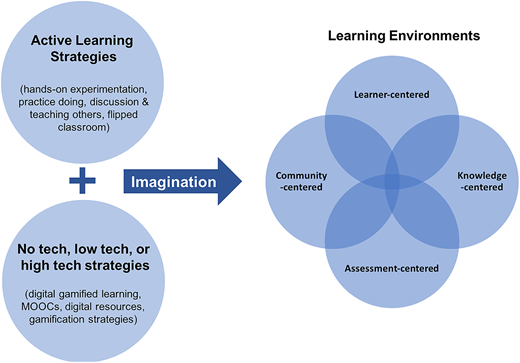
It also reviews the methods used, populations studied, and geographic locations of the studies and ultimately finds that active learning strategies are at the heart of any effective learning environment, whether low-tech, no-tech, or high-tech. This is summarized in the framework for learning in low-tech, information-rich environments proposed in the study.
The following six articles present current research studies and conceptual pieces focused on learning in low tech environments. Similar to the themes that emerged in the review article, these articles provide insight into both the methods for creating a low-tech environment:
through the use of low-tech strategies; and
through the addition of digital technologies into no-tech or very limited low-tech environments.
“Connecting moments of creativity, computational thinking, collaboration, and new media literacy skills”, by Tsortanidou, Daradoumis and Barberá Gregori, provides insight into the use of a low-tech pedagogical model to create a low-tech environment that supports the acquisition of media literacy skills, creativity, and computational thinking for students in primary and secondary school settings. Imagination is presented as a fundamental concept in the model and principles and guidelines that follow the design thinking process are provided for the implementation of the model in classrooms.
In “An iterative process for developing digital gamified-sexual health education for adolescent students in low-tech settings”, Haruna, Zainuddin, Mellecker, Chu and Hu provide insight into the use of design-based research to design, develop, test and refine a digital game that promotes sexual health education for adolescents in Sub-Saharan Africa. The iterations of the game were evaluated using a framework called MAKE, developed by the research team, that combines the elements of motivation, attitude, knowledge, and engagement, essentially looking at the game’s ability to motivate students, improve their attitudes, increase their acquisition of knowledge, and engage them in the learning.
The article, “A Study of Veterinary Scholars’ Perception of MOOCs” by Kumar, also looks at how technology has been added to a limited low-tech environment by investigating how massive open online courses (MOOCs) have been used in India to expand education and professional development in the field of Veterinary Science. They found that individuals are using MOOCs to supplement other learning methods and to support lifelong learning.
Alphonce and Mwantimwa explore Tanzanian students’ use of digital resources in “Students’ use of digital learning resources: diversity, motivations and challenges”, and find that the students studied preferred internet resources but are limited by the cost, limited searching competencies, and limited subscription databases.
Similarly, in “Use of e-resources by unmotivated students: a success story from a library in Russia”, Vasilyeva and Vasilyeva share a novel pedagogical approach for presenting information literacy education that was successful in increasing Russian, first-year undergraduate students’ interest in electronic resources.
Finally, “The effects of gamified flipped instruction on learners' performance and need satisfaction”, by Zainuddin, Shujahat, Chu, Haruna and Farida, delves into a study that examines the differences between conventional flipped classroom and gamification-enhanced flipped classroom instruction in secondary school classrooms in Indonesia. The study found that incorporating gamification concepts into flipped classroom instruction led to a more engaging and enjoyable experience for learners.
Table I below outlines the method, region, setting, population and research questions in the articles in this special issue.
Method and research questions in the articles
| No. | Authors | Method | Region | Setting | Population | Research questions |
|---|---|---|---|---|---|---|
| 1 | Campana and Agarwal | Scoping review | Asia, North America, Australia, Europe and Africa | Colleges, secondary schools | University students under 18, students with disabilities, employed adults, schoolteachers | What are the most prominent strands of research in pedagogy and learning that surmounts challenges of low-tech that has been carried out in the past decade? What are the methods used, populations studied, and places where such research was carried out? |
| 2 | Tsortanidou, Daradoumis and Barberá Gregori | Design thinking process, case study | No specified location | Primary and secondary schools | Primary and secondary school students | How can pedagogy bridge creativity with computational thinking and new media literacy skills in low-tech, information-rich learning environments? |
| 3 | Haruna, Zainuddin, Mellecker, Chu and Hu | Design-based research, quasi-experimental design | Sub-Saharan Africa | Secondary schools | Secondary school students | How effective are gamified learning platforms in supporting sexual health education in Sub-Saharan Africa? |
| 4 | Kumar | Survey | India | Higher education institution | Veterinary science students | What are veterinary students’ perceptions of MOOCs that provide education in veterinary science and animal education? |
| 5 | Alphonce and Mwantimwa | Survey, interviews, and observations | Tanzania | University | University students and staff members | How are students using digital learning resources at a university in Tanzania? What are these students’ motivations for using digital learning resources? What challenges do these students face in using the digital learning resources? |
| 6 | Vasilyeva and Vasilyeva | Verbal assessments, usage data, survey | Russia | University | First-year undergraduates | How can a flexible, interest-driven approach to teaching information literacy impact students’ interest in e-resources? |
| 7 | Zainuddin, Shujahat, Chu, Haruna and Farida | Classroom assessments and survey | Indonesia | Secondary school | Secondary school students | How can gamified flipped learning classrooms support students’ learning? How can gamified flipped learning classrooms support students’ basic need satisfaction in terms of perceived competence, autonomy, and relatedness? |
As discussed above and summarized in Table I, the articles in the special issue provide insight into the different methods of creating a low-tech environment. They do this through studies that cover a variety of topics and regions. The studies also represent a variety of methodologies including design-based research and assessments, which is understandable given that the topic of the special issue is learning in low-tech environments. While the studies are fairly different from each other, they all share similar settings, specifically secondary schools and universities, with the exception of the review article.
In addition to the shared setting, a number of common themes emerged from these studies, which can be seen in Table II.
Themes emerging from the articles
| No. | Authors | Themes in the main figures/findings of the papers |
|---|---|---|
| 1 | Campana and Agarwal | Active learning strategies, mediated by no-tech, low-tech or high-tech, can lead to learning environments that are learner-centered, knowledge-centered, assessment-centered, and community-centered |
| 2 | Tsortanidou, Daradoumis and Barberá Gregori | Incorporating imagination through imaginative teaching and low-tech prototyping methods is crucial for bridging creativity with computational thinking and new media literacy skills in low-tech, information-rich learning environments |
| 3 | Haruna, Zainuddin, Mellecker, Chu and Hu | Using a digital gamified learning platform in a limited resource environment such as Sub-Saharan Africa can engage students in a more effective manner and support increased sexual health learning |
| 4 | Kumar | The introduction of MOOCs into veterinary science education can expand opportunities for education and professional development to a wider variety of students. However, to retain and truly engage students, effective active learning and instructional strategies need to be incorporated into the MOOC course design |
| 5 | Alphonce and Mwantimwa | Some access to technological infrastructure and resources is important to allow students to access and learn from the broad scope of information that can be found in electronic resources |
| 6 | Vasilyeva and Vasilyeva | The true impact for student learning and engagement lies in the teaching techniques and is less reliant on whether it is a high-tech or low-tech environment |
| 7 | Zainuddin, Shujahat, Chu, Haruna and Farida | Pairing gamification strategies with a flipped classroom model can be effective in supporting twenty-first century learning skills in low-tech environments where the implementation is not bound by advanced technological resources and infrastructure |
These common themes across the articles in the special issue, seen in the table above, align and intersect to provide insight into learning in low-tech environments. A majority of the studies pointed to instructional strategies as the key piece in developing effective learning environments over the presence or lack of digital technology. The low-tech aspect was often positioned as a supplementary aspect of the instructional strategies. Active learning strategies were highlighted as an important method for supporting learning and getting learners engaged in their own learning process. One interesting finding that emerged in the article by Tsortanidou, Daradoumis and Barberá Gregori (No. 2 in Table II) is the importance of imagination, which could apply to all aspects of using active learning strategies in combination with low-tech (and even no-tech and high-tech) strategies to support learning (Figure 1). Imagination can be important when designing the low-tech strategies for use in the learning environment as well as for learners when they are engaging with the low-tech materials and activities.
The articles in the special issue ended up covering the following themes that were identified in the call for papers:
The current landscape of learning in low-tech information environments;
Implementation of high-tech information and technological strategies in low-tech environments;
Pedagogical approaches, models, and theories for effective learning in low-tech environments;
Learning in formal and informal low-tech settings;
Strategies and challenges for learning in low-tech information environments; and
Innovations in learning in low-tech information environments.
We invite you to dive into these articles and explore the different ways that low-tech environments can be manifested. We hope that they provide you with ideas for implementing low-tech environments or just provide insight into the reasons for and benefits of offering low-tech environments.
The following themes from the call for papers were not covered by any of the included articles:
Evaluation and assessment of learning in low-tech environments;
Research methods and ethics of learning in low-tech environments;
The purposeful design of low-tech information environments to support mindfulness, and contemplation; and
The future of learning in low-tech environments.
Along with the future work mentioned in each article in this special issue, the areas not covered provide areas and directions for further research on learning in low-tech, information-rich environments. We encourage researchers in this space to further explore these topics in their upcoming work.

