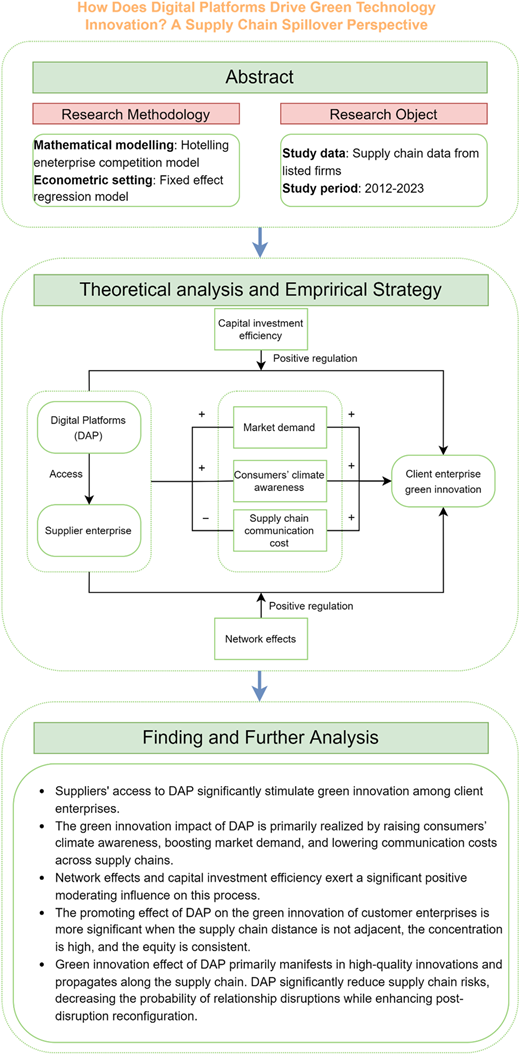
The study aims to theoretically analyze the operational mechanisms of digital platforms (DAP) on green technology innovation via a supply chain perspective, conduct empirical validation and provide theoretical insights and policies for DAP-enabled supply chain green transformation and resilience enhancement.
From a supply chain perspective, this study constructs a Hotelling firm competition model incorporating DAP for theoretical mechanism analysis. It uses supply chain data from listed firms (2012–2023) for empirical validation.
The key findings demonstrate that DAP significantly stimulate green technology innovation among customer firms, with notable heterogeneity across supply chain and firm-level characteristics. The green technology innovation impact of DAP is primarily realized by raising consumers' climate awareness, boosting market demand and lowering communication costs across supply chains. Notably, network effects and capital investment efficiency exert a significant positive moderating influence on this process. Further analysis indicates that DAP primarily foster high-quality green technology innovation and exhibit a diffusion effect in innovation outcomes. Concurrently, DAP substantially mitigate supply chain risks, reduce the likelihood of “chain breakage” and reinforce supply chain restructuring.
This study innovatively incorporates DAP to reveal how suppliers' DAP embedding drive customer firms' green technology innovation under customer competition. From a supply chain linkage perspective, it uncovers platform spillover mechanisms, enriching DAP externality literature. It extends research by focusing on substantive innovation, supply chain diffusion effects and DAP's impact on supply chain risks, offering a comprehensive understanding of supply chain strategic adjustments in the digital context.