


The research article aims to delineate and place into context consumer resistance within the realm of global consumer culture (GCC). It delves into exploring its fundamental forms, establishing a conceptual foundation and outlining implications for future inquiry.
The article adopts a comprehensive conceptual outlook by amalgamating existing insights from a systematic analysis of 110 articles spanning diverse fields like sociology, psychology, marketing and economics. It devises an innovative framework that encapsulates the varying manifestations of consumer resistance based on intensity and target, while proposing an integrative antecedents-decisions-outcomes (ADO) model to elucidate the stimuli, forms and repercussions of resistance within the GCC landscape.
The article categorizes and delineates different consumer dispositions that underpin resistance, showcasing a spectrum of consumer resistance at micro, meso and macro levels and distinguishing between passive and active behaviors. The ADO framework uncovers identity-based, culture-based and socio-economic motivations as pivotal triggers of resistance, various resistance actions as decisions, and multifaceted outcomes that influence consumers, brands, businesses, markets and the GCC itself. Additionally, the study acknowledges notable research gaps and sets forth a comprehensive research agenda for future exploration.
This research offers a distinctive theoretical contribution by furnishing an exhaustive and unified framework for comprehending consumer resistance within the realm of GCC. It establishes connections between diverse disciplinary perspectives, introduces crucial new conceptualizations of resistance manifestations and delineates a research roadmap to enhance the comprehension of this increasingly salient phenomenon in the domain of international marketing.
1. Introduction
When we buy a Starbucks coffee, we also buy a certain ethical stance. We buy the idea that a part of the money goes to Third World children or some other noble cause. We don’t just buy a coffee, we buy our redemption from being only consumers.
Slavoj Žižek, world-renowned Slovene philosopher
Consumer resistance within the realm of global consumer culture (GCC) is becoming increasingly important as ethical considerations and the symbolic, ideological aspects of consumption decisions influence consumer actions (Strizhakova and Coulter, 2019; Torelli and Stoner, 2019). Echoing Slavoj Žižek’s insightful analysis, which suggests that buying items like Starbucks coffee blends a consumer transaction with a perceived ethical duty—a form of “purchasing our redemption”—the connection between consumption and personal values comes to light. Consumer resistance, which refers to the resistance consumers exhibit toward specific products, brands or marketing strategies (Peñaloza and Price, 1993; Roux, 2007; Amine and Gicquel, 2011), plays a critical role in comprehending GCC, as it mirrors the underlying socio-political ideologies and consumer perspectives on globalization and multinational corporations (Ulver and Laurell, 2020). Unravelling these intricacies can shed light on the motivations behind anticonsumption behaviors, boycotts and the adoption of alternative consumption patterns that challenge conventional market narratives (Cherrier, 2009; Lee et al., 2011).
GCC presents a fascinating paradox: it does not just resist opposition but often absorbs and commodifies it (Izberk-Bilgin, 2010). Practices like minimalism, zero-waste living and ethical consumption, initially positioned as anticonsumerist, have been rebranded as lifestyle trends and transformed into profitable markets (Cherrier, 2009; Izberk-Bilgin and Belk, 2025). Similarly, companies like Nike and Pepsi co-opt protest imagery and social justice messages, turning symbols of defiance into tools for brand engagement (Eyada, 2020). This concept, known as “marketable dissent,” demonstrates how corporations have adopted movements that once challenged them by offering eco-friendly products, ethical branding and activism-inspired advertising to align with consumer values (Mayo, 2005; Izberk-Bilgin and Belk, 2025). While these initiatives may convey genuine concern, they also commodify the notion of consuming less, perpetuating consumption through a different aesthetic (Sandlin and Callahan, 2009). In parallel, prominent brands strategically co-opt resistance narratives to enhance loyalty, subtly reshaping activism in ways that are commercially secure and profitable (Jovanovski and Jaeger, 2024). The outcome is a dynamic, adaptable system in which criticism is not silenced but monetized (Jafari et al., 2022), sparking complex questions about whether authentic resistance can persist within a framework that effectively consumes its own opposition.
Recent literature in marketing has delved into consumer resistance as a complex phenomenon, encompassing actions that challenge the market system and consumption culture (Amine and Gicquel, 2011; Cambefort and Roux, 2019; Chaney and Slimane, 2019). This includes behaviors like brand boycotts, anticonsumption lifestyles and subtle forms of opposition to marketplace practices and dominant ideologies (Amine and Gicquel, 2011; Roux, 2007; Russell et al., 2011). Deviations from typical consumer behavior, such as shoplifting, boycotting or reclaiming leftovers, present a spectrum of actions that challenge norms and sometimes disrupt public order (Amine and Gicquel, 2011). Scholars have explored the motivations behind such resistance, often tying them to perceptions of power imbalances, ethical concerns or a rejection of mass-produced meanings (Cherrier et al., 2011; Lee et al., 2011; Roux, 2007). While historically overlooked, these resistant behaviors are critical factors that impact economies and should be considered as such (Amine and Gicquel, 2011). Research on consumption should not only focus on promoting consumption but also on understanding when and why consumers resist market offerings, along with the various forms and theoretical foundations of this resistance as the influence of consumption culture expands into different aspects of our lives (Cherrier, 2009; Bizumic, 2019; Cleveland and McCutcheon, 2022).
International marketers need to closely monitor consumer resistance in the GCC as it can result in significant financial losses and enduring damage to brand reputation (Kim et al., 2025). Consumer resistance, often seen through boycotts, is a potent force that can reshape market dynamics rather than just a short-term response (Chaney and Slimane, 2019). For example, in 2023, Bud Light experienced a 7.3% drop in U.S. beer sales following a boycott by conservative consumers due to a social media marketing campaign featuring a transgender influencer (Kim et al., 2025). This negative reaction not only impacted immediate sales but also harmed the brand’s connection with its core customer base. Even after two years, the consequences lingered, leading Bud Light to lose its leading position in the U.S. beer market, falling to third place as its brand image suffered (Frericks, 2025). This instance underscores that failing to comprehend and address consumer resistance can have long-lasting repercussions, underscoring the importance for global brands to predict and navigate cultural sensitivities in their marketing approaches.
Previous research on consumer resistance, though valuable, often focuses on a micro-level perspective, highlighting individual characteristics and actions against the market (Chaney and Slimane, 2019). This narrow individual-centric view limits our comprehension of the broader institutional factors and consequences of resistance behaviors, especially within the evolving GCC environment. Additionally, numerous existing studies stress the behavioral aspects of consumer resistance while failing to adequately explore the socio-political motives behind such behaviors (Anderson et al., 2018; Mani and Chouk, 2018). The literature remains fragmented, with calls for a more nuanced understanding of consumer attitudes toward cultural in- and out-groups, the interplay of social identities and the intricate dynamics among global, foreign and local consumer cultures (Bartsch et al., 2019; Salomão et al., 2022). Moreover, despite the growing impact of globalization and its effects on consumer landscapes, research lacks adequate consideration of how these global forces influence and shape different forms of consumer resistance (Bartsch et al., 2019; Cleveland and McCutcheon, 2022). This underscores the need for a comprehensive framework that integrates the dynamics of GCC with the motivations and expressions of consumer resistance.
This article aims to address these limitations by offering a comprehensive conceptualization of consumer resistance in the context of GCC. Our main research goal is to explore how consumer resistance can be conceptualized and understood within the GCC, along with its key manifestations, theoretical foundations and future research directions. Examining how global cultural flows interact with consumers’ resistance to market systems, this study aims to provide a more holistic view of resistance that goes beyond individualistic perspectives and recognizes broader cultural and institutional influences. Drawing on consumer dispositions, values and identities that influence resistance behaviors, this study seeks to construct a comprehensive framework for consumer resistance in GCC by integrating findings from various disciplines. Lastly, by identifying gaps in the literature at the intersection of consumer resistance and GCC, this study aims to suggest interdisciplinary approaches to enhance future research and propose new research directions to deepen our understanding of consumer resistance in GCC.
This study will provide significant theoretical contributions to the GCC, consumer resistance and international marketing literature. It aims to advance the GCC literature (building on Cleveland and Bartsch, 2019) by introducing a framework that integrates consumer resistance into the processes of appropriation, indigenization and creolization within global cultural flows. The model seeks to explore the interplay between consumer identity, ethical consumption and social resistance, offering a comprehensive understanding of consumer motivations. Additionally, it will enhance the consumer resistance literature (building on Roux, 2007) by presenting a holistic view that situates different forms of resistance within the GCC context, shedding light on the triggers and targets of opposition in a globalized market. Furthermore, the research will contribute to the international marketing field (e.g. Bartsch et al., 2019; Dey et al., 2019; Cleveland and McCutcheon, 2022) by demonstrating how consumer resistance, influenced by GCC dynamics, impacts consumer behavior, brand perceptions and the efficacy of global marketing strategies in culturally varied markets. Lastly, the study will showcase how consumer resistance can instigate broader systemic changes, prompting adjustments in brand practices and market strategies in response to evolving consumer expectations.
Significant practical contributions for international marketing are offered by understanding how consumer resistance is conceptualized and expressed in the GCC context. Identifying the main drivers and manifestations of resistance in a globalized setting allows international marketers to gain valuable insights into consumer segments that may have concerns about global brands and marketing strategies (Bartsch et al., 2019; Cleveland and McCutcheon, 2022). This knowledge can aid in creating more comprehensive and effective marketing strategies that align with diverse consumer values and address possible opposition (Roux, 2007; Cleveland and Bartsch, 2019; Dey et al., 2019). Ultimately, a deeper comprehension of consumer resistance within the GCC can help companies build stronger consumer relationships, navigate culturally sensitive markets more efficiently, and develop more sustainable and ethical global marketing practices, contributing to meaningful societal changes within the GCC framework (Cleveland and McCutcheon, 2022).
2. Methodology
This is a conceptual study that aims to develop a framework of consumer resistance in GCC and advance its conceptualization, drawing on different perspectives. To achieve this goal, we utilize a conceptual literature review methodology. While traditional literature reviews focus on organizing and describing existing knowledge, conceptual reviews aim to uncover underlying patterns and common foundations that can facilitate the development of new theoretical insights (Jaakkola, 2020). In order for such a review to have a significant impact and be viewed as credible, it is crucial that the process is carried out in a systematic manner. By adopting a structured and methodical approach—rather than randomly selecting sources—we ensure that the literature examined is as comprehensive and representative as possible, thereby strengthening the robustness and relevance of the conceptual findings (Hulland, 2020).
In this study, two fundamental concepts are explored: consumer resistance and GCC. Following a traditional systematic literature review approach (e.g., Paul and Barari, 2022; Paul et al., 2024), we focused on literature that intersects these two concepts. The search query “(consumer* resistance*) AND (global consumer* culture*)” was used in Scopus to identify relevant articles based on their titles, abstracts and keywords. Initially, 121 articles were found. To ensure transparency and credibility, we set clear inclusion and exclusion criteria to avoid bias or cherry-picking (Hulland, 2020). Only peer-reviewed articles in English from social science, business, management, accounting, psychology and economics domains were considered, resulting in 41 articles. Journals were selected based on high quality using Clarivate’s Journal Citation Reports (JCR) rankings (Quartiles 1 and 2), narrowing down the articles to 29. Abstracts were screened for relevance to consumer resistance and GCC, leading to a final selection of 12 articles for review. These articles (i.e. Berry, 2008; Carducci, 2006; Dalmoro et al., 2020; Demont-Heinrich, 2011; Izberk-Bilgin and Belk, 2025; Jovanovski and Jaeger, 2024; Lekakis, 2017; Lysonski and Durvasula, 2013; Mele, 1996; Russell et al., 2011; Sandlin and Callahan, 2009; Ulver and Laurell, 2020) form a foundational basis for analyzing consumer resistance in the context of GCC. However, a brief analysis revealed that while these articles are relevant, they are mainly conceptual and not published in international marketing journals. Given the focus on international marketing theory and practice in this study and the limited number of articles identified not being enough for a rigorous systematic literature review (Paul et al., 2024), we decided to broaden the search criteria.
Instead of looking at the two interlinked concepts, we looked at both concepts as being separate and used the following Boolean for the search in Scopus: “(consumer* resistance*) OR (global consumer* culture*)”. The search process in title, abstract and keywords resulted in 15,557 articles. This indicates that there is rich extant research on the two concepts, only that they are confined to its own domains (i.e. consumer resistance mostly to consumer behavior literature, GCC mostly to international marketing literature), while rarely are they studied together. The next step was to include only peer-reviewed articles published in English within the domains of social science, business, management and accounting, psychology and economics for further analysis, which resulted in 3,243 articles. These articles were published in 159 journals, out of which 99 were journals classified within Quartiles 1 (Q1) and 2 (Q2) of Clarivate’s Journal Citation Reports (JCR) rankings. Applying this criterion resulted in 1,105 articles. In the initial phase, we screened titles and abstracts to identify articles focusing on consumer resistance, anticonsumption, consumer activism and cultural contestation within globalized or transnational consumer markets and GCC. We excluded studies that only briefly mentioned these themes or lacked depth. From this phase, 345 articles were identified. Subsequently, we evaluated full-text articles based on their theoretical and empirical relevance to the conceptualization of consumer resistance in the GCC context. We included articles that centrally explored consumer resistance or GCC, discussed dynamics of globalization, cultural identity or transnational consumption, and utilized appropriate theoretical frameworks (e.g., cultural resistance, subversion, identity work, acculturation to GCC). We excluded articles that primarily discussed consumer resistance in a nonconsumption context, focused on firm responses to resistance (e.g., crisis management) or lacked conceptual or empirical depth. This stage yielded a total of 92 articles. Further examination led us to specific issues on consumer resistance (European Journal of Marketing Vol. 45 No. 11/12, 2011) and GCC (International Marketing Review Vol. 36 No. 4 and No. 5, 2019) from which relevant articles were included. Cross-referencing expanded our pool of studies, resulting in a final dataset of 110 articles. The full article selection process is outlined in Figure 1.
 The PRISMA flow diagram shows four section headings arranged vertically on the left side: “Identification”, “Screening”, “Eligibility”, and “Inclusion”. It is divided into three columns. The left column is labeled “consumer resistance” AND “G C C”, the middle column is labeled “consumer resistance” OR “G C C”, and the third column is unlabeled. The left column contains six vertically arranged text boxes labeled from top to bottom as follows: Text box 1: 121 articles. Text box 2: 41 articles. Text box 3: 29 articles. Text box 4: 12 articles. Text box 5: 12 articles. Text box 6: 12 articles. Text box 1 is connected to text box 2 with a downward arrow labeled negative 80 articles. Text box 2 is connected to text box 3 with a downward arrow labeled negative 12 articles. Text box 3 is connected to text box 4 with a downward arrow labeled negative 17 articles. Text box 4 is connected to text box 5 with a downward arrow. Text box 5 is connected to text box 6 with a downward arrow. The left column and the middle column are divided by a vertical dashed line. The middle column contains six vertically arranged text boxes labeled from top to bottom as follows: Text box 7: 15557 articles. Text box 8: 3243 articles. Text box 9: 1105 articles. Text box 10: 345 articles. Text box 11: 92 articles. Text box 12: 110 articles. Text box 7 is connected to text box 8 with a downward arrow labeled negative 12314 articles. Text box 8 is connected to text box 9 with a downward arrow labeled negative 2138 articles. Text box 9 is connected to text box 10 with a downward arrow labeled negative 760 articles. Text box 10 is connected to text box 11 with a downward arrow labeled negative 253 articles. Text box 11 is connected to text box 12 with a downward arrow labeled positive 18 articles. The third column contains five vertically arranged text boxes labeled from top to bottom as follows: Text box 13: Exclusion criteria: not peer-review article, not in English language, not in selected categories. Text box 14: Exclusion criteria: not Q 1 or Q 2 on J C R rankings. Text box 15: Articles abstract screening (abstract relevance). Text box 16: Articles full text screening: consumer resistance and or or G C C not a core topic. Text box 17: Cross-referencing. Text box 13 points to the arrow connecting text box 7 to text box 8. Text box 14 points to the arrow connecting text box 8 to text box 9. Text box 15 points to the arrow connecting text box 9 to text box 10. Text box 16 points to the arrow connecting text box 10 to text box 11. Text box 17 points to the arrow connecting text box 11 to text box 12. Text boxes 1, 2, 3, 7, 8, 9, 13, and 14 are under the section Identification. Text boxes 4, 10, 15 and 16 are under the section Screening. Text boxes 5, 11, 16 and 17 are under the section Eligibility. Text boxes 6, 12, and 17 are under the section Inclusion.
Articles screening and selection procedure depicted in PRISMA framework. Source: Authors’ own work
The PRISMA flow diagram shows four section headings arranged vertically on the left side: “Identification”, “Screening”, “Eligibility”, and “Inclusion”. It is divided into three columns. The left column is labeled “consumer resistance” AND “G C C”, the middle column is labeled “consumer resistance” OR “G C C”, and the third column is unlabeled. The left column contains six vertically arranged text boxes labeled from top to bottom as follows: Text box 1: 121 articles. Text box 2: 41 articles. Text box 3: 29 articles. Text box 4: 12 articles. Text box 5: 12 articles. Text box 6: 12 articles. Text box 1 is connected to text box 2 with a downward arrow labeled negative 80 articles. Text box 2 is connected to text box 3 with a downward arrow labeled negative 12 articles. Text box 3 is connected to text box 4 with a downward arrow labeled negative 17 articles. Text box 4 is connected to text box 5 with a downward arrow. Text box 5 is connected to text box 6 with a downward arrow. The left column and the middle column are divided by a vertical dashed line. The middle column contains six vertically arranged text boxes labeled from top to bottom as follows: Text box 7: 15557 articles. Text box 8: 3243 articles. Text box 9: 1105 articles. Text box 10: 345 articles. Text box 11: 92 articles. Text box 12: 110 articles. Text box 7 is connected to text box 8 with a downward arrow labeled negative 12314 articles. Text box 8 is connected to text box 9 with a downward arrow labeled negative 2138 articles. Text box 9 is connected to text box 10 with a downward arrow labeled negative 760 articles. Text box 10 is connected to text box 11 with a downward arrow labeled negative 253 articles. Text box 11 is connected to text box 12 with a downward arrow labeled positive 18 articles. The third column contains five vertically arranged text boxes labeled from top to bottom as follows: Text box 13: Exclusion criteria: not peer-review article, not in English language, not in selected categories. Text box 14: Exclusion criteria: not Q 1 or Q 2 on J C R rankings. Text box 15: Articles abstract screening (abstract relevance). Text box 16: Articles full text screening: consumer resistance and or or G C C not a core topic. Text box 17: Cross-referencing. Text box 13 points to the arrow connecting text box 7 to text box 8. Text box 14 points to the arrow connecting text box 8 to text box 9. Text box 15 points to the arrow connecting text box 9 to text box 10. Text box 16 points to the arrow connecting text box 10 to text box 11. Text box 17 points to the arrow connecting text box 11 to text box 12. Text boxes 1, 2, 3, 7, 8, 9, 13, and 14 are under the section Identification. Text boxes 4, 10, 15 and 16 are under the section Screening. Text boxes 5, 11, 16 and 17 are under the section Eligibility. Text boxes 6, 12, and 17 are under the section Inclusion.Articles screening and selection procedure depicted in PRISMA framework. Source: Authors’ own work
This is a framework-based literature review (Paul and Barari, 2022; Paul et al., 2024). Such an approach is highly suitable for a conceptual review studying consumer resistance in GCC as it provides a robust structure for extracting important insights, highlighting research gaps and suggesting directions for future research (Paul and Criado, 2020). Given the complexity of the topic, which spans various disciplines and contexts, using a framework helps to create cohesion and prevent redundant efforts (Paul et al., 2024). This methodical approach is crucial for a conceptual paper intending to advance new theoretical perspectives (Hulland, 2020; Paul et al., 2021; Paul and Barari, 2022). Framework-oriented reviews are regarded as more impactful than other forms of systematic literature reviews due to their clear structure for reporting and coherent synthesis of existing literature, offering comprehensive coverage and maximum clarity (Paul et al., 2024).
To analyze and present the data, we chose the antecedents-decisions-outcomes (ADO) framework (Paul and Benito, 2018). This framework offers a valuable tool for conceptualizing and categorizing consumer resistance in GCC by providing a structured approach to understand its different aspects (Paul et al., 2024). The ADO framework clarifies complex ideas by illustrating the rationale behind decisions and their resulting impacts (Paul and Benito, 2018). It enables the identification of key drivers that lead to consumer resistance in GCC, such as ideological opposition and cultural identity preservation. The decisions component of the framework examines the diverse forms of consumer resistance, including alternative consumption and activism. Additionally, it sheds light on the consequences of consumer resistance, such as the emergence of alternative marketplaces and the preservation of local cultures. This methodical approach assists in recognizing patterns, inconsistencies and gaps in existing knowledge, facilitating the development of a consumer resistance typology. Different combinations of antecedents and decisions can give rise to various types of resistance behaviors, each potentially leading to different outcomes. For instance, consumer resistance driven by cultural identity preservation may manifest through the adoption of local products, while resistance rooted in ideological opposition could result in more active forms of protest. The ADO framework establishes a solid foundation for constructing a comprehensive and theoretically informed understanding of consumer resistance in the intricate landscape of the GCC. It can inform practical decisions and promote thorough theorization (Paul et al., 2024). The ADO framework was supplemented by the TCM (theories, contexts and methods) framework (Paul et al., 2017) to gain insights into the theoretical foundations of both concepts and address gaps related to the methodologies and contexts utilized in current research on the topic.
The coding process entailed multiple steps. After conducting an initial review of the articles, preliminary codes were created to encompass core themes, concepts and elements related to consumer resistance within the GCC context (Paul et al., 2024). Our focus was primarily on exploring diverse definitions of consumer resistance, various forms of consumer resistance documented in the existing literature and consumer dispositions to GCC. To validate the reliability and accuracy of these initial codes, each author devised a set of codes, which were later refined and validated through collaborative discussions among the author team. Subsequently, the validated codes were harmonized with a selected organizational framework (Paul and Menzies, 2023), ADO and TCM, as mentioned earlier. This alignment aids in presenting the findings in a coherent manner, going beyond a mere summary of the literature (Gilson and Goldberg, 2015; Paul et al., 2024).
3. Theoretical foundations of consumer resistance
3.1 Defining consumer resistance
The term “resist” has its roots in the Latin word “resistere,” which combines “re-” meaning “against” and “sistere” meaning “to stand,” emphasizing the idea of halting progress, standing in opposition or resisting something (Amine and Gicquel, 2011). This notion encompasses both passive forms of opposition, like enduring or not yielding, as well as active forms such as combat, struggle or rebellion. As such, “resistance” encompasses a wide range of opposition, spanning physical occurrences and acts of defiance by humans (Roux, 2007). Drawing from discussions on agency and empowerment, resistance can be understood as an “act of constructing an authentic and sovereign self” (Izberk-Bilgin, 2010).
Consumer resistance is a phenomenon that has been present for as long as markets and commerce have existed, with origins dating back to ancient times when individuals or groups opposed specific goods, sellers or economic practices. While consumer resistance has a historical foundation, its formal recognition as an academic concept emerged in the mid-to-late 20th century. Early instances include movements like boycotts during the American Revolution (e.g., resistance to British goods) and opposition to industrialization in the 19th century (e.g., the Luddites protesting mechanized labor). The academic study of consumer resistance began to take shape in the 1970s, with Hirschman’s (1970) “exit, voice, loyalty” model laying down a fundamental framework. Over time, it has become a significant area of interest in consumer research, especially in response to the forces of globalization and corporate influence.
Despite the long history of debates in philosophy and critical sociology regarding consumer society and resistance since the 1960s, the concept of consumer resistance did not appear in marketing literature until much later. The introduction of consumer resistance in marketing can be traced back to the seminal work of Peñaloza and Price (1993), where they defined it as “resistance against a culture of consumption and the marketing of mass-produced meanings … observed in how individuals and groups employ a strategy of appropriation in response to dominant structures” (p. 123). Consumer resistance is often interpreted as an individual’s inclination to oppose or as a particular reaction prompted by conflicting aspects of a situation (Roux, 2007, p. 66). While marketing research on consumer resistance typically centers on the individual consumer, some scholars (e.g., Cambefort and Roux, 2019; Chaney and Slimane, 2019) argue that resistance is a global phenomenon that is best examined from a macro/institutional standpoint. This study integrates and contrasts both perspectives.
Resistance in the social sciences occurs when three conditions align (Roux, 2007): (1) an external force is applied to an individual, (2) the individual acknowledges this force and (3) actively strives to counteract its impact. Essentially, consumer resistance manifests when a consumer or group operates within or tries to break free from the marketing system, pushing back against perceived market dominance, including commercial pressures, influences or strategies that contradict their values (Lee et al., 2011). Resistant consumers actively challenge specific entities (Cherrier et al., 2011; Odou and de Pechpeyrou, 2011; Ulver and Laurell, 2020), such as brands (e.g., Volkswagen’s intentional manipulation of emissions data resulting in widespread consumer distrust and demands for accountability), corporations (e.g., a 40-day boycott of retailer Target over a reduction in diversity, equity and inclusion efforts; social media movements like #BoycottAmazon that gained momentum as consumers reacted to the company’s policies) or marketing methods (e.g., the emergence of “cancel culture” leading to boycotts of companies viewed as unethical, illustrated by the backlash against brands accused of greenwashing; the trend of “dupe culture” where consumers seek affordable alternatives to luxury fashion products, challenging the exclusivity of high-end brands). Thus, consumer resistance primarily revolves around power dynamics, particularly power imbalances (Foucault, 1975, 1982).
This is also the primary distinction between customer resistance and anticonsumption, although there is some overlap between the two concepts. Anticonsumption focuses on consumer opposition to consumption by rejecting, restricting and reclaiming behaviors related to consumption, while consumer resistance deals with opposition to products, practices and partnerships within dominant marketing systems, highlighting power dynamics (Lee et al., 2011). Companies aim to establish credibility through their products, practices and partnerships, but consumer dissatisfaction often grows in these areas. Consumers reject mass-marketed meanings, resist manipulative sales tactics to uphold autonomy and ethics, and question corporate partnerships by seeking alternative exchanges, all challenging the perceived legitimacy of corporate actions (Lee et al., 2011). The strategy of consumer resistance involves a revolutionary dismantling of capitalism, whereas the strategy of anticonsumption revolves around resolving the perceived conflict between the values of capitalism and personal values (Pentina and Amos, 2011). While anticonsumption entails voluntarily reducing one’s consumption levels, consumer resistance involves opposing dominant forces (Hoffmann, 2011). Anticonsumption, as an attitude, is more of a private act with minimal consequences for others, but can lead to consumer resistance behaviors. On the other hand, consumer resistance can exist independently of an anticonsumption attitude and is more consciously directed at changing the system (Galvagno, 2011).
The concept of forming identity plays a crucial role, rather than a secondary one, in the development of consumer resistance (Cherrier, 2009). To comprehend how consumer resistance practices cast their identities, delving into the underlying motivations for consumer resistance is essential. Consumer resistance can be perceived as a driving force that leads to various types of opposition, often sparked by perceived unacceptable behaviors of corporations and negative market practices (Fournier, 1998). This drive stems from a perceived mismatch between a consumer’s values and beliefs and the behaviors of businesses and markets (Fournier, 1998). Consequently, motivations are delineated in the intricate interplay of psychological (e.g., enjoyment, community, surprise), economic (e.g., survival, saving money, earning money) and ideological (e.g., resisting the demand side of the market, resisting the supply side of the market, avoiding involvement in the market) motivations (Fernandez et al., 2011). It can be construed as acts of response, neutralization or direct opposition against firms seen as oppressive. This highlights the reactive nature of certain resistances (Fournier, 1998). Cherrier (2009) identified two identities associated with consumer resistance. The hero identity can be characterized by an external goal of change, discourse on exploitative consumption, existence in an unpredictable world and resistance through political consumption. The project identity pursues an internal change goal, emphasizing emotional isolation, discourse of positional consumption and involvement in creative consumption resistance. From an institutional standpoint, two kinds of market-resisting consumers have been recognized: “rebels” who possess the capability to consume but refuse to engage in the market or challenge its elements, and “entryists” who seek to consume but are excluded from the market (Chaney and Slimane, 2019).
Marketing researchers are notably focused on examining resistance within the context of changes in the marketplace. Mogos Descotes and Pauwels-Delassus (2015) define resistance to brand change as consumer dissatisfaction with modifications in brand attributes, characteristics, and/or usage traditions. Walsh and Lipinski (2008) also study consumer resistance to change, seeing it as a response to the introduction of new elements or shifts in established brand attributes. Additionally, Amine and Gicquel (2011) investigate the categorization of resistance behaviors as a deviation from social norms, observing that resisters often hold unique value systems.
Overall, consumer resistance cuts across various fields and academic disciplines, such as sociology, psychology, marketing and economics, with researchers in each area presenting distinct viewpoints on the phenomenon, including perspectives like social identity, psychological reactance, market power dynamics and economic behavior. In the realm of international marketing, consumer resistance can be characterized as the range of actions, attitudes and beliefs through which consumers actively oppose or resist the principles, products and impacts associated with GCC (Bartsch et al., 2019). This resistance frequently arises from a desire to safeguard and uphold local cultures, identities, economic interests and values amidst perceived cultural standardization and the rise of global brands (Cleveland and Bartsch, 2019).
3.2 Understanding consumer resistance: the role of dispositional factors in shaping resistance behaviors
In this chapter, we explore consumer resistance through the lens of consumer dispositions. The term “consumer dispositions” pertains to how individuals perceive and prefer domestic, foreign or global products based on their personal attitudes toward locally versus internationally produced goods (Bartsch et al., 2016). Consumer dispositions manifest in various forms in literature, closely tied to GCC. Cleveland and Bartikowski (2023) discuss place-related identity dispositions, categorizing them into ethnic identity, cosmopolitanism, identification with GCC, and immigration and acculturation to a host culture. Salomão et al. (2022) suggest a slightly different typology: consumer cosmopolitanism, openness and desire to emulate GCC, susceptibility to GCC and global citizenship through global brands. It is hypothesized that consumer resistance will lead to a distinct consumer dispositions framework, reflecting a range of behaviors—from avoidance and contestation to empowerment—that mirror consumers’ diverse approaches to challenging marketing tactics. In conclusion, each author presents their unique perspective on consumer dispositions, but as of now, there is no all-encompassing framework that consolidates these viewpoints and categorizes the existing conceptualizations.
The review of 110 articles that span across both domains revealed numerous consumer dispositions that we grouped into six categories:
Moral sentiments within the marketplace: Collectively formed moral judgments within a market setting, encompassing objects and practices, reflect the prevailing cultural consensus on the market’s ethical aspects. These judgments categorize consumer behaviors based on shared moral assessments of market-related activities. Aboelenien and Arsel (2024) outline four distinct types of moral sentiments found in marketplaces:
Harmonized: Characterized by a convergence of values among market participants, where no one raises issues regarding the market or its operations. Examples include acts such as gifting, charitable donations and philanthropy.
Divided: Emerges when different groups of actors uphold conflicting values, with a specific collective assuming a central role in critiquing market aspects. This sentiment can be observed in attitudes toward global brands, counterfeit products, luxury fashion and artificial intelligence, among other areas.
Dispersed: Indicates an unsustainable concern where individual actors independently identify issues, resulting in a lack of alignment or significant misalignment across the marketplace.
Enforced: Takes place when organizations or influential actors assert or impose a moral stance on others, even if underlying tensions remain unresolved.
Dispositions tied to places’ identity: These dispositions connect consumers’ identities linked to places (e.g., country, ethnicity, global culture) with their consumption behaviors (Cleveland et al., 2015; Cleveland and Bartikowski, 2023). In other words, these categories classify dispositions based on their association with geographical and cultural identities (Cleveland and Bartikowski, 2018, 2023; Salomão et al., 2022).
Ethnic Identity (EID): The extent to which consumers identify with their ethnic group (Cleveland and Bartikowski, 2018). This identification can influence preferences for brands from their home country (Cleveland and Bartikowski, 2023).
Identification with GCC (IDGCC): The level to which consumers relate to the values and norms of a GCC (Cleveland and Bartikowski, 2018). This association can result in positive attitudes toward global brands from diverse countries (Cleveland and Bartikowski, 2023).
Cosmopolitanism (C-COSMO) (Salomão et al., 2022): An inclination characterized by open-mindedness, appreciation for diversity and a transnational perspective. Cosmopolitan consumers appreciate diversity and show interest in products from various cultures.
Acculturation of immigrant consumers to a host society: The process through which immigrant consumers adopt the norms and values of their new host country, potentially affecting their preferences for host country brands (Cleveland and Bartikowski, 2023).
Place image dispositions (Salomão et al., 2022): A comprehensive category encompassing diverse orientations regarding the image of places and their impact on consumer behavior.
Multilingualism: The capability to utilize multiple languages, which can affect access to information and identification with diverse cultures, influencing consumption (Cleveland et al., 2015).
Ingroup/outgroup biases: These predispositions indicate a leaning toward products based on their origin, whether domestic or foreign, often influenced by emotional or ideological factors (De Nisco et al., 2016; Diamantopoulos et al., 2019; Salomão et al., 2022). Essentially, these biases revolve around the preference or aversion toward domestic versus foreign products driven by nationalistic or negative sentiments (De Nisco et al., 2016; Diamantopoulos et al., 2019).
Consumer ethnocentrism (CET): This concept entails the belief that purchasing foreign-made products is inappropriate or detrimental to the domestic economy (De Nisco et al., 2016; Diamantopoulos et al., 2019; Mandler et al., 2023). In simpler terms, ethnocentric consumers exhibit a preference for domestic goods (De Nisco et al., 2016; Mishra et al., 2023).
Consumer animosity: Refers to negative emotions and resentment toward a particular foreign country, often rooted in political, economic or historical factors (De Nisco et al., 2016; Fong et al., 2022; Kim et al., 2022). The animosity can lead individuals to avoid products from the target country (Krüger et al., 2024).
Consumer xenocentrism (C-XEN) (Diamantopoulos et al., 2019): Involves the perception that one’s own country is inferior to others, resulting in a preference for foreign goods. Xenocentric consumers may demonstrate positive purchase intent toward foreign brands while showing negative intent toward domestic brands.
Patriotism: Encompasses a deep sense of love, support and pride for one’s own country, which can positively impact the consumption of domestic products (Mishra et al., 2023).
Home country bias: Represents a general inclination toward products originating from one’s own country (Mishra et al., 2023).
Consumer practice dispositions: These dispositions encompass the general inclinations and motivations guiding how consumers engage in consumption activities (Francke and Carrete, 2023; Kundu et al., 2024). They are categorized based on overarching approaches and motivations concerning the consumption and disposal of products (Salomão et al., 2022; Francke and Carrete, 2023; Kundu et al., 2024).
Consumer self-regulation (Francke and Carrete, 2023): This refers to consumers’ ability to regulate their impulses, behaviors and decisions to accomplish their objectives. It includes factors like trait self-control and self-regulatory depletion. The precursors of self-regulation are identified as firm-related marketing, external surroundings, social environment and situational factors.
Consumer product disposition (Kundu et al., 2024): These dispositions pertain to how consumers manage used or unwanted products, involving actions such as recycling, donating or discarding. Influential factors comprise individual characteristics, perceived value and environmental considerations.
Susceptibility to GCC (SUS-GCC) (Salomão et al., 2022): This attitude signifies a consumer’s inclination to acquire and use global brands based on perceived excellence, social status and alignment with trends.
Openness to and desire to emulate GCC (ODE-GCC) (Salomão et al., 2022): This orientation reflects an individual’s willingness and eagerness to embrace the standards and principles of GCC.
Global citizenship through global brands (GC-TGB) (Salomão et al., 2022): This disposition indicates consumer recognition of the importance of global citizenship and their alignment with it through global brands.
Materialism: The significance a consumer places on owning possessions and material abundance (Goldsmith et al., 2012).
Status consumption: The inclination to acquire goods and services for the social standing they bestow (Goldsmith et al., 2012).
Information and influence dispositions: These dispositions outline how consumers engage with market information and influence others (Goldsmith et al., 2012; Kiani et al., 2016). They are categorized based on consumers’ tendencies in seeking, processing and sharing market-related information (Goldsmith et al., 2012; Cleveland and Bartikowski, 2018).
Market mavenism (MMT) (Goldsmith et al., 2012; Kiani et al., 2016; Cleveland and Bartikowski, 2018): Describes consumers who exhibit a strong interest and enthusiasm for various aspects of the retail marketplace, acquire extensive marketplace knowledge and actively disseminate this information. They serve as crucial opinion leaders. Influencing factors include aspects such as status consumption, brand engagement concerning self-concept and the desire to be perceived as attractive.
Consumer independence (Goldsmith et al., 2012): Reflects the extent to which consumers prefer to autonomously make their purchasing decisions without seeking guidance from others.
Response to marketing activities: These dispositions impact consumers’ perception of and reaction to marketing strategies (Tsai, 2011). Essentially, they shed light on how inherent consumer traits influence their responses to specific marketing cues (Tsai, 2011; Goldsmith et al., 2012).
Brand engagement with self-concept (BESC; Goldsmith et al., 2012): Refers to how much consumers integrate brands into their self-concept. Consumers with high BESC levels show increased attentiveness to brand-related stimuli.
Attitude toward targeted advertising (Tsai, 2011): Minority consumers, for instance, may develop conflicting yet empowering views on targeted advertising, viewing it as both a validation and a potential means for social change.
Brand familiarity (Mandler et al., 2023): Describes the degree to which consumers are familiar with a brand, which affects how they process brand-related information.
Brand strength (Mandler et al., 2023): Reflects a brand’s overall popularity and success, influencing how consumers interpret new information related to the brand.
Table 1 provides a framework for understanding how different consumer tendencies can result in various forms of consumer resistance in the market. There are six categories of consumer resistance, with some overlap in the underlying consumer tendencies across these groups. When moral sentiments in the market are divided, it indicates a type of resistance by a portion of consumers against the current or intended moral framework of a market (Aboelenien and Arsel, 2024). Similarly, even when sentiments are enforced, there may still be underlying resistance present, albeit suppressed rather than absent (Aboelenien and Arsel, 2024). Boycotts are often driven by moral objections to specific markets or practices (Kim et al., 2022; Krüger et al., 2024). Certain ethnic groups resist brands that they perceive as disregarding or opposing their ethnic values (Cleveland and Bartikowski, 2023), and strong ethnic identification can pose challenges for brands in such cases. Consumer ethnocentrism involves resistance to foreign products based on the perceived moral superiority of domestic products (Shimp and Sharma, 1987; De Nisco et al., 2016). Consumer animosity is a form of resistance directed at products from a country that consumers harbor negative sentiments toward due to past or ongoing events (Klein et al., 1998; Cheah et al., 2016; Fong et al., 2022; Krüger et al., 2024). Patriotism can also manifest as resistance against foreign alternatives in support of national products (Mishra et al., 2023). Consumer self-regulation involves controlling one’s behaviors, and a strong sense of it can lead to resistance against impulsive purchasing prompted by marketing efforts (Francke and Carrete, 2023). Consumer decisions regarding product disposition, like opting for sustainable disposal methods, can be viewed as resistance against unsustainable consumption patterns (Kundu et al., 2024). A high level of consumer independence may result in resistance against persuasive marketing strategies and reliance on individual judgment (Goldsmith et al., 2012). Lastly, defensive processing is a cognitive form of resistance where consumers critically assess and potentially reject marketing messages they perceive as deceitful (Darke and Ritchie, 2007; Mandler et al., 2023).
Framework of types of consumer resistance based on the underlying consumer dispositions
| Type of consumer resistance | Underlying consumer dispositions | Description |
|---|---|---|
| Moral/ethical resistance | Divided marketplace moral sentiments (Aboelenien and Arsel, 2024); boycotts driven by moral objections (Kim et al., 2022; Krüger et al., 2024); sustainable consumer product disposition (Kundu et al., 2024) | Resistance arises from moral or ethical objections to a market, product, or practice. It may manifest as abstaining from participation, engaging in protest or opting for alternatives that reflect one’s ethical principles, such as sustainable consumption |
| Identity-based resistance | Consumer ethnocentrism (Shimp and Sharma, 1987; De Nisco et al., 2016; Bizumic, 2019); strong ethnic identification (Cleveland and Bartikowski, 2023); patriotism (Mishra et al., 2023) | Resistance driven by a preference for one’s own group (nation, ethnicity) and a refusal of foreign alternatives due to a sentiment of national pride or cultural identity. This involves supporting local products and potentially abstaining from purchasing foreign goods |
| Emotionally-driven resistance | Consumer animosity (Klein et al., 1998; Cheah et al., 2016; Fong et al., 2022; Krüger et al., 2024) | Resistance fueled by negative emotions (such as anger, resentment, hatred) toward a particular foreign nation due to political, economic or historical circumstances. This results in a purposeful refusal to engage with products originating from that specific country, irrespective of their quality or other attributes |
| Resistance to marketing influence | High consumer independence (Goldsmith et al., 2012); defensive processing (Darke and Ritchie, 2007; Mandler et al., 2023); strong consumer self-regulation (Francke and Carrete, 2023) | Resistance to persuasive marketing techniques may involve critically evaluating advertising, trusting personal judgment over external influences and practicing impulse control in relation to marketing strategies |
| Behavioral resistance (boycotts) | Consumer animosity (Klein et al., 1998; Cheah et al., 2016; Fong et al., 2022; Krüger et al., 2024); consumer ethnocentrism (Shimp and Sharma, 1987; De Nisco et al., 2016; Bizumic, 2019); divided marketplace moral sentiments (Aboelenien and Arsel, 2024); moral objections (Kim et al., 2022; Krüger et al., 2024) | A straightforward way of opposing something that involves either organized or individual refusal to buy goods or services from a particular company, industry or country in protest against perceived injustices, unfair behaviors or moral concerns. This conduct is frequently driven by deep-rooted beliefs such as moral principles, resentment or ethnocentrism |
| Cognitive resistance | Defensive processing (Darke and Ritchie, 2007; Mandler et al., 2023); skepticism toward marketing messages (implied by consumer independence—Goldsmith et al., 2012) | Mental processes encompassing critical assessment, skepticism and dismissal of marketing information or brand assertions. This resistance operates at a cognitive level, influencing consumers’ processing and reaction to marketing cues, potentially leading to minimal persuasion and avoidance of the advertised products or services |
Source(s): Authors’ own work
3.3 Consumer resistance in the context of global consumer culture
The true ideological test lies not in what we are prepared to criticize, but in what we are prepared to defend.
Slavoj Žižek
In the realm of GCC, consumer resistance emerges as a significant force challenging prevailing market ideologies. The statement by Slavoj Žižek suggests that consumer resistance encompasses more than just rejecting or opposing global brands. It also involves the justifications consumers develop to support their decisions as they engage in ethical consumption, local movements or antibrand activism (Ahmad et al., 2024). This intricate dynamic emphasizes the importance of critically analyzing how resistance functions within existing market structures, positioning it as a key cultural and social practice that influences contemporary consumer identities (Tsiotsou et al., 2024; Camargo et al., 2021). Examining consumer resistance within GCC not only sheds light on market dynamics but also uncovers profound links to cultural heritage, ethical values and social change movements (Demsar et al., 2023; Wang et al., 2023).
GCC is a set of shared meanings, practices and consumption symbols that go beyond national borders (Cleveland et al., 2016). It is a culture without specific territorial ties to any one nation (Sobol et al., 2018). GCC encompasses a range of international cultural values and activities (Cleveland et al., 2016). Within GCC, individuals have the opportunity to construct global identities by choosing cultural aspects that resonate with their self-image (Sobol et al., 2018). The development of GCC does not necessarily indicate complete cultural uniformity but rather the establishment of a common platform where individuals pursue objectives while considering global perspectives to some extent (Cleveland and Laroche, 2007). Consumer resistance often stems from or relates directly to GCC, which is described as a “cultural entity that is not tied to a specific country but is broadly acknowledged as international and transcends individual national cultures” (Cleveland and Laroche, 2007; Cleveland et al., 2016), and can serve as a target for various types of consumer resistance.
GCC is considered a catalyst for consumer resistance. The essence and consequences of GCC can elicit resistance (Riefler, 2012; Sobol et al., 2018). GCC is frequently linked with the proliferation of Western cultural values and consumption trends facilitated by global media and multinational marketing (Cleveland and Laroche, 2007; Cleveland et al., 2016). This perception may be viewed as a challenge to indigenous cultures and customs, inciting resistance to safeguard local values and customary norms (Sobol et al., 2018; Bartikowski and Cleveland, 2017). Additionally, GCC can be seen as advancing cultural uniformity and supplanting local consumption choices with global alternatives, prompting defensive responses (Riefler, 2012; Sobol et al., 2018; Swoboda and Sinning, 2020). Consumers may push back against the notion that “people in different countries around the world will become more similar” (Cleveland and Laroche, 2007). The economic impacts of GCC, such as job outsourcing and susceptibility to foreign economic instabilities, can further instigate resistance (Cleveland and McCutcheon, 2022).
Consumer resistance can also be seen as a response to GCC. Different forms of consumer resistance are direct reactions to the perceived downsides of GCC according to Cleveland and McCutcheon (2022). An example is consumer ethnocentrism (CET), a significant expression of resistance to GCC, where consumers favor local products and consider buying foreign goods as unsuitable or damaging to their national economy and identity (Cleveland et al., 2016; Sobol et al., 2018). The increase in CET can be interpreted as a response to the rise of GCC and the growing presence of foreign goods. Consumer opposition to globalization constitutes a broader form of resistance against the driving forces of GCC, encompassing worries about economic disparity, cultural pollution and the erosion of control over local customs. These views can influence perceptions of global brands (Cleveland and McCutcheon, 2022). Consumers might boycott global brands that symbolize cultural standardization or exploitative global production methods (Cleveland and McCutcheon, 2022; Riefler, 2012). Opting for local brands and goods can act as a protest against the perceived dominance of global brands pushed by GCC (Riefler, 2012; Sobol et al., 2018). This can be a method of supporting local economies and safeguarding cultural uniqueness (Cleveland and McCutcheon, 2022). Lastly, the emergence of “antiglobalscapes” reflects consumers’ specific concerns regarding various elements of globalization contributing to GCC, such as the movement of people (ethnoscapes), media (mediascapes), technology (technoscapes), finance (finanscapes) and ideologies (ideoscapes) (Cleveland and McCutcheon, 2022).
It is crucial to recognize that international consumer resistance often entails a negotiation between local and global influences, rather than a simple rejection of the global (Cleveland and Laroche, 2007; Sobol et al., 2018). Consumers may choose to adopt or dismiss specific aspects of GCC, resulting in a blend of global and local cultural components (Cleveland and Laroche, 2007; Cleveland et al., 2016; Sobol et al., 2018). Even individuals who embrace global culture in certain aspects may demonstrate resistance in others (Cleveland and Laroche, 2007; Cleveland and McCutcheon, 2022). The strength of national identity can significantly impact responses to GCC and influence the probability of consumer resistance (Cleveland et al., 2016; Sobol et al., 2018; Laroche and Teng, 2019). A strong national identity might be associated with heightened consumer ethnocentrism and increased opposition to foreign or global products (Cleveland et al., 2016).
3.4 Theoretical perspectives on consumer resistance in the context of global consumer culture
This chapter will assist in evaluating which established theoretical frameworks are most effective in elucidating consumer resistance within the context of GCC, and how these frameworks complement each other. The theory most commonly employed at the intersection of these two domains is social identity theory (e.g., Bartikowski and Cleveland, 2017; Cleveland and Bartsch, 2019; Makri et al., 2019), which posits that individuals derive their identity from social group memberships and tend to favor their in-groups. This theory helps in understanding why consumers with strong local or national identities (in-groups) may resist global brands or cultural influences seen as emanating from out-groups (foreign or global), while also supporting concepts like ethnocentrism and nationalism. Moreover, it can elucidate the identification with a “global consumer” in-group for certain individuals, resulting in favorable attitudes toward global brands and GCC.
The second most frequently applied theory is acculturation theory (e.g., Russell and Russell, 2006; Cleveland and Laroche, 2007; Russell et al., 2011; Cleveland and Bartsch, 2019; Dey et al., 2019; Strizhakova and Coulter, 2019), which delineates the processes through which individuals from one culture adapt to another. The acculturation framework (assimilation, integration, separation, marginalization; see Cleveland and Bartsch, 2019) offers insights into how consumers interact with GCC. Resistance can be viewed as a form of separation or marginalization, whereas acceptance aligns with assimilation or integration. Furthermore, the concept of glocalization stems from this theory as a form of integration. Ibarra-Cantu and Cheetham (2021) introduce the notion of “consumer multiculturation,” recognizing that consumers can affiliate with multiple cultures, thereby complicating the traditional two-culture acculturation model and providing a more nuanced perspective on how individuals might selectively embrace or resist GCC.
The third most frequently applied theory is consumer culture theory (CCT) (e.g., Albinsson et al., 2010; Galvagno, 2011; Davvetas and Halkias, 2019; Okazaki et al., 2019; Ulver and Laurell, 2020; Jafari et al., 2022), which delves into the socio-cultural dynamics of consumption, emphasizing the meanings consumers associate with goods and services and how consumption shapes identities and social relationships in the realm of market capitalism and globalization. This theory furnishes a comprehensive framework for understanding the emergence and development of GCC, along with the various ways consumers react to it, encompassing resistance, appropriation and adaptation. It underscores the significance of cultural meanings in molding consumption practices. Additionally, ethnocentrism and cosmopolitanism feature prominently in these studies as well.
Ethnocentrism theory (e.g., Bizumic, 2019; Makri et al., 2019; Strizhakova and Coulter, 2019) asserts that individuals tend to regard their ethnic or national group and its products as superior to others. Consumer ethnocentrism directly drives resistance toward foreign products and can extend to global brands perceived as foreign or posing a threat to local industries and cultural values. Conversely, cosmopolitanism (e.g., Riefler, 2012; Cleveland and Bartsch, 2019; Dey et al., 2019; Okazaki et al., 2019; Strizhakova and Coulter, 2019) describes an inclination toward the world, an openness to diverse cultures and a sense of being a global citizen. It is typically linked with a greater acceptance of GCC and global brands, potentially alleviating resistance.
The signaling theory (e.g., Mandler, 2019) posits that brands utilize signals (e.g., perceived globalness) to communicate information about their quality and other attributes to consumers. Perceived brand globalness can serve as a cue of quality or status for certain consumers, eliciting positive evaluations and adoption. However, for consumers who prioritize localness or authenticity, a strong “global” signal might be negatively perceived, provoking resistance. Globalization theory, as a comprehensive framework, is also alluded to, underpinning much of the discourse about GCC and consumer resistance. Cleveland and McCutcheon (2022) delve into this by investigating “antiglobalscapes,” which represent consumers’ concerns regarding various facets of globalization (economic, cultural, technological, etc.). Consumer resistance to GCC emerges as a specific manifestation of these broader antiglobalization sentiments. The work of Appadurai (1990), particularly his typology of global flows (ethnoscapes, mediascapes, etc.), furnishes a foundational comprehension of the forces propelling GCC and the potential sources of resistance.
There has been a recent contention in the literature regarding the absence of a macro-perspective on consumer resistance and GCC, prompting recent efforts to address this gap. Jafari et al. (2022) employ neo-institutional theory to scrutinize how institutions (e.g., the state, religion, the market) influence organizational and individual behavior. In this context, consumer resistance to GCC may be impacted by institutional logics that prioritize local values or norms over global ones. The authors underscore the importance of considering various “orders of neoliberalism” and the influence of “non-market institutions” like family and religion on market dynamics and consumer behavior, including resistance to GCC. Viewing consumer resistance from the lens of institutional theory, it can be perceived as a form of institutional entrepreneurship, wherein “rebels” (who are able but unwilling to consume) and “entryists” (who desire to consume but are excluded from the market) endeavor to challenge and redefine established market institutions. In the realm of international marketing, this framework aids in comprehending how global market norms are resisted by local actors and how alternative consumption practices emerge across different national contexts.
Authors also draw insights from the field of social psychology, applying theories such as cognitive dissonance theory (Kim et al., 2025), which suggests that consumers strive for coherence between their beliefs and behaviors. When consumers engage in boycotts against brands they previously favored, they may diminish their positive perceptions of those brands to align with their actions, thereby impacting brand strength in international contexts. Lastly, certain theories are more or less applicable to one of the two domains. For example, poststructuralist and postmodern perspectives are utilized to underscore the dynamic interplay between power and resistance in the marketplace (Peñaloza and Price, 1993; Cherrier, 2009). Here, consumer resistance is not just a resistance to domination but is co-constituted with it (Cherrier, 2009). Consumers actively appropriate and reinterpret market offerings, and resistance can be assimilated and leveraged by marketing institutions (Peñaloza and Price, 1993). In international marketing, this accentuates the complexities of understanding consumer agency when confronted with potent global brands and marketing messages and illuminates how resistance can manifest in unforeseen and localized manners (Peñaloza and Price, 1993).
As the review expanded beyond the realm of (international) marketing, our aim was to explore the theories employed by scholars from diverse disciplines, notably sociology, psychology and economics. In the realm of sociology (e.g. Carducci, 2006; Demont-Heinrich, 2011; Jovanovski and Jaeger, 2024), studies frequently adopt a cultural studies perspective and highlight cultural resistance. Notable among these scholars is Dick Hebdige, a prominent British cultural theorist and sociologist renowned for his work on subcultures, particularly his book Subculture: The Meaning of Style (1979). Hebdige (1979) contends that subcultures such as punks, mods and skinheads express resistance to mainstream culture not through formal political channels but through their unique styles encompassing fashion, music, language and behavior. These stylistic expressions challenge societal norms, class distinctions and consumerist ideals, acting as symbolic forms of resistance. Hebdige also observes how capitalism tends to commodify and dilute these subcultural acts of rebellion. Sociology scholars argue that GCC appropriates cultural resistance by transforming defiance into marketable aesthetics, evident in practices like the commercialization of punk-inspired fashion by brands like H&M. Concepts such as Ritzer’s “McDonaldization” (2011) and Holt’s idea of “postmodern consumers” (Holt, 2002) exemplify how global capitalism structures the marketing and selling of resistance. Similarly, Naomi Klein’s No Logo (1999) updates Hebdige’s critique of style to modern corporate branding and culture-jamming tactics in a globalized context. Sociology experts frequently interpret global consumer behavior through Wallerstein’s world-system theory, which perceives GCC as a core-periphery structure disseminating Western consumer standards worldwide. Notably, deviance theory, rooted in sociological concepts of deviance compared to societal norms, serves to distinguish between resistance and anticonsumption (Amine and Gicquel, 2011). Anticonsumption theory explores the sociological aspects of rejecting consumption, encompassing various movements like voluntary simplicity (Cherrier, 2009) and culture jamming (Carducci, 2006; Sandlin and Callahan, 2009). Lastly, Varman et al. (2024) extensively employ framing theory to examine how antislavery NGOs rally consumer support.
The application of theories from the psychology field is evident in various studies. Okazaki et al. (2019) utilize terror management theory to explain consumer behavior during disasters, while Torelli and Stoner (2019) incorporate terror management theory in the context of GCC. Kim et al. (2025) employ cognitive dissonance theory principles to analyze the influence of consumer boycotts on brand strength. Ahmad et al. (2024) use construal level theory (Liberman and Trope, 1998) to examine how abstract and concrete activism messages impact brand authenticity in brand activism. Atanga and Mattila (2023) leverage attribution theory to comprehend consumer reactions in corporate socio-political activism. Riefler (2012) links globalization attitude (GA) and global consumer orientation (GCO) to Fishbein and Ajzen's (1975) belief-attitude-behavior hierarchy. Swoboda and Sinning (2020) discuss accessibility-diagnosticity theory (Van Herpen and Pieters, 2007) as a possible explanation for the varied effects on functional and psychological value paths in perceived brand globalness. Finally, Cleveland et al. (2016) refer to Baumeister and Leary (1995) regarding the basic human motivation for the need to belong, which can aid in understanding responses to globalization.
The field of economics is the least represented among the articles under review. For example, Roux (2007) discusses Hirschman’s (1970) classification of voice/exit in relation to strategies of consumer resistance such as boycotts (voice) and consumer movements (exit). Galvagno (2011) highlights Veblen’s work on conspicuous consumption. Roux (2007) and Galvagno (2011) both reference Friedman (1985, 1999) for his research on consumer boycotts.
We suggest a synthesis of previous studies’ theories and present a theoretical representation of consumer resistance in the GCC in Figure 2. Globalization and market capitalism are considered the broad background influencing the emergence of GCC. Within this globalized setting, CCT serves as the overarching framework for comprehending the meanings and behaviors linked to consumption. Our argument revolves around consumers shaping a consumer cultural identity influenced by their various social identities (local, global, national, ethnic, etc.) as expounded by social identity theory. Concurrently, consumers construct perceptions of global and local brands through categorization processes, related stereotypes and signals of brand origin and reach. Anchoring these processes are consumer dispositions (elaborated in the preceding chapter) such as ethnocentrism (favoring local), cosmopolitanism (embracing global) and nationalism (loyalty to nation), impacting how consumers perceive and respond to global and local offerings. These factors collectively affect acculturation processes and responses to GCC. Consumers might assimilate, integrate (resulting in glocalization), separate or marginalize themselves from global cultural influences (as addressed in acculturation theory, refer to Cleveland and Bartsch, 2019). Brand perceptions and consumer dispositions mold brand assessments and attitudes toward both global and local brands. Simultaneously, consumer cultural identity and acculturation processes direct their inclinations toward global/local consumption. Integration of these elements determines consumer behavior and outcomes, including purchase intentions and brand preferences concerning global and local offerings. These processes, as discussed in detail in the subsequent chapter, can potentially give rise to consumer resistance toward GCC, manifesting in behaviors like favoring local/national brands, rejecting global brands or engaging in anticonsumption practices.
 The framework shows twelve text boxes and begins with the text box labeled “Globalization and Market Capitalism” at the top. A downward arrow emerges from “Globalization and Market Capitalism” and points to the text box labeled “Global Consumer Culture (G C C) (Consumer Culture Theory as overarching lens)”. A text box labeled “Social Psychology” is present on its left, connected with it by a double-headed horizontal arrow, and another text box labeled “Institutional Theory” is present on its right, also connected with a double-headed horizontal arrow. Three downward branches emerge from “Global Consumer Culture (G C C)” and point to three horizontally arranged text boxes labeled from left to right as “Consumer Cultural Identity (For example, social identity theory)”, “Brand Perceptions and Stereotypes (For example, signaling theory)”, and “Consumer Dispositions (For example, ethnocentrism, cosmopolitanism, animosity, nationalism)”. A downward arrow emerges from “Consumer Cultural Identity” and points to the text box labeled “Acculturation Processes and Responses (For example, assimilation, integration, glocalization, separation, marginalization)”. A downward arrow emerges from “Brand Perceptions and Stereotypes” and points to the text box labeled “Brand Evaluations and Attitudes”. A downward arrow emerges from “Consumer Dispositions” and points to the text box labeled “Orientations Towards Global or Local”. Three individual downward arrows emerge respectively from “Acculturation Processes and Responses”, “Brand Evaluations and Attitudes”, and “Orientations Towards Global or Local”, and all point to a text box below labeled “Consumer Behaviour and Other Outcomes (For example, purchase intentions, brand choice, engagement with global or local brands or products)”. A final downward arrow emerges from “Consumer Behaviour and Other Outcomes” and points to the bottom text box labeled “Consumer Resistance to G C C (For example, separation, marginalization, neo-ethnicism, anti-materialism, preference for local brands)”.
Theoretical mapping of consumer resistance in GCC. Source: Authors’ own work
The framework shows twelve text boxes and begins with the text box labeled “Globalization and Market Capitalism” at the top. A downward arrow emerges from “Globalization and Market Capitalism” and points to the text box labeled “Global Consumer Culture (G C C) (Consumer Culture Theory as overarching lens)”. A text box labeled “Social Psychology” is present on its left, connected with it by a double-headed horizontal arrow, and another text box labeled “Institutional Theory” is present on its right, also connected with a double-headed horizontal arrow. Three downward branches emerge from “Global Consumer Culture (G C C)” and point to three horizontally arranged text boxes labeled from left to right as “Consumer Cultural Identity (For example, social identity theory)”, “Brand Perceptions and Stereotypes (For example, signaling theory)”, and “Consumer Dispositions (For example, ethnocentrism, cosmopolitanism, animosity, nationalism)”. A downward arrow emerges from “Consumer Cultural Identity” and points to the text box labeled “Acculturation Processes and Responses (For example, assimilation, integration, glocalization, separation, marginalization)”. A downward arrow emerges from “Brand Perceptions and Stereotypes” and points to the text box labeled “Brand Evaluations and Attitudes”. A downward arrow emerges from “Consumer Dispositions” and points to the text box labeled “Orientations Towards Global or Local”. Three individual downward arrows emerge respectively from “Acculturation Processes and Responses”, “Brand Evaluations and Attitudes”, and “Orientations Towards Global or Local”, and all point to a text box below labeled “Consumer Behaviour and Other Outcomes (For example, purchase intentions, brand choice, engagement with global or local brands or products)”. A final downward arrow emerges from “Consumer Behaviour and Other Outcomes” and points to the bottom text box labeled “Consumer Resistance to G C C (For example, separation, marginalization, neo-ethnicism, anti-materialism, preference for local brands)”.Theoretical mapping of consumer resistance in GCC. Source: Authors’ own work
3.5 Contexts in which consumer resistance appears in relation to GCC
Consumer resistance is studied in various contexts in relation to GCC. First, there are country- or region-specific studies, focusing on a single country (e.g. Bizumic, 2019; Mandler et al., 2023) or multiple countries (e.g., Kim et al., 2022; Krüger et al., 2024). For example, Bartikowski and Cleveland (2017) conducted an experimental study featuring Chinese consumers’ reactions to foreign luxury car brands. Cleveland and Bartikowski (2023) gathered information from ethnic Chinese individuals born in China and residing in three different countries (China, Canada, France) to investigate their advocacy for global brands. Cherrier (2009) conducted detailed interviews with voluntary simplifiers and culture jammers within the context of Western consumer culture. Strizhakova et al. (2012) categorized Russian and Brazilian consumers based on measures of cultural identity and consumption practices to analyze their preferences for global and local brands. Zeugner-Roth et al. (2015) utilized ethnocentrism, nationalism and cosmopolitanism to group Austrian and Slovenian consumers and evaluate their inclination to buy foreign and domestic products. Prince et al. (2016) segmented U.S. and U.K. consumers using local identity metrics (xenocentrism and consumer ethnocentrism), contrasting segments based on various consumer attitudes. Cleveland and McCutcheon (2022) gathered data from Canadian students and American consumers to create and validate a tool for gauging their views on the negative repercussions of globalization. Lastly, Makri et al. (2019) explored global digital brand usage in the framework of developed versus developing countries.
Second, some studies have a specific focus on particular brands or industries. For example, Kozinets and Handelman (2004) examined an association of anti-Nike activists as one of their research sites. Hollenbeck and Zinkhan (2006) analyzed online antibrand communities targeting Starbucks, Wal-Mart and McDonald’s, concentrating on individuals who view themselves as social activists. The #cancel_efood case investigated by Vrikki and Lekakis (2024) centered on consumer resistance toward the eFood platform, while Sandikci et al. (2024) carried out a qualitative assessment of consumer activism against the halal Food and Beverage (F&B) market. Additionally, there are studies in the review sample that investigated specific product categories. For instance, Mandler et al. (2023) selected 18 brands from three product categories: sweets, home appliances and fashion to ensure diversity in consumption motivations, category involvement and price levels, while Mishra et al. (2023) examined a low-involvement product category within the context of the Indian retail sector.
Thirdly, identity-based samples are generated using specific demographic and psychographic characteristics of consumers. For example, Cleveland et al. (2016) emphasize the significance of considering consumers’ ethnic and cosmopolitan identity traits. Cleveland and Bartikowski (2023) delve into identity traits related to specific locations (such as ethnic identity, affinity toward GCC, cosmopolitanism and acculturation). In a study by Makri et al. (2019), global–local consumer identities were explored as influencers of global digital brand adoption. Cummings et al. (2025) discovered that the majority of their Gen Z participants see a distinction between boycotting and cancel culture. Dey et al. (2019) conducted a qualitative investigation focusing on ethnic consumers in multicultural London. Stöttinger and Penz (2019) examined how individuals from two different ethnic minority groups in a country not traditionally viewed as multiethnic navigate their ethnic, regional and national identities in everyday life and consumer contexts. Cherrier (2009) specifically selected participants who embrace voluntary simplicity and culture jamming, investigating their anticonsumption ideologies and the formation of consumer-resistant identities. Finally, Cambefort and Roux (2019) undertook a ten-month ethnographic study within an international proenvironmental NGO, shedding light on the perceived challenges of brand resistance within this group.
Fourth, there are studies that focus on attitudes and perceptions. For instance, Alden et al. (2006) delved into consumer attitudes regarding marketplace globalization. Riefler (2012) explored how attitudes toward globalization influence consumers’ negative perceptions of global brands. Cleveland and McCutcheon (2022) devised a scale to gauge consumers’ complex viewpoints on how globalization impacts their well-being negatively. Cambefort and Roux (2019) concentrated on unraveling consumers’ perceptions of the risks associated with brand resistance. Lastly, Swoboda and Sinning (2020) examined the influence of a country’s development and national culture on consumers’ perceptions of brand global reach.
Finally, several studies have delved into analyzing specific consumer behaviors within the realm of resistance to GCC. For example, Cambefort and Roux (2019) conducted interviews with 15 consumers who resist brands, with the goal of understanding the perceived risks associated with different levels of resistance intensity, ranging from avoidance to more extreme actions. Mogos Descotes and Pauwels-Delassus (2015) carried out quantitative research on consumer resistance to brand substitution and its effects on brand relationships. Hollenbeck and Zinkhan (2006) focused on the examination of antibrand communities online. Lastly, Kim et al. (2025) explored consumer boycotts as a form of consumer resistance, shedding light on various motivations for participation, such as consumer animosity and ethnocentrism.
3.6 Methods applied in prior research to study consumer resistance in GCC
Despite only one-third of studies in the initial sample of 12 articles being empirical, the final database of 110 articles is largely different with 62% of studies being empirical. Survey was the most common method of data collection (e.g., Cleveland and Laroche, 2007; Cleveland et al., 2016; Cleveland and McCutcheon, 2022; Kim et al., 2025; Makri et al., 2019; Riefler, 2012; Russell et al., 2011; Salomão et al., 2022; Sobol et al., 2018; Swoboda and Sinning, 2020), followed by in-depth interviews (e.g., Cambefort and Roux, 2019; Cherrier, 2009; Cleveland and Laroche, 2007; Dey et al., 2019; Fernandez et al., 2011; Ibarra-Cantu and Cheetham, 2021), among which there were also life story interviews (Walsh and Lipinski, 2008). Next, ethnography and netnography studies have been conducted by various scholars in different contexts. For instance, Cambefort and Roux (2019) conducted an ethnography over ten months within an international pro-environmental NGO. Cherrier (2009) focused on analyzing websites associated with voluntary simplicity and culture jamming. Fernandez et al. (2011) undertook a netnography study of three online communities. Ulver and Laurell (2020) delved into a qualitative netnographic analysis of social media posts concerning political ideology in consumer resistance. Moreover, in the reviewed studies, scholars incorporated various observation methods, such as participant observations, home visits and content analysis. For example, Dey et al. (2019) utilized researcher observations during different activities like home visits and dining with respondents, while Ibarra-Cantu and Cheetham (2021) included participant observations during food shopping and cooking. Content analysis played a crucial role in analyzing data from different sources, like Internet postings of 790 boycott supporters (Hoffmann, 2011), 18,101 social media posts (Ulver and Laurell, 2020), online documents (chat logs, web pages, email transcripts) from three online antibrand communities (anti-Starbuck’s, anti-Wal-Mart and anti-McDonald’s) (Hollenbeck and Zinkhan, 2006) and analysis of collected 27,114 tweets under the #cancel_efood hashtag (Vrikki and Lekakis, 2024). Other methods include focus groups (e.g., Cleveland and Laroche, 2007) and experiments (e.g., Ahmad et al., 2024; Fong and Kim, 2023; Okazaki et al., 2019).
When analyzing quantitative data, structural equation modeling was most frequently applied method of data analysis (e.g., Cleveland et al., 2016; Cleveland and McCutcheon, 2022; Makri et al., 2019; Salomão et al., 2022; Sobol et al., 2018), followed by factor analysis (e.g., Cleveland and Laroche, 2007; Cleveland et al., 2015), regression analysis (e.g., Bizumic, 2019), multilevel modeling (e.g., Swoboda and Sinning, 2020), contingency analysis (e.g., Hoffmann, 2011), cluster analysis (e.g., Chen, 2020), ANOVA (e.g., Ahmad et al., 2024) and correlations (e.g., Galvagno, 2011). Cleveland and Laroche (2007) developed acculturation to the GCC scale. When analyzing qualitative data, thematic analysis was most commonly applied (e.g., Cambefort and Roux, 2019; Cherrier, 2009; Dey et al., 2019; Fernandez et al., 2011; Ibarra-Cantu and Cheetham, 2021; Walsh and Lipinski, 2008), followed by discourse analysis (e.g., Cherrier, 2009; Ulver and Laurell, 2020), constant comparative approach (e.g., Cambefort and Roux, 2019; Dey et al., 2019; Ibarra-Cantu and Cheetham, 2021) and content analysis (e.g., Hoffmann, 2011). Scholars most commonly used NVivo for data coding and analysis (e.g., Dey et al., 2019; Ibarra-Cantu and Cheetham, 2021), followed by NUD*IST software for indexing, searching and theorizing qualitative data (e.g., Walsh and Lipinski, 2008).
4. Conceptualizing consumer resistance: a comprehensive framework
4.1 Forms or manifestations of consumer resistance in GCC
Consumer resistance presents a complex and multifaceted phenomenon that is extensive yet inadequately researched, encompassing various manifestations (Eckhardt and Mahi, 2012; Mikkonen and Bajde, 2013). Hirschman’s (1970) model of “exit, voice, loyalty” outlines three ways consumers respond to dissatisfaction: switching suppliers (exit), enduring discontent out of loyalty or actively protesting (voice). Peñaloza and Price (1993) define consumer resistance across four dimensions: (1) organizational scale, from individual to collective action; (2) goals, ranging from reformist to radical (3) tactics targeting changes in the marketing mix (e.g., product safety advocacy); or reinterpreting product meanings; and (4) consumer relationships with marketing institutions, either engaging with or seeking alternatives. Fournier (1998) proposes a resistance continuum, from avoidance behaviors to active rebellion like boycotting or dropping out. Pentina and Amos (2011) distinguish between active/violent actions (e.g., shoplifting, boycotts) and passive/nonviolent behaviors (e.g., avoidance, voluntary simplicity). Cambefort and Roux (2019) introduce the “Brand Resistance Intensity Continuum (BRIC)” focused on brand resistance modes such as boycotts, activism and extreme acts. Pentina and Amos (2011) note that resistance can manifest in various ways (physical/mental), scales (individual/collective), directions (progressive/antisocial) and domains (political/self-identity-based). Consumers may resist commercial norms by adopting alternative lifestyles and challenging corporate power (Arnould and Thompson, 2005). Consumer activists often aim to transform mainstream consumer values, driven by changing societal beliefs rather than opposing corporate interests (Kozinets and Handelman, 2004). Despite this, extreme forms of consumer resistance have been overlooked (Cambefort and Roux, 2019), as explored in sociology, particularly by Shepherd (2002) studying radical environmental groups.
We propose a novel conceptualization of consumer resistance manifestations (Figure 3), integrating two key dimensions: the intensity of resistance (active vs. passive) and the target of resistance (ranging from micro to meso and macro levels). Passive resistance includes subtle forms of opposition, such as avoidance, disillusionment and negative attitudes toward specific market offerings. In contrast, active resistance entails intentional actions, such as consciously supporting alternatives (e.g., buying local), vocalizing opposition (e.g., expressing negative opinions online or offline) and engaging in collective action (e.g., participating in boycotts, protests or creating alternative market practices). The level of engagement is inherently higher in active resistance compared to passive resistance. Another dimension distinguishes resistance based on its focus level. On a micro level, resistance is aimed at particular products, brands or companies due to personal value differences or negative brand associations (e.g., brand avoidance or boycotting a specific company). At the meso level, resistance targets marketing practices by rejecting certain advertising methods (e.g., greenwashing) or preferring local options. On the macro level, resistance is directed against broader systemic structures, including globalization and GCC (e.g., antiglobalization movements or global activist campaigns).
 The diagram shows a two-dimensional chart with the vertical axis labeled “Target of Resistance” and the horizontal axis labeled “Intensity of Resistance”. Three horizontal sections divide the vertical axis. The top section is labeled “Macro (consumer culture, market ideology)”, the middle section is labeled “Meso (marketing, market practices)”, and the bottom section is labeled “Micro (brand, firm)”. Along the horizontal axis, the left side is labeled “Passive resistance behaviors”, and the right side is labeled “Active resistance behaviors”. Each of the three sections: macro, meso, and micro—is divided into four columns from left to right. The distribution of text in each section is as follows: Row 1: Macro (consumer culture, market ideology); Column 1: Voluntary Simplicity; Column 2: Adbusting; Column 3: Alternative Modes of Exchange; Column 4: Activism and Anti-globalisation Movements. Row 2: Meso (marketing, market practices); Column 1: Resistance to Marketing Tactics; Column 2: Negative W O M and Ethnocentrism; Column 3: Downsizing; Column 4: Extreme Acts. Row 3: Micro (brand, firm); Column 1: Avoidance; Column 2: Buycott and Coping Strategies; Column 3: Boycott; Column 4: Anti-brand Communities.
Manifestations/forms of consumer resistance. Source: Authors’ own work
The diagram shows a two-dimensional chart with the vertical axis labeled “Target of Resistance” and the horizontal axis labeled “Intensity of Resistance”. Three horizontal sections divide the vertical axis. The top section is labeled “Macro (consumer culture, market ideology)”, the middle section is labeled “Meso (marketing, market practices)”, and the bottom section is labeled “Micro (brand, firm)”. Along the horizontal axis, the left side is labeled “Passive resistance behaviors”, and the right side is labeled “Active resistance behaviors”. Each of the three sections: macro, meso, and micro—is divided into four columns from left to right. The distribution of text in each section is as follows: Row 1: Macro (consumer culture, market ideology); Column 1: Voluntary Simplicity; Column 2: Adbusting; Column 3: Alternative Modes of Exchange; Column 4: Activism and Anti-globalisation Movements. Row 2: Meso (marketing, market practices); Column 1: Resistance to Marketing Tactics; Column 2: Negative W O M and Ethnocentrism; Column 3: Downsizing; Column 4: Extreme Acts. Row 3: Micro (brand, firm); Column 1: Avoidance; Column 2: Buycott and Coping Strategies; Column 3: Boycott; Column 4: Anti-brand Communities.Manifestations/forms of consumer resistance. Source: Authors’ own work
We want to point out that consumer resistance is not just about saying “no” to global consumerism, but it can also involve actively building alternative systems that challenge mainstream consumption patterns. Having that in mind, we created a matrix that categorizes different forms of consumer resistance along two key dimensions: (1) Level of organization: whether the resistance is individual (personal choices and lifestyle changes) or collective (community action, advocacy organized movements) and (2) mode of resistance: whether resistance is reactive (opposing or/and challenging harmful aspects of GCC) or proactive (creating and promoting alternatives). Table 2 summarizes this reasoning. The nature of these examples shows that individual actions often intersect with collective movements, while resistance can be short-term (e.g., boycott) or long-term (e.g., alternative market systems). In practice, we observe that proactive resistance is growing with consumers searching, promoting and creating more sustainable alternatives rather than just opposing GCC.
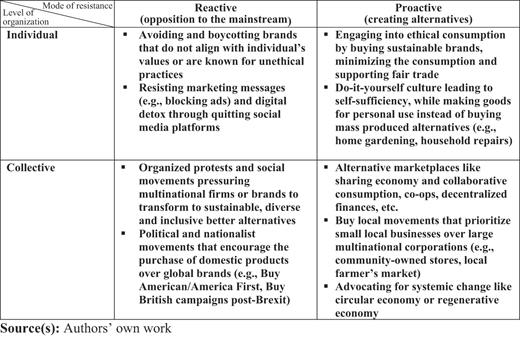
4.2 Toward integrative framework of consumer resistance in GCC
Based on the review of 110 articles that span the domain from various disciplines, we propose a contemporary conceptual framework of consumer resistance in GCC (see Figure 4). We used a structured approach in the form of ADO framework, introduced by Paul and Benito (2018), which helped us to organize our research findings. Antecedents in our model are underlying causes or motivations leading to consumer resistance in GCC. International marketing literature covers primary drivers across a spectrum from individual to collective and typically includes three categories of motivations. Identity-focused motivations stem from consumers’ desires for uniqueness or association with particular social or national groups. Conflict can arise when consumption decisions challenge these identities (Bartikowski and Cleveland, 2017; Cleveland and McCutcheon, 2022). Culture-driven motivations originate from a wish to uphold local traditions, counteract cultural standardization and guard against perceived “cultural pollution” from global influences (Riefler, 2012; Cleveland and McCutcheon, 2022). Lastly, socio-economic motivations are built on worries about economic equity, ethical labor practices, environmental sustainability and the perceived adverse effects of globalization on local economies and social frameworks (Jafari et al., 2022; Cleveland and McCutcheon, 2022).
 The framework shows a large rectangular framework divided into three main vertical sections labeled from left to right as Antecedents, Decisions, and Outcomes. The Antecedents section contains a large vertical dashed rectangle that includes the following text: 1. Psychological drivers for example, perceived risk or fear of uncertainty, perceived threat to freedom, decision fatigue, status quo bias, cognitive dissonance, lack of control, emotional decision making. 2. Cultural and social identity-based drivers for example, global-local identity, ethnocentrism, nationalism, cultural alienation, animosity, subcultural and generational identity, ideological currents, social constraints, multiplicity of overlapping cultural groupings. 3. Economic and market-based drivers for example, market monopoly, over-commercialization, behavioral pricing or dynamic adjustments or perceived overpricing and exploitation, economic inequality awareness, subscription and access-based consumption, perceived dissonance and opposition to market forces. 4. Ethical and environmental drivers for example, ethical and sustainability concerns, C S R scepticism, circular or regenerative economy mis-implementation, human or animal or political rights. 5. Technological and digital resistance drivers for example, data privacy and surveillance concerns, A I-powered personalization, automation and job displacement, metaverse and digital consumerism detox movements, I o T-driven purchasing and smart commerce scepticism. 6. Consumer empowerment and alternative lifestyle for example, voluntary simplicity or minimalism, crypto-economy and decentralized finance, collaborative consumption and sharing economy, D I Y or self-sufficiency. A rightward arrow emerges from Antecedents and points to the second section labeled Decisions, which contains three vertically arranged text boxes labeled from top to bottom as the text box at the top is labeled Rational Evaluation on the left and Emotional Evaluation on the right. A downward arrow emerges from this text box and points to another text box below labeled Motivational State of Resistance. A downward arrow emerges from Motivational State of Resistance and points to the third text box labeled Manifestations of C R that includes the following text: 1. Dimensions of consumer responses to G C C for example, marginalization, separation, (assimilation, integration). 2. Ethical or environmental or market-based C R for example, negative W O M, buycotts, boycotts, exit. 3. Cultural C R for example, counter-cultural lifestyles, reclaiming local identities, culture jamming. 4. Digital and social C R for example, hashtag movements and viral campaigns, cancel culture and online activism. 5. Legal and institutional C R for example, lobbying, consumer advocacy. 6. Economic C R for example, alternative modes of exchange, frugality. 7. Political and ideological C R for example, geopolitical conflicts leading to boycotts, protests, activism. 8. Avoidance. A rightward arrow emerges from Decisions and points to the third section labeled Outcomes. The Outcomes section contains three vertically arranged text boxes labeled from top to bottom as the first text box at the top is labeled Adoption Outcomes and includes text for example, hybrid consumption, digital commerce, brand loyalty. The second text box below is labeled Modification Outcomes and includes text for example, customization, hybrid cultural influence. The third text box at the bottom is labeled Resistance Outcomes and contains subcategories: 1. Individual consumer outcomes for example, assertion of identity, increased agency and control, personal transformation, social consequences, consumer empowerment, rise of ethical and political consumerism, materialism, attitude towards brand or firm or globalisation. 2. Brand outcomes for example, negative impact on brand equity, brand greenwashing, new brand identity development. 3. Firm outcomes for example, need for strategic adaptation, financial losses, restructuring of supply chains, product and service redesign, consumer distrust. 4. Marketing or market practices for example, market learning, potential for co-optation, market regulation, influence on ethical and sustainable consumption, market fragmentation, industry regulations and policy changes. 5. G C C outcomes for example, development of alternative markets, challenging dominant ideologies, cultural tensions, cultural hybridization or creolization, market and cultural shifts, changing social norms. A feedback loop is shown below connecting the Outcomes section back to the Antecedents section, labeled Feedback Loop to New Antecedents or Drivers with additional text below reading corporate or marketing adaptation, evolving consumer movements, policy and regulation changes, cultural reinterpretation and evolution.
Conceptual framework of consumer resistance (CR) in global consumer culture (GCC). Source: Authors’ own work
The framework shows a large rectangular framework divided into three main vertical sections labeled from left to right as Antecedents, Decisions, and Outcomes. The Antecedents section contains a large vertical dashed rectangle that includes the following text: 1. Psychological drivers for example, perceived risk or fear of uncertainty, perceived threat to freedom, decision fatigue, status quo bias, cognitive dissonance, lack of control, emotional decision making. 2. Cultural and social identity-based drivers for example, global-local identity, ethnocentrism, nationalism, cultural alienation, animosity, subcultural and generational identity, ideological currents, social constraints, multiplicity of overlapping cultural groupings. 3. Economic and market-based drivers for example, market monopoly, over-commercialization, behavioral pricing or dynamic adjustments or perceived overpricing and exploitation, economic inequality awareness, subscription and access-based consumption, perceived dissonance and opposition to market forces. 4. Ethical and environmental drivers for example, ethical and sustainability concerns, C S R scepticism, circular or regenerative economy mis-implementation, human or animal or political rights. 5. Technological and digital resistance drivers for example, data privacy and surveillance concerns, A I-powered personalization, automation and job displacement, metaverse and digital consumerism detox movements, I o T-driven purchasing and smart commerce scepticism. 6. Consumer empowerment and alternative lifestyle for example, voluntary simplicity or minimalism, crypto-economy and decentralized finance, collaborative consumption and sharing economy, D I Y or self-sufficiency. A rightward arrow emerges from Antecedents and points to the second section labeled Decisions, which contains three vertically arranged text boxes labeled from top to bottom as the text box at the top is labeled Rational Evaluation on the left and Emotional Evaluation on the right. A downward arrow emerges from this text box and points to another text box below labeled Motivational State of Resistance. A downward arrow emerges from Motivational State of Resistance and points to the third text box labeled Manifestations of C R that includes the following text: 1. Dimensions of consumer responses to G C C for example, marginalization, separation, (assimilation, integration). 2. Ethical or environmental or market-based C R for example, negative W O M, buycotts, boycotts, exit. 3. Cultural C R for example, counter-cultural lifestyles, reclaiming local identities, culture jamming. 4. Digital and social C R for example, hashtag movements and viral campaigns, cancel culture and online activism. 5. Legal and institutional C R for example, lobbying, consumer advocacy. 6. Economic C R for example, alternative modes of exchange, frugality. 7. Political and ideological C R for example, geopolitical conflicts leading to boycotts, protests, activism. 8. Avoidance. A rightward arrow emerges from Decisions and points to the third section labeled Outcomes. The Outcomes section contains three vertically arranged text boxes labeled from top to bottom as the first text box at the top is labeled Adoption Outcomes and includes text for example, hybrid consumption, digital commerce, brand loyalty. The second text box below is labeled Modification Outcomes and includes text for example, customization, hybrid cultural influence. The third text box at the bottom is labeled Resistance Outcomes and contains subcategories: 1. Individual consumer outcomes for example, assertion of identity, increased agency and control, personal transformation, social consequences, consumer empowerment, rise of ethical and political consumerism, materialism, attitude towards brand or firm or globalisation. 2. Brand outcomes for example, negative impact on brand equity, brand greenwashing, new brand identity development. 3. Firm outcomes for example, need for strategic adaptation, financial losses, restructuring of supply chains, product and service redesign, consumer distrust. 4. Marketing or market practices for example, market learning, potential for co-optation, market regulation, influence on ethical and sustainable consumption, market fragmentation, industry regulations and policy changes. 5. G C C outcomes for example, development of alternative markets, challenging dominant ideologies, cultural tensions, cultural hybridization or creolization, market and cultural shifts, changing social norms. A feedback loop is shown below connecting the Outcomes section back to the Antecedents section, labeled Feedback Loop to New Antecedents or Drivers with additional text below reading corporate or marketing adaptation, evolving consumer movements, policy and regulation changes, cultural reinterpretation and evolution.Conceptual framework of consumer resistance (CR) in global consumer culture (GCC). Source: Authors’ own work
In the intricate landscape of GCC, various factors come together to drive consumer resistance. Psychological discomforts like perceived risk and a feeling of lost control in an increasingly globalized market can spark opposition (Amine and Gicquel, 2011; Cambefort and Roux, 2019). On a deeper level, individuals navigate their identities amidst a blend of global and local influences, resulting in resistance when GCC contradicts their deeply rooted cultural and social values such as ethnocentrism, nationalism and animosity toward specific global entities (Russell et al., 2011; Bartsch et al., 2019; Cleveland and Bartsch, 2019; Cleveland and McCutcheon, 2022). This resistance is often intensified by economic concerns arising from perceived overpricing, exploitation by global corporations and a growing recognition of economic disparities exacerbated by global market dynamics (Roux, 2007; Cherrier, 2009; Chaney and Slimane, 2019; Cleveland and McCutcheon, 2022). Additionally, the growing ethical and environmental awareness prompts consumers to oppose brands and behaviors they consider unsustainable or morally objectionable (Cherrier, 2009; Cherrier et al., 2011; Cambefort and Roux, 2019). Furthermore, the prevalence of digital technologies may fuel desires for digital detox and raise worries about data privacy (Özsomer, 2019; Steenkamp, 2019; Makri et al., 2019; Nassen et al., 2023). Finally, a quest for consumer empowerment is reflected in the embrace of alternative lifestyles like voluntary simplicity and engagement in collaborative consumption models, signaling a deliberate move away from the predominant global consumerism paradigms (Roux, 2007; Cherrier et al., 2011; Małecka et al., 2022). Collectively, these diverse factors illustrate how consumers actively navigate and at times oppose the pervasive impact of GCC.
The decisions dimension focuses on the choices or strategies adopted in response to the antecedents (Paul and Benito, 2018). In our case, decisions represent the processes and the diverse ways (forms) in which consumers choose to resist within GCC. We posit that initial consumers undergo a cognitive (rational) assessment of marketplace practices, strategies or discourses, perceiving them as conflicting. This assessment elicits negative emotional responses (such as anger, distrust, frustration) that drive the motivational state of resistance (Roux, 2007). The perceived dissonance and negative emotions trigger a motivational state that leads to various forms of opposition (Cambefort and Roux, 2019). This state motivates consumers to act against market forces, expressed through tactics and behaviors we term consumer resistance manifestations or forms. Consumers demonstrate their resistance in diverse ways, from distancing themselves and excluding themselves from certain beliefs (Cleveland and Bartsch, 2019) to more active forms of opposition. Fueled by ethical and environmental concerns, consumers use negative word-of-mouth and organize boycotts against companies seen as irresponsible (Peñaloza and Price, 1993; Roux, 2007; Hoffmann, 2011; Kim et al., 2025). Culturally, resistance is expressed through adopting countercultural lifestyles, actively reasserting local identities in the era of globalization, and employing creative culture jamming strategies to disrupt mainstream consumerist messages (e.g., Cherrier, 2009; Bartsch et al., 2019; Cleveland and McCutcheon, 2022). Digital and social consumer resistance is visible in hashtag movements, viral campaigns, cancel culture and online activism, used by consumers to collectively challenge and influence corporate behaviors and societal norms (Kozinets, 2021; Vrikki and Lekakis, 2024). For example, Bouvier and Machin (2021) studied Twitter’s (now X) “cancel culture” hashtags, demonstrating both the potential and limitations of digital platforms in promoting social justice initiatives. Economically, individuals may choose alternative modes of exchange and embrace frugality as a deliberate rejection of hyperconsumption (e.g., Roux, 2007; Hoffmann, 2011; Lee et al., 2011). Political and ideological resistance emerges in response to geopolitical conflicts, leading to boycotts, protests and broader activism against perceived adversaries (Russell et al., 2011; Ulver and Laurell, 2020; Kim et al., 2025). Many of these actions are underpinned by the core choice of avoidance, where consumers intentionally opt to shun or resist the offerings and messages of GCC (e.g., Fournier, 1998; Roux, 2007; Cambefort and Roux, 2019). These various forms of resistance underscore the dynamic and often disputed interaction between GCC and individual consumer autonomy.
The outcomes category is the least explored and mostly remains at the conceptual level. First, we divide outcomes based on the possible full spectrum of consumer responses to GCC. We argue that consumer responses to GCC vary based on how individuals negotiate their identity, values and market preferences within a highly interconnected world. While some consumers embrace GCC through adoption, others seek a balance by modifying their consumption patterns, and a third group actively resists due to ethical, cultural or ideological concerns. Second, a deeper examination of resistance outcomes reveals a classification based on the target of resistance, distinguishing three perspectives: consumer outcomes (micro-level), corporate responses (mezzo-level, encompassing brand and firm-level outcomes) and market ideology/consumer culture transformation (macro-level, influencing marketing practices, market structures and the broader effects of GCC). Individuals, in their act of defiance, assert their unique identities (Cherrier et al., 2011) and reclaim a sense of agency (Chaney and Slimane, 2019), sometimes enduring social consequences for their beliefs (Cambefort and Roux, 2019), while also contributing to the growth of ethical and political consumerism (Ulver and Laurell, 2020). Brands, as the visible targets of resistance, may suffer harm to their reputation (Galvagno, 2011; Cambefort and Roux, 2019; Kim et al., 2025), leading some to engage in superficial “greenwashing” (Vangeli et al., 2023), while others are compelled to address their weaknesses and potentially establish new brand identities (Fournier, 1998; Roux, 2007; Chaney and Slimane, 2019). Companies encounter the necessity of strategic adjustments, risking financial setbacks and the need to revamp products and services as consumer trust declines (Thompson and Arsel, 2004; Bartsch et al., 2019). Marketing practices go through a learning process, contending with the risk of appropriating resistance narratives, as the call for ethical and sustainable consumption gains traction, resulting in market segmentation (Cherrier et al., 2011; de Mooij, 2019; Bartsch et al., 2019; Cleveland and McCutcheon, 2022). Ultimately, GCC faces challenges, fostering the emergence of alternative markets (e.g., Fournier, 1998; Małecka et al., 2022), revealing cultural conflicts (Bartikowski and Cleveland, 2017), leading to cultural hybridization and creolization (Cleveland and Bartsch, 2019), indicating significant market and cultural transformations and the evolution of shifting social norms (Bartsch et al., 2019) in a world increasingly aware of the influence and power of the resisting consumer. We posit that consumer resistance in GCC is a dynamic, non-static phenomenon, characterized by an ongoing feedback loop where outcomes give rise to new drivers of resistance.
5. Research agenda: key future directions
Despite the growing academic interest in consumer resistance to GCC, there are still numerous unexplored gaps. We have pinpointed gaps in the existing literature across the domains of two applied frameworks, ADO (antecedents, decisions, outcomes), and TCM (theories, contexts, methods). To guide future inquiry, we have developed a comprehensive list of potential research questions (see Table 3).
Research gaps and future research agenda for consumer resistance in GCC
| Domain | Research gap | Research question | Inspired by |
|---|---|---|---|
| A | A complete, cross-cultural comprehension of the psychological, social, institutional and other factors fueling consumer resistance in the GCC is needed | RQ1.1 What drives consumer disinterest and disidentification with both global and local consumer cultures, and how can marketers effectively engage these consumers? | Strizhakova and Coulter (2019), Steenkamp (2019), Westjohn and Magnusson (2019) |
| RQ1.2 Do the factors underlying consumer resistance to GCC vary significantly across different cultural contexts in terms of economic development, cultural values and historical globalization experiences? | Bartsch et al. (2019), Stöttinger and Penz (2019) | ||
| RQ1.3 What psychological factors, such as reactance and perceived loss of control, contribute to consumer resistance against specific aspects of GCC? | Bartikowski and Cleveland (2017), Cleveland and McCutcheon (2022) | ||
| RQ1.4 How do strong local or national identities mitigate the perceived homogenizing effects of GCC and spur consumer resistance? | Bartikowski and Cleveland (2017), Sobol et al. (2018) | ||
| RQ1.5 To what extent do nonmarket institutions, like family and religion, shape consumer resistance to GCC and its associated values? | Jafari et al. (2022) | ||
| RQ1.6 How does the integration of a global brand within a local market impact its susceptibility to country-level boycotts prompted by non-product-related issues? | Kim et al. (2025) | ||
| RQ1.7 What are the key trigger events or catalysts that can either fuel or dampen international consumer resistance movements? | Russell and Russell (2006) | ||
| RQ1.8 In what ways do collectivistic and individualistic cultural orientations influence consumer participation in collective resistance actions against GCC? | Albinsson et al. (2010) | ||
| RQ1.9 How do different moral sentiments influence the forms and intensity of consumer resistance in a market setting? | Aboelenien and Arsel (2024) | ||
| RQ1.10 How do various dimensions of consumer ethnocentrism predict different forms of consumer resistance beyond mere purchase intentions? | Bizumic (2019) | ||
| RQ1.11 How does the nature and intensity of animosity, whether war-related, economic or political, impact specific forms of consumer resistance like boycotts, negative word-of-mouth or anticonsumption? | Mishra et al. (2023) | ||
| D | The research gap is in comprehending the intricate relationship among consumer identity, social disparities, geopolitical factors and worldwide occurrences in influencing consumer resistance (manifestations) within the GCC context | RQ2.1 How do consumers balance their materialistic desires with their resistance to GCC when making consumption decisions? | Cleveland and McCutcheon (2022) |
| RQ2.2 In what ways do power dynamics and social inequalities intersect with consumer resistance to GCC, particularly in the context of perceived cultural imperialism or economic exploitation? | Lee et al. (2011), Aboelenien and Arsel (2024) | ||
| RQ2.3 How do political and economic ties between countries shape consumer resistance toward brands from those countries over an extended period? | Kim et al. (2025) | ||
| RQ2.4 How do global events such as pandemics and environmental crises intersect with existing international geopolitical tensions to influence consumer resistance behaviors? | Ulver and Laurell (2020) | ||
| RQ2.5 How do perceptions of risk related to brand resistance (performance, social, legal, physical) vary across different cultural dimensions in international markets? | Cambefort and Roux (2019) | ||
| RQ2.6 In which specific product categories or consumption contexts does patriotism most strongly translate into resistance toward foreign brands? | Mishra et al. (2023) | ||
| RQ2.7 How does the strength and significance of ethnic identity interplay with other identity factors (e.g. national identity, global identity) to mold resistance to mainstream market offerings? | Cleveland and Bartikowski (2023) | ||
| RQ2.8 How do the distinct characteristics and constraints of various social media platforms impact consumer choices in selecting platforms for engaging in different forms of consumer resistance? | Narayanan and Singh (2024) | ||
| O | The research gap lies in exploring how consumer resistance in GCC manifests in multicultural marketplaces (consumer, firm and social impact), including the behavioral, cultural, strategic and other dimensions of resistance | RQ3.1 How does consumer resistance to GCC manifest in specific consumption behaviors like boycotting global brands, supporting local alternatives or participating in anticonsumption practices? | Cleveland and McCutcheon (2022) |
| RQ3.2 How do diverse ethnic, racial and national groups within multicultural marketplaces negotiate their stance regarding GCC, and how does resistance manifest within these varied environments? | Jafari et al. (2022) | ||
| RQ3.3 What cultural conflicts and resistance points arise when GCC confronts diverse local traditions and consumption practices in multicultural settings? | Ibarra-Cantu and Cheetham (2021) | ||
| RQ3.4 How can marketers adjust their strategies in multicultural marketplaces to address potential consumer resistance toward globalized offerings and resonate with diverse cultural beliefs? | Bartsch et al. (2019) | ||
| RQ3.5 What specific communication strategies can global brands employ to mitigate the adverse effects of international boycotts, considering varying levels of country affinity and animosity? | Kim et al. (2025) | ||
| RQ3.6 What are the repercussions and lasting effects when companies opt to stay silent or inactive in response to consumer activism and resistance movements? | Narayanan and Singh (2024) | ||
| T | The research gap exists in enhancing theoretical models of consumer resistance in the GCC through the fusion of modern concepts to gain a deeper insight into the dynamic relationship among resistance, identity and globalization within various market settings | RQ4.1 How can the market ownership concept (territorial activism as an emerging form of consumer resistance) be further advanced and applied to better comprehend conflicts and dynamics in various market contexts, particularly beyond stigmatized markets? | Sandikci et al. (2024) |
| RQ4.2 How do different communication frames used by activist groups (beyond NGOs) shape consumer mobilization and possibly create conflicts that impede effective resistance? | Varman et al. (2024) | ||
| RQ4.3 How do various aspects of national and sub-national consumer identities (such as ethnic identity, regional identity) interact with individual motivations for consumer resistance (e.g., ideological discrepancies, perceived risk) in influencing responses to global brands and marketing practices within the GCC context? | Bartsch et al. (2019), Cleveland and Bartikowski (2023) | ||
| RQ4.4 Integrating social identity theory and the concept of “antiglobalscapes,” how do consumers with strong ethnic or national identities respond to global brands that threaten their in-group’s positive distinctiveness across different “globalscapes” (such as ethnoscapes, mediascapes, technoscapes, finanscapes and ideoscapes)? | Cleveland and McCutcheon (2022) | ||
| C | The research gap is in grasping how varied consumer segments, especially in underrepresented and growing markets, tackle, adjust to and resist GCC | RQ5.1 How do local consumer cultures choose, modify and reject aspects of GCC in specific product categories and consumption settings? | Cleveland and Bartsch (2019) |
| RQ5.2 How do consumers in bottom-of-pyramid markets perceive and engage with GCC, and what distinct forms of participation or resistance do they exhibit? | Strizhakova and Coulter (2019), Özsomer (2019) | ||
| RQ5.3 What are the differences in resistance to GCC between ethnic minority and majority consumers, and how are these variances influenced by their acculturation journeys and identity orientations? | Bartikowski et al. (2016) | ||
| RQ5.4 How do immigrant consumers balance their interaction with GCC while preserving their heritage and potentially resisting perceived challenges to their cultural identity? | Ibarra-Cantu and Cheetham (2021) | ||
| RQ5.5 How do cultural norms and ideologies in less represented regions of the Global South and Eastern Europe impact consumer motivations and behaviors regarding consumer resistance? | Narayanan and Singh (2024) | ||
| RQ5.6 How do cultural values and norms in different countries impact the effectiveness of consumer boycotts against global brands? | Albinsson et al. (2010) | ||
| RQ5.7 What influence do local interpretations of global ideologies (e.g., environmentalism, anticorporatism) have on the forms of consumer resistance across diverse international markets? | Ulver and Laurell (2020) | ||
| RQ5.8 How do generational differences, particularly the perspectives of Gen Z and Gen Alpha as digital natives, influence their engagement with and views on various types of consumer activism and resistance? | Atanga and Mattila (2023), Narayanan and Singh (2024), Cummings et al. (2025) | ||
| M | There is a need to develop and enhance longitudinal, culturally sensitive and methodologically diverse strategies to accurately portray the changing landscape of consumer resistance in the GCC within various contexts, identities and measurement systems | RQ6.1 How can longitudinal research designs be utilized to gain a better understanding of the prolonged development of consumer resistance and its implications on global and local markets? | Sobol et al. (2018), Cleveland and Bartsch (2019), Steenkamp (2019) |
| RQ6.2 What are the most effective quantitative and qualitative methodological approaches for investigating the dynamic interplay between consumer resistance, GCC and local consumer cultures in diverse cultural settings? | Strizhakova and Coulter (2019), Bizumic (2019), Okazaki et al. (2019) | ||
| RQ6.3 How can researchers create more culturally sensitive and contextually relevant metrics for consumer resistance, consumer ethnocentrism, cosmopolitanism and associated constructs that consider potential variations based on product category, cultural setting and individual backgrounds? | Bartsch et al. (2019), Samiee (2019), Mandler (2019), Jafari et al. (2022) | ||
| RQ6.4 In what ways can network analysis or other advanced statistical techniques help in depicting the intricate connections among various consumer identities, attitudes and resistance behaviors? | Cleveland and Bartsch (2019), Mandler (2019), Stöttinger and Penz (2019), Steenkamp (2019) | ||
| RQ6.5 How can qualitative methodologies offer deeper insights into the real-life experiences and stories of consumers who actively resist GCC, and what diverse manifestations does this resistance encompass? | Cleveland and McCutcheon (2022) | ||
| RQ6.6 What approaches can be employed to develop reliable and contextually appropriate scales for assessing fundamental concepts in the realm of consumer resistance to GCC? | Narayanan and Singh (2024) |
Note(s): A = antecedents, D = decisions, O = outcomes, T = theories, C = contexts, M = methods
Source(s): Authors’ own work
When it comes to antecedents, a significant gap exists in fully understanding the psychological, social and institutional factors that drive consumer resistance in the GCC across different cultures. Existing literature has mainly focused on Western perspectives, viewing resistance as a reactive and homogeneous phenomenon (Thompson et al., 2006; Kozinets and Handelman, 2004; Izberk-Bilgin, 2010; Ulver and Laurell, 2020), thus overlooking the intricate and context-specific aspects of consumer disengagement and opposition (e.g., Bartsch et al., 2019; Strizhakova and Coulter, 2019). The proposed research questions aim to fill this void by examining disinterest and disidentification (RQ1.1), as well as investigating how cultural, economic and historical elements influence resistance in various regions (RQ1.2). By doing so, it builds upon previous research in cross-cultural consumer psychology and global branding. A key rationale for this research agenda is to comprehend how psychological processes like perceived loss of autonomy and reactance (RQ1.3), often studied through psychological reactance theory (Brehm, 1966), underpin individual-level resistance. Additionally, the impact of identity—be it national, ethnic or religious—in the face of the GCC’s homogenizing effect (RQ1.4, RQ1.5), remains inadequately explored, making social identity theory (Tajfel and Turner, 1986) and institutional theory (Scott, 2008) promising frameworks for further exploration. Furthermore, the complexities and dynamics of consumer resistance concerning global brand positioning (RQ1.6), external stimuli (RQ1.7) and broader cultural orientations (RQ1.8) emphasize the necessity of integrating macro-sociological perspectives like world-systems theory (Wallerstein, 1990) and cultural dimensions theory (Hofstede, 2001). Finally, delving into moral emotions (RQ1.9), consumer ethnocentrism (RQ1.10) and animosity (RQ1.11) could benefit from insights from moral psychology (Haidt, 2007) and conflict theory (Oberschall, 1978), offering a more comprehensive understanding of consumer resistance behaviors. Overall, this proposed research agenda encourages scholars to move away from transactional or simplistic behavioral models toward a culturally ingrained and psychologically sophisticated conceptualization of consumer resistance in global settings.
Consumer resistance in GCC is not solely a result of individual attitudes toward consumption; instead, it is influenced by a complex interplay of factors including identity, structural inequalities, geopolitical realities and global crises. While existing studies have mainly focused on consumer resistance through the lenses of anticonsumption (Cherrier, 2009; Lee et al., 2011) and cultural identity (Askegaard and Linnet, 2011), there is a significant gap in understanding how broader socio-political and economic forces impact the expressions of resistance. In particular, consumers often face a conflict between their material aspirations and their ideological opposition to global capitalism (RQ2.1), a dilemma that can be explored through identity theory (Oyserman, 2009) and Bourdieu’s habitus and capital theory (Bourdieu, 1984). Moreover, consumer resistance is intricately linked to power dynamics—social disparities and perceptions of cultural dominance influence resistance behaviors (Aboelenien and Arsel, 2024), especially in postcolonial and economically marginalized markets (RQ2.2). Theories such as cultural hegemony (Gramsci, 1971) and postcolonial theory (Said, 1978) provide valuable perspectives in these contexts. Geopolitical and historical factors further complicate how brands are received globally (RQ2.3), often turning consumption into a form of political statement (Klein, 1999). The COVID-19 pandemic and ongoing environmental challenges have increased focus on national self-sufficiency and global interconnectedness, which either reinforce or reshape resistance behaviors in politically charged environments (RQ2.4) (Ulver and Laurell, 2020). Additionally, perceived risks—social, legal or psychological—vary across cultures, influencing the nature and timing of consumer resistance (RQ2.5), an area ripe for exploration using Hofstede’s cultural dimensions theory (Hofstede, 2001). Different forms of identity—such as ethnic, national or global—intersect in ways that affect certain product categories like food, clothing or technology, making them more susceptible to resistance (RQ2.6–RQ2.7), underscoring the need for intersectional identity frameworks (Crenshaw, 1989). Lastly, with social media serving as a pivotal platform for mobilization (Narayanan and Singh, 2024), understanding how various platforms influence modes of resistance (RQ2.8) necessitates the integration of media affordance theory (Treem and Leonardi, 2013) into consumer research. This holistic, interdisciplinary approach provides a richer, context-sensitive understanding of consumer resistance in the era of globalized consumption.
In increasingly multicultural marketplaces, consumer resistance to GCC presents a multifaceted challenge that goes beyond cultural boundaries. While past studies have recognized consumer resistance as a reaction to perceived cultural uniformity or market dominance (Kozinets and Handelman, 2004; Thompson and Arsel, 2004; Chaney and Slimane, 2019), the specific ways in which this resistance varies among diverse ethnic, racial and national consumer groups remain largely unexplored. Future research should delve into how behaviors like boycotting brands, favoring local alternatives and participating in anticonsumption movements (RQ3.1) are influenced by identity politics and cultural affiliations in multicultural environments (RQ3.2), where theories of marketplace multiculturalism (Peñaloza, 1994) and cultural hybridity (Bhabha, 1994) offer valuable insights. Resistance often emerges when GCC offerings clash with entrenched local consumption customs or religious norms (RQ3.3) (Ibarra-Cantu and Cheetham, 2021), underscoring the importance of examining cultural discord through the lens of acculturation theory (Berry, 1997). Marketers face strategic challenges in aligning global branding strategies with culturally relevant messages and inclusive value propositions (RQ3.4), which can be assessed using institutional theory to gauge firms’ responsiveness to normative pressures worldwide (Scott, 2008). Additionally, the effectiveness of global communication strategies in times of consumer activism, particularly during boycotts, depends on the interplay of national sentiment, hostility and brand positioning (RQ3.5), guided by country-of-origin theory (Verlegh and Steenkamp, 1999). Choices to either engage or remain silent amidst politically or ethically charged resistance movements can lead to reputational damage or consumer alienation (RQ3.6), warranting a closer investigation into the lasting effects of corporate actions or inactions in global consumer contexts (Narayanan and Singh, 2024). These research questions contribute to the advancement of a holistic understanding of resistance in multicultural markets and suggest a pathway for developing more culturally sensitive and responsive global marketing strategies.
To enhance the theoretical comprehension of consumer resistance in GCC, forthcoming studies should blend modern concepts with foundational resistance theories to tackle the intricate interaction among resistance, identity and globalization across various market landscapes. Current models often categorize resistance as either reactive or ideological (Kozinets and Handelman, 2004; Thompson and Arsel, 2004); however, they insufficiently consider the dynamic manifestations of consumer resistance in territorial, identity-based or digitally-mediated settings. One encouraging path involves expanding the concept of “market ownership” framework (Varman and Belk, 2009), where consumers partake in territorial activism to assert local market sovereignty—a concept extendable from stigmatized or marginalized markets to mainstream consumer domains (RQ4.1) (Sandikci et al., 2024). Additionally, fresh research should explore the impact of activist communication framing—not solely by NGOs but also by decentralized or informal resistance groups—in mobilizing consumers or inciting internal divisions within resistance movements (RQ4.2) (Varman et al., 2024), by drawing from framing theory (Goffman, 1974) and narrative persuasion (Green and Brock, 2000). Moreover, merging insights from social identity theory (Tajfel and Turner, 1986) with emerging viewpoints on “antiglobalscapes” (Appadurai, 1996; Ritzer, 2003; Cleveland and McCutcheon, 2022) could elucidate how layered identities—ethnic, regional or ideological—interact with individual incentives for resistance (RQ4.3), notably when global branding practices are viewed as threats to identity. Exploring how resistance is sparked in diverse globalscapes (e.g., mediascapes, technoscapes) (RQ4.4) will permit a more context-aware and detailed conceptualization of GCC resistance. This direction not only unifies theoretical disparities in present consumer resistance literature but also advances international marketing strategies tailored to cultural diversity and identity dynamics in global markets.
Despite the extensive research on consumer resistance within Western or economically mature markets, there remains a significant gap in understanding how diverse consumer segments, especially in underrepresented and emerging markets, navigate their responses to globalized consumption forces. Existing literature has mainly focused on those regions (Thompson et al., 2006; Sandikci and Ger, 2010; Strizhakova and Coulter, 2019), overlooking how consumers in the Global South, bottom-of-the-pyramid contexts and post-socialist economies engage with or adapt to GCC. Future studies should investigate how local cultures selectively embrace, reject or blend global consumption practices (RQ5.1), taking into account contextual variations across different product categories and socio-economic contexts (Cayla and Eckhardt, 2008). Empirical research has largely focused on regions or cultures with higher levels of consumer resistance, often neglecting other parts of the world. For example, political consumption in Europe varies by region, with significantly higher levels in Northern and Western countries compared to Southern and Eastern regions (Niva and Jallinoja, 2018). A comparative analysis across regions and cultures could highlight cultural-specific factors that influence consumer resistance in the GCC context. Analyzing how consumers in resource-constrained settings interact with or resist GCC (RQ5.2) requires integrating subsistence marketplace theory (Viswanathan, 2007) and culturally embedded acculturation frameworks (Peñaloza, 1994). Additionally, understanding the dynamics between ethnic minority and majority consumers (RQ5.3), as well as how immigrant groups navigate identity preservation and resistance (RQ5.4), can be enhanced by utilizing intersectionality and identity negotiation theory (Askegaard et al., 2005). The ideological foundations of cultural norms in less explored markets such as Eastern Europe or parts of the Global South (RQ5.5–RQ5.7) demand further investigation, especially as local interpretations of global ideologies like environmentalism impact resistance in unique ways (Üstüner and Holt, 2010). Lastly, the evolving attitudes among younger generations, particularly digital natives in Gen Z and Gen Alpha, present important considerations regarding the evolution of resistance in an era characterized by hyperconnectivity, social media activism and increased scrutiny of global brands (RQ5.8) (Atanga and Mattila, 2023). Exploring these dynamics not only diversifies the conceptualization of consumer resistance but also enables international marketers to engage more effectively and ethically with diverse consumer landscapes.
A comprehensive understanding of consumer resistance in GCC requires the development of longitudinal, culturally attuned and methodologically varied research approaches capable of accommodating changing identities, behaviors and market dynamics. There is a scarcity of empirical studies investigating the correlation between consumer resistance and the GCC, especially concerning particular types of resistance like prominent or systemic change-induced resistance, which are hardly studied empirically. Additionally, there is a noticeable absence of studies that empirically compare different types of consumer resistance, including individual versus collective, passive versus reactive or different levels such as micro, mezzo and macro levels. Such comparisons could reveal patterns and distinct motivators of resistance, along with the efficacy and temporal dynamics of various resistance strategies. Current literature frequently relies on cross-sectional studies and limited cultural contexts, which do not capture the fluid nature and temporal evolution of resistance (Cherrier et al., 2011; Askegaard and Linnet, 2011; Cleveland and Bartsch, 2019). Addressing the identified gap, future research should prioritize conducting longitudinal studies (RQ6.1) to track the development of resistance over time, especially in response to global changes like political unrest, pandemics and technological advancements. Furthermore, incorporating mixed-methods and cross-cultural comparative approaches (RQ6.2) can reveal the intricate interplay between local cultural values and the pressures of global consumption. Established theoretical frameworks like CCT (Arnould and Thompson, 2005) and Social Identity Theory provide a solid basis for such investigations, especially when combined with measurement tools sensitive to different contexts. The establishment of culturally appropriate measures for concepts such as ethnocentrism, cosmopolitanism and resistance (RQ6.3, RQ6.6) is crucial for minimizing cultural biases and improving construct validity (Bartsch et al., 2019; Narayanan and Singh, 2024; Steenkamp and de Jong, 2010). Moreover, employing sophisticated methods like social network analysis and cluster modeling (RQ6.4) can shed light on the connections between identity markers, exposure to media and resistance behaviors within consumer communities. While numerous studies on consumer resistance and GCC are theoretical, empirical studies are predominantly quantitative. Qualitative methodologies could offer deeper insights into the reasons behind consumer resistance, explore alternative forms of resistance beyond mere boycotts (e.g., passive resistance), capture the cultural and social dynamics at play, and reconcile apparent contradictions—such as why consumers who resist certain aspects of GCC still engage in consumption in other areas. Qualitative tools like narrative inquiry or ethnography (RQ6.5) are valuable for capturing the actual experiences and symbolic aspects of resistance, adding to a more comprehensive and inclusive comprehension of consumer behaviors in the global market. These combined approaches lay a foundation for a more dynamic, precise and culturally informed depiction of resistance across various time periods and cultural contexts.
6. Discussion
6.1 Theoretical implications
This study enhances existing literature by presenting an innovative conceptual perspective on consumer resistance, delineating it across micro, meso and macro levels while differentiating between passive and active behaviors. Past studies predominantly focused on individual actions like boycotts or brand avoidance (Cherrier, 2009; Lee et al., 2009), overlooking the broader community-level activism and institutional outcomes. By incorporating systemic factors, as suggested by Eteokleous et al. (2016), and proposing a multilevel conceptual framework, our research broadens the understanding of consumer resistance, particularly in global markets (Thompson and Arsel, 2004) and the GCC (Steenkamp, 2019). Introducing a new typology that connects consumer resistance with underlying consumer dispositions (e.g., Bartsch et al., 2016; Cleveland and Bartikowski, 2023; Salomão et al., 2022), our work encourages scholars to view resistance not as a uniform concept but as a spectrum of responses influenced by diverse personal and cultural orientations toward global and local products. Moreover, our study adds to acculturation theory by demonstrating that consumer resistance in the GCC extends beyond mere separation and marginalization.
Our research confirms and broadens existing studies on resistance driven by identity in worldwide marketplaces. While prior research by Cleveland et al. (2011, 2016) and Strizhakova and Coulter (2019) highlights conflicts between local identity and global brand narratives, our analysis shows how these conflicts are influenced by factors such as socio-economic status, geopolitical backgrounds and perceptions of cultural marginalization. This supports Cayla and Eckhardt’s (2008) argument that global branding can perpetuate power imbalances. Additionally, our framework builds upon and elaborates on the work of Cherrier (2009) and Ulver and Laurell (2020), who underscore uncertainties in global consumption, by presenting a methodical classification of resistance actions rooted in various identity stances and cultural perspectives. Thus, the conceptual framework not only questions Western-centric assumptions in existing literature (Peñaloza and Gilly, 1999) but also emphasizes the diverse cultural viewpoints within the GCC.
The identified theoretical fragmentation within consumer resistance literature underscores the pressing necessity for constructing theories that encompass cross-cultural dynamics and contemporary sociological ideas. While past research has utilized CCT to elucidate resistance (Askegaard and Linnet, 2011), few have considered longitudinal dynamics or intersecting identities. Our analysis reveals a scarcity of studies from marginalized markets and highlights the potential of merging institutional theory and glocalization to comprehend adaptive resistance behaviors (Cayla and Peñaloza, 2012; Bartsch et al., 2019). Future research should create culturally more attuned constructs and measurements, addressing the constraints in generalizability present in previous Western-centric studies (Steenkamp and de Jong, 2010). Our results underscore the necessity for dynamic, process-driven models, echoing recent calls for temporal and contextual sensitivity in international marketing theory (Steenkamp, 2019). Furthermore, the recognition of emerging forms of resistance—like digital activism and glocal brand boycotts—implies the field must broaden its theoretical framework following our novel conceptualization of consumer resistance in GCC to more effectively capture the ongoing evolution of resistance in global markets.
6.2 Managerial implications
The classification of resistance behaviors, as proposed in this study, provides marketers with a valuable tool to predict resistance patterns in culturally diverse markets. This can serve as a strategic tool to segment and engage with consumers who may resist global brands. For instance, identifying moral/ethical resistance enables firms to address CSR concerns more proactively, while grasping identity-based resistance can guide more culturally sensitive brand positioning. Previous research has shown that consumers in emerging or culturally sensitive markets often push back against globalization due to perceived cultural imperialism (Strizhakova et al., 2008; Steenkamp and de Jong, 2010). Our research supports this idea and offers practical insights by distinguishing between passive disidentification and active opposition. It is recommended that brands steer clear of applying standardized strategies across diverse markets, as this may worsen resistance instead of alleviating it. This echoes the importance of better cultural alignment and adaptive strategies in international marketing (Pfajfar et al., 2024). While earlier studies (e.g., Rindfleisch et al., 2009; Sandlin and Callahan, 2009) have indicated that resistance is often emotional and unpredictable, our framework reveals that resistance is frequently rooted in identity, values, ideologies and perceived harm. This is consistent with the findings of other researchers (e.g., Neureiter and Bhattacharya, 2021; Kim et al., 2025) who have shown how notions of injustice and moral concerns drive consumer boycotts. Managers are advised to develop segmentation strategies that include not only demographics but also cultural and ideological resistance profiles. Understanding the underlying reasons for consumer resistance enables brands to tailor their responses accordingly—ranging from transparent communication to structural changes in sourcing or production methods—that align with the specific nature of the resistance encountered.
Research findings on resistance based on identity and culture highlight the dangers of using universal marketing messages and support the idea that cultural mismatch can decrease brand value (Özsomer, 2012; Strizhakova and Coulter, 2015). Our research takes this further, revealing that resistance often manifests as a proactive form of asserting culture rather than mere refusal. Brands should, therefore, focus on involving communities in localized storytelling and co-creation, following suggestions by Varman and Belk (2009), emphasizing the importance of authenticity in international marketing. Recommendations by Vredenburg et al. (2020) stress that brands should only take on activist stances based on genuine cultural understanding and dialogue with stakeholders. In diverse markets, success does not just come from adapting content to local contexts but also from allowing local stories to influence brand perception.
Given the dynamic, ever-changing nature of resistance, businesses should go beyond reactive approaches and create proactive monitoring tools to capture emerging sentiments. Our research challenges traditional models that view resistance as sporadic or triggered by specific events (Kozinets and Handelman, 2004). Instead, resistance may develop in parallel with cultural, political or economic shifts, particularly among Gen Z and younger consumers who demonstrate heightened online awareness and activism (Kizgin et al., 2018; Cummings et al., 2025). While previous studies have emphasized the significance of environmental monitoring (Craig and Douglas, 2006), limited attention has been given to how companies should react to resistance deeply rooted in culture. Our research encourages brands to view resistance not solely as a threat to their reputation, but as an opportunity for innovation and engagement. Building on recommendations from Laroche et al. (2005), Izberk-Bilgin (2010) and Kim et al. (2025), brands can turn resistance into strategic insights by engaging with critical feedback as part of a cultural conversation, rather than merely a crisis to manage. By incorporating longitudinal data and digital ethnographic insights into marketing strategies, firms can better predict potential pushback and evolve toward more inclusive and responsive offerings in the GCC.
7. Conclusion
This conceptual article presents a fresh perspective on consumer resistance in the GCC by integrating various research areas to develop a unified framework. It contributes theoretically by connecting consumer behavior, international marketing, cultural studies, sociology and psychology to offer a comprehensive understanding of the motivators, manifestations and consequences of consumer resistance across individual, company and societal scales. This holistic approach enriches scholarly discussions and introduces new research opportunities in the realm of consumer resistance in the GCC.
Based on the findings, practical implications exist for international marketers, brand managers and policymakers. A deep understanding of modern consumer resistance empowers companies to craft international marketing strategies that truly reflect consumer issues, promoting ethical and sustainable business practices. As consumer resistance grows more proactive, policymakers should recognize these changes and drive systemic transformations, whereas brands that genuinely respond to consumer worries could ensure sustained longevity and a competitive edge.
Returning to the introductory quote, consumer resistance in the GCC paradoxically strengthens the very system it aims to oppose. Practices such as ethical consumption and boycotts become absorbed and rebranded within capitalism, giving the illusion of rebellion. Individuals may feel morally righteous while still being deeply embedded in the cycle of consumerism. Therefore, genuine resistance necessitates going beyond market-driven gestures toward systemic transformation, engaging critically with the inherent contradictions that uphold global capitalism. The central query remains: how can consumers navigate the illusion of resistance in the GCC, and to what degree can their efforts effectively challenge the structural underpinnings of capitalism?
Funding: The authors acknowledge the funding from the Slovenian Research and Innovation Agency (No. P5-0177).

