The purpose of this article is to identify the predominant modes to realize corporate-startup engagement (CSE).
We carried out a systematic literature review to synthesize how startups and corporations collaborate in this form of innovation.
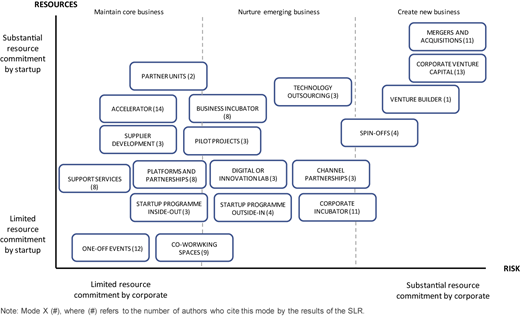
The authors found 19 CSE modes, which range from modes that involve less risk and are simpler to those that involve more risk and are more complex.
The findings consolidate the state of the art on the modes of CSE. It can help scholars drive novel research departing from consolidated findings, and practitioners can understand how collaboration between corporations and startups takes place and anticipate future challenges.
Introduction
The role of corporate innovation is growing rapidly for the discovery of new businesses and markets (Docherty, 2015). However, this challenge needs to be balanced against the organization’s resource limitations (Freeman & Engel, 2007). In recent years, collaboration with partners has become an especially important aspect of innovation strategies (e.g. Weiblen & Chesbrough, 2015; Innovation Leader, 2021; Gutmann & Lang, 2022). Under a mutually beneficial relationship, startups and corporations can gain unique advantages, making corporate-startup engagement (CSE) a recent research focus.
Some companies, alert to disruption, seek innovations to remain competitive, enter new markets, manage talent mobility and access faster technological knowledge (Younis, Desai, & Sigal, 2016). Startups, on the other hand, bring new talent, agility, risk tolerance and digitization power but lack the resources, brand credibility and market access of large companies (Grando, 2016).
In other times, large companies aroused the interest of the market. This disposition began to change to a search for businesses with more aggressive growth, migrating markets to startups (Imaginaik & Masschallenge, 2016), hence the need for established companies to become more entrepreneurial and internalize the power of disruption instead of fighting it (Sudati, 2016; Corvello, Steiber, & Alänge, 2023).
Despite practical interest (Mocker, Bielli, & Haley, 2015; Bonzom & Netessine, 2016), there is still little scientific evidence regarding the breadth and importance of the theme (Giglio, Corvello, Coniglio, Kraus, & Gast, 2023). It remains unclear how large established companies organize for systematic engagements to enhance open innovation and improve innovation management (KPMG, 2014; Bagno, Salerno, Souza Junior, & O’Connor, 2020; De Groote and Backmann, 2020). This study aims to identify modes of CSE, as existing research lacks a comprehensive synthesis of key findings.
The literature describes traditional modes of CSE (e.g. Weiblen & Chesbrough, 2015; Kohler, 2016; Brigl, Gross-Selbeck, Dehnert, Schmieg, & Simon, 2019). However, in addition to traditional engagement modes, large companies have developed programs offering varied support levels for startups (Carvalho, 2019). This shift has led to numerous engagement modes, enabling companies to engage with more startups and gain greater scope and agility (Yrttimaa, 2021; Ching & Caetano, 2021). However, the abundance of options can cause the “paradox of choice” (Schwartz, 2014), leading to decision paralysis or a “fear of missing out” (FOMO). This study aims to address the gap by synthesizing collaboration modes and their theoretical and practical implications.
Collaboration is challenging due to the divergent interests and inequalities among actors (Varesco Kager, Sparr, & Grote, 2022). Many interaction mechanisms fail to demonstrate value to the core business because they are uncommon and poorly understood. Consequently, there is limited knowledge on executing engagements and understanding this relationship, making the benefits often unclear (Bannerjee, Bielli, & Haley, 2016; Giglio et al., 2023).
The paper contributes to the discourse on corporate entrepreneurship and new ventures. To identify the state of the art on CSE, we conducted a systematic literature review (SLR) to provide a comprehensive overview of how CSE is performed and its main modes. This will solidify the scientific theory behind the topic and offer practitioners insights for designing strategies that benefit both academics and practitioners in implementing CSE.
The article begins by introducing the theoretical background and continues with a description of the chosen methodology and the results found, highlighting the modes of CSE. The article goes on with a discussion of the main findings and their theoretical implications and managerial contributions. Finally, we present the limitations of the research and offer suggestions for future research.
Theoretical background
This section will present CSE, including its theoretical framework, critical points for this study and the research hypotheses.
New ventures and CSE
Since the 1970s, new ventures, often funded by venture capital, have been a major source of business innovation (Burgelman, 1983). Many leading companies today were once venture capital-financed startups (Freeman & Engel, 2007). Corporate venture capital programs can be integral to a firm’s innovation strategy. To this day, corporate venture capitalists significantly impact groundbreaking opportunities (Rossi, Festa, Papa, & Scorrano, 2019).
Large companies face significant uncertainty due to unpredictable changes and external events, often driven by the rise of startups. This creates a highly dynamic and less controllable market for organizations (Anthony, Gilbert, & Johnson, 2017; Soni, 2018; Prashantham & Madhok, 2023). This has led to the need for new business models and revenue streams. Large companies excel at incremental innovation with existing technology but are often resistant to disruptive technologies that render their current competencies obsolete – technologies increasingly demonstrated by startups (Kohler, 2016; Heratri & Klang, 2019).
In that way, sustainable long-term innovation relies on a supportive ecosystem (Viki, Toma, & Gons, 2017). Companies that balance “exploitation” and “exploration” effectively leverage their competencies to innovate and improve efficiency (March, 1991; Tushman and O’Reilly, 1996). After the open innovation paradigm (Chesbrough, 2003), innovating internally is not enough. Today, startups are increasingly driving innovation (Docherty, 2015; Imaginaik & MassChallenge, 2016).
Thus, organizations need to focus on creating new businesses to take a step to growth, where you can engage and leverage the entrepreneurial ecosystem to co-create new businesses (Docherty, 2015; Hogenhuis, Van Den Hende, & Hultink, 2016; Yrttimaa, 2021). Therefore, a particular interaction emerges between large companies and startups commonly known as CSE – formal efforts implemented by established companies to engage with entrepreneurial startups (Weiblen & Chesbrough, 2015; Kitsuta, 2021).
CSE as an open innovation strategy
The interaction between large companies and startups as an open innovation strategy has intensified significantly in the last decade (Thieme, 2017; Jucá & Alves, 2022). This approach is viewed as a management practice to institutionalize entrepreneurship and implement a continuous innovation strategy (Sudati, 2016). Since 2015, surveys on CSE have emerged, with large companies increasingly seeking new interaction models for co-creating innovations.
Weiblen and Chesbrough (2015) follow the perspective of the combination of entrepreneurial activity and corporate capacity. Kohler (2016) understands that corporations want to embrace an open innovation strategy, increasingly looking to startups as a source of external innovation. Bonzom and Netessine (2016) investigate the world’s largest public companies and their practices on corporate engagement with startups. To distinguish from the term corporate venturing and to absorb the new modalities of relationships between large companies and startups, CSE emerges as a new value offering strategy (Gutmann & Lang, 2022).
Open innovation offers many opportunities for interaction, providing mutual benefits to the typically separate worlds of corporations and startups (World Economic Forum, 2018). Engagement programs are rapidly growing in relevance (Rundquist & Österling, 2018). However, scholars define various types of corporate commitments differently, lacking unified titles, definitions and descriptions for each model (Thieme, 2017). Although combining entrepreneurial activity with corporate capability is promising, it can be challenging to achieve (Pisoni, Giovannoni, & Onetti, 2022). Companies need to systematically approach these innovation partnerships rather than relying on individual initiatives (Mocker et al., 2015; Steiber, Alänge, & Corvello, 2021).
Based on this, the authors hypothesize that:
The increasingly volatile and uncertain market dynamics have brought corporations and startups closer together.
The various modes of CSE are not consolidated, and this makes it difficult for corporations and startups to make decisions about how to collaborate.
Data and method
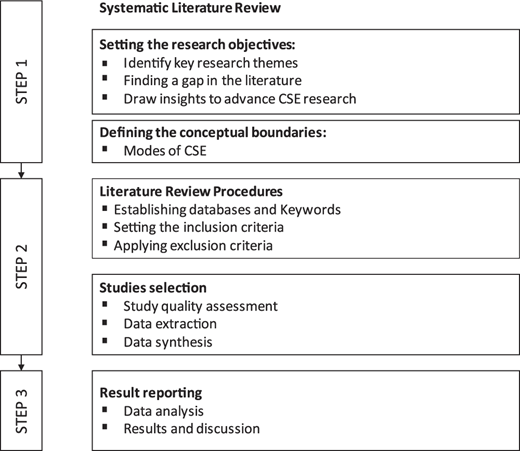
This section outlines the research steps and methodology, including the strategy, design, methods and structural basis, as shown in Figure 1.
Literature review procedures
An SLR was conducted using the literature grounded theory approach proposed by Ermelo, Lacerda, Morandi and Gauss (2021) for its scientific rigor and transparency (Tranfield, Denyer, & Smart, 2003). This study utilized selected methods and instruments to identify literature on corporate-startup collaboration and related issues, supporting the research discussion.
Web of Science and Scopus were selected as bibliometric databases to extract metadata. The sample includes academic journal articles published electronically until August 2023. All selected papers underwent a filtering process and met inclusion criteria. Additionally, we incorporated gray literature, such as e-books and consultancy reports, recognizing that CSE is both an academic and practical topic. Including both academic and gray literature was essential for a comprehensive understanding of the phenomenon (see Table 1).
The search used the following strings (TITLE-ABS-KEY): (1) corporate; (2) startup; (3) “corporate–startup engagement” and (4) “corporate ventur*.” For each database, we tested the number of entries for each keyword, compiled the results and organized them into a database using Sente and Mendeley. Boolean operators “and” and “or” were used to refine the results.
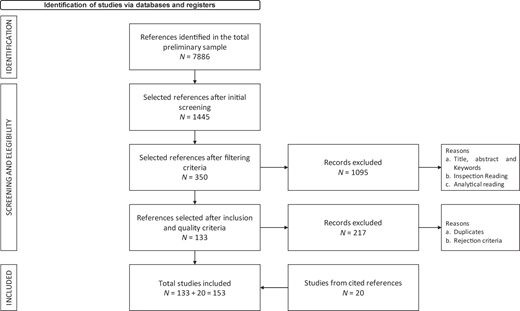
In the preliminary sample, 7,886 papers were retrieved. After initial screening, 1,445 papers were selected. Further filtering based on keyword heuristics, title, abstract, inspection and analytical reading narrowed the sample to 350 papers. Applying quality and inclusion criteria reduced this to 122 papers, with duplicates removed. After analyzing the selected papers and their citations, 20 additional papers were included. The total number of papers used for the working literature and qualitative synthesis is 153 (see Figure 2).
Data analysis followed standard content analysis procedures (Krippendorff, 2004). Selected papers were reviewed, and relevant snippets mentioning CSE modes were extracted using MAXQDA. The software recorded page numbers and references. Snippets were categorized by source and theme, creating a crossover table of CSE modes mentioned by each source.
Results
The results section will present the analysis of the literature and the main modes for corporations and startups to engage, from the SLR findings.
Systematic results on CSE
CSE programs are formal efforts implemented by established companies to engage with entrepreneurial startups (Kitsuta & Quadros, 2018). Typically, companies use multiple approaches simultaneously, regardless of whether the focus is on strategic or financial goals (Bagno et al., 2020).
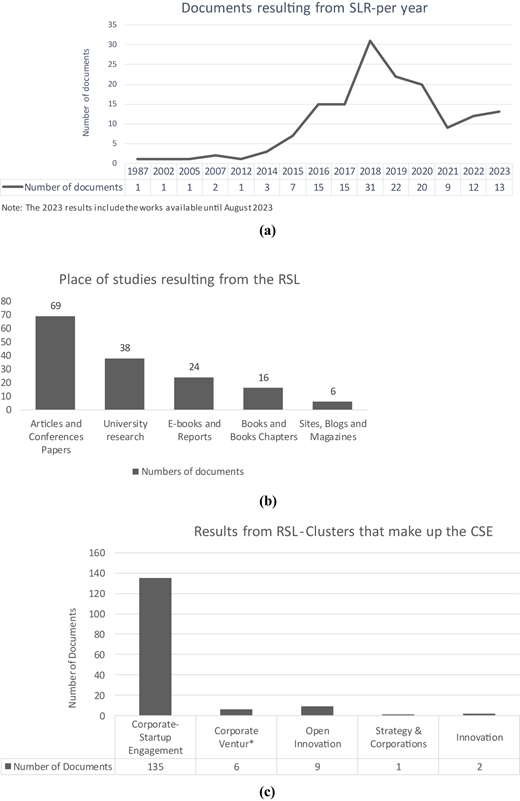
The SLR practice requires analysis to better visualize the results. Figure 3 shows some of these findings from the systematic search.
The most notable work on CSE is Weiblen and Chesbrough (2015). However, prior studies on the theoretical framework of CSE existed, with a significant increase in research after 2015, as shown in Figure 3, Graphic A. Contributions from private companies and consultancies have also been crucial in developing the CSE topic. Moreover, research has advanced beyond gray literature, as shown in Figure 3, Graphic B. While there is growing work and author involvement, studies remain fragmented with limited connections.
For this reason, we clustered the works based on their similarities, as shown in Figure 3, Graphic C. The “corporate-startup engagement” cluster includes studies on programs, modes, success factors and governance. The “corporate ventur*” cluster covers general corporate venturing, meanings, generations, systematic reviews and venture capital. The “open innovation” cluster focuses on this innovation mode in corporations, startups and partnerships. The “strategy and corporations” cluster deals with corporate strategy and innovation strategies. Finally, the “innovation” cluster addresses innovation itself, including business models, co-development and related propositions.
CSE modes
Established companies have various ways to interact with startups (Steiber & Alänge, 2020). Weiblen and Chesbrough (2015) identify corporate venturing, corporate incubators and both outside-in and inside-out programs. Carvalho (2019) categorizes them into five types: corporate incubators and accelerators, corporate venture capital, open innovation challenges, services and informal engagement. Brigl et al. (2019) list innovation labs, accelerators, corporate venture capital, partnership units and incubators. Denysiuk (2021) includes events, resource sharing, business support, partnerships, corporate venture capital and transformational arrangements.
Open innovation programs facilitate collaboration between corporations and startups through knowledge transfer or higher-risk investments (Bannerjee et al., 2016; Lucerga, 2018). New soft governance models now allow broader engagement with startups, offering more scope and agility (Lucerga, 2018; Carvalho, 2019; Kitsuta, 2021). The significance and understanding of these programs are rapidly advancing (Rundquist & Österling, 2018).
Different engagement models and actors vary in terms of relationship type, partner type, knowledge acquisition and the stage of the innovation process (Kohler, 2016; Maciel, Becker, Gomes, & Teixeira, 2018; Lucerga, 2018). Engagement forms may combine multiple approaches, depending on whether the CSE program focuses on strategic or financial objectives.
There is no standard approach to CSE. Engagement modes vary from simple, low-risk mechanisms to complex, high-risk ones. Besides increased venture capital for startups, there has been a significant expansion in support networks over the past decade (Rossi et al., 2019). Previously dominated by government and academic programs, support now includes a wide range of services, incubators and accelerators. Additionally, large companies have developed new programs to support startups (Carvalho, 2019).
The SLR of CSE reveals various modes. The five most common modes, from all the documents compiled, are (1) accelerators, (2) corporate venture capital, (3) one-off events/challenges, (4) mergers and acquisitions (M&A) and (5) corporate incubators. Table 2 highlights the modes for realizing CSE from the literature.
Discussion
Our discussion is based on the main modes of CSE and the hypotheses made previously on the topic.
The enhancement and diversity of the CSE modes
According to Weiblen and Chesbrough (2015), corporations and startups have complementary characteristics. According to Weiblen and Chesbrough (2015), corporations and startups have complementary characteristics. Corporations possess resources, scale, power and the routines necessary to execute proven business models, but they often lack the adaptability, speed and technology that startups offer. Conversely, startups lack the economic and market power and customer access that large companies have. While large companies see the potential value in investing in startups, aligning these strengths is challenging (Simon, Harms, & Schiele, 2019; Prashantham & Madhok, 2023).
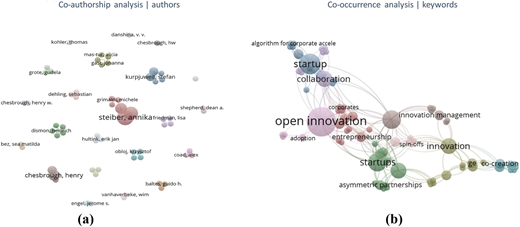
Despite its growth, CSE studies remain fragmented and lack unity (Giglio et al., 2023). This fragmentation is partly due to varying taxonomies in the field, as no unified study guides the nomenclatures. Figure 4, created using VOSviewer for bibliometric network visualization, shows keyword co-occurrence and co-authorship. In Image A, authors often work in silos with little connection, with Annika Steiber and Henry Chesbrough being prominent in the SLR results. Image B highlights the predominance of “open innovation” and “startups” as key terms.
Companies can seek external innovation by engaging with startups through various modes, ranging from robust options like corporate venture capital and venture builders (Kitsuta, 2021) to lighter approaches such as challenges and informal engagement (Bagno et al., 2020). Weiblen and Chesbrough (2015) conclude that there is no best model for engagement because each model has its virtues and challenges; companies should select the model that best fits their goals.
As observed in the SLR, the most prominent engagement mode is the accelerator, focusing on startups with high scaling potential alongside corporations. This mode has gained significant traction as large corporations establish their own accelerators or partner with existing ones. It is a low-risk mechanism that doesn’t require substantial investments. On the other hand, corporate venture capital is one of the vehicles that require the most resources and control; however, the return is proportional to the risk.
Other potential engagement modes are gaining relevance. Beyond traditional models like hackathons, M&A and digital or innovation labs, there has been a significant shift in the corporate world. Large companies are now creating programs and initiatives that offer additional support to startups, such as fostering the creation of internal startups for spin-offs, utilizing venture builders for joint business creation and conducting proof of concept or pilot projects to integrate innovative solutions from startups.
As a finding, we identified numerous references discussing modes of engagement and synthesized 19 distinct CSE modes. This synthesis was necessary due to the varying taxonomies used by different authors and the continuous emergence of new forms in the practical field. By aligning each author’s definitions, we consolidated the main modes evidenced today. Figure 5 presents these modes in a new configuration. To further clarify the CSE field and its modes, Appendix 1 provides definitions from the authors.
The modes of engagement between corporations and startups then vary according to the intentions of the companies and the needs to be fulfilled. Thus, the modes can be altered based on short-, medium- or long-term objectives; financial and/or strategic intentions; direction of the innovation flow, from outside to inside and from inside to outside, and degrees of involvement risk, among others. Within each typology, a specific mode of CSE may be more suitable.
From a contextual analysis of innovation through entrepreneurship, it is evident that the market’s dynamism and agility encourage collaboration between corporations and startups (H1). Despite their differences, these entities have complementary characteristics that drive their partnership. However, although CSE is becoming more common, our hypothesis (H2) was confirmed: there is no consolidated knowledge about the main modes of engagement. Only the most frequent modes are reported, not necessarily the most effective for companies.
Conclusions
Through the studies that were part of this work, CSE imposes itself as an innovation mechanism to enable the strengths of startups and corporations, and despite the difficulties that still exist, it is growing in the ecosystem because of the enormous value it can generate, much for the various distinct modes of CSE that serve corporations and startups in their distinct needs.
Various engagement methods arise, differing in relationships between parties, types of partners, stages of innovation and knowledge acquisition methods. Consequently, several types of relationships can be identified based on the objectives and strategies of the organizations involved, ranging from specific short-term actions to more complex, long-term initiatives.
Implications and avenues for further research
This paper synthesizes the primary modes of CSE through an SLR. Despite ongoing skepticism, startups and corporations are leveraging these methods to enhance their strategies and create value. The main contribution of this study is the synthesis of key modes for implementing CSE programs. While the topic is still emerging as a formal field of study, it is well established in practice. Therefore, further research is recommended, including case studies from both corporate and startup perspectives.
From a practical perspective, this study solidifies CSE as a market practice by detailing its various modes. It provides valuable insights for business managers and startup founders on the current landscape, how to leverage it and the most effective strategies for achieving their goals.
Based on the SLR conducted on CSE, we identified potential research avenues for each engagement mode, with at least one reference per mode. Table 3 outlines these future study directions.
Finally, in addition to what the authors themselves identify (Table 3), a future agenda could involve “design science research” to both advance theory and achieve empirical validation in management practice. One proposal is to develop an artifact that extends the insights from CSE studies to both academics and practitioners, enhancing the effectiveness of these engagements. Additionally, we recommend future studies explore the primary reasons and challenges associated with implementing such approaches.
We would like to thank the Brazilian National Council for Scientific and Technological Research (CNPq) and Coordination of Superior Level Staff Improvement (CAPES) that provided a scholarship for this project.
References
Further reading
Supplementary material
The supplementary material for this article can be found online.