This study aims to investigate to what extent the adoption of technology by organizations depends on the characteristics of the sector in which they operate. The characteristics under study are the participation in Global Value Chains (GVCs) at the sectoral level. Using the term GVC embeddedness emphasizes that it is about an organization’s membership in a sector. Conducting this research is intended to contribute to the technology-organization-environment (TOE) model, which dominates research on the technology adoption by organizations. While the technology and the organization components of the model are well understood, this is less so for the environment component that is central in the present study.
The research was conducted by combining two datasets. The European Company Survey of 2019 provides data about technology adoption by organizations, as it includes information about whether organizations use robots, data analytics to improve processes for the production of goods and services and data analytics to monitor employee performance. At the sectoral level, these data are combined with data from the Trade in Value Added from the Organisation for Economic Co-operation and Development. It was possible to match these data on 15 sectors for 28 countries. Over 20,000 companies were included in the analyses. Logistic multi-level modeling was applied to analyze the nested data with binary outcomes.
GVC embeddedness is positively associated with technology adoption. GVC participation at the sectoral level explains a large share of variation in the use of robots. While it also explains the use of data analytics to improve production processes and employee monitoring, it does so to a lesser extent. For these two kinds of technologies, forward participation matters more than backward participation, suggesting that pressure from foreign buyers may explain the use of these technologies.
This study aims to provide the following novel insights to the literature. First, it aims to expand the TOE model by further investigating the environment component of that model. Secondly, it aims to integrate GVC research and research on technology adoption at the organizational level. And, thirdly, it adds novel insights into research concerning the technology-adoption by adding the role of external factors at the sectoral level.
Introduction
Many organizations experience changes in the technology they use as they apply robots and artificial intelligence (AI), and they digitalize organizational processes to produce goods and services (Choi, Chung, Seyha, & Young, 2020; Simões, Soares, & Barros, 2020). While it may look as if the introduction of these technologies takes place almost automatically, research shows that the adoption of technologies varies considerably across organizations (Muralidharan & Pathak, 2020; Comin, Skinner, & Staiger, 2022). Hence, not every organization is open to technological change and prepared to implement new technologies.
The technology-organization-environment (TOE) model is often applied to understand why organizations adopt technologies. The TOE model brings together 3 components explaining the technology adoption of organizations, namely, (1) technological factors, for example, relate to the costs associated with the technology; (2) organizational factors such as the resources and capabilities of organizations related to using technology and (3) environmental factors that concern organizational external factors such as competition and regulation. While the TOE model is widely used, the environmental (E) dimension requires further attention (Al Hadwer, Tavana, Gillis, & Rezania, 2021; Ghobahloo et al., 2022) as this dimension remained understudied while the technology (T) and the organization (O) dimensions were extensively investigated. What is more, the E dimension is often reduced to rather small theoretical concepts such as perceived pressure from the industry and the government or government regulation (Al Hadwer et al., 2021), which does not match the more encompassing conceptions of the original TOE model (Baker, 2012). Prior studies treat the environment as the circumstances that a single organization faces, such as partner support (Chatterjee, Rana, Dwivedi, & Baabdullah, 2021) and the perceived institutional environment (Olievera et al., 2019). These studies rely on responses from individual companies, whereas the environment also refers to the context in which organizations operate. Methodologically, this requires information about the organizational context. TOE studies connecting the organizational level with contextual factors are not available yet.
The present paper addresses these issues as follows. Prior work based on the TOE model, conceptualizes the structure of the industry in which organizations operate (Dadhich & Hiran, 2022). A central part of that industry concerns how economically open it is, which reflects its level of Global Value Chain (GVC) participation, consisting of the cross-national linkages between organizations (Kano, Tsang, & Yeung, 2020; Elshaarawy & Ezzat, 2022). GVCs are particularly fit as indicators of industry structure, as they are regarded as the broader environmental context of organizations. In this research this is included by analyzing how GVCs at the sectoral level, referred to as GVC embeddedness (Van Zijl & Koster, 2024), relate to technology adoption at the organizational level.
Data from two sources are analyzed. Data about technology adoption are available at the company level. The European Company Survey (ECS) of 2019 includes information on about 20,000 establishments in 28 European countries and asks about 3 different types of technology, namely the use of robots, data analytics for process improvement and data analytics for monitoring employee performance. These three technologies reflect the level of digitalization of organizations and are analyzed separately, as they differ in nature. The ECS also provides information about the sector of operation. This allows adding information about GVC embeddedness at the Nomenclature statistique des activités économiques dans la Communauté européenne (NACE) level (15 sectors per country). GVC data are available through the Trade in Added Value (TiVA) dataset from the Organization for Economic Co-operation and Development (OECD) (OECD, 2021). Two commonly used indicators of GVC participation are investigated (backward and forward participation in GVCs) (OECD, 2021).
The main question addressed in this article is whether GVC participation at the level of the sector is related to the adoption of technology of organizations. The main objectives of this study are to investigate whether the sector can be seen as a relevant context for organizations and to expand and strengthen the E dimension of the TOE model. It does so by concentrating on how the environment serves as a context for technology adoption among organizations.
Technology-organization-environment model
To analyze the adoption of technologies by organizations, research often makes use of the TOE model. Since its inception, the model has proved to be successful to understand technology adoption by organizations. The TOE model does not represent a single theory but is rather a framework that guides the selection of relevant factors to investigate technology adoption and guides research to select which components of the technology, organization and environment matter in understanding the adoption of technology. The technology dimension concerns characteristics such as the costs, complexity and security of the technology under consideration. The organizational dimension concerns characteristics such the absorptive capacity of the organization, the availability of knowledge and the culture of the organization. The environmental dimension concerns relationships that an organization has with governmental regulation and support and value chain characteristics (Baker, 2012).
The TOE model has been applied to a wide range of technologies, such as cloud-based technology, AI (Chatterjee et al., 2021) and blockchain technology (Hanna, Haroun, & Gohar, 2020). The model is versatile, as it can be applied to different kinds of technology, and it enables to include a wide variety of TOE factors. When it comes to the technology factors, it is evident that the costs of digitalization are an important barrier. At the same time there are gains as digitalization contributes to the performance of organizations (Koch, Manuylov, & Smolka, 2021; Alguacil, Turco, & Martínez-Zarzoso, 2022). Regarding the organization factors, having the knowledge to use the technology available in the organizations seems evident. Hence, it is likely that organizations will adopt these technologies to be innovative if they are capable to do so. The present analysis focuses on one of the environment factors, namely GVC participation at the sectoral level, while accounting for some technology and organization factors.
The E in the TOE model: GVC embeddedness
The external environment of organizations consists of several dimensions, of which globalization of production is a salient one. Studies shifted from general approaches to globalization in terms of input and output to more fine-grained ideas about the position that countries, industries and organizations have in the global relations through which products and services are produced (Kano, 2020). GVCs consist of relationships between organizations that are operating in different countries, each adding value as a good or service is passing through the chain. At the core of the GVC approach lies the assumption that the structure of GVCs has an impact on the participating organizations, either via increasing competition and economic and institutional pressure or via increasing opportunities they offer for learning, innovation and the exchange of knowledge. The impact of GVC embeddedness works via two mechanisms, as it defines the need for developing unique resources, knowledge and capabilities and provides access to them via inter-organizational ties (Pandza & Thorpe, 2009; Fawcett, Wallin, Allred, Fawcett, & Magnan, 2011; Ruiz-Ortega, Rodrigo-Alarcón, & Parra-Requena, 2024).
The sectoral level is an important point of reference for organizations. What is conceptually interesting about the sectoral level of GVCs is that it captures both these direct and the indirect connections that organizations have with other internationally operating firms. It is important to note that these pressures and opportunities result from direct participation in GVCs by organizations as well as their indirect GVC participation via belonging to a sector with a high level of GVC participation. Even though some organizations are not directly tapping into a GVC, they may still be under the influence of the GVC via other organizations in their sector. Hence, this kind of GVC participation can be understood as a form of GVC embeddedness (Van Zijl & Koster, 2024) to refer to the direct and indirect global ties that are present in the task and the general environment in which the organization operates. This matches the environment dimension of the TOE model.
Technological change has been considered in relation to GVC participation (Tian et al., 2022; Arora & Siddique, 2024). There are several ways in which this link is evident. First, technology can be transferred via GVCs (Rigo, 2021). And, secondly, mutual learning may occur within GVC relationships, which also supports technology adoption (Ndubuisi & Owusu, 2021). The link is also indirectly found via upgrading of skill levels across GVCs (Ehab and Zaki, 2021). In turn, technology development is believed to be one of the main drivers of the evolution of GVCs (MacCarthy, Blome, Olhager, Srai, & Zhao, 2016). Just as is the case with innovation performance, the link between GVC participation and the use of technology by organizations is a two-way street, in which innovation and technology contribute to further expansion of GVCs and enable GVC participation by organizations (Gopalan, Reddy, & Sasidharan, 2022). At the same time, through participation in GVCs, organizations get access to valuable resources, such as knowledge, information and technology. Therefore, GVCs provide the economic and institutional environment, along with the organizational structures and innovation that support organization to adopt these technologies (Orji, Ojadi, & Okwara, 2022).
Prior research suggests that technology adoption differs across sectors (Comin et al., 2022; Nicoletti, von Rueden, & Andrews, 2020). Nevertheless, researchers also found it difficult to assess the sectoral effect in technology adoption empirically, for example, due to a lack of sectors that could be compared. And even if sectoral differences are investigated, the focus is, for example, on comparing them on a very general level, such as by distinguishing public and private sector organizations. A study by Nicoletti et al. (2020) examines the differences between sectors and countries in technology adoption, showing that there is indeed quite some variance between them. However, the analyses provided in that research remained at the organizational level (the percentage of organizations in a sector adopting certain technologies) and did not include GVC embeddedness as an explanatory factor.
Integrating these insights leads to the following theoretical arguments. First, research shows that technology adoption of organizations varies across sectors. The TOE model explains these differences through variations in the type of technology that is investigated, the characteristics of organizations and environmental conditions. Secondly, while the T and O dimensions of the TOE model are well established, this is not the case for the E dimension. Thirdly, this variation can be explained with the GVC embeddedness through mechanisms such as learning, mimicking and economic and institutional pressure, which provides a test of the role of the environment. Hence, investigating the sector effect of GVCs further expands the TOE model as it is applied to date. As the empirical part of this article focuses on three different technologies, three separate hypotheses are formulated.
GVC embeddedness (forward and backward participation at the sectoral level) is positively related to the use of robots by organizations.
GVC embeddedness (forward and backward participation at the sectoral level) is positively related to the use of data analytics for production by organizations.
GVC embeddedness (forward and backward participation at the sectoral level) is positively related to the use of data analytics to monitor performance by organizations.
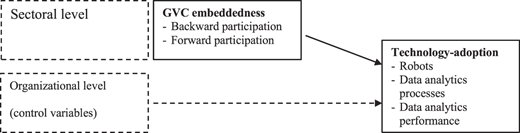
Figure 1 presents the research model of this study. The environment (GVC embeddedness) resides at the sectoral level and is expected to affect the technology adoption by organizations (the use of robots and data analytics for production processes and employee performance). The hypothesized relationships are shown with the black arrow. The relationship between organizational characteristics and technology adoption is shown with the gray arrow.
Data and analytic strategy
Data sources
Data from different sources are combined to investigate the link between GVCs at the sectoral level and the innovation performance of organizations.
Organizational-level data
To assess technology adoption by firms, data from the ECS are analyzed. The ECS is a survey to gather data from companies with at least 10 employees in 28 European countries. Responses are provided by managers responsible for the human resources in those companies. The data for the fourth round were collected between January and July of 2019 (Eurofound & Cedefop, 2020). The 2019 edition of the ECS contains information about 21,869 establishments in 28 European countries (27 European Union member states and the United Kingdom) in total.
Sectoral-level data: GVC participation
The company data are combined with data from the TiVA dataset provided by the OECD, which contains information about many GVC participation indicators (OECD, 2021). The TiVA indicators are available for different levels of analysis (e.g. sector and country) and for different years. Data are matched using the NACE rev 2 classification. This allows to include 15 sectors. To match the TiVA data with the ECS data, the information about GVCs from 2019 is used. The codes in both datasets match. Based on the combination of the country and the sector, the two datasets are coupled.
Measures
Dependent variables: indicators of technology adoption
The ECS dataset gathered in 2019 includes three measures of technologies that organizations apply, namely whether the organization uses robots, data analytics to improve processes of production or service delivery and data analytics to monitor employee performance. These measures are used because they are available in the dataset. Respondents could answer yes (coded 1) or no (coded 0) to the following questions:
“Robots are programmable machines that are capable of carrying out a complex series of actions automatically, which may include the interaction with people. Does this establishment use robots?”
“Does this establishment use data analytics (Data analytics refers to the use of digital tools for analyzing data collected at this establishment or from other sources) to improve the processes of production or service delivery?”
“Does this establishment use data analytics to monitor employee performance?”
These three items are used as the dependent variables of this study, meaning that three analyses will be conducted.
Independent variables: indicators of GVC embeddedness
Several GVC indicators are included in the analyses. Backward participation (the variable exgr_fvash in the TiVA dataset) indicates that the sector is mainly a buyer of external inputs. Forward participation (labeled exgr_dvafxsh) indicates whether the sector is a seller. The natural logarithms of these GVC indicators are added to the models. Using these transformations is often applied in research investigating GVC participation (Thi Mai Hao, Ha, Thi Thanh Huyen, Thi Thu Ha, & Ngoc, 2024). Since some sectors have a score of 0, the logarithms are calculated after 1 is added to the raw score before calculating the logarithms.
Control variables
Control variables are added to account for organizational-level factors influencing technology adoption. Hence, they mostly reflect the O dimension of the TOE model. The following control variables are included.
To measure the knowledge intensity of the companies, a variable measuring knowledge-intensive work practices is used. Koster (2022) developed this construct based on the following ECS items:
For how many employees in this establishment does their job include finding solutions to unfamiliar problems they are confronted with? Your best estimate is good enough (unfamiliar problems).
For how many employees in this establishment does their job include independently organizing their own time and scheduling their own tasks? Your best estimate is good enough (scheduling).
How many employees in this establishment are in jobs that require continuous training? Your best estimate is good enough (continuous training).
In 2018, how many employees in this establishment participated in training sessions on the establishment premises or at other locations during paid working time? Your best estimate is good enough (participation in training).
In 2018, how many employees in this establishment have received on-the-job training or other forms of direct instruction in the workplace from more experienced colleagues? Your best estimate is good enough (on-the-job training).
How many employees in this establishment use personal computers or laptops to carry out their daily tasks? Your best estimate is good enough (computers).
Each question is answered on a seven-point scale to assess to how many of the employees it applies (none at all, less than 20%, 20–39%, 40–59%, 60–79%, 80–99% and all). The Cronbach’s alpha of the scale is 0.71. A summary scale is created by adding the scores on the items and by dividing them by 6.
The composition of the organizations is indicated by the variable open-ended contracts (“How many employees in this establishment have an open-ended contract? Your best estimate is good enough”) and the variable part-time workers (“How many employees in this establishment work part-time (part-time refers to working less than 35 hours per week)? Your best estimate is good enough”). Both are measured on a seven-point scale.
As the adoption of technology may depend on the financial situation of the organizations, the variable profit is included, which consists of the categories yes, no, broke even and missing. Since the adoption of technology may also be related to the external pressure that organizations experience, a variable measuring competitiveness (consisting of the categories: very competitive, fairly competitive, not very competitive, not at all competitive and missing). The variable development is included (a dummy variable indicating that the organization is engaged in the design or development of new products and services). Finally, the variable organizational size is measured by asking the question, “Approximately how many people work in this establishment?” (Three categories, namely: 10–49, 50–249 and 250 and more).
Analyses
The theoretical notion underlying this study is that organizations are embedded in a context affecting their technology adoption. Hence, characteristics of sectors are linked with characteristics of organizations. Furthermore, the empirical data are available for 28 countries. Finally, the dependent variables investigated in this study are scored as a yes/no variable. Together, the nesting of the data – with organizations in sectors in countries – and the nature of the dependent variables led to the decision to apply a multinomial multi-level regression analysis. To fully take advantage of the information at hand, a multi-level logistic analysis is performed with STATA version 18 (using MELOGIT). To simplify the interpretation, the outcomes of the multi-level logistic regression analysis are used to calculate marginal effects. These marginal effects show the probability of a change in the dependent variable with a change in one unit of the independent variable, given that all other variables are set to their mean value. The parameters in the tables can therefore be interpreted as the probability of the occurrence of the three possible outcomes (e.g. no innovation, incremental innovation and radical innovation). Country differences are accounted for by estimating two-level random intercept models.
Because forward and backward participation are correlated (the correlation coefficient is 0.39 at the sectoral level), they are added separately to the models. Before calculating the models, they are checked for multicollinearity. In all models, the variance inflation factors are below 1.30, indicating that multicollinearity is not an issue.
Results
Tables 1–3 present the results of the predicted probabilities derived from the logistic multi-level regression analyses. Table 1 shows that for the use of robots, the probabilities for backward GVC participation and forward GVC participation are 0.158 and 0.104. This indicates that with a unit increase in backward GVC participation, there is a 15.8 increase in the probability that an organization adopts this kind of technology. And, for forward GVC participation this increase is 10.4%. On a scale from 0 to 4.22 (as is the case for backward GVC participation), this implies a total difference of almost 67% between companies operating in sectors that do not participate and those belonging to the sectors with the highest level of GVC participation. For forward GVC participation, this difference is over 30%.
The adoption of data analytics to improve production processes is also related to GVC participation (Table 2). With every unit increase in backward GVC participation, the chances of adoption increase by 2.5%, and with every unit increase in forward GVC participation, the chances of adoption increase by 5.4%. In terms of maximum differences between organizations operating in closed sectors and those operating in sectors with the highest level of GVC participation, this means that the probabilities are 11% higher for backward GVC participation, and for forward GVC participation, this amounts to almost 16%.
Table 3 presents the results for data analytics to monitor employee performance. With every unit increase in backward GVC participation, the chances of adoption increase by 2.2% and with every unit increase in forward GVC participation, the chances of adoption increase by 3.2%. In terms of maximum differences between organizations operating in closed sectors and those operating in sectors with the highest level of GVC participation, for backward GVC participation, and for forward GVC participation, this means that the probabilities are over 9% higher.
These results are in line with hypotheses 1, 2 and 3, which stated that higher levels of GVC embeddedness are associated with technology adoption. Both backward and forward GVC participation at the sectoral level turn out to matter for the use of robots, data analytics to improve production processes, and data analytics to monitor employee performance. At the same time, there are marked differences between the technologies. While the probabilities for using robots maximally increase between 30 and 67%, this range is far lower regarding data analytics (with ranges between 9 and 16%). This points to an aspect of the TOE model that is not directly addressed in this research, namely that characteristics of the technology (the T dimension) matter for understanding technology adoption. The technological dimension stresses the added value and the balance between costs and benefits of applying a technology (Kumar, Singh, & Swain, 2022). Another interpretation stems from the idea that technologies that are more complementary to the already existing ones in an organization and technology readiness explain future adoption (Venkatesh and Bala, 2012). The findings suggest that the technologies differ in that regard. Robots are used far less often (12% of the companies use them) than data analytics (between 32 and 49 of the companies apply these systems), indicating that the former are considered more costly and complex and are hence considered more disruptive. At the same time, the results show that GVC embeddedness may alter these technological factors, given the high increase in probability of use. Recent research explains the connection between GVC embeddedness and technology adoption. First, the sector provides a context in which the adoption of new technology is more common. This particularly is the case if there are leading companies that adopt these technologies present in the sector (Kinkel, Baumgartner, & Cherubini, 2022). These new technologies can then spread to other organizations via increased competition, pressures from other companies and institutional support (Chittipaka, Kumar, Sivarajah, Bowden, & Baral, 2022; Zhong & Moon, 2023) as well as an upgrading of the organization enhancing the skills and capabilities to adopt new technologies (Kinkel et al., 2022). GVC embeddedness resembles these pressures, as it increases external pressure as well as allows for the existence of technology leaders in the sector (Wang & Xiao, 2024).
The results for organizational characteristics are quite similar across the type of technology. Knowledge intensity is an important factor with maximum probabilities ranging from 39 to 70%. Workforce composition in terms of contracts matters very little. Profitability also is not important for understanding technology adoption. Competitiveness seems to matter in that sense that the probability of technology adoption decreases around 10% if organizations do not face competition. Being engaged in design or development of new products and services increases the probabilities of technology adoption in the range of 5–12%. The results show that the probabilities of this organizational characteristic are the highest for data analytics aimed at improving production processes. Finally, organizational size matters for technology adoption. Large organizations are between 14 and 39% more likely to adopt the three technologies than small organizations. These organizational-level characteristics are in line with previous work based on the TOE model (Al Hadwer et al., 2021; Ghobahloo et al., 2022).
Conclusion and discussion
Theoretical implications
This article offers the following theoretical contributions. From the perspective of the TOE model, the analyses confirm one of the underlying assumptions of the model, namely that the environment provides a context influencing the adoption of technology (Bakker, 2012). Besides providing a test of this assumption, the analyses also advance our understanding of the level at which the environment affects organizational decisions. TOE model research typically remains at the organizational level (Horani et al., 2025). This means that organizations are surveyed about the three TOE dimensions, which leads to valuable insights. At the same time, it misses an important point regarding the environment of organizations, namely that this factor constitutes a context in which organizations operate and make decisions regarding the technologies they adopt. The addition that this study offers is that the environment (conceptualized as GVC embeddedness) provides a context explaining technology adoption. In that regard, it is concluded that research based on the TOE model aims to incorporate this aspect in future studies and to further theorize the multi-level nature of the TOE model.
Another contribution lies in the dependent variables investigated in this study. This contribution was not anticipated at the start of the study but requires attention. Usually, TOE research aims at understanding the adoption of a particular technology, such as cloud computing and AI. In these studies, the technological dimension is assessed by asking about perceptions regarding the costs and benefits of adopting that technology, the complexity of adding that technology, as well as the readiness of the organization. What the present analysis adds to that is a focus on multiple technologies, which allows for comparing the differences between them. This comparison further sharpens the role of the technology dimension of the TOE model.
Finally, in TOE model research there is a tendency to focus on barriers (e.g. Agarwal, Kapoor, & Walia, 2023), while the present research shows that the environment also houses factors stimulating, driving and enabling technology adoption. Hence, it points at the importance of incorporating both enablers and potential barriers, which leads to a more balanced view on the dimensions of the TOE model (Jackson & Allen, 2024).
Limitations and future research
First, the analyses connected GVC embeddedness at the sectoral level with organizational-level outcomes. Theoretically, this link is justified with the TOE model. Nevertheless, future analyses may gain from a stronger focus on the mechanisms connecting GVC embeddedness and technology adoption and pay attention to measures of these mechanisms. The present study provides a general insight into the link between GVC embeddedness and technology adoption that can be focused on the question regarding the mechanisms, as well as how GVC embeddedness and organizational characteristics work in unison. This would call for studies in which the relationships between the TOE dimensions are further theorized and explored. As it is now, these dimensions are treated separately (e.g. Chittipaka et al., 2022), while it is very well possible that the environment of organizations and the type of technology have direct consequences for organizational characteristics. Second, the concept of GVC embeddedness can be further advanced. In the current study the existence of direct and indirect GVC connections was assumed but not directly measured. Future studies can improve on this by developing measures of GVC embeddedness that capture these direct and indirect ties empirically. Network approaches, mapping the external relationships of organizations, would be very helpful to advance the research in this direction (Lakhani, Kuruvilla, & Avgar, 2013; Kano et al., 2020). Theoretically, an issue that could not be addressed in this study concerns the direction of the GVC–technology relationship. The present study shows that such a connection exists. Nevertheless, part of the GVC literature argues that the use of technology also feeds back into the GVC as it also enhances the possibilities to manage these chains. Future studies are encouraged to focus attention on such feedback loops between technology and GVC.
Practical implications
The results of this study have the following practical implications for organizations. Organizations considering participating in GVCs may also develop a strategy regarding the technologies they use. While this is particularly so in the case of robots, organizations that increasingly rely on exports may focus on data analytics. The research also emphasizes that the external context of organizations matters indirectly. Hence, organizations are advised to develop means to enable them to receive information about what is happening in their sectors of operation, as an increase of GVC participation in their sector can also affect their technology strategy. Finally, this research also shows that there is a role for sector-level organizations, such as business associations. This follows from the outcome that the sector matters for the technology adoption of organizations, which also seems to imply that organizations in the same sector experience the same developments regarding the use of technology. Hence, mutual learning and developing strategies together can also help these organizations in the process of technology adoption.