


The onset of a crisis demands that businesses respond quickly and effectively. So, it might be helpful to examine the effect of business model innovation and how to increase its impact on better crisis management. This study aims to discuss the aforementioned objectives.
The present study is applied in terms of aim and a quantitative descriptive survey regarding the data collection method. The structural equation model with the partial least squares approach and Smart PLS 3 software was used for the structural analysis of the questionnaire.
The findings revealed that business model innovation could lead to better crisis management. In addition, the components of entrepreneurial capability, resilience and business performance played a mediating role.
Some factors may mediate the effect of business model innovation on crisis management. Thus, future research can investigate them and identify their impact.
The present study suggests that managers should re-examine business model processes and make them innovative to improve crisis management.
The present study examines the factors that affect crisis management with an emphasis on innovation, assesses the impact of mediating factors in this regard and attempts to provide a model to facilitate better crisis management.
Introduction
Today, businesses face ongoing crises, highlighting the need for crisis management to plan effectively to minimize losses and changes to existing processes when businesses face an environmental crisis. In addition, it makes companies capable of meeting new customer needs (Coombs & Laufer, 2018). Focusing attention on this issue creates consistency and proper design in the business models. Designing crisis-resistant business models require innovative actions (Bogdanova, 2020). Research suggests that developing technologies, primarily digital technologies, has resulted in better performance, value creation and innovation in business models (Ranta, Aarikka-Stenroos, & Väisänen, 2021). Business model innovation allows businesses to identify environmental threats and opportunities, create value and increase their resilience in crises (Centobelli, Cerchione, Chiaroni, Del Vecchio, & Urbinati, 2020).
Business resilience involves overcoming environmental challenges (Nickerson & Sulkowski, 2021). Resilient businesses have a competitive advantage over non-resilient businesses since they adapt more quickly to changes in internal and external environments. The literature on crisis management and resilience suggests that they correlate positively (Channa, Shah, & Ghumro, 2019). Furthermore, the entrepreneurial capability is one of the practical factors in business resilience and effective crisis management. Businesses deal with risk and uncertainty to improve their performance (Herbane, 2019). In addition, entrepreneurial capability significantly impacts business performance.
Entrepreneurial firms can better respond to changes, disruptions and environmental crises by creating opportunities and allocating resources according to their performance improvement (Goaill & Al-Hakimi, 2021). Studies have revealed that the more flexible an organization is, the more effective and capable it can be in crisis management and the more resilient it is against environmental change (Lakovic, 2021). Business model innovation during unique crises such as Covid-19 highlights the importance of investigating the effect of business model innovation and other factors on crisis management. Thus, this study attempted to examine the impact of business model innovation on crisis management and entrepreneurial capability, resilience and business performance as mediating variables. Based on our reviews, previous studies have yet to examine the effect of these mediating variables.
The present study aimed to provide an adequate response for businesses in case of a crisis and to investigate the impact of business model innovation on better crisis management. It also examines the mediating role of entrepreneurial capability, resilience and business performance. The present study differs from previous studies, such as those conducted by Bouwman (2019), Bashir and Verma (2019), and Nemlioglu and Mallick (2021), which focused on business model innovation as a critical variable and the implications and factors related to the formation of business model innovation.
Focusing attention on companies' problems with new approaches, such as developing business model innovation, entrepreneurial capability, resilience and performance improvement, can alleviate their challenges (Schiavon, May, & de Mendonça, 2022). Thus, given the importance of the subject, the present study seeks to answer the question of whether business model innovation impacts business crisis management by mediating the role of entrepreneurial capability, resilience and business performance.
Theoretical foundations
Business model innovation
To innovate the business model, one must first understand the existing business and its requirements and then examine how to improve it. Innovation should not necessarily be limited to research and development and the application of technology (Dana, Salamzadeh, Hadizadeh, Heydari, & Shamsoddin, 2022). Innovation in business models may result from entrepreneurial partnerships, innovation, technology management and corporate strategy (Spieth, Schneckenberg, & Ricart, 2014), but this research focuses more on technology development. The rapid development of information and communication technology (ICT) and digital technology change the customers' new demands (Kör, Wakkee, & van der Sijde, 2021). Digital technologies and industry provide new opportunities and benefits for industrial companies to increase product quality, process reliability, flexibility and productivity (Chirumalla, 2021; Dana, Salamzadeh, Mortazavi, & Hadizadeh, 2022; Salamzadeh, Hadizadeh, Rastgoo, Rahman, & Radfard, 2022; Oztemel & Gursev, 2020). Digital technologies have facilitated significant changes in business models. Business model innovations are mainly reflected in using digital technologies to enable a broader range of business models than a company has previously provided (Li, 2020).
Digital technologies act as catalysts for radical product and service innovations.
In low-tech sectors, using digital technologies has a knock-on effect on competitive advantage through innovation. In high-tech sectors, the use of digital technology directly affects competitive advantage. Innovation capabilities are essential in introducing new products and services to gain a competitive advantage. Technology acceptance and corporate innovation are often interrelated (Blichfeldt & Faullant, 2021). Technology-based companies play a vital role in a country's economic prosperity. However, given a society's ability to establish such types of companies at various, contrasting and separate times, their volume is much smaller than expected in many economies. Thus, creating such companies is necessary for the development of any country, although its innovation system helps their establishment (Dana, Tajpour, Salamzadeh, Hosseini, & Zolfaghari, 2021).
Digitalization has been built into products and services and increasingly supports corporate business processes. Digital tools are still used to support the company’s daily operations. Thus, the effect of digitalization on company performance is significant (Truant, Broccardo, & Dana, 2021). Digitalization offers new opportunities for equipment suppliers to support the competitiveness of process industry companies by participating in digital innovations with process innovation capabilities. However, it is associated with challenges that require equipment suppliers to integrate with multiple players in a vast ecosystem to deliver complex software systems of products and services as embedded sources of process innovation. It imposes several challenges to the equipment supplier since it must guarantee its role in the ecosystem, cooperating and competing with other agents simultaneously.
Thus, it must consciously determine which ecosystem strategy to use (Kamalaldin, Sjödin, Hullova, & Parida, 2021). Highlighting the need for industry cooperation as a critical source of business model innovation broadens the industrial network perspective. In conditions where emerging transitions require mutual learning and adaptation, a focus on unique business models provides a limited, even inaccurate, picture of what contributes to or impedes this transition. The simultaneous increase in competition and access to information allows companies to develop their ability to understand, use and exploit the benefits of knowledge, as the capacity to attract reflects an organization’s ability to extract innovative ideas from its environment. It significantly strengthens intra-organizational entrepreneurship and the innovative performance of existing companies (Yildiz, Murtic, Klofsten, Zander, & Richtnér, 2021).
Entrepreneurial capability
Experts have analyzed entrepreneurial capability as a growth factor in businesses. Empirical studies have shown that companies with entrepreneurial capability achieve superior performance in the market (Xiao, Lew, & Park, 2021). Many researchers have considered entrepreneurial ability as individual entrepreneurship in identifying and utilizing market opportunities. Entrepreneurial capability can accelerate new market development opportunities to improve the performance of new jobs (Martin, Javalgi, & Ciravegna, 2020). Many studies have shown that entrepreneurial capability includes organizational, strategic, innovation and learning skills. Developing entrepreneurial capability allows businesses to overcome resource and knowledge shortages.
Entrepreneurship researchers have stated that entrepreneurial competence is a combination of a company's innovative, preventive and risk-taking capabilities (Brouthers, Nakos, & Dimitratos, 2015). Entrepreneurial capability affects business capability (Falahat, Lee, Soto-Acosta, & Ramayah, 2021). Researchers have stated that entrepreneurial competence includes resource access, risk-taking and leadership capability (Kor, Mahoney, & Michael, 2007). Entrepreneurial capability leads to improved innovation performance and knowledge management capability (Yi, Wang, Upadhaya, Zhao, & Yin, 2021). Entrepreneurial capability is also effective in the growth of small and medium enterprises. Several studies have shown that these companies (SMEs) contribute significantly to economic competition, job creation and innovation. In general, companies with entrepreneurial capability perform better in response to environmental changes and crises and operate in dynamic environments (Colombo, Piva, Quas, & Rossi-Lamastra, 2021). Studies indicate that resilience, as a positive adaptation to difficulties, can be a critical factor in the entrepreneurial capability of companies (Manfield & Newey, 2018).
Business resilience
Resilience is a critical concept in crisis management. It is an organizational characteristic to deal with all kinds of problems (Coles, Ritchie, & Wang, 2021). The notion of resilience is used in several areas of knowledge. It refers to the capacity and aptitude of an element to return to a stable state after an interruption. Organizational resilience is the ability to participate in crisis management and get out of a challenging situation (Beuren, dos Santos, & Theiss, 2021). The concept of resilience in economics is divided into two categories: static resilience and dynamic resilience. Static resilience is the ability of a unit or system to maintain business continuity, and dynamic resilience is the speed at which a business returns to a desired state.
Resilience affects business performance and job satisfaction. Studies indicate that resilient companies perform better than non-resilient companies (Hillmann & Guenther, 2021). Organizational resilience promotes effective responses to environmental change and supports the development of different organizational capabilities (Lengnick-Hall, Beck, & Lengnick-Hall, 2011). Organizational resilience includes introducing new capabilities and increasing the ability to monitor and create new opportunities and innovation. Researchers argue that organizational resilience is a dynamic process in which members (including employees) positively adapt by increasing their organization's competitiveness after the crisis. Resilience contributes to organizational performance in critical situations as it helps individuals, groups and organizations to manage and adapt to uncertainty (Lee, Vargo, & Seville, 2013).
The literature defines organizational resilience as the company's dynamic capability. This dynamic ability depends on individuals, groups and subsystems to deal with immediate and unexpected environmental changes. They must have active attitudes, thoughts and adaptative skills to respond to these changes with flexible development (Werner, Yamada, Domingos, Leite, & Pereira, 2021). Organizational resilience includes an organization’s ability to respond to crises and uncertainties and such ability positively impacts company performance (Ali et al., 2021). Organizational resilience is the ability of an organization to continuously develop skills and identify opportunities to increase its competitive advantage after a crisis. In the literature on crisis management, organizational resilience reflects effective crisis management processes conducted by its members, which facilitate coordination, information sharing and the creation of a collective sense. Organizational member interactions through communication play a significant role in organizational resilience (Kim, 2020). Therefore, the resilience levels of individuals and organizations affect the business improvement process (Pathak & Joshi, 2021).
Business performance
Although issues of a conceptual nature still underlie much of the performance debate, focusing attention on this issue remains a fundamental construct in strategy research studies. Strategic management researchers measure business performance using various operational plans to create functional implications for strategic business behavior (Venkatraman & Ramanujam, 1986) since the success or failure of a company depends on its performance. Many companies offer their product or service, and performance determines the extent to which the company has achieved its goals. Each company or organization aims to achieve maximum profit and longevity in the market (AlMulhim, 2021).
Today, organizations and employees must work in a challenging and uncertain environment due to the last decade's recession and the concurrent ongoing changes in the market. Studies suggest that resilient organizations can adequately respond to crises, challenging conditions and expected changes (Rodríguez-Sánchez, Guinot, Chiva, & López-Cabrales, 2021). Organizational performance can be challenging due to different standards, such as sustainability, profitability and coping with environmental changes (Anwar and Abdullah, 2021). Human resources are an essential part of resources that significantly impact the performance of companies, being highlighted as the main factor of organizational resilience (Nyaupane, Prayag, Godwyll, & White, 2020). Studies indicate that organizational resilience positively impacts a company or business (Lengnick-Hall et al., 2011).
Globalization, the technological gap, and the short life cycle of products, services, resilience and others, have resulted in changes in firms’ management and production environment and services. It also increased environmental uncertainty for companies and affected the performance of organizations in crisis management (Nguyen, Le, Nguyen, Pham, & Tran, 2021). Crises pose ambiguous challenges for organizations. Overcoming the crisis can also pave the way for something new, such as strengthening solidarity, identity and organizational resilience. When a crisis occurs, the issue of successful crisis management becomes the issue of public administration effectiveness (Boin, ’t Hart, & Kuipers, 2018). The more flexible a public organization is in its internal and external operations, the greater its ability to effectively manage and respond to crises. Organizational flexibility refers to (1) the decision-making ability, (2) the delegation of authority, (3) the facilitation of employee recruitment, (4) the development of coping strategies, (5) the rapid organizational adaptation, (6) the innovation of processes and procedures and (7) the increased communication (Eckhard, Lenz, Seibel, Roth, & Fatke, 2021).
Crisis management
Crises are characterized by restrictions, integrating borders, situations, distinctions, categories and concepts that create irregular, open and ambiguous conditions from which new configurations of ideas and relationships can be created (Salamzadeh & Dana, 2022). The ability to deal with new crisis configurations can be a threat or an opportunity and determine how external changes shape roles and effects of dealing with a crisis through various mechanisms (Bendell, Sullivan, & Ornstein, 2020; Kimjeon & Davidsson, 2021). The challenges caused by crises require innovative solutions (Ebersberger & Kuckertz, 2021; Orlikowski & Scott, 2021). The crisis caused by the COVID-19 pandemic has resulted in a change in the environment and has imposed many challenges that require innovative solutions (Ebersberger & Kuckertz, 2021). The researchers argue that psychological, sociopolitical and structural technology issues must be explicitly considered and integrated into the study and management of organizational crises.
Although the COVID-19 pandemic has created a significant crisis in terms of scale and impact on the industry, it is not the first disruptive factor that affected the performance of companies (Neise, Verfürth, & Franz, 2021). Prolonged economic downturns negatively affect companies, showing signs of falling sales, falling profits, neglect of financing and difficulty in fulfilling supplier obligations. However, some companies show significant returns in the face of a crisis (Dheer & Salamzadeh, 2022). Better-managed companies in an emerging economy performed better even during and after the global crisis. Companies with better management quality and innovative activities improve their performance during a crisis (Nemlioglu & Mallick, 2021; Orlikowski & Scott, 2021).
Resilience [as a company’s ability to effectively attract, create situational responses and ultimately engage in transformational activities] will be effective in crisis management to take advantage of destructive surprises that threaten the company's survival (Lengnick-Hall et al., 2011, p. 244).
Most previous studies have focused on business model innovation as a critical variable and examined its implications and associated factors. Bouwman's (2019) studies suggest that applying the business model strategy and the experiences of using these models can positively impact innovation and the overall performance of companies. The studies by Bashir & Verma (2019) examined the internal factors and implications associated with business model innovation. They concluded that organizational structure, organizational culture, leadership, technology, size and experience affect the new business model.
Nemlioglu and Mallick (2021) concluded that innovation in the business model increases strategic flexibility and competitive advantage and innovative activities increase profitability. Pedersen, Gwozdz, and Hvass (2018) conducted a study entitled “Business model innovation and value creation.” They concluded that business model innovation could create value for three groups of people, including shareholders, suppliers and buyers, and create an advantage for each. In a study conducted by Anwar (2018), business model innovation affected business performance. In an investigation of other variables, we see that they have been investigated as an independent variables, for example, in the studies conducted by Lengnick-Hall et al. (2011), Manfield and Newey (2018), Eckhard et al. (2021), Ferreira, Coelho, and Moutinho (2020), Hillmann and Guenther (2021).
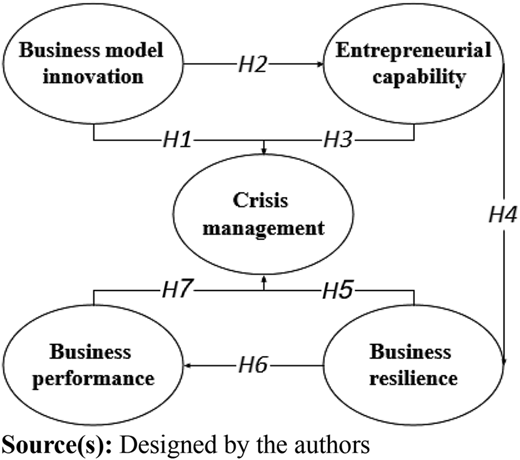
A review of previous theoretical foundations and previous studies related to this research provided the necessary basis for presenting research hypotheses. Businesses can facilitate the entrepreneurial process in the company based on their capabilities due to innovation in their business model and thus manage the crisis when necessary. Accordingly, business model innovation has a significant direct relationship with crisis, and the variables of entrepreneurial capability, business resilience and business performance play a mediating role in this relationship. Identifying the contribution of each component and item in the formation of crisis management can be helpful in planning and explaining the strategy to business owners and strategists. Also, by reviewing the studies conducted to identify the theoretical gap, it was revealed that most previous studies have focused on business model innovation as a key variable and have examined the implications and factors related to the formation of business model innovation. The present study aimed to provide a quick and effective response for businesses in the event of a crisis and to investigate the realization of innovation in the business model and the ways of enhancing its effect on better crisis management to save many businesses. Accordingly, it examines the effect of components of business model innovation, the mediating role of entrepreneurial capability, resilience and business performance on crisis management. Accordingly, the following hypotheses were provided for the present study (Figure 1):
Business model innovation positively and significantly impacts crisis management.
Business model innovation positively and significantly impacts entrepreneurial capability.
Entrepreneurial capability positively and significantly impacts crisis management.
Entrepreneurial capability positively and significantly impacts business resilience.
Business resilience positively and significantly impacts crisis management.
Business resilience positively and significantly impacts business performance.
Business performance positively and significantly impacts crisis management.
Methodology
The present study is a descriptive applied survey and is quantitative regarding the type of collected data. The authors used the structural equation model method with the approach of the least squares method and Smart PLS 3 software. The standard PLS-SEM algorithm was executed on the complete data set to obtain the model scores of all latent variables. This analysis is performed automatically in SmartPLS 3 software, and the user does not need to set it up manually. The data collection tool in this study was an electronic researcher-made questionnaire. This questionnaire was designed based on a five-point Likert scale and included five main components and 20 questions. Business model innovation was measured based on Pang, Wang, Li, and Duan (2019). Besides, the entrepreneurial capability variable was measured with three questions based on the standard questionnaire of Falahat et al. (2021). Based on Hillmann and Guenther (2021), entrepreneurial resilience was measured with two questions. The business performance variable was measured based on Eckhard et al. (2021). Channa et al. (2019) measured the crisis management variable as a dependent variable.
The statistical population of the present study consisted of 950 professors in information technology and entrepreneurship at the Tehran University and Shahid Beheshti University in Iran and managers of information and communication technology companies in Tehran in 2021. Based on Cochran's formula, the sample size was determined to be 274 individuals, selected through the random sampling method for stratified convenience. The researcher sought to ensure that the volume of samples selected from classes was appropriate to the volume of the classes.
The classification was based on employment history, which resulted in four classes. The first class was 5 to 10 years of employment history with a frequency of 23%, the second class was 10 to 15 years of employment history with a frequency of 44%, the third class was 15 to 20 years of employment history with a frequency of 22%, and the fourth class was 20 to 25 years of employment history with a frequency of 11%. Then, considering the table of random numbers, samples were selected from each class using a convenience sampling method. Furthermore, considering the possibility of non-return of some questionnaires, 320 were randomly distributed among the samples. Finally, 293 questionnaires were received. The return rate was 91%, which means that 286 questionnaires could be used.
The partial least squares criteria method was used to assess the reliability of the questionnaire. In this method, reliability is measured by two criteria: (1) Cronbach's alpha and (2) Composite reliability (CR). The results related to the reliability of the research questionnaire are shown by the two criteria mentioned in Table 1. The validity of the questionnaire was assessed by the convergent validity criterion using the partial least squares method. The AVE criterion examines convergent validity (mean-variance extracted); if this criterion is higher than 0.5, the convergent validity of the measurement tool will be confirmed.
Internal consistency of variables (convergent validity and composite reliability)
| Component | Item | t-value | Regression coefficient | Discriminant validity | Combined reliability (CR > 0.7) | Cronbach’s Alpha>0.7 |
|---|---|---|---|---|---|---|
| Business model innovation | IB1 | 6.275 | 0.647 | 0.849 | 0.832 | 0.916 |
| IB2 | 21.494 | 0.851 | ||||
| IB3 | 71.818 | 0.928 | ||||
| IB4 | 29.113 | 0.895 | ||||
| Entrepreneurial capability | EC1 | 57.997 | 0.949 | 0.726 | 0.942 | 0.901 |
| EC2 | 25.306 | 0.916 | ||||
| EC3 | 12.465 | 0.789 | ||||
| Business resilience | FB1 | 40.226 | 0.924 | 0.811 | 0.915 | 0.871 |
| FB2 | 60.091 | 0.935 | ||||
| Business performance | PB1 | 105.542 | 0.960 | 0.872 | 0.894 | 0.893 |
| PB2 | 113.905 | 0.963 | ||||
| PB3 | 33.453 | 0.887 | ||||
| PB4 | 86.201 | 0.951 | ||||
| PB5 | 48.829 | 0.924 | ||||
| Crisis management | MC1 | 33.489 | 0.903 | 0.864 | 0.921 | 0.947 |
| MC2 | 30.014 | 0.881 | ||||
| MC3 | 26.266 | 0.871 | ||||
| MC4 | 22.737 | 0.815 | ||||
| MC5 | 17.444 | 0.862 | ||||
| MC6 | 19.348 | 0.844 |
Source(s): Prepared by the authors
The Smart PLS-3 software was used to test the model and hypotheses. The results show that the average variance extracted for all structures is higher than 0.5, which confirms the validity of the structures. Cronbach's alpha for structures was higher than 0.7, and the composite reliability was also higher than 0.7. In addition, the reliability of the structures is confirmed. According to Table 2, divergent validity is confirmed, and these results show that the research tool has acceptable validity and reliability.
The divergent validity measurement matrix
| Component | Business model innovation | Entrepreneurial capability | Business resilience | Business performance | Crisis management |
|---|---|---|---|---|---|
| Business model innovation | 0.919 | ||||
| Entrepreneurial capability | 0.931 | 0.852 | |||
| Business resilience | 0.501 | 0.689 | 0.900 | ||
| Business performance | 0.672 | 0.711 | 0.743 | 0.933 | |
| Crisis management | 0.701 | 0.719 | 0.756 | 0.817 | 0.929 |
Source(s): Prepared by the authors
Findings
Demographic description
Demographic information of the research subjects is presented in Table 3.
Model fit
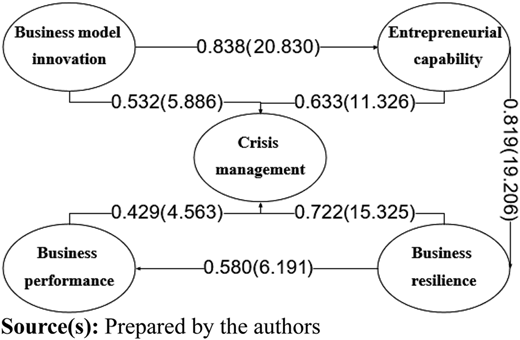
Based on Table 4, all cases indicate a strong fit for the research model, and its numerical value is higher than 1.96. The results of the path analysis to test the research hypotheses are presented below (Figure 2). The t-values higher than +1.96 and less than −1.96 indicate the significance of the relevant parameter and subsequently confirm the research hypotheses (Ramadani, Rahman, Salamzadeh, Rahaman, & Abazi-Alili, 2022).
Evaluation of quantitative model fit
| Hypotheses | Coefficient | t-value | Result |
|---|---|---|---|
| H1: Business model innovation → crisis management | 0.532 | 5.866 | confirmed |
| H2: Business model innovation → entrepreneurial capability | 0.838 | 20.830 | confirmed |
| H3: Entrepreneurial capability → crisis management | 0.633 | 11.326 | confirmed |
| H4: Entrepreneurial capability → business resilience | 0.819 | 19.206 | confirmed |
| H5: Business resilience → crisis management | 0.722 | 15.235 | confirmed |
| H6: Business resilience → business performance | 0.580 | 6.191 | confirmed |
| H7: Business performance → crisis management | 0.429 | 4.563 | confirmed |
Source(s): Prepared by the authors
Discussion and conclusion
Due to the excessive increase of economic crises in the last decade, crisis management has become essential for businesses. Creating and promoting business model innovation can empower business owners to create crisis management, increase entrepreneurial capability, promote resilience and improve business performance. Thus, the main objective of this study is to investigate the impact of business model innovation on crisis management, considering the role of intermediate factors. It is also worth noting today that increased global and regional competition, increased customer demand for more complex products and rapid changes in the environment in which businesses operate have created the need for innovative business models. The present study aimed to provide a quick and effective response for companies in case of a crisis and to investigate the realization of innovation in the business model and ways to leverage its effect on better crisis management to save many businesses. Accordingly, it examined the impact of business model innovation on crisis management with the mediating role of entrepreneurial capability, resilience and business performance in companies in the information and communication technology sector. The results of the present study revealed that business model innovation could cause crisis management in companies. In this regard, entrepreneurial capability, resilience and business performance as mediating variables have positive effects, and previous studies have not addressed this model.
Identifying sustainable paths to growth in increasingly global competition and rapidly changing environment in which businesses operate creates the need for innovative business models. The focus on sustainability always leads to the search for new products, technologies and inspiring business models (Beqiri, 2014).
Considering the essential characteristics of markets and examining the performance of companies during a crisis, companies must reconsider their business models and develop an innovative promotion approach. Existing models may have limited applications and need to be modified. Factors such as entrepreneurial capability, resilience and business performance can be considered in developing business innovation and are expected to help companies in crisis management.
The confirmation of the first, third, fifth and seventh hypotheses of the study revealed that business model innovation, entrepreneurial capability, business performance and business resilience could impact crisis management. Business model innovation is defined as a change in the business model architecture or its components and allows companies to minimize resource constraints and innovation risk, especially during a crisis (Nemlioglu and Mallick, 2021).
To overcome the crisis is highly advisable to provide entrepreneurial responses and increase innovation in new product development, which induces a more rational planning approach (Korsgaard, Anderson, & Gaddefors, 2016; Boers & Henschel, 2021). Entrepreneurship plays a leading role in economic improvement during a crisis and can increase business flexibility and resilience (Dahles & Susilowati, 2015). Resilience can help companies manage crises (Linnenluecke, 2017). Organizations prepared to face crises are better equipped to anticipate, diagnose, manage and make appropriate decisions during a crisis. Thus, preparing for a business crisis is strategically essential and significantly impacts business. High-performing organizations are highly prepared to deal with crises, indicating a close association between overall business success and organizational preparedness for the crisis.
The confirmation of the study's second, fourth and sixth hypotheses revealed that business model innovation has a positive impact on entrepreneurial capability, entrepreneurial capability has a positive impact on business resilience and business resilience has a positive effect on increasing business performance. Innovation occurs in an entrepreneurial ecosystem that usually involves a set of factors. Focusing attention on the growing commercialization of technology has encouraged industry owners and policymakers to develop and expand entrepreneurial ecosystems (Feldman, Siegel, & Wright, 2019). Entrepreneurial capability results in flexibility and increased resilience and provides more flexible responses based on the innovative approach of strategic reconfiguration (Manfield & Newey, 2018). Focusing attention on business sustainability and flexibility principles will improve performance.
Thus, several factors can affect the appropriate management of companies during a crisis. One of the factors that has drawn much attention in the current research is the innovation of the business model. Business model innovation can create value and increase recognition of opportunities to seize a market that competitors have overlooked. Business model innovation is defined as the company's architecture, indicating how the company can create and deliver value to the customer (Anwar, 2018). Considering innovation in their business model, companies can facilitate the entrepreneurial process in the company based on their capabilities and thus increase their competitiveness (Pedersen, 2018). In addition to improving competitiveness, it leads to entrepreneurial empowerment and, consequently, to the emergence of influential factors such as resilience and increased business performance in crisis management.
The results of this study show that business managers should know that entrepreneurial capability, resilience and business performance are effective in crisis management and play a mediating role in applying innovative business models. The role of these three factors in the successful implementation of crisis management is significant, and three factors are influential in shaping the crisis management process. Investigating the impact of these mediating factors on crisis management is one of the differences between this study and other studies, and it is one of the main innovations of this study. By forming the proper organization processes to implement business model innovation capabilities, businesses can help crisis management create value and survive their business using the proper management.
Recommendations
Given the impact and importance of business model innovation in crisis management, managers and strategists are encouraged to review the operational processes and the work process methods in the area of business model and market needs, thereby promoting innovation in these processes. Researchers should also examine the relationship between business innovation and crisis management from other angles to identify more intervening and mediating factors and complete this study.
Limitations
The present study presents several limitations. First, since the data were collected through a questionnaire simultaneously, the relationships presented in the structural model were examined statically. Thus, other studies can be carried out through longitudinal case studies. Second, the present study examined managers of knowledge-based companies facing many crises to effectively manage them in today's ever-changing environment. However, it did not examine issues such as the perceptions and characteristics of the organization’s employees, the essential assets in business or organizations, and their efficiency and effectiveness in crisis management. Thus, future studies can be carried out to investigate the impact of perceptions and characteristics of human resources in any business or organization on crisis management and organizational resilience. Third, the present study investigated the impact of the innovation model on crisis management considering the mediating role of entrepreneurial capability, resilience and organizational performance. Still, several other variables can play a mediating role, and future studies can identify them.
This work has been supported by national funds through FCT – Fundação para a Ciência e Tecnologia through project UIDB/04728/2020.

