There is still considerable resistance against carbon pricing — i.e. carbon taxation or cap-and-trade — in the social and policy sciences. We review its main arguments and conclude that they are not supported by the theoretical and empirical literature on instrument performance. Critics are also unable to offer alternative and feasible instruments that limit free riding in climate solutions and perform better on main evaluation criteria, namely effectiveness, efficiency, equity, and global-harmonization potential. Their argument that carbon pricing meets strong political resistance is countered by its widespread implementation already and by its ability to compensate inequitable impacts. We argue that overcoming unsubstantiated criticism on carbon pricing will lead to more consistent advice from policy experts to politicians, thus improving the feasibility of, and accelerating progress towards, globally harmonized and stringent climate policy. All in all, it might be more widely acknowledged that the remarkable feature of carbon pricing is that, if well implemented, it has a great number of advantages and few disadvantages. Rather than weakening political support by criticizing carbon pricing, critics would contribute more productively to effective global climate policy by defending proper and uniform implementation of it.
1 Introduction
Carbon pricing is on the rise, as illustrated by two events in 2021: the European Commission’s proposal to extend emissions trading to the building and transport sectors (European Commission, 2021b); and China’s — somewhat unconventional — implementation of the largest carbon market worldwide (Goulder et al., 2022; Nogrady, 2021). Carbon price levels in the European Emissions Trading System (EU-ETS) have been above 80€ per ton of CO2 most of the time since 2022 and in 2023 exceeded several times the 100€ threshold. The EU and China are not alone in their ambitions — more than 70 jurisdictions have implemented some form of carbon taxation or emissions trading (World Bank Group, 2023).
Getting the necessary broad support for further diffusion of carbon pricing and tightening of its regulatory effect by raising price levels to meet the Paris Agreement targets requires a minimal level of agreement within academia. The reason is that we need more consistency in advice on climate policy from experts so that politicians will not be confused by deviating messages. While constructive criticism is an integral part of science and necessary to improve policy design, we will show that there is considerable unsubstantiated criticism of carbon pricing. This negatively affects public and political discussions, possibly reinforced by strategic resistance from stakeholders, such as business associations and political parties. We review the main concerns of critics, present counterarguments and evidence, and discuss the main sources of resistance and how they may be overcome.
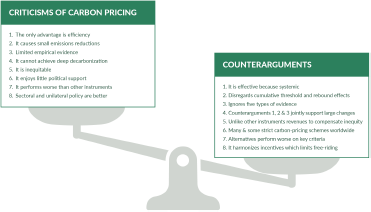
Table A1 in the Appendix provides a list of published criticisms of carbon pricing — whether carbon taxation or cap-and-trade (carbon market or emissions trading). Several of these are widespread — indeed, one can frequently hear them being mentioned in academic meetings and public debates. They therefore merit scrutiny. The table offers some details about each study in the various columns: its second column refers to Figure 1, which summarizes the main criticisms and counterarguments as expounded in the remainder of this paper (structured following the order of arguments in the figure); the third column summarizes the main alternative policy proposed; and the last column summarizes main elements of the criticisms as well as any previous evaluations of the respective publications.
Most of the criticisms are fairly recent, despite expanding and — as we will show later — successful implementation of different forms of carbon pricing in the last decade. The criticisms are diverse; some go as far as saying carbon pricing is neither essential nor desirable, while others downplay its contribution, regarding it to play at best a modest role in a wider policy mix (see third and fourth columns in Table A1). None of the critics express that carbon pricing must occupy a key role in climate policy, and several propose alternative strategies devoid of carbon pricing.
Several of the publications offer a range of criticisms, many of which overlap (Böhm et al., 2012; Huwe and Frick, 2022; Mildenberger and Stokes, 2020; Pearse and Böhm, 2014; Rosenbloom et al., 2020a; Verbruggen, 2021) while others zoom in on particular issues: offsets (Böhm and Dhabi, 2009), carbon markets (Cullenward and Victor, 2020; Markard and Rosenbloom, 2020; Spash, 2010), offshore tax havens (Green, 2021a), equity and problem shifting (Lejano et al., 2020), innovation impacts (Lilliestam et al., 2021), and ethics and justice (Aldred, 2012). Some provide very radical criticism implying outright rejection of carbon pricing in general or of emissions trading in particular (Ball, 2018a,b; Böhm et al., 2012; Huwe and Frick, 2022; Mildenberger and Stokes, 2020; Patt and Lilliestam, 2018; Pearse and Böhm, 2014; Spash, 2010). Few offer constructive suggestions for improving carbon pricing in practice (Cullenward and Victor, 2020) or stress the importance of a policy mix (Tvinnereim and Mehling, 2018) — incidentally, something which is not denied by most proponents of carbon pricing. Almost all publications are of a conceptual–verbal nature (i.e. an opinion or perspective) while two offer quantitative information (Cullenward and Victor, 2020; Lejano et al., 2020) and one undertakes a literature review (Lilliestam et al., 2021) — but as argued later (and in Table A1), the latter may also be considered as an opinion paper.
Certain criticisms are based on mainstream political and economic theory, while others are more radical in nature, such as of a neo-Marxist nature (Böhm et al., 2012). Criticism is perhaps most common among political scientists, which sometimes goes as far as suggesting a minor role for the state and a major role for non-state climate action (Green, 2013). All criticisms lack a systematic comparison of carbon pricing and alternative policies on key criteria, arguably needed to arrive at a balanced judgement.
Several critics (Böhm and Dhabi, 2009; Green, 2021a; Huwe and Frick, 2022; Rosenbloom et al., 2020a; Spash, 2010) lump together carbon pricing and carbon offsets, such as the Clean Development Mechanism, Joint Implementation, REDD, and the Verified Carbon Standard. This is not helpful as their mechanisms and features are very different. Carbon offsetting is not to be confused with carbon pricing through taxes or markets. Offsets, including their potential integration with cap-and-trade programs, merit a separate discussion (Bento et al., 2016; Wara, 2007). Like the critics, we are not convinced by some of the offset arrangements as they either disincentivize genuine mitigation or fail to guarantee environmental integrity and additionality of offsets. But this is no reason to discard carbon pricing; instead, adaptations in its design are needed. In line with this, New Zealand’s ETS has no longer accepted international offsets since 2015 while The Swiss and EU ETS do not accept any offsets as of 2021 (La Hoz Theuer et al., 2023).
Some critics, such as Spash (2010) and Pearse and Böhm (2014), wrote so early that they may perhaps be forgiven for some statements. Indeed, improvements such as better rules for offsets and empirical evidence for instrument performance arrived several years afterwards. For instance, Spash (2010, p. 182) talks about “large price fluctuations also point to the potential instability of an ETS” but this is outdated, given the establishment of the EU-ETS market stability reserve since 2015 (Perino and Willner, 2016).
However, most of the critics wrote in recent years which means that they had access to much of the literature and evidence we will present later as offering counterviews as well as to information about the success of the EU-ETS in recent years, as indicated by Figure 2. For example, Verbruggen (2021) criticizes extensively over-allocation of permits in phases i and ii of the EU-ETS, not admitting that this was needed for political support then, while at the time of writing the system was already in a later phase with many design changes that undo the criticism. In addition, virtually all of the critics write as if they are not aware of the extensive evidence for emissions reduction (Table 1 later), and do not recognize the notion of a counterfactual (i.e. emissions growth or little reduction with carbon pricing in some cases might have resulted in more emissions growth without carbon pricing) or do not acknowledge the difference between small absolute reductions and high reductions relative to low prices (i.e. a high emissions-reduction elasticity of a carbon price).
In addition to these general comments (some of which will be discussed in more detail later) and the brief summaries in Table A1, we could provide more details about each of the criticisms here. This would, however, easily result in a long and overly descriptive section. Instead, we deem it more useful for the reader to see the specific criticisms immediately followed by our response. Hence, we will in subsequent sections present the specific criticisms with some detail and then provide our counterview supported by arguments, evidence, and literature references. This makes, in our view, for more interesting reading while avoiding too much repetition between this and later sections.
Finally, we do not aim to be exhaustive in our assessment of criticisms. Instead, we focus on criticisms that appear in various publications. It is good, though, to note that several other criticisms on carbon pricing can be found in the studies we assess. For example, Aldred (2012) expresses ethical and justice arguments against emissions trading, which it regards as morally objectionable because it “commodifies” the atmosphere and “prices that which is priceless”. This is a deontological position that does not account for whether pricing is the most effective way to reduce CO2 emissions and thus solve climate change. Incidentally, to state, as the author does, that the atmosphere is “commodified” stresses only the pricing or trading dimension of a cap-and-trade system, while one could instead draw attention to the cap as its essential feature which assures that emissions will be limited. In addition, the radical criticism by Böhm and Dhabi (2009), Böhm et al. (2012), and Pearse and Böhm (2014) contains so many cryptic or suggestive terminology (e.g. “loophole, corrupt, utopian, scientism, technocracy, metabolic rift, world ecology, or sub-imperialism”) that we lack the space to respond to in detail. Suffice to say that they do not offer a comparison with alternative instruments on these “criteria”. They also mention the previous ethical concern: “economics has re-geared questions of sustainability away from being moral and environmental issues to being technical problems resolvable through economic calculation”. In addition, they say “The resulting shift in state preferences for privatization, deregulation and marketization is part of what social scientists term “neoliberalism” (only one other critic, Verbruggen, 2021 also employs this term a lot). This is in our view debatable rhetoric as “deregulation” is not what you associate with the cap in a cap-and-trade system: you add a constraint to the market economy, which is the opposite of liberalizing. Overall, this criticism reflects a very normative and subjective approach rather than being analytical and empirical (Purdon, 2018). As a result, and because of limited space, we address only main criticisms which tend to be repeated by multiple authors.
2 Eight Criticisms
Criticism 1: The Only Advantage of Carbon Pricing is Efficiency
No, carbon pricing is effective because it is a system-wide approach
Many of the critics of carbon pricing ignore (Lilliestam et al., 2021; Markard and Rosenbloom, 2020), or belittle the relevance (Böhm et al., 2012; Huwe and Frick, 2022), of an extensive theoretical literature indicating an unmatched effectiveness (i.e. overall or net emissions reduction, considering economy-wide effects, i.e. including direct and indirect emissions of all activities) and efficiency (in terms of achieving emissions reduction against lowest costs or minimum welfare sacrifices) of carbon pricing in reducing carbon emissions. Patt and Lilliestam (2018) and Rosenbloom et al. (2020a) use the analogy that carbon pricing comes down to picking low-hanging fruit, arguing that instead we eventually must pick all the apples on the tree. But this is a wrong analogy as it assumes a static context. However, the order of picking the apples matters as the picking cost (= cost of emissions reduction) will change over time. So, it makes sense to minimize the cost of emissions reduction or maximize reduction for a given cost, and only when technology has improved pick the very costly ones. The single apple tree managed by a single picker further disguises that carbon pricing means dealing with millions of emitters (“apple pickers with their own tree”) with different features. Such arguing by analogy fails to provide a clear picture of the theory behind externalities, heterogeneous emitters and abatement options that motivates carbon pricing. Rosenbloom et al. and many other of the critics seem not to value efficiency, not realizing though that inefficient policies contribute to less emissions reduction for a given budget as well as possibly lower incomes and unemployment — all of which will hamper stable political support for a low-carbon transition (Godinho, 2022; Mohommad, 2021). In addition, some critics do not recognize the effectiveness of emissions reduction in relation to cap-and-trade. For example, Spash (2010) says “mainstream economics focuses exclusively on efficiency analysis and recommends emissions trading schemes on the basis that it can reduce a known set of technically determined abatement control costs.” This is evidently false as ETS guarantees emission reduction through its cap which translates in firms needing emission permits to emit. Hence, ETS equally focuses on effectiveness and efficiency. The next section will also show ample empirical evidence for this.
Verbruggen (2021) misrepresents the efficiency benefits of carbon pricing when stating (p. xviii): “Where heterogeneity prevails, as many specific policies are necessary for the disparate situations. This knocks out the bottom of the vaunted superiority of uniform carbon pricing proposals.” This statement goes against a basic insight of environmental economics, namely that heterogeneity in abatement options and costs makes uniform pricing particularly useful as it assures low-cost solutions are selected. The author’s suggestion of specific policies for each polluter or sector instead will result in arbitrary and inconsistent policies across emitters resulting in higher costs of the same emissions reduction that could have been avoided. It is not just a one-time slip — later (p. xxiii) he says “electricity pricing is more relevant than carbon pricing in deploying a sustainable decarbonized future.” This statement fails to acknowledge the essential difference between a general energy/electricity price and a carbon price: the second will reduce emissions effectively as it is directly targeted at carbon (emissions), unlike the first. In other words, we need electricity prices to reflect carbon content of the energy source (differing between natural gas, oil, biofuel, coal, etc.), which can only be achieved through carbon pricing.
Carbon pricing creates an incentive for agents to reduce carbon emissions as long as the carbon price exceeds their marginal abatement costs. Such an approach leaves flexibility in adopting abatement options, resulting in emissions reduction against minimal costs or welfare sacrifices for society — allowing maximum emissions reduction for a given societal cost (Newell and Stavins, 2003). A comparison of instruments moreover finds that pricing is key to an optimal policy mix when accounting for emissions, learning and R&D (Fischer and Newell, 2008). The basis for these insights is both theoretical and empirical. Formalized theory in the form of models or graphical analysis as is typical in environmental economics has contributed to rigor, logic, and creativity in the deliberation about climate policy. There is a long list of classic contributions regarding environmental taxes and tradable permits (Baumol, 1972; Baumol and Oates, 1975; Dales, 1968; Hahn and Hester, 1989; Mendelsohn, 1986; Pigou, 1920; Russell, 1979; Tietenberg, 1985). Also worthwhile mentioning are theoretical comparisons of carbon tax and market design in the presence of other taxes (Bovenberg and Goulder, 1996; Jacobs and de Mooij, 2015). This paper is, however, not the place to provide an exhaustive review of the quickly expanding research on carbon pricing (Aldy, 2019; Metcalf, 2021).
Some authors criticize assumptions of economics in general (Huwe and Frick, 2022; Verbruggen, 2021), but do not look in detail at specific theories and models used to study energy, environmental and carbon pricing. This underappreciates that theoretical studies can make insights more precise, test new ideas, and guide empirical work. Liu (2013) illustrates this through elaborating a novel argument in the debate about environmental taxes. Since carbon taxes are more difficult to evade than income taxes, shifting taxes from income to carbon will reduce tax evasion and associated welfare costs. An empirical application of his theoretical model indicates these welfare costs to considerably decrease, namely with 28% in the United States, 89% in China, and 97% in India. Another example is the finding that if fuel-importing countries coordinate their carbon taxes they may reduce the national policy burden by shifting rents from the OPEC cartel to the carbon-tax coalition, potentially even resulting in net benefits for the latter (Liski and Tahvonen, 2004).
Huwe and Frick (2022) question the realism of the assumptions underlying the optimality of pricing instruments but do not show this implies that alternative instruments work better. In evaluating cap-and- trade, Spash (2010) and Verbruggen (2021) point at bounded rationality as a factor undercutting effectiveness of emissions reduction. Economists find that optimal tax levels are higher or lower than for rational agents, depending on the type of bounded rationality (Shogren and Taylor, 2008). Of course, empirical values of optimal taxes (captured by the “social cost of carbon”) are elusive (Pindyck, 2019; van den Bergh and Botzen, 2014; Wagner et al., 2021), and practically experts recommend an adaptive, rising carbon tax (rather than an optimal value) until emissions fall sufficiently (Metcalf, 2020; OECD, 2015). Applications of behavioural economics do not question the effectiveness of carbon pricing (Foramitti et al., 2021) but suggest that under bounded rationality carbon markets are in fact more effective than carbon taxes. The market cap implies that prices adjust upward (downward) if boundedly rational agents (e.g. habits or seeking status) give rise to lower (higher) emissions reduction than rational agents (Gsottbauer and van den Bergh, 2011). Under social influence, carbon pricing even gains effectiveness due to a social multiplier — which might be strengthened through additional information provision instruments (Konc et al., 2021).
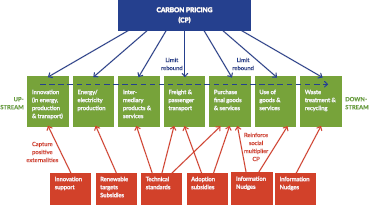
If well implemented, carbon pricing exerts a subtle control over all carbon emissions in the economy. If carbon is priced at the source of production inputs, proportional to carbon content of energy fuels, then all carbon used in the life cycle of products will be reflected in final prices, in turn steering all decisions by investors, innovators, producers, and consumers towards low-carbon options. Carbon pricing thus achieves a systemic effectiveness. Figure 3 illustrates the versatility (Baranzini et al., 2017; Dolan, 2021) and unique wide reach over emissions of carbon pricing, which is underappreciated by many critics. As opposed, alternative instruments tend to focus on one sector or one phase of the product life cycle, resulting in a much narrower reach. For example, whereas regulation through standards shifts technology adoption to lower-carbon options (which generally are not zero-emissions), carbon pricing will moderate production emissions as well as intensity of use and hence overall life-cycle emissions associated with these options. In fact, a technology standard suggests that choice or technological options can be clearly divided into clean and dirty ones. But no option is clean over its full production and life cycle. Carbon pricing recognizes and captures this better than a standard, and hence is a more subtle and accurate incentive for low-carbon behavioural changes throughout the economy.
The importance of price signals seems to be recognized by a great number of scientists and climate activists who are deeply concerned about fossil-fuel subsidies because they lower the cost and prices of fossil-fuel based activities (Sovacool, 2017). Among the critics Green (2021a) and Verbruggen (2021) express this. However, fossil-fuel subsidy reform and carbon-pricing are two sides of the same coin since both will reduce emissions through altering fossil-fuel prices. So, if you think one is important it would make sense to extend your support to the other (van den Bergh et al., 2023).
Several critics question a specific category of carbon-pricing impacts, namely on low-carbon innovation (Green, 2021a; Markard and Rosenbloom, 2020; Patt and Lilliestam, 2018; Rosenbloom et al., 2020a; Verbruggen, 2021). However, the literature on induced innovation and directed technological change provides theoretical support that higher relative prices of an input factor, whether the outcome of policy or market forces, encourage factor-saving innovation (Acemoglu, 2003; Acemoglu et al., 2012; Popp et al., 2010). The higher the price, the more such innovation is accelerated. An older literature has confirmed this empirically for the production factor energy (Newell et al., 1999; Popp, 2019). For further discussion of the empirical evidence on carbon pricing, see the section below on criticism 3.
Criticism 2: Carbon pricing causes small emissions reductions
No, this disregards cumulative threshold and rebound effects
All critics of carbon pricing suggest that carbon pricing will have small effects, with some using a particular terms like “incremental effects” (Green, 2021a; Mildenberger and Stokes, 2020; Tvinnereim and Mehling, 2018). This overlooks that cumulative cost effects due to system-wide pricing, along production chains and life cycles, will cause threshold effects in terms of decisions by energy producers, other firms and households regarding energy sources, use and conservation. Even those who stress the relevance of a system-wide perspective (Rosenbloom et al., 2020a) fail to recognize such systemic and threshold effects, instead of judging pricing as having only small or marginal effects. We were especially surprised that none of the critics give serious attention to rebound as a criterion to judge the performance of instruments. As a result, they do not consider the incapacity of their preferred instruments (e.g. sector/industrial policy, technical standards or adoption subsidies) in terms of controlling for rebound effects, nor the recognized unique role of carbon pricing — notably carbon markets — to achieve this (Font Vivanco et al., 2016; Freire-González, 2020; van den Bergh, 2011).
Total rebound includes direct rebound caused by more intense use of energy-efficient technologies, and indirect rebound due to spending money savings from energy conservation on high-carbon goods and services. Pricing energy proportionally to carbon content controls both rebound channels. For example, increased emissions due to rebound in a carbon market will be compensated through a higher carbon price triggered by the fixed cap.
Alternative instruments that critics often favour tend to score badly in this respect. Efficiency standards stimulate adoption of more efficient equipment but tend to make the use phase cheaper, which generates additional emissions (Gillingham, 2020). Only subjecting uncountable technologies, products and services to consistent standards would overcome the problem of rebound due to shifting expenditures; further complications are due to all these standards needing regular updating to keep up with technological change. Adoption subsidies perform even worse in terms of rebound as they make the adoption or purchase decision more affordable, which may spill over to more intense use (Font et al., 2021) or spending on other goods and services (Exadaktylos and van den Bergh, 2021).
A recent literature review suggests that a possible explanation for the historical close coupling between energy consumption and GDP, despite many efforts to improve energy efficiency in various sectors, is due to large economy-wide rebound effects (Brockway et al., 2021). The study finds economy-wide rebound to be around 50% or higher, meaning that policy effectiveness is more than halved if rebound effects are unaddressed. Rebound thus merits structural attention in evaluation of climate policy instruments, strengthening the case for carbon pricing. In other words, we strongly support energy-efficiency policies — especially to overcome behavioural and institutional barriers to energy conservation — as long as their rebound is adequately controlled through energy/carbon pricing. This is in line with suggestions from a recent review of energy-efficiency policies that concludes as the main concern “Rebound effects at the macro level still warrant careful policy attention, as they may be nontrivial” (Saunders et al., 2021).
Absence of carbon pricing not only increases rebound but also causes unwanted systemic effects related to renewable energy use. Two examples illustrate this. First, historical absence of carbon pricing to discourage fossil fuel use, and instead a focus on adoption subsidies to encourage renewables, has not been very effective. Over the past 50 years the average pattern across most nations of the world shows that energy use from low-carbon sources has substituted for less than one-quarter of fossil-fuel energy use and only one-tenth of fossil-fuelgenerated electricity (York, 2012), while the rest has served to meet increasing energy demand. Given that this study uses historical data, things may be better now, although one cannot be optimistic since renewables tend to be still more stimulated by subsidies than carbon pricing. Second, production-related emissions of solar PV significantly differ between technologies and countries (Liu and van den Bergh, 2020). Without carbon pricing, however, final prices of PV panels will not reflect such differences and hence users will not be stimulated to make decisions that minimize emissions over the life cycle. This problem generalizes to other energy and transport technologies, like wind turbines and electric vehicles.
In summary, carbon pricing will reap emission-reduction gains through these three channels: limiting of rebound, making sure that renewables replace rather than add to fossil fuels, and assuring that production-chain and life-cycle emissions of technologies are accounted for. Finally, a systemic perspective also requires looking at other environmental problems than climate change. In this regard, a recent system-wide study of planetary boundaries is relevant as it finds that “the case for carbon pricing globally becomes even stronger in a multiboundary world, since it can ameliorate many other planetary pressures” (Engström et al., 2020).
Criticism 3: Limited empirical evidence for emissions reduction by carbon pricing
No, critics ignore five types of evidence for emissions reduction
Most critics in Table A1 question the effectiveness of emissions reduction through carbon pricing by offering casuistic and selective evidence, ignoring evidence to the contrary. For example, Pearse and Böhm (2014) say “With no meaningful emissions reductions to show for, and evidence of regulatory failure, the track record of carbon trading is unacceptable.” In a review of the evidence, Green (2021a) suggests that the effects of carbon pricing have been marginal, but her approach stresses low prices while not recognizing that what matters for a fair comparison with other instruments (which are also weak) is price elasticities of emissions. Two other publications, a qualitative one by Verbruggen (2021) and a rather odd review by Lilliestam et al. (2021), suggest that carbon pricing does not induce innovation.
However, an expanding empirical literature demonstrates the strong potential — i.e. high emission-reduction elasticity — of carbon pricing to reduce carbon emissions and trigger low-carbon innovations, despite most implementations having low price levels (Finch and van den Bergh, 2022). Table 1 illustrates evidence from five categories of studies: reviews, multi-country, single country, international transport, and innovation.
A review of ex-post evaluations of carbon pricing finds that the vast majority pertain to EU countries and finds emission reductions of up to 1.5% annually (Green, 2021b). Low emission reductions were partly due to the first trial phase of the EU-ETS characterized by oversupply of emission permits, generating low and volatile carbon prices. Yet, a review of earlier studies by Martin et al. (2016) concluded that emissions by all regulated sectors fell around 3% in phase 1 and during the first years of phase 2, while emissions by industrial firms in France and Germany even decreased between 10% and 26% in phase 2. A study that covers phase 2 and part of phase 3 until 2016 estimates that emissions fell 3.8% (Bayer and Aklin, 2020).
Studies with a broader geographical coverage also conclude that carbon pricing significantly reduces emissions. An analysis of 142 countries over a period of two decades by Best et al. (2020) finds that average annual growth in CO2 emissions is 2% lower in countries with carbon pricing, and that a €1 per ton of CO2 reduces annual emission growth by 0.3%. A study for OECD countries by Sen and Vollebergh (2018) shows that a €1 increase in the energy tax lowers fossil fuel consumption by 0.73%. Imagine what higher carbon prices in the future, or those already observed for the EU-ETS since 2021, will achieve.
Studies of individual countries further underpin the effectiveness of carbon pricing. A carbon tax in Sweden generates annual emission reductions of 6.3% (Andersson, 2019). The carbon tax in British Columbia started at Canadian $10 in 2008 and increased to $35 in 2018, reducing CO2 emissions between 5% and 15% (Murray and Rivers, 2015), and resulting in lower gasoline and diesel usage (Bernard and Kichian, 2019; Erutku and Hildebrand, 2018). Next, Rivers and Schaufele (2015) find that a five-cent increase in this carbon tax reduces gasoline demand by 8.4%, which exceeds the effect of a similar regular gasoline price increase because of high saliency of the tax. Another study assesses that a weak carbon price in Germany, of on average €8 per ton CO2, led to 10% average carbon emission reduction in the power sector, while a higher price of on average €20 per ton CO2 in the UK reduced emissions by 31% (Gugler et al., 2021). It further derives for Germany that carbon pricing results in 74% and 94% lower costs than renewable energy subsidies — for wind and solar, respectively — to abate an additional ton of CO2. Comparing instruments used in Switzerland, Hintermann and Zarkovic (2021) identify similar pollution abatement for plants regulated by the Swiss emissions trading system relative to plants receiving an abatement subsidy, even though the ETS price is an order of magnitude lower than the subsidy. A study for the UK finds that the carbon tax reduced power sector emissions by 6.2% between 2013 and 2016 (Abrell et al., 2022). Another study assesses higher emissions reduction, namely 20% to 26% annually for 2013-2017 (Leroutier, 2022). The reason is it also captured power-plant closure. A new empirical study for the period 1997-2017 finds that carbon pricing has been even the most effective instrument to reduce emissions in the USA (Szasz, 2023).
Several studies show carbon pricing to effectively reduce emissions from international transport. One uses changes in bunker prices for maritime trade, which relate to fuel costs, to estimate relationships with international product trade and associated emissions. It finds that introducing a carbon tax of $40 would reduce emissions from maritime trade by 7.65% (Mundaca et al., 2021). Since 2012 the EU-ETS includes emissions from aviation, which made airlines reduce emissions by 4.7% on average, mainly achieved through a reduction in flights of 4.9% (Fageda and Teixidó, 2022).
Lilliestam et al. (2021) review the literature on innovation impacts and claim that carbon pricing is not effective. It further suggests that innovation stimulated by carbon pricing has tended to be more incremental, whereas deeper innovation may require more targeted policies. An evaluation of their study, however, detected several errors, omissions and biases, concluding that the evidence shows carbon pricing actually induces low-carbon innovation (van den Bergh and Savin, 2021, 2023). This is in line with another, more thorough review (Grubb et al., 2021, p. 36) which concludes: “Given the unambiguous finding that market-wide prices do generally influence patents, the case for carbon pricing is enhanced further, in light of the push it may give to low-carbon innovation, amplified with path dependency (as found in the modelling review cited above).” Regarding the choice between innovation subsidies and carbon pricing, Hart (2019) presents a fundamental model with directed technological change in the energy sector, finding that emissions taxes are far more important than research subsidies: a regulator unable to tax can only achieve 36% of potential benefits, whereas a regulator unable to subsidize can achieve 91% of potential benefits. Still, we do not want to claim that carbon pricing is the major instrument to trigger or direct innovation. We just think that many observers underestimate that innovation may be easily misguided without having correct prices (i.e. including carbon pricing).
Despite low carbon prices, one study finds that low-carbon innovations increased by 10% among firms that faced EU-ETS regulations compared with firms not covered by the EU-ETS (Calel and Deche- zleprétre, 2016). Another analysed innovation in response to price signals using a firm-level panel data set across 80 countries that spans several decades (Aghion et al., 2016). It finds that firms innovate more towards clean technologies in countries with higher fuel prices inclusive of taxes. Popp (2002) studied more than two decades of US patent applications, discovering that higher energy prices — through which carbon pricing will exert its effect — were associated with more patent applications for clean technologies. See also a broader recent review of relevant studies in this vein (Popp, 2019).
Several factors may explain critics’ negative perceptions of the empirical evidence (van den Bergh and Savin, 2021): they have unrealistically high expectations about emission reductions from low carbon prices; they incorrectly equate small emission-reduction effects with statistically insignificant effects; they downplay that small effects under low prices can translate to large emission reduction if prices are raised; and they overlook that constant (or increasing) emissions do not mean emissions were not reduced as without carbon pricing they might have increased (or increased more).
Criticism 4: Carbon pricing cannot achieve deep decarbonization
No, overlooks the weight of previous counterarguments and additional arguments
Several critics suggest carbon pricing is of limited relevance to achieve “deep/radical decarbonization” (Green, 2021a; Mildenberger and Stokes, 2020; Patt and Lilliestam, 2018; Pearse and Böhm, 2014; Rosenbloom et al., 2020a; Tvinnereim and Mehling, 2018). For instance, Tvinnereim and Mehling (2018) state “To date, there is little evidence that carbon pricing has produced deep emission reductions, even at high prices.” Mildenberger and Stokes (2020) refer to “deep emission reductions” and “technology phase-outs” while Green (2021a) talks about “we need to think bigger” and “aggressive climate policy”. This all overlooks that quick deep decarbonization is impossible anyway, regardless of the climate policy, for three reasons: low-carbon innovation and diffusion processes take time; construction of 100% renewable energy infrastructure requires not only considerable time but also many fossil-fuel inputs; and radical cuts in fossil fuel use will be extremely costly and risky, both economically and socially, and hence politically infeasible. Accordingly, the best one can hope for is gradual, but steady, emissions reduction. It is populistic to suggest otherwise (see also the discussion on bans related to Figure 4, under criticism 7).
Rosenbloom et al. (2020a) state that carbon pricing cannot transform systems without offering any proof of this. They fail to recognize that purchase and use decisions by consumers and firms, investors and innovators in all sectors are affected by a serious carbon price. They also neglect that carbon pricing is critical to innovations, as it steers these towards low-carbon options (products and processes), because private investors are driven by price expectations which codetermine profit expectations (Calel and Dechezlepretre, 2016). Furthermore, unlike other instruments, carbon pricing encourages among low-carbon technologies the lowest-carbon ones, include solar photovoltaic panels and electric vehicles with low-carbon life cycles (Liu and van den Bergh, 2020).
Some critics go as far as claiming that carbon pricing is not even essential to deep decarbonization (Mildenberger and Stokes, 2020; Patt and Lilliestam, 2018). Instead, some have pled in favour of divestment, but mainly on the basis of moral arguments — which has not had much impact on actual investments (Braungardt et al., 2019). It is, however, best achieved by increasing the costs and hence lowering the net benefits of fossil-fuel based project and activities. Carbon pricing is the best way to achieve this, as it will assure the net benefits reflect carbon emissions over the whole life cycle of related goods and services. Carbon pricing is therefore uniquely capable of controlling indirect emissions, which matter equally and sometimes even more than direct emissions for deep decarbonization. Moreover, since carbon pricing encourages many changes in the economy simultaneously, if implemented well, it guarantees a large overall effect on emissions reduction. All critics seem to underestimate this.
Altogether, carbon prices are critical to deep decarbonization. They provide a continuous financial incentive for low-carbon choices, they limit energy/carbon rebound, and they trigger domino effects through demand–supply interactions. One can expect that a sufficiently high carbon price will activate a social tipping point (Otto et al., 2020), triggering low-carbon choices throughout the system. For discussions of how deep decarbonization can be enhanced by specific designs of a carbon tax and market see Kaufman et al. (2020) and Dolan (2021).
While it is often said that to achieve deep decarbonization we need demand-side next to supply-side regulation (Creutzig et al., 2018), it is insufficiently recognized by the critics that carbon pricing simultaneously triggers changes in supply and demand. In fact, carbon pricing results in balancing changes throughout the life cycle (Figure 3): if firms do not achieve sufficient emissions reduction in production phases, the carbon price will translate in more expensive final goods and services with high-carbon content, which automatically will discourage demand for them. Such a balancing effect is not achieved with alternative instruments, such as subsidies and technological or product standards, as firms then only pass through the cost of their own abatement processes but not any embodied carbon emissions. In addition, many other demand-oriented strategies run the risk of leading to psychological spillovers and rebound, with limited overall effectiveness on emission reduction (Exadaktylos and van den Bergh, 2021; Sorrell et al., 2020). Their effectiveness will considerably gain from having carbon pricing in place. Hence, carbon pricing is critical for deep decarbonization.
Criticism 5: Carbon pricing is inequitable
No, unlike other instruments revenues generated by carbon pricing can compensate inequity
A recurring concern about carbon taxes is that they are inequitable as they harm low-income households. In this regard, Lejano et al. (2020) study emissions from refineries participating in California’s cap-and-trade program to test if “carbon trading can have unanticipated disequities” as “emitters are disproportionately sited in so-called environmental justice communities”. It is not clear, though, that this is a main issue underlying inequity and it lacks a serious analysis to underpin its bold statements and strong language (“hotspots” of “air toxics”) — notice its disclaimer “we do not include any tests of statistical significance for such a small sample size.” We would further argue that the fundamental reason for any “problem shifting” is not “carbon trading” but lack of effective environmental policies on local air pollution. Mildenberger and Stokes (2020) also point at justice and income inequality when discussing carbon pricing, noting “We cannot raise the cost of energy for millions of underpaid Americans — many of whom are Black and indigenous — and expect the policy to stick.” They recognize revenue use to compensate low-income households (“dividend” in the US context) but express themselves pessimistic about this: “Carbon price and dividend gives greater attention to the politics of climate policy than earlier approaches, but it still struggles to make the benefits more salient than the costs.”, without offering any evidence.
Considering the empirical evidence, one finding is that carbon pricing tends to be progressive in low-income countries, and regressive in only some high-income countries (Dorband et al., 2019; Ohlendorf et al., 2021). A recent study for Europe finds mostly neutral or progressive impacts at the country level (Feindt et al., 2021). More importantly, it is now widely accepted that regressive effects can be avoided through using carbon-pricing revenues to compensate low-income households (Klenert et al., 2018).1 This holds true for both developed countries such as the USA (Goulder et al., 2019) and developing countries (Steckel et al., 2021), where such redistribution may alleviate extreme poverty (Budolf-son et al., 2021; Soergel et al., 2021). Nevertheless, full compensation is complicated, for instance, because insulation costs highly vary per building type, which implies that well-targeted compensation is needed to offset high costs for low-income households (Kröger et al., 2023). This could increase political support in a way that is hard to realize with instruments like technical standards or adoption subsidies, since these do not generate revenues while still causing inequitable effects.
Several studies illustrate this. A survey among 4,997 residents from five countries, including the USA, finds net support in all countries for implementing a high carbon tax if its revenues are redistributed back to citizens (Carattini et al., 2019). In addition, experimental evidence shows that carbon pricing garners support if it is implemented upstream and voters are made aware of its cost-effectiveness — two strategies recommended by economists (Hardisty et al., 2019; Hagmann and Loewenstein, 2019). Ex-post studies further find modest positive impacts of carbon tax rebates on public support (Mildenberger et al., 2022).
It is relevant that carbon pricing is designed to be consistent with equitable outcomes not only for ethical reasons but also for political feasibility. If carbon pricing is designed with this aim, it can contribute to increasing political support. Indeed, a review indicates that if people perceive carbon pricing instruments as fair, this increases policy acceptability and support. Indicating that revenues will be combined for support of vulnerable groups and environmental projects, such as renewable energy, increases policy acceptability most (Maestre-Andrés et al., 2019).
In a study for Sweden, Jagers et al. (2019) use a large-scale (N = 5000) randomized survey experiment about a suggested increase of the carbon tax on petrol to examine how perceptions of a policy’s distributional effects influence policy support. It finds that for those with right-wing ideals a combination of a tax and a compensatory scheme may increase climate policy support, while left-oriented individuals tend to increase support for a carbon tax without compensation.” Based on a study of Ontario, Canada, Raymond (2020) concludes that to reduce vulnerability of carbon pricing policies to populist attacks considering well the design of carbon revenue and carefully explaining the policy mechanism can help building public support. It is more likely that very strict standards or bans, not implemented so far, will create public and political resistance than carbon pricing if the latter impacts are designed to be less visible and diffuse, permeating throughout the economic system. In addition, charging upstream (fossil fuels) rather than producers and final consumers may lead to more support — witness how many people become emotional about and resistant to fossil fuel subsidies (a “negative carbon price”) which is often perceived as benefitting mostly “big oil”. Finally, Fremstad et al. (2022) present a “carbon tax calculator” to provide residents in the USA and Switzerland with personalized estimates of the financial costs and benefits associated with carbon pricing policies. They find that rebates increase public support for carbon taxes in both countries by building support among lower income groups. For the USA, they identify majority support for both low ($50/tCO2) and high ($230/tCO2) carbon taxes in the presence of rebates. In addition, they tested “political messages about carbon pricing” which dampened the increase. This suggests that both rebates and information matter.
Finally, while the suggestion of inequity is quickly invoked in the context of carbon pricing, one should realize that other instruments – if effective – also will increase the cost of life for low-income households. Moreover, adoption subsidies such as on rooftop solar-PV or electric vehicles mainly benefit well-off households.
Criticism 6: Carbon pricing enjoys little political support
No, many and some successful carbon-pricing initiatives worldwide
Most critics in Table A1 question the political feasibility of carbon pricing in general or at a more stringent level. Much pessimism about implementing carbon pricing arises from the USA (Cullenward and Victor, 2020), where unlike in the EU and China, policymakers have generally found it more difficult to garner political support for any climate policy. According to Mildenberger and Stokes (2020) the key problem is lobbying power: “Big carbon polluters — fossil fuel companies, electric utilities, automakers, petrochemical companies, and other heavy industries — have used their structural power to receive policy exemptions” — which represents more the situation in the USA than in the EU. The authors add that “Carbon pricing puts the cart before the horse: we need to disrupt the political power of carbon polluters before we can meaningfully reshape economic incentives.” Fine, we agree, but this is not unique to carbon pricing — it equally holds true if one wants to implement ambitious standards or bans. In summary, the pessimism conveyed by some critics is given in by the US situation and ignores both success outside the USA, advantages of carbon pricing for the USA (Metcalf, 2019), and similar barriers for ambitious standards or bans. Moreover, pointing at negative examples offers no proof; one positive large-scale counter-example like EU-ETS is sufficient reason for optimism — one can learn from it about which conditions need to hold to guarantee success, namely supranational design (more politically stable) and gradual increase of stringency over multiple phases (to get critical support initially and maintain it).
According to another critic, Ball (2018a,b), “A meaningful carbon price would help . . . but in most of the world there is little evidence policymakers have the stomach to impose one.” This may hold true for a carbon tax, which means an explicit price or cost that is visible to all stakeholders. But an emissions trading system does not set a price beforehand while its price may gradually go up over time once the system is implemented (e.g. by lowering the cap). Again, witness the history of the EU-ETS leading to high current carbon prices. This suggests that it may be politically easier to achieve support for an ETS than for a tax. In addition, an ETS has proven to be easier expanded and harmonized internationally (as shown by the history of the EU- ETS), contributing to overcoming political resistance associated with concerns about competitiveness losses in non-member countries.
Nuancing the so-called unpopularity of carbon pricing is the steadily rising number of carbon pricing initiatives around the world, covering both developed and developing countries (World Bank Group, 2023). Moreover, the largest carbon market in the world, EU-ETS, showed sharply increasing prices during past years (Figure 2), while prices of various other carbon markets have also steadily increased over time (e.g. California-Quebec, New Zealand, and Switzerland). A review of carbon markets finds that countries are learning from each other on implementation, and that systems tend to become more robust over time (Narassimhan et al., 2018). Some have argued based on low or fluctuating carbon prices in the past that carbon markets have little future (Bang et al., 2017; Cullenward and Coghlan, 2016; Green, 2017) — instead of waiting for them to evolve over time or advising improvement toward better their design. Such overhasty criticism is outdated and overtaken by the new reality, that is, important carbon markets generating stable and high prices.
While non-price instruments with a weak regulatory effect have seen considerably implementation, it is not obvious that their implementation at a stringent level can count on more voter and political support than stringent carbon pricing. One can doubt this, as sector and technology regulation offer clearer opportunities for lobbyists to negotiate easements and exceptions than multi-sectoral carbon pricing, where the influence of a sector-specific lobby group will be smaller and countered by many other interests. According to Mildenberger and Stokes (2020), “University of California San Diego climate scientist Kate Ricke and colleagues estimate this social cost could be a staggering $417 per tonne. No carbon price in the world comes close to that number.” But they forget to mention that no implicit carbon price of standards comes close to this number either. In fact, comprehensive implicit carbon prices of all major policies (including pricing, carbon taxes, emissions trading systems, fossil fuel taxes, fossil fuel subsidies, renewable portfolio standards, feed-in tariffs, and low-carbon fuel standards) in 25 high- polluting countries that represent 82% of global CO2 emissions in 2019 indicate a very weak average policy of 19.13 US$ in 2019, which moreover has only doubled in a decade time (Carhart et al., 2022). Against this background Kallbekken (2022) argues that research on public support for stringent climate policies of all types, not just carbon pricing, must broaden its scope. Moreover, resistance to carbon pricing by firm lobbies is weakening, even in the notorious US oil industry (Schmalensee and Schoenbrod, 2021), while Europe’s six largest oil and gas producers several years ago already advocated an ambitious carbon price (Grey, 2018).
Some would argue that the yellow-vest protests in France during 2018 and 2019 undercut the case for carbon pricing. But this resistance was in essence caused by bad design, notably cancelling a wealth tax for rich instead of recycling of revenues to those most affected economically by the new tax. A recent survey study of the case concludes, based on press and social media reviews, interviews, and participatory observation, that “Participants are not necessarily against carbon taxes; they are against the specific French tax.” (Mehleb et al., 2021). So the lesson is not to give up on carbon pricing and to design carbon taxation always with a clear equity compensation scheme. Another study finds that yellow-vest protesters overestimated net monetary losses, and wrongly thought that the policy was regressive and environmentally ineffective. They show that changing people’s beliefs through informational treatments substantially increases support (Douenne and Fabre, 2020).
A book by Rabe (2018) provides a balanced account of the diverse political processes and experiences with carbon pricing around the world. By considering the complete policy cycle, it shows that one cannot generalize and that next to negative there are many positive stories to tell. The overall conclusion drawn is that carbon pricing can be both feasible and durable if we draw lessons from the successful examples. Of course, one cannot generalize: a comparative study finds that countries with coal reserves and high rates of corruption tend to be more resistant (Best and Zhang, 2020).
Political feasibility is anyway best judged for a rising scheme of carbon pricing rather than for an immediate high carbon price. Policy support can then evolve gradually, especially when voters and politicians see that weak economy-wide carbon prices already reduce emissions while not generating huge costs (Konc et al., 2022). This finds support from experiences in British Columbia, where survey research showed increasing acceptance of the carbon tax (Murray and Rivers, 2015). For long-term support it is also important that negative economic impacts are limited. In this regard, Haites et al. (2023) note that “Carbon pricing is a critical component of each package due its ability to minimize the risk of adverse economic impacts on domestic industry, support innovation and generate revenue”. Wills et al. (2022) provide evidence in this regard for Brazil, namely that carbon pricing will here work out the best for income and employment.
It is further important to consider climate policy in a global context. Given free riding and competitiveness concerns (see also the section on criticism 8 below), it seems unlikely to achieve strong policies worldwide without harmonization, or some degree of coordination, of national policies. Three mechanisms are widely seen as critical for achieving global collective action: (1) border carbon adjustment (BCA) tariffs (Böhringer et al., 2022); (2) an expanding coalition or club of the most ambitious countries (Cramton et al., 2017, 2015; Hovi et al., 2017; Nordhaus, 2015, 2021); and (3) a transition phase with temporarily different but ultimately convergent carbon prices in developed and developing countries (van den Bergh et al., 2020), possibly combined with international financial transfers (Bauer et al., 2020; Chichilnisky and Heal, 1994; Shiell, 2003).
These are not just theoretical ideas — the EU has already decided to implement a BCA mechanism that charges a levy on the carbon contents of imports based on the carbon price differential between the exporting country and the EU (European Commission, 2021a). Since BCA for non-pricing instruments, such as technical standards, is difficult to assess and motivate, such instruments will be more sensitive to differences in international competitiveness and carbon leakage. As opposed, carbon pricing makes it easier to address import-related emissions, which means acting according to consumer and extended producer responsibilities for climate change (Lenzen et al., 2007). In addition, carbon pricing has been argued to offer the most simple and transparent policy approach to achieve international harmonization (Weitzman, 2014, 2017), and allowing also co-benefits to be accounted for (Edenhofer, 2015). Witness in this respect that the EU-ETS has harmonized policies of 30 countries, whereas no similar example of such broad-scale harmonization exists for other instruments.
A study by Skovgaard et al. (2019) classified 66 adopted policies of carbon pricing into five clusters: early adopters, North-American subnational entities, Chinese pilot provinces, second-wave developed polities, and second-wave developing polities. The authors conclude that the reasons for adopting carbon pricing have shifted over time from domestic to international factors. This further supports the belief that there is opportunity for expanding carbon pricing around the globe. Another comparative study is Gulbrandsen et al. (2019) which finds substantial divergence in the design and implementation across the nine systems examined, This might hamper diffusion or it might through competition and comparison clarify which system functions best — in turn stimulating its diffusion.
One reviewer suggested that trust in the government issues merit attention. A recent study by Kitt et al. (2021) for Canada discusses the role of trust in citizen acceptance of climate policy. They find that “Perceptions of national government competence” is a trust variable that is positively associated with support for all five policies tested (carbon tax, electric vehicle purchase subsidies, and three types of regulation — a low-carbon fuel standard, a vehicle-emissions standard and a zero-emissions vehicle sales mandate). Other forms of trust are not consistently associated with policy support, except for carbon pricing, where trust in the national government’s level of integrity (i.e. honesty, openness, and intention to act in the best interest of the public) and perceived value similarity are positively associated with support. This suggests creating trust is important for effective and stringent climate policy. Another study by Rhodes et al. (2017), also for Canada, finds that trust in governments influences support for the carbon tax, which they attribute to the government’s direct responsibility for the collection and use of tax revenues. This suggests the relevance of clarifying beforehand the nature of the revenue scheme associated with a carbon-pricing proposal, such as that labour taxes will be lowered in general or only or more so for low-income households.
Criticism 7: Carbon pricing performs worse than other instruments
No, alternatives perform worse on key criteria
Much of the unfounded criticism on carbon pricing lacks a thorough comparison with other instruments. Evidently, no instrument is perfect, and it is always easy to stress absolute shortcomings. Therefore, it is important to assess how instruments perform relative to alternatives. To this end, Table 2 summarizes theoretical and empirical insights about four key instrument categories, provided these are all correctly implemented. In other words, the table is not about imperfectly implemented instruments (whether standards or carbon taxes) due to political barriers or misunderstanding of good policy design. The finding of the table is that carbon pricing, if implemented in line with textbook advice (i.e. on carbon in fossil fuels when they come out of the ground or are imported), performs best on four important criteria2: effectiveness (considering system-wide effects, purchase and use, demand and supply, and rebound effects), efficiency (selecting affordable solutions, minimizing economic harm like unemployment), equitability (including revenues to compensate inequity), and international harmonization (allowing stringent national policies). This is quite an achievement and merits more attention and enthusiasm in climate policy advice. It can help to create agreement among climate policy researchers so that they can provide more uniform and consistent advice to policymakers about the pros and cons of instruments of climate policy. Surprisingly, such agreement is currently lacking, which likely contributes to confusion about best instrument choices in policy circles.
One might argue that instruments like a prohibition, ban or net-zero emissions target are more effective in emissions reduction than carbon pricing. But they apply generally only to new products or new entrants, while carbon pricing applies to all products and incumbents as well. Adopting a system-wide perspective, one should notice that a ban on some high-carbon option, moreover, will usually involve a shift to some other option which will not be zero-carbon — this even holds for phasing out coal for electricity generation, which in many cases will lead to more use of gas. Having carbon pricing in place will encourage shifts to the lowest-carbon option as they will be relatively cheap.
Moreover, within the context of climate policy bans tend to take the form of future prohibitions — witness promises since the Paris Agreement by various countries, notably with respect to outlawing the sales of fossil fuel cars around 2040 (Plumer and Tabuchi, 2021). Among the critics, Tvinnereim and Mehling (2018) strongly suggest that reaching agreed climate targets requires zero net greenhouse gas emissions. While such future bans are not very effective in the short run and could turn out to be cheap talk in the longer run, the alternative of immediate bans is highly unrealistic, costly and inconsistent with a liberal society. Figure 4 illustrates the uncertainty about cumulative emissions under a future ban, by comparing scenarios of no, moderate and high carbon pricing. A future ban on its own turns out to be no guarantee for sufficient emissions reduction. Total cumulative emissions are highly uncertain — i.e. very different outcomes are possible — while the target may not even be reached in time.
The critics do not offer very convincing alternative policies, neither in terms of effective emissions reduction nor political feasibility. Several suggest industrial policy, some combination of innovation policy and sector-specific support, as an alternative to carbon pricing (Cullenward and Victor, 2020). But this suffers from various shortcomings: it represents non-systemic policy (Figure 3); it ignores the strong connection of sector lobbying with sector-specific instruments; it conflicts with antitrust legislation (e.g. the EU is very restrictive about industrial support); and it overlooks that support through subsidies or otherwise tends to magnify rebound. Moreover, if industrial policy translates in unequal regulatory pressure across industries, sectors and countries — which is likely — it will lead to carbon leakage and excessive costs of emissions reduction (Bauman, 2021; Weil, 2021).
When talking about their proposed alternative policies, many critics do not mention concrete instruments but vague terms like declining or cutting high-carbon sectors. For example, Rosenbloom et al. (2020a) refer to changes in production or household sectors (e.g. “restoring peat-lands”, “mobility-as-a-service”, “biobased materials”) without specifying how these can be achieved by concrete policies. They suggest that we need so-called “decline policies”, a new and unclear term, the difference of which with traditional “regulatory policy” remains unclear. As if this is not enough, in their rejoinder to a response by van den Bergh and Botzen (2021), they mention another cryptic term, namely “green industrial policy” (Rosenbloom et al., 2020b). All this terminology is not very helpful, but typical of many of the critics. They also never clarify how carbon pricing, which they say may be part of the policy mix, exactly plays a role in their “decline policy”. Avoiding saying anything (specific) about the role of carbon pricing is typical of the broader research on sustainability transitions. This field surprisingly suggest that we can achieve the transition without a major role for regulation and pricing (van den Bergh and Botzen, 2023).
Many critics suggest, without detailed analysis, that we need a policy mix (Markard and Rosenbloom, 2020; Tvinnereim and Mehling, 2018). This often comes down to giving little weight to pricing instruments or not clarifying well how instruments complement each other. While other instrument types cannot substitute for the role of carbon pricing in climate policy (Figure 3, Table 2), they can be synergistic with, pricing. For instance, information provision can create, through social network interactions, a social multiplier of carbon pricing (Konc et al., 2021). On its own, however, information provision has a disappointing effectiveness: namely, in the range of 5%–10% emissions reduction (Delmas et al., 2013). In addition, innovation support in the policy mix, such as through R&D subsidies, will capture positive externalities and knowledge spillovers that are not addressed by carbon pricing, nor by standards or adoption subsidies (Fischer and Newell, 2008; Jaffe et al., 2005). In addition, it is worthwhile to mention the insight from Acemoglu et al. (2012) that optimal regulation involves not too high carbon prices if research subsidies are able to redirect innovation to clean technologies before there is extensive climate damage. The complementary role of such instruments is part of a wider discussion of multiple equilibria, path-dependence and technological lock-in due to increasing returns to scale. To enforce quicker and radical changes, one response is higher-than-Pigouvian carbon prices. Alternatively, many authors have proposed other instruments to counter short-term selection pressure against promising but still immature and expensive technologies and creating so-called “social tipping points” (Geels et al., 2017; Seto et al., 2016; van den Bergh, 2013; van der Ploeg and Venables, 2023). Examples of strategies are information provision, setting a clear future goal (e.g. California’s ZEV program), creating semi-protected niches (e.g. with public subsidies) and public procurement (governments buying low-carbon products). The evidence that these are very effective is meagre. In addition, one could think of restricting advertising for the sake of climate mitigation, about which there are still few studies (Castro-Santa et al., 2023; Gsottbauer and van den Bergh, 2014).
According to the High-Level Commission on Carbon Prices, a good guide for additional policies is to see if they tackle market failures besides carbon dioxide externalities (HLCCP, 2017). Another concern is stranded assets due to irreversible investments by firms. If informed by correct carbon pricing — which changes cost/benefit ratios of investment — this undesirable consequence of investments can be avoided. But as long as high carbon prices are not feasible, additional instruments such as mandates may be helpful (Rozenberg et al., 2020). But one must realize that this is a second-best solution in many cases which should not stop one from fighting for higher carbon prices (or tighter caps in carbon markets). In addition, while some think that standards or subsidies on vehicles, or other energy-using technical equipment, are a good alternative to carbon pricing, one should realize that they only affect adoption and thus need to be complemented with carbon pricing to avoid rebound through more intense use and shifts in spending.
What has received little attention in the literature, however, is that a complex climate policy package has three main disadvantages. First, with many instruments negative synergy is more likely, such as renewable energy targets or standards triggering expensive emission reduction options which then drive out cheaper ones in carbon markets (Fankhauser et al., 2010; van den Bergh et al., 2021). The reason is that such targets — as well as standards or bans — when applied to activities falling already under a carbon market merely imply that emissions permits are freed up and sold on the market, resulting in additional emissions elsewhere. In this case, a carbon market on its own is better, or a combination of carbon taxes (i.e. a fixed carbon price) with sector targets. Second, a rich policy mix with many instruments might frustrate comparison and harmonization among countries, thus — paradoxically — be unable to achieve high ambition or stringency, which results in disappointing emissions reduction. Third, if with a complex policy mix the intended effects on emission is disappointing it may be unclear which instrument has to become more stringent.
Criticism 8: Sectoral and unilateral policy are better than uniform carbon pricing
No, carbon pricing is best able to harmonize incentives (inter)nationally, which limits free riding
The critics do not ask the hard question: why has stopping climate change turned out to be so difficult? There are three main factors which interact: (1) an economy depending on high use of fossil-fuel energy; (2) a zero-carbon substitute not being immediately available but taking a long trajectory of investment and innovation; and (3) climate being a global public good characterized by non-rivalry and non-excludability which triggers free riding regarding emissions reduction. The latter is the main reason why many alternatives proposed by critics of carbon pricing will not work: they do not overcome the free-riding problem. It is important to realize that free riding is present at the level of households, firms, and countries. It is, moreover, magnified by there being so many countries in the world (namely, 195). Past climate negotiations illustrate free riding; according to one expert on the study of negotiations, the “disjunction between what countries say and what they do has been repeated every year since the first summit in 1995” (Barrett, 2018). In fact, solving climate change might well be the most challenging collective action problem humans have ever faced. In this light, it is hardly surprising that the Paris Agreement has not overcome free riding; indeed, it is characterized by a huge diversity of voluntary pledges (NDCs — nationally determined contributions), whereas to be effective it should have taken the form of a binding agreement with compliance through punishment and policy harmonization, for three reasons: first, because uniform policies guarantee consistent incentives or identical marginal costs of abatement and hence lowest total costs of global emission reduction (which are bound to be considerable); secondly, because uniform policies do not create competitive advantages due to climate policy for some countries; and third, arguably most importantly in a global setting, with a uniform policy countries do not have to fear a gradual strengthening of it as all economies will be affected in the same manner, and hence no one’s competitive position will be eroded in the long run — in other words a level playing field is guaranteed.
If climate were a private good owned by one country, a quick government solution to climate change would be feasible as national benefits would be worth the cost. But with climate as a global public good, any national sacrifices to reduce emissions are not balanced by national benefits since the public-good benefits fall mainly onto others. The rational strategy of governments is then free riding, and this is what we see all around us: vague promises including long-term zero-emission targets but weak regulation and pricing — the two policies that really matter for achieving emissions reduction.
Any genuine and effective solution to climate change needs thus to limit free riding among countries. Sectoral and unilateral policy will fall short. At best we can expect weak climate policies out of fear to harm one’s competitive position and economic growth. Still, various critics prefer a sector-specific over a universal approach (Ball, 2018a,b; Cullenward and Victor, 2020; Mildenberger and Stokes, 2020; Patt and Lilliestam, 2018; Rosenbloom et al., 2020a; Tvinnereim and Mehling, 2018). However, a sector-specific approach tends to be ad hoc, costly, and susceptible to lobbying, while causing intersectoral carbon leakage. Some critics suggest a major role for policies aimed at the energy sector, including government or public investments and adoption subsidies (Markard and Rosenbloom, 2020; Tvinnereim and Mehling, 2018; Verbruggen, 2021). Regarding public investment, this overlooks the cost of the needed investment renewables which mainly depends on private investors; regarding adoption subsidies, pricing the high-carbon option is better as it equally closes the gap between prices of low-and high- carbon alternatives, but by punishing the polluter and not rewarding the adopter. Subsidies easily lead to expansion of energy use rather than substitution of high- by low-carbon options (York, 2012).
Overcoming free riding is only possible through some form of collective action among countries that assures consistent policies first between countries and subsequently between households, firms, and sectors in countries (and hence among competitive sectors in distinct countries). To achieve this, there exist basically three options: (1) a global government, (2) an effective international agreement, and (3) an (expanding) climate club. The first option is out of the question and the second is disproven by the Paris Agreement. In particular, the problem of a global agreement involving all countries is that interests diverge too much, notably between rich/poor and fossil-fuel importing/exporting countries. Thus remains the third option of a climate club as the most promising option, especially when developed around an instrument that easily allows for supra-national harmonization, such as carbon pricing (Nordhaus, 2015; van den Bergh et al., 2020).
It is fair to say that there have been efforts to counter the argument that climate solutions are a public good and hence sensitive to free riding. This has even resulted in denial of the need for collective action and the belief that unilateral policy can be sufficient (Aklin and Mildenberger, 2020). This is a quite bold position, as it implies that the logic has been wrong for decades in several disciplines (economics, psychology, political science), where the two classic examples of a public good and free riding have been military defence and climate. “Distributive conflicts” provides a better policy framework according to these authors, but this overlooks that solving inequity will not undo the public-good nature of climate. Inequities merely add asymmetry to the challenge, making a solution more difficult. In particular, global inequity reinforces free riding in negotiations as sacrifices for poor nations are relatively high. National inequity may, moreover, reinforce resistance to implementing effective policies within a country, in turn reinforcing free riding by their government at the global scale.
One study provides as evidence that the UK achieved 9.8% emissions reduction due to unilateral policy (Lépissier and Mildenberger, 2021) — but this overlooks that marginal abatement costs will increase for higher emissions reduction, inviting for free riding on deep decarbonization strategies. Another study by Beiser-McGrath and Bernauer (2019) concludes positively about unilateral policy through assessing stated preferences by citizens from the USA and China. However, revealed preferences of citizens (i.e. votes) and politicians (actual policy implementation) provide a very distinct signal, namely to not expect much from unilateral solutions. It is, moreover, cynical to refer to opinions of citizens in the case of China given that its policies lack a democratic basis.
All in all, our conclusion is that denial of free riding and of the need for global policy harmonization lacks any theoretical and empirical basis. It will not bring effective climate solutions nearer — rather the opposite. It will also lead to inconsistent regulatory pressure (i.e. implicit carbon prices) between sectors and countries, and thus intersectoral and intercountry emissions leakage. Carbon pricing offers the best guarantee for overcoming free riding between all actors at all levels.
3 Conclusions
Our overall assessment indicates that the critics do not offer compelling arguments against carbon pricing (Figure 1). They show little concern for the systemic effectiveness of climate policy, and incorrectly think that efficiency is a more important feature of carbon pricing than its effectiveness. It is especially remarkable that all the critics question the effectiveness of carbon pricing in reducing emissions and triggering low-carbon innovation, but overlook the already rich and diverse empirical literature providing evidence to the contrary. Moreover, they overstate political barriers for carbon pricing, while conveniently ignoring that all stringent climate policy, regardless of the instrument, has turned out politically difficult. We further find that the critics focus too much on absolute features of carbon pricing without comparing and judging these fairly in a broader instrumental setting. In fact, many critics hold carbon pricing to a higher standard than their preferred alternative policy or strategy. Some critics think carbon pricing merits a modest role in the climate-policy mix, whereas most propose discarding it — without offering an alternative that is proven to perform better — instead of fighting for better implementation of it.
Regarding the sources of criticisms, we find that many critics do not show a good and complete knowledge of the relevant theoretical and empirical literature on carbon pricing nor of studies that rigorously and systematically compare instruments of climate policy. This is why our article provided insight into these issues, which may facilitate a more informed debate with those sceptical of carbon pricing. We find it quite surprising and even worrisome that most of these authors, who may be seen as climate-policy experts by many laypersons, do not mention unique, complementary features and advantages of carbon pricing — reflecting an overly ideological and dogmatic viewpoint (consistent with a wider irrational resistance against pricing in the social sciences and society at large, as documented by Frey, 1986). Instead, we as strong proponents of carbon pricing are focused on comparing instruments systematically which results in talking positively about the role of certain other instruments as we recognize their complementary role.
A recurring argument of critics, namely that carbon pricing lacks sufficient political support, overlooks that unfounded criticism can in fact weaken such support. We would suggest critics to consider fighting for better implementation of, and creating more support for, carbon pricing rather than succumb to non-systemic and thus ineffective instruments. In this regard, the critics may want to look into the large body of theory and evidence on climate policy to find that the main alternatives they propose, innovation and industrial policy (third column in Table A1), are not substitutes for carbon pricing but at best complements? Finally, we would recommend participants in the debate on carbon pricing to be explicit about the key criteria they employ as well as how they exactly compare the performance of distinct instruments on these. Our own view on this was summarized in Table 2, which may serve as a starting point for future debate on this.
Current disagreement in academia about the relative performance of different policy instruments on the various criteria (or even disagreement about which criteria are relevant) hampers political feasibility of strong and effective climate policy. Imagine medical doctors would disagree about the best medicines and treatments for diseases, or how to evaluate this — then the government would not know where to focus health investments, likely resulting in resistance to effective treatments being larger than currently. Similarly, politicians are confused and have been given too much freedom regarding climate policy choices because the experts have provided inconsistent advice. Unfounded criticism on carbon pricing adds to the confusion and will erode political support for effective climate policy.
To counter unfounded criticism against carbon pricing, economists might motivate carbon pricing using a broader set of arguments. Among others, it would be wise to stress more that its aim is not generating public revenues but changing behaviours towards low-carbon choices, namely by altering relative prices of high- and low-carbon alternatives in the entire economy. Many non-economists and laypersons insufficiently recognize this, and instead believe that critical to emissions reduction is spending carbon-pricing revenues on so-called “climate projects” (Maestre-Andrés et al., 2021). Moreover, economists’ emphasis on cost-effectiveness (minimal costs of emissions reduction) or efficiency (minimal welfare loss), while correct and important, is far from a complete story. It has diverted attention away from carbon pricing being the most effective instrument for emissions reduction, due to its system-wide impacts which discourages both direct and indirect emissions in the complex web of economic production and consumption relationships. In this respect, using the terminology “cap and trade” for emissions trading may be convincing because it stresses that emissions are capped, giving certainty of emission targets. This certainty of target achievement is a strong form of effectiveness. In addition, economists could emphasize the free-riding nature of climate solutions and the associated need for international policy harmonization to achieve ambitious policies, because many critics of carbon pricing overlook that this provides a strong reason for designing climate policy around carbon pricing. The main message of our article is therefore that, in view of all the arguments and evidence offered (summarized in Figure 1), a key role for carbon pricing in climate policy should no longer be controversial but instead enthusiastically supported by all those involved in policy advice and making. This will provide a solid basis for improving and promoting carbon pricing worldwide. And as we argued, carbon markets promise the best option in terms of stable political support, international diffusion and harmonization, limiting rebound, and gradually achieving a more stringent climate policy over time.
Appendix
Acknowledgements
We thank Théo Konc, Ivan Savin, Irene van Staveren, Marta Talevi, Francis Weyzig, Oskar Wood Hansen, and especially Mark Purdon for their helpful comments.
References
Alternatively, a theoretical study by Jacobs and van der Ploeg (2019) shows how the optimal carbon tax can be made dependent on income redistribution. For instance, under general utility functions the optimal pollution tax should be set below the Pigouvian tax level if the tax is regressive, while under linear Engel curves the optimal pollution tax should equal the Pigouvian tax level even if the tax is regressive and the government wants to redistribute income (Jacobs and van der Ploeg, 2019).
It should also be noted that while taxing in other contexts requires monitoring of associated emissions — which is difficult or impossible, or involves high costs — this does not apply to carbon pricing since one can charge fossil fuels at the source (i.e. the fuel input rather than the emission output).