With the ever-increasing phenomenon of mass luxury, many luxury consumers are shifting from loud displays of logos on their clothes towards more subtle clothing that truly echoes their individualities. This study aims to examine the motivations (intrinsic and extrinsic) of luxury consumers behind such inconspicuous luxury apparel choices.
Purposive sampling technique was employed to collect the data from the luxury respondents. Data were analysed using covariance-based structural equation modelling using AMOS-24 version.
The findings of the study suggest that the intention to purchase inconspicuous luxury apparel is most significantly affected by independent self-construal, followed by hedonism, quality, cultural capital, creative-choice counter-conformity and unpopular-choice counter-conformity. However, a statistically insignificant relationship was reported between snob appeal and the intention to purchase inconspicuous luxury apparel.
The study suggests that luxury brand managers must focus on developing effective marketing strategies, communicating subtle brand cues and the brand’s culture and heritage of craftsmanship to the consumers in order to influence their motivations towards inconspicuous luxury apparel.
The study employs various internal and external motivators from self-determination theory to study the motivations behind the attitude towards inconspicuous luxury fashion consumption.
1. Introduction
Over the years, the word luxury has changed many moulds and has acquired many different meanings and associations. For decades, luxury has been synonymous with extravagance, wealth, indulgence, exclusivity, status and conspicuousness (Kapferer, 1998; Makkar & Yap, 2018b) and was considered a thing that only those with actual leisure time and money to spend could afford (Han, Nunes, & Drèze, 2010). However, the ever-increasing flamboyance among the nouveau-riche, rising purchasing power, mushrooming middle class, penetration of technology and cultural homogenization has led to mass-market proliferation of luxury (Berger & Ward, 2010; Eckhardt, Belk, & Wilson, 2015; Kapferer & Valette-Florence, 2016; Silverstein & Fiske, 2003). As per Bain and Company (2022), the luxury consumer base is expected to increase from 400 million in 2022 to 500 million by 2030. Apparel category has been chosen for research, and the reason is that the apparel sector has recorded a significant global growth of 22–24% and has been going through tremendous changes over the past few years. Moreover, the phenomenon of inconspicuous consumption is more evident in identity-relevant product domains such as apparel and accessories and in situations where consumption is more public than private. Therefore, this makes apparel a good choice for studying the concept of inconspicuous consumption.
The apparel category witnessed a significant global growth of 22–24% in 2022 (Bain and Company, 2022) and has been going through tremendous changes over the past few years. Moreover, the phenomenon of inconspicuous consumption is more evident in identity-relevant product domains such as apparel, accessories and in situations where consumption is more public than private. Therefore, this makes apparel a good choice for studying the concept of inconspicuous consumption.
Although the market for luxury seems promising with huge leaps in consumer base every year, the brands seem to be facing myriad challenges (Berger & Ward, 2010; Eckhardt et al., 2015; Ting, Goh, & Isa, 2018). With the democratization of luxury, elites, in order to disassociate themselves from the masses consuming luxury, (masstige luxury) are demanding very-important-client strategies in order to fulfil their hunger for uniqueness (Berger & Ward, 2010; Han et al., 2010; Silverstein & Fiske, 2003; Wu, Luo, Schroeder, & Borgerson, 2017). Along with this, counterfeits of luxury products are available all through the markets and the availability of luxury rentals has exacerbated the situation (Bardhi & Eckhardt, 2017; Belk, 2014; Nia & Lynne Zaichkowsky, 2000; Silverstein & Fiske, 2003).
Emerging economies like China and India, which essentially favoured ostentatious displays of wealth in the past, have shifted to inconspicuous ways of consuming luxury (Jain, 2020; Sun, D’Alessandro, & Johnson, 2016). In part, this may be due to the desire of culturally equipped people or connoisseurs (Trigg, 2001) to differentiate themselves from the nouveau-riche and partly due to the desire to avoid envy at times of financial austerity (Taylor, Borenstein, & Pangarkar, 2025; Wu et al., 2017). In other words, people are shying away from loud symbols on luxury products as they no longer equate loud displays of wealth with status (O’Cass & McEwen, 2004; Rahman, Chen, Fung, & Kharb, 2020).
Inconspicuousness in luxury apparel connotes an appreciation of the craftsmanship, art-heavy and functional clothing, the textile culture and a tiring logomaniac mindset (Berger & Ward, 2010; Eckhardt et al., 2015). Inconspicuous apparel are discreetly marked without the apparent display of brand prominence and is endowed with quality and craftsmanship (Han et al., 2010; Ting et al., 2018; Wu et al., 2017). Wearing mute logos is “in the vogue” among the elites, for it adds an extra “in-group exclusivity”, subtlety and sophistication (Eckhardt et al., 2015; Taylor et al., 2025; Wu et al., 2017). Catering to this new trend, brands worldwide have responded favourably by introducing the phenomenon of mute logos (Makkar & Yap, 2018a). Shang Xia, an extremely expensive and understated (no logo) Chinese brand, and Muji, a Japanese brand, are highly popular among the aficionados of luxury. Likewise, international brands such as Louis Vuitton, Gucci, The ROW and Hermes have also introduced discreetly marked apparel. Many Indian luxury brands such as Ritu Kumar, Sabyasachi and MATI also provide apparel that signifies the rich heritage and culture of Indian textiles, prints, weaving and embroidery without the prominent display of logos.
Previous studies conducted in the realm of luxury consumption have majorly focused on the motivations of consumers behind conspicuously consuming luxury and inconspicuousness as a separate phenomenon has been given less attention (Amatulli & Guido, 2012; Cheah, Phau, Chong, & Shimul, 2015; Lee, Bae, & Koo, 2020; Shahid & Paul, 2021). However, as reported by Berger and Ward (2010), Eckhardt et al. (2015), Makkar and Yap (2018b), Shao, Grace, and Ross (2019), Truong and McColl (2011) and Wu et al. (2017), have acknowledged the soaring bent of luxury consumers towards inconspicuously consuming luxury. Moreover, the studies done on inconspicuous luxury consumption have largely focused on internal motivators such as need for differentiation and self-identity as factors propelling consumers to consume luxury inconspicuously (Berger & Ward, 2010; Carbajal, Hall, & Li, 2015; Eckhardt & Bardhi, 2020; Truong & McColl, 2011). Some studies have also mentioned the significant role that cultural capital (CC) possessed by connoisseurs in the field of luxury plays in understanding their attitudes and motivations towards inconspicuous consumption (Edgerton & Roberts, 2014; Makkar & Yap, 2018b; Trigg, 2001). However, there is a paucity of research considering the external motivators that may also play a significant role in understating the phenomenon of inconspicuous luxury consumption. Additionally, the existing studies on this topic have been conducted, focusing on luxury consumers exclusively in developed countries and are largely restricted to Westernised contexts.
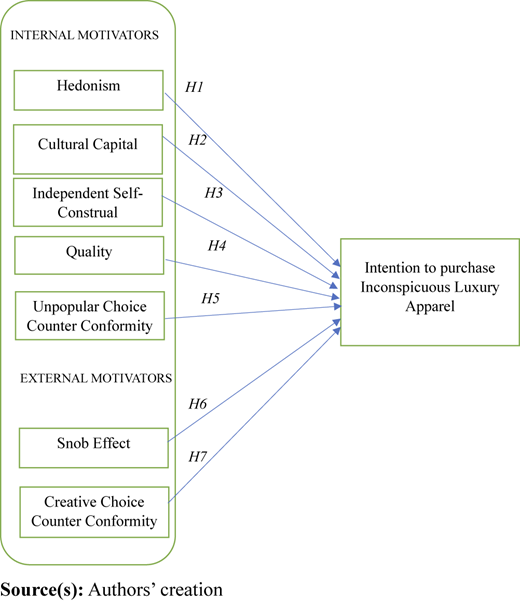
The present paper is the first of its kind that attempts to address this gap and investigate the concept of inconspicuous consumption in the realm of luxury apparel. The objective of the study is to incorporate and examine both the intrinsic as well as extrinsic motivators based on self-determination theory (SDT) in order to holistically understand its impact on consumer motivation towards inconspicuous luxury apparel consumption in India. The study builds on a concoction of intrinsic (hedonism, cultural capital, independent self-construal and unpopular-choice counter-conformity [UCCC]) as well as extrinsic factors (snob appeal and creative choice counter-conformity [CCCC]), which would impact the intentions of the consumers to indulge in inconspicuous luxury apparel consumption. This research has been conducted in the realm of inconspicuous consumption of luxury apparel owing to the changing dynamics taking place in the sector, which would further help both national and international luxury brand managers in understanding the changing motivations of luxury consumers.
The study used survey research to collect data from the target audience. Validated scales from previous studies were employed in order to measure the variables used in the study. Statistical analysis was conducted using covariance-based structure equation modelling for studying the hypothesized relationships between the variables.
The study is arranged as follows: Section 1 provides the introduction; Section 2 and Section 3 highlight the theoretical background and literature review, respectively; Section 4 deals with the methodology adopted and Section 6 and Section 7 represent discussions, conclusions and implications of the study.
2. Theoretical background
2.1 Self-determination theory
The present paper is elementally based upon the SDT as propounded by Kasser and Ryan (1996) and Ryan and Deci (2000). SDT is a macro approach to studying human motives that focuses on behavioural regulations and personality development (Bagozzi, Yi, & Phillips, 1991). The theory argues that there lie various motivations behind the actions and behaviour of individuals, that is to say, “why we do what we do” (Ryan & Deci, 2000). They argue that a favourable interplay of social-environmental factors such as autonomy, feelings of competence and relatedness motivates consumers both internally and externally towards a desired behaviour (Ryan & Deci, 2000; Sheldon, Ryan, Deci, & Kasser, 2004). Deci and Ryan (2008) in their SDT proposed that the motivations lie on a continuum. On one end of the continuum lies intrinsic motivation and on the other lies extrinsic motivation, and within this continuum of extremes lies certain motivations, which are somewhat intrinsic and somewhat extrinsic.
Kasser and Ryan (1996) explain intrinsic motivation as a tendency to seek novelty and uniqueness to understand and enhance one’s capabilities and capacities. It means to be internally intrigued about the world and the culture around us. Extrinsic motivation includes the drive to carry out a particular activity or achieve a specific goal primarily for external rewards or consequences (Deci & Ryan, 2000, 2008), like approval from society and maintaining a favourable social image (Shao et al., 2019). Then there is a sub-type of extrinsic motivation called identified regulation, which means performing an activity or behaviour because you identify with it and it confers a certain degree of autonomy.
SDT has been widely used for studying consumer motivation in myriad domains like energy-saving behaviour (Webb, Soutar, Mazzarol, & Saldaris, 2013), word of mouth (Gilal, Zhang, Gilal, & Gilal, 2019) and e-waste disposal behaviour (Gilal et al., 2019). Additionally, Hudders and Pandelaere (2012), Shahid and Paul (2021) and Chatterjee (2020) have also applied this theory in studying conspicuous and inconspicuous luxury fashion.
Accordingly, this study utilizes various internal and external motivators from SDT for studying consumer motivations towards inconspicuous luxury apparel consumption.
Figure 1 depicts the hypothesized research model.
3. Literature review
3.1 Internal motivators
3.1.1 Hedonism
Hedonic consumption refers to traits of consumer behaviour that have to do with the imaginative, emotional and multisensory elements of the product usage experience (Hirschman & Holbrook, 1982; Vigneron & Johnson, 2004). Hedonistic consumers of luxury seek the fulfilment of their inner feelings of excitement, comfort and a state of abundance through their consumption (Sun et al., 2016; Wong & Ahuvia, 1998). According to Boas, Christenson and Glick (2020), Makkar and Yap (2018a) and Shahid and Paul (2021), luxury goods offer buyers significant intangible emotional rewards and aesthetic and symbolic pleasures that serve the hedonistic tendencies of luxury consumers. Various studies have highlighted a significant relationship between hedonism and the intention to purchase luxury (Hirschman & Holbrook, 1982; Truong & McColl, 2011). A cross-cultural study conducted by Shukla (2012) reveals that hedonism acts as a significant motivator propelling purchase intention towards luxury among developed economies of the UK and the USA. Similarly, unlike perceived otherwise, self-directed pleasures such as hedonism and self-gratification were also found to be significantly impacting the luxury choices among Indians (Jain & Mishra, 2018; Sun et al., 2016). In a study by Makkar and Yap (2018b), it is highlighted that people with intrinsic hedonic desires have a bent to consume inconspicuous luxury as opposed to conspicuous luxury. Hence, inconspicuous luxury consumption seems a suitable consumption choice for consumers having hedonistic tendencies.
Hedonism has a positive effect on the intention to purchase inconspicuous luxury apparel.
3.1.2 Cultural capital
Academics appear to have reached an agreement on the importance of CC in understanding and forecasting luxury consumer behaviour (Berger & Ward, 2010; Eckhardt et al., 2015; Wu et al., 2017). According to Da Cunha Brandão and Barbedo (2022) and Makkar and Yap (2018b), CC refers to the social assets an individual holds such as mannerisms, specialized taste, knowledge and education level, representing one’s social standing and influence. In the realm of luxury, CC connotes the historical background of the brand, its philosophies, in-depth knowledge of the product, the manufacturing processes involved and the designing intricacies that help such luxury consumers in truly decoding the power of inconspicuousness of the brand (Han et al., 2010; Holt, 1995; Makkar & Yap, 2018b).
The acquisition of such specialized knowledge and the not-so-common taste about luxury not only differentiates them from the masses but also advocates for their inner thoughts and feelings about the brand (Da Cunha Brandão & Barbedo, 2022). Such cultural elites value the craftsmanship and the functionality of the apparel. They prefer designs that are hidden in plain sight, which to an untrained eye might not even be luxury but to experts with high CC signal a lot about one’s personality (Chaudhuri, 2006). A study by Berger and Ward (2010) suggests that the lack of CC drives luxury consumers towards conspicuousness, while its adequacy elevates them towards subtleness. Therefore, the presence of high CC affects one’s intention to purchase luxury apparel endowed with high quality and craftsmanship.
Cultural capital has a positive effect on the intention to purchase inconspicuous luxury apparel.
3.1.3 Independent self-construal
According to Da Cunha Brandão and Barbedo (2022) and Lee et al. (2020), independent self-construal (ISC) refers to conceiving oneself as a person whose behaviour is primarily ordered and given meaning by reference to one's internal repertory of feelings, thoughts and actions, as opposed to giving importance to others' thoughts and feelings. Research has revealed that individuals with an ISC rely more on their inner feelings, self-related goals and unique personality while making luxury consumption-related judgements (Da Cunha Brandão & Barbedo, 2022). Such individuals have a tendency to purchase luxury apparel in a snobbish manner, and inconspicuous consumption seems a likely proposition (Kastanakis & Balabanis, 2014). Cross-cultural studies conducted by Shukla (2012) and Shukla, Singh, and Banerjee (2015) opine that luxury consumers in the UK give more preference to inner feelings, values and personal goals when it comes to purchasing luxury as opposed to people from collectivist cultures like India, for whom societal ties take precedence. However, Shahid and Paul (2021), Sun et al. (2016) and Wu et al. (2017) suggest that luxury consumers from emerging economies like India and China do not base their luxury decisions entirely on what others expect out of them but on what they believe they want.
Independent self-construal has a positive effect on the intention to purchase inconspicuous luxury apparel.
3.1.4 Quality
Shahid and Paul (2021) define quality (Q) as the enhanced perceived utility acquired from the consumption of a luxury product. Many researchers have highlighted that high quality is synonymous with luxury and acts as a key driver propelling consumers to consume luxury products (Da Cunha Brandão & Barbedo, 2022; Sun et al., 2016; Wiedmann, Hennigs, & Siebels, 2009). Studies by Soh, Rezaei, and Gu (2017) and Yi-Cheon Yim, Sauer, Williams, Lee, and Macrury (2014) highlight that high product quality in the form of its functional utility influences consumers' intention to purchase luxury. Guido et al. (2020), Shahid and Paul (2021) and Truong and McColl (2011) also opined that intrinsically motivated consumers prefer to consume luxury products that are endowed with high functional value rather than mere outward showiness of the apparel. Conspicuousness of the luxury product takes a back seat for such consumers (Chatterjee, 2020; Kapferer & Valette-Florence, 2016) as they prefer well-crafted unique luxury products. Studies conducted by Jain and Mishra (2018) and Shao et al. (2019) also echo the view that the quest for better quality and experience from luxury items significantly impacts the intention to purchase luxury among the millennials.
Quality has a positive effect on the intention to purchase inconspicuous luxury apparel.
3.1.5 Unpopular-choice counter-conformity
UCCC refers to a consumer's innate desire for seeking originality and individuality with a willingness to tolerate societal rejection (Kauppinen-Räisänen, Gummerus, Koskull, & Cristini, 2019; Tian, Bearden, & Hunter, 2001). UCCC is a dimension of “need for uniqueness” and inculcates an individual’s intrinsic desire to present one’s unique, novel self to others via distinct consumption choices, which may result in enhanced self-image (Das, Habib, Saha, & Jebarajakirthy, 2021; Lee et al., 2020).
Shao et al. (2019) and Truong and McColl (2011) suggested that in order to satisfy their intrinsic desire to express their central beliefs and their individualities, a significant chunk of consumers is embracing the concept of inconspicuous luxury through their unpopular luxury apparel choices with subtle or mute logos on them. Such unpopular luxury choices make these consumers fashion leaders and innovators (Makkar & Yap, 2018b). Studies conducted by Das et al. (2021) and Nikhashemi and Delgado-Ballester (2022) highlight that UCCC significantly impacts the intention to purchase luxury.
UCCC has a positive effect on the intention to purchase inconspicuous luxury apparel.
3.2 External motivators
3.2.1 Snob effect
The snob effect (SE) happens when customers seek out exclusive luxury goods to separate themselves from the crowd and to deviate from accepted social norms in order to project a distinctive and independent self-image (Das et al., 2021; Uzgoren & Guney, 2012). Leibenstein (1950) defines the SE as a phenomenon wherein the customers look out for exquisite and distinct luxury products as a result of mass-market expansion of luxury. According to a study by Eastman and Eastman (2015), consumers who consume luxury for the SE desire special and unusual products and are very likely to reject the product if it is mass-produced. Uzgoren and Guney (2012) asserted that consumers who wish to consume luxury in a snobbish manner have a favourable intention to purchase inconspicuous luxury. On similar lines, Berger and Ward (2010), Das et al. (2021) and Eckhardt et al. (2015) opined that elites, in order to dissociate themselves from the common herd, shy away from the opulent display of their luxury apparel and, in turn, gravitate towards nuanced and subtle apparel.
Snob effect has a positive effect on the intention to purchase inconspicuous luxury apparel.
3.2.2 Creative choice counter-conformity
CCCC refers to the desire of the consumer to exhibit their unique identities in a manner that is not so divergent from the societal norms (Chatterjee, 2020; Kauppinen-Räisänen et al., 2019). CCCC originates from the concept of “need for uniqueness” and can be considered as an extrinsic dimension of the need for uniqueness variable as it inculcates creating a separate identity via goods without breaking the social periphery (Da Cunha Brandão & Barbedo, 2022; Tian et al., 2001). People with creative choice have a tendency to purchase luxury items with certain distinctions such as distinctive features, style and well-crafted designs that offer them prestige and exclusivity and symbolize their unique, novel self (Belk, 2014) and are yet regarded as socially acceptable (Knight & Young Kim, 2007). Studies conducted by Das et al. (2021) and Tian et al. (2001) suggest that creative choice people’s luxury choices are influenced by the reference or the aspirational group they are or wish to be a part of.
CCCC has a positive effect on the intention to purchase inconspicuous luxury apparel.
4. Methodology
4.1 Pilot study
The questionnaire was pre-tested with 10 participants with differing ethnicities, gender and educational backgrounds for checking the clarity and layout of the items. The pre-test indicated a need for adjustments to the language of items to mitigate misinterpretations. The results revealed that some participants visited the store just to window shop and have not actually purchased apparel from the brands considered (Ritu Kumar and FabIndia). In order to capture the real emotions of the respondents, a filter question was added in the questionnaire, asking the respondents whether they have made purchases from these brands at least once in the last six months or not. Only those participants who have actually made purchases from the brands under consideration were selected.
4.2 Measures
This study employed a structured questionnaire for the purpose of data collection as recommended by previous research done in the field (Bian & Forsythe, 2012; Jain & Mishra, 2018).
The entire questionnaire was divided into two parts. The first part inculcated the demographic profile of the respondents. While the second section encompassed items related to constructs used in the study. A five-point Likert scale ranging from 1 (strongly agree) to 5 (strongly disagree) was used to measure each construct. Hedonism was measured using items adapted from scales given by Ioana-Daniela, Lee, Kim, Kang, and Hyun (2018), Shahid and Paul (2021) and Vigneron and Johnson (2004). For measuring CC, items were adapted from scales given by Da Cunha Brandão and Barbedo (2022) and Khodadady and Natanzi (2012). ISC was measured using scales given by Da Cunha Brandão and Barbedo (2022). Items to measures quality were adapted from scale given by Kastanakis and Balabanis (2014). To measure UCCC, items were adapted from scales given by Das et al. (2021) and Tian et al. (2001) SE was measured using scales given by Das et al. (2021) and Kastanakis and Balabanis (2012). CCCC was measured using items adapted from Das et al. (2021), Shao et al. (2019) and Tian et al. (2001). As far as the authors' knowledge of the inexistence of an empirically tested scale for measuring the intention towards inconspicuous consumption of luxury apparel, items to measure it were gathered from three studies (Berger & Ward, 2010; Da Cunha Brandão & Barbedo, 2022; Dogan, Ozkara, & Dogan, 2020). Table 1 depicts the operationalization of the latent variables.
4.3 Data collection and sampling
Data were collected using a self-administered survey from the respondents living in Delhi during the months of October–December, 2023. Delhi was chosen for data collection because the residents of Delhi have relatively high disposable income and hence are more able to afford luxury. The per capita income of Delhi increased by 14% in 2023, making it 158% higher than the national average (I). Moreover, Delhi is leading the luxury goods market in India (Jain, 2019).
The technique that was chosen for data collection was purposive sampling, as the data were collected by visiting exclusive luxury apparel stores of (Ritu Kumar and Fabindia). Past studies done in the field justify this non-probability sampling technique and have attained reliable results (Jain, 2019; Vigneron & Johnson, 2004). The chosen brands offered products with subtle logos on them that suit our purpose. Ritu Kumar, an Indian fashion luxury brand, works widely on the philosophy of creating indigenous designs that represent Indian aesthetics and the age-old Indian textile legacy without being overtly brand-prominent. Likewise, Fabindia works on the philosophy of spreading the vast and diverse craft traditions of India. Its hand-woven apparel is hand-dyed, hand-embroidered and hand-block printed and also without the apparent brand logo.
Using the structured questionnaire, 210 respondents were approached for the survey. Out of the 210 respondents, 180 were found to be eligible based on their past luxury purchases from these brands.
4.4 Respondent’s profile
Of the total respondents, 77% were female and 23% were male. In terms of educational qualification, 7% of the respondents had a qualification of higher secondary or below, 52% were graduated and 41% were post-graduates or above. Considering their occupation, approximately 29% were government employees, 15% were self-employed and 56% were private business owners. In terms of annual income, approximately 21% of them had an annual income between US$12,376 and US$18,000, around 27% had an income between US $18,001 and US$30,000, around 39% had an income between US$30,001 and US$40,000 and the rest had an income above US$40,001. Table 2 highlights the demographic information of the participants.
5. Results and analysis
5.1 Estimates of the model
Firstly, exploratory factor analysis was performed using IBM SPSS Statistics 23, which exhibited the following results: Kaiser–Meyer–Olkin value was 0.724, indicating that the sample was adequate to carry out further analysis. Bartlett's test of sphericity value for the sample was checked, which was less than 0.05, as recommended by Bagozzi et al. (1991). Two items (ISC4: I take responsibility for the kind of subtle luxury apparel choices; UCCC1: When choosing apparel, I have sometimes dared to be different in ways that others are likely to disapprove) were excluded from the list due to insignificant factor loadings, i.e. < 0.7 based on item-total correlation. Deleting the items did not change the meaning of the constructs. Factor loadings of all other items were greater than 0.7, ensuring indicator reliability (Dash & Paul, 2021). Further, Cronbach’s α values were also computed for all the latent constructs using IBM SPSS 23, which were above the threshold limit of 0.7 (Bagozzi et al., 1991), indicating internal consistency, as highlighted in Table 3.
Confirmatory factor analysis was then performed to assess the fitness of the model using IBM SPSS AMOS version 24. The model has been evaluated using covariance-based (CB-SEM). CB-SEM was preferred over partial least squares structural equation modelling because it renders better results in model fitness indices (Dash & Paul, 2021). Table 3 highlights the values of the following indices: chi-square/degree of freedom (CMIN), comparative fit index (CFI), Tucker–Lewis index (TLI), incremental fit index (IFI) and root mean square error of approximation. The assessment of the measurement model indicated that all indices were under their recommended range ensuring the fitness of the proposed model, as shown in Table 3.
Further, convergent validity of the model was measured by assessing average variance extracted (AVE), statistical significance of the factor loadings and construct reliability. Some items were self-generated to suit the context of the study, and some items had to be deleted due to insignificant factor loadings. All 29 items with factor loadings >0.7 were statistically significant (p < 0.01) and were retained. AVE values of all latent constructs were >0.5, as suggested by Fornell and Larcker (1981), and are depicted in Table 4. Composite reliability scores were above the specified threshold of 0.7, thus ensuring the robustness of data.
For assessing the discriminant validity, the fulfilment of the two conditions, i.e. MSV < AVE and ASV < AVE was analysed. As depicted in Table 4, this criterion was fulfilled, indicating all variables were distinct from each other. Additionally, the square root of each AVE construct is greater than the maximum correlation, as per (Fornell & Larcker, 1981) methodology, depicted in Table 5.
Afterwards, hypothesis testing was conducted to identify which of the proposed relationships were supported (Table 6) Depicts the standardized path coefficients, critical ratios, standard errors and p-values of all the constructs used in the study.
The standardized path estimates for six relationships (hedonism to intention towards inconspicuous luxury apparel, CC to intention towards inconspicuous luxury apparel, ISC to intention towards inconspicuous luxury apparel, UCCC to intention towards inconspicuous luxury apparel and CCCC to intention towards inconspicuous luxury apparel) were found to be positive and statistically significant, while that of one relationship (SE to intention towards inconspicuous luxury apparel) was found to be statistically insignificant.
6. Discussion and conclusion
6.1 Discussion of the results
To examine the consumer intention towards inconspicuous luxury apparel consumption, this study made use of various internal and external motivators derived from SDT.
The findings indicate that ISC most significantly impacts the intention to purchase inconspicuous luxury apparel. The results are in line with Da Cunha Brandão and Barbedo (2022) and Shao et al. (2019), which state that consumers who rely on their inner feelings and thought processes are more likely to make decisions independently as opposed to relying on others' opinions. The results, however, were inconsistent with the findings by Ting et al. (2018) where it was observed that Malaysian consumers depend on their social circles and not on their inner thought process, while making subtle luxury fashion choices.
The results further indicated that hedonism also acted as a significant contributor in forming purchase intention towards inconspicuous luxury apparel consumption. The results are also in conformity with Hirschman and Holbrook (1982), Jain (2019) and Truong and McColl (2011), which indicated that Indian luxury consumers with hedonistic tendencies are internally motivated to consume inconspicuous luxury apparel, as it gives them a sense of self-gratification and self-fulfilment as opposed to merely being a social fit (Jain, 2019; Jain & Mishra, 2018).
Quality also turned out to be a significant motivator in forming a favourable purchase intention towards inconspicuous luxury apparel consumption. This finding is also supported by Amatulli and Guido (2012), Pangarkar, Shukla, and Taylor (2021), Truong and McColl (2011) and Vigneron and Johnson (2004), who have confirmed a positive link between the quality of the apparel and an increasing inclination towards mute luxury apparel.
CC possessed by the significant few luxury consumers turned out to be another significant predictor of their intention to purchase inconspicuous luxury apparel among Indians. This finding finds support in the studies done by Berger and Ward (2010), Holt (1998), Jain (2019) and Makkar and Yap (2018a, b), who suggest that consumers who strongly relate to the brand’s culture, its historical background and see the brand as an extension of their self-identities are deeply inclined towards the subtleness of the product. This finding is unique to India, as luxury in India is still thought to be at a nascent stage and is thought of as an emulation of Western consumption patterns. Based on their minutely detailed knowledge of brands like Ritu Kumar and FabIndia, the intricacies of design, manufacturing and its connection to their cultural and historical backgrounds Indians showcase their changing preferences towards home-grown luxury brands as opposed to their western counterparts (Jain, 2019).
CCCC and UCCC were also found to be positively impacting the intentions of Indian luxury consumers towards subtle luxury apparel consumption. This is in agreement with previous literature, asserting that a growing niche of luxury consumers is pursuing distinctiveness from the mainstream and asserting their status without brand prominence (Da Cunha Brandão & Barbedo, 2022; Kastanakis & Balabanis, 2014; Tian et al., 2001; Wu et al., 2017). This finding is novel to a collectivist country like India, thus emphasizing the changing cultural orientation of the Indian consumers away from collectivism towards an individualistic and self-driven behaviour.
However, the theory of the SE given by Leibenstein (1950) and supported by Das et al. (2021), Eastman and Eastman (2015) and Uzgoren and Guney (2012) found no statistically significant effect on Indian consumers' intention to purchase inconspicuous luxury apparel. The reason is that Indian consumers just want to consume apparel that portrays their unique identities, no matter how many others intend to do the same. Therefore, they can be unique while still being a part of an “in-group”. This finding is in contradiction to studies conducted by Das et al. (2021) and Eastman and Eastman (2015), where it was found that luxury consumers, in order to assert their exclusivity from the masses, began adopting inconspicuous luxury fashion.
6.2 Conclusion
6.2.1 Theoretical implications of the study
The present study adds significantly to the strewn luxury literature by highlighting that a significantly growing niche in a socio-hierarchical society like India is adopting inconspicuousness as a way of life when it comes to consuming luxury. Hence, it won’t be an understatement to assert that “inconspicuousness is the new conspicuousness”. In light of this, the present study presents a concoction of intrinsic as well as extrinsic factors, which would impact the intentions of the consumers to indulge in inconspicuous luxury apparel consumption.
6.2.2 Managerial implications
The present study has many important practical implications for luxury brand managers, both national and international, who wish to operate and expand business in India. An important finding of the study highlighted a bent of Indian luxury consumers towards individualistic thought patterns and a touch of “Indian-ness” when making luxury-related purchase decisions. Therefore, marketers of such inconspicuous brands must focus on developing such marketing strategies and programs that communicate the subtle brand signals, its connection to the culture and heritage and how it aligns with their individualities, which would further influence their motivation behind such inconspicuous consumption choices. Like, home-grown brands can communicate to the customer the stories behind the brand, the making of the product and how it's helping in forwarding the legacy of Indian textiles. Also, inconspicuous luxury apparel consumers prefer minimalist designs, high-quality materials and understated brand logos. Therefore, luxury brand managers must create such designer apparel that celebrates subtlety and sophistication rather than in-your-face, logo-laden clothes that signify opulence and extravagance. Moreover, retail store managers of these inconspicuous luxury brands must be trained for highly personalized engagement with the customers, as these consumers prefer exclusive attendance and a personal touch. Such tactics, when employed correctly, get the consumers interested in the brand, enhancing loyalty and retention. Such satisfied patrons in turn may promote the brand through positive word of mouth.
One very novel implication stemming from the study is its contribution towards sustainability (Shingari & Kaur, 2024) and circular economy through slow fashion (Musova, Musa, Drugdova, Lazaroiu, & Alayasa, 2021), which emphasizes fuller and efficient utilization of the available resources. Purchasing apparel without logos makes them less noticeable and allows consumers to freely wear them as and when they wish, simultaneously reducing the need to produce more, thus truly enhancing their individualities and also providing an added advantage of mindfully consuming apparel. It also eliminates the problem of “consumerism” in an already cluttered market, thus furthering the attainment of sustainable outcomes in the fashion industry, which has a significant environmental footprint.
6.2.3 Limitations
The study is not free from limitations. First, the lack of empirically tested measurement scales for measuring the intention to purchase inconspicuous luxury consumption and cultural capital could hamper the results of the study. Future studies must work in this direction. Second, this study was conducted in New Delhi. Future studies must also be done in other tier-1 cities such as Mumbai and Bengaluru. Further, the results of the study revealed a changing mindset of Indian consumers as to how they perceive luxury as an individual as opposed to the general belief of social influence. ISC turned out to be the strongest motivator behind inconspicuous luxury apparel choices among Indian luxury consumers. Therefore, future studies must delve deep into such “self”-related variables.
This study is also limited to a single luxury product category, which is luxury apparel. Future studies must also be conducted in other luxury product categories like handbags, accessories, etc. for in-depth clarity about inconspicuousness across different product lines.