


This paper is to examine the direct relationship between perceived corporate citizenship (CC) and purchase intention (PI). This study also tests the mediating role of brand trust (BT), consumer–brand identification (CBI) and the moderating effect of personal norms by a contribution of social exchange theory, brand relationship theory and social cognitive theory (SCT).
Quantitative research was carried out by means of a survey with a sample of 411 regular consumers who work for national retail brands, where the unit of analysis was an individual. The study analysed the data to test the research hypotheses using SPSS and Smart PLS.
This study found a significant positive impact of perceived CC on purchase intention (direct path), and furthermore, a partial mediation was shown for the indirect path. In addition, personal norms have a significant impact on the relationships between perceived CC on purchase intention, brand trust on purchase intention and CBI on purchase intention.
This study provides useful insights for managers to implement CC strategies to enhance consumer purchase intention and brand relationship in the retail sector within the coronavirus disease 2019 (COVID-19) pandemic.
The current study is perhaps the first to investigate the impact of perceived CC on purchase intention across the BT, CBI and personal norms in the retail industry, period of COVID-19 pandemic. The study also makes some important theoretical contributions and previously not shed light on customer behaviour in this context.
1. Introduction
The retail industry is the most active and energetic and the most complex and demanding (Cervantes and Franco, 2020), and the unprecedented coronavirus disease 2019 (COVID-19) worldwide pandemic outbreak is affecting consumer intent retail (Vakharia, 2020). The COVID-19 pandemic also affects retail customer buying habits globally (Goswami and Chouhan, 2021; Fernandes, 2020). Because corporate citizenship (CC) lowers obstacles and delivers services and products to people in need, companies embrace it. It is time to double down on CC with the present COVID-19 epidemic (SemiColonWeb, 2021; Peters, 2020). When it comes to COVID-19, CC initiatives must have the correct approach and tone (Peters, 2020). CC reflects that an increasing number of firms engage in CC and consider it a strategic cornerstone for an organisation's sustainability (Lin and Liu, 2017a; Newman et al., 2014).
Since CC is referring to “a company's social obligations”, it involves corporate social responsibility (CSR) and how well they satisfy shareholders' legal, ethical and economic obligations (Hayes, 2021). CC and CSR are synonyms (Valor, 2005; Tsai et al., 2014; Hayes, 2021). Social responsibility activities impact consumer behaviour (Fernández Ferrernet et al., 2020) and hence purchase intention (e.g. brand trust (BT) and brand identification) (Marin and Ruiz, 2007; Vlachos et al., 2008; Tsai et al., 2014).
Based on social exchange theory (SET) (Emerson, 1976), this paradigm explains reciprocal interactions between engaging parties (Prentice et al., 2019). SET is the outcome of an exchange procedure. We want to maximise advantages and reduce expenditures (Cherry, 2020). Unfortunately, academic studies have not sufficiently theoretically contributed to explaining the link between SET and CC. Also, it lacks theoretical accuracy, limiting SET usefulness (Cropanzano et al., 2017).
Among the important mediators between CC and purchase, intention is consumer–brand identification (CBI) and BT. Because past research shows that organisations benefit from creating consumer trust and identification, which in turn influences behavioural intentions (Keh and Xie, 2009). This study's secondary hypothesis is consumer–brand relationship theory (CBRT). We view CBI as the amount to which the customer cognitively sees a relationship between his/her personal identity and the brand's identity (Davvetas and Diamantopoulos, 2017; Kumar and Kaushik, 2018).
Personal norms impact the charitable dimension, CBI and purchase intention, according to Abid et al. (2019). Personal norms influence customer purchasing intention, according to Chatzidakis et al. (2014). Furthermore, social responsibility was found to be a precursor to improving personal norms of behaviour and a favourable buying attitude (Rahimah et al., 2018; Wang and Chou, 2020). Personal standards may influence consumer social responsibility and buying intention. The SCT described human behaviour by examining environmental, psychological and behavioural variables (Bandura, 1991, 1999, 2001). Few research studies have examined the impact of personal norms and consumer purchasing intent (Wang and Chou, 2020). To fill up the gaps in the current literature, the following critical research questions were developed:
Does perceived CC affect purchasing intention during the COVID-19 pandemic across the mediation impact of BT and consumer–brand relationship? Furthermore, this study is examined, above relationship is moderated by personal norms.
The aforementioned above research questions will be the research goal of this study. To attain this goal, the current study employed SET, CBRT and SCT. The social exchange hypothesis was utilised to establish the link between CC, BT and purchase intent. The influence of CBI as a mediator of the CC and PI is introduced to consumer–brand relationship theorists. Also, personal norms and buying intention are explained by SCT.
This study adds four valuable features. A direct association between PCC and retail sector is well supported, as is the mediation mechanism between Perceived corporate citizenship (PCC) and Purchuse Intention (PI) and the moderating influence of personal norms. Finally, a theoretical point. Unfortunately, numerous empirical research studies have not sufficiently contributed to our knowledge of how CC affects customers' purchase intention (Husted and Allen, 2007; Tsai et al., 2014) during COVID-19 pandemic. So, this essay will first explore the research on the impact of CC, BT, brand identity and personal norms on purchase intentions in the COVID-19 epidemic. Furthermore, limited implications related to CC during COVID-19 and this study will have contributed to minimise this gap by propose a conceptual model and research hypotheses. The methods and data analysis will test these hypotheses. Finally, we will explore the implications and future work.
2. A survey of the literature and theoretical discussion
2.1 Corporate social responsibility
In the 1980s, a new phrase for the business–society interaction was coined. The term CC is increasingly extensively used in business and academic publications (Jhingan, 2018). Globally, the notion of CC has steadily evolved into a collection of business practices beneficial not just to society in general but also to business enterprises (Maignan and Ferrell, 2000). CC is often referred to as CSR, corporate duty or ethical business. Since it is a sort of corporate self-regulation that is integrated into a company strategy (Lin et al., 2010), on the other hand, CC is considered a more accurate word when discussing the more “social” components of corporate responsibility (Waddock and Smith, 2000).
CC has five dimensions, and these dimensions are critical for studying CC because five dimensions can articulate a very clear economic position (that corporations are capable of assuming economic responsibilities), a legal position (that corporations are capable of assuming legal responsibilities), and a philosophical and normative undertone (that these responsibilities should extend beyond the mere generation of wealth) (Küskü and Zarkada-Fraser,2004; Tasi et al., 2014).
CC has garnered both academic and practitioner interest in recent decades (Lin and Liu, 2017b), yet there is less empirical evidence relating to CC. However, little empirical evidence contributed to our understanding of the COVID-19 pandemic's implications for CC and the retail sector.
2.2 Corporate citizenship and the impact of COVID-19 on the retail sector
COVID-19's substantial alterations to the external environment have had a variety of effects on the retail industry's operations globally (Abeam, 2021). At the time of writing, the UK, Asia and several European Union (EU) member states have placed significant portions of their economies under lockdown. Service industries such as retail (Fernandes, 2020), hospitality and tourism will be badly impacted by the COVID-19 pandemic (Dolnicar and Zare, 2020; Fernandes, 2020). COVID-19, as a pandemic, has the potential to influence the development of social responsibility actions in marketing, and it represents an excellent opportunity for businesses to embrace more genuine and authentic social responsibility and contribute to resolving urgent global social and environmental challenges (He and Harris, 2020).
According to it, retail firms must prioritise social responsibility to overcome the worldwide COVID-19 dilemma because social responsibility efforts are highlighting the importance of donations of all types in all of this. While not every firm can afford to make a monetary gift in the manner described above, there are alternative ways to take a stand. From product donations to community support through access to counselling and at-home activities, or even sharing content on engaging ways to use your brand's products at home, the opportunities are limitless (Shapiro, 2021) and help health sectors and end consumers understand the value of social responsibility. Additionally, retailers will be acknowledged for their vital position in society as the ‘new role for retailers in society,’ which will increase retail BT, identification and purchase intention (Pantano et al., 2020).
2.3 Brand trust
BT has emerged as a vital component of the retail business during the COVID-19 crisis. It helps create an emotional connection between the brand, society and the client (MacKenzie and Rathore, 2020). This psychological state is defined as “accumulated presumptions regarding the brand's validity, integrity and virtue” (Gurviez and Korchia, 2002). The literature shows that CC affects trust (Tsai et al., 2014), but not BT. Trust appears to be required for long-term consumer–brand relationships (Abid et al., 2019). Consumers trust brands because they believe they will not be exploited (Anderson and Weitz, 1992). Trust, being a two-party transaction, is a relational market-based asset (Sichtmann, 2007; Delgado-Ballester and Munuera-Alemán, 2005).
A customer's faith in a company's brand shows that the brand will benefit the consumer (Delgado-Ballester and Munuera-Aleman, 2001). Thus, when people buy, company brand reputation is crucial (Goldsmith et al., 2000). Also, customers choose reliable firms. Customers who trust a brand generate positive feelings about its goodness, honesty and integrity. This strengthens the brand's relationship with the consumer and buying intention (Frasquet et al., 2017). Socially responsible acts also assist customers establish a positive BT and consumer–brand identity (Du et al., 2007; Coelho et al., 2018). Due to the fact that customer brand recognition is a critical component of this study.
2.4 Identification of consumer brands
CBI is critical to comprehending how, when and why businesses assist customers in articulating their identities (Stokburger-Sauer et al., 2012). With CBI, a brand reflects who I am to a consumer (Johnson et al., 2011; Ma, 2020) and contributes to the development of the consumer's self-concept in a variety of ways (Ma, 2020). Consumers are more likely to form and maintain relationships with a brand if they experience a stronger sense of self, as well as social and psychological advantages associated with that brand (Park et al., 2010; Elbedweihy et al., 2016), which increases purchase intention (Kumar and Arun, 2018). Consumers with a low level of brand recognition, on the other hand, may affect purchase intention (Marin et al., 2018). According to several empirical studies, brand recognition does not directly correlate with purchase intentions (Becerra and Badrinarayanan, 2013). According to Stokburger-Sauer et al. (2012), brands are increasingly concerned with social benefits; hence, we anticipate brand social benefits to be a driver of CBI. Brand identification, empirical data reveals, maybe a critical tool for discovering and building such long-term consumer–brand ties (Kumar and Arun, 2018).
However, Martínez et al. (2014) argued that there had been a dearth of study on CBI and its relationship to other social exchange factors. Do customers truly understand what the firms behind their favourite brands are doing or if they support or oppose social causes? Consumers consider these circumstances, which results in brand identification (Rizkallah, 2012).
2.5 Purchase intention
The COVID-19 pandemic disrupts a consumer's lifestyle and purchasing behaviour (Verma and Naveen, 2021). Additionally, the COVID-19 epidemic has altered the purchasing intentions of consumers worldwide (Intelligence, 2021). However, brand participation in socially responsible activities results in an induced market downturn against the COVID-19, overcoming the customer's behavioural intention.
Intentions may be defined as “a person's subjective judgements of a certain item to respond with a specific behaviour” (Moon et al., 2017). According to Gordon (2021), CC refers to a corporation's standards to demonstrate its commitment to CSR. It is a critical component of achieving CC. Regarding this, social responsibility activities have a direct and indirect effect on purchasing intention (Lee and Lee, 2018).
Retailers' socially responsible actions have the potential to influence consumer attitudes and behaviour. Consumers may place their faith and confidence in these retailers (Tofighi and Bodur, 2015). Additionally, consumers may have favourable attitudes and hopeful ideas toward these businesses since they feel the latter are attempting to offer them and the entire society goodwill and advantages (Dang et al., 2020). Thus, consumers who have a hopeful outlook and confidence in socially responsible businesses are more inclined to acquire items and services from them (Ailawadi et al., 2014; Louis et al., 2019). Additionally, social responsibility perceptions influence BT (Kim et al., 2018) of retail businesses, which may affect customer purchases, hence affecting the financial performance of retail organisations (Souza-Monteiroand Hooker, 2017).
2.6 Personal norms
It is well acknowledged that consumer expectations in terms of social responsibility are far from universal; they differ from one customer to the next. Bhattacharya and Sen (2004) assert that these expectations are likely to shape consumer responses to the symbolic components of social responsibility (Abid et al., 2019).
Personal norms are “personal expectations based on internalised ideals” (Schwartz, 1977). They manifest as a sense of moral duty to act in conformity with these principles (Schwartz, 1977). This moral responsibility is typically derived from distinct personal rules (Grankvist et al., 2007). In the literature on socially responsible consumerism, the notion of personal norms has been widely utilised. It explains why certain customers are more likely than others to engage in socially responsible purchasing behaviour. Previous research on consumer attitudes to CSR assumes that personal norms have a moderating influence. This is heavily dependent on the consumer's personal support for the firm's social responsibility programs (Sen and Bhattacharya, 2001; Davis et al., 2017).
There is a scarcity of scientific information relating to social responsibility, brand relationships and personal norms. Personal norms impacted socially responsible behaviours and associated functions (Abid et al., 2019), as did customers' personal and behavioural processes and enhancement of the shopping experience during the COVID-19 and post-COVID-19 periods (Milakovi, 2021). Personal norms (Chatzidakis et al., 2014) also influence customer buying intention (Wang and Chou, 2020).
2.7 Theory of social exchange
SET is combined with dialectical theory to create a framework for investigating corporate social business alliances (Domenico et al., 2009). SET is founded on the notion that human contact and social behaviour are an exchange of physical or intangible activity depending on the benefits or costs acquired from the encounter (Adongo et al., 2019).
In addition, according to Blau (1994), SET, individuals invest in relationships depending on the reward-cost ratio. People only invest in relationships when the benefits surpass the drawbacks of the connection. People are willing to give to charity projects and social activities when the rewards or benefits surpass the cost, but they are hesitant to donate when the cost outweighs the benefit. As a result, self-benefit appeals that allow donors to gain self-benefit from their donation are more effective than other-benefit appeals that allow others in need to gain benefit from their donation in increasing donation because the former appeals help people justify their donation by demonstrating that it serves their own self-interest (Holmes et al., 2002; White and Peloza, 2009; Kim et al., 2012). Furthermore, social benefits increase customer commitment, power and trust (Tyrie and Ferguson, 2013), making it simpler for consumers to defend their altruistic buying decisions (Kim et al., 2012).
2.8 Consumer–brand relationship theory
Because the market is becoming more complicated, the notion of consumer–brand interaction has a significant impact in the marketing area (Gummesson, 2008). Several dimensions are presented in CBRT to describe how people build connections with brands. Some studies concentrate on the emotional attachment to the brand (Malär et al., 2011), the consumer–brand bond as part of the relationship notion (e.g. Batra et al., 2012), and a more cognitive representation of the consumer–brand identity overlap (Malär et al., 2011) (e.g. Stokburger-Sauer et al., 2012). According to the latter, researchers define CBI as the degree to which the customer cognitively sees a relationship to the brand's identifications. The benefits of a good consumer–brand relationship may be shown in retail purchasing intentions (Ltd, 2021).
2.9 Social cognitive theory (SCT)
Recent advances in cognitive psychology, social cognition, and research methodologies have allowed cognitive consistency theories to resurface, as discussed below (Russo and Chaxel, 2017). According to cognitive consistency theories, consumers seek balance and harmony between their ideas and sentiments on the one hand and their purchasing behaviour on the other (Mcguire, 1976).
SCT examines environmental, psychological, and behavioural elements to explain human behaviour (Bandura, 1991, 1999, 2001). Personal norms (Bandura, 2001; Fishbein and Ajzen, 2011) are among the co-determinants discovered by social-cognitive theory. As a result, buyers reject businesses that are incompatible with their own set of beliefs and values, preferring instead to align with firms that mirror their own self-concept and personality (Aaker, 1999). As a result, client attitudes to social responsibility symbols are impacted by how similar the brand's environmental and societal involvement are to their own. Depending on the consumer's personal social responsibility criteria (Abid et al., 2019), these perceptions of congruence may vary (Wang and Chou, 2020).
3. Hypotheses development
The process of CC is “much more participatory” than earlier types of social responsibility and charity. Companies are developing the capacity to define and shape their obligations and place a value on their social and environmental duties (Burchell and Cook, 2006). This realisation and care for environmental and societal activities have resulted in purchasing intention, which refers to customers' readiness to purchase relevant products (Joshi and Rahman, 2015). Based on these observations, the following theory is proposed:
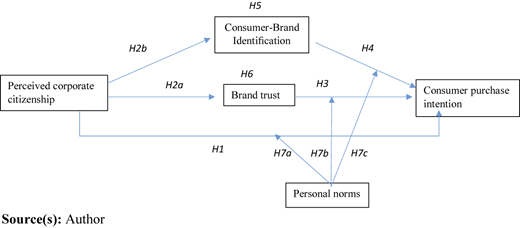
Perceived CC is positively related to consumer purchase intention
CC has a substantial impact on BT, since BT is a calculative process based on an object's or party's ability to perform its duties (i.e. CC) and an evaluation of the costs vs advantages of remaining in the connection (Tsai et al., 2014). Recent empirical research (Tsai et al., 2014) has proven BT's impact on perceived CC. This literature leads to the investigation of the second hypothesis:
Perceived CC is positively related to BT
Implementing socially responsible activities results in more visible actions, such as those engaging consumers or the community (Bravo et al., 2011). As the brand outcomes, it leads to CBI (Coelho et al., 2018). According to Stokburger-Sauer et al. (2012), brand social benefits are primarily concerned with boosting the social interaction possibilities and rewards given by a brand. Researchers believe brand social benefits are a driver of CBI. On the basis of these observations, the following theory is proposed:
Perceived CC is positively related to CBI
BT has a beneficial influence on purchase intention because it fosters highly valued trade interactions. Brands that make customers cheerful, joyous or friendly increase buy intent (Matzler et al., 2008). According to Tsai et al. (2014), BT reduces uncertainty and increases customers' purchase intent. As a result, consider the following hypothesis:
BT is positively related to consumer purchase intention
With CBI, a brand symbolises who I am to a consumer (Johnson et al., 2011; Ma, 2020) and aids in developing his or her self-concept in various ways (Ma, 2020). Marketing scholars agree that consumers are more likely to develop and maintain relationships with a brand if they feel a stronger sense of self and social and psychological benefits from that brand (Park et al., 2010; Elbedweihy et al., 2016), and this increases purchase intention (Kumar and Arun, 2018). As a result of the above reasoning, the following possibilities emerge:
CBI is positively related to consumer purchase intention
According to Hur et al. (2014), social responsibility company actions have a considerable and positive effect on one or two dimensions of customers' confidence in a brand (credibility; Swaen and Chumpitaz (2008). Furthermore, retails' social responsibility imitations have a large and favourable impact on customers' trust (Louis et al., 2019), and it influences consumer buy intention in stores (Chen et al., 2015; Frasquet et al., 2017). Taking these works into account, it is proposed that BT has a mediating effect on the link between perceived CC and purchase intention:
The relationship between perceived CC and purchase intention is positively mediated by BT.
Furthermore, the impact of social responsibility ratings on CBI has previously gained empirical support (Du et al., 2007; Lichtenstein et al., 2004). Brand identification provides psychological advantages to customers by increasing self-esteem, making people more likely to form favourable attitudes and behaviours toward the brand (Abid et al., 2019). In this sense, a firm's participation in socially responsible activities may give customers with high self-esteem in terms of their social and ethical image (Agyei et al., 2021; Kuenzel and Vaux Halliday, 2008). Taking these reasons into account, the following is proposed as a mediating effect of CBI on the link between perceived CC and purchase intention:
The relationship between perceived CC and purchase intention is positively mediated by CBI.
In terms of social responsibility, personal standards appear to be the primary rationale for individuals' proclivity to support initiatives (Stern, 2000). Consumers with high personal norms of social responsibility in their self-concept will thus perceive greater similarity between themselves and the brand, whether in terms of common attributes or shared prototypes, than consumers with low personal norms of social responsibility (Abid et al., 2019), and this has an effect on consumer purchase intention (Wang and Chou, 2020).
Because identification is motivated in part by the consumer's need to maintain a consistent and good self-image (Dutton et al., 1994). Consumers like to associate with a business whose socially responsible actions align with their personal values (Abid et al., 2019). As a result, individuals have larger personal objections to these activities than they believe society does (Maxwell and Garbarino, 2010). Personal standards are more likely to become behaviour when the consumer has a high degree of confidence in the organisation as well as a sense of personal responsibility (Nowak and Washburn, 2002).
Personal norms moderate the relationship between perceived CC and purchase intention.
Personal norms moderate the relationship between BT and purchase intention.
Personal norms moderate the relationship between CBI and purchase intention.
4. Conceptual framework
Figure 1 presents the conceptual framework of this study, which includes perceived CC, CBI, BT, consumer purchase intention and personal norms. This study presented eight hypotheses related to the proposed structure.
5. Methodology
5.1 General research methodology
To test our research model, we carried out a survey among regular consumers who work of national retail brands through mass and medium level retails of the Sri Lanka. It is completely generalisable to consumers with different occupational backgrounds in the Sri Lankan retails industry. The current study is grounded on positivism (Saunders et al., 2011a) and is a non-contrived study (Saunders et al., 2009). The researcher adopted a quantitative approach as the methodology of the study. A questionnaire was administered to collect quantitative data through the survey method. The data for the study were collected during 2021 and through a well-developed and structured questionnaire. This period has most arisen COVID-19 pandemic crises of Sri Lanka. The researcher used the self-administered questionnaire method to collect the relevant data through a “stratified random sampling technique” (Gschwend, 2005).
The ideal target population for this exercise would be the whole population of Sri Lanka. The sample size was selected through subjective methods and is comprised of 500 individuals from Sri Lanka retail consumers and performed using SPSS and structural model analysis using Smart PLS.
The unit of analysis in the current study was an individual retail consumer. Out of 500 questionnaires distributed, 451 respondents returned completed questionnaires, and these respondents were entered into SPSS and treated for missing values. The effective rate of response after discarding ineligible and unreachable respondents from the sample (Saunders et al., 2011b) was 90%, and 411 (n = 411) questionnaires were used for the final analysis.
5.2 Measurements
The measures used in this study were as follows, CC was measured from the five perspectives of economic citizenship, legal citizenship, ethical citizenship, general philanthropic citizenship and strategic philanthropic citizenship, based on the study by Tsai et al. (2014), through 18 items. BT was measured from the three perspectives of integrity, benevolence and credibility, according to Abid et al. (2019), by using 7 items. CBI was measured using five items based on Davvetas and Diamantopoulos (2017). Referring to a study by Abid et al.(2019), personal norms was measured using four items ,and in addition, purchase intention was measured based on Tsai et al. (2014), through three items and above all questions were modified as per the current situation.
The constructs in this study were measured using seven-point Likert scales drawn and modified from previous literature. The pilot study was done primarily to assess the extent of reliability and validity of the research questionnaire (Kothari, 2004), and it was conducted on 20% of the overall research sample (30 respondents). The pilot test showed that the survey items had reliability scores above 0.70 (as measured by Cronbach's alpha), indicating an acceptable level of internal consistency (Nunnally, 1978) reliability, where the values are 0.890 (perceived CC), 0.830 (BT), 0.814 (CBI), 0.745 (personal norms) and 0.756 (purchase intention). Some inappropriate items were refined or removed from our questionnaire after the pilot test was analysed using exploratory factor analysis.
6. Result
6.1 Measurement model assessment
Data analysis has started with the data screening process. Elimination of incomplete responses resulted (Lakmali and Kajendra, 2021) in a sample size of 411. Following the check for accuracy and completeness of data, the parametric assumption of normality was measured. To check the assumption conformity, skewness (+3 to −3) and kurtosis (less than the 10) tests were performed. Furthermore, data were tested for common method variance (CMV) and multivariate assumptions, including tests for normality, linearity, homoscedasticity, multicollinearity and heteroscedasticity, before forwarding the measurement model for CFA via SPSS. CFA is commonly used to check the accuracy of constructing indicators with the researcher's knowledge of the construct's existence (or factor) (Kyal et al., 2021). In line with Hair et al. (2011), items which had factor loading values less than 0.5 were removed (SDC1), and the model was re-tested for validity. Thereafter, statistics for validity and reliability were calculated with the standardised factor loadings. The results of the CFA, AVE, reliability and validity testing are reported in Table 1.
Reliability, validity and CFA measurements
| Discriminant validity | ||||||
|---|---|---|---|---|---|---|
| Indicators | Standardised loading | CBI | BT | PI | PCC | |
| Consumer–brand identification (CBI) – Davvetas and Diamantopoulos (2017) [during COVID-19 pandemic] | 0.779 | |||||
| α = 0.819, CR = 0.880, AVE = 0.607 | ||||||
| I feel a strong sense of belonging to this retail brand | BI1 | 0.714*** | ||||
| I identify strongly with this retail brand | BI2 | 0.775*** | ||||
| This retail brand embodies what I believe in | BI3 | 0.850*** | ||||
| This retail brand is like a part of me | BI4 | 0.839*** | ||||
| This retail brand has a great deal of personal meaning to me | BI5 | 0.779*** | ||||
| Brand trust (BT) Abid et al. (2019) | 0.545 | 0.789 | ||||
| α = 0.863, CR = 0.907, AVE = 0.623 [during COVID-19 pandemic] | ||||||
| Integrity | ||||||
| This retail brand is always honest with its consumers | BI1 | 0.514*** | ||||
| This retail brand is always sincere with consumers | BI2 | 0.575*** | ||||
| This retail brand expresses an interest in its consumers | BI3 | 0.850*** | ||||
| Benevolence | ||||||
| I think this retail brand renews its products to take into account advances in research | BB1 | 0.839*** | ||||
| I think that this retail brand is always looking to improve its response to consumer needs | BB2 | 0.779*** | ||||
| Credibility | ||||||
| I trust the quality of this retail brand's products | BC1 | 0.783*** | ||||
| Buying this retail brand's products is a guarantee | BC2 | 0.659*** | ||||
| Purchase intention (PI) - Tsai et al. (2014) | 0.675 | 0.605 | 0.809 | |||
| α = 0.728, CR = 0.847, AVE = 0.654 [during COVID-19 pandemic] | ||||||
| The likelihood that I would pay for (or continue buying) [the name of the company]'s product is high | PI1 | 0.907*** | ||||
| My willingness to buy (or continue buying) [the name of the company]'s product is very high | PI2 | 0.768*** | ||||
| In the near future, I would consider purchasing (or continuing buying) [the name of the company]'s product | PI3 | 0.723*** | ||||
| Corporate citizenship–Tsai et al. (2014) | 0.527 | 0.838 | 0.61 | 0.671 | ||
| α = 0.921, CR = 0.934, AVE = 0.450 | ||||||
| Perceived economic citizenship [The name of the retail and during COVID-19] is a retail that can … | ||||||
| Ensure to offer competitive prices | EC1 | 0.647*** | ||||
| Control their production costs strictly | EC2 | 0.838*** | ||||
| Always strive to lower their operating cost | EC3 | 0.820*** | ||||
| Always improve service and reduce its fare | EC4 | 0.694*** | ||||
| Perceived legal citizenship [The name of the retail and during COVID-19] is a retail that can … | ||||||
| Ensure that its employees act within the standards defined by the law | LE1 | 0.659*** | ||||
| Refrain from putting aside its contractual obligations | LE2 | 0.653*** | ||||
| Refrain from bending the law even if this helps improve performance | LE3 | 0.790*** | ||||
| Always submit to the principles defined by the regulatory system | LE4 | 0.825*** | ||||
| Perceived ethical citizenship [The name of the retail and during COVID-19] is a retail that can … | ||||||
| Have ethical concerns which transcend the concerns of economic profits | ET1 | 0.804*** | ||||
| Ensure that the respect of ethical principles has priority over economic performance | ET2 | 0.755*** | ||||
| Be committed to well-defined ethical principles | ET3 | 0.879*** | ||||
| Avoid compromising ethical standards in order to achieve corporate goals | ET4 | 0.840*** | ||||
| Perceived general philanthropic citizenship [The name of the retail and during COVID-19] is a retail that can … | ||||||
| Gives adequate donations to charities | DI1 | 0.636*** | ||||
| Gives adequate donations to local schools or institutions | DI2 | 0.791*** | ||||
| Sponsors to improve the public well-being of society | DI3 | 0.797*** | ||||
| Perceived strategic philanthropic citizenship [The name of the retail and during COVID-19] is a retail that can … | ||||||
| Never use prohibited hazard for its production or service | SDC2 | 0.942*** | ||||
| Support employees to appropriately utilise information technology to upgrade overall service Efficiency (e.g. e-document or e-consulting service) | SDC3 | 0.907*** | ||||
Note(s): (1) PCC-perceived corporate citizenship; (2) PI-purchase intention; (3) CBI-consumer–brand identification
Hair et al. (2011) designated the standards of convergent validity criteria as follows: average variance extracted (AVE) higher than 0.5, and composite reliability (CR) higher than 0.7. Additionally, discriminant validity for all constructs was also established as demonstrated by AVE values exceeding corresponding squared correlations for all construct pairs (Fornell and Larcker, 1981). According to that, all items in the measures of exogenous variables were significantly explained, suggesting that the items were converged to this factor, and, hence, to their corresponding dimensions. Therefore, the scale had convergent validity. Model fit (standardised root mean square residual–SRMR) value was 0.097, and it is less than 0.10. It is an acceptable level (Byrne and Hilbert, 2008). R2 value is 0.691, and it is substantial (Hair et al., 2011). The Cronbach's alpha of all variables ranged from 0.728 to 0.921, ensuring each construct's reliability.
The analysis revealed that the validation statistics and fit indices were satisfactory, indicating that the measurement model fits the observed data well, and hence, can be used in testing advanced hypotheses.
6.2 Sample description
The sample's statistical data revealed that 49% of surveyed were male, while 51% were female. Among respondents, 31% belong to the age category of 20–30, followed by 43% belonging to 31 to 40 and 26% belonging to age categories of 41–55. Among respondents, 22% were single and 78% were married.
6.3 Structural model estimation and hypotheses testing
The hypotheses were tested using partial least squares structural equation modelling (PLS-SEM). The standardised parameter estimates in the structure model were tested for significance level using 0.05 bootstrapping method (Hair et al., 2019).
6.3.1 Assessment of direct relationships
First direct effects were tested, and the significance of the direct paths was checked. The direct effect of PCC on PI, BRT on PI, PCC on CBI, CBI on PI and BRT on PI were the direct hypotheses advanced in the study. Standardised regression weight and p-value of this direct effect is given in Table 2.
Standardised regression weight and p-value
| Hypothesis | p-value | Decision | |
|---|---|---|---|
| PCC → PI | H1 | 0.000** | Supported |
| PCC → BRT | H2a | 0.000** | Supported |
| BRT → PI | H3 | 0.000** | Supported |
| PCC → CBI | H2b | 0.000** | Supported |
| CBI → PI | H4 | 0.000** | Supported |
| Moderate 1 | H7a | 0.000** | Supported |
| Moderate 2 | H7b | 0.000** | Supported |
| Moderate 3 | H7c | 0.000** | Supported |
Note(s): (1) PCC-perceived corporate citizenship; (2) PI-purchase intention; (3) BRT-brand trust, (4) CBI-consumer–brand identification
As given in Table 2, p-value of direct path (Standardised estimates of direct effect) is less than 0.05, and hence, the direct effect is significant. Therefore, the above-mentioned direct effect was found to be statistically significant.
6.3.2 Assessment of indirect relationships – mediation impact
To understand the role of mediator (full/partial), the significance level of both direct and the indirect effects should be assessed. According to Table 3, the effect of PCC on PI through BT and CBI is significant as the p-value is 0.000, which is less than 0.05. Also, as shown in Table 3, the direct effect PCC on PI after inserting the mediator, BRT and CBI are still significant (p-value is 0.000, which is less than 0.05). As per, Baron and Kenny (1986) stated that if both direct and indirect paths are significant, the variable is a partial mediator. Hence, according to the findings of the analysis, BRT and CBI are found to be partial mediators. Hence, according to the findings of the analysis, BRT and CBI are found to be a partial mediator. The alternative hypotheses (H5 and H6) are accepted, and it can be concluded that, BRT and CBI significantly mediates the effect of PCC on PI.
Standardised regression weight and p-value – mediate impact
| Hypothesis | p-value | Decision | |
|---|---|---|---|
| PCC → PI | Direct effect | 0.002** | Supported |
| PCC → BRT | 0.000** | Supported | |
| BRT → PI | Indirect effect | 0.000** | Supported |
| PCC → CBI | Direct effect | 0.005** | Supported |
| PCC → PT | 0.002** | Supported | |
| CBI → PI | Indirect effect | 0.000** | Supported |
Note(s): (1) PCC-perceived corporate citizenship; (2) PI-purchase intention; (3) CBI-consumer–brand identification
6.3.3 Assessment of indirect relationships – moderating impact
As per Table 2, personal norms moderate the relationships between PCC → PI (β = 0.520, p < 0.05) BRT → PI (β = 0.544, p < 0.05) and CBI → PI (β = 0.491, p < 0.05), respectively, are seen to be positive and significant.
7. Discussion and implications
7.1 Discussion
Our study is part of a larger investigation of the favourable influence of PCC on PI with the retail business during the COVID-19 pandemic outbreak. It builds on earlier research by employing a triple theoretical framework and considering CC in all of its aspects. To the best of our knowledge, this study has not been studied, despite empirical data and this study being the first to look into the COVID-19 pandemic issue.
PCC has a strong positive direct relationship with PI (H1). This means that firms may employ socially responsible actions to build long-term connections with customers and gain a competitive advantage. Customers desire socially responsible businesses (Agyei et al., 2021). Consumption and social responsibility are defined as an exchange of physical or intangible activity based on encounter incentives (Adongo et al., 2019). According to this claim, social interaction occurs.
The second set of studies demonstrated that PCC had a large and beneficial influence on BRT (H2a).
Blau's (1994) understanding of the importance of social incentives like authority and trust above economic concerns has been extended to business partnerships. BT is a calculative process based on an objector party's capacity to execute its obligations and an evaluation of the costs vs benefits of continuing in the relationship, according to Tasi et al. (2014). This finding will have the largest future influence on SET.
This study also found a high positive correlation between PCC and CBR (H2b). The CBRT describes how customers form relationships with brands (Malär et al., 2011). Brand social benefits are expected to be a driver of CBI, according to Stokburger-Sauer et al. (2012), and overall corporate association for excellent brand recognition (Fatma et al., 2016).
Becerra and Badrinarayanan (2013) claim that BT influences purchase intentions positively, while brand identification does not. However, the study found that BRT and brand awareness boosted purchasing intent (H3 and H4), because trust allows highly valued trade relationships, and brands that make customers happy, cheerful or loving evoke increased buy intention (Torres et al., 2017; Matzler et al., 2008).
In this study, BRT was regarded as a major partial mediator of the connection between PCC and PI. Furthermore, customers identify socially responsible enterprises and are motivated to purchase goods and services from them (Dang et al., 2020). Our study found CBI to be a substantial partial mediator of the PCC–PI relationship; hence, H5 was approved.
This study also looked at the influence of personal norms on the relationship between PCC, BRT and CBI. The current study employed SCT to evaluate how personal norms affect consumer PI in retail. The current study found three moderating factors (H7a, H7b, H7c): PCC PI, BRT PI and CBI PI.
Dickson (2000) claims that personal standards and consumer behaviour show good links between socially responsible behaviour and retail brand purchase intentions. Also, those with strong personal norms and intentions (Abid et al., 2019) benefit more from the altruistic factor (Chatzidakis et al., 2014). Environmental and social concerns benefit consumer-retailers. Customers may also feel that the store is doing something beneficial for the community and the environment. Consumption of archetypal shop standards becomes personal norms for consumers who identify as members of the business (Ho, 2017). Personal standards govern the moral responsibility to make or not make future socially responsible purchases (Nowak and Washburn, 2002; Golob et al., 2018).
7.2 Theoretical consequences
The current research makes the following theoretical additions to the literature.
The first contribution of this work is the use of the BRT, CBI and PI perspectives to PCC research. Many academic research has not contributed sufficiently to explain PCC and PI's link (Tsai et al., 2014). However, nothing is known about the CC and PI as of yet. In particular, insufficient emphasis has been made to the mediating effects of BRT and CBI and the moderating influence of personal norms in explaining the PCC of PI. As a result, the purpose of this work was to contribute to the filling of these information gaps.
Second, and most crucially, the current study found that PCC causes CBI and that CBI can partially mediate the effects of PCC on PI. This has gotten little notice. The current study discusses how CBI mediates the link between PCC and PI by interfering with CBRT.
Furthermore, the researcher uncovered a constraint that is compatible with SET but has not been mentioned previously. SET helps to mediate consumer–brand identity theory. According to this, PCC generates social values, establishes a consumer–brand tie as an intangible, and leads to buy intent as a rewarding. This awarding was motivated in part by customer relationship with brands. Future scholars in this field may incorporate this component into their study.
Furthermore, this study demonstrated that PCC leads to BT and that BT can partially mediate the effects of PCC on PI. This association has already been studied (Tsai et al., 2014), and this research was studying the advanced relationship of BT with SET. According to this, BT components (integrity, benevolence, credibility) facilitate the exchange of intangible and more gratifying activity between PCC and PI.
Furthermore, individuals often expect reciprocal benefits moderated by personal standards such as personal attachment, trust and brand relationship behaviours. SCT, according to this, underpins SET and consumer–brand identity theory.
7.3 Managerial implications
Our research shows the importance of marketing in establishing a social responsibility policy (Maignan and Ferrell, 2000) and brand policy (Lindgreen et al., 2008). Consumers consider social responsibility while choosing brands. Studying social responsibility at the brand level is crucial since many companies use mixed or multibrand strategies (Abid et al., 2019).
These urgent measures affect the businesses' internal and external environments. Companies have sought to safeguard their employees by allowing remote work, reducing business visits and meetings, and increasing IT usage. They have trained their personnel on COVID-19 prevention. Every American who has had at least one immunisation shot and brings in a valid vaccination card received two free Krispy Kreme doughnuts. It is excellent CC during the COVID-19 epidemic (Tyko, 2021). In that circumstance, managers should invest in all five dimensions of CC and build BT. It gives consumers confidence in the brand's ability to satisfy their demands in different conditions.
Every retail buyer wants rapid decisions, longer returns and better product availability. Consumers benefit from shorter retail wait times and better retail economic citizenship. Moreover, the company has concentrated on product suggestions that provide buyers alternatives and inspiration while improving ethical citizenship.
To increase BT, business managers should help them with their economic, legal and strategic philanthropic citizenship. Retail brands also seek to protect staff and consumers by providing safe health benefits. Affordability of important consumer goods should also be promoted. Retailers can also set up “mobile retail outlets” and “mobile social welfare” services to reduce customer travel during the lockdown and avoid virus transmission.
From the COVID-19 pandemic, CC strategy will boost the future resilience and sustainability of retailers and global peoples. And the epidemic might educate corporations to be great corporate citizens who can help solve global issues.
8. Limitations and suggestions for future research
8.1 Limitations of the study
This study provides several vital research contributions; however, it also has some limitations.
This study has been carried out focussing only on Sri Lankan retail industries. Therefore, the application of the study's outcomes into different geographical contexts could be a limitation. This might be future researchers to develop a comparison of different countries perspectives.
Furthermore, a lot of retails were closed due to the lockdown of the COVID-19 pandemic, and it is the impact to sample size.
8.2 Direction for future research
The present research has direction for opening an avenue for a future research study. First, the present study is based on COVID-19, and future research opportunity has created a study of PCC and consumer PI of post-COVID-19 and how to increase the social values.
Second, to address one of the limitations of taking a sample only from the Sri Lankan due to time limitations and other practical reasons, future research is needed, with a broader sample in the South Asian region.
Third, the study suggests examining the concepts of brand loyalty, brand attractiveness and brand commitment to see whether they have the same impact on CC and PI. Furthermore, social trust theory and VBN theory (Value-Belief-Norm Theory) can be tested in the above model.

