The purpose of this study is to examine the adoption of the active learning and teaching methods by university lecturers, taking into account the contribution of certain important factors, including trust, empowerment, thinking styles and emotional intelligence. In addition, this study further reveals the diverse nature of university lecturers with regards to their tendencies to adopt active teaching methods using the segmentation technique of marketing.
A structured survey was implemented with university lecturers in Hanoi (Vietnam), obtaining a sample of 218 respondents from six universities. Descriptive analysis was carried out to identify the extent of the adoption of these methods. In addition, cluster analysis and analysis of variance were computed to extract and define the segments of university lecturers.
The findings show that the lecturers, on average, had a tendency to apply active teaching methods. However, the extent of the application of these methods differed among four clusters: “conservatives,” “liberals,” “junior conservatives” and “junior liberals.” In addition, it was found that the degree to which active methods were applied may have been affected by the lecturers' trust in and their empowerment of the students. The application of active methods may also have been influenced by various covert characteristics of the lecturers, including thinking styles (cognition-based) and emotional intelligence (affect-based). The lecturers' overt characteristics, such as age, education and experience, may also have affected their application of active methods, while biological sex seems not to have been a significant factor.
The results of this study expand the literature by explaining the diversity of university lecturers from the perspective of the active teaching and learning methods. They also provide implications for the management of education reform based on the varied implementation of the said methods that has already taken place.
Introduction
Societies are continually changing, and as a consequence, education is regularly undergoing reform (Cheng, 2020; Elliott and Paton, 2018; Triola et al., 2018). Nowadays, students or learners are considered the center of the educational processes. The role of the lecturers has been transformed from teaching to instructing and facilitating the students' learning. Thus, various methods have been proposed and adopted to actively involve and engage students in the learning activities (Hwang et al., 2015; Prince and Felder, 2007; Yew and Goh, 2016). Regarding this topic, the majority of the research to date has centered on the practices, processes and effects of student-centered learning and teaching methods (Lazonder and Harmsen, 2016; McEnroe-Petitte and Farris, 2020; Yew and Goh, 2016). A smaller amount of research has focused on the motivators, facilitators and constraints of the implementation of such methods (Carless, 2003; Lam et al., 2010). Little research, however, has looked at two of the most important conditions of active teaching methods: trust and empowerment (Curzon-Hobson, 2002; Tan, 2004). Without these two elements, lecturers may not give their students chances to coexplore, coproduce and coevaluate knowledge or choose to apply active teaching methods. As a result, education reform through the employment of the active learning and teaching methods may not be able to achieve its goals.
The selection and adoption of active teaching methods, nevertheless, are affected by many external factors, for example, the characteristics of a nation's culture, support from the school and colleagues and the cooperation of the students and their families (Carless, 2003; Lam et al., 2010; Pham and Renshaw, 2013). In addition, the processes may also be influenced by many internal forces, for example, each lecturer's thinking style (cognition) and emotional intelligence (affect) (Pennington, 1996). Unfortunately, the existing literature has neglected the contribution of such internal elements on the lecturers' selection and adoption processes and decisions. Without this important knowledge, education reform through changes in the teaching and learning methods may be weakened (van Veena et al., 2005).
Moreover, lecturers have always been treated as a homogeneous group with regards to education reform initiatives. However, this population is actually a diverse entity (Finnegan, 1993; May et al., 2013), although their diversity is not as extensive as that of their students (Baumann and Hamin, 2011; Mutz and Daniel, 2013). Therefore, it is necessary to segment the lecturer population in order to choose the most appropriate approach to facilitate and maintain enthusiasm for changes in each lecturer cluster.
The purpose of this study, therefore, is to examine the adoption of the active learning and teaching methods by university lecturers, taking into account the contribution of certain important factors, including trust, empowerment, thinking styles and emotional intelligence. Based on the initial observations of this undertaking, the study further reveals the diverse nature of university lecturers with regards to their tendencies to adopt active teaching methods using the segmentation technique of marketing. The results of this study will expand the literature by explaining the diversity of university lecturers from the perspective of active teaching and learning methods. They will also provide implications for the management of education reform based on the varied implementation of the said methods that has already taken place.
Literature review
The active teaching methods and their antecedents
Active teaching methods are those that put students at the center of the teaching and learning processes and encourage them to actively participate in the education activities (Prince and Felder, 2007). Such methods have been strongly advocated in recent decades since they can help students develop their reflective, critical and collaborative skills as well as help increase their motivation, satisfaction and academic achievement (Hwang et al., 2015; McEnroe-Petitte and Farris, 2020; Yew and Goh, 2016).
Each active teaching method has its own implementation process. For example, the inquiry-based method involves five basic phases: orientation, conceptualization, investigation, conclusion and discussion (Pedaste et al., 2015). Alternatively, the project-based method requires one important starting point (problem presentation) and one essential ending point (the final product) (Helle et al., 2006). In between lay many necessary activities, for example, lectures, out-class group work, in-class group work and workshops and tutoring, among others (de los Ríos et al., 2010).
Although the practices and processes are diverse, active methods all require and facilitate the involvement and flexibility of both the lecturers and the students (Powell, 2000). In order to accomplish this, students must be trusted that they can do what have been traditionally considered some of the tasks of their lecturers, for example, content planning and delivery and performance evaluation (Niemi, 2002). If lecturers do not trust the ability and the readiness of their students, they will limit, or even eliminate, students' participation. In addition, lecturers must also believe that they are capable of motivating their students and controlling the processes and outcomes of the classes (Bandura, 1993). If not, they may be reluctant to attempt active teaching methods.
Trust, however, only represents the perceptual yet invisible part of lecturers' attitude toward the selection and adoption of the active methods of teaching (Jones, 1996). Empowerment, on the other hand, is the operational and visible part of their attitude. Empowerment means that the lecturers authorize their students to play a bigger role in all of the education processes (Cook-Sather, 2002). In this regard, the students of active learning classes (project-based) have a more favorable perception of their own empowerment compared to students studying in classes taught in traditional ways (lecture-based) (Siu et al., 2005).
In addition, the selection and adoption of suitable and preferable teaching methods are influenced by personal factors internal to the lecturer, for example, thinking style and emotional intelligence. Thinking style refers to the ways individuals prefer to use the abilities and resources that they possess in order to do things (Zhang and Sternberg, 2002). For example, “conservative” people want to work on tasks that allow them to follow existing rules and procedures. Conversely, “liberal” people have a desire to try new and challenging things (Zhang, 2010). Thinking styles, thus, are also closely related to the values that people of the same culture or nation share with one another (Hofstede et al., 2010). For example, creative people may find it harder to implement innovative and unconventional ideas in conservative societies than in liberal societies.
Moreover, emotional intelligence is regarded as the ability to identify and manage the feelings of oneself and others (Salovey et al., 1995). A lecturer with a higher level of emotional intelligence may choose a more humanitarian approach when teaching, while a lecturer with a lower level of emotional intelligence may stick with a more controlling and dictatorial method (Vandervoort, 2006). Thus, emotional intelligence is a personal concept and differs among members of the same culture or nation as does thinking style.
Segmentation studies in the education sector
Market segmentation procedures were introduced into academia in the mid-1950s (Dolnicar, 2002; Foedermayr and Diamantopoulos, 2008). Market segmentation is often regarded as the division of the market into relatively heterogeneous segments of customers (Kotler and Armstrong, 2018). Benefits of this practice are numerous. For example, by understanding the structure of the market, managers are able to focus on the most suitable segments of customers. In other words, the misuse or waste of resources for undesirable segments can be avoided. However, weaknesses of this practice are also plentiful. For example, as segmentation is an exploratory process, the division of individuals into segments may be artificial and invalid. Based on the specific purposes and criteria, a market may be divided into different aggregations of segments. In addition, due to its dynamic nature, the segmentation of a market must be an ongoing process. In other words, segmentation must be repeated within certain intervals of time to ensure the meaningfulness of the divisions and the resulting outcomes.
Technically, there are two basic methods of market segmentation: common sense and data driven (Dolnicar, 2002). Applying the first method (common sense or a priori), researchers distinguish different segments based on predetermined criteria, for example, biological sex, age, education, income and type of service and product, among others (Qiu et al., 2015). Employing the second method (data driven or post hoc), researchers identify segments based on the patterns observed within the data, for example, the latent factors and clusters (Guillet et al., 2015). In both cases, the data are collected from respondents through structured instruments or interviews.
Having begun as a practice in marketing, the segmentation method has been applied in a variety of other sectors, including education (Davari et al., 2019; Lee et al., 2019). Results of previous studies have found that student populations are diverse markets on the one hand. For example, in a study in Peru, Angulo et al. (2010) observed six distinct segments in the student population based on their perceived emotional and rational attributes and goals: “the independent,” “the entrepreneur,” “the rational,” “the dreamer,” “the hard worker” and “the emotional.” In another study in the Netherlands, Constantinides and Stagno (2011) identified three different segments with regard to the students' use of social media: “beginners,” “social users” and “informational users.” These findings provide important implications for the management of both the curricular and extra-curricular activities of the students.
On the other hand, earlier studies have also discovered that lecturer populations are heterogeneous entities. Taking into account the lecturers' perceptions of distance study issues, four segments could be detected: “the skeptics,” “the optimists,” “the mild-promising” and “the outliers” (Tao and Yeh, 2008). Alternatively, considering lecturers' beliefs on teaching and technology, five segments could be distinguished: “learner-centered lecturers with technology,” “lecturers critical of technology use in school,” “lecturers uncomfortable with technology,” “lecturers uneasy with learner-centered teaching” and “lecturers critical of a clear-cut stance” (Admiraal et al., 2017). These outcomes are important to the management of the teaching staff in order to achieve its educational goals, including implementing education reform initiatives. It should be noted that the contexts of the just mentioned studies are Taiwan and the Netherlands, respectively.
Method
Selection of setting and population
Vietnam is the setting of this study. It is a worthy location for investigation for two reasons. First, the country has been working hard to reform its education institutions (Nguyen et al., 2016; Nguyen and Bui, 2016). The task is even more challenging in recent years since more and more Vietnamese students are inclined to choose to study overseas. The implementation of active teaching and learning methods can help make the education system in Vietnam more appealing and competitive vis-a-vis other innovative foreign institutions (Nghiêm-Phú and Nguyễn, 2020). Second, making educational reforms in Vietnam is difficult because the country is constrained by its own traditions and cultural values (Nguyen and Tran, 2018; Truong et al., 2017). The values and benefits (e.g. autonomy and individuality) that active teaching methods advocate and facilitate seem to be in conflict with Vietnam's traditional thoughts and practices, which focus on communality and dependency (Hofstede et al., 2010). Examination of this dilemma will not only provide timely insights for education reform in Vietnam but also references for other Asian countries in similar situations (Pham and Renshaw, 2013).
In this study, specifically university lecturers are studied. The lecturers are generally defined as the teaching staff or faculty members who are currently teaching at universities in Vietnam. The rank of the lecturers, however, is not taken into account.
Instrument development
This study relied on existing literature to develop its questionnaire. The items used to measure the active teaching method practices were found in Niemi (2002). The selected items describe the active teaching and learning process, which starts from planning and finishes at evaluation (Helle et al., 2006; Pedaste et al., 2015). In addition, the measures of trust were developed based on the list of skills needed by students as proposed by Boyatzis and Kolb (1995). Each statement expresses the belief that a lecturer holds about the students' ability to perform a given task in the learning process. Moreover, the empowerment scale was created based on the attributes collected by Rogers et al. (1997). The selected items show the ways that lecturers give their students the right and decision-making power to perform their learning tasks.
In addition to these segmentation criteria, the questionnaire also includes two groups of differentiation indicators. First, the overt or observable group is made up of information including lecturers' age, biological sex, highest level of education and length of service in the education sector. Second, the covert or unseen group consists of one cognition-based scale and one affect-based scale. The thinking style scale (cognition) was revised from that of Zhang (2004). Originally, Zhang's (2004) scale employed 13 items, which represent 13 thinking styles. However, many of them are the opposite of each other. Therefore, these monopolar items were combined together to create a new bipolar scale. In addition, the emotional intelligence scale (affect) was modified from that of Wong and Law (2002). In their study, Wong and Law (2002) structured emotional intelligence with four components: self-emotion appraisal, others' emotion appraisal, use of emotion and regulation of emotion. While the first two components reflect the ability to identify the emotions of oneself and others, the last two only show the ability to regulate the emotions of oneself. As a consequence, the scale is unable to measure the ability to regulate the emotions of others as generally defined by Salovey et al. (1995). In order to correct the existing scale, the subject in the “use of emotion” component was changed from oneself to others (e.g. “I always set goals for myself and then try my best to achieve them” → “I would always encourage and support other people to achieve their goals”).
The questionnaire was originally developed in English (Table 1). It was then translated into Vietnamese by one researcher of the research group following a translation – back translation process assisted by Google Translate. After that, the questionnaire was corrected and then approved by a Vietnamese professor fluent in both Vietnamese and English. To further ensure that the questionnaire could be understood by the prospective respondents, it was later pretested on a small sample of ten lecturers from a university in Hanoi with which one of the researchers is affiliated. Since no issues were observed in the pretest, the questionnaire was used for the main survey.
Survey administration
This study applies an a priori segmentation approach (Dolnicar, 2002) with three preselected segmentation criteria: active teaching method practices, trust and empowerment. In order to implement a valid analysis, at least 70 responses are necessary for each segmentation criterion (Dolnicar, 2002). With three criteria, the minimum sample size needed to guarantee a valid outcome is 210. This threshold was employed to guide the data collection process.
In this study, the snowball sampling method was adopted (Sadler et al., 2010). Theoretically, this method is suitable with the recruitment of respondents from a hidden population. The respondents of this study, university lecturers in Vietnam, are not hidden. However, a complete and identifiable population is not available. Therefore, in practice, the snowball sampling method is appropriate.
Since both researchers have a long working and living history in Hanoi, the capital city of Vietnam was chosen as the setting of this study. Although the selection was based on convenience, the Hanoi setting is also representative because this city is one of the two largest education centers in Vietnam, alongside Ho Chi Minh City. Next, the organization of youth unions in higher education institutions in Hanoi was chosen as the sampling channel after evaluating the available resources. In total, five universities (excluding the university at which one of the researchers is currently working) were purposively approached considering three major factors: location within Hanoi, ownership (national or private) and specialization (technology or social sciences). The youth union leader of each university was recruited as the first level of respondents. They then delivered to and gathered the questionnaires from other lecturers in their corresponding universities to ensure diversity in biological sex, age, level of education attained and experience. Here, the experiential knowledge of the first-level respondents served as the guideline (Jennings, 2001). Over a three-month period in the first half of 2019, a total of 221 questionnaires were responded to voluntarily. The ten questionnaires of the pretest survey were also added to the sample to increase the sample size. After eliminating the questionnaires with missing answers for the main items, a sample of 218 was retained. This sample, although medium in size, is adequate for a segmentation with three criteria (Dolnicar, 2002). Thus, the collection of survey data was concluded.
The sample consists of 127 females (58.2%) and 86 males (39.4%). In total, five respondents did not indicate their sex. The majority of the sample (86.7%) includes younger lecturers (aged under 49). Almost 65 percent of the lecturers had already obtained a graduate degree (master's or doctorate) while the remaining had not or are still in the process of obtaining one. A total of 47.7 percent of the lecturers had less than ten years of experience in teaching, while 52.3% had been teaching for more than ten years. These figures reflect the real situation with regards to human resources in the higher education sector in Vietnam in recent years (General Statistics Office of Vietnam, 2019). The profile of the respondents is displayed in Table 2.
Data analysis
After being collected, the data were analyzed in IBM SPSS (International Business Machines Corporation's Statistical Package for the Social Sciences) through several steps. First, descriptive analysis of the data was undertaken to reveal the levels of adoption of active learning and teaching methods by university lecturers, as well as the related characteristics of trust, empowerment, thinking styles and emotional intelligence.
Second, the reliability of the three segmentation-criteria scales was calculated. The outcomes revealed that the Cronbach's alphas of trust and empowerment are 0.81 and 0.76, respectively, with all the corrected item total correlation values exceeding 0.40. Thus, these two scales have reliable internal consistency levels (Morgan et al., 2004). However, among the three measures of the practice scale, one measure (A2) has a relatively low corrected item total correlation value (0.26). Therefore, this item was removed to improve the alpha to 0.65, which is acceptable with a short scale with only two items (Tavakol and Dennick, 2011). Nevertheless, this removal has left the middle part of the teaching and learning process (students searching for information) unaccounted. The remaining two measures only capture the beginning and the end of the process (students participating in planning and evaluation).
Third, the average values of the three criteria were calculated and used in the segmentation process (Burns and Burns, 2008). Initially, a hierarchical analysis using Ward's method was undertaken to define the number of the clusters. The calculation of the change in the agglomeration values suggested a four-cluster solution. Prior to this solution (two or three clusters), the diversity of the sample might be overlooked. On the other hand, after this solution (five clusters or more), the changes become smaller, and the clusters might be too small to be meaningful (Table 3). Next, a k-mean analysis was implemented to determine the members of each cluster. On average, each cluster's members have a similar tendency to adopt active teaching methods and a similar level of trust in and empowerment of the students. Lastly, an analysis of variance (ANOVA and Kruskal–Wallis) was computed to compare the thinking styles, emotional intelligence and other background information of the four clusters.
Findings
The analysis shows that the lecturers in Hanoi have an average tendency to apply active teaching methods (mean value m = 3.74 out of 5 points). They seem to be more generous in letting students search for necessary information for their classes (m = 3.89) than in doing other activities. Similarly, the lecturers' trust and empowerment are also in an average range (m = 3.81 and 3.64 out of 5 points, respectively). The details are displayed in Table 4.
Based on these three criteria, four clusters of the university lecturer sample were identified (Tables 4 and 5). The clusters are named after their levels of adoption of active teaching methods.
The first cluster is a niche group with only seven members, all coming from the same technology university. These lecturers are strictly conservative in terms of the teaching methods they use to deliver the contents of their classes. Thus, this cluster was labeled “conservatives.” Specifically, the lecturers in this cluster do not give their students opportunities to be active learners. In addition, they hold a low level of trust in their students' abilities and seem to limit the power that the students can have in their classes. In addition, the conservative lecturers have internally monarchic thinking styles. However, they declare that they have creative tendencies, which is quite intriguing if taking into account their preferences toward the nonapplication of active teaching methods. Their level of self-rated emotional intelligence, nevertheless, is low, on average. Interestingly, these conservative lecturers are relatively young in age, and the majority of them do not have a doctorate degree.
The second cluster is the opposite of the first one and has the largest number of members (n = 83). The high self-rated scores in all criteria suggest that the lecturers in this cluster prefer active teaching methods, which require a lot of trust in their students' abilities and empowerment. Therefore, this cluster was labeled “liberals.” The “liberals” have the highest level of emotional intelligence. They tend to possess executive, local and conservative styles of thinking. However, these lecturers also want to work on multiple tasks and with collaborative partners. Many of the liberal lecturers are in their 30s (n = 28) and have a master's degree (n = 40). Approximately 36 percent of them have less than 10 (n = 30) or 20 (n = 31) years of teaching experience.
The third cluster has 73 members who are relatively conservative in terms of applying the active teaching methods, and thus was named “junior conservatives,” although they have a relatively high level of trust in, and give a relatively high level of power to, their students. They also have a somewhat liberal thinking style. In this cluster, younger lecturers make up the majority. Those with a doctorate degree are less in number than those with a lower degree.
Finally, the fourth cluster includes 55 lecturers who are quite liberal in terms of applying active teaching methods but not as much so as the liberals, and thus were named “junior liberals,” although their amounts of trust and empowerment are lower. The “junior liberals” regarded themselves a little bit weaker in terms of emotional intelligence compared to the “junior conservatives.” These lecturers have somewhat oligarchic and external approaches. Their characteristics are also similar to the “junior conservatives” in that they both are young and possess lower degrees than the other two groups on average.
Further observation shows that the four clusters differ in almost all criteria, with the exceptions of one emotional intelligence variable (E7) and one demographic variable (biological sex). This suggests that the adoption of active teaching methods by the lecturers in this survey might be affected by their level of trust in students, their tendency to empower students and their thinking styles and emotional intelligence. In addition, the adoption might also be influenced by the age, education and length of service of the lecturers. Specifically, the older, more educated and more experienced lecturers tend to be more liberal in applying active teaching methods.
Discussion
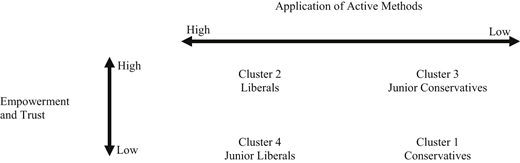
The four clusters of the university lecturers in Hanoi, Vietnam loosely fit a 2 × 2 matrix with active teaching methods on one axis and empowerment and trust on the other axis. As seen in Figure 1, liberal lecturers and conservative lecturers can be considered two opposite groups whose application of active teaching methods, on the one hand, and empowerment and trust, on the other hand, differ significantly from each other. “Liberals” and “junior liberals” have different levels of empowerment and trust, while “conservatives” and “junior conservatives” have different intensities of application of active teaching methods. Finally, and interestingly, both “liberals” and “junior conservatives” empower and trust their students quite a lot, although the amounts they apply active teaching methods vary greatly. In addition, although their degrees of application of active teaching methods are not the same, both “junior liberals” and “conservatives” have a low level of empowerment of and trust in their students.
Theoretical implications
University lecturers, like other groups, are not a homogenous entity (Finnegan, 1993; May et al., 2013). There are lecturers who facilitate active teaching methods alongside those who do not (Admiraal et al., 2017; Tao and Yeh, 2008). Similarly, there are university lecturers who have trust in and empower their students working in the same universities as those who do not. Interestingly, trust and empowerment, the invisible and visible parts of lecturers' attitudes toward their students (Jones, 1996; Niemi, 2002), may also affect the lecturers' attitudes toward the active teaching methods. However, these two factors may not necessarily be the only critical conditions for applying the new teaching methods (Curzon-Hobson, 2002; Tan, 2004). For example, although they have a high level of trust and empowerment, certain lecturers are found to be somewhat unenthusiastic with regards to active teaching methods.
From another perspective, the lecturers' thinking styles and emotional intelligence may be other internal facilitators or inhibitors to applying active teaching methods (Pennington, 1996). However, this does not hold true for all university teaching staff, which is similar to the situation of trust and empowerment mentioned earlier. For example, certain lecturers may have a high self-rated emotional intelligence yet choose not to carry out active teaching methods. Moreover, some lecturers may consider themselves creative thinkers yet also choose not to follow these methods. Considering this observation, the importance of external facilitators, such as support and cooperation, should not be neglected (Carless, 2003; Lam et al., 2010).
On an additional note, this study found that biological sex, an overt variable, is not a significant indicator of lecturers' attitudes toward active teaching methods, which is different from previous findings (Wang et al., 2010). Thus, the a priori differentiation or segmentation of a university teaching staff based on biological sex may not be a reliable approach in certain cases. Otherwise, covert variables, such as thinking styles and emotional intelligence, can be employed as additional segmentation criteria since their reliability and usefulness have been observed.
Practical implications
Theoretically, the values and benefits of active teaching methods (e.g. autonomy and individuality) may not be compatible with the traditional thoughts and behaviors of the Vietnamese society, which are based on communality and dependency (Hofstede et al., 2010; Nguyen and Tran, 2018; Truong et al., 2017). However, this study observed that a significant proportion of Vietnamese university lecturers (“liberals” and “junior conservatives”) have a relatively high level of trust in their students and are trying to empower them. More than half of the lecturers in these clusters are using active teaching methods on a relatively regular basis. To a lesser extent, although possessing a relatively low level of trust in their students and not empowering them very much, another proportion of the Vietnamese university lecturers have also chosen to use these new methods. This implies that any reform of Vietnam's higher education system using the more active approaches has a certain degree of internal support from the university teaching staff. Nevertheless, there still is a certain degree of lack of engagement within the same population. In order to successfully achieve the ultimate goals of education modernization, the identification of uninterested lecturers is a very important task. From there, strategies to reeducate or to change the attitude of these lecturers, especially the external factors, can be proposed.
Other countries, especially those with unstandardized university teaching staff (e.g. being relatively young in age, lacking in experiences or not holding suitable academic degrees), may refer to the current situation in Vietnam to improve their own education reforms. Specifically, external supports (e.g. moral and financial) could be given to the lecturers who trust and empower their students yet still hesitate to apply new teaching methods. In addition, reevaluation may be considered for lecturers who have low levels of emotional intelligence, trust and empowerment. Moreover, recruitment of new lecturers must consider, from the very beginning, the personal characteristics of the candidates in order to ensure that those who are compatible with the purposes of education reforms or modernization are selected.
Concluding remarks
The outcomes of the survey conducted in Hanoi (Vietnam) revealed that the university lecturers there have an average tendency to apply active teaching methods, as well as to trust in and empower their students. In addition, applying the segmentation method used in marketing research, this study identified four different clusters in the sample. The study found that the intensity of applying active teaching methods may be affected by the level of trust in students and student empowerment. In addition, whether these methods are used or not may also be influenced by covert internal characteristics of the lecturers, for example, thinking styles and emotional intelligence. The lecturers' overt characteristics, such as age, education and experience, may impact their implementation of active teaching methods, while biological sex may not play a significant role. These findings have extended the literature on the application of active teaching methods by revealing the diversity of university lecturers, as well as the relative contribution of the abovementioned overt and covert factors.
Limitations and future directions
Several limitations of this study, nonetheless, should be noted. First, the measures used in the questionnaire were originally developed for other contexts. The translation and interpretation of certain items might be unintentionally biased by the researchers and the respondents. To address these issues, future studies in Vietnam may expand their efforts to develop their own measures. Qualitative methods such as focus group interviews and discussions can help generate more relevant items (Rattray and Jones, 2007).
Second, the sample was generated through a nonrandom method. The number of national universities (n = 5) well exceeded that of private university (n = 1). The setting was also limited to one major city in Vietnam. Therefore, the data, and thus, the findings may not be a perfect representation of university teachers, even just in Vietnam. In addition, several environmental or external factors, such as the ownership and specializations of the universities, were not taken into account, given the purpose of the study and the size of the sample. Thus, the impacts of these factors, if there are any, could not be detected either. In the future, other studies may be repeated with larger and more differentiated samples in order to ascertain the existence of varied clusters of university lecturers and to identify the impacts of environmental factors.
Third, the number of steps in active teaching methods identified for this study is small (n = 3). One of them was even removed when undertaking the segmentation attempt. In addition, these steps were defined to reflect active teaching methods in general, not particular approaches taken (Prince and Felder, 2007). In the future, other studies may focus on one particular approach and then generate a larger pool of nominal practices to better evaluate the application of that specific approach.
Last, but not least, there may be certain correlations between the application of active teaching methods and other covert characteristics of the lecturers (thinking styles and emotional intelligence). However, this tendency was only observed through a segmentation analysis. In the future, other studies may structurally examine these correlations to verify the real contribution of the overt factors to the application of active teaching methods.