


Enrolling in an academic discipline or selecting the college major choice is a dynamic process. Very few studies examine this aspect in India. This paper makes a humble attempt to fill this gap using NSSO 71st round data on social consumption on education. The purpose of this paper is to use multinomial regression model to study the different factors that influence course choice in higher education. The different factors (given the availability of information) considered relate to ability, gender, cost of higher education, socio-economic and geographical location. The results indicate that gender polarization is apparent between humanities and engineering. The predicated probabilities bring out the dichotomy between the choice of courses and levels of living expressed through consumption expenditures in terms of professional and non-professional courses. Predicted probabilities of course choices bring in a clear distinction between south and west regions preferring engineering and other professional courses, whereas north, east and NES prefer humanities.
The present paper follows the same approach as that of Turner and Bowen (1999). The Multinomial regression is specified as , where P (Mi=j) denotes the probability of choosing outcome j, the particular course/major choice that categorizes different disciplines. This response variable is specified with five categories: such as medicine, engineering, other professional courses, science and humanities. The authors’ primary interest is to determine the factors governing an individual’s decision to choose a particular subject field as compared to humanities. In other words, to make the system identifiable in the MLR, humanities is treated as a reference category. The vector Xi includes the set of explanatory variables and βj refers to the corresponding coefficients for each of the outcome j. From an aggregate perspective, the distribution of course choices is an important input to the skill (technical skills) composition of future workforce. In that sense, except humanities, the rest of the courses are technical-intensive courses; hence, humanities is treated as a reference category.
The results indicate that gender polarization is apparent between humanities and engineering. The predicated probabilities bring out the dichotomy between the choice of courses and levels of living expressed through consumption expenditures in terms of professional and non-professional courses. Predicted probabilities of course choices bring in a clear distinction between south and west regions preferring engineering and other professional courses, whereas north, east and NES prefer humanities.
Predicted probabilities of course choices bring in a clear distinction between south and west regions preferring engineering and other professional courses, whereas north, east and NES prefer humanities. This course and regional imbalance need to be worked with multi-pronged strategies of providing both access to education and employment opportunities in other states. But the predicted probabilities of medicine and science remain similar across the board. Very few research studies on the determinants of field choice in higher education prevail in India. Research studies on returns to education by field or course choices hardly exist in India. These evidences are particularly important to know which course choices can support student loans, which can be the future area of work.
The research evidence is particularly important to know which course choices can support student loans, which can be the future area of work, as well as how to address the gender bias in the course choices.
The paper has social implications in terms of giving insights into the course choices of students. These findings bring in implications for practice in their ability to predict the demand for course choices and their share of demand, not only in the labor market but also across regions. India has 36 states/UTs and each state/UT has a huge population size and large geographical areas. The choice of course has state-specific influence because of nature of state economy, society, culture and inherent education systems. Further, within the states, rural and urban variation has also a serious influence on the choice of courses.
The present study is a value addition on three counts. First, the choice of courses includes the recent trends in the preference over market-oriented/technical courses such as medicine, engineering and other professional courses (chartered accountancy and similar courses, courses from Industrial Training Institute, recognized vocational training institute, etc.). The choice of market-oriented courses has been examined in relation to the choice of conventional subjects. Second, the socio-economic background of students plays a significant role in the choice of courses. Third, the present paper uses the latest data on Social Consumption on Education.
1. Introduction
Selecting the best possible course, given the individual endowments, is a challenging key decision in a youth’s life, because students have imperfect information and beliefs about probability of success, match or mismatch between ability and effort, enjoyability of a course, knowledge requirements of jobs, peer and family pressure, expected earnings, employment rates, etc. Choice of major is a critical decision that determines many future outcomes. Understanding these factors involves a series of processes that impinges on the private and social returns to human capital investment (Turner and Bowen, 1999). Studying the relationship between major choice and labor market outcomes is equally important from a societal perspective. The present paper makes an effort to understand the various factors that influence the choice of course using the available data sources.
In India, 27.29m students were enrolled in various undergraduate courses in 2015‒2016. This number constitutes 80 percent of total enrollment in higher educational institutions (AIHES, 2017). This statistic depicts a gross enrollment ratio (GER) of 25 percent, which is considerably low in comparison to developed nations. The young India combined with low GER clearly indicates the prospects of students’ enrollment growth. Nonetheless, students’ decisions about whether to enroll in college, where to enroll in college, what to study in college, how long and how to finance college are the sequential complex questions on which the students have very limited information. The choice of major or course is one of the important determinants of the labor market outcomes of students. It is also the other way round that the choice of a major plays a critical role in determining the future earnings. These two decisions reinforce each other[1]. When students and families make their choice, very little is known about various factors that influence the choice.
Students may make their major choice decisions partly due to the expected (lifetime) earnings, information on earnings and its lagged response, employment rates, and probability of success, either constant or perceived association with different majors. There are many other elements entering the choice of concentration of college students, namely, students’ tastes and preferences[2], high school curriculum/preparedness, cognitive and non-cognitive ability, expected benefits of alternative courses of study, exposure to different fields of study, knowledge content required in job market, and business cycle-related choices, besides the heterogeneous personal and family background characteristics including social and parental expectations and attitudes and interests stimulated by faculty and peer groups. Major/choice selection further reflects a variety of underlying factors, such as affordability, social status, etc.
In this backdrop, the objective of the present paper is to identify the determinants on the probability of students’ enrollment of courses in higher education. In this endeavor, we examine the most popular choice of subjects among students, namely, medicine, engineering, other professional courses, science and humanities. It can be noted from the review of earlier studies in the next section that there hardly exist studies that examine the course choices[3] in India. This paper makes an effort to fill this gap. It is expected that the estimated probability of course choices can inform the policy on the initiatives toward science, technology, engineering and mathematics (STEM), job-oriented and skill development courses, the balance between market and non-market-oriented courses, etc.
2. Review of select earlier studies
There exists a huge literature dealing with different aspects on the study of major choice[4]. The present review restricts itself to studies that deal with factors that determine the major choice. In the economic literature, estimates on the returns to education prevail since 1960s (Becker, 1975; Mincer, 1974; Schultz, 1961). One of the earliest studies examined how mathematical ability influences subject choice in explaining the differences in earnings across disciplines. This differential return is found to be on account of the quantitative abilities in the production of human capital (Paglin and Rufolo, 1990). On these lines, many papers examined linking the choice of courses and their earning differentials. For instance, in analyzing the demand for and return to education, Altonji (1993) developed a model in which higher education involves a chain of sequential decisions about whether to attend college and then what subject to major, based on expected economic returns. In this framework, he explored the effects of ability, high school preparation, preferences for schooling and the borrowing rate in two periods[5]. He further estimated the effects of gender, aptitude, high school curriculum and family background on the expected returns.
Using data from the National Longitudinal Survey of Young Men, Berger (1988) examined the relationship between predicted future earnings for five broad fields and choice of major. Following Heckman selection framework, he estimated the short-term expected future earnings from each degree. The predicted future earnings for each major are subsequently included in a conditional logit model of college choice, which is found to be a significant factor in students’ decisions. Controlling for family background characteristics, he found that individuals are likely to choose those majors that offer better future earning flow and not based on the entry level salary. Later, Montmarquette et al. (2002) examined that the choice of a major depends on students’ perceived probability of success and the predicted earnings of graduates and a counterfactual if students fail to complete the degree. Using a mixed multinomial logit model, they found that expected earnings are the most significant variable. However, they reported significant differences in the impact of expected earnings by gender and race.
Adopting experimental approach, Arcidiacono et al. (2010) collected information from students about their expected earnings in the current chosen majors and in counterfactual majors, and subjective assessments of their abilities in chosen and counterfactual majors. Using this panel of beliefs, they estimated a model of college major choice that incorporates these subjective expectations and assessments. They found that both expected earnings and students’ abilities in different majors are important determinants of student’s choice of a major. They further estimated that 7.5 percent of students would switch majors if they did not make any forecast errors. They also found if expected earnings were equal across majors, students would switch over for humanities and social sciences to the tune of 17 percent and choosing economics would fall by 16 percent.
Taking further, Long et al. (2015) tried to find out the time lag or lagged response of completed major response in a field in year t+y and its relation to wages in the associated occupations in year t. This is explored by estimating the causality and correlation between majors produced in year t and associated occupational wages in year t–y. Further, they assessed whether choice of majors responds to national and local labor market wages, how responsive are the tightly connected majors and occupation to wages, and existence of heterogeneity in response by student characteristics. They found that college majors are most strongly related to wages observed three years earlier, when students were college freshmen. The responses to wages vary depending on the extent to which there is a strong mapping of majors into particular occupations. Yet, another important finding is that majors respond more strongly in disciplines wherein information is more salient and applicable. Differences in student ability and aptitudes have been found to influence choice of college majors. For example, Turner and Brown (1999) provided evidence of ability sorting across majors by SAT scores. Cognitive and non-cognitive abilities play a large role in the choice of college major (Heckman and Mosso, 2014).
As can be noted, very few studies examine the choice of course (major)[6] in India. One such study is Chakrabarti (2009), which estimated the factors that explain choice of different stream of studies such as Arts, Commerce, Science and Technical Education as compared to not enrolling in higher education using the 52nd round NSSO data. She first estimated the demand for higher education by considering its social composition, gender-related aspects, economic background and cost of education. Since then, the deepening of globalization brought about many changes across the higher education system in countries, such as reduction in the size of the government, government-funded systems including education, more specifically higher education. Paralleled is the attraction of the skilled individuals, which led to the increase in the social demand for professional higher education.
3. The present study
In this light, the present paper attempts to explore the determinants on the probability of students’ enrollment of courses in higher education. One major difficulty in the estimation of choice of course is the selection issue, as we do not get information on choice of subjects for students, who drop out from higher education. Even among those who continue to pursue higher education, what is available is the realized choices of major and not the initial choices. It is quite possible that there could be a difference between the initial and realized choices, due to many reasons. Such information on the initial or ex ante choice of courses is not available. Hence, many choice path determinants could not be measured also due to the uncertainty involved in each stage of decision making. The paper notes the major data gap in directly studying the course choice in India, given the available data. This has been further discussed in the agenda for future research. Hence, the paper attempts to examine the enrollment by academic discipline in a multinomial logistic regression (MLR) and thereby examines the causal relationship between the set of select explanatory variables.
We are motivated to examine the choice (enrollment) of selected subjects that are most popular among students. Accordingly, the paper focuses on the subject choices of medicine, engineering, other professional courses, science and humanities. Given the categorical nature of course choice, MLR is estimated. The present study is a value addition on three counts. First, the choice of courses includes the recent trends in the preference over market-oriented/technical courses such as medicine, engineering and other professional courses (chartered accountancy and similar courses, courses from Industrial Training Institute (ITI), recognized vocational training institute, etc.). The choice of market-oriented courses has been examined in relation to the choice of conventional subjects. Second, the socio-economic background of students plays a significant role in the choice of courses. Third, the present paper uses the recent 71st round NSSO data on Social Consumption on Education. It is pertinent to note that no earnings data are available from this survey and the same is supplemented with the earning data from IHDS-II.
Much of the literature on choice of major utilizes individual survey data; multinomial logit (MLR) is used to estimate choices among a limited number of broad fields of study. The present paper follows the same approach as that of Turner and Bowen (1999). It is specified as follows:
where P (Mi=j) denotes the probability of choosing outcome j, the particular course/major choice that categorizes different disciplines. This response variable is specified with five categories: such as medicine, engineering, other professional courses, science and humanities. Our primary interest is to determine the factors governing an individual’s decision to choose a particular subject field as compared to humanities. In other words, to make the system identifiable in the MLR, humanities is treated as a reference category. The vector Xi includes the set of explanatory variables and βj refers to the corresponding coefficients for each of the outcome j. From an aggregate perspective, the distribution of course choices is an important input to the skill (technical skills) composition of future workforce. In that sense, except humanities, the rest of the courses are technical-intensive courses; hence, humanities is treated as a reference category.
4. Data and variables
The present paper uses the 71st Round data of NSSO on “Participation and Expenditure on Education”. The survey covered the whole of India, and the period of survey was of 6-month duration, starting on January 1, 2014 and ending on June 30, 2014. A stratified multi-stage design was adopted for the survey. A total of 4,577 villages were surveyed in rural India and the number of urban blocks surveyed was 3,720 as first-stage units in urban areas. The total number of households surveyed was 36,479 and 29,447 in rural and urban India, respectively. The total number of individuals covered were 178,331 in rural and 132,496 in urban India (Government of India, 2015). The present paper uses extensively the information from Block 5 of the schedule 25.2 in understanding the central question of the paper, namely, factors that influence the enrollment choice of course in higher education.
There were 93,513 individuals in 5‒29 age group in the survey who were then attending any educational institution. Among these individuals, our variable of interest was students who were enrolled in graduate and above courses. Considering the dependent response variable, our analysis was based on the 17,235 students in this age group who were then attending any higher educational institution in the major courses such as medicine, engineering (includes IT and computer courses), other professional courses (chartered accountancy and similar courses and courses from ITIs), science (including agriculture) and humanities. Table I report the variables included in the multinomial logistic regression. They are grouped as follows: expected income, ability, cost of education, personal, socio-economic and location factors.
Determinants of college course/major choice
| Broad group | Determinants | Veritable notation | Categories |
|---|---|---|---|
| Expected earnings | Earning by discipline (Proxy for expected earnings) | Earning | Cluster by States and disciplinary choices derived from IHDS-II survey |
| Ability enhancers | Language spoken at home and school: dummy | LANG_INSTU_HOME | Different=1; Same=0 |
| Able to operate computer: dummy | ABLE_OPERATE_COMP | Yes=1; No=0 | |
| Private coaching: dummy | PRIVATE_COACHING | Yes=1; No=0 | |
| Cost of education | HH. Expenditure on education: continuous | HHX_education | Cluster by States and course |
| Free education: dummy | Free_education | Yes=1; No=0 | |
| Type of institution: dummy | Govt_Institution | Govt=1; Non-Govt=0 | |
| Personal factors | Gender: dummy | GENDER_STUDENTS | Male=1; Female=0 |
| Social group: categorical | OBC, Others | Scheduled Tribes/Scheduled Castes=1; Other Backward Castes (OBC)=2; Other Castes=3 | |
| Religion: categorical | Christianity, Other Religion, Hinduism, | Islam=1; Christianity=2; Other Religions=3; Hinduism=4 | |
| Socio-economic factors | Level of living: categorical | Q2, Q3, Q4, Q5 | From Poorest to Richest HH expenditure quintiles Q1; Q2; Q3; Q4; Q5 |
| Occupation of family: categorical | Salary earning, casual labor, other labor | Self-employed=1; Salary earning=2; Casual labor=3; Other Labor = 4 | |
| Education of head of family: Dummy | Edn_hoh | Elementary and Below=0 and secondary and above=1 | |
| Family size: categorical | Small, Medium, Large | Marginal=1; Small=2; Medium=3; Large=4 | |
| Geographical location | Sector: categorical | Urban | Rural=1; Urban=2 |
| Regions: categorical | West, East, NES, North | South=1; West=2; East=3: North-East=4; North=5 |
Note: Reference category in italic letters
Expected Earnings are proxied by the wage rate of individuals by discipline and states. Since earnings (wage rate) of individuals are not available in the NSSO 71st round, the same is taken from the India Human Development Survey- II, 2012. It is jointly conducted by the University of Maryland and the National Council of Applied Economic Research, New Delhi. It covers all states and union territories of India, with the exception of Andaman/Nicobar and Lakshadweep. The survey covers 42,152 households in 384 districts, 1,420 villages and 1,042 urban blocks located in 276 towns and cities across India. The villages and urban blocks are the primary sampling unit from which the rural sample was drawn using stratified random sampling and the urban sample from a stratified sample of towns and cities within states (or groups of states) selected by probability proportional to population (Desai et al., 2015).
Education variable collected in IHDS-II survey comprises of various degrees and majors in higher education. The various degrees consist of graduate degree in general/nonprofessional education (BA, BSc, BCom, etc.); graduate degree in engineering (BE, BTech.); graduate degree in medicine (MBBS/BAMS); post-graduate and above degree in general/nonprofessional education (Masters, PhD); post-graduate degree in professional education (MD, Law, MBA, CA, etc.); and diploma in vocational education (Diploma<3 years; Diploma 3+years). Another category is incomplete, that is non-graduates (a completed higher secondary level). Using this available information, we create a new variable, the subject choice consisting of the subjects humanities (including science), engineering, medicine and other professional courses. This categorization is followed so as to align with course choices that we categorized using the NSSO 71st round data. The column 2 in Table II exhibits the categorization.
Mean earning by highest degree of the working age populationa in India
| Highest degree | Subject choice | Mean earning | Freq. | % Distribution |
|---|---|---|---|---|
| (1) | (2) | (3) | (4) | (5) |
| BA, BSc, BCom, etc. | Humanities | 150,833 | 7,654 | 63.95 |
| BE, BTech. | Engineering | 273,827 | 383 | 3.20 |
| MBBS/BAMS | Medicine | 306,088 | 109 | 0.91 |
| Masters, PhDb | NA | 190,082 | 2,260 | 18.88 |
| MD, Law, MBA, CA, etc. | Other Professional | 226,354 | 486 | 4.06 |
| Diploma <3 years | -do- | 158,353 | 705 | 5.89 |
| Diploma 3+ years | -do- | 209,523 | 189 | 1.58 |
| Othersb | NA | 107,518 | 182 | 1.52 |
| Total | 169,450 | 11,968 | 100.00 |
Notes: a15–65 age group (Based on IHDS-II); bExcluded as there are no subject details available
Within humanities, we extracted science graduates using the information in the variable on the subject studied after high school. The data are inflated to 2014 using the per captia income growth across states. The mean earnings of the working age population 15‒65 across states and subject groups are used as a proxy for expected earnings. This information is triangulated to NSSO 71st survey data using a cluster variable of states and subjects choices. To get an idea of the earnings differential, Table II reports the mean earnings of individuals with highest degree among the working age population. It can be noted the highest earning is among the MBBS/BAMS and least earning is among the BA/BSc/BCom categories, besides others.
4.1 Ability
The acquired ability[7] variables seek to determine whether different types of cognitive capabilities affect the probability of success and expected earnings of graduates in different major choices. The unobservable characteristics of ability measures enter into the choice models as SAT scores, mathematical ability, high school academic preparation, cognitive and non-cognitive abilities, etc. In the absence of such information, the present paper attempts to include three proxy ability dummy measures, namely, language spoken at home and school is the same or different, ability to operate computer and the private coaching opted by the student. The language spoken at home and college is used as indicators of unobserved ability. Introducing language ability into the analysis is important, since it is essential for explaining college selection and also has a significant impact on college choice and earnings after college graduation. If language spoken at home is the same as studied in school, it indicates a higher acquired ability to speak, read and write another language (English). Most of the college/university courses use textbooks written in English and the medium of instruction is likely to be English. However, language spoken at home is likely to be the regional language. When medium of instruction is other than the one spoken at home (English), it brings in an additional acquired ability for the student to the selection of choice of courses. It can reflect the economic conditions of the family, which is a well-known positive relationship between education and income. Studying the influence language spoken at home and school over the course choice brings out some interesting findings. The connection between language and cognitive ability and earnings is analyzed by a number of studies. For instance, Azam et al. (2011) estimated the effects of English language skills on wages. They found that hourly wages are on average 34 percent higher for men who speak fluent English and 13 percent higher for men who speak a little English compared to men who do not speak English. The return to fluent English is as large as the return to complete secondary school and half as large as the return to complete a Bachelor’s degree.
Similar argument can be made for ability to operate computer. The digital technologies have spread rapidly across the world. Adapting workers’ skills to the demands of the new economy is a challenge and responding to the fast-changing information and communication technology (ICT) and their adoption requires multiplicity of skills. Hence, this acquired ability to operate computer is used as yet another proxy for ability in the paper.
4.2 Descriptive statistics
Table III reports descriptive statistics of the variables used in the paper. The mean earnings for graduates with humanities are Rs.190,466, whereas they are Rs.249,919 for medical graduates. In the total sample of students, 30 percent of them speak the same language both at home and in their colleges. Among them, the humanities major constitutes 50 percent, followed by 30 percent enrolled in other professional courses. On the contrary, majority of the students, 70 percent, speak different languages than the ones they speak at home. Different language share is the highest among engineering course, followed by other professional courses. Another proxy for ability considered here is the dummy variable ability to operate computers. In the overall sample, more than 80 percent of the students are able to operate computers. As expected, the highest share of students in this category chooses engineering courses, followed by other professional courses. However, 60 percent of the students enroll in humanities, followed by other professional courses among the 20 percent who are not able to operate computer. Another effort promoting activity to enhance ability is private coaching. In the overall sample, more than 80 percent students take private tuition. Unlike other two ability proxies, here, it can be noted that private tuition is common across all course groups except medicine.
Summary statistics of attending students by major choice (in %)
| Medicine | Engineering | Other Prof. courses | Science | Humanities | Total | |
|---|---|---|---|---|---|---|
| Expected Earnings (in Rs) | 249,919 | 272,890 | 241,555 | 190,466 | 164,282 | 226,021 |
| Lang_Same | 0.97 | 4.96 | 29.34 | 10.87 | 53.86 | 5,178 |
| Different | 7.23 | 40.72 | 27.18 | 12.23 | 12.64 | 12,057 |
| ABLE_OPERATE_COMP | 5.76 | 34.18 | 28.88 | 11.30 | 19.88 | 14,972 |
| NO | 2.65 | 2.17 | 20.86 | 15.25 | 59.08 | 2,263 |
| PRIVATE_COACHING | 6.13 | 31.19 | 27.14 | 10.87 | 24.67 | 14,227 |
| NO | 1.66 | 24.27 | 31.08 | 16.29 | 26.70 | 3,008 |
| HH Exp. Higher Education (in Rs.) | 112,891 | 75,598 | 41,617 | 25,862 | 11,675 | 46,263 |
| Free_education | 5.46 | 31.33 | 28.02 | 11.50 | 23.69 | 15,951 |
| No | 3.97 | 13.24 | 25.39 | 15.73 | 41.67 | 1,284 |
| Govt | 6.80 | 44.84 | 27.90 | 9.12 | 11.34 | 6,456 |
| Non_Govt | 4.48 | 21.08 | 27.79 | 13.43 | 33.22 | 10,779 |
| Male | 3.75 | 37.60 | 27.70 | 10.92 | 20.04 | 10,011 |
| Female | 7.57 | 19.42 | 28.00 | 13.07 | 31.94 | 7,224 |
| SC/ST | 6.14 | 23.53 | 26.51 | 11.50 | 32.31 | 2,129 |
| OBC | 5.13 | 32.15 | 25.27 | 13.83 | 23.63 | 6,495 |
| Others | 5.12 | 31.51 | 30.96 | 10.11 | 22.30 | 6,915 |
| Islam | 5.98 | 25.40 | 27.71 | 11.51 | 29.40 | 1,772 |
| Christianity | 10.64 | 23.08 | 24.80 | 11.72 | 29.76 | 1,109 |
| All Other Religions | 7.38 | 29.53 | 30.22 | 9.33 | 23.54 | 317 |
| Hinduism | 4.73 | 31.16 | 27.96 | 12.00 | 24.15 | 13,636 |
| Q1 | 2.72 | 15.75 | 23.61 | 13.72 | 44.20 | 2,317 |
| Q2 | 3.63 | 20.22 | 26.10 | 13.69 | 36.36 | 2,973 |
| Q3 | 4.27 | 26.00 | 29.56 | 12.89 | 27.28 | 3,281 |
| Q4 | 5.31 | 34.21 | 27.72 | 12.08 | 20.68 | 4,124 |
| Q5 | 8.63 | 42.67 | 29.96 | 8.61 | 10.13 | 4,540 |
| Self-employed | 4.72 | 28.60 | 27.78 | 11.78 | 27.11 | 8,682 |
| Salary earning | 6.77 | 33.19 | 27.42 | 11.45 | 21.18 | 5,897 |
| Casual labor | 2.99 | 22.03 | 30.53 | 11.64 | 32.81 | 1,271 |
| Other labor | 5.42 | 32.27 | 27.36 | 13.79 | 21.16 | 1,385 |
| Illiterate | 3.64 | 21.69 | 27.65 | 12.32 | 34.70 | 2,199 |
| Primary/UPry | 4.36 | 25.38 | 28.05 | 12.13 | 30.07 | 5,019 |
| Sec/Hr Sec | 4.81 | 32.16 | 27.63 | 11.43 | 23.97 | 5,799 |
| Grad&above | 8.16 | 36.77 | 27.93 | 11.71 | 15.43 | 4,218 |
| Marginal | 4.56 | 34.80 | 31.76 | 9.46 | 19.43 | 592 |
| Small | 5.88 | 36.19 | 28.84 | 10.85 | 18.24 | 7,011 |
| Medium | 5.14 | 27.27 | 27.08 | 13.02 | 27.50 | 6,367 |
| Large | 4.78 | 21.07 | 26.40 | 11.98 | 35.77 | 3,265 |
| Rural | 5.42 | 26.89 | 24.86 | 12.24 | 30.60 | 7,680 |
| Urban | 5.30 | 32.46 | 30.21 | 11.48 | 20.54 | 9,555 |
| South | 6.01 | 44.67 | 28.50 | 13.81 | 7.01 | 3,779 |
| West | 5.44 | 25.33 | 33.93 | 9.11 | 26.19 | 2,997 |
| East | 3.24 | 29.21 | 26.23 | 7.58 | 33.75 | 1,914 |
| NES | 10.20 | 23.24 | 20.50 | 13.25 | 32.82 | 1,932 |
| North | 4.13 | 25.89 | 27.28 | 12.72 | 29.99 | 6,613 |
| Total | 5.35 | 29.98 | 27.83 | 11.82 | 25.02 | 17,235 |
4.2.1 Cost of education
Invariably almost all earlier studies indicate the direct link between the choice of majors and the expected earnings. It may be noted this is the direct benefit of selecting a particular major, though realizable in the future. In other words, the returns to education have been implicitly the underlying factor in the choice of major. However, studies rarely examined the influence of cost of education on the choice of major. Cost of education is a significant predictor of the course enrollment. The proxy for cost of education available in the NSSO data is the household expenditure on higher education by the broad disciplinary choices. It ranges from Rs. 11,675 for humanities to Rs. 112,891 for medical courses (Table III). Yet, another cost of education proximate variable used here is whether education is free or not. Almost 90 percent of the total sample report education is free. Among them, the highest share of free education is availed by engineering, other professional and humanities students. On the contrary, no free education is available to humanities, followed by other professional courses. It is important to note that engineering students get the highest share of free education. Another cost-related factor is whether the students study in government or non-government institutions. It is well known that cost of higher education in government institutions is much lower than in non- government or private institutions. More than 60 percent of the total sample students are enrolled in government institutions. Among this, the highest share is in engineering, followed by other professionals, whereas in non-government institutions, the highest share is among humanities, followed by other professional and engineering courses.
4.2.2 Personal characteristics
The personal variables included in the model are gender, caste and religion. The gender variable, for example, seeks to determine whether women are (as is generally believed) less likely than men to choose science or engineering subjects. Similarly, the caste and religious affiliation influence the choice of course in college. With regard to the gender composition, around 60 percent of the sample constitutes male students enrolled in higher education. Among this, the highest preference is for engineering, followed by other professional and humanities courses. Among female students, highest preference is humanities, followed by other professional and engineering courses. The same pattern is found across Christian students. With regard to social category, in the total sample, 40 percent belong to general or forward category, another 40 percent OBC, and the rest 20 percent belong to SC/ST category. Among the privileged and OBC groups, the most preferred course is engineering, other professional courses, followed by humanities. A similar pattern is found across Hindus, which constitute 80 percent of the sample, whereas among SC/ST students, the first preferred courses is humanities, followed by other professional courses. This pattern is similar to the preferences of Islamic students.
4.2.3 Socio-economic variables
Family expenditures, the education and occupational levels of parents, as well as elements of family structure such as the size of the family enter the model as socio-economic variables. Historically, education and income are positively related. With rising cost of professional as well as general higher education, the economic condition of family is one of the decisive factors for the course choices. The present paper uses two economic indicators, occupation and the level of living of family (proxied by quintiles of monthly per capita consumption expenditures), as predictors to investigate the quantitative impact of different categories on selection of courses. It is argued that a more privileged background would enable a student to take risk by entering a more demanding course in science. Similarly, the parental education variables measure potential educational advantages or disadvantage due to a student’s educational background of family, which may influence him or her to choose a major with a higher risk.
In case of economic factors, among the lowest level of living quintile, 44.20 percent are enrolled in humanities, followed by other professional and engineering courses (Table III). Similar is the pattern across the low or Q2 quintile. In the middle quintile Q3, the highest share of students prefer other professional courses, followed by humanities and engineering courses. In the upper middle quintile Q4, students first prefer engineering, followed by other professional courses and humanities courses. In the top quintile Q5, engineering, other professional courses and humanities occupy the major shares. Interestingly, medicine and sciences occupy the same shares across quintiles. A clear division is apparent between the least Q1 and the top Q5 in terms of course choices. With regard to occupation, 50 percent of the students’ families are engaged in self-employment, followed by another 34 percent in salaried earnings. Among the self-employed, most preferred course is engineering, and equal preference is between other professional and humanities, whereas among the salaried, the first preferred course is engineering, followed by other professional and humanities courses.
Educational attainment of the head of the household is classified as no literate, primary, secondary and graduate and above levels of education. In the total sample, 34 percent of the students’ head of the family attains secondary education, ranging from 9 to 12 years of schooling. Another 30 percent are with 5‒8 years of schooling. Another 24 percent of students’ head of the family has graduate and above educational attainment. When education of the head of household is secondary and above, the most preferred course is engineering, followed by other professional and humanities courses. When education of the head of the household is below elementary levels, the most preferred course is humanities, followed by other professional courses and engineering.
In the case of family size, majority, almost 70 percent, of the sample students belong to either small or medium family size, including marginal families, the highest preferences are towards engineering, followed by other professional and humanities as in the case of rich quintile Q5, male and Hindu students. Among the large family size, most preferred course is humanities, followed by other professional and engineering courses as found in poorest quintile Q1 and in below elementary levels of education of the head of the households.
4.2.4 Geographical
The choice of major depends not only on the costs, expected earnings, and household characteristics but also on differences in regions. The regional variables considered in the analysis are location and regions. Locations measure college education received in urban areas as rural areas is treated as the reference category. Regions measure the students belonging to different regions of the country, namely, south, north, east, west and NES. In the analysis, the region south is treated as reference category (see Table I). India has 36 states/UTs and each state/UT has a huge population size and large geographical areas. The choice of course has region and state-specific influence because of the vast variation in the nature of state economy, society, culture and inherent education systems. In this direction, the variable regions as one of predictor is included in the model. South is a reference category, as it depicts faster educational development compared to the rest of the regions, more so among the market-oriented professional courses. It is in this context, one needs to think south versus the rest of the regions in India. This is one of the few papers that examine the regional variations in India in this fashion.
With regard to location, among the rural students, the most preferred course is humanities, followed by engineering and other professional courses. Urban areas mirror the preferences of rich quintile Q5 and marginal, small and medium family sizes. With regard to regions, in the total sample, 40 percent belong to northern regions, followed by 22 percent from south. Among the North, the highest preferred course is humanities, followed by other professional and engineering courses. In the NES and Eastern regions, the first preferred course is humanities, followed by engineering and other professional courses. In the West, the first preferred course is other professional courses, followed by humanities and engineering. Whereas in the South, the top most preferred course is engineering, followed by other professional and science courses. Including the variable “Regions” becomes significant, as it depicts contrasting pattern in the enrollment preferences. All factors considered here relate to demand side. Equally important are the supply side factors, namely, access to and availability of seats in higher educational institutions. The present paper does not focus on the supply side factors, as there is no information directly available from the survey[8]. Nonetheless, the role of supply side factors does play a role on subject choice.
5. Discussion
Table IV reports the marginal effects from estimating the MLR on the enrollment by disciplinary choices relative to the base category, humanities. How these different factors determine the probability of selecting different courses is examined by estimating the MLR. The preliminary analysis such as correlation coefficient matrix indicates that there is no multicollinearity among the selected variables (Table AI). The overall test of model in LR χ2 and its probability values are found to be satisfactory. As Cameron & Trivedi (p. 333) noted, “a marginal effect, or partial effect, most often measures the effect on the conditional mean of y of a change in one of the regressors, say Xk. In the linear regression model, the marginal effect equals the relevant slope coefficient, greatly simplifying analysis. For nonlinear models, this is no longer the case, leading to remarkably many different methods for calculating marginal effects.” The marginal effect for categorical variables shows how P(Y=1) changes as the categorical variable change from 0 to 1, after controlling in some way for the other variables in the model[9]. The marginal effects are preferred in the present paper, as they are the same as the slope coefficients and hence easy to interpret.
Results of the determinants of college major choice: multinomial regression
| Explanatory variables | Medicine | Engineering | Other Prof | Science | |
|---|---|---|---|---|---|
| Dummy | LANG_INSTU_HOME | 0.0660*** (0.007) | 2.9537*** (0.169) | −0.3195*** (0.013) | −0.0222* (0.011) |
| -do- | ABLE_OPERATE_COMP=2 | 0.0029 (0.007) | −0.3496* (0.165) | 0.1045*** (0.018) | 0.1330*** (0.017) |
| -do- | PRIVATE_COACHING | 0.0655*** (0.007) | 0.9467*** (0.171) | −0.0574*** (0.012) | −0.0927*** (0.010) |
| Lhhxed | 0.0107*** (0.002) | 3.4302*** (0.079) | 0.2201*** (0.008) | −0.1098*** (0.007) | |
| Dummy | FREE_EDUCATION | −0.0034 (0.008) | −0.2453 (0.180) | 0.0285 (0.020) | 0.0425** (0.015) |
| -do- | type_instn_2cate | 0.0169*** (0.004) | 1.4241*** (0.105) | −0.0067 (0.010) | −0.0970*** (0.009) |
| -do- | GENDER_STUDENTS | −0.0400*** (0.004) | −0.1994* (0.094) | −0.0423*** (0.010) | −0.0557*** (0.008) |
| ST/SC Base | OBC | −0.0001 (0.006) | 0.1651 (0.134) | −0.0383** (0.014) | 0.0391*** (0.012) |
| Others | −0.0069 (0.005) | −0.2044 (0.136) | 0.0295* (0.014) | −0.0042 (0.012) | |
| Islam Base | Christianity | −0.0214* (0.010) | −1.1077*** (0.225) | −0.0043 (0.028) | 0.0248 (0.023) |
| Other Religions | −0.0202* (0.010) | −1.3741*** (0.253) | −0.0686* (0.027) | −0.0010 (0.023) | |
| Hinduism | −0.0206** (0.007) | −0.2559 (0.149) | −0.0584*** (0.016) | 0.0326* (0.013) | |
| Q1 Base | Q2 | 0.0070 (0.006) | −0.0055 (0.191) | −0.0079 (0.019) | −0.0011 (0.017) |
| Q3 | 0.0068 (0.006) | 0.1291 (0.188) | 0.0118 (0.018) | −0.0218 (0.017) | |
| Q4 | 0.0159** (0.006) | 0.5176** (0.185) | −0.0234 (0.018) | −0.0457** (0.016) | |
| Q5 | 0.0458*** (0.008) | 1.3420*** (0.196) | 0.0034 (0.019) | −0.1006*** (0.017) | |
| Dummy | Edn_hoh | 0.0079 (0.004) | 0.5149*** (0.105) | −0.0342** (0.011) | −0.0053 (0.009) |
| Self-Employed | Salary earning | 0.0059 (0.004) | 0.0402 (0.107) | −0.0231* (0.011) | 0.0077 (0.010) |
| Base | Casual labor | −0.0154* (0.007) | −1.1946*** (0.214) | 0.0237 (0.020) | −0.0060 (0.016) |
| Other labor | −0.0017 (0.007) | 0.1035 (0.185) | −0.0358 (0.019) | 0.0652*** (0.018) | |
| Marginal Base | Small | 0.0121 (0.008) | 0.6188* (0.285) | −0.0348 (0.028) | 0.0279 (0.023) |
| Medium | 0.0097 (0.009) | 0.5105 (0.291) | −0.0494 (0.028) | 0.0522* (0.023) | |
| Large | 0.0243* (0.010) | 0.8979** (0.305) | −0.0356 (0.030) | 0.0282 (0.025) | |
| Rural Base | Urban | −0.0252*** (0.004) | −0.3397*** (0.099) | 0.0717*** (0.010) | −0.0033 (0.009) |
| South Base | West | 0.0217*** (0.006) | −1.5936*** (0.166) | 0.0313* (0.016) | −0.0498*** (0.013) |
| East | −0.0009 (0.007) | −2.4489*** (0.213) | 0.0026 (0.019) | −0.0601*** (0.015) | |
| NES | 0.0373*** (0.009) | −2.2271*** (0.181) | −0.0988*** (0.019) | 0.0043 (0.017) | |
| North | 0.0016 (0.005) | −1.6760*** (0.154) | −0.0063 (0.014) | 0.0313* (0.013) | |
| Constant | −38.447*** (0.900) | −36.238*** (0.714) | −36.238*** (0.714) | −26.973*** (0.693) | |
| Pseudo R2 | 0.3302 | 0.3302 | 0.3302 | 0.3302 | |
| LR χ2 (124) | 16,763.35 | 16,763.35 | 16,763.35 | 16,763.35 | |
| N | 17,235 | 17,235 | 17,235 | 17,235 |
Notes: dy/dx for factor levels is the discrete change from the base level. Estimates on standard error are in parentheses. *p<0.05; **p<0.01; ***p<0.001
Correlation matrix of dependent variable and selected predictors
| Choice | Earning | Language | Compute | Pvt_Co~h | hhxedn | Free_Edn | type_i~e | Gender | social~p | Religi~4 | level_~g | occupa~n | family~e | Edn_hoh | Sector | Regions | |
|---|---|---|---|---|---|---|---|---|---|---|---|---|---|---|---|---|---|
| Choice | 1 | ||||||||||||||||
| Earning | −0.377* | 1 | |||||||||||||||
| Language | −0.471* | 0.260* | 1 | ||||||||||||||
| computer | 0.323* | −0.181* | −0.2871* | 1 | |||||||||||||
| Pvt_Coac | −0.076* | 0.013 | 0.0431* | −0.0018 | 1 | ||||||||||||
| hhxedn | −0.585* | 0.421* | 0.3626* | −0.2403* | 0.0540* | 1 | |||||||||||
| Free_Edn | 0.128* | −0.058* | −0.0425* | 0.1030* | −0.0279* | −0.075* | 1 | ||||||||||
| type_instn | −0.294* | 0.008 | 0.1738* | −0.1149* | 0.1124* | 0.1696* | −0.1831* | 1 | |||||||||
| Gender | −0.143* | 0.059* | 0.0740* | −0.1116* | −0.0303* | 0.0860* | −0.0245* | 0.0535* | 1 | ||||||||
| social_gp | −0.064* | 0.073* | 0.0437* | −0.1053* | −0.0909* | 0.0572* | −0.0773* | 0.0123 | −0.0004 | 1 | |||||||
| Religion4 | −0.032* | −0.011 | −0.1318* | −0.0171* | −0.0291* | 0.0131 | −0.0475* | 0.0383* | 0.0112 | 0.0216* | 1 | ||||||
| level_livi | −0.306* | 0.176* | 0.2807* | −0.3009* | −0.0204* | 0.2027* | −0.0975* | 0.1394* | 0.0003 | 0.2045* | 0.0398* | 1 | |||||
| Occupatio | −0.023* | 0.016* | 0.0558* | −0.0398* | 0.0114 | 0.0406* | 0.0184* | −0.0035 | −0.0091 | −0.047* | −0.0354* | 0.1067* | 1 | ||||
| family_si | 0.158* | −0.070* | −0.1569* | 0.1409* | 0.0065 | −0.111* | 0.0228* | −0.050* | −0.064* | −0.084* | −0.1100* | −0.3707* | −0.2062* | 1 | |||
| Edn_hoh | −0.144* | 0.107* | 0.1271* | −0.1317* | −0.0303* | 0.0718* | −0.0825* | 0.029* | −0.0113 | 0.191* | 0.0386* | 0.3294* | 0.0735* | −0.1328* | 1 | ||
| Sector | −0.103* | 0.095* | 0.1356* | −0.1772* | −0.0496* | 0.0664* | −0.0497* | 0.009 | −0.062* | 0.151* | −0.0297* | 0.3424* | 0.1389* | −0.1330* | 0.2370* | 1 | |
| Regions | 0.177* | −0.043* | −0.2015* | 0.1488* | −0.0796* | −0.109* | 0.0186* | −0.128* | 0.021* | 0.097* | −0.0450* | −0.0651* | −0.0359* | 0.2137* | 0.1327* | −0.0161* | 1 |
Note: *Statistically significant at 95 percent level
The proxy for expected earning is dropped from the model, as it did not report expected results, It could be probably due to limitations in the data. The ability to speak another language than the one spoken at home is more likely of choosing engineering with humanities as the base category. This predictor is highly significant across all course choices, albeit a declining probability of choosing other professional courses and science[10]. But this finding is contradictory to Jain (2016), who examined the impact of official language policies using historical data. He found that linguistically mismatched districts have 18 percent lower literacy rates and 20 percent lower college graduation rates, driven by difficulty in acquiring education due to a different mediums of instruction in schools. It could be because in Jain’s study, literacy rates are analyzed with languages, whereas the present study focusses on course choices in higher education. The ability to operate computer increases with 13 percentage points, and the students are more likely to choose the sciences courses, followed by 11 percentage points for other professional courses, whereas the same variable surprisingly shows that students are significantly less likely to choose engineering course. The students attending any private coaching are more likely of enrolling in engineering with a 95 percentage higher points, whereas the same tend to less likely enroll in other professional and science courses[11]. Ability factors considered here could probably capture the unobservable such as hard work or any other innate abilities. The results indicate that the higher the ability (proxies[12]), more apparent will be the preference for engineering. In other words, the more able students are crowded in engineering courses.
The cost of education is proxied by the reported household expenditure on education for all enrolled children by discipline. The log of this expenditure has more likelihood for engineering courses, followed by other professional and medical courses. But the likelihood is significantly less likely in science course by 11 percentage points. The results indicate that increasing the cost of higher education by charging higher fees, as a method of generating resources, can have serious welfare implication, especially for science courses, reporting 0.042 percentage points, with students more likely choosing science courses than others. One main reason could be that fees and other payments in any courses are higher in non-government institutions. This is further shown that provision of free education improves the likelihood of enrolling in science courses. Studying in government institutions increases the likelihood of enrolling in engineering and medicine courses as well. This might be the case for students for high preference to enroll in government intuitions for engineering and medical courses.
The likelihood of enrolling in engineering courses of female students (compared to male and humanities) declines by 19 percentage points among engineering, declines by 5 percentage points among science courses and 4 percentage points in medicine and other professional courses each. This is a serious concern, as the expected earnings or, in other words, the economic returns to such courses are higher. This can have a bearing on the economic freedom that would have accrued to women in future. Such gender disparity begins at the higher secondary level. Sahoo and Klasen (2018) found that there is substantial intra-household gender disparity in the choice of study stream at the higher secondary level of education. They reported that girls are 20 percentage points less likely than boys to study in technical streams as compared to arts or humanities.
Among the caste groups, keeping SC/ST and humanities as the base category, the likelihood of OBC students is less likely by 4 percentage points of enrolling in other professional courses, whereas the likelihood improves by 5 percentage points in science courses. In the case of general category, the likelihood increases by 3 percentage points in other professional courses. The non SC/ST students’ preference for other professional course is lesser than the preference of SC/ST students. This indicates the preference over other skill orientations, apart from the conventional professional courses of engineering, medicine and sciences, is more among SC/ST students. This could be on account of the cost and time duration (opportunity cost) of other professional courses that are lesser than the conventional professional courses that normally range from a minimum four to six years in India.
With regard to religious group, keeping Islam and humanities as the base category, the likelihood of enrolling is less likely by the Christian students in engineering and medicine by 2 and 11 percentage points, respectively. With Hindu students, the likelihood declines by 2 percentage points in medicine and by 5 percentage points in other professional courses (Table IV). Hindu students, the majority student population, prefer engineering courses.
Expenditure groups or the level of living quintiles with the poorest quintile as the base category is statistically insignificant at Q2 and Q3 across courses. Among Q4 quintiles, the likelihood of enrolling in engineering and medicine courses is increased by 5 percentage points and 1 percentage point, respectively. With regard to Q5 quintile, the same pattern continues; however, the percentage point augments over quintiles. In other words, an incremental effect is visible: the gap between Q4 and Q5 quintiles in medicine and engineering courses widens at an increasing level. On the contrary, the likelihood declines by 5 percentage points in Q4 and 10 percentage points less likely in Q5 quintiles among science courses. Income inequity widens in the case of medicine, engineering and science courses.
Similar to family economic status, parental education plays a crucial role in children’s choice of subjects. Education of the head of the household with the base category of elementary and below levels, the likelihood of enrolling in other professional courses declines by 3 percentage points and improves by 5 percentage points in engineering. It is noticed that as education level of head of family goes up, shift from non-technical to technical courses is observed. This shows a considerable positive externality or spillover effect by promoting greater educational achievements of the successive generations when parents are better educated.
For occupation category with self-employed as the base category, the probability of enrolling in other professional courses declines by 2 percentage points for the children of salaried parents. For the children of casual labor families as compared to the self-employed families, the increase in probabilities is 6 percentage points for choosing science courses against humanities. Family size plays an important role in quantity quality trade off, particularly at the school education, the choice between schooling and work, that is the higher the family size, the lesser will be the chances for the children to continue schooling than participating in work. For family size with marginal as the base category, the likelihood increases by 6 percentage points among small, increases by 5 percentage points among medium family size in science, and 3 percentage points more likely among large families enrolling in medicine and 9 percentage points more likely among large families in engineering.
Location advantages or disadvantages of students for deciding the courses are mainly because of better infrastructure, teacher quality, cost of education and the quality of peer groups. The social and economic difference that we have in terms of rural/urban and different regions of the country has inherent influence on the choice of courses. Rural as the base category indicates probability by 2 percentage points less likely in enrolling in medicine; and 3 percentage points less likely in engineering among urban students. For other location characteristic regions, with South as reference category, the West indicates that there is a likelihood of 2 percentage points that students will be more likely enrolled in medicine and 3 percentage points that students will be more likely enrolled in other professional courses, whereas the students are less likely to be enrolled in engineering and science courses, whereas in Eastern region, the same less likely in engineering and science courses continues. In the NES, the pattern is less likely found in engineering and other professional courses but more likely in medicine courses. In the North, the probability of enrolling in engineering is less likely. But the likelihood of enrolling in science courses is 3 percentage points more likely in north.
The logit regressions reveal that for India, ceteris paribus, an individual residing in South India has a significantly higher probability of attending engineering courses than an individual from other regions of India. In order to understand the south and preference for engineering phenomenon, an attempt is made to estimate the predicted average probabilities of subject choice by regions[13]. The same has been pursued for knowing about the wealth effect across course choices in the subsequent section.
5.1 Predicated probabilities
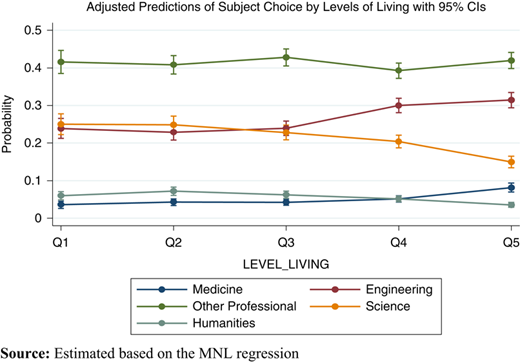
Figure 1 plots the predicted probabilities of subject choice by levels of living quintiles. The probability of selecting humanities and medicine remain around the same till quintile Q4; the choice of medicine surpasses humanities at quintile Q5. But the pattern between the choice of humanities and medicines varies. The pattern is similar across medicine and engineering; a clear shift can be seen as levels of living quintiles move from Q4 and Q5. Parallel to this, the predicted probabilities of humanities and science depict the same patterns but on the reverse (decline) as levels of living quintiles move from Q4 and Q5. On the contrary, predicted probability of selecting other professional courses is highest across quintiles. On similar lines, Geetha Rani (2015) lamented that professional courses, namely medical and engineering not only have a long duration and high cost courses but also they are also high paying degrees. This tilted allocation of talent indeed perpetuates the inequality across life time earnings. This would result in imbalance in the course structure, as able and talented students would opt for market-oriented courses than the conventional courses, creating an imbalance. Further, these potential inefficiencies in the allocation of talent could impede innovation at the top of the socio-economic pyramid. The analysis here brings out the hierarchical preferences of courses across assorted expenditure levels of families, which intend to generate earning inequality in the future.
A similar analysis is attempted to estimate the predicated probabilities of subject choices across regions (Figure 2). In this figure, we try to answer the question as to what extent the place of studying matters from where a student graduates. In other words, are students with a degree from one of the institutions in the south are more likely to be choosing engineering than any other subject choice as compared to other regions of India, north, east, west and north east.
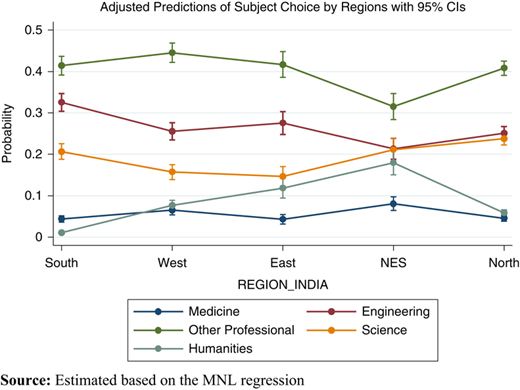
The predicted probabilities for medicine remain almost the same across regions. The predicated probabilities of engineering are the highest in the South, followed by East, West, North and the least in the NES regions. The average predicted probability of enrolling in other professional courses is the highest across all regions, except NES. This pattern is similar to the predicted probabilities of engineering courses, that is the predicated probabilities are the highest in the south and least in the NES. Followed by South, the highest probabilities of enrolling in other professional courses are found to be in West, North and Eastern regions. Yet another interesting trend predicted is the probability of enrolling in science almost remains the same across regions, except a lesser probability in the Eastern region. The likelihood of enrolling in humanities is the highest in the NES, followed by East, North, West and least predicted probability in the Southern regions.
This clearly brings out the preferences of technical and non-technical courses between different regions. Why is it so? One of the reasons could be the growth of private institutions in few states accentuated after the adoption of the neo-liberal policies. This period coincides with macro economic reforms in major policy changes at both macro and sub-sectoral levels. These reform packages imposed decline on the public budgets on education, more specifically on higher and technical education. These economic reforms resulted in several policy directions, paved way for several alternatives, including rapid expansion of the private sector in higher and technical education. Some states managed to face these challenges and opportunities. It would be appropriate to quote the Perroux (1950)[14]; he was one of the first who asserted that growth does not appear everywhere at the same time and manifests itself in points or poles of growth. The enrolment patterns across regions would further widen the regional disparity in terms of employment and income generation. Policy implication is that initiatives are to be in place to promote education, and employment in other regions is equally important, so that regional balance is maintained and movement of labor, capital and trade is avoided from backward to developed regions as development takes place.
6. Concluding remarks
In this section, we summarize the major findings, suggestions and policy implications. The paper brings out interesting results, albeit there are few concerns. It can be said that course choices are influenced by knowing another language that is different from the one spoken at home, private coaching, cost of higher education, type of institution, gender, better-off economic status, urban locations and regions. The consumption expenditure quintiles reinforce the relationship between earnings and course of choices. The dichotomy is clear between the choice of courses and expenditure or levels of living quintiles in terms of technical and non-technical streams. This would further widen the existing inequalities by adding yet another dimension of inequality. Although the choice-based credit system[15] makes an effort to reduce this divergence, it is not yet permeated in the higher education system.
Gender polarization is very clear between humanities and engineering. The analysis of choice of individual discipline reveals that female youths have significantly higher likelihood of attending humanities courses as compared to their male counterpart. However, for every other stream, that is, science, medicine, engineering and other professional courses, there is a strong gender bias against female even after controlling for social and economic background of the household. The same holds good with SC/ST, Islam, students belonging to the poorest to middle expenditure quintiles Q1 through Q3, large family size and education of the head of household with below elementary levels, whereas male, OBC, other caste groups, Hindus, rich quintiles Q4 and Q5, marginal, small and medium family size and education of head of the household with secondary and above levels prefer engineering and other professional courses.
Predicted probabilities of course choices bring in a clear distinction between south and west regions preferring engineering and other professional courses, whereas north, east and NES prefer humanities. The findings of the paper suggest that course and regional imbalance needs to be worked with multi-pronged strategies of providing both access to education and employment opportunities in other states to maintain regional balance. However, the predicted probabilities of medicine and science remain similar across the board. These findings bring in implications for practice in their ability to predict the demand for course choices and their share of demand, not only in the labor market but also across regions. Further, within the states, rural and urban variation can have serious influence on choice of courses. In this direction, analysis at state levels related to choice of courses can be further examined.
6.1 Agenda for future research
As noted earlier, very few studies on the determinants of field choice in higher education prevail in India. It is primarily because of lack of such data. More in-depth surveys are required to study the course choice problem in India, as the existing NSSO data inform only the realized choice of courses but not the actual choice and whether actual choice is the same as realized choice. Yet, another significant data gap in this area is the information on expected earnings from taking up this course, the preparedness of students at the senior secondary level, the institution type, quality of education at the school level, marks obtained at school leaving board examination, etc. Hence, there is a need for sample surveys to include such information in the collection of data. Equally important are the cost studies on higher education, more specifically what is the relationship between cost of higher education across courses and demand for student loans? This evidence is particularly important to know which course choices can support student loans. Is demand for student loans higher as cost of higher education is increasing? Does it vary between public and private institutions of higher education and its relationship with course choices? What is the relationship between course choices and the demand for skills and skill content in the labor market? What is the match or mismatch between skill content of courses and their choices with regard to the demand for skills in the labor market? On the distributional aspect, a number of research questions arise: how course choices either maintain the status quo or how they have helped in the redistribution and social mobility among students? How do they widen the earning inequality, is there any inter-generational mobility across course choices? How similar professions are flocked or sorted together in terms of marital relationship?
The authors would like to thank two anonymous referees of the journal for their valuable comments and suggestions which helped in improving the quality paper substantially. Remaining errors if any are liable to the authors.
Notes
Separating the effects of wages on career choices versus career choices on wages is a challenging task, owing to basic identification issues with regard to not only quantity and price but also the ex ante and ex post realization of both quantity and price (Freeman and Hirsch, 2008).
These individual characteristics determine how much students enjoy their coursework and how much time and effort they invest towards their degree.
Course choice here refers to the realized course choice of the students.
Not relating to India.
Borrowing rate or interest rate compared between ex post or realized returns to college on the probability of various post-secondary college outcomes and the ex ante or expected return to starting college.
The Indian way of saying a major is course. Hereafter, major is referred as course.
Studies generally use SAT scores or grade points, but there is hardly any information available on the innate or acquired ability of students like marks obtained, etc., in these survey data.
One way may be to calculate a ratio of capacity/college going population in each district/state and controlling the same. This can be further examined with district and or state fixed effects, which will be the future area of work for the authors.
In other words, with a dichotomous independent variable, the marginal effect is the difference in the adjusted predictions for the two groups.
Only the statistically significant parameters are discussed.
It can be argued that one of the determinants, not taking private coaching, which may perhaps mean that the child has more help at home, may be because parents are able to help or the child has better ability, for which there is no information available. However, it may also mean that the child has less ability, so parents do not want to invest on him/her, or parents have less ability to offer extra support or the child not interested in studies. It can be argued that although taking private tuition is an indicator of economic conditions, the rationale to include it under ability is because taking private tuition is expected to enhance the quality of learning of the students. But, the purpose of taking private tuition is unknown, as this information is unavailable. Hence, the channels could not be explored further. Since this information is not available, there could be reverse causality when one looks at the relationship between subject choice and spending on private tuition, because choosing science subject perhaps mean students need to spend more on private tuition as compared to humanities. However, the underlying reasons are unobservable.
Ability to operate computers.
The prediction of outcomes on the basis of current characteristics is possible without regard to the causal relationships among variables (Constantine, 2012). Although it can be argued that these interpretations are merely association, one cannot ignore that potential power and added complexity of regression analysis are best reserved for either predicting outcomes or explaining relationships.
One of his main contribution was the concept of poles de croissance or “growth poles.” It implied that Government policies aimed at the regeneration of a specific local region were critically dependent upon the input‒output linkages associated with the industry. It uncovers regional inequalities and focuses the direction on propulsive and propelled units. Further, it offers a dynamic image of the regions, which is invariably based on a general tendency to spatial focus of manufacturing facilities; and it presents a basis for an alternative for centralization by supporting the creation of new development poles, namely, the decentralized focus.
The most important recommendation of the Yashpal Committee (Government of India, 2009).

