


This study aims to compare the purchase intention of counterfeit outdoor products between Taiwan and Hong Kong consumers.
A total of 584 respondents from Hong Kong (n = 247, 42%) and Taiwan (n = 337, 58%) were recruited for the study. Data analysis was performed by using structural equation modelling techniques.
The results showed that consumers' perceived risk had a negative influence on attitude and intention to purchase counterfeit outdoor products. Moreover, attitude towards buying counterfeit outdoor products, perceived behavioural control and subjective norm had positive impacts on purchase intention. Brand consciousness, however, had a negative influence on purchase intention. The multi-group analysis identified significant differences between Hong Kong and Taiwanese respondents.
This study provides a better understanding of how these factors affect purchase intention of counterfeit outdoor products across different cultures.
Introduction
Because of an increasing interest in a healthy and active lifestyle, the outdoor recreation industry has been growing in recent years (Duff and Phelps, 2016). This worldwide growth in the industry has witnessed the establishment of various outdoor-related organisations, including the Outdoor Industry Association (OIA) in the USA, the European Outdoor Group (EOG) in Europe and the Scandinavian Outdoor Group (SOG) in Scandinavia. In China, the China Outdoor Association (COA) and China Outdoor Commerce Alliance (COCA) represent the industry. In an OIA report in 2017, it was noted that outdoor recreation was one of the largest economic sectors in the USA, generating US$887bn in consumer spending. The primary component was in travel spending, although the amount spent on outdoor recreation products, including gear, apparel, footwear, equipment and services, was still significant, amounting to US$184.5bn. This was a significant increase from the US$120.7bn reported in 2012 (Outdoor Industry Association, 2017).
The outdoor recreation markets in both Hong Kong and Taiwan have developed much earlier when compared to China. Hong Kong, as one of the major cities and transportation hubs in Asia, is home to many outdoor recreation brands. Companies in the outdoor recreation industry set up their subsidiaries and distribution networks in Hong Kong to strategically manage and promote their businesses in the region. Consequently, consumers in Hong Kong are familiar with many outdoor brands and can easily purchase outdoor recreation equipment. According to a government survey, the retail sales in travel and sporting goods, household goods and other goods was US$8.7bn in 2016 (Census and Statistics Department of Hong Kong SAR, 2016). Over in Taiwan, the outdoor recreation industry is characterised by its established supply chains linking suppliers of raw materials, intermediaries, manufacturers, distributors and retailers. According to the Taiwan Outdoor Group (TOG), the retail value of the outdoor recreation market is about US$1bn in 2014.
The above discussion highlights the value of the outdoor recreation industry in both Hong Kong and Taiwan. However, because of the popularity of outdoor products, it has become one of the primary targets for counterfeiting (Transcrime, 2010). Many outdoor recreation companies are located in China, where a grey market exists. Counterfeits of popular outdoor recreation brands are common in both brick-and-mortar and online stores, and this has led to considerable losses to companies in the industry (Anti-Counterfeiting Group, 2003). Some of the companies have taken steps to prevent the purchase of counterfeits and protect authentic products. For example, Arc'Teryx, a leading Canada outdoor recreation brand, used its website to educate its customers to distinguish genuine products from counterfeits. Moncler, an Italian–France luxury outdoor brand, used radio frequency identification (RFID) chips in their products to counter counterfeit goods.
There are many different outdoor activities, each requiring different types of equipment and outdoor products to protect users and enhance their experiences. Compared to other product categories, consumers are more likely to value functionality, safety and environmentally friendly features in outdoor recreation products. Consequently, such features will result in higher prices for these products. This creates an opportunity for counterfeits to offer lower prices to attract consumers. However, using counterfeit outdoor recreation products can be risky for consumers. When the products do not perform in the harsh outdoor environment, it may lead to physical harm to consumers.
Although counterfeit purchases have been examined in many different product categories (Chiu et al., 2014; Chiu and Leng, 2016; Phau and Teah, 2009; Phau et al., 2009), the product category of outdoor recreation product has not received much interest. To address the research gap in the extant literature, the primary purpose of this study is to explore the factors influencing consumers' purchase intention of counterfeit outdoor products using the theory of planned behaviour (TPB, Ajzen, 1991). The TPB is a widely used social-psychological model to explain consumers' both volitional and non-volitional decision-making process (Ajzen, 1991) and deemed as an appropriate theory to explore consumers' consumption of counterfeits. Moreover, to date, few studies have investigated differences in consumers' attitudes and behaviour toward counterfeits across countries (Bian and Veloutsou, 2007; Chiu and Leng, 2016). It has been argued that more cross-cultural research in consumer behaviour is needed to gain a better understanding of the role of cultural differences in consumers' decision-making process (De Mooij and Hofstede, 2011; Hassan et al., 2016). Cross-cultural research can also provide insights into consumer behaviour in countries or regions with different economic development and cultural norms (De Mooij and Hofstede, 2011). Accordingly, the secondary purpose of this study is to examine the purchase intention of counterfeit outdoor products between Hong Kong and Taiwanese consumers.
Literature review
Theory of planned behaviour
The TPB posits that an individual's purchase behaviour is determined by purchase intention, which is, in turn, determined by the attitude towards the behaviour, subjective norms and perceived behavioural control (Ajzen, 1991). In many studies across a spectrum of product categories, general support of the TPB in the purchase of counterfeit goods has been found. Specifically, it was established that intentions are predictive of actual behaviour. Also, attitude, subjective norm and perceived behavioural control are positively correlated with intention and behaviour. However, the relative importance of attitude, subjective norm and perceived behavioural control in predicting intention can vary across product categories (Ajzen, 1991; Armitage and Conner, 2001).
The TPB has also been used to explain behaviour in the purchase of counterfeit goods (Phau et al., 2009; Chiu et al., 2014; De Matos et al., 2007; Penz and Stottinger, 2005; Chiu and Leng, 2015, 2016). The TPB is deemed an appropriate tool to understand consumer behaviour in the purchase of counterfeits, as it examines consumers' both volitional and non-volitional decision-making process (Ajzen, 1991). Similar to other product categories, attitude, subjective norms and perceived behavioural control are positively correlated with intention in purchasing counterfeits. When consumers have a more favourable attitude towards the purchase of counterfeits, they are also more likely to purchase counterfeits (Swami et al., 2009; Tom et al., 1998; Phau et al., 2009; Ang et al., 2001; Chiu et al., 2014; Wee et al., 1995).
In addition, subjective norms can affect consumer's intention to purchase counterfeits (De Matos et al., 2007; Penz and Stottinger, 2005; Phau et al., 2009; Ang et al., 2001; Tom et al., 1998; Rahman et al., 2011; Prendergast et al., 2002; Huang et al., 2015; Chiu et al., 2014). When the behaviour of purchasing counterfeits is accepted by relatives and friends, the consumer is more likely to purchase counterfeits. Conversely, when the behaviour is not accepted by relatives and friends, the consumer is less likely to engage in such behaviour, especially when the product category is conspicuous (Lan et al., 2012; Tang et al., 2014; Lord et al., 2001).
Due to their illicit nature, counterfeits are not openly available for sale to consumers in many markets. Consequently, consumers do not have complete control in their purchase of counterfeits, as this depends on access to information on the availability of counterfeits (Lan et al., 2012). With higher levels of access to counterfeit goods, consumers will have higher levels of perceived behavioural control, and this can lead to higher levels of intentions to purchase counterfeit goods (Prendergast et al., 2002; Chiu et al., 2014; Chiu and Leng, 2016; Armitage and Conner, 2001; Penz and Stottinger, 2005). Consequently, the following hypotheses are detailed as below:
Attitude towards purchasing counterfeit outdoor products will have a positive influence on purchase intention of counterfeit outdoor products.
Perceived behavioural control will have a positive influence on purchase intention of counterfeit outdoor products.
Subjective norm will have a positive influence on purchase intention of counterfeit outdoor products.
Brand consciousness
Brand consciousness refers to consumers' psychological preference of brand-name products in their decision-making process to purchase (Nelson and Mcleod, 2005; Jiang and Shan, 2016). Extant literature suggests that brand consciousness may have a negative impact on consumers' intention to purchase counterfeit outdoor products (Chiu and Leng, 2016). Consumers who have a higher brand consciousness tend to buy branded products to express their ideal self-image and associate themselves with a higher level of social status (Wee et al., 1995; Bian and Moutinho, 2011). In particular, brand names can play an essential role in affecting consumer choice in the sports apparel category (Dickson and Pollack, 2000). They not only reflect consumer choice but also indicate membership and shared beliefs of the group (Chae et al., 2006; Dickson and Pollack, 2000; Bae, 2011).
Counterfeit products often use authentic brand name and logo to confuse consumers particularly when they are not familiar with the product (Nelson and Mcleod, 2005; Jiang and Shan, 2016). This suggests that brand consciousness may be an essential factor in the study of counterfeits buying behaviour. As such, it is expected that consumers who are high in brand consciousness are less likely to purchase counterfeits (Gentry et al., 2006; Phau et al., 2009). This leads to the following hypothesis:
Brand consciousness will have a negative influence on purchase intention of counterfeit outdoor products.
Perceived risk
Perceived risk consists of consumers' perceptions of the uncertainty and adverse consequences of purchasing a service/product (Park et al., 2005). The literature suggests that perceived risk can affect consumers' attitudes and purchase intention (De Matos et al., 2007; Wee et al., 1995; Lobb et al., 2007). As counterfeits are not genuine products, consumers expect that there will be inherent risks when using the products (Ting et al., 2016). These risks include functional risks where the products do not perform as expected and social risks where the consumer is ostracised as a result of purchasing and using counterfeits (Veloutsou and Bian, 2008).
There are potential risks in all outdoor activities. Consumers who are familiar with outdoor activities will be more aware of such risks when compared to general consumers (Grant et al., 1996). In particular, counterfeit outdoor recreation products may carry physical risks when the product causes physical harm to the consumer. Risk-averse consumers may be more concerned as to whether counterfeits goods will perform as expected, are safe or will affect them adversely in how others perceive them. As such, they are less likely to have a positive attitude towards purchasing counterfeits and an intention to purchase counterfeits (Ang et al., 2001; Tom et al., 1998; Chiu et al., 2014). Consequently, the hypotheses are as follows:
Perceived risk will have a negative influence on attitude towards purchasing counterfeit outdoor products.
Perceived risk will have a negative influence on purchase intention of counterfeit outdoor products.
Cultural differences
Consumers' acceptance and purchase of counterfeits differ across countries (Eisend and Schuchert-Güler, 2006; Gentry et al., 2006; Bian and Veloutsou, 2007). In part, this difference is explained by cultural and historical factors. As copyright protection legislation originated in western countries, it is a notion that has gained less acceptance and support in Asian countries. Consequently, Asian consumers are more accepting when it comes to purchasing and consuming counterfeits (Swinyard et al., 1990; Hamelin et al., 2013; Tang et al., 2014; Chang, 2004).
However, even among Asian countries, there are differences in the consumption of counterfeits. A study showed that although consumers in Hong Kong and China share many cultural and demographic similarities, there were still differences in the attitudes towards the purchase of counterfeits and the availability of counterfeits in the two regions (Tang et al., 2014). Similarly, although the majority of consumers in Singapore and Taiwan are of Chinese ethnicity, there were differences between the two countries in attitudes and subjective norms towards counterfeits (Chiu and Leng, 2016) (Figure 1).
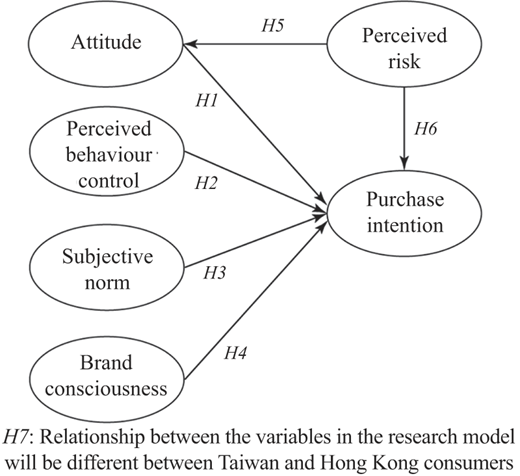
Extant literature has identified a need to examine the cultural difference in consumers' decision-making process (De Mooij and Hofstede, 2011). In this study, although both Taiwan and Hong Kong are predominantly Chinese societies with similar demographics and cultures, they have different histories. This may result in differences in consumers' attitudes and behaviours. Therefore, consumers' acceptance and purchase behaviour of counterfeits may still differ across the two regions. The final hypothesis for this study is as follows:
Relationships between the variables in the research model will be different between Taiwan and Hong Kong consumers.
Method
Participants and procedure
The questionnaires were distributed to physical outdoor speciality shops in Taiwan and outdoor shops in Hong Kong over three months from November 2016 to February 2017. The products selected for this study were hiking products, as they are the most popular outdoor products amongst consumers. Respondents were provided with a small gift as a token of appreciation for completing the questionnaire. Of the total 584 valid questionnaires, 58% (n = 337) were from Taiwan and 42% (n = 247) were from Hong Kong. Among Taiwanese respondents, 58.2% (n = 196) were male. The modal group of Taiwanese respondents was between 31 and 40 years of age (n = 128, 38%) with a university degree (n = 227, 67.4%). For the Hong Kong study, 55.1% (n = 136) of the respondents were male. The modal group for Hong Kong respondents was between 21 and 30 years of age (n = 115, 46.6%). This is detailed in Table 1 below.
Respondents' demographic characteristics
| Taiwan (n = 337) | Hong Kong (n = 247) | |||
|---|---|---|---|---|
| n | % | n | % | |
| Gender | ||||
| Male | 196 | 58.2 | 136 | 55.1 |
| Female | 141 | 41.8 | 111 | 44.9 |
| Age (years) | ||||
| Below 20 | 5 | 1.5 | 41 | 16.6 |
| 21–30 | 77 | 22.8 | 115 | 46.6 |
| 31–40 | 128 | 38.0 | 70 | 28.3 |
| Above 40 | 127 | 37.7 | 21 | 8.5 |
| Education | ||||
| Senior high | 25 | 7.4 | 89 | 36.0 |
| University | 227 | 67.4 | 89 | 36.0 |
| Graduate school | 84 | 25.2 | 69 | 28.0 |
| Income* | ||||
| 1 | 24 | 7.1 | 19 | 7.7 |
| 2 | 39 | 11.6 | 177 | 71.7 |
| 3 | 83 | 24.6 | 32 | 12.9 |
| 4 | 191 | 56.7 | 19 | 7.7 |
Note(s): *Due to the different currencies in Hong Kong and Taiwan, the income level was labelled from 1 to 5
Hong Kong: 1 = below HKD10,000; 2 = HKD10,001–HKD25,000; 3 = HKD25,001–HKD50,000; 4 over HKD50,001 per month
Taiwan: 1 = below NTD20,000; 2 = NTD20,001–NTD30,000; 3 = NTD30,001–NTD40,000; 5 over NTD40,001 per month
Measures
The survey instrument was based on earlier studies. The scales of purchase intention (three items), attitude towards counterfeit goods (five items), perceived behavioural control (four items), subjective norm (four items) and brand consciousness (four items) were adopted from Chiu and Leng (2016). Perceived risk scale was taken from De Matos et al. (2007). These items were originally written in English and translated into traditional Chinese, using back-translation (Brislin, 1970). All items were assessed on a seven-point Likert scale, ranging from strongly disagree (1) to strongly agree (7).
Data analysis
Data analysis proceeded in three phases using SPSS 20.0 and Amos 20.0. First, the scale reliability and validity were calculated by confirmatory factor analysis (CFA) with maximum likelihood (ML) estimation. A chi-square statistic index, comparative fit index (CFI), Tucker and Lewis index (TLI) and root mean square error of approximation (RMSEA) were used to test the adequacy of the research model. According to the criteria suggested by Hair et al., 2010, CFI and TLI values should be larger than 0.90, and the RMSEA value should be below 0.08. Second, structural equation modelling (SEM) analysis was used to examine the hypotheses in the proposed model. Finally, a multiple-group analysis was conducted to examine the differences between Taiwanese and Hong Kong samples in the conceptual model.
Results
Scale reliability and validity
Scale reliability and validity were evaluated by conducting a CFA. However, it found that one item of subjective norm and one item of brand consciousness reported low factor loadings (< 0.50). Thus, it was determined that dropping these items would improve the model without compromising the theoretical meaningfulness of the measure (Bentler and Chou, 1987; Byrne, 2016). The deletion of these item resulted in an appropriate model fit of measurement model, χ2 (174) = 528.081, CFI = 0.963, TLI = 0.955, RMSEA = 0.067.
The reliability of the scale was calculated using composite reliability (De Matos et al., 2007) and Cronbach's alpha. As shown in Table 2, the values of CR ranged from 0.856–0.972, fulfilling the recommended criterion of 0.70 (Fornell and Larcker, 1981). The values of Cronbach's alpha all fulfilled the cut-off of 0.70 (Nunnally, 1978). The convergent validity was tested by factor loading and the average variance extracted (AVE) and revealed appropriate results (Hair et al., 2010). The factor loadings of the observable items were all above the criterion of 0.50, and AVE values of the construct were higher than the suggested value 0.50, except for perceived behavioural control (0.485). Moreover, discriminant validity was evaluated by the method proposed by Fornell and Larcker (1981). As reported in Table 3, the correlation coefficients between pairs of constructs were less than the square root of AVE for the individual variables, and as such, there was good discriminant validity of the constructs in this study.
Summary results of measurement
| Construct | Number of items | Cronbach's alpha | Factor loadings | CR | AVE |
|---|---|---|---|---|---|
| INT | 3 | 0.971 | 0.947–0.983 | 0.972 | 0.920 |
| ATT | 5 | 0.941 | 0.793–0.923 | 0.944 | 0.770 |
| PBC | 4 | 0.884 | 0.667–0.919 | 0.889 | 0.670 |
| SN | 3 | 0.960 | 0.920–0.938 | 0.961 | 0.891 |
| BC | 3 | 0.851 | 0.685–0.921 | 0.856 | 0.668 |
| PR | 3 | 0.894 | 0.797–0.915 | 0.897 | 0.744 |
Note(s): INT = purchase intention; ATT = attitude; PBC = perceived behavioural control; SN = subjective norm; BC = brand consciousness; PR = perceived risk
Mean, SD, square roots of AVE and correlations between constructs
| Mean | SD | INT | ATT | PBC | SN | BC | PR | |
|---|---|---|---|---|---|---|---|---|
| INT | 2.784 | 1.459 | 0.959 | |||||
| ATT | 2.678 | 1.296 | 0.825 | 0.878 | ||||
| PBC | 4.226 | 1.552 | 0.466 | 0.476 | 0.818 | |||
| SN | 2.747 | 1.312 | 0.683 | 0.744 | 0.476 | 0.944 | ||
| BC | 4.289 | 1.173 | −0.289 | −0.215 | −0.153 | −0.164 | 0.817 | |
| PR | 5.057 | 1.304 | −0.497 | −0.465 | −0.156 | −0.417 | 0.458 | 0.862 |
Note(s): INT = purchase intention; ATT = attitude; PBC = perceived behavioural control; SN = subjective norm; BC: brand consciousness, PR = perceived risk. Italic diagonal elements are the square root of AVE; values below the diagonal are correlations
Hypothesis testing
The goodness-of-fit indices showed that the proposed model fitted the data adequately, model fit: χ2 (183) = 626.227, CFI = 0.917, TLI = 0.903, RMSEA = 0.079 (Hu and Bentler, 1999). The results showed that purchase intention, attitude, perceived behavioural control and subjective norms have positive influences on purchase intention (p < 0.001), supporting H1, H2 and H3. Moreover, brand consciousness had a negative influence on purchase intention (p < 0.01), supporting H4. Finally, the paths from perceived risk to attitude and purchase intention were statistically and negatively significant (p < 0.001), supporting H5 and H6. Table 4 shows the results of hypotheses testing in more detail.
Multi-group analysis
Independent t-tests were conducted to measure differences between Taiwanese (n = 337) and Hong Kong (n = 247) respondents. The results are reported in Table 5. There were significant differences in the mean score of purchase intention, attitude, perceived behavioural control, subjective norm and perceived risk between Taiwanese and Hong Kong respondents. Compared to Taiwanese respondents, Hong Kong respondents reported significantly higher purchase intention (M Taiwanese = 2.369, M Hong Kongese = 3.351; t = −8.294, p < 0.001), attitude (M Taiwanese = 2.242, M Hong Kongese = 3.273; t = −10.326, p < 0.001), perceived behavioural control (M Taiwanese = 3.756, M Hong Kongese = 4.868; t = −9.138, p < 0.001) and subjective norm (M Taiwanese = 2.267, M Hong Kongese = 3.402; t = −11.237, p < 0.001) towards purchasing counterfeit outdoor products. However, Taiwanese respondents reported a higher level of perceived risk (M Taiwanese = 5.379, M Hong Kongese = 4.618; t = 7.266, p < 0.001) than Hong Kong consumers.
Results of independent t-tests
| Construct | Mean (SD) | ||
|---|---|---|---|
| Taiwanese (n = 337) | Hong Kongese (n = 247) | t-value | |
| INT | 2.369 (1.273) | 3.351 (1.508) | −8.294*** |
| ATT | 2.242 (1.049) | 3.273 (1.365) | −10.326*** |
| PBC | 3.756 (1.596) | 4.868 (1.233) | −9.138*** |
| SN | 2.267 (1.134) | 3.402 (1.256) | −11.237*** |
| BC | 4.352 (1.247) | 4.204 (1.061) | 1.549 |
| PR | 5.379 (1.305) | 4.618 (1.170) | 7.266*** |
Note(s): *p < 0.01, **p < 0.001
As a next step, the multi-group analysis was conducted for the proposed model to examine differences between Taiwanese and Hong Kong consumers. The data were split into Taiwanese (n = 337) and Hong Kongese (n = 247) sample sets for the multi-group analysis by using SEM. The overall model fit in each group was examined respectively. In both groups, the model fitted the data acceptably: χ2 (183) = 609.447, CFI = 0.918, TLI = 0.904, RMSEA = 0.063 for Taiwanese sample; χ2 (183) = 703.738, CFI = 0.897, TLI = 0.881, RMSEA = 0.091 for Hong Kong sample (Hu and Bentler, 1999). Therefore, the model was deemed plausible and stable across the two groups. The standardised coefficients of each path between Taiwanese and Hong Kong consumers are reported in Table 6.
Multi-group analysis
| Path | Taiwanese (n = 337) | Hong Kongese (n = 247) | Critical ratio for difference | ||
|---|---|---|---|---|---|
| Estimate | p | Estimate | p | ||
| ATT → INT | 0.826 | 0.000 | 0.667 | 0.000 | −1.903† |
| PBC → INT | 0.084 | 0.001 | 0.130 | 0.004 | 0.893 |
| SN → INT | 0.217 | 0.000 | 0.158 | 0.000 | −0.985 |
| BC → INT | −0.104 | 0.022 | −0.147 | 0.027 | −0.536 |
| PR → ATT | −0.275 | 0.000 | −0.422 | 0.000 | −1.653† |
| PR → INT | −0.092 | 0.016 | −0.202 | 0.000 | −1.658† |
Note(s): †p < 0.10
Next, to compare whether Taiwanese and Hong Kong consumers differ significantly with respect to any single path of the proposed model, the values of the critical ratio for differences were examined. As reported in Table 6, the significant differences were found in the paths from perceived risk to attitude (critical ratio for difference = −1.653, p < 0.10) and purchase intention (critical ratio for difference = −1.658, p < 0.10), indicating that perceived risk has stronger influences on attitude and purchase intention for Hong Kong consumers. Moreover, it found that the path from attitude to purchase intention was significantly different between Taiwanese and Hong Kong consumers (critical ratio for difference = −1.903, p < 0.10), indicating attitude has a stronger influence on purchase intention for Taiwanese consumers. Therefore, the results support H7 that consumer behaviour towards counterfeit outdoor products is different across Taiwan and Hong Kong.
Discussion
Researchers have endeavoured to investigate the factors influencing the consumers' purchase behaviour across various types of counterfeit products. In particular, TPB has been used as a critical framework to explain consumers' attitude and purchasing behaviour towards counterfeit goods (Chiu et al., 2014; Chiu and Leng, 2015, 2016). To explore consumers' purchasing behaviour of counterfeits in the outdoor recreation market, this study used the TPB as the theoretical base to examine consumers' decision-making process of buying counterfeit outdoor products. In addition, brand consciousness and perceived risk were incorporated to examine as possible factors in this study.
The results support the use of TPB in explaining the purchase intention of counterfeit outdoor recreation products. Specifically, it was found that subjective norms, perceived behavioural control and attitude had a positive influence on the intention to purchase counterfeits outdoor recreation products. This is consistent with the findings from earlier studies on the purchase of counterfeits in other product categories (Chiu et al., 2014; Chiu and Leng, 2016; Yoon, 2011). In particular, the role of attitude is the most influential among the three variables of TPB, indicating the critical role of individuals' attitudes towards counterfeit outdoor products in purchase intention. Many studies have also found similar results that when individuals have a more favourable and positive attitude towards counterfeits, they are more likely to make a purchase of counterfeits (Sharma and Chan, 2017; Souiden et al., 2018).
The additional factor of brand consciousness was found to have a negative influence on consumers' attitudes towards the purchase of counterfeit outdoor recreation products. This relationship is consistent with the findings of previous studies (Chiu and Leng, 2016; Gentry et al., 2006; Phau et al., 2009; Jiang and Shan, 2016). Brands are essential in the purchase of outdoor recreation products, as it is a symbol of quality and elicits trust from consumers (Phau et al., 2009). Consumers who are high in brand consciousness are, thus, less likely to purchase counterfeits (Gentry et al., 2006; Chiu and Leng, 2016; Bhatia, 2018).
Moreover, perceived risk, as expected, had a negative influence on consumers' attitude towards counterfeit outdoor recreation products and their purchase intention. These findings are in line with previous studies in the context of counterfeit products (Chiu et al., 2014; Huang et al., 2004). It must be noted that role of perceived risk could be more salient in this study as outdoor recreation products are mostly used in an environment with many potential risks. Consumers depend on the products to protect them from danger and face the challenges of their surroundings. As such, it is not surprising that perceived risk significantly affects both consumers' attitude and purchase intention.
Further, it was found that Hong Kong consumers have higher levels of purchase intention, attitude, subjective norm and perceived behavioural control than Taiwanese consumers. These findings may be attributed to the availability and relatively low price of counterfeit products in Hong Kong (Chan et al., 1998). Thus, Hong Kong consumers are more likely to have a more favourable attitude towards counterfeit outdoor products and are less concerned about purchasing them. In addition, the multi-group analysis found that consumers in Hong Kong and Taiwan are different in their attitude and purchase intention of counterfeits outdoor recreation products. Hong Kong consumers are affected to a larger extent by the level of perceived risk on attitude and purchase intention when compared to consumers in Taiwan. Although Taiwan and Hong Kong share the same Chinese culture, this study suggests that consumer behaviour in the two countries is not similar.
Practical implication
The outdoor recreation product industry has taken many initiatives to prevent counterfeits at the stage of design, manufacture and marketing. This study examines the purchase of counterfeits from the consumer perspective. Applying the TPB, which is used in explaining the purchase of counterfeits in other product categories, this study suggests that consumers are aware of safety and functionality issues in the outdoor recreation product context.
More risk-averse consumers are less likely to purchase counterfeits. They will prefer to buy authentic products, perhaps driven by the quality and perceived safety and functionality promised by the brands. As such, outdoor recreation product companies should focus on marketing the product attributes of their brand that emphasises their speciality or function that cannot be reproduced by other companies. In addition, the companies should also emphasise the risks in outdoor activities and how the use of quality and trusted brands can minimise such risks. This marketing strategy is especially important for consumers with higher perceived risk. It will create brand loyalty in this group of consumers. In particular, the study also suggests that different marketing anti-counterfeit strategies should be used in different geographic areas according to the different consumers' attitudes toward counterfeits.
Limitations and future research
This study is not without limitations. First, respondents of this study were selected from consumers patronising brick-and-mortar retail stores selling authentic products. However, it must be noted that most counterfeit purchases occur on internet platforms. Studies found that consumers may have different behaviours purchasing outdoor products online (Chiu et al., 2018). Future research should investigate online purchasing behaviour, as it may differ from brick-and-mortar consumers. Moreover, this study did not explore consumers' interest and involvement in outdoor activities, which could be influential factors in predicting purchase intention. Therefore, future research needs to comprehensively consider consumers' demographic backgrounds to better understand their decision-making process in purchasing counterfeit outdoor products. Also, this study studied only hiking counterfeit products. Future studies should consider other different types of outdoor products to obtain a more holistic picture of counterfeit product purchasing behaviour. In addition, it should be noted that the TPB has been criticised for ignoring emotional, habitual and motivational factors in consumers' decision-making process (Perugini and Bagozzi, 2001). Therefore, future studies may consider applying the model of goal-directed behaviour (Perugini and Bagozzi, 2001), which is another social-psychological model addressing the limitations of the TPB, to explore consumers' purchase behaviour of outdoor counterfeits (Chiu et al., 2018; Chiu and Choi, 2018).
Conclusion
In sum, this study is one of the few to explore the factors affecting consumers' intention to purchase counterfeit outdoor products and further compare the differences between Taiwan and Hong Kong. This study found that the TPB explained Taiwan and Hong Kong consumers' behaviour of purchasing counterfeit outdoor products. Moreover, it was found that the influence of attitude on purchase intention was more substantial for Taiwan consumers. Meanwhile, the impact of perceived risk on consumers' attitudes and purchase intention was more influential for Hong Kong consumers.
The authors would like to thank the Institute of International Business and Governance, established with the substantial support of a grant from the Research Grants Council of the Hong Kong Special Administrative Region, China (UGC/IDS16/17), for its support.
References
Appendix 1
Survey instrument
Purchase intention scale
I will purchase counterfeit outdoor products.
I will never consider buying counterfeit outdoor products.
The probability that I will consider buying counterfeit outdoor products is high.
Attitude towards counterfeit goods
Generally speaking, buying counterfeit outdoor products is a better choice.
Considering the price, I prefer counterfeit outdoor products.
I enjoy shopping for counterfeit outdoor products.
Buying counterfeit outdoor products generally benefits the consumer.
There is nothing wrong with purchasing counterfeit outdoor products.
Subjective norm
If I purchase counterfeit outdoor products, most of the people who are important to me will disapprove.
People who are important to me will look down on me if I purchase counterfeit outdoor products.
My family members will think it is okay to purchase counterfeit outdoor products.
My friends believe that buying counterfeit sporting goods is wrong.*
Perceived behavioural control
It is easy to purchase counterfeit outdoor products.
I know where to purchase counterfeit outdoor products.
I can find counterfeit outdoor products if I wanted to.
Buying counterfeit outdoor products is entirely within my control.
Brand consciousness
Well-known brands are best for me.
I usually choose more expensive brands.
I prefer buying best-selling brands.
The most advertised brands are usually better choices.*
Perceived risk
The risk that I take when I buy a counterfeit outdoor product is high.
There is high probability that the counterfeit outdoor product does not work.
Spending money with a counterfeit outdoor product might be a bad decision.
*Items were removed due to low factor loadings (< 0.50)

