


This study aims to examine how theory is used in articles published in leading accounting journals and considers what these patterns imply for the development of the discipline.
Using Gregor’s (2006) taxonomy, this study analyses a stratified random sample of 200 articles from six leading accounting journals across two periods (2007–2009 and 2017–2019). It examines the functional role theory plays, compares patterns across journals and tracks changes over time.
Explanation–Prediction (EP) theory dominates and has increased over time. Other forms of theorising remain limited, although there are small increases in explanatory and design-oriented studies. US-based journals show stronger reliance on EP, while the European journal displays greater diversity in the purposes served by theory.
This study focuses on six influential journals and two time periods. Future research could include a broader range of journals and longer timeframes to capture wider developments in accounting research.
A strong focus on EP theory may limit the discipline’s ability to address emerging challenges. Encouraging a wider range of theoretical approaches could enhance accounting’s relevance and connection to practice.
Greater diversity in theory use may help accounting better respond to societal challenges such as sustainability, technological change and evolving institutional demands.
This study offers a new perspective by examining the functional role of theory across accounting research. It provides empirical evidence on dominant patterns of theory use and their implications for disciplinary development.
1. Introduction
Theory plays a central role in the development of academic disciplines by structuring knowledge, guiding empirical inquiry and enabling explanation and prediction of phenomena (Sandberg and Alvesson, 2021; Bacharach, 1989; Popper, 1959). In accounting research, however, the purpose and role of theory have long been subject to debate. While accounting has a long professional history, its establishment as an academic discipline is comparatively recent, and scholars have questioned the extent to which the field has developed its own coherent theoretical foundations (Gaffikin, 2006; Coetsee, 2010). Concerns have also been raised regarding the fragmentation of theoretical perspectives across accounting subfields and continued reliance on theories borrowed from adjacent disciplines such as economics, finance and sociology (Inanga and Schneider, 2005; Dumay et al., 2018).
These debates are closely linked to broader questions about disciplinary development. On the one hand, some degree of theoretical consolidation plays an important role in shaping intellectual identity, shared research agendas and access to academic resources (Johnson, 1972; Elias, 1982; Benbasat and Weber, 1996; Moses, 2026). On the other hand, excessive convergence around a narrow set of theoretical purposes may limit the discipline’s capacity to engage with emerging organisational and societal challenges, including technological transformation, sustainability and governance issues (Leuz, 2022; Hopwood, 2007, 2009; Brown and Dillard, 2013; Carnegie et al., 2021; Agyemang, 2024). Understanding how theory is used within influential accounting research may therefore provide insight into how prevailing publication norms balance disciplinary coherence with openness to diverse theoretical purposes.
Prior studies of theory in accounting have largely been situated within specific research domains or epistemological traditions. For example, theoretical diversity has been examined within management accounting research (e.g. Kihn and Näsi, 2017), while epistemological assumptions underpinning accounting practices have also been explored (e.g. Jansen, 2018; Musmini et al., 2019). Although such contributions have advanced understanding of theory use within particular contexts, less attention has been directed towards the functional purposes that theory serves within published accounting research – that is, the role theory plays in structuring, explaining, predicting or informing action in individual studies. Focusing on functional purpose provides a common analytical reference point that does not depend on shared epistemological assumptions, methodological choices or substantive research domains. This enables systematic comparison across diverse research contexts, methodological traditions and publication outlets, thereby providing broader insight into prevailing expectations regarding theoretical contribution in leading journals.
Recent reflections on the state of accounting scholarship have further highlighted questions of theoretical diversity and the criteria used to evaluate scholarly contribution. For example, Moses (2026) noted that paradigmatic preferences and method-centred evaluation practices shape what is recognised as legitimate theoretical contribution, with implications for the range of perspectives represented within the discipline. Similar concerns have been raised in prior accounting research examining the evaluation and positioning of alternative research approaches (e.g. Parker, 2008). These reflections point to the importance of examining not only which theories are used in accounting research but also the role theory plays in influential publication outlets. However, despite increasing discussion in editorial essays and reflective commentaries (see also Chua, 2019; Maran et al., 2023), relatively limited empirical evidence exists on how theory is actually used in articles published in leading accounting journals and how publication norms operationalise expectations regarding theoretical contribution in practice.
This study addresses this need by providing a systematic analysis of the functional purposes that theory serves in influential international accounting research. By examining how theory is deployed – rather than which theoretical traditions are invoked – across leading journals, regions and time periods, the paper offers empirical insight into historic patterns of theory use and how these patterns may shape theoretical diversity and disciplinary development. To do so, the study applies Gregor’s (2006) taxonomy, which classifies theory according to the role it performs in research, including analytical, explanatory, predictive and design-oriented functions. A functional classification is particularly appropriate in this context, as it enables comparison across heterogeneous research domains and traditions where frameworks based primarily on epistemological or paradigmatic distinctions may be less suitable for systematic analysis.
Accordingly, this research addresses the following questions:
What functional purpose does theory serve in research published in the highest ranked international accounting journals?
How has the functional use of theory in leading accounting journals changed over time?
What implications do these patterns have for the development of the accounting discipline?
The analysis focuses on the six historically influential accounting journals that have shaped publication norms and research trajectories within the discipline (Oler et al., 2010). Although these journals do not capture the full diversity of international accounting scholarship, examining theory use within them provides insight into the dominant functional purposes recognised in leading publication outlets. The study compares two time periods, 2007–2009 and 2017–2019, to assess continuity and change in patterns of theory use. A stratified random sample of 200 articles was analysed using Gregor’s (2006) taxonomy, which classifies theory according to the primary function theory serves in research. The findings show that explanation–prediction (EP) theory remains the dominant functional purpose, while its use has increased over time, particularly in US-based journals. While the modest growth found in explanatory and design-oriented uses of theory suggests some expansion in theoretical diversity, the overall distribution of theoretical purpose indicates relative stability in dominant publication expectations.
By providing empirical evidence on how theory is functionally deployed across the influential accounting research journals, this study contributes to ongoing debates concerning theoretical diversity [1], disciplinary autonomy and the relationship between research and practice. The study also offers a foundation for future research examining how expectations regarding theoretical contribution evolve over time and how they shape the intellectual trajectory of accounting scholarship.
The remainder of the paper is structured as follows. Section 2 reviews the literature on theory in accounting and disciplinary development. Section 3 outlines the research methodology. Section 4 presents the results, Section 5 discusses the findings, and Section 6 concludes the paper.
2. Background
2.1 Criticisms and fragmentation of accounting research
Absence of a consistent theory of accounting has long been identified as a criticism of the discipline’s research (e.g. Chua, 1986). Accounting scholarship has been described as lacking a broad integrative theoretical framework that can serve as a reference point for hypothesis development or model building (e.g. Inanga and Schneider, 2005). Instead, research frequently draws on borrowed or context-specific theoretical constructs, such as financial reporting theories or agency theory contributing to perceptions of fragmented and piecemeal theoretical development (e.g., Moses, 2026).
Although greater theoretical diversity has been noted in recent decades, commonly used perspectives – including agency theory, institutional theory and legitimacy theory – continue to originate largely from reference disciplines (Dumay et al., 2018). This pattern raises questions about the functional purposes that theory serves in accounting research and whether prevailing theoretical orientations support broader disciplinary development.
Theory development does occur within accounting research (Richardson, 2012); however, such contributions are often situated within particular sub-disciplines. For instance, Kihn and Näsi (2017) documented multiple theoretical approaches within management accounting research, while Aldredge et al. (2017) observed that qualitative accounting studies frequently emphasise contextual or grand theorising. These field-specific investigations have advanced understanding of theory use within particular domains but provide limited insight into how theory functions across the discipline as a whole.
Closer interaction between academic research and professional practice has been advocated as important for addressing contemporary accounting challenges (Laughlin, 2011; Chow and Duh, 2013; Tucker and Lowe, 2014; Tucker and Schaltegger, 2016). However, the concentration of research within specialised areas and selective application of theoretical perspectives may constrain the development of a discipline-wide understanding of how theory contributes to influential accounting scholarship. Therefore, examining patterns in the functional use of theory in leading publication journals offers a means of assessing dominant theoretical expectations and their potential implications for disciplinary coherence and research relevance.
2.2 Theory and disciplinary development
Approaches to theory in accounting research have evolved over time. The increased adoption of scientific methods from the 1960s onwards has been linked to a growing emphasis on research rigour within the discipline (Reiter and Williams, 2002; Petruk et al., 2013). The expansion of doctoral programmes and the wider use of quantitative analysis further contributed to the institutionalisation of accounting research as an academic field (Gaffikin, 2006). More recently, this emphasis on rigour has been reinforced through a growing focus on causal inference and research designs capable of supporting empirically testable relationships (Leuz, 2022).
Accounting research from the 1970s to the 2000s has often been characterised in terms of positive and normative orientations (Gaffikin, 2006). Over time, theoretical resources were increasingly drawn from economics, finance and psychology, broadening the range of ideas used in accounting scholarship (e.g. Moses, 2026). By the late 1990s and beyond, interpretive and qualitative approaches gained greater visibility, and the limitations of purely quantitative approaches were more explicitly recognised (Gendron, 2009; Luft and Shields, 2014). At the same time, positive and empirically cumulative approaches remained influential within leading journals (e.g., Everett et al., 2015).
The expansion of qualitative and interpretive research has often been supported by theories drawn from the social sciences. However, views differ regarding the implications of this development. Malmi and Granlund (2009), for example, questioned whether externally derived theories necessarily provide useful guidance for management accounting practice, whereas Parker (2012) argued that broader theoretical and methodological approaches can generate more critical and transformative research. These debates suggest that theoretical development in accounting reflects both diversification and continuing uncertainty regarding the role of externally derived theories.
More broadly, disciplinary development has been associated with the presence of shared frameworks and cumulative knowledge. Johnson (1972) emphasised the importance of classification systems in supporting intellectual progress, while Popper (1959) highlighted the role of theory generation in scientific development. Kuhn (1970) further underscored the importance of journals, conferences and academic communities in shaping disciplinary trajectories. Drawing upon these perspectives, the ways in which theory is used and valued within influential publication journals may have important implications for how the discipline evolves.
Furthermore, reliance on theories from more established disciplines may have mixed consequences. Chubin and Connolly (1982) suggested that alignment with established research trajectories can support legitimacy and career advancement, whereas Elias (1982) argued that increasing independence from reference disciplines is important for long-term disciplinary development. Similarly, Benbasat and Weber (1996) warned that sustained dependence on externally generated theories may inhibit the formation of a distinct disciplinary identity.
Accounting’s development reflects these tensions. Although long established as a professional practice, its emergence as an academic discipline occurred later and has followed different trajectories across national contexts (Stevenson et al., 2018). The prior literature highlights regional variation in research traditions, with US-based accounting research often associated with positive orientations and European research more frequently linked to interpretive and socially embedded approaches (Beattie, 2014; Gendron, 2009; Carnegie et al., 2021). Studies have also reported increasing concentration in the research topics and methods within leading accounting journals (Oler et al., 2010; Palea, 2017).
Recent reflections suggest that debates over theory in accounting are shaped not only by philosophical differences but also by evaluative practices and publication norms within leading outlets. Moses (2026), for example, argued that method-centred and paradigmatically aligned evaluation practices may influence the range of perspectives recognised within influential journals. Consequently, questions of disciplinary development are closely linked to how theoretical contribution is operationalised and assessed in practice. These reflections highlight the importance of examining theory not only in terms of its epistemological orientation or disciplinary origin but also in terms of the functions it performs within leading journals.
Overall, the prior literature highlights concerns regarding fragmentation, dependence on reference disciplines and variation in research traditions within accounting. However, limited attention has been directed towards the functional purpose that theory serves across leading accounting journals. Examining how theory is used within the most influential journals therefore provides a grounded basis for assessing dominant theoretical expectations and their implications for accounting disciplinary development.
2.3 Functional classification of theory
Theory plays a variety of roles in accounting and organisational research, including structuring empirical observation, guiding interpretation and supporting explanation or prediction of observed phenomena. However, debates within accounting and related fields suggest that theory is frequently implicitly equated with explanatory or hypothesis-testing frameworks, which may obscure the diverse ways in which theory is used across different research traditions (Sandberg and Alvesson, 2021). Focusing on the functions that theory performs therefore offers an alternative perspective to classifications based primarily on epistemological orientation or disciplinary origin.
Classification systems provide structured means of organising conceptual knowledge and facilitating comparison across heterogeneous research contexts (Doty and Glick, 1994; Sewchurran and Brown, 2011). In accounting research, how theory is defined has been shown to influence assessments of theoretical diversity and contribution. For example, studies adopting narrow conceptions of theory as abstract or “grand” frameworks often report limited theoretical engagement, whereas broader conceptualisations reveal more pervasive functional use of theory across empirical work (e.g. Ferri et al., 2018). These observations suggest that examining theory through its functional purposes may provide additional insight into how theory operates in practice within influential publication journals.
Several approaches to categorising theory have been proposed within the organisational and management literature. Llewellyn (2003), for instance, distinguished the levels of theorising in qualitative research, while Sandberg and Alvesson (2021) identified multiple forms of theory aimed at explaining, understanding or provoking organisational insight. Although these frameworks provide valuable conceptual insight, they are not designed as operational classification tools for systematically comparing large bodies of published research across diverse domains, methods and journal contexts (Sandberg and Alvesson, 2021). In contrast, Gregor (2006) developed a taxonomy that classifies theory according to the primary purpose it serves within research, distinguishing between analytical, explanatory, predictive, explanation-and-prediction and design-and-action forms of theorising (see Table 1). This functional orientation enables comparison across heterogeneous research topics, methods and paradigms without requiring assumptions about underlying philosophical commitments. Although originally developed in the Information Systems literature, the taxonomy has been considered as a discipline-agnostic classification framework that focuses on what theory does in research rather than its substantive domain, epistemological stance or disciplinary origin and has subsequently been applied in organisational studies to examine patterns of theoretical contribution across diverse research traditions.
Gregor’s taxonomy of theory types
| Theory type | Distinguishing attributes |
|---|---|
| Analysis (AA) | Says what is. The theory does not extend beyond analysis and description. No causal relationships are specified among phenomena and no predictions are made |
| Explanation (EE) | Says what is, how, why, when and where. The theory provides explanations but does not aim to predict precisely. It involves no testable propositions |
| Prediction (PP) | Says what is and what will be. The theory provides predictions and has testable propositions but does not have well-developed justificatory causal explanations |
| Explanation & prediction (EP) | Says what is, how, why, when, where and what will be. Provides predictions and includes testable propositions and causal explanations |
| Design & action (DA) | Says how to do something. The theory gives explicit prescriptions (e.g. methods, techniques, principles of form and function) for constructing an artefact |
Adopting a functional classification is particularly appropriate in the present study given the diversity of accounting research published within leading journals. By focusing on what theory does – rather than which theoretical traditions are invoked – the approach allows systematic examination of how different forms of theorising are used and valued within influential publication outlets. Consistent with Gregor (2006), the application of the taxonomy involves interpretive judgement, recognising that theory types are interconnected rather than mutually exclusive. The framework is therefore used not to evaluate theoretical quality, but to identify the dominant functional purposes guiding each article’s research design and contribution.
This perspective is reinforced by recent reflections suggesting that evaluative practices within academic publishing shape which forms of theory are recognised as legitimate contributions. For example, Moses (2026) highlighted how method-centred and paradigmatically aligned evaluation practices can influence the range of theoretical perspectives represented in accounting research. Such observations further support the need to examine not only which theories are used but also the purposes for which theory is used within empirical studies.
Figure 1 illustrates the interconnections among Gregor’s (2006) theory types, emphasising their conceptual relatedness rather than a hierarchical ordering. Adapted to enhance visual clarity, the figure reinforces the interpretive application of the functional classification and avoids treating theory categories as rigid or discrete. Together with Table 1, it provides a systematic yet flexible basis for examining dominant functional purposes in accounting research, consistent with recent calls to better understand how theory is operationalised within scholarly practice. Section 3 outlines the methodological approach used to apply this framework in this study.
 The framework contains 5 connected theory types. Theory for analysing is placed at the bottom. It connects to theory for explaining, theory for predicting, theory for explaining and predicting, and theory for design and action. Theory for explaining connects to theory for explaining and predicting and to theory for design and action. Theory for predicting connects to theory for explaining and predicting and to theory for design and action. Theory for explaining and predicting has a two-way link with theory for design and action.
Interconnections among Gregor’s (2006) theory types
Source: Adapted from Gregor (2006, p. 630)
The framework contains 5 connected theory types. Theory for analysing is placed at the bottom. It connects to theory for explaining, theory for predicting, theory for explaining and predicting, and theory for design and action. Theory for explaining connects to theory for explaining and predicting and to theory for design and action. Theory for predicting connects to theory for explaining and predicting and to theory for design and action. Theory for explaining and predicting has a two-way link with theory for design and action.Interconnections among Gregor’s (2006) theory types
Source: Adapted from Gregor (2006, p. 630)
3. Methodology
3.1 Journal selection
This study examines theory use in the highest ranked international accounting journals that are widely regarded as historically influential and aspirational publication journals within the discipline. To identify appropriate journals for analysis, rankings from four recognised journal evaluation systems were reviewed: the UK Financial Times (FT50) list, the UK Chartered Association of Business Schools (CABS) ranking, the SCImago Journal Rank (SJR) and the Australian Business Deans Council (ABDC) list (see Table 2).
Ranked position of the ten leading accounting journals collated from four journal ranking lists
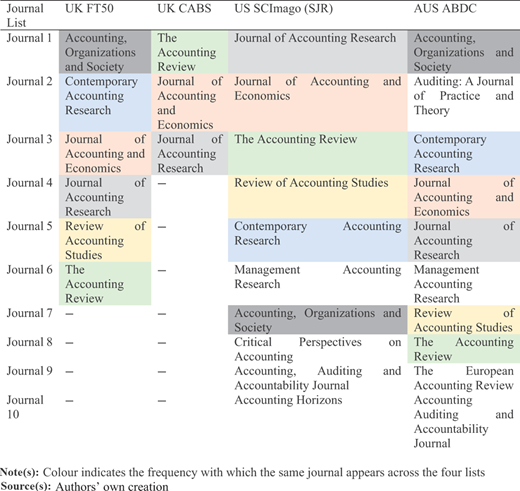 |
Journals that appeared consistently across multiple rankings were considered to represent the most influential publication venues shaping research expectations and scholarly trajectories in accounting. Based on this comparison, six journals were selected for detailed analysis: Accounting, Organizations and Society (AOS), Contemporary Accounting Research (CAR), Journal of Accounting and Economics (JAE), Journal of Accounting Research (JAR), Review of Accounting Studies (RAS) and The Accounting Review (TAR) (see Table 3).
Lists the leading accounting journals used for analysis, their abbreviations and national origin, presented in alphabetical order
| Journal list | Journal name |
|---|---|
| Journal 1 | Accounting, Organizations and Society (AOS) UK |
| Journal 2 | Contemporary Accounting Research (CAR) Canada |
| Journal 3 | Journal of Accounting and Economics (JAE) USA |
| Journal 4 | Journal of Accounting Research (JAR) USA |
| Journal 5 | Review of Accounting Studies (RAS) USA |
| Journal 6 | The Accounting Review (TAR) USA |
While these journals do not represent the full diversity of international accounting scholarship, their prominence and aspirational status make them appropriate for examining dominant norms regarding theoretical contribution in leading publication outlets.
3.2 Sampling design
To investigate patterns of theory use over time, the study compares two non-consecutive three-year periods: 2007–2009 and 2017–2019. This longitudinal design enables examination of both continuity and change in theoretical orientations across a decade characterised by technological, regulatory and societal developments affecting accounting practice and research.
All research articles published in the six journals during the selected periods were first identified (Table 4). From this population, a stratified random sample of 200 articles was drawn (Table 5). This approach ensured proportional representation of journals and publication years, thereby reducing the risk that observed patterns of theory use were driven by uneven publication volumes across outlets or time. Stratified sampling is commonly used in content analysis and archival research to obtain manageable yet representative data sets when analysing large publication populations (Krippendorff, 2018).
Number of articles published per year
| Journal name | 2007–2009 | 2017–2019 | |||||||||||||
|---|---|---|---|---|---|---|---|---|---|---|---|---|---|---|---|
| 2007 | % | 2008 | % | 2009 | % | Total | 2017 | % | 2018 | % | 2019 | % | Total | Total | |
| Journal of Accounting and Economics | 30 | 14.8 | 35 | 15.5 | 25 | 10.4 | 90 | 39 | 13.5 | 38 | 11.9 | 37 | 11.6 | 114 | 204 |
| Journal of Accounting Research | 30 | 14.8 | 37 | 16.4 | 27 | 11.3 | 94 | 32 | 11.1 | 34 | 10.7 | 31 | 9.7 | 97 | 191 |
| Accounting, Organizations and Society | 32 | 15.8 | 44 | 19.5 | 58 | 24.3 | 134 | 37 | 12.8 | 41 | 12.9 | 37 | 11.6 | 115 | 249 |
| Contemporary Accounting Research | 43 | 2l.18 | 34 | 15.0 | 36 | 15.1 | 113 | 70 | 24.3 | 75 | 23.5 | 85 | 26.6 | 230 | 343 |
| Review of Accounting Studies | 24 | 11.8 | 24 | 10.6 | 24 | 10.0 | 72 | 50 | 17.3 | 47 | 14.7 | 47 | 14.7 | 144 | 216 |
| The Accounting Review | 44 | 21.7 | 52 | 23.0 | 69 | 28.8 | 165 | 60 | 20.8 | 84 | 26.3 | 83 | 25.9 | 227 | 392 |
| Total articles | 203 | 100 | 226 | 100 | 239 | 100 | 668 | 288 | 100 | 319 | 100 | 320 | 100 | 927 | 1595 |
Number of articles in sample selected from each identified journal published during 2007–2009 and 2017–2019
| Journal name | 2007–2009 | 2017–2019 | Total | ||||||
|---|---|---|---|---|---|---|---|---|---|
| 2007 | 2008 | 2009 | Total | 2017 | 2018 | 2019 | Total | ||
| Journal of Accounting and Economics (JAE) | 4 | 4 | 3 | 11 | 5 | 5 | 5 | 15 | 26 |
| Journal of Accounting Research (JAR) | 4 | 5 | 3 | 12 | 4 | 4 | 4 | 12 | 24 |
| Accounting, Organizations and Society (AOS) | 4 | 6 | 7 | 17 | 5 | 5 | 4 | 14 | 31 |
| Contemporary Accounting Research (CAR) | 5 | 4 | 5 | 14 | 9 | 9 | 11 | 29 | 43 |
| Review of Accounting Studies (RAS) | 3 | 3 | 3 | 9 | 6 | 6 | 6 | 18 | 27 |
| The Accounting Review (TAR) | 6 | 6 | 9 | 22 | 7 | 11 | 10 | 28 | 49 |
| Total sample | 84 | 116 | 200 | ||||||
This sample size balances analytical depth with representativeness and is consistent with prior classification-based studies in accounting research (e.g. Oler et al., 2010). The sample was allocated proportionally across periods based on the total number of published articles, yielding 84 articles for 2007–2009 (668/1,595 × 200 = 83.8, rounded to 84) and 116 articles for 2017–2019 (927 / 1595 × 200 = 116.2, rounded to 116). Articles within each journal were then selected using a random selection procedure implemented in Excel.
3.3 Analytical framework
Theory use in each sampled article was classified using Gregor’s (2006) taxonomy of theory types. This framework categorises theory according to the primary functional purpose it serves within research rather than according to epistemological stance or specific theoretical tradition. Such a functional classification was considered particularly suitable for the present study because the analysis spans heterogeneous research topics, methodological approaches and journal contexts.
Gregor’s taxonomy distinguishes five theory types:
Analysis (AA): theory used to describe, structure or classify phenomena.
Explanation (EE): theory used to explain how and why phenomena occur.
Prediction (PP): theory used primarily to forecast outcomes or relationships.
Explanation and Prediction (EP): theory combining causal explanation with testable predictive propositions.
Design and Action (DA): theory providing prescriptive guidance for constructing artefacts, systems or practices.
In this study, the taxonomy is applied solely to identify the dominant theoretical purpose guiding each article’s research design and contribution. It is not used to evaluate the ontological or epistemological assumptions underlying particular theories.
3.4 Coding procedure
Each sampled article was independently reviewed by each member of the research team to identify the primary functional purpose that theory serves in the study. Consistent with prior content analysis approaches, coding focused on sections where theoretical contribution is typically articulated, including the introduction, theoretical framework, hypothesis development and discussion sections. These sections were examined to identify how theory informed the research problem, guided the empirical design and supported the claimed contribution of the study.
Where multiple theories were referenced within a single article, classification was based on the dominant theoretical purpose underpinning the study’s research questions and analytical strategy. In particular, attention was given to whether theory was used primarily to structure and describe phenomena, to provide interpretive explanation, to generate testable predictions, to integrate causal explanation with empirical testing or to inform the development or enactment of accounting practices or artefacts. This functional emphasis ensured consistency with Gregor’s (2006) taxonomy, which conceptualises theory in terms of the role it performs within research rather than its epistemological or paradigmatic foundations.
Coding disagreements were resolved through iterative discussion among three experienced researchers until consensus was reached. This process enhanced classification reliability by allowing alternative interpretations to be considered and reconciled.
To improve transparency and enable readers to assess the practical application of the classification framework, Table 6 provides illustrative examples of how theory categories were assigned to specific studies. These examples demonstrate how differences in research objectives – such as conceptual synthesis, causal interpretation, predictive modelling or prescriptive system development – informed coding decisions.
Illustrative examples of theory classification using Gregor’s (2006) taxonomy
| Theory type | Primary goal | Example paper (author, year, title) | Why classified this way | Alignment with Gregor (2006) |
|---|---|---|---|---|
| Analysis (AA) | To describe, structure or classify “what is” | Chenhall, R. H. (2008, AOS)–Accounting for the horizontal organization: A review essay | The paper synthesises and organises prior literature on horizontal organisational forms and associated management control practices. Its contribution is conceptual and classificatory, developing structured understanding and identifying research directions rather than proposing or empirically testing causal hypotheses or predictive relationships | Gregor (2006) defined analysis theory as theory that describes and structures phenomena without specifying causal relationships or predictive propositions |
| Explanation (EE) | To explain how and why phenomena occur | Mouritsen, J., Hansen, A., and Hansen, C. (2009, AOS)–Short and long translations: Management accounting calculations and innovation management | The study uses actor–network theory to explain how accounting calculations shape innovation processes through organisational “translations.” The objective is interpretive understanding rather than forecasting outcomes | Gregor (2006) characterised explanation theory as providing causal or process understanding of phenomena without necessarily generating testable predictive propositions |
| Prediction (PP) | To forecast outcomes or relationships | Allee, K.D., Deangelis, MD and Moon, J. (2018, JAR) – Disclosure “Scriptability” | While it has explanatory elements, its primary contribution is a metric designed to forecast the speed of market reaction to digital disclosures. The study develops a novel metric (“scriptability”) and evaluates its ability to predict variation in market reaction speed and information dissemination. Its contribution centres on improving predictive capability rather than developing rich causal mechanisms | Gregor (2006) described prediction theory as theory that states what will be and supports forecasting through testable propositions, even where justificatory explanation is limited |
| Explanation and prediction (EP) | To explain causal relationships and test them empirically | Banker, R. D., Bardhan, I. R., and Chen, T. (2008, AOS)–The role of manufacturing practices in mediating the impact of activity-based costing on plant performance | The paper develops a mediation model explaining how manufacturing practices influence the effectiveness of ABC systems and empirically tests the proposed relationships using plant-level data | Gregor (2006) defined explanation-and-prediction theory as providing causal explanation alongside empirically testable predictions about observed outcomes |
| Design and action (DA) | To prescribe how artefacts, practices or systems can be constructed or implemented | Wouters, M., and Wilderom, C. (2008, AOS)–Developing performance-measurement systems as enabling formalization | The study examines prescriptive design principles for the development and implementation of performance-measurement systems. Drawing on a longitudinal action-research case, it specifies how experience-based development, experimentation with measures, employee professionalism and system transparency can be used to construct performance-measurement systems that function as enabling rather than coercive forms of control. The contribution lies in articulating how such systems should be designed and developed in practice, rather than merely explaining or predicting their effects | Gregor (2006) defined design-and-action theory as prescriptive knowledge that explains how artefacts, methods or systems can be constructed. This study aligns with that definition by offering actionable principles for designing and developing performance-measurement systems as organisational artefacts, specifying how design and implementation processes should be structured to achieve enabling outcomes |
3.5 Analytical strategy
Following classification, descriptive analysis was undertaken to examine the distribution of theory types across journals and time periods. Comparative analysis was then used to assess shifts in dominant theoretical orientations and the extent of theoretical diversity within and across publication journals. This approach enables examination of how prevailing expectations regarding theoretical contribution may reflect broader patterns in disciplinary development and research priorities within accounting.
4. Results
The first research question is addressed by examining the functional purposes that theory serves in accounting research published in the six leading journals. This was assessed by analysing the mean concentration of each theory category across the sampled papers in each period. The results, presented in Table 7, indicate that EP theory was the most frequently used category in both periods, with a mean concentration of 3.0 in 2007–2009 and 4.5 in 2017–2019. The reported means represent the number of sampled articles classified within each theory category per journal and period and should therefore be interpreted as reflecting the distribution of theory types rather than the intensity or quality of theorising. The remaining theory categories exhibited relatively low mean values and showed only modest or statistically insignificant variation across periods.
Mean number of articles and pairwise t-test p-values by theory type
| Theory type | EP | PP | AA | EE | DA |
|---|---|---|---|---|---|
| Mean (2007–2009) | 3.000 | 1.000 | 0.389 | 0.167 | 0.111 |
| EP | – | ||||
| PP | <0.001 | – | |||
| AA | <0.001 | 0.052 | – | ||
| EE | <0.001 | 0.001 | 0.352 | – | |
| DA | <0.001 | 0.001 | 0.263 | 0.700 | – |
| Mean (2017–2019) | 4.500 | 1.167 | 0.056 | 0.444 | 0.278 |
| EP | – | ||||
| PP | <0.001 | – | |||
| AA | <0.001 | 0.003 | – | ||
| EE | <0.001 | 0.064 | 0.078 | – | |
| DA | <0.001 | 0.015 | 0.080 | 0.473 | – |
| DiD test (p-values) | 0.020 | 0.665 | 0.151 | 0.220 | 0.291 |
Pairwise comparisons are based on independent-sample t-tests. DiD denotes difference-in-differences tests comparing changes across the two periods (2007–2009 and 2017–2019). Reported values are p-values
The second research question examines whether patterns of theory use changed over time. A Differences-in-Differences (D&D) test indicates that the concentration of EP theory increased significantly between the two periods (p = 0.02), while changes in the other theory categories were not statistically significant.
To assess differences between theory categories within each period, paired two-sample t-tests were conducted. As shown in Table 7, the use of EP theory was significantly higher than that of PP, AA, EE and DA theories in both periods. In addition, significant differences were observed between PP theory and both EE and DA theory in the first period, and between PP theory and both AA and DA theory in the second period.
Analysis of variance (ANOVA) (Table 8) further confirmed significant variation between theory categories within each period, with statistically significant F-statistics (p < 0.001). Overall, these findings indicate that EP orientations remained dominant in leading accounting journals across both periods. Although the concentration of EP theory increased over time, the broader distribution of theory categories suggests continuity rather than a fundamental shift in the dominant purposes for which theory is used. Appendix 1 provides additional visual support for this pattern.
One-way ANOVA results
| Period | Source | df | MS | F | p-value |
|---|---|---|---|---|---|
| 2007–2009 | Between groups | ||||
| 4 | 26.261 | 27.710 | <0.001 | ||
| Within groups | 85 | 0.948 | |||
| 2017–2019 | Between groups | 4 | 61.122 | 44.028 | <0.001 |
| Within groups | 85 | 1.388 |
One-way ANOVA tests whether the mean number of articles differs significantly across theory types within each period. Reported p-values correspond to the between-groups F-test
When examining individual journals, Appendix 2 indicates a modest increase in the range of theory categories represented in the second period across the US-based journals JAE, JAR and TAR. In contrast, the remaining US journal, RAS, exhibited relative stability, with two theory categories represented in both periods. The European-based journal AOS displayed the greatest diversity in theoretical purposes, with all five theory categories represented across both periods. The Canadian journal CAR exhibited three theory categories in each period, suggesting limited change in its overall theoretical profile.
Appendix 2 also highlights the emergence of DA theory in JAE and TAR during the second period, whereas such studies were absent in the first period. DA theory was represented in AOS in both periods, with a slight increase over time. Similarly, increased use of EE theory is observed in the second period for JAE, AOS and TAR. These journal-level patterns are consistent with the overall mean trends reported in Tables 7 and 8.
Because CAR displayed comparatively limited variation in theory distribution across periods, it was not emphasised in the subsequent regional aggregation to facilitate clearer comparison between dominant US-based journals and the European journal AOS. Appendix 3 therefore presents combined distributions for the three US journals alongside results for AOS separately. The visual comparison reinforces the persistence of EP orientations in US journals, alongside comparatively greater diversity in the purposes served by theory in AOS. These results provide an empirical basis for examining how dominant publication outlets may shape broader disciplinary trajectories.
5. Discussion
This study examines the functional purposes that theory serves within influential accounting research and explores the implications of these patterns for disciplinary development. By analysing theory use across six historically influential international accounting journals over two time periods, the study provides insight into the stability and evolution of dominant theoretical purposes and how publication norms may shape broader research trajectories. In doing so, the findings address the third research question by illustrating how dominant patterns of theory use shape the development of the accounting discipline, including its intellectual orientation, methodological preferences and engagement with practice.
Using Gregor’s (2006) functional taxonomy, the findings indicate that EP represents the dominant functional purpose guiding theoretical contribution in leading accounting journals in both periods examined. The dominance of EP theory observed in this study is consistent with broader developments in accounting research, where increasing emphasis has been placed on causal inference and the use of research designs capable of supporting empirical testing (Leuz, 2022). Prediction (PP) theory also appears frequently, while analytical (AA), explanatory (EE) and design-and-action (DA) uses of theory occur less often. Although the concentration of EP theory increased significantly between the two periods, the broader distribution of theory categories suggests continuity rather than a fundamental shift in the function theory serves in aspirational publication outlets.
At the journal level, some expansion in theoretical diversity is observable. Three US-based journals show modest growth in the range of theory categories represented in the later period, largely associated with limited increases in explanatory and design-oriented research. However, theoretical diversity remained stable in other North American journals. In contrast, the European-based journal AOS consistently exhibited broader representation of functional theory purposes across both periods. These patterns suggest that while EP traditions continue to shape publication norms, selective openness to alternative theoretical purposes may be emerging within certain leading journals.
Regional differences in functional use of theory may be understood in light of the historical development of accounting research traditions. US accounting scholarship became institutionalised earlier than in many other contexts (Stevenson et al., 2018), contributing to the establishment of research conventions grounded in cumulative empirical testing and positivist methodological orientations. Prior studies have noted that prestigious US accounting journals have often prioritised research focusing on capital markets, forecasting and positive theory traditions (Gendron, 2009; Hopwood, 2009; Wilkinson and Durden, 2015). Within this research environment, EP theory aligns closely with expectations regarding rigorous hypothesis testing and incremental theoretical refinement.
By contrast, European accounting research has been characterised by stronger engagement with social and interpretive approaches (Gendron, 2009). These traditions frequently use qualitative or context-sensitive methodologies that prioritise understanding organisational processes and societal implications rather than forecasting specific outcomes. The greater functional diversity observed in the sole European journal analysed in this study is therefore consistent with these broader intellectual traditions. The Canadian journal examined appears to occupy an intermediate position, reflecting features associated with both North American and European research orientations.
The persistence of EP theory also raises questions regarding the discipline’s capacity to respond to emerging phenomena. Accounting practice operates in environments shaped by rapid technological development and evolving societal expectations (Kroon et al., 2021; Leuz, 2022). EP theorising typically relies on accumulated empirical knowledge and well-specified causal relationships (Gregor, 2006), which may be less readily available in novel or rapidly changing contexts. Scholars have therefore suggested that broader theoretical purposes – including exploratory, interpretive and design-oriented approaches – may support more comprehensive engagement with complex organisational and societal challenges (Sandberg and Alvesson, 2021).
A strong orientation towards EP research may also influence the relationship between accounting research and practice. Prior literature has highlighted concerns that academic accounting research can become detached from practitioner priorities when theoretical contributions are primarily framed in terms of incremental extensions to existing literature rather than practice-driven problematisation (Mihaltan, 2019). Similarly, Gaffikin (2006) argued that positivist approaches may be less well suited to examining socially embedded accounting phenomena characterised by human judgement, institutional dynamics and contextual complexity. While EP theory contributes to methodological rigour and evidential credibility, it does not eliminate the influence of disciplinary norms, publication incentives and researcher perspectives (Baldwin et al., 2022; Schumm, 2021).
At the same time, the modest increase in design-and-action and explanatory studies observed in the later period suggests some recognition of the value of broader theoretical purposes. Design-and-action theorising provides prescriptive knowledge concerning how accounting artefacts, systems or practices may be constructed and enacted (Gregor, 2006), thereby potentially supporting engagement with emerging technological and organisational innovations (Leuz, 2022). However, the relatively limited presence of such studies in leading journals indicates that shifts in functional expectations of theory remain gradual rather than transformative.
Gregor (2006) conceptualised theory types as interconnected rather than sequential, allowing design-oriented theorising to build on analytical or explanatory insights. Although relatively few design-and-action studies were identified in the sample, the framework provides a useful lens for examining how different theoretical purposes may coexist and interact over time. Future research examining additional periods or a broader range of journals may offer further insight into whether increased functional diversity in theory use is sustained or expanded within the discipline.
The findings also contribute to ongoing debates regarding accounting’s reliance on theoretical frameworks developed in reference disciplines. Previous research suggests that sustained dependence on externally derived theoretical traditions may shape perceptions of disciplinary maturity and autonomy (Benbasat and Weber, 1996; Elias, 1982; Pfeffer, 1993). The continued dominance of EP theory across regions and journals may reflect the influence of research conventions associated with economics and related fields, where cumulative empirical testing is strongly emphasised. While such orientations may enhance methodological legitimacy, they may also influence how influential accounting research positions itself intellectually within the broader academic landscape.
Several limitations should be acknowledged. The study focuses on a sample of articles from historically influential journals that are widely regarded as aspirational publication journals within the discipline. Although examining these journals provides insight into dominant expectations regarding theoretical contribution, the findings do not capture the full diversity of international accounting scholarship, particularly in emerging or regionally oriented journals. Moreover, the analysis compares only two time periods and therefore cannot fully assess longer-term trajectories in theory use. Future research could extend this approach to conference publications, special issues or additional journal ecosystems to examine whether functional diversity in functional use of theory varies across different scholarly contexts.
Overall, the findings suggest that functional expectations regarding theory use remain relatively stable within leading accounting journals, with EP orientations continuing to dominate. While incremental increases in alternative theoretical purposes are observable, publication norms appear to exert a stabilising influence on how theoretical contributions are framed and evaluated. These patterns highlight how expectations regarding theory use may shape the discipline’s intellectual development and research priorities.
6. Conclusion
This study provides systematic empirical evidence on the functional purpose that theory serves within leading international accounting journals. By analysing theory use across six historically influential journals over two time periods, the study shows that EP theory remains the dominant functional purpose shaping recognised theoretical contribution in aspirational publication journals. The increased concentration of EP studies over time points to continuity in prevailing theoretical expectations, while only modest growth in explanatory and design-oriented uses of theory suggests that diversification remains incremental rather than transformative.
The analysis further identifies important regional variation in patterns of theory use for leading journals. US-based journals continue to exhibit a strong emphasis on EP contributions, whereas the European journal in the sample demonstrates comparatively broader functional diversity. At the same time, evidence of gradual convergence is observable, as EP orientations have also increased within the European journals. Together, these patterns suggest that editorial norms in leading journals play a dual role: stabilising dominant expectations regarding theoretical contribution while selectively accommodating alternative forms of theorising over time.
By examining theory through its functional purposes rather than its epistemological foundations or disciplinary origins, this study makes three primary contributions to accounting research. First, the study provides one of the first systematic empirical mappings of how theory is used across heterogeneous areas of accounting research in leading journals. Applying Gregor’s (2006) taxonomy as a functional classification framework enables comparison across diverse research topics, methodological traditions and publication contexts. In doing so, the study complements existing literature that has focused on specific subfields or epistemological debates and offers a discipline-level perspective on the dominant functions that theory is expected to perform in influential journals.
Secondly, the findings contribute to debates on disciplinary development by demonstrating how publication norms shape expectations of theoretical contribution in practice. The sustained dominance of EP theory indicates that cumulative empirical testing continues to serve as a central criterion for recognised theoretical contribution in aspirational journals. At the same time, the limited but observable presence of analytical, explanatory and design-oriented theorising highlights potential pathways through which the discipline’s theoretical repertoire may gradually expand. From this perspective, greater functional diversity in theory use may support engagement with emerging accounting phenomena, including technological transformation, sustainability challenges and evolving institutional environments.
Thirdly, the study contributes to discussions concerning the relationship between accounting research and practice. Prior research has cautioned that research agendas heavily oriented towards incremental theoretical refinement may risk reduced engagement with practitioner concerns (Hopwood, 2007, 2009; Humphrey and Gendron, 2015). By empirically documenting the concentration of particular functional purposes of theory, this study provides a concrete empirical basis for considering how expectations regarding theoretical contribution may influence accounting’s societal relevance, educational priorities and intellectual autonomy.
Overall, the study demonstrates that theoretical contribution in influential accounting research remains strongly oriented towards EP traditions, even as early signs of functional diversification emerge. Recognising and supporting a wider range of functional theoretical purposes may enhance the discipline’s adaptability, strengthen its intellectual identity and improve its capacity to address complex contemporary accounting challenges.
Note
In this study, theoretical diversity refers to the range of functional purposes for which theory is used within accounting research (e.g., analytical, explanatory, predictive, or design-oriented). This is distinct from theoretical commonality, which refers to shared expectations within influential publication outlets regarding what constitutes legitimate theoretical contribution. Importantly, greater commonality in evaluative expectations does not necessarily imply greater diversity in theory use. Journals may exhibit strong agreement about what counts as theoretical contribution while continuing to privilege a relatively narrow set of functional purposes. The analysis does not treat diversity as inherently desirable or undesirable, but instead examines how such patterns of shared norms and limited functional variation may shape the discipline’s capacity to respond to emerging phenomena.
References
Further reading
Appendix 1
 The left pie chart is labelled 2007 to 2009. The categories are A A 1, 8 per cent; E E 1, 4 per cent; P P 1, 22 per cent; E P 1, 64 per cent; and D A 1, 2 per cent. The right pie chart is labelled 2017 to 2019. The categories are A A 2, 1 per cent; E E 2, 7 per cent; P P 2, 18 per cent; E P 2, 70 per cent; and D A 2, 4 per cent.
Purpose of theory in the combined leading six accounting journals published between 2007–2009 and 2017–2019, expressed as percentage of the total number of sampled papers in each period
Source: Authors’ own creation
The left pie chart is labelled 2007 to 2009. The categories are A A 1, 8 per cent; E E 1, 4 per cent; P P 1, 22 per cent; E P 1, 64 per cent; and D A 1, 2 per cent. The right pie chart is labelled 2017 to 2019. The categories are A A 2, 1 per cent; E E 2, 7 per cent; P P 2, 18 per cent; E P 2, 70 per cent; and D A 2, 4 per cent.Purpose of theory in the combined leading six accounting journals published between 2007–2009 and 2017–2019, expressed as percentage of the total number of sampled papers in each period
Source: Authors’ own creation
Appendix 2
 The chart has 6 rows and 2 columns. The column headers are 2007 to 2009 and 2017 to 2019. Row J A E shows A A 1, 0 per cent; E E 1, 0 per cent; P P 1, 18 per cent; E P 1, 82 per cent; and D A 1, 0 per cent. J A E for 2017 to 2019 shows A A 2, 0 per cent; E E 2, 6 per cent; P P 2, 0 per cent; E P 2, 87 per cent; and D A 2, 7 per cent. Row J A R shows A A 1, 0 per cent; E E 1, 8 per cent; P P 1, 0 per cent; E P 1, 92 per cent; and D A 1, 0 per cent. J A R for 2017 to 2019 shows A A 2, 0 per cent; E E 2, 8 per cent; P P 2, 25 per cent; E P 2, 59 per cent; and D A 2, 8 per cent. Row A O S shows A A 1, 41 per cent; E E 1, 6 per cent; P P 1, 23 per cent; E P 1, 18 per cent; and D A 1, 12 per cent. A O S for 2017 to 2019 shows A A 2, 7 per cent; E E 2, 22 per cent; P P 2, 7 per cent; E P 2, 50 per cent; and D A 2, 14 per cent. Row C A R shows A A 1, 0 per cent; E E 1, 7 per cent; P P 1, 36 per cent; E P 1, 57 per cent; and D A 1, 0 per cent. C A R for 2017 to 2019 shows A A 2, 0 per cent; E E 2, 7 per cent; P P 2, 21 per cent; E P 2, 72 per cent; and D A 2, 0 per cent. Row R A S shows A A 1, 0 per cent; E E 1, 0 per cent; P P 1, 22 per cent; E P 1, 78 per cent; and D A 1, 0 per cent. R A S for 2017 to 2019 shows A A 2, 0 per cent; E E 2, 0 per cent; P P 2, 17 per cent; E P 2, 83 per cent; and D A 2, 0 per cent. Row T A R shows A A, 0 per cent; E E, 0 per cent; P P, 24 per cent; E P, 76 per cent; and D A, 0 per cent. T A R for 2017 to 2019 shows A A 2, 0 per cent; E E 2, 3 per cent; P P 2, 29 per cent; E P 2, 64 per cent; and D A 2, 4 per cent.
Proportion of the purpose of theory in the top six accounting journals between 2007–2009 and 2017–2019, expressed as a percentage of the total number of papers sampled in each journal
Source: Authors’ own creation
The chart has 6 rows and 2 columns. The column headers are 2007 to 2009 and 2017 to 2019. Row J A E shows A A 1, 0 per cent; E E 1, 0 per cent; P P 1, 18 per cent; E P 1, 82 per cent; and D A 1, 0 per cent. J A E for 2017 to 2019 shows A A 2, 0 per cent; E E 2, 6 per cent; P P 2, 0 per cent; E P 2, 87 per cent; and D A 2, 7 per cent. Row J A R shows A A 1, 0 per cent; E E 1, 8 per cent; P P 1, 0 per cent; E P 1, 92 per cent; and D A 1, 0 per cent. J A R for 2017 to 2019 shows A A 2, 0 per cent; E E 2, 8 per cent; P P 2, 25 per cent; E P 2, 59 per cent; and D A 2, 8 per cent. Row A O S shows A A 1, 41 per cent; E E 1, 6 per cent; P P 1, 23 per cent; E P 1, 18 per cent; and D A 1, 12 per cent. A O S for 2017 to 2019 shows A A 2, 7 per cent; E E 2, 22 per cent; P P 2, 7 per cent; E P 2, 50 per cent; and D A 2, 14 per cent. Row C A R shows A A 1, 0 per cent; E E 1, 7 per cent; P P 1, 36 per cent; E P 1, 57 per cent; and D A 1, 0 per cent. C A R for 2017 to 2019 shows A A 2, 0 per cent; E E 2, 7 per cent; P P 2, 21 per cent; E P 2, 72 per cent; and D A 2, 0 per cent. Row R A S shows A A 1, 0 per cent; E E 1, 0 per cent; P P 1, 22 per cent; E P 1, 78 per cent; and D A 1, 0 per cent. R A S for 2017 to 2019 shows A A 2, 0 per cent; E E 2, 0 per cent; P P 2, 17 per cent; E P 2, 83 per cent; and D A 2, 0 per cent. Row T A R shows A A, 0 per cent; E E, 0 per cent; P P, 24 per cent; E P, 76 per cent; and D A, 0 per cent. T A R for 2017 to 2019 shows A A 2, 0 per cent; E E 2, 3 per cent; P P 2, 29 per cent; E P 2, 64 per cent; and D A 2, 4 per cent.Proportion of the purpose of theory in the top six accounting journals between 2007–2009 and 2017–2019, expressed as a percentage of the total number of papers sampled in each journal
Source: Authors’ own creation
Appendix 3
 The top row is U K journal. For 2007 to 2009, A A 1 is 41 per cent, E E 1 is 6 per cent, P P 1 is 23 per cent, E P 1 is 18 per cent, and D A 1 is 12 per cent. For 2017 to 2019, A A 2 is 7 per cent, E E 2 is 22 per cent, P P 2 is 7 per cent, E P 2 is 50 per cent, and D A 2 is 14 per cent. The bottom row is U S journals. For 2007 to 2009, the visible percentages are 81 per cent, 17 per cent, and 2 per cent. For 2017 to 2019, the visible percentages are 73 per cent, 19 per cent, 4 per cent, and 4 per cent.
Purpose of theory in European (UK) journal vs US journals, 2007–2009 and 2017–2019, expressed as percentage of the total number of sampled papers in each group
Source: Authors’ own creation
The top row is U K journal. For 2007 to 2009, A A 1 is 41 per cent, E E 1 is 6 per cent, P P 1 is 23 per cent, E P 1 is 18 per cent, and D A 1 is 12 per cent. For 2017 to 2019, A A 2 is 7 per cent, E E 2 is 22 per cent, P P 2 is 7 per cent, E P 2 is 50 per cent, and D A 2 is 14 per cent. The bottom row is U S journals. For 2007 to 2009, the visible percentages are 81 per cent, 17 per cent, and 2 per cent. For 2017 to 2019, the visible percentages are 73 per cent, 19 per cent, 4 per cent, and 4 per cent.Purpose of theory in European (UK) journal vs US journals, 2007–2009 and 2017–2019, expressed as percentage of the total number of sampled papers in each group
Source: Authors’ own creation

