Rapid advancements in artificial intelligence (AI) technology have brought about numerous opportunities and challenges in various fields, including education and research. ChatGPT, as an AI tool, can generate complex analytical texts based on simple texts. However, the use of this tool poses various legal and ethical challenges, including authenticity, researcher participation and plagiarism. Accordingly, the present study aims to evaluate the acceptance of using ChatGPT among university faculty members.
The extended unified theory of acceptance and use of technology (UTAUT) model was employed in the survey, in which 625 university faculty members participated.
The research findings demonstrated that the social influence of ChatGPT among university professors has an impact on their utilization of this tool in educational and research processes. Additionally, security and trust influenced research participants in using ChatGPT. The results of this study indicate that ChatGPT has numerous capabilities in the field of education and research.
The theoretical contribution of this research is to provide a model and identify the factors influencing the acceptance of ChatGPT in the academic field. In this model, the factors of performance expectation, ease of use of technology, degree of efficiency, social influence, security, trust, infrastructure and environment were effective in the adoption of ChatGPT. However, university administrators should establish the educational infrastructure for utilizing this tool and develop implementing regulations while considering the legal challenges.
Introduction
In recent years, educational processes have undergone significant changes towards online learning and digital education (Ronaghi, 2022a). AI literacy is an essential global goal in the field of education (Yim and Su, 2025). The focus of early AI algorithms was on controlled learning under biological organisms and physical properties (Kar, 2016). AI has different tools for data analysis that can be used in different fields.
ChatGPT plays an important role in the distinction between artificial general intelligence (AGI) and artificial narrow intelligence (ANI). ChatGPT, like Siri, tends towards AGI. These programs are not specifically designed for a particular domain, but they have extensive applications due to their scale, speed, and breadth (Kissinger et al., 2021). In the education field, ChatGPT can contribute to the learning process and increase the productivity of students through effective feedback. Despite the limitations of this tool, such as incorrect information and inaccurate references, students can quickly obtain initial knowledge without much effort. Additionally, researchers can collect and analyze preliminary research information using this tool (Dwivedi et al., 2023). In order to use ChatGPT, its challenges need to be investigated.
In the field of education, various challenges have been raised in different studies regarding the implementation of ChatGPT, such as addressing cheating in exams (Mitchell, 2023), evaluating creativity and authenticity (Chakravarti, 2023), and integration of this tool in organizational tasks like the purchasing process or advertisements (Chen et al., 2022). Based on the review of previous studies on ChatGPT, its acceptance among university users requires further analysis and conducting field studies among one of the stakeholders in the education sector, namely university professors, has been identified as a research gap.
Baird and Maruping (2021) believe that the use of ChatGPT can vary in different regions and countries. For example, in developing countries that are usually technology importers and have fewer experts in advanced technologies, there might be a high dependency on this tool and all the outputs of ChatGPT may become the criteria for decision-making and analysis.
Considering the importance of the issue, developing countries in the Middle East were chosen for the study. Accordingly, the objective of this study is to assess the acceptance of ChatGPT among faculty members in Middle Eastern universities. To this end, the following research questions are raised:
What factors affect the acceptance of ChatGPT among faculty members of universities?
What is the current status of ChatGPT acceptance among faculty members of Middle Eastern universities?
The theoretical contribution of this research is to provide a model and identify the factors influencing the acceptance of ChatGPT in the academic field. In the research model, the environmental dimension and the trust dimension are mentioned in comparison with the UTAUT model. From a managerial perspective, the results of this study can be useful for policy-makers in the scientific field of countries and university administrators to plan for the use of ChatGPT in education and research. Creating a suitable infrastructure for using ChatGPT can provide a basis for students’ academic development.
Literature review
ChatGPT, education and academic sector
AI tools have brought significant changes in various fields, including educational centers and universities, where they are recognized as popular educational technologies. AI in education is an emerging technology and a rapidly expanding project. Along with many advantages, it also brings challenges such as data privacy violations, intellectual property rights and false content generation (Yan and Liu, 2025). Digital transformation in universities and educational institutions leads to the formation of new structures and digitization of processes, which can have different effects on the environment and sustainability (Ronghi and Ronaghi, 2025). AI chatbots can be used in various forms, such as mobile applications. Since they have facilitated access to educational programs, learning resources, and interaction with curriculum, these tools have been well-received by the university community and students (Okonkwo and Ade-Ibijola, 2021). One of the areas where AI chatbots have been utilized in education is providing personalized feedback for writing assignments.
Given the challenges and concerns that the use of AI in education poses, it is important to develop AI policies and implementation frameworks for this technology. The UNESCO Framework for AI in Education takes a humanistic approach and focuses on the protection of human rights and sustainable development (Chan, 2023). The framework prioritizes human control over technology and seeks to improve the capabilities of teachers and students in using this technology (Resseguier and Rodrigues, 2021).
Educational governance should support the use of ChatGPT tools to achieve university goals. Governance can also help students use AI tools and accordingly encourage teachers to update assessment methods and guide AI-based learning (Pinho et al., 2025). Governance should create equity in the university because inequality in access to smart tools can create educational inequalities. Educational policies should ensure equitable access to new technologies for students.
The new versions of ChatGPT have the potential to fundamentally change the classroom experience and the outcomes of students’ knowledge and skills. One way to address this issue is to adopt an experimental and experiential mindset for educators. Educators, with a strong understanding of the subject matter and proper training in critical thinking, may be able to distinguish the contribution of an AI chatbot from a student’s work (Chen et al., 2022). The opportunities of ChatGPT in the educational environment include providing initial educational content, personal feedback (such as text editing), automating administrative tasks, language training, enhancing online education, and one-on-one support (Elliot, 2022). Along with the many advantages of using ChatGPT, it also brings some risks.
The risks of ChatGPT include data quality and information bias, ethical challenges, interpretation of the output model, security and privacy, limited interpretability, authenticity detection, human-machine interaction issues, transparency, job loss, excessive reliance on technology, and limited guidelines for technology development (Gammoh, 2025). Bouschery et al. (2023) revealed that ChatGPT could be a useful tool for writing introductions or literature reviews in an article. However, there is a possibility of distorting the real content and plagiarism in these sections.
There is limited evidence that ChatGPT can perform well in other research areas such as developing hypotheses or analyzing results. The deployment process of this tool has evolved in a way that the journal Nature has shown several articles attributing ChatGPT as a co-author (van Dis et al., 2023). Despite the challenges and complexities of the use of ChatGPT in higher education training, chatbots and other AI tools are expanding, and educators, researchers, and university administrators need to adapt to this dynamic digital environment. Human-AI interaction in higher education is becoming more developed in the future. Therefore, the acceptance of this technology by the academic community requires more thorough analysis.
Research hypotheses derivation
Various studies have used technology acceptance models in different contexts. According to previous studies, the most commonly used and credible model is technology acceptance model (TAM), proposed by Davis et al. (1989), Rico-Bautista et al. (2021). The variables in the initial model of technology acceptance are limited as they only evaluate a portion of users’ perceptual characteristics. In various studies conducted in higher education, such as Garon et al. (2019), Abbad (2021) and Al-Mamary (2022), the unified theory of acceptance and use of technology (UTAUT) model has been used to assess technology acceptance. This model has four variables, effort expectancy, performance expectancy, social influence, and facilitating conditions (Venkatesh et al., 2003). In universities and business environments, the UTAUT model and its developed versions have more applications due to the use of more complete and appropriate variables. Venkatesh (2022) believes that the extended UTAUT model is suitable for assessing the acceptance of AI tools by considering technological and environmental dimensions.
Rico-Bautista et al. (2021) identified the influential factors on AI adoption in educational centers and universities. The model they presented can be considered as a developed version of the UTAUT model. The factors influencing the adoption of AI tools in the higher education environment include:
Performance expectation: is the degree to which users believe that using technology can lead to better achievements and better performance of their tasks. Akinnuwesi et al. (2022) showed that performance expectation is an influential factor in the use of digital technology. Also, Andrew et al. (2021) referred to the impact of performance expectancy on the use of AI-related technologies. According to the effects of performance on the use of technology in previous studies, the first research hypothesis is formed:
Performance expectation has a positive influence on the ChatGPT adoption.
Degree of efficiency: is the extent to which the use of technology improves the efficiency of the organization. The adoption of any technology in an organization aims to achieve goals with lower costs. Rico-Bautista et al. (2021) showed that the more AI technology can contribute to the efficiency of an educational institution, the more it affects the acceptance and usage of that tool. This finding leads us to the formulation of the second hypothesis:
Degree of efficiency has a positive influence on the ChatGPT adoption.
Ease of use: is the level of comfort and easy access to the desired technology. The study by Chatterjee et al. (2021) indicated the impact of ease of use of AI systems on users’ behavioral intention. Venkatesh (2022) mentioned the influence of effort expectancy and ease of use on individuals’ use of AI tools. Hence, we present our third research hypothesis:
Ease of use has a positive influence on the ChatGPT adoption.
Social influence: refers to the reflection of others’ opinions on an individual’s perception of technology. The social environment and others’ opinions are influential factors in people’s choices. Shiferaw and Mehari (2019) demonstrated that the social influence of the environment can be effective in the use of smart technology. Ronaghi and Forouharfar (2020) believed that the influence of others’ opinions on individual users can be effective in the use of disruptive technology. Hence, we present our fourth research hypothesis:
Social influence has a positive influence on the ChatGPT adoption.
Security and Trust: indicate the acceptability of technology usage and its security. Given the various ethical challenges of using ChatGPT, such as privacy protection, as well as legal limitations such as fraud and maintaining the authenticity of work, this factor can be effective in the use of ChatGPT. Choudhury and Shamszare (2023) showed that trust in ChatGPT is an influential factor in its usage. Additionally, Rico-Bautista et al. (2021) consider AI tool security to be effective in its use. Therefore, we can propose the following hypothesis:
Security and Trust have positive influence on the ChatGPT adoption.
Environment and Infrastructure: refer to the provision of infrastructure and organizational support in technology usage. Chatterjee et al. (2021) referred to the role of facilitating conditions in the use of AI-based systems in organizations. Hence, the sixth hypothesis of the research is proposed in the following:
Environment and Infrastructure have positive influence on the ChatGPT adoption.
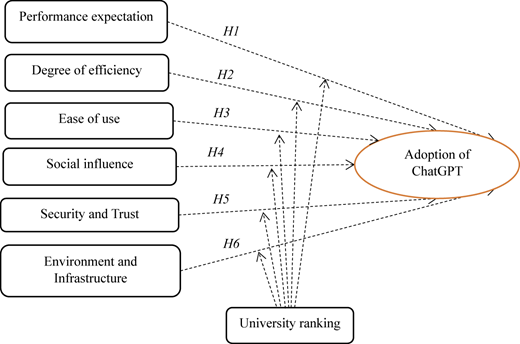
Figure 1 presents the conceptual model based on the extended UTAUT model and the proposed model by Rico-Bautista et al. (2021) according to the research hypotheses. University infrastructure can affect the way technology is used and the extent to which it is adopted. Given that different universities will be examined, in this model, the university ranking variable is evaluated as a mediating variable.
Methods
This study was applied in nature and utilized a quantitative method. Furthermore, the research paradigm was post-positivism. Post-positivists aim to uncover the causes and effects of a phenomenon, and from this understanding, knowledge is constructed through precise measurement of variables (Creswell, 2014). Based on this, the relationships between the variables were tested using the survey strategy. Venkatesh (2022) proposed the extended UTAUT model for evaluating the acceptance of AI tools. Rico-Bautista et al. (2021) presented the influential factors on the acceptance of AI tools in the field of education based on the extended UTAUT model. Therefore, in this study, the extended UTAUT model was used based on the Rico-Bautista et al.’s (2021) model, and the initial model consisted of seven constructs. A questionnaire was used to collect data. The initial questionnaire was sent to 8 faculty members of the university who had research articles in the field of AI, and their suggested modifications were incorporated into the questionnaire, and the face validity of the questionnaire was confirmed. The final questionnaire consisted of 4 demographic questions and 25 questions related to the research variables. The constructs and items of the questionnaire are presented in Table 1.
To evaluate reliability, the results of Cronbach’s alpha coefficient and Dillon-Goldstein (DG) rho for the variables are shown in Table 2. Based on the obtained values, which were greater than 0.7, the reliability of the questionnaire was acceptable. Two indicators, composite reliability (CR) and average variance extracted (AVE), were used to evaluate convergent reliability (Fornell and Lacker, 1981). The results shown in Table 2 confirm the convergent reliability of the research tool.
Fornell and Larcker’s method was used to determine discriminant validity. The results presented in Table 3 confirm the discriminant validity.
Developing countries in the Middle East region, which mainly had an oil-based economy, realized the global shift towards AI and advanced technologies with the advent of the fourth industrial revolution (Ronaghi and Ronaghi, 2025). It is predicted that the Middle East will account for 2% of the total global benefits of AI equivalent to 320 billion US dollars in 2030 (PWC, 2024). Due to the lack of specialized workforce in the field of advanced technologies in developing countries and the multiplied impact of these technologies on society, the evaluation of using AI tools in these regions is of great importance. For this reason, the study population included faculty members of universities in the Middle East region as developing countries. A list of top universities in Middle Eastern countries was prepared according to the Shanghai Ranking in 2024, and the contact information of their faculty members was collected from the universities’ websites. Simple random sampling method was used. A total of 950 electronic questionnaires were sent out. Within 53 days, 625 questionnaires were received. Structural equation modeling (SEM) is a powerful statistical method that combines factor analysis and regression to examine complex relationships between latent and observed variables (Hair et al., 2021). Smart PLS-3 software was used for analyzing the collected data. This method allows researchers to examine complex causal structures with non-normal data and small samples and achieve valid and meaningful results.
Results
Demographic information of the faculty members as research participants is shown in Table 4. As can be seen, 80% of them had more than ten years of work experience at the university. Additionally, most of the participants were from universities in Iran and Saudi Arabia. Also, 82% of the participants were male. It should be noted that all the universities examined in the Middle East region had a ranking of top 100 in the Shanghai ranking and are not considered advanced world universities.
T-statistics, path coefficients and p-values were calculated for the research hypotheses. Based on the obtained results of t-statistic and p-values in Table 5, all the main research hypotheses are confirmed at a 95% confidence level. Based on these findings, it was revealed that the recognition of ChatGPT capabilities in the field of university education and research, as well as its ease of access and learning, are influential factors in the use of this technology. On the other hand, as confidence in the findings and outputs of ChatGPT increases and universities provide access infrastructure to this tool, the possibility of its use among faculty members increases. Also, social media advertising and the prevailing atmosphere in universities are other influential factors in the acceptance of ChatGPT in universities. Compared to the traditional UTAUT model (Venkatesh et al., 2003), it was found that trust and security are effective factors in the use of ChatGPT. Based on this, the use of controlled versions of AI in universities can provide users with reliable outputs.
The results of other hypotheses (H1R-H6R) show that the construction of the university rank variable does not play an intervening role in the influence of factors affecting AI adoption (See Table 5). Based on this, it can be acknowledged that according to the development of the use of AI in all societies, the rank of the university is not an effective factor in the use of ChatGPT.
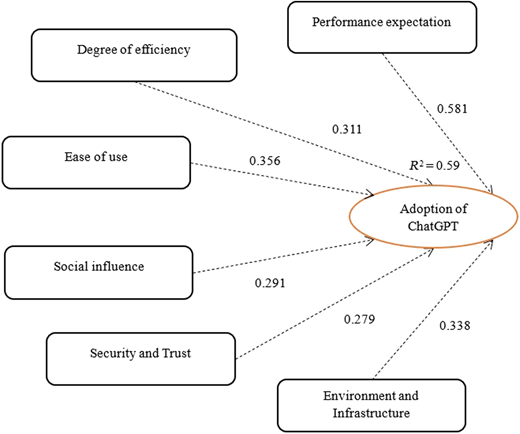
Figure 2 shows the structural model along with the path coefficients. Model coefficients show that the performance expectation, degree of efficiency, ease of use, security and trust, social influence, environment and Infrastructure have an effect on adoption of ChatGPT, and among these, the performance expectation has had the greatest effect on adoption of ChatGPT. According to coefficient of determination (R2), the structural model explained 59% of variance in adoption of ChatGPT (R2 = 0.59).
Another evaluation for the structural model involves the F-value, which illustrates the impact of latent variables. An F-value of 0.02 or lower suggests a small effect, while a medium effect is indicated by a value of 0.15. Additionally, an effect is considered strong if the F-value is equal to or greater than 0.35. In this research, there were three relationships with medium effect sizes and three with small effect sizes (security and trust = 0.181 > degree of efficiency = 0.172 > ease of use = 0.167 > social influence = 1.12 > environment = 0.089 > performance expectation = 0.049). As a result, it is clear that the variables of trust and security, degree of efficiency and ease of use had a significant impact on the adoption of ChatGPT. Based on this, paying attention to the safe platform of using technology and training about the capabilities of this tool can become the basis for using ChatGPT in the university.
Discussion
The discussion about the use of ChatGPT in various fields has become widespread. In the academic field, the use of this tool in education and research is very challenging, and various perspectives have been raised on this matter. Academic stakeholders, including researchers, journal editors, and publishers, are discussing the appropriate use of AI tools in the process of information gathering and scientific article writing (Stokel-Walker, 2023). Compared to the traditional UTAUT model (Venkatesh et al., 2003), the model presented in this research also considered the environmental and security variables in the adoption of AI technology. Also, according to the extended model of Venkatesh (2022), security and trust variables were added in this model.
In contrast to the study by Baidoo-Anu and Owusu Ansah (2023) and Dewivedi et al. (2023), which reviewed the capabilities and challenges of ChatGPT in the field of education, this study focused on examining the acceptance of ChatGPT among university faculty members in the form of a field study.
The result of the first hypothesis (β = 0.581, ρ = 0.001) showed that the variable “performance expectation” has an impact on the use and acceptance of ChatGPT. In other words, the faculty members of the studied universities use ChatGPT due to its useful capabilities in educational processes and its impact on scientific article writing. Based on this finding, it is clear that familiarity with technology applications is an effective factor in using ChatGPT. The result of this hypothesis demonstrates the usefulness of ChatGPT in the academic sector. With the use of AI tools, it is possible to improve the educational effectiveness and quality of research and provide the basis for the academic development of students. In line with the result of this hypothesis, the study by Andrew et al. (2021) showed that the capabilities of AI tools and their role in work tasks have an influential role in their use.
Based on the result of the second hypothesis (β = 0.311, ρ = 0.003), it was found that the degree of efficiency has a positive impact on the adoption of ChatGPT. Based on this finding, the useful application of ChatGPT in enhancing educational and research activities of the university was demonstrated. According to the Theory of Planned Behavior (TPB), people’s behaviors are influenced by their beliefs (Ajzen, 2020). The output of the second hypothesis also showed that users’ attitudes about the efficiency of technology are an effective factor in using ChatGPT.
Therefore, university faculty members believe that the use of this tool can facilitate educational and learning processes and university research overall, leading to the improvement of the university’s status and educational centers. Ronaghi (2022c) also believes that data analysis and intelligent tools enhance organizational productivity.
Results of the third hypothesis (β = 0.356, ρ = 0.021) showed that the ease of use of ChatGPT is an effective factor in its usage and acceptance. The existence of various websites providing services based on ChatGPT facilitates its adoption among faculty members. The easier the usability and learning of AI tools, the higher the likelihood of their usage (Jain et al., 2022).
The fourth hypothesis test results (β = 0.291, ρ = 0.002) indicated that social influence is an influential factor in the usage of ChatGPT in universities. The mindset of peers, other university members, and the advertising of ChatGPT capabilities encourage users to use this tool. Jain et al. (2022) demonstrated that a user’s adoption of AI tools is influenced by the opinions of their peers.
The results of the fifth hypothesis’ testing (β = 0.279, ρ = 0.004) revealed that security and trust are influential factors in the usage and acceptance of ChatGPT. The trust factor is not mentioned in the traditional UTAUT model. Building trust can be an effective factor to overcome the ethical challenges of using technology (Feizi and Ronaghi, 2010). The higher the user’s confidence in this tool, the more it can be used. Ensuring privacy in data collection and analysis, as well as addressing legal challenges of using ChatGPT, provides the necessary infrastructure for using this tool.
The last factor, infrastructure, affected the adoption of ChatGPT according to the results of the sixth hypothesis (β = 0.338, ρ = 0.003). Based on this, it can be claimed that if a university provides software and network access to ChatGPT and conducts training courses on this subject for faculty members, the potential for using this technology is created. Considering that the research was conducted in Middle Eastern countries as developing countries, creating AI technology infrastructure by universities as leading institutions in society is very important. Alongside this result, Ronaghi (2022b) demonstrated that organizational capabilities are influential factors in accepting AI technology in active organizations in the Middle East.
In order to answer the first question of the research, the results of the hypotheses reveal that the performance expectation, degree of efficiency, ease of use, security and trust, social influence, environment and Infrastructure have an impact on acceptance of ChatGPT.
In response to the second research question, the statistical test results showed that the adoption of ChatGPT variable has an acceptable value. As a result, it is evident that the use of ChatGPT has been accepted among faculty members of Middle Eastern universities and is being used as an effective tool in educational and research processes. Therefore, universities should provide the legal infrastructure for using this tool in their institutions and among faculty members.
Managerial implications and future studies
The acceptance of ChatGPT among faculty members has opportunities and threats. Given the useful applications of ChatGPT in the field of education, educational center managers should pursue the development of AI tools along with the development of human resources in order to achieve productivity in human-machine interaction (Alshater, 2022).
In this regard, considering the challenges of using ChatGPT, the New York Department of Education banned the use of this tool in all educational centers starting from January 2023 (Hirsh- Pasek and Blinkoff, 2023). The prohibition of such technology is not a solution for any educational center or university, as students and researchers can still legally or illegally use it on various networks. Instead, university professors and instructors should use its capabilities as an auxiliary tool (Qadir, 2022). Proper use of ChatGPT should be taught in universities to institutionalize the culture of learning from advanced technology.
In the same vein, the use of the information technology (IT) Mindfulness framework is a suitable tool for creating a mental structure for instructors (Thatcher and colleagues, 2018). Providing IT Mindfulness-based training prevents job burnout and helps identify misinformation (Pflügner et al., 2021). Developing critical thinking skills in students and raising their awareness of using new tools is another appropriate solution to address the challenges of using ChatGPT in education (Chen et al., 2022). Considering the ethical challenges in the use of AI (Yan and Liu, 2025) and the effect of the trust factor in the use of this technology, it is suggested to design an ethical code of AI in the field of education and research in universities with the participation of experts, and that all faculty members and researchers adhere to the code of AI. It should also be noted that the AI tool serves as a research and education tool and does not hinder students’ creative thinking. Also, the proper use of artificial intelligence tools can provide the basis for creating educational justice for the benefit of different sections of the society.
In developing countries, due to the shortage of experts in new technologies, various individuals, from school students to organizational managers and senior officials, may rely on ChatGPT as a reliable analytical source and use its answers to develop their knowledge and understanding in all subjects (Baird and Maruping, 2021). However, using this tool without understanding its limitations can be detrimental and lead to uncertain results.
The countries under study mainly have oil-based economies, and according to the technological advances in the last decade, the organizations active in these areas are changing towards smartness and digital transformation (Ronaghi, 2022b). Therefore, universities need to create a suitable research platform for the development of digital technologies such as AI in order to be able to compete with other advanced universities. Furthermore, in developing countries, the use of new technologies can create a class divide. For example, educated individuals familiar with current knowledge can use the capabilities of this tool to better analyze financial markets or scientific achievements and gain profits. However, weaker segments do not have such abilities (Weissglass, 2022). Therefore, training on the use of ChatGPT and how to make it available to the public requires proper planning and policymaking in developing countries.
Based on this geographical constraint, future studies are suggested to focus on examining the acceptance of ChatGPT tools in developed countries and top universities worldwide, and compare the results with this study. The presentation of a suitable training model based on the capabilities and challenges of ChatGPT among students can also be considered in future studies. This study only investigated the acceptance of ChatGPT, and future studies can evaluate its performance and effectiveness in educational and organizational processes.
Conclusion
In developing countries, due to the novelty of disruptive technologies and a shortage of AI experts, the use of ChatGPT poses many challenges at the societal level. The use of AI tools and user acceptance is a significant factor in planning in this field. This study set out to examine the factors influencing university faculty members’ acceptance of ChatGPT, and the findings indicate that performance expectation, ease of use of technology, degree of efficiency, social influence, security, trust, infrastructure and environment play pivotal roles in this process. According to the results of this research, it was evident that the acceptance and utilization of ChatGPT-related results among the university community in the Middle East region has been well received. It should be noted that the use of this tool requires training and understanding of its challenges. Training on the use of ChatGPT, how to present it, and making it accessible to the public requires proper planning and policymaking in developing countries. Institutions should provide targeted professional development and policy guidance to promote ethical and effective use of ChatGPT in teaching and research. Therefore, scientific policymakers in these countries and IT managers need to provide the necessary infrastructure for the use of ChatGPT tools and train specialized personnel. Furthermore, addressing the ethical issues of ChatGPT is not solely the responsibility of developers, but rather policymakers, managers, users, and even the public play an important role in the ethical use of this tool. The capabilities and acceptance of ChatGPT by the university community should not overlook its challenges, such as privacy and creative thinking among users. Instead of relying solely on ChatGPT for educational or research purposes, it can be used as a tool to enhance knowledge and promote researchers’ thinking without ignoring the risk of plagiarism. Ultimately, the successful integration of ChatGPT in academia depends not only on technological capability but also on cultivating a culture of trust, ethical responsibility, and critical engagement with AI.
Ethical approval
The author(s) declare that there are no ethical conflicts associated with the submitted manuscript.